My 2nd Kiss My Asana Day Offering is Live! April 23, 2023
Posted by ajoyfulpractice in 7-Day Challenge, Changing Perspectives, Donate, Health, Hope, Karma Yoga, Life, One Hoop, Pain, Volunteer, Wisdom, Yoga.Tags: KISS MY ASANA, Matthew Sanford, Mind Body Solutions, Viparita Karani
add a comment
“Happy Riḍván!” to those celebrating “the Most Great Festival.” Many blessings to anyone Counting the Omer or celebrating/observing Eastertide / the Octave of Easter!
Having one of those days, weeks, months, years?
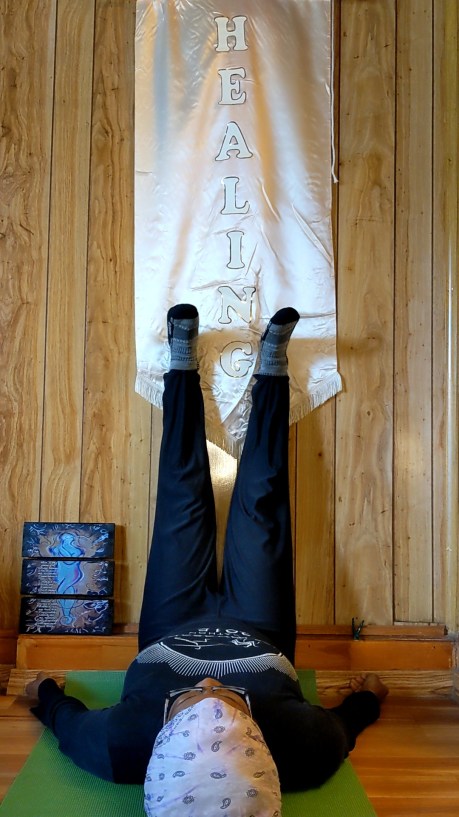
The picture above is part of my 2023 offering for the 10th annual Kiss My Asana yogathon, which benefits Mind Body Solutions (MBS). This week (April 22nd – 28th), I’m dedicated to raising awareness and resources for MBS’ life-affirming work to help people living with disabilities – and you can help too! You can help by joining me as we practice with purpose, by sharing this page, and/or by making a donation that creates opportunities for more people to practice yoga.
Mind Body Solutions provides live, online resources to people living with disabilities, worldwide. In addition to 11 live online yoga classes a week, MBS has also created a comprehensive library of recorded adaptive yoga classes for students, instructional videos for adaptive yoga teachers, and insightful interviews between our founder, Matthew Sanford, and adaptive students. It all helps people with disabilities live more fully, where they are and how they are.
Each year, in addition to hosting a fundraising page and making my personal donation, I offer a blog post and/or a YouTube post – sometimes even a whole practice. This year, part of my offering is a series of poses I’m posting on the Community page of my YouTube channel. Of course, there’s more to the poses (and pictures) than meets the eye. So, keep in mind that they – like the classes I lead – are just the tip of the iceberg.
What happens at Mind Body Solutions is the whole enchilada!
Ultimately, MBS is all about people having better relationships with their mind-body and spreading the message that a greater connection between mind and body can help us all live with improved comfort and ease.
You can click here to Kiss My Asana Now! (Or, you can also click here to join my team and get people to kiss [your] asana!)
If you’re interested in my previous KMA offerings, check out the following (some links only take you to the beginning of a series ad/or to YouTube):
- 30 Poses in 30 Days
- A Musical Preview
- 5-Minute Practices (the playlist)
- 5 Questions Answered by Yogis
- Answers to Yogis Questions
- A Poetry Practice
- A Preview of the April 1st Practice
- Some Stories
- Prāņāyāma
- The Body/Chakra offerings
### PUCKER UP ###
FTWMI: Speaking the Language of Hope April 23, 2023
Posted by ajoyfulpractice in Baha'i, Changing Perspectives, Donate, Faith, Fitness, Gratitude, Healing Stories, Health, Hope, Karma Yoga, Life, Music, One Hoop, Pain, Peace, Religion, Riḍván, Suffering, Volunteer, Wisdom, Yoga.Tags: Healing Stories, inspiration, jónsi, Karma Yoga, KISS MY ASANA, Matthew Sanford, Robert Boustany, sigur rós, truth, yogathon
add a comment
“Happy Riḍván!” to those celebrating “the Most Great Festival.” Many blessings to anyone Counting the Omer or celebrating/observing Eastertide / the Octave of Easter!
For Those Who Missed It: The Following was originally posted as part of my Kiss My Asana offering in 2020. I have adjusted some language, added a couple of critical details, and also added class details and links. Some links connect to sites outside of this blog.
( )
– Title of the third sigur rós album, on which all songs are “sung” by jónsi (born 4/23/1975) in Hopelandic (“Vonlenska” in Icelandic)
A lot of people, myself included, find sigur rós music relaxing. I also find it visceral, something felt deep in the body. So, sometimes, when I want people to really tune in and pay attention to how they are feeling – deep in their bodies – I play sigur rós. There are albums where jónsi, who was born today in 1975, sings in Icelandic. On the third album, however, he sings in an imaginary language known as Vonlenska. Vonlenska, as identified by a journalist, first appeared in the ninth track of the band’s debut album. The song is called “Von,” the Icelandic word for “hope.” Hence the name: Volenska. Hopelandic.
Hopelandic. How can you not love that name, or the idea of a place where the native language is hope?
“it’s of course not an actual language by definition (no vocabulary, grammar, etc.), it’s rather a form of gibberish vocals that fits to the music and acts as another instrument. jónsi likens it with what singers sometimes do when they’ve decided on the melody but haven’t written the lyrics yet.”
– from the faq section of the sigur rós website
When I play sigur rós in class, I remind people that they are hearing an imaginary language, but also point out that if you listen long enough you can not only sing along you can also feel as if you understand what is being sung – if not the words (since they aren’t, technically, words), at least the sentiment. I also explain that it is a little like listening to the mind-body.
Our minds and bodies speak in sensation, that’s how they communicate information. The only problem is, we’re not always fluent in sensation. So, just like we do when we are learning a new language, we need to experience the “vocabulary” in context and then repeat and repeat them until they are ingrained. Living our lives in our bodies is a little like being immersed in a foreign language – except for the part where we can ignore all of the sensation/information and only converse in our native tongue because, in some ways, it is easier than trying to understand this language no one spends a lot of time teaching us how to understand. The physical practice of yoga (hatha yoga, regardless of the style or tradition) is a way to start learning the language.
It’s not that hard to find a yoga class, if you consider yourself able-bodied and/or of sound mind (and/or if you are not marginalized in any way). Even now, under the when there was a worldwide lockdown, there were lots of options. It may take a little effort to find a yoga practice that works for you, but it’s out there. What if, however, you (or someone around you) didn’t consider you able-bodied and/or of sound mind? What if you had been told that because you couldn’t move parts of your body on your own, couldn’t breathe without a machine, and/or didn’t feel sensation the way others felt it, you couldn’t practice yoga? What if your body didn’t look like the teacher’s body? What if you had experienced a loss or a traumatic event so devastating that it was hard to get out of bed? What if you were burnt out from taking care of people? What if a doctor told you that you were all but dead?
“Or do you need to get quiet enough to understand that some person – maybe close to you, maybe you – needs a beautiful place to come to, just to be, to come back to the purity of your existence.
And whatever’s dragged you through your life up to this point, beaten you forward to solve whatever problems, you drop all of that. And find yourself.”
– Robert Boustany describing that ‘Every answer is inside you.’
I started practicing yoga between professional dancers and musicians, people who used their bodies to make a living. They were also people (pardon the pun) very in-tune with their bodies. Then there was me, and on the first day, Robert Boustany explained that I already practiced yoga (philosophically speaking).
Because I knew Robert’s background and knew some of the people who practiced with him under various conditions, it would be decades before it occurred to me that some people thought they couldn’t practice yoga. It was heartbreaking to realize that some people were being denied a really profound internal experience, a profoundly healing experience, because of a misconception about what yoga is and what it is not. It was heartbreaking to realize that there were yoga teachers all of the world who only knew how to teach a single, sometimes stereotypical, person – especially since there are so many people in the world who are not stereotypical.
“As I write this book, I am a yoga teacher, and I still get around in a wheelchair. I teach bodies that can stand when I cannot, that can feel things where I do not. This is possible because I have explored a different kind of connection between mind and body. Although I still cannot move my legs – and have no goal to do so – I do feel a heightened level of presence throughout my entire consciousness, including my paralyzed body.
It is a connection that we all share. Most of us, however, have not needed to bring it fully to consciousness. I believe this shared connection has profound implications not just for the shape and quality of our consciousness, but for the aging process, for the experience of trauma, for our approach to disability and rehabilitation, and even for our survival on this planet.”
– quoted from the Introduction to Waking: A Memoir of Trauma and Transcendence by Matthew Sanford
Matthew Sanford is one of those people who is not stereotypical. He founded Mind Body Solutions to help those who have experienced trauma, loss, and disability find new ways to live by integrating both mind and body. Known for their adaptive yoga classes, MBS provides “traditional yoga” classes, workshops, and outreach programs. They also train yoga teachers and offer highly specialized training for health care professionals. This year’s yogathon, the 10th annual yogathon, kicked off yesterday. Seven days to practice with purpose: to do yoga, share yoga, and help others. By participating in the Kiss My Asana yogathon you join a global movement, but in a personal way. In other words, you practice yoga… for 7 days. And you can start right now!
You can click here to Kiss My Asana Now! (Or, you can also click here to join my team and get people to kiss [your] asana!)
Please join me for a 65-minute virtual yoga practice on Zoom today (Sunday, April 23rd) at 2:30 PM. Use the link from the “Class Schedules” calendar if you run into any problems checking into the class. You can request an audio recording of this practice via a comment below or by emailing myra (at) ajoyfulpractice.com.
Sunday’s playlist is available on YouTube and Spotify.
Pucker Up & Kiss My Asana!!!
The practices I lead are full of little bits of teaching/practice I’ve picked up from Matthew Sanford and other teachers and students at Mind Body Solutions. Plus, I’ll be posting KMA offerings on the community page on my YouTube channel.
If you’re interested in my previous KMA offerings, check out the following (some links only take you to the beginning of a series):
- 30 Poses in 30 Days
- A Musical Preview
- 5-Minute Practices (the playlist)
- 5 Questions Answered by Yogis
- Answers to Yogis Questions
- A Poetry Practice
- A Preview of the April 1st Practice
- Some Stories
- Prāņāyāma
- The Body/Chakra offerings
In the spirit of generosity (“dana”), the Zoom classes, recordings, and blog posts are freely given and freely received. If you are able to support these teachings, please do so as your heart moves you. (NOTE: You can donate even if you are “attending” a practice that is not designated as a “Common Ground Meditation Center” practice, or you can purchase class(es). Donations are tax deductible; class purchases are not necessarily deductible.)
### ( ) ###
The Powerful Thing We Do When We Come Together… Waiting (the Tuesday post) April 18, 2023
Posted by ajoyfulpractice in Books, Changing Perspectives, Faith, Gratitude, Healing Stories, Hope, Lent / Great Lent, Life, Music, Mysticism, One Hoop, Pain, Peace, Philosophy, Poetry, Ramadan, Religion, Science, Suffering, Tragedy, Wisdom, Yoga.Tags: Constitution, David DeSteno, DHIMMĪ, gevurah, Henry Wadsworth Longfellow, Imam Khalid Latif, inspiration, khorasan, kriya yoga, Laylat al-Qadr, Marcus Aurelius, nasheeds, Octave of Easter, Paul Revere, Qur'an, Ramadan, Reba McEntire, Religion, Rod Stryker, Ryan Holiday, Sami Yusuf, sha’b, Sunnah, truth, ummah, yesod
add a comment
“Ramadān Mubarak, Blessed Ramadān!” to anyone who observing the holy month of Ramadān. (Keep your eyes open!) Many blessings to anyone Counting the Omer or celebrating/observing Eastertide / the Octave of Easter!
“I know I’m waiting
Waiting for something
Something to happen to me
But this waiting comes with
Trials and challenges
Nothing in life is free”
“My Lord, show me right from wrong
Give me light, make me strong
I know the road is long
Make me strong”
– quoted from the song “Make Me Strong” by Sami Yusuf
There’s a lot in my head and heart today, a lot I want to share. But, it’s a lot. So, I’m going to ask you to wait a moment and, while you’re waiting, I’m going to ask you to send me some strength… as I send you some strength.
All over the world, people come together. Sometimes physically; sometimes virtually; sometimes spiritual; and sometimes religiously. It happens a lot when Nature cooperates – and/or when people work together to overcome natural (and man-made) disasters. It also happens this time of year, because so many communities are engaged in holy obligations, observations, and celebrations. I’ve talked about such things quite a bit recently and, this week, I again focus on a holy time – this time on the holy month of Ramadān.*
However, in addition to using this time (wisely) to share information that can bring us all closer together; I also want to use today to bring awareness to how powerful we all are (and can be) when we come together. Because, there is so much power in what we do when we come together – even virtually. There is power in coming together and waiting together. What is especially powerful is what we do, in community, when we come together and wait together. People have known about this power for eons upon eons. We see it in rituals and traditions around the world: in people coming together, as a community, during different sacred times throughout the year.
What is funny (ironic) to me is how, despite years of proof, Western science is only recently figuring out and acknowledging this power.
“But if we remove the theology—views about the nature of God, the creation of the universe, and the like—from the day-to-day practice of religious faith, the animosity in the debate evaporates. What we’re left with is a series of rituals, customs, and sentiments that are themselves the results of experiments of sorts. Over thousands of years, these experiments, carried out in the messy thick of life as opposed to sterile labs, have led to the design of what we might call spiritual technologies—tools and processes meant to sooth, move, convince, or otherwise tweak the mind. And studying these technologies has revealed that certain parts of religious practices, even when removed from a spiritual context, are able to influence people’s minds in the measurable ways psychologists often seek.”
– quoted from the (09/14/2021) Wired article entitled, “Psychologists Are Learning What Religion Has Known for Years: Social scientists are researching what humans can do to improve their quality of life. Their findings echo what religious practices perfected centuries ago.” by David DeSteno
In Yoga Sūtra 2.1, Patanjali described a spiritual technology that he called it kriyā yoga: a cleansing ritual consisting of tapas (“heat”, “discipline”, and “austerity”, as well as the practices that build heat, discipline, and austerity); svādyāya (“self-study” – which is reflection); and īshvarapraņidhāna (“trustful surrender to the Divine”). I often note that rituals made up of these exact three elements exist outside of yoga – and include observing a silent retreat (Buddhism), giving up leavened bread during Passover (Judaism), fasting for Yom Kippur (Judaism), fasting during Lent (Christianity), observing the 19-Day Fast (Bahá’í), and fasting during the holy month of Ramadān, which is ending this week.
More often than not, I contemplate and talk about the power of these rituals, of community, and of waiting in a positive way. For example, this month I have talked about the kindness in the waiting; I have referenced strength cultivated while waiting; and I have focused on the positive “destinations” we are looking forward to arriving/experiencing. I have not focused (much) on the fact that there is so much trauma that many of us are waiting for the next negative.
Yes, we can be (and are) excited about visiting new places; reconnecting with friends and family; starting new jobs and new relationships; having babies and seeing those babies hit new milestones (like taking first steps and graduating, which can be their first steps into adulthood); and hitting our own milestones. However, if we’re being honest, we are simultaneously waiting for those positives and, also, waiting for the next mass shooting, the next random shooting, the next assault, the next insult, the next ban, and the next law that keeps people from accessing “certain unalienable Rights, that among these are Life, Liberty and the pursuit of Happiness.”
Let’s be honest: We’re all waiting for the next trauma.
But, what are doing while we’re waiting?
“Take a moment to break your mind free of any distraction that causes your heart to be shackled in anxiety or pain. Remove from yourself any feeling of emptiness or remorse that comes from having to put on a face that is not your own to gain acceptance from a society that won’t take you as you are. Let your thoughts move away from those who can’t look beyond the color of your skin, the texture of your hair, the accent that you speak with, or anything else that makes you beautiful. Don’t chase after words that are unfamiliar to you but seek and speak with words that are sincerely your own. Be with those who give you hope and courage, who help you to be bold in your prayer. Forget the judgments and harshness of any who have lead you to believe that you cannot ask of your Creator for whatever your heart wishes. Don’t inhibit yourself in anyway. God is Most Generous and Most Merciful, and we all are entitled to benefit from that generosity and mercy. You are going to stand in front of the Creator of the Heavens and the Earth, One who looks for a reason to accept from you, not push you away.”
– quoted from a 2012 “Ramadān Reflection” (Day 26) for Huffington Post by Imam Khalid Latif
Given that the Western science community has only recently started to catch up with the religious and spiritual communities, I should not be surprised that so many of us have taken spiritual, energetic, and psychological power for granted. Some of us scoff at people who talk about “thoughts and prayers” every time there is a shooting in the United States. But what are we doing? That is an important question: What are we doing?
I am asking that question in the context of each individual person’s civic duty, moral duty, and physical/material duty – and I am also asking in the context of energy, emotion, and spirit. Because, here’s the thing, the bottom line: Thoughts and prayers can create resistance; thoughts and prayers can create obstacles. Thoughts and prayers can create despair.
I know, I know, that’s not the way it’s “supposed” to work. Except it is.
It is supposed to work exactly like that. It is the way it has always worked. That’s one of the reasons the stoic Emperor Marcus Aurelius** wrote, “Our actions may be impeded… but there can be no impeding our intentions or dispositions. Because we can accommodate and adapt. The mind adapts and converts to its own purposes the obstacle to our acting…. The impediment to action advances action. What stands in the way becomes the way.”
So, maybe those of us who want change need to take another look at thoughts and prayers. Maybe we all need to look at what it is for which we are praying/hoping/wishing/thinking and how that praying/hoping/wishing/thinking creates the energy, emotion, and spirit needed for people to engage their minds and bodies. Maybe we need to look at how all of that can create more energy towards the positive, instead of continually experiencing how it contributes to the negative.
We need to start believing in change for the better. And, while we’re waiting, we need to start doing the things that enable us to create that better – and we need to come do it in community.
“The Creation Equation states that when the intensity of desire, or shakti (Is), plus the intensity of the energy you direct toward achieving it, or vayu (Iv), is greater than the intensity of resistance, or karma (Ik), it equals attainment of your desire, or prapti (P). Thus, the formula looks something like this:
Is + Iv > Ik = P.”
– quoted from “Chapter 11. The Formula For Fulfilling Your Desires” in The Four Desires: Creating a Life of Purpose, Happiness, Prosperity, and Freedom by Rod Stryker
UMMAH [Arabic] – Community, refers to a group of people who share common religious beliefs, often used as a synonym for “ummat al-Islām” (“the Islāmic Community”). Also appears in the Qur’ān as “Ummah Wāhida” (“One Nation”).
SHA’B [Arabic] – A Nation or Community which share common ancestry and geography (but not necessarily culture, language, or beliefs).
DHIMMĪ [Arabic] – Protected Person, historically used in reference to non-Muslims living within an Islamic state and conveys certain legal rights related to life, property, and religious freedom.
Please join me today (Tuesday, April 18th) at 12:00 PM or 7:15 PM for a yoga practice on Zoom. You can use the link from the “Class Schedules” calendar if you run into any problems checking into the class. You can request an audio recording of this practice via a comment below or (for a slightly faster reply) you can email me at myra (at) ajoyfulpractice.com.
Tuesday’s playlist is available on YouTube and Spotify. [Look for “Ramadan 2023”]
Two quick notes about the music: First, while the most of the musicians featured on the playlists during these final days of Ramadān are Muslim there are some exceptions. One of the notable exceptions – notable, because she is the only female soloist and the only non-Muslim singer on the list – is Reba McEntire. Her song “Pray for Peace” is on the playlist because she re-released it during the month of Ramadān in 2014 – but not just randomly in the month, the song was released in the last ten days of the month! Second, there are some songs on the playlist that are Nasheeds (meaning they are religiously moral songs) that, in some traditions, are meant to be sung without instrumentation or only with percussion. I have, however, included orchestrated versions of these songs, because this seems to have worked best in an in-studio setting. I mean no disrespect by this choice. As far as I know, percussion or voice only recordings of each song are available (if you want to build your own playlist). Alternatively, you can practice without the music.
I remixed the playlist because I wanted to include some new songs. One of these songs is on the playlist three (3) times and was inspired by “the stories in In Baghdad Dreaming Of Cairo: In Cairo, Dreaming Of Baghdad by Rumi and by The Alchemist by Paulo Coelho.” The song is moving in English (and as an instrumental, which is how it shows up during the practice), but it is next level in Arabic. Let’s go. Better yet, let’s make the whole world feel like home.
In the spirit of generosity (“dana”), the Zoom classes, recordings, and blog posts are freely given and freely received. If you are able to support these teachings, please do so as your heart moves you. (NOTE: You can donate even if you are “attending” a practice that is not designated as a “Common Ground Meditation Center” practice, or you can purchase class(es). Donations are tax deductible; class purchases are not necessarily deductible.)
*NOTE: Click here if you are interested in the midnight ride of Paul Revere.
**NOTE: The Marcus Aurelius statement is from Book 5 of Meditations. The translation above appears in the preface of The Obstacle is the Way: The Timeless Art of Turning Trials into Triumphs by Ryan Holiday.
### WE ARE STRONGER TOGETHER ###
The Powerful Thing We Do When We Come Together… Waiting (mostly the music) April 18, 2023
Posted by ajoyfulpractice in Changing Perspectives, Faith, Healing Stories, Hope, Life, Music, Mysticism, One Hoop, Pain, Peace, Philosophy, Poetry, Ramadan, Religion, Science, Suffering, Tragedy, Wisdom, Yoga.Tags: gevurah, inspiration, khorasan, kriya yoga, Laylat al-Qadr, nasheeds, Octave of Easter, Qur'an, Reba McEntire, Religion, Sami Yusuf, Sunnah, truth, ummah, yesod
add a comment
“Ramadān Mubarak, Blessed Ramadān!” to anyone observing the holy month of Ramadān. (Keep your eyes open!) Many blessings to anyone Counting the Omer or celebrating/observing Eastertide / the Octave of Easter!
“I know I’m waiting
Waiting for something
Something to happen to me
But this waiting comes with
Trials and challenges
Nothing in life is free”
“My Lord, show me right from wrong
Give me light, make me strong
I know the road is long
Make me strong”
– quoted from the song “Make Me Strong” by Sami Yusuf
Please join me today (Tuesday, April 18th) at 12:00 PM or 7:15 PM for a yoga practice on Zoom. You can use the link from the “Class Schedules” calendar if you run into any problems checking into the class. You can request an audio recording of this practice via a comment below or (for a slightly faster reply) you can email me at myra (at) ajoyfulpractice.com.
Tuesday’s playlist is available on YouTube and Spotify. [Look for “Ramadan 2023”]
Two quick notes about the music: First, while the most of the musicians featured on the playlists during these final days of Ramadān are Muslim there are some exceptions. One of the notable exceptions – notable, because she is the only female soloist and the only non-Muslim singer on the list – is Reba McEntire. Her song “Pray for Peace” is on the playlist because she re-released it during the month of Ramadān in 2014 – but not just randomly in the month, the song was released in the last ten days of the month! Second, there are some songs on the playlist that are Nasheeds (meaning they are religiously moral songs) that, in some traditions, are meant to be sung without instrumentation or only with percussion. I have, however, included orchestrated versions of these songs, because this seems to have worked best in an in-studio setting. I mean no disrespect by this choice. As far as I know, percussion or voice only recordings of each song are available (if you want to build your own playlist). Alternatively, you can practice without the music.
I remixed the playlist because I wanted to include some new songs. One of them is moving in English (and as an instrumental), but it is next level in Arabic. Let’s go. Better yet, let’s make the whole world feel like home.
In the spirit of generosity (“dana”), the Zoom classes, recordings, and blog posts are freely given and freely received. If you are able to support these teachings, please do so as your heart moves you. (NOTE: You can donate even if you are “attending” a practice that is not designated as a “Common Ground Meditation Center” practice, or you can purchase class(es). Donations are tax deductible; class purchases are not necessarily deductible.)
### WE ARE STRONGER TOGETHER ###
Finding Grace In the Waiting, or vice versa (a “missing” and “renewed” Saturday/Sunday post) April 16, 2023
Posted by ajoyfulpractice in Books, Buddhism, Changing Perspectives, Dharma, Faith, Gratitude, Healing Stories, Hope, Lent / Great Lent, Life, Music, Mysticism, One Hoop, Pain, Passover, Peace, Philosophy, Ramadan, Religion, Science, Shavuot, Suffering, Wisdom, Women, Yoga.Tags: Buddha, Buddha's Birthday, chesed, Counting the Omer, Erwin Schrödinger, Eugene Wigner, Exodus, Four Noble Truths, gevurah, Great Lent, Guy Johnston, Hilary Tann, Holy Saturday, Jack Hawley, James Kubicki, kabbalah, Laylat al-Qadr, Lazarus of Bethany, Lazarus Saturday, Lent / Great Lent, Martha of Bethany, Mary of Bethany, Passover, Pope Francis, R. S. Thomas, Rabbi David Fohrman, Rabbi Mordechai Becher, Ramadan, sefirot, shastra kripa, Shemot, Shiva, shiv’ah, Shlomo Yitzchaki (Rashi), Siddhartha, The Gospel According to John, the Virgin Mary, שִׁבְעָה, שבעה
add a comment
Blessings to anyone Counting the Omer or celebrating Easter and Eastertide / the Octave of Easter! “Ramadān Mubarak, Blessed Ramadān!” to anyone who is observing the holy month of Ramadān. (Keep your eyes open!)
This is the “missing” and slightly revised post for Saturday, April 8th, which was the 2023 Saturday before Easter in Western Christian traditions and Lazarus Saturday in the Orthodox Christian traditions, as well as Passover and the holy month of Ramadān. This is also an Easter post. NOTE: There are references to death and dying. You can request an audio recording of this Saturday practice and/or the Easter practice from 2020 via a comment below or (for a slightly faster reply) you can email me at myra (at) ajoyfulpractice.com.
In the spirit of generosity (“dana”), the Zoom classes, recordings, and blog posts are freely given and freely received. If you are able to support these teachings, please do so as your heart moves you. (NOTE: You can donate even if you are “attending” a practice that is not designated as a “Common Ground Meditation Center” practice, or you can purchase class(es). Donations are tax deductible; class purchases are not necessarily deductible.
Check out the “Class Schedules” calendar for upcoming classes.)
“Still; all that close throng
Of spirits waiting, as I,
For the message.
Prompt me, God;
But not yet. When I speak,
Though it be you who speak
Through me, something is lost.
The meaning is in the waiting.”
– quoted from the poem “Kneeling” by R. S. Thomas, with accompanying music composed by Hilary Tann, featuring Guy Johnston
April marks the beginning of our Saturday exploration of the second of the four graces found in Indian philosophy, particularly in the Himalayan tradition of the Yoga Philosophy. We started with “Grace of God” (or Divine Grace) and we plan to end the year with Grace of Self. The second and third graces (Grace of Scripture and Grace of Guru) are often flipped and, in some ways, this practice connects the two. Mostly, however, this is about shastra kripa. In another practice (and post), I will get into why some traditions do not translate shastra as “scripture” and also why those tradition do not consider the scriptures I reference below as shastras. However, some do and, ultimately, the practice is about what we find inside the stories.
Pay close attention and you will find there is a lot of waiting – so much waiting – in the stories that people commemorate during Passover; the Saturday of Holy Week (which is the Saturday before Easter); Lazarus Saturday (which is the Saturday before Palm Sunday); and during the holy month of Ramadān. In 2023, all of those observations overlapped each other and overlapped some celebrations of the Buddha’s birthday – and there is significant waiting in the story of the Buddha. It is almost like there is something important about waiting. It is almost like there is something holy, something Divine, about waiting.
Waiting is something we all do at some point in our day-to-day lives – and it can be challenging. Whether we are waiting our turn or waiting for something for which we desire, we can get fidgety and impatient on the best days. We can be especially fidgety and impatient if we feel like nothing is happening or that something is not happening fast enough. But something is always happening; we just need to bring awareness to the moment.
This is where the waiting in yoga and meditation comes in handy: We can bring awareness to how we wait.
For instance, we may notice that we are so keen to do something that we start doing things that don’t actually serve us. We may even do things that are detrimental, because we don’t have the strength to wait. (And don’t doubt for a minute, that waiting, patiently, requires a certain kind of strength.) Additionally, we may notice that we are in the habit of saying, “I can’t wait,” when what we really mean is “I can hardly wait.” At first, the difference can seem like a matter of semantics, but then we notice that the mind-body is taking cues from our conscious awareness and that changing our inner dialogue (as well as what we verbalize to others) changes the way we show up in the moment. Over time, we may find that there can be kindness in waiting. We may notice that waiting sometimes gives us an opportunity to get ready for what’s ahead.
In fact, if you pay close attention, you will find that there is something important about what people do while they wait – especially in the sacred stories commemorated (this year) on April 8th.
“First and foremost, we believe creation of the world, G-d created a world in which he wanted the human being to actually be able to do something – that is to say, to exercise free will, to be like G-d, meaning to be a creator, not to be lab rats…. He wants us to have a relationship with Him. But to have a relationship with G-d requires that I have an exercise of my free will…. Free will means an environment in which not necessarily do I always have pleasure when I make the right decisions and not necessarily does someone always suffer when they make the wrong decision. Free will is having real power to create stuff. Free will is having real power to alleviate suffering.”
– Rabbi Mordechai Becher, in vlog explaining one of several reasons why suffering exists
While some people celebrate the birthday of the Siddhartha Gautama, also known as Gautama Buddha, on different days in May, some celebrate on April 8th. I have heard that Siddhartha Gautama sat under the Bodhi tree and was determined to wait there until he awakened to the nature of reality. In some suttas, it says that the Buddha (“the Awakened One”) sat there for an additional seven days. Eventually, he started teaching from this enlightened state. Some say that he only ever taught about two things: suffering and the end of suffering. His teachings were codified in the Four Noble Truths of Buddhism and the Noble Eightfold Path. According to the former:
- Suffering exists
- Suffering is caused by attachment, clinging, craving
- There is an end to suffering
- The Noble Eight-fold Path is the way to end suffering
Following the path includes some sitting… and waiting. What is promised at the end of the sitting and waiting is freedom from suffering.
Towards the end of the holy month of Ramadān, people in the Muslim community seek the holiest of nights, Laylat al-Qadr (translated as “Night of Power,” “Night of Destiny,” “Night of Value,” Night of Measure,” Night of Decree” or “Night of Honour”), which is commemorated as the anniversary of the revelations of the Qur’ān. As they seek (and wait) they pray. This pattern of people waiting for revelations (and freedom) shows up again and again in the other Abrahamic traditions.
For example, the story of Passover (which is summarized below), is the story of the Jewish people waiting to be free. Part of the story is also about waiting to be passed over during the 10th and final plague. Remember, that during most of the waiting, the Jewish people had to continue living their lives as enslaved people in Egypt. They had to suffer the indignities and hardships of slaver – and, also, the first nine plagues. They had to wait, with faith. Then, on that final night they had to wait and believe. They had to believe enough to celebrate freedom that had not been given. One the second night of Passover, some people begin Counting the Omer.
The sacred ritual of Counting the Omer is a period of 49 days, a total of 7 weeks, leading up to Shavuot or Shavuos (also known as the “Festival of Weeks”) – which itself is a commemoration of the Jewish people receiving the Torah. Commonly associated with Jewish mysticism (Kabbalah), the practice of Counting the Omer involves 7 of the 10 attributes of the Divine that are found on the Tree of Life. Each day is associated with a different attribute, as is each week – which means that for 49 days people are focusing-concentrating-meditating on the interrelation of two attributes. Since each attribute is associated with a different part of the body, and some people combine a physical component, it’s a ritual exercise wrapped in a mystical meditation disguised as a 49-day perspective changing challenge.
In some ways, Counting the Omer is a period of waiting. However, it is not the only time, in Jewish tradition, when people are praying and reflecting while they wait. Nor is it the only time when 7 is a factor. In fact, one of the notably periods of waiting occurs after someone dies and their loved ones are “sitting shiva.” The Hebrew word shiva ( שִׁבְעָה ) comes from shiv’ah ( שבעה ), which means “seven,” and it is a seven-day period of mourning. The rituals, traditions, and prayers associated with Shiva formalize the grieving process and also provide a container for people to express compassion. It can also be a way to express hope.
“As spring is nature’s season of hope, so Easter is the Church’s season of hope. Hope is an active virtue. It’s more than wishful thinking….. My hope in the Resurrection is not an idle hope like wishing for good weather but an active hope. It requires something on my part – work. Salvation is a gift from God for which I hope, but Saint Paul told the Philippians to ‘work out your salvation with fear and trembling’ (2:12). My hope in the resurrection and eternal life in heaven requires work on my part.”
– quoted from A Year of Daily Offerings by Rev. James Kubicki
In the Gospel According to John (11:1 – 45), Jesus received the news that Lazarus was sick, but then waited (until he died) before traveling to Bethany. The text is very clear that Lazarus had been dead (or dead and buried) for four days. Historically speaking, and given that there are seven-day periods of mourning depicted in the Torah, Mary and Martha (and all of their friends) would have been “sitting shiva” when Jesus and the disciples arrived in Bethany. To be clear, they were waiting for Jesus and then they were waiting for the end of the mourning period.
While Lazarus Saturday is not always highlighted in Western Christian traditions the way it is in Orthodox Christian traditions, there are several parts of the story that are critical. First, Jesus waited (and knew when Lazarus died). Second, the description of how Lazarus was buried – in a cave with a stone in front – matches the descriptions of how Jesus was buried. Third, Jesus asks the sisters if they believe in him (and ask for verbal confirmation) – which was the whole reason he waited. Finally, it is notable that news of Jesus raising Lazarus from the dead reached Jerusalem before Jesus arrived home for Passover.
Why did the news travel faster than Jesus? According to the Gospel, it is because he waited… in the desert – and that period of waiting in the desert is commemorated by people who observe Lent and Great Lent. However, those are not the only periods of waiting in the Christian liturgy. Remember, after his crucifixion and death, Jesus was buried, much like Lazarus – and his mother, Mary, and his followers waited.
“This year however, we are experiencing, more than ever, the great silence of Holy Saturday. We can imagine ourselves in the position of the women on that day. They, like us, had before their eyes the drama of suffering, of an unexpected tragedy that happened all too suddenly. They had seen death and it weighed on their hearts. Pain was mixed with fear: would they suffer the same fate as the Master? Then too there was fear about the future and all that would need to be rebuilt. A painful memory, a hope cut short. For them, as for us, it was the darkest hour.
Yet in this situation the women did not allow themselves to be paralyzed. They did not give in to the gloom of sorrow and regret, they did not morosely close in on themselves, or flee from reality. They were doing something simple yet extraordinary: preparing at home the spices to anoint the body of Jesus. They did not stop loving; in the darkness of their hearts, they lit a flame of mercy. Our Lady spent that Saturday, the day that would be dedicated to her, in prayer and hope. She responded to sorrow with trust in the Lord. Unbeknownst to these women, they were making preparations, in the darkness of that Sabbath, for “the dawn of the first day of the week”, the day that would change history. Jesus, like a seed buried in the ground, was about to make new life blossom in the world; and these women, by prayer and love, were helping to make that hope flower. How many people, in these sad days, have done and are still doing what those women did, sowing seeds of hope! With small gestures of care, affection and prayer.”
– Homily of His Holiness Pope Francis, Easter Vigil, Holy Saturday, 11 April 2020
The following was originally posted in April 2020 and revised in April 2022 (in the “Down the Rabbit Hole” section). Some information was posted during Passover and holy week this year, but I am posting it here, For Those Who Missed It. This version has been slightly revised.
Whenever I think about Easter, the waiting that happened on the Saturday between Good Friday and Easter, and the moment when the rock was rolled away to reveal the empty tomb, I think of one thing: Wigner’s friend taking care of that quantum mechanics Cat.
For those of you not familiar with physicist Erwin Schrödinger’s thought experiment (or paradox), it goes like this: The (imaginary) cat is closed up in a box with an unstable radioactive element that has a 50-50 chance of killing the cat before the box is opened. According to quantum mechanics, there is a moment when the cat is simultaneously alive and dead. This is called superposition and it could be considered the scientific equivalent of non-duality. When the box is opened, revealing the state of the cat, the superposition collapses into a single reality. (There is also the possibility that opening the box changes the percentage, but that’s a whole different tunnel.)
Physicist Eugene Wigner took things a bit farther by adding a friend. According to the Wigner’s thought experiment, instead of doing the experiment, the scientist leaves it all in the hands of a friend and waits for a report. Now, there is the superposition inside of the box and there is a separate superposition inside the lab, which means the wave (or superposition) collapses into a single reality when the box is opened (creating reality as the friend knows it) and collapses again when the (imaginary) friend reports to the scientist (establishing the original scientist’s reality). Let’s not even get into what happens if the friend opens the box and leaves the lab without reporting back to the original scientist, but has a certain expectation – i.e., understanding of reality – about what the scientist will find in the lab. Through it all, the cat exists (and ceases to exist) within its own reality. It never experiences the superposition others experience. It just is.
That state of being, existing, takes us back to Passover, and eventually to the Resurrection of Jesus.
“And He said, ‘For I will be with you, and this is the sign for you that it was I Who sent you. When you take the people out of Egypt, you will worship God on this mountain.’”
– quoted from Shemot – Exodus (3:12)
“God said to Moses, ‘Ehyeh asher ehyeh (I will be what I will be),’ and He said, ‘So shall you say to the children of Israel, “Ehyeh (I will be) has sent me to you.’””
– quoted from Shemot – Exodus (3:14)
In the Exodus story, while the Jewish people were slaves in Egypt, G-d commanded Moses to go to Pharaoh and demand the Jews be released. Moses had an interesting backstory and was, in some ways, the perfect person to be the (human) hero of the story. However, he was humble to the point of lacking confidence and ended up asking his brother Aaron to come along on the mission. When their show of power didn’t convince Pharaoh of the authority of G-d, everyone was subject to nine plagues: blood, frogs, lice, wild beasts in the streets, pestilence, boils, hail, locusts, and day(s) of darkness. Remember it was not only Pharaoh and the Egyptians who suffered. The Jews, who were already suffering the hardship of slavery, also had to endure the additional hardships. On the evening of the tenth plague, the death of the first born male child, the Jewish families were told to smear lambs blood on their doors – so their households will be passed over. They were also commanded to celebrate and give thanks for their freedom – even though they are still slaves.
Yes, it is a little mind boggling, but what passes as the first Passover Seder happened in Egypt and during a time of slavery. Considering Pharaoh had changed his mind before, they had no way of knowing (with any certainty) that they would be freed immediately after the tenth plague. See where this is going? In that moment, the Jewish people are simultaneously free and not free.
Furthermore, Rabbi David Fohrman, quoting Shlomo Yitzchaki, the medieval French rabbi known as Rashi, points out that when G-d initial spoke to Moses and Moses asked for G-d’s identity, Moses was told three times that the One who spoke was the One who would always be with Moses and the Jewish people. Regardless of what they experience, Rashi explained, G-d will be with them. This is the very definition of compassion, which literally means “to suffer with.”
“‘Whenever goodness and “dharma” (right action) weaken and evil grows stronger, I make Myself a body. I do this to uplift and transform society, reestablish the balance of goodness over wickedness, explain the sublime plan and purpose of life, and serve as the model for others to follow. I come age after age in times of spiritual and moral crisis for this purpose.’”
– Krishna speaking to Arjuna (4.7 – 8) in The Bhagavad Gita: A Walkthrough for Westerners by Jack Hawley
Jesus was (during his time), and future Christians are, kind of in the same boat. In the last week of his life, he was betrayed, crucified, dead, buried, and resurrected – and he simultaneously was not. However, most of that is semantics. What is critical is the dead/buried, and resurrected part. In those moments, even right after the tomb was opened and there was some confusion about what had happened, Jesus was essentially the quantum physics Cat – and Christians, as well as non-believers, were either the original scientist or the friend.
Yet, when everything is said and done (stay with me here), this is all head stuff. What people observe, commemorate, and/or celebrate in modern times, isn’t really about the head. Faith never is. It’s all about the heart. It’s all about love. Specifically, in these examples, it all comes back to G-d’s love expressed as compassion.
“For God so loved the world that he gave his one and only Son, that whoever believes in him shall not perish but have eternal life.”
– quoted from The Gospel According to John (3:16, NIV)
The playlist for Saturday (4/8/2023) is available on YouTube and Spotify.
### STRENGTH IN LOVING-KINDNESS ###
FTWMI: The Cost of Freedom April 16, 2023
Posted by ajoyfulpractice in Books, Changing Perspectives, Faith, Healing Stories, Hope, Music, One Hoop, Pain, Ramadan, Religion, Suffering, Tragedy, Yoga.Tags: Abraham Lincoln, Bamidbar, Crosby Stills Nash & Young, District of Columbia Compensated Emancipation Act, Easter, emancipation, Emancipation Act, Numbers, Octave of Easter, Ramadān
add a comment
Blessings to anyone Counting the Omer or celebrating Easter and Eastertide / the Octave of Easter! “Ramadān Mubarak, Blessed Ramadān!” to anyone who is observing the holy month of Ramadān. (Keep your eyes open!)
For Those Who Missed It: The following was originally posted today in 2020. Dates and related information (including links) have been updated. *UPDATE: I revised some language and added a quote in this post after the practice.
“Find the cost of freedom
Buried in the ground
Mother Earth will swallow you
Lay your body down.”
– “Find the Cost of Freedom” by Crosby, Stills, Nash & Young
Most people, I think, would agree that freedom is priceless. I mean, at least, I think we can all agree about that when we are talking about our own freedom. Things get a little twisted when we are talking about someone else’s freedom. How much do we value the freedom – or even the life – of someone we perceive as different from us? How much do we value the freedom – or even the life – of someone with whom we disagree about even the meaning of freedom?
What happens if you have to put a price freedom? What happens if you actually have to quantify the value of life, liberty, freedom (which is, ultimately, the pursuit of happiness)?
Did that last question take you back to the Constitution and the founders of the United States? Let’s really go back, get the full context, shall we?
“We hold these truths to be self-evident, that all men are created equal, that they are endowed by their Creator with certain unalienable Rights, that among these are Life, Liberty and the pursuit of Happiness.”
– excerpt from the Declaration of Independence as presented by the Committee of Five and approved and signed by the Second Continental Congress, 1776
Yes, yes; it’s inspiring and lovely – and I do love the sentiment: those are words to live and lead by. And yet…. And yet…. Here’s one of the interesting and twisted things about all that: The founders of the United States, who created a country based on those highly virtuous concepts outlined in the Declaration of Independence, did so while simultaneously creating a country (that same country) that systematically declared women and certain people of color to not only not be equal, but to also not be entitled to the very rights which they said were “endowed by their Creator.” These men, for the Committee of Five and the signers of the Constitution were all men (so far as I know), were willing to fight in order to secure their freedom from Great Britain. Furthermore, they believed, as Caesar Rodney (the Gentleman from Delaware) famously put it when he cast his vote for independence, “As I believe the voice of my constituents and of all sensible and honest men is in favor of independence, my judgment concurs with them; I vote for independence.” In other words, they believed they represented the voice of the People (i.e., other men) who were willing to lay down their lives for freedom: that was the cost of freedom.
“The one who brought his offering on the first day was Nahshon the son of Amminadab of the tribe of Judah. And his offering was one silver bowl weighing one hundred and thirty [shekels], one silver sprinkling basin [weighing] seventy shekels according to the holy shekel, both filled with fine flour mixed with olive oil for a meal offering. One spoon [weighing] ten [shekels] of gold filled with incense. One young bull, one ram and one lamb in its first year for a burnt offering. One young he goat for a sin offering. And for the peace offering: two oxen, five rams, five he goats, five lambs in their first year; this was the offering of Nahshon the son of Amminadab.”
– Bamidbar / Numbers 7:12 – 7:17
In the Hebrew Bible / the Christian Old Testament, G-d not only gave Moses instructions for how to deal with Pharaoh, but also instructions on how the Jewish people were to deal with the last days of the plague (in particular during the final plague); how to travel and camp; how to take a census (or accounting of the men); how to establish leadership; and how to build and dedicate a temple. G-d also instructed Moses that each Tribe of Israel was required to make a sacrifice, or offering, as a way to give thanks and offer devotion. In other words, according to what they were able and how many were in their tribe, each leader paid the cost of freedom.
Today in 1862, nearly nine months before the Emancipation Proclamation went into effect, President Abraham Lincoln signed the District of Columbia Compensated Emancipation Act. The act essentially ended slavery in the capital city (although it did not apply to fugitive slaves who had escaped from Maryland) and set aside over $100,100,000 as compensation for the 3,185 people who were freed.
That was the cost of freedom: over $1 million, plus an additional $100,000, for approximately 3,185 people.
But, let’s not get the facts twisted. The compensation was primarily for the slave owners who were “losing their property.” President Lincoln appointed a 3-person Emancipation Commission, which met 5 days a week, for months on end, in order to review 966 petitions and dole out compensation accordingly. Petitions included the name, age, sex, and “particular description” of the enslaved person in question and were made on behalf of black, as well as white, “slave owners.” Yes, that is correct. At the time, certain places within the Union – like the District of Columbia – were home to freedmen who had purchased their family members so that they too could be free. (I started to put purchased in quotes, but the reality is people paid to be free.) This act did not apply to any Confederate slaver owners or anyone who had aided the Confederacy’s (lost) cause. Furthermore, it made it a felony to “kidnap” or in any way re-enslave a freed person or formerly enslaved person.
The Compensated Emancipation Act paid Union slave-owners $300 per freed person and paid formerly enslaved people a resettlement or “emigrant” fee – not to exceed $100 each – if they chose to relocate to places like Haiti and Liberia. It established payment for the commissioners ($200,000 each); a clerk ($200 per month plus an occasional 25 cent processing fee); and paid a marshal “such fees as are allowed by law for similar services performed by him in the Circuit Court of the District of Columbia.” It also stated, “that the Secretary of the Treasury shall cause all other reasonable expenses of said commission to be audited and allowed, and that said compensation, fees, and expenses shall be paid from the Treasury of the United States.” In July of 1862, an amendment was added which allowed formerly enslaved people to petition for compensation (on their own behalf) if their former masters had not already done so. The amendment did something even the Declaration of Independence and the original Act didn’t do: it gave equal weight and consideration to petitioners – regardless of their color or the color of the person who might challenge their petition.
Similar compensation was proposed, but never implanted in the rest of the United States. Today (April 16th), is Emancipation Day in the District of Columbia. It is a public holiday in the country’s capital city and yet, outside of D. C., most people don’t think twice about Emancipation Day – unless it falls on a Saturday or Sunday (like it does this year) and thereby delays the official federal tax day for a few days (so that people can have Monday off).
So, there are three examples of the cost of freedom. What’s the cost of your freedom? What, for that matter, does it mean to you to be free? And, what are you doing with your freedom – even when your movement/freedom has been restricted by the quarantine and social distancing?
“If one thinks of oneself as free, one is free, and if one thinks of oneself as bound, one is bound. Here this saying is true, ‘Thinking makes it so.’”
– Ashtavakra Gita 1:11
Please join me for a 65-minute virtual yoga practice on Zoom today (Sunday, April 16nd) at 2:30 PM. Use the link from the “Class Schedules” calendar if you run into any problems checking into the class. You can request an audio recording of this practice via a comment below or by emailing myra (at) ajoyfulpractice.com.
Sunday’s playlist is available on YouTube and Spotify.
In the spirit of generosity (“dana”), the Zoom classes, recordings, and blog posts are freely given and freely received. If you are able to support these teachings, please do so as your heart moves you. (NOTE: You can donate even if you are “attending” a practice that is not designated as a “Common Ground Meditation Center” practice, or you can purchase class(es). Donations are tax deductible; class purchases are not necessarily deductible.)
### FEEL FREE, BE FREE ###
Where We Begin… & How It All Works April 12, 2023
Posted by ajoyfulpractice in Books, Changing Perspectives, Dharma, Faith, Healing Stories, Hope, Lent / Great Lent, Life, Music, One Hoop, Pain, Passover, Poetry, Ramadan, Religion, Suffering, Wisdom, Yoga.Tags: Gary Soto, Great Lent, Octave of Easter, Passover, Spy Wednesday, Stuart Chase, The Gospel According to Luke, Yoga Sutra 2.20
add a comment
“Chag Sameach!” to everyone celebrating Passover and/or Counting the Omer! Blessings to anyone celebrating Great Week or Eastertide / the Octave of Easter! “Ramadān Mubarak, Blessed Ramadān!” to anyone who is observing the holy month of Ramadān.
“How strange that we can begin at any time.
With two feet we get down the street.
With a hand we undo the rose.
With an eye we lift up the peach tree
And hold it up to the wind – white blossoms
At our feet. Like today. I started”
– quoted from the poem “Looking Around, Believing” by Gary Soto (born 04/12/1952)
Like life, the various religious rituals and traditions currently being observed around the world are stories of cause and effect. In fact, the order and arrangement of things like the Passover Seder, Lent, Great Lent, Eastertide, and the holy month of Ramadān intentionally heighten our awareness of cause and effect. Our physical practice of yoga, regardless of the style or tradition, can do the same thing. In fact, just like with the religious stories, where we start matters, because where start determines how things unfold and how the story is told. How the story is told reinforces the message and plays a part in what we remember – and in what we believe.
The economist and social theorist Stuart Chase is often quoted as saying, “For those who believe, no proof is necessary. For those who do not believe, no proof is possible.” I generally associate this with the idea expressed in Yoga Sūtra 2.20, which indicates that we “[understand] only what the mind-intellect shows us.” All of which makes me wonder: What happens when we start in a different place?
That question is at the heart of the story associated with Easter Wednesday, which is the fourth day of the Octave of Easter in the Western Christian traditions.* Not surprisingly, the answer is simple: Work your way back to the beginning. As Jewish communities are entering the last days of Passover; Orthodox Christians are observing Great Wednesday (also known as Spy Wednesday); and Muslim communities are keeping their eyes open for the holiest night of the holy month of Ramadān; let’s practice a little svādhyāya (“self-study”) partially inspired by the Gospel According to Luke (24:13 – 35).
“He asked them, ‘What are you discussing so intently as you walk along?’ They stopped short, sadness written across their faces. Then one of them, Cleopas, replied, ‘You must be the only person in Jerusalem who hasn’t heard about all the things that have happened there the last few days.’”
– The Gospel According to Luke (24:17 – 18, NLT)
Please join me today (Wednesday, April 12th) at 4:30 PM or 7:15 PM for a yoga practice on Zoom. Use the link from the “Class Schedules” calendar if you run into any problems checking into the class. You will need to register for the 7:15 PM class if you have not already done so. You can request an audio recording of this practice via a comment below or by emailing myra (at) ajoyfulpractice.com.
Wednesday playlist is available on YouTube and Spotify. [Look for “04122020 All That Is Holy”]
If you are interested in my previous Gary Soto-inspired musings (that are more directly tied to his life and poetry), check out the following: a 2018 blog post about vinyasa and vinyasa krama , a 2019 blog post about why we begin where we begin, and a 2021 blog post about, well, life.
*NOTE: Easter Week is known as Bright Week in Orthodox Christian traditions and begins this Sunday.
In the spirit of generosity (“dana”), the Zoom classes, recordings, and blog posts are freely given and freely received. If you are able to support these teachings, please do so as your heart moves you. (NOTE: You can donate even if you are “attending” a practice that is not designated as a “Common Ground Meditation Center” practice, or you can purchase class(es). Donations are tax deductible; class purchases are not necessarily deductible.)
### “As far as I can tell, daughter, it works like this” ~ Gary Soto ###
Callings, Commandments, & a Good “Ending” (a “renewed” Thursday/Friday post) April 12, 2023
Posted by ajoyfulpractice in "Impossible" People, Art, Books, Changing Perspectives, Faith, Fitness, Food, Gratitude, Healing Stories, Hope, Lent / Great Lent, Life, Music, Mysticism, One Hoop, Pain, Passover, Peace, Philosophy, Ramadan, Religion, Shavuot, Suffering, Tragedy, Wisdom, Writing, Yoga.Tags: Beresh't, Chaka Khan and Rufus, Counting of the Omer, Counting the Omer, Easter, Exodus, Genesis, Good Friday, Gospel According to Matthew, Great Friday, Great Lent, Hanuman Jayanti, kabbalah, Last Supper, Lent / Great Lent, Marcus J Freed, Maundy Thursday, Meghan G, Metta, mitzvot, Passover, Ramadan, Sarah Kendzior, seder, sefirot, Shemot, svādhyāya, The Acts of the Apostles, The Book of Acts, The Gospel According to John, tov, Via Dolorosa, Zohar
add a comment
“Chag Sameach!” to everyone celebrating Passover and/or Counting the Omer! Blessings to anyone celebrating Great Week or Eastertide / the Octave of Easter! “Ramadān Mubarak, Blessed Ramadān!” to anyone who is observing the holy month of Ramadān.
Depending on how you look at it, this is either a “missing” post for April 6th and 7th or an early post for April 13th and 14th. For Those Who Missed It: Elements of the following have been previously posted. Click here for last year’s compilation post, which includes links to the originals. Dates have been updated. NOTE: The change in the color of the quotes is intentional.
In the spirit of generosity (“dana”), the Zoom classes, recordings, and blog posts are freely given and freely received. If you are able to support these teachings, please do so as your heart moves you. (NOTE: You can donate even if you are “attending” a practice that is not designated as a “Common Ground Meditation Center” practice, or you can purchase class(es). Donations are tax deductible; class purchases are not necessarily deductible.
Check out the “Class Schedules” calendar for upcoming classes.)
“We talk of becoming one with God and many seekers are looking to reach higher spiritual levels, but first we must unify the different parts of ourselves. To see that we are complex beings, often with apparent internal contradictions, but this too is also a form of oneness. Understanding the Divine begins by first understanding ourselves.”
– from the introduction to The Kabbalah Sutras: 49 Steps to Enlightenment, by Marcus J. Freed
During a Passover Seder, when Jewish people commemorate their ancestors’ exodus from slavery in Egypt, they wash their hands before and after the story of exodus is told through the lens of four questions. The first time, hands are washed without a blessing; the second time, hands are washed with a blessing. Like everything else in the Seder, even the name and the questions, the hand washing is crucial and symbolic.
The Hebrew word “Seder” means “order, procedure.” Just like in our yoga practice, everything happens in a very specific order that tells the story of the people, of their faith, and of their exodus. Symbols are used to engage not only the numerically young children at the table, but also those who are spiritually young and may not have studied the Torah. For example, the elements of the four questions (leavened vs. unleavened bread; all vegetables vs. bitter herbs; dipping the herbs in brine or vinegar and also in a sweet paste; eating in a variety of positions vs. eating in a reclining position) are symbolic of how quickly people fled when given the chance to escape Egypt; the bitterness of slavery; the sweat and tears of the enslaved people, as well as the bricks-and-mortar the enslaved were forced to build; and the luxury and privilege implied in eating in a reclining position – as if one has not a care in the world. The symbolic nature of the different aspects of the observation means that the ritual is both a mental experience and a visceral experience. Still, it’s easy to overlook the hand washing, even though it’s in the Bible.
“For Aaron and his sons shall wash their hands and their feet thereat: Whenever they enter the tent of meeting, they shall wash with water so that they will not die. Also, when they approach the altar to minister by presenting a food offering to the LORD, they shall wash their hands and feet so that they will not die. This is to be a lasting ordinance for Aaron and his descendants for the generations to come.”
– Shemot – Exodus 30:19 – 30:21 (NIV)
In the Eastern philosophies (like Yoga) and religions (like Judaism) arms and hands are recognized as extensions of the heart. They are how we reach out to others, embrace others, embrace ourselves, and even embrace a moment. We use our hands and arms to build the world around us. We also use our hands and arms to love one another (or not) and to defend or support what we love (or not). Love (chesed) and strength (gevurah) are two of the aspects of the Divine (found on the Tree of Life). Furthermore, Jewish mysticism identifies these elements of the Divine as being embodied by the right and left arms, respectively. It is no accident then, nor is it only an element of good hygiene, that hands are washed before handling sacred food. In fact, in the Hasidic tradition, “Water represents the healing power of wisdom. Water flows downward, carrying its essential simplicity to each thing. It brings them together as a single living, growing whole. We pour water over our hands as an expression of wisdom pouring downward passing through our heart and from there to our interaction with the world around us.”
Of the 613 commandments within the Jewish tradition, at least 21 – 27 are directly related to the observation of Passover, the Seder, the Counting of the Omer (which begins on the second night of Passover), and Shavuot (which begins at the end of the Counting of the Omer). The Last Supper (or suppers, depending on who you ask) is acknowledged as Jesus’ last meal and the source of the Eucharist or Holy Communion in Christian faiths. While the one of the four canonical gospels (John) places Passover after Jesus’s death, the synoptic gospels (Matthew, Mark, and Luke) present The Last Supper as a Passover Seder. Therefore, it would make sense that Jesus – recognized as a rabbi, a teacher, long before he was considered by some to be the Messiah – would have made sure everyone washed their hands, twice during the Seder. It’s part of the Law, part of the Commandments.
“This makes perfect sense on reflection, as these are the organs that we can use to master ourselves and to complete the relationship with others, depending on the words we speak and the way we interact (e.g., Who we are giving to or walking towards and away from). In this sense, Malchut-mastery also comprises communication. It asks us: how are you using communication as a tool for giving and creating? Are you using your feet to walk towards situations where you can be more loving, and are your hands creating a kinder world?”
– quoted from “Day 7 / THE ROYAL PATH OF LOVE: MASTERY IN LOVINGKINDNESS מלכות שבחסד ” in The Kabbalah Sutras: 49 Steps to Enlightenment by Marcus J. Freed
If you are familiar with the Kabbalah (Jewish mysticism) and the Tree of Life, you might be thinking that my explanation is not completely accurate. It’s not completely accurate, because The Zohar only associates chesed and gevurah with the arms. Meanwhile, the hands, as well as the feet and mouth, are associated with malchut, which can be translated into English as sovereignty, stewardship, leadership, kinship, queenship, and mastery. These body parts are, as Marcus Freed points out, what we use to create (and move towards) new experiences, new realities, and new world orders.
So, it is interesting to note that an (often) unnamed woman washing Jesus’ feet is considered the catalyst for Judas betraying Jesus. Equally interesting is that before the Seder, Jesus washed the feet of his disciples. That last bit of feet washing is one of the events commemorated by some Christians on Maundy Thursday.
Very few people talk about what happened to Judas and the money after the betrayal, even though the Gospel According to Matthew (27:1 – 10) and The Acts of the Apostles (1:16 – 18) give explicit, albeit slightly different, details. Additionally, there is some difference in notation about when Judas left the last supper or if he even attended. Either way, it was at the Last Supper – which some accounts depict as the Passover Seder – that Jesus washed the feet of his disciples. When Simon Peter objected, Jesus told him three particularly noteworthy things; things that remind us that none of this is about the money.
“‘Know ye what I have done to you? Ye call me Master and Lord: and ye say well; for so I am. If I then, your Lord and Master, have washed your feet; ye also ought to wash one another’s feet. For I have given you an example, that ye should do as I have done to you.’”
– The Gospel According to John (13:12 – 15, KJV)
“‘If I wash thee not, thou hast no part with me.’”
– The Gospel According to John (13:8, KJV)
“‘A new command I give you: Love one another. As I have loved you, so you must love one another. By this everyone will know that you are my disciples, if you love one another.’”
– The Gospel According to John (13:34 – 35, KJV)
The word “Maundy” comes to us, by way of Middle English and Old French, from a Latin word that means “command, order.” While it may be associated with the ritual of washing the feet of a saint, showing hospitality, or preparing a body for burial, the command or order associated with the Thursday before Easter is that “new command.” It is a command repeatedly reiterated in the Gospel According to John (15:12 and 15:17). It is also a sentiment that is echoed in one of the last things Jesus said on the cross, when he connected his own mother with one of his disciples as if they are mother and son. It is a lesson Jesus taught again and again. Yet, it is a lesson all too often forgotten; even though it is the whole point of the story.
“‘A second is equally important: “Love your neighbor as yourself.”’”
– The Gospel According to Matthew (22:39, NLT)
Sunset on Thursday night (April 6th) marked the beginning of the Counting of the Omer in Jewish mysticism (Kabbalah). The Counting of the Omer is a 49-day observation which reflects the days the newly freed Jews were in the desert and segues into the commemoration of the people receiving the Torah. When people observe the Counting of the Omer there is an extra element of prayer, of offering, and also contemplation on two connected elements of the Divine (from the Tree of Life). One the first night, the connect elements are Chesed She b’Chesed (Lovingkindness in Lovingkindness). In the Western Christian traditions, that same night (this year) is connected to the beginning of the events associated with Good Friday.
But, why is the Friday before Easter good? And why are there so many holy observations going on around the world at the same time?
Let’s start with the second question first, because that will lay the foundation for answering the first question.
“People ask me how I find hope. I answer that I don’t believe in hope, and I don’t believe in hopelessness. I believe in compassion and pragmatism, in doing what is right for its own sake. Hope can be lethal when you are fighting an autocracy because hope is inextricable from time. An enduring strategy of autocrats is to simply run out the clock.”
– quoted from Hiding in Plain Sight by Sarah Kendzior
Serendipitously, I received two texts from the same Austin suburb (on April 11, 2020). One was from a friend, sharing the Sarah Kendzior quote (above). The other was from my brother, asking why people were celebrating the same thing at different times. The quote sharpened my focus. The question brings me to you.
Even though he didn’t ask the question in an all encompassing way, I am going to answer his question here in a broader sense, and in a pretty basic way.
On Friday, April 7, 2023, people all over the the world celebrated the second day (and then the third night) of Passover; started (or were in the middle of) the third week of the holy month of Ramadān; celebrated Good Friday (in the Western Christian traditions); got ready for Lazarus Saturday (which was April 8th, in the Eastern Orthodox Christian traditions); and, after sunset, counted “two days of the Omer” (in some Jewish traditions). All of that was followed by, Easter Sunday (in the Western Christian traditions) and Palm Sunday (the Sunday before Easter) in the Eastern Orthodox Christian traditions. Oh, and some people observe/celebrate more than one of those traditions at the same time. When you add in the (Wednesday/Thursday) celebrations of Hanuman Jayanti (in the Hindu traditions) and consider that these observations and celebrations are occurring all over the world – and keeping in mind different time zone – it can get really confusing. Hence my brothers question.
If we just stick with the Abrahamic religions for a moment, remember that Passover is a commemoration of the Exodus story, which is the story of the Jewish people being freed from slavery in Egypt. The Jewish liturgical calendar is lunar-based and, therefore, Passover happens at a slightly different time each year on the Gregorian (i.e., secular) calendar. According to all four canonical gospels of the New Testament, Jesus spent the last week of his life preparing for Passover (and what he knew was coming in terms of the Crucifixion and Resurrection). Three of the four gospels indicate that what Christians (and artists) refer to as the “Last Supper” was actually a Passover Seder – so we are back to a lunar calendar, although it’s a different lunar calendar. Keep in mind that the initial switch to the Gregorian calendar (in the fall of 1582) was partially motivated by the Roman Catholic Church’s desire to have consistency in the timing of liturgical observations and that Orthodox Christians operate under the old-school Julian calendar, which brings us to a third timeline.
While most modern Christians focus exclusively on the New Testament and observe holy times accordingly, some Christians also follow the observations commanded in Deuteronomy and Leviticus.
Finally, the holy month of Ramadān is based on yet another calendar, giving us a fourth timeline. Islām, Christianity, and Judaism share historical roots and some of the same beliefs (e.g., a belief in the oneness of God, a belief in angels, a belief in revealed book, etc.); however, the ninth month of the Muslim calendar does not always fall in March or April and is not directly connected to Passover. So, just for this moment, I’m going to tighten my focus.
Are you still with me? Be honest. If you need a scorecard, I’m happy to provide one – especially since I’m about to go down the (metaphorical) rabbit hole.
“And God saw that it was good.”
– Words that appear 7 times in the Creation Story found in Bereish’t – Genesis
Tov is a Hebrew word that means “good.” If we only think of the word “good” in a modern context – as something desired, approved, right, pleasing, and welcome – we can find ourselves in a bit of a quandary; because, we’ve lost part of the meaning. I often say that there was a time when everything people did had meaning. Over time, as people got further away from the meaning, rituals became traditions – things people did just because their ancestors did them. Over more time, traditions lose their meaning and just become things people say. Even though, there are some rituals and traditions that have their meanings baked into the practice (i.e., Passover and Good Friday), people don’t always understand that meaning.
Things can get even more confusing when cultures overlap and people are suddenly witnessing multiple practices they don’t understand – because they don’t know the meaning. These kinds of perplexing situations happen a lot in the Spring, when all the major religions and philosophies have significant observations and celebrations that overlap. This can get even more confusing when, for instance, people outside of Judaism wonder why there’s a celebration associated with a time of so much suffering and non-Christians wonder how the Friday of Holy Week / Passion Week can be simultaneously associated with the trial, persecution, crucifixion, and death of Jesus and also good. It’s a bit of a conundrum… until you go a little deeper.
Going deeper means we don’t look at the events of Good Friday using the modern understanding of “good.” Instead, we go back to the beginning of the Torah (also the Christian Old Testament), where God defined something as “good” when it was useful and serving its purpose. In the Christian tradition, Jesus is recognized as the Messiah, the Christ, the one who heralds and ushers in an era of peace and salvation. He served his purpose, because he lived, suffered, was crucified, died, was buried, and was risen – in order for sins to be forgiven. Thus, the events commemorated on the Friday before Easter are considered “good,” because they were meaningful and served a purpose. And, just as there is a meaningful “order” to a Passover Seder, there is a particular path which tells the story of Good Friday.
“And God said, ‘There will be light,’ and there was light.
And God saw the light that it was good, and God separated between the light and between the darkness.”
– Beresh’t / Genesis 1:3-4
For Good Friday, many Christians move through the Stations of the Cross, a visual pilgrimage of Jesus’ last moments. The earliest “Way of the Cross” or “Way of Sorrows” artwork and the Scriptural Way of the Cross (introduced by Pope John Paul II on Good Friday 1991 and approved by Pope Benedict in 2007) depict 14 scenes or “steps,” ending with Jesus being laid in the tomb. The Resurrection is often considered to be the 15th Station of the Cross. (NOTE: The Resurrection is the 14th Station according to the “New Way of the Cross” in the Philippines; however, this version is different from the previous mentioned versions.) The art is meant to mirror Via Dolorosa (the “Way of Sorrow/Pain”) in Jerusalem, the actual path Jesus would have taken to Mount Calvary.
When people “move through the Stations of the Cross,” it is a ritual pilgrimage wrapped in a walking tour wrapped in a children’s picture book disguised as traditional art. That is not unlike our physical practice of yoga, which can sometimes be a history lesson wrapped up in philosophical discourse disguised as physical exercise.
The layers are baked in; however, we can sometimes be too far away from the meaning to understand the rituals of the practice. We can find ourselves facing that aforementioned quandary: We’re doing poses without understanding how they serve or benefit us – and then doing them in a way that means we’re not getting all the benefits. We might also do poses and sequences for the “wrong” reasons. Sometimes we forget that, regardless of the style or tradition, we want every yoga practice to be “good” in the Old Testament way. We want poses to have meaning and purpose.
So, again, we have to go deeper.
Going deeper to me means highlighting the physical-mental purposes and benefits of poses and sequences – and, also, digging into the symbolic aspects of the practice. Even doing a little svādhyāya (“self-study”) to notice what comes up (physically, mentally, emotionally, energetically, and even spiritually) in certain situations. So, for 11 years, I taught a Good Friday yoga practice that essentially mirrored the Via Dolorosa and the way people walk through the Stations of the Cross. I didn’t lead any prayers; but, I did hold a little space for people that wanted to pray.
I know it was a little much for some folks. I also know that some people really appreciated a yoga practice. Every year, someone asked me if I was going to do the Good Friday theme and, every year, someone thanked me and said that it was meaningful, which was good.
“You ain’t got no kind of feeling inside
I got something that will sho’ ’nuff set your stuff on fire
You refuse to put anything before your pride
What I got will knock all your pride aside”
– quoted from the song “Tell Me Something Good” by Chaka Khan and Rufus
Friday’s playlist is available on YouTube and Spotify.
NOTE: This is a mostly Good Friday playlist for a “First Friday Night Special” and it is very similar to what I have used in the past for a the vinyasa practice referenced above.
METTA MEDITATION (with relationships):
Prior to the quarantine, Metta Meditation was part of my daily commute. Part I gives you a little background and a partially guided meditation. Part II includes guided meditation for the cardinal and intercardinal directions. These meditations were recorded in the Spring of 2019.
May you be safe and protected
May you be peaceful and happy
May you be healthy and strong
May you have ease and well-being, today and always.
If you are interested in combining a physical practice (yoga or weightlifting) with the Counting of the Omer, you can purchase a copy of Marcus J. Freed’s The Kabbalh Sutras: 49 Steps to Enlightenment.
NOTE: As much as I am able, I like to highlight the quotes with a good color, i.e., a meaningful color. That is why some of these quotes are black, for those who know.
### “et lux in tenebris lucet et tenebrae eam non comprehenderunt” (John 1:5) ###
Keep Envisioning Freedom (mostly the music & post links) April 11, 2023
Posted by ajoyfulpractice in "Impossible" People, Books, Changing Perspectives, Faith, Gratitude, Healing Stories, Hope, Lent / Great Lent, Life, Music, Mysticism, One Hoop, Pain, Passover, Peace, Poetry, Ramadan, Religion, Suffering, Tragedy, Wisdom, Yoga.Tags: Charlie Harary, Exodus, Passover, seder, Shemot
add a comment
“Chag Sameach!” “Happy Festival!” to anyone celebrating Passover. “Ramadān Mubarak, Blessed Ramadān!” to anyone who was observing the holy month of Ramadān. Many blessings to all, and especially to those celebrating or observing Great Tuesday, Easter Tuesday, or Counting the Omer!
“‘Speak to the entire community of Israel, saying, “On the tenth of this month, let each one take a lamb for each parental home, a lamb for each household. But if the household is too small for a lamb, then he and his neighbor who is nearest to his house shall take [one] according to the number of people, each one according to one’s ability to eat, shall you be counted for the lamb.”’”
– Shemot / Exodus 12:3-4
“‘And this is how you shall eat it: your loins girded, your shoes on your feet, and your staff in your hand; and you shall eat it in haste it is a Passover sacrifice to the Lord.’”
– Shemot / Exodus 12:11
Here’s an excerpt from last year’s post:
Every year, as we approach the end of Passover, I think about the first Passover Seder. What would that have been like? How would have felt to celebrate freedom? How would it have felt to give thanks to G-d for that freedom? Charlie Harary points out that while it is natural to think the first Passover Seder occurred a year after exodus, it actually happened the night before exodus. That’s right: G-d commanded the Jewish people to celebrate their freedom and give thanks for being delivered out of Egypt before they were even free – even before they knew their freedom was guaranteed.
Can you imagine doing that? Can you imagine how it would feel? Can you imagine the faith it would take to sit in the middle of your suffering, in the middle of your family and friends as they suffer, and give thanks for what’s to come?
Click here to read more.
Please join me today (Tuesday, April 11th) at 12:00 PM or 7:15 PM for a yoga practice on Zoom. You can use the link from the “Class Schedules” calendar if you run into any problems checking into the class. You can request an audio recording of this practice via a comment below or (for a slightly faster reply) you can email me at myra (at) ajoyfulpractice.com.
Tuesday’s playlist is available on YouTube and Spotify. [Look for “04142020 Envisioning Freedom”]
Passover, the holy month of Ramadān, Lent and Great Lent (as well as Easter, Eastertide, and Bright Week) occur on different dates on the Gregorian calendar. I’m not planning to incorporate the birthdays (or poetry) of Misuzo Kaneko (b. 04/11/1903) and Mark Strand (b. 04/11/1934) into this year’s practice, however… You can click here for the 2018 post and here for the 2019 post, if you are interested in their lives and poetry.
In the spirit of generosity (“dana”), the Zoom classes, recordings, and blog posts are freely given and freely received. If you are able to support these teachings, please do so as your heart moves you. (NOTE: You can donate even if you are “attending” a practice that is not designated as a “Common Ground Meditation Center” practice, or you can purchase class(es). Donations are tax deductible; class purchases are not necessarily deductible.)
### BE EMPTY & BE FULL ###
Callings & Purpose-Driven Lives (this is the “missing” Wednesday post) April 9, 2023
Posted by ajoyfulpractice in Books, Changing Perspectives, Dharma, Faith, Healing Stories, Hope, Lent / Great Lent, Life, Love, Music, Mysticism, One Hoop, Pain, Passover, Peace, Philosophy, Ramadan, Religion, Suffering, Wisdom, Women, Writing, Yoga.Tags: Anthony of Sourozh, Counting the Omer, Diane K. Osbon, Exodus, Fast of the Firstborn, Feast of Unleavened Bread, Feast of Weeks, Gospel According to Matthew, Gospel of Judas, Great Lent, Great Wednesday, Great Week, Holy Wednesday, Holy Week, Joseph Campbell, Lent / Great Lent, Ma Nishtana, Mark M. Mattison, monomyth, Nahshon, Oxford English Dictionary, Passion of the Christ, Passion Wednesday, Passion Week, Passover, Pesach, Pope Francis, Ramadan, Ramadān, Robert Walter, Safron Rossi PhD, seder, Shemot, Spy Wednesday, Stuart Chase, svādhyāya, The Gospel According to John, The Gospel According to Luke, The Gospel According to Mark, The Gospel According to Matthew
add a comment
“Chag Sameach!” to everyone celebrating Passover and/or Counting the Omer! Blessings to anyone observing Palm Sunday during Great Lent or Easter! “Ramadān Mubarak, Blessed Ramadān!” to anyone who is observing the holy month of Ramadān.
This is the “missing” post for Wednesday, April 5th. It is a little comparative analysis related to the story of Exodus and the Passion story. You can request an audio recording of this practice via a comment below or (for a slightly faster reply) you can email me at myra (at) ajoyfulpractice.com.
In the spirit of generosity (“dana”), the Zoom classes, recordings, and blog posts are freely given and freely received. If you are able to support these teachings, please do so as your heart moves you. (NOTE: You can donate even if you are “attending” a practice that is not designated as a “Common Ground Meditation Center” practice, or you can purchase class(es). Donations are tax deductible; class purchases are not necessarily deductible.
Check out the “Class Schedules” calendar for upcoming classes.)
“To refuse the call
means stagnation.
You enter the forest
at the darkest point,
where there is no path.
Where there is a way or path,
it is someone else’s path.
You are not on your own path.
If you follow someone else’s way,
you are not going to realize
your potential.”
– quoted from “In the Field” in A Joseph Campbell Companion: Reflections on the Art of Living by Joseph Campbell (edited by Robert Walter, Conceived by Diane K. Osbon)
Technically speaking, Joseph Campbell was a professor of literature. His Bachelor of Arts degree was in English and his Master of Arts degree was in medieval literature. But, he also studied languages, philosophy, and religion and he became known for his research and teachings about comparative mythology and comparative religion. In The Hero with a Thousand Faces (published in 1949), he theorized that every mythic story (including every folk story and every religious story) in the world was just a variation of a single story: a monomyth. His conclusion was based on shared elements and a common order of events. The order and the elements can be broken down into seventeen (17) stages that fall within three categories.
These categories of separation, initiation, and return – as well as the seventeen stages within – can be found in our lives, just as they are found in the stories that some people commemorate throughout their lives. While I have highlighted all the steps on other occasions,* this year I felt “called” to highlight just a few elements and stages that show up in the stories people commemorate during Holy Week (also known as Passion Week or Great Week) and during Passover. First, we have to identify the hero – which may not always be as obvious as modern movies make it out to be – and, if there is a hero/protagonist, there will be an antagonist (or two) who is often in a position of authority and some kind of confrontation and reckoning. There is also a calling, a purpose – even though the protagonist may not always know it or understand it – and a refusal to answer the call. Then there is some supernatural (or magical) aid; trials and tribulations; a goddess (who represents “all-powerful, all encompassing, unconditional love”); temptation; apostasis (a death of some kind); and the ultimate boon (something beneficial) that can in some way be shared with the world.
Variations of the details within the following comparison have been posted in different contexts. An index of the earlier posts appears at the bottom of this post.
“For those who believe, no proof is necessary. For those who do not believe, no proof is possible.”
– attributed to Stuart Chase
We’ve hit that auspicious and holy time on the calendar(s) when all of the Abrahamic religious traditions (and several traditions outside of those religions) are engaged in sacred celebrations and rituals that are tied to suffering and the end of suffering. Wednesday, April 5, 2023, was a particularly significant time as it simultaneously marked the last week of Lent, which is also Passiontide (in Western Christianity); the penultimate week of Great Lent (in Orthodox Christianity); the beginning of the third week of the holy month of Ramadān (in Islām); and the beginning of Passover (in Jewish communities). Outside of the Abrahamic religions, some communities also started celebrations for Hanuman Jayanti (which was on Thursday).
As I previously mentioned, in reference to a question from my brother, it is not a coincidence that so many holy obligations are happening at the same time even though different faiths use different calendars. While how the holidays overlap on the Gregorian calendar is different from year to year, the fact that they overlap is significant and relevant, because the stories of Exodus and the story of Jesus’ last week are connected – and, on Wednesday, we focused on some of those connections. Specifically, we focused on the story of Holy/Passion Wednesday, also known as Spy Wednesday during both practices and, during the evening practice, we also focused on the story of Passover, which started on Wednesday at sunset.
Stories (& Back Stories)
“What makes this night different from all [other] nights?
1) On all nights we need not dip even once, on this night we do so twice?
2) On all nights we eat chametz or matzah, and on this night only matzah?
3) On all nights we eat any kind of vegetables, and on this night maror?
4) On all nights we eat sitting upright or reclining, and on this night we all recline?”
– The Four Questions (“Ma Nishtana”)
How is this practice different from all the other practices? Good question. It is a question you can ask before any practice. It is also a question that sounds a lot like “The Four Questions” traditionally asked by the youngest person at a Passover Seder. The word seder is a Hebrew word that means “order” or “arrangement,” and it refers to the ritual feast people in the Jewish community have on the first night of Passover (or first two nights for Orthodox and Conservative communities outside of Israel). The meal is a symbolic celebration of the Exodus story, which is the story of how the Jews were freed from slavery in Egypt. Really, the meal is the story – beginning with the questions, which are also symbolic.
Passover, which is also called Pesach and The Feast of Unleavened Bread, is considered a spring festival. In ancient times, it was directly connected to the harvesting and offering of barley – which was the first grain to ripen and harvest in the Holy Land. For seven days (eight days for the Orthodox and Conservative communities, especially in the diaspora), people commemorate the story of Exodus, which is a story of faith. The ritual observation actually begins before the Passover Seder, with the removal of chametz (“leavening”), as it is forbidden to consume, keep, or own chametz during Passover. Some forms or chametz will be burned; other forms can be given away or even sold. Keep in mind that the agents of “rising” or fermentation are not forbidden – in fact, wine is a required part of the celebration. However, the action of rising is symbolic and part of the story (2. where the Jews have to flee so fast their bread doesn’t have time to rise.)
Another part of the story and another ritual that occurs before the Passover Seder is the Fast of the Firstborn, which falls on the day before the evening of the Passover Seder (with adjustments made when Passover begins on a Saturday night – which is the end of the Sabbath). Again, this is a symbolic element of the story as first-born sons (and “newborn” sons) play critical roles in the Exodus story (as you will see below).
The observation of Passover is the link between the two observations, because, historically speaking, Jesus was a Jewish teacher or rabbi, who returned home to Jerusalem for Passover. The Gospel According to Saint John (12:1) is the only New Testament gospel that specifically refers to Passover as a reference point for the beginning of the last week of Jesus’ life. However, all four of the canonical gospels mention preparation for the festival, feast, or first day (depending on the translation) of “Unleavened Bread” and describe a jubilant and memorable moment where Jesus rode into town on a donkey (a symbol of peace) and was greeted by people who honored him by laying down palm fronds (and possibly coats) to cover his path. In Christian communities, Palm Sunday or Passion Sunday is the final Sunday of Lent and marks Christians’ final preparation for Easter.
The Heroes/Protagonists & Their Callings
“The Lord saw that he had turned to see, and God called to him from within the thorn bush, and He said, ‘Moses, Moses!’ And he said, ‘Here I am!’”
– Shemot – Exodus 3:4
In some ways, both Moses and Jesus were born to be the heroes. However, to fit Joseph Campbell’s criteria, they must have a “call to adventure:” something that separates them from their mundane, everyday existence and propels them into a mystical experience. The call is the first of three (or four, depending on how you count) stages that mark a separation from community. In some ways, Moses had two separations before he heard the call. In some ways, Jesus was always separated; however, there is a point where he is specifically called out (i.e., betrayed and denied).
According to Shemot / Exodus, an Egyptian pharaoh first oppressed and then enslaved the Jewish people. He also ordered all Hebrew newborn sons to be killed. For a while, the midwives and the Jewish mothers circumvented Pharaoh’s order. Then, he ordered all the newborn sons to be thrown in the river. Jochebed, Moses’ birth mother, hid her son for three months. Then, she very cleverly placed him in a basket in the river and sent her daughter, Miriam, to watch the baby in the basket. When Pharaoh’s daughter scooped up the baby – who she would eventually name “Moses… ‘For I drew him from the water’” – Miriam offered to secure a wet nurse (who was, of course, Jochebed, their mother). In this way, Moses grew up as the Pharaoh’s grandson and, also, grew up knowing he was Jewish. This was the first separation (and the first return).
At the age of 40, Moses stepped in to protect a Jewish man who was being beaten by an Egyptian and had to flee his home. This was the second separation. When he was 80, he received his “calling.” Now, we could say that Moses was called earlier (see earlier separations), but there is no denying what happened when G-d (in the form of the burning bush) commanded him to return to Egypt and speak to Pharaoh about freeing the Jewish people. Because he had lived a lifetime (40 years) and established a home in Midian, the return to Egypt is the second return and the third separation (if you’re counting). Theoretically, Moses was also 80 when he received the Torah, G-d’s truth for his people, and he was 120 when he died – but that’s a story for a different day.
“For God so loved the world that he gave his one and only Son, that whoever believes in him shall not perish but have eternal life.”
– quoted from The Gospel According to John (3:16, NIV)
Christians believe that Jesus was born with and for a specific purpose – and that, unlike Moses, he was aware of this purpose and his calling. According to all four canonical gospels of the New Testament, Jesus spent a period of time in the desert and then spent the last week of his life preparing for Passover (and for what he knew was coming, in terms of the Crucifixion and Resurrection). The Gospels also indicate that Jesus spent that time preparing his disciples. Three of the four indicate that what Christians (and artists) refer to as the “Last Supper” was actually a Passover Seder. While most Christians do not have a Passover Seder, they do commemorate this preparation time through the observations of Lent and Great Lent.
Supernatural/Magical Aid
“And He said, ‘For I will be with you, and this is the sign for you that it was I Who sent you. When you take the people out of Egypt, you will worship God on this mountain.’”
– Shemot / Exodus 3:12
“God said to Moses, ‘Ehyeh asher ehyeh (I will be what I will be),’ and He said, ‘So shall you say to the children of Israel, “Ehyeh (I will be) has sent me to you.’””
– Shemot / Exodus 3:14
According to Joseph Campbell’s paradigm, every hero(ine) encounters a supernatural or magical aid when they begin their journey. This aid often helps navigate the transition between the known and the unknown and also aids in the transition back to the regular world once the mission is complete and the ultimate boon has been acquired/achieved. In the Bible stories, this aid comes in multiple forms. First, aid comes in a purely Spiritual/Divine form – and the hand or power of God (and the Holy Spirit) are explicitly detailed in both stories. Second, aid comes in the form of other people.
Both stories are full of what some might consider coincidences, but they are also full of “open miracles” and signs of the power of God. If we are skeptical, we can ignore Moses’ lineage and consider it a coincidence that he survived Pharaoh’s orders to kill all the newborn Hebrew sons. It may also seem like a wild coincidence that his life unfolded as it did. But, then there’s the burning bush that called him and showed him how his staff could become a snake. There’s also the fact that Aaron received a call to meet his brother Moses. Finally, there are all the different signs that the Pharaoh considered to be nothing more than magic: Aaron’s staff becoming a snake; the Ten Plagues (blood, frogs, lice, wild beasts in the streets, pestilence, boils, hail, locusts, day(s) of darkness, and the death of the first born male child); the fact that the tenth plague “passed over” the Jewish people; the fact that the river parted; and, finally, that the people were sustained in the desert. One critical – but not often highlighted – aspect of the Ten Plagues is that they not only started on command, they also ended on command.
In Christianity, Jesus is the supernatural and the aid (as I note below). His very nature is more… super. Throughout the New Testament gospels, the disciples detailed “open miracles” performed by Jesus – especially during the period of time that is commemorated by the Lenten season.
People in both stories were required to have faith in order to be saved and released from their suffering. Faith is, in this case, the magic or supernatural element. Through their faith, Miriam and Aaron served as aids who assisted Moses (as did the Pharaoh’s daughter). Additionally, the people in the Passover story were told that the most have faith and follow the instructions of G-d in order to to be passed over and saved. Remember, not everyone celebrated the first Passover – neither did everyone flee when given the opportunity. The Midrash, talmudic commentary, describes the assistance of Nahshon, who believed that G-d would save the Jewish people and, therefore, waded into the water.
Trials and Tribulations
Passion (noun): 1. [mass noun] strong and barely controllable emotion; 1.2 intense sexual love; 1.3 [in singular] an intense desire or enthusiasm for something; 2. (the Passion) The suffering and death of Jesus.
Origin: Middle English: from Old French; from late Latin passio(n-), from Latin pati- “suffer”
– from Oxford Dictionaries
The first big piece of suffering within the story of Shemot / Exodus is the oppression and enslavement of the Jewish people. Then, there is Pharaoh’s edict. We can debate how much (or little) Moses suffered before he intervened and had to flee; but, there is no question that the Jewish people suffered nine of the Ten Plagues, right along with the Egyptians. In the monomyth outline, the series of trials and tests are challenges one has to overcome in order to be transformed. In the story of Exodus, the Jewish people were told to have faith. Part of that faith involved envisioning, and also celebrating, freedom that had not yet come. That was the whole point of the first Seder, which actually happened before the exodus. The moment when Pharaoh’s heart hardened again, and the Jewish people were stuck between the Egyptian army and the raging water of the sea, is another example of a test.
The trials and tribulations related to Holy/Passion/Great Week are multiple. First, there is the passion (or suffering) associated with Jesus being born into a human body and therefore experiencing the suffering that is associated with being human. Then there is the passion narrative, which is chronicled in the Gospels as the last week of Jesus’ life. Events described as “the Passion of Jesus” and/or as “the Passion of the Christ” may include everything beginning with the events of Lazarus Saturday, Palm Sunday, and the cleansing of the temple all the way through the betrayal, crucifixion, death, and resurrection – or may only include the anointing of Jesus; the Last Supper; the agony of Jesus; the betrayal; and Jesus’ arrest, trials before the Sanhedrin and before Pilate; as well as the crucifixion, death, burial, and resurrection. To be clear, the passion or suffering described includes that of the disciples and of Mary (his mother) and the other people Jesus met along the Via Dolorosa.
The Goddess(es)
“People often think of the Goddess as a fertility deity only. Not at all—she’s the muse. She’s the inspirer of poetry. She’s the inspirer of the spirit. So, she has three functions: one, to give us life; two, to be the one who receives us in death; and three, to inspire our spiritual, poetic realization.”
– quoted from “Chapter 1. Myth and the Feminine Divine: Th Goddess as Nature” in Goddesses: Mysteries of the Feminine Divine by Joseph Campbell (edited and with a forward by Safron Rossi, PhD)
The Goddess of the monomyth is also depicted as the temptress. She represents all-powerful, all encompassing, unconditional love. It is love that is described as “love that a fortunate infant may experience with his or her mother.” In the story of Exodus, Jochebed, Miriam, all the midwives, and even Pharaoh’s daughter exhibit the characteristics of the goddess. Moses’ wife might also be considered a goddess of the story.
If you think of this type of love in the context of Christianity, you might immediately think of the Virgin Mary – which is fair and true. However, in the context of the Passion Story, there were several women who showed Jesus (and others) great love and compassion. One woman, in particular, is usually unnamed, but she is notable in the Gospels specifically because of the way she loves (and expresses her love) for Jesus – and because her part of the story is critical to the way events unfolded.
In the Gospel According to Luke (7:36 – 50), Jesus was having what might be described as a luxurious dinner (because he was “reclining”) when a woman who had a sinful past washed his feet with her tears and hair. Then, she poured expensive oil from an expensive alabaster jar onto his feet. This incident took place in the home of a Pharisee named Simon and the woman is not identified by name. In the Gospel According to Matthew (26:6 – 13) and the Gospel According to Mark (14:3 – 9) the incident – or a similar incident – took place in Bethany at the home of Simon the Leper and the oil is poured over his head (but there there is no mention of tears and hair). Here, again, the woman is not identified; however, all three synoptic gospels indicate that the woman “came,” which could be interpreted as meaning that she did not live in the home.
The indicated timelines, as well as the different locations, also lead some to believe that these may be different events. Some traditions identify the woman (or women) as Mary Magdalene – and that misrepresentation never ends well – but the Gospel According to John (12:1 – 8) is the only account that identifies the woman as someone named Mary. According to John, “Mary” poured the oil on Jesus’ feet and then wiped his feet with her hair. The account does not, however, indicate that she “came” to the home, leading many to believe that she was Mary of Bethany, the sister of Lazarus and Martha.
Jesus ultimately used the washing of his feet as a teaching moment for the disciples; but, first, it was a moment of contention that led to the betrayal. [Insert villain music here.]
The Antagonists
“This is the secret message of judgment Jesus spoke with Judas Iscariot over a period of eight days, three days before he celebrated Passover.
When he appeared on earth, he did signs and great wonders for the salvation of humanity. Some [walked] in the way of righteousness, but others walked in their transgression, so the twelve disciples were called.”
– quoted from The Gospel of Judas, translated by Mark M. Mattison
The Egyptian Pharaoh, with his hardened heart, is undoubtedly the antagonist in the Passover story. He is motivated by power and greed – as is the case with so many villains. It is curious, however, that the passive voice is sometimes used with regard to his hardened heart and that (in Shemot / Exodus 10:1 and 14:17) G-d is clearly the one that hardened Pharaoh’s heart.
The Wednesday of Holy Week, Passion Week, or Great Week is also known as Spy Wednesday. A spy is a person inside a group, organization, or country who collects information so that others can attack, ambush, or otherwise ensnare the group, organization, country and/or the leaders therein. In the Passion story, Judas Iscariot is the spy and the woman washing Jesus’ feet pushed Juda’ buttons, which resulted in him betraying his rabbi and friend.
Several gospels indicate that more than one disciple was upset by the woman’s actions; however, Judas was particularly incensed by the cost of the honor. He was the one who held the purse strings – sometimes, too tightly and too personally – and felt that the cost of the oil and the jar used could have gone to the poor (or, into his own pockets). He was so upset that he decided to betray Jesus. [Insert villain more music here.]
“Then one of the Twelve—the one called Judas Iscariot—went to the chief priests and asked, ‘What are you willing to give me if I deliver him over to you?’ So they counted out for him thirty pieces of silver.”
– The Gospel According to Matthew (26:14 – 15, NIV)
When it comes to Judas’ betrayal there are also different accounts. Most people are familiar with the idea that Judas was paid 30 pieces of silver. In the Gospel According to Mark (14:11), the chief priests promised to pay Judas and this is often referenced as “a few pieces of silver.” In two accounts, however, Satan possessed Judas. Yes, that’s right, in the Gospel According to Luke (22:4) and the Gospel According to John (13:27), the devil made him do it. Or, you could look at the devil as a euphemism for his own anger, jealousy, and hubris. It’s also important, I think, to note that in a few places – including at least one gnostic gospel, Judas betrayed Jesus because Jesus told him (Judas) to do so. Which, if you look at it that way, means God gave both men a purpose and a call.
Regardless of why he did it, Judas’ betrayal means that for generation after generation his name is mud. His reputation is smeared. One action made him the ultimate villain, the devil incarnate, and… one of the reasons we have the story. Remember, there is no Easter without the Resurrection. There’s is no Resurrection without the Crucifixion and the Passion. There is no Crucifixion and Passion (or Suffering) without the betrayal. And there is no betrayal without Judas of Iscariot. I’m not saying that he is equal to Jesus. What I am pointing out is that they are both an important part of the story and they are both “sacrificed” because – according to the teachings – “God so loved the world….”
Temptation
“[[Jesus]] answered and said to them, ‘I’m not laughing at you. You’re not doing this because you want to, but because through this your God [will be] praised.’”
– quoted from The Gospel of Judas, translated by Mark M. Mattison
“Jesus shows us how to face moments of difficulty and the most insidious of temptations by preserving in our hearts a peace that is neither detachment nor superhuman impassivity, but confident abandonment to the Father and to his saving will, bestows life and mercy.”
– excerpt from 2019 Palm Sunday homily by Pope Francis
There are several underlying temptations in the story of exodus, although they are not all explicitly described as temptations. However, if we do a little svādhyāya (“self-study”) and put ourselves in Moses’ shoes, several temptations become obvious. Moses knew his family and his people – he knew he was Jewish – but he was raised in the royal household. He was raised without experiencing some of the direct oppression felt by his family and friends. He is like the Old Testament Buddha, a prince who witnessed the suffering of others. He could have ignored his brothers’ “burdens;” just as he could have ignored the Hebrew man being struck by an Egyptian – and perhaps he was tempted to do so. Furthermore, when he was called by the burning bush, he was fearful, doubtful, and tempted not to answer. We also see temptation in the fact that some enslaved Hebrews stayed in Egypt and others (later) compromised their faith during their exile.
According to the Gospels of Matthew, Mark, and Luke, as well as in The Epistle to the Hebrews, Jesus spent 40 days in the desert praying and fasting. He was also tempted by the devil / Satan. Judas, obviously, fell into temptation when he betrayed Jesus – as did Peter when he denied Jesus three times (according to all four canonical gospels).
Apostasis
“Contrary to what many think or feel, Lent is a time of joy. It is a time when we come back to life. It is a time when we shake off what is bad and dead in us in order to become able to live, to live with all the vastness, all the depth, and all the intensity to which we are called. Unless we understand this quality of joy in Lent, we will make of it a monstrous caricature, a time when in God’s own name we make our life a misery.”
– quoted from “An Introduction to Lent” (dated February 17, 1968) by Metropolitan Anthony of Sourozh
Joseph Campbell described a moment of physical and/or spiritual death, which could also be considered as a moment of limbo, abandonment, and/or a moment when the hero is categorically altered. Oddly, it is also described as a state of “divine knowledge, love, compassion, and bliss.” In Shemot / Exodus, G-d specifically told Moses that he (and the Jewish people) would not be abandoned. But, the previously mentioned moments of separation were also times when Moses “died” and was no longer identified in the same way. The Jewish people, themselves, were in a state if limbo before (and just after) their emancipation – but, remember, they were told to celebrate the freedom that had been promised.
Holy Saturday, which is the Saturday before Easter in the Western Christian traditions, is the commemoration of the apostasis in the Passion story. According to the Gospels, Jesus died and rose again – but, there was that moment (or day) of limbo and waiting. That day was (and is) a moment of transcendence, love, compassion, and knowledge – even though everyone was not aware of it at the time.
The Ultimate Boon
“This notion of joy connected with effort, with ascetical endeavour, with strenuous effort may indeed seem strange, and yet it runs through the whole of our spiritual life, through the life of the Church and the life of the Gospel. The Kingdom of Gd is something to be conquered. It is not simply given to those who leisurely, lazily wait for it to come. To those who wait for it in that spirit, it will come indeed: it will come at midnight; it will come like the Judgement of God, like the thief who enters when he is not expected, like the bridegroom, who arrives while the foolish virgins are asleep.”
– quoted from “An Introduction to Lent” (dated February 17, 1968) by Metropolitan Anthony of Sourozh
A boon is, literally, a favor or request. It is something helpful or beneficial. It can also be seen as a reward or prize. Ultimately, however, it is grace. In the biblical stories, that grace is the promise of salvation. The overall message – of the existence and power of the Divine and of God’s love – can also be considered the ultimate boon in both the Exodus story and the Passion story.
More specifically, freedom (first from the suffering of slavery) and the freedom to worship according to their faith and culture are the ultimate boon for Moses, the Jewish people in the Exodus story, and for the modern Jewish communities. Remember, however, that Exodus story as commemorated by the observation of Passover is just one part of a larger story. In fact, on the second night of Passover, some people begin Counting the Omer – which is a 49-day period of prayer the culminates with Shavout (also known as Shavuos), which is the “Feast of Weeks” and the anniversary of the revelation of the Torah: another boon.
For Jesus, the apostles, and for the modern Christian communities, the ultimate boon is (again) freedom from suffering and the ability worship according to their faith and culture. Additionally, for Christians, there is the belief that the crucifixion and resurrection of Jesus (as well as belief in the Divinity of Jesus) delivers everlasting life. In this way, Jesus himself is the ultimate boon – because he is the Christian Messiah. Dogmatically speaking, the concept of a Messiah originated within Judaism and included specific qualifications for how the Messiah would be identified. According to Judaism, Jesus does not meet the criteria; for Christians he does. Therefore, for Christians, faith in Jesus as the Messiah is the “ticket to heaven” (because his crucifixion and resurrection are considered the Ultimate Boon).
“‘A new command I give you: Love one another. As I have loved you, so you must love one another. By this everyone will know that you are my disciples, if you love one another.’”
– The Gospel According to John (13:34 – 35, KJV)
Wednesday (4:30) afternoon’s playlist is available on YouTube and Spotify. [Look for “Spy Wednesday 2022”]
Wednesday (7:15) evening’s playlist is available on YouTube and Spotify. [Look for “03312021 Spy Wednesday + Passover”]
INDEX
Here is a partial list of some of the original posts related to the Lenten seasons, Passover, and Easter. (Most of these are Wednesday posts.)
April 12, 2020 – Down the Rabbit Hole, On the 12th
April 16, 2020 – The Cost of Freedom
March 28, 2021 – Questions of Faith
April 14, 2022 – How You Use Your Power Matters
April 22, 2022 – Remembering Rachel’s Challenge, Especially When You’re Suffering
*NOTE: I have several “missing” posts that are still draft mode, but I plan to post them later this year (and may add links accordingly).
 A Joyful Practice