“Happy Dhanteras!” to everyone celebrating Diwali.
This “missing” post for Saturday, October 22nd is a compilation based on posts from 2020. You can request an audio recording of a relevant practice via a comment below or (for a slightly faster reply) you can email me at myra (at) ajoyfulpractice.com.
In the spirit of generosity (“dana”), the Zoom classes, recordings, and blog posts are freely given and freely received. If you are able to support these teachings, please do so as your heart moves you. (NOTE: You can donate even if you are “attending” a practice that is not designated as a “Common Ground Meditation Center” practice, or you can purchase class(es). Donations are tax deductible; class purchases are not necessarily deductible.
[Conscious, subconscious, unconscious mind, and every plane of existence, we meditate on the (adorable) Light, that it may inspire us, enlighten us, and remove our obstacles.]
– “Gāyatrī Mantra” from the Rig Veda (from Mandala 3.62.10)
During the darkest times of the year, people all over the world celebrate light. In each culture’s stories and traditions, light overcoming darkness is a metaphor for good overcoming evil; life overcoming death, wisdom overcoming fear; love overcoming hate; hope overcoming despair, and knowledge overcoming ignorance. This year, the celebrations kick off with Diwali, the Indian festival of lights.
Diwali is a five-day celebration which takes its name from Deepavali, which are rows and rows of lamps. It is a lunar calendar based holiday observed throughout India, parts of Southeast Asia, and the diaspora by Hindus, Sikhs, Jains, and Newar Buddhists. Each day has different rituals and customs, which may vary between religious, cultural, and regional traditions. But, the common threads are the (clay) lamps and other great displays of light; pujas (“offerings”); feasts and sweets; epic tales of heroes and heroines prevailing; and a focus on relationships and also on wealth.
While some communities start earlier, most people’s Diwali celebrations begin with Dhanteras, a day that the Indian ministry of Ayurveda, Yoga and Naturopathy, Unani, Siddha and Homeopathy designated as “National Ayurveda Day” (in 2016). Many will make puja (“an offering”) to Lakshmi, the goddess of wealth and prosperity, fertility and abundant crops, and overall good fortunate. People will also create decorations, including rangolas, which are associated with Laksmi; clean their homes; and buy something new – usually gold, silver, clothes, and gadgets. This year, this first day of Diwali coincides with a very modern light-related anniversary: Thomas Edison’s light bulb moment.
“‘I never did anything worth doing by accident, nor did any of my inventions come indirectly through accident, except the phonograph. No, when I have, fully decided that a result is worth getting, I go about it, and make trial after trial, until it comes.’”
– Thomas Edison, as quoted in “A Photographic Talk with Edison” by Theodore Dreiser (printed in Success Magazine, Feb. 1898)
We often think of “ah-ha” or “eureka” moments, light bulb moments, and epiphanies as being sudden and unexpected. In fact, the word “epiphany” comes to us from Greek (by way of Middle English, Latin, and in some sense Old French) from a word that means “reveal.”And, one of the definitions is “a moment of sudden revelation or insight” – reinforcing the idea that something is happening in the snap of a finger. The reality, however, is that there is a back story to ah-ha moments, epiphanies, and even the Epiphany.
Consider that The Three Magi don’t follow the star from the East to honor “‘the child who has been born king of the Jews’” if there isn’t a foundation of faith. Theoretically, without his background in science, Ian Fleming would have returned to his lab and thrown out the culture plates he had forgotten to clean when he left for his 2-week vacation in 1928. Without all his previous years of research, he wouldn’t have known what he was looking at and he wouldn’t be credited with discovering penicillin. Then there is Thomas Edison, who had a lot of “light bulb moments.”
Thomas Alva Edison, born February 11, 1847, didn’t invent electric lights (or even light bulbs). They already existed when he set up his Menlo Park, New Jersey lab in 1876, but electric lights were too bright for household use, burned too quickly, and could be dangerous when they melted. So, most people just stuck with gaslights. The problem with gaslight was that it was also dangerous and didn’t provide consistent light (because it flickered). Edison decided he could do better… he just had to invent the infrastructure to safely bring electricity into people’s homes, interior fixtures, and some kind of cost-effective and efficient bulb. The bulb, it turned out, was the rub.
“I have not failed 10,000 times. I have not failed once. I have succeeded in proving that those 10,000 ways will not work. When I have eliminated the ways that will not work, I will find the way that will work.”
– (attributed to) Thomas Edison
Edison and his team spent several months working 16 – 18 hours at a stretch and testing at least 1,600 different materials – including fishing line, coconut fibers, beard hair, and platinum wire. The platinum wire was moderately successful in that it typically had a high melting point. However, additional research showed that air absorption weakened the filament causing it to melt at lower temperatures than expected. Edison, resolved the issue with a vacuum bulb, but ultimately deemed the design (with its low electrical resistance) too expensive. So, back to the drawing board they went; breaking up their hours upon hours of work with beer and music played (by Edison) on the lab’s pipe organ.
Some would say that the “ah-ha” moment came to Thomas Edison one night when he was “absent mindedly” rolling a piece of lampblack (or black carbon) between his fingers. But such a depiction ignores all the previous experiments, his scientific knowledge, and the fact he had used lampblack in his telephone transmitter. Such a premise also discounts the additional changes that would be made before the bulb was commercially viable. Either way, at some point late on the evening of October 21st, or sometime in the wee early morning hours of October 22nd, 1879, Thomas Edison, age 32, tested what we now consider the first successful (commercially viable) electric light bulb. The carbonized cotton could burn for up to 14½ hours. Later, Edison would switch to bamboo fiber, which lasted for 1,200 hours.
During his lifetime, Thomas Edison would be granted over 1,083 patents for things like the phonograph, the carbon transmitter, the motion picture camera, and the commercial electric light bulb. He was married with children, had influential friends in high (and low) places, and successfully ran an industry that provided for his family and the families of others. Then, at an age that was considered significantly old at the time, he lost “everything. At around 5:20 PM on December 9, 1914 an explosion ripped through the lab, destroying ten buildings, thousands of prototypes, and years of research. By the time the fire was contained, a little after midnight on December 10th, the damage was estimated at over $2 million dollars and affected over half of the plant’s property. The loss was even bigger when people realized that the insurance wouldn’t even cover a half of the damage.
While those around him were devastated, the 67-year old was in awe of the fire produced by all the different chemicals, fibers, fabrics, and elements in the labs. He was also energized about the possibility of starting over the very next day! His resilient attitude was contagious and, thanks in part to a loan from his friend Henry Ford, the plant was back in operation within three weeks. By the end of the following year, the plant had almost $10 million dollars in revenue.
“It’s all right. We’ve just got rid of a lot of rubbish.”
– Thomas Edison (to his son Charles), as quoted in a 1961 Reader’s Digest article
“There’s only one thing to do, and that is to jump right in and rebuild.”
– A. H. Wilson, vice president and general manager of Thomas Edison’s Menlo Park
Saturday’s playlist is available on YouTube and Spotify. [Look for “Diwali (1-2) for 10222022”]
“Go get your mother and all her friends. They’ll never see a fire like this again.”
– Thomas Edison (to his son Charles), as quoted in a 1961 Reader’s Digest article
“Happy Dhanteras!” to everyone celebrating Diwali.
“oṃ bhūr bhuvaḥ svaḥ
tat savitur vareṇyaṃ
bhargo devasya dhīmahi
dhiyo yo naḥ pracodayāt”
[Conscious, subconscious, unconscious mind, and every plane of existence, we meditate on the (adorable) Light, that it may inspire us, enlighten us, and remove our obstacles.]
– “Gāyatrī Mantra” from the Rig Veda (from Mandala 3.62.10)
Please join me for a 90-minute virtual yoga practice on Zoom today (Saturday, October 22nd) at 12:30 PM (PDT) / 2:30 PM (CST). Use the link from the “Class Schedules” calendar if you run into any problems checking into the class. You can request an audio recording of this practice via a comment below or by emailing myra (at) ajoyfulpractice.com.
Saturday’s playlist is available on YouTube and Spotify.
In the spirit of generosity (“dana”), the Zoom classes, recordings, and blog posts are freely given and freely received. If you are able to support these teachings, please do so as your heart moves you. (NOTE: You can donate even if you are “attending” a practice that is not designated as a “Common Ground Meditation Center” practice, or you can purchase class(es). Donations are tax deductible; class purchases are not necessarily deductible.)
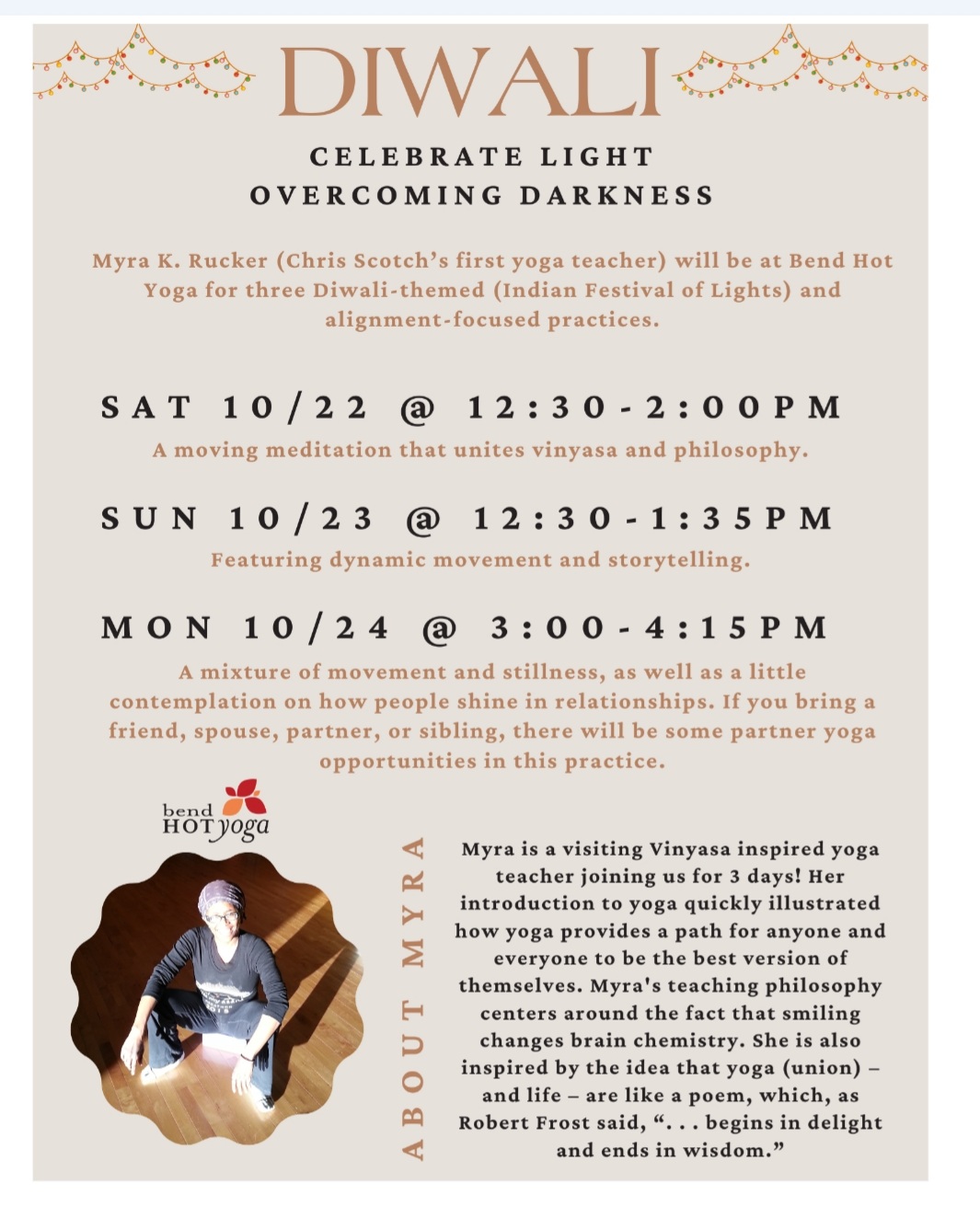
Just a reminder: The classes I am guest teaching at Bend Hot Yoga (this weekend) will be available live via ZOOM. Check my “Class Schedules” calendar for access details. (NOTE: Meeting codes are the same as they normally would be for each day, but the times are different. Timeslisted below are PDT.)
[*This time last year, I mentioned that the Carry app had won an American Heart Association startup grant and was in the running for a second national grant. While we didn’t win the public popularity vote, the initial grant is funding the videos we are currently filming – videos featuring some new (to Carry) yoga teachers and a wide range of pregnant and postpartum people. During our first day of filming, we completed videos suitable for all trimesters – and the things one might experience during the different trimesters: different moods and schedules, as well as different aches and ailments. There’s a little something for everyone, and I think everyone experiencing the journey of parenthood will see themselves reflected on the app.
For Those Who Missed It: A variation of the following was originally posted in October 2021. References to a “floating holiday” have been deleted.
“Enormous activities are going on in our body; in our brain, in our heart, in our digestive system and in every cell of the body. Few people are aware of their physical beings. Body is the starting point in the spiritual journey.
.
The dynamic play of the energy of pure consciousness is taking place in each cell of our body, in every moment. The subtle vibrations and the movement of the energies in the body are the doorways to realize the Divine union.”
.
– quoted from OM Sutra: The Pathway to Enlightenment by Amit Ray and Banani Ray
It is easier to remember that other people have had experiences that I have never had than it is to remember that I have had experience that other people have never had. For instance, I am amazed at how often I have to remind myself that everyone – even people with whom I have shared the practice for over a decade – haven’t taken every class; read every blog post, article, and book; seen every movie, play, ballet, and concert; and/or heard every dharma talk, sermon, parashah, lecture, interview, and TedTalk that I have taken, read, seen, and/or heard. Sometimes I actually chuckle at the number of times a week that I have to remind myself of Yoga Sūtra 2.20, which states that we can only see what our mind-intellect shows us and we can only understand what we are shown.
So, every once in a while, I chuckle at myself and remember to reintroduce some foundational aspect of my practice.
Today is one of those foundation days.
Since I am not teaching on Zoom today, people on the Wednesday class list, will receive links to previously recorded practices. If you are not on the Wednesday list, you can request an audio recording of either practice via a comment belowor (for a slightly faster reply) you can email me at myra (at) ajoyfulpractice.com.]
The playlist that we originally used for this practice is available on YouTube and Spotify. [Look for “07112020 An Introduction”]
Alternatively, another playlist that will also work is available on YouTube and Spotify. [Look for “05252022 Pratyahara II”]
In the spirit of generosity (“dana”), the Zoom classes, playlists, and blog posts are freely given and freely received. If you are able to support these teachings, please do so as your heart moves you. (NOTE: You can donate even if you are “attending” a practice that is not designated as a “Common Ground Meditation Center” practice, or you can purchase class(es). If you don’t mind me knowing your donation amount you can also donate to me directly. Donations to Common Ground are tax deductible; class purchases and donations directly to me are not necessarily deductible.)
Chag sameach!” to those celebrating Shemini Atzeret and Simchat Torah.
For Those Who Missed It: The following was originally posted in September 2021.If you’re on my Monday class list, I’ve sent you a recording of this practice since there is no Zoom practice tonight. If you are not on the Monday list, you can request an audio recording of either practice via a comment below or (for a slightly faster reply) you can email me at myra (at) ajoyfulpractice.com.
In the spirit of generosity (“dana”), the Zoom classes, recordings, and blog posts are freely given and freely received. If you are able to support these teachings, please do so as your heart moves you. (NOTE: You can donate even if you are “attending” a practice that is not designated as a “Common Ground Meditation Center” practice, or you can purchase class(es). Donations are tax deductible; class purchases are not necessarily deductible.
“Another classic definition of yoga is ‘to be one with the divine.’ It does not matter what name we use for the divine – God, Allah, Īśvara, or whatever – anything that brings us closer to understanding that there is a power higher and greater than ourselves is yoga. When we feel in harmony with that higher power, that too is yoga.”
– quoted from “1 – Yoga: Concept and Meaning” in The Heart of Yoga: Developing a Personal Practice by T. K. V. Desikachar
If you take even the most rudimentary survey course on the Yoga Philosophy, you will learn that the Sanskrit word yoga means “union” (and you will probably learn that it comes from the root word for “to yoke”). Go a little deeper, however, and you will find a lot of different classical (as well as modern) interpretations of the word, including the idea that it is “to come together” or “to unite.” In our physical practice of yoga, hatha yoga, there is often an emphasis on bringing the mind, body, and spirit together. The reality, however, is that there is already a mind-body-spirit connection. The practice is simply a way to recognize and reinforce the connection. And, just as we are individually connected in a variety of ways, we are collectively connected – we just need a way to recognize and reinforce those connections.
Dr. David DeSteno has a Ph.D. in psychology from Yale University and is currently a professor of psychology at Northeastern University, where he directs the Social Emotions Group – a psychology lab that focuses on “ways to improve the human condition.” To be clear, the lab is not focused on technological hardware but on social behavior. As his bio states: “At the broadest level, his work examines the mechanisms of the mind that shape vice and virtue. Studying hypocrisy and compassion, pride and punishment, cheating and trust, his work continually reveals that human moral behavior is much more variable than most would predict.”
Recently, I came across a Wired article that was adapted from his book How God Works: The Science Behind the Benefits of Religion, in which he points out that in many areas of his (20 years worth of) research, psychologists and neuroscientists are simply (re)codifying systems that have existed for thousands of years in religions all over the world. The overlapping points –where east meets west; where ritual and tradition meet science and the scientific method; where faith meets reason – always fascinate me and also make me chuckle. I chuckle at the hubris that Dr. DeSteno identifies within himself (and other scientists), which relegates ritual and tradition to superstition and myth – forgetting that every old wives’ tale or story from the old country was a way for ancient civilizations to understand the university, just as “science” is the way the modern world understands the university. That same element of hubris is also why sometimes modern scientists forget that they don’t know everything.
At the same time, I am fascinated by the connection between faith and reason and by the way we human beings (sometimes) trust certain things when we experience them directly; trust things for which we have no other explanation than that it is; and at other times can only trust something that has been “scientifically proven.” In this case, “scientifically proven” means that it is quantified and also that the cause and effect can be duplicated. Of course, this makes me laugh, sardonically, because thousands of years of “evidence” is often thrown out as “anecdotal” because of who experienced it and how it was originally documented.
“But if we remove the theology—views about the nature of God, the creation of the universe, and the like—from the day-to-day practice of religious faith, the animosity in the debate evaporates. What we’re left with is a series of rituals, customs, and sentiments that are themselves the results of experiments of sorts. Over thousands of years, these experiments, carried out in the messy thick of life as opposed to sterile labs, have led to the design of what we might call spiritual technologies—tools and processes meant to sooth, move, convince, or otherwise tweak the mind. And studying these technologies has revealed that certain parts of religious practices, even when removed from a spiritual context, are able to influence people’s minds in the measurable ways psychologists often seek.”
– quoted from the (09/14/2021) Wired article entitled, “Psychologists Are Learning What Religion Has Known for Years: Social scientists are researching what humans can do to improve their quality of life. Their findings echo what religious practices perfected centuries ago.” by David DeSteno
Throughout the year I reference a lot of different rituals, customs, and traditions from a variety of different cultures, religions, and philosophies. I do this because I firmly believe that we human beings have more commonalities than differences. Some of those commonalities involve the ways in which we come together as spiritual communities and the power of those get-togethers. As I have mentioned before, there are certain times of year – often around the changing of the seasons – when everyone and their brother seems to be getting together for some communal ritual. These times are powerful in that they are steeped in faith; however, when you look at the Jewish community around this time of year, it becomes obvious that the power is in the faith as well as in the coming together – the yoga, as it were – of the community.
For instance, there are some devout Jews who will begin preparing for the New Year 40 days before Yom Kippur. Then there are people who only come to services during the High Holidays, the “Ten Days of Awe / Ten Days of Atonement.” This latter group includes people who identify as culturally and/or ethnically Jewish. Then, just a few days later, people celebrate Sukkot – and now the coming together includes, according to the Hebrew Bible and the Christian Old Testament, people who are not Jewish in any way, shape, or form. Power is increasing, as is knowledge – which is also power.
“The Talmud tells us that one of the things that is in constant need of “bolstering” and improvement is Torah study. Thus, we say “Chazak” to strengthen ourselves in Torah study.
It’s crucial to review the Torah we’ve learned so as not to forget it. This is why, after finishing a portion of the Talmud, we say “Hadran alach,” “I will return to you.” Similarly, when we finish a book of Torah, we say “Chazak,” in other words, “We should have the strength to review what we learned.”
Likewise, when a person does a mitzvah, we say “Yasher koach” (“More power to you”), meaning, “Just as you did this mitzvah, may it be G‑d’s will that you do many more mitzvahs!”
– quoted from “Why Say ‘Chazak’ Afer Finishing a Book of Torah?” by Rabbi Yehuda Shurpin (posted on chabad.org)
When I explain Sukkot to my yoga community, I specifically mention that it takes place over seven days (as explicitly stated in Devarim – Deuteronomy 16:15) and is celebrated over eight days in the diaspora. The extra day is actually “a second day festival” which, when observed, applies to all major holidays. For the Jewish diaspora (i.e., the community residing outside of Israel), a “second festival day” was established about 2,000 years ago to reconcile the fact that a new month started with the sighting of the new moon at the Temple in Jerusalem and then that sighting had to be communicated to the world at large. In addition to building in travel time (since this was before telecommunication and the internet), religious leaders took into account the fact that messengers may not arrive (in an appropriate period of time or at all). People within the Orthodox and Conservative Jewish communities are primarily the only people within the diaspora who still observe this second day, but the timeline can get a little confusing when holidays overlap.
While I often reference the extra day when it comes to Sukkot, I haven’t always mentioned that for some (excluding the diaspora) the eighth day is its own separate celebration: Shemini Atzeret, literally “The Eighth [day] of Assembly.” Furthermore, this eighth day has its own rituals, traditions, and prayers – specifically, the prayer for rain and the prayer to remember departed souls. Traditionally, this is NOT a celebration for “[all] who live within your city.” It is immediately followed by Simchat Torah (or, for some, the second day of Shemini Atzeret), which is a celebration of an ending that is also a beginning.
As prescribed by the Talmud, the Torah – which consists of the “Five Books of Moses” – is read publicly over the course of the year and traditionally people are not meant to go more than three days without reading the Torah. The five books are divided up into 54 portions, known as Parshah (or Sidra), which are read weekly and accompanied by special blessings. Each week a special group of people are selected to read the designated portion during services. There are times when two portions are combined. The most notably combination occurs when the end of Devarim – Deuteronomy (33:1 – 34:12), known as V’Zot HaBerachach Parshah, is immediately followed by the reading of the first chapter of Bereishit – Genesis. This double reading occurs on Simchat Torah (or the second day of Shemini Atzeret). Simchat Torah literally means “Rejoicing with/of the Torah” and services are traditionally filled with singing, spontaneous dancing, and more gratitude… which is more power.
“Gratitude, for instance, is something we had studied closely, and a key element of many religious practices. Christians often say grace before a meal; Jews give thanks to God with the Modeh Ani prayer every day upon awakening. When we studied the act of giving thanks, even in a secular context, we found it made people more virtuous…. We’ve also found that when feeling gratitude to a person, to fate, or to God, people become more helpful, more generous, and even more patient.”
– quoted from the (09/14/2021) Wired article entitled, “Psychologists Are Learning What Religion Has Known for Years: Social scientists are researching what humans can do to improve their quality of life. Their findings echo what religious practices perfected centuries ago.” by David DeSteno
The playlist for this practice is available on YouTube and Spotify. [Look for “06162020 Abe’s House & Soweto”]
“If we have no peace, it is because we have forgotten that we belong to each other.”
Chag sameach!” to those celebrating Sukkot and getting ready for Shemini Atzeret and Simchat Torah.
*As some of you know, I haven’t been posting my normally verbose content because I’ve been working up to some big projects (which are all come together in the next 2 weeks). Since I haven’t posted much during this Sukkot – and since today is the anniversary of the birth of Noah Webster (b. 1758) and Oscar Wilde (b. 1854), here’s a revised post with links to some of my other Sukkot-related content.
For Those Who Missed It: This was originally posted in September 2021. You can request an audio recording of the related practices via a comment below or (for a slightly faster reply) you can email me at myra (at) ajoyfulpractice.com.
“I believe that the purpose of life is to be happy. From the moment of birth, every human being wants happiness and does not want suffering. Neither social conditioning nor education nor ideology affect this. From the very core of our being, we simply desire contentment.”
– Tenzin Gyatso, the 14th Dalai Lama in July 2015
During Sukkot, people are commanded to be happy. But what does happiness even mean? Happiness is, after all, a really personal thing, a really personal experience. I can ask, “What do you need to be happy?” But it would be really ignorant to believe that if I surround myself with the things and people that “make you happy” that I will also be happy. In fact, that’s an example of several different types of avidyā (“ignorance”) and klişţa (dysfunctional/afflicted) tendencies that lead to suffering. Furthermore, if you’ve studied a little philosophy, especially a little Eastern philosophy, you know it’s a trick question; because you know that happiness is a state of mind. So, it is more important to know (a) what you value and appreciate and (b) what happiness means to you (at this moment and in any given moment).
As I’ve mentioned before, Hod, the fifth sefirot or attribute of the divine on the Tree of Life, translates into English as “humility,” “gratitude,” “splendor,” and “glory.” Thinking of all of those together gives us some insight into what it means to be thankful – in other words, pleased, relieved, and grateful. To be grateful is to feel and/or show an appreciation for a kindness or courtesy. Gratitude, then, is defined as the “quality of being thankful; [the] readiness to show appreciation for and to return kindness.” Finally, appreciation is the defined as “recognition and enjoyment of the good qualities of someone or something.” Even though anyone can say “thank you,” for the smallest demonstration of kindness – and we absolutely must as it is a way of returning some of that kindness – it can sometimes feel like a throwaway line. A true expression of gratitude, however, includes a little detail to demonstrate “a full understanding” of why something or someone is valued.
“Western society commonly perceives happiness as the outcome of what you achieve and acquire….
Happiness is not a happening. Happiness is a state of mind. You can have everything in the world and still be miserable. Or you can have relatively little and feel unbounded joy.
The Talmud says:
‘Who is rich? The one who appreciates what he has.’ (Pirkei Avot 4:1)”
– quoted from “Way #27: Happiness” in 48 Ways to Wisdom by Rabbi Noah Weinberg
Once we establish what we value and appreciate, we can look at happiness as the embodied expression of our enjoyment and appreciation. Then, too, we must recognize that “happiness” (whatever that means to you at this moment) is not one-size-fits-all. For some people, happiness is an ecstatic kind of joy. For others, it is “just not being miserable.” Then there is every experience in between – plus the fact that the way we experience happiness today may not be the way we experienced happiness yesterday or the way we will experience it tomorrow.
At the Happiness Studies Academy (HAS), where you can get a certificate in “Happiness Studies,” the experience that is happiness falls into the rubric of positive psychology, which is defined as “the scientific study of positive human functioning and flourishing on multiple levels that include the biological, personal, relational, institutional, cultural, and global dimensions of life.” In other words, scholars like HAS co-founder Dr. Tal Ben-Shahar are concerned with the interdisciplinary science of living a good life – whatever that means to you at this moment. As I mentioned on September 25th, the anniversary of the creation and initial approval of the United States Bill of Rights (in 1789), the founding fathers had definite ideas about what was needed in order for the citizens of their new nation to experience “life, liberty, and the pursuit of happiness.”
Similarly, the Buddha expressed ideas about what a person needs to be happy and the HAS definition fits the Buddha’s teachings on the happiness of a householder. Bhante Henepola Gunaratana, a Sri Lankan Theravada Buddhist monk, summarizes the overall Buddhist concept of happiness as “not suffering” or being free of suffering. Then there is the German philosopher Friedrich Nietzsche (an October baby), whose ultimate meaning is not exactly like Patanjali’s instructions in the Yoga Sūtras; and yet, sounds very similar to YS 2.46 (“sthirasukham āsanam”). In both cases, there is an emphasis on finding balance between effort and relaxation (i.e., power without resistance).
“Happiness is the feeling that power increases – that resistance is being overcome.”
– Friedrich Nietzsche
One thing to remember, when applying Nietzsche’s words to our physical practice (or to society), is that there is resistance in too much power. Think about a power lifter who has very muscular arms and legs. They might have some flexibility in their spine and hips, but their most muscular parts tend to be their least flexible parts. So, while they might be able to move easily in one direction, they might find it really hard to move in a direction that is counter to the way they have trained their body. Furthermore, finding balance between effort and relaxation, finding that state where there is power without resistance, is not just physical; it requires mental and emotional effort as well. Happiness, after all, is a mind-body-spirit experience.
Science has shown that our propensity for happiness is based on a cocktail of genetics, personality, and attitude. That mixture of elements combined with our circumstances creates what was referred to by Drs. Philip Brickman and Donald T. Campbell as a “hedonic treadmill” (or “hedonic adaptation”), whereby as our circumstances change our expectations (and desires) also change – creating a baseline for happiness. Accordingly, research in positive psychology shows that regardless of how extreme an event is (e.g., we win the lottery or experience a debilitating accident) people return to their happiness baseline (or “hedonic set point”) in a relatively short period of time. We just need recover time.
During that recovery time there are things that promote good mental, emotional, and physical health. In fact, Dr. Tal Ben-Shahar’s “Six Tips for Happiness” encapsulate the best ways we can spend our time if we want to cultivate happiness, including: eating well, sleeping, staying hydrated, exercising, and the practices of acceptance and gratitude. Some of those things we may not always want to do, but we feel better when we do them. We also may or may not (automatically) feel grateful for what has happened to us, but not being grateful for something is definitely detrimental. Furthermore, science has shown that even thinking about something for which we could be grateful is beneficial.
The benefits of thinking, contemplating, and/or meditating on “positive” emotions are some of the reasons why Matthieu Ricard, considers happiness a skill. M. Ricard is a French Tibetan Buddhist monk who has served as a translator for the 14th Dalai Lama and has been called “the happiest man in the world.” He is also one of the monks whose brain has been observed and studied to learn the clinical benefits of meditation. What researchers have learned about M. Ricard’s brain, however, is about more than just mindfulness. While hooked up to 256 electrodes, the brains of Matthieu Ricard and the other mediators indicated that even adult brains have some neuroplasticity and, therefore, can be changed. The research shows that we can not only change our brains; it shows that in doing so we can change our baseline for happiness.
M. Ricard equates changing one’s baseline for happiness to training for a marathon. It’s about pacing and using the appropriate techniques. In the documentary “A Joyful Mind,” Dr. Richard Davidson, a psychologist and neuroscientist at the University of Wisconsin, states that brain scans indicate someone new to meditation can meditate 30 minutes a day over a 2-week period and see a change in brain activity. If you specifically want to change your baseline for happiness, one of the most effective “training techniques” is cultivating benevolent thoughts – like meditating on loving-kindness and compassion (which takes us right back to Leo Tolstoy’s answer of “do that person good”). Another effective method for changing your happiness baseline is giving thanks.
“You don’t start by the action; you start by the motivation, and motivation is something that can be cultivated…..
It is the inner quality that you need to cultivate first, and then the expression in speech and action will just naturally follow. The mind is the king. The speech and the activities are the servants. The servants are not going to tell the king how it is going to be. The king has to change, and then the other ones follow up.”
– Matthieu Ricard, speaking about generosity and other mental attitudes in a 2011 Sounds True interview with Tami Simon, entitled “Happiness is a Skill”
In 2020, when World Mental Health Day (Oct 10th) fell during Sukkot, I mentioned that happiness could be considered an aspect of good mental health. I also mentioned that The Mental Health Foundation, the largest charity in the United Kingdom devoted to mental health, points out that “Good mental health is not simply the absence of diagnosable health problems, although good mental health is likely to protect against development of many such problems.” I ultimately concluded that when we look at happiness through this mental health lens, “happy people,” just like people with good mental health, are capable of doing certain things that may not be possible when experiencing mental health issues and/or when unhappy. This is consistent with the Yoga Philosophy.
Rabbi Noah Weinberg made the same observation in 48 Ways to Wisdom in “Way #27: Happiness,” when he dispelled certain myths about happiness and contentment by pointing out that a happy person has the energy and inclination to do things like spontaneously go for a boat ride. The unhappy person, however, only seems to have the energy and inclination to stay stuck in a downward spiral. Here, again, it is important to remember that if we don’t have a recovery period – after experiencing something really good or something really tragic – any one of us can get stuck in that downward spiral.
Just as we can raise our baseline for happiness, circumstances can lower our baseline. In either case, there is a change in brain chemistry as well as in behavior. We may welcome the physiological changes that come from being a happier person. However, if our baseline is going down, we may find we need some help – possibly even some professional help – in order to get ourselves and our baseline back to a functioning level. Because, again, the key to happiness fits our mind, body, and spirit.
“Happiness is a sense of harmony, completion, and wholeness.”
– quoted from The Meaning of Happiness: The Quest for Freedom of the Spirit in Modern Psychology and the Wisdom of the East by Alan Watts
Please join me for a 65-minute virtual yoga practice on Zoom today (Sunday, October 16th) at 2:30 PM.You can use the link from the “Class Schedules”calendar if you run into any problems checking into the class. You can request an audio recording of this practice via a comment belowor (for a slightly faster reply) you can email me at myra (at) ajoyfulpractice.com.
Sunday’s playlist is available on YouTube and Spotify. [Look for “10102020 World Mental Health Day (also Sukkot 4)”]
“Give yourself permission to be human.
Happiness lies at the intersection between pleasure and meaning.
Keep in mind that happiness is mostly dependent on our state of mind, not on our status or the state of our bank account.
Simplify!
Remember the mind body connection.
Express gratitude, whenever possible.”
– quoted from the Harvard University’s Psychology 1504 (“Positive Psychology”) course by Dr. Tal Ben-Shahar
You can find portions of this post, in slightly different contexts, in the linked posts highlighted above.
If you are thinking about suicide, worried about a friend or loved one, or would like emotional support, you can dial 988 (in the US) or call 1-800-273-TALK (8255). You can also call the TALK line if you are struggling with addiction or involved in an abusive relationship. The Lifeline network is free, confidential, and available to all 24/7. YOU CAN TALK ABOUT ANYTHING.
In the spirit of generosity (“dana”), the Zoom classes, recordings, and blog posts are freely given and freely received. If you are able to support these teachings, please do so as your heart moves you. (NOTE: You can donate even if you are “attending” a practice that is not designated as a “Common Ground Meditation Center” practice, or you can purchase class(es). Donations are tax deductible; class purchases are not necessarily deductible.
“When it was over, I was so happy, I felt like crying. I wanted to win this one for Casey. After what I did in Brooklyn, he could have forgotten about me and who would blame him? But he gave me another chance and I’m grateful.”
– Don “Gooneybird” Larsen (who got a second chance today in 1956)
Please join me for a 90-minute virtual yoga practice on Zoom today (Saturday, October 8th) at 12:00 PM. Use the link from the “Class Schedules” calendar if you run into any problems checking into the class. You can request an audio recording of this practice via a comment below or by emailing myra (at) ajoyfulpractice.com.
Saturday’s playlist is available on YouTube and Spotify.
In the spirit of generosity (“dana”), the Zoom classes, recordings, and blog posts are freely given and freely received. If you are able to support these teachings, please do so as your heart moves you. (NOTE: You can donate even if you are “attending” a practice that is not designated as a “Common Ground Meditation Center” practice, or you can purchase class(es). Donations are tax deductible; class purchases are not necessarily deductible.)
“Shana Tovah U’Metukah!” to anyone who is observing the High Holidays.
Please join me for a 90-minute virtual yoga practice on Zoom today (Saturday, October 1st) at 12:00 PM. Use the link from the “Class Schedules” calendar if you run into any problems checking into the class. You can request an audio recording of this practice via a comment below or by emailing myra (at) ajoyfulpractice.com.
Saturday’s playlist is available on YouTube and Spotify.
In the spirit of generosity (“dana”), the Zoom classes, recordings, and blog posts are freely given and freely received. If you are able to support these teachings, please do so as your heart moves you. (NOTE: You can donate even if you are “attending” a practice that is not designated as a “Common Ground Meditation Center” practice, or you can purchase class(es). Donations are tax deductible; class purchases are not necessarily deductible.)
“Shana Tovah U’Metukah!” to anyone who is observing the High Holidays.
For Those Who Missed It:The following was originally posted in 5781/2020. Class and date-related details have been updated. An extra quote and a recent video have also been embedded within the main text.
“Why can’t we talk it over? Oh it seems to me That sorry seems to be the hardest word”
– quoted from “Sorry Seems to Be the Hardest Word” by Sir Elton John and Bernie Taupin
For years, I avoided saying the words, “I’m sorry.” It wasn’t that I never made a mistake or didn’t feel remorse about something I had said or done or even thought. Instead, I very deliberately, very intentionally, practiced expressing my remorse with other words. Because, despite the song and the old saying, “sorry” is a word I think it is far too easy for people to say.
We say we’re sorry when we accidentally bump into someone while walking or when we both reach for the same prop in a yoga class. We say “sorry” when we hit the wrong button on the elevator and the door closes on someone who was trying to catch it or when we don’t hold the door open for someone who has their hands full. We say “sorry” when we didn’t hear or understand something someone says and we say we’re sorry when we don’t want to do something that’s clearly not right for us to do. We use the same word for the little inconsequential stuff as for the really big stuff and we do this despite the fact that we have so many other words; words that in some cases are much more appropriate for a situation. (Say hello, “excuse me” and “pardon me.”)
I apologize.
I didn’t mean to hurt you.
I’ll do better next time.
Please forgive me.
I was wrong.
Please give me a second chance.
Pardon me.
I regret what I did/said.
My bad.
Excuse me.
Please accept my regrets.
Mea culpa.
Earlier in the New Year (that started this past Sunday at sunset), I mentioned that words are one of our super powers – and by that I mean they are one of the siddhis (or “powers”) unique to being human according to Indian philosophy. In fact, the process of asking and/or offering forgiveness is something that utilizes all six (6) of the powers unique to being human.
First, there is uha (“knowledge without doubt, clear understanding, intuitive knowledge”). In a dhamma talk entitled “The Ancient Heart of Forgiveness,” Buddhist teacher Jack Kornfield refers to the act of forgiveness as a “a deep process of the heart, which requires a person to process and honor ”the betrayal of yourself or others, the grief, the anger, the hurt, the fear.” I’ll add to that the need to process and honor the love, expectation, and disappointment that are usually involved in the situation. In order to reach the point where we can truly ask and/or offer forgiveness we have to understand the situation and the underlying emotions. The absolute worst “apologies” ever – and I put that in quotes, because they really aren’t apologies – are conditional and redirect action towards those who have been harmed. For instance, when people say something like, “I’m sorry if you were offended, but…” and/or “I apologize to anyone I may have offended,” they aren’t actually apologizing. The act of asking for and/or offering forgiveness is similar to the act of expressing gratitude: the more specific one can be, the more genuine the act – and this requires truly understanding the situation.
The second “power unique to being human” is shabda (“word”) and it is our ability to not only form a sound, but also to assign meaning that sound; depict that sound and meaning visually; to remember the sound, meaning, and visual depiction and to convey that meaning to others. I think it is obvious how this power comes into play when we are talking about forgiveness and repentance. However, for the record, let me reiterate that the words we use matter because of how we use them! (Also, this is one of those powers where one could say that this is a power other beings in the animal kingdom share with being human. And while this is true, humans have the ability to deliberately and intentionally hone this ability. Consider, also, the power of the written word. A handwritten apology is akin to a love letter.)
Adhyayana is the ability to “study, analyze, and comprehend” and it is directly tied to the first “power unique to being human.” This analytical ability not only allows us to turn inward and gain an understanding of our own intentions (as well as the intentions of others), it also means we can dig deep inside of ourselves and gain a clear understanding of what we are feeling. We can’t always understand how other people are feeling, but we can take a moment to cultivate empathy by considering how we would feel if the shoe were on the other foot. This third power also gives us the ability to understand why one person’s actions, words, and thoughts can hurt us in a way it is hard to get past, while another person’s actions, words, and thoughts feel inconsequential. Finally, it gives us the ability to predict the cause and effect of our thoughts, words, and deeds – which means we have the capacity to not hurt someone and/or to stop making the same mistake over and over again.
“It’s a deep work of the heart that purifies and releases – and somehow permits us to love and be free.”
– quoted from a dhamma talk entitled “The Ancient Heart of Forgiveness” by Jack Kornfield
The fourth “power unique to being human” is dukha-vighata-traya, which means we are born with the ability to eliminate three-fold sorrow (“physical-mental-spiritual suffering”) because we have the ability to understand the cause and the cure of what ails us. Forgiveness and repentance are powerful healing agents. They are a balm to the soul. Letting go of what no longer serves us (or only serves in dividing us) can feel like a cool breeze on a summer day. It’s a clean slate and is like hitting the reset button on a relationship. Remember, as teachers like Jack Kornfield point out, forgiveness is for you: “It’s not for anyone else.”
The final two powers are suhrit-prapti (which is “cultivating a good heart; finding friends”) and dana (“generosity, the ability to give”). I put these two together not because they are less than the others, but because they – along with the fourth – can defy logic. They are, in every tradition, heart practices. The ability to cultivate friendship and emotionally invest in others carries with it the risk of being hurt. There is a reason why the word “passion,” which comes to us from Latin, by way of Old French and Middle English is more closely associated with love (and strong emotions) than with its original meaning “to suffer.” The ability to cultivate a good heart means that we open up to the wisdom that is part of the heart (according to Eastern philosophies) and also that we are capable of thinking beyond our own needs and desires. This last part – the ability to consider the needs and desires of others – is directly tied to our ability to give others what they need, including what is legally ours. We can spend all day considering what material possessions we have that could benefit others, but let us not forget the priceless value of what is in our own hearts. We are the only one who can offer our forgiveness.
“It’s one of the greatest gifts you can give yourself, to forgive. Forgive everybody.”
– Dr. Maya Angelou
Teshuvah (or Tchuvah), the Hebrew word for “repentance, return, turn,” is a big part of the High Holidays. On Yom Kippur, The Day of Atonement, there is even an absolution of vows (every vow). But remember, this is not about self flagellation (or even, really, about condemnation). In offering forgiveness to ourselves and others we are not required to forget or condone bad behavior. Neither are we required to stay in a bad situation. The practice does not require us to be perfect. The practice does, however, require us to open our hearts to the possibility of a new beginning.
“To err is human, to forgive, divine.”
– quoted from “An Essay on Criticism” (line 525) by Alexander Pope
Please join me today (Wednesday, September 28th) at 4:30 PM or 7:15 PM for a yoga practice on Zoom. Use the link from the “Class Schedules” calendar if you run into any problems checking into the class. You will need to register for the 7:15 PM class if you have not already done so. You can request an audio recording of this practice via a comment below.
Wednesday’s playlist is available on YouTube and Spotify. [Look for “High Holidays: Sorry”]
In the spirit of generosity (“dana”), the Zoom classes, recordings, and blog posts are freely given and freely received. If you are able to support these teachings, please do so as your heart moves you. (NOTE: You can donate even if you are “attending” a practice that is not designated as a “Common Ground Meditation Center” practice, or you can purchase class(es). Donations are tax deductible; class purchases are not necessarily deductible.)
“I’ve got a suitcase of memories that I almost left behind Time after time Time after time”
– quoted from the song “Time after Time” by Cyndi Lauper
Please join me for a 90-minute virtual yoga practice on Zoom today (Saturday, September 24th) at 12:00 PM. Use the link from the “Class Schedules” calendar if you run into any problems checking into the class. You can request an audio recording of this practice via a comment below or by emailing myra (at) ajoyfulpractice.com.
Saturday’s playlist is available on YouTube and Spotify. [Look for “10052021 A Matter of Time”]
“Time is a sequence of moments and, hence, a sequence of the mutations of the gunas which take place at every moment. We only become aware of these moments-changes at intervals, when a whole series of them has resulted in mutation which is sufficiently remarkable to be apparent to our senses.”
– quoted from How to Know God: The Yoga Aphorisms of Patanjali (4:33), translated and with commentary by Swami Prabhavananda and Christopher Isherwood
In the spirit of generosity (“dana”), the Zoom classes, recordings, and blog posts are freely given and freely received. If you are able to support these teachings, please do so as your heart moves you. (NOTE: You can donate even if you are “attending” a practice that is not designated as a “Common Ground Meditation Center” practice, or you can purchase class(es). Donations are tax deductible; class purchases are not necessarily deductible.)
 ###
###
 A Joyful Practice