“Happy Diwali!” to anyone celebrating! May we all be healthy, wealthy, and wise on World Kindness Day!
For Those Who Missed It: This is a revised (and slightly expanded) “missing” post related to Monday, November 13th. Some links have been updated and a date-related note has been added for 2023. You can request an audio recording of a related practice via a comment below or (for a slightly faster reply) you can email me at myra(at) ajoyfulpractice.com.
In the spirit of generosity (“dana”), the Zoom classes, recordings, and blog posts are freely given and freely received. If you are able to support these teachings, please do so as your heart moves you. [NOTE: You can donate even if you are “attending” a practice that is not designated as a “Common Ground Meditation Center” practice, or you can purchase class(es). Donations are tax deductible; class purchases are not necessarily deductible.]
Check out the “Class Schedules” calendar for upcoming classes (and for holiday-related changes).
“Embrace me completely
just as a creeper completely embraces a tree
May you be the one loving me only, not another
may you not go away from me”
— Atharva Veda 6.8 (translated by Dr. R. L. Kashyap)
In India and Southeast Asia, Diwali (the 5-day festival of lights) is celebrated by a very diverse group of people. The diversity is not only religious and spiritual — as it is a tradition for Hindus, Jains, Sikhs, and Newar Buddhists. There are many other sociocultural differences. So, as you can imagine, there are lots of different ways that people tell the story of light overcoming darkness, good overcoming evil; life overcoming death, wisdom overcoming fear; love overcoming hate; hope overcoming despair, and knowledge overcoming ignorance.
For instance, in some rural parts of north, west, and central India, the fourth day of Diwali is a day when people observe Govardhan puja, an offering to honor the legend of Krishna saving the cowherds and farmers from the rain and floods by lifting Mount Govardhan. People build miniature-sized mountains out of cow dung and also “build” mountains of food and mountains of sweets. There is also thanksgiving, especially around the purchase of staples, like salt, which are considered essentials to life.
“with my mind I attract you
just as a bird on the ground beats its wings to go up
May you be the one loving me only, not another
may you not go away from me”
— Atharva Veda 6.8 (translated by Dr. R. L. Kashyap)
The main day of Diwali, yesterday, is often associated with the part of the epic poem the Rāmāyaņa when Rāma, his bride Sītā, and his brother Lakshmana returned home after 14 years in exile. According to the legend, their homecoming was met with brightly lit candles, lamps, and fireworks. The homecoming and the light festivities marked the end of the darkness that represented the jealousy which led to the trio’s exile and Sītā’s kidnapping during the exile, as well as the doubt and fear felt by some of the characters that appear throughout the poem. The lights symbolize the couples love, devotion, and faith in each other; Lakshmana and Hanuman’s devotion to Rāma; and their victory over those who tried to defeat them.
Ergo, for a good majority, this fourth day shines a light on love, relationships, and devotion — especially between husbands and wives. In some areas, husbands give their wives gifts and other areas parents treat their newlywed children to a feast (which also involves gifts).
In addition to telling those aforementioned parts of the Rāmāyaņa, people will also celebrate the story of the defeat of the evil King Bali. Sometimes the story is related to a husband and wife (Shiva and Pārvatī) playing a game of dice on a board with twelve squares and thirty pieces. Every element of the story is symbolic — including the fact that it is a “strip” version of the game, during which the husband ceremoniously looses all his clothes.
One of my favorite husband-wife Diwali stories is actually associated with the first day; but I also tell it on this day. It is the story of a clever wife who used light (and all the properties of light) to “defeat” Death (Yama, in the form of a snake) when he arrived on the fourth night of her marriage in order to take away her new husband, the prince. The legend always reminds me of Scheherazade, in that the wife in the Diwali story also spends the night telling stories and singing songs in order to extend life.
“I go around your mind just as the sun[light] goes around heaven and earth
May you be the one loving me only, not another
may you not go away from me”
— Atharva Veda 6.8 (translated by Dr. R. L. Kashyap)
2023 NOTE: The fourth day of Diwali (2023) coincided with World Kindness Day, which was established in 1998 by the World Kindness Movement, a coalition of non-government organizations (NGOs). In eastern philosophies, which encourage cultivating the opposites (YS 2.33 – 2.34), every emotion has an opposite (and a near peer). For example, the flip side of anger and frustration is loving-kindness. While there has been darkness in the world on this date in the past (e. g., the terrorist attacks in Paris November 13, 2015) and there is darkness in the world today, there was and is also light.
There was light in people standing together in solidarity and proclaiming “Je suis Charlie” and “Je suis Ahmed” at the beginning of 2015. And, there is light today when people who are perceived as being different from each other remember that we all human. That light is a little bit of metta in the world.
And, no, I’m not referring to a short version of a certain basketball player born today 1979. I’m referring to the reason he changed his name: the practice of lovingkindness.
There is no playlist for the Common Ground Meditation Center practices.
The 2022 Monday Night Special playlist is available on YouTube and Spotify. [Look for “Diwali (Day 3-4) 2022”]
The World Kindness Day playlist is available on YouTube and Spotify. [Look for “11132021 The Power of Kindness to the nth Degree”]
The 2020 playlist is available on YouTube and Spotify. [Look for “Diwali (Day 4) 2020”]
Happy Diwali and Kali Puja! Blessings, light, love, and peace to everyone, everywhere!
This “missing” post for Sunday, November 12th is a compilation of previously and newly posted information. You can request an audio recording of a related practice via a comment below or (for a slightly faster reply) you can email me at myra (at) ajoyfulpractice.com.
In the spirit of generosity (“dana”), the Zoom classes, recordings, and blog posts are freely given and freely received. If you are able to support these teachings, please do so as your heart moves you. (NOTE: You can donate even if you are “attending” a practice that is not designated as a “Common Ground Meditation Center” practice, or you can purchase class(es). Donations are tax deductible; class purchases are not necessarily deductible.
[Conscious, subconscious, unconscious mind, and every plane of existence, we meditate on the (adorable) Light, that it may inspire us, enlighten us, and remove our obstacles.]
— “Gāyatrī Mantra” from the Rig Veda (from Mandala 3.62.10)
During the darkest times of the year, people all over the world celebrate light. In each culture’s stories and traditions, light overcoming darkness is a metaphor for good overcoming evil; life overcoming death, wisdom overcoming fear; love overcoming hate; hope overcoming despair, and knowledge overcoming ignorance. Once again, the celebrations kick off with Diwali, the Indian festival of lights.
Diwali is a five-day celebration which takes its name from Deepavali, which are rows and rows of lamps. It is a lunar calendar based holiday observed throughout India, parts of Southeast Asia, and the diaspora by Hindus, Sikhs, Jains, and Newar Buddhists. Each day has different rituals and customs, which may vary between religious, cultural, and regional traditions. But, the common threads are the (clay) lamps and other great displays of light; pujas (“offerings”); feasts and sweets; epic tales of heroes and heroines prevailing; and a focus on relationships and also on wealth.
While some communities start earlier, most people’s Diwali celebrations begin with Dhanteras, a day that the Indian ministry of Ayurveda, Yoga and Naturopathy, Unani, Siddha and Homeopathy designated as “National Ayurveda Day” (in 2016). Many pujans (“offering ceremonies”) are dedicated to Lakshmi, the goddess of wealth and prosperity, fertility and abundant crops, and overall good fortunate. People also create decorations, including rangolas, which are associated with Lakshmi; clean their homes; and buy something new — usually gold, silver, clothes, and gadgets.
The second day of Diwali (which was Saturday in 2023) is known as Choti (“little”) Diwali and, also, as Naraka Chaturdasi. Naraka is a Sanskrit word for “hell” and the day is associated with the story of Krishna defeating the asura (“demon”) Narakasura. Again, the elements of the story — as well as the rituals and traditions of the day — have symbolic significance related to the ways people live their lives and the ways their souls can be liberated from suffering (i.e., hell). Some people spend the day praying to the souls of their ancestors, sending light for their afterlife journey. In some regions (e.g., Tamil Nadu, Goa, and Karnataka), Choti Diwali is the main Diwali day. People get oil massages and take ritual baths. Some people also spend part of the day visiting their temple. For people celebrating the “little” Diwali, the second day is a day to visit friends and family and share sweets and gifts.
“Fiery-eyed Durga astride a golden lion; Saraswati resplendent in white along with her swan; a glowing Lakshmi seated on a lotus in bloom; and Kali with her frightening garland of skulls. The legends that surround them are told over and over again and soon the children know them by heart. For them, as it is for me, these beautiful lotus-eyed goddesses are not just religious icons but part of one’s family. They laugh and cry, quarrel with each other over petty things, they have fragile natures despite their powerful forms. They are often jealous, angry, greedy and plot deviously against their enemies but still they need to be loved by their devotees, Then they appear, splendid, glorious and benevolent, to dazzle us with their all-pervading light.”
— quoted from the “Introduction” to The Book of Devi by Bubul Sharma
The third day (today) is the biggest day for most: Diwali! It coincides with the darkest night of the festival and is normally marked by people getting together, feasting and celebrating. In fact, this is a time when the youngest members of the family visit their elders; businesses owners give gifts to their employees; and, instead of the fasts that are commonly associated with some Indian religious rituals, there are great feasts. Pujas are again made to Lakshmi. For some people, however, pujans are dedicated to Kali, the goddess of time and change, creation, power, war, destruction, and death. In many ways, making an offering to Kali highlights the fact that Diwali is a day of renewal, new beginnings, and starting over.
The stories in the Rāmāyaņa highlight all of the themes associated with Diwali — and the end is particularly pertinent to the third day. In the epic poem (which is part of the Mahābhārata), Rāma, his wife Sītā, and his brother Lakshmana are exiled by the brothers’ father. Their great adventure includes Sītā being kidnapped by the demon king Ravana (and rescued with help from Hanuman, the monkey king); a great battle where an entire army gets sick (and ultimately healed, to Hanuman); the defeat of Ravana; and the revelation that Hanuman overcame his doubts, insecurities, and fears by focusing on the love and devotion for Lord Rama that shined (like a bright light) in his heart. Finally, after 14 years of exile, Rāma, Sītā, and Lakshmana returned home to Ayodhya — on the day that is now celebrated as Diwali. According to the legends, people lit up the city in order to guide the travelers home and also to celebrate their return. So, every year, people from all of the different religions light up their homes, businesses, and temples to commemorate this auspicious homecoming.
SIDE NOTE: As they travelled home, Sītā requested a pit stop in Kishkindha, because she wanted to enter Ayodhya with a company of women as her escorts. The request and fulfillment are conveyed in just a few lines, making up a minuscule portion of the epic poem. Normally, I would not mention this tiny passage — even though, if you think about it, it is a powerful moment when a woman who has suffered trauma and drama asks for (and receives) what she needs before facing what could be more trauma, drama, and judgement.
It also highlights the power of a group of women standing up for each other. So, it seems fitting to mention this moment on the anniversary of the birth of Elizabeth Cady Stanton — the social activist, abolitionist, and suffragist — who was born November 12, 1815, in Johnstown, New York.
“The moment we begin to fear the opinions of others and hesitate to tell the truth that is in us, and from motives of policy are silent when we should speak, the divine floods of light and life no longer flow in our souls. Every truth we see is ours to give the world, not to keep to ourselves alone, for in so doing we cheat humanity out of their rights and check our own development.”
— quoted from Elizabeth Cady Stanton’s speech at the National American Woman Suffrage Association convention (and birthday celebration for Susan B. Anthony), February 18, 1890
Sunday’s playlist is available on YouTube and Spotify. [Look for “Diwali (Day 2-3) 2022”].
If you are thinking about suicide, worried about a friend or loved one, or would like emotional support, you can dial 988 (in the US) or call 1-800-273-TALK (8255)for the Suicide and Crisis Lifeline. You can also call this TALK line if you are struggling with addiction or involved in an abusive relationship. The Lifeline network is free, confidential, and available to all 24/7. YOU CAN TALK ABOUT ANYTHING.
White Flag is a new app, which I have not yet researched, but which may be helpful if you need peer-to-peer (non-professional) support.
Happy Diwali and Kali Puja! Blessings, light, love, and peace to everyone, everywhere!
“The moment we begin to fear the opinions of others and hesitate to tell the truth that is in us, and from motives of policy are silent when we should speak, the divine floods of light and life no longer flow in our souls. Every truth we see is ours to give the world, not to keep to ourselves alone, for in so doing we cheat humanity out of their rights and check our own development.”
— quoted from Elizabeth Cady Stanton’s speech at the National American Woman Suffrage Association convention (and birthday celebration for Susan B. Anthony), February 18, 1890
Please join me for a 65-minute virtual yoga practice on Zoom today (Sunday, November 12th) at 2:30 PM.Use the link from the “Class Schedules” calendar if you run into any problems checking into the class. You can request an audio recording of this practice via a comment below or by emailing myra (at) ajoyfulpractice.com.
Sunday’s playlist is available on YouTube and Spotify. [Look for “Diwali (Day 2-3) 2022”].
In the spirit of generosity (“dana”), the Zoom classes, recordings, and blog posts are freely given and freely received. If you are able to support these teachings, please do so as your heart moves you. (NOTE: You can donate even if you are “attending” a practice that is not designated as a “Common Ground Meditation Center” practice, or you can purchase class(es). Donations are tax deductible; class purchases are not necessarily deductible.)
Peace and blessings to all, and especially to those observing/remembering armistice and/or celebrating (Choti) Diwali. May there be more light in the world.
For Those Who Missed It: With the exception of the final quote and additional links (at the end), the following is a slightly revised version of a 2020 post. Class details and some links have been updated.
“Compassion. Respect. Common Sense.”
— Retired Marine Staff Sergeant Tim Chambers (a.k.a The Saluting Marine) when asked what he wanted to inspire in people who see him standing/saluting
At “the eleventh hour of the eleventh day of the eleventh month,” Paris time, 1918, all was quiet on the Western Front. At least in theory. It wasn’t as neat and tidy as it sounds; however, there was an official cease fire, an armistice that was scheduled to last 30 days. It was, for all intensive purposes, the end of World War I. Exactly a year later, Buckingham Palace hosted the first official Armistice Day event in England — and, thanks to the suggestion of South African author and politician Sir Percy Fitzpatrick, people around Europe began observing two minutes of silence in honor of those who had died during the war and those who were left behind.
The practice of observing two minutes of silence (in honor of people lost during conflict) started as a daily practice in Cape Town, South Africa in the spring of 1918. Today, those two minutes are one of the rituals shared by people who are observing Armistice Day (in the Britain and the Commonwealth, France, Belgium, and Poland) and Veterans Day (in the USA and Canada). These observations are sometimes, like in the case of England, focused on those who served and were impacted by World War I. However, in the United States and Canada it is a day to honor all veterans and their families. (The UK, USA, and Canada all have separate days to honor those who died while serving in any military conflict.)
“They shall grow not old, as we that are left grow old; Age shall not weary them, nor the years condemn. At the going down of the sun and in the morning We will remember them”
— “Ode of Remembrance” quoted from the poem “For the Fallen” by Laurence Binyon, published September 1914 (in honor of the casualties of the British Expeditionary Force in the opening action of the war on the Western Front, WWI)
We have so many rituals and traditions around remembering those who were lost during conflict and tragedy. But, consider how we honor the living — those who return with wounds we can see, as well as wounds we cannot. Since today is a day, in the United States, when we remember all those who served — living and dead — it is a good time to really consider the experiences and challenges of those who return home different from the way they left.
During Movember classes, I talk about mental health and the fact that middle aged white men make up the highest percentage of suicides in America. Add to that, the increase in the percentages when someone has served in the military. Every 72 minutes, a veteran or active service member takes their own life; that works out to ~17 — 20 people a day or ~140 a week. These numbers do not include people who attempt suicide or consider it.
As I’ve pointed out before, we must keep in mind, that people feel a lot of different things people when they consider suicide. It’s emotional. There are, also, a lot of different things that pull people back away from the edge. It’s personal. Some people may not want to talk about the details of their service and the things that they experienced. They may, however, want to talk about something else. We can honor them by listening.
“IX
Calm fell. From Heaven distilled a clemency; There was peace on earth, and silence in the sky; Some could, some could not, shake off misery: The Sinister Spirit sneered: ‘It had to be!’ And again the Spirit of Pity whispered, ‘Why?’”
— from the poem “And There Was a Great Calm (On the Signing of the Armistice, 11 Nov 1918)” by Thomas Hardy
Please join me today (Saturday, November 11th) at 12:00 PM, for a 90-minute yoga practice on Zoom. Use the link from the “Class Schedules” calendar if you run into any problems checking into the class. You can request an audio recording of this practice via a comment below or by emailing myra (at) ajoyfulpractice.com.
Saturday’s playlist is available on YouTube and Spotify. [Look for “11/11 @ 11”]
If you are thinking about suicide, worried about a friend or loved one, or would like emotional support, you can dial 988 (in the US) or call 1-800-273-TALK (8255)for the Suicide and Crisis Lifeline. You can also call this TALK line if you are struggling with addiction or involved in an abusive relationship. The Lifeline network is free, confidential, and available to all 24/7. YOU CAN TALK ABOUT ANYTHING.
White Flag is a new app, which I have not yet researched, but which may be helpful if you need peer-to-peer (non-professional) support.
In the spirit of generosity (“dana”), the Zoom classes, recordings, and blog posts are freely given and freely received. If you are able to support these teachings, please do so as your heart moves you. (NOTE: You can donate even if you are “attending” a practice that is not designated as a “Common Ground Meditation Center” practice, or you can purchase class(es). Donations are tax deductible; class purchases are not necessarily deductible.)
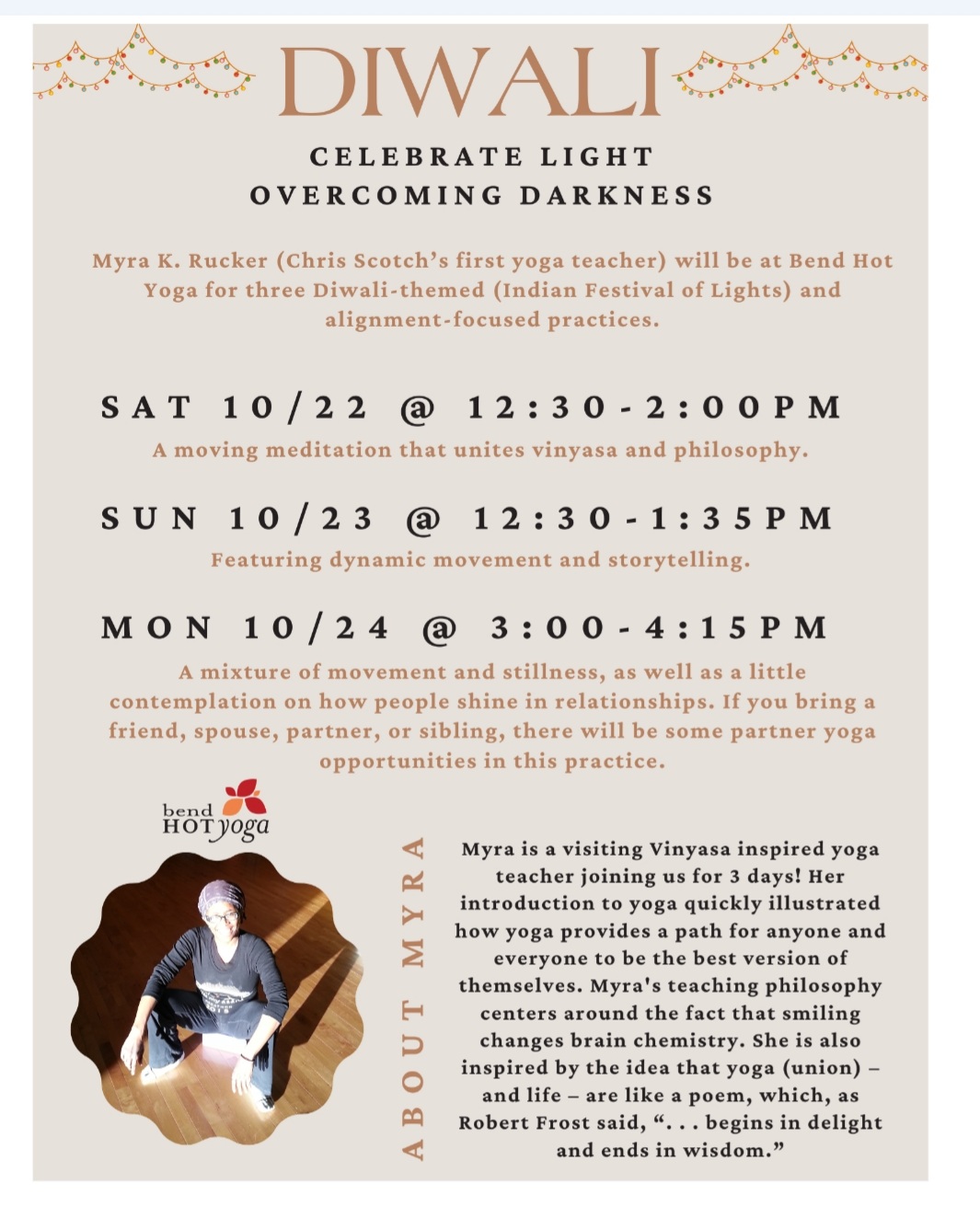
Please join me for a 75-minute virtual yoga practice on Zoom today (Monday, October 24th) at 3:00 PM (PDT) / 5:00 PM (CST). This practice will be a Somatic Yoga Experience that combines micro-movements with gentle dynamic motion. (It’ll make you wanna “sye.”) You can use the link from the “Class Schedules”calendar if you run into any problems checking into the class. You can request an audio recording of this practice via a comment belowor (for a slightly faster reply) you can email me at myra (at) ajoyfulpractice.com.
Monday’s playlist is available on YouTube and Spotify. [Look for “Diwali (Day 3-4) 2022”]
In the spirit of generosity (“dana”), the Zoom classes, recordings, and blog posts are freely given and freely received. If you are able to support these teachings, please do so as your heart moves you. (NOTE: You can donate even if you are “attending” a practice that is not designated as a “Common Ground Meditation Center” practice, or you can purchase class(es). Donations are tax deductible; class purchases are not necessarily deductible.)
The regular Common Ground Meditation Center practice at 5:30 PM (CST) will return next week.
Please join me for a 65-minute virtual yoga practice on Zoom today (Sunday, October 23rd) at 12:30 PM (PDT) / 2:30 PM (CST).You can use the link from the “Class Schedules”calendar if you run into any problems checking into the class. You can request an audio recording of this practice via a comment belowor (for a slightly faster reply) you can email me at myra (at) ajoyfulpractice.com.
Sunday’s playlist is available on YouTube and Spotify. [Look for “Diwali (Day 2-3) 2022”]
In the spirit of generosity (“dana”), the Zoom classes, recordings, and blog posts are freely given and freely received. If you are able to support these teachings, please do so as your heart moves you. (NOTE: You can donate even if you are “attending” a practice that is not designated as a “Common Ground Meditation Center” practice, or you can purchase class(es). Donations are tax deductible; class purchases are not necessarily deductible.)
“Happy Dhanteras!” to everyone celebrating Diwali.
This “missing” post for Saturday, October 22nd is a compilation based on posts from 2020. You can request an audio recording of a relevant practice via a comment below or (for a slightly faster reply) you can email me at myra (at) ajoyfulpractice.com.
In the spirit of generosity (“dana”), the Zoom classes, recordings, and blog posts are freely given and freely received. If you are able to support these teachings, please do so as your heart moves you. (NOTE: You can donate even if you are “attending” a practice that is not designated as a “Common Ground Meditation Center” practice, or you can purchase class(es). Donations are tax deductible; class purchases are not necessarily deductible.
[Conscious, subconscious, unconscious mind, and every plane of existence, we meditate on the (adorable) Light, that it may inspire us, enlighten us, and remove our obstacles.]
– “Gāyatrī Mantra” from the Rig Veda (from Mandala 3.62.10)
During the darkest times of the year, people all over the world celebrate light. In each culture’s stories and traditions, light overcoming darkness is a metaphor for good overcoming evil; life overcoming death, wisdom overcoming fear; love overcoming hate; hope overcoming despair, and knowledge overcoming ignorance. This year, the celebrations kick off with Diwali, the Indian festival of lights.
Diwali is a five-day celebration which takes its name from Deepavali, which are rows and rows of lamps. It is a lunar calendar based holiday observed throughout India, parts of Southeast Asia, and the diaspora by Hindus, Sikhs, Jains, and Newar Buddhists. Each day has different rituals and customs, which may vary between religious, cultural, and regional traditions. But, the common threads are the (clay) lamps and other great displays of light; pujas (“offerings”); feasts and sweets; epic tales of heroes and heroines prevailing; and a focus on relationships and also on wealth.
While some communities start earlier, most people’s Diwali celebrations begin with Dhanteras, a day that the Indian ministry of Ayurveda, Yoga and Naturopathy, Unani, Siddha and Homeopathy designated as “National Ayurveda Day” (in 2016). Many will make puja (“an offering”) to Lakshmi, the goddess of wealth and prosperity, fertility and abundant crops, and overall good fortunate. People will also create decorations, including rangolas, which are associated with Laksmi; clean their homes; and buy something new – usually gold, silver, clothes, and gadgets. This year, this first day of Diwali coincides with a very modern light-related anniversary: Thomas Edison’s light bulb moment.
“‘I never did anything worth doing by accident, nor did any of my inventions come indirectly through accident, except the phonograph. No, when I have, fully decided that a result is worth getting, I go about it, and make trial after trial, until it comes.’”
– Thomas Edison, as quoted in “A Photographic Talk with Edison” by Theodore Dreiser (printed in Success Magazine, Feb. 1898)
We often think of “ah-ha” or “eureka” moments, light bulb moments, and epiphanies as being sudden and unexpected. In fact, the word “epiphany” comes to us from Greek (by way of Middle English, Latin, and in some sense Old French) from a word that means “reveal.”And, one of the definitions is “a moment of sudden revelation or insight” – reinforcing the idea that something is happening in the snap of a finger. The reality, however, is that there is a back story to ah-ha moments, epiphanies, and even the Epiphany.
Consider that The Three Magi don’t follow the star from the East to honor “‘the child who has been born king of the Jews’” if there isn’t a foundation of faith. Theoretically, without his background in science, Ian Fleming would have returned to his lab and thrown out the culture plates he had forgotten to clean when he left for his 2-week vacation in 1928. Without all his previous years of research, he wouldn’t have known what he was looking at and he wouldn’t be credited with discovering penicillin. Then there is Thomas Edison, who had a lot of “light bulb moments.”
Thomas Alva Edison, born February 11, 1847, didn’t invent electric lights (or even light bulbs). They already existed when he set up his Menlo Park, New Jersey lab in 1876, but electric lights were too bright for household use, burned too quickly, and could be dangerous when they melted. So, most people just stuck with gaslights. The problem with gaslight was that it was also dangerous and didn’t provide consistent light (because it flickered). Edison decided he could do better… he just had to invent the infrastructure to safely bring electricity into people’s homes, interior fixtures, and some kind of cost-effective and efficient bulb. The bulb, it turned out, was the rub.
“I have not failed 10,000 times. I have not failed once. I have succeeded in proving that those 10,000 ways will not work. When I have eliminated the ways that will not work, I will find the way that will work.”
– (attributed to) Thomas Edison
Edison and his team spent several months working 16 – 18 hours at a stretch and testing at least 1,600 different materials – including fishing line, coconut fibers, beard hair, and platinum wire. The platinum wire was moderately successful in that it typically had a high melting point. However, additional research showed that air absorption weakened the filament causing it to melt at lower temperatures than expected. Edison, resolved the issue with a vacuum bulb, but ultimately deemed the design (with its low electrical resistance) too expensive. So, back to the drawing board they went; breaking up their hours upon hours of work with beer and music played (by Edison) on the lab’s pipe organ.
Some would say that the “ah-ha” moment came to Thomas Edison one night when he was “absent mindedly” rolling a piece of lampblack (or black carbon) between his fingers. But such a depiction ignores all the previous experiments, his scientific knowledge, and the fact he had used lampblack in his telephone transmitter. Such a premise also discounts the additional changes that would be made before the bulb was commercially viable. Either way, at some point late on the evening of October 21st, or sometime in the wee early morning hours of October 22nd, 1879, Thomas Edison, age 32, tested what we now consider the first successful (commercially viable) electric light bulb. The carbonized cotton could burn for up to 14½ hours. Later, Edison would switch to bamboo fiber, which lasted for 1,200 hours.
During his lifetime, Thomas Edison would be granted over 1,083 patents for things like the phonograph, the carbon transmitter, the motion picture camera, and the commercial electric light bulb. He was married with children, had influential friends in high (and low) places, and successfully ran an industry that provided for his family and the families of others. Then, at an age that was considered significantly old at the time, he lost “everything. At around 5:20 PM on December 9, 1914 an explosion ripped through the lab, destroying ten buildings, thousands of prototypes, and years of research. By the time the fire was contained, a little after midnight on December 10th, the damage was estimated at over $2 million dollars and affected over half of the plant’s property. The loss was even bigger when people realized that the insurance wouldn’t even cover a half of the damage.
While those around him were devastated, the 67-year old was in awe of the fire produced by all the different chemicals, fibers, fabrics, and elements in the labs. He was also energized about the possibility of starting over the very next day! His resilient attitude was contagious and, thanks in part to a loan from his friend Henry Ford, the plant was back in operation within three weeks. By the end of the following year, the plant had almost $10 million dollars in revenue.
“It’s all right. We’ve just got rid of a lot of rubbish.”
– Thomas Edison (to his son Charles), as quoted in a 1961 Reader’s Digest article
“There’s only one thing to do, and that is to jump right in and rebuild.”
– A. H. Wilson, vice president and general manager of Thomas Edison’s Menlo Park
Saturday’s playlist is available on YouTube and Spotify. [Look for “Diwali (1-2) for 10222022”]
“Go get your mother and all her friends. They’ll never see a fire like this again.”
– Thomas Edison (to his son Charles), as quoted in a 1961 Reader’s Digest article
“Happy Dhanteras!” to everyone celebrating Diwali.
“oṃ bhūr bhuvaḥ svaḥ
tat savitur vareṇyaṃ
bhargo devasya dhīmahi
dhiyo yo naḥ pracodayāt”
[Conscious, subconscious, unconscious mind, and every plane of existence, we meditate on the (adorable) Light, that it may inspire us, enlighten us, and remove our obstacles.]
– “Gāyatrī Mantra” from the Rig Veda (from Mandala 3.62.10)
Please join me for a 90-minute virtual yoga practice on Zoom today (Saturday, October 22nd) at 12:30 PM (PDT) / 2:30 PM (CST). Use the link from the “Class Schedules” calendar if you run into any problems checking into the class. You can request an audio recording of this practice via a comment below or by emailing myra (at) ajoyfulpractice.com.
Saturday’s playlist is available on YouTube and Spotify.
In the spirit of generosity (“dana”), the Zoom classes, recordings, and blog posts are freely given and freely received. If you are able to support these teachings, please do so as your heart moves you. (NOTE: You can donate even if you are “attending” a practice that is not designated as a “Common Ground Meditation Center” practice, or you can purchase class(es). Donations are tax deductible; class purchases are not necessarily deductible.)
Just a reminder: The classes I am guest teaching at Bend Hot Yoga (this weekend) will be available live via ZOOM. Check my “Class Schedules” calendar for access details. (NOTE: Meeting codes are the same as they normally would be for each day, but the times are different. Timeslisted below are PDT.)
[“Happy Diwali!” to anyone celebrating! May you be healthy, wealthy, and wise!]
[The 75-minute Common Ground Meditation Center practice, in the spirit of generosity (“dana”), is freely given and freely received. You can use the link from the “Class Schedules” calendar if you run into any problems checking into the class. You can request an audio recording of Monday’s practice via a comment below or (for a slightly faster reply) you can email me at myra (at) ajoyfulpractice.com.
“Yama said: ‘The good is one thing; the pleasant, another. Both of these, serving different needs, bind a man. It goes well with him who, of the two, takes the good; but he who chooses the pleasant misses the end.’
‘Both the good and the pleasant present themselves to a man. The calm soul examines them well and discriminates. Yea, he prefers the good to the pleasant; but the fool chooses the pleasant out of greed and avarice.’”
— quoted from Katha Upanishad (Part I – Chapter II, Verses 1-2) translated by Swami Nikhilananda
The final day of Diwali, the 5-day festival of light celebrated throughout India, Southeast Asia, and the diaspora, is a day devoted to siblings — specifically the bond between sisters and brothers. Sisters, who celebrate today in this way, may give a puja (“offering” and prayers) on behalf of their brothers — that their brothers may enjoy a long, healthy, and happy life — and then will host a dinner in honor of their brothers. But, it’s not just a matter of creating a feast with their brothers’ favorite food. No, in some traditions, a sister will hand feed their brothers. (Yet another tradition when people will have to be creative in order to observe this year.)
I have two brothers, with whom I have very different relationships, and while I never wish either of them harm, it is sometimes a lot easier to wish the best for the one that is my favorite. (To be fair, my favorite is also my other brother’s favorite sibling). But, having “a favorite” kind of flies in the face of much of Yoga and Buddhist philosophy. It creates and perpetuates suffering. While others with siblings might say, “Yeah, but it’s human,” my relationships with my brothers makes me wonder how this final day of Diwali became associated with siblings. What, after all, do brothers and sisters have to do with light symbolically overcoming anything?
“Yama said: ‘The goal which all the Vedas declare, which all austerities aim at and which men desire when they lead the life of continence, I will tell you briefly: it is Om.’”
— quoted from Katha Upanishad (Part I – Chapter II, Verse 15) translated by Swami Nikhilananda
There are actually a couple of different brother-sister stories associated with this final day of Diwali. One, in particular, resonates with me because the brother and sister have a difference in opinion that causes a great deal of strife. While I can’t really relate to the subject of their argument, I can definitely relate to the feeling of being at odds with one’s brother.
According to the legends, Yami (also known as Yamuna) and Yama are twins, born to Sūrya (the Sun) and his wife Sandhya. If, like me, you’re familiar with another set of twins in Indian mythology — Nara and Nārāyaņa, who are identical except that one is in a physical-corporal body and one is in a spiritual-energetic body — then you might be expecting a twist. Of course, in the case of Yami and Yama the twist is a doozy. You see, in the 10th hymn in the 10th book of the Rigveda the twins have a falling out because Yami wants to marry her brother, but Yama points out that not only is incest forbidden — there are health-related reasons behind it being forbidden.
Health and well-being are underlying elements throughout Diwali. Part of the focus on health comes from the fact that Lakşmī, the goddess of joy, prosperity, and wealth, is also the goddess of fertility. More importantly, however, she shares a birthday — the first day of Diwali — with Dhanvantari, the god of medicine (Aryuveda). In my mind, the fact that they both rise from the churning of the primordial “Ocean of Milk” on Dhanteras makes them energetic siblings (at the very least).
“Within the Waters – Soma thus hath told me-dwell all balms that heal, And Agni, he who blesseth all. O Waters, teem with medicine to keep my body safe from harm, So that I long may see the Sun. Whatever sin is found in me, whatever evil I have wrought, If I have lied or falsely sworn, Waters, remove it far from me. The Waters I this day have sought, and to their moisture have we come: O Agni, rich in milk, come thou, and with thy splendour cover me.”
— quoted from Rigveda (Book 10, Hymn 9. 6-9) translated by Ralph T. H. Griffith
Remember, also, that Yama is “Death” and appears in an earlier Diwali story about a young prince and his very clever wife. Even though “Death” is conquered in that story — and even though 2020 is a year where I can’t blame anyone for vilifying death — Yama is not always portrayed as evil incarnate. Everything changes, everything ends. The problem is not the end — as it is also a beginning; the problem is how we deal with the end of something. How we let go of something that isn’t going our way or ends before we are ready for it to end.
According to the legend, Yama is the first mortal to die and so becomes the ruler of death (as well as dharma, South, and the underworld). His twin, Yami, does not handle his death well. In fact, she seems to be on a never ending downward spiral of grief, because (to her) her brother (and the love of her life) just died. At this point in the story, night (darkness) is created so that Yami can experience the passage of time and, therefore, the healing that comes from the passage of time.
“Yes I understand That every life must end As we sit alone I know someday we must go
Oh, I’m a lucky man To count on both hands The ones I love Some folks just have one Yeah, others they got none
Stay with me Let’s just breathe”
— quoted from “Just Breathe” by Pearl Jam
There is no playlist for the Common Ground practices.
2024 UPDATE: There is a 2023 playlist available on YouTube and Spotify. [Look for “Diwali (Day 5) 2023”]
“‘The knowing Self is not born; It does not die. It has not sprung from anything; nothing has sprung from It. Birthless, eternal, everlasting and ancient, It is not killed when the body is killed.’
‘Atman, smaller than the small, greater than the great, is hidden in the hearts of all living creatures. A man who is free from desires beholds the majesty of the Self through tranquility of the senses and the mind and becomes free from grief.’”
— quoted from Katha Upanishad (Part I – Chapter II, Verses 18 & 20) translated by Swami Nikhilananda
11/02/2024 Updated with 2023 playlist, revised formatting, and tags/categories.
 ###
###
 A Joyful Practice