Many blessings to everyone, and especially to anyone Counting the Omer!
“Thus are Nature and Grace of one accord: for Grace is God, as Nature is God: He is two in manner of working and one in love; and neither of these worketh without other: they be not disparted.”
– quoted from Chapter 63 Revelations of Divine Love (Revelations of Love in 16 Shewings) by Julian of Norwich
As noted below, I get super excited about the wisdom of Julian of Norwich. Even though I am not teaching live on Zoom today, I will send a previously recorded practice (from 2020) to everyone on the Saturday mailing list. You can request an audio recording of this practice via a comment below or by emailing myra(at) ajoyfulpractice.com.
Since we have been exploring the four kinds of grace (“kripa”) this year, and recently started focusing on “shastra kripa,” I want to anchor the anchoress and her work in this context. First, remember that, in some traditions, “shastra” refers to a collection of knowledge or laws of nature that are true, that have “always been and will always be” true, and that can only be communicated directly from the Divine to someone who has done the work to reach a certain state of enlightenment and/or awareness. In other words, the information may be written down at some point – thus becoming sacred text – but, initially, it must be shown (or shewn) to an individual anchored in their practice. While she was not an Indian or Hindu mystic, considering Julian (as well as her revelations and the way they were shared) in this context, may help us go a little deeper into the meaning and importance of shastra kripa.
“And when through God’s mercy and with his help we put ourselves into harmony with nature and grace, we shall truly see that sin is more more vile and painful than hell, without comparison….”
– quoted from Chapter 63 Revelations of Divine Love (Revelations of Love in 16 Shewings) by Julian of Norwich*
For Those Who Missed It: The following was originally posted in May 2020. I have edited it slightly and added a note at the end with additional context the manuscripts quoted in this post. There are no class details since the Zoom class was cancelled.
“We are kept all as securely in Love in woe as in weal, by the Goodness of God.”
“All shall be well, and all shall be well, and (in) all manner of thing(s) shall be well.”
– quoted from Chapters 1 and 27 Revelations of Divine Love (Revelations of Love in 16 Shewings) by Julian of Norwich
Hurray! It’s finally here; one of my favorite days, devoted to one of my favorite people: the Roman Catholic feast day for St. Julian of Norwich. (Her Lutheran feast day is May 8th.) Julian (which may or may not have been her given name) was a 14th century anchoress who is always going to make my Top 10 list of favorite mystics/contemplatives. Scratch that, she always makes my ever-changing Top 5. Let’s be honest; she’s always in the Top 3. And her life and writing are very relevant – and very similar – to what we are experiencing today.
Julian is noteworthy not only because she is the author of the oldest surviving book written in English by a woman, but also because she lived an extraordinary life – most of it in seclusion. As an anchoress (sometimes referred to as anchorite or anchoret) she withdrew from the secular world, for religious reasons, and spent the majority of her life in a tiny cell in the “corner” of a church in the city of Julian. You can think of her as a hermit-in-place. Taking a vow of stability, as anchoresses did, and even being given a symbolic funeral – as anchorites would be considered “dead to the world” – were very common practice in the Middle Ages. Julian’s experience, however, was a little atypical.
While we typically think of anchorites as living in seclusion, with even more isolation than people who retreat into an abbey or convent, Julian lived in the bustling city of Norwich. As a spiritual counselor and model of devout life, she was permitted to engage with the populace through the window of her cell and provide people with what they needed, whether that be clothing for the poor, spiritual advice, and/or prayers. She could also accept alms, food, and other gifts as she served the community. We have it on great authority that not only did the locals take advantage of Julian’s spiritual guidance, but that she also was sought out by mystics and others, like Margery Kempe, who would be remembered in their own right. Additionally, the city of Norwich was full of poverty, famine, social conflict, religious schism, and disease during her lifetime. So, we can conclude that, for a hermit, Julian was quite busy.
“These Revelations were shewed to a simple creature unlettered, the year of our Lord 1373, the Thirteenth day of May. Which creature afore desired three gifts of God. The First was mind of His Passion; the Second was bodily sickness in youth, at thirty years of age; the Third was to have of God’s gift three wounds.”
– quoted from Chapter 2 of Revelations of Divine Love (Revelations of Love in 16 Shewings) by Julian of Norwich
At some point in her life, Julian asked God for three gifts. At 30-and-a-half, Julian became so ill that she believed she was going to die. Her conclusion was based, in part, by the fact that in her short lifetime Norwich had experienced the Black Death three times – the first time when she was 6 years old. At one point, the Black Death resulted in the death of a third of the population. Also, she was very, very sick. She was so sick that she was given last rites on May 8, 1373.
During these very scary and traumatic moments – moments all believed would be her last – Julian received her three gifts from God: (1) to experience the Passion (“suffering”) and love of Christ; (2) to experience personal suffering/illness in youth; and (3) to receive the spiritual wounds of true contrition, genuine compassion, and a sincere longing for God. She received her gifts in the form of 16 “shewings” and, wrote them all down when she recovered.
“He shewed me a little thing, the quantity of an hazel-nut, in the palm of my hand; and it was as round as a ball. I looked thereupon with eye of my understanding, and thought: What may this be? And it was answered generally thus: It is all that is made. I marvelled how it might last, for methought it might suddenly have fallen to naught for little. And I was answered in my understanding: It lasteth, and ever shall for that God loveth it. And so All-thing hath the Being by the love of God.”
“In this Little Thing I saw three properties. The first is that God made it, the second is that God loveth it, the third, that God keepeth it. But what is to me verily the Maker, the Keeper, and the Lover, — I cannot tell; for till I am Substantially oned to Him, I may never have full rest nor very bliss: that is to say, till I be so fastened to Him, that there is right nought that is made betwixt my God and me.”
– quoted from Chapter 5 of Revelations of Divine Love (Revelations of Love in 16 Shewings) by Julian of Norwich
There are two official copies of Julian’s Revelations of Divine Love (A Revelation of Love in 16 Shewings): a short version (“short text”) and a longer version (“long text”). The Short Text is believed to be the one she initially wrote after her recovery and the Long Text is believed to have been written over time, and with some encouragement. Both versions were copied many times, during Julian’s lifetime, and sometimes given as gifts.*
One might expect that Julian’s writings were scary and filled with doom and horror, but they are not. In fact, both versions are full of hope and trust in God’s goodness. Additionally, Julian comes across as intelligent, sensitive, and very much grounded in reality. Even though she includes theological points, like presenting God as Father and Mother, which were not authorized by the Church, Julian was neither sanctioned nor criticized as a heretic. In fact, like Saint Teresa of Ávila – another remarkable Christian mystic who happened to be a woman – Julian was encouraged by the church to write and distribute her work. Both women, within their texts, downplayed their intellect and influence and, yet, they are remembered while some of the religious leaders of their time have been forgotten. Another curious thing to note is that, unlike other scholars and religious authors of the time, Julian wrote in English (not Latin).
“We shall suddenly be taken from all our pain and from all our woe, and of His Goodness we shall come up above, where we shall have our Lord Jesus for our meed and be fulfilled with joy and bliss in Heaven.”
“I saw that God rejoiceth that He is our Father, and God rejoiceth that He is our Mother, and God rejoiceth that He is our Very Spouse and our soul is His loved Wife. And Christ rejoiceth that He is our Brother, and Jesus rejoiceth that He is our Saviour. These are five high joys, as I understand, in which He willeth that we enjoy; Him praising, Him thanking, Him loving, Him endlessly blessing.”
– quoted from Chapters 1 and 52 of Revelations of Divine Love (Revelations of Love in 16 Shewings) by Julian of Norwich
Over the years, my friend Lori and I have discussed Julian and her work, and the circumstances within which she worked her spiritual magic. We have, over the years, craved the ability to retreat while simultaneously still serving a purpose in the world. We have also, over the years, wondered at the mindset and fortitude required to not only ask for the gifts Julian requested, but also to receive them and utilize them as she did. This, to paraphrase the Rev. Dr. Cynthia Bourgeault (a modern day contemplative and mystic), is not for sissies.
Now, here we are, and Lori and I recently discussed – via the wonders of technology – that we are all experiencing some of Julian’s circumstances. The whole world is experiencing some of Julian’s circumstances and, while we may not request or even want her gifts, we can definitely appreciate her lessons and what they have to teach us. Regardless of our spirituality or religiosity, we can definitely benefit from her “shewings” of divine love.
“It is thus logical that God, being our Father, be also our Mother. Our Father desires, our Mother operates and our good Lord the Holy Ghost confirms; we are thus well advised to love our God through whom we have our being, to thank him reverently and to praise him for having created us and to pray fervently to our Mother, so as to obtain mercy and compassion, and to pray to our Lord, the Holy Ghost, to obtain help and grace.
I then saw with complete certainty that God, before creating us, loved us, and His love never lessened and never will. In this love he accomplished all his works, and in this love he oriented all things to our good and in this love our life is eternal.
With creation we started but the love with which he created us was in Him from the very beginning and in this love is our beginning.”
– quoted from Chapter 59 of Revelations of Divine Love (Revelations of Love in 16 Shewings) by Julian of Norwich
Saturday’s playlist is available on YouTube and Spotify. [Look for “05132020 All Will Be Well Wednesday”]
*NOTE: One thing I neglected to mention (in 2020) is that the single surviving copy of the “short text” was copied in the fifteenth century from an original dated 1413 and is located in the British Museum Library. The three surviving copies of the “long text” are later copies and are located in the British Library Museum and the Paris Bibliothèque Nationale. The first quote above is from a copy edited by Grace Warrack, which is also the source of at least one other quote. The second quote is from a Penguin Classics edition translated and edited by Elizabeth Spearing and A. C. Spearing, which is based on a manuscript edited by Barry Windeatt.
In the spirit of generosity (“dana”), the Zoom classes, recordings, and blog posts are freely given and freely received. If you are able to support these teachings, please do so as your heart moves you. (NOTE: You can donate even if you are “attending” a practice that is not designated as a “Common Ground Meditation Center” practice, or you can purchase class(es). Donations are tax deductible; class purchases are not necessarily deductible.)
Many blessings to everyone, and especially to anyone Counting the Omer!
“The mind is like an iceberg, it floats with one-seventh of its bulk above water.”
– possibly Sigmund Freud, as quoted in his New York Times obituary (09/24/1939)
Last week’s explanation of different traditions having different understandings of the meaning of shastra, might have induced fever dreams. However, the essence of the different meanings – as it relates to our practice and the concept of “grace of shastra” – is the same: Shastra is a collection of knowledge or laws of nature that are true, that have “always been and will always be” true, and that can be communicated directly. Some of the difference in meanings comes from how the knowledge or rules of nature are communicated – and to whom. Because, for some, the knowledge can only be communicated directly from the Divine to someone who has done the work to reach a certain state of enlightenment and/or awareness.
Of course, a teacher can then communicate the truth to others; however, those others must also do the work in order to truly understand the knowledge or precepts. Today, let’s consider one of the ways in which someone could initially and directly receive the truth. (Warning: Yoga Sūtra 1.10 is a bit of a caveat.)
Yoga Sūtra 1.38: svapna nidrā jñānālambanaṁ
– “Or by meditating on the knowledge gained from dreams and sleep, one acquires stability of mind.”
For Those Who Missed It: The following was originally posted on May 6, 2020. Other than moving the very first quote (above), I have added a link and updated the class details, but the content is the same.
“The conscious mind may be compared to a fountain playing in the sun and falling back into the great subterranean pool of subconscious from which it rises.”
– Sigmund Freud, as quoted in his New York Times obituary (09/24/1939)
“The interpretation of dreams is the royal road to knowledge of the unconscious activities of the mind.”
– from The Interpretation of Dreams by Sigmund Freud
Let’s talk about our dreams. During this pandemic, some people have mentioned having particularly wild dreams – even when they weren’t sick. People have also talked about either remembering or not remembering their dreams, but in the opposite way than what is normal for them. I recently dreamed there was a brown rabbit sitting at the foot of my bed. It wasn’t doing anything; just hopped up and sat there for a bit. Not touching me, or biting me – not even really looking at me or wiggling its nose – just sitting there.
Prior to seeing the movie US, a dream like that would have had me running to search for Freud’s take on the symbolism of rabbits. Rather than going down that particular (and surprising) rabbit hole, let’s just stick with the work and the history.
Born today (May 6th) in 1856, Dr. Sigmund Freud was a neurologist who studied researched cerebral paralysis or cerebral palsy, as it is known today. In an attempt to better understand the workings of the brain, Freud collaborated with Dr. Josef Breuer, a physician who utilized a type of hypnosis very different from what Freud had previously studied. Breuer’s work, especially with a patient referred to as “Anna O,” laid the foundation for psychoanalysis – the development of which would lead to Freud’s legacy as the “Father of Psychoanalysis” and dream interpretation.
“…here we have another limitation to the effectiveness of analysis; after all, analysis does not set out to make pathological reaction impossible, but to give the patient’s ego freedom to decide one way or the other.”
– from The Ego and the Id by Sigmund Freud
“Psychoanalysis in the hands of the physician is what confession is in the hands of the Catholic priest. It depends on its user and its use, whether it becomes a beneficial tool or a two-edged sword.”
– Bertha Pappenheim (also known as “Anna O”)
Bertha Pappenheim (a.k.a. “Anna O” and “Only A Girl”) was a Jewish Austrian feminist, education organizer, and writer who was born into a wealthy and prestigious family. She was highly educated, cultured, and spoke multiple languages. She was immersed in a variety of cultures throughout her childhood. In her twenties, around the same time that her father became ill, she started experiencing a variety of physical and mental ailments. The ailments became worse after her father’s death. Breuer initially diagnosed her with hysteria (a pretty common diagnosis for women at that time, regardless of how they presented) and started her on a new type of hypnosis therapy. Rather than trying to cure or “correct” her, however, Breuer placed “Anna O” under hypnosis and encouraged her to talk in order to reveal the underlying causes of her symptoms. Breuer believed that the underlying causes were childhood traumas, suppressed memories, and suppressed thoughts. “Anna O’ referred to this therapy as her “talking cure” and it did in fact alleviate some of her symptoms and reduce the intensity of others. (NOTE: She discontinued her therapy with Breuer after accusing him of getting her pregnant; an accusation that is either not mentioned in either of their biographies or dismissed as a symptom of her illness. Later in life, as an educator, Pappenheim would not allow girls in her care to utilize the therapy that had become commonplace.)
By the time Freud (who never met Bertha Pappenheim) started collaborating with Breuer, he had pretty much given up on the possibility of hypnosis being a consistently viable treatment for his patients. Breuer’s method, however, was different and so Freud began to encourage his patients to speak freely about whatever came up in whatever manner it came up. He referred to this stream of consciousness as “free association” and eventually concluded that dreams were the key to the subconscious and repressed memories. His clinical experience evolved into the development of psychoanalysis.
“Neurosis is the inability to tolerate ambiguity.”
– Sigmund Freud
Keep in mind that during the bulk of this work on a new form of treatment, Freud himself was experiencing symptoms that, had he been a woman, would have led to a diagnosis of hysteria. Naturally, he started using his new treatment on himself and ultimately codified a system of symbols and dream interpretation that supported his theories about sexual development and its correlation to maturity; an understanding of “wish fulfillment” and the desires of the ego and super ego; his seduction theory, which explained certain neurosis as the result of repressed sexual trauma and abuse; and postulation of the Oedipus Complex, which he said manifested as “castration anxiety” in men and “penis envy” in women. (NOTE: Freud firmly dismissed Dr. Carl Jung’s discussions of an “Electra complex,” positing that there was one issue experienced by different genders in different ways, as opposed to multiple issues which could be experienced by any gender.)
As I started reading Freud at a tender age, I could go on like this all night… especially since the history is just as interesting as the clinical concepts. But, at some point I need to go to sleep – perchance to dream. And if you ask me if you’re in my dreams, the answer may surprise you. (Or not: after all, a little over half of small business professionals dream about work and the vast majority who dream of work, put those dreams into action when the wake. Keep that in mind next time you think I dreamed up a sequence.)
“Dreams are often most profound when they seem the most crazy.”
– from The Interpretation of Dreams by Sigmund Freud
If you’re curious about what I might “dream up” next, please join me for a 90-minute virtual yoga practice on Zoom today (Saturday, May 6th) at 12:00 PM.Use the link from the “Class Schedules” calendar if you run into any problems checking into the class. You can request an audio recording of this practice via a comment below or by emailing myra(at) ajoyfulpractice.com.
Saturday’s playlist is available on YouTube and Spotify. [Look for “05062020 What Dreams May Come”]
In the spirit of generosity (“dana”), the Zoom classes, recordings, and blog posts are freely given and freely received. If you are able to support these teachings, please do so as your heart moves you. (NOTE: You can donate even if you are “attending” a practice that is not designated as a “Common Ground Meditation Center” practice, or you can purchase class(es). Donations are tax deductible; class purchases are not necessarily deductible.)
“Being entirely honest with oneself is a good exercise.”
– from a letter written by Sigmund Freud to Dr. Wilhelm Fleiss, otolaryngologist (dated 10/15/1897)
### SOMETIMES THE APPLE STAYS CLOSE TO THE TREE ###
“Happy Riḍván!” to those celebrating “the Most Great Festival.” Many blessings to everyone, and especially to anyone Counting the Omer!
For Those Who Missed It: The following was originally posted in 2021. In addition to a few revisions, I have updated the class details and music links, as well as information related to this year’s Kiss My Asana yogathon. Some embedded links will direct you outside of this blog. Astronomical details related to April 26, 2021 have not been changed. WARNING: There is passing reference to people with mental health issues.You can request an audio recording of this practice via a comment below or (for a slightly faster reply) you can email me at myra (at) ajoyfulpractice.com.
“‘My main point today is that usually one gets what one expects, but very rarely in the way one expected it.’”
– quoted from a draft of Charles Richter’s 1970 retirement speech, as printed in the Appendix of Richter’s Scale: Measure of an Earthquake, Measure of a Man by Susan Elizabeth Hough
Over the last month (or so) I have developed a new guilty pleasure: watching the Lock Picking Lawyer’s YouTube videos. To be completely transparent, I will admit that I have known people who spent their down time at work picking locks from the “lost and found” (or locks that someone on staff had to break, because the owner locked themselves out). I will also admit that I found it an odd and eyebrow raising hobby – especially when they did it in full view of the very people who relied on locks for security. However, my previous opinions haven’t stopped me from getting hooked by these videos, starting with the first one I watched (which I will link at the end of this post).
The first video was the Lock Picking Lawyer’s annual April 1st video, which is slightly different from his regular offering (in that it is a joke); but still contains some of the same elements that are, frankly speaking, compelling and addictive. First, the videos are witty, logical, informative, and low-key ASMR. (ASMR stands for Autonomous Sensory Meridian Response and is used to describe content that provides a calming experience for the brain and spine; what some people call a “brain massage.”) Second, the videos are philosophical on several different levels and reinforce some critical elements of our physical practice of yoga.
“Philosophy is like trying to open a safe with a combination lock: each little adjustment of the dials seems to achieve nothing, only when everything is in place does the door open.”
– Ludwig Wittgenstein, philosopher
Born in Vienna, Austria today in 1889, Dr. Ludwig Wittgenstein was part of one of the richest families in Europe and (although he was the youngest of nine) he inherited his father’s fortune at the age of 24. Many people associate great wealth with great ease and comfort, but none of that wealth prevented Dr. Wittgenstein from suffering severe depression, contemplating suicide, or losing three of his brothers to mental health issues. He made anonymous donations to artists and writers (including Rainer Maria Rilke). Then he gave his entire fortune to his brothers and sisters. Throughout his lifetime, he worked in several different areas in an attempt to find some ease to his suffering, but he ultimately said that philosophy saved him and was “the only work that gave me real satisfaction.” His work in logic, the philosophy of mathematics, the philosophy of the mind, and the philosophy of language is recognized as some of the most important works of philosophy of the twentieth century.
As I have previously mentioned (specifically in the 2020 blog post on this date), “The word philosophy comes to us from Greek, by way of Latin, Old French, and Middle English, from a word that means “love of wisdom.” It is the study of the fundamental nature of knowledge, thought, reality, and existence. It provides a way to think about and understand the world, the universe, and everything. As stated in Wikipedia, it “is the study of general and fundamental questions about existence, knowledge, values, reason, mind, and language.” The most basic question being, “Why?” which spirals out as:
Who/What are you?
Why do you exist?
Where does the world come from? / Why does the world exist?
The philosophy of yoga addresses all of these questions, and the follow-up questions (like, “Why do we/I/other people do the things we/I/they do?” and “How do I find balance in my life/relationships/pose?”). Yoga addresses philosophical questions even when someone only practices the physical practice, because, ultimately, the physical practice is a container in which we can consider these questions.
One of the questions that we address – especially through the physical practice – is the question of security/stability and comfort/ease. Many commentaries on Patanjali’s Yoga Sūtras (in particular, commentary related to YS 2.46 – 49) point out that “stability and comfort go hand in hand.” We see this on and off the mat. There is a bit of a dichotomy, however, between what we think will bring us security/stability and comfort/ease versus what actually gives us those feelings. We could, for instance, have all the wealth of Ludwig Wittgenstein and, just as he did, suffer greatly.
One way people with stuff suffer is when they don’t feel their stuff is secure. For instance, consider the uncomfortable feeling some people have when they think they have forgotten to lock their front door after leaving home. Since the emotional (fear) response is connected to the perception of a threat, the feeling that they may have left the door unlocked is similar to returning home and finding the door wide open. Although the latter may, understandably, be more intense and acute – and combined with the fear that someone with nefarious intentions is inside – both sensations can be eliminated if we are secure in the knowledge that the door is locked (maybe because we checked before we left) and that the door is closed and locked upon our return.
What becomes very clear after a watching a few of the videos from the Locking Picking Lawyer is that in most cases locks are “easily” picked. On one level, they provide a deterrent, but – more importantly – they are manifested maya (“illusion”). And, philosophically speaking, because they can be opened by someone you may not want to open them, the lock and the closed door only give us the illusion of security – and that illusion (or perception) is what gives us the feeling of ease/comfort.
One of the things I appreciate about the Locking Picking Lawyer’s content is that while he readily “picks” apart the illusion, he also provides information that can make us better consumers. In being better informed – about the reality of locks – we make better decisions and, also, may experience more stable comfort and ease. Remember, in the Eastern philosophies, like Yoga and Buddhism, suffering comes from attachment and the end of suffering comes from the practice of non-attachment. No one wants someone to steal or mess with their stuff – that’s why people lock their stuff up! However, letting go of the illusion of the lock (and key or combination) can alleviate some suffering. Not only can letting alleviate mental and emotional suffering, it can be one of the keys to unlocking physical suffering.
“The human body is the best picture of the human soul.”
– Ludwig Wittgenstein, philosopher
I don’t know much about the Locking Picking Lawyer (other than the obvious and the fact that he’s married to Mrs. Lock Picking Lawyer, who apparently has no interest in picking locks). However, I definitely appreciate that his videos (unintentionally) reinforce the following critical elements which are directly applicable to our physical practice of yoga:
You need the right tools.
You can access almost anything with the right skills/knowledge.
You have to start with stability (i.e., secure what you’re accessing the way you would access it “in the wild”).
It’s important to access the core.
Take your time and go by the numbers / step by step.
It’s important to listen (and pay attention to what’s “clicking” and “binding”).
More knowledge comes from the inside than the outside.
Sometimes you have to turn things around.
Never underestimate the power of a good wiggle/jiggle.
It’s important to have a sense of humor.
Also, as an aside, you can do something again to show it wasn’t a fluke.
“The most remarkable feature about the magnitude scale was that it worked at all and that it could be extended on a worldwide basis. It was originally envisaged as a rather rough-and-ready procedure by which we could grade earthquakes. We would have been happy if we could have assigned just three categories, large, medium, and small; the point is, we wanted to avoid personal judgments. It actually turned out to be quite a finely tuned scale.”
– quoted from the Earthquake Information Bulletin (January- February 1980, Volume 12, Number 1) article, “Charles F. Richter – An Interview” by Henry Spall, U. S. Geological Survey, Reston, Va. (regarding the scale Mr. Richter developed with Beno Gutenberg)
With regard to those last two bullet points, today is also the anniversary of the births of the seismologist and physicist Charles Richter (b. 1900, Overpeck, Ohio) and the award-winning Carol Burnett (b. 1933, San Antonio, Texas). Mr. Richter, along with Beno Gutenberg, developed the Richter Magnitude Scale in 1935. Prior to their creation, shock measurement was based on The Mercalli intensity scale, which was developed by the Italian priest Giuseppe Mercalli and used Roman numerals (I to XII) to rate shocks based on how buildings and people were affected. The Richter-Gutenberg collaboration was designed to measure displacement in a non-subjective manner. The idea of using “magnitude” came from Mr. Richter’s interest in astronomy. (There’s a good possibility that if he were alive today he would spend some part of this evening and the next checking out the “Super” Pink Moon.) In addition to being remembered for his knowledge and ingenuity, Charles Richter is remembered as being a little prickly on the outside, but warm on the inside and for having a sense of humor – although he didn’t often laugh at himself.
Maybe Carol Burnett, one of the funniest people on the face of the Earth, could have helped Charles Richter laugh at the fact that a man who wasn’t planning to become a seismologist became synonymous with seismology. She has won 6 Primetime Emmy Awards (out of 23 nominations); 7 Golden Globe Awards (out of 18 nominations); 3 Tony Awards; and 3 Grammy Awards. An actress, comedian, singer, and writer, she has also received everything from 2 Peabody Awards to a Screen Actors Guild (SAG) Life Achievement Award; a Presidential Medal of Freedom; and the Mark Twain Prize for American Humor. She was even awarded the very first Golden Globes Carol Burnett Lifetime Achievement Award (for Television) and has a star on the Hollywood Walk of Fame. But, before all of that, she endured a lot of suffering as a child because of the instability of her first family – specifically her parents, who were alcoholics. Then she suffered as an adult when her oldest child suffered from drug addiction (and then died of pneumonia at the age of 39).
A natural born performer, even before she “went into show business,” Carol Burnett sang, created characters, and developed the imagination that would lead her to a career that has spanned 7 decades. One of the things that “saved” her from a life of complete misery and insecurity was her grandmother Mabel – who not only raised her when her parents moved to Hollywood, but also regularly took her to the movies. As a secret “I love you” to her grandmother, Ms. Burnett would tug on her left ear at the end of every episode of The Carol Burnett Show.
“The first time someone said, ‘What are your measurements?’ I answered, ’37, 24, 38 – but not necessarily in that order.’”
– Carol Burnett, comedian
Wednesday playlist is available on YouTube and Spotify. (Look for “04262020 Philosophy of Locks”)
If you are thinking about suicide, worried about a friend or loved one, or would like emotional support, you can dial 988 (in the US) or call 1-800-273-TALK (8255). You can also call the TALK line if you are struggling with addiction or involved in an abusive relationship. The Lifeline network is free, confidential, and available to all 24/7. YOU CAN TALK ABOUT ANYTHING.
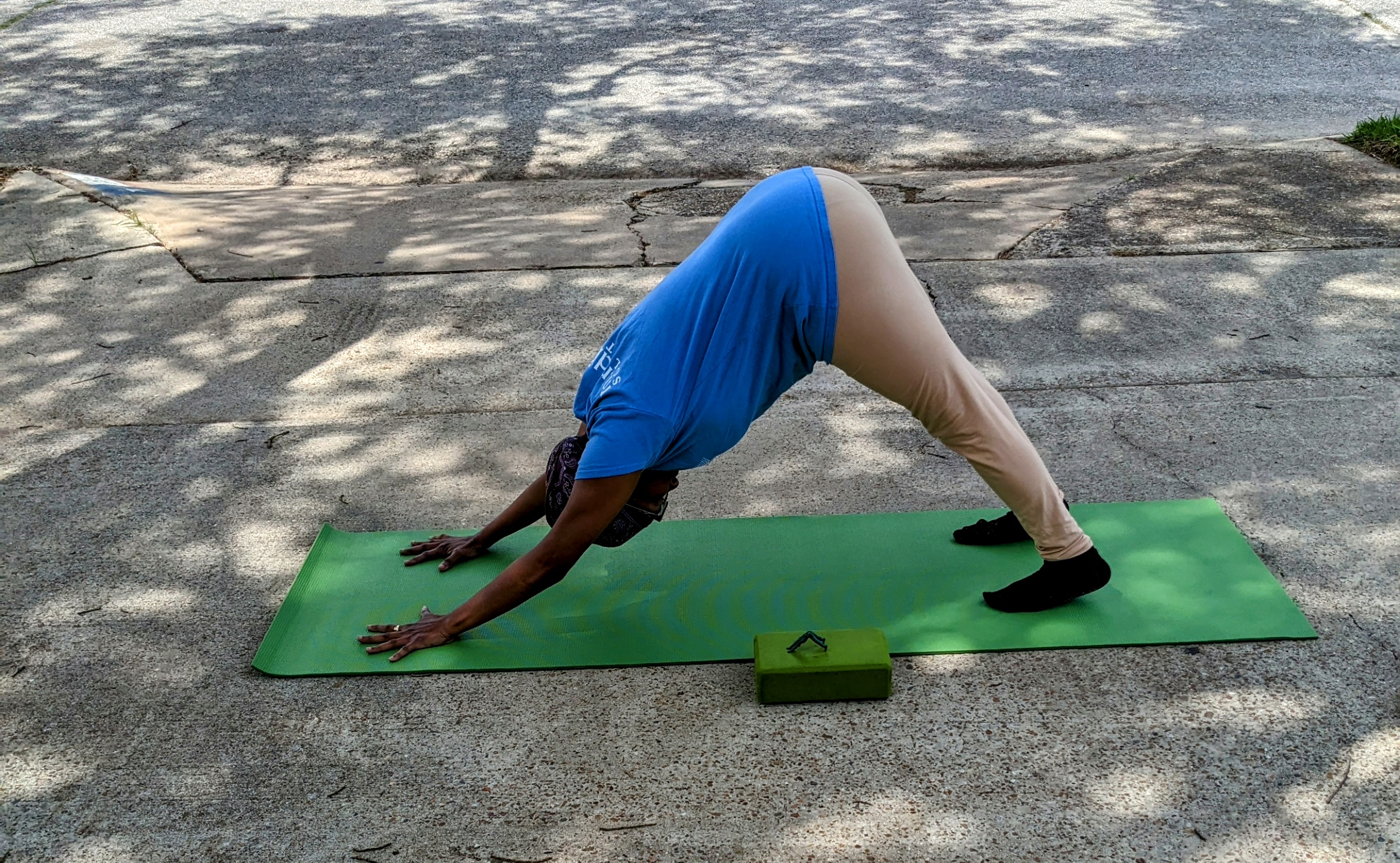
The picture above is part of my 2023 offering for the 10th annual Kiss My Asana yogathon, which benefits Mind Body Solutions (MBS). This week (April 22nd – 28th), I’m dedicated to raising awareness and resources for MBS’ life-affirming work to help people living with disabilities – and you can help too! You can help by joining me as we practice with purpose, by sharing this page, and/or by making a donation that creates opportunities for more people to practice yoga.
Mind Body Solutions provides live, online resources to people living with disabilities, worldwide. In addition to 11 live online yoga classes a week, MBS has also created a comprehensive library of recorded adaptive yoga classes for students, instructional videos for adaptive yoga teachers, and insightful interviews between our founder, Matthew Sanford, and adaptive students. It all helps people with disabilities live more fully, where they are and how they are.
Each year, in addition to hosting a fundraising page and making my personal donation, I offer a blog post and/or a YouTube post – sometimes even a whole practice. This year, part of my offering is a series of poses I’m posting on the Community page of my YouTube channel. Of course, there’s more to the poses (and pictures) than meets the eye. So, keep in mind that they – like the classes I lead – are just the tip of the iceberg.
What happens at Mind Body Solutions is the whole enchilada!
Ultimately, MBS is all about people having better relationships with their mind-body and spreading the message that a greater connection between mind and body can help us all live with improved comfort and ease.
The pictures above are part of my 2023 offering for the 10th annual Kiss My Asana yogathon, which benefits Mind Body Solutions (MBS). This week (April 22nd – 28th), I’m dedicated to raising awareness and resources for MBS’ life-affirming work to help people living with disabilities – and you can help too! You can help by joining me as we practice with purpose, by sharing this page, and/or by making a donation that creates opportunities for more people to practice yoga.
Mind Body Solutions provides live, online resources to people living with disabilities, worldwide. In addition to 11 live online yoga classes a week, MBS has also created a comprehensive library of recorded adaptive yoga classes for students, instructional videos for adaptive yoga teachers, and insightful interviews between our founder, Matthew Sanford, and adaptive students. It all helps people with disabilities live more fully, where they are and how they are.
Each year, in addition to hosting a fundraising page and making my personal donation, I offer a blog post and/or a YouTube post – sometimes even a whole practice. This year, part of my offering is a series of poses I’m posting on the Community page of my YouTube channel. Of course, there’s more to the poses (and pictures) than meets the eye. So, keep in mind that they – like the classes I lead – are just the tip of the iceberg.
What happens at Mind Body Solutions is the whole enchilada!
Ultimately, MBS is all about people having better relationships with their mind-body and spreading the message that a greater connection between mind and body can help us all live with improved comfort and ease.
“Happy Riḍván!” to those celebrating “the Most Great Festival.” Many blessings to anyone Counting the Omer or celebrating/observing Eastertide / the Octave of Easter!
The picture above is part of my 2023 offering for the 10th annual Kiss My Asana yogathon, which benefits Mind Body Solutions (MBS). This week (April 22nd – 28th), I’m dedicated to raising awareness and resources for MBS’ life-affirming work to help people living with disabilities – and you can help too! You can help by joining me as we practice with purpose, by sharing this page, and/or by making a donation that creates opportunities for more people to practice yoga.
Mind Body Solutions provides live, online resources to people living with disabilities, worldwide. In addition to 11 live online yoga classes a week, MBS has also created a comprehensive library of recorded adaptive yoga classes for students, instructional videos for adaptive yoga teachers, and insightful interviews between our founder, Matthew Sanford, and adaptive students. It all helps people with disabilities live more fully, where they are and how they are.
Each year, in addition to hosting a fundraising page and making my personal donation, I offer a blog post and/or a YouTube post – sometimes even a whole practice. This year, part of my offering is a series of poses I’m posting on the Community page of my YouTube channel. Of course, there’s more to the poses (and pictures) than meets the eye. So, keep in mind that they – like the classes I lead – are just the tip of the iceberg.
What happens at Mind Body Solutions is the whole enchilada!
Ultimately, MBS is all about people having better relationships with their mind-body and spreading the message that a greater connection between mind and body can help us all live with improved comfort and ease.
“Happy Riḍván!” to those celebrating “the Most Great Festival.” Many blessings to anyone Counting the Omer or celebrating/observing Eastertide / the Octave of Easter!
For Those Who Missed It: The Following was originally posted as part of my Kiss My Asana offering in 2020. I have adjusted some language, added a couple of critical details, and also added class details and links. Some links connect to sites outside of this blog.
( )
– Title of the third sigur rós album, on which all songs are “sung” by jónsi (born 4/23/1975) in Hopelandic (“Vonlenska” in Icelandic)
A lot of people, myself included, find sigur rós music relaxing. I also find it visceral, something felt deep in the body. So, sometimes, when I want people to really tune in and pay attention to how they are feeling – deep in their bodies – I play sigur rós. There are albums where jónsi, who was born today in 1975, sings in Icelandic. On the third album, however, he sings in an imaginary language known as Vonlenska. Vonlenska, as identified by a journalist, first appeared in the ninth track of the band’s debut album. The song is called “Von,” the Icelandic word for “hope.” Hence the name: Volenska. Hopelandic.
Hopelandic. How can you not love that name, or the idea of a place where the native language is hope?
“it’s of course not an actual language by definition (no vocabulary, grammar, etc.), it’s rather a form of gibberish vocals that fits to the music and acts as another instrument. jónsi likens it with what singers sometimes do when they’ve decided on the melody but haven’t written the lyrics yet.”
– from the faq section of the sigur rós website
When I play sigur rós in class, I remind people that they are hearing an imaginary language, but also point out that if you listen long enough you can not only sing along you can also feel as if you understand what is being sung – if not the words (since they aren’t, technically, words), at least the sentiment. I also explain that it is a little like listening to the mind-body.
Our minds and bodies speak in sensation, that’s how they communicate information. The only problem is, we’re not always fluent in sensation. So, just like we do when we are learning a new language, we need to experience the “vocabulary” in context and then repeat and repeat them until they are ingrained. Living our lives in our bodies is a little like being immersed in a foreign language – except for the part where we can ignore all of the sensation/information and only converse in our native tongue because, in some ways, it is easier than trying to understand this language no one spends a lot of time teaching us how to understand. The physical practice of yoga (hatha yoga, regardless of the style or tradition) is a way to start learning the language.
It’s not that hard to find a yoga class, if you consider yourself able-bodied and/or of sound mind (and/or if you are not marginalized in any way). Even now, under the when there was a worldwide lockdown, there were lots of options. It may take a little effort to find a yoga practice that works for you, but it’s out there. What if, however, you (or someone around you) didn’t consider you able-bodied and/or of sound mind? What if you had been told that because you couldn’t move parts of your body on your own, couldn’t breathe without a machine, and/or didn’t feel sensation the way others felt it, you couldn’t practice yoga? What if your body didn’t look like the teacher’s body? What if you had experienced a loss or a traumatic event so devastating that it was hard to get out of bed? What if you were burnt out from taking care of people? What if a doctor told you that you were all but dead?
“Or do you need to get quiet enough to understand that some person – maybe close to you, maybe you – needs a beautiful place to come to, just to be, to come back to the purity of your existence.
And whatever’s dragged you through your life up to this point, beaten you forward to solve whatever problems, you drop all of that. And find yourself.”
– Robert Boustany describing that ‘Every answer is inside you.’
I started practicing yoga between professional dancers and musicians, people who used their bodies to make a living. They were also people (pardon the pun) very in-tune with their bodies. Then there was me, and on the first day, Robert Boustany explained that I already practiced yoga (philosophically speaking).
Because I knew Robert’s background and knew some of the people who practiced with him under various conditions, it would be decades before it occurred to me that some people thought they couldn’t practice yoga. It was heartbreaking to realize that some people were being denied a really profound internal experience, a profoundly healing experience, because of a misconception about what yoga is and what it is not. It was heartbreaking to realize that there were yoga teachers all of the world who only knew how to teach a single, sometimes stereotypical, person – especially since there are so many people in the world who are not stereotypical.
“As I write this book, I am a yoga teacher, and I still get around in a wheelchair. I teach bodies that can stand when I cannot, that can feel things where I do not. This is possible because I have explored a different kind of connection between mind and body. Although I still cannot move my legs – and have no goal to do so – I do feel a heightened level of presence throughout my entire consciousness, including my paralyzed body.
It is a connection that we all share. Most of us, however, have not needed to bring it fully to consciousness. I believe this shared connection has profound implications not just for the shape and quality of our consciousness, but for the aging process, for the experience of trauma, for our approach to disability and rehabilitation, and even for our survival on this planet.”
– quoted from the Introduction to Waking: A Memoir of Trauma and Transcendence by Matthew Sanford
Matthew Sanford is one of those people who is not stereotypical. He founded Mind Body Solutions to help those who have experienced trauma, loss, and disability find new ways to live by integrating both mind and body. Known for their adaptive yoga classes, MBS provides “traditional yoga” classes, workshops, and outreach programs. They also train yoga teachers and offer highly specialized training for health care professionals. This year’s yogathon, the 10th annual yogathon, kicked off yesterday. Seven days to practice with purpose: to do yoga, share yoga, and help others. By participating in the Kiss My Asana yogathon you join a global movement, but in a personal way. In other words, you practice yoga… for 7 days. And you can start right now!
Please join me for a 65-minute virtual yoga practice on Zoom today (Sunday, April 23rd) at 2:30 PM.Use the link from the “Class Schedules” calendar if you run into any problems checking into the class. You can request an audio recording of this practice via a comment below or by emailing myra (at) ajoyfulpractice.com.
The practices I lead are full of little bits of teaching/practice I’ve picked up from Matthew Sanford and other teachers and students at Mind Body Solutions. Plus, I’ll be posting KMA offerings on the community page on my YouTube channel.
If you’re interested in my previous KMA offerings, check out the following (some links only take you to the beginning of a series):
In the spirit of generosity (“dana”), the Zoom classes, recordings, and blog posts are freely given and freely received. Ifyou are able to support these teachings, please do so as your heart moves you. (NOTE: You can donate even if you are “attending” a practice that is not designated as a “Common Ground Meditation Center” practice, or you can purchase class(es). Donations are tax deductible; class purchases are not necessarily deductible.)
“Happy Riḍván!” to those celebrating “the Most Great Festival.” Many blessings to anyone Counting the Omer or celebrating/observing Eastertide / the Octave of Easter!
This is a “missing” post for Saturday, April 22nd. It includes some recycled quotes and re-purposed information from earlier posts. Some embedded links will take you outside of the blog. You can request an audio recording of this practice via a comment below or (for a slightly faster reply) you can email me at myra (at) ajoyfulpractice.com.
“Those who contemplate the beauty of the earth find reserves of strength that will endure as long as life lasts. There is something infinitely healing in the repeated refrains of nature — the assurance that dawn comes after night, and spring after winter.”
– quoted from Silent Spring by Rachel Carson (published 1962)
So, this week we considered the power found in waiting, waiting in community and also the power of water and light – which is akin to fire – (plus there were some references to wind). But what about Earth… and Space? And what does any of this have to do with grace, particularly shastra kripa (or, at least, one of the definitions of shastra kripa)? To get to all that we have to get grounded, dig deep, and take a little detour through another celebration related to waiting and through a yogathon.
Notice, however, that all of the references below are centered and grounded in community.
“But it seems reasonable to believe — and I do believe — that the more clearly we can focus our attention on the wonders and realities of the universe about us the less taste we shall have for the destruction of our race. Wonder and humility are wholesome emotions, and they do not exist side by side with a lust for destruction.”
– Rachel Carson accepting the John Burroughs Medal (April 1952) and printed in Lost Woods: The Discovered Writing of Rachel Carson
In addition to being the beginning of the 10th annual Kiss My Asana yogathon, today was Earth Day. While the roots of Earth Day can be found in the 1962 publication of Rachel Carson’s Silent Spring, an actual day dedicated to Earth and peace was initially proposed by John McConnell during a 1969 conferenced hosted by the United Nations Educational, Scientific and Cultural Organization (UNESCO). The very first Earth Day, as he proposed it, was held in San Francisco on March 21, 1970, to coincide with the first day of spring in the northern hemisphere. Gaylord Nelson, a United States Senator from Wisconsin, proposed a nationwide environmental teach-in and hired a young activist named Denis Hayes to organize the first national Earth Day, which was held on April 22, 1970. More than 20 million people, including then-President Richard Nixon and First Lady Pat Nixon, participated in the events on April 22, 1970, making that day one of the largest protests in the United States. (The 1970 Earth Day teach-in was the largest recorded protest until the 2020 protest after the murder of George Floyd.)
“In these troubled times it is a wholesome and necessary thing for us to turn again to the earth and in the contemplation of her beauties to know the sense of wonder and humility. There is modern truth to the ancient wisdom of the psalmist: `I will lift up mine eyes unto the hills, from whence cometh my help.’”
– quoted from Rachel Carson’s original submission to “Words to Live By” for This Week Magazine (1951)
“A determination to be outward looking in the process of community building had already become an established aspect of culture in many, many places; it has now blossomed, in a rising number of communities, into a sense of real responsibility for the spiritual and material progress of larger and larger groups within society, well beyond the membership of the Bahá’í community itself. The efforts of the friends to build communities, to engage in social action, and to contribute to the prevalent discourses of society have cohered into one global enterprise, bound together by a common framework for action, focused on helping humanity to establish its affairs on a foundation of spiritual principles.”
– quoted from the Riḍván 2022 message from the Universal House of Justice “To the Bahá’is of the World”
Thursday night marked the beginning of the twelve-day festival of Ridván, “the Most Great Festival” in the Baháʼí Faith. As I mentioned last month, the Baháʼí Faith is a monotheistic faith that believes in the oneness of God and religion, as well as the oneness and nobility of humanity. The community believes that, historically, there has been a “progressive revelation of religious truth” which has been shared with the world through the voices of the prophets or Divine Messengers, known as “Manifestations of God” (which include “Braham, Krishna, Zoroaster, Moses, Buddha, Jesus Christ, Muhammad, and, in more recent times, the Báb and Bahá’u’lláh”). People within the faith are taught to honor the value of different religious and philosophical traditions as well as the value of education, especially in science (which is viewed by some faiths as being contrary to religion).
The Bahá’í calendar begins around the Vernal (Spring) Equinox in the Northern Hemisphere and has 19 months with 19 days – each named for one of the 19 names/manifestations/attributes of God. For example, “Splendor” and “Glory” are the English translations for Bahá and Jalál, the first two months (and days) of this solar calendar. There are also 4 or 5 intercalary days that occur just before the final month and which are considered “transcendent” in nature. The calendar is partially tied to the Gregorian calendar, in that days on each calendar always correspond with each other; however, the Bahá’í calendar is very much focused around its own historical liturgy. Hence, why 2023 is the year 180 BE (Bahá’í Era).
The twelve-day festival of Ridván, one of the holiest times within the Bahá’í community, is celebrated during the second month and begins exactly one Gregorian-month after the new year. This “Most Great Festival” in the Baháʼí Faith honors the time that the founder of the Bahá’i Faith, Bahá’u’lláh waited in the original garden of Ridván prior to being exiled to Constantinople. The Arabic word ridván means “paradise” and I indicated “the original garden,” because in addition to the garden outside of Baghdad, where the great spiritual leader (considered a manifestation of the Divine) prepared for his exile, there is a second garden with the same name in Israel, which Bahá’u’lláh visited after years of exile.
The festival is a time of a sacred time of prayer, reflection, and celebration. This year’s celebrations began two hours before sunset on Thursday – with the specific timing meant to commemorate the actual time, in 1863, when Bahá’u’lláh entered the Najíbíyyih Garden with his three sons and his secretary and began to receive the visitors who wanted to wish him well before his departure. It was during this time, in the space he called “paradise,” that Bahá’u’lláh declared himself as the most recent manifestation of God; that all religious wars were repealed; that there would not be another manifestation of the God for another 1,000 years; and that the names of God (or attributes of the divine) are manifested in all things. To honor the fact that he made these announcements, the Universal House of Justice issues an annual Ridván message. They also hold elections held during this time. The first day (yesterday), the ninth day (next Saturday), and the twelfth day are considered the most holy of days. The ninth day is auspicious because it is the day the rest of Bahá’u’lláh’s family joined him in the garden and it is also the beginning of the third month, Jamál (“Beauty”).
“Besides my involvement with the Investor’s Circle, I temporarily put aside my plan for an institute and returned to the basics – an almost exclusive focus on my yoga practice. After a couple of years, I decided that it was time to share my experience with yoga and paralysis. If nothing else, I could help others who lived with disability. I started teaching an adapted yoga class at the Courage Center, a leading rehabilitation facility in a suburb of Minneapolis.
My idea was that by teaching this class, I could give something back – an obvious means to make my experience useful. What I found was much more. I thought I was teaching these students, when, in fact, they were teaching me. Neurological deficit is a frontier of mind-body integration. Working with these students has taught me that the principles of yoga are nondiscriminating – they can travel though any body.”
– quoted from “16, Falling Gracefully” in “Part Three: Yoga, Bodies, and Baby Boys” of Waking: A Memoir of Trauma and Transcendence by Matthew Sanford
As I have mentioned before, my first exposure to the physical practice of yoga was also my first exposure to Yoga Philosophy and to the fact that anyone and everyone can practice yoga. Sometimes we stumble upon the practice that works for us. However, sometimes it takes an extra effort to find the practice (and the teacher) that works for our particular mind-bod-spirit. In fact, it wasn’t until I took my first yoga teacher training that I really realized how many people weren’t practicing, because they didn’t know they could practice. Even worse, some people had been told that they couldn’t practice – which is heartbreaking.
Still, I believed (and continue to believe) in the transformative, healing, and joyful experience of yoga. I also still believe there is a practice for every mind/body/spirit – every veteran, every person with disability, every survivor of sexual assault and other trauma, every elderly person, every person living with chronic pain, every person with a terminal illness, and every caregiver. I am joyfully participating in the Kiss My Asana yogathon for the 10th year in a row, because Mind Body Solutions is helping people find their practice!
The Kiss My Asana yogathon is an annual event that raises awareness and resources for Mind Body Solutions and their life-affirming work to help people living with disabilities. Best known for their Adaptive Yoga Program, which provides adapted yoga opportunities for people around the globe, MBS currently provides live, online resources to people living with disabilities, worldwide. In addition to 11 live online yoga classes a week, MBS has also created a comprehensive library of recorded adaptive yoga classes for students, instructional videos for adaptive yoga teachers, and insightful interviews between the founding teacher, Matthew Sanford, and adaptive students. In the past, MBS has also offered training and workshops for yoga teachers, healthcare professionals, and caregivers (so they can share this work in their communities, too).
All of this helps people with disabilities live more fully, where they are and how they are. Ultimately, however, Mind Body Solutions is all about everyone having better relationships with their mind-body and spreading the message that a greater connection between mind and body can help us all live with improved comfort and ease. So, we can all benefit from the practice, because we all experience trauma, loss, and disability in some way shape or form.
The yogathon started as a month-long endeavor, but switched to a 7-day yogathon in 2020. This week (April 22nd – 28th) I’m planning to practice with purpose. I’m going to “Do Yoga. Share Yoga. Help Others.” – and you can join me! The practices I lead will be full of little bits of teaching/practice I’ve picked up from Matthew Sanford and other teachers and students at Mind Body Solutions. Plus, I’ll be posting on the community page on my YouTube channel.
If you’re interested in my previous KMA offerings, check out the following (some links only take you to the beginning of a series):
Saturday’s playlist is available on YouTube and Spotify. [Look for “0422020 Earth Day”]
What’s this?
Dandasana (“Staff Pose”)
Have you subscribed to my YouTube page? It’s mostly playlists, plus a few mini-practices and videos from previous yogathons. Starting later tonight, I’m also going to be posting on my community page as part of my 2023 Kiss My Asana offering. So, check it out if you want to know more about the pose pictured above (and why we’re doing it).
Blessings to anyone observing Holy Monday / Passion Monday or Great Lent! “Ramadān Mubarak, Blessed Ramadān!” to anyone who is observing the holy month of Ramadān. Many blessings to all during this “Season for Non-violence” and all other seasons!
This “missing” post for Monday, April 4th. You can request an audio recording of this practice (or a date-related practice) via a comment below or (for a slightly faster reply) you can email me at myra (at) ajoyfulpractice.com.
In the spirit of generosity (“dana”), the Zoom classes, recordings, and blog posts are freely given and freely received. If you are able to support these teachings, please do so as your heart moves you. (NOTE: You can donate even if you are “attending” a practice that is not designated as a “Common Ground Meditation Center” practice. Donations are tax deductible.
– the original New York Metropolitan Transportation Authority slogan to promote public safety
The message is everywhere (at least in the United States). It’s on billboards and posters, commercials and print ads, public service announcements and t-shirts. In fact, the message is so ubiquitous, it feels like it’s been around forever. And maybe, on some level it has. However, the slogan was actually a campaign that was trademarked and implemented by the New York Metropolitan Transportation Authority (NY MTA) after the 9/11 terrorist attack in 2001. Nine years after the attack (in July of 2010), the NY MTA granted the U. S. Department of Homeland Security (DHS) permission to use slogan as part of a national anti-terrorism campaign. That campaign created partnerships with state and local governments, federal agencies, major sports leagues, transit stations, entertainment venues, private businesses, places of worship, nonprofits, schools, and many other types of organizations – which is why the message is, quite literally, everywhere.
There’s even a National “If You See Something, Say Something®” Awareness Day (September 25), also known as #SeeSayDay, which serves the same two-fold purpose as the overall campaign:
To remind everyone to keep an eye out for suspicious activity, that might be related to terrorism
To empower people to report suspicious activity to the proper authorities
Part of that first part requires people to be able to recognize suspicious activity (that might be related to terrorism) and, also, to recognize that we all play a part in public safety. The second part gives people the authority to act. All in all, it is a great campaign. Of course, some interesting things have happened since 2001, with regard DHS’s national campaign. First, the definition of “suspicious activity” has expanded to include anything that might be criminal and/or that makes someone uncomfortable. Second, some people feel more empowered than others. Then there’s a third outcome, predicated by the other two. One might even call it an “unintended consequence.”
Sometimes the people who feel most empowered to report “suspicious activity” are uncomfortable with innocuous activities – which can create (and has created) situations where actually suspicious activity is not reported. It’s a double-edged sword that, in some ways, presents every individual with a moral (and practical) conundrum:
How do we fulfill our purpose (according to the “law”) and by whose authority can we exert our judgment/opinion about someone else’s behavior?
“One’s personal duty in life (one’s sva-dharma) should be viewed as one’s highest responsibility to his or her highest Self, the Atma. This ultrahigh level of duty carries with it the requirement that one never does anything that is contrary to this True Self Within. And even if you consider your sva-dharma more narrowly from the standpoint of being true to your profession, you should not hesitate to fight. For a warrior, war against evil, greed, cruelty, hate, and jealousy is the highest duty.”
– Krishna speaking to Arjuna (2.31) in The Bhagavad Gita: A Walkthrough for Westerners by Jack Hawley
Sacred texts from a variety of different cultures, tell us that everyone has a purpose. However, even if you don’t believe the old adage, science has shown that people who live a purpose driven life have better physical and mental health and stronger resilience than their peers. It’s a bit of a cycle: we need our mind-body-spirit to fulfill a purpose and fulfilling the purpose strengthens our mind-body-spirit so that we are better equipped to fulfill the purpose.
Sometimes, however, we do things – or don’t do things – that sap our energy and drag us down. If our mind-bodies are temples, then the things that sap our energy are like thieves in the temple. Thieves can be eating the wrong foods; drinking too much of the wrong beverages and/or not drinking enough water; not resting; not exercising; partaking in illicit drugs; not managing stress; and/or being surrounded by negative opinions. Doesn’t matter what they are though, because at some point we have to throw the thieves out of the temple in order to restore the temple to its original purpose.
“And Jesus went into the temple of God, and cast out all them that sold and bought in the temple, and overthrew the tables of the moneychangers, and the seats of them that sold doves,” (Matthew 21:12 KJV)
“And said unto them, It is written, My house shall be called the house of prayer; but ye have made it a den of thieves.” (Matthew 21:13 KJV)
– The Gospel According to Matthew
Passion Monday, or Holy Monday, is associated with the story of Jesus cleansing the temple. According to the New Testament Gospels, Jesus is very clear about his purpose as he enters the last week of his life. He understands that there will be suffering (hence, the passion), trials, tribulation, and betrayal, and joy. He knows he will be tested and tempted (yet another passion/suffering). It is unclear if he knows how quickly the suffering will begin, but suffice it to say, it is immediate.
When he returns to Jerusalem for Passover, Jesus finds that the Temple of Jerusalem had been turned into a defacto market place. All four (4) canonical gospels (Matthew, Mark, Luke, and John) state that Jesus runs the livestock and the merchants out, and overturns the tables of the money changers and the dove sellers. He then begins to heal the sick and to teach, thus restoring the temple to its original purpose. Children praise him and this, along with everything else, riles up the establishment.
In three (3) of the New Testament Gospels (Matthew, Mark, and Luke) several groups of the establishment question Jesus’ authority and his views on taxes. First he is asked, “By what authority are you doing these things?” To which, Jesus asks his own question regarding the authority of the then wildly popular John the Baptist:
“And Jesus answered and said unto them, I also will ask you one thing, which if ye tell me, I in like wise will tell you by what authority I do these things.” (Matthew 21:24 KJV)
“The baptism of John, whence was it? from heaven, or of men? And they reasoned with themselves, saying, If we shall say, From heaven; he will say unto us, Why did ye not then believe him?” (Matthew 21:25 KJV)
“And they answered Jesus, and said, We cannot tell. And he said unto them, Neither tell I you by what authority I do these things.” (Matthew 21:26 KJV)
Later, in another attempt to trap Jesus, the elders ask him if the Jewish people should pay taxes to the Roman Empire. He asks them to show him a coin suitable for payment and, when they present a coin with a Roman face on the front – specifically, Caesar’s face – Jesus says, “Render therefore unto Caesar the things which are Caesar’s; and unto God the things that are God’s.” (Matthew 22:21)
“But if you do not fight this battle of good over evil, you will fail in both your worldly duty and in your duty to your very Self. You will violate your sva-dharma. Not doing the right thing when it is required is worse than doing the wrong thing.”
– Krishna speaking to Arjuna (2.33) in The Bhagavad Gita: A Walkthrough for Westerners by Jack Hawley
Just like Jesus in the New Testament, we can all find ourselves in situations where we feel the responsibility to speak up and do the right thing. We may even find that someone questions our authority to do what we feel must be done. In fact, we may be the one questioning whether we have the authority (or the correct information) to do something. And that last part is crucial; because – as we must remember – part of the DHS campaign was about awareness.
Just like Patanjali, Western Science, delineates a conscious, unconscious, and subconscious part of the mind. In the Yoga Sūtras, Patanjali also described four levels of conscious-awareness: gross, subtle, bliss, and I-ness. (YS 1.17) Those first two levels (gross and subtle) must be engaged in order for us to fulfill our purpose. If they are not engaged, then we are like a zombie, sleep-walking through life.
“The great error in Rip’s composition was an insuperable aversion to all kinds of profitable labor.”
– quoted from “Rip Van Winkle” by Washington Irving
Passion Week, or Holy Week, is associated with a moveable feast and, therefore, falls at different times on the Gregorian calendar. This year, Passion Monday (in the Western Christian and Roman Catholic traditions) coincides with the anniversary of the birth of Washington Irving (born April 3, 1783), whose “Rip Van Winkle” can be connected to ancient Greek philosophy and to a story about ancient Christians that appears in the Qur’an.
Just like each person has a purpose in life (and with regard to public safety), each part of the mind-body plays a part in our ability to fulfill our purpose. Just like things we consume – food, drink, media, experiences – can be the thieves that prevent us from doing our duty, so too can an injury… or, something as simple as one part of our body “falling asleep.”
Technically (medically) speaking, a body part falling asleep is “transient (temporary) paresthesia,” which occurs when pressure on the nerves and/or reduced blood flow causes a disconnect between the brain and the affected body part. In addition to the affected body part not working properly until it “wakes up,” a person may stop all other conscious activity in order to resolve the issue with the one part that is in pain. To add insult to injury, it’s not only painful when part of the body falls asleep, it’s also painful to “wake” it up. But, we must, if we are to (safely) function as a (united) whole.
“A man dies when he refuses to stand up for that which is right. A man dies when he refuses to stand up for justice. A man dies when he refuses to take a stand for that which is true.”
– quoted from a sermon (or speech at the pulpit) given on March 8, 1965, by the Rev. Martin Luther King Jr.
“Nine days and nine nights of blessings and happiness if you are celebrating Chaitra Navaratri!” “Ramadān Mubarak, Blessed Ramadān!” to anyone who is observing the holy month of Ramadān. Blessings to anyone observing Lent or Great Lent! Many blessings to all during this “Season for Non-violence” and all other seasons!
This is the “missing” post for Sunday, March 26th. It is also a revised (and expanded) from 2019, with an itty bit from 2020– so, literally another look. Some links in the post connect to sites outside of the blog. You can request an audio recording of this practice via a comment belowor (for a slightly faster reply) you can email me at myra (at) ajoyfulpractice.com.
In the spirit of generosity (“dana”), the Zoom classes, recordings, and blog posts are freely given and freely received. If you are able to support these teachings, please do so as your heart moves you. (NOTE: You can donate even if you are “attending” a practice that is not designated as a “Common Ground Meditation Center” practice, or you can purchase class(es). Donations are tax deductible; class purchases are not necessarily deductible.
– quoted from the poem “Mending Wall” by Robert Frost
“The violets in the mountains have broken the rocks. The world thirsts after sympathy, compassion, love.”
– quoted from the play Camino Real by Tennessee Williams (The first sentence is also the epitaph on his grave.)
There are people in the world who will say you haven’t read poetry until you read Robert Frost, and Southerners in the world who will say you haven’t seen a play until you’ve seen Tennessee Williams. Born 37 years and over 2,000 miles apart, these two literary icons shared a birthday (3/26) and way with words. Although, some would say they used their words in different ways.
Born in 1874, in San Francisco, California, Robert Frost wrote about things like “a snowy evening,” “mending a wall,” and “the road not taken” – although, in the latter case, people often mistake it for “the road less traveled.” His poems are often as much about perspective as they are about the way we tell a story (and the fact that the way we tell a story can change the story). They also illustrate how the stories we tell (ourselves and the world) are not always about the truth so much as they about what we understand about the world and ourselves.
Born in 1911, in Columbus, Mississippi, Tennessee Williams wrote about emotionally volatile people in the South and from the South. He wrote about characters and circumstances that reflected the emotional turmoil he saw and felt inside himself and all around him. Then, so that the emotional states of the the people and situations could not be ignored (or missed) he reinforced them with the use of props, sound effects, and blocking. In other words, he used the physical to embody the emotional and energetic – and, in doing so, drew the audience into the hearts of the characters.
Even though their mediums and subjects were different, they both wrote in a way that can make you pause, look again…and again. Once or thrice you may even wonder how many ways you can see/interpret/understand what has been said, and how it applies to your life. A good story, regardless of the medium, will make you do that: consider how it applies to your life.
“Something we were withholding made us weak Until we found out that it was ourselves We were withholding from our land of living, And forthwith found salvation in surrender.”
– quoted from the poem “The Gift Outright” by Robert Frost
Every once in a while (as I did last Wednesday and again on Sunday), I mention Maty Ezraty, who was a teacher of teachers and who said that every yoga practice should be like a good story. One of my takeaways from that suggestion has always been that, each part of the mind-body-spirit is like a character in a story. Just like each character has a different purpose and a different point of view, each pose/sequence can give each part of our bodies and minds an opportunity to tell their story. Another takeaway is that everything is leading to and from the heart of the story.
So, let’s start with the hearts.
“What is straight? A line can be straight, or a street, but the human heart, oh, no, it’s curved like a road through mountains.”
– quoted from the play “A Streetcar Named Desire” by Tennessee Williams
Yes, I said, “hearts” – plural. Swami Rama from the Himalayan tradition said that we have three hearts: a physical heart, which for most of us is on the left side; an emotional heart on the opposite side, which for most of us is on the right; and an energetic heart that connects the two. That energetic heart, which some consider a spiritual heart, connects our hearts with all the other hearts around us. Additionally, in yoga and other Eastern healing arts, energy for the heart flows through the arms.
The heart chakra, in yoga (as it comes to us from India) is symbolically and energetically associated with the upper torso, shoulders, arms, hands, and fingers. In Yin Yoga, which is based on Traditional Chinese Medicine, the heart median has three branches, one of which runs down the inner arms into the pinky fingers. According to the Kabbalah, Jewish mysticism, there are 10 Divine attributes (from the Tree of Life) through which G-d is revealed to the world – and 7 of these can be found in the body. Love/loving-kindness (chesed in Hebrew) is associated with the right arm and is balanced by strength (gevurah in Hebrew), which is associated with the left arm.
Just as people contemplate the Divine attributes when they are counting the Omer in some Jewish traditions, people in Buddhist traditions contemplate the Divine abodes (brahmavihārāḥ in Sanskrit), which are heart practices: loving-kindness or benevolence (mettā); compassion (karuṇā); empathetic joy (muditā); and equanimity (upekkhā). In some Indian philosophies (like Yoga), the ability to cultivate a good heart/make friends (suhrit-prapati) and generosity (dana) can also be considered heart practices. On (and off) the mat, we can contemplate these same emotional and energetic aspects of ourselves by bringing awareness to our arms and how we use our arms… to reach out, to embrace, to extend ourselves.
We may notice – as we move through our practice or through our day – how we are expressing our heart or how we are withholding our heart. But, there’s always the possibility that we don’t notice. We may not notice when we are off the mat, because we are distracted. We may not notice on the mat, because we are focused on other parts of the mind-body. This is why it’s important to notice how we move and why we move the way we move – because it all tells a story.
“Two roads diverged in a yellow wood, And sorry I could not travel both And be one traveler, long I stood And looked down one as far as I could To where it bent in the undergrowth;
Then took the other, as just as fair,”
– quoted from the poem “The Road Not Taken” by Robert Frost
There are hundreds of poses and hundreds, thousands – maybe even millions – of ways to move into and out of pose. And each one of those ways gives us another way of looking at the story. The tricky thing is that sometimes we keep coming back to the story the same way. But, what happens if we came at things a different way? What happens if we let a different part of our mind-body-spirit take the lead? What happens if our circumstances and understanding of the world changes? What happens if our understanding of ourselves changes?
Sometimes, the practice can be like a favorite story that we read again and again – or re-read, years after the initial reading – and we suddenly see everything from a different perspective. In fact, one of the things I like about the practice is the opportunity to revisit themes and/or sequences and suddenly discover something completely different. It’s also one of the things I love about reading (and watching) great works of art.
“We have to use a spell to make them balance: “Stay where you are until our backs are turned!” We wear our fingers rough with handling them. Oh, just another kind of out-door game, One on a side. It comes to little more: There where it is we do not need the wall: He is all pine and I am apple orchard. My apple trees will never get across And eat the cones under his pines, I tell him. He only says, “Good fences make good neighbours.” Spring is the mischief in me, and I wonder If I could put a notion in his head: “Why do they make good neighbours? Isn’t it Where there are cows? But here there are no cows. Before I built a wall I’d ask to know What I was walling in or walling out, And to whom I was like to give offence.”
– quoted from the poem “Mending Wall” by Robert Frost
Parighāsana (Gate Pose) stretches the pelvic area and hamstrings, while also engaging the sides of the torso and abdomen eccentrically (up side) and concentrically (down side). According to B.K.S. Iyengar’s Light on Yoga, the pose “keeps the abdominal muscles and organs in condition and the skin around the abdomen will not sag but remain healthy. The sideways spinal movement will help persons suffering from stiff backs.” I find that it is a great way to get into the hips and the legs. Another aspect of the pose is what happens to the heart area – not only physically, but emotionally.
Parighāsana offers us the opportunity to open up the shoulders (physically) and open the gates on all sides of the heart (emotionally and energetically). It also offers some interesting insight into how we sometimes engage the different aspects of our heart. For instances, when I cue and describe the pose in a practice, many people have a tendency to lift the bottom hand up to meet the top hand – rather than extending the upper body down towards the lower hand. To be fair, many people do not have the strength and flexibility to kneel on one leg, stretch out the other leg, and then bend sideways until the top hand lowers down. But, what is interesting is how people deal with the resistance. Initially, they lift the bottom hand up – because it’s easy (and obvious). When I point out that it’s the top hand that needs to reach down, many people will fold in on themselves; essentially closing down and hiding the heart to make the connection. However, the “goal” is to open the gate and to stay open in the process.
“Lonely . . . When so many are lonely as seem to be lonely, it would be inexcusably selfish to be lonely alone.”
– Don Quixote in the Prologue to Camino Real by Tennessee Williams
We all build walls around our hearts. Sometimes we do it for protection, because we have perceived an actual threat. Other times, we build walls, because of fear associated with a perceived threat. That perceived threat might turn out to be an actual threat, but it could also simply be a possibility (or a misperception). Of course, we can also get in the habit of building walls – because it’s what others have done before us, what we’ve been taught, and/or because we have experienced harm in the past. But, even castle walls have gates and drawbridges, a way in and a way out.
When we really pay attention to the ways we engage our heart, on and off the mat, we may find it challenging to open the gate. We may find that we take the easy route – especially when there’s a little awkward balancing, as there is in parighāsana – and/or we may find that we are compromising ourselves (and our hearts) in order to make a connection. One suggestion I make, during the physical practice, is to bend the lifted elbow (so the hand is behind the head) and then use the whole body to rotate the elbow up. This changes the focus and reinforces the idea that we are opening the heart and the side-body. I often sequence a modified side plank after the “Gate Pose,” as a reminder that there can be more than one way to open a gate.
Take a moment to consider a time when you compromised yourself in order to make a connection. How could you have refocused your awareness, energy, and resources in order to reinforce what was important? Could you have made the connection (or a similar connection) in a different way?
“It should be of the pleasure of a poem itself to tell how it can. The figure a poem makes. It begins in delight and ends in wisdom. The figure is the same as for love. No one can really hold that the ecstasy should be static and stand still in one place. It begins in delight, it inclines to the impulse, it assumes direction with the first line laid down, it runs a course of lucky events, and ends in a clarification of life–not necessarily a great clarification, such as sects and cults are founded on, but in a momentary stay against confusion.”
– quoted from the essay “The Figure a Poem Makes” by Robert Frost (which served as an introduction to his Collected Poems beginning with the 1939 edition)
Two of my favorite lines from Robert Frost speak of wisdom and delight, and the gift that comes from giving our whole selves. Every time I step on a yoga mat, I experience the wisdom and the delight. I also experience a plethora of gifts. One of those gifts is how the practice affects the mind. In Cat on a Hot Tin Roof, Tennessee Williams has Brick acknowledging that he is an alcoholic, but not seeming to want to give up his drinking because, “It’s like a switch, clickin’ off in my head. Turns the hot light off and the cool one on, and all of a sudden there’s peace.” But then, as his father points out to him, there is the morning.
One of the gifts of yoga is that it brings peace without the hangover. It can flip the switch. Another thing to consider is that the practice has a way of opening the heart so we can get to the violets.
“To me, its meaning is simple. The hard, the cold, the oppressive will—at long last—be broken apart by a force that is beautiful, natural, colorful, alive.”
Peace and blessings to all, and especially to those observing Lent, Great Lent, and the Baháʼí 19-Day Fast during this “Season for Non-violence” and all other seasons!
“You could call someone where it’s still early.
Go out and look at the stars shining in the past
Or open the Joachim Jeremias to the densely printed page, it’s corner folded for some reason not yet remembered
before you set the clock.
You have to set the clock— for a moment that doesn’t exist yet”
– quoted from the poem “Home Remedy” in God’s Silence by Franz Wright
Do you remember this week, three years ago? Do you remember today?
I know, I know, some parts of the last three years are a blur; but, three years ago today, I was putting together a full-length practice video, to post on YouTube. It was a Wednesday, everything was shutting down, and I was posting the video so people could keep up their practice. I had no real plans to do anything else… other than post on the blog for two weeks and maybe post a couple of more videos. Goodness. Do you remember when…?
It’s a little surreal to realize that – not counting my videos on the Carry prenatal yoga and meditation app – my first full-length (physical) practice video, with all it’s flaws, is still my only full-length (physical) practice video. What is super surreal is to think about the hundreds of full-length audio recordings I’ve made in the meantime and, also, to realize that 2019 was the last time I taught a live class on the anniversary of the birth of Franz Wright.
“I am here to learn to bear the beams of love, what else
Bells through the leaves, I am here to endure the
bells tolling underground”
– quoted from the poem “Introduction” in God’s Silence by Franz Wright
Born in Vienna, today in 1953, Franz Wright spent portions of his childhood in Washington (state), California, and the Midwestern United States (in particular, Minnesota). In addition to sharing similar poetic themes, he and his father, James Wright, are the only parent and child to win a Pulitzer Prize in the same category. The elder Wright suffered from depression, bipolar disorders, and alcoholism and focused on the emotional suffering he saw around him, especially that suffering experienced by the disenfranchised in America. The younger Wright wrote about isolation, loneliness, longing, insomnia, and death intersecting with kindness, love, faith, hope, and peace. Three years ago today, I thought it oddly and serendipitously appropriate that my first virtual offering focused on Franz Wright’s work.
Three years later, I find his words still ring true and, oddly, still fit our current circumstances.
Versions of the following were original posted on March18thand20thof 2020. You can click on the dates (to the left) to view the original posts. Some links (below) will take you away from my blog.
Chicago Tribune critic Julia Keller once described one of Franz Wright’s collections as being “ultimately about joy and grace and the possibility of redemption, about coming out whole on the other side of emotional catastrophe,” while Denis Johnson supposedly compared his poems to “tiny jewels shaped by blunt, ruined fingers – miraculous gifts.” I know, that’s a lot to take in (and you might need to read that Va. Woolf-like sentence again). The thing is; I think we are (still) in the middle of a Franz Wright poem. So, brace yourself.
I first came across Franz Wright’s poem “Solution” in a 2015 blog post written by Alison McGhee, a New York Times bestselling author and Pulitzer Prize-nominee, who writes and teaches up the street from where I was in March of 2020. In the post (which I strongly recommend), Professor McGhee wrote about an encounter she had with someone best described as her exterior opposite. Yet the interior movements of the heart, all of our hearts, are ultimately the same – something both Alison McGhee’s short post and Franz Wright’s poem illustrate bluntly, beautifully, and miraculously.
Both the post and the poem contain reminders we could all use right now.
“What is the meaning of kindness? Speak and listen to others, from now on, as if they had recently died. At the core the seen and unseen worlds are one.”
– “Solution” by Franz Wright
Franz Wright’s poems are full of natural spirituality and that oftentimes “heartbreaking human conflict between religion and spirit.” The final line of the poem “Solution” reminds me of 2 Corinthians 4:18 where Saint Paul and Saint Timothy wrote, “So we fix our eyes not on what is seen, but on what is unseen, since what is seen is temporary, but what is unseen is eternal.” NOTE: The New Living Translation translates this passage as “So we don’t look at the troubles we can see now; rather, we fix our gaze on things that cannot be seen. For the things we see now will soon be gone, but the things we cannot see will last forever.” In 2020, I suggested focusing on what is unseen (during the practice). Today, I suggest focusing on the unseen as grace (how ever that resonates for you).
“II
The long silences need to be loved, perhaps more than the words which arrive to describe them in time.”
– quoted from the poem “Home Remedy” in God’s Silence by Franz Wright
Franz Wright won two National Endowment for the Arts grants (1985 and 1992), a Guggenheim Fellowship (1989), a Whiting Award (1991), the PEN/Voelcker Award for Poetry, (1996), and the aforementioned Pulitzer Prize for Poetry. His first collection after winning the 2004 Pulitzer Prize was entitled God’s Silence. I haven’t read all of it (yet), but I am still fascinated by the idea of 144 pages worth of Franz Wright poetry curated around the idea of “God’s Silence.” Notice, that it’s 144 pages – not 144 poems. (Poets everywhere are now doing the math.) This is the kind of the thing that gets me oddly excited, because there is so much I want to know!
I want to know if he was referring to silence that is the response to a prayer or a request (or even a curse); the silence that precedes an answer; the silence that follows the answer (when the questioner is dumbfounded or in awe of the response); the silence when one is pondering the best way to phrase something and therefore measuring their words; the silence of shock (can we shock God?); the silence of disappointment; the silence of wonder; the silence when no one is around; the silence of sleeping children; the silence between one breath and the next; the silence of meditation; the silence of peace; the silence honoring the dead; the silence just before a newborn declares itself alive; or….The list goes on.
He could have been talking about all of the above. Or none of the above. There are so many possibilities – and they are all full of grace (whatever that means to you in this moment)!
“I
Armed Conflict
Snowy light fills the room pronouncing itself
softly. The telephone ringing
in the deserted city— ”
– the poem “Armed Conflict” quoted from God’s Silence by Franz Wright
The first section of God’s Silence is entitled “East Boston, 1996” and the first poem in that section, “Armed Conflict,” sets the stage for the other poems, including “Solitary Play: Minnesota, 1961” – which is a dark and twisted coming of age poem. The latter feels even darker and more twisted given so many current events related to children and our conflicts about the 2nd Amendment. And that’s the thing, again, about Franz Wright’s poetry: We don’t have to go through the things he went through to feel, deep inside of our own hearts, the gut-wrenching things he felt.
We don’t have to be the son of James Wright to understand what it is like to stand in the shadow and the light of a parent who struggled every day with their own darkness and light. Neither do we have to be abandoned by said parent to see the poignant irony of living (and dying) in much the same ways. Nor do we have to spend our finally days, dealing with terminal lung cancer and writing what are essentially love poems to our spouse*, to understand why a collection of memories is named Kindertotenwald (essentially, a forest of ones who will never age). We all get it, can get it; especially, if we read (or listen to) Franz Wright’s poetry.
Maybe, possibly, we can also get the grace that was his kindness, love, faith, hope, and peace.
“After all, it was only a blizzard in Minneapolis in 1959. How are you supposed to describe something like me? And when you think about it, why should you try, why should you even care?”
– quoted from the prose poem “Wintersleep” in Kindertotenwald by Franz Wright
I not only care about poetry that gets you through hard times, I love it. In part, because it makes you realize that someone has been through harder – or, as hard of a time as you. Additionally, I think one of the reasons I was/am so fascinated with the idea of God’s Silence is that part of my practice involves silence, moving into silence and stillness. The kind of silence and stillness that can make people uncomfortable, because it is so powerful. Yet, it is simultaneously the kind of silence and stillness that is the epitome of peace. When Patanjali codified the philosophy of yoga in the Yoga Sūtras, he wrote, “yogash citta vritti nirodah.” (YS 1.2) Yoga ceases the fluctuations of the mind.
Silence.
Perhaps, God’s silence.
“Like you a guest, a ghost here
Everything will be forgotten
And either I am too alone or I am not alone enough to make each moment holy
(no one bats 1,000 friend
no one
bats 500)
And I have heard God’s silence like the sun
and sought to change
Now
I’m just going to listen to the silence
till the Silence.”
– quoted from the poem “Introduction” in God’s Silence by Franz Wright
Please join me for a 90-minute virtual yoga practice on Zoom today (Saturday, March 18th) at 12:00 PM.Use the link from the “Class Schedules” calendar if you run into any problems checking into the class. You can request an audio recording of this practice via a comment below or by emailing myra (at) ajoyfulpractice.com.
Saturday’s playlist is available on YouTube and Spotify. [Look for “07082020 On Death & Dying”]
*NOTE: Franz Wright was married to the translator Elizabeth Oehlkers Wright. In addition to writing and recording some of his poems (including the Clem Snide song “Encounter at 3AM,”) Mr. Wright recorded some of his final thoughts and conversations before he died in 2015. Last Words, is a documentary featuring those final recordings.
“All of this is for your benefit. And as God’s grace reaches more and more people, there will be great thanksgiving, and God will receive more and more glory.
That is why we never give up. Though our bodies are dying, our spirits are being renewed every day.
For our present troubles are small and won’t last very long. Yet they produce for us a glory that vastly outweighs them and will last forever!
So we don’t look at the troubles we can see now; rather, we fix our gaze on things that cannot be seen. For the things we see now will soon be gone, but the things we cannot see will last forever.”
– The Second Epistle of Paul the Apostle to the Corinthians 4:15 – 18 (NLT)
In the spirit of generosity (“dana”), the Zoom classes, recordings, and blog posts are freely given and freely received. If you are able to support these teachings, please do so as your heart moves you. (NOTE: You can donate even if you are “attending” a practice that is not designated as a “Common Ground Meditation Center” practice, or you can purchase class(es). Donations are tax deductible; class purchases are not necessarily deductible.)