FTWMI: The Philosophy of Picking Locks (& Other Things Related to Internal Movement) [the “missing” Wednesday post] April 26, 2023
Posted by ajoyfulpractice in 7-Day Challenge, Baha'i, Buddhism, Changing Perspectives, Confessions, Depression, Donate, Faith, Gratitude, Healing Stories, Health, Hope, Karma Yoga, Life, Loss, Love, Music, One Hoop, Pain, Philosophy, Religion, Riḍván, Science, Suffering, Tragedy, Volunteer, Wisdom, Yoga.Tags: Adho Mukha Svanasana, ASMR, Beno Gutenberg, Carol Burnett, Charles Richter, Henry Spall, KISS MY ASANA, Lock Picking Lawyer, Ludwig Wittgenstein, maya, Mind Body Solutions, pranayama, Rainer Maria Rilke, Susan Elizabeth Hough, Yoga Sutras 2.46-2.49
add a comment
“Happy Riḍván!” to those celebrating “the Most Great Festival.” Many blessings to everyone, and especially to anyone Counting the Omer!
For Those Who Missed It: The following was originally posted in 2021. In addition to a few revisions, I have updated the class details and music links, as well as information related to this year’s Kiss My Asana yogathon. Some embedded links will direct you outside of this blog. Astronomical details related to April 26, 2021 have not been changed. WARNING: There is passing reference to people with mental health issues. You can request an audio recording of this practice via a comment below or (for a slightly faster reply) you can email me at myra (at) ajoyfulpractice.com.
In the spirit of generosity (“dana”), the Zoom classes, recordings, and blog posts are freely given and freely received. If you are able to support these teachings, please do so as your heart moves you. (NOTE: You can donate even if you are “attending” a practice that is not designated as a “Common Ground Meditation Center” practice, or you can purchase class(es).
This week you can also click here to Kiss My Asana Now! (Or, you can also click here to join my team and get people to kiss [your] asana!)
Donations are tax deductible; class purchases are not necessarily deductible.Check out the “Class Schedules” calendar for upcoming classes.)
“‘My main point today is that usually one gets what one expects, but very rarely in the way one expected it.’”
– quoted from a draft of Charles Richter’s 1970 retirement speech, as printed in the Appendix of Richter’s Scale: Measure of an Earthquake, Measure of a Man by Susan Elizabeth Hough
Over the last month (or so) I have developed a new guilty pleasure: watching the Lock Picking Lawyer’s YouTube videos. To be completely transparent, I will admit that I have known people who spent their down time at work picking locks from the “lost and found” (or locks that someone on staff had to break, because the owner locked themselves out). I will also admit that I found it an odd and eyebrow raising hobby – especially when they did it in full view of the very people who relied on locks for security. However, my previous opinions haven’t stopped me from getting hooked by these videos, starting with the first one I watched (which I will link at the end of this post).
The first video was the Lock Picking Lawyer’s annual April 1st video, which is slightly different from his regular offering (in that it is a joke); but still contains some of the same elements that are, frankly speaking, compelling and addictive. First, the videos are witty, logical, informative, and low-key ASMR. (ASMR stands for Autonomous Sensory Meridian Response and is used to describe content that provides a calming experience for the brain and spine; what some people call a “brain massage.”) Second, the videos are philosophical on several different levels and reinforce some critical elements of our physical practice of yoga.
“Philosophy is like trying to open a safe with a combination lock: each little adjustment of the dials seems to achieve nothing, only when everything is in place does the door open.”
– Ludwig Wittgenstein, philosopher
Born in Vienna, Austria today in 1889, Dr. Ludwig Wittgenstein was part of one of the richest families in Europe and (although he was the youngest of nine) he inherited his father’s fortune at the age of 24. Many people associate great wealth with great ease and comfort, but none of that wealth prevented Dr. Wittgenstein from suffering severe depression, contemplating suicide, or losing three of his brothers to mental health issues. He made anonymous donations to artists and writers (including Rainer Maria Rilke). Then he gave his entire fortune to his brothers and sisters. Throughout his lifetime, he worked in several different areas in an attempt to find some ease to his suffering, but he ultimately said that philosophy saved him and was “the only work that gave me real satisfaction.” His work in logic, the philosophy of mathematics, the philosophy of the mind, and the philosophy of language is recognized as some of the most important works of philosophy of the twentieth century.
As I have previously mentioned (specifically in the 2020 blog post on this date), “The word philosophy comes to us from Greek, by way of Latin, Old French, and Middle English, from a word that means “love of wisdom.” It is the study of the fundamental nature of knowledge, thought, reality, and existence. It provides a way to think about and understand the world, the universe, and everything. As stated in Wikipedia, it “is the study of general and fundamental questions about existence, knowledge, values, reason, mind, and language.” The most basic question being, “Why?” which spirals out as:
- Who/What are you?
- Why do you exist?
- Where does the world come from? / Why does the world exist?
The philosophy of yoga addresses all of these questions, and the follow-up questions (like, “Why do we/I/other people do the things we/I/they do?” and “How do I find balance in my life/relationships/pose?”). Yoga addresses philosophical questions even when someone only practices the physical practice, because, ultimately, the physical practice is a container in which we can consider these questions.
One of the questions that we address – especially through the physical practice – is the question of security/stability and comfort/ease. Many commentaries on Patanjali’s Yoga Sūtras (in particular, commentary related to YS 2.46 – 49) point out that “stability and comfort go hand in hand.” We see this on and off the mat. There is a bit of a dichotomy, however, between what we think will bring us security/stability and comfort/ease versus what actually gives us those feelings. We could, for instance, have all the wealth of Ludwig Wittgenstein and, just as he did, suffer greatly.
One way people with stuff suffer is when they don’t feel their stuff is secure. For instance, consider the uncomfortable feeling some people have when they think they have forgotten to lock their front door after leaving home. Since the emotional (fear) response is connected to the perception of a threat, the feeling that they may have left the door unlocked is similar to returning home and finding the door wide open. Although the latter may, understandably, be more intense and acute – and combined with the fear that someone with nefarious intentions is inside – both sensations can be eliminated if we are secure in the knowledge that the door is locked (maybe because we checked before we left) and that the door is closed and locked upon our return.
What becomes very clear after a watching a few of the videos from the Locking Picking Lawyer is that in most cases locks are “easily” picked. On one level, they provide a deterrent, but – more importantly – they are manifested maya (“illusion”). And, philosophically speaking, because they can be opened by someone you may not want to open them, the lock and the closed door only give us the illusion of security – and that illusion (or perception) is what gives us the feeling of ease/comfort.
One of the things I appreciate about the Locking Picking Lawyer’s content is that while he readily “picks” apart the illusion, he also provides information that can make us better consumers. In being better informed – about the reality of locks – we make better decisions and, also, may experience more stable comfort and ease. Remember, in the Eastern philosophies, like Yoga and Buddhism, suffering comes from attachment and the end of suffering comes from the practice of non-attachment. No one wants someone to steal or mess with their stuff – that’s why people lock their stuff up! However, letting go of the illusion of the lock (and key or combination) can alleviate some suffering. Not only can letting alleviate mental and emotional suffering, it can be one of the keys to unlocking physical suffering.
“The human body is the best picture of the human soul.”
– Ludwig Wittgenstein, philosopher
I don’t know much about the Locking Picking Lawyer (other than the obvious and the fact that he’s married to Mrs. Lock Picking Lawyer, who apparently has no interest in picking locks). However, I definitely appreciate that his videos (unintentionally) reinforce the following critical elements which are directly applicable to our physical practice of yoga:
- You need the right tools.
- You can access almost anything with the right skills/knowledge.
- You have to start with stability (i.e., secure what you’re accessing the way you would access it “in the wild”).
- It’s important to access the core.
- Take your time and go by the numbers / step by step.
- It’s important to listen (and pay attention to what’s “clicking” and “binding”).
- More knowledge comes from the inside than the outside.
- Sometimes you have to turn things around.
- Never underestimate the power of a good wiggle/jiggle.
- It’s important to have a sense of humor.
Also, as an aside, you can do something again to show it wasn’t a fluke.
“The most remarkable feature about the magnitude scale was that it worked at all and that it could be extended on a worldwide basis. It was originally envisaged as a rather rough-and-ready procedure by which we could grade earthquakes. We would have been happy if we could have assigned just three categories, large, medium, and small; the point is, we wanted to avoid personal judgments. It actually turned out to be quite a finely tuned scale.”
– quoted from the Earthquake Information Bulletin (January- February 1980, Volume 12, Number 1) article, “Charles F. Richter – An Interview” by Henry Spall, U. S. Geological Survey, Reston, Va. (regarding the scale Mr. Richter developed with Beno Gutenberg)
With regard to those last two bullet points, today is also the anniversary of the births of the seismologist and physicist Charles Richter (b. 1900, Overpeck, Ohio) and the award-winning Carol Burnett (b. 1933, San Antonio, Texas). Mr. Richter, along with Beno Gutenberg, developed the Richter Magnitude Scale in 1935. Prior to their creation, shock measurement was based on The Mercalli intensity scale, which was developed by the Italian priest Giuseppe Mercalli and used Roman numerals (I to XII) to rate shocks based on how buildings and people were affected. The Richter-Gutenberg collaboration was designed to measure displacement in a non-subjective manner. The idea of using “magnitude” came from Mr. Richter’s interest in astronomy. (There’s a good possibility that if he were alive today he would spend some part of this evening and the next checking out the “Super” Pink Moon.) In addition to being remembered for his knowledge and ingenuity, Charles Richter is remembered as being a little prickly on the outside, but warm on the inside and for having a sense of humor – although he didn’t often laugh at himself.
Maybe Carol Burnett, one of the funniest people on the face of the Earth, could have helped Charles Richter laugh at the fact that a man who wasn’t planning to become a seismologist became synonymous with seismology. She has won 6 Primetime Emmy Awards (out of 23 nominations); 7 Golden Globe Awards (out of 18 nominations); 3 Tony Awards; and 3 Grammy Awards. An actress, comedian, singer, and writer, she has also received everything from 2 Peabody Awards to a Screen Actors Guild (SAG) Life Achievement Award; a Presidential Medal of Freedom; and the Mark Twain Prize for American Humor. She was even awarded the very first Golden Globes Carol Burnett Lifetime Achievement Award (for Television) and has a star on the Hollywood Walk of Fame. But, before all of that, she endured a lot of suffering as a child because of the instability of her first family – specifically her parents, who were alcoholics. Then she suffered as an adult when her oldest child suffered from drug addiction (and then died of pneumonia at the age of 39).
A natural born performer, even before she “went into show business,” Carol Burnett sang, created characters, and developed the imagination that would lead her to a career that has spanned 7 decades. One of the things that “saved” her from a life of complete misery and insecurity was her grandmother Mabel – who not only raised her when her parents moved to Hollywood, but also regularly took her to the movies. As a secret “I love you” to her grandmother, Ms. Burnett would tug on her left ear at the end of every episode of The Carol Burnett Show.
“The first time someone said, ‘What are your measurements?’ I answered, ’37, 24, 38 – but not necessarily in that order.’”
– Carol Burnett, comedian
Wednesday playlist is available on YouTube and Spotify. (Look for “04262020 Philosophy of Locks”)
If you are thinking about suicide, worried about a friend or loved one, or would like emotional support, you can dial 988 (in the US) or call 1-800-273-TALK (8255). You can also call the TALK line if you are struggling with addiction or involved in an abusive relationship. The Lifeline network is free, confidential, and available to all 24/7. YOU CAN TALK ABOUT ANYTHING.
If you are a young person in crisis, feeling suicidal, or in need of a safe and judgement-free place to talk, you can also click here to contact the TrevorLifeline (which is staffed 24/7 with trained counselors).
Here’s A Big Philosophical Questions: Is This Resting or Stretching?
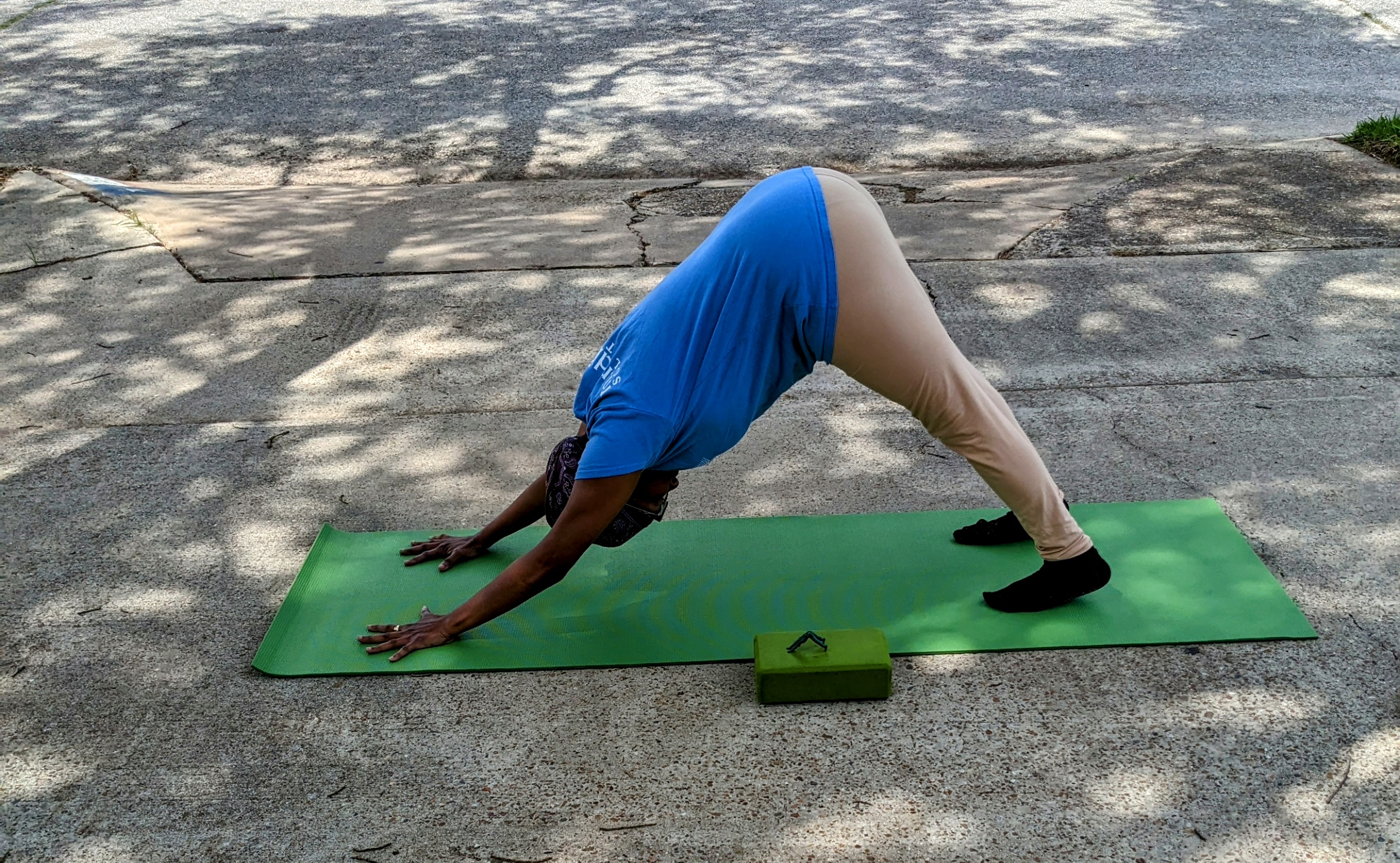
Check the Community page on my YouTube channel later tonight for the answer(s)!
Unlock Your Generosity & Kiss My Asana!!
The picture above is part of my 2023 offering for the 10th annual Kiss My Asana yogathon, which benefits Mind Body Solutions (MBS). This week (April 22nd – 28th), I’m dedicated to raising awareness and resources for MBS’ life-affirming work to help people living with disabilities – and you can help too! You can help by joining me as we practice with purpose, by sharing this page, and/or by making a donation that creates opportunities for more people to practice yoga.
Mind Body Solutions provides live, online resources to people living with disabilities, worldwide. In addition to 11 live online yoga classes a week, MBS has also created a comprehensive library of recorded adaptive yoga classes for students, instructional videos for adaptive yoga teachers, and insightful interviews between our founder, Matthew Sanford, and adaptive students. It all helps people with disabilities live more fully, where they are and how they are.
Each year, in addition to hosting a fundraising page and making my personal donation, I offer a blog post and/or a YouTube post – sometimes even a whole practice. This year, part of my offering is a series of poses I’m posting on the Community page of my YouTube channel. Of course, there’s more to the poses (and pictures) than meets the eye. So, keep in mind that they – like the classes I lead – are just the tip of the iceberg.
What happens at Mind Body Solutions is the whole enchilada!
Ultimately, MBS is all about people having better relationships with their mind-body and spreading the message that a greater connection between mind and body can help us all live with improved comfort and ease.
You can click here to Kiss My Asana Now! (Or, you can also click here to join my team and get people to kiss [your] asana!)
If you’re interested in my previous KMA offerings, check out the following (some links only take you to the beginning of a series ad/or to YouTube):
- 30 Poses in 30 Days
- A Musical Preview
- 5-Minute Practices (the playlist)
- 5 Questions Answered by Yogis
- Answers to Yogis Questions
- A Poetry Practice
- A Preview of the April 1st Practice
- Some Stories
- Prāņāyāma
- The Body/Chakra offerings
- Did you miss the last four offerings?
- KMA Day 1, 2023
- KMA Day 2, 2023 – Part I and Part II (with the picture)
- KMA Day 3, 2023
- KMA Day 4, 2023 – Part I and Part II (with the pictures)
Thanks to MW!
You Don’t forget to add an extra wiggle to your day.
Lock Picking Lawyer Challenges Mrs. Lock Picking Lawyer
Revised 04/26/2023
### “That’s All I Have for You Today.” ~LPL ###
The Philosophy of Opening Locks (& Measuring Internal Movement) April 26, 2020
Posted by ajoyfulpractice in Uncategorized.Tags: asana, Beno Gutenberg, Charles Richter, Dj Shadow, Gary Snyder, John Guare, Karma Yoga, Kevin Bacon, KISS MY ASANA, Ludwig Wittgenstein, Matthew Sanford, Richter scale, samkhya, Samuel L Jackson, sankhya, six degrees, yoga, yoga philosophy
add a comment
(“Ramadan Mubarak, Blessed Ramadan!” to anyone who is observing Ramadan. I typically talk about Ramadan at the end of the season, so keep your eyes open.)
“I read somewhere that everybody on this planet is separated by only six other people. Six degrees of separation between us and everyone else on this planet. The President of the United States, a gondolier in Venice, just fill in the names. I find it A) extremely comforting that we’re so close, and B) like Chinese water torture that we’re so close because you have to find the right six people to make the right connection… I am bound to everyone on this planet by a trail of six people.”
– Playwright John Guare, author of Six Degrees of Separation
“Six Degrees of Kevin Bacon” or “Bacon’s Law” is based on the “six degrees of separation” theorem and the idea that Kevin Bacon has made so many movies he is the very essence of connectivity. (Although at least one study has shown Samuel L. Jackson is even more connected than Kevin Bacon, but that’s another story for another day.)
Simply stated, the ideas together indicate that by way of a series of (virtual or metaphorical) handshakes anyone (yourself included) is more closely connected to Kevin Bacon (or Samuel L. Jackson) than you might think. It’s a fun trivia game, something you can do when cabin or quarantine fever kicks in. It’s also a little surreal when you consider it in the context of your own life and realize how small the world is, and how connected you are to people you have never met and will never meet. (For example, during most of my lifetime – even as a kid – I have always been one to two handshakes away from the President of the United States, at least from Ronald Reagan forward.)
There is a similar idea related to the internet and Wikepedia. According to the “Getting to Philosophy” game, if you click on the first link in the main portion of a Wikepedia article, and continue clicking on the first link in subsequent articles, you will inevitably land on the “Philosophy” page. Sometimes it only takes seven clicks, sometimes it takes 14. Although, in all fairness, there are times when the fifth or sixth article contains two conjoined links in the first sentence and since the second link is “philosophy” you have to keep going all the way around red Robin’s barn. Bottom line, no matter where begin we always end up in philosophy.
“Philosophy is like trying to open a safe with a combination lock: each little adjustment of the dials seems to achieve nothing, only when everything is in place does the door open.”
– Ludwig Wittgenstein, philosopher
Most of you have heard or seen me state that the physical practice of yoga (hatha yoga, regardless of the style or tradition) is part of an 8-limbed philosophy. But what does that mean and why does that matter?
The word philosophy comes to us from Greek, by way of Latin, Old French, and Middle English, from a word that means “love of wisdom.” It is the study of the fundamental nature of knowledge, thought, reality, and existence. It provides a way to think about and understand the world, the universe, and everything. As stated in Wikepedia, it “is the study of general and fundamental questions about existence, knowledge, values, reason, mind, and language.” The most basic question being, “Why?” which spirals out as:
- Who/What are you?
- Why do you exist?
- Where does the world come from? / Why does the world exist?
The philosophy of yoga addresses all of these questions, and the follow-up questions (like, “Why do we/I/other people do the things we/I/they do?” and “How do I find balance in my life/relationships/pose?”). Yoga addresses philosophical questions even when someone only practices the physical practice, because, ultimately, the physical practice is a container in which we can consider these questions.
At least, that’s one way to look at the practice.
“It’s a gift*; it’s like there’s a moment in which the thing is ready to let you see it. In India, this is called darshan. Darshan means getting a view, and if the clouds blow away, as they did once for me, and you get a view of the Himalayas from the foothills, an Indian person would say, ‘Ah, the Himalayas are giving you their darshana’; they’re letting you have their view. This comfortable, really deep way of getting a sense of something takes time. It doesn’t show itself to you right away. It isn’t even necessary to know the names of things the way a botanist would. It’s more important to be aware of the ‘suchness’ of the thing; it’s a reality. It’s also a source of a certain kind of inspiration for creativity. I see it in the work of Georgia O’Keeffe.”
– Poet Gary Snyder on Indian philosophy
Consider, however, that the philosophy of yoga is one of six major Indian philosophies or darśana in Sanskrit, which means “point of view” or “ways to see.” As I referenced yesterday’s blog post and mentioned in yesterday’s class, one of the other six philosophies is Sankhya, which is the one most closely related to Yoga. Sankhya is the oldest Indian philosophy and focuses on the way in which one thinks/reasons and understands purusha (“pure consciousness”) and prakriti (unmanifested, primordial “matter”), and how everything and everyone manifests/exists as a result of these two elements combining with the forces of three “energies” (gunas) inherent in matter.
Yoga and Sankhya are so closely related that a philosophical question arises at all times: (Once you are aware of yourself, doing whatever you are doing) are you practicing yoga or sankhya? And is there a non-subjective way to measure, qualify, or quantify the degree to which you are doing one versus the other? For that matter, is there a non-subjective way to measure the interior movements of the heart and how practicing can shake us to our core?
“We would have been happy if we could have assigned just three categories, large, medium, and small; the point is, we wanted to avoid personal judgments. It actually turned out to be quite a finely tuned scale.”
– Charles Richter, seismologist and physicist (born today in 1900), on the scale he developed with Beno Gutenberg
Born today in 1889, the philosopher Ludwig Wittgenstein said, “The human body is the best picture of the human soul.” If you’re interested in using your body to answer that age old DJ Shadow question (“What does your soul look like?”), please join me today (Sunday, April 26th) at 2:30 PM, for a 65-minute virtual yoga practice on Zoom. Some of the new Zoom security protocols have definitely kicking in; so, please use the link from the “Class Schedules” calendar if you run into any problems. Saturday’s playlist is available on YouTube and Spotify.
Can you knock my socks off when you Kiss My Asana?
The 7th Annual Kiss My Asana yogathon benefits Mind Body Solutions, which was founded by Matthew Sanford to help those who have experienced trauma, loss, and disability find new ways to live by integrating both mind and body. Known for their adaptive yoga classes, MBS provides “traditional yoga” classes, workshops, and outreach programs. They also train yoga teachers and offer highly specialized training for health care professionals. This year’s yogathon is only a week long! Seven days, starting yesterday (Saturday), to do yoga, share yoga, and help others. By participating in the Kiss My Asana yogathon you join a global movement, but in a personal way. In other words, you practice yoga… for 7 days.
The yogathon raises resources and awareness. So, my goal this year is to tell 7 stories in 7 days and raise $600 for Mind Body Solutions. You can do yoga starting today. You can share yoga be inviting a friend to one of my classes or by forwarding one of the blog posts. You can help others by donating or, if you are not able to donate, come to class Saturday – Wednesday (or request a class you can do on your own) and practice the story poses on Thursday and Friday so that I can make a donation on your behalf.
You can add 5 minutes of yoga (or meditation) to your day; you can learn something new about your practice; or even teach a pose to someone close to you – or even to one of your Master Teachers/Precious Jewels.
To give you some ideas about how you can spend this week, consider that in past years my KMA offerings have included donation-based classes and (sometimes) daily postings. Check out one of my previous offerings dated April 26th (or thereabouts):
30 Poses in 30 Days (scroll down to see April 26th)
A Musical Preview (scroll down to see March 26th)
* Psst…Ella’s story was my first KMA 2020 offering and her pose is Tadasana / Samasthiti (Mountain Pose / Equal Standing) as if you are offering a gift. Today’s story is the story philosophy and connectivity via a little bit of the histories of Charles Richter and Ludwig Wittgenstein. So far I only have one yogi submitted story, which means I need 4 more. Please tell me your story!
You can also check out yesterday’s all-humanity, Kick-Off gathering featuring insights from MBS founder Matthew Sanford, conversation with MBS students, and a mind-body practice for all. If you’re not familiar with MBS, this will give you a glimpse into the work, the people, and the humanity of the adaptive yoga program which I am helping to raise $50K of essential support.
### WELL, HELLO HEGEL ###
 A Joyful Practice