Purpose & Responsibility (the “missing” Wednesday post) March 29, 2025
Posted by ajoyfulpractice in Books, Changing Perspectives, Dharma, Faith, Healing Stories, Hope, Lent / Great Lent, Life, Music, Mysticism, One Hoop, Peace, Philosophy, Poetry, Ramadan, Religion, Robert Frost, Tennessee Williams, Wisdom, Writing, Yoga.Tags: 988, Bhagavad Gita, Imam Khalid Latif, Jack Hawley, Laylat al-Qadr, nasheeds, Peter Gould, Qur'an, Qur’ān, Ramaḍān, Reba McEntire, Responsibility, Robert Frost, Season for Nonviolence, Sūrah Qadr, Tennessee Williams
add a comment
“Ramaḍān Mubarak, Blessed Ramaḍān!” to anyone observing the holy month of Ramaḍān. (Keep your eyes open!) Many blessings also to all, and especially to those who are observing Great Lent and/or Lent!
Peace, ease, and responsibility to all, throughout this “Season for Nonviolence” and all other seasons!
This “missing” post for Wednesday, March 26th features new and previously posted content, as well as excerpts. Since we have entered the final days of Ramaḍān, the practice and playlists include references to Islām. You can request an audio recording of this practice or a previous practice via a comment below or (for a slightly faster reply) you can email myra (at) ajoyfulpractice.com.
In the spirit of generosity (“dana”), the Zoom classes, recordings, and blog posts are freely given and freely received. If you are able to support these teachings, please do so as your heart moves you. (NOTE: You can donate even if you are “attending” a practice that is not designated as a “Common Ground Meditation Center” practice, or you can purchase class(es).
Donations are tax deductible; class purchases are not necessarily deductible.
Check out the “Class Schedules” calendar for upcoming classes.
“Having a clear intention (Niyyah in Arabic) and understanding your position, talents, motivation and means as an Amanah (translated as ‘trust’, or ‘responsibility towards others’) are important elements….”
— quoted from The Heart of Design interview (with Imam Khalid Latif), entitled “Building Conscious Community” by Peter Gould
We begin each practice with a purpose, an intention. On one level, there are the reasons we are on the mat — and those reasons can vary. They can be small and very personal and/or the can be multifaceted and directly affect others (i.e., communal). They can be physical, mental, emotional, energetic, spiritual, and/or religious. Either way, I believe the reason(s) we have for being on the mat are connected to our purpose and intention off the mat. In other words, I believe everyone has a purpose in life and that we should be very intentional about how we move through our day — not to mention our practice — as we go about the business of fulfilling our purpose.
Keeping our intention in mind, keeps us focused.
“‘People are in fact the sum total of the beliefs they hold in their hearts, Arjuna, and there are indeed various kinds of faith. One’s faith corresponds to one’s nature, and one’s nature is equivalent to one’s faith….’”
— Krishna speaking to Arjuna (17.2, abridged) in The Bhagavad Gita: A Walkthrough for Westerners by Jack Hawley
The idea that everyone has a purpose (in life) isn’t just my belief. It is a belief held by many people around the world. It is a belief at the heart of many spiritual, religious, and philosophical practices. One could argue that there are whole industries built around the idea of living a purpose-driven life. Furthermore, research even shows the importance of having an overreaching purpose. And while many can agree on the importance of having a purpose, on and off the mat, there is not necessarily consensus on the origin of that purpose.
Some believe we each, individually, put meaning into our lives and, therefore, give ourselves (and our lives) purpose. Others, however, believe that purpose is God-given. That latter group includes people (and faiths) that believe in having a calling. Sometimes, the idea of a calling is only applied to people within a religious and/or spiritual field. Other times, as explained in the Bhagavad Gita (“The Song of the Lord”), people believe that everyone is called to do something and that the something they are called to do serves the greater community, as well as the greater good.
In other words, we all have a responsibility to ourselves, as well as to others.
“‘Your very nature dictates that you perform the duties attuned to your disposition. Those duties are your dharma, your natural calling. It is far better to do your own dharma, even if you do it imperfectly, than to try to master the work of another. Those who perform the duties called for by their obligations, even if those duties seem of little merit, are able to do them with less effort – and this releases consciousness that can be directed Godward.’”
— Krishna speaking to Arjuna (18.47) in The Bhagavad Gita: A Walkthrough for Westerners by Jack Hawley
This week, as I have been thinking about people involved in various civil rights movements, I have also been thinking about the responsibility that comes with purpose. According to the Bhagavad Gita, “The responsibilities of people in the various segments of society can be divided under four general headings: Seers, Leaders, Providers, and Servers. No particular group of people is superior to any other, but like limbs of the body, each has a respective role to play.” (18.41)
Throughout this sacred text, the word “responsibility” is associated (and interchangeable) with the words “dharma” and “sva-dharma” (“duty” and “personal duty”). These Sanskrit words have several other literal translations into English, depending on the context, including (personal) “merit”, “eternal law”, and/or “natural law”. There is, within this sacred discussion, a very definite understanding of free will, and the possibility that someone will intentionally or inadvertently not fulfill their purpose. However, there is also an underlying concept of predestination, based on our disposition (or nature) — and this underlying concept is related to faith as well as to duty/responsibility.
“Something we were withholding made us weak
Until we found out that it was ourselves
We were withholding from our land of living,
And forthwith found salvation in surrender.”
— quoted from the poem “The Gift Outright” by Robert Frost
“The violets in the mountains have broken the rocks. The world thirsts after sympathy, compassion, love.”
— quoted from the play Camino Real by Tennessee Williams (The first sentence is also the epitaph on his grave.)
March 26th is the anniversary of births of Robert Frost (b. 1894) and Tennessee Williams (b. 1911). Normally, I might talk about how their talents were clearly gifts and callings — that also came with responsibilities. Had I been a little more focused, I would have referenced the fact gifts like theirs (like yours) can not be held back — even by rocks and fences.
I could have made these references because, this year, this week coincided with what some consider the holiest days during the holy month of Ramaḍān: the last ten days/nights and, in particular, the odd nights. More importantly, Wednesday night might have been the holiest and most sacred night: Laylat al-Qadr (translated as “Night of Power”, “Night of Destiny”, “Night of Value”, “Night of Measure”, “Night of Decree”, or “Night of Honour”).
“We sent it [the Qur’ān] down on the Night of Power.
And what can make you know what is the Night of Power?
The Night of Power is better than a thousand months.
The Angels and the Spirit [the inspiration] descend therein by their Lord’s leave for every affair.
Peace! It is till the rising of the dawn.”
— Sūrah Qadr (“Portion 97 of the Qur’ān”) 1 – 5
CLICK ON THE EXCERPT TITLES BELOW FOR MORE.
FTWMI: A Night of Great Power & Great Peace (a “renewed” post)
Take Another Look at Yourself (the “missing” Sunday post, which is a “renewed” post )
“Use your time wisely. Spend it only in pursuit of things that are good. Hold the world in your hand if you so desire, but never let the world use your heart as its abode. Your understanding of the world around you will be based off of how you take care of the world within you. Treat your heart as something precious and let only what is good for [it] have the privilege of receiving its love.”
— Imam Khalid Latif in a 2013 “Ramadān Reflection” for Huffington Post
Wednesday’s playlist is available on YouTube and Spotify. [Look for “Ramadan & Eid 2024”]
Some quick notes about the music: First, my playlists for the final days of Ramadān are not halal (“permissible”) in all Islamic traditions, because of the orchestrations. They do, however, feature musicians who are Muslim (with a few exceptions).
Reba McEntire is one of the notable exceptions — notable, because in previous years she was the only female soloist and the only non-Muslim singer on the playlists. While this year’s playlists include several Muslim women as musicians and composers, “Pray for Peace” is still highlighted because it was re-released during the month of Ramadān in 2014 — but not just randomly in the month, the song was released in the last ten days of the month (during the holiest part of the month)!
Some songs on the playlist are Nasheeds (meaning they are religiously moral songs) that, in some traditions, are meant to be sung without instrumentation or only with percussion. I have, however, included orchestrated versions of these songs, because this seems to have worked best in an in-studio setting. I mean no disrespect by this choice. As far as I know, percussion or voice only recordings of the Nasheeds are available (if you want to build your own playlist). Alternatively, you can practice without the music — which is always a suitable option.
Finally, the YouTube version currently includes some additional before/after music.
If you are thinking about suicide, worried about a friend or loved one, or would like emotional support, you can dial 988 (in the US) or call 1-800-273-TALK (8255) for the Suicide and Crisis Lifeline. You can also call this TALK line if you are struggling with addiction or involved in an abusive relationship. The Lifeline network is free, confidential, and available to all 24/7. YOU CAN TALK ABOUT ANYTHING.
White Flag is a new app, which I have not yet researched, but which may be helpful if you need peer-to-peer (non-professional) support.
If you are a young person in crisis, feeling suicidal, or in need of a safe and judgement-free place to talk, you can also click here to contact the TrevorLifeline (which is staffed 24/7 with trained counselors).
### Your Duty Is Calling! ###
Here’s A Little “something, something” for the Holi-daze (the “missing” Sunday post) December 22, 2024
Posted by ajoyfulpractice in Changing Perspectives, Faith, Healing Stories, Health, Life, One Hoop, Peace, Philosophy, Poetry, Robert Frost, Wisdom, Writing, Yoga.Tags: 988, A Christmas Carol, Dave, essential workers, holi-daze, holidays, It's A Wonderful Life, mental health, Richard Rohr, Robert Frost, SAD, Seasonal Affective Disorder, winter
add a comment
Happy Holidays! Many blessings to everyone and especially to anyone cultivating kindness, friendship, peace, freedom, understanding, gratitude, and wisdom (no matter how much you struggle).
May you be safe and protected / May you be peaceful and happy / May you be healthy and strong! May you be nourished!
This is the “missing” post for Sunday, December 22nd. It contains some re-purposed (previously posted) content and a couple of excerpts. You can request an audio recording of this practice via a comment below or (for a slightly faster reply) you can email myra (at) ajoyfulpractice.com.
In the spirit of generosity (“dana”), the Zoom classes, recordings, and blog posts are freely given and freely received. If you are able to support these teachings, please do so as your heart moves you. (NOTE: You can donate even if you are “attending” a practice that is not designated as a “Common Ground Meditation Center” practice, or you can purchase class(es).
Donations are tax deductible; class purchases are not necessarily deductible.
I will offering in-person classes during January 2025. Click here for more details and to reserve your spots now. Let’s start the 2025 together!
Check out the “Class Schedules” calendar for upcoming classes (and holiday cancellations).
“The woods are lovely, dark and deep,
But I have promises to keep,
And miles to go before I sleep,
And miles to go before I sleep.”
— quoted from the poem “Stopping by Woods on a Snowy Evening” by Robert Frost
There was a time, not too long ago, when we were acutely aware that things were different. We had to adjust almost every ritual, every tradition, every practice, and every habit. For some, that meant that there was less hustle and bustle for some. For some, however, it was just as busy or — in the case of essential workers like parents, delivery people, people in groceries, and/or people in health care — that time was even busier and more chaotic than normal. Either way there was an extra layer of stress and uncertainty.
Maybe you are someone for whom it feels like things are “back to normal”. Maybe you are someone for whom things will never be the way they were. Or, maybe you are someone somewhere in between. Either way, you may be feeling a certain kind of way this time of year — and that certain kind of way may involve stress and uncertainty. You may feel like you are never going to get everything done in time and/or that the only way you can get everything done is to not do the things that you usually do to take care of yourself — all of which just creates more stress.
Bottom line, this time of year can often be stressful, exhausting, and draining regardless of our individual and collective circumstance (and that’s even before we throw in grief). While some of those feelings can be attributed to the fact that it is colder and darker in a lot of places in the Northern hemisphere, some of what we’re feeling can also be because we are going against our natural rhythms: rushing around when everything (and everyone) else is slowing down to rest for a bit.
If you’re a feeling any of these things, you are no alone. In fact, feeling out of sorts (especially this time of year) is so common that it is a common motif in some of our favorite holiday classics.
Click on the excerpt titles below if you’re feeling like Scrooge and/or like life is less than Wonderful.
For Those Who Missed It: “Bah Humbug!” & Other SAD Sayings
For Those Who Missed It: Living “A (SAD) Wonderful Life”
If you are feeling a little bit of holi-daze, this is a good time to put your legs up, relax, release, and rest. Sure, you may need a little bit of movement (plus some extra hydration and light) in order to get to that place where you can let go of all the busy-ness and settle into the moment — even if it is just for a moment — but it will be worth the effort. Consider for a moment that there is great power in letting go (i.e., surrendering) and being still in the silence. That power is restorative, healing, and can be exactly what you need to keep going forward.
Ironically, we really face and recognize that power when we are struggling to still the body and quiet the mind because…. [insert whatever you think/feel must be done RIGHT, RIGHT NOW]. The struggle is why this is also a good time to remember a wise bit of advice from yoga buddy Dave: You don’t have to do everything to have a happy holiday.
Finally, this is a good time to pause and practice a little gratitude. Express gratitude for those people who were essential to your well-being four years ago, as well as to those who are still taking care of all of us. Appreciate the people with whom you choose to spend your time (and maybe even some of those family members, master teachers, and precious jewels with whom you feel forced to spend your time). Give thanks for anything and anyone who brings meaning to this season.
Now, offer a compassionate moment of peace and ease to everyone, everywhere.
After all, all of the winter holidays being celebrated this week are ultimately about light and peace.
“I know because it’s Christmas, you’re surely hoping for some very special sermon. I don’t think I have one, really, [because] there’s really only one message. And there’s nothing new to tell you. It’s the same message that if you’re praying (and that isn’t always true of Christians), it goes deeper and deeper and deeper. If you’re quiet once in a while (and that isn’t always true of Americans), it goes deeper and deeper and deeper.”
— “Christmas 2016: Really only One Message” homily by Richard Rohr, OFM (delivered on Sunday, December 25, 2016)
Sunday’s playlist is available on YouTube and Spotify. [Look for “12222020 Winter Holidays”]
If you are thinking about suicide, worried about a friend or loved one, or would like emotional support, you can dial 988 (in the US) or call 1-800-273-TALK (8255) for the Suicide and Crisis Lifeline. You can also call this TALK line if you are struggling with addiction or involved in an abusive relationship. The Lifeline network is free, confidential, and available to all 24/7. YOU CAN TALK ABOUT ANYTHING.
White Flag is a new app, which I have not yet researched, but which may be helpful if you need peer-to-peer (non-professional) support.
If you are a young person in crisis, feeling suicidal, or in need of a safe and judgement-free place to talk, you can also click here to contact the TrevorLifeline (which is staffed 24/7 with trained counselors).
### STILLNESS & CHILLNESS ###
DID YOU KNOW #2: Proprioception (A Kiss My Asana offering) April 15, 2024
Posted by ajoyfulpractice in 7-Day Challenge, Donate, Fitness, Healing Stories, Health, Karma Yoga, Oliver Sacks, One Hoop, Poetry, Robert Frost, Science, Volunteer, Wisdom, Yoga.Tags: adaptive yoga, Dr. Oliver Sacks, kinesthesia, KISS MY ASANA, Mind Body Solutions, proprioception, Robert Frost, yoga, yogathon
add a comment
Happy National Poetry Month! “Nine days and nine nights of blessings and happiness if you are celebrating Chaitra Navaratri!” Many blessings to all and especially to those observing Great Lent!
“There is a direct union of oneself with a motorcycle, for it is so geared to one’s proprioception, one’s movements and postures, that it responds almost like part of one’s own body. Bike and rider become a single, indivisible entity; it is very much like riding a horse. A car cannot become part of one in quite the same way.”
— quoted from the chapter “Muscle Beach” in On the Move: A Life by Oliver Sacks
I refer to proprioception in every vinyasa practice. However, I don’t always use the term. Check out the video below to see what I do say and way it’s important — on and off the mat.
NOTE: To get the full effect, watch the video on YouTube.
The video above is part of my 2024 offering for the 11th annual Kiss My Asana yogathon, which benefits Mind Body Solutions (MBS). I am super excited to dedicate this week (April 13th — 19th) to raising awareness and resources for MBS’ life-affirming work “to help people live better in the body they have.” You can help by joining me as we practice with purpose, by sharing this page, and/or by making a donation that creates opportunities for more people to practice yoga.
Each year, in addition to hosting my fundraising page and making my own personal donation, I offer a blog post and/or a YouTube post — sometimes even a whole practice. This year, I wanted to highlight elements of the practice that we may overlook or take for granted. I also wanted to underscore that participating in the Kiss My Asana yogathon is just a tangible way to do what we do in every practice: set an intention and dedicate the merits of the practice to someone other than ourselves. Finally, I wanted to offer something that reflects my inspirations; something that “begins in delight and ends in wisdom;” and something that was short, fun, and full of insight (or, maybe it’s just randomly useful information) — something that I think of as the video equivalent of a villanelle (check out that last link for details).
You can click here to Kiss My Asana Now! (Or, you can also click here to join my team and get people to kiss [your] asana!)
If you’re interested in my previous KMA offerings, check out the following (some links only take you to the beginning of a series and/or to YouTube):
- 30 Poses in 30 Days
- A Musical Preview
- 5-Minute Practices (the playlist)
- 5 Questions Answered by Yogis
- Answers to Yogis Questions
- A Poetry Practice
- A Preview of the April 1st Practice
- Some Stories
- Prāņāyāma
- The Body/Chakra offerings
- A Series of Poses (scroll down to see the first KMA Community Page post)
If you subscribe to my YouTube channel, you can be notified as soon as the videos are posted.
### I WOULD LOVE FOR YOU TO KISS MY ASANA! ###
DID YOU KNOW #1: [It’s Time to] Kiss My Asana! April 14, 2024
Posted by ajoyfulpractice in 7-Day Challenge, Changing Perspectives, Donate, Healing Stories, Hope, Karma Yoga, One Hoop, Philosophy, Poetry, Robert Frost, Volunteer, Wisdom, Yoga.Tags: KISS MY ASANA, Mind Body Solutions, Robert Frost, yoga, yogathon, YouTube
add a comment
Happy National Poetry Month! “Nine days and nine nights of blessings and happiness if you are celebrating Chaitra Navaratri!” Many blessings to all and especially to those observing Great Lent!
“It should be of the pleasure of a poem itself to tell how it can. The figure a poem makes. It begins in delight and ends in wisdom. The figure is the same as for love. No one can really hold that the ecstasy should be static and stand still in one place. It begins in delight, it inclines to the impulse, it assumes direction with the first line laid down, it runs a course of lucky events, and ends in a clarification of life–not necessarily a great clarification, such as sects and cults are founded on, but in a momentary stay against confusion.”
— quoted from the essay “The Figure a Poem Makes” by Robert Frost (which served as an introduction to his Collected Poems beginning with the 1939 edition)
It is officially time to Kiss My Asana!
The 11th annual Kiss My Asana yogathon, which benefits Mind Body Solutions (MBS), has begin and I am super excited to dedicate this week (April 13th — 19th) to raising awareness and resources for MBS’ life-affirming work “to help people live better in the body they have.” You can help by joining me as we practice with purpose, by sharing this page, and/or by making a donation that creates opportunities for more people to practice yoga.
Each year, in addition to hosting my fundraising page and making my own personal donation, I offer a blog post and/or a YouTube post — sometimes even a whole practice. This year, I wanted to highlight elements of the practice that we may overlook or take for granted. I also wanted to underscore that participating in the Kiss My Asana yogathon is just a tangible way to do what we do in every practice: set an intention and dedicate the merits of the practice to someone other than ourselves. Finally, I wanted to offer something that reflects my inspirations (like the idea quoted above).
Sometimes, when I talk about the idea that our practice can be like Robert Frost’s description of a poem that “begins in delight and ends in wisdom,” I think of the sequence as a living, breathing villanelle that begins and ends with Balasana (“Child’s Pose”). Simply put, a villanelle is 19-line poem with the first and third lines of the opening stanza alternately repeating in the other stanzas and then concluding the final stanza. This year, I wanted to offer something short, fun, and full of insight (or, maybe it’s just randomly useful information) — something that I think of as the video equivalent of a villanelle.
The first offering is below. It didn’t go quite as planned, but this is just the beginning.
You can click here to Kiss My Asana Now! (Or, you can also click here to join my team and get people to kiss [your] asana!)
If you’re interested in my previous KMA offerings, check out the following (some links only take you to the beginning of a series and/or to YouTube):
- 30 Poses in 30 Days
- A Musical Preview
- 5-Minute Practices (the playlist)
- 5 Questions Answered by Yogis
- Answers to Yogis Questions
- A Poetry Practice
- A Preview of the April 1st Practice
- Some Stories
- Prāņāyāma
- The Body/Chakra offerings
- A Series of Poses (scroll down to see the first KMA Community Page post)
If you subscribe to my YouTube channel, you can be notified as soon as the videos are posted.
### PUCKER UP ###
Take Another Look at Your Talents & Your Light (mostly the music and blessings) March 26, 2024
Posted by ajoyfulpractice in Books, Dharma, Faith, Healing Stories, Hope, Lent / Great Lent, Life, Love, Music, One Hoop, Philosophy, Ramadan, Religion, Robert Frost, Tennessee Williams, Wisdom, Yoga.Tags: Holy Tuesday, Holy Week, parables, Passion Tuesday, Passion Week, Robert Frost, Season for Nonviolence, Season of Non-violence, Tennessee Williams
add a comment
“Ramadān Mubarak, Blessed Ramadān!” to anyone observing the holy month of Ramadān. (Keep your eyes open.) Many blessings to all, and especially to those observing Passion Tuesday / Holy Tuesday or Great Lent throughout this “Season for Nonviolence” and during all other seasons!
“Something we were withholding made us weak
Until we found out that it was ourselves
We were withholding from our land of living,
And forthwith found salvation in surrender.”
— quoted from the poem “The Gift Outright” by Robert Frost (b. 1874)
“We have not long to love.
Light does not stay.
The tender things are those
we fold away.”
— quoted from the poem “We Have Not Long to Love” by Tennessee Williams (b. 1911)
Please join me today (Tuesday, March 26th) at 12:00 PM or 7:15 PM for a yoga practice on Zoom. You can use the link from the “Class Schedules” calendar if you run into any problems checking into the class. You can request an audio recording of this practice via a comment below or by emailing myra (at) ajoyfulpractice.com.
Tuesday’s playlist is available on YouTube and Spotify. [Look for “Passion Tuesday April 7, 2020” or “04072020 Passion Tuesday.”]
In the spirit of generosity (“dana”), the Zoom classes, recordings, and blog posts are freely given and freely received. If you are able to support these teachings, please do so as your heart moves you. (NOTE: You can donate even if you are “attending” a practice that is not designated as a “Common Ground Meditation Center” practice, or you can purchase class(es). Donations are tax deductible; class purchases are not necessarily deductible.)
###  ###
###
EXCERPT: “The Day of Introductions” January 20, 2024
Posted by ajoyfulpractice in Books, Changing Perspectives, Faith, Healing Stories, Hope, Karma, Kumbh Mela, Life, Music, One Hoop, Religion, Suffering, Tragedy, Wisdom, Writing, Yoga.Tags: Amanda Gorman, Elizabeth Alexander, Joseph Robinette Biden, Maya Angelou, Miller Williams, Richard Blanco, Robert Frost
add a comment
May all beings everywhere feel a sense of belonging! Warm wishes for peace and righteousness to everyone celebrating Kumbh Mela!!
“We can do this if we open our souls instead of hardening our hearts. If we show a little tolerance and humility, and if we’re willing to stand in the other person’s shoes, as my mom would say, just for a moment, stand in their shoes. Because here’s the thing about life: There’s no accounting for what fate will deal you. Some days when you need a hand. There are other days when we’re called to lend a hand. That’s how it has to be. That’s what we do for one another. And if we are this way, our country will be stronger, more prosperous, more ready for the future. And we can still disagree.”
— quoted from the January 20, 2021, Inaugural Speech by President Joseph Biden
The following (reformatted) excerpt is from a 2021 post:
“So: Here we are — again, beginning and also ending. Ending also and beginning, again – are we here? Are we all in? That is a question that could be asked (and is implied) by every president and vice president. Never forget, that every administration is intended to serve us, we the people. And yet, we also serve; as citizens of this nation — even of the world — we have responsibilities to ourselves and to one another. Just as we look at what a candidate, a president and/or vice president elect, and a sitting president and/or vice president has to offer us, we must consider what we have to offer ourselves and one another. Then, we offer it.
Offering what we have to offer is a reoccurring theme with these inaugurations. And, it’s what Robert Frost meant when, on January 20, 1961, he spoke of “The Gift Outright” as the first poet to recite a poem at a presidential inauguration. What we offer can be as profoundly simple as a ‘[hopeful] Good morning,’ as Maya Angelou suggested when she became the second inauguration poet on January 20, 1993 — or as simply profound as ‘[dreaming] for every child an even chance’ as Miller Williams had us consider on January 20, 1997. We must, as Elizabeth Alexander said on June 20, 2009, ‘consider, reconsider [our words]’ and the mighty power of love. We must, as all the poets have said, remember where from where we come and, as Richard Blanco reminded us in January 21, 2013, to say ‘hello / shalom, buon giorno / howdy / namaste / or buenos días in the language my mother taught me—in every language spoken into one wind[.]’ And we can, we must, as the sixth and the youngest inauguration poet to date implored us, ‘forge our union with purpose’ and ‘lift our gazes not to what stands between us, but what stands before us.’ This is what we need to live well.”
Click here for the entire post about palindromes and a brief history of Inauguration Day in the USA.
“Scripture tells us to envision that ‘everyone shall sit under their own vine and fig tree and no one shall make them afraid.’ If we’re to live up to our own time, then victory won’t lie in the blade but in all the bridges we’ve made.
That is the promise to glade, the hill we climb if only we dare it, because being American is more than a pride we inherit – it’s the past we step into and how we repair it.”
— quoted from the poem “The Hill We Climb” by Amanda Gorman, during the January 20, 2021 Presidential Inauguration (the “Scripture” she cites Micah 4:4)
Please join me today (Saturday, January 20th) at 12:00 PM for a yoga practice on Zoom. You can use the link from the “Class Schedules” calendar if you run into any problems checking into the class. You can request an audio recording of this practice via a comment below or (for a slightly faster reply) you can email myra (at) ajoyfulpractice.com.
Saturday playlist is available on YouTube and Spotify.
In the spirit of generosity (“dana”), the Zoom classes, recordings, and blog posts are freely given and freely received. If you are able to support these teachings, please do so as your heart moves you. (NOTE: You can donate even if you are “attending” a practice that is not designated as a “Common Ground Meditation Center” practice, or you can purchase class(es). Donations are tax deductible; class purchases are not necessarily deductible.)
### AUM ###
Hope & FTWMI: The Importance of Feeling/Being Safe June 20, 2023
Posted by ajoyfulpractice in "Impossible" People, Art, Changing Perspectives, Faith, Gratitude, Healing Stories, Hope, Karma, Life, Music, One Hoop, Pain, Peace, Philosophy, Poetry, Robert Frost, Suffering, Tragedy, Wisdom, Yoga.Tags: #WorldRefugeeDay, António Guterres, Antony Blinken, asylum, Emanuel Celler, Emi Mamoud, Hope, Metta, Robert Frost, samkhya, siddhis, svādhyāya, Sāmkhya Karika, Ukraine, United Nations General Assembly, World Refugee Day, Yoga Sutra 2.46
add a comment
Happy Pride! May we all be safe and protected, especially if we find ourselves seeking asylum.
“‘Home,’ he mocked gently.
‘Yes, what else but home?
It all depends on what you mean by home.”
[…]
“‘Home is the place where, when you have to go there,
They have to take you in.’
‘I should have called it
Something you somehow haven’t to deserve.’”
– quoted from the poem “The Death of the Hired Man” by Robert Frost
Today’s practice begins with the instruction to go into a position where you feel safe, supported, and comfortable; to make yourself at home. Usually, that rift on Yoga Sūtra 2.46 leads directly into the instruction to go deeper. Today, however, I want to cultivate an extra bit of awareness around the concept of home. That extra bit of awareness that comes in the form of hope.
I have recently noted (in myself) how having a place I call home – and being in that place – allows me to tap into a sense of hope, to have faith when faced with traumatic events, and to feel more resilient – so I can get up after being knocked down. I am super grateful for having this experience of home that gives me this experience of hope. However, I can’t help but wonder what it would feel like to not have that sense of home and the associated feeling of hope.
How would you go about finding “Hope Away from Home” and who would help you?
In the Robert Frost poem, Silas (hopes he) has Mary and Warren. These are people with whom he already has a relationship. They are more like family to him than his own (blood-related) family. Even though they may not see their relationship the same way, there is history there. Yes, the history is complicated and (for Warren) problematic, but it’s still there – and it gives Silas a moment of hope.
How do you find “Hope Away from Home” when there is no prior relationship and history?
For that matter, if you are in your own home and someone comes calling in their hour of need, do you respond like Mary? Or, do you respond like Warren?
For Those Who Missed It: This is an extremely revised version of my post from June 20, 2022. In addition to updating some verbiage, I have re-ordered it and added information related to the 2023 theme. Just a heads up, there are references to the war.
“During my decade as UN High Commissioner for Refugees, I witnessed the resilience and contributions of refugees across all walks of life.
Their perseverance in the face of adversity inspires me every day.
Refugees represent the very best of the human spirit.
They need and deserve support and solidarity — not closed borders and pushbacks.
As we mark World Refugee Day, we confront a startling statistic.
More than 100 million people living in countries rocked by conflict, persecution, hunger and climate chaos have been forced to flee their homes.
These are not numbers on a page.
These are individual women, children and men making difficult journeys — often facing violence, exploitation, discrimination and abuse.”
– quoted from the 2023 World Refugee Day statement by United Nations Secretary-General António Guterres
The United Nations General Assembly declared June 20th as World Refugee Day in December of 2000. In 1951, the United Nations Refugee Convention defined a refugee as “someone who fled his or her home and country owing to ‘a well-founded fear of persecution because of his/her race, religion, nationality, membership in a particular social group, or political opinion.” Additionally, the United Nations High Commissioner for Refugees recognizes that “many refugees are in exile to escape the effects of natural or human-made disasters.” Asylum Seekers, Internally Displaced Persons (IDPs), Stateless Persons, and Returnees all fall under the Refugees category. Although they are granted certain rights and protections under the 1951 Refugee Convention and its 1967 Protocol, refugees are some of the most vulnerable people in the world, because we often say one thing and do something completely different.
“This startling discrimination against central, eastern and southern Europe points out the gap between what we say and what we do. On the one hand we publicly pronounce the equality of all peoples, discarding all racialistic theories; on the other hand, in our immigration laws, we embrace in practice these very theories we abhor and verbally condemn.”
– United States Representative Emanuel Celler (D-NY) speaking to the Senate about immigration quotes in 1948
Beware, ya’ll, I’ve got my hammer out; because I feel like some things need to be hammered home.
I could say that that this feeling started when I re-read the quote above (from 1948) and started thinking about how much it (unfortunately) still applies. However, the truth is a little more complicated than that. The truth is that I’m always thinking about “the gap between what we say and what we do” – in any situation. But, I especially started thinking about in relation to refugees when Russia invaded Ukraine towards the end of February 2022. That invasion, and the escalation of a war that began when Russia invaded and annexed Crimea at the end of February 2014, highlighted the fact that refugees can come from anywhere and look like anyone. However, that heightened awareness of who can be a refugee, also reinforced the fact that many people in the world have stereotypes and biases that make life harder for people who are already facing horrific challenges.
Some people, at various points along Ukraine’s border, said they saw no discrimination happening as people initially fled the conflict. Others witnessed and/or experienced racial bias which resulted in people being stranded in a volatile situation. We can all believe what we want – or believe what we must to sleep at night – but if you were paying attention as the events unfolded, you saw and heard newscasters attributing value based on race, ethnicity, and nationality. If you were paying attention, you witnessed countries and local governments setting policy based on race, ethnicity, nationality, and gender.
Even if you weren’t paying attention to any of those things, you could look inside of your own heart and mind and observe how you felt about refugees fleeing Ukraine versus refugees fleeing Afghanistan… or Syria… or Vietnam… or Venezuela… or South Sudan… or the Congo….
“Whoever. Wherever. Whenever.
Everyone has the right to seek safety.”
– the 2022 theme for World Refugee Day
World Refugee Day is an internationally observed day to honor the humanity of all refugees. It is a day to celebrate the strength, courage, and resilience of people who have held onto their families, cultures, languages, and dreams despite being forced to flee their home country either to escape war, famine, pestilence, persecution, or all of the above. It is also a day to raise awareness and solicit support, while cultivating empathy, compassion, and understanding. Finally it is a time to recognize the generosity of host countries.
In his 2023 World Refugee statement, United Nations Secretary-General António Guterres referenced the resilience, perseverance, and contributions of refugees and then said, “I call on the world to harness the hope that refugees carry in their hearts. Let’s match their courage with the opportunities they need, every step of the way.” Of course, to do as Secretary-General Guterres suggested – really, to honestly do any of the things required of this day – we must each tap into the power of our own heart (and mind). We must engage and honor those powers “unique to being human” – and, to do that, we must practice a little svādhyāya (“self-study”).
“We will continue to represent the best of American values by saving lives and alleviating suffering, working with our partners at home and abroad to assist the forcibly displaced in their time of need – no matter who or where they are, on World Refugee Day and every day.”
– quoted from the 2022 World Refugee Day statement by United States Secretary of State Antony Blinken*
As I have mentioned before, I can be skeptical of the idea that only humans can cultivate the six siddhis (“attainments” or abilities) that are described as being “unique to being human” in the Sāmkhya Karika. Similarly, I question the idea that certain values can (or should be) described as if they only belong to a certain group of people – especially since so many different groups share the same values. I strongly encourage us, however, to look at our own personal values and what we each (individually) believe to be true. In the process, I also strongly encourage us to look at whether or not what is in our hearts is also in our minds and reflected by our words and deeds. When we do this, we give ourselves the opportunity to look at whether or not our affiliations reflect what’s in our hearts and in our minds. This is one way to practice svādhyāya (“self-study”).
Svādhyāya (“self-study”) is the fourth niyama or internal “observation” in the Yoga Philosophy. I want to emphasis that it is an exercise in OBSERVATION. I often place it in the same category as discernment and contemplation, as those practices appear in the Spiritual Exercises of Ignatius of Loyola – meaning, these are ways to note the “interior movement” of one’s own heart, especially in certain contexts. Like discernment and contemplation, svādhyāya can be part of our judgment toolbox, but it’s not about making or passing judgments; it’s about making good, virtuous, choices.
By “good,” I mean something that has meaning and purpose. By “virtuous,” I mean something that is generous in it’s ability to alleviate suffering (i.e., something that does the least amount of harm to the most amount of beings and/or over the longest amount of time).
“According to this principle, a refugee should not be returned to a country where he or she faces serious threats to his or her life or freedom. This protection may not be claimed by refugees who are reasonably regarded as a danger to the security of the country, or having been convicted of a particularly serious crime, are considered a danger to the community.
The rights contained in the 1951 Convention include:
-
The right not to be expelled, except under certain, strictly defined conditions;
-
The right not to be punished for illegal entry into the territory of a contracting State;
-
The right to work;
-
The right to housing;
-
The right to education;
-
The right to public relief and assistance;
-
The right to freedom of religion;
-
The right to access the courts;
-
The right to freedom of movement within the territory;
-
The right to be issued identity and travel documents.
Some basic rights, including the right to be protected from refoulement, apply to all refugees. A refugee becomes entitled to other rights the longer they remain in the host country, which is based on the recognition that the longer they remain as refugees, the more rights they need.”
– quoted from the United Nations
According to the United Nations, refugees are entitled to certain rights that are, theoretically, human rights. The United States is NOT on the top 10 list of countries who receive the most refugees, however, according to U. S. Secretary of State Antony Blinken, “The United States is the world’s largest single donor of humanitarian assistance….” Within those statements, there is a huge contradiction.
The contradiction of which I speak is not the fact that many people believe the U. S. myth and talking point that “people are always coming here.” No, I’m talking about the fact that the United States doesn’t even guarantee all of the aforementioned rights to it’s citizens. When you look at how that contradiction (and, some could argue, hypocrisy) plays out in real time, it’s easy to see how we end up with a conflict between theory and practice. Another way to look at that is: This is one of the reason’s there’s a “gap between what we say and what we do.”
Ok, so, here is the final nail: I think it’s important acknowledge that gap and why it’s here (inside of each of us, as well as in the world). Also, given the 2020 theme, I think it’s important to contemplate what “safety” means to us. The UN has five points that define “seeking safety” means:
- Right to seek asylum
- Safe access
- No pushbacks
- No discrimination
- Humane treatment
Even with those five points (and the descriptions outlined by the UN), we can only define what it means to us individually. We can only define what finding safety would look like to us if we were forced from our home and from our homeland. Once we do that, however, once we define it, we are one step closer to being able to extend it.
“Once you’ve woken up to the understanding that vulnerable people literally die for their lives
There is no alternative but to decide to care.
So you resolve to care.
You realize that vulnerability is not synonymous with weakness
That all of us are vulnerable in some way. / That some days we’re weaker than most / and that some of us don’t have that option.
So you grieve for those who lost their lives / and you grieve for the ones that you lost too. / Not just during this crisis / but during every one before it….”
– from the poem that begins “The Seven Stages of Grief during Coronavirus: Acceptance.” (see end of post) by Emi Mamoud (@EmiThePoet)
Please join me today (Tuesday, June 20th) at 12:00 PM or 7:15 PM for a yoga practice on Zoom. You can use the link from the “Class Schedules” calendar if you run into any problems checking into the class. You can request an audio recording of this practice via a comment below or (for a slightly faster reply) you can email me at myra (at) ajoyfulpractice.com.
Today’s playlist is available on YouTube and Spotify.
NOTE: We used a different playlist for 2020 – 2022. Click here and scroll down for the previous playlist.
Emi Mamoud, an incredible poet
Some elements of the above post were included in my 2020 World Refugee Day post, which philosophically focused on Yoga Sūtra 2.25 and the connection between avidyā (“ignorance”) and suffering. Click here to read that post.
*NOTE: Since I made a point (on Juneteenth 2022) of mentioning certain aspects of my own legacy, please note that Secretary of State Antony Blinken’s paternal grandparents were Jewish immigrants from what is now Ukraine, his maternal grandparents were Hungarian Jews, and his step-father was a Holocaust survivor (and refugee).
In the spirit of generosity (“dana”), the Zoom classes, recordings, and blog posts are freely given and freely received. If you are able to support these teachings, please do so as your heart moves you. (NOTE: You can donate even if you are “attending” a practice that is not designated as a “Common Ground Meditation Center” practice, or you can purchase class(es). Donations are tax deductible; class purchases are not necessarily deductible.
Check out the “Class Schedules” calendar for upcoming classes.)
### May we all be peaceful and happy / May we all be healthy and strong / May we all have ease and wellbeing ###
Take Another Look at Yourself (the “missing” Sunday post, which is a “renewed” post ) March 30, 2023
Posted by ajoyfulpractice in Art, Books, Buddhism, Changing Perspectives, Faith, Healing Stories, Hope, Lent / Great Lent, Life, Love, Music, Mysticism, One Hoop, Pain, Peace, Philosophy, Poetry, Ramadan, Religion, Robert Frost, Suffering, Tennessee Williams, Traditional Chinese Medicine, Wisdom, Writing, Yin Yoga, Yoga.Tags: B.K.S. Iyengar, Bramaviharas, Chaitra Navaratri, chakra, chesed, gevurah, Great Lent, heart, kabbalah, Lent / Great Lent, Maty Ezraty, parighasana, Patricia Clarkson, Ramadan, Ramadān, Robert Frost, Season for Nonviolence, Season of Non-violence, sefirot, Skandamata, Swami Rama, Tennessee Williams
add a comment
“Nine days and nine nights of blessings and happiness if you are celebrating Chaitra Navaratri!” “Ramadān Mubarak, Blessed Ramadān!” to anyone who is observing the holy month of Ramadān. Blessings to anyone observing Lent or Great Lent! Many blessings to all during this “Season for Non-violence” and all other seasons!
This is the “missing” post for Sunday, March 26th. It is also a revised (and expanded) from 2019, with an itty bit from 2020 – so, literally another look. Some links in the post connect to sites outside of the blog. You can request an audio recording of this practice via a comment below or (for a slightly faster reply) you can email me at myra (at) ajoyfulpractice.com.
In the spirit of generosity (“dana”), the Zoom classes, recordings, and blog posts are freely given and freely received. If you are able to support these teachings, please do so as your heart moves you. (NOTE: You can donate even if you are “attending” a practice that is not designated as a “Common Ground Meditation Center” practice, or you can purchase class(es). Donations are tax deductible; class purchases are not necessarily deductible.
Check out the “Class Schedules” calendar for upcoming classes.)
“Something there is that doesn’t love a wall,
That sends the frozen-ground-swell under it,
And spills the upper boulders in the sun;
And makes gaps even two can pass abreast.”
– quoted from the poem “Mending Wall” by Robert Frost
“The violets in the mountains have broken the rocks. The world thirsts after sympathy, compassion, love.”
– quoted from the play Camino Real by Tennessee Williams (The first sentence is also the epitaph on his grave.)
There are people in the world who will say you haven’t read poetry until you read Robert Frost, and Southerners in the world who will say you haven’t seen a play until you’ve seen Tennessee Williams. Born 37 years and over 2,000 miles apart, these two literary icons shared a birthday (3/26) and way with words. Although, some would say they used their words in different ways.
Born in 1874, in San Francisco, California, Robert Frost wrote about things like “a snowy evening,” “mending a wall,” and “the road not taken” – although, in the latter case, people often mistake it for “the road less traveled.” His poems are often as much about perspective as they are about the way we tell a story (and the fact that the way we tell a story can change the story). They also illustrate how the stories we tell (ourselves and the world) are not always about the truth so much as they about what we understand about the world and ourselves.
Born in 1911, in Columbus, Mississippi, Tennessee Williams wrote about emotionally volatile people in the South and from the South. He wrote about characters and circumstances that reflected the emotional turmoil he saw and felt inside himself and all around him. Then, so that the emotional states of the the people and situations could not be ignored (or missed) he reinforced them with the use of props, sound effects, and blocking. In other words, he used the physical to embody the emotional and energetic – and, in doing so, drew the audience into the hearts of the characters.
Even though their mediums and subjects were different, they both wrote in a way that can make you pause, look again…and again. Once or thrice you may even wonder how many ways you can see/interpret/understand what has been said, and how it applies to your life. A good story, regardless of the medium, will make you do that: consider how it applies to your life.
“Something we were withholding made us weak
Until we found out that it was ourselves
We were withholding from our land of living,
And forthwith found salvation in surrender.”
– quoted from the poem “The Gift Outright” by Robert Frost
Every once in a while (as I did last Wednesday and again on Sunday), I mention Maty Ezraty, who was a teacher of teachers and who said that every yoga practice should be like a good story. One of my takeaways from that suggestion has always been that, each part of the mind-body-spirit is like a character in a story. Just like each character has a different purpose and a different point of view, each pose/sequence can give each part of our bodies and minds an opportunity to tell their story. Another takeaway is that everything is leading to and from the heart of the story.
So, let’s start with the hearts.
“What is straight? A line can be straight, or a street, but the human heart, oh, no, it’s curved like a road through mountains.”
– quoted from the play “A Streetcar Named Desire” by Tennessee Williams
Yes, I said, “hearts” – plural. Swami Rama from the Himalayan tradition said that we have three hearts: a physical heart, which for most of us is on the left side; an emotional heart on the opposite side, which for most of us is on the right; and an energetic heart that connects the two. That energetic heart, which some consider a spiritual heart, connects our hearts with all the other hearts around us. Additionally, in yoga and other Eastern healing arts, energy for the heart flows through the arms.
The heart chakra, in yoga (as it comes to us from India) is symbolically and energetically associated with the upper torso, shoulders, arms, hands, and fingers. In Yin Yoga, which is based on Traditional Chinese Medicine, the heart median has three branches, one of which runs down the inner arms into the pinky fingers. According to the Kabbalah, Jewish mysticism, there are 10 Divine attributes (from the Tree of Life) through which G-d is revealed to the world – and 7 of these can be found in the body. Love/loving-kindness (chesed in Hebrew) is associated with the right arm and is balanced by strength (gevurah in Hebrew), which is associated with the left arm.
Just as people contemplate the Divine attributes when they are counting the Omer in some Jewish traditions, people in Buddhist traditions contemplate the Divine abodes (brahmavihārāḥ in Sanskrit), which are heart practices: loving-kindness or benevolence (mettā); compassion (karuṇā); empathetic joy (muditā); and equanimity (upekkhā). In some Indian philosophies (like Yoga), the ability to cultivate a good heart/make friends (suhrit-prapati) and generosity (dana) can also be considered heart practices. On (and off) the mat, we can contemplate these same emotional and energetic aspects of ourselves by bringing awareness to our arms and how we use our arms… to reach out, to embrace, to extend ourselves.
We may notice – as we move through our practice or through our day – how we are expressing our heart or how we are withholding our heart. But, there’s always the possibility that we don’t notice. We may not notice when we are off the mat, because we are distracted. We may not notice on the mat, because we are focused on other parts of the mind-body. This is why it’s important to notice how we move and why we move the way we move – because it all tells a story.
“Two roads diverged in a yellow wood,
And sorry I could not travel both
And be one traveler, long I stood
And looked down one as far as I could
To where it bent in the undergrowth;
Then took the other, as just as fair,”
– quoted from the poem “The Road Not Taken” by Robert Frost
There are hundreds of poses and hundreds, thousands – maybe even millions – of ways to move into and out of pose. And each one of those ways gives us another way of looking at the story. The tricky thing is that sometimes we keep coming back to the story the same way. But, what happens if we came at things a different way? What happens if we let a different part of our mind-body-spirit take the lead? What happens if our circumstances and understanding of the world changes? What happens if our understanding of ourselves changes?
Sometimes, the practice can be like a favorite story that we read again and again – or re-read, years after the initial reading – and we suddenly see everything from a different perspective. In fact, one of the things I like about the practice is the opportunity to revisit themes and/or sequences and suddenly discover something completely different. It’s also one of the things I love about reading (and watching) great works of art.
“We have to use a spell to make them balance:
“Stay where you are until our backs are turned!”
We wear our fingers rough with handling them.
Oh, just another kind of out-door game,
One on a side. It comes to little more:
There where it is we do not need the wall:
He is all pine and I am apple orchard.
My apple trees will never get across
And eat the cones under his pines, I tell him.
He only says, “Good fences make good neighbours.”
Spring is the mischief in me, and I wonder
If I could put a notion in his head:
“Why do they make good neighbours? Isn’t it
Where there are cows? But here there are no cows.
Before I built a wall I’d ask to know
What I was walling in or walling out,
And to whom I was like to give offence.”– quoted from the poem “Mending Wall” by Robert Frost
Parighāsana (Gate Pose) stretches the pelvic area and hamstrings, while also engaging the sides of the torso and abdomen eccentrically (up side) and concentrically (down side). According to B.K.S. Iyengar’s Light on Yoga, the pose “keeps the abdominal muscles and organs in condition and the skin around the abdomen will not sag but remain healthy. The sideways spinal movement will help persons suffering from stiff backs.” I find that it is a great way to get into the hips and the legs. Another aspect of the pose is what happens to the heart area – not only physically, but emotionally.
Parighāsana offers us the opportunity to open up the shoulders (physically) and open the gates on all sides of the heart (emotionally and energetically). It also offers some interesting insight into how we sometimes engage the different aspects of our heart. For instances, when I cue and describe the pose in a practice, many people have a tendency to lift the bottom hand up to meet the top hand – rather than extending the upper body down towards the lower hand. To be fair, many people do not have the strength and flexibility to kneel on one leg, stretch out the other leg, and then bend sideways until the top hand lowers down. But, what is interesting is how people deal with the resistance. Initially, they lift the bottom hand up – because it’s easy (and obvious). When I point out that it’s the top hand that needs to reach down, many people will fold in on themselves; essentially closing down and hiding the heart to make the connection. However, the “goal” is to open the gate and to stay open in the process.
“Lonely . . . When so many are lonely as seem to be lonely, it would be inexcusably selfish to be lonely alone.”
– Don Quixote in the Prologue to Camino Real by Tennessee Williams
We all build walls around our hearts. Sometimes we do it for protection, because we have perceived an actual threat. Other times, we build walls, because of fear associated with a perceived threat. That perceived threat might turn out to be an actual threat, but it could also simply be a possibility (or a misperception). Of course, we can also get in the habit of building walls – because it’s what others have done before us, what we’ve been taught, and/or because we have experienced harm in the past. But, even castle walls have gates and drawbridges, a way in and a way out.
When we really pay attention to the ways we engage our heart, on and off the mat, we may find it challenging to open the gate. We may find that we take the easy route – especially when there’s a little awkward balancing, as there is in parighāsana – and/or we may find that we are compromising ourselves (and our hearts) in order to make a connection. One suggestion I make, during the physical practice, is to bend the lifted elbow (so the hand is behind the head) and then use the whole body to rotate the elbow up. This changes the focus and reinforces the idea that we are opening the heart and the side-body. I often sequence a modified side plank after the “Gate Pose,” as a reminder that there can be more than one way to open a gate.
Take a moment to consider a time when you compromised yourself in order to make a connection. How could you have refocused your awareness, energy, and resources in order to reinforce what was important? Could you have made the connection (or a similar connection) in a different way?
In A Streetcar Named Desire, Blanche DuBois says, “I always depended on the kindness of strangers.” Remember, we are all Blanche…but we are also those strangers. Click here for the brief 2020 post about making loving-kind connections.
“It should be of the pleasure of a poem itself to tell how it can. The figure a poem makes. It begins in delight and ends in wisdom. The figure is the same as for love. No one can really hold that the ecstasy should be static and stand still in one place. It begins in delight, it inclines to the impulse, it assumes direction with the first line laid down, it runs a course of lucky events, and ends in a clarification of life–not necessarily a great clarification, such as sects and cults are founded on, but in a momentary stay against confusion.”
– quoted from the essay “The Figure a Poem Makes” by Robert Frost (which served as an introduction to his Collected Poems beginning with the 1939 edition)
Two of my favorite lines from Robert Frost speak of wisdom and delight, and the gift that comes from giving our whole selves. Every time I step on a yoga mat, I experience the wisdom and the delight. I also experience a plethora of gifts. One of those gifts is how the practice affects the mind. In Cat on a Hot Tin Roof, Tennessee Williams has Brick acknowledging that he is an alcoholic, but not seeming to want to give up his drinking because, “It’s like a switch, clickin’ off in my head. Turns the hot light off and the cool one on, and all of a sudden there’s peace.” But then, as his father points out to him, there is the morning.
One of the gifts of yoga is that it brings peace without the hangover. It can flip the switch. Another thing to consider is that the practice has a way of opening the heart so we can get to the violets.
“To me, its meaning is simple. The hard, the cold, the oppressive will—at long last—be broken apart by a force that is beautiful, natural, colorful, alive.”
– Patricia Clarkson explaining why she was quoting Tennessee Williams during a 2009 HRC New Orleans Dinner speech
Sunday’s playlist is available on YouTube and Spotify.
Errata: The Robert Frost poem is called “Mending Wall” and a link has been embedded for a Winter Solstice post.
### HEART-SUFFICIENT ###
Take Another Look at Yourself (mostly the music w/UPDATED link) March 26, 2023
Posted by ajoyfulpractice in Art, Books, Buddhism, Changing Perspectives, Faith, Healing Stories, Hope, Lent / Great Lent, Life, Love, Music, One Hoop, Pain, Peace, Philosophy, Poetry, Ramadan, Religion, Robert Frost, Suffering, Tennessee Williams, Wisdom, Yoga.Tags: Chaitra Navaratri, Great Lent, Lent / Great Lent, Ramadan, Ramadān, Robert Frost, Season for Nonviolence, Season of Non-violence, Skandamata, Tennessee Williams
add a comment
“Nine days and nine nights of blessings and happiness if you are celebrating Chaitra Navaratri!” “Ramadān Mubarak, Blessed Ramadān!” to anyone who is observing the holy month of Ramadān. Blessings to anyone observing Lent or Great Lent! Many blessings to all during this “Season for Non-violence” and all other seasons!
“Something there is that doesn’t love a wall,
That sends the frozen-ground-swell under it,
And spills the upper boulders in the sun;
And makes gaps even two can pass abreast.”
– excerpt from the poem “Mending Wall” by Robert Frost
“The violets in the mountains have broken the rocks. The world thirsts after sympathy, compassion, love.”
– excerpt from the play Camino Real by Tennessee Williams (The first sentence is also the epitaph on his grave.)
Please join me for a 65-minute virtual yoga practice on Zoom today (Sunday, March 26th) at 2:30 PM. Use the link from the “Class Schedules” calendar if you run into any problems checking into the class. You can request an audio recording of this practice via a comment below or by emailing myra (at) ajoyfulpractice.com.
Sunday’s playlist is available on YouTube and Spotify.
Click here for the “missing” post related to this practice.
In the spirit of generosity (“dana”), the Zoom classes, recordings, and blog posts are freely given and freely received. If you are able to support these teachings, please do so as your heart moves you. (NOTE: You can donate even if you are “attending” a practice that is not designated as a “Common Ground Meditation Center” practice, or you can purchase class(es). Donations are tax deductible; class purchases are not necessarily deductible.)
Errata: The Robert Frost poem is called “Mending Wall.” Some formatting has been updated.
### HEART-SUFFICIENT ###
On the Road Again… & It’s Lit!!! October 21, 2022
Posted by ajoyfulpractice in Dharma, Faith, Hope, Meditation, Philosophy, Religion, Wisdom, Yoga.Tags: Bend Hot Yoga, Diwali, Oregon, Robert Frost
2 comments
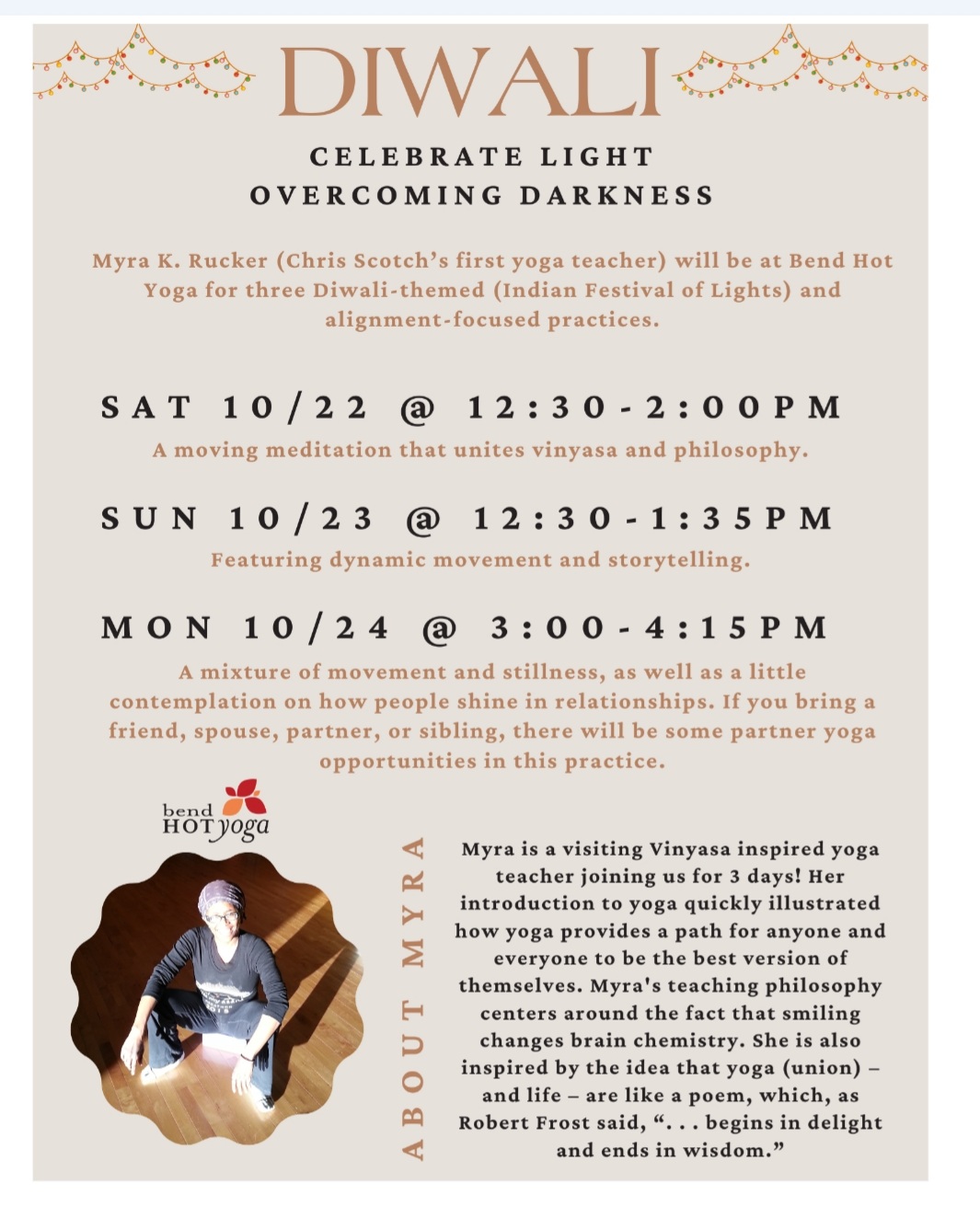
Just a reminder: The classes I am guest teaching at Bend Hot Yoga (this weekend) will be available live via ZOOM. Check my “Class Schedules” calendar for access details. (NOTE: Meeting codes are the same as they normally would be for each day, but the times are different. Times listed below are PDT.)
 A Joyful Practice