Many blessings to everyone, and especially to anyone Counting the Omer!
“‘Anything I can sing,’ he observes, ‘I call a song. Anything I can’t sing, I call a poem. Anything I can’t sing or anything that’s too long to be a poem, I call a novel. But my novels don’t have the usual story lines. They’re about my feelings at a certain place at a certain time.’”
– quoted from the liner notes by Nat Hentoff (from Bob Dylan’s album The Freewheelin’ Bob Dylan)
This is a footnote with links. If it were longer (and written by him), Robert Allen Zimmerman (born today in 1941) might call this a novel; because, it’s about how today feels weird to me.
First, it’s kind of a weird day in rock and roll. Tina Turner, the legendary Queen of Rock and Roll, just passed away today at the age of 83. Meanwhile, Bob Dylan, the rock and roll poet, turned 82 today. Yes, there are other things that make today weird – even sad and tragic, when you consider that it is the first anniversary of the mass shooting at Robb Elementary School in Uvalde, Texas. However, in the middle of all the sadness, tragedy, and even confusion (over why certain things aren’t changing in a way that makes us all safer), there are some joyful memories and some persistent reminders.
The memories include ones of my mom taking me to see Tina Turner’s Private Dancer tour (in 1985). It was my very first rock and roll concert. Another such memory is finding the mantras and chants that Tina Turner recorded after she started practicing Buddhism. Listening to those mantras and chants, I remember that the human spirit is divine, beautiful, and able to persevere. I find different, but equally persistent, reminders in the poetry – and music – of Bob Dylan, who is quoted in the liner notes for The Freewheelin’ Bob Dylan as saying, “The most important thing I know I learned from Woody Guthrie…. I’m my own person. I’ve got basic common rights-whether I’m here in this country or any other place. I’ll never finish saying everything I feel, but I’ll be doing my part to make some sense out of the way we’re living, and not living, now. All I’m doing is saying what’s on my mind the best way I know how. And whatever else you say about me, everything I do and sing and write comes out of me.”
I think the same philosophy applies to Tina Turner.
Sometimes, I compare Bob Dylan and his career to winning the lottery with that elusive Powerball® of talent, drive, and other people’s perceptions. My comparison is not meant to take anything away from his talent and hard work. Quite the opposite. It’s just meant to highlight that sometimes people have things working in their favor. On the flip side, Tina Turner had the talent and the drive, but that last piece – other people’s perceptions (not to mention her own at certain times in her life) – worked against her. If you look at her life, where she started and the abuse that she endured early on, you’ll find there were a lot of things working against her. Yet, she survived. She thrived. She succeeded.
Tina Turner became one the best-selling recording artists of all time; won 12 Grammy Awards (including three Grammy Hall of Fame awards and a Grammy Lifetime Achievement Award); was inducted into the Rock and Roll Hall of Fame two times (in 1991 and 2021) and became the first woman and the first Black artist to appear on the cover of Rolling Stone. She appeared in movies and had a movie and a musical based on her life. Her accolades also include being a recipient of the 2005 Kennedy Center Honors.
She survived. She thrived. She succeeded. More importantly, she continued making beauty in the world.
“Nothing last forever. No one lives forever. The flower that fades and dies. Winter passes and spring comes. Embrace the cycle of life that is the greatest love. Go beyond fear.
Go beyond fear.
Beyond fear takes you into the place where love grows.
When you refuse to follow the impulses of fear, anger, and revenge. Beyond means to feel yourself. Start every day singing like the birds. Singing takes you beyond.
Beyond. Beyond. Beyond.”
– excerpted from “Beyond: Spiritual Message By Tina Turner” on the album Beyond: Buddhist and Christian Prayers by Tina Turner, Dechen Shak-Dagsay & Regula Curti
Please join me today (Wednesday, May 24th) at 4:30 PM or 7:15 PM for a yoga practice on Zoom. Use the link from the “Class Schedules” calendar if you run into any problems checking into the class. You will need to register for the 7:15 PM class if you have not already done so. You can request an audio recording of this practice via a comment below or by emailing myra (at) ajoyfulpractice.com.
Wednesday’s playlist is available on YouTube and Spotify. [Look for “05242022 Bob’s Poems”]
In the spirit of generosity (“dana”), the Zoom classes, recordings, and blog posts are freely given and freely received. If you are able to support these teachings, please do so as your heart moves you. (NOTE: You can donate even if you are “attending” a practice that is not designated as a “Common Ground Meditation Center” practice, or you can purchase class(es). Donations are tax deductible; class purchases are not necessarily deductible.)
– “Although the same objects may be perceived by different minds, they are perceived in different ways, because those minds manifested differently.”
Please join me for a 65-minute virtual yoga practice on Zoom today (Sunday, May 21st) at 2:30 PM.Use the link from the “Class Schedules” calendar if you run into any problems checking into the class. You can request an audio recording of this practice via a comment below or by emailing myra (at) ajoyfulpractice.com.
Sunday’s playlist is available on YouTube and Spotify. [Look for “05212022 The Fools and the Angels”]
“‘I will remain here while anyone remains and do whatever comes to my hand, [Clara Barton, b. 1881] declared stoutly. I may be compelled to face danger, but never fear it….’”
– quoted from Clara Barton, Professional Angel by Elizabeth Brown Pryor
In the spirit of generosity (“dana”), the Zoom classes, recordings, and blog posts are freely given and freely received. If you are able to support these teachings, please do so as your heart moves you. (NOTE: You can donate even if you are “attending” a practice that is not designated as a “Common Ground Meditation Center” practice, or you can purchase class(es). Donations are tax deductible; class purchases are not necessarily deductible.)
Many blessings to everyone, and especially to anyone Counting the Omer!
“Thus are Nature and Grace of one accord: for Grace is God, as Nature is God: He is two in manner of working and one in love; and neither of these worketh without other: they be not disparted.”
– quoted from Chapter 63 Revelations of Divine Love (Revelations of Love in 16 Shewings) by Julian of Norwich
As noted below, I get super excited about the wisdom of Julian of Norwich. Even though I am not teaching live on Zoom today, I will send a previously recorded practice (from 2020) to everyone on the Saturday mailing list. You can request an audio recording of this practice via a comment below or by emailing myra(at) ajoyfulpractice.com.
Since we have been exploring the four kinds of grace (“kripa”) this year, and recently started focusing on “shastra kripa,” I want to anchor the anchoress and her work in this context. First, remember that, in some traditions, “shastra” refers to a collection of knowledge or laws of nature that are true, that have “always been and will always be” true, and that can only be communicated directly from the Divine to someone who has done the work to reach a certain state of enlightenment and/or awareness. In other words, the information may be written down at some point – thus becoming sacred text – but, initially, it must be shown (or shewn) to an individual anchored in their practice. While she was not an Indian or Hindu mystic, considering Julian (as well as her revelations and the way they were shared) in this context, may help us go a little deeper into the meaning and importance of shastra kripa.
“And when through God’s mercy and with his help we put ourselves into harmony with nature and grace, we shall truly see that sin is more more vile and painful than hell, without comparison….”
– quoted from Chapter 63 Revelations of Divine Love (Revelations of Love in 16 Shewings) by Julian of Norwich*
For Those Who Missed It: The following was originally posted in May 2020. I have edited it slightly and added a note at the end with additional context the manuscripts quoted in this post. There are no class details since the Zoom class was cancelled.
“We are kept all as securely in Love in woe as in weal, by the Goodness of God.”
“All shall be well, and all shall be well, and (in) all manner of thing(s) shall be well.”
– quoted from Chapters 1 and 27 Revelations of Divine Love (Revelations of Love in 16 Shewings) by Julian of Norwich
Hurray! It’s finally here; one of my favorite days, devoted to one of my favorite people: the Roman Catholic feast day for St. Julian of Norwich. (Her Lutheran feast day is May 8th.) Julian (which may or may not have been her given name) was a 14th century anchoress who is always going to make my Top 10 list of favorite mystics/contemplatives. Scratch that, she always makes my ever-changing Top 5. Let’s be honest; she’s always in the Top 3. And her life and writing are very relevant – and very similar – to what we are experiencing today.
Julian is noteworthy not only because she is the author of the oldest surviving book written in English by a woman, but also because she lived an extraordinary life – most of it in seclusion. As an anchoress (sometimes referred to as anchorite or anchoret) she withdrew from the secular world, for religious reasons, and spent the majority of her life in a tiny cell in the “corner” of a church in the city of Julian. You can think of her as a hermit-in-place. Taking a vow of stability, as anchoresses did, and even being given a symbolic funeral – as anchorites would be considered “dead to the world” – were very common practice in the Middle Ages. Julian’s experience, however, was a little atypical.
While we typically think of anchorites as living in seclusion, with even more isolation than people who retreat into an abbey or convent, Julian lived in the bustling city of Norwich. As a spiritual counselor and model of devout life, she was permitted to engage with the populace through the window of her cell and provide people with what they needed, whether that be clothing for the poor, spiritual advice, and/or prayers. She could also accept alms, food, and other gifts as she served the community. We have it on great authority that not only did the locals take advantage of Julian’s spiritual guidance, but that she also was sought out by mystics and others, like Margery Kempe, who would be remembered in their own right. Additionally, the city of Norwich was full of poverty, famine, social conflict, religious schism, and disease during her lifetime. So, we can conclude that, for a hermit, Julian was quite busy.
“These Revelations were shewed to a simple creature unlettered, the year of our Lord 1373, the Thirteenth day of May. Which creature afore desired three gifts of God. The First was mind of His Passion; the Second was bodily sickness in youth, at thirty years of age; the Third was to have of God’s gift three wounds.”
– quoted from Chapter 2 of Revelations of Divine Love (Revelations of Love in 16 Shewings) by Julian of Norwich
At some point in her life, Julian asked God for three gifts. At 30-and-a-half, Julian became so ill that she believed she was going to die. Her conclusion was based, in part, by the fact that in her short lifetime Norwich had experienced the Black Death three times – the first time when she was 6 years old. At one point, the Black Death resulted in the death of a third of the population. Also, she was very, very sick. She was so sick that she was given last rites on May 8, 1373.
During these very scary and traumatic moments – moments all believed would be her last – Julian received her three gifts from God: (1) to experience the Passion (“suffering”) and love of Christ; (2) to experience personal suffering/illness in youth; and (3) to receive the spiritual wounds of true contrition, genuine compassion, and a sincere longing for God. She received her gifts in the form of 16 “shewings” and, wrote them all down when she recovered.
“He shewed me a little thing, the quantity of an hazel-nut, in the palm of my hand; and it was as round as a ball. I looked thereupon with eye of my understanding, and thought: What may this be? And it was answered generally thus: It is all that is made. I marvelled how it might last, for methought it might suddenly have fallen to naught for little. And I was answered in my understanding: It lasteth, and ever shall for that God loveth it. And so All-thing hath the Being by the love of God.”
“In this Little Thing I saw three properties. The first is that God made it, the second is that God loveth it, the third, that God keepeth it. But what is to me verily the Maker, the Keeper, and the Lover, — I cannot tell; for till I am Substantially oned to Him, I may never have full rest nor very bliss: that is to say, till I be so fastened to Him, that there is right nought that is made betwixt my God and me.”
– quoted from Chapter 5 of Revelations of Divine Love (Revelations of Love in 16 Shewings) by Julian of Norwich
There are two official copies of Julian’s Revelations of Divine Love (A Revelation of Love in 16 Shewings): a short version (“short text”) and a longer version (“long text”). The Short Text is believed to be the one she initially wrote after her recovery and the Long Text is believed to have been written over time, and with some encouragement. Both versions were copied many times, during Julian’s lifetime, and sometimes given as gifts.*
One might expect that Julian’s writings were scary and filled with doom and horror, but they are not. In fact, both versions are full of hope and trust in God’s goodness. Additionally, Julian comes across as intelligent, sensitive, and very much grounded in reality. Even though she includes theological points, like presenting God as Father and Mother, which were not authorized by the Church, Julian was neither sanctioned nor criticized as a heretic. In fact, like Saint Teresa of Ávila – another remarkable Christian mystic who happened to be a woman – Julian was encouraged by the church to write and distribute her work. Both women, within their texts, downplayed their intellect and influence and, yet, they are remembered while some of the religious leaders of their time have been forgotten. Another curious thing to note is that, unlike other scholars and religious authors of the time, Julian wrote in English (not Latin).
“We shall suddenly be taken from all our pain and from all our woe, and of His Goodness we shall come up above, where we shall have our Lord Jesus for our meed and be fulfilled with joy and bliss in Heaven.”
“I saw that God rejoiceth that He is our Father, and God rejoiceth that He is our Mother, and God rejoiceth that He is our Very Spouse and our soul is His loved Wife. And Christ rejoiceth that He is our Brother, and Jesus rejoiceth that He is our Saviour. These are five high joys, as I understand, in which He willeth that we enjoy; Him praising, Him thanking, Him loving, Him endlessly blessing.”
– quoted from Chapters 1 and 52 of Revelations of Divine Love (Revelations of Love in 16 Shewings) by Julian of Norwich
Over the years, my friend Lori and I have discussed Julian and her work, and the circumstances within which she worked her spiritual magic. We have, over the years, craved the ability to retreat while simultaneously still serving a purpose in the world. We have also, over the years, wondered at the mindset and fortitude required to not only ask for the gifts Julian requested, but also to receive them and utilize them as she did. This, to paraphrase the Rev. Dr. Cynthia Bourgeault (a modern day contemplative and mystic), is not for sissies.
Now, here we are, and Lori and I recently discussed – via the wonders of technology – that we are all experiencing some of Julian’s circumstances. The whole world is experiencing some of Julian’s circumstances and, while we may not request or even want her gifts, we can definitely appreciate her lessons and what they have to teach us. Regardless of our spirituality or religiosity, we can definitely benefit from her “shewings” of divine love.
“It is thus logical that God, being our Father, be also our Mother. Our Father desires, our Mother operates and our good Lord the Holy Ghost confirms; we are thus well advised to love our God through whom we have our being, to thank him reverently and to praise him for having created us and to pray fervently to our Mother, so as to obtain mercy and compassion, and to pray to our Lord, the Holy Ghost, to obtain help and grace.
I then saw with complete certainty that God, before creating us, loved us, and His love never lessened and never will. In this love he accomplished all his works, and in this love he oriented all things to our good and in this love our life is eternal.
With creation we started but the love with which he created us was in Him from the very beginning and in this love is our beginning.”
– quoted from Chapter 59 of Revelations of Divine Love (Revelations of Love in 16 Shewings) by Julian of Norwich
Saturday’s playlist is available on YouTube and Spotify. [Look for “05132020 All Will Be Well Wednesday”]
*NOTE: One thing I neglected to mention (in 2020) is that the single surviving copy of the “short text” was copied in the fifteenth century from an original dated 1413 and is located in the British Museum Library. The three surviving copies of the “long text” are later copies and are located in the British Library Museum and the Paris Bibliothèque Nationale. The first quote above is from a copy edited by Grace Warrack, which is also the source of at least one other quote. The second quote is from a Penguin Classics edition translated and edited by Elizabeth Spearing and A. C. Spearing, which is based on a manuscript edited by Barry Windeatt.
In the spirit of generosity (“dana”), the Zoom classes, recordings, and blog posts are freely given and freely received. If you are able to support these teachings, please do so as your heart moves you. (NOTE: You can donate even if you are “attending” a practice that is not designated as a “Common Ground Meditation Center” practice, or you can purchase class(es). Donations are tax deductible; class purchases are not necessarily deductible.)
Many blessings to everyone, and especially to anyone Counting the Omer (Lag B’Omer or Lag LaOmer)!
This is a “missing” post for Tuesday, May 9th.You can request an audio recording of this practice via a comment below or (for a slightly faster reply) you can email me at myra (at) ajoyfulpractice.com.
“Tio, kio malamas vin, ne faru al via ulo. Tio estas la tuta Torao; la resto estas la klarigo. Nun iru studi.”
“That which is hateful to you, do not do to your fellow. That is the whole Torah; the rest is the explanation. Now go and study.”
– quoted from the story of Hillel the Elder “[teaching] the meaning of the whole Torah while standing on one foot,” translated into Esperanto and English by Dr. L. L. Zamenhof
It is not the point of the story – and, in some ways it doesn’t matter – however, today I am wondering “Which foot?”
According to the Talmud a potential convert to Judaism went to two famous rabbis of the 1st century and asked to be taught the whole Torah while standing on one foot.* Rabbi Shammai insulted the man and threw him out. Rabbi Hillel (the Elder) taught a lesson about respect, which some commentators say is also love.
Respect/love that’s the important part of the story. However, today, I am also wondering about which foot. Because, which foot determines which leg and which hip bear the weight of the lesson – and which leg and hip, represents the (symbolic) foundation of the teaching.
“Yes, how my love this moment here is ripe for us Yes, you and I so brave against the years If nothing’s left to live we must find a way There’s reason yet to live There’s something left to give We must find a way There is so much to give”
– quoted from “When Nothing’s Left” by Royal Wood
As I often mention this time of year, Jewish mysticism (Kabbalah) indicates that the Tree of Life has ten sefirot (“emanations,” attributes, or manifestations) of the Divine – seven of which are associated with the body. For instance, the right leg/thigh is associated with the fourth attribute, Netzach, meaning “endurance,” “sustainability,” “victory,” and “persistence.” Meanwhile, the left leg/thigh is associated with Hod, which can be defined as “humility,” “gratitude,” “splendor,” and “glory.” I often reference this in relation to the Counting of the Omer, a 7-week period of prayer and reflection which begins on the second night of Passover. Each night, for 49 days, people count the days of the Omer and reflect on a combination of two of the sefirot.
We’re heading towards the end of the fifth week; and so, the focus is on how each attribute – lovingkindness, strength, balance, endurance, humility, bonding, and stewardship – shows up in relation to Hod. Sunset on Monday marked the beginning of Lag B’Omer (or Lag LaOmer) – Day 33 of (or in) the Omer, which is Hod She’b’Hod. The 33rd day has an extra special significance and is treated differently from the other days. The reason it’s different is related to hope – gained, lost, and regained – and, also, to that first lesson regarding respect/love.
“They said by way of example that Rabbi Akiva had twelve thousand pairs of students in an area of land that stretched from Gevat to Antipatris in Judea, and they all died in one period of time, because they did not treat each other with respect.”
– quoted from Yevamot 62b:9 in The Koren Talmud Bavli Noé (Vol. 14 Yevamot 1), with commentary by Rabbi Adin Even-Israel Steinsaltz and English from The William Davidson digital edition
I often refer to Counting the Omer as a preparation ritual, similar to other observations and celebrations that fit within the rubric of kriya yoga. What I don’t often mention is that the beginning of the 7 weeks is also a period of mourning related to Rabbi Akiva’s 24,000 students and the lost hope that their deaths represent. Obviously, so many people being lost at once would be devastating and heartbreaking. However, the communal hopelessness is also related to the fact that the 24,000 were preparing for the return of the Temple.
Yet, somehow, despite focusing on the scholarly aspects of their faith, they got it wrong.
How? How could so many students of Torah not respect/love one another properly? How could so many students of one of the greatest rabbis not understand a foundational element of their teaching? According to some commentary, they did not love those that had different opinions and perspectives. Rather than learning from one another, they believed they could only respect/love those who shared the same views. So the were struck down by a plague.
Some scholars say the plague that killed them was an actual disease (as it is indicated in the text); others say it was a metaphor for war against the Roman Empire. Either way, Lag B’Omer (or Lag LaOmer) is the anniversary of the day when the plague ended – or when a revolt led by Simon Bar Kokhba achieved a victory against the Roman Empire. It is also the anniversary of the death one of the students from Rabbi Akiva’s second cohort: Rabbi Shimon Bar Yochai, whose life is celebrated as a symbol of hope for the future.
All the activities people put on hold during the period of mourning, resume on the 33rd Day of the Omer. Additionally, some people will make a pilgrimage to sacred sites. In some communities, people build bonfires to symbolize the ways in which people marked the beginning of the holidays and the sabbath in medieval times and the fires Bar Kokhba’s soldiers would have used to communicate. (Similarly, children may use toy boy and arrows to reenact the revolt.) Bonfires and torches are also symbolic of the mystical fire that surrounded Rabbi Shimon Bar Yochai as he shared his wisdom of the Torah on his last day. Finally, the fires symbolize the light of the Torah and the return of that light to the Jewish people.
They are a reminder that Rabbi Akiva didn’t give up – even when all were lost and he hit the proverbial wall.
“And the world was desolate of Torah until Rabbi Akiva came to our Rabbis in the South and taught his Torah to them. This second group of disciples consisted of Rabbi Meir, Rabbi Yehuda, Rabbi Yosei, Rabbi Shimon, and Rabbi Elazar ben Shamua. And these are the very ones who upheld the study of Torah at that time. Although Rabbi Akiva’s earlier students did not survive, his later disciples were able to transmit the Torah to future generations.”
– quoted from Yevamot 62b:10 in The Koren Talmud Bavli Noé (Vol. 14 Yevamot 1), with commentary by Rabbi Adin Even-Israel Steinsaltz and English from The William Davidson digital edition
For Those Who Missed It: The following was originally posted in 2020. One quote was moved. Additionally, the first and third paragraphs have been slightly revised.
“For there is no doubt that the most radical division that it is possible to make of humanity is that which splits it into two classes of creatures: those who make great demands on themselves, piling up difficulties and duties; and those who demand nothing special of themselves, but for whom to live is to be every moment what they already are, without imposing on themselves any effort towards perfection; mere buoys that float on the waves.”
― from The Revolt of the Masses by José Ortega y Gasset
My friend Bob P once told me this joke: “There are two kinds of people in a kayak, the people that just fell out and the people who are about to fall out.” I find his joke is a pretty apropos metaphor for that feeling of “hitting the wall” during [the] pandemic; if you haven’t hit the wall, you’re about to hit the wall. The same can be said for some of life’s greatest heartaches. While it might seem trite to suggest that you can tell a lot about a person by how they get over/under/around/through the wall, it doesn’t change the fact that [what we’ve been through and are going through] is all part of our circumstances and, to paraphrase José Ortega y Gasset, we are (in part) our circumstances.
Born in Spain, today (May 9th) in 1883, Ortega y Gasset was an existential philosopher and writer, as well as a bit of an activist/social reformer, who believed that life was simultaneously fate and freedom, but that freedom could only be experienced within a given fate. In other words, we must play the hand we’re dealt – but, and this is key, we decide what game we’re playing with the hand we’re dealt. In fact, Ortega y Gasset encouraged actively deciding and creating a “project of life” and, in doing so, create meaning not only for one’s self, but also for others.
– “The objective world (what is seen), consisted of a combination of elements and senses, and having a nature of illumination, activity, and stability, has two purposes: fulfillment and freedom.
– The “gunas” fall into four categories: specific/identifiable, unspecific/unidentifiable, barely describable (by signs), and absolutely indescribable (because it is beyond reference)
It may seem strange, even counterintuitive to some, to draw parallels between the work of 20th century existential philosophers and psychologists (or psychoanalysts) and the work of the ancient yogis (and medieval rabbis). Yet, remember, Patanjali, Vyasa, and the authors of the sacred texts like the Upanishads were explaining their life experiences – just like modern day existentialists – and codifying their life philosophies. When you get right down to it, all of this comes down to an understanding of the nature of things and the nature of ourselves. So, once again, we are back to the same two questions: “Who are you?” and “Where does the world come from?”
José Ortega y Gasset was a strong proponent of creating one’s world and being an active creator rather than a passive receiver. The second section/chapter of the yoga sutras (“The Foundation on Practice”) begins by focusing on how we are creating our world and our experiences in the world – sometimes unconsciously.
“Life cannot wait until the sciences may have explained the universe scientifically. We cannot put off living until we are ready. The most salient characteristic of life is its coerciveness: it is always urgent, “here and now” without any possible postponement. Life is fired at us point-blank. And culture, which is but its interpretation, cannot wait any more than can life itself.”
– from Misión de la Universidad (Mission of the University) by José Ortega y Gasset
Tuesday’s playlist is available on YouTube and Spotify. [Look for “05009020 JOyG”]
*NOTE: In most translations of the Talmud, it clearly states that the gentile was the one standing on one foot during the lesson.
Many blessings to everyone, and especially to anyone Counting the Omer (Lag B’Omer or Lag LaOmer)!
“Yes, how my love this moment here is ripe for us Yes, you and I so brave against the years If nothing’s left to live we must find a way There’s reason yet to live There’s something left to give We must find a way There is so much to give”
– from “When Nothing’s Left” by Royal Wood
Please join me today (Tuesday, May 9th) at 12:00 PM or 7:15 PM for a yoga practice on Zoom.You can use the link from the “Class Schedules”calendar if you run into any problems checking into the class. You can request an audio recording of this practice via a comment below or (for a slightly faster reply) you can email me at myra(at) ajoyfulpractice.com.
Tuesday’s playlist is available on YouTube and Spotify. [Look for “05009020 JOyG”]
In the spirit of generosity (“dana”), the Zoom classes, recordings, and blog posts are freely given and freely received. If you are able to support these teachings, please do so as your heart moves you. (NOTE: You can donate even if you are “attending” a practice that is not designated as a “Common Ground Meditation Center” practice, or you can purchase class(es). Donations are tax deductible; class purchases are not necessarily deductible.)
Many blessings to everyone, and especially to anyone Counting the Omer!
This is a “missing” post for Sunday, May 7th.Warning: It alludes to certain current events.You can request an audio recording of this practice via a comment below or (for a slightly faster reply) you can email me at myra (at) ajoyfulpractice.com.
“…You see, my dear friend, I am made up of contradictions, and I have reached a very mature age without resting upon anything positive, without having calmed my restless spirit either by religion or philosophy. Undoubtedly I should have gone mad but for music. Music is indeed the most beautiful of all Heaven’s gifts to humanity wandering in the darkness. Alone it calms, enlightens, and stills our souls. It is not the straw to which the drowning man clings; but a true friend, refuge, and comforter, for whose sake life is worth living.”
– quoted from 1877 letter from Pyotr Ilyich Tchaikovsky to Nadezhda Filaretovna “N. F.” von Meck (who financially supported the composer for 13-years), as published in The Life & Letters of Peter Ilich Tchaikovsky by Modeste Tchaikovsky
How are you feeling today? And, what are you feeling today?
Perhaps you are feeling one thing very passionately. Perhaps, like me today, you are feeling several very strong emotions. Either way, I would encourage you to take a moment to breathe into what you’re feeling and to acknowledge what you’re feeling, every time you inhale, every time you exhale. That is the practice.
So, today, I am breathing into my gratitude for my practice and for the opportunity to breathe and move (even when I may not move as much as easily as I would like). I am breathing into my gratitude that some people were safe and well enough to join me on Zoom, or use the recording of a practice, and/or read (or listen) to this blog post. However, I am also feeling angry, frustrated, worried, fearful, heartbroken, and emotionally exhausted – because of things that are happening in the world, in my country, in my home state, and in my hometown – and I am breathing into all of that, too. Because that is the practice.
One of the beautiful things about the practice is that it allows for and provides a container in which we can process all of our emotions and sensations – even when they seem contradictory. It is a time and a place where we can pause and set our burdens aside for a moment – not with the intention to ignore what we must do in the world; but, instead, as a way to go deeper into ourselves and into what can be done.
“I am now wholly occupied with the new work … and it is hard for me to tear myself away from it. I believe it comes into being as the best of my works. I must finish it as soon as possible, for I have to wind up a lot of affairs and I must soon go to London. I told you that I had completed a Symphony which suddenly displeased me, and I tore it up. Now I have composed a new symphony which I certainly shall not tear up.”
– quoted from an 1893 letter from Pyotr Ilyich Tchaikovsky to his brother Modest, as published in Tchaikovsky: The Man Revealed by John Suchet
According to the Gregorian calendar, today (May 7th) is the anniversary of the birth of both Johannes Brahms and Pyotr Ilyich Tchaikovsky. Brahms was born in Hamburg, Germany – which would have marked time with the Gregorian calendar when the composer was born in 1833. However, Tchaikovsky was born in Votkinsk, Russian Empire – which would have been using the Julian calendar in 1840, making April 25th the composer’s “official” birth date. Both composers created music that could be considered “the most beautiful of all Heaven’s gifts to humanity wandering in the darkness.” Yet, I have a long history with Tchaikovsky and tend to lean into his music.
So, today is a day when I would normally play some rather festive ballet music – and pair it with what might be considered hopeful and inspiring poetry by Robert Browning, who was born in Camberwell, London, England today in 1840. But, I did not start off today feeling hopeful or inspired. Neither did I initially feel like proclaiming, “Rejoice we are allied” – because we are not.
We are not yet allied.
I mean, maybe we are together in our hearts. Maybe our spirits are one. Maybe we are of the same mind, in the privacy of our own minds. Out in the world, however, we are not presenting a united front against evil, violence, oppression, and tyranny. We are not yet joining the energy of youth with the wisdom of old age and working together to bring about peace. We can not trust the opening lines from Robert Browning’s poem “RABBI BEN EZRA,” because we are constantly reminded that we may not have the time that the poet promised.
“Grow old along with me! The best is yet to be, The last of life, for which the first was made: Our times are in His hand Who saith ‘A whole I planned, Youth shows but half; trust God: see all, nor be afraid!’”
– quoted from the poem “RABBI BEN EZRA” by Robert Browning
I’ll be honest, it kind of irks me that some really amazing lines of poetry sound like things shouted by my master teachers and precious jewels, people that push my buttons. I get especially annoyed by people who respond to calls for change by saying that it’s not the time or the place to discuss changes that need to be made. Unfortunately, in the United States, we can no longer ask, “When is the time and when is the place?” because horrific tragedies just keep happening. Even before we reached the point where we are today, the unstated answer to the question was, “It’s never the time and it’s never the place.” And now we have politicians that straight up say that they’ll discuss gun reform in our dreams.
So, let’s go there.
“Never the time and the place
And the loved one all together!
This path—how soft to pace!
This May—what magic weather!
Where is the loved one’s face?
In a dream that loved one’s face meets mine,
But the house is narrow, the place is bleak
Where, outside, rain and wind combine
With a furtive ear, if I strive to speak,
With a hostile eye at my flushing cheek,
With a malice that marks each word, each sign!
O enemy sly and serpentine,
Uncoil thee from the waking man!
Do I hold the Past
Thus firm and fast
Yet doubt if the Future hold I can?
This path so soft to pace shall lead
Thro’ the magic of May to herself indeed!
Or narrow if needs the house must be,
Outside are the storms and strangers: we
Oh, close, safe, warm sleep I and she,—
I and she!”
– quoted from the poem “Never the Time and the Place” by Robert Browning
Now I know, I know, that at the end of the poem, the poet decides to go back to sleep and back to the love that is in his dreams. In real life, however, Robert Browning’s poetry (and his dreams) led to him meeting, falling in love, and marrying the poet Elizabeth Barrett. Their lives were not perfect. They had to overcome challenges, illness, and hardships; but, they were together “safe, warm.” Furthermore, since I was talking about dreams and Sigmund Freud yesterday, I can’t help but think of the knowledge that is found in dreams and the work that is needed to make those dreams come true.
Which brings me back Pyotr Ilyich Tchaikovsky – whose music has been used (in Russia) as a signal that things need to change.
Even though I feel like we need change (and that a younger generation may bring it), I’m not broadcasting “Danse des petits cygnes” (“Dance of the little swans”) today as a shibboleth or coded message encouraging people to overthrow the government. I don’t think the answer to our violence problems is more violence. Instead, I feel more like playing Tchaikovsky’s “Symphony No. 6 in B Minor, Op. 74,” which comes with it’s own conspiracy backstory and a little bit of wisdom.
Tchaikovsky composed “Symphony No. 6 in B Minor, Op. 74” at the very end of his life. He called it the “Passionate Symphony” (in Russian). However, he died nine days after the piece premiered (in October 1893) and, therefore, could not correct the French translator who later called the piece “Pathétique” – which means to “invoking pity” or, in English, can also mean “miserably inadequate.”
Pity is a tricky emotion, because it implies that whatever or whomever inspires (or invokes) the pity is somehow beneath the person who is feeling the emotion. It is not the same as empathy or sympathy – which I think we need more of in the world – and it is not the same as compassion (again, which could be useful right now). Pity allows us to “feel sorry for [the ones suffering]” and then to go on about our business. Tchaikovsky, however, was not producing pity. He was feeling, passionately, and creating something amazing, beneficial, and hopeful out of those emotions.
He was drawing everyone in the world in and saying, “life is worth living.”
“If this symphony is misunderstood, and torn to shreds, I shall think it quite normal, and not at all surprising. It will not be the first time. But I myself absolutely believe it to be the best and especially the most sincere of all my works. I love it as I have never loved any single one of my other musical creations.”
– quoted from an 1893 letter from Pyotr Ilyich Tchaikovsky to his nephew Vladimir “Bob” Davydov as posted in “Music History Monday: His Own Requiem?” by Robert Greenberg
Pick your music. The second option is “balletic” and “Christmas-y.”
The playlist used today is available on YouTube and Spotify. [Look for “10282020 Feeling Pathétique?”]
The playlist I have typically used is also available on YouTube and Spotify. [Look for “05072022 Rejoice We Are Allied”]
“Rejoice we are allied To That which doth provide And not partake, effect and not receive! A spark disturbs our clod; Nearer we hold of God Who gives, than of His tribes that take, I must believe.”
– quoted from the poem “RABBI BEN EZRA” by Robert Browning
If you are thinking about suicide, worried about a friend or loved one, or would like emotional support, you can dial 988 (in the US) or call 1-800-273-TALK (8255). You can also call the TALK line if you are struggling with addiction or involved in an abusive relationship. The Lifeline network is free, confidential, and available to all 24/7. YOU CAN TALK ABOUT ANYTHING.
“Happy Riḍván!” to those celebrating “the Most Great Festival.” Many blessings to everyone, and especially to anyone Counting the Omer!
For Those Who Missed It: The following was originally posted in 2021. In addition to a few revisions, I have updated the class details and music links, as well as information related to this year’s Kiss My Asana yogathon. Some embedded links will direct you outside of this blog. Astronomical details related to April 26, 2021 have not been changed. WARNING: There is passing reference to people with mental health issues.You can request an audio recording of this practice via a comment below or (for a slightly faster reply) you can email me at myra (at) ajoyfulpractice.com.
“‘My main point today is that usually one gets what one expects, but very rarely in the way one expected it.’”
– quoted from a draft of Charles Richter’s 1970 retirement speech, as printed in the Appendix of Richter’s Scale: Measure of an Earthquake, Measure of a Man by Susan Elizabeth Hough
Over the last month (or so) I have developed a new guilty pleasure: watching the Lock Picking Lawyer’s YouTube videos. To be completely transparent, I will admit that I have known people who spent their down time at work picking locks from the “lost and found” (or locks that someone on staff had to break, because the owner locked themselves out). I will also admit that I found it an odd and eyebrow raising hobby – especially when they did it in full view of the very people who relied on locks for security. However, my previous opinions haven’t stopped me from getting hooked by these videos, starting with the first one I watched (which I will link at the end of this post).
The first video was the Lock Picking Lawyer’s annual April 1st video, which is slightly different from his regular offering (in that it is a joke); but still contains some of the same elements that are, frankly speaking, compelling and addictive. First, the videos are witty, logical, informative, and low-key ASMR. (ASMR stands for Autonomous Sensory Meridian Response and is used to describe content that provides a calming experience for the brain and spine; what some people call a “brain massage.”) Second, the videos are philosophical on several different levels and reinforce some critical elements of our physical practice of yoga.
“Philosophy is like trying to open a safe with a combination lock: each little adjustment of the dials seems to achieve nothing, only when everything is in place does the door open.”
– Ludwig Wittgenstein, philosopher
Born in Vienna, Austria today in 1889, Dr. Ludwig Wittgenstein was part of one of the richest families in Europe and (although he was the youngest of nine) he inherited his father’s fortune at the age of 24. Many people associate great wealth with great ease and comfort, but none of that wealth prevented Dr. Wittgenstein from suffering severe depression, contemplating suicide, or losing three of his brothers to mental health issues. He made anonymous donations to artists and writers (including Rainer Maria Rilke). Then he gave his entire fortune to his brothers and sisters. Throughout his lifetime, he worked in several different areas in an attempt to find some ease to his suffering, but he ultimately said that philosophy saved him and was “the only work that gave me real satisfaction.” His work in logic, the philosophy of mathematics, the philosophy of the mind, and the philosophy of language is recognized as some of the most important works of philosophy of the twentieth century.
As I have previously mentioned (specifically in the 2020 blog post on this date), “The word philosophy comes to us from Greek, by way of Latin, Old French, and Middle English, from a word that means “love of wisdom.” It is the study of the fundamental nature of knowledge, thought, reality, and existence. It provides a way to think about and understand the world, the universe, and everything. As stated in Wikipedia, it “is the study of general and fundamental questions about existence, knowledge, values, reason, mind, and language.” The most basic question being, “Why?” which spirals out as:
Who/What are you?
Why do you exist?
Where does the world come from? / Why does the world exist?
The philosophy of yoga addresses all of these questions, and the follow-up questions (like, “Why do we/I/other people do the things we/I/they do?” and “How do I find balance in my life/relationships/pose?”). Yoga addresses philosophical questions even when someone only practices the physical practice, because, ultimately, the physical practice is a container in which we can consider these questions.
One of the questions that we address – especially through the physical practice – is the question of security/stability and comfort/ease. Many commentaries on Patanjali’s Yoga Sūtras (in particular, commentary related to YS 2.46 – 49) point out that “stability and comfort go hand in hand.” We see this on and off the mat. There is a bit of a dichotomy, however, between what we think will bring us security/stability and comfort/ease versus what actually gives us those feelings. We could, for instance, have all the wealth of Ludwig Wittgenstein and, just as he did, suffer greatly.
One way people with stuff suffer is when they don’t feel their stuff is secure. For instance, consider the uncomfortable feeling some people have when they think they have forgotten to lock their front door after leaving home. Since the emotional (fear) response is connected to the perception of a threat, the feeling that they may have left the door unlocked is similar to returning home and finding the door wide open. Although the latter may, understandably, be more intense and acute – and combined with the fear that someone with nefarious intentions is inside – both sensations can be eliminated if we are secure in the knowledge that the door is locked (maybe because we checked before we left) and that the door is closed and locked upon our return.
What becomes very clear after a watching a few of the videos from the Locking Picking Lawyer is that in most cases locks are “easily” picked. On one level, they provide a deterrent, but – more importantly – they are manifested maya (“illusion”). And, philosophically speaking, because they can be opened by someone you may not want to open them, the lock and the closed door only give us the illusion of security – and that illusion (or perception) is what gives us the feeling of ease/comfort.
One of the things I appreciate about the Locking Picking Lawyer’s content is that while he readily “picks” apart the illusion, he also provides information that can make us better consumers. In being better informed – about the reality of locks – we make better decisions and, also, may experience more stable comfort and ease. Remember, in the Eastern philosophies, like Yoga and Buddhism, suffering comes from attachment and the end of suffering comes from the practice of non-attachment. No one wants someone to steal or mess with their stuff – that’s why people lock their stuff up! However, letting go of the illusion of the lock (and key or combination) can alleviate some suffering. Not only can letting alleviate mental and emotional suffering, it can be one of the keys to unlocking physical suffering.
“The human body is the best picture of the human soul.”
– Ludwig Wittgenstein, philosopher
I don’t know much about the Locking Picking Lawyer (other than the obvious and the fact that he’s married to Mrs. Lock Picking Lawyer, who apparently has no interest in picking locks). However, I definitely appreciate that his videos (unintentionally) reinforce the following critical elements which are directly applicable to our physical practice of yoga:
You need the right tools.
You can access almost anything with the right skills/knowledge.
You have to start with stability (i.e., secure what you’re accessing the way you would access it “in the wild”).
It’s important to access the core.
Take your time and go by the numbers / step by step.
It’s important to listen (and pay attention to what’s “clicking” and “binding”).
More knowledge comes from the inside than the outside.
Sometimes you have to turn things around.
Never underestimate the power of a good wiggle/jiggle.
It’s important to have a sense of humor.
Also, as an aside, you can do something again to show it wasn’t a fluke.
“The most remarkable feature about the magnitude scale was that it worked at all and that it could be extended on a worldwide basis. It was originally envisaged as a rather rough-and-ready procedure by which we could grade earthquakes. We would have been happy if we could have assigned just three categories, large, medium, and small; the point is, we wanted to avoid personal judgments. It actually turned out to be quite a finely tuned scale.”
– quoted from the Earthquake Information Bulletin (January- February 1980, Volume 12, Number 1) article, “Charles F. Richter – An Interview” by Henry Spall, U. S. Geological Survey, Reston, Va. (regarding the scale Mr. Richter developed with Beno Gutenberg)
With regard to those last two bullet points, today is also the anniversary of the births of the seismologist and physicist Charles Richter (b. 1900, Overpeck, Ohio) and the award-winning Carol Burnett (b. 1933, San Antonio, Texas). Mr. Richter, along with Beno Gutenberg, developed the Richter Magnitude Scale in 1935. Prior to their creation, shock measurement was based on The Mercalli intensity scale, which was developed by the Italian priest Giuseppe Mercalli and used Roman numerals (I to XII) to rate shocks based on how buildings and people were affected. The Richter-Gutenberg collaboration was designed to measure displacement in a non-subjective manner. The idea of using “magnitude” came from Mr. Richter’s interest in astronomy. (There’s a good possibility that if he were alive today he would spend some part of this evening and the next checking out the “Super” Pink Moon.) In addition to being remembered for his knowledge and ingenuity, Charles Richter is remembered as being a little prickly on the outside, but warm on the inside and for having a sense of humor – although he didn’t often laugh at himself.
Maybe Carol Burnett, one of the funniest people on the face of the Earth, could have helped Charles Richter laugh at the fact that a man who wasn’t planning to become a seismologist became synonymous with seismology. She has won 6 Primetime Emmy Awards (out of 23 nominations); 7 Golden Globe Awards (out of 18 nominations); 3 Tony Awards; and 3 Grammy Awards. An actress, comedian, singer, and writer, she has also received everything from 2 Peabody Awards to a Screen Actors Guild (SAG) Life Achievement Award; a Presidential Medal of Freedom; and the Mark Twain Prize for American Humor. She was even awarded the very first Golden Globes Carol Burnett Lifetime Achievement Award (for Television) and has a star on the Hollywood Walk of Fame. But, before all of that, she endured a lot of suffering as a child because of the instability of her first family – specifically her parents, who were alcoholics. Then she suffered as an adult when her oldest child suffered from drug addiction (and then died of pneumonia at the age of 39).
A natural born performer, even before she “went into show business,” Carol Burnett sang, created characters, and developed the imagination that would lead her to a career that has spanned 7 decades. One of the things that “saved” her from a life of complete misery and insecurity was her grandmother Mabel – who not only raised her when her parents moved to Hollywood, but also regularly took her to the movies. As a secret “I love you” to her grandmother, Ms. Burnett would tug on her left ear at the end of every episode of The Carol Burnett Show.
“The first time someone said, ‘What are your measurements?’ I answered, ’37, 24, 38 – but not necessarily in that order.’”
– Carol Burnett, comedian
Wednesday playlist is available on YouTube and Spotify. (Look for “04262020 Philosophy of Locks”)
If you are thinking about suicide, worried about a friend or loved one, or would like emotional support, you can dial 988 (in the US) or call 1-800-273-TALK (8255). You can also call the TALK line if you are struggling with addiction or involved in an abusive relationship. The Lifeline network is free, confidential, and available to all 24/7. YOU CAN TALK ABOUT ANYTHING.
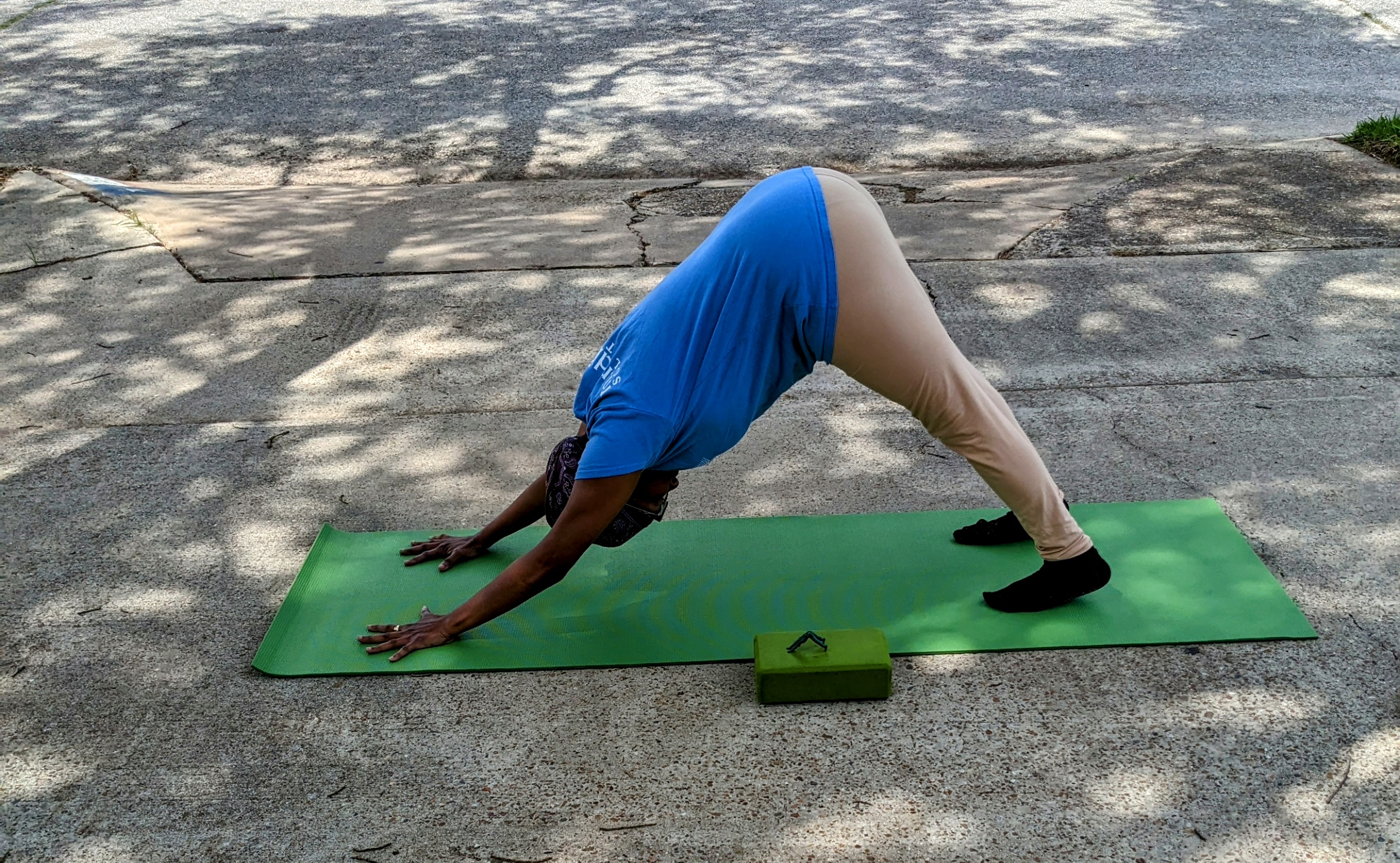
The picture above is part of my 2023 offering for the 10th annual Kiss My Asana yogathon, which benefits Mind Body Solutions (MBS). This week (April 22nd – 28th), I’m dedicated to raising awareness and resources for MBS’ life-affirming work to help people living with disabilities – and you can help too! You can help by joining me as we practice with purpose, by sharing this page, and/or by making a donation that creates opportunities for more people to practice yoga.
Mind Body Solutions provides live, online resources to people living with disabilities, worldwide. In addition to 11 live online yoga classes a week, MBS has also created a comprehensive library of recorded adaptive yoga classes for students, instructional videos for adaptive yoga teachers, and insightful interviews between our founder, Matthew Sanford, and adaptive students. It all helps people with disabilities live more fully, where they are and how they are.
Each year, in addition to hosting a fundraising page and making my personal donation, I offer a blog post and/or a YouTube post – sometimes even a whole practice. This year, part of my offering is a series of poses I’m posting on the Community page of my YouTube channel. Of course, there’s more to the poses (and pictures) than meets the eye. So, keep in mind that they – like the classes I lead – are just the tip of the iceberg.
What happens at Mind Body Solutions is the whole enchilada!
Ultimately, MBS is all about people having better relationships with their mind-body and spreading the message that a greater connection between mind and body can help us all live with improved comfort and ease.
“Ramadān Mubarak, Blessed Ramadān!” to anyone who observing the holy month of Ramadān. (Keep your eyes open!) Many blessings to anyone Counting the Omer or celebrating/observing Eastertide / the Octave of Easter!
“I know I’m waiting Waiting for something Something to happen to me But this waiting comes with Trials and challenges Nothing in life is free”
“My Lord, show me right from wrong Give me light, make me strong I know the road is long Make me strong”
– quoted from the song “Make Me Strong” by Sami Yusuf
There’s a lot in my head and heart today, a lot I want to share. But, it’s a lot. So, I’m going to ask you to wait a moment and, while you’re waiting, I’m going to ask you to send me some strength… as I send you some strength.
All over the world, people come together. Sometimes physically; sometimes virtually; sometimes spiritual; and sometimes religiously. It happens a lot when Nature cooperates – and/or when people work together to overcome natural (and man-made) disasters. It also happens this time of year, because so many communities are engaged in holy obligations, observations, and celebrations. I’ve talked about such things quite a bit recently and, this week, I again focus on a holy time – this time on the holy month of Ramadān.*
However, in addition to using this time (wisely) to share information that can bring us all closer together; I also want to use today to bring awareness to how powerful we all are (and can be) when we come together. Because, there is so much power in what we do when we come together – even virtually. There is power in coming together and waiting together. What is especially powerful is what we do, in community, when we come together and wait together. People have known about this power for eons upon eons. We see it in rituals and traditions around the world: in people coming together, as a community, during different sacred times throughout the year.
What is funny (ironic) to me is how, despite years of proof, Western science is only recently figuring out and acknowledging this power.
“But if we remove the theology—views about the nature of God, the creation of the universe, and the like—from the day-to-day practice of religious faith, the animosity in the debate evaporates. What we’re left with is a series of rituals, customs, and sentiments that are themselves the results of experiments of sorts. Over thousands of years, these experiments, carried out in the messy thick of life as opposed to sterile labs, have led to the design of what we might call spiritual technologies—tools and processes meant to sooth, move, convince, or otherwise tweak the mind. And studying these technologies has revealed that certain parts of religious practices, even when removed from a spiritual context, are able to influence people’s minds in the measurable ways psychologists often seek.”
– quoted from the (09/14/2021) Wired article entitled, “Psychologists Are Learning What Religion Has Known for Years: Social scientists are researching what humans can do to improve their quality of life. Their findings echo what religious practices perfected centuries ago.” by David DeSteno
In Yoga Sūtra 2.1, Patanjali described a spiritual technology that he called it kriyā yoga: a cleansing ritual consisting of tapas (“heat”, “discipline”, and “austerity”, as well as the practices that build heat, discipline, and austerity); svādyāya (“self-study” – which is reflection); and īshvarapraņidhāna (“trustful surrender to the Divine”). I often note that rituals made up of these exact three elements exist outside of yoga – and include observing a silent retreat (Buddhism), giving up leavened bread during Passover (Judaism), fasting for Yom Kippur (Judaism), fasting during Lent (Christianity), observing the 19-Day Fast (Bahá’í), and fasting during the holy month of Ramadān, which is ending this week.
More often than not, I contemplate and talk about the power of these rituals, of community, and of waiting in a positive way. For example, this month I have talked about the kindness in the waiting; I have referenced strength cultivated while waiting; and I have focused on the positive “destinations” we are looking forward to arriving/experiencing. I have not focused (much) on the fact that there is so much trauma that many of us are waiting for the next negative.
Yes, we can be (and are) excited about visiting new places; reconnecting with friends and family; starting new jobs and new relationships; having babies and seeing those babies hit new milestones (like taking first steps and graduating, which can be their first steps into adulthood); and hitting our own milestones. However, if we’re being honest, we are simultaneously waiting for those positives and, also, waiting for the next mass shooting, the next random shooting, the next assault, the next insult, the next ban, and the next law that keeps people from accessing “certain unalienable Rights, that among these are Life, Liberty and the pursuit of Happiness.”
Let’s be honest: We’re all waiting for the next trauma.
But, what are doing while we’re waiting?
“Take a moment to break your mind free of any distraction that causes your heart to be shackled in anxiety or pain. Remove from yourself any feeling of emptiness or remorse that comes from having to put on a face that is not your own to gain acceptance from a society that won’t take you as you are. Let your thoughts move away from those who can’t look beyond the color of your skin, the texture of your hair, the accent that you speak with, or anything else that makes you beautiful. Don’t chase after words that are unfamiliar to you but seek and speak with words that are sincerely your own. Be with those who give you hope and courage, who help you to be bold in your prayer. Forget the judgments and harshness of any who have lead you to believe that you cannot ask of your Creator for whatever your heart wishes. Don’t inhibit yourself in anyway. God is Most Generous and Most Merciful, and we all are entitled to benefit from that generosity and mercy. You are going to stand in front of the Creator of the Heavens and the Earth, One who looks for a reason to accept from you, not push you away.”
– quoted from a 2012 “Ramadān Reflection” (Day 26) for Huffington Post by Imam Khalid Latif
Given that the Western science community has only recently started to catch up with the religious and spiritual communities, I should not be surprised that so many of us have taken spiritual, energetic, and psychological power for granted. Some of us scoff at people who talk about “thoughts and prayers” every time there is a shooting in the United States. But what are we doing? That is an important question: What are we doing?
I am asking that question in the context of each individual person’s civic duty, moral duty, and physical/material duty – and I am also asking in the context of energy, emotion, and spirit. Because, here’s the thing, the bottom line: Thoughts and prayers can create resistance; thoughts and prayers can create obstacles. Thoughts and prayers can create despair.
I know, I know, that’s not the way it’s “supposed” to work. Except it is.
It is supposed to work exactly like that. It is the way it has always worked. That’s one of the reasons the stoic Emperor Marcus Aurelius** wrote, “Our actions may be impeded… but there can be no impeding our intentions or dispositions. Because we can accommodate and adapt. The mind adapts and converts to its own purposes the obstacle to our acting…. The impediment to action advances action. What stands in the way becomes the way.”
So, maybe those of us who want change need to take another look at thoughts and prayers. Maybe we all need to look at what it is for which we are praying/hoping/wishing/thinking and how that praying/hoping/wishing/thinking creates the energy, emotion, and spirit needed for people to engage their minds and bodies. Maybe we need to look at how all of that can create more energy towards the positive, instead of continually experiencing how it contributes to the negative.
We need to start believing in change for the better. And, while we’re waiting, we need to start doing the things that enable us to create that better – and we need to come do it in community.
“The Creation Equation states that when the intensity of desire, or shakti (Is), plus the intensity of the energy you direct toward achieving it, or vayu (Iv), is greater than the intensity of resistance, or karma (Ik), it equals attainment of your desire, or prapti (P). Thus, the formula looks something like this:
Is + Iv > Ik = P.”
– quoted from “Chapter 11. The Formula For Fulfilling Your Desires” in The Four Desires: Creating a Life of Purpose, Happiness, Prosperity, and Freedom by Rod Stryker
UMMAH [Arabic] – Community, refers to a group of people who share common religious beliefs, often used as a synonym for “ummat al-Islām” (“the Islāmic Community”). Also appears in the Qur’ān as “Ummah Wāhida” (“One Nation”).
SHA’B [Arabic] – A Nation or Community which share common ancestry and geography (but not necessarily culture, language, or beliefs).
DHIMMĪ [Arabic] – Protected Person, historically used in reference to non-Muslims living within an Islamic state and conveys certain legal rights related to life, property, and religious freedom.
Please join me today (Tuesday, April 18th) at 12:00 PM or 7:15 PM for a yoga practice on Zoom. You can use the link from the “Class Schedules”calendar if you run into any problems checking into the class. You can request an audio recording of this practice via a comment below or (for a slightly faster reply) you can email me at myra(at) ajoyfulpractice.com.
Tuesday’s playlist is available on YouTube and Spotify.[Look for “Ramadan 2023”]
Two quick notes about the music: First, while the most of the musicians featured on the playlists during these final days of Ramadān are Muslim there are some exceptions. One of the notable exceptions – notable, because she is the only female soloist and the only non-Muslim singer on the list – is Reba McEntire. Her song “Pray for Peace” is on the playlist because she re-released it during the month of Ramadān in 2014 – but not just randomly in the month, the song was released in the last ten days of the month! Second, there are some songs on the playlist that are Nasheeds (meaning they are religiously moral songs) that, in some traditions, are meant to be sung without instrumentation or only with percussion. I have, however, included orchestrated versions of these songs, because this seems to have worked best in an in-studio setting. I mean no disrespect by this choice. As far as I know, percussion or voice only recordings of each song are available (if you want to build your own playlist). Alternatively, you can practice without the music.
I remixed the playlist because I wanted to include some new songs. One of these songs is on the playlist three (3) times and was inspired by “the stories in In Baghdad Dreaming Of Cairo: In Cairo, Dreaming Of Baghdad by Rumi and by The Alchemist by Paulo Coelho.” The song is moving in English (and as an instrumental, which is how it shows up during the practice), but it is next level in Arabic. Let’s go. Better yet, let’s make the whole world feel like home.
In the spirit of generosity (“dana”), the Zoom classes, recordings, and blog posts are freely given and freely received. If you are able to support these teachings, please do so as your heart moves you. (NOTE: You can donate even if you are “attending” a practice that is not designated as a “Common Ground Meditation Center” practice, or you can purchase class(es). Donations are tax deductible; class purchases are not necessarily deductible.)
**NOTE: The Marcus Aurelius statement is from Book 5 of Meditations. The translation above appears in the preface of The Obstacle is the Way: The Timeless Art of Turning Trials into Triumphs by Ryan Holiday.
“Ramadān Mubarak, Blessed Ramadān!” to anyone observing the holy month of Ramadān. (Keep your eyes open!) Many blessings to anyone Counting the Omer or celebrating/observing Eastertide / the Octave of Easter!
“I know I’m waiting Waiting for something Something to happen to me But this waiting comes with Trials and challenges Nothing in life is free”
“My Lord, show me right from wrong Give me light, make me strong I know the road is long Make me strong”
– quoted from the song “Make Me Strong” by Sami Yusuf
Please join me today (Tuesday, April 18th) at 12:00 PM or 7:15 PM for a yoga practice on Zoom. You can use the link from the “Class Schedules”calendar if you run into any problems checking into the class. You can request an audio recording of this practice via a comment below or (for a slightly faster reply) you can email me at myra(at) ajoyfulpractice.com.
Tuesday’s playlist is available on YouTube and Spotify.[Look for “Ramadan 2023”]
Two quick notes about the music: First, while the most of the musicians featured on the playlists during these final days of Ramadān are Muslim there are some exceptions. One of the notable exceptions – notable, because she is the only female soloist and the only non-Muslim singer on the list – is Reba McEntire. Her song “Pray for Peace” is on the playlist because she re-released it during the month of Ramadān in 2014 – but not just randomly in the month, the song was released in the last ten days of the month! Second, there are some songs on the playlist that are Nasheeds (meaning they are religiously moral songs) that, in some traditions, are meant to be sung without instrumentation or only with percussion. I have, however, included orchestrated versions of these songs, because this seems to have worked best in an in-studio setting. I mean no disrespect by this choice. As far as I know, percussion or voice only recordings of each song are available (if you want to build your own playlist). Alternatively, you can practice without the music.
In the spirit of generosity (“dana”), the Zoom classes, recordings, and blog posts are freely given and freely received. If you are able to support these teachings, please do so as your heart moves you. (NOTE: You can donate even if you are “attending” a practice that is not designated as a “Common Ground Meditation Center” practice, or you can purchase class(es). Donations are tax deductible; class purchases are not necessarily deductible.)
Blessings to anyone Counting the Omer or celebrating Easter and Eastertide / the Octave of Easter! “Ramadān Mubarak, Blessed Ramadān!” to anyone who is observing the holy month of Ramadān. (Keep your eyes open!)
For Those Who Missed It: The following was originally posted today in 2020. Dates and related information (including links) have been updated. *UPDATE: I revised some language and added a quote in this post after the practice.
“Find the cost of freedom Buried in the ground Mother Earth will swallow you Lay your body down.”
– “Find the Cost of Freedom” by Crosby, Stills, Nash & Young
Most people, I think, would agree that freedom is priceless. I mean, at least, I think we can all agree about that when we are talking about our own freedom. Things get a little twisted when we are talking about someone else’s freedom. How much do we value the freedom – or even the life – of someone we perceive as different from us? How much do we value the freedom – or even the life – of someone with whom we disagree about even the meaning of freedom?
What happens if you have to put a price freedom? What happens if you actually have to quantify the value of life, liberty, freedom (which is, ultimately, the pursuit of happiness)?
Did that last question take you back to the Constitution and the founders of the United States? Let’s really go back, get the full context, shall we?
“We hold these truths to be self-evident, that all men are created equal, that they are endowed by their Creator with certain unalienable Rights, that among these are Life, Liberty and the pursuit of Happiness.”
– excerpt from the Declaration of Independence as presented by the Committee of Five and approved and signed by the Second Continental Congress, 1776
Yes, yes; it’s inspiring and lovely – and I do love the sentiment: those are words to live and lead by. And yet…. And yet…. Here’s one of the interesting and twisted things about all that: The founders of the United States, who created a country based on those highly virtuous concepts outlined in the Declaration of Independence, did so while simultaneously creating a country (that same country) that systematically declared women and certain people of color to not only not be equal, but to also not be entitled to the very rights which they said were “endowed by their Creator.” These men, for the Committee of Five and the signers of the Constitution were all men (so far as I know), were willing to fight in order to secure their freedom from Great Britain. Furthermore, they believed, as Caesar Rodney (the Gentleman from Delaware) famously put it when he cast his vote for independence, “As I believe the voice of my constituents and of all sensible and honest men is in favor of independence, my judgment concurs with them; I vote for independence.” In other words, they believed they represented the voice of the People (i.e., other men) who were willing to lay down their lives for freedom: that was the cost of freedom.
“The one who brought his offering on the first day was Nahshon the son of Amminadab of the tribe of Judah. And his offering was one silver bowl weighing one hundred and thirty [shekels], one silver sprinkling basin [weighing] seventy shekels according to the holy shekel, both filled with fine flour mixed with olive oil for a meal offering. One spoon [weighing] ten [shekels] of gold filled with incense. One young bull, one ram and one lamb in its first year for a burnt offering. One young he goat for a sin offering. And for the peace offering: two oxen, five rams, five he goats, five lambs in their first year; this was the offering of Nahshon the son of Amminadab.”
– Bamidbar / Numbers 7:12 – 7:17
In the Hebrew Bible / the Christian Old Testament, G-d not only gave Moses instructions for how to deal with Pharaoh, but also instructions on how the Jewish people were to deal with the last days of the plague (in particular during the final plague); how to travel and camp; how to take a census (or accounting of the men); how to establish leadership; and how to build and dedicate a temple. G-d also instructed Moses that each Tribe of Israel was required to make a sacrifice, or offering, as a way to give thanks and offer devotion. In other words, according to what they were able and how many were in their tribe, each leader paid the cost of freedom.
Today in 1862, nearly nine months before the Emancipation Proclamation went into effect, President Abraham Lincoln signed the District of Columbia Compensated Emancipation Act. The act essentially ended slavery in the capital city (although it did not apply to fugitive slaves who had escaped from Maryland) and set aside over $100,100,000 as compensation for the 3,185 people who were freed.
That was the cost of freedom: over $1 million, plus an additional $100,000, for approximately 3,185 people.
But, let’s not get the facts twisted. The compensation was primarily for the slave owners who were “losing their property.” President Lincoln appointed a 3-person Emancipation Commission, which met 5 days a week, for months on end, in order to review 966 petitions and dole out compensation accordingly. Petitions included the name, age, sex, and “particular description” of the enslaved person in question and were made on behalf of black, as well as white, “slave owners.” Yes, that is correct. At the time, certain places within the Union – like the District of Columbia – were home to freedmen who had purchased their family members so that they too could be free. (I started to put purchased in quotes, but the reality is people paid to be free.) This act did not apply to any Confederate slaver owners or anyone who had aided the Confederacy’s (lost) cause. Furthermore, it made it a felony to “kidnap” or in any way re-enslave a freed person or formerly enslaved person.
The Compensated Emancipation Act paid Union slave-owners $300 per freed person and paid formerly enslaved people a resettlement or “emigrant” fee – not to exceed $100 each – if they chose to relocate to places like Haiti and Liberia. It established payment for the commissioners ($200,000 each); a clerk ($200 per month plus an occasional 25 cent processing fee); and paid a marshal “such fees as are allowed by law for similar services performed by him in the Circuit Court of the District of Columbia.” It also stated, “that the Secretary of the Treasury shall cause all other reasonable expenses of said commission to be audited and allowed, and that said compensation, fees, and expenses shall be paid from the Treasury of the United States.” In July of 1862, an amendment was added which allowed formerly enslaved people to petition for compensation (on their own behalf) if their former masters had not already done so. The amendment did something even the Declaration of Independence and the original Act didn’t do: it gave equal weight and consideration to petitioners – regardless of their color or the color of the person who might challenge their petition.
Similar compensation was proposed, but never implanted in the rest of the United States. Today (April 16th), is Emancipation Day in the District of Columbia. It is a public holiday in the country’s capital city and yet, outside of D. C., most people don’t think twice about Emancipation Day – unless it falls on a Saturday or Sunday (like it does this year) and thereby delays the official federal tax day for a few days (so that people can have Monday off).
So, there are three examples of the cost of freedom. What’s the cost of your freedom? What, for that matter, does it mean to you to be free? And, what are you doing with your freedom – even when your movement/freedom has been restricted by the quarantine and social distancing?
“If one thinks of oneself as free, one is free, and if one thinks of oneself as bound, one is bound. Here this saying is true, ‘Thinking makes it so.’”
– Ashtavakra Gita 1:11
Please join me for a 65-minute virtual yoga practice on Zoom today (Sunday, April 16nd) at 2:30 PM.Use the link from the “Class Schedules” calendar if you run into any problems checking into the class. You can request an audio recording of this practice via a comment below or by emailing myra (at) ajoyfulpractice.com.
In the spirit of generosity (“dana”), the Zoom classes, recordings, and blog posts are freely given and freely received. Ifyou are able to support these teachings, please do so as your heart moves you. (NOTE: You can donate even if you are “attending” a practice that is not designated as a “Common Ground Meditation Center” practice, or you can purchase class(es). Donations are tax deductible; class purchases are not necessarily deductible.)
 ###
###