FTWMI: “This is why you were brought [here]” November 29, 2022
Posted by ajoyfulpractice in Books, Changing Perspectives, Dharma, Faith, Healing Stories, Hope, Life, Love, Men, Mysticism, Pain, Philosophy, Religion, Suffering, Wisdom, Writing, Yoga.Tags: 1 Epistle General of Peter, Arthur Greeves, Bhagavad Gita, C. S. Lewis, Christian apologetics, Jack Hawley, joy, The Inklings, William Wordsworth, Yoga Sutra 1.23, Yoga Sutra 2.45
1 comment so far
For Those Who Missed It: The following was originally posted November 29, 2020. Class details and links have been updated.
“Surprised by joy — impatient as the Wind
I turned to share the transport — Oh! with whom
But Thee, deep buried in the silent tomb,
That spot which no vicissitude can find?
Love, faithful love, recalled thee to my mind —
But how could I forget thee? Through what power,
Even for the least division of an hour,
Have I been so beguiled as to be blind
To my most grievous loss? —”
– quoted from the poem, “Surprised by Joy – Impatient As The Wind” by William Wordsworth (written in memory of his daughter)
If you’re anything like me, when you think of C. S. Lewis, born today in 1898, you think of Narnia and Aslan, and Christian allegories sometimes disguised as fantasy and children’s books. Like me, you might express a little confusion over why Mr. Lewis himself said the Chronicles of Narnia were not “allegories” and you might absolutely love The Screwtape Letters even though (or maybe because) it is super dark and written so well that it almost always feels as if no one will win and “The Patient” – as well as the demons – will be condemned to everlasting turmoil. Regardless of how he defined his work, you might recognize Mr. Lewis and his writing as falling under the heading of Christian apologetics. However, if – like me – you’ve read more C. S. Lewis than you’ve studied, you might be surprised by the author’s multi-layered relationship with “Joy.”
Christian apologetics is a category of study and theology focused on the defense of Christianity. It has its foundations in Torah study and Greek philosophical discourse, but there is a long list of New Testament Biblical references to the need for “a verbal defense” of belief. One of the best examples comes from The First Epistle General of Peter.
“But even if you should suffer for what is right, you are blessed. ‘Do not fear their threats; do not be frightened.’ But in your hearts revere Christ as Lord. Always be prepared to give an answer to everyone who asks you to give the reason for the hope that you have. But do this with gentleness and respect….”
– 1 Epistle General of Peter (3:14 – 15, NIV)
Unlike the epistles, or letters, attributed to Saint Paul and titled to reference specific Church communities (e.g. in Corinth, Galatia, Colossae, etc.), the letters attributed to Saint Peter are more generically addressed to “strangers” in a variety of areas (in 1st Peter) and “to them that have obtained like precious faith with us through the righteousness of God and our Saviour Jesus Christ” (in 2nd Peter, KJV). The meaning of “strangers” is debatable, but what is consistent in the letters, and in modern understanding of the letters, is that the letter are addressed to people who were subject to persecution (because of their faith), people who might have been tempted to give up their faith because of the persecution, and who – despite the persecution – experienced a faith-related longing. This longing, which Saint Peter described as “hope,” C. S. Lewis defined as “Joy.”
“The reader who finds these three episodes of no interest need read this book no further, for in a sense the central theme of my life is about nothing else. For those who are still disposed to proceed I will only underline the quality common to the three experiences; it is that of an unsatisfied desire which is itself more desirable than any other satisfaction. I call it Joy, which is here a technical term and must be sharply distinguished both from Happiness and Pleasure. Joy (in my sense) has indeed one characteristic, and one only, in common with them; the fact that anyone who has experienced it will want it again. Apart from that, and considered only in its quality, it might almost equally well be called a particular kind of unhappiness or grief. But then it is a kind we want. I doubt whether anyone who has tasted it would ever, if both were in his power, exchange it for all the pleasures in the world. But then Joy is never in our power and pleasure often is.”
– quoted from Surprised by Joy: The Shape of My Early Life by C. S. Lewis
Clive Staples Lewis was the Belfast-born youngest son of Albert James Lewis (a solicitor) and Florence “Flora” Augusta Lewis, who could be considered Irish royalty. Flora’s father was an Anglican priest; one of her great-grandfathers was Bishop Hugh Hamilton; and another of her great-grandfathers was the Right Honourable John Staples, who served as an Irish Member of Parliament for 37 years and was a descendant of titled persons in Northern Ireland. Naturally, C. S. – later known as “Jacksie” and then “Jack” – was baptized in the (Anglican) Church of Ireland, which is the second-largest church in Ireland (after the Roman Catholic Church) and identifies itself as both Catholic and Reformed. All that is to say that, he and his older brother Warren “Warnie” Hamilton Lewis were raised in a very structured, family-embedded tradition of faith.
Somewhere along the way, for a variety of reasons – and based on a variety of experiences – both brothers fell away from the Church and away from their family’s traditional beliefs.
While “Warnie,” the elder brother, finished his schooling and went on to serve 18 years in the military, the younger Lewis brother was drafted, sent to the front line on his 19th birthday, was wounded and traumatized by the death of his friends, and was sent home within a year. Once he physically recovered, “Jack” (whose nickname came from a beloved pet) went back to England to finish his studies.
Previously, at around age 15, “Jack” became interested in the occult and began to actively and publicly define himself as an atheist. As such, he spent an inordinate amount of time thinking about God, explaining why God didn’t exist, and surrounding himself with like-minded people and things. The problem was that when he returned to Oxford and started paying attention to his experiences (and the way he felt as he read, wrote, and interacted with people), he found he was being (spiritually and emotionally) sustained and nurtured by things and people who were theistic as opposed to atheistic. And the more he delved into his embodied experience, rather than just his analytical experience, the more he realized… there was something more.
“But soon (I cannot say how soon) nature ceased to be a mere reminder of the books, became herself the medium of the real joy. I do not say she ceased to be a reminder. All Joy reminds. It is never a possession, always a desire for something longer ago or further away or still ‘about to be’. But Nature and the books now became equal reminders, joint reminders, of – well, of whatever it is. I came no nearer to what some would regard as the only genuine love of nature, the studious love which will make a man a botanist or an ornithologist. It was the mood of a scene that mattered to me; and in tasting that mood my skin and nose were as busy as my eyes”
– quoted from Surprised by Joy: The Shape of My Early Life by C. S. Lewis
At around the same time, 1931, both brothers reclaimed their Christian roots and deepened their brotherly bond. They had been living together in Oxford for about a year, went on walking tours together, and participated in the weekly Thursday night “Inkling” meetings – which featured works-in-progress of the various members who were and would become literary giants in the English language. The “Inklings” – who were all white, Christian men of Oxford – included in their number the Lewis brothers, their close friend J. R. R. Tolkien (and his son Christopher, who were both raised Catholic), Charles Williams (a devout member of the [Anglican] Church of England), Henry Victor “Hugo” Dyson Dyson (a lecturer and literary collector known as H. V. D. Dyson, who was instrumental in C. S. Lewis’s return to Christianity), and Arthur Owen Barfield (“the first and last Inkling,” whose anthroposophical beliefs in a spiritual world accessed through human experience heavily influenced all the other Inklings).
C. S. Lewis’s spiritual memoir, Surprised by Joy, concludes in 1931, but wasn’t published until 1955. In the interim (around 1950), he started corresponding with a Jewish American poet (in the United States) who was estranged from her abusive husband. This woman – a child prodigy, an atheist, and former Communist, whose husband (also an author) may have introduced her to C. S. Lewis’s work – started the transatlantic correspondence because she had faith-related questions. Intrigued, and ultimately attracted, to each other’s intellect, the correspondence became more personal than theological. She frequently referenced him to others and once wrote, “Just got a letter from Lewis in the mail. I think I told you I’d raised an argument or two on some points? Lord, he knocked my props out from under me unerringly; one shot to a pigeon. I haven’t a scrap of my case left. And, what’s more, I’ve seldom enjoyed anything more. Being disposed of so neatly by a master of debate, all fair and square – it seems to be one of the great pleasures of life, though I’d never have suspected it in my arrogant youth. I suppose it’s unfair tricks of argument that leave wounds. But after the sort of thing that Lewis does, what I feel is a craftsman’s joy at the sight of a superior performance.”
The poet officially divorced her husband, converted to Christianity, and moved with her two school-aged sons to England to be with “Jack.” In April of 1956, several years after her arrival (in 1953), the couple entered into a “civil marriage” so that she and her children could stay in England. It was described as a marriage of friendship and convenience. However, when his wife was diagnosed with cancer (in October of 1956), C. S. Lewis realized he not only admired her, he loved her. He was 58 years old and surprised by Joy* – as his beloved wife was Helen Joy Davidman.
(*NOTE: C. S. Lewis was teased by his friends, but said that the title and intention of the book Surprised by Joy had nothing to do with his wife being Joy. So, you can take the overlap as serendipity… or God winking.)
“Total surrender is the first step towards the fruition of either. Shut your mouth; open your eyes and ears. Take in what is there and give no thought to what might have been or what is somewhere else. That can come later, if it must come at all. (And notice how the true training for anything whatever that is good always prefigures and, if submitted to, will always help us in the true training for the Christian life. That is a school where they can always use your previous work whatever the subject it was on.)”
– quoted from Surprised by Joy: The Shape of My Early Life by C. S. Lewis
Yoga Sūtra 1.23: īśvarapraņidhānādvā
– “[A perfectly still, pristine state of mind] comes from a special process of devotion and letting go into Ishvara [the Divine], the creative source from which we emerged.”
Yoga Sūtra 2.45: samādhisiddhirīśvarapraņidhānāt
– “From trustful surrender to Ishvara [the Divine], [a perfectly still, pristine state of mind] comes.”
“‘To work without desire may seem impossible, but the way to do it is to substitute thoughts of Divinity for thoughts of desire. Do your work in this world with your heart fixed on the Divine instead of on outcomes. Do not worry about results. Be even tempered in success or failure. This mental evenness is what is mean by yoga…. Indeed, equanimity is yoga!’” (2.48)
“‘Those who see Me in everything and everything in Me, know the staggering truth that the Self in the individual is the Self in all. As they live in constant spiritual awareness, I am never out of their sight or lost to them – nor are they every out of My sight or lost to Me. ’” (6.30)
– Krishna speaking to Arjuna in The Bhagavad Gita: A Walkthrough for Westerners by Jack Hawley
Please join me today (Tuesday, November 29th) at 12:00 PM or 7:15 PM for a yoga practice on Zoom. You can use the link from the “Class Schedules” calendar if you run into any problems checking into the class. You can request an audio recording of this practice via a comment belowor (for a slightly faster reply) you can email me at myra (at) ajoyfulpractice.com.
Today’s playlist is available on YouTube and Spotify. [Look for “11292020 Jack’s Surprising Joy”]
In the spirit of generosity (“dana”), the Zoom classes, recordings, and blog posts are freely given and freely received. If you are able to support these teachings, please do so as your heart moves you. (NOTE: You can donate even if you are “attending” a practice that is not designated as a “Common Ground Meditation Center” practice, or you can purchase class(es). Donations are tax deductible; class purchases are not necessarily deductible.)
“Your remarks about music would seem to lead back to my old idea about a face being always a true index of character… not of course exactly, but its general tone. What type of person is this girl of whom Debussy has been talking to you? As to your other suggestions about old composers like Schubert or Beethoven, I imagine that, while modern music expresses both feeling, thought and imagination, they expressed pure feeling. And you know all day sitting at work, eating, walking, etc., you have hundreds of feelings that can’t (as you say) be put into words or even into thought, but which could naturally come out in music. And that is why I think that in a sense music is the highest of the arts, because it really begins where the others leave off.”
– quoted from a letter addressed to his childhood friend Arthur Greeves (who he called “after my brother, my oldest and most intimate friend”), written by C. S. “Jack” Lewis, dated 20 June 1916
The connection between home and Joy….
“It was this that forced me to write. I longed to make things, ships, houses, engines. Many sheets of cardboard and pairs of scissors I spoiled, only to turn from my hopeless failures in tears. As a last resource, as a pis aller, I was driven to write stories instead. You can do more with a castle in a story than with the best cardboard castle that ever stood on a nursery table.”
– quoted from Surprised by Joy: The Shape of My Early Life by C. S. Lewis
### TASTE JOY (But don’t get it twisted and confuse “lower” pleasure with the “higher”)! ###
Cèlèbrer Une Vie & FTWMI: Recuerda Todas Almas November 2, 2022
Posted by ajoyfulpractice in Books, Faith, Gratitude, Healing Stories, Life, Loss, Love, Mysticism, One Hoop, Religion, Yoga.Tags: 2 Maccabees, Alain Baudry, All Souls' Day, Allhallowtide, Death, Dia de los Muertos, Dia de Muertos, e e cummings, grief, Halloween, Kevin Brockmeier
2 comments
Many blessings to those observing All Souls y Día de (los) Muertos!
“That was what the living did: they died.”
.
– quoted from The Brief History of the Dead by Kevin Brockmeier
On Sunday (10/30/2022), I was shocked to hear that one of my Minneapolis yoga buddies was terminally ill. Just a few hours later, I was shocked and saddened to hear that he had passed. His family hosted a celebration of life so that he could spend his final hours surrounded by people who loved and respected him. It was hard; but I heard the opportunity gave him and them some comfort.
For years, AB practiced yoga at the old Downtown Minneapolis YMCA. He was partially responsible for me meeting one of my favorite people on the planet and, additionally, his mother once joined us for a class during one of her visits to the Twin Cities. (I have a vague idea that she might have taught yoga at one time; however, since I never read her autobiography, don’t quote me on this point. Either way, she definitely started practicing long before I ever did!)
AB loved the music and especially appreciated my Christmas-story playlist. For many years, he gave me an Amazon gift card so I could purchase more music for class! In addition to swapping music, we swapped a few books – including Kevin Brockmeier’s The Brief History of the Dead, which I mention at this time every year. We also shared an occasional meal. For better or for worse, I got to watch his life change.
I also got to see his practice change. (NOTE: For those who knew whom as an esteemed attorney and French academic editor, here I am talking about his yoga practice.) At one point, while we were still at the old Y, he asked me what would make certain aspects of the practice more accessible to him. Later, he decided he was getting enough cardio and strength from boot camp (and other cardio classes) and that what he needed/wanted from his yoga practice was the meditation and deep tissue work he experienced when he dropped into one of my Yin Yoga classes. Unfortunately, the Yin Yoga classes didn’t always fit into his schedule. So, we talked about how he could add a little Yin to the very yang vinyasa practices that worked for his schedule. Eventually, when the Y moved to it’s fancier digs and more classes overlapped, he made the decision (as so many did) to take classes that were more active than yoga. We still caught up in the lobby and, occasionally, outside of the Y; but…. Time marches on.
As reports and tributes come in from all over the world, I can’t help but notice how “one of those random people who came to yoga and became a friend,” meant so much to so many different people and for so many different reasons. AB’s life and death are a reminder that a person can affect the lives of a lot of different people in a lot of different ways.
Today’s sequence reflects the yin/yang that AB appreciated. It’s also an opportunity to celebrate a life that touched so many. Repose en paix, mon ami. Nous nous souviendrons de toi. Nous nous souviendrons de toi.
For Those Who Missed It: The following was originally posted November 2, 2020. Class details and links have also been updated or added.
“i carry your heart with me(i carry it in
.
my heart)i am never without it(anywhere
i go you go,my dear;and whatever is done
by only me is your doing,my darling)“
.
– quoted from “[i carry your heart with me(I carry it in)]” by e e cummings
Take a moment to bring your awareness to your hearts. Not just your physical heart, or even just your emotional heart – take a moment to bring your awareness to your energetic heart and all of its connections. You can even think of that energetic heart as a spiritual heart and all of its connections. Either way, when I talk about the various ways we can map out our energy – and especially when I specifically refer to the energy system of nadis (“rivers”) and chakras (“wheels”) as outlined by Yoga and Ayurveda, as they come to us from India, I often mention that we can be genetically and energetically (even spiritually) connected to people we have never met and will never meet. Similarly, we are connected, genetically and energetically (even spiritually), to people we will never meet again… people who have passed from the physical world (back) into the energetic and spiritual world.
Throughout history, people from various cultures around the world have had (and continue to have) different ways of honoring these connections – especially the spiritual and energetic connections we have with those who passed on into another realm of existence. Yes, I said, “another realm of existence;” because, while someone ceases to exist in the material and physical sense, they can continue to exist in an emotional, energetic, and spiritual sense – as long as we remember them.
“No two reports were ever the same. And yet always there was the drumlike thumping noise.
Some people insisted that it never went away, that if you concentrated and did not turn your ear from the sound, you could hear it faintly behind everything in the city….”
.
– quoted from The Brief History of the Dead by Kevin Brockmeier
Today, November 2nd, is All Souls’ Day, also known as the Commemoration of All the Faithful Departed – the last day of Allhallowtide in the Western Christian tradition and the final Día de (los) Muertos in Mexico and the Mexican diaspora. Like All Saints’ Day (which was yesterday), there was a time when this holy time was celebrated in the Spring – and, in fact, there are still traditions, like the Eastern Orthodox Churches, which remember the dead around Easter. However, the fifth Benedictine Abbot of Cluny, St. Odilon of Cluny, established this Western observation in the 10th century and the practice has endured. Unlike All Saints, today is a day dedicated to all departed souls and, in particular, to those who may or may not have lived a “faithful” life according to the Church.
While it is not a national holiday in Catholic countries, nor is it one of the five days of holy obligation within the Catholic Church, it is a day of prayer (and, for some, quite a few masses). Here, the prayers are not so much as for the living as for the dead, because Christians who have a “fundamental belief that there is a prayerful spiritual bond between those in heaven (Christian triumphant) and the living (the Christian militant)” may also believe that those who die without being baptized and/or living a faithful life (the Church penitent, also known as “the Church suffering” and “the Church expectant”) will languish in Purgatory without God’s grace.
So, today people pray for that grace so their dearly departed loved ones will no longer suffer. In addition to the vibrant Día de (los) Muertos traditions I mentioned yesterday, as well as the traditions of guising, souling, and the exchange of soul cakes (that I mentioned on Halloween), All Souls’ Day is known for bell tolling and candle lighting, which both represent the cleansing of souls and power of light overcoming darkness.
“If he had not believed that the dead would be raised, it would have been foolish and useless to pray for them. In his firm and devout conviction that all of God’s faithful people would receive a wonderful reward, Judas made provision for a sin offering to set free from their sin those who had died. It is therefore a holy and wholesome thought to pray for the dead, that they may be loosed from sins.”
.
– 2 Maccabees (12:44 – 46)
Please join me today (Wednesday, November 2nd) at 4:30 PM or 7:15 PM for a yoga practice on Zoom. Use the link from the “Class Schedules” calendar if you run into any problems checking into the class. You will need to register for the 7:15 PM class if you have not already done so. You can request an audio recording of this practice via a comment below or (for a slightly faster reply) you can email me at myra (at) ajoyfulpractice.com.
Tuesday’s playlist is available on YouTube and Spotify. [Look for “11022021 All Souls / Dia de los”]
In the spirit of generosity (“dana”), the Zoom classes, recordings, and blog posts are freely given and freely received. If you are able to support these teachings, please do so as your heart moves you. (NOTE: You can donate even if you are “attending” a practice that is not designated as a “Common Ground Meditation Center” practice, or you can purchase class(es). Donations are tax deductible; class purchases are not necessarily deductible.)
“One particular issue of the L. Sims News & Speculation Sheet—the Sims Sheet, people called it—addressed the matter of this sound. Fewer than twenty per cent of the people Luka interviewed claimed that they could still hear it after the crossing, but almost everyone agreed that it resembled nothing so much as—could be nothing other than—the pounding of a heart. The question, then, was where did it come from? It could not be their own hearts, for their hearts no longer beat. The old man Mahmoud Qassim believed that it was not the actual sound of his heart but the remembered sound, which, because he had both heard and failed to notice it for so long, still resounded in his ears. The woman who sold bracelets by the river thought that it was the heartbeat at the center of the world, that bright, boiling place she had fallen through on her way to the city. ‘As for this reporter,’ the article concluded, ‘I hold with the majority. I have always suspected that the thumping sound we hear is the pulse of those who are still alive. The living carry us inside them like pearls. We survive only so long as they remember us.”’
.
– quoted from The Brief History of the Dead by Kevin Brockmeier
.
.
### “BA-DUM. BA-DUM. BA-DUM.” ###
Curious About: Houdini’s Last Month (and Allhallowtide)? November 1, 2022
Posted by ajoyfulpractice in Mysticism, Religion, Suffering.Tags: All Hallows' Eve, Allhallowtide, Halloween, Harry Houdini, Samhain
add a comment
Many blessings to those observing Allhallowtide y Día de (los) Muertos!
“My brain is the key that sets me free.”
– Harry Houdini’s motto, as quoted in the Houdini Museum (Scranton, Pennsylvania)
Harry Houdini died October 31, 1926 – it was a tragic end of a very bad month for the magician/illusionist. Click here to read a little history of Halloween and about why Houdini had such a bad month.
### This is just a teaser. Trick or Treat? ###
On the Road Again… & It’s Lit!!! October 21, 2022
Posted by ajoyfulpractice in Dharma, Faith, Hope, Meditation, Philosophy, Religion, Wisdom, Yoga.Tags: Bend Hot Yoga, Diwali, Oregon, Robert Frost
2 comments
Just a reminder: The classes I am guest teaching at Bend Hot Yoga (this weekend) will be available live via ZOOM. Check my “Class Schedules” calendar for access details. (NOTE: Meeting codes are the same as they normally would be for each day, but the times are different. Times listed below are PDT.)
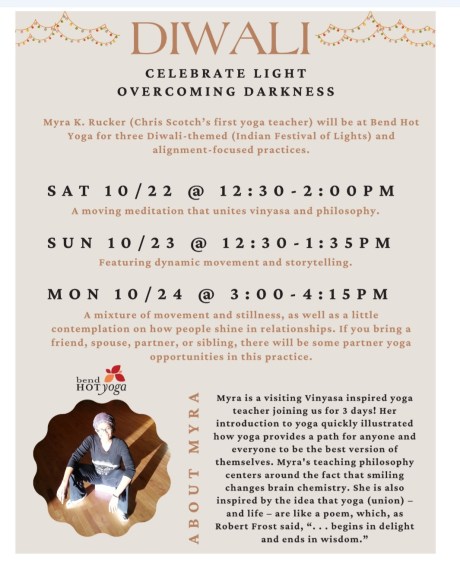
### Put Your Lights On ###
Listen, I’m Still SINGING BOUT MY STUFF! (mostly links, felicitations, and an explanation) October 18, 2022
Posted by ajoyfulpractice in "Impossible" People, Art, Books, Faith, Healing Stories, Hope, Life, Music, Ntozake Shange, One Hoop, Pain, Poetry, Religion, Shemini Atzeret / Simchat Torah, Suffering, Yoga.Tags: Carry app, Maya Page, Portland, Postpartum, prenatal, prenatal yoga
add a comment
Chag sameach!” to those celebrating Simchat Torah.
“she’s half-notes scattered
without rhythm/ no tune
sing her sighs
sing the song of her possibilities
sing a righteous gospel
let her be born
let her be born
& handled warmly.
[Lady in Brown] I’m outside Chicago
[Lady in Yellow] I’m outside Detroit
[Lady in Purple] I’m outside Houston
[Lady in Red] I’m outside Baltimore
[Lady in Green] I’m outside San Francisco
[Lady in Blue] I’m outside Manhattan
[Lady in Orange] I’m outside Saint Louis”
– All the Ladies from for colored girls who have considered suicide/when the rainbow is enuf by Ntozake Shange
I’m “outside” Portland, working with a talented group of Yoga teachers, pregnant – as well as postpartum – people, and filmmakers to create new classes for the Carry app.
Conceived by Maya Page, the Carry app is an iOS-based yoga and meditation app “for pregnancy, birth, and beyond,” that promotes healing for a wide spectrum of people. Even though my experiences working with the Carry app put me front and center – instead of behind the scenes – the intersecting energies around creation, birth, healing, and life is something I’ve experienced before. I experienced it working (behind the scenes) with Ntozake Shange on an anniversary revival of her groundbreaking and award-winning choreopoem for colored girls who have considered suicide/when the rainbow is enough.
Born today in 1948, Ntozake was an award winning playwright and novelist who changed her name to the Zulu words meaning “she comes with her own things” and “who walks like a lion.” The beginning of her story predates the transistor radio (first introduced today in 1954), but the radio is a definite element in her stories. You can click here to read last year’s related post.
Today’s playlist is available on YouTube and Spotify. [Look for “07112020 An Introduction.”]
Since I am not teaching on Zoom today, people on the Tuesday class list, will receive links to previously recorded practices. If you are not on the Tuesday list, you can request an audio recording of either practice via a comment below or (for a slightly faster reply) you can email me at myra (at) ajoyfulpractice.com.
In the spirit of generosity (“dana”), the Zoom classes, recordings, and blog posts are freely given and freely received. If you are able to support these teachings, please do so as your heart moves you. (NOTE: You can donate even if you are “attending” a practice that is not designated as a “Common Ground Meditation Center” practice, or you can purchase class(es). Donations are tax deductible; class purchases are not necessarily deductible.
Check out the “Class Schedules” calendar for upcoming classes.]
### “I found god in myself
and i loved her
i loved her fiercely” (NS) ###
FTWMI: Generally Coming Together October 17, 2022
Posted by ajoyfulpractice in Books, Buddhism, Changing Perspectives, Depression, Faith, Fitness, Gratitude, Healing Stories, Health, Hope, Life, Loss, Meditation, Music, One Hoop, Philosophy, Religion, Science, Shemini Atzeret / Simchat Torah, Sukkot, Wisdom, Yoga.Tags: David DeSteno, Mother Teresa, Rabbi Yehuda Shurpin, T. K. V. Desikachar, yoga
add a comment
Chag sameach!” to those celebrating Shemini Atzeret and Simchat Torah.
For Those Who Missed It: The following was originally posted in September 2021. If you’re on my Monday class list, I’ve sent you a recording of this practice since there is no Zoom practice tonight. If you are not on the Monday list, you can request an audio recording of either practice via a comment below or (for a slightly faster reply) you can email me at myra (at) ajoyfulpractice.com.
In the spirit of generosity (“dana”), the Zoom classes, recordings, and blog posts are freely given and freely received. If you are able to support these teachings, please do so as your heart moves you. (NOTE: You can donate even if you are “attending” a practice that is not designated as a “Common Ground Meditation Center” practice, or you can purchase class(es). Donations are tax deductible; class purchases are not necessarily deductible.
Check out the “Class Schedules” calendar for upcoming classes.]
“Another classic definition of yoga is ‘to be one with the divine.’ It does not matter what name we use for the divine – God, Allah, Īśvara, or whatever – anything that brings us closer to understanding that there is a power higher and greater than ourselves is yoga. When we feel in harmony with that higher power, that too is yoga.”
– quoted from “1 – Yoga: Concept and Meaning” in The Heart of Yoga: Developing a Personal Practice by T. K. V. Desikachar
If you take even the most rudimentary survey course on the Yoga Philosophy, you will learn that the Sanskrit word yoga means “union” (and you will probably learn that it comes from the root word for “to yoke”). Go a little deeper, however, and you will find a lot of different classical (as well as modern) interpretations of the word, including the idea that it is “to come together” or “to unite.” In our physical practice of yoga, hatha yoga, there is often an emphasis on bringing the mind, body, and spirit together. The reality, however, is that there is already a mind-body-spirit connection. The practice is simply a way to recognize and reinforce the connection. And, just as we are individually connected in a variety of ways, we are collectively connected – we just need a way to recognize and reinforce those connections.
Dr. David DeSteno has a Ph.D. in psychology from Yale University and is currently a professor of psychology at Northeastern University, where he directs the Social Emotions Group – a psychology lab that focuses on “ways to improve the human condition.” To be clear, the lab is not focused on technological hardware but on social behavior. As his bio states: “At the broadest level, his work examines the mechanisms of the mind that shape vice and virtue. Studying hypocrisy and compassion, pride and punishment, cheating and trust, his work continually reveals that human moral behavior is much more variable than most would predict.”
Recently, I came across a Wired article that was adapted from his book How God Works: The Science Behind the Benefits of Religion, in which he points out that in many areas of his (20 years worth of) research, psychologists and neuroscientists are simply (re)codifying systems that have existed for thousands of years in religions all over the world. The overlapping points –where east meets west; where ritual and tradition meet science and the scientific method; where faith meets reason – always fascinate me and also make me chuckle. I chuckle at the hubris that Dr. DeSteno identifies within himself (and other scientists), which relegates ritual and tradition to superstition and myth – forgetting that every old wives’ tale or story from the old country was a way for ancient civilizations to understand the university, just as “science” is the way the modern world understands the university. That same element of hubris is also why sometimes modern scientists forget that they don’t know everything.
At the same time, I am fascinated by the connection between faith and reason and by the way we human beings (sometimes) trust certain things when we experience them directly; trust things for which we have no other explanation than that it is; and at other times can only trust something that has been “scientifically proven.” In this case, “scientifically proven” means that it is quantified and also that the cause and effect can be duplicated. Of course, this makes me laugh, sardonically, because thousands of years of “evidence” is often thrown out as “anecdotal” because of who experienced it and how it was originally documented.
“But if we remove the theology—views about the nature of God, the creation of the universe, and the like—from the day-to-day practice of religious faith, the animosity in the debate evaporates. What we’re left with is a series of rituals, customs, and sentiments that are themselves the results of experiments of sorts. Over thousands of years, these experiments, carried out in the messy thick of life as opposed to sterile labs, have led to the design of what we might call spiritual technologies—tools and processes meant to sooth, move, convince, or otherwise tweak the mind. And studying these technologies has revealed that certain parts of religious practices, even when removed from a spiritual context, are able to influence people’s minds in the measurable ways psychologists often seek.”
– quoted from the (09/14/2021) Wired article entitled, “Psychologists Are Learning What Religion Has Known for Years: Social scientists are researching what humans can do to improve their quality of life. Their findings echo what religious practices perfected centuries ago.” by David DeSteno
Throughout the year I reference a lot of different rituals, customs, and traditions from a variety of different cultures, religions, and philosophies. I do this because I firmly believe that we human beings have more commonalities than differences. Some of those commonalities involve the ways in which we come together as spiritual communities and the power of those get-togethers. As I have mentioned before, there are certain times of year – often around the changing of the seasons – when everyone and their brother seems to be getting together for some communal ritual. These times are powerful in that they are steeped in faith; however, when you look at the Jewish community around this time of year, it becomes obvious that the power is in the faith as well as in the coming together – the yoga, as it were – of the community.
For instance, there are some devout Jews who will begin preparing for the New Year 40 days before Yom Kippur. Then there are people who only come to services during the High Holidays, the “Ten Days of Awe / Ten Days of Atonement.” This latter group includes people who identify as culturally and/or ethnically Jewish. Then, just a few days later, people celebrate Sukkot – and now the coming together includes, according to the Hebrew Bible and the Christian Old Testament, people who are not Jewish in any way, shape, or form. Power is increasing, as is knowledge – which is also power.
“The Talmud tells us that one of the things that is in constant need of “bolstering” and improvement is Torah study. Thus, we say “Chazak” to strengthen ourselves in Torah study.
It’s crucial to review the Torah we’ve learned so as not to forget it. This is why, after finishing a portion of the Talmud, we say “Hadran alach,” “I will return to you.” Similarly, when we finish a book of Torah, we say “Chazak,” in other words, “We should have the strength to review what we learned.”
Likewise, when a person does a mitzvah, we say “Yasher koach” (“More power to you”), meaning, “Just as you did this mitzvah, may it be G‑d’s will that you do many more mitzvahs!”
– quoted from “Why Say ‘Chazak’ Afer Finishing a Book of Torah?” by Rabbi Yehuda Shurpin (posted on chabad.org)
When I explain Sukkot to my yoga community, I specifically mention that it takes place over seven days (as explicitly stated in Devarim – Deuteronomy 16:15) and is celebrated over eight days in the diaspora. The extra day is actually “a second day festival” which, when observed, applies to all major holidays. For the Jewish diaspora (i.e., the community residing outside of Israel), a “second festival day” was established about 2,000 years ago to reconcile the fact that a new month started with the sighting of the new moon at the Temple in Jerusalem and then that sighting had to be communicated to the world at large. In addition to building in travel time (since this was before telecommunication and the internet), religious leaders took into account the fact that messengers may not arrive (in an appropriate period of time or at all). People within the Orthodox and Conservative Jewish communities are primarily the only people within the diaspora who still observe this second day, but the timeline can get a little confusing when holidays overlap.
While I often reference the extra day when it comes to Sukkot, I haven’t always mentioned that for some (excluding the diaspora) the eighth day is its own separate celebration: Shemini Atzeret, literally “The Eighth [day] of Assembly.” Furthermore, this eighth day has its own rituals, traditions, and prayers – specifically, the prayer for rain and the prayer to remember departed souls. Traditionally, this is NOT a celebration for “[all] who live within your city.” It is immediately followed by Simchat Torah (or, for some, the second day of Shemini Atzeret), which is a celebration of an ending that is also a beginning.
As prescribed by the Talmud, the Torah – which consists of the “Five Books of Moses” – is read publicly over the course of the year and traditionally people are not meant to go more than three days without reading the Torah. The five books are divided up into 54 portions, known as Parshah (or Sidra), which are read weekly and accompanied by special blessings. Each week a special group of people are selected to read the designated portion during services. There are times when two portions are combined. The most notably combination occurs when the end of Devarim – Deuteronomy (33:1 – 34:12), known as V’Zot HaBerachach Parshah, is immediately followed by the reading of the first chapter of Bereishit – Genesis. This double reading occurs on Simchat Torah (or the second day of Shemini Atzeret). Simchat Torah literally means “Rejoicing with/of the Torah” and services are traditionally filled with singing, spontaneous dancing, and more gratitude… which is more power.
“Gratitude, for instance, is something we had studied closely, and a key element of many religious practices. Christians often say grace before a meal; Jews give thanks to God with the Modeh Ani prayer every day upon awakening. When we studied the act of giving thanks, even in a secular context, we found it made people more virtuous…. We’ve also found that when feeling gratitude to a person, to fate, or to God, people become more helpful, more generous, and even more patient.”
– quoted from the (09/14/2021) Wired article entitled, “Psychologists Are Learning What Religion Has Known for Years: Social scientists are researching what humans can do to improve their quality of life. Their findings echo what religious practices perfected centuries ago.” by David DeSteno
The playlist for this practice is available on YouTube and Spotify. [Look for “06162020 Abe’s House & Soweto”]
“If we have no peace, it is because we have forgotten that we belong to each other.”
– Mother Teresa
### Peace, Strength, Courage, Wisdom, Love, Kindness, Compassion, Joy, YOGA ###
FTWMI*: What Does It Mean to You? October 16, 2022
Posted by ajoyfulpractice in Books, Buddhism, Changing Perspectives, Faith, Gratitude, Healing Stories, Hope, Life, Meditation, Music, Philosophy, Religion, Suffering, Sukkot, Tragedy, Wisdom, Yoga.Tags: Alan Watts, avidya, Bhante Henepola Gunaratana, Buddha, Dalai Lama, Donald T. Campbell, Friedrich Nietzsche, Hod, Matthieu Ricard, mental health, Noah Webster, Oscar Wilde, Philip Brickman, Pirkei Avot, Rabbi Noah Weinberg, Sukkot, Tal Ben-Shahar, Tenzin Gyatso, Yoga Sutra 2.46
add a comment
Chag sameach!” to those celebrating Sukkot and getting ready for Shemini Atzeret and Simchat Torah.
*As some of you know, I haven’t been posting my normally verbose content because I’ve been working up to some big projects (which are all come together in the next 2 weeks). Since I haven’t posted much during this Sukkot – and since today is the anniversary of the birth of Noah Webster (b. 1758) and Oscar Wilde (b. 1854), here’s a revised post with links to some of my other Sukkot-related content.
For Those Who Missed It: This was originally posted in September 2021. You can request an audio recording of the related practices via a comment below or (for a slightly faster reply) you can email me at myra (at) ajoyfulpractice.com.
“I believe that the purpose of life is to be happy. From the moment of birth, every human being wants happiness and does not want suffering. Neither social conditioning nor education nor ideology affect this. From the very core of our being, we simply desire contentment.”
– Tenzin Gyatso, the 14th Dalai Lama in July 2015
During Sukkot, people are commanded to be happy. But what does happiness even mean? Happiness is, after all, a really personal thing, a really personal experience. I can ask, “What do you need to be happy?” But it would be really ignorant to believe that if I surround myself with the things and people that “make you happy” that I will also be happy. In fact, that’s an example of several different types of avidyā (“ignorance”) and klişţa (dysfunctional/afflicted) tendencies that lead to suffering. Furthermore, if you’ve studied a little philosophy, especially a little Eastern philosophy, you know it’s a trick question; because you know that happiness is a state of mind. So, it is more important to know (a) what you value and appreciate and (b) what happiness means to you (at this moment and in any given moment).
As I’ve mentioned before, Hod, the fifth sefirot or attribute of the divine on the Tree of Life, translates into English as “humility,” “gratitude,” “splendor,” and “glory.” Thinking of all of those together gives us some insight into what it means to be thankful – in other words, pleased, relieved, and grateful. To be grateful is to feel and/or show an appreciation for a kindness or courtesy. Gratitude, then, is defined as the “quality of being thankful; [the] readiness to show appreciation for and to return kindness.” Finally, appreciation is the defined as “recognition and enjoyment of the good qualities of someone or something.” Even though anyone can say “thank you,” for the smallest demonstration of kindness – and we absolutely must as it is a way of returning some of that kindness – it can sometimes feel like a throwaway line. A true expression of gratitude, however, includes a little detail to demonstrate “a full understanding” of why something or someone is valued.
“Western society commonly perceives happiness as the outcome of what you achieve and acquire….
Happiness is not a happening. Happiness is a state of mind. You can have everything in the world and still be miserable. Or you can have relatively little and feel unbounded joy.
The Talmud says:
‘Who is rich? The one who appreciates what he has.’ (Pirkei Avot 4:1)”
– quoted from “Way #27: Happiness” in 48 Ways to Wisdom by Rabbi Noah Weinberg
Once we establish what we value and appreciate, we can look at happiness as the embodied expression of our enjoyment and appreciation. Then, too, we must recognize that “happiness” (whatever that means to you at this moment) is not one-size-fits-all. For some people, happiness is an ecstatic kind of joy. For others, it is “just not being miserable.” Then there is every experience in between – plus the fact that the way we experience happiness today may not be the way we experienced happiness yesterday or the way we will experience it tomorrow.
At the Happiness Studies Academy (HAS), where you can get a certificate in “Happiness Studies,” the experience that is happiness falls into the rubric of positive psychology, which is defined as “the scientific study of positive human functioning and flourishing on multiple levels that include the biological, personal, relational, institutional, cultural, and global dimensions of life.” In other words, scholars like HAS co-founder Dr. Tal Ben-Shahar are concerned with the interdisciplinary science of living a good life – whatever that means to you at this moment. As I mentioned on September 25th, the anniversary of the creation and initial approval of the United States Bill of Rights (in 1789), the founding fathers had definite ideas about what was needed in order for the citizens of their new nation to experience “life, liberty, and the pursuit of happiness.”
Similarly, the Buddha expressed ideas about what a person needs to be happy and the HAS definition fits the Buddha’s teachings on the happiness of a householder. Bhante Henepola Gunaratana, a Sri Lankan Theravada Buddhist monk, summarizes the overall Buddhist concept of happiness as “not suffering” or being free of suffering. Then there is the German philosopher Friedrich Nietzsche (an October baby), whose ultimate meaning is not exactly like Patanjali’s instructions in the Yoga Sūtras; and yet, sounds very similar to YS 2.46 (“sthirasukham āsanam”). In both cases, there is an emphasis on finding balance between effort and relaxation (i.e., power without resistance).
“Happiness is the feeling that power increases – that resistance is being overcome.”
– Friedrich Nietzsche
One thing to remember, when applying Nietzsche’s words to our physical practice (or to society), is that there is resistance in too much power. Think about a power lifter who has very muscular arms and legs. They might have some flexibility in their spine and hips, but their most muscular parts tend to be their least flexible parts. So, while they might be able to move easily in one direction, they might find it really hard to move in a direction that is counter to the way they have trained their body. Furthermore, finding balance between effort and relaxation, finding that state where there is power without resistance, is not just physical; it requires mental and emotional effort as well. Happiness, after all, is a mind-body-spirit experience.
Science has shown that our propensity for happiness is based on a cocktail of genetics, personality, and attitude. That mixture of elements combined with our circumstances creates what was referred to by Drs. Philip Brickman and Donald T. Campbell as a “hedonic treadmill” (or “hedonic adaptation”), whereby as our circumstances change our expectations (and desires) also change – creating a baseline for happiness. Accordingly, research in positive psychology shows that regardless of how extreme an event is (e.g., we win the lottery or experience a debilitating accident) people return to their happiness baseline (or “hedonic set point”) in a relatively short period of time. We just need recover time.
During that recovery time there are things that promote good mental, emotional, and physical health. In fact, Dr. Tal Ben-Shahar’s “Six Tips for Happiness” encapsulate the best ways we can spend our time if we want to cultivate happiness, including: eating well, sleeping, staying hydrated, exercising, and the practices of acceptance and gratitude. Some of those things we may not always want to do, but we feel better when we do them. We also may or may not (automatically) feel grateful for what has happened to us, but not being grateful for something is definitely detrimental. Furthermore, science has shown that even thinking about something for which we could be grateful is beneficial.
The benefits of thinking, contemplating, and/or meditating on “positive” emotions are some of the reasons why Matthieu Ricard, considers happiness a skill. M. Ricard is a French Tibetan Buddhist monk who has served as a translator for the 14th Dalai Lama and has been called “the happiest man in the world.” He is also one of the monks whose brain has been observed and studied to learn the clinical benefits of meditation. What researchers have learned about M. Ricard’s brain, however, is about more than just mindfulness. While hooked up to 256 electrodes, the brains of Matthieu Ricard and the other mediators indicated that even adult brains have some neuroplasticity and, therefore, can be changed. The research shows that we can not only change our brains; it shows that in doing so we can change our baseline for happiness.
M. Ricard equates changing one’s baseline for happiness to training for a marathon. It’s about pacing and using the appropriate techniques. In the documentary “A Joyful Mind,” Dr. Richard Davidson, a psychologist and neuroscientist at the University of Wisconsin, states that brain scans indicate someone new to meditation can meditate 30 minutes a day over a 2-week period and see a change in brain activity. If you specifically want to change your baseline for happiness, one of the most effective “training techniques” is cultivating benevolent thoughts – like meditating on loving-kindness and compassion (which takes us right back to Leo Tolstoy’s answer of “do that person good”). Another effective method for changing your happiness baseline is giving thanks.
“You don’t start by the action; you start by the motivation, and motivation is something that can be cultivated…..
It is the inner quality that you need to cultivate first, and then the expression in speech and action will just naturally follow. The mind is the king. The speech and the activities are the servants. The servants are not going to tell the king how it is going to be. The king has to change, and then the other ones follow up.”
– Matthieu Ricard, speaking about generosity and other mental attitudes in a 2011 Sounds True interview with Tami Simon, entitled “Happiness is a Skill”
In 2020, when World Mental Health Day (Oct 10th) fell during Sukkot, I mentioned that happiness could be considered an aspect of good mental health. I also mentioned that The Mental Health Foundation, the largest charity in the United Kingdom devoted to mental health, points out that “Good mental health is not simply the absence of diagnosable health problems, although good mental health is likely to protect against development of many such problems.” I ultimately concluded that when we look at happiness through this mental health lens, “happy people,” just like people with good mental health, are capable of doing certain things that may not be possible when experiencing mental health issues and/or when unhappy. This is consistent with the Yoga Philosophy.
Rabbi Noah Weinberg made the same observation in 48 Ways to Wisdom in “Way #27: Happiness,” when he dispelled certain myths about happiness and contentment by pointing out that a happy person has the energy and inclination to do things like spontaneously go for a boat ride. The unhappy person, however, only seems to have the energy and inclination to stay stuck in a downward spiral. Here, again, it is important to remember that if we don’t have a recovery period – after experiencing something really good or something really tragic – any one of us can get stuck in that downward spiral.
Just as we can raise our baseline for happiness, circumstances can lower our baseline. In either case, there is a change in brain chemistry as well as in behavior. We may welcome the physiological changes that come from being a happier person. However, if our baseline is going down, we may find we need some help – possibly even some professional help – in order to get ourselves and our baseline back to a functioning level. Because, again, the key to happiness fits our mind, body, and spirit.
“Happiness is a sense of harmony, completion, and wholeness.”
– quoted from The Meaning of Happiness: The Quest for Freedom of the Spirit in Modern Psychology and the Wisdom of the East by Alan Watts
Please join me for a 65-minute virtual yoga practice on Zoom today (Sunday, October 16th) at 2:30 PM. You can use the link from the “Class Schedules” calendar if you run into any problems checking into the class. You can request an audio recording of this practice via a comment below or (for a slightly faster reply) you can email me at myra (at) ajoyfulpractice.com.
Sunday’s playlist is available on YouTube and Spotify. [Look for “10102020 World Mental Health Day (also Sukkot 4)”]
“Give yourself permission to be human.
Happiness lies at the intersection between pleasure and meaning.
Keep in mind that happiness is mostly dependent on our state of mind, not on our status or the state of our bank account.
Simplify!
Remember the mind body connection.
Express gratitude, whenever possible.”
– quoted from the Harvard University’s Psychology 1504 (“Positive Psychology”) course by Dr. Tal Ben-Shahar
You can find portions of this post, in slightly different contexts, in the linked posts highlighted above.
If you are thinking about suicide, worried about a friend or loved one, or would like emotional support, you can dial 988 (in the US) or call 1-800-273-TALK (8255). You can also call the TALK line if you are struggling with addiction or involved in an abusive relationship. The Lifeline network is free, confidential, and available to all 24/7. YOU CAN TALK ABOUT ANYTHING.
If you are a young person in crisis, feeling suicidal, or in need of a safe and judgement-free place to talk, you can also click here to contact the TrevorLifeline (which is staffed 24/7 with trained counselors).
In the spirit of generosity (“dana”), the Zoom classes, recordings, and blog posts are freely given and freely received. If you are able to support these teachings, please do so as your heart moves you. (NOTE: You can donate even if you are “attending” a practice that is not designated as a “Common Ground Meditation Center” practice, or you can purchase class(es). Donations are tax deductible; class purchases are not necessarily deductible.
Check out the “Class Schedules” calendar for upcoming classes.]
### Be Joyful! Whatever that means to you at this moment. ###
Wake Up & Give Thanks! (just the music & felicitations) October 12, 2022
Posted by ajoyfulpractice in Life, Music, Religion, Sukkot.add a comment
“Chag sameach!” to everyone observing Sukkot!
Please join me today (Wednesday, October 12th) at 4:30 PM or 7:15 PM for a yoga practice on Zoom. Use the link from the “Class Schedules” calendar if you run into any problems checking into the class. You will need to register for the 7:15 PM class if you have not already done so. You can request an audio recording of this practice via a comment below or (for a slightly faster reply) you can email me at myra (at) ajoyfulpractice.com.
Tuesday’s playlist is available on YouTube and Spotify. [Look for “Sukkot 3”]
In the spirit of generosity (“dana”), the Zoom classes, recordings, and blog posts are freely given and freely received. If you are able to support these teachings, please do so as your heart moves you. (NOTE: You can donate even if you are “attending” a practice that is not designated as a “Common Ground Meditation Center” practice, or you can purchase class(es). Donations are tax deductible; class purchases are not necessarily deductible.)
###  ###
###
For Those Who Are Grateful (just the music & felicitations) October 11, 2022
Posted by ajoyfulpractice in "Impossible" People, Life, Music, Mysticism, Religion, Sukkot, Women, Yoga.add a comment
“Chag sameach!” to anyone who is observing Sukkot.
Please join me today (Tuesday, October 11th) at 12:00 PM or 7:15 PM for a yoga practice on Zoom. You can use the link from the “Class Schedules” calendar if you run into any problems checking into the class. You can request an audio recording of this practice via a comment below or (for a slightly faster reply) you can email me at myra (at) ajoyfulpractice.com.
Tuesday’s playlist is available on YouTube and Spotify. [Look for “Sukkot 2.75 for 10112022”]
In the spirit of generosity (“dana”), the Zoom classes, recordings, and blog posts are freely given and freely received. If you are able to support these teachings, please do so as your heart moves you. (NOTE: You can donate even if you are “attending” a practice that is not designated as a “Common Ground Meditation Center” practice, or you can purchase class(es). Donations are tax deductible; class purchases are not necessarily deductible.)
### 🎶 ###
How Much Longer… (just the music & felicitations) October 5, 2022
Posted by ajoyfulpractice in Life, Music, New Year, Religion, Yom Kippur.Tags: Gregorian calendar, Navaratri
add a comment
Many blessings to everyone, and especially to those observing Yom Kippur or Navaratri!
Please join me today (Wednesday, October 5th) at 4:30 PM or 7:15 PM for a yoga practice on Zoom. Use the link from the “Class Schedules” calendar if you run into any problems checking into the class. You will need to register for the 7:15 PM class if you have not already done so. You can request an audio recording of this practice via a comment below or (for a slightly faster reply) you can email me at myra (at) ajoyfulpractice.com.
Tuesday’s playlist is available on YouTube and Spotify. [Look for “High Holidays: How Much Longer…”]
In the spirit of generosity (“dana”), the Zoom classes, recordings, and blog posts are freely given and freely received. If you are able to support these teachings, please do so as your heart moves you. (NOTE: You can donate even if you are “attending” a practice that is not designated as a “Common Ground Meditation Center” practice, or you can purchase class(es). Donations are tax deductible; class purchases are not necessarily deductible.)

