Many blessings to everyone and especially to anyone celebrating PRIDE and/or the Apodosis of the Ascension on the anniversary of D-Day.
Happy Pride!
“And what is the right way of living? Are we to live in sports always? If so, in what kind of sports? We ought to live sacrificing, and singing, and dancing, and then a man will be able to propitiate the Gods, and to defend himself against his enemies and conquer them in battle. The type of song or dance by which he will propitiate them has been described, and the paths along which he is to proceed have been cut for him.” (Book 7)
— quoted from The Laws by Plato
Before we consider the “right way [to live]”, we must consider what we believe. Not “In what” or “In whom”; but simply what is it that we believe with every bone and every fiber, and every day of every year? It is a simple, yet tricky question.. Because if you believe something — really, truly, believe with your whole heart and every fiber of your being — then your actions will reflect your beliefs. Right? Everything will be in alignment. Right?
Only, we humans tend to be a little more complicated than that. So, maybe the next thing to consider isn’t whether your every thought, word, and deed perfectly reflects what you believe. Maybe the next thing to consider is whether or not you are willing to put all of your efforts — all of your thoughts, words, and deeds — on the line, in support of a campaign (or an organization…or a country…) in which you believe.
What would you do for freedom, for country, for God (whatever that means to you at this moment)?
On a certain level, this last question was answered by George Williams and the other founders of the YMCA, today in 1844, and by those who stormed the beaches of Normandy on D-Day, exactly 100 years later (today in 1944).
The stories of these two events are very (very) different and yet they come back to the same thing(s): What people believe.
“Don’t say things. What you are stands over you the while, and thunders so that I cannot hear what you say to the contrary. A lady of my acquaintance said, ‘I don’t care so much for what they say as I do for what makes them say it.’”
— quoted from 1875 essay “Social Aims” by Ralph Waldo Emerson
Please join me tonight, Friday, June 6, 2025, 7:15 PM – 8:20 PM (CST) for “What We Believe II”. You can use the link from the “Class Schedules”calendar if you run into any problems checking into the class. You can request an audio recording of this practice via a comment below or (for a slightly faster reply) you can email myra(at) ajoyfulpractice.com.
This Yin Yoga practice is accessible and open to all.
NOTE: At the beginning of the practice, you will be prompted to pause and select a track. The playlist tracks are slightly different in length and duration; however, the overall content is the same.
A playlist inspired by D-Day and the founding of the YMCA is also available on YouTube and Spotify. [Look for “06062020 D-Day & YMCA]
Prop wise, I will suggest using a table or a chair and this is a kitchen sink practice. You can practice without props or you can use “studio” and/or “householder” props. Example of “Studio” props: 1 – 2 blankets, 2 – 3 blocks, a bolster, a strap, and an eye pillow. Example of “Householder” props: 1 – 2 blankets or bath towels, 2 – 3 books (similar in size), 2 standard pillows (or 1 body pillow), a belt/tie/sash, and a face towel.
You may want extra layers (as your body may cool down during this practice). Having a wall, chair, sofa, or coffee table will also be handy.
If you are thinking about suicide, worried about a friend or loved one, or would like emotional support, you can dial 988 (in the US) or call 1-800-273-TALK (8255)for the Suicide and Crisis Lifeline. You can also call this TALK line if you are struggling with addiction or involved in an abusive relationship. The Lifeline network is free, confidential, and available to all 24/7. YOU CAN TALK ABOUT ANYTHING.
White Flag is an app, which I have not yet researched, but which may be helpful if you need peer-to-peer (non-professional) support.
In the spirit of generosity (“dana”), the Zoom classes, recordings, and blog posts are freely given and freely received. If you are able to support these teachings, please do so as your heart moves you. (NOTE: You can donate even if you are “attending” a practice that is not designated as a “Common Ground Meditation Center” practice, or you can purchase class(es). Donations are tax deductible; class purchases are not necessarily deductible.) ERRATA: Updated invitation number.
### PEACE TO & FROM EVERYTHING & EVERYONE WE ENCOUNTER ###
Many blessings to everyone and especially to anyone cultivating friendship, peace, freedom, understanding, and wisdom during International Week of the Deaf and during Banned Books Week.
Stay safe! Live well! Hydrate and nourish your heart, body, and mind.
This is the “missing” post for Saturday, September 28th.Some embedded links direct to sites outside of this blog. This post references 3 banned books and contains related quotes.You can request an audio recording of this practice via a comment below or (for a slightly faster reply) you can email myra(at) ajoyfulpractice.com.
In the spirit of generosity (“dana”), the Zoom classes, recordings, and blog posts are freely given and freely received. If you are able to support these teachings, please do so as your heart moves you. (NOTE: You can donate even if you are “attending” a practice that is not designated as a “Common Ground Meditation Center” practice, or you can purchase class(es).
Donations are tax deductible; class purchases are not necessarily deductible.
“The God asked Adam: ‘Who told you that you were naked?’ (Gn 3:11). That is, ‘Who told you that you were bad? Who told you that you were not what you should be …Humanity, who told you that you were separated from me, that you were guilty?’ In asking Adam, ‘Who told you that you were naked,’ God was asking a fundamental question, one that we will discuss…. We will discuss judging, guilt and fear of punishment and how this leads to self-punishment which is the essence of sins.”
— quoted from the Introduction of Who Told You That You Were Naked?: Freedom from Judgment, Guilt and Fear of Punishment by John Jacob Raub
Here is one of the underlying (and motivating) questions related to the 2024 Saturday practices: Why do we think, say, and do the things we do (or don’t do)?
The answer to this question is really layers upon layers of experiences, which I sometimes reference as samskāra (“mental impression”). However, what may not always be clear in my overly-simplified-for-the-practice breakdown is that our actions can be informed by our experiences as well as the experiences of others — and sometimes those “others” are people we have never met and can never met. Sometimes those “others” are actually our ancestors and the ancestors of those around us; because they (and we) all contribute to our cultures.
Wikipedia defines culture, in the social sense, as “a concept that encompasses the social behavior, institutions, and norms found in human societies, as well as the knowledge, beliefs, arts, laws, customs, capabilities, and habits of the individuals in these groups.” Culture includes language, ideas, beliefs, customs, codes of conduct, institutions, tools, techniques, works of art, rituals, traditions, ceremonies, food, and other elements. Culture also includes expectations, norms, mores, and values. Since each of us is part of multiple groups, each of us has multiple cultures.
We have our family cultures plus the cultures of every other group to which we belong: including (but not limited to) the cultures related our abilities (mental and physical), age, education, ethnicity, gender, generation, nationality, race, religion, occupation, sex, sexuality, and vocations. Keep in mind that there can be — and usually are — regional/location differences within each culture. For instance, certain expectations around online yoga practices are slightly different than if you practiced yoga with me in-person at a studio, the YMCA, or the meditation center — all of which have different cultures. Similarly, if you observe a certain faith and go to a meeting hall, temple, synagogue, church, or mosque related to your faith anywhere in the world you will find some aspects of the culture that are familiar; however, you will also find some differences.
Sometimes, the differences can seem really minute. Sometimes they can be a big deal. And, sometimes, they can be really funny (while also, maybe, being a big deal). For instance, you might say, “Break a leg” to someone going on stage for a theatre performance… unless they were a ballet dancer (in which case you would wish them, “Merde” (which French for “shit”).
“First things first: there is a big difference between the medical and cultural definition of deafness. From the medical point of view, it is a disability caused by hearing loss, which can happen at any moment in life. Now, from the cultural perspective, it is a different way to experience life not based on sounds. Usually, these two concepts are differentiated between people who are deaf (medically) and Deaf (culturally).
Today, 13% of the United States’ population are deaf or hearing impaired. However, not all of them identify with the deaf culture.”
— quoted from the Hand Talk article entitled, “Deaf culture: what is it, history, aspects, examples & facts” by Ana Sofia Gala
“Saturday 28 September 2024: Deaf Culture Celebrations
Celebrating the rich cultural heritage of the deaf communities through our sign languages and cultures. Deaf Culture involves the behaviours, traditions, beliefs, values, history, humour, art that exists within Deaf communities. We are proud of our linguistic and cultural identities. Sign up for Sign Language rights by hosting an event today that demonstrates the rich cultures of our deaf communities.”
— quoted from the “Daily Themes” page of the World Federation of the Deaf website
Today (Saturday, September 28th), the sixth day of International Week of the Deaf (IWD), is dedicated to celebrating Deaf Culture, which includes sign languages and, also, expectations around the usage of sign languages. Just like with any other community, some aspects of the culture within the Deaf community overlap with aspects of the culture of the region. Then, there are some aspects that are unique to people who are in the Deaf community and, also, things that are unique to the different communities that use the different sign languages. In addition to the sign languages, Deaf culture includes the recognition that sign language is a valid, important, and powerful form of communication; storytelling; facial expressions and expressive motion (used in tandem with the words); and identity (which includes sign names). That identity piece is really important when we remember that there is a medical definition that is different from the cultural definition; that sign languages have a history in education; and that Children of Deaf Adults (CODA) are part of culture.
For many, part of the culture is also about being able to exist alongside of the “hearing world,” without having to assimilating into it. There is also etiquette around eye contact (and, in some places, around eavesdropping). While a person outside of the Deaf community may think people who are deaf are missing something, people within the culture are very much aware of their “gains” (i.e., positive experiences that are unique to being Deaf).
Finally, just like with any other community, there are jokes.
Click here if the video of Jon Urquhart is not visible on your device.
While I thought the modern, social use, of the word “culture” was a modern invention, the (Western) idea actual dates back to the 17th century (CE) and has roots in the 1st century Roman empire (BCE). According to Noah Webster’s 1828 American Dictionary of the English Language, “We ought to blame the culture not the soil.” Granted, that sentence was used in the dictionary to better explain the word “culture” as it relates to agriculture; however, I think it can also be applied to here: to social culture. If we pay attention the methods of cultivating a society, we start to to notice what grows and what doesn’t grow. We start to see why some people view some things as acceptable and other things as not acceptable — which brings me to the fact that today was also the seventh day of Banned Books Week (September 22–28, 2024).
Hopefully, it goes without saying that I don’t believe in book bans. Do I have my preferences? Of course! Just like everyone else, I definitely wish I didn’t have to deal with things that negatively impact me — and, by that, I mean things that encourage people to be hateful and/or violent. However, I also believe everyone has a right to tell their story and that every adult has a right to read or not read that story. Furthermore, I believe in authors, publishers, libraries, and teachers recommending appropriate materials for appropriate age levels — which they do, because that’s their jobs. I believe parents and guardians have a responsibility to review materials to see if it is appropriate for their child, keeping in mind that restricting information can sometimes do more harm than good (especially in this internet age). I think they also have the responsibility — along with authors, publishers, libraries, and teachers — to provide some context around the subject matter. Of course, I grew up in a household (and in communities) where we shared books and talked about those books.
Finally, I think it is irresponsible to not do all of the above — just as I believe it is irresponsible to force your desires on another.
This week, I intentionally highlighted banned books that I have read (because books are often challenged by people who have not read the books they are challenging). For better or for worse, I also selected books that I could understand (on a certain level) why someone challenged. In other words, I picked books that a good faith argument could convince me should be reviewed by an adult before it is read by a child or young adult (see above). That being said, the books I selected ended up having some commonalities. For instance, the banned books I quoted on Monday, Tuesday, and Wednesday are often challenged for the same reasons. In all three cases, the books referenced and/or depicted things that are culturally abhorrent around the world — like the assault of a child. But, there were also objections around the depictions and/or criticisms of different cultures. Finally, there was material related to something almost everyone fears: death/loss.
The banned books I selected for Saturday (really, related to Friday and Saturday) are different from the other books. First, I’m not sure that a good faith argument that will convince me they should be banned (in most of the United States). Second, they are different because they are children’s books. Finally, they aren’t challenged because of their words; they are challenged because of their pictures. Both books have pictures of someone without their clothes.
Which takes us back to the original questions, specifically: Who told you nudity was bad? Who told you there was something wrong with your body?
“I’m not the milk and the milk’s not me. I’m Mickey!”
— Mickey, quoted from In The Night Kitchen by Maurice Sendak
Every culture around the world has different expectations around nudity. In some places, there is nothing wrong with a baby, toddler, or young child (of any gender) running around without their clothes. In some places, sex and gender become a factor in determining how much nudity (if any) is acceptable and how much is taboo. Finally, there are communities where being clothed (partially or entirely) is not part of the culture. All of this is why, when I celebrate the work of Maurice Sendak, in June, I scoff a little at the fact that people object to toddler Mickey not having on any clothes when he falls In the Night Kitchen.
After all, kids that age “fall out” of their clothes all the time.
Additionally, as Ursula Nordstrom, publisher and editor-in-chief of Harper Junior Books pointed out, little kids are not bothered by the fact that Mickey doesn’t have any clothes. Why aren’t they bothered? Because no one has taught them there is anything wrong with a toddler not having on their clothes in the middle of the night. Correction: No one has taught them that there is anything sinful about a toddler not having on their clothes.
Now, we can get into the question of if (or when) children should be taught that they need to wear clothes — at home and/or in public — and we can even get into a conversation of the reasons they need their clothes. But, keep in mind, it all comes back to culture and culture is different in different countries. In some countries, nude sunbathing — or, just sunbathing topless — is not that big of a deal. Pretty much everyone does it. In other places, people drew underwear on all the illustrations of Mickey… and banned another book until the publisher reprinted the book to hide 1/16 (0.0625) of an inch of nudity.
Thickness of U. S. penny: 1.52 mm (0.060 in)
Thickness of U. S. quarter: 1.75 mm (0.069 in)
— dimensions quoted from the United States Mint
Martin Handford, born September 27, 1956, is the British author and illustrator of a series of illustrated puzzle books. Originally published in the UK as Where’s Wally? (on September 21, 1987), the series features a guy in red and white stripes who is in the middle of a crowd that covers two pages. The goal is to find him (and his friends) in each illustration. As the book progresses, the guy gets harder and harder to find in part because he gets smaller and in part because there are more people (and things) in the drawings. On average, he is 0.153 square inches (0.99 square centimeters) big in the first book; which means he is slightly bigger than that in the second scene, the controversial scene: “One the Beach.”
When the book was published in the US, as Where’s Waldo?, someone noticed that the illustration shows a mischievous child putting ice cream on the back of a woman who had untied her bikini top while she was sunbathing. Of course, the cold makes the women jump up, exposing herself to the people across from her. As for the person looking at the book… well, if you look real close, you can see the side of one of her breasts. According to the American Library Association (ALA), Where’s Waldo? was the 87th most challenged book in the 1990’s. It fell off of the list after that, presumably because the publisher moved that teeny tiny green bikini — a strip slightly larger than the side of penny, but a tad bit smaller than the side of a quarter.
“‘I can’t tell you how pleased I am that Waldo has taken on a life of his own,’ [Martin Handford] says. ‘I’d like to inspire children to open their minds to explore subjects more, to be aware of what’s going on around them. I’d like them to see wonder in places that may not have occurred to them.’”
— quoted from the Candlewick Press page for Where’s Waldo? The Fantastic Journey (by author/illustrator: Martin Handford)
BONUS BANNED BOOK:
According to the ALA, the Holy Bible — consisting of the Hebrew Bible/Christian Old Testament and the Christian New Testament — was the 52nd most challenged title from 2010-2019. The most common reasons for the challenges were “religious viewpoint, violence.” I find it interesting to note that, again, the Bible contains some of the same (aforementioned) themes for which other books are banned — like assault.
I also find it interesting, as I mentioned throughout the week, that people are more interested in figuring out ways to stop the story than they are in stopping the harmful actions.
Saturday’s playlist is available on YouTube and Spotify. [Look for “06102020 Here Be The Wild Things”]
If you are thinking about suicide, worried about a friend or loved one, or would like emotional support, you can dial 988 (in the US) or call 1-800-273-TALK (8255)for the Suicide and Crisis Lifeline. You can also call this TALK line if you are struggling with addiction or involved in an abusive relationship. The Lifeline network is free, confidential, and available to all 24/7. YOU CAN TALK ABOUT ANYTHING.
White Flag is a new app, which I have not yet researched, but which may be helpful if you need peer-to-peer (non-professional) support.
For Those Who Missed It: The following was originally posted in 2021. Class details and one quoted have been updated or added. WARNING: This post references war.A link to a philosophical variation of this theme, one related to divine play, is linked at the end the of this post.
“Don’t say things. What you are stands over you the while, and thunders so that I cannot hear what you say to the contrary. A lady of my acquaintance said, ‘I don’t care so much for what they say as I do for what makes them say it.’”
– quoted from 1875 essay “Social Aims” by Ralph Waldo Emerson
What do you believe? It seems like such a simple question – especially since it’s not “In what” or “In whom” do you believe? But simple questions can be the trickiest. Because if you believe something – really, truly, believe with your whole heart and every fiber of your being – than your actions will reflect your beliefs. Right? Everything will be in alignment. Right?
Only, we humans tend to be a little more complicated than that. So, maybe the next thing to consider isn’t whether your every thought, word, and deed perfectly reflects what you believe. Maybe the next thing to consider is whether or not you are willing to put all of your efforts – all of your thoughts, words, and deeds – on the line, in support of a campaign (or an organization…or a country…) in which you believe. What would you do for freedom, for country, for God (what every that means to you at this moment)?
Prior to going to London in 1841, George Williams was a young draper from the countryside (Dulverton, Somerset, England to be exact) who had attended school in Tiverton, Devon and apprenticed at a shop in Bridgewater (also in Somerset). He was not a man of the world. But he had a sense of self and described himself as a “careless, thoughtless, godless, swearing young fellow.” For all that, when he arrived in London for a job, he was way out of his depth. He saw London as a dirty place, a place of temptation, a kind of hell on Earth. (Keep in mind; I have heard that he couldn’t tell the difference between schoolgirls in uniform and prostitutes if they were standing on a street corner.)
“All athletes are disciplined in their training. They do it to win a prize that will fade away, but we do it for an eternal prize. So I run with purpose in every step. I am not just shadowboxing. I discipline my body like an athlete, training it to do what it should. Otherwise, I fear that after preaching to others I myself might be disqualified.”
– 1 Corinthians 9:25 – 27 (NLT)
Motivated to overcome the unhealthy living and working conditions and inspired by Muscular Christianity, a mid-19th century philosophical movement based on the idea that one’s mind-body and actions should glorify God, Sir Williams gathered together 11 other drapers to create a place for healthy and moral activities and for, as he said, “the improving of the spiritual conditioning of young men engaged in drapery, embroidery, and other trades.” They gathered together today, June 6th in 1844, to create what one of the drapers, Christopher W. Smith, suggested they call the “Young Men’s Christian Association” [YMCA].
The ideas behind the YMCA expanded and, by the early 1850’s, there were YMCA meetings and branches throughout the United Kingdom, Australia, Belgium, Canada, France, Germany, the Netherlands, Switzerland, and the United States. Jean-Henri Dunant (who would later co-win the first Noble Peace Prize for founding the International Committee of the Red Cross) was the founder of the Swiss branch of the YMCA, Secretary of the YMCA Geneva, and the person who spearheaded the idea for a YMCA World Conference. At that first conference, in August 1855, 99 delegates from nine countries adopted the Paris Basis, which included an international mission and motto. That motto came from John 17:21, “That they all may be one.”
“Soldiers, Sailors and Airmen of the Allied Expeditionary Force!
You are about to embark upon the Great Crusade, toward which we have striven these many months. The eyes of the world are upon you. The hopes and prayers of liberty-loving people everywhere march with you. In company with our brave Allies and brothers-in-arms on other Fronts, you will bring about the destruction of the German war machine, the elimination of Nazi tyranny over the oppressed peoples of Europe, and security for ourselves in a free world.”
– quoted from the June 6, 1944, printed “Order of the Day” (issued to 175,000 troops by Supreme Headquarters, Allied Expeditionary Force) and the subsequent speech by United States General Dwight D. Eisenhower, Commander of Operation Overlord
Exactly a hundred years (to the date) after the founding of the YMCA, a World War II battle began on the beaches of Normandy, France. At least 156,000 Allied troops put their lives on the line in the effort to liberate Western Europe from Nazi Germany. Today is the anniversary of D-Day, the beginning of the Battle of Normandy, which lasted from June 6, 1944 until August 30th. Codenamed “Operation Overlord,” the military campaign was a coordinated amphibious and airborne effort on five beaches by the United States, the United Kingdom, Canada, France, Poland, Australia, New Zealand, Belgium, Czechoslovakia, Greece, Luxembourg, Netherlands, and Norway.
The original plan was for troops to land on June 5th, on beaches codenamed Gold, Juno, Sword, Omaha, and Utah. However, bad weather delayed the start – and created tactical issues. Some troops were not able to land when and where they were scheduled to land – in one case, at Juno, infantry made it to shore ahead of their supporting armoury – resulting in many casualties. The Allied forces met their heaviest resistance, and possibly the highest casualties, on Omaha Beach, but by the end of the day, the Allies had invaded Nazi-controlled territory.
The campaign that started today, in 1944, moved across the Normandy countryside, engaging over 2 million Allied troops. By the end of August, Paris had been liberated, Germany was forced out of northwestern France, and Allied forces were prepared to join their Soviet allies in the continued effort to rid the world of fascism and end what we now know was the Holocaust.
But, of course, there was a cost. An estimated 226,386 Allied troops died in the campaign, with the Axis powers losing somewhere between 288,000 – 530,000 troops. An estimated 25,000 to 39,000 civilians died (between the pre-invasion bombing and the actual bombing).
“They shall grow not old, as we that are left grow old; Age shall not weary them, nor the years condemn. At the going down of the sun and in the morning We will remember them.”
– from “Ode of Remembrance” taken from “For the Fallen” by Laurence Binyon
When we remember those who were lost today and throughout the war – as well as when we remember those who survived, but were left with permanent scars, inside and out – we must remember that even during times of war, even when there is a draft, people put their lives on the line for a lot of different reasons. People put all of their efforts – all of their thoughts, words, and deeds – on the line, in support of a campaign (or an organization…or a country…) because of something in which they believe. Maybe, like those who engaged in the Muscular Christianity movement of the mid-19th century, it’s a belief in patriotic duty, discipline, self-sacrifice, manliness, and the moral and physical beauty of athleticism. Maybe it’s a belief in freedom, liberty, and the pursuit of happiness.
Maybe it’s a belief in life.
We can’t always know why someone thinks what they think, says what they say, or does what they do. We can, however, give some thought to how our thoughts, words, and deeds reflect our deepest beliefs.
“And what is the right way of living? Are we to live in sports always? If so, in what kind of sports? We ought to live sacrificing, and singing, and dancing, and then a man will be able to propitiate the Gods, and to defend himself against his enemies and conquer them in battle. The type of song or dance by which he will propitiate them has been described, and the paths along which he is to proceed have been cut for him.” (Book 7)
– quoted from The Laws by Plato
Please join me today (Tuesday, June 6th) at 12:00 PM or 7:15 PM for a yoga practice on Zoom. You can use the link from the “Class Schedules”calendar if you run into any problems checking into the class. You can request an audio recording of this practice via a comment below or (for a slightly faster reply) you can email me at myra(at) ajoyfulpractice.com.
Tuesday’s playlist is available on YouTube and Spotify. [Look for “06062020 D-Day & YMCA]
In the spirit of generosity (“dana”), the Zoom classes, recordings, and blog posts are freely given and freely received. If you are able to support these teachings, please do so as your heart moves you. (NOTE: You can donate even if you are “attending” a practice that is not designated as a “Common Ground Meditation Center” practice, or you can purchase class(es). Donations are tax deductible; class purchases are not necessarily deductible.)
### PEACE TO & FROM EVERYTHING & EVERYONE WE ENCOUNTER ###
Many blessings to all, and especially to those celebrating or observing Holy Week, Great Lent, or Passover! “Ramadān Mubarak, Blessed Ramadān!” to anyone who was observing the holy month of Ramadān.
This chapter-length post, related to the last few days of Holy Week or Passion Week and the beginning of Passover, is a combination of several revised posts from previous years, with some additional context. In addition to the quotes, there are additional section headings (in color) you can use to break up your reading time. You can request an audio recording of any of the pre-recorded practices via a comment belowor (for a slightly faster reply) you can email me at myra (at) ajoyfulpractice.com.
In the spirit of generosity (“dana”), the Zoom classes, recordings, and blog posts are freely given and freely received. If you are able to support these teachings, please do so as your heart moves you. (NOTE: You can donate even if you are “attending” a practice that is not designated as a “Common Ground Meditation Center” practice, or you can purchase class(es). Donations are tax deductible; class purchases are not necessarily deductible.
– Words that appear 7 times in the Creation Story found in Bereish’t – Genesis
Tov is a Hebrew word that means “good.” At the beginning of the Torah (also the Christian Old Testament), God defines something as “good” when it is useful and serving its purpose. In our physical practice of yoga, regardless of the style or tradition, we want every pose to be “good” in this way. However, in a modern context – when we think of the word “good” as something that as desired, approved, right, pleasing, and welcome – we can find ourselves in a bit of a quandary, when we don’t know what we’re doing. On the mat, that quandary may mean we’re doing poses without understanding how they serve or benefit us – and then doing them in a way that means we’re not getting all the benefits. It could also mean doing poses and sequences for the wrong reasons. Off the mat, that quandary can result in us doing things that have lost their meaning.
I often point to the fact that there was a time when everything people did had meaning. Over time, as people got further away from the meaning, rituals became traditions – things people did just because their ancestors did them. When those traditions lose meaning, they just become things people say. There are some rituals and traditions that have their meanings baked into the practice; however, even then, people sometimes don’t really understand the meaning. Then, too, things can get even more confusing when cultures overlap and suddenly people are witnessing practices they don’t understand – because they don’t know the meaning.
These kinds of perplexing situations happen a lot in the Spring, when all the major religions and philosophies have significant observations and celebrations that overlap. This can get ever more confusing when, for instance, people outside of Judaism wonder why there’s a celebration associated with a time of so much suffering and non-Christians have a hard time understanding how the Friday of Holy Week / Passion Week can be simultaneously associated with the trial, persecution, crucifixion, and death of Jesus and also good. It’s a bit of a conundrum… until you go a little deeper.
DOWN THE RABBIT HOLE…
PLEASE NOTE: This next portion, revised from April 2020, involves a theoretical discussion on non-COVID related death.
“People ask me how I find hope. I answer that I don’t believe in hope, and I don’t believe in hopelessness. I believe in compassion and pragmatism, in doing what is right for its own sake. Hope can be lethal when you are fighting an autocracy because hope is inextricable from time. An enduring strategy of autocrats is to simply run out the clock.”
*
– quoted from Hiding in Plain Sight by Sarah Kendzior
Serendipitously, I received two texts from the same Austin suburb (on April 11, 2020). One was from a friend, sharing the Sarah Kendzior quote (above). The other was from my brother, asking why people were celebrating the same thing at different times. The quote sharpened my focus. The question brings me to you.
Even though he didn’t ask the question in an all encompassing way, I am going to answer his question here in a broader sense, and in a pretty basic way.
On Friday 15, 2022, people all over the the world will be beginning the third week of the holy month of Ramadān; celebrating Good Friday (in the Western Christian traditions); getting ready for Holy Saturday (on April 16th, in the Eastern Orthodox Christian traditions); and, at sunset, beginning Passover. Then, there’s Easter Sunday (in the Western Christian traditions), which this year is also Palm Sunday (the Sunday before Easter) in the Eastern Orthodox Christian traditions. It is also the time, in the Jewish traditions, that people begin Counting the Omer. Oh, and then there are people who will celebrate Easter and Passover, and maybe even start Counting the Omer. Plus, outside of the Abrahamic religions, there are millions more who will celebrate Hanuman Jayanti, also on the 16th. When you consider that these observations and celebrations are occurring all over the world – and keeping in mind different time zone – it can get really confusing. Hence my brothers question.
If we just stick with the Abrahamic religions for a moment, remember that Passover is a commemoration of the Exodus story, which is the story of the Jewish people being freed from slavery in Egypt. The Jewish liturgical calendar is lunar-based and, therefore, Passover happens at a slightly different time each year on the Gregorian (i.e., secular) calendar. According to all four canonical Gospels of the New Testament, Jesus spent the last week of his life preparing for Passover (and what he knew was coming in terms of the Crucifixion and Resurrection). Three of the four gospels indicate that what Christians (and artists) refer to as the “Last Supper” was actually a Passover Seder – so we are back to a lunar calendar, although it’s a different lunar calendar. Orthodox Christians operate under the old-school Julian calendar, so now we have a third timeline.
Just to add a little spice to the mix, consider that, dogmatically speaking, the concept of a Messiah originated within Judaism and includes specific qualifications for how the Messiah would be identified. According to the Christian paradigm, Jesus met the qualifications. According to most Jews, he did not. Most modern Christians focus exclusively on the New Testament and observe holy times accordingly. Some Christians, however, also follow the observations commanded in Deuteronomy and Leviticus.
Got it? Be honest. If you need a scorecard, I’m happy to provide one – especially since I’m about to go down the (metaphorical) rabbit hole.
“As spring is nature’s season of hope, so Easter is the Church’s season of hope. Hope is an active virtue. It’s more than wishful thinking….. My hope in the Resurrection is not an idle hope like wishing for good weather but an active hope. It requires something on my part – work. Salvation is a gift from God for which I hope, but Saint Paul told the Philippians to ‘work out your salvation with fear and trembling’ (2:12). My hope in the resurrection and eternal life in heaven requires work on my part.”
*
– quoted from A Year of Daily Offerings by Rev. James Kubicki
Whenever I think about Easter, the waiting that happens on the Saturday between Good Friday and Easter, and the moment when the rock is rolled away to reveal the empty tomb, I think of one thing: Wigner’s friend taking care of Schrödinger’s Cat.
For those of you not familiar with physicist Erwin Schrödinger’s thought experiment (or paradox), it goes like this: The (imaginary) cat is closed up in a box with an unstable radioactive element that has a 50-50 chance of killing the cat before the box is opened. According to quantum mechanics, there is a moment when the cat is simultaneously alive and dead. This is called superposition and it could be considered the scientific equivalent of non-duality. When the box is opened, revealing the state of the cat, the superposition collapses into a single reality. (There is also the possibility that opening the box changes the percentage, but that’s a whole different tunnel.)
Physicist Eugene Wigner took things a bit farther by adding a friend. According to the Wigner’s thought experiment, instead of doing the experiment, the scientist leaves it all in the hands of a friend and waits for a report. Now, there is the superposition inside of the box and there is a separate superposition inside the lab, which means the wave (or superposition) collapses into a single reality when the box is opened (creating reality as the friend knows it) and collapses again when the (imaginary) friend reports to the scientist (establishing the original scientist’s reality). Let’s not even get into what happens if the friend opens the box and leaves the lab without reporting back to the original scientist, but has a certain expectation – i.e., understanding of reality – about what the scientist will find in the lab. Through it all, the cat exists (and ceases to exist) within its own reality. It never experiences the superposition others experience. It just is.
That state of being, existing, takes us back to Passover, and eventually to the Resurrection of Jesus.
“And He said, ‘For I will be with you, and this is the sign for you that it was I Who sent you. When you take the people out of Egypt, you will worship God on this mountain.’”
*
– quoted from Shemot – Exodus (3:12)
*
“God said to Moses, ‘Ehyeh asher ehyeh (I will be what I will be),’ and He said, ‘So shall you say to the children of Israel, “Ehyeh (I will be) has sent me to you.’””
*
– quoted from Shemot – Exodus (3:14)
In the Exodus story, while the Jewish people were slaves in Egypt, G-d commanded Moses to go to Pharaoh and demand the Jews be released. Moses had an interesting backstory and was, in some ways, the perfect person to be the (human) hero of the story. However, he was humble to the point of lacking confidence and ended up asking his brother Aaron to come along on the mission. When their show of power didn’t convince Pharaoh of the authority of G-d, everyone was subject to nine plagues: blood, frogs, lice, wild beasts in the streets, pestilence, boils, hail, locusts, and day(s) of darkness. Remember it was not only Pharaoh and the Egyptians who suffered. The Jews, who were already suffering the hardship of slavery, also had to endure the additional hardships. On the evening of the tenth plague, the death of the first born male child, the Jewish families were told to smear lambs blood on their doors – so their households will be passed over. They were also commanded to celebrate and give thanks for their freedom – even though they are still slaves.
Yes, it is a little mind boggling, but what passes as the first Passover Seder happened in Egypt and during a time of slavery. Considering Pharaoh had changed his mind before, they had no way of knowing (with any certainty) that they would be freed immediately after the tenth plague. See where this is going? In that moment, the Jewish people are simultaneously free and not free.
Furthermore, Rabbi David Fohrman, quoting Shlomo Yitzchaki, the medieval French rabbi known as Rashi, points out that when G-d initial spoke to Moses and Moses asked for G-d’s identity, Moses was told three times that the One who spoke was the One who would always be with Moses and the Jewish people. Regardless of what they experience, Rashi explained, G-d will be with them. This is the very definition of compassion, which literally means “to suffer with.”
“’Whenever goodness and “dharma” (right action) weaken and evil grows stronger, I make Myself a body. I do this to uplift and transform society, reestablish the balance of goodness over wickedness, explain the sublime plan and purpose of life, and serve as the model for others to follow. I come age after age in times of spiritual and moral crisis for this purpose.’”
*
– Krishna speaking to Arjuna (4.7 – 8) in The Bhagavad Gita: A Walkthrough for Westerners by Jack Hawley
Jesus (during his time) was, and future Christians are, kind of in the same boat. In the last week of his life, he was betrayed, crucified, dead, buried, and resurrected – and he simultaneously was not. However, most of that is semantics. What is critical is the dead/buried, and resurrected part. In those moments, even right after the tomb was opened and there was some confusion about what had happened, Jesus was essentially Schrödinger’s Cat – and Christians, as well as non-believers, were either the original scientist or the friend.
Yet, when everything is said and done (stay with me here), this is all head stuff. What people are observing, commemorating, and/or celebrating right now, isn’t really about the head. Faith never is. It’s all about the heart. It’s all about love. Specifically, in these examples, it all comes back to G-d’s love expressed as compassion.
“For God so loved the world that he gave his one and only Son, that whoever believes in him shall not perish but have eternal life.”
*
– quoted from The Gospel According to John (3:16, NIV)
The rituals related to the aforementioned observations emphasize a specific order of events and how a story is told through the order of events. In the case of Passover, the story of Exodus is told through the symbolic elements of the Passover Seder. The Seder (which means “order” or “arrangement”) moves through 15 steps, including “The Four Questions” that lead to the telling of the story. It’s a ritual pilgrimage wrapped in a dinner party wrapped in a children’s bedtime story disguised as a tradition.
For Good Friday, many Christians move through the Stations of the Cross, a visual pilgrimage of Jesus’ last moments. The earliest “Way of the Cross” or “Way of Sorrows” artwork and the Scriptural Way of the Cross (introduced by Pope John Paul II on Good Friday 1991, and approved by Pope Benedict in 2007) depict 14 scenes or “steps,” ending with Jesus being laid in the tomb. The Resurrection is often considered to be the 15th Station of the Cross. (NOTE: The Resurrection is the 14th Station according to the “New Way of the Cross” in the Philippines; however, this version is different from the previous mentioned versions.) The art is meant to mirror Via Dolorosa (the “Way of Sorrow/Pain”) in Jerusalem, the actual path Jesus would have taken to Mount Calvary. So, when people “move through the Stations of the Cross” it is a ritual pilgrimage wrapped in a walking tour wrapped in a children’s picture book disguised as traditional art.
Within the Jewish community, the sacred ritual of Counting the Omer begins on the second day of Passover. This is a period of 49 days, a total of 7 weeks, leading up to Shavuot (also known as the “Festival of Weeks”) – which itself is a commemoration of the Jewish people receiving the Torah. Commonly associated with Jewish mysticism (Kabbalism), the practice of Counting the Omer involves 7 of the 10 attributes of the Divine that are found on the Tree of Life. Each day is associated with a different attribute, as is each week – which means that for 49 days people are focusing-concentrating-meditating on the interrelation of two attributes. Since each attribute is associated with a different part of the body, and some people combine a physical component, it’s a ritual exercise wrapped in a mystical meditation disguised as a 49-day perspective changing challenge.
Coincidentally – or, perhaps, divinely intentionally – this year’s celebrations of Easter (in Western Christianity) and Palm Sunday (in Eastern Orthodox Christianity) – which, again, are all about the power of G-d’s love – overlap the second night and day of Passover, which is also the beginning of Counting the Omer, when people focus on “Love/Lovingkindness in Love/Lovingkindness.”
All of the religious rituals above traditionally involve prayers, which I do not include in the practices. However, if you are religious and observing there’s always an opportunity to pray as you feel is appropriate. If you are not religious and/or are not familiar with the stories, you can think of what I offer as a history lesson wrapped in a little svādhyāya (“self-study) disguised as a physical yoga practice… or you could ignore what comes up for you and just decide I’m stepping out of my lane.
“You ain’t got no kind of feeling inside I got something that will sho’ ’nuff set your stuff on fire You refuse to put anything before your pride What I got will knock all your pride aside”
*
– quoted from the song “Tell Me Something Good” by Chaka Khan and Rufus
2020 was the first time in 11 years that I did not teaching on Good Friday. It was also the first time in 11 years, that I taught on Easter. It was (and still is) a little surreal and bittersweet. While I know some people appreciate a yoga practice that essentially mirrors the Via Dolorosa and walks through the Stations of the Cross; I also know it’s a little much for some folks. Every year, someone asks me if I’m going to do the Good Friday theme and, every year, someone thanks me and says that it’s meaningful, which is good.
Getting back to that idea of the Friday of Holy Week / Passion Week being good, remember that in Christian traditions Jesus is recognized as the Messiah, the Christ, the one who heralds and ushers in an era of peace and salvation. He serves his purpose, because he lives, suffers, is crucified, dies, is buried, and rises – in order for sins to be forgiven. There is no passion, no crucifixion, no death, no burial, nor resurrection, however, without the betrayal. Implying that the betrayal and Judas, by extension, are good, because they are meaningful (and have a purpose) is one of the things that gets me into trouble.
“’Strange? Yes. It is difficult for most people to comprehend that the Supreme Divinity is actually moving about in human form. But for those few who dare to learn the secret that is I, Divinity, who is the Operator within them, their own Self, My coming in human form is a rare opportunity to free themselves from the erroneous belief that they are their bodies.’”
*
– Krishna speaking to Arjuna (4.9) in The Bhagavad Gita: A Walkthrough for Westerners (4:9) by Jack Hawley
Every year that I taught at the YMCA, with the exception of 2019, someone complained to the YMCA management about one of my Passion Week classes. It didn’t matter that the complaint often came up in a class where I also told the Passover story. It didn’t matter that throughout the year, I talk about a variety of religions and religious observations. It was always Passion Week that caused someone to say that what I teach and the way I teach are not appropriate.
Keep in mind, it’s still very common for people to tell me that I made them uncomfortable (or even touched them) because of something that was personal only to them. Yoga can be very healing, but in the process it can bring up a lot of trauma. Religion, specifically religious fanaticism, has caused a lot of harm in the history of the world; so, it is not surprising that hearing me talking about a religious practice during a yoga practice is upsetting to some. It’s especially not surprising or unexpected if they are not familiar with the history and original intention of the philosophy. On the religious front, though, the complaint always goes went through management and it always involved Christianity and Passion Week. The irony is not lost on me that these classes were always at the Young Men’s Christian Association. (As a side note, outside of the YMCA, I have had someone complain that Judaism came up a lot throughout the year.)
“That they all may be one. (John 17:21)”
*
– YMCA motto adopted, along with the “Paris Basis,” by international delegates at the First World Conference of the YMCA, 1855
I would like to think that I’ve become a little wiser and a little more conscious as a teacher. I definitely appreciate feedback and take it into consideration. That said, I still teach the themes I teach. I still teach with the understanding that everyone doesn’t believe what I believe. I still teach with the understanding that even when I teach from a historical, philosophical, and conceptual perspective, some people will think I am of a certain faith and have a religious agenda.
I hate breaking it to y’all, but I’m neither Jewish, Christian, Muslim, Buddhist, Sikh, Baha’i, Daoist, Hindu, Wiccan, Pagan, nor any number of things you might have considered. But, I do have an agenda.
“Yoga” means union. Throughout the 8-Limb philosophy there is a recognition of and belief in something Divine – G-d. Whatever that means to you at this moment, it is simultaneously that and not that (neti, neti). The end goal of the philosophy is sometimes referred to as “union with the Divine.” That, however, does not mean – or does not only mean – union with an anthropomorphic being. It does, however, mean a state of awareness and existence that understands how everything and everyone is connected. Being connected, working together, that is yoga. Being intentional about our thoughts, words, and deeds, because what we think, say, and do affects everything and everyone around us, that is part of the practice. As someone who practices the philosophy, that’s my agenda: yoga.
“We talk of becoming one with God and many seekers are looking to reach higher spiritual levels, but first we must unify the different parts of ourselves. To see that we are complex beings, often with apparent internal contradictions, but this too is also a form of oneness. Understanding the Divine begins by first understanding ourselves.”
*
– quoted from the introduction to The Kabbalah Sutras: 49 Steps to Enlightenment, by Marcus J. Freed
This year, 2022, I am not teaching on Good Friday or Easter Sunday (which is Easter in the Roman Catholic and Western Christian traditions, Palm Sunday in the Eastern Orthodox Christian traditions, and Hanuman Jayanti). However, I am teaching on what is considered Lazarus Saturday in Eastern Orthodox Christianity. I will also send out pre-recorded practices to anyone on the Friday or Sunday lists.
If you are following the Orthodox Christian calendar and would like a recording of last week’s classes, please comment or email me.
Meanwhile, I offer you a little taste of my personal practice (see meditation below) followed by Meghan G’s Good Friday message, which was part of my 202 Kiss My Asana offering. Yes, yes, the annual yogathon where we “do yoga, share yoga, and help others” is coming next week.
METTA MEDITATION (with relationships):
Prior to the quarantine, Metta Meditation was part of my daily commute. Part I gives you a little background and a partially guided meditation. Part II (coming soon) includes guided meditation for the cardinal and intercardinal directions. These meditations were recorded in the Spring of 2019.
In my Good Friday post, I alluded to some people who would miss my Good Friday class. One of those people that immediately came to mind was Meghan G (who some of you will remember as Yogi #12: The Fixer during Kiss My Asana 2016). When I requested stories for Kiss My Asana 2020, Meghan G sent me the following Good Friday story:
“My story has happened quite recently. On Good Friday, just last week, I was feeling so disconnected from my faith community of Saint Joan of Arc, my yoga community Downtown YMCA Friday night yogis and really the whole human community. Every tradition or ritual that I/we have grounds me in the meaning of Holy Week was uprooted. Holy Week, and Good Friday contemporary stations of the cross in particular, is one of the most sacred times of the year. It almost felt to me that day as though it was being ignored.
In an effort to stop the downward spiral of disconnectedness, I sought out Saint Joan of Arc’s Good Friday celebration on video, posted on the website. I had tried to worship this way on Holy Thursday, but found myself distracted, multi-tasking and unfulfilled by the experience. So this Friday I decided to stop the swirling in my mind I would lead myself through a series of poses to calm and focus my mind. Myra had prepared me well for this. As I listened to the Stations of the Cross and the familiar music and stories from my faith community I progressed through a series of poses that were also as familiar and soothing as the service. I was able to connect Jesus’s suffering on the cross with the greater suffering in our world right now (and always) and feel again a part of the human community.
Thank you, Myra, for teaching me over the years to do yoga as you do life…with intention and love. Happy Easter, Meghan”
Thanks, again, Meghan!
*
“’And know also, Arjuna, that as the Divinity in all creatures and all nature, I am birthless and deathless. And yet, from time to time I manifest Myself in worldly form and live what seems an earthly life. I may appear human but that is only my “mya” (power of illusion), because in truth I am beyond humankind; I just consort with nature, which is Mine.’”
*
– Krishna speaking to Arjuna (4.6) in The Bhagavad Gita: A Walkthrough for Westerners by Jack Hawley
*
[NOTE: As much as I am able, I like to highlight the quotes with a good color, i.e., a meaningful color. Today that color is black, for those who know.]
*
### “et lux in tenebris lucet et tenebrae eam non comprehenderunt” (John 1:5) ###
“Don’t say things. What you are stands over you the while, and thunders so that I cannot hear what you say to the contrary. A lady of my acquaintance said, ‘I don’t care so much for what they say as I do for what makes them say it.’”
– quoted from 1875 essay “Social Aims” by Ralph Waldo Emerson
What do you believe? It seems like such a simple question – especially since it’s not “In what” or “In whom” do you believe? But simple questions can be the trickiest. Because if you believe something – really, truly, believe with your whole heart and every fiber of your being – than your actions will reflect your beliefs. Right? Everything will be in alignment. Right?
Only, we humans tend to be a little more complicated than that. So, maybe the next thing to consider isn’t whether your every thought, word, and deed perfectly reflects what you believe. Maybe the next thing to consider is whether or not you are willing to put all of your efforts – all of your thoughts, words, and deeds – on the line, in support of a campaign (or an organization…or a country…) in which you believe. What would you do for freedom, for country, for God (what every that means to you at this moment)?
Prior to going to London in 1841, George Williams was a young draper from the countryside (Dulverton, Somerset, England to be exact) who had attended school in Tiverton, Devon and apprenticed at a shop in Bridgewater (also in Somerset). He was not a man of the world. But he had a sense of self and described himself as a “careless, thoughtless, godless, swearing young fellow.” For all that, when he arrived in London for a job, he was way out of his depth. He saw London as a dirty place, a place of temptation, a kind of hell on Earth. (Keep in mind; I have heard that he couldn’t tell the difference between schoolgirls in uniform and prostitutes if they were standing on a street corner.)
“All athletes are disciplined in their training. They do it to win a prize that will fade away, but we do it for an eternal prize. So I run with purpose in every step. I am not just shadowboxing. I discipline my body like an athlete, training it to do what it should. Otherwise, I fear that after preaching to others I myself might be disqualified.”
– 1 Corinthians 9:25 – 27 (NLT)
Motivated to overcome the unhealthy living and working conditions and inspired by Muscular Christianity, a mid-19th century philosophical movement based on the idea that one’s mind-body and actions should glorify God, Sir Williams gathered together 11 other drapers to create a place for healthy and moral activities and for, as he said, “the improving of the spiritual conditioning of young men engaged in drapery, embroidery, and other trades.” They gathered together today, June 6th in 1844, to create what one of the drapers, Christopher W. Smith, suggested they call the “Young Men’s Christian Association” [YMCA].
The ideas behind the YMCA expanded and, by the early 1850’s, there were YMCA meetings and branches throughout the United Kingdom, Australia, Belgium, Canada, France, Germany, the Netherlands, Switzerland, and the United States. Jean-Henri Dunant (who would later co-win the first Noble Peace Prize for founding the International Committee of the Red Cross) was the founder of the Swiss branch of the YMCA, Secretary of the YMCA Geneva, and the person who spearheaded the idea for a YMCA World Conference. At that first conference, in August 1855, 99 delegates from nine countries adopted the Paris Basis, which included an international mission and motto. That motto came from John 17:21, “That they all may be one.”
“Soldiers, Sailors and Airmen of the Allied Expeditionary Force!
You are about to embark upon the Great Crusade, toward which we have striven these many months. The eyes of the world are upon you. The hopes and prayers of liberty-loving people everywhere march with you. In company with our brave Allies and brothers-in-arms on other Fronts, you will bring about the destruction of the German war machine, the elimination of Nazi tyranny over the oppressed peoples of Europe, and security for ourselves in a free world.”
– quoted from the June 6, 1944, printed “Order of the Day” (issued to 175,000 troops by Supreme Headquarters, Allied Expeditionary Force) and the subsequent speech by United States General Dwight D. Eisenhower, Commander of Operation Overlord
Exactly a hundred years (to the date) after the founding of the YMCA, a World War II battle began on the beaches of Normandy, France. At least 156,000 Allied troops put their lives on the line in the effort to liberate Western Europe from Nazi Germany. Today is the anniversary of D-Day, the beginning of the Battle of Normandy, which lasted from June 6, 1944 until August 30th. Codenamed “Operation Overlord,” the military campaign was a coordinated amphibious and airborne effort on five beaches by the United States, the United Kingdom, Canada, France, Poland, Australia, New Zealand, Belgium, Czechoslovakia, Greece, Luxembourg, Netherlands, and Norway.
The original plan was for troops to land on June 5th, on beaches codenamed Gold, Juno, Sword, Omaha, and Utah. However, bad weather delayed the start – and created tactical issues. Some troops were not able to land when and where they were scheduled to land – in one case, at Juno, infantry made it to shore ahead of their supporting armour – resulting in many casualties. The Allied forces met their heaviest resistance, and possibly the highest casualties, on Omaha Beach, but by the end of the day, the Allies had invaded Nazi-controlled territory.
The campaign that started today, in 1944, moved across the Normandy countryside, engaging over 2 million Allied troops. By the end of August, Paris had been liberated, Germany was forced out of northwestern France, and Allied forces were prepared to join their Soviet allies in the continued effort to rid the world of fascism and end what we now know was the Holocaust.
But, of course, there was a cost. An estimated 226,386 Allied troops died in the campaign, with the Axis powers losing somewhere between 288,000 – 530,000 troops. An estimated 25,000 to 39,000 civilians died (between the pre-invasion bombing and the actual bombing).
“They shall grow not old, as we that are left grow old; Age shall not weary them, nor the years condemn. At the going down of the sun and in the morning We will remember them.”
– from “Ode of Remembrance” taken from “For the Fallen” by Laurence Binyon
When we remember those who were lost today and throughout the war – as well as when we remember those who survived, but were left with permanent scars, inside and out – we must remember that even during times of war, even when there is a draft, people put their lives on the line for a lot of different reasons. People put all of their efforts – all of their thoughts, words, and deeds – on the line, in support of a campaign (or an organization…or a country…) because of something in which they believe. Maybe, like those who engaged in the Muscular Christianity movement of the mid-19th century, it’s a belief in patriotic duty, discipline, self-sacrifice, manliness, and the moral and physical beauty of athleticism. Maybe it’s a belief in freedom, liberty, and the pursuit of happiness.
Maybe it’s a belief in life.
We can’t always know why someone thinks what they think, says what they say, or does what they do. We can, however, give some thought to how our thoughts, words, and deeds reflect our deepest beliefs.
Please join me for a 65-minute virtual yoga practice on Zoom today (Sunday, June 6th) at 2:30 PM, for an experience. Use the link from the “Class Schedules” calendar if you run into any problems checking into the class. You can request an audio recording of this practice via a comment below or by emailing myra (at) ajoyfulpractice.com.
Sunday’s playlist is available on YouTube and Spotify. [Look for “06062020 D-Day & YMCA]
In the spirit of generosity (“dana”), the Zoom classes, recordings, and blog posts are freely given and freely received. If you are able to support these teachings, please do so as your heart moves you. (NOTE: You can donate even if you are “attending” a practice that is not designated as a “Common Ground Meditation Center” practice, or you can purchase class(es). Donations are tax deductible; class purchases are not necessarily deductible.)
### PEACE TO & FROM EVERYTHING & EVERYONE WE ENCOUNTER ###
“Let us look at the matter thus: May we not conceive each of us living beings to be a puppet of the Gods, either their plaything only, or created with a purpose-which of the two we cannot certainly know? But we do know, that these affections in us are like cords and strings, which pull us different and opposite ways, and to opposite actions; and herein lies the difference between virtue and vice. According to the argument there is one among these cords which every man ought to grasp and never let go, but to pull with it against all the rest; and this is the sacred and golden cord of reason, called by us the common law of the State; there are others which are hard and of iron, but this one is soft because golden; and there are several other kinds. Now we ought always to cooperate with the lead of the best, which is law.” (Book 1)
– “The union (yoga), alliance, or relationship between our power to see (and what we see) is the way to experiencing our own true nature.”
I’m going to acknowledge, right off the bat, that there are other ways to work – or explore or play – with the sutra of the day. I’ll even go so far as to say that if we were encountering this sutra at almost any other time, even on this day in any other year, I would definitely be all about the play. Play is, after all, essential to our growth and is also an element of the Divine. In Hinduism, divine play is lila (or leela) and the concept occurs in non-dualism Indian philosophy (as a way to describe everything in the universe as the outcome of creative play) and in dualism Indian philosophy (as the interaction between God and God’s disciples, in order to understand the nature of the universe). If you are having a hard time telling the difference, do not despair… play around with it a little.
“According to my view, any one who would be good at anything must practise that thing from his youth upwards, both in sport and earnest, in its several branches: for example, he who is to be a good builder, should play at building children’s houses; he who is to be a good husbandman, at tilling the ground; and those who have the care of their education should provide them when young with mimic tools. They should learn beforehand the knowledge which they will afterwards require for their art.” (Book 1)
And what is the right way of living? Are we to live in sports always? If so, in what kind of sports? We ought to live sacrificing, and singing, and dancing, and then a man will be able to propitiate the Gods, and to defend himself against his enemies and conquer them in battle. The type of song or dance by which he will propitiate them has been described, and the paths along which he is to proceed have been cut for him.” (Book 7)
– from The Laws by Plato
“Life must be lived as play, playing certain games, making sacrifices, singing and dancing, and then a man will be able to propitiate the gods, and defend himself against his enemies, and win in the contest.”
– Dutch philosopher Johan Huizinga summarizing Plato (in Homo Ludens)
Outside of Indian religion and philosophy, you find a similar concept in the ancient Greek philosophers and in forms of ecstatic dance (which exists in various Christian traditions, as well as in Judaism, the Sufism, various Shamanism, and Santeria). You also find it in sacred text. For example, in First Corinthians 3:18 -19, Saint Paul (and Sosthenes), the people who make up the Christian Church in Corinth (Greece) are instructed, “Let no one deceive himself: If anyone among you thinks himself to be wise in this age, let him become foolish, so that he may become wise. For the wisdom of this world is foolishness with God.” (Berean Literal Bible) Some translations state that the “wise” should “become fools.” A little later in the letter, the authors will speak of “put[ting] away childish things” (1st Corinthians 13:11 -12); which many people see as a reference to physical age/maturity – when, in fact, the authors are speaking of spiritual maturity. There is, then, an implication in the text that all wisdom here on Earth is, actually, foolishness and that as long as we only “see” the material world (and ourselves in the material world) there is a need to keep playing. (This dove-tails back to the sutra and to Plato, in that there is a definite purpose to playing.)
“On the contrary, Augustine says (Music. ii, 15): ‘I pray thee, spare thyself at times: for it becomes a wise man sometimes to relax the high pressure of his attention to work.’ Now this relaxation of the mind from work consists in playful words or deeds. Therefore it becomes a wise and virtuous man to have recourse to such things at times.”
– from Summa Theologica (2a 2ae, 168 3) by Saint Thomas Aquinas
Saint Thomas Aquinas not only points to the need to play, as a way to rest the soul, he also provides very specific guidelines for spiritual. Additionally, in the Second Part of the Second Part of the Summa, when addressing question 168, he cautions against excessive play, as well as “the sin” of too little play. With regard to the guidelines, first and foremost, he says that “[play] should not be sought in indecent or injurious deeds or words” and, ultimately, that “we must be careful, as in all other human actions, to conform ourselves to persons, time, and place, and take due account of other circumstances, so that our fun ‘befit the hour and the man,’ as Tully says (De Offic. i, 29).”
All of this to say that the theme(s) for today beg(s) for a little divine play, as the sutra indicates such interaction helps us to better understand the universe and our place in the universe. Also, in the past, I have played today (mostly at the Y) to celebrate the day the YMCA was founded by George Williams in 1844. I have always endeavored to balance the play with an element of seriousness as today is also the anniversary of D-Day (1944). Add to that everything else that is happening in the world, in my little piece of the world, and in my personal world, and sometimes even I find it hard to play. However, even though I am super late in posting, we are still having class at Noon today.
It is up to you if you play, explore, or work during the 90-minute virtual yoga practice on Zoom today (Saturday, June 6th) at 12:00 PM. You can use the link from the “Class Schedules” calendar if you run into any problems checking into the class.
Today’s playlist will be available on YouTube and Spotify. (Links will be available on Zoom and I will update this page, with links, after the class. If you are not feeling particularly playful, you can use the playlists titled “06032020 How Can We See, Dr. Wiesel.”)
Another way, to refresh and restore your body today is with free (outdoor) acupuncture available in Saint Paul today(11 AM – 5 PM, see details here).
“From everything I saw, knew, and felt, my decision had been made: LaGuardia was out. Wishing or hoping otherwise wasn’t going to help.”
– from Highest Duty: My Search for What Really Matters by Chelsey B.”Sully” Sullenberger
We all experience moments where things don’t go as planned or as we want them to go. As Chelsey “Sully” Sullenberger said, “Not every situation can be foreseen or anticipated. There isn’t a checklist for everything.” In these moments, we can second guess ourselves, recriminate ourselves, or we can trust what we feel, and then move forward.
Sometimes it is really easy to follow our intuition. At other times we have to practice listening to that still, silent voice inside of our own heart. At other times, we just have a sense of knowing that we must trust our gut and or the funny feeling in the pit of our belly or low back. My whispers of intuition usually happen around books, or discussions about books – and occasionally with music. It happened on September 10, 2001 (when I felt a strong urge to buy a small copy of the The Art of War). It happened at the end of last year during a conversation about the work and life of Ram Das (when I kept insisting he had died, on the day he was actually dying). And, in a similar, roundabout serendipitous and easily chalked up as a coincidence fashion, it happened when I was trying to figure out the appropriate tone and content for my first COVID-19 blog post.
I had an idea – one we will undoubtedly visit later – but I was worried it would come off as a little to flippant and cavalier. I also wanted to make sure there was space within the frame for good information. And, in my musings, I remembered that my new housemate had given me a copy of Pema Chödrön’s Living Beautifully with Uncertainty and Change. Note: This was not the only gift in the form of a book that I received last year – or in previous years. And, honestly, I didn’t really remember the title or the titular subject. However, something whispered for me to get the book.
Sunday night, when faced with the news that my classes at the Douglas Dayton YMCA and Flourish have been cancelled, I felt the desire to go deeper. {On your next inhale, go deeper.}
Pema Chödrön writes, “In My Stroke of Insight, the brain scientist Jill Bolte Taylor’s book about her recovery from a massive stroke, she explains the physiological mechanism behind emotion: an emotion like anger that’s an automatic response lasts just 90 seconds from the moment it’s triggered until it runs its course. One and a half minutes, that’s all. When it lasts any longer, which it usually does, it’s because we’ve chosen to rekindle it.
The fact of the shifting, changing nature of our emotions is something we could take advantage of. But do we? No. Instead, when an emotion comes up, we fuel it with our thoughts, and what should last one and a half minutes may be drawn out for 10 or 20 years. We just keep recycling the story line. We keep strengthening our old habits.”
Essentially, we throw more fuel on the fire and (literally) light it up again.
What happens if, instead of adding fuel to the flame, we just spend 90 seconds watching the light flare up… and then go out? What happens if, as we do in meditation and as we do our physical practice of yoga, we just breathe into the moment? What happens if the only story we tell is the non-story, that “doing the 90 seconds thing” story that is no story, only experience. (Someone in Chödrön’s circle refers to it as the “one-and-a-half minute thing,” so think of it however it works for you.)
You can settle into a comfortable position, set a timer, and do this on your own. Or, you can click below (or here if the video doesn’t show on your phone) and do it with me. Either way, the idea is to breathe and feel what you feel, for 90 seconds, without adding any story: no value judgments, no interpretations, and no explanations.
Its 90 seconds. If you practice on the mat with me, you know you can do just about anything for 90 seconds.
(NOTE: The picture above is missing Leslie Kaminoff’s Yoga Anatomy, Steve Ross’s Happy Yoga, Stephen Cope’s The Wisdom of Yoga, all my Yin Yoga and Taoist texts, a copy of the Ramayana, and Alanna Kaivalya’s Myths of the Asanas, at the very least.)
“Form follows function – that has been misunderstood. Form and function should be one, joined in a spiritual union.”
– Frank Lloyd Wright
“If something is boring after two minutes, try it for four. If still boring, then eight. Then sixteen. Then thirty-two. Eventually one discovers that it is not boring at all.”
– John Cage
Saturday mornings at the Y, just like any morning, is a great time to explore the physical and philosophical practice of yoga. However, I am partial to my Saturdays since I have 90 minutes to engage in the practice of exploration. For the last few years, I have started the new year with a “Building From the Ground Up” sequence – each Saturday adding more poses and another layer of the philosophy. Sometimes I still tie-in a meditation point specific to the date, and to whatever aspect of the philosophy is on tap for the day. Sometimes, however, it’s just straight philosophy and an opportunity to consider the meditation through movement. Whatever I plan for the year, usually wraps up around the end of July – when we start breaking down a different physical practice, the Ashtanga Primary Series.
This year, philosophically, I decided to sequentially move through Patanjali’s Yoga Sutras. Each week breaking down a sutra with commentary. (This week will be YS 1.31.) Physically, we have been breaking down a course of poses outlined by B. K. S. Iyengar in Light On Yoga.
The Saturday class is not an Iyengar class; however, (as teachers like Seane Corn have pointed out) if you are going to practice vinyasa, it’s a good idea to practice Iyengar as it will give you the solid foundation and insight into the asanas (poses).
Iyengar’s Course I is 30 weeks of detailed practice, specifically intended to build a physical practice from the ground up. While they are not limbs themselves, abhyasa (continuous practice with devotion) and vairagya (actively practicing the art of letting go or non-attachment) definitely make up the fertile soil from which the 8-limbs of yoga grow and thrive. And, they are key elements to the courses that appear in the appendix of Light On Yoga. At first, each set of poses is practiced for two (2) weeks before additional poses are added to the sequence. Later, some sequences are repeated for three (3) or four (4) weeks – and sometimes the order of the sequence changes. The 30-week course is followed by a 3-day course, which is slightly different from the 30-day course since the asanas are timed. Finally, there is some guidance on adding sun salutations (surya namaskar) to the physical practice and a list entitled “Important asanas in Course I.”
“If these asanas are mastered then the others given in this course will come even without regular practice.
– B. K. S. Iyengar writing about the “Impostant asanas in Course I”
The important asanas list, when followed by the sun salutations, looks and feels a lot like one of the first vinyasa practices to appear in the West, the Ashtanga Primary Series introduced to Sri Pattabhi Jois. This is not a random coincidence. While Iyengar and Jois were in very different physical/health conditions when they started practicing yoga, they practiced at the same time and with the same teacher: Sri Krishnamacharya. The practices they introduced to the West – just like the physical practices introduced by some of Krishnamacharya’s other students (including Indra Devi, T. K. V. Desikichar, and A. G. Mohan) reflect their own personal practices – which were the result of the physical and mental needs. Remember, classically, the physical practice of yoga (hatha yoga, regardless of the style or tradition) prepares the practitioner for deep-seated meditation. Ergo, even though they might practice the same poses, a very sickly young boy may use a different method of practice than a very active teenage boy.
(Side Note: It is also not a random coincidence that we generally start exploring the Ashtanga Primary series at the end of July: instead the timing coincides with the birthday of Sri Pattabhi Jois.)
YMCA classes are always open to members and their guests. If you are a member, please feel free to join us for class at any time throughout the year – and, feel free to bring a guest.
For further reading, check outLight on Yoga by B. K. S. Iyengar; Heart of Yoga by T. K. V. Desikichar; Ashtanga Yoga the Practice Manual by David Swenson; The Secret of the Yoga Sutra: Samadhi Pada by Pandit Rajmani Tigunait, PhD (Note: This is Part 1 of a series and only includes the first section of the sutras. There are many translations of the sutras, a great online resource is Patanjali’s Yoga Sutras on swamij.com.)
It’s Wednesday, October 26th and we are back in business (at least until the New Year’s holiday schedule kicks in).
Please join me for regularly scheduled classes at the Douglass Dayton YMCA at Gaviidae, Nokomis Yoga, and Blaisdell YMCA. (Flourish and Common Ground classes return in 2019!)
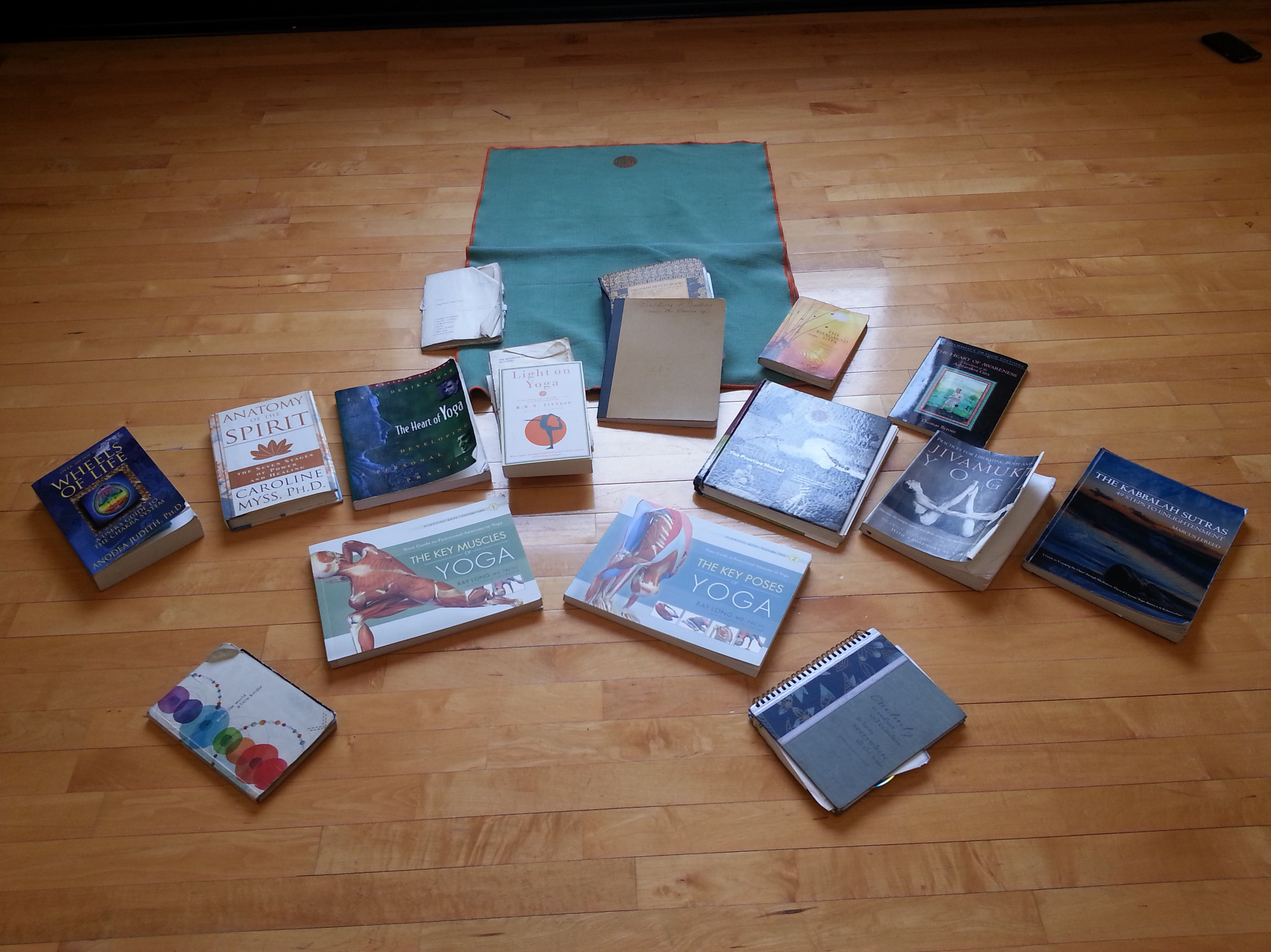
 A Joyful Practice