Many blessings to everyone, and especially to anyone Counting the Omer (Lag B’Omer or Lag LaOmer)!
This is a “missing” post for Tuesday, May 9th.You can request an audio recording of this practice via a comment below or (for a slightly faster reply) you can email me at myra (at) ajoyfulpractice.com.
“Tio, kio malamas vin, ne faru al via ulo. Tio estas la tuta Torao; la resto estas la klarigo. Nun iru studi.”
“That which is hateful to you, do not do to your fellow. That is the whole Torah; the rest is the explanation. Now go and study.”
– quoted from the story of Hillel the Elder “[teaching] the meaning of the whole Torah while standing on one foot,” translated into Esperanto and English by Dr. L. L. Zamenhof
It is not the point of the story – and, in some ways it doesn’t matter – however, today I am wondering “Which foot?”
According to the Talmud a potential convert to Judaism went to two famous rabbis of the 1st century and asked to be taught the whole Torah while standing on one foot.* Rabbi Shammai insulted the man and threw him out. Rabbi Hillel (the Elder) taught a lesson about respect, which some commentators say is also love.
Respect/love that’s the important part of the story. However, today, I am also wondering about which foot. Because, which foot determines which leg and which hip bear the weight of the lesson – and which leg and hip, represents the (symbolic) foundation of the teaching.
“Yes, how my love this moment here is ripe for us Yes, you and I so brave against the years If nothing’s left to live we must find a way There’s reason yet to live There’s something left to give We must find a way There is so much to give”
– quoted from “When Nothing’s Left” by Royal Wood
As I often mention this time of year, Jewish mysticism (Kabbalah) indicates that the Tree of Life has ten sefirot (“emanations,” attributes, or manifestations) of the Divine – seven of which are associated with the body. For instance, the right leg/thigh is associated with the fourth attribute, Netzach, meaning “endurance,” “sustainability,” “victory,” and “persistence.” Meanwhile, the left leg/thigh is associated with Hod, which can be defined as “humility,” “gratitude,” “splendor,” and “glory.” I often reference this in relation to the Counting of the Omer, a 7-week period of prayer and reflection which begins on the second night of Passover. Each night, for 49 days, people count the days of the Omer and reflect on a combination of two of the sefirot.
We’re heading towards the end of the fifth week; and so, the focus is on how each attribute – lovingkindness, strength, balance, endurance, humility, bonding, and stewardship – shows up in relation to Hod. Sunset on Monday marked the beginning of Lag B’Omer (or Lag LaOmer) – Day 33 of (or in) the Omer, which is Hod She’b’Hod. The 33rd day has an extra special significance and is treated differently from the other days. The reason it’s different is related to hope – gained, lost, and regained – and, also, to that first lesson regarding respect/love.
“They said by way of example that Rabbi Akiva had twelve thousand pairs of students in an area of land that stretched from Gevat to Antipatris in Judea, and they all died in one period of time, because they did not treat each other with respect.”
– quoted from Yevamot 62b:9 in The Koren Talmud Bavli Noé (Vol. 14 Yevamot 1), with commentary by Rabbi Adin Even-Israel Steinsaltz and English from The William Davidson digital edition
I often refer to Counting the Omer as a preparation ritual, similar to other observations and celebrations that fit within the rubric of kriya yoga. What I don’t often mention is that the beginning of the 7 weeks is also a period of mourning related to Rabbi Akiva’s 24,000 students and the lost hope that their deaths represent. Obviously, so many people being lost at once would be devastating and heartbreaking. However, the communal hopelessness is also related to the fact that the 24,000 were preparing for the return of the Temple.
Yet, somehow, despite focusing on the scholarly aspects of their faith, they got it wrong.
How? How could so many students of Torah not respect/love one another properly? How could so many students of one of the greatest rabbis not understand a foundational element of their teaching? According to some commentary, they did not love those that had different opinions and perspectives. Rather than learning from one another, they believed they could only respect/love those who shared the same views. So the were struck down by a plague.
Some scholars say the plague that killed them was an actual disease (as it is indicated in the text); others say it was a metaphor for war against the Roman Empire. Either way, Lag B’Omer (or Lag LaOmer) is the anniversary of the day when the plague ended – or when a revolt led by Simon Bar Kokhba achieved a victory against the Roman Empire. It is also the anniversary of the death one of the students from Rabbi Akiva’s second cohort: Rabbi Shimon Bar Yochai, whose life is celebrated as a symbol of hope for the future.
All the activities people put on hold during the period of mourning, resume on the 33rd Day of the Omer. Additionally, some people will make a pilgrimage to sacred sites. In some communities, people build bonfires to symbolize the ways in which people marked the beginning of the holidays and the sabbath in medieval times and the fires Bar Kokhba’s soldiers would have used to communicate. (Similarly, children may use toy boy and arrows to reenact the revolt.) Bonfires and torches are also symbolic of the mystical fire that surrounded Rabbi Shimon Bar Yochai as he shared his wisdom of the Torah on his last day. Finally, the fires symbolize the light of the Torah and the return of that light to the Jewish people.
They are a reminder that Rabbi Akiva didn’t give up – even when all were lost and he hit the proverbial wall.
“And the world was desolate of Torah until Rabbi Akiva came to our Rabbis in the South and taught his Torah to them. This second group of disciples consisted of Rabbi Meir, Rabbi Yehuda, Rabbi Yosei, Rabbi Shimon, and Rabbi Elazar ben Shamua. And these are the very ones who upheld the study of Torah at that time. Although Rabbi Akiva’s earlier students did not survive, his later disciples were able to transmit the Torah to future generations.”
– quoted from Yevamot 62b:10 in The Koren Talmud Bavli Noé (Vol. 14 Yevamot 1), with commentary by Rabbi Adin Even-Israel Steinsaltz and English from The William Davidson digital edition
For Those Who Missed It: The following was originally posted in 2020. One quote was moved. Additionally, the first and third paragraphs have been slightly revised.
“For there is no doubt that the most radical division that it is possible to make of humanity is that which splits it into two classes of creatures: those who make great demands on themselves, piling up difficulties and duties; and those who demand nothing special of themselves, but for whom to live is to be every moment what they already are, without imposing on themselves any effort towards perfection; mere buoys that float on the waves.”
― from The Revolt of the Masses by José Ortega y Gasset
My friend Bob P once told me this joke: “There are two kinds of people in a kayak, the people that just fell out and the people who are about to fall out.” I find his joke is a pretty apropos metaphor for that feeling of “hitting the wall” during [the] pandemic; if you haven’t hit the wall, you’re about to hit the wall. The same can be said for some of life’s greatest heartaches. While it might seem trite to suggest that you can tell a lot about a person by how they get over/under/around/through the wall, it doesn’t change the fact that [what we’ve been through and are going through] is all part of our circumstances and, to paraphrase José Ortega y Gasset, we are (in part) our circumstances.
Born in Spain, today (May 9th) in 1883, Ortega y Gasset was an existential philosopher and writer, as well as a bit of an activist/social reformer, who believed that life was simultaneously fate and freedom, but that freedom could only be experienced within a given fate. In other words, we must play the hand we’re dealt – but, and this is key, we decide what game we’re playing with the hand we’re dealt. In fact, Ortega y Gasset encouraged actively deciding and creating a “project of life” and, in doing so, create meaning not only for one’s self, but also for others.
– “The objective world (what is seen), consisted of a combination of elements and senses, and having a nature of illumination, activity, and stability, has two purposes: fulfillment and freedom.
– The “gunas” fall into four categories: specific/identifiable, unspecific/unidentifiable, barely describable (by signs), and absolutely indescribable (because it is beyond reference)
It may seem strange, even counterintuitive to some, to draw parallels between the work of 20th century existential philosophers and psychologists (or psychoanalysts) and the work of the ancient yogis (and medieval rabbis). Yet, remember, Patanjali, Vyasa, and the authors of the sacred texts like the Upanishads were explaining their life experiences – just like modern day existentialists – and codifying their life philosophies. When you get right down to it, all of this comes down to an understanding of the nature of things and the nature of ourselves. So, once again, we are back to the same two questions: “Who are you?” and “Where does the world come from?”
José Ortega y Gasset was a strong proponent of creating one’s world and being an active creator rather than a passive receiver. The second section/chapter of the yoga sutras (“The Foundation on Practice”) begins by focusing on how we are creating our world and our experiences in the world – sometimes unconsciously.
“Life cannot wait until the sciences may have explained the universe scientifically. We cannot put off living until we are ready. The most salient characteristic of life is its coerciveness: it is always urgent, “here and now” without any possible postponement. Life is fired at us point-blank. And culture, which is but its interpretation, cannot wait any more than can life itself.”
– from Misión de la Universidad (Mission of the University) by José Ortega y Gasset
Tuesday’s playlist is available on YouTube and Spotify. [Look for “05009020 JOyG”]
*NOTE: In most translations of the Talmud, it clearly states that the gentile was the one standing on one foot during the lesson.
Many blessings to everyone, and especially to anyone Counting the Omer (Lag B’Omer or Lag LaOmer)!
“Yes, how my love this moment here is ripe for us Yes, you and I so brave against the years If nothing’s left to live we must find a way There’s reason yet to live There’s something left to give We must find a way There is so much to give”
– from “When Nothing’s Left” by Royal Wood
Please join me today (Tuesday, May 9th) at 12:00 PM or 7:15 PM for a yoga practice on Zoom.You can use the link from the “Class Schedules”calendar if you run into any problems checking into the class. You can request an audio recording of this practice via a comment below or (for a slightly faster reply) you can email me at myra(at) ajoyfulpractice.com.
Tuesday’s playlist is available on YouTube and Spotify. [Look for “05009020 JOyG”]
In the spirit of generosity (“dana”), the Zoom classes, recordings, and blog posts are freely given and freely received. If you are able to support these teachings, please do so as your heart moves you. (NOTE: You can donate even if you are “attending” a practice that is not designated as a “Common Ground Meditation Center” practice, or you can purchase class(es). Donations are tax deductible; class purchases are not necessarily deductible.)
Many blessings to everyone, and especially to anyone Counting the Omer!
This is a “missing” post for Sunday, May 7th.Warning: It alludes to certain current events.You can request an audio recording of this practice via a comment below or (for a slightly faster reply) you can email me at myra (at) ajoyfulpractice.com.
“…You see, my dear friend, I am made up of contradictions, and I have reached a very mature age without resting upon anything positive, without having calmed my restless spirit either by religion or philosophy. Undoubtedly I should have gone mad but for music. Music is indeed the most beautiful of all Heaven’s gifts to humanity wandering in the darkness. Alone it calms, enlightens, and stills our souls. It is not the straw to which the drowning man clings; but a true friend, refuge, and comforter, for whose sake life is worth living.”
– quoted from 1877 letter from Pyotr Ilyich Tchaikovsky to Nadezhda Filaretovna “N. F.” von Meck (who financially supported the composer for 13-years), as published in The Life & Letters of Peter Ilich Tchaikovsky by Modeste Tchaikovsky
How are you feeling today? And, what are you feeling today?
Perhaps you are feeling one thing very passionately. Perhaps, like me today, you are feeling several very strong emotions. Either way, I would encourage you to take a moment to breathe into what you’re feeling and to acknowledge what you’re feeling, every time you inhale, every time you exhale. That is the practice.
So, today, I am breathing into my gratitude for my practice and for the opportunity to breathe and move (even when I may not move as much as easily as I would like). I am breathing into my gratitude that some people were safe and well enough to join me on Zoom, or use the recording of a practice, and/or read (or listen) to this blog post. However, I am also feeling angry, frustrated, worried, fearful, heartbroken, and emotionally exhausted – because of things that are happening in the world, in my country, in my home state, and in my hometown – and I am breathing into all of that, too. Because that is the practice.
One of the beautiful things about the practice is that it allows for and provides a container in which we can process all of our emotions and sensations – even when they seem contradictory. It is a time and a place where we can pause and set our burdens aside for a moment – not with the intention to ignore what we must do in the world; but, instead, as a way to go deeper into ourselves and into what can be done.
“I am now wholly occupied with the new work … and it is hard for me to tear myself away from it. I believe it comes into being as the best of my works. I must finish it as soon as possible, for I have to wind up a lot of affairs and I must soon go to London. I told you that I had completed a Symphony which suddenly displeased me, and I tore it up. Now I have composed a new symphony which I certainly shall not tear up.”
– quoted from an 1893 letter from Pyotr Ilyich Tchaikovsky to his brother Modest, as published in Tchaikovsky: The Man Revealed by John Suchet
According to the Gregorian calendar, today (May 7th) is the anniversary of the birth of both Johannes Brahms and Pyotr Ilyich Tchaikovsky. Brahms was born in Hamburg, Germany – which would have marked time with the Gregorian calendar when the composer was born in 1833. However, Tchaikovsky was born in Votkinsk, Russian Empire – which would have been using the Julian calendar in 1840, making April 25th the composer’s “official” birth date. Both composers created music that could be considered “the most beautiful of all Heaven’s gifts to humanity wandering in the darkness.” Yet, I have a long history with Tchaikovsky and tend to lean into his music.
So, today is a day when I would normally play some rather festive ballet music – and pair it with what might be considered hopeful and inspiring poetry by Robert Browning, who was born in Camberwell, London, England today in 1840. But, I did not start off today feeling hopeful or inspired. Neither did I initially feel like proclaiming, “Rejoice we are allied” – because we are not.
We are not yet allied.
I mean, maybe we are together in our hearts. Maybe our spirits are one. Maybe we are of the same mind, in the privacy of our own minds. Out in the world, however, we are not presenting a united front against evil, violence, oppression, and tyranny. We are not yet joining the energy of youth with the wisdom of old age and working together to bring about peace. We can not trust the opening lines from Robert Browning’s poem “RABBI BEN EZRA,” because we are constantly reminded that we may not have the time that the poet promised.
“Grow old along with me! The best is yet to be, The last of life, for which the first was made: Our times are in His hand Who saith ‘A whole I planned, Youth shows but half; trust God: see all, nor be afraid!’”
– quoted from the poem “RABBI BEN EZRA” by Robert Browning
I’ll be honest, it kind of irks me that some really amazing lines of poetry sound like things shouted by my master teachers and precious jewels, people that push my buttons. I get especially annoyed by people who respond to calls for change by saying that it’s not the time or the place to discuss changes that need to be made. Unfortunately, in the United States, we can no longer ask, “When is the time and when is the place?” because horrific tragedies just keep happening. Even before we reached the point where we are today, the unstated answer to the question was, “It’s never the time and it’s never the place.” And now we have politicians that straight up say that they’ll discuss gun reform in our dreams.
So, let’s go there.
“Never the time and the place
And the loved one all together!
This path—how soft to pace!
This May—what magic weather!
Where is the loved one’s face?
In a dream that loved one’s face meets mine,
But the house is narrow, the place is bleak
Where, outside, rain and wind combine
With a furtive ear, if I strive to speak,
With a hostile eye at my flushing cheek,
With a malice that marks each word, each sign!
O enemy sly and serpentine,
Uncoil thee from the waking man!
Do I hold the Past
Thus firm and fast
Yet doubt if the Future hold I can?
This path so soft to pace shall lead
Thro’ the magic of May to herself indeed!
Or narrow if needs the house must be,
Outside are the storms and strangers: we
Oh, close, safe, warm sleep I and she,—
I and she!”
– quoted from the poem “Never the Time and the Place” by Robert Browning
Now I know, I know, that at the end of the poem, the poet decides to go back to sleep and back to the love that is in his dreams. In real life, however, Robert Browning’s poetry (and his dreams) led to him meeting, falling in love, and marrying the poet Elizabeth Barrett. Their lives were not perfect. They had to overcome challenges, illness, and hardships; but, they were together “safe, warm.” Furthermore, since I was talking about dreams and Sigmund Freud yesterday, I can’t help but think of the knowledge that is found in dreams and the work that is needed to make those dreams come true.
Which brings me back Pyotr Ilyich Tchaikovsky – whose music has been used (in Russia) as a signal that things need to change.
Even though I feel like we need change (and that a younger generation may bring it), I’m not broadcasting “Danse des petits cygnes” (“Dance of the little swans”) today as a shibboleth or coded message encouraging people to overthrow the government. I don’t think the answer to our violence problems is more violence. Instead, I feel more like playing Tchaikovsky’s “Symphony No. 6 in B Minor, Op. 74,” which comes with it’s own conspiracy backstory and a little bit of wisdom.
Tchaikovsky composed “Symphony No. 6 in B Minor, Op. 74” at the very end of his life. He called it the “Passionate Symphony” (in Russian). However, he died nine days after the piece premiered (in October 1893) and, therefore, could not correct the French translator who later called the piece “Pathétique” – which means to “invoking pity” or, in English, can also mean “miserably inadequate.”
Pity is a tricky emotion, because it implies that whatever or whomever inspires (or invokes) the pity is somehow beneath the person who is feeling the emotion. It is not the same as empathy or sympathy – which I think we need more of in the world – and it is not the same as compassion (again, which could be useful right now). Pity allows us to “feel sorry for [the ones suffering]” and then to go on about our business. Tchaikovsky, however, was not producing pity. He was feeling, passionately, and creating something amazing, beneficial, and hopeful out of those emotions.
He was drawing everyone in the world in and saying, “life is worth living.”
“If this symphony is misunderstood, and torn to shreds, I shall think it quite normal, and not at all surprising. It will not be the first time. But I myself absolutely believe it to be the best and especially the most sincere of all my works. I love it as I have never loved any single one of my other musical creations.”
– quoted from an 1893 letter from Pyotr Ilyich Tchaikovsky to his nephew Vladimir “Bob” Davydov as posted in “Music History Monday: His Own Requiem?” by Robert Greenberg
Pick your music. The second option is “balletic” and “Christmas-y.”
The playlist used today is available on YouTube and Spotify. [Look for “10282020 Feeling Pathétique?”]
The playlist I have typically used is also available on YouTube and Spotify. [Look for “05072022 Rejoice We Are Allied”]
“Rejoice we are allied To That which doth provide And not partake, effect and not receive! A spark disturbs our clod; Nearer we hold of God Who gives, than of His tribes that take, I must believe.”
– quoted from the poem “RABBI BEN EZRA” by Robert Browning
If you are thinking about suicide, worried about a friend or loved one, or would like emotional support, you can dial 988 (in the US) or call 1-800-273-TALK (8255). You can also call the TALK line if you are struggling with addiction or involved in an abusive relationship. The Lifeline network is free, confidential, and available to all 24/7. YOU CAN TALK ABOUT ANYTHING.
Many blessings to everyone, and especially to anyone Counting the Omer!
“Outside are the storms and strangers: we Oh, close, safe, warm sleep I and she,— I and she!”
– quoted from the poem “Never the Time and the Place” by Robert Browning
Please join me for a 65-minute virtual yoga practice on Zoom today (Sunday, May 7th) at 2:30 PM.Use the link from the “Class Schedules” calendar if you run into any problems checking into the class. You can request an audio recording of this practice via a comment below or by emailing myra (at) ajoyfulpractice.com.
Pick your music. The second option “balletic” and “Christmasy.”
The playlist I will use today is available on YouTube and Spotify. [Look for “10282020 Feeling Pathétique?”]
The playlist I have typically used today is also available on YouTube and Spotify. [Look for “05072022 Rejoice We Are Allied”]
In the spirit of generosity (“dana”), the Zoom classes, recordings, and blog posts are freely given and freely received. If you are able to support these teachings, please do so as your heart moves you. (NOTE: You can donate even if you are “attending” a practice that is not designated as a “Common Ground Meditation Center” practice, or you can purchase class(es). Donations are tax deductible; class purchases are not necessarily deductible.)
If you are thinking about suicide, worried about a friend or loved one, or would like emotional support, you can dial 988 (in the US) or call 1-800-273-TALK (8255). You can also call the TALK line if you are struggling with addiction or involved in an abusive relationship. The Lifeline network is free, confidential, and available to all 24/7. YOU CAN TALK ABOUT ANYTHING.
Feliz Cinco de Mayo! Many blessings to everyone, and especially to anyone celebrating Buddha Purnima and/or Counting the Omer!
“What I really need is to get clear about what I must do, not what I must know, except insofar as knowledge must precede act. What matters is to find a purpose, to see what it really is that God wills that I shall do; the crucial thing is to find a truth which is truth for me, to find the idea for which I am willing to live and die.”
– quoted from a journal entry #5100 “Gilleleie, dated August 1, 1835” by Søren Kierkegaard
Even though he shares a birthday with some great people I know, I hardly ever mention the existential philosopher Søren Kierkegaard on his actual birthday. That’s because he was born today, May 5, 1813. Sure, he was born in Copenhagen, Denmark, Denmark–Norway, 49 years before the Battle of Puebla – which took place on Cinco de Mayo, 1862 in Puebla de Zaragoza, Mexico (almost 9.5 thousand kilometers away from Copenhagen, where Kierkegaard died, seven years before the battle). And, yes, he lived almost 150 years before Cinco de Mayo became a celebration of Mexican heritage in the United States. However, for me, that celebration of heritage is crucial and a great opportunity to breathe and to share the music of Mexican-Americans.
Despite what some people think, Cinco de Mayo has absolutely nothing to do with Mexican Independence Day (September 16th) and everything to do with the spirit, the will, and the determination of the people in Puebla, Mexico in 1862. The Battle of Puebla took place during the second Franco-Mexican War (also known as the Second French Intervention in Mexico). This was forty-plus years after the Mexican War of Independence and during a time when Mexico was deeply in financial debt to France, Great Britain, and Spain. Newly elected Mexican President Benito Juárez (the countries first indigenous Zapotec head of state) decided to put a time limit on payments related to loans incurred by his conservative predecessors. When the European countries received word that Mexico was going to default on their loans, they planned an invasion.
By January 1862, Spanish officials were insisting that the naval forces from the three nations were only in Mexico to negotiate payment. While the English and Spanish did begin negotiations, representatives from France made it clear that the French Emperor (Napoleon III) was not interested in negotiations (or treaties). The French took over two small towns and then General Charles de Lorencez and 6,000 French troops (which now included some Mexicans) headed to Puebla de los Ángeles. They were expecting another easy victory. Instead, they were defeated by a significantly smaller group of Mexicans led by General Ignacio Zaragoza Seguín (who was born in the Mexican province of Texas). Also leading Mexican troops was General José Miguel Pascual Negrete Novoa (born in Puebla and best known as Miguel Negrete), who had previously flipped back and forth between the constitutionalists and the conservatives – but ultimately was very clear about who he was and on whose side he would fight.
“Yo tengo Patria antes que Partido.”
– “I have a Homeland before a Party.” quote attributed to General Miguel Negrete (after switching back to the Mexican side during the Second French Intervention in Mexico)
The underdogs prevailed in 1862. People were so inspired that Puebla was renamed Puebla de Zaragoza. When General Zaragoza died (of typhoid fever) in September 1862, President Juárez declared Cinco de Mayo an annual holiday. Unfortunately, after a vicious battle on May 17, 1863, the city fell during the Second Battle of Puebla and the French forces pushed on to Mexico City. Eventually, the constitutionally elected president and his allies had to flee and a Second Empire of Mexico was established. That “empire” collapsed soon after the French military pulled out (in part due to pressure from the United States) and the Republic of Mexico was restored in the summer of 1867.
Unlike Mexican Independence Day, Cinco de Mayo is not celebrated throughout Mexico as a national holiday. In fact, up until the 1950s and 1960s, it was primarily only celebrated in Puebla. Now, it has also become a celebration of heritage – primarily the Mexican-American heritage which reflects the spirit and resilience of a small group of people. So, it’s a big deal in my hometown – in fact, some of my neighbors started celebrating yesterday. It has also become a big celebration time in other parts of the country (even the world). But, today is also one of those days that meshes with that thing I often say during religious observations: the further away we get from the meaning of a ritual or tradition, the more it becomes something that people just say or do. The more, in fact, it becomes something commercial.
Sometimes, in becoming commercial, a day takes on a whole new meaning. For example, think about what Saint Patrick’s Day means to you – especially if you’re not Catholic and/or of Irish descent. Now, think about what Cinco de Mayo means to you – especially if you hadn’t heard of the Battle of Puebla before today.
“One must first learn to know himself before knowing anything else. Not until a man has inwardly understood himself and then sees the course he has to take does his life gain peace and meaning; only then is he free….”
– quoted from a journal entry #5100 “Gilleleie, dated August 1, 1835” by Søren Kierkegaard
Cinco de Mayo is a celebration of the ability to overcome “insurmountable” odds and to throw off oppression. This year, the practice is a little different; so the music is a little different – and as we breathe, we’ll go a little deeper… philosophically as well as physically. Which brings us back to the existential philosopher Søren Kierkegaard.
On a certain level, Kierkegaard acknowledged that the level of introspection in which he engaged and recommended was not accessible to everyone. He criticized “aristocrats” who ignore the less fortunate, and maintain their own comfort at the expense of others, as “ungodly.” To him, introspection wasn’t a waste of time; it was the first step in being a mature and spiritually evolved human-being. It was a step closer to God.
While Søren Kierkegaard was a Christian existentialist, his thoughts on love, living a life with purpose, honoring community while also knowing your own mind, and connecting with the Divine may be very meaningful to people of different faiths and belief systems. For instance, they can be very meaningful and insightful to people who study and/or practice Buddhism. After all, Prince Siddhartha Gautama could be considered the ideal: someone born into wealth and privileges, who was also committed to alleviating suffering.
This year (2023), Cinco de Mayo overlaps Buddha Purnima in parts of India and Nepal and Vesak in Sri Lanka. Pūrṇimā is the Sanskrit word for (“full moon”) and this particular full moon is associated with the enlightenment or awakening of Gautama Buddha. Some believe Siddhartha Gautama was awakened in the same month in which he celebrated his birthday and, so, for some today is a birthday celebration as well. Others in Southeast Asia will celebrate Vesak (which occurs during Vaisakha, the second month of some lunar calendars) in a few days or weeks, depending on tradition.
While people use different calendars and observe on different days, the practice is the same… sitting and breathing.
“Don’t forget to love yourself.”
– Søren Kierkegaard
Please join me for a “First Friday Night Special” Somatic Yoga Experience (SYE) tonight, May 5th, 7:15 PM – 8:20 PM (CST), featuring some “Gentle Somatic Yoga,” a little ViniYoga-inspired movement, pranayama, and meditation – with an emphasis on Prāṇāyāma. Use the link from the “Class Schedules” calendar if you run into any problems checking into the class. You will need to register for the 7:15 PM class if you have not already done so. You can request an audio recording of this practice via a comment below or by emailing myra (at) ajoyfulpractice.com.
This practice is accessible and open to all.
Prop wise, this is a kitchen sink practice.You can practice without props or you can use “studio” and/or “householder” props. Example of “Studio” props: 1 – 2 blankets, 2 – 3 blocks, a bolster, a strap, and an eye pillow. Example of “Householder” props: 1 – 2 blankets or bath towels, 2 – 3 books (similar in size), 2 standard pillows (or 1 body pillow), a belt/tie/sash, and a face towel.
You may want extra layers (as your body may cool down during this practice). Having a wall, chair, sofa, or coffee table may be handy.
Friday’s playlist is available on YouTube and Spotify. [Look for “Cinco de Mayo Viernes 2023”]
“Happy Riḍván!” to those celebrating “the Most Great Festival.” Many blessings to everyone, and especially to anyone Counting the Omer!
For Those Who Missed It: The following was originally posted in 2021. In addition to a few revisions, I have updated the class details and music links, as well as information related to this year’s Kiss My Asana yogathon. Some embedded links will direct you outside of this blog. Astronomical details related to April 26, 2021 have not been changed. WARNING: There is passing reference to people with mental health issues.You can request an audio recording of this practice via a comment below or (for a slightly faster reply) you can email me at myra (at) ajoyfulpractice.com.
“‘My main point today is that usually one gets what one expects, but very rarely in the way one expected it.’”
– quoted from a draft of Charles Richter’s 1970 retirement speech, as printed in the Appendix of Richter’s Scale: Measure of an Earthquake, Measure of a Man by Susan Elizabeth Hough
Over the last month (or so) I have developed a new guilty pleasure: watching the Lock Picking Lawyer’s YouTube videos. To be completely transparent, I will admit that I have known people who spent their down time at work picking locks from the “lost and found” (or locks that someone on staff had to break, because the owner locked themselves out). I will also admit that I found it an odd and eyebrow raising hobby – especially when they did it in full view of the very people who relied on locks for security. However, my previous opinions haven’t stopped me from getting hooked by these videos, starting with the first one I watched (which I will link at the end of this post).
The first video was the Lock Picking Lawyer’s annual April 1st video, which is slightly different from his regular offering (in that it is a joke); but still contains some of the same elements that are, frankly speaking, compelling and addictive. First, the videos are witty, logical, informative, and low-key ASMR. (ASMR stands for Autonomous Sensory Meridian Response and is used to describe content that provides a calming experience for the brain and spine; what some people call a “brain massage.”) Second, the videos are philosophical on several different levels and reinforce some critical elements of our physical practice of yoga.
“Philosophy is like trying to open a safe with a combination lock: each little adjustment of the dials seems to achieve nothing, only when everything is in place does the door open.”
– Ludwig Wittgenstein, philosopher
Born in Vienna, Austria today in 1889, Dr. Ludwig Wittgenstein was part of one of the richest families in Europe and (although he was the youngest of nine) he inherited his father’s fortune at the age of 24. Many people associate great wealth with great ease and comfort, but none of that wealth prevented Dr. Wittgenstein from suffering severe depression, contemplating suicide, or losing three of his brothers to mental health issues. He made anonymous donations to artists and writers (including Rainer Maria Rilke). Then he gave his entire fortune to his brothers and sisters. Throughout his lifetime, he worked in several different areas in an attempt to find some ease to his suffering, but he ultimately said that philosophy saved him and was “the only work that gave me real satisfaction.” His work in logic, the philosophy of mathematics, the philosophy of the mind, and the philosophy of language is recognized as some of the most important works of philosophy of the twentieth century.
As I have previously mentioned (specifically in the 2020 blog post on this date), “The word philosophy comes to us from Greek, by way of Latin, Old French, and Middle English, from a word that means “love of wisdom.” It is the study of the fundamental nature of knowledge, thought, reality, and existence. It provides a way to think about and understand the world, the universe, and everything. As stated in Wikipedia, it “is the study of general and fundamental questions about existence, knowledge, values, reason, mind, and language.” The most basic question being, “Why?” which spirals out as:
Who/What are you?
Why do you exist?
Where does the world come from? / Why does the world exist?
The philosophy of yoga addresses all of these questions, and the follow-up questions (like, “Why do we/I/other people do the things we/I/they do?” and “How do I find balance in my life/relationships/pose?”). Yoga addresses philosophical questions even when someone only practices the physical practice, because, ultimately, the physical practice is a container in which we can consider these questions.
One of the questions that we address – especially through the physical practice – is the question of security/stability and comfort/ease. Many commentaries on Patanjali’s Yoga Sūtras (in particular, commentary related to YS 2.46 – 49) point out that “stability and comfort go hand in hand.” We see this on and off the mat. There is a bit of a dichotomy, however, between what we think will bring us security/stability and comfort/ease versus what actually gives us those feelings. We could, for instance, have all the wealth of Ludwig Wittgenstein and, just as he did, suffer greatly.
One way people with stuff suffer is when they don’t feel their stuff is secure. For instance, consider the uncomfortable feeling some people have when they think they have forgotten to lock their front door after leaving home. Since the emotional (fear) response is connected to the perception of a threat, the feeling that they may have left the door unlocked is similar to returning home and finding the door wide open. Although the latter may, understandably, be more intense and acute – and combined with the fear that someone with nefarious intentions is inside – both sensations can be eliminated if we are secure in the knowledge that the door is locked (maybe because we checked before we left) and that the door is closed and locked upon our return.
What becomes very clear after a watching a few of the videos from the Locking Picking Lawyer is that in most cases locks are “easily” picked. On one level, they provide a deterrent, but – more importantly – they are manifested maya (“illusion”). And, philosophically speaking, because they can be opened by someone you may not want to open them, the lock and the closed door only give us the illusion of security – and that illusion (or perception) is what gives us the feeling of ease/comfort.
One of the things I appreciate about the Locking Picking Lawyer’s content is that while he readily “picks” apart the illusion, he also provides information that can make us better consumers. In being better informed – about the reality of locks – we make better decisions and, also, may experience more stable comfort and ease. Remember, in the Eastern philosophies, like Yoga and Buddhism, suffering comes from attachment and the end of suffering comes from the practice of non-attachment. No one wants someone to steal or mess with their stuff – that’s why people lock their stuff up! However, letting go of the illusion of the lock (and key or combination) can alleviate some suffering. Not only can letting alleviate mental and emotional suffering, it can be one of the keys to unlocking physical suffering.
“The human body is the best picture of the human soul.”
– Ludwig Wittgenstein, philosopher
I don’t know much about the Locking Picking Lawyer (other than the obvious and the fact that he’s married to Mrs. Lock Picking Lawyer, who apparently has no interest in picking locks). However, I definitely appreciate that his videos (unintentionally) reinforce the following critical elements which are directly applicable to our physical practice of yoga:
You need the right tools.
You can access almost anything with the right skills/knowledge.
You have to start with stability (i.e., secure what you’re accessing the way you would access it “in the wild”).
It’s important to access the core.
Take your time and go by the numbers / step by step.
It’s important to listen (and pay attention to what’s “clicking” and “binding”).
More knowledge comes from the inside than the outside.
Sometimes you have to turn things around.
Never underestimate the power of a good wiggle/jiggle.
It’s important to have a sense of humor.
Also, as an aside, you can do something again to show it wasn’t a fluke.
“The most remarkable feature about the magnitude scale was that it worked at all and that it could be extended on a worldwide basis. It was originally envisaged as a rather rough-and-ready procedure by which we could grade earthquakes. We would have been happy if we could have assigned just three categories, large, medium, and small; the point is, we wanted to avoid personal judgments. It actually turned out to be quite a finely tuned scale.”
– quoted from the Earthquake Information Bulletin (January- February 1980, Volume 12, Number 1) article, “Charles F. Richter – An Interview” by Henry Spall, U. S. Geological Survey, Reston, Va. (regarding the scale Mr. Richter developed with Beno Gutenberg)
With regard to those last two bullet points, today is also the anniversary of the births of the seismologist and physicist Charles Richter (b. 1900, Overpeck, Ohio) and the award-winning Carol Burnett (b. 1933, San Antonio, Texas). Mr. Richter, along with Beno Gutenberg, developed the Richter Magnitude Scale in 1935. Prior to their creation, shock measurement was based on The Mercalli intensity scale, which was developed by the Italian priest Giuseppe Mercalli and used Roman numerals (I to XII) to rate shocks based on how buildings and people were affected. The Richter-Gutenberg collaboration was designed to measure displacement in a non-subjective manner. The idea of using “magnitude” came from Mr. Richter’s interest in astronomy. (There’s a good possibility that if he were alive today he would spend some part of this evening and the next checking out the “Super” Pink Moon.) In addition to being remembered for his knowledge and ingenuity, Charles Richter is remembered as being a little prickly on the outside, but warm on the inside and for having a sense of humor – although he didn’t often laugh at himself.
Maybe Carol Burnett, one of the funniest people on the face of the Earth, could have helped Charles Richter laugh at the fact that a man who wasn’t planning to become a seismologist became synonymous with seismology. She has won 6 Primetime Emmy Awards (out of 23 nominations); 7 Golden Globe Awards (out of 18 nominations); 3 Tony Awards; and 3 Grammy Awards. An actress, comedian, singer, and writer, she has also received everything from 2 Peabody Awards to a Screen Actors Guild (SAG) Life Achievement Award; a Presidential Medal of Freedom; and the Mark Twain Prize for American Humor. She was even awarded the very first Golden Globes Carol Burnett Lifetime Achievement Award (for Television) and has a star on the Hollywood Walk of Fame. But, before all of that, she endured a lot of suffering as a child because of the instability of her first family – specifically her parents, who were alcoholics. Then she suffered as an adult when her oldest child suffered from drug addiction (and then died of pneumonia at the age of 39).
A natural born performer, even before she “went into show business,” Carol Burnett sang, created characters, and developed the imagination that would lead her to a career that has spanned 7 decades. One of the things that “saved” her from a life of complete misery and insecurity was her grandmother Mabel – who not only raised her when her parents moved to Hollywood, but also regularly took her to the movies. As a secret “I love you” to her grandmother, Ms. Burnett would tug on her left ear at the end of every episode of The Carol Burnett Show.
“The first time someone said, ‘What are your measurements?’ I answered, ’37, 24, 38 – but not necessarily in that order.’”
– Carol Burnett, comedian
Wednesday playlist is available on YouTube and Spotify. (Look for “04262020 Philosophy of Locks”)
If you are thinking about suicide, worried about a friend or loved one, or would like emotional support, you can dial 988 (in the US) or call 1-800-273-TALK (8255). You can also call the TALK line if you are struggling with addiction or involved in an abusive relationship. The Lifeline network is free, confidential, and available to all 24/7. YOU CAN TALK ABOUT ANYTHING.
The picture above is part of my 2023 offering for the 10th annual Kiss My Asana yogathon, which benefits Mind Body Solutions (MBS). This week (April 22nd – 28th), I’m dedicated to raising awareness and resources for MBS’ life-affirming work to help people living with disabilities – and you can help too! You can help by joining me as we practice with purpose, by sharing this page, and/or by making a donation that creates opportunities for more people to practice yoga.
Mind Body Solutions provides live, online resources to people living with disabilities, worldwide. In addition to 11 live online yoga classes a week, MBS has also created a comprehensive library of recorded adaptive yoga classes for students, instructional videos for adaptive yoga teachers, and insightful interviews between our founder, Matthew Sanford, and adaptive students. It all helps people with disabilities live more fully, where they are and how they are.
Each year, in addition to hosting a fundraising page and making my personal donation, I offer a blog post and/or a YouTube post – sometimes even a whole practice. This year, part of my offering is a series of poses I’m posting on the Community page of my YouTube channel. Of course, there’s more to the poses (and pictures) than meets the eye. So, keep in mind that they – like the classes I lead – are just the tip of the iceberg.
What happens at Mind Body Solutions is the whole enchilada!
Ultimately, MBS is all about people having better relationships with their mind-body and spreading the message that a greater connection between mind and body can help us all live with improved comfort and ease.
“Chag Sameach!” to everyone celebrating Passover and/or Counting the Omer! Blessings to anyone observing Palm Sunday during Great Lent or Easter! “Ramadān Mubarak, Blessed Ramadān!” to anyone who is observing the holy month of Ramadān.
This is the “missing” post for Wednesday, April 5th. It is a little comparative analysis related to the story of Exodus and the Passion story. You can request an audio recording of this practice via a comment belowor (for a slightly faster reply) you can email me at myra (at) ajoyfulpractice.com.
In the spirit of generosity (“dana”), the Zoom classes, recordings, and blog posts are freely given and freely received. If you are able to support these teachings, please do so as your heart moves you. (NOTE: You can donate even if you are “attending” a practice that is not designated as a “Common Ground Meditation Center” practice, or you can purchase class(es). Donations are tax deductible; class purchases are not necessarily deductible.
You enter the forest at the darkest point, where there is no path.
Where there is a way or path, it is someone else’s path.
You are not on your own path.
If you follow someone else’s way, you are not going to realize your potential.”
– quoted from “In the Field” in A Joseph Campbell Companion: Reflections on the Art of Living by Joseph Campbell (edited by Robert Walter, Conceived by Diane K. Osbon)
Technically speaking, Joseph Campbell was a professor of literature. His Bachelor of Arts degree was in English and his Master of Arts degree was in medieval literature. But, he also studied languages, philosophy, and religion and he became known for his research and teachings about comparative mythology and comparative religion. In The Hero with a Thousand Faces (published in 1949), he theorized that every mythic story (including every folk story and every religious story) in the world was just a variation of a single story: a monomyth. His conclusion was based on shared elements and a common order of events. The order and the elements can be broken down into seventeen (17) stages that fall within three categories.
These categories of separation, initiation, and return – as well as the seventeen stages within – can be found in our lives, just as they are found in the stories that some people commemorate throughout their lives. While I have highlighted all the steps on other occasions,* this year I felt “called” to highlight just a few elements and stages that show up in the stories people commemorate during Holy Week (also known as Passion Week or Great Week) and during Passover. First, we have to identify the hero – which may not always be as obvious as modern movies make it out to be – and, if there is a hero/protagonist, there will be an antagonist (or two) who is often in a position of authority and some kind of confrontation and reckoning. There is also a calling, a purpose – even though the protagonist may not always know it or understand it – and a refusal to answer the call. Then there is some supernatural (or magical) aid; trials and tribulations; a goddess (who represents “all-powerful, all encompassing, unconditional love”); temptation; apostasis (a death of some kind); and the ultimate boon (something beneficial) that can in some way be shared with the world.
Variations of the details within the following comparison have been posted in different contexts. An index of the earlier posts appears at the bottom of this post.
“For those who believe, no proof is necessary. For those who do not believe, no proof is possible.”
– attributed to Stuart Chase
We’ve hit that auspicious and holy time on the calendar(s) when all of the Abrahamic religious traditions (and several traditions outside of those religions) are engaged in sacred celebrations and rituals that are tied to suffering and the end of suffering. Wednesday, April 5, 2023, was a particularly significant time as it simultaneously marked the last week of Lent, which is also Passiontide (in Western Christianity); the penultimate week of Great Lent (in Orthodox Christianity); the beginning of the third week of the holy month of Ramadān (in Islām); and the beginning of Passover (in Jewish communities). Outside of the Abrahamic religions, some communities also started celebrations for Hanuman Jayanti (which was on Thursday).
As I previously mentioned, in reference to a question from my brother, it is not a coincidence that so many holy obligations are happening at the same time even though different faiths use different calendars. While how the holidays overlap on the Gregorian calendar is different from year to year, the fact that they overlap is significant and relevant, because the stories of Exodus and the story of Jesus’ last week are connected – and, on Wednesday, we focused on some of those connections. Specifically, we focused on the story of Holy/Passion Wednesday, also known as Spy Wednesday during both practices and, during the evening practice, we also focused on the story of Passover, which started on Wednesday at sunset.
Stories (& Back Stories)
“What makes this night different from all [other] nights? 1) On all nights we need not dip even once, on this night we do so twice? 2) On all nights we eat chametz or matzah, and on this night only matzah? 3) On all nights we eat any kind of vegetables, and on this night maror? 4) On all nights we eat sitting upright or reclining, and on this night we all recline?”
– The Four Questions (“Ma Nishtana”)
How is this practice different from all the other practices? Good question. It is a question you can ask before any practice. It is also a question that sounds a lot like “The Four Questions” traditionally asked by the youngest person at a Passover Seder. The word seder is a Hebrew word that means “order” or “arrangement,” and it refers to the ritual feast people in the Jewish community have on the first night of Passover (or first two nights for Orthodox and Conservative communities outside of Israel). The meal is a symbolic celebration of the Exodus story, which is the story of how the Jews were freed from slavery in Egypt. Really, the meal is the story – beginning with the questions, which are also symbolic.
Passover, which is also called Pesach and The Feast of Unleavened Bread, is considered a spring festival. In ancient times, it was directly connected to the harvesting and offering of barley – which was the first grain to ripen and harvest in the Holy Land. For seven days (eight days for the Orthodox and Conservative communities, especially in the diaspora), people commemorate the story of Exodus, which is a story of faith. The ritual observation actually begins before the Passover Seder, with the removal of chametz (“leavening”), as it is forbidden to consume, keep, or own chametz during Passover. Some forms or chametz will be burned; other forms can be given away or even sold. Keep in mind that the agents of “rising” or fermentation are not forbidden – in fact, wine is a required part of the celebration. However, the action of rising is symbolic and part of the story (2. where the Jews have to flee so fast their bread doesn’t have time to rise.)
Another part of the story and another ritual that occurs before the Passover Seder is the Fast of the Firstborn, which falls on the day before the evening of the Passover Seder (with adjustments made when Passover begins on a Saturday night – which is the end of the Sabbath). Again, this is a symbolic element of the story as first-born sons (and “newborn” sons) play critical roles in the Exodus story (as you will see below).
The observation of Passover is the link between the two observations, because, historically speaking, Jesus was a Jewish teacher or rabbi, who returned home to Jerusalem for Passover. The Gospel According to Saint John (12:1) is the only New Testament gospel that specifically refers to Passover as a reference point for the beginning of the last week of Jesus’ life. However, all four of the canonical gospels mention preparation for the festival, feast, or first day (depending on the translation) of “Unleavened Bread” and describe a jubilant and memorable moment where Jesus rode into town on a donkey (a symbol of peace) and was greeted by people who honored him by laying down palm fronds (and possibly coats) to cover his path. In Christian communities, Palm Sunday or Passion Sunday is the final Sunday of Lent and marks Christians’ final preparation for Easter.
The Heroes/Protagonists & Their Callings
“The Lord saw that he had turned to see, and God called to him from within the thorn bush, and He said, ‘Moses, Moses!’ And he said, ‘Here I am!’”
– Shemot – Exodus 3:4
In some ways, both Moses and Jesus were born to be the heroes. However, to fit Joseph Campbell’s criteria, they must have a “call to adventure:” something that separates them from their mundane, everyday existence and propels them into a mystical experience. The call is the first of three (or four, depending on how you count) stages that mark a separation from community. In some ways, Moses had two separations before he heard the call. In some ways, Jesus was always separated; however, there is a point where he is specifically called out (i.e., betrayed and denied).
According to Shemot / Exodus, an Egyptian pharaoh first oppressed and then enslaved the Jewish people. He also ordered all Hebrew newborn sons to be killed. For a while, the midwives and the Jewish mothers circumvented Pharaoh’s order. Then, he ordered all the newborn sons to be thrown in the river. Jochebed, Moses’ birth mother, hid her son for three months. Then, she very cleverly placed him in a basket in the river and sent her daughter, Miriam, to watch the baby in the basket. When Pharaoh’s daughter scooped up the baby – who she would eventually name “Moses… ‘For I drew him from the water’” – Miriam offered to secure a wet nurse (who was, of course, Jochebed, their mother). In this way, Moses grew up as the Pharaoh’s grandson and, also, grew up knowing he was Jewish. This was the first separation (and the first return).
At the age of 40, Moses stepped in to protect a Jewish man who was being beaten by an Egyptian and had to flee his home. This was the second separation. When he was 80, he received his “calling.” Now, we could say that Moses was called earlier (see earlier separations), but there is no denying what happened when G-d (in the form of the burning bush) commanded him to return to Egypt and speak to Pharaoh about freeing the Jewish people. Because he had lived a lifetime (40 years) and established a home in Midian, the return to Egypt is the second return and the third separation (if you’re counting). Theoretically, Moses was also 80 when he received the Torah, G-d’s truth for his people, and he was 120 when he died – but that’s a story for a different day.
“For God so loved the world that he gave his one and only Son, that whoever believes in him shall not perish but have eternal life.”
– quoted from The Gospel According to John (3:16, NIV)
Christians believe that Jesus was born with and for a specific purpose – and that, unlike Moses, he was aware of this purpose and his calling. According to all four canonical gospels of the New Testament, Jesus spent a period of time in the desert and then spent the last week of his life preparing for Passover (and for what he knew was coming, in terms of the Crucifixion and Resurrection). The Gospels also indicate that Jesus spent that time preparing his disciples. Three of the four indicate that what Christians (and artists) refer to as the “Last Supper” was actually a Passover Seder. While most Christians do not have a Passover Seder, they do commemorate this preparation time through the observations of Lent and Great Lent.
Supernatural/Magical Aid
“And He said, ‘For I will be with you, and this is the sign for you that it was I Who sent you. When you take the people out of Egypt, you will worship God on this mountain.’”
– Shemot / Exodus 3:12
“God said to Moses, ‘Ehyeh asher ehyeh (I will be what I will be),’ and He said, ‘So shall you say to the children of Israel, “Ehyeh (I will be) has sent me to you.’””
– Shemot / Exodus 3:14
According to Joseph Campbell’s paradigm, every hero(ine) encounters a supernatural or magical aid when they begin their journey. This aid often helps navigate the transition between the known and the unknown and also aids in the transition back to the regular world once the mission is complete and the ultimate boon has been acquired/achieved. In the Bible stories, this aid comes in multiple forms. First, aid comes in a purely Spiritual/Divine form – and the hand or power of God (and the Holy Spirit) are explicitly detailed in both stories. Second, aid comes in the form of other people.
Both stories are full of what some might consider coincidences, but they are also full of “open miracles” and signs of the power of God. If we are skeptical, we can ignore Moses’ lineage and consider it a coincidence that he survived Pharaoh’s orders to kill all the newborn Hebrew sons. It may also seem like a wild coincidence that his life unfolded as it did. But, then there’s the burning bush that called him and showed him how his staff could become a snake. There’s also the fact that Aaron received a call to meet his brother Moses. Finally, there are all the different signs that the Pharaoh considered to be nothing more than magic: Aaron’s staff becoming a snake; the Ten Plagues (blood, frogs, lice, wild beasts in the streets, pestilence, boils, hail, locusts, day(s) of darkness, and the death of the first born male child); the fact that the tenth plague “passed over” the Jewish people; the fact that the river parted; and, finally, that the people were sustained in the desert. One critical – but not often highlighted – aspect of the Ten Plagues is that they not only started on command, they also ended on command.
In Christianity, Jesus is the supernatural and the aid (as I note below). His very nature is more… super. Throughout the New Testament gospels, the disciples detailed “open miracles” performed by Jesus – especially during the period of time that is commemorated by the Lenten season.
People in both stories were required to have faith in order to be saved and released from their suffering. Faith is, in this case, the magic or supernatural element. Through their faith, Miriam and Aaron served as aids who assisted Moses (as did the Pharaoh’s daughter). Additionally, the people in the Passover story were told that the most have faith and follow the instructions of G-d in order to to be passed over and saved. Remember, not everyone celebrated the first Passover – neither did everyone flee when given the opportunity. The Midrash, talmudic commentary, describes the assistance of Nahshon, who believed that G-d would save the Jewish people and, therefore, waded into the water.
Trials and Tribulations
Passion (noun): 1. [mass noun] strong and barely controllable emotion; 1.2 intense sexual love; 1.3 [in singular] an intense desire or enthusiasm for something; 2. (the Passion) The suffering and death of Jesus.
Origin: Middle English: from Old French; from late Latin passio(n-), from Latin pati- “suffer”
– from Oxford Dictionaries
The first big piece of suffering within the story of Shemot / Exodus is the oppression and enslavement of the Jewish people. Then, there is Pharaoh’s edict. We can debate how much (or little) Moses suffered before he intervened and had to flee; but, there is no question that the Jewish people suffered nine of the Ten Plagues, right along with the Egyptians. In the monomyth outline, the series of trials and tests are challenges one has to overcome in order to be transformed. In the story of Exodus, the Jewish people were told to have faith. Part of that faith involved envisioning, and also celebrating, freedom that had not yet come. That was the whole point of the first Seder, which actually happened before the exodus. The moment when Pharaoh’s heart hardened again, and the Jewish people were stuck between the Egyptian army and the raging water of the sea, is another example of a test.
The trials and tribulations related to Holy/Passion/Great Week are multiple. First, there is the passion (or suffering) associated with Jesus being born into a human body and therefore experiencing the suffering that is associated with being human. Then there is the passion narrative, which is chronicled in the Gospels as the last week of Jesus’ life. Events described as “the Passion of Jesus” and/or as “the Passion of the Christ” may include everything beginning with the events of Lazarus Saturday, Palm Sunday, and the cleansing of the temple all the way through the betrayal, crucifixion, death, and resurrection – or may only include the anointing of Jesus; the Last Supper; the agony of Jesus; the betrayal; and Jesus’ arrest, trials before the Sanhedrin and before Pilate; as well as the crucifixion, death, burial, and resurrection. To be clear, the passion or suffering described includes that of the disciples and of Mary (his mother) and the other people Jesus met along the Via Dolorosa.
The Goddess(es)
“People often think of the Goddess as a fertility deity only. Not at all—she’s the muse. She’s the inspirer of poetry. She’s the inspirer of the spirit. So, she has three functions: one, to give us life; two, to be the one who receives us in death; and three, to inspire our spiritual, poetic realization.”
– quoted from “Chapter 1. Myth and the Feminine Divine: Th Goddess as Nature” in Goddesses: Mysteries of the Feminine Divine by Joseph Campbell (edited and with a forward by Safron Rossi, PhD)
The Goddess of the monomyth is also depicted as the temptress. She represents all-powerful, all encompassing, unconditional love. It is love that is described as “love that a fortunate infant may experience with his or her mother.” In the story of Exodus, Jochebed, Miriam, all the midwives, and even Pharaoh’s daughter exhibit the characteristics of the goddess. Moses’ wife might also be considered a goddess of the story.
If you think of this type of love in the context of Christianity, you might immediately think of the Virgin Mary – which is fair and true. However, in the context of the Passion Story, there were several women who showed Jesus (and others) great love and compassion. One woman, in particular, is usually unnamed, but she is notable in the Gospels specifically because of the way she loves (and expresses her love) for Jesus – and because her part of the story is critical to the way events unfolded.
In the Gospel According to Luke (7:36 – 50), Jesus was having what might be described as a luxurious dinner (because he was “reclining”) when a woman who had a sinful past washed his feet with her tears and hair. Then, she poured expensive oil from an expensive alabaster jar onto his feet. This incident took place in the home of a Pharisee named Simon and the woman is not identified by name. In the Gospel According to Matthew (26:6 – 13) and the Gospel According to Mark (14:3 – 9) the incident – or a similar incident – took place in Bethany at the home of Simon the Leper and the oil is poured over his head (but there there is no mention of tears and hair). Here, again, the woman is not identified; however, all three synoptic gospels indicate that the woman “came,” which could be interpreted as meaning that she did not live in the home.
The indicated timelines, as well as the different locations, also lead some to believe that these may be different events. Some traditions identify the woman (or women) as Mary Magdalene – and that misrepresentation never ends well – but the Gospel According to John (12:1 – 8) is the only account that identifies the woman as someone named Mary. According to John, “Mary” poured the oil on Jesus’ feet and then wiped his feet with her hair. The account does not, however, indicate that she “came” to the home, leading many to believe that she was Mary of Bethany, the sister of Lazarus and Martha.
Jesus ultimately used the washing of his feet as a teaching moment for the disciples; but, first, it was a moment of contention that led to the betrayal. [Insert villain music here.]
The Antagonists
“This is the secret message of judgment Jesus spoke with Judas Iscariot over a period of eight days, three days before he celebrated Passover.
When he appeared on earth, he did signs and great wonders for the salvation of humanity. Some [walked] in the way of righteousness, but others walked in their transgression, so the twelve disciples were called.”
– quoted from The Gospel of Judas, translated by Mark M. Mattison
The Egyptian Pharaoh, with his hardened heart, is undoubtedly the antagonist in the Passover story. He is motivated by power and greed – as is the case with so many villains. It is curious, however, that the passive voice is sometimes used with regard to his hardened heart and that (in Shemot / Exodus 10:1 and 14:17) G-d is clearly the one that hardened Pharaoh’s heart.
The Wednesday of Holy Week, Passion Week, or Great Week is also known as Spy Wednesday. A spy is a person inside a group, organization, or country who collects information so that others can attack, ambush, or otherwise ensnare the group, organization, country and/or the leaders therein. In the Passion story, Judas Iscariot is the spy and the woman washing Jesus’ feet pushed Juda’ buttons, which resulted in him betraying his rabbi and friend.
Several gospels indicate that more than one disciple was upset by the woman’s actions; however, Judas was particularly incensed by the cost of the honor. He was the one who held the purse strings – sometimes, too tightly and too personally – and felt that the cost of the oil and the jar used could have gone to the poor (or, into his own pockets). He was so upset that he decided to betray Jesus. [Insert villain more music here.]
“Then one of the Twelve—the one called Judas Iscariot—went to the chief priests and asked, ‘What are you willing to give me if I deliver him over to you?’ So they counted out for him thirty pieces of silver.”
– The Gospel According to Matthew (26:14 – 15, NIV)
When it comes to Judas’ betrayal there are also different accounts. Most people are familiar with the idea that Judas was paid 30 pieces of silver. In the Gospel According to Mark (14:11), the chief priests promised to pay Judas and this is often referenced as “a few pieces of silver.” In two accounts, however, Satan possessed Judas. Yes, that’s right, in the Gospel According to Luke (22:4) and the Gospel According to John (13:27), the devil made him do it. Or, you could look at the devil as a euphemism for his own anger, jealousy, and hubris. It’s also important, I think, to note that in a few places – including at least one gnostic gospel, Judas betrayed Jesus because Jesus told him (Judas) to do so. Which, if you look at it that way, means God gave both men a purpose and a call.
Regardless of why he did it, Judas’ betrayal means that for generation after generation his name is mud. His reputation is smeared. One action made him the ultimate villain, the devil incarnate, and… one of the reasons we have the story. Remember, there is no Easter without the Resurrection. There’s is no Resurrection without the Crucifixion and the Passion. There is no Crucifixion and Passion (or Suffering) without the betrayal. And there is no betrayal without Judas of Iscariot. I’m not saying that he is equal to Jesus. What I am pointing out is that they are both an important part of the story and they are both “sacrificed” because – according to the teachings – “God so loved the world….”
Temptation
“[[Jesus]] answered and said to them, ‘I’m not laughing at you. You’re not doing this because you want to, but because through this your God [will be] praised.’”
– quoted from The Gospel of Judas, translated by Mark M. Mattison
“Jesus shows us how to face moments of difficulty and the most insidious of temptations by preserving in our hearts a peace that is neither detachment nor superhuman impassivity, but confident abandonment to the Father and to his saving will, bestows life and mercy.”
– excerpt from 2019 Palm Sunday homily by Pope Francis
There are several underlying temptations in the story of exodus, although they are not all explicitly described as temptations. However, if we do a little svādhyāya (“self-study”) and put ourselves in Moses’ shoes, several temptations become obvious. Moses knew his family and his people – he knew he was Jewish – but he was raised in the royal household. He was raised without experiencing some of the direct oppression felt by his family and friends. He is like the Old Testament Buddha, a prince who witnessed the suffering of others. He could have ignored his brothers’ “burdens;” just as he could have ignored the Hebrew man being struck by an Egyptian – and perhaps he was tempted to do so. Furthermore, when he was called by the burning bush, he was fearful, doubtful, and tempted not to answer. We also see temptation in the fact that some enslaved Hebrews stayed in Egypt and others (later) compromised their faith during their exile.
According to the Gospels of Matthew, Mark, and Luke, as well as in The Epistle to the Hebrews, Jesus spent 40 days in the desert praying and fasting. He was also tempted by the devil / Satan. Judas, obviously, fell into temptation when he betrayed Jesus – as did Peter when he denied Jesus three times (according to all four canonical gospels).
Apostasis
“Contrary to what many think or feel, Lent is a time of joy. It is a time when we come back to life. It is a time when we shake off what is bad and dead in us in order to become able to live, to live with all the vastness, all the depth, and all the intensity to which we are called. Unless we understand this quality of joy in Lent, we will make of it a monstrous caricature, a time when in God’s own name we make our life a misery.”
– quoted from “An Introduction to Lent” (dated February 17, 1968) by Metropolitan Anthony of Sourozh
Joseph Campbell described a moment of physical and/or spiritual death, which could also be considered as a moment of limbo, abandonment, and/or a moment when the hero is categorically altered. Oddly, it is also described as a state of “divine knowledge, love, compassion, and bliss.” In Shemot / Exodus, G-d specifically told Moses that he (and the Jewish people) would not be abandoned. But, the previously mentioned moments of separation were also times when Moses “died” and was no longer identified in the same way. The Jewish people, themselves, were in a state if limbo before (and just after) their emancipation – but, remember, they were told to celebrate the freedom that had been promised.
Holy Saturday, which is the Saturday before Easter in the Western Christian traditions, is the commemoration of the apostasis in the Passion story. According to the Gospels, Jesus died and rose again – but, there was that moment (or day) of limbo and waiting. That day was (and is) a moment of transcendence, love, compassion, and knowledge – even though everyone was not aware of it at the time.
The Ultimate Boon
“This notion of joy connected with effort, with ascetical endeavour, with strenuous effort may indeed seem strange, and yet it runs through the whole of our spiritual life, through the life of the Church and the life of the Gospel. The Kingdom of Gd is something to be conquered. It is not simply given to those who leisurely, lazily wait for it to come. To those who wait for it in that spirit, it will come indeed: it will come at midnight; it will come like the Judgement of God, like the thief who enters when he is not expected, like the bridegroom, who arrives while the foolish virgins are asleep.”
– quoted from “An Introduction to Lent” (dated February 17, 1968) by Metropolitan Anthony of Sourozh
A boon is, literally, a favor or request. It is something helpful or beneficial. It can also be seen as a reward or prize. Ultimately, however, it is grace. In the biblical stories, that grace is the promise of salvation. The overall message – of the existence and power of the Divine and of God’s love – can also be considered the ultimate boon in both the Exodus story and the Passion story.
More specifically, freedom (first from the suffering of slavery) and the freedom to worship according to their faith and culture are the ultimate boon for Moses, the Jewish people in the Exodus story, and for the modern Jewish communities. Remember, however, that Exodus story as commemorated by the observation of Passover is just one part of a larger story. In fact, on the second night of Passover, some people begin Counting the Omer – which is a 49-day period of prayer the culminates with Shavout (also known as Shavuos), which is the “Feast of Weeks” and the anniversary of the revelation of the Torah: another boon.
For Jesus, the apostles, and for the modern Christian communities, the ultimate boon is (again) freedom from suffering and the ability worship according to their faith and culture. Additionally, for Christians, there is the belief that the crucifixion and resurrection of Jesus (as well as belief in the Divinity of Jesus) delivers everlasting life. In this way, Jesus himself is the ultimate boon – because he is the Christian Messiah. Dogmatically speaking, the concept of a Messiah originated within Judaism and included specific qualifications for how the Messiah would be identified. According to Judaism, Jesus does not meet the criteria; for Christians he does. Therefore, for Christians, faith in Jesus as the Messiah is the “ticket to heaven” (because his crucifixion and resurrection are considered the Ultimate Boon).
“‘A new command I give you: Love one another. As I have loved you, so you must love one another. By this everyone will know that you are my disciples, if you love one another.’”
– The Gospel According to John (13:34 – 35, KJV)
Wednesday (4:30) afternoon’s playlist is available on YouTube and Spotify. [Look for “Spy Wednesday 2022”]
Wednesday (7:15) evening’s playlist is available on YouTube and Spotify. [Look for “03312021 Spy Wednesday + Passover”]
INDEX
Here is a partial list of some of the original posts related to the Lenten seasons, Passover, and Easter. (Most of these are Wednesday posts.)
Blessings to anyone observing Palm Sunday or Great Lent! “Ramadān Mubarak, Blessed Ramadān!” to anyone who is observing the holy month of Ramadān. Many blessings to all during this “Season for Non-violence” and all other seasons!
“And if a book ever comes from another shelf,
because someone or something drove it away,
make room.
It fits next to you.”
– quoted from the 2023 International Children’s Book Day message “I am a book, read me.” by Vagelis Iliopoulos (translated from Greek by the author)
“Here we see the abyss of our evil immersed in a greater love, with the result that our isolation becomes fellowship.
Brothers and sisters, a love like this, embracing us totally and to the very end, a love of Jesus like this, has the capacity to turn our stony hearts into hearts of flesh, and make them capable of mercy, tenderness and compassion. It is the style of God, this closeness, with passion and tenderness. God is like this.”
– quoted from the 2023 Palm Sunday homily by Pope Francis
How are you feeling today?
How ever you are feeling, these messages are for you:
I hope that, where ever you are (and where ever you roam), you do not feel alone – even if you are by yourself. I hope that you are either physically surrounded by people who respect you, love you, and treat you well – or that you feel the respect, love, and kindness of people who may not be with you physically.
I hope all of that, for everyone; and yet I know that there are people today – way too many people today – who are not feeling that. I know there are people feeling alone, lonely, maybe even abandoned and cast aside. I know some of those people may even be people I know and love and whom I would like to feel my respect and lovingkindness. I also know that, for some, the feeling is just a momentary bleep on the radar – part of being human – and there is no real crisis or danger.
For others, however, the crisis and the danger is a disaster waiting to happen (or already happening) It is something we should all note – and consider what we can do to alleviate the suffering or, at least, to not make it worse.
I know all of this. So, I should not have been surprised that Vagelis Iliopoulos’s International Children’s Book Day message and Pope Francis’s Palm Sunday homily are so closely aligned and so tied to that sensation of abandonment. Because both know it is a human feeling that can absolutely break us. They both also know that even though our individual circumstances may be different, we are all in this life together.
“Brothers and sisters, today let us implore this grace: to love Jesus in his abandonment and to love Jesus in the abandoned all around us, in the abandoned all around us. Let us ask for the grace to see and acknowledge the Lord who continues to cry out in them. May we not allow his voice to go unheard amid the deafening silence of indifference. God has not left us alone; let us care, then, for those who feel alone and abandoned. Then, and only then, will we be of one mind and heart with the one who, for our sake, ‘emptied himself’ (Phil 2:7). Totally emptied for us.”
– quoted from the 2023 Palm Sunday homily by Pope Francis
In addition to being Palm Sunday in Roman Catholic and Western Christian traditions, today is International Children’s Book Day, an annual celebration of children, books, authors, and illustrators that coincides with the anniversary of the birth of Hans Christian Andersen’s (born today in 1805). Many children learn lessons about abandonment, loneliness, and togetherness from fairytales, books and poems by Christian Anderson and other authors, just as they/we learn those same lessons from the Bible (Old and New Testaments).
Those same texts also teach us how to let go, release, our fears and insecurities and to embrace peace… and each other.
– quoted from the 2023 International Children’s Book Day message “I am a book, read me.” by Vagelis Iliopoulos (translated from Greek by the author)
Please join me for a 65-minute virtual yoga practice on Zoom today (Sunday, April 2nd) at 2:30 PM.Use the link from the “Class Schedules” calendar if you run into any problems checking into the class. You can request an audio recording of this practice via a comment below or by emailing myra (at) ajoyfulpractice.com.
Sunday’s playlist is available on YouTubeand Spotify. [Look for “Palm Sunday: Peace & Passion”]
In the spirit of generosity (“dana”), the Zoom classes, recordings, and blog posts are freely given and freely received. Ifyou are able to support these teachings, please do so as your heart moves you. (NOTE: You can donate even if you are “attending” a practice that is not designated as a “Common Ground Meditation Center” practice, or you can purchase class(es). Donations are tax deductible; class purchases are not necessarily deductible.)
If you are thinking about suicide, worried about a friend or loved one, or would like emotional support, you can dial 988 (in the US) or call 1-800-273-TALK (8255). You can also call the TALK line if you are struggling with addiction or involved in an abusive relationship. The Lifeline network is free, confidential, and available to all 24/7. YOU CAN TALK ABOUT ANYTHING.
“Nine days and nine nights of blessings and happiness if you are celebrating Chaitra Navaratri!” “Ramadān Mubarak, Blessed Ramadān!” to anyone who is observing the holy month of Ramadān. Blessings to anyone observing Lent or Great Lent! Many blessings to all during this “Season for Non-violence” and all other seasons!
This is the “missing” post for Sunday, March 26th. It is also a revised (and expanded) from 2019, with an itty bit from 2020– so, literally another look. Some links in the post connect to sites outside of the blog. You can request an audio recording of this practice via a comment belowor (for a slightly faster reply) you can email me at myra (at) ajoyfulpractice.com.
In the spirit of generosity (“dana”), the Zoom classes, recordings, and blog posts are freely given and freely received. If you are able to support these teachings, please do so as your heart moves you. (NOTE: You can donate even if you are “attending” a practice that is not designated as a “Common Ground Meditation Center” practice, or you can purchase class(es). Donations are tax deductible; class purchases are not necessarily deductible.
– quoted from the poem “Mending Wall” by Robert Frost
“The violets in the mountains have broken the rocks. The world thirsts after sympathy, compassion, love.”
– quoted from the play Camino Real by Tennessee Williams (The first sentence is also the epitaph on his grave.)
There are people in the world who will say you haven’t read poetry until you read Robert Frost, and Southerners in the world who will say you haven’t seen a play until you’ve seen Tennessee Williams. Born 37 years and over 2,000 miles apart, these two literary icons shared a birthday (3/26) and way with words. Although, some would say they used their words in different ways.
Born in 1874, in San Francisco, California, Robert Frost wrote about things like “a snowy evening,” “mending a wall,” and “the road not taken” – although, in the latter case, people often mistake it for “the road less traveled.” His poems are often as much about perspective as they are about the way we tell a story (and the fact that the way we tell a story can change the story). They also illustrate how the stories we tell (ourselves and the world) are not always about the truth so much as they about what we understand about the world and ourselves.
Born in 1911, in Columbus, Mississippi, Tennessee Williams wrote about emotionally volatile people in the South and from the South. He wrote about characters and circumstances that reflected the emotional turmoil he saw and felt inside himself and all around him. Then, so that the emotional states of the the people and situations could not be ignored (or missed) he reinforced them with the use of props, sound effects, and blocking. In other words, he used the physical to embody the emotional and energetic – and, in doing so, drew the audience into the hearts of the characters.
Even though their mediums and subjects were different, they both wrote in a way that can make you pause, look again…and again. Once or thrice you may even wonder how many ways you can see/interpret/understand what has been said, and how it applies to your life. A good story, regardless of the medium, will make you do that: consider how it applies to your life.
“Something we were withholding made us weak Until we found out that it was ourselves We were withholding from our land of living, And forthwith found salvation in surrender.”
– quoted from the poem “The Gift Outright” by Robert Frost
Every once in a while (as I did last Wednesday and again on Sunday), I mention Maty Ezraty, who was a teacher of teachers and who said that every yoga practice should be like a good story. One of my takeaways from that suggestion has always been that, each part of the mind-body-spirit is like a character in a story. Just like each character has a different purpose and a different point of view, each pose/sequence can give each part of our bodies and minds an opportunity to tell their story. Another takeaway is that everything is leading to and from the heart of the story.
So, let’s start with the hearts.
“What is straight? A line can be straight, or a street, but the human heart, oh, no, it’s curved like a road through mountains.”
– quoted from the play “A Streetcar Named Desire” by Tennessee Williams
Yes, I said, “hearts” – plural. Swami Rama from the Himalayan tradition said that we have three hearts: a physical heart, which for most of us is on the left side; an emotional heart on the opposite side, which for most of us is on the right; and an energetic heart that connects the two. That energetic heart, which some consider a spiritual heart, connects our hearts with all the other hearts around us. Additionally, in yoga and other Eastern healing arts, energy for the heart flows through the arms.
The heart chakra, in yoga (as it comes to us from India) is symbolically and energetically associated with the upper torso, shoulders, arms, hands, and fingers. In Yin Yoga, which is based on Traditional Chinese Medicine, the heart median has three branches, one of which runs down the inner arms into the pinky fingers. According to the Kabbalah, Jewish mysticism, there are 10 Divine attributes (from the Tree of Life) through which G-d is revealed to the world – and 7 of these can be found in the body. Love/loving-kindness (chesed in Hebrew) is associated with the right arm and is balanced by strength (gevurah in Hebrew), which is associated with the left arm.
Just as people contemplate the Divine attributes when they are counting the Omer in some Jewish traditions, people in Buddhist traditions contemplate the Divine abodes (brahmavihārāḥ in Sanskrit), which are heart practices: loving-kindness or benevolence (mettā); compassion (karuṇā); empathetic joy (muditā); and equanimity (upekkhā). In some Indian philosophies (like Yoga), the ability to cultivate a good heart/make friends (suhrit-prapati) and generosity (dana) can also be considered heart practices. On (and off) the mat, we can contemplate these same emotional and energetic aspects of ourselves by bringing awareness to our arms and how we use our arms… to reach out, to embrace, to extend ourselves.
We may notice – as we move through our practice or through our day – how we are expressing our heart or how we are withholding our heart. But, there’s always the possibility that we don’t notice. We may not notice when we are off the mat, because we are distracted. We may not notice on the mat, because we are focused on other parts of the mind-body. This is why it’s important to notice how we move and why we move the way we move – because it all tells a story.
“Two roads diverged in a yellow wood, And sorry I could not travel both And be one traveler, long I stood And looked down one as far as I could To where it bent in the undergrowth;
Then took the other, as just as fair,”
– quoted from the poem “The Road Not Taken” by Robert Frost
There are hundreds of poses and hundreds, thousands – maybe even millions – of ways to move into and out of pose. And each one of those ways gives us another way of looking at the story. The tricky thing is that sometimes we keep coming back to the story the same way. But, what happens if we came at things a different way? What happens if we let a different part of our mind-body-spirit take the lead? What happens if our circumstances and understanding of the world changes? What happens if our understanding of ourselves changes?
Sometimes, the practice can be like a favorite story that we read again and again – or re-read, years after the initial reading – and we suddenly see everything from a different perspective. In fact, one of the things I like about the practice is the opportunity to revisit themes and/or sequences and suddenly discover something completely different. It’s also one of the things I love about reading (and watching) great works of art.
“We have to use a spell to make them balance: “Stay where you are until our backs are turned!” We wear our fingers rough with handling them. Oh, just another kind of out-door game, One on a side. It comes to little more: There where it is we do not need the wall: He is all pine and I am apple orchard. My apple trees will never get across And eat the cones under his pines, I tell him. He only says, “Good fences make good neighbours.” Spring is the mischief in me, and I wonder If I could put a notion in his head: “Why do they make good neighbours? Isn’t it Where there are cows? But here there are no cows. Before I built a wall I’d ask to know What I was walling in or walling out, And to whom I was like to give offence.”
– quoted from the poem “Mending Wall” by Robert Frost
Parighāsana (Gate Pose) stretches the pelvic area and hamstrings, while also engaging the sides of the torso and abdomen eccentrically (up side) and concentrically (down side). According to B.K.S. Iyengar’s Light on Yoga, the pose “keeps the abdominal muscles and organs in condition and the skin around the abdomen will not sag but remain healthy. The sideways spinal movement will help persons suffering from stiff backs.” I find that it is a great way to get into the hips and the legs. Another aspect of the pose is what happens to the heart area – not only physically, but emotionally.
Parighāsana offers us the opportunity to open up the shoulders (physically) and open the gates on all sides of the heart (emotionally and energetically). It also offers some interesting insight into how we sometimes engage the different aspects of our heart. For instances, when I cue and describe the pose in a practice, many people have a tendency to lift the bottom hand up to meet the top hand – rather than extending the upper body down towards the lower hand. To be fair, many people do not have the strength and flexibility to kneel on one leg, stretch out the other leg, and then bend sideways until the top hand lowers down. But, what is interesting is how people deal with the resistance. Initially, they lift the bottom hand up – because it’s easy (and obvious). When I point out that it’s the top hand that needs to reach down, many people will fold in on themselves; essentially closing down and hiding the heart to make the connection. However, the “goal” is to open the gate and to stay open in the process.
“Lonely . . . When so many are lonely as seem to be lonely, it would be inexcusably selfish to be lonely alone.”
– Don Quixote in the Prologue to Camino Real by Tennessee Williams
We all build walls around our hearts. Sometimes we do it for protection, because we have perceived an actual threat. Other times, we build walls, because of fear associated with a perceived threat. That perceived threat might turn out to be an actual threat, but it could also simply be a possibility (or a misperception). Of course, we can also get in the habit of building walls – because it’s what others have done before us, what we’ve been taught, and/or because we have experienced harm in the past. But, even castle walls have gates and drawbridges, a way in and a way out.
When we really pay attention to the ways we engage our heart, on and off the mat, we may find it challenging to open the gate. We may find that we take the easy route – especially when there’s a little awkward balancing, as there is in parighāsana – and/or we may find that we are compromising ourselves (and our hearts) in order to make a connection. One suggestion I make, during the physical practice, is to bend the lifted elbow (so the hand is behind the head) and then use the whole body to rotate the elbow up. This changes the focus and reinforces the idea that we are opening the heart and the side-body. I often sequence a modified side plank after the “Gate Pose,” as a reminder that there can be more than one way to open a gate.
Take a moment to consider a time when you compromised yourself in order to make a connection. How could you have refocused your awareness, energy, and resources in order to reinforce what was important? Could you have made the connection (or a similar connection) in a different way?
“It should be of the pleasure of a poem itself to tell how it can. The figure a poem makes. It begins in delight and ends in wisdom. The figure is the same as for love. No one can really hold that the ecstasy should be static and stand still in one place. It begins in delight, it inclines to the impulse, it assumes direction with the first line laid down, it runs a course of lucky events, and ends in a clarification of life–not necessarily a great clarification, such as sects and cults are founded on, but in a momentary stay against confusion.”
– quoted from the essay “The Figure a Poem Makes” by Robert Frost (which served as an introduction to his Collected Poems beginning with the 1939 edition)
Two of my favorite lines from Robert Frost speak of wisdom and delight, and the gift that comes from giving our whole selves. Every time I step on a yoga mat, I experience the wisdom and the delight. I also experience a plethora of gifts. One of those gifts is how the practice affects the mind. In Cat on a Hot Tin Roof, Tennessee Williams has Brick acknowledging that he is an alcoholic, but not seeming to want to give up his drinking because, “It’s like a switch, clickin’ off in my head. Turns the hot light off and the cool one on, and all of a sudden there’s peace.” But then, as his father points out to him, there is the morning.
One of the gifts of yoga is that it brings peace without the hangover. It can flip the switch. Another thing to consider is that the practice has a way of opening the heart so we can get to the violets.
“To me, its meaning is simple. The hard, the cold, the oppressive will—at long last—be broken apart by a force that is beautiful, natural, colorful, alive.”
“Nine days and nine nights of blessings and happiness if you are celebrating Chaitra Navaratri!” “Ramadān Mubarak, Blessed Ramadān!” to anyone who is observing the holy month of Ramadān. Blessings to anyone observing Lent or Great Lent! Many blessings to all during this “Season for Non-violence” and all other seasons!
“Something there is that doesn’t love a wall, That sends the frozen-ground-swell under it, And spills the upper boulders in the sun; And makes gaps even two can pass abreast.”
– excerpt from the poem “Mending Wall” by Robert Frost
“The violets in the mountains have broken the rocks. The world thirsts after sympathy, compassion, love.”
– excerpt from the play Camino Real by Tennessee Williams (The first sentence is also the epitaph on his grave.)
Please join me for a 65-minute virtual yoga practice on Zoom today (Sunday, March 26th) at 2:30 PM. Use the link from the “Class Schedules” calendar if you run into any problems checking into the class. You can request an audio recording of this practice via a comment below or by emailing myra (at) ajoyfulpractice.com.
In the spirit of generosity (“dana”), the Zoom classes, recordings, and blog posts are freely given and freely received. Ifyou are able to support these teachings, please do so as your heart moves you. (NOTE: You can donate even if you are “attending” a practice that is not designated as a “Common Ground Meditation Center” practice, or you can purchase class(es). Donations are tax deductible; class purchases are not necessarily deductible.)
Errata: The Robert Frost poem is called “Mending Wall.” Some formatting has been updated.
 ###
###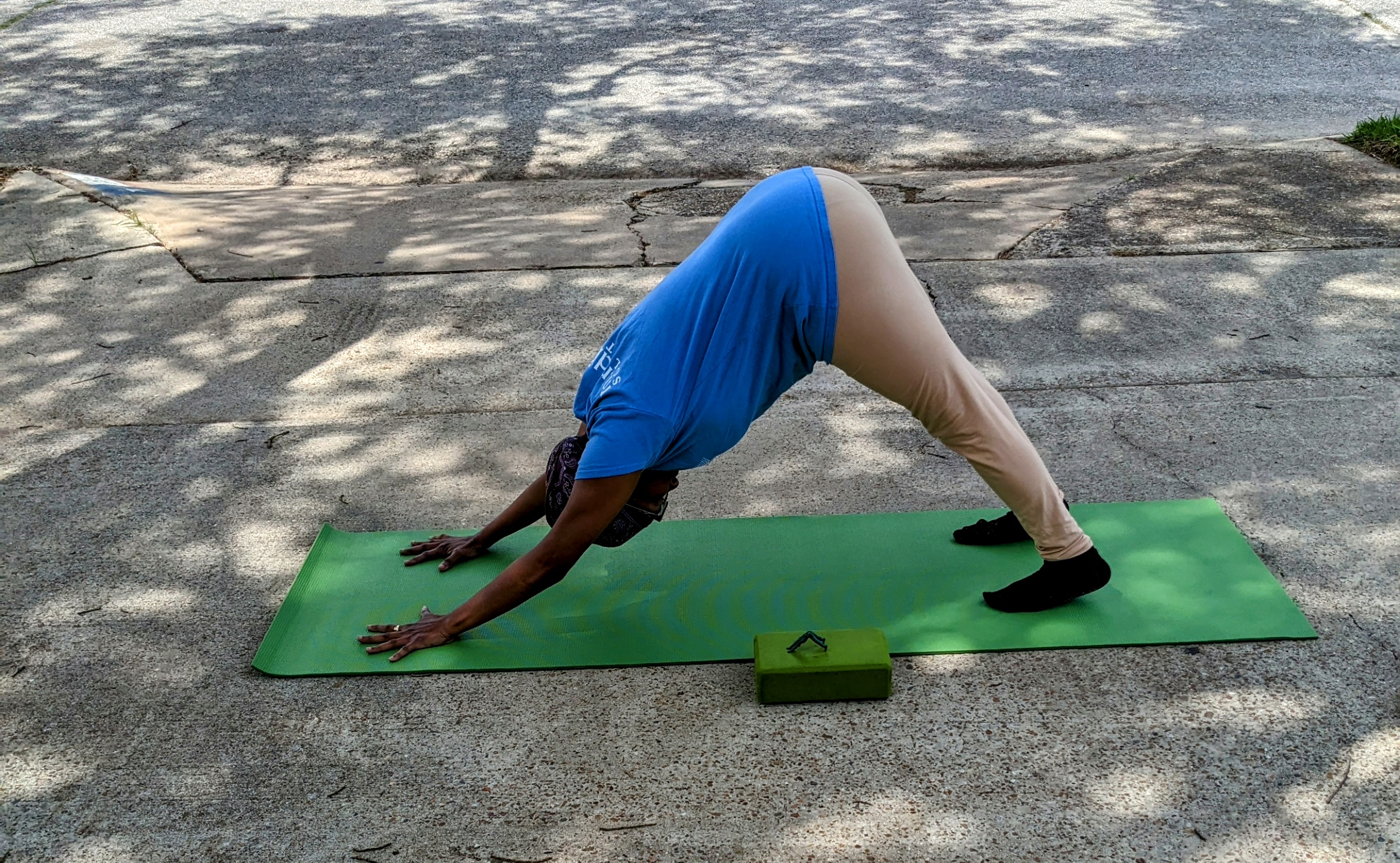
 A Joyful Practice