The pictures above are part of my 2023 offering for the 10th annual Kiss My Asana yogathon, which benefits Mind Body Solutions (MBS). This week (April 22nd – 28th), I’m dedicated to raising awareness and resources for MBS’ life-affirming work to help people living with disabilities – and you can help too! You can help by joining me as we practice with purpose, by sharing this page, and/or by making a donation that creates opportunities for more people to practice yoga.
Mind Body Solutions provides live, online resources to people living with disabilities, worldwide. In addition to 11 live online yoga classes a week, MBS has also created a comprehensive library of recorded adaptive yoga classes for students, instructional videos for adaptive yoga teachers, and insightful interviews between our founder, Matthew Sanford, and adaptive students. It all helps people with disabilities live more fully, where they are and how they are.
Each year, in addition to hosting a fundraising page and making my personal donation, I offer a blog post and/or a YouTube post – sometimes even a whole practice. This year, part of my offering is a series of poses I’m posting on the Community page of my YouTube channel. Of course, there’s more to the poses (and pictures) than meets the eye. So, keep in mind that they – like the classes I lead – are just the tip of the iceberg.
What happens at Mind Body Solutions is the whole enchilada!
Ultimately, MBS is all about people having better relationships with their mind-body and spreading the message that a greater connection between mind and body can help us all live with improved comfort and ease.
“Happy Riḍván!” to those celebrating “the Most Great Festival.” Many blessings to everyone, and especially to anyone Counting the Omer!
This is a post-practice note related to Monday, April 24th. Some embedded links will take you outside of the blog. You can request an audio recording of this practice via a comment below or (for a slightly faster reply) you can email me at myra (at) ajoyfulpractice.com.
“Everybody knows a thousand stories. But only one cocklebur catches in your fur and that subject is your question. You live with that question. You may not even know what that question is. It hangs around a long time. I’ve carried a novel as long as twenty years, and some poems longer than that.”
– Robert Penn Warren quoted from a 1981 interview
Looking back at some old blog posts related to April 24th, it took me a second to realize why the 2021 post wasn’t just a copy or and expanded version of the 2020 post. Then I remembered. In 2020, I focused on telling the story of the Library of Congress, which was established today 1800, and preserves by (and about) people like including Anthony Trollope (b. 1815), Carl Spitteler (b. 1845), Robert Penn Warren (b. 1905), Sue Grafton (b. 1940), Eric Bogosian (b. 1953), and Kelly Clarkson (b. 1982). In 2021, I focused on telling the story of Robert Penn Warren.
In both cases, however, the practice was all about how our minds and bodies tell stories.
Whether we realize it or not, we are constantly telling stories. We tell stories verbally, visually, and viscerally. We tell stories in the ways we move and, also, in the ways we don’t move. We tell stories about where we’ve been, where we are, and where we’re going – and we do this on and off the mat. Whether we realize it or not. On the mat, the storytelling is done through the poses and sequences. Since our bodies are different, we can each tell (and understand) the same “story” in different ways. Since our bodies change over time, we can learn different things about ourselves each time we tell the “story.”
“Social tensions have a parallel in the personal world. The individual is an embodiment of external circumstances, so that a personal story is a social story.”
– Robert Penn Warren quoted from “A Conversation with Robert Penn Warren [with] Frank Gado / 1966 (From First Person: Conversations on Writers and Writing, by Frank Gado” as printed in Conversations with Robert Penn Warren, edited by Gloria L. Cronin and Ben Siegel
Just as literal and physical storytelling is a big part of my practice, it is a big part of what happens at Mind Body Solutions (MBS). Matthew Sanford, the founding teacher of MBS, calls the stories we tell “healing stories.” If you click on the link above for the 2021, you will find the healing stories of people who have directly benefited from practicing adaptive yoga and who directly benefit from the Kiss My Asana yogathon. If you click on the link above for 2020, you will find a “piece” of a healing story that is still being told.
If you’re interested in my previous Kiss My Asana (KMA) offerings, check out the following (some links only take you to the beginning of a series ad/or to YouTube):
“Happy Riḍván!” to those celebrating “the Most Great Festival.” Many blessings to anyone Counting the Omer or celebrating/observing Eastertide / the Octave of Easter!
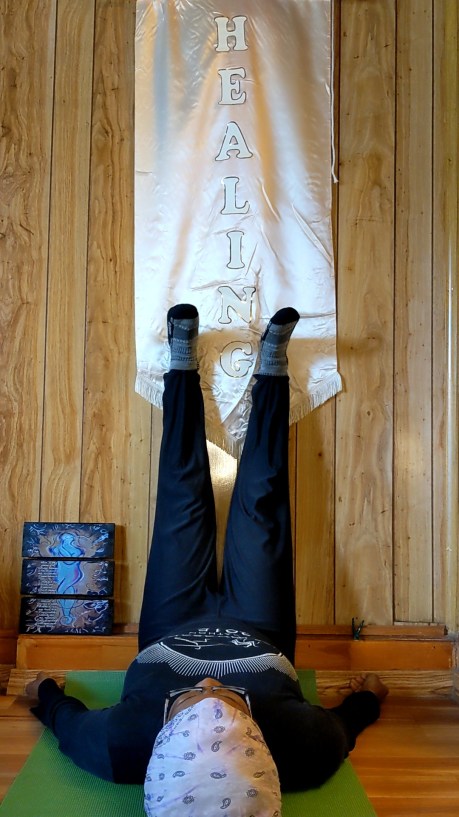
The picture above is part of my 2023 offering for the 10th annual Kiss My Asana yogathon, which benefits Mind Body Solutions (MBS). This week (April 22nd – 28th), I’m dedicated to raising awareness and resources for MBS’ life-affirming work to help people living with disabilities – and you can help too! You can help by joining me as we practice with purpose, by sharing this page, and/or by making a donation that creates opportunities for more people to practice yoga.
Mind Body Solutions provides live, online resources to people living with disabilities, worldwide. In addition to 11 live online yoga classes a week, MBS has also created a comprehensive library of recorded adaptive yoga classes for students, instructional videos for adaptive yoga teachers, and insightful interviews between our founder, Matthew Sanford, and adaptive students. It all helps people with disabilities live more fully, where they are and how they are.
Each year, in addition to hosting a fundraising page and making my personal donation, I offer a blog post and/or a YouTube post – sometimes even a whole practice. This year, part of my offering is a series of poses I’m posting on the Community page of my YouTube channel. Of course, there’s more to the poses (and pictures) than meets the eye. So, keep in mind that they – like the classes I lead – are just the tip of the iceberg.
What happens at Mind Body Solutions is the whole enchilada!
Ultimately, MBS is all about people having better relationships with their mind-body and spreading the message that a greater connection between mind and body can help us all live with improved comfort and ease.
“Happy Riḍván!” to those celebrating “the Most Great Festival.” Many blessings to anyone Counting the Omer or celebrating/observing Eastertide / the Octave of Easter!
For Those Who Missed It: The Following was originally posted as part of my Kiss My Asana offering in 2020. I have adjusted some language, added a couple of critical details, and also added class details and links. Some links connect to sites outside of this blog.
( )
– Title of the third sigur rós album, on which all songs are “sung” by jónsi (born 4/23/1975) in Hopelandic (“Vonlenska” in Icelandic)
A lot of people, myself included, find sigur rós music relaxing. I also find it visceral, something felt deep in the body. So, sometimes, when I want people to really tune in and pay attention to how they are feeling – deep in their bodies – I play sigur rós. There are albums where jónsi, who was born today in 1975, sings in Icelandic. On the third album, however, he sings in an imaginary language known as Vonlenska. Vonlenska, as identified by a journalist, first appeared in the ninth track of the band’s debut album. The song is called “Von,” the Icelandic word for “hope.” Hence the name: Volenska. Hopelandic.
Hopelandic. How can you not love that name, or the idea of a place where the native language is hope?
“it’s of course not an actual language by definition (no vocabulary, grammar, etc.), it’s rather a form of gibberish vocals that fits to the music and acts as another instrument. jónsi likens it with what singers sometimes do when they’ve decided on the melody but haven’t written the lyrics yet.”
– from the faq section of the sigur rós website
When I play sigur rós in class, I remind people that they are hearing an imaginary language, but also point out that if you listen long enough you can not only sing along you can also feel as if you understand what is being sung – if not the words (since they aren’t, technically, words), at least the sentiment. I also explain that it is a little like listening to the mind-body.
Our minds and bodies speak in sensation, that’s how they communicate information. The only problem is, we’re not always fluent in sensation. So, just like we do when we are learning a new language, we need to experience the “vocabulary” in context and then repeat and repeat them until they are ingrained. Living our lives in our bodies is a little like being immersed in a foreign language – except for the part where we can ignore all of the sensation/information and only converse in our native tongue because, in some ways, it is easier than trying to understand this language no one spends a lot of time teaching us how to understand. The physical practice of yoga (hatha yoga, regardless of the style or tradition) is a way to start learning the language.
It’s not that hard to find a yoga class, if you consider yourself able-bodied and/or of sound mind (and/or if you are not marginalized in any way). Even now, under the when there was a worldwide lockdown, there were lots of options. It may take a little effort to find a yoga practice that works for you, but it’s out there. What if, however, you (or someone around you) didn’t consider you able-bodied and/or of sound mind? What if you had been told that because you couldn’t move parts of your body on your own, couldn’t breathe without a machine, and/or didn’t feel sensation the way others felt it, you couldn’t practice yoga? What if your body didn’t look like the teacher’s body? What if you had experienced a loss or a traumatic event so devastating that it was hard to get out of bed? What if you were burnt out from taking care of people? What if a doctor told you that you were all but dead?
“Or do you need to get quiet enough to understand that some person – maybe close to you, maybe you – needs a beautiful place to come to, just to be, to come back to the purity of your existence.
And whatever’s dragged you through your life up to this point, beaten you forward to solve whatever problems, you drop all of that. And find yourself.”
– Robert Boustany describing that ‘Every answer is inside you.’
I started practicing yoga between professional dancers and musicians, people who used their bodies to make a living. They were also people (pardon the pun) very in-tune with their bodies. Then there was me, and on the first day, Robert Boustany explained that I already practiced yoga (philosophically speaking).
Because I knew Robert’s background and knew some of the people who practiced with him under various conditions, it would be decades before it occurred to me that some people thought they couldn’t practice yoga. It was heartbreaking to realize that some people were being denied a really profound internal experience, a profoundly healing experience, because of a misconception about what yoga is and what it is not. It was heartbreaking to realize that there were yoga teachers all of the world who only knew how to teach a single, sometimes stereotypical, person – especially since there are so many people in the world who are not stereotypical.
“As I write this book, I am a yoga teacher, and I still get around in a wheelchair. I teach bodies that can stand when I cannot, that can feel things where I do not. This is possible because I have explored a different kind of connection between mind and body. Although I still cannot move my legs – and have no goal to do so – I do feel a heightened level of presence throughout my entire consciousness, including my paralyzed body.
It is a connection that we all share. Most of us, however, have not needed to bring it fully to consciousness. I believe this shared connection has profound implications not just for the shape and quality of our consciousness, but for the aging process, for the experience of trauma, for our approach to disability and rehabilitation, and even for our survival on this planet.”
– quoted from the Introduction to Waking: A Memoir of Trauma and Transcendence by Matthew Sanford
Matthew Sanford is one of those people who is not stereotypical. He founded Mind Body Solutions to help those who have experienced trauma, loss, and disability find new ways to live by integrating both mind and body. Known for their adaptive yoga classes, MBS provides “traditional yoga” classes, workshops, and outreach programs. They also train yoga teachers and offer highly specialized training for health care professionals. This year’s yogathon, the 10th annual yogathon, kicked off yesterday. Seven days to practice with purpose: to do yoga, share yoga, and help others. By participating in the Kiss My Asana yogathon you join a global movement, but in a personal way. In other words, you practice yoga… for 7 days. And you can start right now!
Please join me for a 65-minute virtual yoga practice on Zoom today (Sunday, April 23rd) at 2:30 PM.Use the link from the “Class Schedules” calendar if you run into any problems checking into the class. You can request an audio recording of this practice via a comment below or by emailing myra (at) ajoyfulpractice.com.
The practices I lead are full of little bits of teaching/practice I’ve picked up from Matthew Sanford and other teachers and students at Mind Body Solutions. Plus, I’ll be posting KMA offerings on the community page on my YouTube channel.
If you’re interested in my previous KMA offerings, check out the following (some links only take you to the beginning of a series):
In the spirit of generosity (“dana”), the Zoom classes, recordings, and blog posts are freely given and freely received. Ifyou are able to support these teachings, please do so as your heart moves you. (NOTE: You can donate even if you are “attending” a practice that is not designated as a “Common Ground Meditation Center” practice, or you can purchase class(es). Donations are tax deductible; class purchases are not necessarily deductible.)
“Happy Riḍván!” to those celebrating “the Most Great Festival.” Many blessings to anyone Counting the Omer or celebrating/observing Eastertide / the Octave of Easter!
This is a “missing” post for Saturday, April 22nd. It includes some recycled quotes and re-purposed information from earlier posts. Some embedded links will take you outside of the blog. You can request an audio recording of this practice via a comment below or (for a slightly faster reply) you can email me at myra (at) ajoyfulpractice.com.
“Those who contemplate the beauty of the earth find reserves of strength that will endure as long as life lasts. There is something infinitely healing in the repeated refrains of nature — the assurance that dawn comes after night, and spring after winter.”
– quoted from Silent Spring by Rachel Carson (published 1962)
So, this week we considered the power found in waiting, waiting in community and also the power of water and light – which is akin to fire – (plus there were some references to wind). But what about Earth… and Space? And what does any of this have to do with grace, particularly shastra kripa (or, at least, one of the definitions of shastra kripa)? To get to all that we have to get grounded, dig deep, and take a little detour through another celebration related to waiting and through a yogathon.
Notice, however, that all of the references below are centered and grounded in community.
“But it seems reasonable to believe — and I do believe — that the more clearly we can focus our attention on the wonders and realities of the universe about us the less taste we shall have for the destruction of our race. Wonder and humility are wholesome emotions, and they do not exist side by side with a lust for destruction.”
– Rachel Carson accepting the John Burroughs Medal (April 1952) and printed in Lost Woods: The Discovered Writing of Rachel Carson
In addition to being the beginning of the 10th annual Kiss My Asana yogathon, today was Earth Day. While the roots of Earth Day can be found in the 1962 publication of Rachel Carson’s Silent Spring, an actual day dedicated to Earth and peace was initially proposed by John McConnell during a 1969 conferenced hosted by the United Nations Educational, Scientific and Cultural Organization (UNESCO). The very first Earth Day, as he proposed it, was held in San Francisco on March 21, 1970, to coincide with the first day of spring in the northern hemisphere. Gaylord Nelson, a United States Senator from Wisconsin, proposed a nationwide environmental teach-in and hired a young activist named Denis Hayes to organize the first national Earth Day, which was held on April 22, 1970. More than 20 million people, including then-President Richard Nixon and First Lady Pat Nixon, participated in the events on April 22, 1970, making that day one of the largest protests in the United States. (The 1970 Earth Day teach-in was the largest recorded protest until the 2020 protest after the murder of George Floyd.)
“In these troubled times it is a wholesome and necessary thing for us to turn again to the earth and in the contemplation of her beauties to know the sense of wonder and humility. There is modern truth to the ancient wisdom of the psalmist: `I will lift up mine eyes unto the hills, from whence cometh my help.’”
– quoted from Rachel Carson’s original submission to “Words to Live By” for This Week Magazine (1951)
“A determination to be outward looking in the process of community building had already become an established aspect of culture in many, many places; it has now blossomed, in a rising number of communities, into a sense of real responsibility for the spiritual and material progress of larger and larger groups within society, well beyond the membership of the Bahá’í community itself. The efforts of the friends to build communities, to engage in social action, and to contribute to the prevalent discourses of society have cohered into one global enterprise, bound together by a common framework for action, focused on helping humanity to establish its affairs on a foundation of spiritual principles.”
– quoted from the Riḍván 2022 message from the Universal House of Justice “To the Bahá’is of the World”
Thursday night marked the beginning of the twelve-day festival of Ridván, “the Most Great Festival” in the Baháʼí Faith. As I mentioned last month, the Baháʼí Faith is a monotheistic faith that believes in the oneness of God and religion, as well as the oneness and nobility of humanity. The community believes that, historically, there has been a “progressive revelation of religious truth” which has been shared with the world through the voices of the prophets or Divine Messengers, known as “Manifestations of God” (which include “Braham, Krishna, Zoroaster, Moses, Buddha, Jesus Christ, Muhammad, and, in more recent times, the Báb and Bahá’u’lláh”). People within the faith are taught to honor the value of different religious and philosophical traditions as well as the value of education, especially in science (which is viewed by some faiths as being contrary to religion).
The Bahá’í calendar begins around the Vernal (Spring) Equinox in the Northern Hemisphere and has 19 months with 19 days – each named for one of the 19 names/manifestations/attributes of God. For example, “Splendor” and “Glory” are the English translations for Bahá and Jalál, the first two months (and days) of this solar calendar. There are also 4 or 5 intercalary days that occur just before the final month and which are considered “transcendent” in nature. The calendar is partially tied to the Gregorian calendar, in that days on each calendar always correspond with each other; however, the Bahá’í calendar is very much focused around its own historical liturgy. Hence, why 2023 is the year 180 BE (Bahá’í Era).
The twelve-day festival of Ridván, one of the holiest times within the Bahá’í community, is celebrated during the second month and begins exactly one Gregorian-month after the new year. This “Most Great Festival” in the Baháʼí Faith honors the time that the founder of the Bahá’i Faith, Bahá’u’lláh waited in the original garden of Ridván prior to being exiled to Constantinople. The Arabic word ridván means “paradise” and I indicated “the original garden,” because in addition to the garden outside of Baghdad, where the great spiritual leader (considered a manifestation of the Divine) prepared for his exile, there is a second garden with the same name in Israel, which Bahá’u’lláh visited after years of exile.
The festival is a time of a sacred time of prayer, reflection, and celebration. This year’s celebrations began two hours before sunset on Thursday – with the specific timing meant to commemorate the actual time, in 1863, when Bahá’u’lláh entered the Najíbíyyih Garden with his three sons and his secretary and began to receive the visitors who wanted to wish him well before his departure. It was during this time, in the space he called “paradise,” that Bahá’u’lláh declared himself as the most recent manifestation of God; that all religious wars were repealed; that there would not be another manifestation of the God for another 1,000 years; and that the names of God (or attributes of the divine) are manifested in all things. To honor the fact that he made these announcements, the Universal House of Justice issues an annual Ridván message. They also hold elections held during this time. The first day (yesterday), the ninth day (next Saturday), and the twelfth day are considered the most holy of days. The ninth day is auspicious because it is the day the rest of Bahá’u’lláh’s family joined him in the garden and it is also the beginning of the third month, Jamál (“Beauty”).
“Besides my involvement with the Investor’s Circle, I temporarily put aside my plan for an institute and returned to the basics – an almost exclusive focus on my yoga practice. After a couple of years, I decided that it was time to share my experience with yoga and paralysis. If nothing else, I could help others who lived with disability. I started teaching an adapted yoga class at the Courage Center, a leading rehabilitation facility in a suburb of Minneapolis.
My idea was that by teaching this class, I could give something back – an obvious means to make my experience useful. What I found was much more. I thought I was teaching these students, when, in fact, they were teaching me. Neurological deficit is a frontier of mind-body integration. Working with these students has taught me that the principles of yoga are nondiscriminating – they can travel though any body.”
– quoted from “16, Falling Gracefully” in “Part Three: Yoga, Bodies, and Baby Boys” of Waking: A Memoir of Trauma and Transcendence by Matthew Sanford
As I have mentioned before, my first exposure to the physical practice of yoga was also my first exposure to Yoga Philosophy and to the fact that anyone and everyone can practice yoga. Sometimes we stumble upon the practice that works for us. However, sometimes it takes an extra effort to find the practice (and the teacher) that works for our particular mind-bod-spirit. In fact, it wasn’t until I took my first yoga teacher training that I really realized how many people weren’t practicing, because they didn’t know they could practice. Even worse, some people had been told that they couldn’t practice – which is heartbreaking.
Still, I believed (and continue to believe) in the transformative, healing, and joyful experience of yoga. I also still believe there is a practice for every mind/body/spirit – every veteran, every person with disability, every survivor of sexual assault and other trauma, every elderly person, every person living with chronic pain, every person with a terminal illness, and every caregiver. I am joyfully participating in the Kiss My Asana yogathon for the 10th year in a row, because Mind Body Solutions is helping people find their practice!
The Kiss My Asana yogathon is an annual event that raises awareness and resources for Mind Body Solutions and their life-affirming work to help people living with disabilities. Best known for their Adaptive Yoga Program, which provides adapted yoga opportunities for people around the globe, MBS currently provides live, online resources to people living with disabilities, worldwide. In addition to 11 live online yoga classes a week, MBS has also created a comprehensive library of recorded adaptive yoga classes for students, instructional videos for adaptive yoga teachers, and insightful interviews between the founding teacher, Matthew Sanford, and adaptive students. In the past, MBS has also offered training and workshops for yoga teachers, healthcare professionals, and caregivers (so they can share this work in their communities, too).
All of this helps people with disabilities live more fully, where they are and how they are. Ultimately, however, Mind Body Solutions is all about everyone having better relationships with their mind-body and spreading the message that a greater connection between mind and body can help us all live with improved comfort and ease. So, we can all benefit from the practice, because we all experience trauma, loss, and disability in some way shape or form.
The yogathon started as a month-long endeavor, but switched to a 7-day yogathon in 2020. This week (April 22nd – 28th) I’m planning to practice with purpose. I’m going to “Do Yoga. Share Yoga. Help Others.” – and you can join me! The practices I lead will be full of little bits of teaching/practice I’ve picked up from Matthew Sanford and other teachers and students at Mind Body Solutions. Plus, I’ll be posting on the community page on my YouTube channel.
If you’re interested in my previous KMA offerings, check out the following (some links only take you to the beginning of a series):
Saturday’s playlist is available on YouTube and Spotify. [Look for “0422020 Earth Day”]
What’s this?
Dandasana (“Staff Pose”)
Have you subscribed to my YouTube page? It’s mostly playlists, plus a few mini-practices and videos from previous yogathons. Starting later tonight, I’m also going to be posting on my community page as part of my 2023 Kiss My Asana offering. So, check it out if you want to know more about the pose pictured above (and why we’re doing it).
“Happy Riḍván!” to those celebrating “the Most Great Festival.” Many blessings to anyone Counting the Omer or celebrating/observing Eastertide / the Octave of Easter! Also, “Happy Earth Day!” to everyone.
“But it seems reasonable to believe — and I do believe — that the more clearly we can focus our attention on the wonders and realities of the universe about us the less taste we shall have for the destruction of our race. Wonder and humility are wholesome emotions, and they do not exist side by side with a lust for destruction.”
– Rachel Carson accepting the John Burroughs Medal (April 1952) and printed in Lost Woods: The Discovered Writing of Rachel Carson
Please join me for a 90-minute virtual yoga practice on Zoom today (Saturday, April 22nd) at 12:00 PM.Use the link from the “Class Schedules” calendar if you run into any problems checking into the class. You can request an audio recording of this practice via a comment below or by emailing myra(at) ajoyfulpractice.com.
Saturday’s playlist is available on YouTube and Spotify. [Look for “0422020 Earth Day”]
In the spirit of generosity (“dana”), the Zoom classes, recordings, and blog posts are freely given and freely received. If you are able to support these teachings, please do so as your heart moves you. (NOTE: You can donate even if you are “attending” a practice that is not designated as a “Common Ground Meditation Center” practice, or you can purchase class(es). Donations are tax deductible; class purchases are not necessarily deductible.)
While yesterday’s practice served up “phun” with a side of suffering, how we deal with suffering is the main course during tonight’s practice. The following was originally posted in 2021. I have updated the date-related practice information. Even though there is no music for the Monday night practice, I have retained the links from last year’s practice.
In the spirit of generosity (“dana”), the Zoom classes, recordings, and blog posts are freely given and freely received. If you are able to support these teachings, please do so as your heart moves you. (NOTE: You can donate even if you are “attending” a practice that is not designated as a “Common Ground Meditation Center” practice, or you can purchase class(es). Donations are tax deductible; class purchases are not necessarily deductible.)
“‘Bhikkhus, I could tell you in many ways about the animal kingdom, so much so that it is hard to find a simile for the suffering in the animal kingdom. Suppose a man threw into the sea a yoke with one hole in it, and the east wind carried it to the west, and the west wind carried it to the east, and the north wind carried it to the south, and the south wind carried it to the north. Suppose there were a blind turtle that came up once at the end of each century. What do you think, bhikkhus [monks]? Would that blind turtle put his neck into that yoke with one hole in it?’
Bhikkhus: ‘He might, venerable sir, sometime or other at the end of a long period.’
‘Bhikkhus, the blind turtle would take less time to put his neck into that yoke with a single hole in it than a fool, once gone to perdition, would take to regain the human state, I say. Why is that? Because there is no practicing of the Dhamma there, no practicing of what is righteous, no doing of what is wholesome, no performance of merit. There mutual devouring prevails, and the slaughter of the weak.’”
– quoted from “The Animal Kingdom” in Majjhima Nikāya 129, Balapandita Sutta: Fools and Wise Men
Don’t ask me why, because I can give you a hundred reasons, but I always seem to “mis-remember” a certain Buddhist story. I mix up the details of the story – I have heard that other teachers (greater teachers than me) do the same. In my case, the blind turtle becomes a dolphin who likes to play; another teacher makes the piece of driftwood a golden ring, heavy enough to sink down to the bottom of the sea (only to get churned back up again). Additionally, I have heard others say that the convergence of the ring and the sea creature happens every hundred years, every thousand years, every five billion years, or a kalpa (based on Hindu and/or some Buddhist texts). But, be all that as it may, the purpose of the story doesn’t change: it highlights the odds of being born (or reborn) into a human existence and the preciousness of human life. And, just as the purpose of the story doesn’t change, neither does the driving compulsion to tell the story – even when one mixes up the details.
While we are on the subject of details, take a moment to consider the details of your life. Consider your unique experiences, thoughts, words, deeds, and relationships. Back in 2016, Dr. B. B. Cael, who was then a graduate student in the MIT-WHOI Joint Program (Massachusetts Institute of Technology and The Woods Hole Oceanographic Institution), calculated that the probability of a blind sea turtle randomly rising up so that it’s head poked through a hole in a piece of drift wood was 7.2 x 10^-16 and the probability of a human being (who is going to be reincarnated) coming back as another human was 6.5 x 10^-16. Now, all of that is just random – without any consideration to specific details like in which body of water the creature rise or what month or what year. Imagine if you will, the probability of you… or me…or anyone we know actually existing as we do. It is miraculous and magnificent!
When I consider how magnificent and miraculous it all is, it reinforces my belief that we are all here for a purpose: a divine purpose. Or, at the very least, that our lives should have a purpose; that we should live a purpose-driven life.
“Find your struggle, learn your lesson, and then know your purpose.”
– a “Monaism” (saying by Mona Miller, as quoted by Seane Corn)
Mona Miller was the teacher of one of my teachers, Seane Corn. Like me, like Seane, like pretty much every teacher who regularly guides a group of people, Mona had things she was known for saying. Her students called those sayings, Monaisms, and the one above reminds me of Marcus Aurelius’ stoic belief that the obstacle is the way. It is also a perfect recipe for being driven and staying driven. After all, we all have struggles, strife, challenges, discomfort, suffering, and disease – and we all want (and deserve) relief from that which ails us. If we take a moment, just a moment, to reflect on what ails us we start to realize four very salient facts:
We are not the only person suffering.
Someone else has, is, and will suffer as we are suffering.
How we deal with our suffering can alleviate suffering or cause more suffering (in ourselves and others).
How we deal with our suffering can inspire others as they deal with their suffering.
“Sanklapa goes beyond just intention. Sankalpa truly cares for the impact.”
– Embrace Yoga’s Roots: Courageous Ways to Deepen Your Practice by Susanna Barkataki
Our ritual of setting an intention and “dedicating” our practice is similar to the Buddhist tradition of “dedicating of the merit” and is rooted in the fifth niyama (“internal observation”), Īśvarapraņidhāna, which is offering our efforts back to the source. The underlying idea in these practices is the very definition of karma yoga as outlined in The Bhagavad Gita (2.31 – 2.51): that we should do our best and work without desire, because the work we do is our “personal duty in life (one’s sva-dharma).”
On Saturday, we go a little deeper by practicing with a sankalpa. The Sanskrit word can be translated into English as “will,” “determination,” and “(the highest) vow.” However, as Susanna Barkataki points out, there is no English word that encompasses the complete and true meaning. Part of the problem with the English translations is that we don’t have one word for something that simultaneously compels us, fuels us, and motivates us. We don’t have an English word for something that consciously embed so deeply into our fiber that it unconsciously starts determining how we live, think, speak, and act. Even “purpose” has to be “driven.”
Of course, these practices require a certain level of trust, a certain level of faith, or – at the very least – a certain level of hopeful desire that what benefits us will also benefit others. One way I frame this is to think of each of us is being like every hero in every culture’s hero’s journey. Accordingly, our work in the world will result in a boon that benefits the world. This is true whether we look at our life (and life purpose) through the lens of our occupation, vocation, and/or avocation. This is true whether we have all the advantages or all the disadvantages. This is true whether people expect us to succeed or whether we are viewed as the underdog. Either way, how we show up in the world matters, because we matter.
“That grain of salt You talk about Gets bigger and bigger each day It’s making a pearl Inside my heart With layer and layers of tears I’d give you this pearl To save our hearts”
– quoted from the song “Grain of Salt” by John Doe
I have a lot of favorite metaphors about how we can deal with hardship and challenges. One of my favorites is what happens when an oyster, clam, or other shelled mollusks gets a bit of salt, sand, or debris inside of its shell. Since the mollusk doesn’t have fingers and opposable thumbs it can use to root around and remove the irritating object, it begins to lave the object with its natural secretion. Over and over again, the shell creature coats the object until it is smooth (and iridescent) and no longer irritating. The end result is something we humans often find valuable.
Of course, I’m going to discourage anyone from getting an actual pearl to remind them of this metaphor, because it is (in a practical sense) an imperfect metaphor. While the mollusk finds a non-violent way to end its suffering, the harvesting of the pearl (especially in a commercial sense) usually requires killing the shelled creature. In the case of cultured pearls, someone intentionally places the irritating object in the shell (hence causing suffering) and then kills the mollusk or, if it can be “irritated” again, places it back in the water to go through more suffering. Hence why, when I use the metaphor, I focus more on what the mollusk has to teach us than what we teach ourselves.
It is, however, important to remember that we are teaching ourselves. In other words, we are teaching each other. The way we think, speak, act, and live our lives is a lesson to others – and especially to the children around us. I know there are a lot of celebrities who consistently proclaim that they are not role models. Yet, each of us is a living example; each of us is modeling behavior – and the children around us are watching and learning. They are learning from their parents, grandparents, their teachers, their coaches, their neighbors, their world leaders, and the siblings of all of the above. They are also learning from each other. And what is more important than the words someone tells them is the lived example that they observe.
“Pighla de zanjeerein [Melt the shackles]
Bana unki shamsheerein [and make swords out of them]
Kar har maidaan fateh o bandeya [Win every battlefield, overcome all your limitations/restrictions”]
– quoted from the song “Kar Har Maidaan Fateh” by Shreya Ghoshal and Sukhwinder Singh
The 2018 film Sanju is based on the real life story of a Bollywood actor, Sanjay Dutt (portrayed by Ranbir Kapoor). Called “Sanju” by his mother, the actor experienced a series of personal crises intertwined with political crises and a downward spiral that resulted in him dealing with his losses, challenges, and conflicts in the some of the most dysfunctional/afflicted ways possible. He turned to drugs and alcohol, and became addicted – which, of course, led to more suffering. In a song that is featured in the movie, and in the associated video, Manisha Koirala appears as a vision of Nargis, Sanju’s mother, encouraging him to live a better life.
In keeping with the language found in many sacred texts from Asia, the song, “Kar Har Maidaan Fateh” refers to one’s struggles, challenges, and suffering as “shackles” or “chains.” The song instructs one to turn the very things that could defeat us into something that can help us overcome our struggles and win our personal battles. It speaks of the power of determination so strong that it overcomes bad luck; climbing onto “clouds of adversity” and grabbing “the collar of the difficult tough times – all in order to become special and “separate from the ordinary crowd.” The song specifically refers to “swords” (and even what can be accomplished with a “broken sword”), but consider other tools that one can use to overcome adversity.
Remember, Edward Bulwer-Lytton said, “The pen is mightier than the sword.” Remember the power of a sharp mind and what happens when you make your mind up to do something. Remember, too, that once a lesson is learned it continues to serve.
“If all the world is a classroom and every day of life is a lesson, then certainly your profession and workplace are included.
After all, He has unlimited ways to provide your livelihood, but He chose to direct you to this way of life.
What sparks of divine wisdom await you here?”
– quoted from Hayom Yom*, 9 Iyar
(*lit. “From Day to Day”); an anthology of aphorisms and customs, arranged according to the days of the year, assembled from the talks and letters of Rabbi Yosef Yitzchak of Lubavitch (1880-1950), sixth Lubavitch Rebbe; compiled by Rabbi Menachem Mendel Schneerson, seventh Lubavitch Rebbe. “Iyar” is the eighth month of the civil year and the second month of the Jewish religious year, based on the Hebrew calendar.
Please join me today (Monday, May 16th) at 5:30 PM for a 75-minute virtual yoga practice on Zoom. Use the link from the “Class Schedules” calendar if you run into any problems checking into the class. Give yourself extra time to log in if you have not upgraded to Zoom 5.0. You can request an audio recording of this practice via a comment below.
There is no playlist for the Common Ground Meditation Center practice.
The playlist for Sunday (05/16/2021) is available on YouTube and Spotify.
“Yo soy yo y mi circunstancia, y si no la salvo a ella no me salvo yo.”
[“I am I and my circumstance, and if I don’t save it I don’t save myself.”]
— quoted from Meditaciones del Quijote [Don Quixote Mediations] by José Ortega y Gasset
Thank you to everyone who supported the 9th annual Kiss My Asana yogathon. Both Mind Body Solutions and I surpassed our goals (Woohooo!!!) thanks to everyone’s generosity. As always, I am grateful for everyone that did yoga, shared yoga, and helped others.
“Dikhla de zinda hai tu [Show to everyone that you are still alive]
Baaqi hai tujhme hausla [and there is courage left in you…]”
“Tooti shamsheerein toh kya [So what if your sword is broken]
Tooti shamsheeron se hee [Even with this broken sword]
Kar har maidan fateh [Win all the battlefields…]”
“Teri koshishein hee kaamyaab hongi [your attempts, efforts will be successful]
Jab teri ye zidd aag hogi [when your insistence, attempts would turn into a burning desire]
Phoonk de na-umeediyan, na-umeediyan [Burn down all the hopeless, negativeness…]”
– quoted from the song “Kar Har Maidaan Fateh” byShreya Ghoshal and Sukhwinder Singh (with English translations)
Happy Riḍván!” to those celebrating the “the Most Great Festival.” “Ramadān Mubarak, Blessed Ramadān!” to anyone observing the holy month of Ramadān. Many blessings to all, and especially to those celebrating or observing Eastertide or Counting the Omer!
I’m excited to once again participate in the Kiss My Asana yogathon, which is Mind Body Solutions‘ biggest fundraiser and a way to spread the message that a greater connection between mind and body can help all of us live with improved comfort and ease, no matter our condition, age, or ability.
I started Joyfully participating in the 2014 yogathon because I believe in the transformative, healing, and joyful experience of yoga. I also believe there is a practice for every mind/body/spirit – every veteran, every person with disability, every survivor of sexual assault and other trauma, every elderly person, every person living with chronic pain, every person with a terminal illness – and Mind Body Solutions is helping people find their practice!
Mind Body Solutions’ mission and message reach all walks of life – people living with disabilities, terminal illness, chronic pain, trauma, and PTSD – to name a few. Best known for their Adaptive Yoga Program, which provides adapted yoga opportunities for people around the globe. MBS also offers training and workshops for yoga teachers, healthcare professionals, and caregivers (so they can share this work in their communities, too).
Each year, in addition to hosting a fundraising page and making my personal donation, I offer a blog post and/or a YouTube post – sometimes even a whole practice. This year, I am making videos highlighting different parts of our bodies and, in doing so, different parts of our lived experience. Many more connections exist than the ones I’m highlighting. So, keep in mind that these videos – like the classes I lead – are just the tip of the iceberg.
What happens at Mind Body Solutions is the whole enchilada!
If you have two more minutes to spare, I’d recommend you also check out the Mind Body Solutions video (below) so you can see exactly how your donation will help! Thank you for taking the time and for showing your support – and don’t forget to forward this to anyone who you think might want to donate or join!
Happy Riḍván!” to those celebrating the “the Most Great Festival.” “Ramadān Mubarak, Blessed Ramadān!” to anyone observing the holy month of Ramadān. Many blessings to all, and especially to those celebrating or observing Eastertide or Counting the Omer!
The links in this particular post will take you outside of my blog. Quick Update: Thanks to all of you, I have helped raise 1% of the yogathon’s overall goal! If a few more people donate, I could double my personal goal and help raise 2% of the overall goal. Please consider donating today!
I’m excited to once again participate in the Kiss My Asana yogathon, which is Mind Body Solutions‘ biggest fundraiser and a way to spread the message that a greater connection between mind and body can help all of us live with improved comfort and ease, no matter our condition, age, or ability.
I started Joyfully participating in the 2014 yogathon because I believe in the transformative, healing, and joyful experience of yoga. I also believe there is a practice for every mind/body/spirit – every veteran, every person with disability, every survivor of sexual assault and other trauma, every elderly person, every person living with chronic pain, every person with a terminal illness – and Mind Body Solutions is helping people find their practice!
Mind Body Solutions’ mission and message reach all walks of life – people living with disabilities, terminal illness, chronic pain, trauma, and PTSD – to name a few. Best known for their Adaptive Yoga Program, which provides adapted yoga opportunities for people around the globe. MBS also offers training and workshops for yoga teachers, healthcare professionals, and caregivers (so they can share this work in their communities, too).
Each year, in addition to hosting a fundraising page and making my personal donation, I offer a blog post and/or a YouTube post – sometimes even a whole practice. This year, I am making videos highlighting different parts of our bodies and, in doing so, different parts of our lived experience. Many more connections exist than the ones I’m highlighting. So, keep in mind that these videos – like the classes I lead – are just the tip of the iceberg.
What happens at Mind Body Solutions is the whole enchilada!
If you have two more minutes to spare, I’d recommend you also check out the Mind Body Solutions video (below) so you can see exactly how your donation will help! Thank you for taking the time and for showing your support – and don’t forget to forward this to anyone who you think might want to donate or join!
Happy Riḍván!” to those celebrating the “the Most Great Festival.” “Ramadān Mubarak, Blessed Ramadān!” to anyone observing the holy month of Ramadān. Many blessings to all, and especially to those celebrating or observing Eastertide or Counting the Omer!
I’m excited to once again participate in the Kiss My Asana yogathon, which is Mind Body Solutions‘ biggest fundraiser and a way to spread the message that a greater connection between mind and body can help all of us live with improved comfort and ease, no matter our condition, age, or ability.
I started Joyfully participating in the 2014 yogathon because I believe in the transformative, healing, and joyful experience of yoga. I also believe there is a practice for every mind/body/spirit – every veteran, every person with disability, every survivor of sexual assault and other trauma, every elderly person, every person living with chronic pain, every person with a terminal illness – and Mind Body Solutions is helping people find their practice!
Mind Body Solutions’ mission and message reach all walks of life – people living with disabilities, terminal illness, chronic pain, trauma, and PTSD – to name a few. Best known for their Adaptive Yoga Program, which provides adapted yoga opportunities for people around the globe. MBS also offers training and workshops for yoga teachers, healthcare professionals, and caregivers (so they can share this work in their communities, too).
Each year, in addition to hosting a fundraising page and making my personal donation, I offer a blog post and/or a YouTube post – sometimes even a whole practice. This year, I am making videos highlighting different parts of our bodies and, in doing so, different parts of our lived experience. Many more connections exist than the ones I’m highlighting. So, keep in mind that these videos – like the classes I lead – are just the tip of the iceberg.
What happens at Mind Body Solutions is the whole enchilada!
If you have two more minutes to spare, I’d recommend you also check out the Mind Body Solutions video (below) so you can see exactly how your donation will help! Thank you for taking the time and for showing your support – and don’t forget to forward this to anyone who you think might want to donate or join!



 ###
###
