jump to navigation

FTWMI: A Song or 2 For You *REVISED* December 2, 2023

Posted by ajoyfulpractice in Books, Buddhism, Hope, Love, Meditation, Music, Philosophy, Suffering, Vipassana, Yoga.
Tags: , , , , , , , , , ,
add a comment

May you be safe and protected, during the 16 Days of Activism Against Gender-based Violence (November 25th – December 10th) and on all the other days of your life.

For Those Who Missed It: The following was originally posted in 2020. Some sections have been edited to bring the context into the present.

“The timing of the electrical failure seemed dramatic and perfectly correct, as if the lights had said, ‘You have no need for sight. Listen.’”

— quoted from Bel Canto by Ann Patchett

There was a time, not too long ago really, when I felt like I had a certain amount of control over how I began a practice and, therefore, how I told the story that was the class. Sometimes, in part because of my history in technical theatre, I relished days like today when I could combine my thirst for the practice with my love of literature and of the performing arts. I relished creating a dramatic moment when some of my favorite things converged and collapsed into one moment. But, alas, things change and in rolling with the punches I am reminded of the original intention of the story. No matter the drama, it was always about love and the practice (and love of the practice).

In Yoga and in Buddhism, there are techniques that became so popular they are now seen as styles or traditions. There are people, in both cases, who practice each technique as if it is the whole practice. The classic example in Yoga is vinyasā – which literally means “to place in a special way” and involves sequencing poses that exaggerate the body’s natural tendencies (to expand on the inhale and flex on the exhale). In Buddhism, the classic example is vipassanā – which literally means “to see in a special way” and involves paying attention to the way the body responds to the breath (see above). Notice the common root in the Sanskrit words? Notice also the connection to the breath and the body?

There are more these two things have in common, but the most common thing may be people’s habit of translating them into English words that (sometimes) barely hint at their original meaning. So, vinyasā becomes “flow” and vipassanā becomes “insight.” The English words are true; but, make it easy to miss the point and also to miss two key elements of both practices: breath and sense withdrawal.

“She sang as if she was saving the life of every person in the room.”

— quoted from Bel Canto by Ann Patchett

Imagine singing as if you were saving lives; imagine the breath awareness and control that would take. When they hear the words bel canto, many people outside of classical music think of the novel written by Ann Patchett, who was born today in 1963. The novel is based on the 1996 — 1997 hostage crisis that took place at the Japanese Embassy in Lima Peru (Dec 17th — April 22nd). It details the interactions of the terrorists and their hostages — including a world renowned opera singer. Opera and music are central themes throughout the novel, which is named for the Italian term for “beautiful singing” or “beautiful song.” The thing is; bel canto, like vinyasā and vipassanā, is a technique that became known as a style — and it requires control (and awareness) of the breath.

At one time, “bel canto” was just a term applied to beautiful singing — much like some of the music on today’s playlist — but, specifically, to beautiful Italian singing. During the later 18th and early 19th century, however, people started using it in reference to a very specific type of Italian singing, which emphasized even tone; legato (“tied together” or long) phrasing deliberately juxtaposed to staccato (“detached” or short) phrasing — which sometimes also involved dramatic tempo changes; and vibrato (“vibrating” or pulsating). There was also an emphasis on emphasis (or accent) and how emotion was being conveyed. The technique was sometimes applied (and understood) outside of Italian music, but often with less drama attached to it.

“Love was action. It came to you. It was not a choice.”

— quoted from Bel Canto by Ann Patchett

By the end of the 19th century, people were using the term “bel canto” to specifically distinguish a certain style of opera and classical music (mostly associated with Italian and French composers) from operatic and classical music that was described as “weightier, more powerful… speech-inflicted” (and mostly associated with German composers). Similarly, as we moved into the middle and late 20th century, people started using the term “vinyasā” — and even “vipassanā” — to distinguish one type of practice from other traditional styles of practice.

In the parallels I am drawing, one of the things to note is what gets lost in translation. Sometimes, without awareness of why we move the way we move in vinyasā, people just think it’s about putting poses together and moving as swiftly as one can. In fact, there are people who are drawn to that type of practice for the very same reason it turns some people off. Similarly, some people say that they “only practice vipassanā” as a way to distance themselves from Buddhism (or their understanding of cultural Buddhism). The thing is, as I see it, the point of these techniques was to go deeper into the overall practice — and the minute you distance yourself from the intention of the practice is the minute you start spiraling into the “hear be dragons” part of the experience. Sure, it is cool to explore what is considered unchartered territory, but it must always be done (to paraphrase J. R. R. Tolkien) with awareness of the dragons / dangers.

“‘Most of the time, we’re loved for what we can do rather than for who we are. It’s not such a bad thing, being loved for what you can do.’
‘But the other is better,’ Gen said.
Roxane pulled her feet into the chair and hugged her knees to her chest. ‘Better. I hate to say better, but it is. If someone loves you for what you can do then it’s flattering, but why do you love them? If someone loves you for who you are then they have to know you, which means you have to know them.’”

— Roxanne Cross (the soprano) and Gen Watanabe (the translator) in Bel Canto by Ann Patchett

One of the “dangers” of being in close quarters for long periods of time, as people were during the hostage crisis and in the novel (and as we all were in 2020), is that people’s best and worst qualities get exaggerated. It becomes harder, sometimes impossible, to avoid conflict. Other times, it becomes harder (sometimes impossible) to ignore someone’s bad behavior. Similarly, however, we are confronted with people’s good behavior and the heart of people — if we’re paying attention and if we are open to that possibility. Certain situations are opportunities for more trauma and drama — as we have seen ever since the beginning of the pandemic. These same situations are opportunities for forgiveness and healing. But because the lines get blurred with such close proximity, it can all happen at the same time and with the same people. And, I find, that these are the times when we need to withdraw a bit.

I know, I know, you’re thinking, “But where would I go? Where can I go when everything is closed and winter is upon us?” Well, I’m glad you asked.

Some people escape inside of books, some inside of music or movies, and some inside of themselves (through practices like meditation, prayer, yoga, Tai Chi, or Qigong). The idea here is not to escape as if you are running away from home. The idea is to take a moment to turn inward, reflect, and remind yourself of what is in your heart. It’s also a way to remind yourself of what you value and of your guiding principles. Sure, it is harder to do these things during a pandemic. However, it’s harder to do these things if you are in prison or in the middle of a hostage situation… or a war — and yet, people do!

I mentioned earlier that sense withdrawal is one of the key elements shared by vinyasā and vipassanā. In the Yoga Philosophy, pratyāhāra (“withdrawing the senses”) is the fifth limb of the practice. Swami Jnaneshvara Bharati, of the Himalayan tradition, explains that placement in the philosophy by writing that “The willingness or unwillingness to withdraw attention from sensory experience is a significant dividing line between those who experience true meditation and those who experience only physical relaxation.” In other words, in order to focus, concentrate, and meditate on a single point — to the point that we are completely absorbed into (and merged with) the object our focus — we must let go of everything else.

Pratyāhāra is not, as some people believe, forcefully ignoring something or someone. Instead, this is a gentle releasing of awareness. It is something we already do unconsciously or subconsciously when we are really invested in a project or a person. In those times, we may really enjoy the experience. On the flip side, sometimes, the letting go is neither gentle nor peaceful. Sometimes, it is unexpected and jarring and creates a great deal of stress and strain. On a certain level, over the last few months years, we’ve all experienced both kinds of letting go. The question becomes, how have you perceived it (the letting go) and what have you received in turn?

“It was too much work to remember things you might not have again, and so one by one they opened up their hands and let them go.”

— quoted from Bel Canto by Ann Patchett

Please join me today (Saturday, December 2nd) at 12:00 PM, for a 90-minute yoga practice on Zoom. Use the link from the “Class Schedules” calendar if you run into any problems checking into the class. You can request an audio recording of this practice via a comment below or by emailing myra (at) ajoyfulpractice.com.

Saturday’s playlist is available on YouTube and Spotify.  [Look for “12022020 Ann P’s Beautiful Singing”]

Click here for links to the music we used during last year’s First Friday Night Special.

“But together they moved through the world quite easily, two small halves of courage making a brave whole.”

— quoted from Bel Canto by Ann Patchett

In the spirit of generosity (“dana”), the Zoom classes, recordings, and blog posts are freely given and freely received. If you are able to support these teachings, please do so as your heart moves you. (NOTE: You can donate even if you are “attending” a practice that is not designated as a “Common Ground Meditation Center” practice, or you can purchase class(es). Donations are tax deductible; class purchases are not necessarily deductible.)

### HOW AWARE ARE YOU THAT YOU’RE BREATHING? (How about now) ###

More 1.34, on 10.25 (the “missing” Wednesday post) October 25, 2023

Posted by ajoyfulpractice in Books, Buddhism, Changing Perspectives, Faith, Healing Stories, Health, Hope, Japa-Ajapa, Life, Mantra, Meditation, Music, Oliver Sacks, One Hoop, Pain, Peace, Philosophy, Religion, Science, Suffering, William Shakespeare, William Wordsworth, Wisdom, Yoga.
Tags: , , , , , , , , , , , ,
2 comments

Peace to all, every day and especially on Saint Crispin’s Day!

This is the “missing” post Wednesday, October 25th. It features some previously posted information (with links to the related 2020 posts). WARNING: This post and the linked post reference historical battles and individual challenges. You can request an audio recording of the practice via a comment below or (for a slightly faster reply) you can email myra (at) ajoyfulpractice.com.

In the spirit of generosity (“dana”), the Zoom classes, recordings, and blog posts are freely given and freely received. If you are able to support these teachings, please do so as your heart moves you. (NOTE: You can donate even if you are “attending” a practice that is not designated as a “Common Ground Meditation Center” practice, or you can purchase class(es). Donations are tax deductible; class purchases are not necessarily deductible.

Check out the “Class Schedules” calendar for upcoming classes.)

“This day is call’d the Feast of Crispian.
He that outlives this day, and comes safe home,
Will stand a tip-toe when this day is nam’d,
And rouse him at the name of Crispian.
He that shall live this day, and see old age,
Will yearly on the vigil feast his neighbours,
And say ‘To-morrow is Saint Crispian.’”

— quoted from Act IV, Scene iii, of Henry V by William Shakespeare 

Today, October 25th, is Saint Crispin’s Day, also known as the Feast Day of Saint Crispin — although, technically, it is the feast day of Saint Crispin and his twin brother* Saint Crispinian. The brothers were reportedly Roman noblemen who gave up their riches and became cobblers when they converted to Catholicism. They initially escaped religious persecution by fleeing to Soissons, in northern France;  however, their success as cobblers and lay preachers ultimately led to them martyred today in 286 (or, possibly, 285).

Saint Crispin and Saint Crispinian are the patron saints of cobblers, curriers, glove makers, lace makers, lace workers, leather workers, saddle makers, saddlers, shoemakers, tanners, weavers. I would wager, however, that outside of those industries, most people don’t think about the saints, themselves, so much as they think about the day — which is ironic when you consider that their feast day is a black letter day in most Christian traditions.

Prior to the invention of the printing press, calendars in the Roman Republic used red ink for special holidays. The Roman Catholic Church continued this tradition for their liturgical calendar and printed the dates of lesser holidays, those that were not part of the liturgy, in black letters. I am unclear if Saint Crispin’s Day was ever a red-letter day; but, it was (temporarily) removed from the Roman Catholic liturgical calendar shortly after Vatican II.

Up until recently, I had also removed it from my calendar.

I do not remember the exact moment I decided to stop focusing on Saint Crispin’s Day. However, the reason I took it off my calendar is probably the same reason it was even on my calendar in the first place. It is also the reason most people remember the day (if not the date): William Shakespeare and the day’s association with war.

“This story shall the good man teach his son;
And Crispine Crispian shall ne’er go by,
From this day to the ending of the world,
But we in it shall be remembred;

— quoted from Act IV, Scene iii, of Henry V by William Shakespeare

William Shakespeare’s play Henry V (originally titled The Cronicle History of Henry the fift and The Life of Henry the Fifth in the Frist Quatro and First Folio, respectively) is a history play and — like William Wordsworth’s poem about Vice-Admiral Horatio Nelson and Henry Wadsworth Longfellow’s poem about Paul Revere — it is a great example of myth building. The play is all about King Henry V of England just before and after the Battle of Agincourt, which took place on October 25, 1415. A significant part of the Hundred Years’ War (1337–1453), a Middle Ages conflict between England and France over land, titles, power, and nationalism, the Battle of Agincourt was memorable for several reasons.

First, the Battle of Agincourt was an unexpected victory for the English and it gave them control of the disputed area for 14 years. Second, King Henry was actually (physically) involved in the battle; while Charles VI of France was plagued by extreme mental health issues and did not (directly) command the French army. Finally, William Shakespeare memorialized England’s victory — and King Henry V’s leadership — with the play that, some would argue, features one of the most inspirational call–to–arms in literature and theatre: the Saint Crispin’s Day speech.

“We few, we happy few, we band of brothers;
For he to-day that sheds his blood with me
Shall be my brother; be he ne’er so vile,
This day shall gentle his condition;

— quoted from Act IV, Scene iii, of Henry V by William Shakespeare

Parts of Hal’s speech have been used in relation to other armed conflicts — like the Battle of Balaclava which was fought on October 25, 1854 — as well as in relation to political battles in the British parliament and the United States government. Shakespeare’s words have also been quoted and/or paraphrased in movies, television shows, video games, music, and books. They have been used by people on the right side of history, as well as by those who have ended up on the wrong side of history.

The powerful words above have bolstered people, for sure; but, I can’t help wondering if they have also mislead people. After all, we are all connected before a single drop of blood is shed. We have all been connected through shared challenges and traumas, especially over the last few years — and can “strip [our] sleeve and show [our] scars” to prove it. But, even before all that, we are brothers, sisters, and siblings in and of the Spirit. We are all connected through breath and the act of breathing.

Here are a couple of excerpts from a related 2020 post entitled, “First Step: Breathe In, Second Step: Breathe Out”:

“As different as our circumstances, our appearances, and personalities — and therefore our lives — may be, there are certain things we all have in common. We all live and die, love and are loved, experience great wins and great loss. We are also, to paraphrase First Lady Eleanor Roosevelt, all in this together — even when we feel alone, isolated, and going through things we can’t imagine anyone else understanding. Yet, here we sit and stand and lie — here we are, struggling together and apart; finding our way together, even though we are apart.”

“Then there were more changes, more challenges, more conflicts, and more compromises. And, through it all, I did the same thing you did — I kept breathing. What was helpful (and continues to be helpful), above and beyond everything else, was knowing how to breath and being surrounded by people who also were focused on knowing how to breathe. Breath, after all, is life. It’s not enough just to breathe, however, because how we breathe determines how we live.”

Click here to read more about the breathing lessons inspired by the novelist, short story writer, and literary critic Anne Tyler, who was born today 1941.

None of us can survive without breathing. Just as it is important to put on our own oxygen mask first when there is an emergency (so that we can help others), I think it is important to remember how our breath is connected to our minds and bodies. Breathing into that connection with awareness can reinforce our connections to each other. In the first part of the Yoga Sūtras, Patanjali breaks down a list of obstacles, distractions, and ailments that hinder someone’s ability to be the best version of themselves. (YS 1.30 –  1.31) Then he gives examples of ways to meditate in order to clear the mind and remove the obstacles, distractions, and ailments. One of those suggestions is to focus on the breath — specifically, on the exhale and the extension of the breath. (YS 1.34)

Another way to look at the practice is to consider how using the breath to reinforce the mind-body connection, as well as our connection to all of humanity, also has the power to — as William Shakespeare put it — gentle someone’s vile condition.

“Mindfulness of breathing takes the highest place among the various subjects of Buddhist meditation. It has been recommended and praised by the Enlightened One thus: ‘This concentration through mindfulness of breathing, when developed and practiced much, is both peaceful and sublime, it is an unadulterated blissful abiding, and it banishes at once and stills evil unprofitable thoughts as soon as they arise.’ Though of such a high order, the initial stages of this meditation are well within the reach of a beginner though he be only a lay student of the Buddha-Dhamma.”

— quoted from the commentary on the Satipatthana Sutta (The Foundations of Mindfulness) by Nyanasatta Thera

Wednesday’s playlist is available on YouTube and Spotify. [Look for “10272020 Pranayama II”]

“‘Breathing lessons – really,’ [Fiona] said, dropping to the floor with a thud. ‘Don’t they reckon I must know how to breathe by now?’”

— quoted from Breathing Lessons by Anne Tyler

Looking for more? Click here for the post entitled “Third Step: Repeat the First & Second Steps” (which features commentary for the video below).

The practice begins ~5 minutes in….

“‘Oh honey, you’re just lucky they offer such things,’ Maggie told her…. ‘I mean you’re given all these lessons for the unimportant things–piano-playing, typing. You’re given years and years of lessons in how to balance equations, which Lord knows you will never have to do in normal life. But how about parenthood? Or marriage, either, come to think of it. Before you can drive a car you need a state-approved course of instruction, but driving a car is nothing, nothing, compared to living day in and day out with a husband and raising up a new human being.’”

— quoted from Breathing Lessons by Anne Tyler

*NOTE: Some scholars describe Saint Crispin and Saint Crispinian as twins; some simply as brothers; and some indicate that they were brothers in Spirit.

### Breathe In (Know That We Are All Breathing In); Breathe Out (Know That We Are All Breathing Out) ###

More 1.34, on 10.25 (mostly the music) October 25, 2023

Posted by ajoyfulpractice in Books, Changing Perspectives, Faith, Healing Stories, Health, Hope, Japa-Ajapa, Life, Mantra, Meditation, Music, Pain, Peace, Philosophy, Religion, Suffering, Wisdom, Yoga.
Tags: , , , , , ,
add a comment

Peace to all, every day and especially on Saint Crispin’s Day!

“‘Breathing lessons – really,’ [Fiona] said, dropping to the floor with a thud. ‘Don’t they reckon I must know how to breathe by now?’”

— quoted from Breathing Lessons by Anne Tyler

Please join me for a virtual yoga practice on Zoom, today (Wednesday, October 25th) at 4:30 PM or 7:15 PM. Use the link from the “Class Schedules” calendar if you run into any problems checking into the class. You can request an audio recording of this practice via a comment below or by emailing myra (at) ajoyfulpractice.com.

Wednesday’s playlist is available on YouTube and Spotify. [Look for “10272020 Pranayama II”]

“‘Oh honey, you’re just lucky they offer such things,’ Maggie told her…. ‘I mean you’re given all these lessons for the unimportant things–piano-playing, typing. You’re given years and years of lessons in how to balance equations, which Lord knows you will never have to do in normal life. But how about parenthood? Or marriage, either, come to think of it. Before you can drive a car you need a state-approved course of instruction, but driving a car is nothing, nothing, compared to living day in and day out with a husband and raising up a new human being.’”

— quoted from Breathing Lessons by Anne Tyler

In the spirit of generosity (“dana”), the Zoom classes, recordings, and blog posts are freely given and freely received. If you are able to support these teachings, please do so as your heart moves you. (NOTE: You can donate even if you are “attending” a practice that is not designated as a “Common Ground Meditation Center” practice, or you can purchase class(es). Donations are tax deductible; class purchases are not necessarily deductible.)

### Breathe In (Know That We Are All Breathing In); Breathe Out (Know That We Are All Breathing Out) ###

The Grace of [a] Guru with Good Advice (mostly the music and excerpt) July 22, 2023

Posted by ajoyfulpractice in Art, Books, Confessions, Food, Health, Life, Music, Philosophy, Wisdom, Writing, Yoga.
Tags: , , , ,
add a comment

Peace, blessings, and tacos for everyone!!!

“‘Their breathin’ was deep and smooth and regular. When they brought air into their bodies, they visualized suckin’ in as much energy and vitality as possible; when they expelled air, they visualized blowin’ out all the staleness and flatness inside o’ them.’”

— quoted from “Air” in Jitterbug Perfume by Tom Robbins

The following excerpt is from a 2020 post:

“I’m not much for beer, but I’m a huge fan of a well-made taco and I’m a huge fan of Tom Robbins’s fourth novel, Jitterbug Perfume. Born today in 1932, in Blowing Rock, North Carolina, Robbins is a self-described “hillbilly” who grew up in a Baptist household, went to a military college prep school, studied journalism in college, enlisted in the Air Force, and spent a year as a meteorologist in Korea and two years in Nebraska before being discharged. He returned to Richmond, Virginia (where his family had moved during his early childhood) and started reading poetry in a coffee shop.”

Click here to read more about how this connects to the practice.

Please join me for a 90-minute virtual yoga practice on Zoom today (Saturday, July 22nd) at 12:00 PM. Use the link from the “Class Schedules” calendar if you run into any problems checking into the class. You can request an audio recording of this practice via a comment below or by emailing myra (at) a joyfulpractice.com

Saturday’s playlist is available on YouTube and Spotify. [Look for “07222020 The Perfect Taco”]

In the spirit of generosity (“dana”), the Zoom classes, recordings, and blog posts are freely given and freely received. If you are able to support these teachings, please do so as your heart moves you. (NOTE: You can donate even if you are “attending” a practice that is not designated as a “Common Ground Meditation Center” practice, or you can purchase class(es). Donations are tax deductible; class purchases are not necessarily deductible.)

Check out the “Class Schedules” calendar for upcoming classes.

### “‘Breathe properly. Stay curious. And always eat your beets.’” ###

Water Music Peace (the “missing” Monday post that is also a “long lost” post) July 17, 2023

Posted by ajoyfulpractice in Books, Confessions, Healing Stories, Life, Mantra, Music, One Hoop, Pain, Peace, Pema Chodron, Philosophy, Suffering, Tragedy, Wisdom, Yoga.
Tags: , , , , , , , , , , , , , , , , , , , , , , , , , , ,
add a comment

Peace and blessings to everyone, and especially to those who are dealing with conflict.

This is a “missing” post for July 17, 2023 (and also for 2022). You can request an audio recording of either practice via a comment below or (for a slightly faster reply) you can email me at myra (at) ajoyfulpractice.com.

In the spirit of generosity (“dana”), the Zoom classes, recordings, and blog posts are freely given and freely received. If you are able to support these teachings, please do so as your heart moves you. (NOTE: You can donate even if you are “attending” a practice that is not designated as a “Common Ground Meditation Center” practice, or you can purchase class(es). Donations are tax deductible; class purchases are not necessarily deductible.

Check out the “Class Schedules” calendar for upcoming classes.)

“I am getting ready to go see Stalin and Churchill…. I have a briefcase filled up with information on past conferences and suggestions on what I’m to do and say. Wish I didn’t have to go, but I do and it can’t be stopped now.”

– quoted from a letter dated July 3, 1945 addressed to his mother (Martha) and sister (Mary) by President Harry S. Truman

In Yoga and Āyurveda, as they come to us from India, the vital energy of the mind-body flows through the nadi like water flows down a river. In fact, nadi or nāḍī (“energy channels”) is also found in some texts as  nādi or nadī and translated into English as “rivers.” So, while I sometimes encourage people to bring awareness to the sound of their own personal ocean, it would be more precise to say “your own personal river.” Furthermore, when we tune into the breath during our practice – and especially when we move to the pace of the breath in a vinyāsa practice – what we are really doing is floating (or swimming) down the river.

Peacefully, floating or swimming down the river; thinking peace in, peace out.

Just as it is helpful to breathe “peace in, peace out,” when we are on the mat or cushion, this little exercise in prānāyāma (awareness of breath) can be helpful when we’re off the mat – especially if someone is pushing our buttons and/or we have the expectation that someone will push our buttons. It’s a nice tool to have in your mindfulness-based toolkit… or briefcase. It would have been a really handy tool for certain world leaders today in 1945.

For that matter, it would have been handy for certain members of British royalty today in 1717.

“It is more pertinent to ask why the opera did not function; and the main reason for this was the chaos surrounding relations between George I and his son, the Prince of Wales, which had a profound impact on the social activities of the primary financial supporters of the opera, the aristocracy. The two Georges had never been on particularly good terms.”

– quoted from “8. Royal Academy of Music 1719–28) and its Directors” by Elizabeth Gibson, as published in Handel, Tercentenary Collection, edited by Stanley Sadie and Anthony Hicks

It is easy to forget, when someone is pushing your buttons, that your reaction has a ripple effect. Since it seems like no one can push a person’s buttons like family, I think that forgetting how one’s actions/reactions affect others is magnified when the family in question has a certain amount of power. Take the two Georges, for instance.

George I was King of Great Britain and Ireland (beginning August 1, 1714), as well as the ruler of the Electorate of Hanover, an electorate of the Holy Roman Empire (beginning January 23, 1698). While his positions afforded him some power and wealth, he may have been sensitive about the fact that times were changing. The power of the monarchy started to diminish under his rule and, to add insult to injury, people in London did not think very highly of him (or his intelligence). His son was not always viewed more favorably, but he did throw a good party – and people loved a good party. Additionally, George II, the Prince of Wales, presented himself as 100% English, something his father could not do.

According to the stories, the prince and heir apparent, felt a certain kind of way because his father was still alive and still on the throne. The idea that his own time to rule would be short pushed George II’s buttons and he reacted by throwing lavish parties and dinners – so that he would be the talk of the town. This, in turn, pushed his father’s buttons and the senior George needed a way to, quite literally, turn the tide.

King George I wanted to create an event more lavish and more extraordinary than any party or dinner his son could host. A concert on the river sounded like just the ticket and so, the elder George turned to the friend and personal composer of his son’s wife: George Frideric Handel, whose “Water Music” premiered on the River Thames today (7/17) in 1717.

“Many other barges with persons of quality attended, and so great a number of boats that the whole river in a manner was cover’d; a city company’s barge was employ’d for the musick, wherein were fifty instruments of all sorts, who play’d all the way from Lambeth (while the barges drove with the tide without rowing, as far as Chelsea) the finest symphonies compos’d express for this occasion by Mr. Handel….”

– quoted from a July 19, 1717, article in the Daily Courant 

As reported by the Daily Courant, Britain’s first daily newspaper, one or two royal barges and a city barge started floating down the River Thames at around 8 PM that Wednesday, July 17th (according to the Julian Calendar). The royal barge(s) carried King George I and a ton of aristocrats. A City of London barge carried about 50 musicians. While there is some debate about the original order of the the three suites – as well as about which instruments were on the barge with the musicians – and while some modern composers doubt that George Handel composed all the music specifically for the concert on the Thames, there is no question that the composition was well received. The music was played as the barges floated (with the tide) from Whitehall Palace – towards Chelsea, where the king and his court debarked for dinner at around 11 PM – and then, again, as the barges were rowed back to the palace. A reference to music being played during the king’s dinner sounds like it was different music than what was played on the barge, however, there’s no additional information in the article. The article did note that the musicians played Handel’s music “over three times.”

What always strikes me is the image of all the regular people who came to listen to the music. I imagine some of those who were on boats heard the music from beginning to end. However, people along the shoreline would have heard bits and pieces. Perhaps the beginning and then, hours later, the very end. Someone else could have heard the end and then the beginning – or, the middle twice. It sounds like it could have been fun, and peaceful. Fun and peaceful unless, of course, you were the king – who would rule until his death in June 1727 – or the prince, who became king and elector at the age of 43.

King George II eventually lost popularity among the populace and became estranged from his own son. But, the conflict between the two Georges did not end with the elder’s death. The latter skipped his father’s funeral and hid his father’s will. Then, in 1749, he hired George Frideric Handel to compose “Music for the Royal Fireworks (HWV 351),” which was rehearsed in front of a paying audience on April 21, 1749 and performed in London’s Green Park (with fireworks) on April 27, 1749. It was a lavish and bombastic display – both musically and visually – meant to celebrate the end of the War of the Austrian Succession and the signing of the Treaty of Aix-la-Chapelle (Aachen) in 1748. People were severely injured and King George II’s father was long gone, but perhaps using the same composer made the younger feel like he had bested his father.

“We had a tough meeting yesterday. I reared up on my hind legs and told ’em where to get off and they got off. I have to make it perfectly plain to them at least once a day that so far as this President is concerned Santa Claus is dead and that my first interest is U.S.A….. Then I want peace – world peace and will do what can be done by us to get it. But certainly am not going to set up another [illegible] here in Europe, pay reparations, feed the world, and get nothing for it but a nose thumbing. They are beginning to wake to the fact that I mean business.”

– quoted from a letter to U. S. First Lady Bess Truman, dated “Berlin, July 20, 1945,” by U. S. President Harry S. Truman (as published in Dear Bess: The Letters from Harry to Bess Truman, 1910–1959, edited by Robert H. Ferrell)

The Potsdam Conference, held at Cecilienhof Palace in the then-Soviet occupied Potsdam, Germany, started on July 17, 1945. It was a meeting between “the Big Three” Allied leaders – United States President Harry S. Truman, United Kingdom Prime Minister Winston Churchill, and Communist Party General Secretary Joseph Stalin – to decide what to do with Germany after the Nazis unconditional surrender on May 8, 1945. The meetings were also attended by UK Prime Minister Clement Attlee (who replaced PM Churchill after the first nine meetings) and foreign ministers and aides, including  Vyacheslav Molotov (for the Soviet Union), Anthony Eden and Ernest Bevin (who replaced Mr. Eden as Great Britain’s Secretary of State for Foreign Affairs), and James F. Byrnes (for the United States). While it was peace conference between allies and the leaders shared a love of music (over formal dinners), the meetings were not without tension and conflict.

An obvious point of tension and conflict came from the fact that the conference took place while World War II was still ongoing. Yes, Germany had surrendered, but Japan was still fighting. Some internal tension came from the fact that the conference involved several leaders new to their roles. Meetings were paused for a couple of days, because of British elections, and two key players were replaced. Additionally, Harry Truman had only been appointed as the U. S. president after the death of President Franklin Delano Roosevelt on April 12, 1945. Then there was the fact that France was included in the agreements, but General Charles de Gaulle was not invited to the the Potsdam Conference and previous peace conferences conferences (because of friction with the United States).

The shifting of leadership – especially in the middle of the conference – and friction between leaders would have been challenging no matter what. However, additional tension came from the fact that the Allied leaders had different opinions about Joseph Stalin. Although, to be blunt, there was a consensus: most believed that General Secretary Stalin could not be trusted.

“I just have a hunch that Stalin is not that kind of man. Harry [Hopkins] says he’s not and that he does not want anything but security for his country, and I think that if I give him everything I possibly can and ask for nothing in return, noblesse oblige, he won’t try to annex anything and will work for a world of democracy and peace.”

– President Franklin D. Roosevelt, speaking to American Ambassador to Moscow, William Bullitt, in 1941 (as quoted from the March 7, 1949 remarks of U. S. Representative Foster Furcolo, as printed in the United States of America Congressional Record: Proceedings and Debates of the 81st Congress, First Session, Appendix (January 3, 1949 – March 12, 1949)  

Prime Minister Churchill compared the Soviet leader to the devil. His predecessor, Prime Minister Attlee, had initially considered communism as a political possibility, but ultimately considered leaders like Joseph Stalin as a cautionary tale. Clement Attlee approached the Soviet leader in a manner similar to President Roosevelt – who thought that the Soviet leader would be honorable – and believed that treating the Soviets as anything other than allies would become a self-fulfilling prophecy. He eventually changed his tune and agreed with Ernest Bevin, who also joined the conference after the election results were announced. Secretary of State for Foreign Affairs Bevin was publicly anti-communism, but not overtly hostile towards the general secretary. Within five years, however, both British leaders were not only against communism, they were also anti-Soviet.

President Truman, by his own admission, was nervous about being new to his role and about coming to an agreement with the other leaders. He thought his predecessor’s assessment of Joseph Stalin was categorically wrong. However, during the conference he wrote a letter to First Lady Bess Truman stating that he perceived the Soviet leader as he straightforward. In an earlier letter, he also indicated that he had a secret bargaining chip: news of the successful detonation of the first atomic bomb (at White Sands Proving Ground on July 16, 1945). Unbeknownst to the president, two spies were in New Mexico and witness the detonation firsthand. The spies had informed the general secretary before he arrived at the conference – possibly, before the president received the information through official channels.

“We are going to do what we can to make Germany a decent nation, so that it may eventually work its way from the economic chaos it has brought upon itself back to into a place in the civilised world.”

– quoted from the August 1945 speech, regarding the Potsdam Conference, by President Harry S. Truman

By the conclusion of The Potsdam Conference, on August 2, 1945, the Allies announced their intention to demilitarization, denazification, democratization, decentralization, dismantling, and decartelization Germany. Their plans included the repealing Nazi laws, especially those that allowed discrimination on grounds of race, creed, and political opinion; the organization of new judicial and education systems; the reversal of annexations; the elimination of Nazi officials in government; and the “Orderly and humane” expulsion of (ethnic) German citizens in Poland, Czechoslovakia, and Hungary (but not Yugoslavia). The Allied leaders also made plans for the arrest and trials of Nazi war criminals and post-war reparations (most of which went to the Soviet Union). Additionally, they created a Council of Foreign Ministers – made up of officials from the United Kingdom, the Union of the Soviet Socialist Republics, China, France and the United States – which would establish treaties with Germany allies like Italy and Bulgaria. Finally, the leaders at the Potsdam Conference divided Germany and Berlin into four occupied zones – a section controlled by each of “the Big Three” plus France. The division inevitably meant new (and different) standards of living and economic structures for those in the west versus those in the east.

The goals of the Potsdam Conference included eliminating the last vestiges of the Nazi party, establishing and ensuring peace, and figuring out a way for the whole world to heal after so much trauma and so much war. While it was successful on some levels, the decisions that were made during the conference also laid the foundation for more conflict and friction. In particular, the decision to divide Germany and the German economy resulted in ramifications that are still felt, even after the reunification of Germany (1989 – 1991). Also, the final declaration was that Japan surrender or suffer “prompt and utter destruction.” In the end, that declaration resulted in the United States dropping atomic bombs on Hiroshima (8/6) and Nagasaki (8/9). But, in some ways, the end of the war was just the beginning of the process. In fact, looking back, it seems we are still working to fulfill the goals of the Potsdam Conference – still working to remember that the ultimate goal is peace.

“I believe that we must assist free peoples to work out their own destinies in their own way.

I believe that our help should be primarily through economic and financial aid which is essential to economic stability and orderly political processes.

The world is not static, and the status quo is not sacred. But we cannot allow changes in the status quo in violation of the Charter of the United Nations by such methods as coercion, or by such subterfuges as political infiltration. In helping free and independent nations to maintain their freedom, the United States will be giving effect to the principles of the Charter of the United Nations.”

– quoted from the “Truman Doctrine” speech, as delivered to the joint session of the United States Congress by President Harry S. Truman (March 12, 1947)

There is no playlist for the Common Ground Meditation Center practices.

The playlist for previous years is available on YouTube and Spotify. [Look for “07172021 Water Music Peace”]

“The seeds of totalitarian regimes are nurtured by misery and want. They spread and grow in the evil soil of poverty and strife. They reach their full growth when the hope of a people for a better life has died. We must keep that hope alive.

The free peoples of the world look to us for support in maintaining their freedoms.

If we falter in our leadership, we may endanger the peace of the world — and we shall surely endanger the welfare of our own nation.”

– quoted from the “Truman Doctrine” speech, as delivered to the joint session of the United States Congress by President Harry S. Truman (March 12, 1947)


### PEACE In, PEACE Out ###

Rigid Bodies I & II (the “missing” post(s)) July 5, 2023

Posted by ajoyfulpractice in Abhyasa, Books, Buddhism, Changing Perspectives, Karma, Music, One Hoop, Pema Chodron, Philosophy, Science, Vairagya, Wisdom, Writing, Yoga.
Tags: , , , , , , , , , , , , , , , , , , , , , ,
add a comment

Many blessings to everyone!

This is a “missing” post for July 5, 2023 (and also for 2022). You can request an audio recording of either practice via a comment below or (for a slightly faster reply) you can email me at myra (at) ajoyfulpractice.com.

In the spirit of generosity (“dana”), the Zoom classes, recordings, and blog posts are freely given and freely received. If you are able to support these teachings, please do so as your heart moves you. (NOTE: You can donate even if you are “attending” a practice that is not designated as a “Common Ground Meditation Center” practice, or you can purchase class(es). Donations are tax deductible; class purchases are not necessarily deductible.

Check out the “Class Schedules” calendar for upcoming classes.)

“Every body continues in its state of rest, or uniform motion in a right line, unless compelled to change that state by forces impressed upon it.”

– “Law 1” quoted from “Axioms, or Laws of Motion” in Philosophiæ Naturalis Principia Mathematica by Sir Isaac Newton

NOTE: Some editions use the term “straight line.”

Take a moment to relax, maybe place your hand(s) on your belly, and observe what happens if nothing gets in the way. Notice how your tension-free belly rises and falls as the breath enters and leaves the body. Notice how the “force” of the breath, which is a symbol of our life and a symbol of our spirit, is an agent of change – physically, mentally, emotionally, and even energetically.

You can use your breath, forcefully, to break up and/or release tension. Similarly, lengthening the breath and observing the breath (which can all be described as prāņāyāma) change things when we are practicing on the mat. The way we breathe and the awareness of our breath can also be an agent of change off the mat. We just have to pay attention and stay focused to things that are naturally occurring.

However, paying attention, staying focused, and even breathing deeply in and breathing deeply out can be challenging in certain situations… especially situations involving challenging people… rigid bodies, if you will.

“I most gladly embrace your proposal of a private correspondence. What’s done before many witnesses is seldom without some further concerns than that for truth; but what passes between friends in private, usually deserves the name of consultation rather than contention; and so I hope it will prove between you and me….

But in the mean time, you defer too much to my ability in searching into this subject. What Descartes did was a good step. You have added much several ways, and especially in considering the colours of thin plates. If I have seen farther, it is by standing on the shoulders of giants.”

– quoted from a letter marked “Cambridge, February 5, 1675-76” from Sir Isaac Newton to Dr. Robert Hooke, as published in Memoirs of the Life, Writings, and Discoveries of Sir Isaac Newton by David Brewster

Sir Isaac Newton was just a 43-year old “natural philosopher” when he published the first edition of his Philosophiæ Naturalis Principia Mathematica (Mathematical Principles of Natural Philosophy) today in 1687. The treatise included definitions of terms, his laws of motion, and a law of universal gravitation. It was partially based on Sir Isaac Newton’s own observations of the natural world and partially based on the theories, definitions, and observations of others. Those others, which Sir Isaac Newton referred to as “giants,” included Galileo Galilei and Johannes Kepler – whose laws of planetary motion were themselves modifications of the observations and heliocentric theory of Nicolaus Copernicus, yet another giant.

All of the aforementioned natural philosophers – or scientists, as we now call people who study matter and the mechanics of matter in space and time (i.e., physics), started with phenomena that was naturally occurring; could be observe in nature; and could be duplicated on some level. Then they went deeper… or farther, depending on your perspective. For Sir Isaac Newton, going deeper and farther meant having discussions with some his peers and even with some people who were skeptical of his work. He even had an ongoing correspondence with one of his master teachers and precious jewels – someone we might refer to as a “rigid body.”

  1. An object at rest remains at rest, and object in motion remains in motion (at the same speed and in the same direction, unless acted upon by an unbalanced force).

  2. The acceleration of an object is dependent upon two variables – the net force acting upon the object and the mass of the object.

  3. For every action there is an equal and opposite reaction.

– Sir Isaac Newton’s Laws of Motion

In physics, a “rigid body” (or “rigid object”) is a solid collection of matter that (a) does not change in size or shape or (b) changes at such a miniscule level that it is not perceptible. In quantum mechanics, the focus is on a collection of points – which, on a very rudimentary level, takes us back to the original definition. Focusing on a collection of points means highlighting a consistent distance between points that allows for the external appearance of stillness. In Albert Einstein’s theory of special relativity, nothing is absolutely rigid and, therefore, something is only considered “rigid” if it is not moving at the speed of light. This latter understanding means that the issue of something (or someone) being rigid becomes an issue of perception (and relativity).

Just like with the laws of motion – and, in particular with “The Law of Inertia” (i.e., the first law), the idea of a “rigid body” is physical science that can be observed on and off the mat. We can observe it in the way we move – physically, mentally, emotionally, and even energetically. We can observe it in the way holding a pose is perceived as “stillness,” even though there is movement and change. If we just go a little deeper, we start to notice cause-and-effect and how the laws of motion are also the laws of karma. For example, if we do something nice for someone, they can do something equally nice for someone else. When we really pay attention, we start to notice the the ways things (and people) change over time – even when they appear not to change.

“Every relationship you develop, from casual to intimate, helps you become more conscious. No union is without spiritual value.”

– quoted from “Morning Visual Meditation” (Chakra 2) by Caroline Myss

According to Eastern philosophies, like Yoga and Buddhism, everything is an opportunity for practice. In fact, the Yoga Sūtras include many reminders that everything is an opportunity to learn more about ourselves, about our true nature, and about the universe. Yoga Sūtra 2.18 specifically states that everything is an opportunity to liberate ourselves. So, what do we do when we interact with someone who seems resistant to change and/or to seeing things from different perspectives?

We could view them as master teachers, precious jewels, and/or rigid bodies.

Master teachers give us a master classes in ourselves. Precious jewels – like a grain of sand or salt in the shell of an oyster, clam, or other shelled mollusks – can be that irritating source of something we eventually view as valuable. It’s all a matter of perspective. One way to cultivate this perspective is by viewing another person as our reflection. If we are interacting with someone who appears to be “hooked,” we might recognize that we are (possibly) also “hooked” – which is the first step in getting “unhooked.” Similarly, if we feel like we are banging our head up against a brick wall and start seeing someone as a “rigid body,” we might ask ourselves: What/where is the change we are not perceiving?

Remember, according to Albert Einstein’s theory of relativity, nothing is absolutely rigid. Ergo, change is always happening… somewhere.

It is happening inside the mind-body of people we may consider rigid; it is also happening inside of our own mind-body. We are not responsible for the change that is happening (or not happening) inside of someone else. However, when we notice the possibility of change inside of ourselves, the question then becomes, do you resist the change or embrace the change? Answering that question does not mean that we give up on our ideas or conform to the way someone else thinks. No, it means going deeper and farther… like Sir Isaac Newton.

“‘But this I immediately discovered in him,’ adds [Dr. Henry Pemberton*], still further, ‘which at once both surprised and charmed me. Neither his extreme great age, nor his universal reputation had rendered him stiff in opinion, or in any degree elated. Of this I had occasion to have almost daily experience. The remarks I continually sent him by letters on his Principia, were received with the utmost goodness. These were so far from being anyways displeasing to him, that, on the contrary, it occasioned him to speak many kind things of me to my friends, and to honour me with a public testimony of his good opinion.’ A modesty, openness, and generosity, peculiar to the noble and comprehensive spirit of Newton. ‘Full of wisdom and perfect in beauty,’ yet not lifted up by pride nor corrupted by ambition. None, however, knew so well as himself the stupendousness of his discoveries in comparison with all that had been previously achieved; and none realized so thoroughly as himself the littleness thereof in comparison with the vast region still unexplored.”

– quoted from “Life of Sir Isaac Newton” by N. W. Chittenden, as published in Newton’s Principia: The Mathematical Principles of Natural Philosophy; To which is added, Newton’s System of the World by Isaac Newton, translated into English by Andrew Motte (first American edition; New York: published [1848] Daniel Adee, c1846) 

*NOTE: Dr. Henry Pemberton edited the third edition of the Philosophiæ Naturalis Principia Mathematica (Mathematical Principles of Natural Philosophy). 

Up until the twentieth century (and the publication of Albert Einstein’s theory of relativity), the Philosophiæ Naturalis Principia Mathematica (Mathematical Principles of Natural Philosophy) was the starting point for many scientist as they observed and explored the natural movement of the world. In many ways, that first edition was also Sir Isaac Newton’s starting point.

After sharing his ideas and theories, Sir Isaac Newton went back, reviewed his work, and published a second edition of the Philosophiæ Naturalis Principia Mathematica (Mathematical Principles of Natural Philosophy), with annotation and corrections, in 1713. He published a third edition in 1726. Eventually, he was recognized as one of the world’s greatest mathematicians and physicists and his Principia became the foundation for classical mechanics – one of the cornerstones of modern physics.

Eventually, Sir Isaac Newton became one of the “giants.”

“A short time before his death he uttered this memorable sentiment: ‘I do not know what I may appear to the world; but to myself I seem to have been only like a boy playing on the sea-shore, and diverting myself in now and then finding a smoother pebble or a prettier shell than ordinary, while the great ocean of truth lay all undiscovered before me.’ How few ever reach the shore even, much less find ‘a smoother pebble or a prettier shell!’”

– quoted from “Life of Sir Isaac Newton” by N. W. Chittenden, as published in Newton’s Principia: The Mathematical Principles of Natural Philosophy; To which is added, Newton’s System of the World by Isaac Newton, translated into English by Andrew Motte (first American edition; New York: published [1848] Daniel Adee, c1846)

The playlist for Wednesday, July 5, 2023, is available on YouTube and Spotify. [Look for “10202020 Pratyahara”]

Click here if you are interested in a philosophical take on fear and liberation related to the 2022 practice.

NOTE: The playlist for Tuesday, July 5, 2022, is also available on YouTube and Spotify. [Look for “05262020 Fearless Play with Miles & Sally”]

### Feel Free… To Move ###

FTWMI: The Philosophy of Picking Locks (& Other Things Related to Internal Movement) [the “missing” Wednesday post] April 26, 2023

Posted by ajoyfulpractice in 7-Day Challenge, Baha'i, Buddhism, Changing Perspectives, Confessions, Depression, Donate, Faith, Gratitude, Healing Stories, Health, Hope, Karma Yoga, Life, Loss, Love, Music, One Hoop, Pain, Philosophy, Religion, Riḍván, Science, Suffering, Tragedy, Volunteer, Wisdom, Yoga.
Tags: , , , , , , , , , , , , , ,
add a comment

“Happy Riḍván!” to those celebrating “the Most Great Festival.” Many blessings to everyone, and especially to anyone Counting the Omer!

For Those Who Missed It: The following was originally posted in 2021. In addition to a few revisions, I have updated the class details and music links, as well as information related to this year’s Kiss My Asana yogathon. Some embedded links will direct you outside of this blog. Astronomical details related to April 26, 2021 have not been changed.  WARNING: There is passing reference to people with mental health issues. You can request an audio recording of this practice via a comment below or (for a slightly faster reply) you can email me at myra (at) ajoyfulpractice.com.

In the spirit of generosity (“dana”), the Zoom classes, recordings, and blog posts are freely given and freely received. If you are able to support these teachings, please do so as your heart moves you. (NOTE: You can donate even if you are “attending” a practice that is not designated as a “Common Ground Meditation Center” practice, or you can purchase class(es).
This week you can also click here to Kiss My Asana Now! (Or, you can also  click here to join my team and get people to kiss [your] asana!)

Donations are tax deductible; class purchases are not necessarily deductible.

Check out the “Class Schedules” calendar for upcoming classes.)

“‘My main point today is that usually one gets what one expects, but very rarely in the way one expected it.’”

– quoted from a draft of Charles Richter’s 1970 retirement speech, as printed in the Appendix of Richter’s Scale: Measure of an Earthquake, Measure of a Man by Susan Elizabeth Hough

Over the last month (or so) I have developed a new guilty pleasure: watching the Lock Picking Lawyer’s YouTube videos. To be completely transparent, I will admit that I have known people who spent their down time at work picking locks from the “lost and found” (or locks that someone on staff had to break, because the owner locked themselves out). I will also admit that I found it an odd and eyebrow raising hobby – especially when they did it in full view of the very people who relied on locks for security. However, my previous opinions haven’t stopped me from getting hooked by these videos, starting with the first one I watched (which I will link at the end of this post).

The first video was the Lock Picking Lawyer’s annual April 1st video, which is slightly different from his regular offering (in that it is a joke); but still contains some of the same elements that are, frankly speaking, compelling and addictive. First, the videos are witty, logical, informative, and low-key ASMR. (ASMR stands for Autonomous Sensory Meridian Response and is used to describe content that provides a calming experience for the brain and spine; what some people call a “brain massage.”) Second, the videos are philosophical on several different levels and reinforce some critical elements of our physical practice of yoga.

“Philosophy is like trying to open a safe with a combination lock: each little adjustment of the dials seems to achieve nothing, only when everything is in place does the door open.”

– Ludwig Wittgenstein, philosopher

Born in Vienna, Austria today in 1889, Dr. Ludwig Wittgenstein was part of one of the richest families in Europe and (although he was the youngest of nine) he inherited his father’s fortune at the age of 24. Many people associate great wealth with great ease and comfort, but none of that wealth prevented Dr. Wittgenstein from suffering severe depression, contemplating suicide, or losing three of his brothers to mental health issues. He made anonymous donations to artists and writers (including Rainer Maria Rilke). Then he gave his entire fortune to his brothers and sisters. Throughout his lifetime, he worked in several different areas in an attempt to find some ease to his suffering, but he ultimately said that philosophy saved him and was “the only work that gave me real satisfaction.” His work in logic, the philosophy of mathematics, the philosophy of the mind, and the philosophy of language is recognized as some of the most important works of philosophy of the twentieth century.

As I have previously mentioned (specifically in the 2020 blog post on this date), “The word philosophy comes to us from Greek, by way of Latin, Old French, and Middle English, from a word that means “love of wisdom.” It is the study of the fundamental nature of knowledge, thought, reality, and existence. It provides a way to think about and understand the world, the universe, and everything. As stated in Wikipedia, it “is the study of general and fundamental questions about existence, knowledge, values, reason, mind, and language.” The most basic question being, “Why?” which spirals out as:

  • Who/What are you?
  • Why do you exist?
  • Where does the world come from? / Why does the world exist?

The philosophy of yoga addresses all of these questions, and the follow-up questions (like, “Why do we/I/other people do the things we/I/they do?” and “How do I find balance in my life/relationships/pose?”). Yoga addresses philosophical questions even when someone only practices the physical practice, because, ultimately, the physical practice is a container in which we can consider these questions.

One of the questions that we address – especially through the physical practice – is the question of security/stability and comfort/ease. Many commentaries on Patanjali’s Yoga Sūtras (in particular, commentary related to YS 2.46 – 49) point out that “stability and comfort go hand in hand.” We see this on and off the mat. There is a bit of a dichotomy, however, between what we think will bring us security/stability and comfort/ease versus what actually gives us those feelings. We could, for instance, have all the wealth of Ludwig Wittgenstein and, just as he did, suffer greatly.

One way people with stuff suffer is when they don’t feel their stuff is secure. For instance, consider the uncomfortable feeling some people have when they think they have forgotten to lock their front door after leaving home. Since the emotional (fear) response is connected to the perception of a threat, the feeling that they may have left the door unlocked is similar to returning home and finding the door wide open. Although the latter may, understandably, be more intense and acute – and combined with the fear that someone with nefarious intentions is inside – both sensations can be eliminated if we are secure in the knowledge that the door is locked (maybe because we checked before we left) and that the door is closed and locked upon our return.

What becomes very clear after a watching a few of the videos from the Locking Picking Lawyer is that in most cases locks are “easily” picked. On one level, they provide a deterrent, but – more importantly – they are manifested maya (“illusion”). And, philosophically speaking, because they can be opened by someone you may not want to open them, the lock and the closed door only give us the illusion of security – and that illusion (or perception) is what gives us the feeling of ease/comfort.

One of the things I appreciate about the Locking Picking Lawyer’s content is that while he readily “picks” apart the illusion, he also provides information that can make us better consumers. In being better informed – about the reality of locks – we make better decisions and, also, may experience more stable comfort and ease. Remember, in the Eastern philosophies, like Yoga and Buddhism, suffering comes from attachment and the end of suffering comes from the practice of non-attachment. No one wants someone to steal or mess with their stuff – that’s why people lock their stuff up! However, letting go of the illusion of the lock (and key or combination) can alleviate some suffering. Not only can letting alleviate mental and emotional suffering, it can be one of the keys to unlocking physical suffering.

“The human body is the best picture of the human soul.”

– Ludwig Wittgenstein, philosopher

I don’t know much about the Locking Picking Lawyer (other than the obvious and the fact that he’s married to Mrs. Lock Picking Lawyer, who apparently has no interest in picking locks). However, I definitely appreciate that his videos (unintentionally) reinforce the following critical elements which are directly applicable to our physical practice of yoga:

  • You need the right tools.
  • You can access almost anything with the right skills/knowledge.
  • You have to start with stability (i.e., secure what you’re accessing the way you would access it “in the wild”).
  • It’s important to access the core.
  • Take your time and go by the numbers / step by step.
  • It’s important to listen (and pay attention to what’s “clicking” and “binding”).
  • More knowledge comes from the inside than the outside.
  • Sometimes you have to turn things around.
  • Never underestimate the power of a good wiggle/jiggle.
  • It’s important to have a sense of humor.

Also, as an aside, you can do something again to show it wasn’t a fluke.

“The most remarkable feature about the magnitude scale was that it worked at all and that it could be extended on a worldwide basis. It was originally envisaged as a rather rough-and-ready procedure by which we could grade earthquakes. We would have been happy if we could have assigned just three categories, large, medium, and small; the point is, we wanted to avoid personal judgments. It actually turned out to be quite a finely tuned scale.”

– quoted from the Earthquake Information Bulletin (January- February 1980, Volume 12, Number 1) article, “Charles F. Richter – An Interview” by Henry Spall, U. S. Geological Survey, Reston, Va. (regarding the scale Mr. Richter developed with Beno Gutenberg)

With regard to those last two bullet points, today is also the anniversary of the births of the seismologist and physicist Charles Richter (b. 1900, Overpeck, Ohio) and the award-winning Carol Burnett (b. 1933, San Antonio, Texas). Mr. Richter, along with Beno Gutenberg, developed the Richter Magnitude Scale in 1935. Prior to their creation, shock measurement was based on The Mercalli intensity scale, which was developed by the Italian priest Giuseppe Mercalli and used Roman numerals (I to XII) to rate shocks based on how buildings and people were affected. The Richter-Gutenberg collaboration was designed to measure displacement in a non-subjective manner. The idea of using “magnitude” came from Mr. Richter’s interest in astronomy. (There’s a good possibility that if he were alive today he would spend some part of this evening and the next checking out the “Super” Pink Moon.) In addition to being remembered for his knowledge and ingenuity, Charles Richter is remembered as being a little prickly on the outside, but warm on the inside and for having a sense of humor – although he didn’t often laugh at himself.

Maybe Carol Burnett, one of the funniest people on the face of the Earth, could have helped Charles Richter laugh at the fact that a man who wasn’t planning to become a seismologist became synonymous with seismology. She has won 6 Primetime Emmy Awards (out of 23 nominations); 7 Golden Globe Awards (out of 18 nominations); 3 Tony Awards; and 3 Grammy Awards. An actress, comedian, singer, and writer, she has also received everything from 2 Peabody Awards to a Screen Actors Guild (SAG) Life Achievement Award; a Presidential Medal of Freedom; and the Mark Twain Prize for American Humor. She was even awarded the very first Golden Globes Carol Burnett Lifetime Achievement Award (for Television) and has a star on the Hollywood Walk of Fame. But, before all of that, she endured a lot of suffering as a child because of the instability of her first family – specifically her parents, who were alcoholics. Then she suffered as an adult when her oldest child suffered from drug addiction (and then died of pneumonia at the age of 39).

A natural born performer, even before she “went into show business,” Carol Burnett sang, created characters, and developed the imagination that would lead her to a career that has spanned 7 decades. One of the things that “saved” her from a life of complete misery and insecurity was her grandmother Mabel – who not only raised her when her parents moved to Hollywood, but also regularly took her to the movies. As a secret “I love you” to her grandmother, Ms. Burnett would tug on her left ear at the end of every episode of The Carol Burnett Show.

“The first time someone said, ‘What are your measurements?’ I answered, ’37, 24, 38 – but not necessarily in that order.’”

– Carol Burnett, comedian

Wednesday playlist is available on YouTube and Spotify. (Look for “04262020 Philosophy of Locks”)

If you are thinking about suicide, worried about a friend or loved one, or would like emotional support, you can dial 988 (in the US) or call 1-800-273-TALK (8255). You can also call the TALK line if you are struggling with addiction or involved in an abusive relationship. The Lifeline network is free, confidential, and available to all 24/7. YOU CAN TALK ABOUT ANYTHING. 

If you are a young person in crisis, feeling suicidal, or in need of a safe and judgement-free place to talk, you can also click here to contact the TrevorLifeline (which is staffed 24/7 with trained counselors).

Here’s A Big Philosophical Questions: Is This Resting or Stretching?
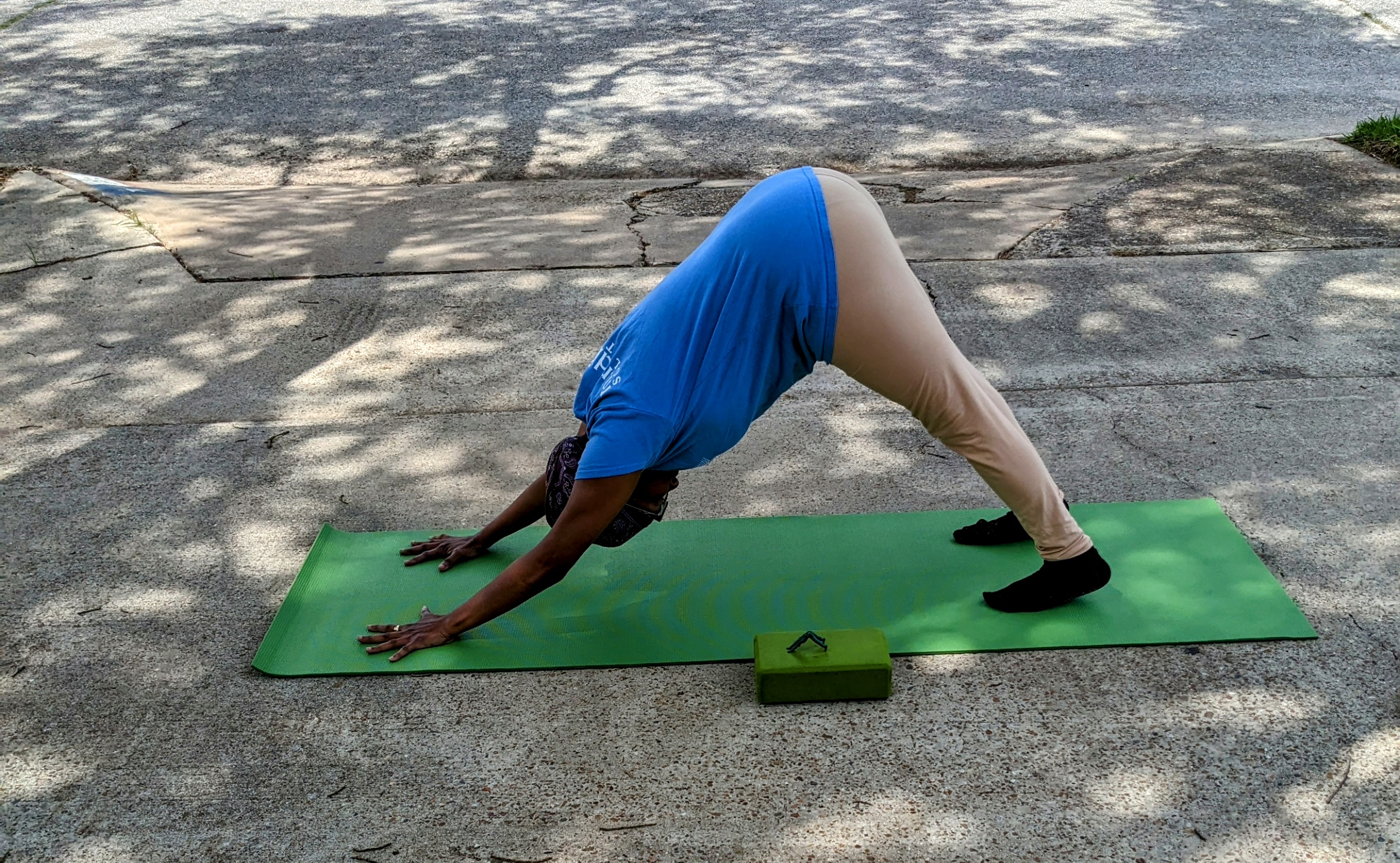
PXL_20230425_200744529~2

 Check the Community page on my YouTube channel later tonight for the answer(s)!

Unlock Your Generosity & Kiss My Asana!!

The picture above is part of my 2023 offering for the 10th annual Kiss My Asana yogathon, which benefits Mind Body Solutions (MBS). This week (April 22nd – 28th), I’m dedicated to raising awareness and resources for MBS’ life-affirming work to help people living with disabilities – and you can help too! You can help by joining me as we practice with purpose, by sharing this page, and/or by making a donation that creates opportunities for more people to practice yoga.

Mind Body Solutions provides live, online resources to people living with disabilities, worldwide. In addition to 11 live online yoga classes a week, MBS has also created a comprehensive library of recorded adaptive yoga classes for students, instructional videos for adaptive yoga teachers, and insightful interviews between our founder, Matthew Sanford, and adaptive students. It all helps people with disabilities live more fully, where they are and how they are.

Each year, in addition to hosting a fundraising page and making my personal donation, I offer a blog post and/or a YouTube post – sometimes even a whole practice. This year, part of my offering is a series of poses I’m posting on the Community page of my YouTube channel. Of course, there’s more to the poses (and pictures) than meets the eye. So, keep in mind that they – like the classes I lead – are just the tip of the iceberg.

What happens at Mind Body Solutions is the whole enchilada!

Ultimately, MBS is all about people having better relationships with their mind-body and spreading the message that a greater connection between mind and body can help us all live with improved comfort and ease.

You can click here to Kiss My Asana Now! (Or, you can also click here to join my team and get people to kiss [your] asana!) 

If you’re interested in my previous KMA offerings, check out the following (some links only take you to the beginning of a series ad/or to YouTube):

Thanks to MW!

You Don’t forget to add an extra wiggle to your day.

Lock Picking Lawyer Challenges Mrs. Lock Picking Lawyer

Revised 04/26/2023

### “That’s All I Have for You Today.” ~LPL ###

Simple and True, with Music (the “missing” Tuesday post) January 11, 2023

Posted by ajoyfulpractice in Books, Changing Perspectives, Dharma, Faith, First Nations, Healing Stories, Hope, Life, Mysticism, One Hoop, Philosophy, Poetry, Wisdom, Writing, Yoga.
Tags: , , , , , , , , , , , , , , , ,
add a comment

This “missing” post related to Tuesday, January 10th is an expanded and revised remix of a 2022 post. You can request an audio recording of either year’s practice via a comment below or (for a slightly faster reply) you can email me at myra (at) ajoyfulpractice.com.

In the spirit of generosity (“dana”), the Zoom classes, recordings, and blog posts are freely given and freely received. If you are able to support these teachings, please do so as your heart moves you. (NOTE: You can donate even if you are “attending” a practice that is not designated as a “Common Ground Meditation Center” practice, or you can purchase class(es). Donations are tax deductible; class purchases are not necessarily deductible.)

Check out the “Class Schedules” calendar for upcoming classes.

“Some days I catch a rhythm, almost a song
in my own breath. I’m alone here
in Brooklyn Heights, late morning, the sky
above the St. George Hotel clear, clear
for New York, that is. The radio playing
“Bird Flight,” Parker in his California
tragic voice fifty years ago, his faltering
“Lover Man” just before he crashed into chaos.”

– quoted from the poem “Call It Music by Philip Levine

Breathing is something we all do. It’s something we all must do in order to survive – and, yet, it is all to easy to forget about it. Even in this day and age, it is all too easy to take our breathing for granted. So, take a moment to breathe.

Just breathe and pay attention to your breath.

Catch the rhythm that is your breath, the rhythm of your life.

Breath – and the awareness of breath – is the guiding teacher that we carry with us where ever we go. Our breath can be a true reflection of how we are living and/or surviving in any given moment. It can tell us if we are about to soar like a bird and/or if we are about to crash into chaos.

“The perfect sunlight angles into my little room
above Willow Street. I listen to my breath
come and go and try to catch its curious taste,
part milk, part iron, part blood, as it passes
from me into the world. This is not me,
this is automatic, this entering and exiting,
my body’s essential occupation without which
I am a thing. The whole process has a name,
a word I don’t know, an elegant word not
in English or Yiddish or Spanish, a word
that means nothing to me.”

– quoted from the poem “Call It Musicby Philip Levine

There are any number of words in any number of languages that could come to mind when reading the words of the poet Philip Levine, who was born January 10, 1928, in Detroit, Michigan. Of course, the word that immediately springs to my mind is the Sanskrit word prāṇāyāma. Defined as the awareness of breath and the extension of breath, prāṇāyāma is the fifth limb of the 8-limb Yoga Philosophy. It is the second half of the physical practice of yoga and it bridges the gap between the mind-body and our awareness of our mind-body.

Although there are many techniques, basic prāṇāyāma is a very simple practice: focus on your breath for a set period of time. While the practice is just that simple, it is not always easy. There are lots of things that can get in the way. However, one of the great things about this practice is that paying attention to the breath is also the true way around those obstacles. I would even argue that nothing is more simple and true than breathing and bringing awareness to that automatic entering and leaving.

“Some things
you know all your life. They are so simple and true
they must be said without elegance, meter and rhyme,
they must be laid on the table beside the salt shaker,
the glass of water, the absence of light gathering
in the shadows of picture frames, they must be
naked and alone, they must stand for themselves.”

– quoted from the poem “A Simple Truthby Philip Levine

Philip Levine was the second of three sons (and the first identical twin) born to Jewish immigrants just as the Nazi party was getting a foothold in Germany. He had the unfortunate experience of watching anti-Semitism rise in is own (proverbial) backyard and to also witness how racism (and other -isms) created a schism between the different people who made up the working class. Following in the tradition of Walt Whitman, he started giving voice to America’s voiceless and – even after he left the “mitten state” – he wrote poems about the plight of regular people in his hometown.

In some ways, Mr. Levine followed in his parent’s footsteps. His father, Harry Levine, owned a used (car) parts store; his mother, Esther Priscol (Pryszkulnik) Levine, sold books; and, starting at the age of fourteen, the poet worked in auto factories as he pursued his literary degrees. After graduating from Detroit Central High School, he earned his Bachelor of Arts, in literature, from Wayne (State) University and then “unofficially” attended classes at the University of Iowa. He earned a mail-order master’s degree and then returned to the University of Iowa to teach and pursue a Masters of Fine Arts, which he completed in 1957.

By the time he graduated from the University of Iowa (1957), he was beginning to gain significant recognition as a poet. In addition to teaching at a plethora of major universities around the country, he was lauded and recognized with national literary awards, including the two National Book Awards (1980 and 1991), Guggenheim Foundation fellowships (1973 and 1980), the Pulitzer Prize for Poetry (1995, for the collection The Simple Truth), and the Ruth Lilly Poetry Prize (1987). He served on the Board of Chancellor of the Academy of American Poets (1000-2006) and as Poet Laureate Consultant in Poetry to the Library of Congress (also known as the U. S. Poet Laureate) from 2011-2012. In collaboration with saxophonist and composer Benjamin Boone, Philip Levine created a collection of jazz poetry, “a literary genre defined as poetry necessarily informed by jazz music” – which was released in 2018, almost exactly three years and a month after his death. As a writer, he not only protested the Vietnam War, he kept speaking for the disenfranchised using simple truths… truths that could not be denied.

Can you taste
what I’m saying? It is onions or potatoes, a pinch
of simple salt, the wealth of melting butter, it is obvious,
it stays in the back of your throat like a truth
you never uttered because the time was always wrong,
it stays there for the rest of your life, unspoken,
made of that dirt we call earth, the metal we call salt,
in a form we have no words for, and you live on it.

– quoted from the poem “A Simple Truthby Philip Levine

The sixth chakra, which is located around the third eye (and about in inch into your forehead, half an inch above there), is symbolically associated with big “T” Truth – and with our ability to seek it, perceive it, and recognize it when we encounter it. The energy of this area is a curious energy, in that it continually pushes us to question everything. It supports healthy self-inquiry when the energy is balanced; however, when out of balance, it can manifest feelings of doubt or an inability to “see the truth” when it is right in front of you.

In Wheels of Life: A User’s Guide to the Chakra System, Anodea Judith, Ph.D., connects the sixth chakra to “knowledge, understanding and transcendent consciousness,” as well as to intuition. In Anatomy of the Spirit: The Seven Stages of Power and Healing, Caroline Myss, Ph.D. further connects it to the Christian sacrament of Ordination and the sefirot (“emanations” or Divine attributes) of Binah (Divine “understanding”) and Hokhmah or Chokmah (Divine “wisdom”). Similar to the love described in the sixth mansion of Saint Teresa of Ávila‘s El Castillo Interior or Las Moradas, ordination distinguishes and elevates the faithful. Note, also, that in the Kabbalah-inspired system I have previously mentioned, the “higher” or mind-related sefirot are not included in a physical practice of the Divine attributes.

My standard summary of how the energetic and symbolic elements manifest in our lives goes something like this: Consider how where you come from determines the friends you make (or don’t make); how where you come from and the people around you play a role in how you see yourself; and how where you come from, the friends you make along the way, and how you see yourself, play a part in how (or if) you embrace yourself (or others), embrace a moment, and extend your gifts out into the world – or not. Consider also how where you come from, the friends you make along the way, how you see yourself, and whether you extend what’s in your heart connect to how you express yourself, how you know (or don’t know) the truth when you perceive it, and how all of that contributes to your experience of this present moment.

That summary can be extrapolated and applied to a variety of scenarios, including how we cultivate new habits and achieve our goals, dreams, and desires. Consider, for instance, that the first chakra is related to physical survival and physical form – which means it is our matter. It is also our plans. Friends are our support system, cheering us on and/or providing guidance, while also providing accountability. When I think of the third chakra, the solar plexus – as it relates to our self esteem, our personality, and our sense of self – I think of the idea that we have “fire in the belly.” We can think of this idiom literally, in terms of digestive juices – which is a whole other conversation – and we can think of it as the internal element that keeps us physically motivated. To continue the metaphor, it’s what makes us hungry for more.

Then there is the heart, which connects the physical with the mental and emotional. It’s the energetic-emotional connection between the mind and the body. Here, it is the connection between the idea (the pattern) and the manifestation (the matter). This is also the idea of purusha (pure consciousness) and prakriti (elemental, unformed matter or substance). When we get into the throat chakra – related to mental determination and willpower – we are starting to move into the intangible. Those parts of our lived experiences that are “barely describable” and can only be indicated (lingamatra) and those things that are “absolutely indescribable [because they are] beyond any point of reference” (alinga).

Consider that last bit a moment. As you think about that last part, also think about the idea that your goals and desires, your wishes, hopes, dreams (and yes, even your fears), are fully formed somewhere in your heart… and maybe the back of your mind. Somewhere out in the ether, that possibility is real. But there are a lot of steps between conception and manifestation. And until we take the first step, they all feel like giant leaps.

To make life even more challenging, anybody can give anyone a metaphorical road map about physical survival and what it takes to sustain the body. We know the body’s basic necessities and there are people who are dedicated to breaking that down into what different body types need to survive at a peak level. On a certain level, people can also create road maps for the mind – and we do, all the time, which is why the self-help industry is so massive. But, there’s still a part of the journey that can only be experienced by the person taking the trip. There’s a part of the journey that is barely or absolutely indescribable. It’s the part of the journey that can never be duplicated. It’s the journey between what’s in a person’s heart and what’s in their head.

Even if someone explained how they got from point A to point B – and even if that explanation came with a Jean-Paul Sartre nauseous-level breakdown of how they felt and what they thought along the way – the only thing the rest of us could completely replicate would be the physical aspects of the journey. But, that part in between, it’s like getting lost, stuck in a traffic jam, and not knowing where you’re going – all while on a schedule.

The longest journey you will make in your life is from your head to your heart.

*

– possibly a Sioux statement, although it is often attributed to Anonymous

*

Tuesday’s (2023) playlist is available on YouTube and Spotify.

NOTE: The end of the YouTube playlist includes a special recording of the Bird Flight radio show, hosted by Phil Schaap on WKCR 89.9. I couldn’t find it on Spotify (maybe because I’m like “Lazy Bird” – which is what rounds out the Spotify playlist).

Last year there was a surprise posting! Did you see it? It’s the first step in a journey (that we’ve already begun and finished)!

*

### Always Get Into The Habit ###

FTWMI: The Power of a Good/Meaningful Push January 4, 2023

Posted by ajoyfulpractice in Art, Books, Buddhism, Changing Perspectives, Christmas, Dharma, Faith, Healing Stories, Hope, Life, Meditation, Mysticism, New Year, Pain, Peace, Pema Chodron, Philosophy, Religion, Science, Suffering, Tragedy, Wisdom, Writing, Yoga.
Tags: , , , , , , , , ,
add a comment

“Happy New Year,” to everyone!

For Those Who Missed It: The following was originally posted in January of 2021 and 2022. Class details, some links, and some references have been updated.

  1. An object at rest remains at rest, and object in motion remains in motion (at the same speed and in the same direction, unless acted upon by an unbalanced force).

  2. The acceleration of an object is dependent upon two variables – the net force acting upon the object and the mass of the object.

  3. For every action there is an equal and opposite reaction.

– Sir Isaac Newton’s Laws of Motion

Sir Isaac Newton proved that sometimes we all need a little push. At the age of 43, he published Philosophiæ Naturalis Principia Mathematica, which included his laws of motion, law of universal gravitation, and an expansion of Galileo Galilei’s observations and of Johannes Kepler’s laws of planetary motion (which were themselves modifications of the observations and heliocentric theory of Nicolaus Copernicus). There are several elements in the Principia that can apply to the physical practice of yoga (and to the practice of the Yoga Philosophy). However, the most direct application comes from the laws of motion, the first of which is also known as “The Law of Inertia.” We can see these principles at work just by observing a tension-free belly rising and falling as the breath enters and leaves the body.

We can go deeper with the mathematics and the science; but, just for a moment (maybe even 90-seconds) stick with the breath. Notice the Inhale, the pause, and the exhale…. Notice that third law kicking in….

Also, notice how the “force” of the breath, which is a symbol of our life and a symbol of our spirit, is an agent of change – physically, mentally, emotionally, and even energetically. Just as lengthening the breath and observation of the breath (which all can be described as prāņāyāma) change things when we are practicing on the mat, they can be an agent of change off the mat. We just have to pay attention and stay focused. But, paying attention, staying focused, and even breathing deeply in and breathing deeply out can be challenging in certain situations… especially situations involving challenging people.

“Thirdly, that I do justly value your excellent disquisitions, and I am extremely well pleased to see those notions promoted and improved which I long since began, but had not time to complete. That I judge you have gone farther in that affair much than I did, and that as I judge you cannot meet with any subject more worthy your contemplation, so believe the subject cannot meet with a fitter and more able person to inquire into it than yourself, who are every way accomplished to compleat [sic], rectify, and reform what were the sentiments of my younger studies, which I designed to have done somewhat at myself…. Your design and mine are, I suppose, at the same thing, which is the discovery of truth, and I suppose we can both endure to hear objections, so as they come not in a manner of open hostility, and have minds equally inclined to yield to the plainest deductions of reason from experiment.”


– quoted from a 1675-76 letter from Dr. Robert Hooke to Sir Isaac Newton, as published in Memoirs of the Life, Writings, and Discoveries of Sir Isaac Newton by David Brewster

“I most gladly embrace your proposal of a private correspondence. What’s done before many witnesses is seldom without some further concerns than that for truth; but what passes between friends in private, usually deserves the name of consultation rather than contention; and so I hope it will prove between you and me….


But in the mean time, you defer too much to my ability in searching into this subject. What Descartes did was a good step. You have added much several ways, and especially in considering the colours of thin plates. If I have seen farther, it is by standing on the shoulders of giants.”


– quoted from a letter marked “Cambridge, February 5, 1675-76” from Sir Isaac Newton to Dr. Robert Hooke, as published in Memoirs of the Life, Writings, and Discoveries of Sir Isaac Newton by David Brewster

One might think when first reading the polite words and oh so charming letters between Dr. Robert Hooke and Sir Isaac Newton that theirs was a destined to be a friendship like that between Herman Melville and Nathaniel Hawthorne. Or, if you have never heard of Hooke, that their correspondence was more akin to that of the epistles between Rainer Maria Rilke and the 19-year old officer cadet Franz Xaver Kappus, whereby the world becomes overly familiar with the work of one because of their letters – and, in some ways this would be true. Along with Nicolaus Copernicus, René Descartes, Johannes Kepler, Galileo Galilei, as well as John Flamsteed and Edmond Halley (the first two designated Astronomer Royal (whose observations Newton used in the Principia), Dr. Robert Hooke could be considered one of Sir Isaac Newton’s “giants.” But don’t get it twisted; Hooke and Newton were not “besties.” If anything, they could best be described as each other’s master teachers and precious jewels.

I often reference “master teachers and precious jewels” as people who push our buttons and get us hooked; people who give us master classes on ourselves; and/or people who add value to our life experience (even as they drive us crazy). These are the naysayers, the antagonists, the doubters, and our own personal heretics. They are the ones who never believe we can do something; hardly every give us credit when we do it (see Hooke and Newton, above); sometimes claim the credit for their own (also see above); and just seem to make everything harder. We can look at them as obstacles, road blocks, and detours on our journey towards our goals – or we can look at them as teachers. We can borrow a page from the Emperor Marcus Aurelius and look at them as “the way.” Or, to paraphrase Stacy Flowers, we can look at them as the coach.

Stacey Flowers is a motivational speaker, mother, and “eternal optimist” who gave a 2016 Tedx Talk about “The 5 People You Need to Be Happy” (cheerleader, mentor, coach, friend, and peer). After last year the last few years, we might think of them as the five people who keep us grounded and focused. The way she counted them out, each finger was very intentionally chosen as a symbol for the role each person would play in someone’s life. For the coach, the one whose job is to push us farther than we think we can go and consider possibilities that seem outside of our arena, she uses the middle finger (which in some, but not all, cultures is a major league insult). The correspondence between Dr. Robert Hooke and Sir Isaac Newton are basically them giving each other the finger – without which some advancement in science might not have been made at the time.

“Every relationship you develop, from casual to intimate, helps you become more conscious. No union is without spiritual value.”


– from “Morning Visual Meditation” (Chakra 2) by Caroline Myss

Hooke and Newton’s debate about the existence and characteristics of ether and the nature of light started in a very public, and very acrimonious, fashion. There was some shift, between the public and private discourse; however, in that Hooke went from publicly stating that Newton basically stole his ideas to acknowledging how Newton continued his ideas. Meanwhile, Newton went from publicly giving Hooke no credit for the premise of the ideas – and, also, stating that Hooke’s conclusion “seems itself impossible” and was based on “both experiment and demonstration to the contrary” – to privately (in his letter) acknowledging Hooke’s contributions. But, again, this shift only seemed to be in private. In public, the disputes continued even past Hooke’s death. These disputes, along with disputes the good doctor had with other scientists, allowed Newton (and others) to paint a very negative picture of Hooke’s character.

Sir Isaac Newton also, reportedly (and as indicated above), had a contentious character. He is remembered, however, for his work. On the other hand, Robert Hooke is infamous for his plethora of disputes with other scientists (in a lot of different disciplines) – and many of those debates seem to be directly tied to Hooke trying to multitask. But, no matter how much some might want to consider him a waste of space, his disputes actually contributed to the advancement of scientific discovery. In part, perhaps because they were all members of The Royal Society of London (and, therefore, dedicated to “improving natural knowledge”), the others never completely disregarded Hooke’s insights and hypothesis. Instead, they continued the inquiry. Perhaps I am reading it wrong, but there seems to be little cognitive dissonance on the part of those with whom Hooke quarreled, because everyone was constantly running experiments and making observations in an effort to find proof of the truth – or maybe just to prove Hooke wrong.

“When I have got some more observations of it I shall bee [sic] able to tell you how long it will last and where it will pass[. At] present I dare not pretend to that knowledge.”


– quoted from a letter to “to Crompton [for Newton]” dated “December 15th (1680)” by John Flamsteed, the first Astronomer Royal

On some level, we all know someone like Dr. Robert Hooke. We might even be someone else’s Dr. Hooke. Either way, consider how you feel when you encounter that person who pushes your buttons and/or is constantly telling you that you are wrong – or, sometimes (even worse), that person who refuses to see that they are wrong. Ani Pema Chödrön, the American Tibetan Buddhist nun, describes a tightening that happens when we get “hooked.” We don’t all feel it in the exact same place and in the exact same way, and the intensity may vary; but we all know that feeling. The question is: Do we always notice that feeling? Second question: Do we notice the beginning of the sensation or only when it is about to go nuclear (meaning our sympathetic nervous system is all systems go to fight, flee, or freeze)? Finally, what do we do when we recognize that feeling?

Ani Chödrön specifically recommends practicing the “4 R’s;” while others might just say, “Stop and breathe for a moment.” Either way, taking a moment to acknowledge what is happening (how we are reacting) and giving ourselves an opportunity to respond – rather than react – can be the difference between someone’s negativity being an obstacle versus becoming a way for us to continue moving forward. That moment when we pause and breathe and recognize that we are a step away from losing focus, can be the difference between succeeding in our goals (like Sir Isaac Newton) and failing to follow through on all our goals (like Dr. Robert Hooke). That moment when we pause and breathe and recognize that we are a step away from losing focus, can be the difference between making our way through (or around) an obstacle and being stuck.

What I’m saying is that that metaphorical push can be the force we need to make the change we want. This is especially true after last year the last few years and the negative energy that has followed us into this year. Don’t get me wrong, I’m not advocating letting anyone actually push you around – not even in a metaphorically sense and definitely not in a physical, emotional, and/or energetic sense. But, I do think it is important to acknowledge that we all push and pull each other on a certain level, because we are all forces of nature. While we may welcome, even solicit, a little push from someone we see as a mentor, friend, and/or peer; we may not always appreciate the shove from “the coach” we didn’t ask to coach us. Always remember, though, that there are many ways we can utilize a contentious relationships. Or, more specifically, there are many ways we can benefit from noticing how we react or respond to contentious relationships in our lives and in our practice.

Just consider, for a moment, how you (physically and mentally) react to the following:

When going by the Gregorian calendar, Sir Isaac Newton was born today (January 4th) in 1643, in Woolsthorpe, Lincolnshire, England. As a scientist and a man of letters, Newton would have been fully aware of the Gregorian calendar, which Catholic-ruled lands started using in 1582 and Protestant German states in 1699. However, he lived his whole life officially using the Julian calendar (because England and it’s colonies did not switch until 1752, 25 or 26 years after Newton’s death). If you go by the Old Style, Julian calendar, Sir Isaac Newton was actually born on Christmas Day – a fact that really got some people hot (as in pissed) when it was pointed out on Twitter a few years back.

Speaking of Christmas, today (January 4th) is the 10th or 11th day (depending on when you start counting). According to the catechism myth attached to the “12 Days of Christmas” song, the gifts for these days translates to: “a partridge in a pear tree” for Jesus (and the cross); “two turtle doves” representing the Old and New Testament; “three French Hens” for the theological virtues of Faith, Hope, and Charity (Love); “four calling birds” for the four canonical New Testament Gospels (or their corresponding evangelicals, Matthew, Mark, Luke, and John); “five gold rings” are the first Five Books of the Hebrew Bible and the Christian Old Testament (which provide the back story for the three Abrahamic religions); “six geese a-laying” for the six days of creation; “seven swans a-swimming,” the consistently most expensive gift, stand for the seven gifts of the Holy Spirit (wisdom, understanding, knowledge, counsel, fortitude, piety, and fear of the Lord) or the seven sacraments (Baptism, Eucharist, Confirmation, Reconciliation, Anointing of the Six, Marriage, and Ordination); “eight maids a-milking” for the eight beatitudes (or blessings); “nine ladies dancing” for the nine fruits of the Holy Spirit;  “ten lords a-leaping” for the ten commandments; and “eleven pipers piping” for the eleven faithful apostles.


Please join me today (Wednesday, January 4th) at 4:30 PM or 7:15 PM for a yoga practice on Zoom. Use the link from the “Class Schedules” calendar if you run into any problems checking into the class. You will need to register for the 7:15 PM class if you have not already done so. You can request an audio recording of this practice via a comment below or by emailing myra (at) ajoyfulpractice.com.

Wednesday’s playlist is available on YouTube and Spotify. [Look for “01042022 New(ton’s) Beginnings”]

In the spirit of generosity (“dana”), the Zoom classes, playlists, and blog posts are freely given and freely received. If you are able to support these teachings, please do so as your heart moves you. (NOTE: You can donate even if you are “attending” a practice that is not designated as a “Common Ground Meditation Center” practice, or you can purchase class(es). Donations to Common Ground are tax deductible.)


Who are your five people?


### (Don’t even get me started about….) ###

For Those Who Missed It: The Power of a Good/Meaningful Push January 4, 2022

Posted by ajoyfulpractice in Art, Books, Buddhism, Changing Perspectives, Christmas, Dharma, Faith, Healing Stories, Hope, Life, Meditation, Mysticism, New Year, Pain, Peace, Pema Chodron, Philosophy, Religion, Science, Suffering, Tragedy, Wisdom, Writing, Yoga.
Tags: , , , , , , , , ,
add a comment

“Happy New Year,” to everyone!

The following was originally posted in January of 2021. Class details have been updated.

  1. An object at rest remains at rest, and object in motion remains in motion (at the same speed and in the same direction, unless acted upon by an unbalanced force).

  2. The acceleration of an object is dependent upon two variables – the net force acting upon the object and the mass of the object.

  3. For every action there is an equal and opposite reaction.

– Sir Isaac Newton’s Laws of Motion

Sir Isaac Newton proved that sometimes we all need a little push. At the age of 43, he published Philosophiæ Naturalis Principia Mathematica, which included his laws of motion, law of universal gravitation, and an expansion of Galileo Galilei’s observations and of Johannes Kepler’s laws of planetary motion (which were themselves modifications of the observations and heliocentric theory of Nicolaus Copernicus). There are several elements in the Principia that can apply to the physical practice of yoga (and to the practice of the Yoga Philosophy). However, the most direct application comes from the laws of motion, the first of which is also known as “The Law of Inertia.” We can see these principles at work just by observing a tension-free belly rising and falling as the breath enters and leaves the body.

We can go deeper with the mathematics and the science; but, just for a moment (maybe even 90-seconds) stick with the breath. Notice the Inhale, the pause, and the exhale…. Notice that third law kicking in….

Also, notice how the “force” of the breath, which is a symbol of our life and a symbol of our spirit, is an agent of change – physically, mentally, emotionally, and even energetically. Just as lengthening the breath and observation of the breath (which all can be described as prāņāyāma) change things when we are practicing on the mat, they can be an agent of change off the mat. We just have to pay attention and stay focused. But, paying attention, staying focused, and even breathing deeply in and breathing deeply out can be challenging in certain situations… especially situations involving challenging people.

“Thirdly, that I do justly value your excellent disquisitions, and I am extremely well pleased to see those notions promoted and improved which I long since began, but had not time to complete. That I judge you have gone farther in that affair much than I did, and that as I judge you cannot meet with any subject more worthy your contemplation, so believe the subject cannot meet with a fitter and more able person to inquire into it than yourself, who are every way accomplished to compleat [sic], rectify, and reform what were the sentiments of my younger studies, which I designed to have done somewhat at myself…. Your design and mine are, I suppose, at the same thing, which is the discovery of truth, and I suppose we can both endure to hear objections, so as they come not in a manner of open hostility, and have minds equally inclined to yield to the plainest deductions of reason from experiment.”


– quoted from a 1675-76 letter from Dr. Robert Hooke to Sir Isaac Newton, as published in Memoirs of the Life, Writings, and Discoveries of Sir Isaac Newton by David Brewster

“I most gladly embrace your proposal of a private correspondence. What’s done before many witnesses is seldom without some further concerns than that for truth; but what passes between friends in private, usually deserves the name of consultation rather than contention; and so I hope it will prove between you and me….


But in the mean time, you defer too much to my ability in searching into this subject. What Descartes did was a good step. You have added much several ways, and especially in considering the colours of thin plates. If I have seen farther, it is by standing on the shoulders of giants.”


– quoted from a letter marked “Cambridge, February 5, 1675-76” from Sir Isaac Newton to Dr. Robert Hooke, as published in Memoirs of the Life, Writings, and Discoveries of Sir Isaac Newton by David Brewster

One might think when first reading the polite words and oh so charming letters between Dr. Robert Hooke and Sir Isaac Newton that theirs was a destined to be a friendship like that between Herman Melville and Nathaniel Hawthorne. Or, if you have never heard of Hooke, that their correspondence was more akin to that of the epistles between Rainer Maria Rilke and the 19-year old officer cadet Franz Xaver Kappus, whereby the world becomes overly familiar with the work of one because of their letters – and, in some ways this would be true. Along with Nicolaus Copernicus, René Descartes, Johannes Kepler, Galileo Galilei, as well as John Flamsteed and Edmond Halley (the first two designated Astronomer Royal (whose observations Newton used in the Principia), Dr. Robert Hooke could be considered one of Sir Isaac Newton’s “giants.” But don’t get it twisted; Hooke and Newton were not “besties.” If anything, they could best be described as each other’s master teachers and precious jewels.

I often reference “master teachers and precious jewels” as people who push our buttons and get us hooked; people who give us master classes on ourselves; and/or people who add value to our life experience (even as they drive us crazy). These are the naysayers, the antagonists, the doubters, and our own personal heretics. They are the ones who never believe we can do something; hardly every give us credit when we do it (see Hooke and Newton, above); sometimes claim the credit for their own (also see above); and just seem to make everything harder. We can look at them as obstacles, road blocks, and detours on our journey towards our goals – or we can look at them as teachers. We can borrow a page from the Emperor Marcus Aurelius and look at them as “the way.” Or, to paraphrase Stacy Flowers, we can look at them as the coach.

Stacey Flowers is a motivational speaker, mother, and “eternal optimist” who gave a 2016 Tedx Talk about “The 5 People You Need to Be Happy” (cheerleader, mentor, coach, friend, and peer). After last year, we might think of them as the five people who keep us grounded and focused. The way she counted them out, each finger was very intentionally chosen as a symbol for the role each person would play in someone’s life. For the coach, the one whose job is to push us farther than we think we can go and consider possibilities that seem outside of our arena, she uses the middle finger (which in some, but not all, cultures is a major league insult). The correspondence between Dr. Robert Hooke and Sir Isaac Newton are basically them giving each other the finger – without which some advancement in science might not have been made at the time.

“Every relationship you develop, from casual to intimate, helps you become more conscious. No union is without spiritual value.”


– from “Morning Visual Meditation” (Chakra 2) by Caroline Myss

Hooke and Newton’s debate about the existence and characteristics of ether and the nature of light started in a very public, and very acrimonious, fashion. There was some shift, between the public and private discourse; however, in that Hooke went from publicly stating that Newton basically stole his ideas to acknowledging how Newton continued his ideas. Meanwhile, Newton went from publicly giving Hooke no credit for the premise of the ideas – and, also, stating that Hooke’s conclusion “seems itself impossible” and was based on “both experiment and demonstration to the contrary” – to privately (in his letter) acknowledging Hooke’s contributions. But, again, this shift only seemed to be in private. In public, the disputes continued even past Hooke’s death. These disputes, along with disputes the good doctor had with other scientists, allowed Newton (and others) to paint a very negative picture of Hooke’s character.

Sir Isaac Newton also, reportedly (and as indicated above), had a contentious character. He is remembered, however, for his work. On the other hand, Robert Hooke is infamous for his plethora of disputes with other scientists (in a lot of different disciplines) – and many of those debates seem to be directly tied to Hooke trying to multitask. But, no matter how much some might want to consider him a waste of space, his disputes actually contributed to the advancement of scientific discovery. In part, perhaps because they were all members of The Royal Society of London (and, therefore, dedicated to “improving natural knowledge”), the others never completely disregarded Hooke’s insights and hypothesis. Instead, they continued the inquiry. Perhaps I am reading it wrong, but there seems to be little cognitive dissonance on the part of those with whom Hooke quarreled, because everyone was constantly running experiments and making observations in an effort to find proof of the truth – or maybe just to prove Hooke wrong.

“When I have got some more observations of it I shall bee [sic] able to tell you how long it will last and where it will pass[. At] present I dare not pretend to that knowledge.”


– quoted from a letter to “to Crompton [for Newton]” dated “December 15th (1680)” by John Flamsteed, the first Astronomer Royal

On some level, we all know someone like Dr. Robert Hooke. We might even be someone else’s Dr. Hooke. Either way, consider how you feel when you encounter that person who pushes your buttons and/or is constantly telling you that you are wrong – or, sometimes (even worse), that person who refuses to see that they are wrong. Ani Pema Chödrön, the American Tibetan Buddhist nun, describes a tightening that happens when we get “hooked.” We don’t all feel it in the exact same place and in the exact same way, and the intensity may vary; but we all know that feeling. The question is: Do we always notice that feeling? Second question: Do we notice the beginning of the sensation or only when it is about to go nuclear (meaning our sympathetic nervous system is all systems go to fight, flee, or freeze)? Finally, what do we do when we recognize that feeling?

Ani Chödrön specifically recommends practicing the “4 R’s;” while others might just say, “Stop and breathe for a moment.” Either way, taking a moment to acknowledge what is happening (how we are reacting) and giving ourselves an opportunity to respond – rather than react – can be the difference between someone’s negativity being an obstacle versus becoming a way for us to continue moving forward. That moment when we pause and breathe and recognize that we are a step away from losing focus, can be the difference between succeeding in our goals (like Sir Isaac Newton) and failing to follow through on all our goals (like Dr. Robert Hooke). That moment when we pause and breathe and recognize that we are a step away from losing focus, can be the difference between making our way through (or around) an obstacle and being stuck.

What I’m saying is that that metaphorical push can be the force we need to make the change we want. This is especially true after last year and the negative energy that has followed us into this year. Don’t get me wrong, I’m not advocating letting anyone actually push you around – not even in a metaphorically sense and definitely not in a physical, emotional, and/or energetic sense. But, I do think it is important to acknowledge that we all push and pull each other on a certain level, because we are all forces of nature. While we may welcome, even solicit, a little push from someone we see as a mentor, friend, and/or peer; we may not always appreciate the shove from “the coach” we didn’t ask to coach us. Always remember, though, that there are many ways we can utilize a contentious relationships. Or, more specifically, there are many ways we can benefit from noticing how we react or respond to contentious relationships in our lives and in our practice.

Just consider, for a moment, how you (physically and mentally) react to the following:

When going by the Gregorian calendar, Sir Isaac Newton was born today (January 4th) in 1643, in Woolsthorpe, Lincolnshire, England. As a scientist and a man of letters, Newton would have been fully aware of the Gregorian calendar, which Catholic-ruled lands started using in 1582 and Protestant German states in 1699. However, he lived his whole life officially using the Julian calendar (because England and it’s colonies did not switch until 1752, 25 or 26 years after Newton’s death). If you go by the Old Style, Julian calendar, Sir Isaac Newton was actually born on Christmas Day – a fact that really got some people hot (as in pissed) when it was pointed out on Twitter a few years back.

Speaking of Christmas, today (January 4th) is the 10th or 11th day (depending on when you start counting). According to the catechism myth attached to the “12 Days of Christmas” song, the gifts for these days translates to: “a partridge in a pear tree” for Jesus (and the cross); “two turtle doves” representing the Old and New Testament; “three French Hens” for the theological virtues of Faith, Hope, and Charity (Love); “four calling birds” for the four canonical New Testament Gospels (or their corresponding evangelicals, Matthew, Mark, Luke, and John); “five gold rings” are the first Five Books of the Hebrew Bible and the Christian Old Testament (which provide the back story for the three Abrahamic religions); “six geese a-laying” for the six days of creation; “seven swans a-swimming,” the consistently most expensive gift, stand for the seven gifts of the Holy Spirit (wisdom, understanding, knowledge, counsel, fortitude, piety, and fear of the Lord) or the seven sacraments (Baptism, Eucharist, Confirmation, Reconciliation, Anointing of the Six, Marriage, and Ordination); “eight maids a-milking” for the eight beatitudes (or blessings); “nine ladies dancing” for the nine fruits of the Holy Spirit;  “ten lords a-leaping” for the ten commandments; and “eleven pipers piping” for the eleven faithful apostles.


Please join me today (Tuesday, January 4th) at 12:00 PM or 7:15 PM for a yoga practice on Zoom. Use the link from the “Class Schedules” calendar if you run into any problems checking into the class. Give yourself extra time to log in if you have not upgraded to Zoom 5.0. You can request an audio recording of this practice via a comment below or by emailing myra (at) ajoyfulpractice.com.

Tuesday’s playlist is available on YouTube and Spotify

In the spirit of generosity (“dana”), the Zoom classes, playlists, and blog posts are freely given and freely received. If you are able to support these teachings, please do so as your heart moves you. (NOTE: You can donate even if you are “attending” a practice that is not designated as a “Common Ground Meditation Center” practice, or you can purchase class(es). If you don’t mind me knowing your donation amount you can also donate to me directly. Donations to Common Ground are tax deductible; class purchases and donations directly to me are not necessarily deductible.)


Who are your five people?


### (Don’t even get me started about….) ###