HAPPY New Year 2026! ** UPDATED** January 1, 2026
Posted by ajoyfulpractice in Bhakti, Changing Perspectives, Donate, Faith, Healing Stories, Health, Hope, Japa, Japa-Ajapa, Karma Yoga, Life, Love, Mala, Mantra, Meditation, Mysticism, New Year, One Hoop, Peace, Philosophy, Traditional Chinese Medicine, Vipassana, Wisdom, Writing, Yin Yoga, Yoga.Tags: 108 Sun Salutations, Anthony Shumate, Kwanzaa, New Year's Day, Nguzo Saba, Nia, Sun Salutations, Surya Namaskar
add a comment
“Happy New Year!” “Kwanzaa, yenu iwe na heri!” – “May your Kwanzaa be happy!” to everyone who is celebrating!
Many blessings to all!
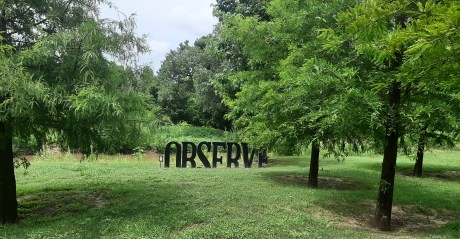
Part of the 6-piece “Monumental Moments” series
by Anthony Shumate, 2015
(located in Buffalo Bayou Park, along the Kinder Footpaths)
TRANSFORM • RENEW • HEAL • ENERGIZE
Celebrate the New Year with 108 Sun Salutations 10:00 AM – 1:00 PM CST!
AND/OR
RELAX • RELEASE • REST • RENEW • HEAL
Celebrate the New Year with Restorative Yoga+Meditation
5:00 PM – 7:00 PM CST!
The New Year is a beginning and an ending… and it is also a middle. On New Year’s Day we honor and celebrate transition with 108 Sun Salutations in the morning (10 AM – 1 PM, CST) and/or a Restorative* Yoga plus Meditation practice in the evening (5 – 7 PM, CST). We also put things in perspective.
These practices are open and accessible to all, regardless of experience.
*NOTE: In previous years, the evening practice has been Yin Yoga.
Please wear loose, comfortable clothing and make sure you are well hydrated before the practice. It is best to practice on an empty stomach (especially for the 108 ajapa-japa mala), but if you must eat less than 1 hour before the practice, make sure to keep it light. Make sure to have a towel (at the very least) for the 108 practice. For Restorative Yoga, a pillow/cushion or two, blocks or (hardcover) books, and a blanket or towel will be useful. I always recommend having something handy (pen and paper) that you can use to note any reflections (and will have some supplies handy).
IN-PERSON IS FULL! Use the link above for login information (or click here for more details about these practices and other practice opportunities related to the New Year).
The 108 playlist is available on YouTube and Spotify. [Look for “New Year’s Day 108 Ajapa-Japa Mala.”] NOTE: This playlist was revised for 2024, but should still sync up with the 2021 — 2023 recordings.
The Restorative playlist is available on YouTube and Spotify. [Look for “01072022 A Reflective Moment”]
Both practices are available in-person (if you are registered) and online. They are also donation based. If you don’t mind me knowing your donation amount you can donate to me directly. You can also email me to request my Venmo or Ca$hApp ID. If you want your donation to be anonymous (to me) and/or tax deductible, please donate through Common Ground Meditation Center (type my name under “Teacher”).
Please note that there is still no late admittance and you must log in before the beginning of the practice (so, by 9:45 AM for the 108 or by 4:45 PM for the Restorative Yoga+Meditation). You will be re-admittance if you get dumped from the call.)
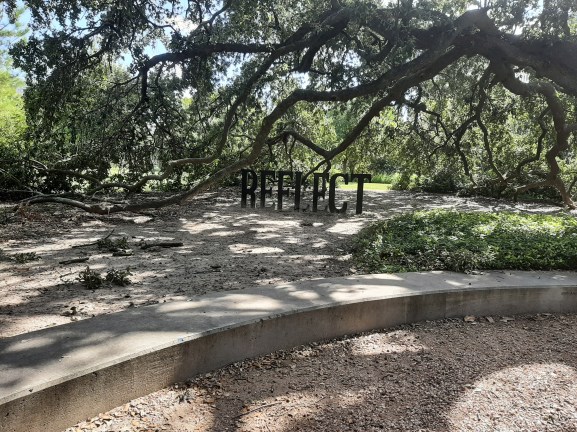
Part of the 6-piece “Monumental Moments” series
by Anthony Shumate, 2015
(located in Buffalo Bayou Park, along the Kinder Footpaths)
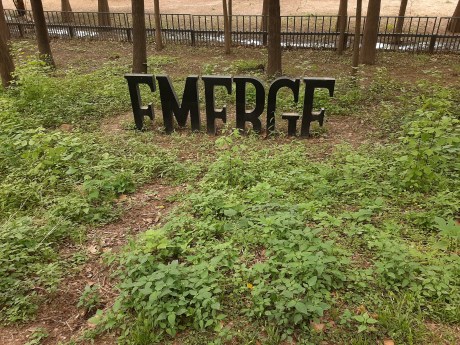
Part of the 6-piece “Monumental Moments” series
by Anthony Shumate, 2015
(located in Buffalo Bayou Park, along the Kinder Footpaths)
*Anthony Shumate’s “Monumental Moments” sculptures are located in Buffalo Bayou Park, along the Kinder Footpaths in Houston, Texas. They are unexpected reminders to “Explore,” “Pause,” “Reflect,” “Listen,” “Emerge,” and “Observe” – all things we do in our practice!
### NAMASTE ###
A Quick Note & EXCERPT: “Purpose Driven” (a Tuesday post, that’s also for Wednesday and Thursday!) December 30, 2025
Posted by ajoyfulpractice in 7-Day Challenge, Changing Perspectives, Christmas, Faith, Healing Stories, Health, Hope, Japa, Japa-Ajapa, Life, Loss, Meditation, Mysticism, New Year, One Hoop, Peace, Philosophy, Religion, Science, Wisdom, Yoga.Tags: 12 Days of Christmas, 988, catechism, Christmas, Dr. Nick Hobson, holidays, Imani, Kuumba, Kwanzaa, New Year's, Nguzo Saba, Nia, Sita (Joan Weiner) Bordow, Surya Namaskar, Swami Satchidananda, Twelvetide, Yoga Sutras 1.12-1.14
add a comment
“Kwanzaa, yenu iwe na heri!” – “May your Kwanzaa be happy!” to everyone who is celebrating!
“My research over the last decade has helped understand why rituals in particular (and not any other behaviors like habits, for instance) are effective at battling negative emotions. Be it anxiety, stress, fear, doubt, sadness, grief – you name it. Rituals are there to save the day. The dread we feel after experiencing a loss happens because it feels like the situation is outside our control (and it usually is). Rituals reinstate that control.”
— quoted from “The emerging science of ritual – a new look on an ancient behavior: And how you can use it to live life to the fullest” by Dr. Nick Hobson (contributing to the ThriveGlobal.com, Dec. 7, 2017)
There is something to be said for a good ritual. I don’t just mean a habit, something you do repeatedly — even if it’s something you are in the habit of doing at a particular time. Neither am I just referring to a tradition — which could be a group habit and/or a ritual that has been passed down through generations, but has lost some of it’s deeper meaning. No, I am referring to something that is more like a ceremony; something infused with purpose and meaning.
Consider your exercise routine. You may be in the habit of doing a certain kind of physical activity at a certain time on certain day(s). Changes in your routine (and the resulting cancellations during the holidays) may leave you feeling off kilter. However, you know you will return to that routine (or something similar) because it serves a purpose and you value the experience. It may even connect you to a community.
No matter what you do, if you have that regular routine, you probably experience something more than physical well-being. You may notice mental and emotional benefits that serve you on multiple levels of your life. You may even do the thing you do for those specific benefits. In this way, what you do could be considered abhyasa (“[continuous and deliberate] practice, [engaged with sincere devotion]”) (YS. 1.12-1.14) However, those extra benefits are just that — lagniappe (“a little (something) extra”). They are gifts that are not intentionally part of the exercise.
Now, consider the physical practice of yoga, which you could consider a ritual within a ritual. It is part of a larger practice, and that larger practice intentional includes benefits beyond the physical. If you go to a different class; use one of my videos or recordings; and/or practice on your own, the ritual of the practice — i.e., the order in which we do the practice and the meaning behind the order and what we do within the sequences — still includes the deeper meaning and serves a deeper purpose, one that is beyond the physical-mental. One of my teachers once argued that this is true even if/when the meaning and purpose are not explicitly stated.
The meaning and purpose are baked in; they were part of the creation process.
Click on the excerpt title below for more about these holidays and our New Year’s Day tradition that is also a ritual!
Updated & Revised! Purpose Driven (a Friday post, that’s also for Saturday and Sunday!)
“Nia (purpose) — To make our collective vocation the building and development of our community in order to restore our people to their traditional greatness.”
— The fifth of the Nguzo Saba (or “Seven Essential Pillars”) of Kwanzaa
For people celebrating Kwanzaa, “Nia (Purpose)” is the focus for the fifth day (today, Tuesday); “Kuumba (creativity)” is the focus for the sixth day; and “Imani (faith)” is the focus for the sixth day. These final three days of Kwanzaa coincide with the fifth, sixth, seventh (or eighth) days of the “12 Days of Christmas” (depending on when you start counting).
If you are following along with the symbolic meaning of the gifts in the song, you will notice that the 5th, 6th, and 7th gifts are infused with purpose, meaning, creativity, and (of course) faith: “five gold rings” are the first Five Books of the Hebrew Bible and the Christian Old Testament (which provide the back story for the three Abrahamic religions); “six geese a-laying” for the six days of creation; and “seven swans a-swimming”, the consistently most expensive gift, stand for the seven gifts of the Holy Spirit (wisdom, understanding, knowledge, counsel, fortitude, piety, and fear of the Lord) or the seven sacraments (Baptism, Eucharist, Confirmation, Reconciliation, Anointing of the Six, Marriage, and Ordination). As for the eighth day, those could be considered extra (spiritual) gifts: “eight maids a-milking” for the eight beatitudes (or blessings).
“Kuumba (creativity) — To do always as much as we can, in the way we can, in order to leave our community more beautiful and beneficial than we inherited it.
Imani (faith) — To believe with all our heart in our people, our parents, our teachers, our leaders, and the righteousness and victory of our struggle.”
— The sixth and seventh of the Nguzo Saba (or “Seven Essential Pillars”) of Kwanzaa
Online (Zoom) classes are cancelled today through Wednesday, December 31st.
People on the recording email list(s) receive backup recordings. There are also some practice videos on my YouTube channel. You can check the “Class Schedules” calendar for upcoming classes. You can also request an audio recording of this practice via a comment below or (for a slightly faster reply) you can email me at myra (at) ajoyfulpractice.com.
The playlist for the fifth day of Kwanzaa is available on YouTube and Spotify. [Look for “12302020 Purpose Driven”]
“Consider, for instance, in moments of grief, rituals help ease our pain and suffering. But, again I ask, how do they do this, and why rituals in particular? As my collaborators Mike Norton and Francesca Gino have shown, rituals alleviate feeling of grief and loss by increasing a feelings of control.”
— quoted from “The emerging science of ritual – a new look on an ancient behavior: And how you can use it to live life to the fullest” by Dr. Nick Hobson (contributing to the ThriveGlobal.com, Dec. 7, 2017)
If you are thinking about suicide, worried about a friend or loved one, or would like emotional support, you can dial 988 (in the US) or call 1-800-273-TALK (8255) for the Suicide and Crisis Lifeline. You can also call this TALK line if you are struggling with addiction or involved in an abusive relationship. The Lifeline network is free, confidential, and available to all 24/7. YOU CAN TALK ABOUT ANYTHING.
White Flag is an app, which I have not yet researched, but which may be helpful if you need peer-to-peer (non-professional) support.
If you are a young person in crisis, feeling suicidal, or in need of a safe and judgement-free place to talk, you can also click here to contact the TrevorLifeline (which is staffed 24/7 with trained counselors).
In the spirit of generosity (“dana”), the Zoom classes, recordings, and blog posts are freely given and freely received. If you are able to support these teachings, please do so as your heart moves you. (NOTE: You can donate even if you are “attending” a practice that is not designated as a “Common Ground Meditation Center” practice, or you can purchase class(es).
Donations are tax deductible; class purchases are not necessarily deductible.
Check out the “Class Schedules” calendar for upcoming classes.
“You can perform japa, repetition of a mantra or Sacred Word, in the midst of your day-to-day work. Then, when it becomes a habit, even when you are working intensely a portion of the mind will keep repeating the mantra always. That means you have locked one end of your chain to a holy place, while the rest of the chain remains still in the outside world.”
— a note written by Swami Satchidananda, quoted in Sri Swami Satchidananda: Apostle of Peace by Sita (Joan Weiner) Bordow
I am offering in-person classes during January 2026. Click here for more details and to reserve your spots now. Let’s start the 2026 together!
### OM AUM ###
Time to Gear Up for 2026 (a quick announcement about the new year)! December 18, 2025
Posted by ajoyfulpractice in 108 Sun Salutations, 7-Day Challenge, Fitness, Health, Hope, Meditation, Minneapolis, Minnesota, New Year, One Hoop, Surya Namaskar, Twin Cities, Yin Yoga, Yoga.Tags: 108 Sun Salutations, asana, in-person classes, meditation, Restorative Yoga, studio classes, vinyasa, Winter is coming, yoga, Zoom classes
add a comment
Happy, Peaceful, Joyful Holidays, to all!
At this point, pulling out all my gear to deal with January in Minnesota has become a tradition. So…

I’m Gearing Up Again for Another New Year!
For a limited time only, I will be back in the Twin Cities. In-person practices (also available on Zoom) will be held at various locations Thursday, January 1st until Wednesday, January 7th — with an Open House on Friday, January 9th.
Click here for more details and to reserve your spots now. Let’s start the 2026 together!
In the spirit of generosity (“dana”), the Zoom classes, recordings, and blog posts are freely given and freely received. If you are able to support these teachings, please do so as your heart moves you. (NOTE: You can donate even if you are “attending” a practice that is not designated as a “Common Ground Meditation Center” practice, or you can purchase class(es). Donations are tax deductible; class purchases are not necessarily deductible.)
### Let’s Go! ###
Getting Ready to Let Go… Again (the “missing” Tuesday post) September 30, 2025
Posted by ajoyfulpractice in "Impossible" People, 7-Day Challenge, 9-Day Challenge, Books, Changing Perspectives, Faith, First Nations, Healing Stories, Hope, Life, New Year, One Hoop, Pain, Peace, Philosophy, Religion, Rosh Hashanah, Suffering, Tragedy, Wisdom, Women, Writing, Yoga, Yom Kippur.Tags: 988, Ardhanaranari, Ardhanarishvara, Ayudha Puja, Charlie Harary, Elie Wiesel, faith, George Carlin, god, Gouvernement du Canada, Government of Canada, High Holidays, Judaism, Lakshmi, Marion Erster Rose Wiesel, Marion Wiesel, Mary Annette Pember, National Truth and Reconciliation Day (Canada), Navaratri, Norwegian Nobel Committee, Psalm 27, Rosh Hashanah, Saraswati, Scott Buckley, Sharada Navaratri, Shofar, Siddhidhatri, Ten Days of Atonement, Ten Days of Awe, truth, Yoga Sutra 2.39, Yom Kippur
add a comment
“Chag sameach!” (“Happy Festival!”) to everyone observing the High Holidays. “Nine days and nine nights of blessings and happiness if you are celebrating Sharada Navaratri!” Many blessings to everyone and especially to anyone seeking friendship, peace, freedom, understanding, and wisdom on Canada’s National Truth and Reconciliation Day.
Stay safe! Live well! Hydrate and nourish your heart, body, and mind.
This “missing” compilation post for Tuesday, September 30th, features new and previously posted content. You can request an audio recording of this practice or a previous practice via a comment below or (for a slightly faster reply) you can email myra (at) ajoyfulpractice.com.
In the spirit of generosity (“dana”), the Zoom classes, recordings, and blog posts are freely given and freely received. If you are able to support these teachings, please do so as your heart moves you. (NOTE: You can donate even if you are “attending” a practice that is not designated as a “Common Ground Meditation Center” practice, or you can purchase class(es).
Donations are tax deductible; class purchases are not necessarily deductible.
Check out the “Class Schedules” calendar for upcoming classes.
“You know how important that is. That’s the whole, that’s the whole, meaning of life, isn’t it? Trying to find a place for your stuff….”
“Have you noticed that their stuff is [ __ ] and your [ __ ] is stuff?”
— George Carlin, quoted from the standup routine about “A Place for… Stuff” (from his Comic Relief appearance, March 29, 1986)
We all come to the practice with “stuff”. As George Carlin so hilariously pointed out, we all go through life with “stuff”. Even though he was (mostly) talking about material things, I am talking more metaphorically… and energetically. We all have stuff. We all have the things that keeps us moving, the things that keep us stuck, and “the things that keep us here”(centered and grounded).
One thing can fit in more than one category and — because things change — something can move from one category to another. When the latter happens, we may find ourselves holding on to “[ __ ]” that no longer serves us.
The following excerpts are from a 2021 & 2023 versions of a 2020 post.
NOTE: Randomly, coincidentally, or not, two people named Buckley created pieces entitled “The Things That Keep Us Here”. I’ve never read Carla Buckley’s novel, but I’ve used Scott Buckley’s haunting composition on more than one occasion. It is part of his Monomyth album and includes a description that also seems to fit the synopsis of the novel, “Family. Duty. The things that keep us grounded, what keep us from giving up on our hopes, but what also holds us back from stepping across the precipice into the unknown.”
As the High Holidays come to an end, I always find myself thinking about the things to which I cling even though they are no longer serving me — or never served me. I think about how the very “things that keep us grounded” and keep us from stepping into danger can also be the things that keep us from freely moving into our future.
Yoga Sūtra 2.39: aparigrahasthairye janmakathantāasambodhah
— “A person firmly established in the non-possessiveness gains complete understanding of the “why-ness” (or essence of why) of birth.”
Like everyone else, I have my favorite stories for each season; but, I don’t get the chance to tell every story every year…. There is, however, a story I make sure to tell every year, right at the end of the High Holidays. It’s a Charlie Harary story with a timeless message.
Some people may believe that I save today’s story for the one of the final days of the High Holidays because it is sometimes an intense physical practice. But, in reality, there is a bit of symbolism that plays out in the story and in the timing of the story. You see, even though I don’t talk about the significance of Rosh Hashanah, the Ten Days of Awe / Ten Days of Atonement, and Yom Kippur until people are observing them; many people within the Jewish community start planning and observing (a time of contemplation and preparation) 49 days before Rosh Hashanah and some people start fasting forty days before Yom Kippur. They listen for the call of the shofar and recite Psalm 27 twice a day. Some communities even begin a tradition of communal prayers for forgiveness (Selichot). For others, observation begins with Rosh Hashanah and the Ten Days of Repentance — even though, if they plan to go home and/or attend services, they have to make arrangements beforehand. Finally, there are people who may only fast and attend services on Yom Kippur.
There is merit to each person’s timetable. And I see this kind of timetable in other communities — including in the yoga community….
Click on the excerpt titles below for the related 2021 and 2023 posts.
Wow! You’re Still Holding on to That? (the “missing” Wednesday post)
The Fierce Mother Goddess (a revised excerpt):
The High Holidays happen at the same time every year on the Hebrew calendar, but at different times on the Gregorian calendar. Similarly, they overlap with different holidays observed by people using other (religious) calendars. This year, the High Holidays (almost) directly overlap Navaratri, the Hindu festival of “nine nights” celebrating divine feminine energy in various manifestations.
Each of manifestation of Durga/Parvati manifestation is a symbolic milestone (and a reminder that women “contain multitudes”). The final day1 is devoted to Siddhidhatri, whose name literally means “land/earth of achievements”. Her name can also be translated as “Giver of Perfection”, as She is believed to be endowed with all the siddhis (“abilities” or “powers”) in the Universe and, also, to be able to bestow all of them. Typically, however, She only gives nine of the multitudes — some of which are referenced in the Yoga Sūtras.
In art and literature, she is sometimes depicted as being half of Shiva (with Him being half of Her), meaning that they are the embodiment the yin/yang symbol. When they are shown together in this way, they are each known as Ardhanarishvara, Ardhanaranari, or similar names that all highlight the fact that They are partially a woman.
When we look at the hero(ine)’s journey — as told through each day’s story, we are reminded that Durga/Parvati is a warrior or, if you will, a hero friend.
1NOTE: During the big celebrations of Navaratri (in the Spring and Fall) the final day is a double celebration — which may mean more feasting in some regions and more fasting in others. For example, some celebrations on the ninth day of Navaratri will also be Ayudha Puja (“worship of tools”), when people celebrate peace and knowledge and give thanks for the tools of their occupation. This means that some will give thanks for musical instruments and others will give thanks for their farming machinery. At the same time, some will make their puja (“offering”) to Saraswati — who is associated with knowledge, the arts, and culture, etc. — and others will direct their attention to Lakshmi — who is associated with prosperity, wealth, and fertility, etc.
These fall celebrations also include a tenth day, Dussehra or Vijayadashami, which commemorates Lord Rama’s victory over a 10-headed demon.
The Part About Truth:
“We must always take sides. Neutrality helps the oppressor, never the victim. Silence encourages the tormentor, never the tormented. Sometimes we must interfere. When human lives are endangered, when human dignity is in jeopardy, national borders and sensitivities become irrelevant. Wherever men and women are persecuted because of their race, religion, or political views, that place must—at that moment—become the center of the universe.”
— quoted from the 1986 Nobel Peace Prize Acceptance Speech by Elie Wiesel
As I mentioned in the 2023 post excerpted above, there are people — myself included — who can get impatient when we decide we are ready for change and when we see that change needs to happen. However, there are times when stopping bad behavior is not the only change that needs to happen. There are times when the end of something horrible is just the beginning of the work that needs to be done in order for there to be healing. This is true of individual insults and injuries (where we individually ask or offer forgiveness). This is also true when it comes to really big things that we must never forget.
Born today (Tuesday) in 1928, in Sighet, Kingdom of Romania, Elie Wiesel was a writer, professor, political activist, polyglot (who spoke at least six languages), and Nobel laureate. He was also a Holocaust survivor who, along with his family and Sighet’s entire Jewish population, was moved into confinement ghettos in March 1944. In May of that same year, the officials within German-occupied Hungary started deporting people to Auschwitz. Elie Wiesel’s mother (Sarah Feig) and younger sister (Tzipora) were murdered upon arrival, as were 90% of the people deported to Auschwitz. Mr. Wiesel and his father (Shlomo Wiesel) would eventually be moved to Buchenwald, where the elder Wiesel was murdered shortly before the camp was liberated.
Elie Wiesel and his two older sisters (Beatrice and Hilda) were the only survivors in their immediate family. The siblings were reunited in a French orphanage and eventually immigrated to North America — with Elie and Hilda settling in the United States and Beatrice moving to Montreal, Quebec, Canada. In April 1969, he married Marion Erster Rose, who survived the Holocaust after she and her family were sent to Gurs internment camp (in France).
For 10 years, Elie Wiesel did not speak or write about his experiences during the war. Eventually, a discussion with a close friend prompted him to write a 900-page memoir Un di velt hot geshvign (And the World Remained Silent) in Yiddish. An abridged version of the book was published in Buenos Aires and then, in 1955, her wrote a shorter version in French and called it La Nuit, which was published in English as Night. While not many copies of Night were initially sold, the book garnered a lot of attention and was eventually translated into 30 languages. To date, over ten million copies of Night have been sold in the US alone. Elie Wiesel wrote over 40 books, including two collections of memoirs and some novels. He also wrote The Trial of God, which he turned into a play of the same name.
Elie Wiesel and Marion Rose Wiesel, who translated 14 of her husband’s books, won numerous awards and honors for their humanitarian efforts. When Mr. Wiesel won the 1986 Nobel Peace Prize, the couple used the Nobel prize money to start the Elie Wiesel Foundation for Humanity.
The Norwegian Nobel Committee referred to Elie Wiesel as “messenger to mankind” and “one of the most important spiritual leaders and guides in an age when violence, repression, and racism continue to characterize the world”. The committee also pointed out that while his activism started with his own trauma, his compassion and desire for peace extended to the whole world.
The Part About Truth & Reconciliation:
“To forget would be not only dangerous but offensive; to forget the dead would be akin to killing them a second time.”
— quoted from “Preface to the New Translation” in Night by Elie Wiesel (a new translation by Marion Wiesel)
September 30th is National Truth and Reconciliation Day in Canada. It is a day of remembrance and also a day of activism. According to an Indian Country Today article by Mary Annette Pember, Canada’s Truth and Reconciliation commission estimated “that up to 6,000 children died at the schools from disease, abuse, starvation, and other ills.” As I mentioned in a 2021 post, those Canadian numbers become even more appalling when added to the unheard stories of children who suffered similar traumas and tragedies in the United States (which had over 2.5 times as many schools).
Unlike the United States, Canada has made an effort to grapple with the horrors of their past, uncover the truths, and is (officially) “dedicated to moving forward, together in solidarity, across every part of these lands, united in truth, healing and respect.”
“On this National Day for Truth and Reconciliation, we pause to remember the children taken from their families, those who never returned home, and the individuals, families and communities still living with the lasting impacts and trauma caused by the residential school system in Canada. Orange Shirt Day, founded by residential school Survivor Phyllis Webstad, has long been a grassroots movement led by Indigenous Peoples to honour the legacy of Survivors, who have shared their experiences to bring national attention to these truths. This day marks a solemn national commitment to truth, accountability and reconciliation.”
— quoted from the “Statement by Ministers Guilbeault, Alty, Chartrand and Gull-Masty on the National Day for Truth and Reconciliation” (English version)
NOTE: The Statement is also (officially) available in Algonquin, Cree (Eastern), Denesuline, Inuktituk, Innu-Aimun, Mi’kmaq, Michif, Oji-Cree, Ojibway (Western), and Plains Cree
Tuesday’s playlist is available on YouTube and Spotify. [Look for “High Holidays: Drop Your Bags”]
NOTE: The YouTube playlist includes the Charlie Harary story that originally inspired this practice.
The residential school system is a topic that can cause trauma from memories of past abuse. Messages around the National Day for Truth and Reconciliation can be an unwelcome reminder to those who suffered hardships through generations of government policies that were harmful to Indigenous Peoples. A 24-hour support line (1-866-925-4419) provides crisis referral services to survivors and their families and explains how to access further health support from the Government of Canada. The Hope for Wellness Helpline provides immediate, culturally safe, crisis intervention support for First Nations, Inuit and Métis, 24 hours a day, seven days a week through its hotline, 1-855-242-3310, or its online chat at hopeforwellness.ca. The service is available in English, French and, upon request, in Cree, Ojibway and Inuktitut.
If you are struggling, thinking about suicide, worried about a friend or loved one, or would like emotional support, you can dial 988 (in the US) or call 1-800-273-TALK (8255) for the Suicide and Crisis Lifeline. You can also call this TALK line if you are struggling with addiction or involved in an abusive relationship. The Lifeline network is free, confidential, and available to all 24/7. YOU CAN TALK ABOUT ANYTHING.
White Flag is an app, which I have not yet researched, but which may be helpful if you need peer-to-peer (non-professional) support.
If you are a young person in crisis, feeling suicidal, or in need of a safe and judgement-free place to talk, you can also click here to contact the TrevorLifeline (which is staffed 24/7 with trained counselors).
### “Gemar chatimah tovah.” (“A good final sealing.”) ###
To Be Good or To Be Perfect (the “missing” Sunday post) September 28, 2025
Posted by ajoyfulpractice in "Impossible" People, 7-Day Challenge, 9-Day Challenge, Art, Changing Perspectives, Dharma, Faith, Fitness, Healing Stories, Hope, Life, New Year, One Hoop, Peace, Philosophy, Religion, Rosh Hashanah, Suffering, Wisdom, Women, Yoga, Yom Kippur.Tags: 988, Aish, Ananta Ripa Ajmera, Beresh't, Bhagavad Gita, bible, faith, Genesis, High Holidays, Imposter Syndrome, International Week of Deaf People (IWDP), Kalaratri, Kali, Leonard Cohen, mitzvot, Navaratri, Rabbi Binyomin Weisz, Rosh Hashanah, Sharada Navaratri, Shofar, Ten Days of Atonement, Ten Days of Awe, Tikkun Olam, tov, World Federation of the Deaf (WFD), Yoga Sutra 1.37, Yom Kippur
add a comment
“Chag sameach!” (“Happy Festival!”) to everyone observing the High Holidays. “Nine days and nine nights of blessings and happiness if you are celebrating Sharada Navaratri!” Many blessings to everyone and especially to anyone cultivating friendship, peace, freedom, understanding, and wisdom during International Week of Deaf People.
Stay safe! Live well! Hydrate and nourish your heart, body, and mind.
This “missing” compilation post for Sunday, September 28th, features new and previously posted content. You can request an audio recording of this practice or a previous practice via a comment below or (for a slightly faster reply) you can email myra (at) ajoyfulpractice.com.
In the spirit of generosity (“dana”), the Zoom classes, recordings, and blog posts are freely given and freely received. If you are able to support these teachings, please do so as your heart moves you. (NOTE: You can donate even if you are “attending” a practice that is not designated as a “Common Ground Meditation Center” practice, or you can purchase class(es).
Donations are tax deductible; class purchases are not necessarily deductible.
Check out the “Class Schedules” calendar for upcoming classes.
“Deaf communities are innovative communities! Our diverse intersectional global communities, found in every country on Earth, consisting of deaf people from different backgrounds and life experiences, are innovators! We have multiple opportunities to impact technological change. The future of our technology starts with our knowledge, drawn from our diverse communities, working together to shape the future we want. Together, we will innovate, inspire and create a world where deaf people everywhere can sign anywhere!”
— quoted from the “International Week of Deaf People 2025 — Daily Themes: A Week of Celebration, Awareness, and Action” (Sunday) section of the World Federation of the Deaf (WFD) website
Today (Sunday) was the seventh day of the International Week of Deaf People. As I mentioned earlier in the week, there is an overreaching theme for the year (2025: “No Human Rights Without Sign Language Rights”) and a daily focus. The Sunday focus was “Set the basis for the future: together we can innovate, inspire, and impact!”
These themes inspire people and are a way to get a group of people from different backgrounds, cultures, and languages working in a coordinated way to bring about change all over the world — change that serves everyone (even those of us who are not in the Deaf community).
At the beginning of our physical practice of yoga, we set a “group intention” — to get on the same page, so we can work together — and then we each have an opportunity to set our own “personal intention”. I refer to the latter as, “your goal, your desire, your reason for being on the mat.” Sometimes, I encourage people to go a little deeper and identify how their goal or desire serves them: “… how it brings you peace, balance, maybe even joy.” This is all followed by a dedication and, sometimes, the awareness that what serves us individually can serve us collectively.
The additional suggestions are reminders that sometimes things can work out in a different way then we envisioned. For example, if your goal or desire is to own a classic Shelby Cobra, it could serve you because you need a way to commute to work and/or because you love vintage Mustangs. If you need reliable transportation, but you get too fixated on the make and model, you might miss an opportunity to obtain a car that serves you (and those around you). If you love classic cars and already have reliable transportation, maybe you check out other makes and models (or years) to satisfy your desire.
On the mat, every pose — as well as how each pose fits into the sequence — affects the mind-body in different ways. Additionally, every part of the mind-body could be affected in a similar way by a multitude of other poses. Standing balance is good for your vestibular system and can strengthen the standing leg, hips, and core, while also creating flexibility (and strength) in the lifted leg. If you have issues standing on one foot, using a prop (like a wall) can be more beneficial than falling out of the pose every couple of seconds. By the same token, if you really want to focus on the flexibility or “opening” (more than the balance), you might practice a supine version of the same pose or a different pose altogether.
All that being said, it’s easy to get caught up in the momentum of doing something — on or off the mat — and forget WHY we’re spending our time doing what we’re doing. That tendency to forget is why I remind people, at least once during the practice, to “remember your intention / remember your dedication.”
“And God said, ‘There will be light,’ and there was light.
And God saw the light that it was good, and God separated between the light and between the darkness.”
— quoted from Beresh’t / Genesis 1:3-4
Last Monday (September 22nd) at sunset marked the beginning of Rosh Hashanah (“the Head of the Year”), which is the beginning of the “Ten Days of Atonement” or “Ten Days of Awe” (which culminate with Yom Kippur, “The Day of Atonement”). There are several ways in which this period is different from a secular new year. First, there is the period of time, which is one of the holiest times of the year for some communities and may be celebrated by people who might not typically go to services. Second, observing these days are religious commandments and, therefore, observed by Jewish communities around the world and by communities where people observe the commanded holidays outlined in Deuteronomy. Finally, this is more than a celebration — it is an observation: a time for reflection, remembrance, and repentance.
It is also a time to consider how one could spend their time… doing something that is “good” .
“And God saw that it was good.”
— Words that appear 7 times in the Creation story found in Beresh’t / Genesis
Another way Rosh Hashanah is different from a secular new year (or the other new years found on the Hebrew calendar) is that people do not wish each other “Happy New Year”. Instead, people say1, “Shana Tovah” (“Good Year”) or “Shana Tovah U’Metukah!” (“Good and Sweet Year”). Tov is a Hebrew word that means “good”; and, as we find in the beginning of the Torah (also the Christian Old Testament), God defined things as “good” when they had meaning and served their purpose.
So, similar to the beginning of our physical practice of yoga, people who observe the “Ten Days of Atonement” and the “Ten Days of Awe” spend some time setting intentions and digging into how those goals and desires will serve them (and others) during the year ahead.
Some of the following was previously posted in a slightly different context.
“…every person is obligated to say, ‘For my sake alone the world was created.’ That doesn’t mean the world is mine to consume everything indiscriminately (although God does want us to enjoy the pleasures of this world).
What it does mean is that we must take responsibility for any problem in the world. If you recognize a problem – whether it be a piece of litter on the street or a major social issue that needs adjusting – you shouldn’t just say ‘someone else will deal with it.’ There is nobody else. In God’s eyes, the rule is: You saw it, you fix it.”
— Aish Rabbi on Tikkun Olam
Tikkun Olam is a phrase in Hebrew which literally means “repair the world” — although, many people think of it as “heal the world”. Classically, it refers to the rule of law: what is needed in order to restore social order. In the modern context, people think of it as how each person can do something, maybe even has an obligation to do something (when they can), and could even be compared to dharma (“law”) in Indian philosophies.
There are several things that happen when people (in general) start thinking about how they can make a difference. One of those things is that they look for inspiration in others. In fact, Yoga Sūtra 1.37 states that clarity of mind can come from “contemplating on the mind [or heart] of those who are free from desire” and, in the commentary, Swami Vivekananda said, “Take some holy person, some great person whom you revere, some saint whom you know to be perfectly nonattached, and think of his heart. That heart has become non-attached, and meditate on that heart; it will calm the mind. If you cannot do that, there is the next way…”.
Other commentary suggests focusing on your own heart and mind as if you were free from desire. This is a handy suggestion, because while looking to others for inspiration can be really motivating, it can also be problematic. For example, people have a tendency of putting their inspirations on pedestals. Such myth building belies the fact that people (take Gandhi, for instance) are (and were) human; that they make mistakes; and sometimes have really horrible opinions that co-exist with their more admirable ones.
On the flip side, comparisons to others can be problematic because they can lead to a really debilitating mindset: Imposter Syndrome, the belief that someone is somehow fraudulent. This type of self-doubt can manifest in a lot of different ways. It can show up as someone dreaming, planning, and/or re-working something so much that they never get to the point of doing the thing. It can also show up as someone never getting started because they are afraid of disappointing themselves (or others) and/or not doing something as well as others. Finally, it can just show up as a general feeling of malaise that saps your energy and makes it harder to focus… let alone do your best. It can be a vicious cycle that is perpetuated by a desire to be perfect and live up to expectations.
But, if we backup a little, we may remember that the important part is not that we do what someone else can do: The important thing is to do what we are able to do and to do the best that we can. This is explicitly spelled out in The Bhagavad Gita when Krishna spoke to Arjuna about “achieving perfection” and said, “‘Your very nature dictates that you perform the duties attuned to your disposition. Those duties are your dharma, your natural calling. It is far better to do your own dharma, even if you do it imperfectly, than to try to master the work of another. Those who perform the duties called for by their obligations, even if those duties seem of little merit, are able to do them with less effort — and this releases consciousness that can be directed Godward.’” (BG 18.47)
This same lesson on perfection and purpose can be found in the lesson of the shofar, as explained by Rabbi Binyomin Weisz.
For Those Who Missed It: Portions of the following excerpt were posted in 2020 and/or 2024.
“But the truth is: ‘All sounds are kosher’ – not only for the shofar, but for the heart as well.”
— quoted from an article entitled “Perfectly Imperfect: The Secret of the Shofar” (09/12/2020) by Rabbi Binyomin Weisz
A shofar is a ram’s horn that is blown (like a trumpet) during most Rosh Hashanah services and at the end of Yom Kippur. Historically, it has also been used at other times, including as a call-to-arms before a battle. During the High Holidays, there are four types of sounds (tekiah = a long, smooth blast; shevarim = three short bursts; terua = a series of short bursts; and tekiah gedolah = a long, drawn out, smooth blast), which are produced in very specific patterns in order to remind people to turn inward and reflect, remember, repent, and hope.
As with most spiritual rituals, the horn has to be produced in a certain way and blown by a specific person. However, the mitzvah (or “commandment”) related to the High Holidays is not related to the blowing — it’s a commandment related to hearing the sound. Obviously, since it is an organic instrument, each shofar sounds slightly different. What is super fascinating to me (and others), however, is that certain imperfections do not “ruin” the instrument.
As teachers and scholars like Rabbi Binyomin Weisz point out, a hole can change the sound of the shofar and it’s still kosher. Granted, there are some ways a shofar can be broken — and even fixed — that make it no longer kosher. In fact, the very act of “fixing” a broken shofar, so that it sounds like it originally sounded, can make it unusable for its intended purpose — and, therefore, not good — which just strengthens the lesson for me. Given that so many people struggle with “imposter syndrome” and high expectations, here are four steps you can do at any time:
- Let go of expectations and focus on what you can do / are doing;
- Remember Rule 303 (see the last embedded link above): Do what you can do, as much as you can, and for as long as you can;
- Appreciate what you’re doing, because it has value/meaning; AND
- Remember the value/meaning of you (being who you are and doing what you do).
“So I draw courage and stand face-to-face with my limitations, without shrinking or running. I allow for honest remorse. Here is my place of Now….
Of course, acceptance does not mean becoming complacent. I still need to honestly evaluate my life and reflect on how I want to act differently this coming year. It also doesn’t preclude trying my best.
But at this very moment my state of ‘now’ is my truth.”
— quoted from an article entitled “Perfectly Imperfect: The Secret of the Shofar” (09/12/2020) by Rabbi Binyomin Weisz
A version of the following (revised) note was posted earlier this year.
“I find a lot of similarity between Goddess Kalaratri, who symbolizes the spiritual power of transcendence, and Goddess Chandraghanta, who represents the power of transformation (in chapter 3). While transformation happens from taking strong, consistent action to overcome our fears, transcendence results from applying spiritual knowledge to see traumas we have experienced through the eyes of wisdom. This ensures we never see ourselves as helpless victims at the mercy of a cruel world but rather as powerful manifesters of our own destinies.”
— quoted from the “Cultivating Transcendence” section of “Chapter 7 — Transcending Trauma with Wisdom” in The Way of the Goddess: Daily Rituals to Awaken Your Inner Warrior and Discover Your True Self by Ananta Ripa Ajmera
Today (Sunday) was also the seventh day of Navaratri, the Hindu festival of “nine nights” celebrating divine feminine energy in various manifestations. This seventh day of Navaratri is dedicated to Kalaratri, the most ferocious form of Durga/Parvati. I will admit that I sometimes have a hard time with elements of the Divine that show up as ferocious. However, I appreciate that sometimes strong, fierce energy/medicine is needed to eliminate negative energy — and this is why Kalaratri is so strong: She eliminates negativity.
Some believe that Kalaratri destroys all demons, ghosts, evil spirits just be showing up. She is associated with nighttime (which is when plants grow) and the crown chakra (which is this present moment). Her name is sometimes used interchangeably with Kali, who is the dark-skinned Goddess associated with destruction, time, and change. Because people believes she can give her devotees siddhis (“abilities”) like knowledge, power, and wealth, she is also known as Shubankari (“Auspicious”). People also believe Kalaratri can make someone fearless.
Of course, being fearless comes in handy if you want to bring about some “good” changes in the world — especially when you are committed to non-violence.
“Despite Goddess Kalaratri’s frightening appearance, I find her to be the most loving form of Goddess Durga because she removes everything that is not us: the illusions, lies, and myths we have subscribed to (without even knowing we have done so!). Because only when we are free from illusions are we truly free. This goddess brings the Gospel of John to life: ‘And you shall know the Truth, and that Truth shall set you free.’
Vedanta spiritual philosophy describes Truth, to be true, must be so at all times: past, present, and future.”
— quoted from the “Cultivating Transcendence” section of “Chapter 7 — Transcending Trauma with Wisdom” in The Way of the Goddess: Daily Rituals to Awaken Your Inner Warrior and Discover Your True Self by Ananta Ripa Ajmera
Sunday’s playlist is available on YouTube and Spotify. [Look for “High Holidays: Good or Perfect”]
NOTE: One track is in a different place for continuity between platforms.
“Ring the bells that still can ring
Forget your perfect offering
There is a crack in everything
That’s how the light gets in.”
— quoted from the poem/song “Anthem” by Leonard Cohen
If you are thinking about suicide, worried about a friend or loved one, or would like emotional support, you can dial 988 (in the US) or call 1-800-273-TALK (8255) for the Suicide and Crisis Lifeline. You can also call this TALK line if you are struggling with addiction or involved in an abusive relationship. The Lifeline network is free, confidential, and available to all 24/7. YOU CAN TALK ABOUT ANYTHING.
White Flag is an app, which I have not yet researched, but which may be helpful if you need peer-to-peer (non-professional) support.
If you are a young person in crisis, feeling suicidal, or in need of a safe and judgement-free place to talk, you can also click here to contact the TrevorLifeline (which is staffed 24/7 with trained counselors).
1NOTE: There are several Hebrew (and Yiddish) blessings that may be used at specific times and/or to specific people just before and throughout the High Holidays. The ones described above are generic and used throughout the ten days. The one below may be used by some from “noon on Rosh Hashanah, when our fates are already written, until Yom Kippur, when our fates for the coming year are to be sealed”.
### “Gemar chatimah tovah.” (“A good final sealing.”) ###
Let’s Focus on “Little Things” (the “missing” compilation post for Wednesday) September 24, 2025
Posted by ajoyfulpractice in "Impossible" People, 7-Day Challenge, 9-Day Challenge, Art, Changing Perspectives, Faith, Gratitude, Healing Stories, Hope, Karma Yoga, Life, New Year, One Hoop, Philosophy, Religion, Rosh Hashanah, Science, Suffering, Wisdom, Women, Yoga.Tags: 988, Alison Gopnik PhD, Ananta Ripa Ajmera, asana, Beau Lotto, Carissa Nadira Fadzil, Chandraghanta, Convention on the Rights of Persons with Disabilities (CRPD), Cyrus Tan Heoi Sam, Danna Isabela Trujillo León, Declaration on the Rights of Deaf Children, faith, hatha yoga, High Holidays, International Week of Deaf People (IWDP), Karol Valentina Trujillo León, Lara Adnan Alqaisi, Navaratri, Noaz Laquerriere-Leven, Ntando Hlophe, prāņāyāma, Rabbi Yaakov Salomon, Rosh Hashanah, Sbahle Chili, Sharada Navaratri, UNICEF, Yara Adnan Alqaisi, yoga
add a comment
“Chag sameach!” (“Happy Festival!”) to everyone observing the High Holidays. “Nine days and nine nights of blessings and happiness if you are celebrating Sharada Navaratri!” Many blessings to everyone and especially to anyone cultivating friendship, peace, freedom, understanding, and wisdom during International Week of Deaf People.
Stay safe! Live well! Hydrate and nourish your heart, body, and mind.
This is the “missing” compilation post for Wednesday, September 24th, features new and previously posted content. As noted, some links will take you to sites outside of WordPress.
You can request an audio recording of this practice or a previous practice via a comment below or (for a slightly faster reply) you can email myra (at) ajoyfulpractice.com.
In the spirit of generosity (“dana”), the Zoom classes, recordings, and blog posts are freely given and freely received. If you are able to support these teachings, please do so as your heart moves you. (NOTE: You can donate even if you are “attending” a practice that is not designated as a “Common Ground Meditation Center” practice, or you can purchase class(es).
Donations are tax deductible; class purchases are not necessarily deductible.
Check out the “Class Schedules” calendar for upcoming classes.
“Alison Gopnik, Ph.D.: Learning begins literally from the time babies are born and there’s even some evidence there’s learning inside of the womb. So when babies are born, for instance, they discriminate between the sounds of the language that they’ve heard and sounds of another language. So they’re already seeing, hearing, making sense of what’s going on around them.”
— quoted from the “Transcript of ‘When do babies begin to learn? — What you can do to support your child’s development.’” in the “Parenting” section of the UNICEF website
Think back to when you first started to learn. Or, since some research indicates that we start learning in the womb, take a moment to remember the first learning situation you remember. Maybe it was in a school setting or maybe you remember learning something at home or on a playground. Just take a moment to remember everything you remember about that moment.
My guess is that, even if you remember great details — or pick a memory you remember in great detail, there is a “little” detail you might not mention if you were asked to recount the moment. My guess is that you wouldn’t mention the language. Unless the memory you picked was related to learning a language other than your first known language, you probably take the language itself for granted. It was a “little”, easily over-looked detail.
If, however, you were forced or required to learn in a language other than your first language, that “little” thing can become a big deal. Being in an environment where you have a hard time understanding and/or struggle to understand the words — even before you get to the subject matter — can limit your ability to learn and limit your possibilities. As an adult, you may be able to find some work-arounds, especially if there are other people around to give you context clues.
But, what if those people are also using a different language? What if you are a child who doesn’t have the life experience to figure out context clues?
This would be frustrating (and infuriating) — especially if people treated you like you were dumb and/or not worth the energy it would take to teach you.
Now, I know, given what’s happening in the United States (and other places in the world), that someone may think I’m talking about an immigration (or even a colonization) issue here. Or, since I included an embedded link to a post about literacy, that I’m talking about that issue. But, no. This time, I’m talking about that fact that millions of people around the world communicate with one of at least 300 sign languages and, for many of them, a sign language is their first language.
“1. States Parties recognize the right of persons with disabilities to education. With a view to realizing this right without discrimination and on the basis of equal opportunity, States Parties shall ensure an inclusive education system at all levels and lifelong learning….”
“3. States Parties shall enable persons with disabilities to learn life and social development skills to facilitate their full and equal participation in education and as members of the community. To this end, States Parties shall take appropriate measures, including:
a) Facilitating the learning of Braille, alternative script, augmentative and alternative modes, means and formats of communication and orientation and mobility skills, and facilitating peer support and mentoring;
b) Facilitating the learning of sign language and the promotion of the linguistic identity of the deaf community;
c) Ensuring that the education of persons, and in particular children, who are blind, deaf or deafblind, is delivered in the most appropriate languages and modes and means of communication for the individual, and in environments which maximize academic and social development.”
— quoted from “Article 24 – Education” of the Convention on the Rights of Persons with Disabilities (CRPD)
As I previously mentioned, this week is International Week of Deaf People (IWDP) and the 2025 theme is “No Human Rights Without Sign Language Rights”. The Wednesday focus was “Multilingual education for deaf learners”, which “advocates for the implementation of Article 24 of the CRPD, which requires that deaf learners receive education in environments that are both linguistically and culturally appropriate: quality inclusive multilingual settings alongside other deaf peers.”
As I highlighted in a 2024 post (and as explained in the video below), the Declaration on the Rights of Deaf Children consists of ten articles. Those ten articles are not only valid with regard to Deaf Children, they are also valid (and important) with regard to children from all over the world — and especially those who are dealing with trauma, loss, and disabilities, while also navigating a new language (or two).
“4. In order to help ensure the realization of this right, States Parties shall take appropriate measures to employ teachers, including teachers with disabilities, who are qualified in sign language and/or Braille, and to train professionals and staff who work at all levels of education. Such training shall incorporate disability awareness and the use of appropriate augmentative and alternative modes, means and formats of communication, educational techniques and materials to support persons with disabilities.
5. States Parties shall ensure that persons with disabilities are able to access general tertiary education, vocational training, adult education and lifelong learning without discrimination and on an equal basis with others. To this end, States Parties shall ensure that reasonable accommodation is provided to persons with disabilities.”
— quoted from “Article 24 – Education” of the Convention on the Rights of Persons with Disabilities (CRPD)
“Little” things are like little kids: They can become really big problems when we’re not paying attention or they can become really big deals, who make big, positive impacts on the world, when we pay the correct amount of attention. “Little” are transformative! Since this is true on and off the mat, I dedicate at least one practice during the High Holidays to the “little” things that can come together to make a big deal. These are things we do all the time. They come together to make our practice and to take us deeper into our practice and deeper into our lives. They can also take us come together to help us reach our goals.
The following revised excerpt is from a 2023 post (with a slightly different context). Due to the sequences, the order of the “little things” is different each year. The order in the this linked post is the 2021 order. The order below is from this year. Some embedded links connect outside of this blog.
“And then we spoke about Rosh Hashana… finally.
People always talk about making big changes – New Year resolutions.
‘I want to lose 50 pounds.’
‘I want to finish the entire Talmud.’
‘I’m going to spend 90 minutes of quality time with my daughter every night.’
It doesn’t work. It never does. And if it does, it peters out. You have no choice. You must start small.”
— quoted from “Preparing for Rosh Hashana: The secret to an inspiring new year” by Rabbi Yaakov Salomon
If you are anything like me, there’s a good chance that when you decide you want to do something (or stop doing something), you want one of those handy-dandy “time slips” — not because you don’t want to do the work, but because once you make up your mind you’re ready for the change. However, we can’t snap our fingers and “skip to the good part”. We do not have a magical, fantastical (theoretically possibly) way of skipping ahead. Even if we did, it wouldn’t be advisable, because we wouldn’t (necessarily) be ready on every level. Just because some part of our mind is ready, doesn’t mean our whole being is ready. We get ready during the time that we’re taking the steps to make something happen (or to make something stop happening).
Those steps — even when they are little baby steps — make a big difference.
“The key to getting the most out of any experience is preparation before the event. You cannot expect to leap from the shower to the shul and instantly feel holy. It just doesn’t work that way.”
— quoted from “Preparing for Rosh Hashana: The secret to an inspiring new year” by Rabbi Yaakov Salomon
Just as you can’t jump up off the coach and run a marathon, without some training, Rabbi Yaakov Salomon once pointed out that the desire for a deep spiritual connection requires some preparation. The means he mentioned included introspection, meditation, and prayer — all methods also mentioned in other traditions, including in Indian philosophies like yoga. A lot of people, however, aren’t familiar with all 8-limbs of the Yoga Philosophy; they just know about the two limbs that form the postural practice: āsana and prāņāyāma. But, just practicing those two little things can take you deeper into the overall practice and help cultivate big connections.
In many ways, hatha yoga (the physical practice of yoga, regardless of the style or tradition) is all about little things and about bringing awareness to the little things. The way we sit or stand determines how we breathe; the way we breathe in different positions determines how we feel. When we bring our awareness to how we feel we can go deeper into the pose as well as into ourselves. It all starts with little things. Little things, like how we place our hands or engage our core, can make the difference between going deeper into a pose and deeper into ourselves versus getting injured.
Although, sometimes we learn a lot about ourselves from getting injured; but that’s another story for another day.
Using the practice to notice little things can give us insight into why we think the way we think and do (and say) the things we do (and say) — on and off the mat. It can also help us bring awareness to how little things get us ready for the big things. For instance, next time you’re on the mat, give yourself the opportunity to notice these “little things” — one at a time and then all together:
-
- Āsana (“seat” or pose): Notice what’s touching the mat, touching the floor, touching a prop — even a chair — and how does everything else stack up from there.
- Prāņāyāma: Notice your breath. Can you breathe deeply in and breathe deeply? (If not, adjust your āsana.)
- Notice what you notice; bring your awareness to your awareness. (Where is your focus?)
- Notice the the sensation/information that informs your practice. (Is your mind-body ready for what you’re doing or do you need to do less? Could you, safely and mindfully, do more?)
- Notice the “L” of your hands, especially when you have weight in your hands and arms. (In grade school you might have learned that one “L” on your forehead means loser, but if you put two “L”s together you have a shot at a goal; if you tip the ends out, you have a “W” — which means winner.)
- Find the balance within the imbalance, because the practice is all about balance: balancing effort and relaxation; balancing strength and flexibility; and there is also balancing on one limb (and balancing both sides).
- Dance Break! (Every once in a while, everybody needs to loosen up and wiggle.)
- Remember your intention and your dedication. We set these early in the practice and then remember them as we go so that we stay focused on our goals. On or off the mat, you can think of this as your “WHY”.
- Practice vinyāsa krama (“place things in a special way, for a step-by-step progression”). As Dr. Beau Lotto said, “…your brain can only ever make small steps in its ideas.” So, what is the next logical step from where you are to where you want to be?
- Express gratitude for what you’ve done and what you’re about to do.
Lifting the corners of your mouth up towards your ears, is usually one of the little things we do.
This practice featured the personal story of Rabbi Yaakov Salomon (from the Aish website). It’s a story about little things and is a great reminder that while we may not always notice the little things until they become the big things, the little things matter. In fact, every little thing we feel, think, say, and do is the possibility of a big thing we’re in the habit of feeling, thinking, saying, or doing.
“Transformation is not something that accidentally happens to us. Like every part of the Navaratri cycle. It is something we initiate and experience again and again during our lives. For myself, day 3 of this cyclical practice (or week 3 or month 3, depending on how you structure your own Navaratri practice) is an opportunity to do something outside my comfort zone.”
— quoted from the “Cultivating Transformation” section of “Chapter 3 — Igniting the Fire of Transformation” in The Way of the Goddess: Daily Rituals to Awaken Your Inner Warrior and Discover Your True Self by Ananta Ripa Ajmera
EXCERPT: The following slightly revised excerpt was originally posted in a slightly different context.
In addition to being the second day of the High Holidays and the third day of the International Week of Deaf People (IWDP), Wednesday was also the third day and night of Sharada Navaratri, the “nine nights” celebrating Divine feminine energy in various manifestations. Some people see the manifestations as nine different women; however, they are also seen by some as the same woman at different points in her story. For instance, her third form is Chandraghanta, whose name “one who has a half-moon shaped like a bell” comes from the image of the newly-wed Parvati. She is depicted as a combination of beauty, grace, and courage, with her third eye open — the result of all the (yoga) preparation performed by Her previous manifestation. That open third eye means that she is always ready to fight evil and demons. In fact, she is sometimes known as the “Goddess Who Fights Demons”.
Here, “demons” can be a metaphor for anything that ails you physically, mentally, emotionally — even energetically, spiritually, and religiously. They can be challenges and hurdles that need to be over come. They can even be mistakes… sins… or vows (as I refer to them during the High Holidays) that can be absolved or forgiven. In fact, the faithful of all the different religions believe that there are ways (and even special times) when mistakes, sins, and broken vows are turned away… or washed away.
“I find a lot of similarity between Goddess Kalaratri, who symbolizes the spiritual power of transcendence, and Goddess Chandraghanta, who represents the power of transformation (in chapter 3). While transformation happens from taking strong, consistent action to overcome our fears, transcendence results from applying spiritual knowledge to see traumas we have experienced through the eyes of wisdom. This ensures we never see ourselves as helpless victims at the mercy of a cruel world but rather as powerful manifesters of our own destinies.”
— quoted from the “Cultivating Transcendence” section of “Chapter 7 — Transcending Trauma with Wisdom” in The Way of the Goddess: Daily Rituals to Awaken Your Inner Warrior and Discover Your True Self by Ananta Ripa Ajmera
Wednesday’s playlist is available on YouTube and Spotify. [Look for “High Holidays: Little Things”]
(My apologies for not posting the music before the 4:30 practice.)
If you are thinking about suicide, worried about a friend or loved one, or would like emotional support, you can dial 988 (in the US) or call 1-800-273-TALK (8255) for the Suicide and Crisis Lifeline. You can also call this TALK line if you are struggling with addiction or involved in an abusive relationship. The Lifeline network is free, confidential, and available to all 24/7. YOU CAN TALK ABOUT ANYTHING.
White Flag is an app, which I have not yet researched, but which may be helpful if you need peer-to-peer (non-professional) support.
If you are a young person in crisis, feeling suicidal, or in need of a safe and judgement-free place to talk, you can also click here to contact the TrevorLifeline (which is staffed 24/7 with trained counselors).
### MAY YOUR NAME BE WRITTEN & SEALED IN THE BOOK OF LIFE ###
Let’s Focus on “Little Things” (mostly the music) September 24, 2025
Posted by ajoyfulpractice in 7-Day Challenge, 9-Day Challenge, Changing Perspectives, Faith, Healing Stories, Hope, Life, New Year, One Hoop, Philosophy, Religion, Rosh Hashanah, Wisdom, Yoga.Tags: 988, High Holidays, International Week of Deaf People (IWDP), Navaratri, Rabbi Yaakov Salomon, Rosh Hashanah, Sharada Navaratri
add a comment
“L’Shana Tovah U’Metukah!” to everyone celebrating Rosh Hashanah and the High Holidays. “Nine days and nine nights of blessings and happiness if you are celebrating Sharada Navaratri!” Many blessings to everyone and especially to anyone cultivating friendship, peace, freedom, understanding, and wisdom during International Week of Deaf People.
Stay safe! Live well! Hydrate and nourish your heart, body, and mind.
“The key to getting the most out of any experience is preparation before the event. You cannot expect to leap from the shower to the shul and instantly feel holy. It just doesn’t work that way.”
— quoted from “Preparing for Rosh Hashana: The secret to an inspiring new year” by Rabbi Yaakov Salomon
Please join me today (Wednesday, September 24th) at 4:30 PM or 7:15 PM for a yoga practice on Zoom. You can use the link from the “Class Schedules” calendar if you run into any problems checking into the class. You can request an audio recording of this practice via a comment below or (for a slightly faster reply) you can email myra (at) ajoyfulpractice.com.
Wednesday’s playlist is available on YouTube and Spotify. [Look for “High Holidays: Little Things”]
(My apologies for not posting the music before the 4:30 practice.)
If you are thinking about suicide, worried about a friend or loved one, or would like emotional support, you can dial 988 (in the US) or call 1-800-273-TALK (8255) for the Suicide and Crisis Lifeline. You can also call this TALK line if you are struggling with addiction or involved in an abusive relationship. The Lifeline network is free, confidential, and available to all 24/7. YOU CAN TALK ABOUT ANYTHING.
White Flag is an app, which I have not yet researched, but which may be helpful if you need peer-to-peer (non-professional) support.
If you are a young person in crisis, feeling suicidal, or in need of a safe and judgement-free place to talk, you can also click here to contact the TrevorLifeline (which is staffed 24/7 with trained counselors).
In the spirit of generosity (“dana”), the Zoom classes, recordings, and blog posts are freely given and freely received. If you are able to support these teachings, please do so as your heart moves you. (NOTE: You can donate even if you are “attending” a practice that is not designated as a “Common Ground Meditation Center” practice, or you can purchase class(es).
Donations are tax deductible; class purchases are not necessarily deductible.
Check out the “Class Schedules” calendar for upcoming classes.
###  ###
###
A Quick Note & Excerpts for These Auspicious Times September 23, 2025
Posted by ajoyfulpractice in "Impossible" People, 7-Day Challenge, 9-Day Challenge, Art, Bhakti, Books, Changing Perspectives, Faith, Healing Stories, Hope, Life, Music, Mysticism, New Year, One Hoop, Peace, Philosophy, Poetry, Religion, Rosh Hashanah, Wisdom, Women, Yoga.Tags: 988, Ananta Ripa Ajmera, Bramacharini, Bramcharya, Dorothy Miles, High Holidays, International Day of Sign Languages (IDSL), International Week of Deaf People (IWDP), Lori Palatnik, Navaratri, Norman Fischer, Rabbi Alan Lew, Rosh Hashanah, Sharada Navaratri, sign languages, Ten Days of Atonement, Ten Days of Awe, World Federation of the Deaf, Yogini
add a comment
“L’Shana Tovah U’Metukah!” to everyone celebrating Rosh Hashanah and the High Holidays. “Nine days and nine nights of blessings and happiness if you are celebrating Sharada Navaratri!” Many blessings to everyone and especially to anyone cultivating friendship, peace, freedom, understanding, and wisdom during International Week of Deaf People and on International Day of Sign Languages.
Stay safe! Live well! Hydrate and nourish your heart, body, and mind.
“How do you get ready for something big, for something momentous, for something auspicious?”
— The prompt question from Monday’s Common Ground Meditation Center practice (on 9/22/2025)
In response to last night’s prompt question, one of my yoga buddies talked about getting ready for a wedding and, over the weekend, another yoga buddy talked about going to a wedding anniversary party. These were big, momentous, auspicious occasions. They required people to get ready and, also, to RSVP!
But, how do you RSVP for another year of life?
RSVP
— Acronym for Répondez s’il vous plaît [French for “Respond if you please”]
CLICK ON THE EXCERPT TITLE BELOW TO FIND OUT HOW YOUR RSVP FOR ANOTHER YEAR OF LIFE!
“FOR TEN DAYS, THE GARES ARE OPEN AND THE WORLD is fluid. We are finally awake, if only in fits and starts, if only to toss and turn. For ten days, transformation is within our grasp. For ten days, we can imagine ourselves not as fixed and immutable beings, but rather as a limitless field upon which qualities and impulses rise up and fall away again like waves on the sea. Some of these impulses rise up with particular intensity. We may even experience them as afflictions, but they can be the keys to our transformation. Their intensity points to the disequilibrium and dysfunction in us that is in need of transformation.”
— quoted from “Chapter 7, What The Soul Does While The Gates Are Still Open: The Ten Days of Teshuvah” in This is Real and You Are Completely Unprepared: The Days of Awe as a Journey of Transformation by Rabbi Alan Lew (with a forward by Norman Fischer)
After last night’s practice, I virtually attended a Temple Ner Tamid service that featured Cantor Meredith Greenberg leading the synagogue in a song with the refrain, “Ten Days / You Have Ten Days”. The song refers to the High Holidays (or High Holy Days) known as the “Ten Days of Atonement” and the “Ten Days of Awe” — which begin with Rosh Hashana ( “the Head of the Year”) and culminate with Yom Kippur, “The Day of Atonement”. Of course, some people spend more than ten days preparing their hearts and minds for a new year. Some people actually begin their reflection process 7 weeks (49 days) before the new year, on Tisha B’Av, a day of mourning which commemorates the destruction of the first Temple in Jerusalem.
Over the weekend, I had a very rich conversation with a dear friend (who was also a dear friend of my mom) and she told me about This is Real and You Are Completely Unprepared: The Days of Awe as a Journey of Transformation by Rabbi Alan Lew. I haven’t read it yet, but I am always struck by how people spend their time and how much time they need to get their hearts and minds in the right place for a special occasion (which, in this case, is the rest of their lives).
For some it is 10 days, for some it is 40, for some it is 49, for some it is 9.
The following (slightly revised) excerpt was originally posted in October 2024.
“While this may sound like an extreme–and even scary–story, I don’t see it as the tale of a goddess who gave up everything to marry a god. Instead, I understand it as the story of a Truth seeker who gave up all distractions to merge with the ultimate Truth.”
— quoted from the “Knowing BRAHMACHARINI” section of “Chapter 2: Channeling Your Energy — Channeling Your Energy (when you’re feeling excited) with Goddess Brahmacharini, the one who follows brahmacharya (the path of self-control)” in The Way of the Goddess: Daily Rituals To Awaken Your Inner Warrior And Discover Your True Self by Ananta Ripa Ajmera
Yesterday was also the beginning of Sharada Navaratri, the most celebrated of the four Navaratri festivals. Navaratri literally means “nine nights” and is a Hindu celebration of God / the Divine as a woman. Each day is dedicated to a different manifestation of Durga/Parvati and each manifestation marks a different point in Her journey. Today, the second day, is dedicated to the Goddess Brahmacharini (“Unmarried One”), who is also Yogini. Both of her names highlight her path.
A yogini is a woman who practices yoga. Brahmacharini shares a root with the fourth yama (external “restraint” or universal commandment), brahmacharya, which can be translated as following in the steps of God or “chasing God” — or even that the devotee is riding in God’s “chariot”. All of these translations are associated with the life of someone who is deeply invested in their religious and spiritual life. In art, Brahmacharini has all the symbols of an ascetic: bare feet, a mala (rosary) and a kamandalu (water pot). Since people consider her a symbol of bliss and calmness, some pray to her for moksha (“liberation” from suffering), peace, and prosperity.
People also believe Brahmacharini can endow them with strong concentration and self-control. In fact, her story is full of the great challenges associated with the austerity she practices in order to achieve her goal of marriage. To me, she, herself, is liminal in that she is the embodiment of the auspicious moment between the goddess being identified as a daughter and the goddess being identified as a wife.
“The story of Brahmacharini and Shiva is not meant to be the story of a romantic relationship; Shiva is merely symbolic of the true Self. He is pure consciousness, the eternal soul, which we strive to merge with vis–à–vis the power of spiritual practice.”
— quoted from the “Knowing BRAHMACHARINI” section of “Chapter 2: Channeling Your Energy — Channeling Your Energy (when you’re feeling excited) with Goddess Brahmacharini, the one who follows brahmacharya (the path of self-control)” in The Way of the Goddess: Daily Rituals To Awaken Your Inner Warrior And Discover Your True Self by Ananta Ripa Ajmera
Each and every person on the planet (or a space station) “contain[s] multitudes” and experiences different seasons of life. At different stages in our lives, we are recognized in different ways. At different times in our lives we fulfill different roles. Each season and each role comes with different responsibilities and expectations, as well as with different skills, abilities, experiences, and powers.
Take a moment to recognize the path you are on; the journey that is your life; the season you are in; the roles you play; and the way you serve the world.
Take a moment to acknowledge that you can simultaneously experience excitement, anticipation, doubt, fear, hesitation, and joy every time you experience change.
Take a moment to do what you need to do to grieve and appreciate what is no longer and, also, to appreciate what is not yet — knowing that what is not yet is a possibility that could be or might never be.
Take a moment to remember that you and the things you do have meaning and are valuable.
Now, take a breath, exhale, and begin.
“You hold the word in hand
and offer the palm of friendship;
of frontiers where men of speech lend lip-
service to brotherhood, you pass, unhampered
by sounds that drown the meaning, or by fear
of the foreign-word-locked fetter;
oh, better
the word in hand than a thousand
spilled from the mouth upon the hearless ear.”
— quoted from the poem “To A Deaf Child” by Dorothy Miles
Variations of the following have been previously posted.
In addition to the religious/cultural holidays referenced above, September 23rd, is the International Day of Sign Languages (IDSL). This year, it is the second day of International Week of Deaf People (IWDP). While IWDP is celebrated during the last full week of September (and therefore the dates shift a little), IDSL is held annually on the anniversary of the day, in 1951, when the World Federation of the Deaf (WFD) was established in Rome, Italy, during the first World Deaf Conference. That first conference was organized by Ente Nazionale Sordomuti (ENS), the Italian Deaf Association, and attended by representatives from 25 countries. Now, WFD is an international non-profit and non-governmental organization of deaf associations from 133 countries. It promotes the human rights of deaf people worldwide and works with the United Nations (UN) General Assembly and UN agencies like the World Health Organization (WHO).
Each day of IWDP has a different focus. As I mentioned in the the post excerpted below, The 2025 theme for the entire week is “No Human Rights Without Sign Language Rights”, which is also the Tuesday focus.
“All people have an inherent right to human rights from birth. For deaf people, sign language rights are fundamental for the full enjoyment of their human rights. As we look at the Universal Declaration of Human Rights, we recognise progress made and the challenges that remain in ensuring equality for all. We recognise that our achievements are leading us towards our goal: a world where deaf people everywhere can sign anywhere.”
— quoted from the “International Week of Deaf People 2025 — Daily Themes: A Week of Celebration, Awareness, and Action” (Monday) section of the World Federation of the Deaf (WFD) website
CLICK HERE TO LEARN MORE ABOUT INTERNATIONAL WEEK OF DEAF PEOPLE & MEET SOME OF THE PEOPLE I HIGHLIGHTED LAST YEAR!
NOTE: In 2025, this will be the first post and yesterday’s post will be the second post.
Please join me today (Tuesday, September 23rd) at 12:00 PM or 7:15 PM for a yoga practice on Zoom. You can use the link from the “Class Schedules” calendar if you run into any problems checking into the class. You can request an audio recording of this practice via a comment below or by emailing myra (at) ajoyfulpractice.com.
Tuesday’s playlist is available on YouTube and Spotify. [Look for “Rosh Hashanah 2021”]
(My apologizes for not posting before the noon practice.)
Click here (or below) for the Dorothy Miles poem “To A Deaf Child.”
If you are struggling, thinking about suicide, worried about a friend or loved one, or would like emotional support, you can dial 988 (in the US) or call 1-800-273-TALK (8255) for the Suicide and Crisis Lifeline. You can also call this TALK line if you are struggling with addiction or involved in an abusive relationship. The Lifeline network is free, confidential, and available to all 24/7. YOU CAN TALK ABOUT ANYTHING.
White Flag is an app, which I have not yet researched, but which may be helpful if you need peer-to-peer (non-professional) support.
If you are a young person in crisis, feeling suicidal, or in need of a safe and judgement-free place to talk, you can also click here to contact the TrevorLifeline (which is staffed 24/7 with trained counselors).
Errata: The Tuesday focus for the International Week of Deaf People was originally misidentified as the Monday focus.
### MAY YOUR NAME BE WRITTEN & SEALED IN THE BOOK OF LIFE ###
What We Do to Get Ready (the post-practice compilation post for Monday) September 22, 2025
Posted by ajoyfulpractice in 9-Day Challenge, Art, Books, Changing Perspectives, Faith, Healing Stories, Hope, Life, Mysticism, New Year, One Hoop, Peace, Philosophy, Poetry, Religion, Rosh Hashanah, Science, Vairagya, Wisdom, Yoga.Tags: 988, Dorothy Miles, Equinox, High Holidays, International Week of Deaf People (IWDP), Joan Borysenko, kriya yoga, kriyā yoga, Navaratri, Rosh Hashanah, Shailaputri, Sharada Navaratri, sign languages, svādhyāya, Swami J, Swami Jnaneshvara Bharati, Swami Vivekananda, tapas, Ten Days of Atonement, Ten Days of Awe, Unetaneh Tokef, Yoga Sutra 2.1, Yoga Sutras 3.9-3.16, īśvarapraņidhāna
add a comment
“L’Shana Tovah U’Metukah!” to everyone celebrating Rosh Hashanah and the High Holidays. “Nine days and nine nights of blessings and happiness if you are celebrating Sharada Navaratri!” Many blessings to everyone and especially to anyone cultivating friendship, peace, freedom, understanding, and wisdom during the Equinox and International Week of Deaf People.
Stay safe! Live well! Hydrate and nourish your heart, body, and mind.
This post-practice post for Monday, September 22nd, is a compilation post, which includes some new and previously posted content, plus a series of excerpts. Please note that linked excerpts direct you to posts that will include content related to a specific year. The 2025 prompt question was, “How do you get ready for something big, for something momentous, for something auspicious?” You can request an audio recording of this practice or a previous practice via a comment below or (for a slightly faster reply) you can email myra (at) ajoyfulpractice.com.
In the spirit of generosity (“dana”), the Zoom classes, recordings, and blog posts are freely given and freely received. If you are able to support these teachings, please do so as your heart moves you. (NOTE: You can donate even if you are “attending” a practice that is not designated as a “Common Ground Meditation Center” practice, or you can purchase class(es).
Donations are tax deductible; class purchases are not necessarily deductible.
Check out the “Class Schedules” calendar for upcoming classes.
“Those Samâdhis with which we ended our last chapter are very difficult to attain; so we must take them up slowly. The first step, the preliminary step, is called Kriya-yoga. Literally this means work, working towards Yoga.”
— quoted from the commentary on Yoga Sūtra 2.1, from Raja Yoga by Swami Vivekananda
When you first consider the Monday prompt question, you may think that the answer depends on what you’re getting ready to do. However, I would argue that such an answer is related to the finer details of your life. If you take in the big picture, you will notice that we usually get ready for something big by taking a moment to look back and make sure we have all our ducks in a row. In other words, we reflect and we make a plan — even if that plan is just related to what we are going to wear or how we want our house to look when company comes over. In the process, we also make sure our head and heart are in the right place; that we have an attitude that is going to serve us.
In some ways, the general process we use to get ready is one way to look at the process Patanjali described as kriyā yoga (“yoga in action”): a combination of tapah (“heat, discipline, austerity” and the practices that cultivate them — physically, mentally, emotionally, even spiritually and religiously), svādhyāya (“self-study”), and īśvarapraņidhāna (“trustful surrender to [God]”). (YS 1.2) I reference this rubric throughout the year, because it is not only a process we can use individually, it is also a process that communities use when they are getting ready for a big, momentous, auspicious time… like a new season and/or a new year.
The new moon on Sunday was actually the precursor all of the above since Monday was the Autumnal Equinox in the Northern Hemisphere (or Spring/Vernal Equinox in the Southern Hemisphere); the beginning of Sharada Navaratri in some Hindu communities; and the beginning of the International Week of the Deaf People. Additionally, Monday at sunset marked the beginning of Rosh Hashanah in Jewish communities around the world (and in communities where people observe the commanded holidays outlined in Deuteronomy).
THE EQUINOX EXCERPTS — “On Having A Good Time” (revised):
“The transition from one year to the next year happens in an infinitely short moment that is actually non-existent in time. So too, there are transitions in the moments of life and the moments of meditation. Mindfulness of transitions in daily life and during meditation time is extremely useful on the spiritual journey to enlightenment.”
— quoted from the commentary on “Yoga Sutras 3.9-3.16: Witnessing Subtle Transitions With Samyama” by Swami Jnaneshvara Bharati (“Swami J”)
In theory, the angle of the Earth combines with its rotation around the sun to produce four noteworthy (and marked) dates: Autumnal Equinox, Winter Solstice, Vernal (or Spring) Equinox, and Summer Solstice.
I say, “in theory”, because we like to think that everyone around the world has equal amounts of day and night on the equinox and that these appreciable moments in time are actually that — appreciable and notable. The truth, however, is that there is no sudden/automatic change in how much light and how much darkness we get. It’s not a dimmer switch and we can honestly notice changes much earlier than indicated by the celestial calendar. Furthermore, no one is really getting 12 hours of daylight and 12 hours of night on the actual equinox. We perceive daylight long after the sun has moved below the horizon and, therefore, daytime is longer at latitudes above the equator than below.
Here in Houston, we got 12 hours and 10 minutes (as did people in Cairo, Egypt; with people in Shanghai, China maybe getting 1 more minute than that). On the flip side, someone in Anchorage, Alaska got 12 hours and 17 minutes and people in Helsinki, Finland got 12 hours and 19 minutes). Meanwhile, people in Cape Town, South Africa; Sydney, New South Wales, Australia; and Auckland (Tāmaki Makaurau) on Te Ika-a-Māui/North Island of Aotearoa/New Zealand all got 12 hours and 9 minutes.
Even at the equator, a true 12-hour split doesn’t happen on the equinox (“equal night”): It happens on the equilux (“equal light”), which falls on Thursday, September 25th. for most mid-latitude people in the Northern Hemisphere. (Although the exact date does vary by location.)
Click on the excerpt title below for more about how you could spend your time.
THE NAVARATRI EXCERPT — “Making Connections, Part 2 [in the New Year] Part 2” (revised):
Navaratri (which means “nine nights”, in Sanskrit) occurs four times on the Hindu calendar and is a celebration of divine feminine energy — specifically of Durga, the divine mother, in various manifestations. Some people (read, mostly men) think of these manifestations as different women. Others (read, mostly women) recognize these manifestations as the same woman at different points in her life. The latter understanding is underscored by the fact that each day is dedicated to a different manifestation of Durga/Parvati and each manifestation marks a different point in Her journey.
Navaratri always begins by celebrating Durga as Shailaputri (“Daughter of Mountain”). Shailaputri is the daughter of Himavat, the Mountain King or Guardian God of Himalayan Mountains, and is recognized as a divine manifestation of Mahadevi and a reincarnation of Sati (the wife of Shiva), who then reincarnates as Parvati. In art, she holds a trishula or trident in her right hand and a lotus in her left hand, all while riding Shiva’s bull Nandi, whose name means “happy, joy, and satisfaction”.
The fall (Sharada) Navaratri celebration, which started today (Monday), is the biggest and most celebrated of the four celebrations. Rituals and traditions vary from one region to the other and, during this festival, celebrations in some regions may include other manifestations of the Divine. For example, while some celebrations on the ninth day of Navaratri will also be Ayudha Puja (“worship of tools”) — when people celebrate peace and knowledge and give thanks for the tools of their occupation, some will give thanks for musical instruments and others will give thanks for their farming machinery. At the same time, some will make their puja (“offering”) to Saraswati — who is associated with knowledge, the arts, and culture, etc. — and others will direct their attention to Lakshmi — who is associated with prosperity, wealth, and fertility, etc. These fall celebrations also include a tenth day, Dussehra or Vijayadashami, which commemorates Lord Rama’s victory over a 10-headed demon.
THE INTERNATIONAL WEEK OF THE DEAF EXCERPTS — “Paying Attention is the First Step” & “Holchaj yIjatlh. (‘Speak in their language.’)” (revised):
“…people meet and part.
The word becomes the action in this language of the heart.”
— quoted from the English translation of the poem “Language for the Eye” by Dorothy Miles
Today, September 22nd, the beginning of International Week of Deaf People (IWDP). While IWDP is celebrated during the last full week of September (and therefore the dates shift a little), International Day of Sign Languages (IDSL) is held annually on September 23rd, the anniversary of the day, in 1951, when the World Federation of the Deaf (WFD) was established in Rome, Italy, during the first World Deaf Conference. That first conference was organized by Ente Nazionale Sordomuti (ENS), the Italian Deaf Association, and attended by representatives from 25 countries. Now, WFD is an international non-profit and non-governmental organization of deaf associations from 133 countries. It promotes the human rights of deaf people worldwide and works with the United Nations (UN) General Assembly and UN agencies like the World Health Organization (WHO).
Each day of IWDP has a different focus. The 2025 theme for the entire week is “No Human Rights Without Sign Language Rights” and the focus on Monday was “Deaf communities leading”. Both themes highlight the importance of including people in conversations about things (like social policy) that will affect them and emphasizes the fact that, “Deaf-led alliances, in collaboration with governments and other organisations, play a vital role in advancing sign language rights. Following the motto ‘nothing about us without us’, true progress comes from partnerships where deaf people lead and others support them as committed allies.”
Since we are heading into a New Year, you might spend your time by learning a new language.
There are, in fact, about 300 sign languages used around the world. This includes some (but not all) language families, like the French Sign Language Family, and the languages therein — like French Sign Language, Italian Sign Language, Quebec Sign Language, American Sign Language, Irish Sign Language, Russian Sign Language, Dutch Sign Language (NGT), Spanish Sign Language, Mexican Sign Language, Brazilian Sign Language (LIBRAS), Catalan Sign Language, Ukrainian Sign Language, Austrian Sign Language (along with its twin Hungarian Sign Language and its offspring Czech Sign Language) and others. That estimate also includes some (but not all) dialects and some village languages, as well as some Deaf-community and school languages. I am not sure if that estimate includes any speech-taboo languages1; but, suffice to say, there are a lot of sign languages. And, knowing one does not mean that you can use the other; any more than knowing one romance language means you can completely understand another.
THE NEW YEAR EXCERPT — “An Invitation to ‘Reflecting, Remembering, Repenting, & Planting’” (revised):
“Through the years I’ve written and taught extensively about ‘liminal time,’ that pregnant pause between what is no longer and what is not yet. Although liminal time is a known stage in all rites of passage, most people have never heard of it. Whether we’re talking about a pandemic, a war, a refugee crisis, or even a man or womanhood ritual, a graduation, or a new job far away from family and friends, the stages (though not the intensity) of a rite of passage are the same.”
— quoted from “Running the Gauntlet of the Unknown” by Joan Borysenko, PhD (posted at joanborysenko.com, April 1, 2020)
This is a liminal moment — a transitional or threshold moment, a doorway in between moments; like the pauses in between the inhale and the exhale. As I have mentioned before, we could say that about any moment in our lives; however, this is one of those Liminal moments that is being recognized as an auspicious time by several communities around the world. This is one of those moments full of ceremony, ritual, and tradition.
It is an opportunity to “request” (or accept) and plan for more time.
“Who will be calm and who will be tormented?
Who will become poor and who will get rich?
Who will be made humble and who will be raised up?
But teshuvah and tefillah and tzedakah [repentance and prayer and righteous acts]
deflect the evil of the decree.”
— quoted from the poem “Unetaneh Tokef” (“Let Us Speak of the Awesomeness”)
Literally “the Head of the Year”, Rosh Hashanah is known as the Jewish New Year and is also the beginning of the High Holidays — known as the “Ten Days of Atonement” and the “Ten Days of Awe” — which culminate with Yom Kippur, “The Day of Atonement”. It is one of the holiest times of the year for some and is celebrated by people who might not typically go to services. Unlike a secular new year, it is more than a celebration — it is an observation: a time for reflection, remembrance, and repentance.
It is also a time when people “request” (or accept) and plan for a new year of life and purpose.
Click on the excerpt title below for more about how people prepare for a meaningful and sweet new year (or, click here to scroll through a variety of posts about Rosh Hashanah).
There is no playlist for the Common Ground Meditation Center practices.
Music Note: You can click on the excerpt title above for the playlists featuring the poem I mentioned during the Monday practice.
If you are thinking about suicide, worried about a friend or loved one, or would like emotional support, you can dial 988 (in the US) or call 1-800-273-TALK (8255) for the Suicide and Crisis Lifeline. You can also call this TALK line if you are struggling with addiction or involved in an abusive relationship. The Lifeline network is free, confidential, and available to all 24/7. YOU CAN TALK ABOUT ANYTHING.
White Flag is an app, which I have not yet researched, but which may be helpful if you need (non-professional) support.
If you are a young person in crisis, feeling suicidal, or in need of a safe and judgement-free place to talk, you can also click here to contact the TrevorLifeline (which is staffed 24/7 with trained counselors).
1 According to Wikipedia, speech-taboo languages “are developed by the hearing community and only used secondarily by the deaf.”
### MAY YOUR NAME BE WRITTEN & SEALED IN THE BOOK OF LIFE ###
Eid is An Ending & Beginning (mostly the music & blessings) March 30, 2025
Posted by ajoyfulpractice in Bhakti, Changing Perspectives, Faith, Healing Stories, Kirtan, Lent / Great Lent, Life, Music, Mysticism, New Year, One Hoop, Philosophy, Ramadan, Religion, Wisdom, Women, Yoga.Tags: 988, Chaitra Navaratri, Eid al-Fitr, Eid ul-Fitr, Imam Khalid Latif, Intervention, Lent / Great Lent, nasheeds, Ramaḍān, Reba McEntire, Samvatsarādi, Season for Nonviolence, Ugadi, Yugadi
add a comment
Many blessings to all on National Doctors’ Day (in the US)!
“Eid Mubarak, Blessed Festival!” to anyone celebrating the end of the holy month of Ramaḍān. “Happy Ugadi, Samvatsarādi, or Yugadi, Happy New Year!” to those who are celebrating! “Nine days and nine nights of blessings and happiness if you are celebrating Chaitra Navaratri!” Many blessings to those observing Lent & Great Lent!
Peace, ease, and intervention to all, throughout this “Season for Nonviolence” and all other seasons!
“It’s a blessing to have seen another Ramadān but it’s also a blessing to see the first day of Shawwal and every tomorrow that I will see. Don’t focus on what you don’t have. Definitely don’t focus on what others see that you have. But just take a moment and think about all that you do have and let gratitude carry you through the days.”
— quoted from a 2013 “Ramadān Reflection” (Day 30) for Huffington Post by Imam Khalid Latif
Please join me for a 65-minute virtual yoga practice on Zoom today (Sunday, March 30th) at 2:30 PM. Use the link from the “Class Schedules” calendar if you run into any problems checking into the class. You can request an audio recording of this practice via a comment below or by emailing myra (at) ajoyfulpractice.com.
Sunday’s playlist is available on YouTube and Spotify.
Some quick notes about the music: First, my playlists for the final days of Ramadān are not halal (“permissible”) in all Islamic traditions, because of the orchestrations. They do, however, feature musicians who are Muslim (with a few exceptions). They also include some notable exceptions. For example, this playlist includes songs related to other holidays (and events) being observed today.
Reba McEntire is another of the notable exceptions — notable, because in previous years she was the only female soloist and the only non-Muslim singer on the playlists. While this year’s playlists include several Muslim women as musicians and composers, “Pray for Peace” is still highlighted because it was re-released during the month of Ramadān in 2014 — but not just randomly in the month, the song was released in the last ten days of the month (during the holiest part of the month)!
Some songs on the playlist are Nasheeds (meaning they are religiously moral songs) that, in some traditions, are meant to be sung without instrumentation or only with percussion. I have, however, included orchestrated versions of these songs, because this seems to have worked best in an in-studio setting. I mean no disrespect by this choice. As far as I know, percussion or voice only recordings of the Nasheeds are available (if you want to build your own playlist). Alternatively, you can practice without the music — which is always a suitable option.
Finally, the YouTube version currently includes some additional before/after music.
If you are thinking about suicide, worried about a friend or loved one, or would like emotional support, you can dial 988 (in the US) or call 1-800-273-TALK (8255) for the Suicide and Crisis Lifeline. You can also call this TALK line if you are struggling with addiction or involved in an abusive relationship. The Lifeline network is free, confidential, and available to all 24/7. YOU CAN TALK ABOUT ANYTHING.
White Flag is a new app, which I have not yet researched, but which may be helpful if you need peer-to-peer (non-professional) support.
If you are a young person in crisis, feeling suicidal, or in need of a safe and judgement-free place to talk, you can also click here to contact the TrevorLifeline (which is staffed 24/7 with trained counselors).
In the spirit of generosity (“dana”), the Zoom classes, recordings, and blog posts are freely given and freely received. If you are able to support these teachings, please do so as your heart moves you. (NOTE: You can donate even if you are “attending” a practice that is not designated as a “Common Ground Meditation Center” practice, or you can purchase class(es). Donations are tax deductible; class purchases are not necessarily deductible.)
 A Joyful Practice