Just a reminder: The classes I am guest teaching at Bend Hot Yoga (this weekend) will be available live via ZOOM. Check my “Class Schedules” calendar for access details. (NOTE: Meeting codes are the same as they normally would be for each day, but the times are different. Timeslisted below are PDT.)
[For Those Who Missed It: The following was originally posted in 2021. This is an abridged version with updated class details. ]
“Start with a dream. Chase after it. Run with it. Hold FAST to Your Dreams. (Your dream is worth chasing.)”
– A little inspiration from Run Like Rel
The old Downtown Minneapolis YMCA was always full of people working to maximize their time. Some thought about how they could spend their time and, always seeming to come up short; they ultimately sacrificed what they wanted to do for themselves or what they could do for others. Then there were people who really inspired me, in part because they figured out ways to help others while they did what they loved. Some of those inspirational people were people who run, like Chris Scotch and Deb B, who found established organizations (and people) who could benefit from their running. Also on my inspirational leader board: twin sisters Jessica and Ariel Kendall.
To be honest, I probably wouldn’t have been able to tell the twins apart in the beginning except for the fact that one came to yoga regularly and one loved to run. They both were interested in inspiring kids and helping kids bridge achievement gaps while developing confidence and leadership skills. The runner, “Rel” had an idea – a dream, really – that they could help others through running. So, she started a blog, created some coaching and mentoring opportunities, and partnered with some already established corporations, races, and non-profits. Then off she went, running – on and off the trails. Things look really different today than they did in five, going on six, years ago, but the sisters are still encouraging young people to “Run like Rel.” There are several lessons in that little story; lessons you can run with; lessons about how life is more like a marathon than a sprint.
Speaking of marathons…
The Battle of Marathon was notable for a number of reasons. It marked the end of King Darius I of Persia’s attempt to invade Greece and allowed classical Greek civilization to be firmly established. Although Darius the Great’s son, Xerxes I, would be more successful than his father, the battle in 490 BCE was a turning point in history that lead to the beginning of “Western Civilization” as we know it. One might even argue that the modern concept of democracy might be very different were it not for the Battle of Marathon.
Ancient Greece was made up of city-states or “polis” consisting of an urban area protected by walls and/or geographic barriers and a high point or “acropolis” (city-top) which contained the religious and municipal buildings. At one point there were thousands of city-states, including Corinth (Kórinthos), Thebes (Thíva), Syracuse (Siracusa), Aegina (Égina), Rhodes (Ródos), Árgos, Erétria, and Elis. Each one had its own form of government and culture. For example, Sparta (Spárti) had two hereditary kings with equal power and a “council of elders,” plus a strong army. Athens (Athína), on the other hand, operated under a form of democracy whereby all adult male citizens (living within the city walls) had an assembly in order to a vote. While each city-state had its own governing philosophy and would sometimes battle against one another, they were invested in this socio-political structure and would, therefore, fight together against tyrannical powers like the kings of ancient Persia.
King Darius was particularly angry when citizens of Athens (Athína) and Erétria came together in 498 BCE to support the Ionian Revolt (499 to 493 BCE). But, once his forces regrouped and squashed the revolt, he set his eyes on the Greek city-states. He eventually destroyed ancient Erétria, but – despite outnumbering the Athenians (and the thousand or so Plataeans that joined them) by over two to one – his army was once again thwarted.
“He cometh from the purple hills, Where the fight has been to-day; He bears the standard in his hand— Shout round the victor’s way. The sun-set of a battle won, Is round his steps from Marathon.”
– quoted from the poem “Eucles Announcing the Victory of Marathon.” by L. E. L. (Letitia Elizabeth Landon)
The Battle of Marathon makes for a good story. It’s one of those inspiring stories of the underdogs prevailing and it’s one of the stories that bolstered the ancient Greeks morale. In fact, the story of how the Athenians, with the assistance of a relatively small group of Plataeans, conquered the enormous Persian army is also notable because it is one of the earliest recorded battles. There are, however, some discrepancies in what’s recorded. For instance, depending on who you ask (and how they track time), the Battle of Marathon either happened on August 12th or it happened today, on September 12th, 490 BEC. Then there’s the story of an Athenian who either saw a Persian ship turn in the direction of Athens and ran for miles in order to make sure the city’s defenses were raised or was sent from Athens to Sparta to ask for reinforcements and then ran back to let the assembly know that the Spartans were in the middle of a religious festival and would not be joining the battle. Then there’s the fact that no one can agree on said hero’s name: was it Pheidippides or was it Philippides? Or, wait; was it Thersipus of Erchius or Eucles?
For the record, Herodotus (“The Father of History”) – who was born shortly after the war and in an area ruled by Persia – wrote about a professional messenger named Pheidippides or Philippides who ran from Athens to Sparta and then back again. Said messenger would have run 240 kilometers (150 miles) each way – which today would be considered an (ultra) ultra-marathon. Herodotus made no mention of a messenger running from Marathon to Athens. Instead, he wrote about the messenger’s encounter with Pan – which fed into the idea that the Athenians won because Pan caused panic in the hearts and minds of the Persian military and also explained the relatively ornate shrine to Pan under the Acropolis. Herodotus concluded that the Athenians quick marched back home to prevent a coastal attack – which makes sense since the Greeks were outnumbered ten to one by the Persian navy, which was basically just guarding their ships.
The story of someone running from Marathon to Athens appeared around the 1st century AD in an essay by Plutarch that referenced an earlier work that would have appeared about a hundred years after the time of Herodotus. This was serious commentary. However, around the 2nd century AD, Lucian of Samasota wrote a satirical piece about the same story. Only the messenger’s name was different: in the earlier works he was Thersipus of Erchius or Eucles; in Lucian’s satire he was back to Philippides. Regardless of his name, this particular messenger would have somehow had to run around Mount Pentelicus (also known as Mount Pentelikon). The longer of the two routes would have been approximately 40 kilometers (25 miles) and would have taken him up some foothills before a final descent into Athens. The other route, of 35 kilometers (22 miles), was shorter, but would have included a steep climb (of over 5 kilometers or 3.1 miles) right at the beginning.
The runner announcing victory with his last breath has been the inspiration for a lot of art, including an 1834 sculpture by Jean-Pierre Cortot (entitled “The Soldier of Marathon announcing the Victory”) and a painting by Benjamin Haydon, which was published as an engraving by S. Sangster in 1836. The engraving and the accompanying poem by Letitia Elizabeth Landon (L. E. L.) referred to the messenger as Eucles. However, when Luc-Olivier Merson painted the messenger in 1869 – in what I consider a halfway decent, one-armed variation of “Cobra Pose” – he is back to being “The Soldier of Marathon.” Ten years later, in 1879, Robert Browning wrote the (relatively short) poem “Pheidippides” and not only changed the name of the runner, but also his path (alas, he did not change the hero’s ultimate demise). According to Browning, Pheidippides ran from Athens to Sparta to Athens, then ran to Marathon and then back to Athens. For anyone keeping count: that would be about 550 – 560 kilometers (344.2 – 350 miles) in a matter of days.
As astounding and impossible as those distances might seem, the more modern accounts depicted the messenger as a professional runner – someone who had trained to run distances – and became an inspiration for the organizers of the first Olympic Games. From 1896 until 1920, the Olympics hosted a race that was approximately 40-kilometer (25-mile). In 1921, the “marathon” was standardized as 42.195 kilometers (or 26 miles, 385 yards).
Today there are over 800 marathons held around the world, many of which have wheelchair divisions, and millions of people training to go the distance. There are couch-to-marathon training programs designed to prepare people in 12 weeks or 24 weeks. There are even “Zombie” training programs, because (let’s be real), if being chased by brain-eating Zombies won’t get you running, then nothing will. One big lesson from these training programs is that every day can get you closer to your goal – even the rest day – and that’s one of the key elements to pacing yourself.
“—at least I can breathe, Fear in thee no fraud from the blind, no lie from the mute!
Such my cry as, rapid, I ran over Parnes’ ridge; Gully and gap I clambered and cleared till, sudden, a bar Jutted, a stoppage of stone against me, blocking the way. Right! for I minded the hollow to traverse, the fissure across: ‘Where I could enter, there I depart by! Night in the fosse?; Athens to aid? Tho’ the dive were thro’ Erebos, deg. thus I obey– Out of the day dive, into the day as bravely arise! No bridge Better!’–when–ha! what was it I came on, of wonders that are?”
– quoted from the poem “Pheidippides” by Robert Browning
If you’ve run a little or a lot, you know it’s important to pace yourself – and the key elements to pacing yourself as you run can also be important elements to pacing yourself on and off the mat. Now matter who you are or what you do, it’s also nice to have some tips on pacing yourself. The first list is inspired by runners and the idea of preparing for a marathon. The second list (further down) is a method of self-care called P.A.C.E.
Take it day by day. One of the lessons we can take from Pheidippides (or Philippides, or Thersipus of Erchius, or Eucles) is that we are only guaranteed this present moment. So, consider how you want to spend the time you’ve been given. Remember, every breath you take is the beginning of a new moment, a new day, a new week, a new month, a new year. How do you want to spend your time? Also, with whom do you want to spend your time? Finally, how does your time (and how you use it) serve you and the people around you?
Keep breathing. In a vinyāsa practice, where we move as we practice, our pace is set by the breath. Breathing is also critical in a foot race (of any duration). So, you have to figure out a way to keep breathing in different positions. Patanjali’s Yoga Sūtras tells us that the “secret” to breathing deeply is a steady and stable, easy and comfortable – even joyful – foundation. Throughout most of our practice, we are on our feet; so, it’s good to check in with how your feet feel. (This is also a reminder to all runners and potential runners: If your feet/shoes don’t feel steady and stable, easy and comfortable – maybe even joyful – before you get moving, you might be headed towards an injury or some plantar fasciitis.)
Keep your goal in mind and keep moving step by step. If you are anything like me, once you envision a possibility and decide where you want to go in life, you want things to hurry up and happen. You may not mind the work, you may even enjoy it, but you can still be impatient – and that’s when it’s important to remember why you’re doing what you’re doing and that every step counts just like every day matters. When thinking about your “goal,” consider if you’re all about the journey or if you’re in it for the destination. One caveat, however, is to not focus so much on the medal or physical prize you may receive in the end. Think, instead, about how the goal serves you (how it brings you peace, balance, maybe even joy) and how it will feel to accomplish your goal. Finally, map out your steps!
There’s a mountain, there’s always a mountain. It doesn’t matter which version of the story you use, the runner always has to get around the mountain (and it’s a forest filled mountain). The mountain is a reminder that every one of us is going to run into an obstacle at some point in our journey. Like the Athenian, there are some “mountains” we know are coming (when we map out our steps) and, therefore, we can consider different paths. One obvious obstacle, on and off the mat, is that we’re going to get tired and run out of steam. Another is that you could injure or strain something. What’s your plan for those possibilities? How do you encourage yourself to keep going? Who else encourages you and cheers you on?
The stoic Emperor Marcus Aurelius said that the obstacle is the way. So, if you are prepared to dig down deep inside of yourself in order to get around (or over) the obstacles you know are coming, then you can also dig down deep when you run into the obstacle you didn’t expect.
Stay positive and keep breathing (again), even if you have to let something go. In truth, there are a lot of other tips that runner’s use when training and when racing, but a positive attitude is always helpful and I keep coming back to the breath because it is one of our primary sources of fuel. We can’t get where we are going if we’re not breathing. Also, poor breathing can cause the body to tighten up and not function properly. So, if you want to stay loose and keep moving, you have to keep breathing. Finally, many of the stories (and pictures) of the “Marathon runner” indicate that he dropped all of his belongings so that he could run faster. Take a moment to consider what’s weighing you down and holding you back. Take a moment to consider that there’s a fine balance between a healthy ego that helps you get things done and an overblown (or defeated) ego that becomes yet another obstacle.
“Next, bring your awareness to your present moment experience. Notice any areas of tension or tightness in the body. Many of you have been donning PPE on shift and this may have left some residual constriction in your body. Observe any physical sensations you have, along with your thoughts and thought patterns in the here and now. If any unpleasant emotions arise as you are doing this, I invite you to anchor in the breath, breathing fully and deeply as you stay with your experience.”
– quoted from the article “P.A.C.E. Yourself: A Practice Honoring Healthcare Workers” by Reena Kotecha, MBBS, BSc Hons (posted March 30, 2021 on mindful.org)
Dr. Reena Kotecha is the London-based founder of the “Mindful Medics” Programme. She holds dual degrees in Medicine and Neuroscience & Mental from Imperial College London and, as a result of her own experiences with work-related stress and burnout, has studied Āyurvedic medicine, prāṇāyāma, and mindfulness meditation. Last March, as countries around the world were locking down because of the pandemic, Dr. Reena Kotecha offered healthcare workers a self-care practice called “P.A.C.E. Yourself.” Here’s a condensed version of the P. A. C. E. steps, which I think could be helpful to anyone. (NOTE: The descriptions below are my explanations. You can find Dr. Kotecha’s brief explanations here and her recorded meditation below.)
Permission. Give yourself permission to be who you are, as you are, in this moment – and give yourself permission to take care of yourself. Dr. Kotecha suggests using a phrase (like “I offer myself this opportunity for well-being.’’) to encourage yourself to pay attention to your own health and wellness.
Awareness and Anchor.Be present and breathe into what is. (See quote above for Dr. Kotecha’s explanation.)
Compassion. Just as we do on the mat, once you’ve noticed how you feel – and “express a little gratitude for the sensation, the information that informs your practice” – offer yourself a little kindness and self-compassion. What would feel good in this moment? What would allow you to move into the next moment with a little more peace and ease?
Envision. Just as we do in other practices, visualize yourself moving forward with peace and ease. Dr. Kotecha’s instruction includes space for visualizing how your feelings might change as you move out of the “practice space” and into the action place. Like the previous list’s steps 4 and 5, this is an opportunity to consider how you breathe through the challenges ahead.
“‘Remember to enjoy it’ says [running coach Tom] Craggs, ‘sometimes take the headphones out, suck the crowd in, when you get to those last few miles dedicate each one to someone important in your life. You’ll bring it home and have a fantastic race.’”
– quoted from the Runner’s World article entitled “Last-minute pacing tips for your best half-marathon: You’ve put in all the hard work in training, but here’s how to make sure you stick to race pace.” by Jane McGuire
Please join me on the virtual mat today (Monday, September 12th) at 5:30 PM for a 75-minute virtual yoga practice.
This is a 75-minute Common Ground Meditation Center practice that, in the spirit of generosity (dana), is freely given and freely received. You can use the link from the “Class Schedules” calendar if you run into any problems checking into the class. You can request an audio recording of this practice via a comment below.
This post from 2020 – and the one you can find here, related to yesterday’s “anger/kindness” theme – have come back to haunt me. Yet, they have also come back to bring me some comfort. I hope you, too, find some comfort and good practice reminders in the following. In addition to some format edits, class details and links have been updated for today.
“…aware at last that in this world, with great power there must also come — great responsibility!”
– quoted from Amazing Fantasy #15 by Stan Lee, et al, August 1962
In 1962, at the end of the comic book that introduced Spiderman to the world, Peter Parker is faced with the tragic and life-altering loss of his Uncle Ben Parker. This loss leads to the life-altering realization that he can never again take his actions for granted. The words above, which appear in the final panel, are perhaps the most well-known and oft quoted words in comic book history. Really, in world history, when you consider that the words (and the idea behind them date back) to the French Revolution. We’re human; so, context matters. The way we receive the message, or even internalize the lesson, is different if we first read it in the final panel of a fantasy comic book versus if we’re studying historical documents from the French National Convention in 1793. We may discount the message, or take it more seriously, when it is attributed to a beloved elder (like Ben Parker) versus when it is attributed to a British Prime Minister (like William Lamb or Winston Churchill). Especially in a situation like those referenced above, there is a certain gravitas that comes not only from the words, but also from the speaker and whether their life is a reflection of the words.
“Are you practicing?”
– David Swenson, on the cover of his Ashtanga Yoga: The Practice Manual
Do they practice what they preach? Seeing the contradiction and/or hypocrisy, do we do as they say or as they do? Or, do we completely disregard the benefit of the lesson, because it is associated with someone who behaved badly?
These are the questions a lot of people are asking right now, in regards to race, sex, sexuality, religion, and the forming of countries (in particular the United States) and companies. They are also questions some of us in spiritual and religious communities have been asking for years with regard to our practices. Part of the challenge in answering these questions, with regard to bad behavior associated with the founders of an institution, is ignorance about the true nature of thing (avidyā). We may not always know about the bad behavior when we first become associated with an institution and, sometimes, the way in which we learn about the bad behavior makes it seem not so bad. Doesn’t matter if we are born into a society or join a community as an adult, once we are involved, our experiences are very personal and, as a result, we associate these situations with our sense of self – or false sense of self (asmitā). We define ourselves based on our attachment to things we like (rāga) and our aversion to things we dislike (dveşa) – even though sometimes don’t understand the true nature of what we like and dislike (hence, more avidyā). Finally, we are challenged by these questions, because answering may mean we lose something very meaningful to us, we may lose our sense of who we are, and we fear those losses like Peter Parker fears the loss of his uncle.
Notice, all the challenges I mentioned above are identified in the Yoga Sūtra as kleśāh (“afflicted” or “dysfunctional”) and therefore they are the very things that lead to suffering. Patanjali recommends meditation (YS 2.11) and the 8-limbs of yoga (YS 2.28) as a way to end the afflicted or dysfunctional thought patterns (and therefore the words and deeds) which lead to suffering. (Note, this instruction dovetails with the Buddha’s recommendation of meditation and the noble 8-fold path of Buddhism, as well as certain theological practices found in the major religions.) There’s only one problem: For most of us in the West, the practices of yoga and meditation are mired in the muck of bad behavior and the suffering that has been caused by that bad behavior.
“I was far more hurt by the culture of silence and ignoring the victim and victim-blaming than the abuse itself. If there would’ve been support from the community, and it had been dealt with, it would have gone away.”
– Anneke Lucas, founder of Liberation Prison Yoga, quoted in The New Yorker (07/23/2019) about confronting Sri Pattabhi Jois
Almost exactly a year ago, I posted about the foundations and how on Saturdays I place a year-long emphasis on “building the practice from the ground up,” both physically and philosophically. In the post I mentioned B. K. S. Iyengar (b. 12/14/1918) and Sri Pattabhi Jois (who was born today in 1915). Both teachers are part of a small group (of mostly Indian men) who were charged by their teacher Sri Krishnamacharya with introducing the physical practice of yoga to the Western world. Both teachers introduced their personal practice as “the practice” and for many people those practices are how people define “yoga.” Thinking that yoga is a particular set of poses and/or a specific way of doing them is problematic in and of itself. However, there is a bigger problem: both of these teachers have been very credibly accused of bad behavior. And, they are not alone. There are a number of yoga (and Buddhist) teachers (male and female) who have been called out for bad behavior. (Note: I am not using the term “bad behavior” in an attempt to belay or undermine the heinous of what people have allegedly done. Instead, I am using the term as an umbrella to cover sexual misconduct, physical and psychological abuse, and financial misconduct.)
A few days after I posted, a friend and fellow yogi sent me an email, with a link to an article about Jois, and expressed concern about the allegations and “about the current Ashtanga community’s response (or lack thereof) to his abuses.” In conclusion, this friend acknowledged their own conflict about allegations related to their own practices and asked about my thoughts. I started to reply, but then didn’t finish or send the reply (because, well…life). So, with apologies to my friend and fellow yogi, here is part of my response:
Hi! How are you?
Thank you for your email (and the link). I had only heard a portion of this, and it was quite a while back – so, obviously, a lot more has come up. I appreciate the information. Interestingly enough, a friend who is also an Iyengar teacher is in town and when we were catching up she posed a similar question about the value of the teachings when the teacher (and their actions) are so clearly heinous. I ask myself this question a lot, because (unfortunately) there’s so much bad behavior.
Honestly, I’m not sure I have a good answer. In regards to individuals and their bad behaviors, this is something I have also seen in the performing arts (and obviously in Corporate America and religious organizations), and it is why I think it is so important to maintain awareness and connection to the ethical components of these practices – not as a way to condemn or ostracize others, but as a way to have checks and balances into our own practices and behaviors. Ultimately, there is a power element to the practice of yoga and a power imbalance in the (formal) teacher-student(s) relationship. It is up to the (formal) teacher to maintain awareness of this power and power imbalance in order to protect themselves AND the student(s).
I am not part of a formal tradition and have not had any direct contact with guru-predators. And I’ve never had a big-G Guru, which is itself a can of worms. That said; if I hear of someone doing something questionable I will steer people away. (Even though, in my case, I am only going by hearsay and have to step carefully.) Also, when people ask me about teacher trainings I always stress checking out the teacher/studio/situation to make sure that their comfortable with the instructors. I also stress that during teacher trainings (or intensives) people are sometimes asked to do things they may not feel comfortable doing and that it is important to feel secure in knowing when you are uncomfortable because you are outside your comfort zone (i.e., being asked to do something you haven’t ever done before) versus feeling uncomfortable because someone is doing something or asking you to do something that is just plain wrong.
Like Jubilee Cook, I often wonder why – even when people didn’t/don’t feel like they had/have the power to bring a predator down – they don’t understand that they have the power to stop others from being abused! I mean, I do get it on a certain level…and I say this not as a way to blame the victims, but to highlight an additional challenge.
Part of that additional challenge (or maybe it’s a separate challenge) is that people in formal traditions (led by big-G Gurus) experience a combination of hero worship and brain washing that can itself be a kind of trauma. In the recent past, it has taken people a bit of time to “deprogram.” My hope is that the delay in Ashtangis speaking up comes from needing to “deprogram.” Or maybe that’s my naiveté, because honestly, as more comes out, more shame and blame comes up – and people tend to want to curl up and ignore it. Especially, if/when you can pretend that sense certain people are dead the abuse has ended.
With regard to actual teachings…I found there is amazing value in the practice of yoga (on so many different levels)
That’s where I stopped. And, to a certain degree, that is where I am still stuck; because I can’t go back and learn all the valuable things about yoga through a less fractured lens. Maybe “stuck” isn’t the right word, but the bottom line is that this is an issue I confront on a fairly regular basis – not because I’ve personally encountered so much of this bad behavior, but because I can’t go back and pretend like bad behavior didn’t happen. I want people to be informed, but I don’t not always feel it is appropriate to bring certain things up in the middle of a yoga practice. Yes, yes, I do sometimes bring up a lot of controversial and horrific things that have happened in history. I also wrestle with the decision to do so.
Sometimes, I become aware of someone’s bad behavior and I change the way I teach certain things – or leave something/someone out completely, if I know of another way to make the point. Sometimes, I pivot because I’m aware of the history (or age) of someone in the room. I also, sometimes, make a misstep; I am human after all. However, I teach certain things (like religion, philosophy, science, and history) as if they were part of a history lesson or a survey course. I do this out of respect for the subject/theme and also because I think knowledge is power. And with that power…
I am not a big fan of William J. Broad’s very well researched and very well written book The Science of Yoga: The Risks and Rewards. Broad is very upfront about the fact that his book is about the physical practice – but that’s one of my big complaints about the book! By separating the physical practice from the larger context, the book does the exact same thing so many people do: it removes the ethics. Yet what Broad’s research reinforces, to me, is that one of the “rewards” of the postural practice (the increase in physical health and power) becomes a risk if some kind of ethical component is not affixed to the practice.
Let us not forget, Patanjali gave us the ethical component when he codified the system – and he didn’t give it to us as an afterthought. He gave it us first (just as the Buddha did). Most yoga teachers, and all teachers of Buddhism or the major religions, are aware of the ethics of their particular system. If they are not teaching those elements, they may not be practicing them. If they are not practicing the ethics of their system, in all aspects of their life, we end up with more suffering.
My apologies, again, to my friend and fellow yogi, for the delay. I also apologize to all for any missteps I’ve made along the way.
Please join me today (Tuesday, July 26th) at 12:00 PM or 7:15 PM for a yoga practice on Zoom. You can use the link from the “Class Schedules” calendar if you run into any problems checking into the class. If you are using and Apple device and having problems viewing the “Class Schedules,” you may need to update your browser.
You can request an audio recording of this practice via a comment belowor (for a slightly faster reply) you can email me at myra (at) ajoyfulpractice.com.
Today’s playlist is available on YouTube and Spotify. [Look for “04192020 Noticing Things”. It is actually two playlists and you can decide which one you use.)
If you would like to know more about the history of the practices mentioned above, here is a Kiss My Asana blog post from 2016. I started to excerpt it, but trust you won’t think unkindly about the amazing yogi in the profile just because he shares a gender with people who have harmed others.
In the spirit of generosity (“dana”), the Zoom classes, recordings, and blog posts are freely given and freely received. If you are able to support these teachings, please do so as your heart moves you. (NOTE: You can donate even if you are “attending” a practice that is not designated as a “Common Ground Meditation Center” practice, or you can purchase class(es). Donations are tax deductible; class purchases are not necessarily deductible.)
“Let’s work together In harmony Let’s build a better world No suffering
And in times of darkness Just reach out ‘Cause there is a promise It won’t be denied
Let there be light Let there be joy Let there be love And understanding Let there be peace Throughout the land.”
– quoted from the song “Let There Be Light” by Carlos Santana (b. 1947)
As I mentionedduring yesterday’s practice, some (off the mat) invitations to practice and to turn inward, are stressful, awkward, and horrible. I specifically referenced moments when we (or anyone) is being called out for being racist, sexist, anti-Semitic, homophobic, Islamophobic, xenophobic, ageist, and/or ableist. So, some might argue that such invitations are always stressful, awkward, and horrible. This is especially true, as I mentioned, when we don’t even recognize that we are blowing the proverbial dog-whistle we inherited from our ancestors.
Yet, as I also mentioned, accepting such invitations creates the opportunity to make real change. The thing I did not explicitly say is that the idea of making “real change” is a euphemism and is itself a kind of dog-whistle. Because, when we talk about making “real change” in a societal sense, we are assuming that everyone understands that we mean “positive” change and that everyone has the same understanding of what “positive” means. Such assumptions, however, are part of our avidyā (“ignorance”), which is an afflicted/dysfunctional thought pattern that leads to suffering.
Because we don’t all see the world – or each other – the same way, we do not recognize the same problems and/or the same solutions to such problems. A perfect example of that is the current issue around choice and abortion – which, let’s be clear, is really an issue about privacy and reproductive rights. Even if you consider yourself “pro-life,” your ideas on this issue are based upon your beliefs about what is private vs public and where that line is drawn when it comes to reproduction.
I am very aware, that just reading such statements pushed some people’s buttons and gotten people hooked. I am also aware that my next statement will push some more buttons and start reeling people in. Because, when you wade into the debate about privacy and reproduction, you also wade into the debate about life outside of the womb. And, more and more, we are seeing that we don’t all see this issue the same way. More and more, the conversations coming up today are the same conversations that Pearl S. Buck started having in 1949 and that the Kennedy family started having in the early 1900’s. When we really look back at those earlier conversations, we start to recognize the dog-whistles, we start to recognize the changes that take us backwards, and we can start considering how we move forward in a way that is more functional (and that makes for a more functional society).
Since Carlos Santana was born today in 1947, and the first Special Olympics Games were held today in 1968, today’s practice is about raising awareness around one of the “-isms” many overlook and about using the hook to get “unhooked.”
Please join me today (Wednesday, July 20th) at 4:30 PM or 7:15 PM for a yoga practice on Zoom.Use the link from the “Class Schedules” calendar if you run into any problems checking into the class. You will need to register for the 7:15 PM class if you have not already done so. Give yourself extra time to log in if you have not upgraded to Zoom 5.0. You can request an audio recording of this practice via a comment below or by emailing myra (at)ajoyfulpractice.com.
Wednesday’s playlist is available on YouTube and Spotify. [Look for “07202021 Using the Hook”]
“Like diabetes, deafness, polio or any other misfortune, [intellectual disabilities] can happen in any family. It has happened in the families of the poor and the rich, of governors, senators, Nobel prizewinners, doctors, lawyers, writers, men of genius, presidents of corporations – the President of the United States.”
– quoted from a September 22, 1962 article by Eunice Kennedy Shriver printed in The Saturday Evening Post
In the spirit of generosity (“dana”), the Zoom classes, recordings, and blog posts are freely given and freely received. If you are able to support these teachings, please do so as your heart moves you. (NOTE: You can donate even if you are “attending” a practice that is not designated as a “Common Ground Meditation Center” practice, or you can purchase class(es). Donations are tax deductible; class purchases are not necessarily deductible.)
### Is This The Plank In Your Eye? (Cause It’s Definitely The Sawdust In Mine!) ###
“Every relationship you develop, from casual to intimate, helps you become more conscious. No union is without spiritual value.”
– from “Morning Visual Meditation” (focus for Chakra 2) by Caroline Myss
I have had a lot of teachers over the years – teachers who have taught me some amazing things about myself and about the world. When I am able, as much as I am able, I give credit where credit is due. But, sometimes, as I internalize a lesson and make it my own, I may forget the source. Or, I may just forget to mention the source. Hopefully, that does not in any way dimension the teaching.
Shiva Rea’s outline for the Global Mala Project (a world-wide practice of 108 Sun Salutations) might be the first time I came across the term “precious jewels” as a way to describe people with whom “you have unresolved conflict”. Unfortunately, I do not recollect when I first heard “master teacher” as shorthand for someone who gives you a master class on yourself. But, it is an idea that is very much backed up by some of the sūtras, suttas, and lojang statement and I often pair these two terms together – especially when we set our personal intentions and dedications – because they underscore some very important aspects of the practice and some very fundamental elements of mindfulness-based practices like Yoga and Buddhism:
All relationships are sacred;
You can learn something from everyone and everything;
Every encounter is opportunity to practice;
Every opportunity to practice is an opportunity to turn inward, to take a look at yourself, and to contemplate the gap between how you show up in the world and how you want to (or think) you show up in the world.
Purnima means “full moon.” This full moon day (and night) – which is the first full moon after the Summer Solstice – is extra special for a number of reasons, including the fact that it is a celebration of those who teach us to remove darkness. Even though it is, formally, a celebration of specific “Big G” Teachers and, in some cultures, can also be a celebration of non-religious “little g” teachers, it can also be an opportunity to take note of those who shine light on the darkness. You know, all those people who push your buttons, get you hooked, and make you hot (under the collar)?
We may wish we didn’t have to deal with them, but they are a reminder that we can not remove the darkness we can not see.
Please join me today (Wednesday, July 13th) at 4:30 PM or 7:15 PM for a yoga practice on Zoom.Use the link from the “Class Schedules” calendar if you run into any problems checking into the class. You will need to register for the 7:15 PM class if you have not already done so. Give yourself extra time to log in if you have not upgraded to Zoom 5.0. You can request an audio recording of this practice via a comment below or by emailing myra (at)ajoyfulpractice.com.
Wednesday’s playlist is available on YouTube and Spotify. [Look for “Guru Purnima 2020”]
In the spirit of generosity (“dana”), the Zoom classes, recordings, and blog posts are freely given and freely received. If you are able to support these teachings, please do so as your heart moves you. (NOTE: You can donate even if you are “attending” a practice that is not designated as a “Common Ground Meditation Center” practice, or you can purchase class(es). Donations are tax deductible; class purchases are not necessarily deductible.)
This is the “missing” post for today, Sunday, July 10th. You can request an audio recording of this practice via a comment belowor (for a slightly faster reply) you can email me at myra (at) ajoyfulpractice.com.
In the spirit of generosity (“dana”), the Zoom classes, recordings, and blog posts are freely given and freely received. If you are able to support these teachings, please do so as your heart moves you. (NOTE: You can donate even if you are “attending” a practice that is not designated as a “Common Ground Meditation Center” practice, or you can purchase class(es). Donations are tax deductible; class purchases are not necessarily deductible.
“1. If any one ensnare another, putting a ban upon him, but he can not prove it, then he that ensnared him shall be put to death.
2. If any one bring an accusation against a man, and the accused go to the river and leap into the river, if he sink in the river his accuser shall take possession of his house. But if the river prove that the accused is not guilty, and he escape unhurt, then he who had brought the accusation shall be put to death, while he who leaped into the river shall take possession of the house that had belonged to his accuser.
3. If any one bring an accusation of any crime before the elders, and does not prove what he has charged, he shall, if it be a capital offense charged, be put to death.
4. If he satisfy the elders to impose a fine of grain or money, he shall receive the fine that the action produces.
5. If a judge try a case, reach a decision, and present his judgment in writing; if later error shall appear in his decision, and it be through his own fault, then he shall pay twelve times the fine set by him in the case, and he shall be publicly removed from the judge’s bench, and never again shall he sit there to render judgement.”
*
– quoted from the Code of Hammurabi (translated by L. W. King, as posted on the Yale Law School’s Lillian Goldman Law Library website for The Avalon Project: Documents in Law, History, and Diplomacy)
Before we go any further, let me clarify something important. The title of this blog post can be – and is intended to be – taken in different ways. This is not, however, a treatise on the beginning of how people started taking legal action against one another. Although, to that end, I will say that carved and chiseled tablets from as far back as 2350 BCE provide very clear evidence of Near East, Middle East, and African societies with codified expectations, processes, and precedents. Here in the West, the most well-known of these ancient legal texts is probably the Code of Hammurabi (circa 18th century BCE), which is recognized as the laws of Hammurabi, sixth king of the First Dynasty of Babylon. Preserved on a stone slab over 7 feet (i.e., over 2 meters) tall, the text contains an image of King Hammurabi and Shamash, the Babylonian sun god and god of justice, followed by several thousands of lines of cuneiform text.
The Code of Hammurabi includes 282 rules and guidelines, which establish what happens “if” someone does something – or is accused of doing something – and what happens “[w]hen” they are proven guilty or “if” they are proven innocent “then” what happens to the accuser. The latter are particularly interesting to me, because there is no double standard: falsely accusing someone could carry the same penalty as having done the deed. It is also interesting to note that (per the fifth code, as quoted above) judges were not above the penalty of law – a rule that underscores the responsibility that comes with judicial power.
In many cases, the penalty for grievances were severe (and final). While some parts of our modern Western society have done away with the death penalty and most have eliminated “trial by river,” we can very clearly trace many of our laws, litigation processes, and penalties through the history of the Abrahamic religions and into the here-and-now – at least, from a purely historical perspective. In fact, the Code of Hammurabi is so historical significant to our modern society that Hammurabi’s image is included in the relief portraits of lawgivers located over the gallery doors of the House Chamber in the United States Capital – right next to Moses and across from two gentleman from Virginia: George Mason and Thomas Jefferson.
“We will now discuss in a little more detail the struggle for existence…. I should premise that I use the term Struggle for Existence in a large and metaphorical sense, including dependence of one being on another, and including (which is more important) not only the life of the individual, but success in leaving progeny.”
*
– from On the Origin of Species by Means of Natural Selection, or the Preservation of Favoured Races in the Struggle for Life by Charles Darwin (pub. 1859)
So, again, this post is not about the history of law. Instead, this post is about a trial that started today in 1925. It is not, as any good law professor or lawyer will tell you, the first (or the first significant) trial in the United States of America. Therefore, it is not the beginning of this great nation’s (sometimes way too “great”) litigation system. However, when I think about litigation that set a precedent for the way laws and legal proceedings affect society – and are affected by society – I think of The State of Tennessee v. John Thomas Scopes, better known as “The Scopes Monkey Trial,” which took place in Dayton Tennessee (July 10-21, 1925).
At the center of the trial, legally speaking, was John Thomas Scopes, a high school biology substitute teacher who was accused of violating Tennessee’s “Butler Act” by teaching evolution during a high school biology class. Tennessee teachers were required, by law, to not teach evolution or deny Intelligent Design (ID) – even though the required text book had a chapter on evolution. By most accounts, Scopes skipped the chapter, but he still provided an opportunity to challenge what some considered an unconstitutional Act. Given the subject matter, it is not surprising that the trial became a carnival-like spectacle. There were vendors selling Bibles, toy monkeys, hot dogs, and lemonade. Despite the summer heat, the crowd size eventually increased to the point that the whole thing had to be moved outside. Those who couldn’t make it to Tennessee and/or the court “room” could listen to the trial on the radio. And, everyone had an opinion. Of course, the legal opinions that mattered came from the lawyers.
“Science is a magnificent force, but it is not a teacher of morals…. If civilization is to be saved from the wreckage threatened by intelligence not consecrated by love, it must be saved by the moral code of the meek and lowly Nazarene. His teachings, and His teachings alone, can solve the problems that vex the heart and perplex the world.”
*
– quoted from William Jennings Bryan’s written summation to The State of Tennessee v. John Thomas Scopes (as distributed to the press), July 1925
*
“My statement that there was there was no need to try this case further, and for the court to instruct that the defendant is guilty under the law was not made as a plea of guilty or an admission of guilt. We claim that the defendant is not guilty, but as the court has excluded any testimony, except as to the one issue as to whether he taught that man descended from a lower order of animals, and we cannot contradict that testimony, there is no logical thing to come except that the jury find a verdict that we may carry to the higher court, purely as a matter of proper procedure. We do not think it is fair to the court or counsel on the other side to waste a lot of time when we know this is the inevitable result and probably the best result for the case. I think that is all right?”
*
– quoted from Clarence Darrow’s “bench statement” just before the jury’s verdict was announced in The State of Tennessee v. John Thomas Scopes, July 21, 1925
William Jennings Bryan – who was known as “The Great Commoner” and “The Boy Orator” – represented the state of Tennessee and, therefore, the idea that man was created by (the Abrahamic) God and had no relation to “other” primates. By 1925, when the trial occurred, Mr. Bryan had severed the country as a litigator; a member of the U.S. House of Representatives (from Nebraska’s 1st district); and as the 41st U. S. Secretary of State (serving under President Woodrow Wilson). He had also, unsuccessfully, run for president on three different occasions. He was adored by some, abhorred by some, and was nothing short of polarizing. [As a side note, William Jennings Bryan died five days after the verdict came in of the “Scopes Monkey Trial.”]
Then there was Clarence Darrow, for the defense.
Clarence Darrow was prominent member of the American Civil Liberties Union (ACLU) and had just (the previous year) wrapped up the very public “Leopold and Loeb murder” trial. He was considered a witty, sophisticated country lawyer, who even had the audacity to put the state’s attorney (William Jennings Bryan) on the witness stand. In 1925, Clarence Darrow was already establishing his reputation as a brilliant criminal defense lawyer who fought for the underdog. Just as was the case when he represented Nathan Leopold and Richard Loeb, his motivation for representing John Scopes wasn’t about whether or not his client broke the law. It wasn’t even, as he pointed out in his summation, whether or not the court would find his client guilty. No, Clarence Darrow’s focus was ultimately about whether or not laws and punishments made sense. As he would illustrate in his later defense of the brothers Ossian Sweet and Henry Sweet (1926), as well as of Thomas Massie (1931), he was about the rule of law and “the law of love.”
“I do not believe in the law of hate. I may not be true to my ideals always, but I believe in the law of love, and I believe you can do nothing with hatred. I would like to see a time when man loves his fellow man, and forgets his color or his creed. We will never be civilized until that time comes.”
*
– quoted from the end of Clarence Darrow’s 7-hour closing argument in The People of Michigan v. Henry Sweet (the second of the “Sweet Trials, involving a defendant from the racially charged The People of Michigan v. Ossian Sweet et al.), May 11, 1926
Clarence Darrow’s “law of love” is the same “moral code of the meek and lowly Nazarene” that William Jennings Bryan cited and, ironically, it speaks directly to the origin of Charles Darwin’s treatise on evolution. That is to say, it is related to how we are all connected and how our survival is based on “dependence of one being on another.” However, those early teachings – which actually predate Jesus – are not always practiced as they are preached. Similarly, evolution as it was debated in Tennessee in 1925 and at Oxford University in 1860, was not exactly what Darwin presented in 1859. In fact, the scientist never even used the word “evolution” in his first text. But, it didn’t take long for his argument to, ummm, evolve (or devolve, depending on your perspective). The way Darwin approached the subject was partially responsible for why it changed and why it can still be such a hot topic.
“There is grandeur in this view of life, with its several powers, having been originally breathed into a few forms or into one; and that, whilst this planet has gone cycling on according to the fixed law of gravity, from so simple a beginning endless forms most beautiful and most wonderful have been, and are being, evolved.”
*
– from On the Origin of Species by Means of Natural Selection, or the Preservation of Favoured Races in the Struggle for Life by Charles Darwin
The idea of evolution didn’t start with Charles Darwin. No, even the Greek philosopher Aristotle (384–322 BCE) referenced earlier ideas (that predated his life) and contemplated an internal purpose (related to survival). Aristotle believed that this “internal purposiveness” existed in all living beings and could be passed down through generations. So, if the idea existed before Darwin’s On the Origin of Species (or, more completely, On the Origin of Species by Means of Natural Selection, or the Preservation of Favoured Races in the Struggle for Life) was published on November 24,1859, why did Darwin’s work create such an uproar?
To get to the origins of Origins – or at least the controversy, chaos, and uproar around it, let’s go back to 1852, when Herbert Spencer, an English philosopher, biologist, anthropologist, and sociologist used the German term “entwicklungsgeschichte” (“development history”), which had previously been used in relation to embryos and single cell organisms, to explain cosmic and biological changes in societies. Spencer would later write an essay coining the phrase “theory of evolution” – in relation to Darwin’s work. However, in the same year (1852) that Spencer wrote about cultures having “development history,” he also wrote an essay called “The Philosophy of Style” in which he promoted writing “to so present ideas that they may be apprehended with the least possible mental effort.” In other words, Spencer advocated writing to make the meaning plain and accessible.
I can’t say for sure how much Darwin himself was influenced by Spencer, but it is very clear that Darwin wrote On the Origin of Species for non-specialists. In other words, he wrote it for the masses. And, as it was easily understood (and written by a then esteemed scientist), it became wildly discussed – in the parlors and in the public. The first big public debate occurred onJune 30, 1860 during the British Science Association’s annual meeting at Oxford University. The next big public debate started today, July 10, 1925, in Dayton, Tennessee (USA). In both cases, what people remember is the way two very articulate men squared off around matters of faith and reason, and the moral and ethical implications of believing one origin story over the other.
As predicted by his lawyer, John Scopes was found guilty by the jury. The judge fined him $100 (the equivalent of about $1,670.26, as I post this today). As planned, the case was appealed to the Supreme Court of Tennessee (in 1926). All five of the defense’s constitutional points of appeal were rejected by the higher court. However, the verdict was overturned on a technicality: the $100 penalty required by the legislation was higher than what the state constitution said a judge could apply. Had the jury assigned the fine, it is possible that the case could have continued to the Supreme Court of the United States.
“It has often and confidently been asserted, that man’s origin can never be known: but ignorance more frequently begets confidence than does knowledge: it is those who know little, and not those who know much, who so positively assert that this or that problem will never be solved by science.”
*
– from The Descent of Man, and Selection in Relation to Sex by Charles Darwin (pub. 1871)
The fact that “The Scopes Monkey Trial” is related to Charles Darwin’s On the Origin of Species is tangentially related to why I think of it as a litigation “origin” story. More importantly, as the first United States trial to be nationally televised broadcasted on the radio, The State of Tennessee v. John Thomas Scopes set a precedent on how trials are covered by the press and how the public pays attention to such trials. The press was right there, in the court “room” and, therefore, it put the whole country in the jury box; hearing testimony in real time. It was the beginning of a national (even an international) court of public opinion that’s not restricted to the parlors and the streets. Instead, this expanded defacto jury also becomes a judging and legislating body that is quick to convert cases into real world applications (and vice versa). For example, the initial verdict in 1925, led to several state legislations debating anti-evolution legislation – most of which were rejected, but some of which were codified. While Tennessee’s “Butler Act” was rescinded September 1, 1967, there have been similar legal and pedagogical debates in the United States as recently as 2005 and 2007 (hello, Kansas – where evolution is still officially “an unproven theory”). The case also led to changes in science text books (across the country) and changes in the way in which students were taught – and not just about how they were taught biology.
Finally, as a textbook case on how the U. S. legal system could work, “The Scopes Monkey Trial” was/is a primer for how the constitution can be applied to day-to-day life and how that application can be defended… or rejected. It is a tried and true First Amendment case and, to me, is the origin story of how so many Americans view the legality of their constitutional rights, as well as how they understand their rights to challenge how the constitution is applied and the process by which they might exercise those rights. As so many states (including my own home state) codify things that I view as absolutely egregious (and unconstitutional) – and as SCOTUS shockingly overturns precedent – I see lots of opportunities for Scopes-like “tests.”
As soon as Texas created it’s “bounty hunter” abortion law, I said there’s going to be some Scope-like cases testing this. Within a matter of days, cases were filed. Just a couple of weeks ago, mere days after SCOTUS overturned Roe v Wade and Planned Parenthood v Casey, a woman here in Texas was pulled over while driving in the high-occupancy vehicle (HOV) lane. She was cited for not having at least one passenger. The woman, who is pregnant, cited the aforementioned Texas penal code and the SCOTUS decision as “proof” that she was driving lawfully. She was given a ticket, which means she gets her day in court. I don’t know anything else about this woman and I don’t know anything about her politics, but – whether her motivations are purely economic or whether they are more expansive – her case will put these matters to the test.
And, how ever, those cases are decided, the world will be watching… and discussing.
“Now, we came down here to offer evidence in this case and the court has held under the law that the evidence we had is not admissible, so all we can do is to take an exception and carry it to a higher court to see whether the evidence is admissible or not. As far as this case stands before the jury, the court has told you very plainly that if you think my client taught that man descended from a lower order of animals, you will find him guilty… and there is no dispute about the facts. Scopes did not go on the stand, because he could not deny the statements made by the boys. I do not know how you may feel, I am not especially interested in it, but this case and this law will never be decided until it gets to a higher court, and it cannot get to a higher court probably, very well, unless you bring in a verdict…. We cannot argue to you gentlemen under the instructions given by the court we cannot even explain to you that we think you should return a verdict of not guilty. We do not see how you could. We do not ask it.”
*
– quoted Clarence Darrow’s statement to the jury, just before the verdict was announced in The State of Tennessee v. John Thomas Scopes, July 21, 1925
Sunday’s playlist is available on YouTube and Spotify. [Look for the “Hays Code” playlist dated “March 31” on YouTube and “03302020” on Spotify]
The Law of Love
“Let no debt remain outstanding, except the continuing debt to love one another, for whoever loves others has fulfilled the law.”
– The Epistle of Paul the Apostle to the Romans (13:8, NIV)
“For all the law is fulfilled in one word, even in this; Thou shalt love thy neighbour as thyself. But if ye bite and devour one another, take heed that ye be not consumed one of another.”
– The Epistle of Paul the Apostle to the Galatians (5:14-15, KJV)
*
“Is it on your grandmother’s or grandfather’s side that you are descended from an ape?”
*
– Bishop Samuel Wilberforce to Thomas Henry Huxley (reportedly), June 30, 1860
*
“I asserted – and I repeat – that a man has no reason to be ashamed of having an ape for his grandfather. If there were an ancestor whom I should feel shame in recalling it would rather be a man – a man of restless and versatile intellect – who, not content with an equivocal success in his own sphere of activity, plunges into scientific questions with which he has no real acquaintance, only to obscure them with aimless rhetoric, and distract the attention of his hearers from the real point at issue by eloquent digressions and skilled appeals to religious prejudice.”
*
– Thomas Henry Huxley to Bishop Samuel Wilberforce (reportedly), June 30, 1860 (from Life and Letters of Thomas Henry Huxley, by his Son Leonard Huxley by Leonard Huxley (Volume I)
While yesterday’s practice served up “phun” with a side of suffering, how we deal with suffering is the main course during tonight’s practice. The following was originally posted in 2021. I have updated the date-related practice information. Even though there is no music for the Monday night practice, I have retained the links from last year’s practice.
In the spirit of generosity (“dana”), the Zoom classes, recordings, and blog posts are freely given and freely received. If you are able to support these teachings, please do so as your heart moves you. (NOTE: You can donate even if you are “attending” a practice that is not designated as a “Common Ground Meditation Center” practice, or you can purchase class(es). Donations are tax deductible; class purchases are not necessarily deductible.)
“‘Bhikkhus, I could tell you in many ways about the animal kingdom, so much so that it is hard to find a simile for the suffering in the animal kingdom. Suppose a man threw into the sea a yoke with one hole in it, and the east wind carried it to the west, and the west wind carried it to the east, and the north wind carried it to the south, and the south wind carried it to the north. Suppose there were a blind turtle that came up once at the end of each century. What do you think, bhikkhus [monks]? Would that blind turtle put his neck into that yoke with one hole in it?’
Bhikkhus: ‘He might, venerable sir, sometime or other at the end of a long period.’
‘Bhikkhus, the blind turtle would take less time to put his neck into that yoke with a single hole in it than a fool, once gone to perdition, would take to regain the human state, I say. Why is that? Because there is no practicing of the Dhamma there, no practicing of what is righteous, no doing of what is wholesome, no performance of merit. There mutual devouring prevails, and the slaughter of the weak.’”
– quoted from “The Animal Kingdom” in Majjhima Nikāya 129, Balapandita Sutta: Fools and Wise Men
Don’t ask me why, because I can give you a hundred reasons, but I always seem to “mis-remember” a certain Buddhist story. I mix up the details of the story – I have heard that other teachers (greater teachers than me) do the same. In my case, the blind turtle becomes a dolphin who likes to play; another teacher makes the piece of driftwood a golden ring, heavy enough to sink down to the bottom of the sea (only to get churned back up again). Additionally, I have heard others say that the convergence of the ring and the sea creature happens every hundred years, every thousand years, every five billion years, or a kalpa (based on Hindu and/or some Buddhist texts). But, be all that as it may, the purpose of the story doesn’t change: it highlights the odds of being born (or reborn) into a human existence and the preciousness of human life. And, just as the purpose of the story doesn’t change, neither does the driving compulsion to tell the story – even when one mixes up the details.
While we are on the subject of details, take a moment to consider the details of your life. Consider your unique experiences, thoughts, words, deeds, and relationships. Back in 2016, Dr. B. B. Cael, who was then a graduate student in the MIT-WHOI Joint Program (Massachusetts Institute of Technology and The Woods Hole Oceanographic Institution), calculated that the probability of a blind sea turtle randomly rising up so that it’s head poked through a hole in a piece of drift wood was 7.2 x 10^-16 and the probability of a human being (who is going to be reincarnated) coming back as another human was 6.5 x 10^-16. Now, all of that is just random – without any consideration to specific details like in which body of water the creature rise or what month or what year. Imagine if you will, the probability of you… or me…or anyone we know actually existing as we do. It is miraculous and magnificent!
When I consider how magnificent and miraculous it all is, it reinforces my belief that we are all here for a purpose: a divine purpose. Or, at the very least, that our lives should have a purpose; that we should live a purpose-driven life.
“Find your struggle, learn your lesson, and then know your purpose.”
– a “Monaism” (saying by Mona Miller, as quoted by Seane Corn)
Mona Miller was the teacher of one of my teachers, Seane Corn. Like me, like Seane, like pretty much every teacher who regularly guides a group of people, Mona had things she was known for saying. Her students called those sayings, Monaisms, and the one above reminds me of Marcus Aurelius’ stoic belief that the obstacle is the way. It is also a perfect recipe for being driven and staying driven. After all, we all have struggles, strife, challenges, discomfort, suffering, and disease – and we all want (and deserve) relief from that which ails us. If we take a moment, just a moment, to reflect on what ails us we start to realize four very salient facts:
We are not the only person suffering.
Someone else has, is, and will suffer as we are suffering.
How we deal with our suffering can alleviate suffering or cause more suffering (in ourselves and others).
How we deal with our suffering can inspire others as they deal with their suffering.
“Sanklapa goes beyond just intention. Sankalpa truly cares for the impact.”
– Embrace Yoga’s Roots: Courageous Ways to Deepen Your Practice by Susanna Barkataki
Our ritual of setting an intention and “dedicating” our practice is similar to the Buddhist tradition of “dedicating of the merit” and is rooted in the fifth niyama (“internal observation”), Īśvarapraņidhāna, which is offering our efforts back to the source. The underlying idea in these practices is the very definition of karma yoga as outlined in The Bhagavad Gita (2.31 – 2.51): that we should do our best and work without desire, because the work we do is our “personal duty in life (one’s sva-dharma).”
On Saturday, we go a little deeper by practicing with a sankalpa. The Sanskrit word can be translated into English as “will,” “determination,” and “(the highest) vow.” However, as Susanna Barkataki points out, there is no English word that encompasses the complete and true meaning. Part of the problem with the English translations is that we don’t have one word for something that simultaneously compels us, fuels us, and motivates us. We don’t have an English word for something that consciously embed so deeply into our fiber that it unconsciously starts determining how we live, think, speak, and act. Even “purpose” has to be “driven.”
Of course, these practices require a certain level of trust, a certain level of faith, or – at the very least – a certain level of hopeful desire that what benefits us will also benefit others. One way I frame this is to think of each of us is being like every hero in every culture’s hero’s journey. Accordingly, our work in the world will result in a boon that benefits the world. This is true whether we look at our life (and life purpose) through the lens of our occupation, vocation, and/or avocation. This is true whether we have all the advantages or all the disadvantages. This is true whether people expect us to succeed or whether we are viewed as the underdog. Either way, how we show up in the world matters, because we matter.
“That grain of salt You talk about Gets bigger and bigger each day It’s making a pearl Inside my heart With layer and layers of tears I’d give you this pearl To save our hearts”
– quoted from the song “Grain of Salt” by John Doe
I have a lot of favorite metaphors about how we can deal with hardship and challenges. One of my favorites is what happens when an oyster, clam, or other shelled mollusks gets a bit of salt, sand, or debris inside of its shell. Since the mollusk doesn’t have fingers and opposable thumbs it can use to root around and remove the irritating object, it begins to lave the object with its natural secretion. Over and over again, the shell creature coats the object until it is smooth (and iridescent) and no longer irritating. The end result is something we humans often find valuable.
Of course, I’m going to discourage anyone from getting an actual pearl to remind them of this metaphor, because it is (in a practical sense) an imperfect metaphor. While the mollusk finds a non-violent way to end its suffering, the harvesting of the pearl (especially in a commercial sense) usually requires killing the shelled creature. In the case of cultured pearls, someone intentionally places the irritating object in the shell (hence causing suffering) and then kills the mollusk or, if it can be “irritated” again, places it back in the water to go through more suffering. Hence why, when I use the metaphor, I focus more on what the mollusk has to teach us than what we teach ourselves.
It is, however, important to remember that we are teaching ourselves. In other words, we are teaching each other. The way we think, speak, act, and live our lives is a lesson to others – and especially to the children around us. I know there are a lot of celebrities who consistently proclaim that they are not role models. Yet, each of us is a living example; each of us is modeling behavior – and the children around us are watching and learning. They are learning from their parents, grandparents, their teachers, their coaches, their neighbors, their world leaders, and the siblings of all of the above. They are also learning from each other. And what is more important than the words someone tells them is the lived example that they observe.
“Pighla de zanjeerein [Melt the shackles]
Bana unki shamsheerein [and make swords out of them]
Kar har maidaan fateh o bandeya [Win every battlefield, overcome all your limitations/restrictions”]
– quoted from the song “Kar Har Maidaan Fateh” by Shreya Ghoshal and Sukhwinder Singh
The 2018 film Sanju is based on the real life story of a Bollywood actor, Sanjay Dutt (portrayed by Ranbir Kapoor). Called “Sanju” by his mother, the actor experienced a series of personal crises intertwined with political crises and a downward spiral that resulted in him dealing with his losses, challenges, and conflicts in the some of the most dysfunctional/afflicted ways possible. He turned to drugs and alcohol, and became addicted – which, of course, led to more suffering. In a song that is featured in the movie, and in the associated video, Manisha Koirala appears as a vision of Nargis, Sanju’s mother, encouraging him to live a better life.
In keeping with the language found in many sacred texts from Asia, the song, “Kar Har Maidaan Fateh” refers to one’s struggles, challenges, and suffering as “shackles” or “chains.” The song instructs one to turn the very things that could defeat us into something that can help us overcome our struggles and win our personal battles. It speaks of the power of determination so strong that it overcomes bad luck; climbing onto “clouds of adversity” and grabbing “the collar of the difficult tough times – all in order to become special and “separate from the ordinary crowd.” The song specifically refers to “swords” (and even what can be accomplished with a “broken sword”), but consider other tools that one can use to overcome adversity.
Remember, Edward Bulwer-Lytton said, “The pen is mightier than the sword.” Remember the power of a sharp mind and what happens when you make your mind up to do something. Remember, too, that once a lesson is learned it continues to serve.
“If all the world is a classroom and every day of life is a lesson, then certainly your profession and workplace are included.
After all, He has unlimited ways to provide your livelihood, but He chose to direct you to this way of life.
What sparks of divine wisdom await you here?”
– quoted from Hayom Yom*, 9 Iyar
(*lit. “From Day to Day”); an anthology of aphorisms and customs, arranged according to the days of the year, assembled from the talks and letters of Rabbi Yosef Yitzchak of Lubavitch (1880-1950), sixth Lubavitch Rebbe; compiled by Rabbi Menachem Mendel Schneerson, seventh Lubavitch Rebbe. “Iyar” is the eighth month of the civil year and the second month of the Jewish religious year, based on the Hebrew calendar.
Please join me today (Monday, May 16th) at 5:30 PM for a 75-minute virtual yoga practice on Zoom. Use the link from the “Class Schedules” calendar if you run into any problems checking into the class. Give yourself extra time to log in if you have not upgraded to Zoom 5.0. You can request an audio recording of this practice via a comment below.
There is no playlist for the Common Ground Meditation Center practice.
The playlist for Sunday (05/16/2021) is available on YouTube and Spotify.
“Yo soy yo y mi circunstancia, y si no la salvo a ella no me salvo yo.”
[“I am I and my circumstance, and if I don’t save it I don’t save myself.”]
— quoted from Meditaciones del Quijote [Don Quixote Mediations] by José Ortega y Gasset
Thank you to everyone who supported the 9th annual Kiss My Asana yogathon. Both Mind Body Solutions and I surpassed our goals (Woohooo!!!) thanks to everyone’s generosity. As always, I am grateful for everyone that did yoga, shared yoga, and helped others.
“Dikhla de zinda hai tu [Show to everyone that you are still alive]
Baaqi hai tujhme hausla [and there is courage left in you…]”
“Tooti shamsheerein toh kya [So what if your sword is broken]
Tooti shamsheeron se hee [Even with this broken sword]
Kar har maidan fateh [Win all the battlefields…]”
“Teri koshishein hee kaamyaab hongi [your attempts, efforts will be successful]
Jab teri ye zidd aag hogi [when your insistence, attempts would turn into a burning desire]
Phoonk de na-umeediyan, na-umeediyan [Burn down all the hopeless, negativeness…]”
– quoted from the song “Kar Har Maidaan Fateh” byShreya Ghoshal and Sukhwinder Singh (with English translations)
“We’re kind of a family – a huge, expanded family. And we can do any number of things, because each one of us is going to do a different thing. But mostly we’re just going to try and be groovy, and (uh) spread that grooviness to everybody.”
*
– Wavy Gravy being interviewed at the John F. Kennedy airport in August 1969 (about Hog Farm’s participation at the Woodstock Music and Art Fair)
Please join mefor a 65-minutevirtual yoga practiceon Zoom today(Sunday, May 15th)at 2:30 PM. You can use the link from the “Class Schedules” calendar if you run into any problems checking into the class. You can request an audio recording of this practice via a comment belowor (for a slightly faster reply) you can email me at myra (at) ajoyfulpractice.com.
Sunday’s is available on YouTube and Spotify. [Look for ”05152022 Still (Not) Clowning Around”]
NOTE: Due to artist protests, one song may not play on Spotify. As I support artists in their efforts to bring about change, I am not re-mixing affected playlists because of the protests. This particular remix was due to additional content.
In the spirit of generosity (“dana”), the Zoom classes, recordings, and blog posts are freely given and freely received. If you are able to support these teachings, please do so as your heart moves you. (NOTE: You can donate even if you are “attending” a practice that is not designated as a “Common Ground Meditation Center” practice, or you can purchase class(es). Donations are tax deductible; class purchases are not necessarily deductible.)
“Chag Sameach!” “Happy Festival!” to anyone celebrating Passover. “Ramadān Mubarak, Blessed Ramadān!” to anyone who was observing the holy month of Ramadān. Many blessings to all, and especially to those celebrating or observing Holy Saturday, Lazarus Saturday, and/or Hanuman Jayanti!
“Jackie‘s body was a temple of God, an instrument of peace.”
*
– quoted from Reverend Jesse Jackson’s eulogy of Jackie Robinson (October 1972)
What are the odds that 42 people would view this blog on the day (yesterday) that Jackie Robinson – number 42, for the uninitiated – broke the color barrier in Major League Baseball? I actually don’t know the odds, but it happened. Even though I had my reasons for not linking previous April 15th posts to yesterday’s entry, my stats made me think about the fact that maybe someone would appreciate that amazing story. So…
Here’s a little excerpt from my 2019, when this April 15th coincided with Passion Week: “In 2017, just a few months before my grandmother died, I watched a little bit of the World Series with her and my mom (her daughter). It was the Houston Astros versus the Los Angeles Dodgers and at one point my mother said, ‘I wonder which team your grandfather and great-grandfather would have been rooting for.’ Not thinking about the history of baseball in that moment, I questioned her question – after all, they were Texas men! But then my mother reminded me that the L. A. Dodgers were originally the Brooklyn Dodgers and that there was a time when “every Black man in America was a Dodgers fan.” Click here to read the rest of the post.
*
Here’s a little excerpt from my 2020, when April 15th coincided with Passover: “Can you imagine being the first to taste freedom?
I mean, it’s easy to think that there would be such overwhelming relief, gratitude, and joy. And maybe there was. But, there would also be trepidation. There might also be hesitation. There might be a little doubt that you know what to do or how to act. There might be some concern about the others who would follow you.
Can you imagine the first who knows the fear of having that freedom taken away? Can you imagine the attitude of the person who is first?” Click here to read the rest of the post.
*
###“’One’s personal duty in life (one’s sva-dharma) should be viewed as one’s highest responsibility to his or her highest Self, the Atma.'” ~Krishna (BG 2.31) ###
Many blessings to all, and especially to those celebrating or observing Holy Week, Great Lent, or Passover! “Ramadān Mubarak, Blessed Ramadān!” to anyone who was observing the holy month of Ramadān.
This chapter-length post, related to the last few days of Holy Week or Passion Week and the beginning of Passover, is a combination of several revised posts from previous years, with some additional context. In addition to the quotes, there are additional section headings (in color) you can use to break up your reading time. You can request an audio recording of any of the pre-recorded practices via a comment belowor (for a slightly faster reply) you can email me at myra (at) ajoyfulpractice.com.
In the spirit of generosity (“dana”), the Zoom classes, recordings, and blog posts are freely given and freely received. If you are able to support these teachings, please do so as your heart moves you. (NOTE: You can donate even if you are “attending” a practice that is not designated as a “Common Ground Meditation Center” practice, or you can purchase class(es). Donations are tax deductible; class purchases are not necessarily deductible.
– Words that appear 7 times in the Creation Story found in Bereish’t – Genesis
Tov is a Hebrew word that means “good.” At the beginning of the Torah (also the Christian Old Testament), God defines something as “good” when it is useful and serving its purpose. In our physical practice of yoga, regardless of the style or tradition, we want every pose to be “good” in this way. However, in a modern context – when we think of the word “good” as something that as desired, approved, right, pleasing, and welcome – we can find ourselves in a bit of a quandary, when we don’t know what we’re doing. On the mat, that quandary may mean we’re doing poses without understanding how they serve or benefit us – and then doing them in a way that means we’re not getting all the benefits. It could also mean doing poses and sequences for the wrong reasons. Off the mat, that quandary can result in us doing things that have lost their meaning.
I often point to the fact that there was a time when everything people did had meaning. Over time, as people got further away from the meaning, rituals became traditions – things people did just because their ancestors did them. When those traditions lose meaning, they just become things people say. There are some rituals and traditions that have their meanings baked into the practice; however, even then, people sometimes don’t really understand the meaning. Then, too, things can get even more confusing when cultures overlap and suddenly people are witnessing practices they don’t understand – because they don’t know the meaning.
These kinds of perplexing situations happen a lot in the Spring, when all the major religions and philosophies have significant observations and celebrations that overlap. This can get ever more confusing when, for instance, people outside of Judaism wonder why there’s a celebration associated with a time of so much suffering and non-Christians have a hard time understanding how the Friday of Holy Week / Passion Week can be simultaneously associated with the trial, persecution, crucifixion, and death of Jesus and also good. It’s a bit of a conundrum… until you go a little deeper.
DOWN THE RABBIT HOLE…
PLEASE NOTE: This next portion, revised from April 2020, involves a theoretical discussion on non-COVID related death.
“People ask me how I find hope. I answer that I don’t believe in hope, and I don’t believe in hopelessness. I believe in compassion and pragmatism, in doing what is right for its own sake. Hope can be lethal when you are fighting an autocracy because hope is inextricable from time. An enduring strategy of autocrats is to simply run out the clock.”
*
– quoted from Hiding in Plain Sight by Sarah Kendzior
Serendipitously, I received two texts from the same Austin suburb (on April 11, 2020). One was from a friend, sharing the Sarah Kendzior quote (above). The other was from my brother, asking why people were celebrating the same thing at different times. The quote sharpened my focus. The question brings me to you.
Even though he didn’t ask the question in an all encompassing way, I am going to answer his question here in a broader sense, and in a pretty basic way.
On Friday 15, 2022, people all over the the world will be beginning the third week of the holy month of Ramadān; celebrating Good Friday (in the Western Christian traditions); getting ready for Holy Saturday (on April 16th, in the Eastern Orthodox Christian traditions); and, at sunset, beginning Passover. Then, there’s Easter Sunday (in the Western Christian traditions), which this year is also Palm Sunday (the Sunday before Easter) in the Eastern Orthodox Christian traditions. It is also the time, in the Jewish traditions, that people begin Counting the Omer. Oh, and then there are people who will celebrate Easter and Passover, and maybe even start Counting the Omer. Plus, outside of the Abrahamic religions, there are millions more who will celebrate Hanuman Jayanti, also on the 16th. When you consider that these observations and celebrations are occurring all over the world – and keeping in mind different time zone – it can get really confusing. Hence my brothers question.
If we just stick with the Abrahamic religions for a moment, remember that Passover is a commemoration of the Exodus story, which is the story of the Jewish people being freed from slavery in Egypt. The Jewish liturgical calendar is lunar-based and, therefore, Passover happens at a slightly different time each year on the Gregorian (i.e., secular) calendar. According to all four canonical Gospels of the New Testament, Jesus spent the last week of his life preparing for Passover (and what he knew was coming in terms of the Crucifixion and Resurrection). Three of the four gospels indicate that what Christians (and artists) refer to as the “Last Supper” was actually a Passover Seder – so we are back to a lunar calendar, although it’s a different lunar calendar. Orthodox Christians operate under the old-school Julian calendar, so now we have a third timeline.
Just to add a little spice to the mix, consider that, dogmatically speaking, the concept of a Messiah originated within Judaism and includes specific qualifications for how the Messiah would be identified. According to the Christian paradigm, Jesus met the qualifications. According to most Jews, he did not. Most modern Christians focus exclusively on the New Testament and observe holy times accordingly. Some Christians, however, also follow the observations commanded in Deuteronomy and Leviticus.
Got it? Be honest. If you need a scorecard, I’m happy to provide one – especially since I’m about to go down the (metaphorical) rabbit hole.
“As spring is nature’s season of hope, so Easter is the Church’s season of hope. Hope is an active virtue. It’s more than wishful thinking….. My hope in the Resurrection is not an idle hope like wishing for good weather but an active hope. It requires something on my part – work. Salvation is a gift from God for which I hope, but Saint Paul told the Philippians to ‘work out your salvation with fear and trembling’ (2:12). My hope in the resurrection and eternal life in heaven requires work on my part.”
*
– quoted from A Year of Daily Offerings by Rev. James Kubicki
Whenever I think about Easter, the waiting that happens on the Saturday between Good Friday and Easter, and the moment when the rock is rolled away to reveal the empty tomb, I think of one thing: Wigner’s friend taking care of Schrödinger’s Cat.
For those of you not familiar with physicist Erwin Schrödinger’s thought experiment (or paradox), it goes like this: The (imaginary) cat is closed up in a box with an unstable radioactive element that has a 50-50 chance of killing the cat before the box is opened. According to quantum mechanics, there is a moment when the cat is simultaneously alive and dead. This is called superposition and it could be considered the scientific equivalent of non-duality. When the box is opened, revealing the state of the cat, the superposition collapses into a single reality. (There is also the possibility that opening the box changes the percentage, but that’s a whole different tunnel.)
Physicist Eugene Wigner took things a bit farther by adding a friend. According to the Wigner’s thought experiment, instead of doing the experiment, the scientist leaves it all in the hands of a friend and waits for a report. Now, there is the superposition inside of the box and there is a separate superposition inside the lab, which means the wave (or superposition) collapses into a single reality when the box is opened (creating reality as the friend knows it) and collapses again when the (imaginary) friend reports to the scientist (establishing the original scientist’s reality). Let’s not even get into what happens if the friend opens the box and leaves the lab without reporting back to the original scientist, but has a certain expectation – i.e., understanding of reality – about what the scientist will find in the lab. Through it all, the cat exists (and ceases to exist) within its own reality. It never experiences the superposition others experience. It just is.
That state of being, existing, takes us back to Passover, and eventually to the Resurrection of Jesus.
“And He said, ‘For I will be with you, and this is the sign for you that it was I Who sent you. When you take the people out of Egypt, you will worship God on this mountain.’”
*
– quoted from Shemot – Exodus (3:12)
*
“God said to Moses, ‘Ehyeh asher ehyeh (I will be what I will be),’ and He said, ‘So shall you say to the children of Israel, “Ehyeh (I will be) has sent me to you.’””
*
– quoted from Shemot – Exodus (3:14)
In the Exodus story, while the Jewish people were slaves in Egypt, G-d commanded Moses to go to Pharaoh and demand the Jews be released. Moses had an interesting backstory and was, in some ways, the perfect person to be the (human) hero of the story. However, he was humble to the point of lacking confidence and ended up asking his brother Aaron to come along on the mission. When their show of power didn’t convince Pharaoh of the authority of G-d, everyone was subject to nine plagues: blood, frogs, lice, wild beasts in the streets, pestilence, boils, hail, locusts, and day(s) of darkness. Remember it was not only Pharaoh and the Egyptians who suffered. The Jews, who were already suffering the hardship of slavery, also had to endure the additional hardships. On the evening of the tenth plague, the death of the first born male child, the Jewish families were told to smear lambs blood on their doors – so their households will be passed over. They were also commanded to celebrate and give thanks for their freedom – even though they are still slaves.
Yes, it is a little mind boggling, but what passes as the first Passover Seder happened in Egypt and during a time of slavery. Considering Pharaoh had changed his mind before, they had no way of knowing (with any certainty) that they would be freed immediately after the tenth plague. See where this is going? In that moment, the Jewish people are simultaneously free and not free.
Furthermore, Rabbi David Fohrman, quoting Shlomo Yitzchaki, the medieval French rabbi known as Rashi, points out that when G-d initial spoke to Moses and Moses asked for G-d’s identity, Moses was told three times that the One who spoke was the One who would always be with Moses and the Jewish people. Regardless of what they experience, Rashi explained, G-d will be with them. This is the very definition of compassion, which literally means “to suffer with.”
“’Whenever goodness and “dharma” (right action) weaken and evil grows stronger, I make Myself a body. I do this to uplift and transform society, reestablish the balance of goodness over wickedness, explain the sublime plan and purpose of life, and serve as the model for others to follow. I come age after age in times of spiritual and moral crisis for this purpose.’”
*
– Krishna speaking to Arjuna (4.7 – 8) in The Bhagavad Gita: A Walkthrough for Westerners by Jack Hawley
Jesus (during his time) was, and future Christians are, kind of in the same boat. In the last week of his life, he was betrayed, crucified, dead, buried, and resurrected – and he simultaneously was not. However, most of that is semantics. What is critical is the dead/buried, and resurrected part. In those moments, even right after the tomb was opened and there was some confusion about what had happened, Jesus was essentially Schrödinger’s Cat – and Christians, as well as non-believers, were either the original scientist or the friend.
Yet, when everything is said and done (stay with me here), this is all head stuff. What people are observing, commemorating, and/or celebrating right now, isn’t really about the head. Faith never is. It’s all about the heart. It’s all about love. Specifically, in these examples, it all comes back to G-d’s love expressed as compassion.
“For God so loved the world that he gave his one and only Son, that whoever believes in him shall not perish but have eternal life.”
*
– quoted from The Gospel According to John (3:16, NIV)
The rituals related to the aforementioned observations emphasize a specific order of events and how a story is told through the order of events. In the case of Passover, the story of Exodus is told through the symbolic elements of the Passover Seder. The Seder (which means “order” or “arrangement”) moves through 15 steps, including “The Four Questions” that lead to the telling of the story. It’s a ritual pilgrimage wrapped in a dinner party wrapped in a children’s bedtime story disguised as a tradition.
For Good Friday, many Christians move through the Stations of the Cross, a visual pilgrimage of Jesus’ last moments. The earliest “Way of the Cross” or “Way of Sorrows” artwork and the Scriptural Way of the Cross (introduced by Pope John Paul II on Good Friday 1991, and approved by Pope Benedict in 2007) depict 14 scenes or “steps,” ending with Jesus being laid in the tomb. The Resurrection is often considered to be the 15th Station of the Cross. (NOTE: The Resurrection is the 14th Station according to the “New Way of the Cross” in the Philippines; however, this version is different from the previous mentioned versions.) The art is meant to mirror Via Dolorosa (the “Way of Sorrow/Pain”) in Jerusalem, the actual path Jesus would have taken to Mount Calvary. So, when people “move through the Stations of the Cross” it is a ritual pilgrimage wrapped in a walking tour wrapped in a children’s picture book disguised as traditional art.
Within the Jewish community, the sacred ritual of Counting the Omer begins on the second day of Passover. This is a period of 49 days, a total of 7 weeks, leading up to Shavuot (also known as the “Festival of Weeks”) – which itself is a commemoration of the Jewish people receiving the Torah. Commonly associated with Jewish mysticism (Kabbalism), the practice of Counting the Omer involves 7 of the 10 attributes of the Divine that are found on the Tree of Life. Each day is associated with a different attribute, as is each week – which means that for 49 days people are focusing-concentrating-meditating on the interrelation of two attributes. Since each attribute is associated with a different part of the body, and some people combine a physical component, it’s a ritual exercise wrapped in a mystical meditation disguised as a 49-day perspective changing challenge.
Coincidentally – or, perhaps, divinely intentionally – this year’s celebrations of Easter (in Western Christianity) and Palm Sunday (in Eastern Orthodox Christianity) – which, again, are all about the power of G-d’s love – overlap the second night and day of Passover, which is also the beginning of Counting the Omer, when people focus on “Love/Lovingkindness in Love/Lovingkindness.”
All of the religious rituals above traditionally involve prayers, which I do not include in the practices. However, if you are religious and observing there’s always an opportunity to pray as you feel is appropriate. If you are not religious and/or are not familiar with the stories, you can think of what I offer as a history lesson wrapped in a little svādhyāya (“self-study) disguised as a physical yoga practice… or you could ignore what comes up for you and just decide I’m stepping out of my lane.
“You ain’t got no kind of feeling inside I got something that will sho’ ’nuff set your stuff on fire You refuse to put anything before your pride What I got will knock all your pride aside”
*
– quoted from the song “Tell Me Something Good” by Chaka Khan and Rufus
2020 was the first time in 11 years that I did not teaching on Good Friday. It was also the first time in 11 years, that I taught on Easter. It was (and still is) a little surreal and bittersweet. While I know some people appreciate a yoga practice that essentially mirrors the Via Dolorosa and walks through the Stations of the Cross; I also know it’s a little much for some folks. Every year, someone asks me if I’m going to do the Good Friday theme and, every year, someone thanks me and says that it’s meaningful, which is good.
Getting back to that idea of the Friday of Holy Week / Passion Week being good, remember that in Christian traditions Jesus is recognized as the Messiah, the Christ, the one who heralds and ushers in an era of peace and salvation. He serves his purpose, because he lives, suffers, is crucified, dies, is buried, and rises – in order for sins to be forgiven. There is no passion, no crucifixion, no death, no burial, nor resurrection, however, without the betrayal. Implying that the betrayal and Judas, by extension, are good, because they are meaningful (and have a purpose) is one of the things that gets me into trouble.
“’Strange? Yes. It is difficult for most people to comprehend that the Supreme Divinity is actually moving about in human form. But for those few who dare to learn the secret that is I, Divinity, who is the Operator within them, their own Self, My coming in human form is a rare opportunity to free themselves from the erroneous belief that they are their bodies.’”
*
– Krishna speaking to Arjuna (4.9) in The Bhagavad Gita: A Walkthrough for Westerners (4:9) by Jack Hawley
Every year that I taught at the YMCA, with the exception of 2019, someone complained to the YMCA management about one of my Passion Week classes. It didn’t matter that the complaint often came up in a class where I also told the Passover story. It didn’t matter that throughout the year, I talk about a variety of religions and religious observations. It was always Passion Week that caused someone to say that what I teach and the way I teach are not appropriate.
Keep in mind, it’s still very common for people to tell me that I made them uncomfortable (or even touched them) because of something that was personal only to them. Yoga can be very healing, but in the process it can bring up a lot of trauma. Religion, specifically religious fanaticism, has caused a lot of harm in the history of the world; so, it is not surprising that hearing me talking about a religious practice during a yoga practice is upsetting to some. It’s especially not surprising or unexpected if they are not familiar with the history and original intention of the philosophy. On the religious front, though, the complaint always goes went through management and it always involved Christianity and Passion Week. The irony is not lost on me that these classes were always at the Young Men’s Christian Association. (As a side note, outside of the YMCA, I have had someone complain that Judaism came up a lot throughout the year.)
“That they all may be one. (John 17:21)”
*
– YMCA motto adopted, along with the “Paris Basis,” by international delegates at the First World Conference of the YMCA, 1855
I would like to think that I’ve become a little wiser and a little more conscious as a teacher. I definitely appreciate feedback and take it into consideration. That said, I still teach the themes I teach. I still teach with the understanding that everyone doesn’t believe what I believe. I still teach with the understanding that even when I teach from a historical, philosophical, and conceptual perspective, some people will think I am of a certain faith and have a religious agenda.
I hate breaking it to y’all, but I’m neither Jewish, Christian, Muslim, Buddhist, Sikh, Baha’i, Daoist, Hindu, Wiccan, Pagan, nor any number of things you might have considered. But, I do have an agenda.
“Yoga” means union. Throughout the 8-Limb philosophy there is a recognition of and belief in something Divine – G-d. Whatever that means to you at this moment, it is simultaneously that and not that (neti, neti). The end goal of the philosophy is sometimes referred to as “union with the Divine.” That, however, does not mean – or does not only mean – union with an anthropomorphic being. It does, however, mean a state of awareness and existence that understands how everything and everyone is connected. Being connected, working together, that is yoga. Being intentional about our thoughts, words, and deeds, because what we think, say, and do affects everything and everyone around us, that is part of the practice. As someone who practices the philosophy, that’s my agenda: yoga.
“We talk of becoming one with God and many seekers are looking to reach higher spiritual levels, but first we must unify the different parts of ourselves. To see that we are complex beings, often with apparent internal contradictions, but this too is also a form of oneness. Understanding the Divine begins by first understanding ourselves.”
*
– quoted from the introduction to The Kabbalah Sutras: 49 Steps to Enlightenment, by Marcus J. Freed
This year, 2022, I am not teaching on Good Friday or Easter Sunday (which is Easter in the Roman Catholic and Western Christian traditions, Palm Sunday in the Eastern Orthodox Christian traditions, and Hanuman Jayanti). However, I am teaching on what is considered Lazarus Saturday in Eastern Orthodox Christianity. I will also send out pre-recorded practices to anyone on the Friday or Sunday lists.
If you are following the Orthodox Christian calendar and would like a recording of last week’s classes, please comment or email me.
Meanwhile, I offer you a little taste of my personal practice (see meditation below) followed by Meghan G’s Good Friday message, which was part of my 202 Kiss My Asana offering. Yes, yes, the annual yogathon where we “do yoga, share yoga, and help others” is coming next week.
METTA MEDITATION (with relationships):
Prior to the quarantine, Metta Meditation was part of my daily commute. Part I gives you a little background and a partially guided meditation. Part II (coming soon) includes guided meditation for the cardinal and intercardinal directions. These meditations were recorded in the Spring of 2019.
In my Good Friday post, I alluded to some people who would miss my Good Friday class. One of those people that immediately came to mind was Meghan G (who some of you will remember as Yogi #12: The Fixer during Kiss My Asana 2016). When I requested stories for Kiss My Asana 2020, Meghan G sent me the following Good Friday story:
“My story has happened quite recently. On Good Friday, just last week, I was feeling so disconnected from my faith community of Saint Joan of Arc, my yoga community Downtown YMCA Friday night yogis and really the whole human community. Every tradition or ritual that I/we have grounds me in the meaning of Holy Week was uprooted. Holy Week, and Good Friday contemporary stations of the cross in particular, is one of the most sacred times of the year. It almost felt to me that day as though it was being ignored.
In an effort to stop the downward spiral of disconnectedness, I sought out Saint Joan of Arc’s Good Friday celebration on video, posted on the website. I had tried to worship this way on Holy Thursday, but found myself distracted, multi-tasking and unfulfilled by the experience. So this Friday I decided to stop the swirling in my mind I would lead myself through a series of poses to calm and focus my mind. Myra had prepared me well for this. As I listened to the Stations of the Cross and the familiar music and stories from my faith community I progressed through a series of poses that were also as familiar and soothing as the service. I was able to connect Jesus’s suffering on the cross with the greater suffering in our world right now (and always) and feel again a part of the human community.
Thank you, Myra, for teaching me over the years to do yoga as you do life…with intention and love. Happy Easter, Meghan”
Thanks, again, Meghan!
*
“’And know also, Arjuna, that as the Divinity in all creatures and all nature, I am birthless and deathless. And yet, from time to time I manifest Myself in worldly form and live what seems an earthly life. I may appear human but that is only my “mya” (power of illusion), because in truth I am beyond humankind; I just consort with nature, which is Mine.’”
*
– Krishna speaking to Arjuna (4.6) in The Bhagavad Gita: A Walkthrough for Westerners by Jack Hawley
*
[NOTE: As much as I am able, I like to highlight the quotes with a good color, i.e., a meaningful color. Today that color is black, for those who know.]
*
### “et lux in tenebris lucet et tenebrae eam non comprehenderunt” (John 1:5) ###
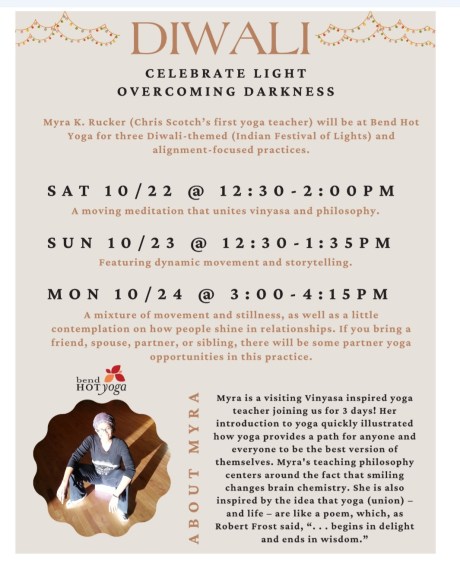

 ###
###
