Lucy’s Light, a variation on the theme (mostly the music) December 13, 2022
Posted by ajoyfulpractice in "Impossible" People, Faith, Healing Stories, Hope, Life, Meditation, Mysticism, One Hoop, Philosophy, Religion, Wisdom, Yoga.Tags: Advent, Feast Day of Saint Lucia, Feast of Saint Lucia, Saint Lucy's Day
add a comment
Many blessings to all and especially those observing the Feast Day of Saint Lucia and/or Advent.
“‘Remember, dear friend, that I am subtly inherent in everything, everything in the universe! I am the all-illuminating light of the sun, the light in the moon, the brilliance in the fire – all light is Mine. I am even the consciousness of light, and indeed, I am the consciousness of the entire cosmos.’”
– The Bhagavad Gita: A Walkthrough for Westerners (15:12) by Jack Hawley
Please join me today (Tuesday, December 13th) at 12:00 PM or 7:15 PM for a yoga practice on Zoom. You can use the link from the “Class Schedules” calendar if you run into any problems checking into the class. You can request an audio recording of this practice via a comment below or (for a slightly faster reply) you can email me at myra (at) ajoyfulpractice.com.
Tuesday’s playlist is available on YouTube and Spotify.
NOTE: Due to artists’ protests, one song may not play on Spotify. The YouTube playlists contains some official videos that are not available on Spotify.
“O St Lucy, preserve the light of my eyes so that I may see the beauties of creation, the glow of the sun, the colour of the flowers and the smile of children.
Preserve also the eyes of my soul, the faith, through which I can know my God, understand His teachings, recognize His love for me and never miss the road that leads me to where you, St Lucy, can be found in the company of the angels and saints.”
– quoted from A Novena Prayer to St Lucy, Protector of the Eyes
In the spirit of generosity (“dana”), the Zoom classes, recordings, and blog posts are freely given and freely received. If you are able to support these teachings, please do so as your heart moves you. (NOTE: You can donate even if you are “attending” a practice that is not designated as a “Common Ground Meditation Center” practice, or you can purchase class(es). Donations are tax deductible; class purchases are not necessarily deductible.)
### 🎶 ###
We Remember This Date (mostly the music w/2 links) December 7, 2022
Posted by ajoyfulpractice in Books, Changing Perspectives, Faith, Healing Stories, Health, Hope, Life, Loss, Music, One Hoop, Pain, Peace, Suffering, Tragedy, Wisdom, Yoga.Tags: Amy Greene, December 7th, Hiroshima, Nagasaki, Pearl Harbor, Shizuoka, World War II, yoga
add a comment
“I was beginning to see then what I have learned now. It’s not forgetting that heals. It’s remembering.”
.
– quoted from Bloodroot by Amy Greene
Please join me today (Wednesday, November 30th) at 4:30 PM or 7:15 PM for a yoga practice on Zoom. Use the link from the “Class Schedules” calendar if you run into any problems checking into the class. You will need to register for the 7:15 PM class if you have not already done so. You can request an audio recording of this practice via a comment below or by emailing myra (at)ajoyfulpractice.com.
Wednesday’s playlist is available on YouTube and Spotify. [Look for “12/7 and Healing 2021”]
Here are two (2) posts related to December 7th. The first one is personal. The second one is the one to be expected.
In the spirit of generosity (“dana”), the Zoom classes, playlists, and blog posts are freely given and freely received. If you are able to support these teachings, please do so as your heart moves you. (NOTE: You can donate even if you are “attending” a practice that is not designated as a “Common Ground Meditation Center” practice, or you can purchase class(es). (Donations to Common Ground are tax deductible; class purchases and donations directly to me are not necessarily deductible.)
.
###  ###
###
FTWMI: “This is why you were brought [here]” November 29, 2022
Posted by ajoyfulpractice in Books, Changing Perspectives, Dharma, Faith, Healing Stories, Hope, Life, Love, Men, Mysticism, Pain, Philosophy, Religion, Suffering, Wisdom, Writing, Yoga.Tags: 1 Epistle General of Peter, Arthur Greeves, Bhagavad Gita, C. S. Lewis, Christian apologetics, Jack Hawley, joy, The Inklings, William Wordsworth, Yoga Sutra 1.23, Yoga Sutra 2.45
1 comment so far
For Those Who Missed It: The following was originally posted November 29, 2020. Class details and links have been updated.
“Surprised by joy — impatient as the Wind
I turned to share the transport — Oh! with whom
But Thee, deep buried in the silent tomb,
That spot which no vicissitude can find?
Love, faithful love, recalled thee to my mind —
But how could I forget thee? Through what power,
Even for the least division of an hour,
Have I been so beguiled as to be blind
To my most grievous loss? —”
– quoted from the poem, “Surprised by Joy – Impatient As The Wind” by William Wordsworth (written in memory of his daughter)
If you’re anything like me, when you think of C. S. Lewis, born today in 1898, you think of Narnia and Aslan, and Christian allegories sometimes disguised as fantasy and children’s books. Like me, you might express a little confusion over why Mr. Lewis himself said the Chronicles of Narnia were not “allegories” and you might absolutely love The Screwtape Letters even though (or maybe because) it is super dark and written so well that it almost always feels as if no one will win and “The Patient” – as well as the demons – will be condemned to everlasting turmoil. Regardless of how he defined his work, you might recognize Mr. Lewis and his writing as falling under the heading of Christian apologetics. However, if – like me – you’ve read more C. S. Lewis than you’ve studied, you might be surprised by the author’s multi-layered relationship with “Joy.”
Christian apologetics is a category of study and theology focused on the defense of Christianity. It has its foundations in Torah study and Greek philosophical discourse, but there is a long list of New Testament Biblical references to the need for “a verbal defense” of belief. One of the best examples comes from The First Epistle General of Peter.
“But even if you should suffer for what is right, you are blessed. ‘Do not fear their threats; do not be frightened.’ But in your hearts revere Christ as Lord. Always be prepared to give an answer to everyone who asks you to give the reason for the hope that you have. But do this with gentleness and respect….”
– 1 Epistle General of Peter (3:14 – 15, NIV)
Unlike the epistles, or letters, attributed to Saint Paul and titled to reference specific Church communities (e.g. in Corinth, Galatia, Colossae, etc.), the letters attributed to Saint Peter are more generically addressed to “strangers” in a variety of areas (in 1st Peter) and “to them that have obtained like precious faith with us through the righteousness of God and our Saviour Jesus Christ” (in 2nd Peter, KJV). The meaning of “strangers” is debatable, but what is consistent in the letters, and in modern understanding of the letters, is that the letter are addressed to people who were subject to persecution (because of their faith), people who might have been tempted to give up their faith because of the persecution, and who – despite the persecution – experienced a faith-related longing. This longing, which Saint Peter described as “hope,” C. S. Lewis defined as “Joy.”
“The reader who finds these three episodes of no interest need read this book no further, for in a sense the central theme of my life is about nothing else. For those who are still disposed to proceed I will only underline the quality common to the three experiences; it is that of an unsatisfied desire which is itself more desirable than any other satisfaction. I call it Joy, which is here a technical term and must be sharply distinguished both from Happiness and Pleasure. Joy (in my sense) has indeed one characteristic, and one only, in common with them; the fact that anyone who has experienced it will want it again. Apart from that, and considered only in its quality, it might almost equally well be called a particular kind of unhappiness or grief. But then it is a kind we want. I doubt whether anyone who has tasted it would ever, if both were in his power, exchange it for all the pleasures in the world. But then Joy is never in our power and pleasure often is.”
– quoted from Surprised by Joy: The Shape of My Early Life by C. S. Lewis
Clive Staples Lewis was the Belfast-born youngest son of Albert James Lewis (a solicitor) and Florence “Flora” Augusta Lewis, who could be considered Irish royalty. Flora’s father was an Anglican priest; one of her great-grandfathers was Bishop Hugh Hamilton; and another of her great-grandfathers was the Right Honourable John Staples, who served as an Irish Member of Parliament for 37 years and was a descendant of titled persons in Northern Ireland. Naturally, C. S. – later known as “Jacksie” and then “Jack” – was baptized in the (Anglican) Church of Ireland, which is the second-largest church in Ireland (after the Roman Catholic Church) and identifies itself as both Catholic and Reformed. All that is to say that, he and his older brother Warren “Warnie” Hamilton Lewis were raised in a very structured, family-embedded tradition of faith.
Somewhere along the way, for a variety of reasons – and based on a variety of experiences – both brothers fell away from the Church and away from their family’s traditional beliefs.
While “Warnie,” the elder brother, finished his schooling and went on to serve 18 years in the military, the younger Lewis brother was drafted, sent to the front line on his 19th birthday, was wounded and traumatized by the death of his friends, and was sent home within a year. Once he physically recovered, “Jack” (whose nickname came from a beloved pet) went back to England to finish his studies.
Previously, at around age 15, “Jack” became interested in the occult and began to actively and publicly define himself as an atheist. As such, he spent an inordinate amount of time thinking about God, explaining why God didn’t exist, and surrounding himself with like-minded people and things. The problem was that when he returned to Oxford and started paying attention to his experiences (and the way he felt as he read, wrote, and interacted with people), he found he was being (spiritually and emotionally) sustained and nurtured by things and people who were theistic as opposed to atheistic. And the more he delved into his embodied experience, rather than just his analytical experience, the more he realized… there was something more.
“But soon (I cannot say how soon) nature ceased to be a mere reminder of the books, became herself the medium of the real joy. I do not say she ceased to be a reminder. All Joy reminds. It is never a possession, always a desire for something longer ago or further away or still ‘about to be’. But Nature and the books now became equal reminders, joint reminders, of – well, of whatever it is. I came no nearer to what some would regard as the only genuine love of nature, the studious love which will make a man a botanist or an ornithologist. It was the mood of a scene that mattered to me; and in tasting that mood my skin and nose were as busy as my eyes”
– quoted from Surprised by Joy: The Shape of My Early Life by C. S. Lewis
At around the same time, 1931, both brothers reclaimed their Christian roots and deepened their brotherly bond. They had been living together in Oxford for about a year, went on walking tours together, and participated in the weekly Thursday night “Inkling” meetings – which featured works-in-progress of the various members who were and would become literary giants in the English language. The “Inklings” – who were all white, Christian men of Oxford – included in their number the Lewis brothers, their close friend J. R. R. Tolkien (and his son Christopher, who were both raised Catholic), Charles Williams (a devout member of the [Anglican] Church of England), Henry Victor “Hugo” Dyson Dyson (a lecturer and literary collector known as H. V. D. Dyson, who was instrumental in C. S. Lewis’s return to Christianity), and Arthur Owen Barfield (“the first and last Inkling,” whose anthroposophical beliefs in a spiritual world accessed through human experience heavily influenced all the other Inklings).
C. S. Lewis’s spiritual memoir, Surprised by Joy, concludes in 1931, but wasn’t published until 1955. In the interim (around 1950), he started corresponding with a Jewish American poet (in the United States) who was estranged from her abusive husband. This woman – a child prodigy, an atheist, and former Communist, whose husband (also an author) may have introduced her to C. S. Lewis’s work – started the transatlantic correspondence because she had faith-related questions. Intrigued, and ultimately attracted, to each other’s intellect, the correspondence became more personal than theological. She frequently referenced him to others and once wrote, “Just got a letter from Lewis in the mail. I think I told you I’d raised an argument or two on some points? Lord, he knocked my props out from under me unerringly; one shot to a pigeon. I haven’t a scrap of my case left. And, what’s more, I’ve seldom enjoyed anything more. Being disposed of so neatly by a master of debate, all fair and square – it seems to be one of the great pleasures of life, though I’d never have suspected it in my arrogant youth. I suppose it’s unfair tricks of argument that leave wounds. But after the sort of thing that Lewis does, what I feel is a craftsman’s joy at the sight of a superior performance.”
The poet officially divorced her husband, converted to Christianity, and moved with her two school-aged sons to England to be with “Jack.” In April of 1956, several years after her arrival (in 1953), the couple entered into a “civil marriage” so that she and her children could stay in England. It was described as a marriage of friendship and convenience. However, when his wife was diagnosed with cancer (in October of 1956), C. S. Lewis realized he not only admired her, he loved her. He was 58 years old and surprised by Joy* – as his beloved wife was Helen Joy Davidman.
(*NOTE: C. S. Lewis was teased by his friends, but said that the title and intention of the book Surprised by Joy had nothing to do with his wife being Joy. So, you can take the overlap as serendipity… or God winking.)
“Total surrender is the first step towards the fruition of either. Shut your mouth; open your eyes and ears. Take in what is there and give no thought to what might have been or what is somewhere else. That can come later, if it must come at all. (And notice how the true training for anything whatever that is good always prefigures and, if submitted to, will always help us in the true training for the Christian life. That is a school where they can always use your previous work whatever the subject it was on.)”
– quoted from Surprised by Joy: The Shape of My Early Life by C. S. Lewis
Yoga Sūtra 1.23: īśvarapraņidhānādvā
– “[A perfectly still, pristine state of mind] comes from a special process of devotion and letting go into Ishvara [the Divine], the creative source from which we emerged.”
Yoga Sūtra 2.45: samādhisiddhirīśvarapraņidhānāt
– “From trustful surrender to Ishvara [the Divine], [a perfectly still, pristine state of mind] comes.”
“‘To work without desire may seem impossible, but the way to do it is to substitute thoughts of Divinity for thoughts of desire. Do your work in this world with your heart fixed on the Divine instead of on outcomes. Do not worry about results. Be even tempered in success or failure. This mental evenness is what is mean by yoga…. Indeed, equanimity is yoga!’” (2.48)
“‘Those who see Me in everything and everything in Me, know the staggering truth that the Self in the individual is the Self in all. As they live in constant spiritual awareness, I am never out of their sight or lost to them – nor are they every out of My sight or lost to Me. ’” (6.30)
– Krishna speaking to Arjuna in The Bhagavad Gita: A Walkthrough for Westerners by Jack Hawley
Please join me today (Tuesday, November 29th) at 12:00 PM or 7:15 PM for a yoga practice on Zoom. You can use the link from the “Class Schedules” calendar if you run into any problems checking into the class. You can request an audio recording of this practice via a comment belowor (for a slightly faster reply) you can email me at myra (at) ajoyfulpractice.com.
Today’s playlist is available on YouTube and Spotify. [Look for “11292020 Jack’s Surprising Joy”]
In the spirit of generosity (“dana”), the Zoom classes, recordings, and blog posts are freely given and freely received. If you are able to support these teachings, please do so as your heart moves you. (NOTE: You can donate even if you are “attending” a practice that is not designated as a “Common Ground Meditation Center” practice, or you can purchase class(es). Donations are tax deductible; class purchases are not necessarily deductible.)
“Your remarks about music would seem to lead back to my old idea about a face being always a true index of character… not of course exactly, but its general tone. What type of person is this girl of whom Debussy has been talking to you? As to your other suggestions about old composers like Schubert or Beethoven, I imagine that, while modern music expresses both feeling, thought and imagination, they expressed pure feeling. And you know all day sitting at work, eating, walking, etc., you have hundreds of feelings that can’t (as you say) be put into words or even into thought, but which could naturally come out in music. And that is why I think that in a sense music is the highest of the arts, because it really begins where the others leave off.”
– quoted from a letter addressed to his childhood friend Arthur Greeves (who he called “after my brother, my oldest and most intimate friend”), written by C. S. “Jack” Lewis, dated 20 June 1916
The connection between home and Joy….
“It was this that forced me to write. I longed to make things, ships, houses, engines. Many sheets of cardboard and pairs of scissors I spoiled, only to turn from my hopeless failures in tears. As a last resource, as a pis aller, I was driven to write stories instead. You can do more with a castle in a story than with the best cardboard castle that ever stood on a nursery table.”
– quoted from Surprised by Joy: The Shape of My Early Life by C. S. Lewis
### TASTE JOY (But don’t get it twisted and confuse “lower” pleasure with the “higher”)! ###
FTWMI: More Hope, More History… November 9, 2022
Posted by ajoyfulpractice in Books, Changing Perspectives, Dharma, Faith, Healing Stories, Hope, Karma, Life, Loss, Music, Mysticism, One Hoop, Pain, Peace, Philosophy, Suffering, Tragedy, Wisdom, Writing, Yoga.Tags: anonymous, BioNtech, Bruce Springsteen, COVID-19, David Bowie, David Hasselhoff, destiny, fate, Holocaust, John F. Kennedy, John Tagliabue, Kristallnacht, Livnam Kaur, Margaret Thatcher, Ronald Reagan, Seamus Heaney, Shicksalstag, Sophocles
add a comment
For Those Who Missed It: The following was originally posted on November 9, 2020 and reposted in 2021. Class details and links have been updated, as have some date notations. *Granted, things don’t always turn out the way we expect.
“Fate is what you are given. Destiny is what you make of it.”
– original source unknown
Let’s talk about the difference between fate and destiny. Often, especially in (American) English, we use the words interchangeably, and without distinction. We sometimes do this even if we know “destiny” shares etymological roots with “destination” and “fate” is rooted in the mythology of the three goddess, sisters, or witches (depending on the depiction) who weave (or stir) together the circumstances of one’s life. Either way you look at it, both are related to cause and effect – something we pay attention to in the Eastern philosophies like Yoga and Buddhism.
The concept of will, or determination, is one of the challenges that comes up when discussing fate and destiny; because, our understanding of the concepts may involve a level of predestination. One way to distinguish the two concepts, and the role predestination plays, is to think of fate as the present moment – which has been determined by all the previous moments – and destiny as a possible future moment – which will be determined by fate (i.e., this present moment and all the previous moments). If we look at it this way, we can’t change our fate, but we can change our destiny.
Yes, yes, it might be possible to present and argue the reverse, but I think that way gets really muddled. I’d rather go back to the “seat” of the words. Fate comes to the English from Latin, by way of Italian and Middle English, from a phrase that means “that which has been spoken.” Destiny comes through Old French and Middle English, from the Latin meaning “make firm, establish.” So, again, fate is what has happened and destiny is what we make happen. As an example, step back [a couple of days] with me and let’s revisit Philoctetes from The Cure at Troy: A Version of Sophocles’ Philoctetes.
“Human beings suffer.
They torture one another
They get hurt and they get hard.
No poem or play or song
Can fully right a wrong
Inflicted and endured.
History says, Don’t hope
On this side of the grave,
But then, once in a lifetime
The longed-for tidal wave
Of justice can rise up
And hope and history rhyme.”
– The Greek Chorus in The Cure at Troy: A Version of Sophocles’ Philoctetes by Seamus Heaney
Remember that Philoctetes was a great archer who had a magical bow. According to Sophocles accounting of events, the bow was a thank you gift from Heracles, the divine protector of mankind and patron of gymnasiums, whose funeral pyre could only be lit by the great archer. So, by using his skills to light the pyre, Philoctetes has the means to (eventually) assist Odysseus in winning the Trojan War by mortally wounding Paris with a poisoned arrow. Those circumstances, along with the fact that he is bitten by a poisonous snake, make up Philoctetes’ fate. His destiny could be to die of his wounds on the island where his colleagues abandoned him – because they couldn’t stand the sound of his belly aching – or he could go to Troy, win the war, and have his snake wound healed.
Now, keep in mind that like all the other characters, the fate and destiny of Philoctetes are tied up with the fate and destiny of Paris who, once wounded, could have been healed if he hadn’t pissed off and abandoned his first wife. (Alas, poor, pitiful Paris, thought his destiny was power, rather than the love of a “good woman,” and let that thirst for power be his dharma or guiding principle.)
“Fate is your karma. Destiny is your dharma.”
– Livnam Kaur
Some people think the power of fate and destiny can reside not only in our actions, but also in a date. Take today, for instance: November 9th. In Germany it is known as Schicksalstag – “Destiny Day” or “Fateful Day” – because of all the historical events that happened today and shaped the history of Germany. It’s kind of wild, when you think about it. But, also, when you start to go deeper into the events, you start to realize that some (but not all) of the events were planned because people believed in the power of the day.
In talking about the events of today throughout German history, most people start with 1848 and the execution of the democratic politician, poet, and publisher Robert Blum. One of the leaders of the National Assembly of 1848 and a prominent figure during the Vienna revolts, Blum was arrested after the Vienna revolts and argued in vain that his role as a deputy from the German Diet should protect him from execution. Instead, his death was used as an example and a method for crushing the subsequent revolution in Germany in the spring of 1849.
Fast forward 70 years, to 1918, and Emperor Wilhelm II was dethroned by his chancellor, Max von Baden, and socialist and social democratic politicians proclaimed the beginning of the “Free” German Republic. As a side note, Albert Einstein was named winner of the 1921 Nobel Prize in Physics today in 1922.
In 1923, the failed “Beer Hall Putsch” marked the initial emergence and downfall of the Nazi Party. Even though the march officially failed it was the beginning of Adolf Hitler’s rise to power, and during the Nazi regime it was considered a national holiday honoring the Nazis who died today in 1923. As a side note, German Crown Prince Wilhelm (son of the ousted Emperor) chose this day to return out of exile.
Another example of people using previous events to infuse their actions with the power of the day’s history tragically, and horrifically, happened today in 1938: Kristallnacht (“Night of Glass”). The Nazis symbolically chose this night to begin destroying synagogues and Jewish properties. More than 400 Jewish people died and, after this demonstration of far-reaching anti-Semitism, the Nazi’s arrested approximately 30,000 people on November 10th, many of whom would ultimately die in concentration camps.
“Two thousand years ago, the proudest boast was ‘civis romanus sum’ [‘I am a Roman citizen’]. Today, in the world of freedom, the proudest boast is ‘Ich bin ein Berliner!’ … All free men, wherever they may live, are citizens of Berlin, and therefore, as a free man, I take pride in the words ‘Ich bin ein Berliner!’”
– U. S. President John Kennedy, speaking to the public in West Berlin, June 26, 1963
“Every stone bears witness to the moral bankruptcy of the society it encloses.”
– English Prime Minister Margaret Thatcher as quoted in the New York Times article “Mrs. Thatcher Visits the Berlin Wall” by John Tagliabue (published Oct. 30, 1982)
One of the outcomes of the World War II was the division of Germany and, ultimately, the construction of the Berlin Wall. However, today in 1989 marked the beginning of the fall of the Berlin Wall and the end of German separation. In many ways, this event can be seen as an accident. I mean, it wasn’t like anyone planned it to happen today.
Yes, people, including Presidents John F. Kennedy and Ronald Reagan, had called for the end of the Wall. Furthermore, musicians like David Bowie (1987), Bruce Springsteen (1988), and David Hasselhoff (1989) boldly played songs about freedom in concerts near the Wall – and, in Hasselhoff’s case, over the Wall! There was also the announced intention (by the East German government) to change policy. But the changes were intended for a different day.
“We come to Berlin, we American presidents, because it’s our duty to speak, in this place, of freedom. But I must confess, we’re drawn here by other things as well: by the feeling of history in this city, more than 500 years older than our own nation; by the beauty of the Grunewald and the Tiergarten; most of all, by your courage and determination. Perhaps the composer Paul Lincke understood something about American presidents. You see, like so many presidents before me, I come here today because wherever I go, whatever I do: Ich hab noch einen Koffer in Berlin. [I still have a suitcase in Berlin…..]”
There is one sign the Soviets can make that would be unmistakable, that would advance dramatically the cause of freedom and peace. General Secretary Gorbachev, if you seek peace, if you seek prosperity for the Soviet Union and eastern Europe, if you seek liberalization, come here to this gate. Mr. Gorbachev, open this gate. Mr. Gorbachev, tear down this Wall!”
– U. S. President Ronald Reagan, speaking to the public at Brandenburg Gate, June 12, 1987
When the policy changes were announced by Günter Schabowski, an official of the Socialist Unity Party of Germany (SED), during a press conference on November 9th, he hadn’t actually been briefed about the details. Based on the wording of the announcement he had been given, when asked when the policy changes would go into effect, he said, “As far as I know… effective immediately, without delay.” That wasn’t actually true, but, the metaphorical wrecking ball was swinging. In answering follow up questions, and in subsequent interviews that day, Schabowski “confirmed” that the decrease in travel restrictions applied to every part of the Wall and to travel in every direction – including into West Berlin. Naturally, people started showing up at the Wall demanding to be let through and, by 11:30 PM, at least two gates were open.
On the flip side, I would not be surprised if the German drug company BioNtech intentionally chose this date to announce that their COVID-19 vaccine, developed with Pfizer, is 90% effective. I wouldn’t be surprised at all if someone thought drawing on the power of the day would give people more hope than a basic announcement on any other day. After all, the announcement [a year ago] today, *means the end of the world’s suffering isn’t just fate, it’s destiny.
“Call miracle self-healing,
The utter self-revealing
Double-take of feeling.
If there’s fire on the mountain
And lightening and storm
And a god speaks from the sky
That means someone is hearing
The outcry and the birth-cry
Of new life at its term.
It means once in a lifetime
That justice can rise up
And hope and history rhyme.”
– The Greek Chorus in The Cure at Troy: A Version of Sophocles’ Philoctetes by Seamus Heaney
Please join me today (Wednesday, November 9th) at 4:30 PM or 7:15 PM for a yoga practice on Zoom. Use the link from the “Class Schedules” calendar if you run into any problems checking into the class. You will need to register for the 7:15 PM class if you have not already done so. You can request an audio recording of this practice via a comment below or (for a slightly faster reply) you can email me at myra (at) ajoyfulpractice.com.
Tuesday’s playlist is on YouTube and Spotify.
In the spirit of generosity (“dana”), the Zoom classes, recordings, and blog posts are freely given and freely received. If you are able to support these teachings, please do so as your heart moves you. (NOTE: You can donate even if you are “attending” a practice that is not designated as a “Common Ground Meditation Center” practice, or you can purchase class(es). Donations are tax deductible; class purchases are not necessarily deductible.)
(And, if you want some Bruce….)
“I’m not here for or against any government. I’ve come to play rock ‘n’ roll for you in the hope that one day all the barriers will be torn down”
– Bruce Springsteen, speaking German in East Berlin, before playing “Chimes of Freedom” with the E Street Band, during the “Rocking the Wall” concert, July 19, 1988
### dóchas / dúchas // història / esperança // histoire / espoir // historio / espero ###
Cèlèbrer Une Vie & FTWMI: Recuerda Todas Almas November 2, 2022
Posted by ajoyfulpractice in Books, Faith, Gratitude, Healing Stories, Life, Loss, Love, Mysticism, One Hoop, Religion, Yoga.Tags: 2 Maccabees, Alain Baudry, All Souls' Day, Allhallowtide, Death, Dia de los Muertos, Dia de Muertos, e e cummings, grief, Halloween, Kevin Brockmeier
2 comments
Many blessings to those observing All Souls y Día de (los) Muertos!
“That was what the living did: they died.”
.
– quoted from The Brief History of the Dead by Kevin Brockmeier
On Sunday (10/30/2022), I was shocked to hear that one of my Minneapolis yoga buddies was terminally ill. Just a few hours later, I was shocked and saddened to hear that he had passed. His family hosted a celebration of life so that he could spend his final hours surrounded by people who loved and respected him. It was hard; but I heard the opportunity gave him and them some comfort.
For years, AB practiced yoga at the old Downtown Minneapolis YMCA. He was partially responsible for me meeting one of my favorite people on the planet and, additionally, his mother once joined us for a class during one of her visits to the Twin Cities. (I have a vague idea that she might have taught yoga at one time; however, since I never read her autobiography, don’t quote me on this point. Either way, she definitely started practicing long before I ever did!)
AB loved the music and especially appreciated my Christmas-story playlist. For many years, he gave me an Amazon gift card so I could purchase more music for class! In addition to swapping music, we swapped a few books – including Kevin Brockmeier’s The Brief History of the Dead, which I mention at this time every year. We also shared an occasional meal. For better or for worse, I got to watch his life change.
I also got to see his practice change. (NOTE: For those who knew whom as an esteemed attorney and French academic editor, here I am talking about his yoga practice.) At one point, while we were still at the old Y, he asked me what would make certain aspects of the practice more accessible to him. Later, he decided he was getting enough cardio and strength from boot camp (and other cardio classes) and that what he needed/wanted from his yoga practice was the meditation and deep tissue work he experienced when he dropped into one of my Yin Yoga classes. Unfortunately, the Yin Yoga classes didn’t always fit into his schedule. So, we talked about how he could add a little Yin to the very yang vinyasa practices that worked for his schedule. Eventually, when the Y moved to it’s fancier digs and more classes overlapped, he made the decision (as so many did) to take classes that were more active than yoga. We still caught up in the lobby and, occasionally, outside of the Y; but…. Time marches on.
As reports and tributes come in from all over the world, I can’t help but notice how “one of those random people who came to yoga and became a friend,” meant so much to so many different people and for so many different reasons. AB’s life and death are a reminder that a person can affect the lives of a lot of different people in a lot of different ways.
Today’s sequence reflects the yin/yang that AB appreciated. It’s also an opportunity to celebrate a life that touched so many. Repose en paix, mon ami. Nous nous souviendrons de toi. Nous nous souviendrons de toi.
For Those Who Missed It: The following was originally posted November 2, 2020. Class details and links have also been updated or added.
“i carry your heart with me(i carry it in
.
my heart)i am never without it(anywhere
i go you go,my dear;and whatever is done
by only me is your doing,my darling)“
.
– quoted from “[i carry your heart with me(I carry it in)]” by e e cummings
Take a moment to bring your awareness to your hearts. Not just your physical heart, or even just your emotional heart – take a moment to bring your awareness to your energetic heart and all of its connections. You can even think of that energetic heart as a spiritual heart and all of its connections. Either way, when I talk about the various ways we can map out our energy – and especially when I specifically refer to the energy system of nadis (“rivers”) and chakras (“wheels”) as outlined by Yoga and Ayurveda, as they come to us from India, I often mention that we can be genetically and energetically (even spiritually) connected to people we have never met and will never meet. Similarly, we are connected, genetically and energetically (even spiritually), to people we will never meet again… people who have passed from the physical world (back) into the energetic and spiritual world.
Throughout history, people from various cultures around the world have had (and continue to have) different ways of honoring these connections – especially the spiritual and energetic connections we have with those who passed on into another realm of existence. Yes, I said, “another realm of existence;” because, while someone ceases to exist in the material and physical sense, they can continue to exist in an emotional, energetic, and spiritual sense – as long as we remember them.
“No two reports were ever the same. And yet always there was the drumlike thumping noise.
Some people insisted that it never went away, that if you concentrated and did not turn your ear from the sound, you could hear it faintly behind everything in the city….”
.
– quoted from The Brief History of the Dead by Kevin Brockmeier
Today, November 2nd, is All Souls’ Day, also known as the Commemoration of All the Faithful Departed – the last day of Allhallowtide in the Western Christian tradition and the final Día de (los) Muertos in Mexico and the Mexican diaspora. Like All Saints’ Day (which was yesterday), there was a time when this holy time was celebrated in the Spring – and, in fact, there are still traditions, like the Eastern Orthodox Churches, which remember the dead around Easter. However, the fifth Benedictine Abbot of Cluny, St. Odilon of Cluny, established this Western observation in the 10th century and the practice has endured. Unlike All Saints, today is a day dedicated to all departed souls and, in particular, to those who may or may not have lived a “faithful” life according to the Church.
While it is not a national holiday in Catholic countries, nor is it one of the five days of holy obligation within the Catholic Church, it is a day of prayer (and, for some, quite a few masses). Here, the prayers are not so much as for the living as for the dead, because Christians who have a “fundamental belief that there is a prayerful spiritual bond between those in heaven (Christian triumphant) and the living (the Christian militant)” may also believe that those who die without being baptized and/or living a faithful life (the Church penitent, also known as “the Church suffering” and “the Church expectant”) will languish in Purgatory without God’s grace.
So, today people pray for that grace so their dearly departed loved ones will no longer suffer. In addition to the vibrant Día de (los) Muertos traditions I mentioned yesterday, as well as the traditions of guising, souling, and the exchange of soul cakes (that I mentioned on Halloween), All Souls’ Day is known for bell tolling and candle lighting, which both represent the cleansing of souls and power of light overcoming darkness.
“If he had not believed that the dead would be raised, it would have been foolish and useless to pray for them. In his firm and devout conviction that all of God’s faithful people would receive a wonderful reward, Judas made provision for a sin offering to set free from their sin those who had died. It is therefore a holy and wholesome thought to pray for the dead, that they may be loosed from sins.”
.
– 2 Maccabees (12:44 – 46)
Please join me today (Wednesday, November 2nd) at 4:30 PM or 7:15 PM for a yoga practice on Zoom. Use the link from the “Class Schedules” calendar if you run into any problems checking into the class. You will need to register for the 7:15 PM class if you have not already done so. You can request an audio recording of this practice via a comment below or (for a slightly faster reply) you can email me at myra (at) ajoyfulpractice.com.
Tuesday’s playlist is available on YouTube and Spotify. [Look for “11022021 All Souls / Dia de los”]
In the spirit of generosity (“dana”), the Zoom classes, recordings, and blog posts are freely given and freely received. If you are able to support these teachings, please do so as your heart moves you. (NOTE: You can donate even if you are “attending” a practice that is not designated as a “Common Ground Meditation Center” practice, or you can purchase class(es). Donations are tax deductible; class purchases are not necessarily deductible.)
“One particular issue of the L. Sims News & Speculation Sheet—the Sims Sheet, people called it—addressed the matter of this sound. Fewer than twenty per cent of the people Luka interviewed claimed that they could still hear it after the crossing, but almost everyone agreed that it resembled nothing so much as—could be nothing other than—the pounding of a heart. The question, then, was where did it come from? It could not be their own hearts, for their hearts no longer beat. The old man Mahmoud Qassim believed that it was not the actual sound of his heart but the remembered sound, which, because he had both heard and failed to notice it for so long, still resounded in his ears. The woman who sold bracelets by the river thought that it was the heartbeat at the center of the world, that bright, boiling place she had fallen through on her way to the city. ‘As for this reporter,’ the article concluded, ‘I hold with the majority. I have always suspected that the thumping sound we hear is the pulse of those who are still alive. The living carry us inside them like pearls. We survive only so long as they remember us.”’
.
– quoted from The Brief History of the Dead by Kevin Brockmeier
.
.
### “BA-DUM. BA-DUM. BA-DUM.” ###
FTWMI: Recuerda a las inocentes (*UPDATED*) November 1, 2022
Posted by ajoyfulpractice in Art, Faith, Health, Life, Loss, Mysticism, Yoga.Tags: All Hallows' Day, All Saints Day, Allhallowtide, Day of the Holy Innocents, Dia de los Muertos, Dia de Muertos, Hanal Pixan, Kevin Brockmeier, Mexico, Reverend Richard A. Donohoe, Stephanie Carmon, Yucatan
add a comment
Many blessings to those observing All Saints y Día de (los) Muertos!
For Those Who Missed It: A variation of the following was originally posted in November 2020. This version has been revised to include information about celebrations in 2021. Class details and links have also been updated or added.
“All Saints is a celebration of the communion of saints, those people we believe are in heaven, through good works and God’s grace…. On All Saints’ Day there’s a call to live as saints, to remind us how we’re supposed to live.”
*
– Very Reverend Richard A. Donohoe, vicar of Catholic Charities for Diocese of Birmingham
Today, November 1st, is the end of Samhain and the second day of Allhallowtide. It is known as All Hallows Day, meaning it is holy, or All Saints Day in Western Christianity and it is the beginning of Día de (los) Muertos for Mexicans and the Mexican diaspora. Traditionally today is a memorial day for saints and innocents, i.e. young children, and is a national holiday in some Christian countries. In the Methodist tradition, it is a solemn occasion of remembrance and thanksgiving observed by Christians who have a “fundamental belief that there is a prayerful spiritual bond between those in heaven (Christian triumphant) and the living (the Christian militant).” People will pray for blessings and protection; tend graves; leave flowers – like chrysanthemums in Belgium and France – and; in some country there is an exchange of traditional (and symbolic) treats. In Mexico and for the Mexican diaspora, however, Día de (los) Muertos is traditionally all of the above and a giant celebration full of brightly colored parades, music and dancing, candy skulls, marigolds, and ofrendas (“offerings”) or home or graveside alters curated around the life of a loved one.
In 2020, however, it was hard to remember to celebrate when so many had died. In the United States, people of color – including thousands of Mexican-Americans – have been hit hard by the pandemic. According to the nCov2019 Coronavirus Dashboard, almost 92k people had died (as of the morning of November 1, 2020) – and that number did not include people who died over the quarantine months because of the additional physical, mental, and emotional strain of the pandemic. In response to the toll, Mexican President Andrés Manuel López Obrador announced three days of national mourning, beginning with Halloween. The government canceled parades, asked for cemeteries to close, and announced that the flag at the National Palace in Mexico would be flown at half mast in honor of those lost during the pandemic. A year later, over 288,000 people in Mexico had died from Covid-19, BUT the country was reporting a 95% vaccination rate – which meant it was time to once again celebrate lives well lived. This year, people will again remember and celebrate – not only those lost because of Covid, but also those lost in recent mass shootings that deeply affected people in Mexico and the Mexican diaspora.
Even though it is hard to remember to celebrate when there is so much tragedy, the human spirit perseveres and always finds a way. That people will find a way is not surprising when we remember that some of these traditions date back to the rituals of the Mayans, Aztecs, and over 40 other indigenous cultures that survived despite colonization. So, in addition to flying the flag at half mast in 2020, the government created an official ofrenda for all victims of the pandemic and annual ofrenda contests were held virtually or in appropriate socially distant ways. And, of course, people continued to make pan de muertos, the traditional bread of the dead, and to decorate with sugar skulls and paper banners.
“Since living in Merida, I have been able to witness the deep connection Yucatecans have to this special time of year honoring the souls of their departed loved ones. One of the things that I have always admired about Yucatecans is that they keep many of their traditions alive by believing, practicing and teaching their children about them. They don’t just go through the motions; they truly pay attention to detail and live the experience.”
*
– quoted from Yucatan’s Hanal Pixan: How It Differs from the Day of the Dead in other parts of Mexico” in the Yucatan Times (10/31/2018) by Stephanie Carmon
There are several days dedicated to all saints and innocents in the Eastern and Western Christian traditions. In particular, there is a Day of the Holy Innocents (December 28th) which commemorates children under two who were killed by order of King Herod I the Great in his attempt to kill the newborn Jesus. And, Pope Boniface IV formally established an All Saints’ Day in May, when he dedicated the Parthenon in Rome to the Virgin Mary and all martyrs. When Pope Gregory III dedicated Saint Peter’s Basilica in Rome to all saints, he moved the feast date to November 1st – but that only applied to people in Rome. It was Pope Gregory IV, in 837, who ordered the date to officially apply to all Western Christians. Within the Catholic Church it is considered a Holy Day of Obligation.
In the Eastern Orthodox Church all saints are commemorated in the spring on the Sunday after Pentecost. This Byzantine tradition became more popular during the reign of the Emperor Leo VI, also known as “Leo the Wise.” The Empress Theophano was so devoted to the church that she left her reign and retired to a monastery around 893. After she died on November 10th, a series of miracles occurred and the emperor decided to build a church to hold her relics. However, he was not allowed to name the church after her and decided instead to dedicate the church to “All Saints,” whether martyred or not, so that her life would be celebrated every year. She would be remembered.
“The woman who sold bracelets by the river thought that it was the heartbeat at the center of the world, that bright, boiling place she had fallen through on her way to the city. ‘As for this reporter,’ the article concluded, ‘I hold with the majority. I have always suspected that the thumping sound we hear is the pulse of those who are still alive. The living carry us inside them like pearls. We survive only so long as they remember us.’”
*
– quoted from The Brief History of the Dead by Kevin Brockmeier
Please join me today (Tuesday, November 1st) at 12:00 PM or 7:15 PM for a yoga practice on Zoom. You can use the link from the “Class Schedules” calendar if you run into any problems checking into the class. You can request an audio recording of this practice via a comment below or (for a slightly faster reply) you can email me at myra (at) ajoyfulpractice.com.
Tuesday’s playlist is available on YouTube and Spotify. [Look for “11012020 All Saints / Día de los”]
In the spirit of generosity (“dana”), the Zoom classes, recordings, and blog posts are freely given and freely received. If you are able to support these teachings, please do so as your heart moves you. (NOTE: You can donate even if you are “attending” a practice that is not designated as a “Common Ground Meditation Center” practice, or you can purchase class(es). Donations are tax deductible; class purchases are not necessarily deductible.)
*
### “BA-DUM. BA-DUM. BA-DUM.” ###
The Angels (& Devils) Within Us (the “missing” post) October 29, 2022
Posted by ajoyfulpractice in Changing Perspectives, Confessions, Faith, Healing Stories, Hope, Karma, Life, Loss, Meditation, Music, One Hoop, Pain, Peace, Philosophy, Suffering, Tragedy, Vairagya, Volunteer, Wisdom, Yoga.Tags: Angels' Night, Bill McGraw, Cabbage Night, Charles Eads, Christopher Isherwood, Detroit, Devil's Night, Emma Davidson-Dillon, Hell Night, James Eliot, Matthew Phelan, Metacognition, Michigan, Mischief Night, Moving Night, Nobi Shigemoto, Pandit Rajmani Tigunait, Rosa Parks, St. John's College Oxford, svadyaya, svādhyāya, Swami Prabhavananda, Thomas Alexander Walker, Tom Walker, Will Rogers, Yoga Sutra 1.37, Yoga Sutra 2.33, Yoga Sutra 2.44, Yoga Sutras 1.33-1.34, Yoga Sutras 2.33-2.35
add a comment
This is a “missing” post for Saturday, October 29th. You can request an audio recording of a related practice via a comment below or (for a slightly faster reply) you can email me at myra (at) ajoyfulpractice.com.
In the spirit of generosity (“dana”), the Zoom classes, recordings, and blog posts are freely given and freely received. If you are able to support these teachings, please do so as your heart moves you. (NOTE: You can donate even if you are “attending” a practice that is not designated as a “Common Ground Meditation Center” practice, or you can purchase class(es). Donations are tax deductible; class purchases are not necessarily deductible.
Check out the “Class Schedules” calendar for upcoming classes.]
“Violence is clearly destructive. It springs from fear, one of the fundamental afflictions. According to this sutra, the practice of non-violence requires us to arrest our violent tendencies by cultivating thoughts opposite to violence.”
*
– quoted from the commentary on Yoga Sūtra 2.33 from The Practice of the Yoga Sutra: Sadhana Pada by Pandit Rajmani Tigunait, PhD
By all accounts, it started off simply and innocently enough. Just a few childish pranks at the end of Thanksgiving: knocking at the door that opened to reveal no one; random, unexplained noises, cabbage being uprooted and then tossed around; patio furniture inexplicably shifting and moving to a neighbor’s porch. You know, things that ghost, goblins, and devils might do when the veil between worlds was lifted. It was so simple and innocent, in fact, that in 1790, a headmaster at Saint John’s College in Oxford even ended a school play with a little encouragement: “an Ode to Fun which praises children’s tricks on Mischief Night in most approving terms.”
Mischief Night, the night before Halloween, is also known as Hell Night, Cabbage Night, Gate Night, Moving Night, Devil’s Night, and a variety of other names throughout the United Kingdom, Canada, and the United States. It was just supposed to be a little “trick” before the treats. References to Devil’s Night and Mischief Night in Michigan can be found as early as the 1910’s – when college students reportedly started bonfires and then handed cigars to the firefighters who came to put out the flames. However, the vandalism and arson increased in the 1930’s and 1940’s. By the 1970’s, the simple and innocent pranks in Detroit turned into criminal mischief and started extending into October 29th. From the 1970’s through the 1990’s, there was serious vandalism and arson that resulted in thousands of dollars worth of damage. In 1983, over 550 fires were reported. In 1984, the number of reported fires was more than 800. Some officials started theorizing that some people were using the reputation of Devil’s Night to commit insurance fraud. And, speaking of that reputation, by the mid-1980’s, people were not only driving into town from other states to watch the fires, they were flying in from other countries.
“Fire buffs, newspeople and just plain gawkers came to watch Detroit burn Wednesday night.
They even came all the way from Tokyo.
Director Nobi Shigemoto was here with an eight-person crew from Asahi national TV network. The crew planned to follow fire trucks Wednesday night and do a live shot from in front of Highland park fire headquarters before returning to Japan.”
*
“Shigemoto said Detroiters ask him why he is ‘looking at bad things.’
His reply:
This is the truth. US (is a) most rich country. When you look at Detroit, it looks nothing like rich.’”
*
– quoted from the Detroit Free Press article “Keeping the watch – Reporters, fire buffs, gawkers come to track night’s events” by Bill McGraw (printed in the “Devil’s Night” section, dated 31 Oct 1985, Thu)
In the mid-1980’s, then-Detroit mayor Coleman Young and city officials created the “No More Devil’s Night” campaign, which included a dusk-to-dawn curfew for teenagers, neighborhood watches, the opportunity to “adopt” empty properties, and a coordinated “patrol” effort by police officers, firefighters, and miscellaneous city workers. Over 11,000 volunteers participated that first year – and the number of reported fires was cut in half. Local cable television offered free access to premium channels so that more people would stay home. News outlets agreed not to air footage that might glamorize arson and/or encourage copycats – and the number of fires dropped. The number of volunteers rose (to ~17,000) in 1987, and again the number of reported fires dropped.
Detroit’s “No More Devil’s Night” campaign was so successful that when Dennis Archer was elected mayor, in January of 1994, he decided his predecessor’s official campaign was no longer needed. People warned him he was wrong. Unfortunately, those people were right. According to a New York Times article (dated November 1, 1994), there were 40,000 volunteers working to combat the arson and other criminal mischief in 1993 versus 8,000 in 1994. That difference in volunteers reflected a trend well established in previous years: more volunteers resulted in less arson and criminal mischief; less volunteers meant more arson. While there were significantly less fires in 1994 than there had been in 1984, one of those fires – set on October 30, 1994, in the same suburb Nobi Shigemoto filmed nine years earlier – resulted in the death of 1-year old Destiny Wilson and the serious injury of several others, including Destiny’s mother, 3-year old sister Ivory, and two older siblings. Then-mayor Archer and other city officials rebranded the original campaign and got more serious about cultivating the opposite energy; being angels instead of devils.
“However, if the process of non-violence is to be effective in counteracting violence, we must first describe and outline it clearly and methodically. Because violent thoughts always precede a violent act, an act of non-violence will be effective only if it is preceded by non-violent thoughts. Violence is an active phenomenon, whereas non-violence is mistakenly thought to be passive – simply the absence of violence. Non-violence must be as active as violence itself.”
*
– commentary on Yoga Sūtra 2.33 from The Practice of the Yoga Sutra: Sadhana Pada by Pandit Rajmani Tigunait, PhD
The rebranded Angels’ Night(s) encouraged volunteers to do what they could to actively combat the violence with non-violence, from October 29th – 31st. It was based on the idea that if everyone cared, everyone could do something to make a difference. Some people volunteered to patrol their neighborhood with flashing amber lights on their vehicles. Others agreed to wear orange ribbons and participated in neighborhood watches – even adopting an “empty” property. Still others agreed to leave their lights on and to enforce – or honor – the curfew. Official activities were organized at recreation and community centers. Bottom line, there was a way for everyone, regardless of age or ability, to stay alert and stay connected. In 1995, 40,000 – 50,000 volunteers agreed to be “angels.” As before, arson and vandalism steadily declined.
While there was a spike in arsons around Halloween 2010, the overall decline in “devilish” activity continued through the 2000’s and 2010’s. In 2005, official “Angels’ Night” activities were cancelled as the entire city mourned the death of Rosa Parks. In 2015, there were “only” 52 fires (with 24 appearing to be arson). Interestingly, this steady decline around Halloween was paralleled by a slight increase in fires around the 4th of July. In 2018, there were only three reported fires and the city officially ended the campaign. Citizens, however, continue to be angels.
“The earliest recorded instance of someone saying ‘Hurt people hurt people’ appears in the Feb. 26, 1959, edition of a local Texas newspaper, the Amarillo Globe-Times, in its review of a lecture program put on by the Parent Teacher Association of Fannin Junior High School. The Globe-Times attributes the line to a speaker named Charles Eads, who, judging from the article’s description, spoke in the manner of vaudeville satirist and cowboy Will Rogers:…’”Hurt people hurt people.’ So, maybe before I wound someone next time, I’ll stop and think if it’s because I’ve been hurt, myself.’”
*
– quoted from the article “The History of ‘Hurt People Hurt People’ – The adage has been credited to everyone from pastors to self-help gurus to Andrew Garfield. It’s much older.” By Matthew Phelan (posted on slate.com, Sept 17, 2019)
We’ve all been hurt. We all suffer. According to the Yoga Philosophy, dysfunctional/afflicted thought patterns create suffering. The question – which is also addressed in philosophies like Buddhism, and even in the major religions – is, “What do we do with our own suffering?” Do we alleviate it? That’s the next question, because the philosophies say that we have the ability to alleviate our own suffering? Of course, there’s always the flipside, where our hurt/suffering becomes the foundation for more suffering and “devilish” behavior?
To answer the questions, take a moment to do a little svādhyāya (“self-study”) or discernment – what some might call “metacognition.” Consider your own reaction to the aforementioned Devil’s Night, especially with regard to the arson and vandalism. Consider, who you think was responsible – not only for the problem, but also for the solution. Are you keeping in mind that the initial fires, even in Detroit, were set by college students? Have you thought about what was happening in the world when the arson first increased? Did you remember that the Wilson family lived in the suburbs?
Consider how you feel when you take it all in and then consider how those feelings translate into thoughts that precede your words and then your deeds. Given the opportunity to counteract violence and destruction, would your active response to the “devilish” behavior be functional and skillful – or would it be just another form of damage?
In the first section of the Yoga Sūtras, there are several different ways in which we can achieve transparency of mind. One way is to focus on the breath. (YS 1.34) Another way is to “focus on someone who is free from all desire.” (YS 1.37) This is what people are ostensibly doing when they ask themselves, “What would … do?” Of course, the commentary indicates that in the absence of resonating with some great figure – from religion, philosophy, or mythology – we could focus on the best version of ourselves: What would we do/say if we were free from desire? What would we do/say if we were not attached to a particular outcome?
“Then concentrate upon [the] heart. Try to imagine how it must feel to be a great saint; pure and untroubled by sense-objects….”
*
– quoted from the commentary on Yoga Sūtra 1.37 from How To Know God: The Yoga Aphorisms of Patanjali translated and with commentary by Swami Prabhavananda and Christopher Isherwood
Another method for achieving clarity of mind, according to Patanjali’s Yoga Sūtras, is to offer friendliness to those who are happy, compassion to those who are suffering, happiness to those who are virtuous, and indifference/non-judgement to those who (we consider) are non-virtuous. (YS 1.33) I personally love this idea, but I also know it can be challenging. Different parts may be challenging for different people – and under different circumstances – but the part that is usually challenging for me is the last part: offering indifference/non-judgement to someone (I consider) non-virtuous – or whose actions are not virtuous. Sure, ideally, we could ignore those non-virtuous people/actions and they would go away or stop their “devilish” behavior; but, life doesn’t always work that way. Sometimes we have to directly engage and actively combat the violence in a non-violent way.
My non-violent way is logic. While I often believe that (my) logic will resolve conflict and/or get people to do what I think is right, that is not actually how the world works – because that’s not how the human mind works. Remember, according to Yoga Sūtra 2.20, we can only see/comprehend what our mind-intellect is ready to show us. This is not an idea restricted to the people we think are wrong in their thinking; this also applies to each and every one of us.
Don’t get me wrong. I’m not saying that logic doesn’t work. I’m saying that if someone we consider to be non-virtuous, or acting in a way that is non-virtuous, were to think (and feel) the way we think (and feel) they would speak and act the way we do. So, applying our own logic on someone else does not work. They have to apply their own logic. While we may be able to help someone apply their own logic, we can only do so with a clear mind.
In other words, to truly alleviate suffering, we have to turn inward. We have to understand our own feelings and thoughts and how those become our words and deeds. In turn, we have to understand the impact/effect of our words and deeds. It is only then that we can effectively, as Patanjali said in Yoga Sūtra 2.44, be in the company of angels.
“No, don’t give up
I won’t give up
‘Cause there must be angels”
*
– quoted from the song “Angels” by Tom Walker (written by Emma Davidson-Dillon / James Eliot / Thomas Alexander Walker)
Saturday’s playlist is available on YouTube and Spotify.
(NOTE: The Spotify playlist contains one track that may not play without a subscription. My apologies for the inconvenience.)
*
### Be safe, y’all! ###
On the Road Again… & It’s Lit!!! October 21, 2022
Posted by ajoyfulpractice in Dharma, Faith, Hope, Meditation, Philosophy, Religion, Wisdom, Yoga.Tags: Bend Hot Yoga, Diwali, Oregon, Robert Frost
2 comments
Just a reminder: The classes I am guest teaching at Bend Hot Yoga (this weekend) will be available live via ZOOM. Check my “Class Schedules” calendar for access details. (NOTE: Meeting codes are the same as they normally would be for each day, but the times are different. Times listed below are PDT.)
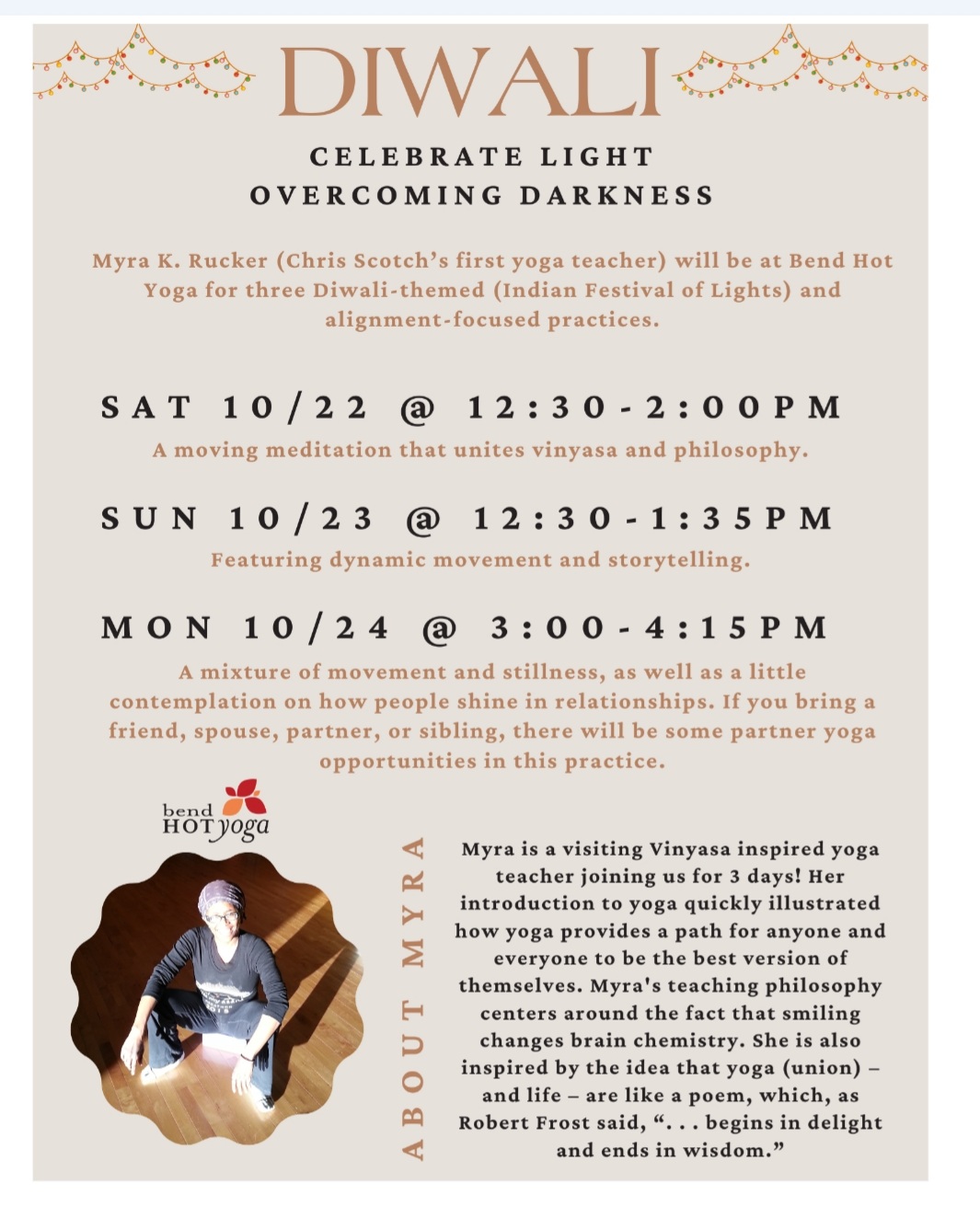
### Put Your Lights On ###
Listen, I’m Still SINGING BOUT MY STUFF! (mostly links, felicitations, and an explanation) October 18, 2022
Posted by ajoyfulpractice in "Impossible" People, Art, Books, Faith, Healing Stories, Hope, Life, Music, Ntozake Shange, One Hoop, Pain, Poetry, Religion, Shemini Atzeret / Simchat Torah, Suffering, Yoga.Tags: Carry app, Maya Page, Portland, Postpartum, prenatal, prenatal yoga
add a comment
Chag sameach!” to those celebrating Simchat Torah.
“she’s half-notes scattered
without rhythm/ no tune
sing her sighs
sing the song of her possibilities
sing a righteous gospel
let her be born
let her be born
& handled warmly.
[Lady in Brown] I’m outside Chicago
[Lady in Yellow] I’m outside Detroit
[Lady in Purple] I’m outside Houston
[Lady in Red] I’m outside Baltimore
[Lady in Green] I’m outside San Francisco
[Lady in Blue] I’m outside Manhattan
[Lady in Orange] I’m outside Saint Louis”
– All the Ladies from for colored girls who have considered suicide/when the rainbow is enuf by Ntozake Shange
I’m “outside” Portland, working with a talented group of Yoga teachers, pregnant – as well as postpartum – people, and filmmakers to create new classes for the Carry app.
Conceived by Maya Page, the Carry app is an iOS-based yoga and meditation app “for pregnancy, birth, and beyond,” that promotes healing for a wide spectrum of people. Even though my experiences working with the Carry app put me front and center – instead of behind the scenes – the intersecting energies around creation, birth, healing, and life is something I’ve experienced before. I experienced it working (behind the scenes) with Ntozake Shange on an anniversary revival of her groundbreaking and award-winning choreopoem for colored girls who have considered suicide/when the rainbow is enough.
Born today in 1948, Ntozake was an award winning playwright and novelist who changed her name to the Zulu words meaning “she comes with her own things” and “who walks like a lion.” The beginning of her story predates the transistor radio (first introduced today in 1954), but the radio is a definite element in her stories. You can click here to read last year’s related post.
Today’s playlist is available on YouTube and Spotify. [Look for “07112020 An Introduction.”]
Since I am not teaching on Zoom today, people on the Tuesday class list, will receive links to previously recorded practices. If you are not on the Tuesday list, you can request an audio recording of either practice via a comment below or (for a slightly faster reply) you can email me at myra (at) ajoyfulpractice.com.
In the spirit of generosity (“dana”), the Zoom classes, recordings, and blog posts are freely given and freely received. If you are able to support these teachings, please do so as your heart moves you. (NOTE: You can donate even if you are “attending” a practice that is not designated as a “Common Ground Meditation Center” practice, or you can purchase class(es). Donations are tax deductible; class purchases are not necessarily deductible.
Check out the “Class Schedules” calendar for upcoming classes.]
### “I found god in myself
and i loved her
i loved her fiercely” (NS) ###
FTWMI: Generally Coming Together October 17, 2022
Posted by ajoyfulpractice in Books, Buddhism, Changing Perspectives, Depression, Faith, Fitness, Gratitude, Healing Stories, Health, Hope, Life, Loss, Meditation, Music, One Hoop, Philosophy, Religion, Science, Shemini Atzeret / Simchat Torah, Sukkot, Wisdom, Yoga.Tags: David DeSteno, Mother Teresa, Rabbi Yehuda Shurpin, T. K. V. Desikachar, yoga
add a comment
Chag sameach!” to those celebrating Shemini Atzeret and Simchat Torah.
For Those Who Missed It: The following was originally posted in September 2021. If you’re on my Monday class list, I’ve sent you a recording of this practice since there is no Zoom practice tonight. If you are not on the Monday list, you can request an audio recording of either practice via a comment below or (for a slightly faster reply) you can email me at myra (at) ajoyfulpractice.com.
In the spirit of generosity (“dana”), the Zoom classes, recordings, and blog posts are freely given and freely received. If you are able to support these teachings, please do so as your heart moves you. (NOTE: You can donate even if you are “attending” a practice that is not designated as a “Common Ground Meditation Center” practice, or you can purchase class(es). Donations are tax deductible; class purchases are not necessarily deductible.
Check out the “Class Schedules” calendar for upcoming classes.]
“Another classic definition of yoga is ‘to be one with the divine.’ It does not matter what name we use for the divine – God, Allah, Īśvara, or whatever – anything that brings us closer to understanding that there is a power higher and greater than ourselves is yoga. When we feel in harmony with that higher power, that too is yoga.”
– quoted from “1 – Yoga: Concept and Meaning” in The Heart of Yoga: Developing a Personal Practice by T. K. V. Desikachar
If you take even the most rudimentary survey course on the Yoga Philosophy, you will learn that the Sanskrit word yoga means “union” (and you will probably learn that it comes from the root word for “to yoke”). Go a little deeper, however, and you will find a lot of different classical (as well as modern) interpretations of the word, including the idea that it is “to come together” or “to unite.” In our physical practice of yoga, hatha yoga, there is often an emphasis on bringing the mind, body, and spirit together. The reality, however, is that there is already a mind-body-spirit connection. The practice is simply a way to recognize and reinforce the connection. And, just as we are individually connected in a variety of ways, we are collectively connected – we just need a way to recognize and reinforce those connections.
Dr. David DeSteno has a Ph.D. in psychology from Yale University and is currently a professor of psychology at Northeastern University, where he directs the Social Emotions Group – a psychology lab that focuses on “ways to improve the human condition.” To be clear, the lab is not focused on technological hardware but on social behavior. As his bio states: “At the broadest level, his work examines the mechanisms of the mind that shape vice and virtue. Studying hypocrisy and compassion, pride and punishment, cheating and trust, his work continually reveals that human moral behavior is much more variable than most would predict.”
Recently, I came across a Wired article that was adapted from his book How God Works: The Science Behind the Benefits of Religion, in which he points out that in many areas of his (20 years worth of) research, psychologists and neuroscientists are simply (re)codifying systems that have existed for thousands of years in religions all over the world. The overlapping points –where east meets west; where ritual and tradition meet science and the scientific method; where faith meets reason – always fascinate me and also make me chuckle. I chuckle at the hubris that Dr. DeSteno identifies within himself (and other scientists), which relegates ritual and tradition to superstition and myth – forgetting that every old wives’ tale or story from the old country was a way for ancient civilizations to understand the university, just as “science” is the way the modern world understands the university. That same element of hubris is also why sometimes modern scientists forget that they don’t know everything.
At the same time, I am fascinated by the connection between faith and reason and by the way we human beings (sometimes) trust certain things when we experience them directly; trust things for which we have no other explanation than that it is; and at other times can only trust something that has been “scientifically proven.” In this case, “scientifically proven” means that it is quantified and also that the cause and effect can be duplicated. Of course, this makes me laugh, sardonically, because thousands of years of “evidence” is often thrown out as “anecdotal” because of who experienced it and how it was originally documented.
“But if we remove the theology—views about the nature of God, the creation of the universe, and the like—from the day-to-day practice of religious faith, the animosity in the debate evaporates. What we’re left with is a series of rituals, customs, and sentiments that are themselves the results of experiments of sorts. Over thousands of years, these experiments, carried out in the messy thick of life as opposed to sterile labs, have led to the design of what we might call spiritual technologies—tools and processes meant to sooth, move, convince, or otherwise tweak the mind. And studying these technologies has revealed that certain parts of religious practices, even when removed from a spiritual context, are able to influence people’s minds in the measurable ways psychologists often seek.”
– quoted from the (09/14/2021) Wired article entitled, “Psychologists Are Learning What Religion Has Known for Years: Social scientists are researching what humans can do to improve their quality of life. Their findings echo what religious practices perfected centuries ago.” by David DeSteno
Throughout the year I reference a lot of different rituals, customs, and traditions from a variety of different cultures, religions, and philosophies. I do this because I firmly believe that we human beings have more commonalities than differences. Some of those commonalities involve the ways in which we come together as spiritual communities and the power of those get-togethers. As I have mentioned before, there are certain times of year – often around the changing of the seasons – when everyone and their brother seems to be getting together for some communal ritual. These times are powerful in that they are steeped in faith; however, when you look at the Jewish community around this time of year, it becomes obvious that the power is in the faith as well as in the coming together – the yoga, as it were – of the community.
For instance, there are some devout Jews who will begin preparing for the New Year 40 days before Yom Kippur. Then there are people who only come to services during the High Holidays, the “Ten Days of Awe / Ten Days of Atonement.” This latter group includes people who identify as culturally and/or ethnically Jewish. Then, just a few days later, people celebrate Sukkot – and now the coming together includes, according to the Hebrew Bible and the Christian Old Testament, people who are not Jewish in any way, shape, or form. Power is increasing, as is knowledge – which is also power.
“The Talmud tells us that one of the things that is in constant need of “bolstering” and improvement is Torah study. Thus, we say “Chazak” to strengthen ourselves in Torah study.
It’s crucial to review the Torah we’ve learned so as not to forget it. This is why, after finishing a portion of the Talmud, we say “Hadran alach,” “I will return to you.” Similarly, when we finish a book of Torah, we say “Chazak,” in other words, “We should have the strength to review what we learned.”
Likewise, when a person does a mitzvah, we say “Yasher koach” (“More power to you”), meaning, “Just as you did this mitzvah, may it be G‑d’s will that you do many more mitzvahs!”
– quoted from “Why Say ‘Chazak’ Afer Finishing a Book of Torah?” by Rabbi Yehuda Shurpin (posted on chabad.org)
When I explain Sukkot to my yoga community, I specifically mention that it takes place over seven days (as explicitly stated in Devarim – Deuteronomy 16:15) and is celebrated over eight days in the diaspora. The extra day is actually “a second day festival” which, when observed, applies to all major holidays. For the Jewish diaspora (i.e., the community residing outside of Israel), a “second festival day” was established about 2,000 years ago to reconcile the fact that a new month started with the sighting of the new moon at the Temple in Jerusalem and then that sighting had to be communicated to the world at large. In addition to building in travel time (since this was before telecommunication and the internet), religious leaders took into account the fact that messengers may not arrive (in an appropriate period of time or at all). People within the Orthodox and Conservative Jewish communities are primarily the only people within the diaspora who still observe this second day, but the timeline can get a little confusing when holidays overlap.
While I often reference the extra day when it comes to Sukkot, I haven’t always mentioned that for some (excluding the diaspora) the eighth day is its own separate celebration: Shemini Atzeret, literally “The Eighth [day] of Assembly.” Furthermore, this eighth day has its own rituals, traditions, and prayers – specifically, the prayer for rain and the prayer to remember departed souls. Traditionally, this is NOT a celebration for “[all] who live within your city.” It is immediately followed by Simchat Torah (or, for some, the second day of Shemini Atzeret), which is a celebration of an ending that is also a beginning.
As prescribed by the Talmud, the Torah – which consists of the “Five Books of Moses” – is read publicly over the course of the year and traditionally people are not meant to go more than three days without reading the Torah. The five books are divided up into 54 portions, known as Parshah (or Sidra), which are read weekly and accompanied by special blessings. Each week a special group of people are selected to read the designated portion during services. There are times when two portions are combined. The most notably combination occurs when the end of Devarim – Deuteronomy (33:1 – 34:12), known as V’Zot HaBerachach Parshah, is immediately followed by the reading of the first chapter of Bereishit – Genesis. This double reading occurs on Simchat Torah (or the second day of Shemini Atzeret). Simchat Torah literally means “Rejoicing with/of the Torah” and services are traditionally filled with singing, spontaneous dancing, and more gratitude… which is more power.
“Gratitude, for instance, is something we had studied closely, and a key element of many religious practices. Christians often say grace before a meal; Jews give thanks to God with the Modeh Ani prayer every day upon awakening. When we studied the act of giving thanks, even in a secular context, we found it made people more virtuous…. We’ve also found that when feeling gratitude to a person, to fate, or to God, people become more helpful, more generous, and even more patient.”
– quoted from the (09/14/2021) Wired article entitled, “Psychologists Are Learning What Religion Has Known for Years: Social scientists are researching what humans can do to improve their quality of life. Their findings echo what religious practices perfected centuries ago.” by David DeSteno
The playlist for this practice is available on YouTube and Spotify. [Look for “06162020 Abe’s House & Soweto”]
 A Joyful Practice