“Happy Riḍván!” to those celebrating “the Most Great Festival.” Many blessings to everyone, and especially to anyone Counting the Omer!
This is a post-practice note related to Monday, April 24th. Some embedded links will take you outside of the blog. You can request an audio recording of this practice via a comment below or (for a slightly faster reply) you can email me at myra (at) ajoyfulpractice.com.
“Everybody knows a thousand stories. But only one cocklebur catches in your fur and that subject is your question. You live with that question. You may not even know what that question is. It hangs around a long time. I’ve carried a novel as long as twenty years, and some poems longer than that.”
– Robert Penn Warren quoted from a 1981 interview
Looking back at some old blog posts related to April 24th, it took me a second to realize why the 2021 post wasn’t just a copy or and expanded version of the 2020 post. Then I remembered. In 2020, I focused on telling the story of the Library of Congress, which was established today 1800, and preserves by (and about) people like including Anthony Trollope (b. 1815), Carl Spitteler (b. 1845), Robert Penn Warren (b. 1905), Sue Grafton (b. 1940), Eric Bogosian (b. 1953), and Kelly Clarkson (b. 1982). In 2021, I focused on telling the story of Robert Penn Warren.
In both cases, however, the practice was all about how our minds and bodies tell stories.
Whether we realize it or not, we are constantly telling stories. We tell stories verbally, visually, and viscerally. We tell stories in the ways we move and, also, in the ways we don’t move. We tell stories about where we’ve been, where we are, and where we’re going – and we do this on and off the mat. Whether we realize it or not. On the mat, the storytelling is done through the poses and sequences. Since our bodies are different, we can each tell (and understand) the same “story” in different ways. Since our bodies change over time, we can learn different things about ourselves each time we tell the “story.”
“Social tensions have a parallel in the personal world. The individual is an embodiment of external circumstances, so that a personal story is a social story.”
– Robert Penn Warren quoted from “A Conversation with Robert Penn Warren [with] Frank Gado / 1966 (From First Person: Conversations on Writers and Writing, by Frank Gado” as printed in Conversations with Robert Penn Warren, edited by Gloria L. Cronin and Ben Siegel
Just as literal and physical storytelling is a big part of my practice, it is a big part of what happens at Mind Body Solutions (MBS). Matthew Sanford, the founding teacher of MBS, calls the stories we tell “healing stories.” If you click on the link above for the 2021, you will find the healing stories of people who have directly benefited from practicing adaptive yoga and who directly benefit from the Kiss My Asana yogathon. If you click on the link above for 2020, you will find a “piece” of a healing story that is still being told.
If you’re interested in my previous Kiss My Asana (KMA) offerings, check out the following (some links only take you to the beginning of a series ad/or to YouTube):
“Happy Riḍván!” to those celebrating “the Most Great Festival.” Many blessings to anyone Counting the Omer or celebrating/observing Eastertide / the Octave of Easter!
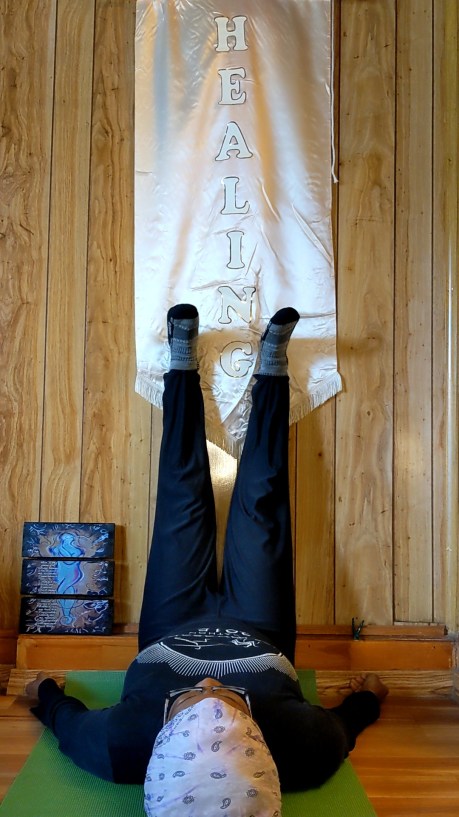
The picture above is part of my 2023 offering for the 10th annual Kiss My Asana yogathon, which benefits Mind Body Solutions (MBS). This week (April 22nd – 28th), I’m dedicated to raising awareness and resources for MBS’ life-affirming work to help people living with disabilities – and you can help too! You can help by joining me as we practice with purpose, by sharing this page, and/or by making a donation that creates opportunities for more people to practice yoga.
Mind Body Solutions provides live, online resources to people living with disabilities, worldwide. In addition to 11 live online yoga classes a week, MBS has also created a comprehensive library of recorded adaptive yoga classes for students, instructional videos for adaptive yoga teachers, and insightful interviews between our founder, Matthew Sanford, and adaptive students. It all helps people with disabilities live more fully, where they are and how they are.
Each year, in addition to hosting a fundraising page and making my personal donation, I offer a blog post and/or a YouTube post – sometimes even a whole practice. This year, part of my offering is a series of poses I’m posting on the Community page of my YouTube channel. Of course, there’s more to the poses (and pictures) than meets the eye. So, keep in mind that they – like the classes I lead – are just the tip of the iceberg.
What happens at Mind Body Solutions is the whole enchilada!
Ultimately, MBS is all about people having better relationships with their mind-body and spreading the message that a greater connection between mind and body can help us all live with improved comfort and ease.
“Happy Riḍván!” to those celebrating “the Most Great Festival.” Many blessings to anyone Counting the Omer or celebrating/observing Eastertide / the Octave of Easter!
For Those Who Missed It: The Following was originally posted as part of my Kiss My Asana offering in 2020. I have adjusted some language, added a couple of critical details, and also added class details and links. Some links connect to sites outside of this blog.
( )
– Title of the third sigur rós album, on which all songs are “sung” by jónsi (born 4/23/1975) in Hopelandic (“Vonlenska” in Icelandic)
A lot of people, myself included, find sigur rós music relaxing. I also find it visceral, something felt deep in the body. So, sometimes, when I want people to really tune in and pay attention to how they are feeling – deep in their bodies – I play sigur rós. There are albums where jónsi, who was born today in 1975, sings in Icelandic. On the third album, however, he sings in an imaginary language known as Vonlenska. Vonlenska, as identified by a journalist, first appeared in the ninth track of the band’s debut album. The song is called “Von,” the Icelandic word for “hope.” Hence the name: Volenska. Hopelandic.
Hopelandic. How can you not love that name, or the idea of a place where the native language is hope?
“it’s of course not an actual language by definition (no vocabulary, grammar, etc.), it’s rather a form of gibberish vocals that fits to the music and acts as another instrument. jónsi likens it with what singers sometimes do when they’ve decided on the melody but haven’t written the lyrics yet.”
– from the faq section of the sigur rós website
When I play sigur rós in class, I remind people that they are hearing an imaginary language, but also point out that if you listen long enough you can not only sing along you can also feel as if you understand what is being sung – if not the words (since they aren’t, technically, words), at least the sentiment. I also explain that it is a little like listening to the mind-body.
Our minds and bodies speak in sensation, that’s how they communicate information. The only problem is, we’re not always fluent in sensation. So, just like we do when we are learning a new language, we need to experience the “vocabulary” in context and then repeat and repeat them until they are ingrained. Living our lives in our bodies is a little like being immersed in a foreign language – except for the part where we can ignore all of the sensation/information and only converse in our native tongue because, in some ways, it is easier than trying to understand this language no one spends a lot of time teaching us how to understand. The physical practice of yoga (hatha yoga, regardless of the style or tradition) is a way to start learning the language.
It’s not that hard to find a yoga class, if you consider yourself able-bodied and/or of sound mind (and/or if you are not marginalized in any way). Even now, under the when there was a worldwide lockdown, there were lots of options. It may take a little effort to find a yoga practice that works for you, but it’s out there. What if, however, you (or someone around you) didn’t consider you able-bodied and/or of sound mind? What if you had been told that because you couldn’t move parts of your body on your own, couldn’t breathe without a machine, and/or didn’t feel sensation the way others felt it, you couldn’t practice yoga? What if your body didn’t look like the teacher’s body? What if you had experienced a loss or a traumatic event so devastating that it was hard to get out of bed? What if you were burnt out from taking care of people? What if a doctor told you that you were all but dead?
“Or do you need to get quiet enough to understand that some person – maybe close to you, maybe you – needs a beautiful place to come to, just to be, to come back to the purity of your existence.
And whatever’s dragged you through your life up to this point, beaten you forward to solve whatever problems, you drop all of that. And find yourself.”
– Robert Boustany describing that ‘Every answer is inside you.’
I started practicing yoga between professional dancers and musicians, people who used their bodies to make a living. They were also people (pardon the pun) very in-tune with their bodies. Then there was me, and on the first day, Robert Boustany explained that I already practiced yoga (philosophically speaking).
Because I knew Robert’s background and knew some of the people who practiced with him under various conditions, it would be decades before it occurred to me that some people thought they couldn’t practice yoga. It was heartbreaking to realize that some people were being denied a really profound internal experience, a profoundly healing experience, because of a misconception about what yoga is and what it is not. It was heartbreaking to realize that there were yoga teachers all of the world who only knew how to teach a single, sometimes stereotypical, person – especially since there are so many people in the world who are not stereotypical.
“As I write this book, I am a yoga teacher, and I still get around in a wheelchair. I teach bodies that can stand when I cannot, that can feel things where I do not. This is possible because I have explored a different kind of connection between mind and body. Although I still cannot move my legs – and have no goal to do so – I do feel a heightened level of presence throughout my entire consciousness, including my paralyzed body.
It is a connection that we all share. Most of us, however, have not needed to bring it fully to consciousness. I believe this shared connection has profound implications not just for the shape and quality of our consciousness, but for the aging process, for the experience of trauma, for our approach to disability and rehabilitation, and even for our survival on this planet.”
– quoted from the Introduction to Waking: A Memoir of Trauma and Transcendence by Matthew Sanford
Matthew Sanford is one of those people who is not stereotypical. He founded Mind Body Solutions to help those who have experienced trauma, loss, and disability find new ways to live by integrating both mind and body. Known for their adaptive yoga classes, MBS provides “traditional yoga” classes, workshops, and outreach programs. They also train yoga teachers and offer highly specialized training for health care professionals. This year’s yogathon, the 10th annual yogathon, kicked off yesterday. Seven days to practice with purpose: to do yoga, share yoga, and help others. By participating in the Kiss My Asana yogathon you join a global movement, but in a personal way. In other words, you practice yoga… for 7 days. And you can start right now!
Please join me for a 65-minute virtual yoga practice on Zoom today (Sunday, April 23rd) at 2:30 PM.Use the link from the “Class Schedules” calendar if you run into any problems checking into the class. You can request an audio recording of this practice via a comment below or by emailing myra (at) ajoyfulpractice.com.
The practices I lead are full of little bits of teaching/practice I’ve picked up from Matthew Sanford and other teachers and students at Mind Body Solutions. Plus, I’ll be posting KMA offerings on the community page on my YouTube channel.
If you’re interested in my previous KMA offerings, check out the following (some links only take you to the beginning of a series):
In the spirit of generosity (“dana”), the Zoom classes, recordings, and blog posts are freely given and freely received. Ifyou are able to support these teachings, please do so as your heart moves you. (NOTE: You can donate even if you are “attending” a practice that is not designated as a “Common Ground Meditation Center” practice, or you can purchase class(es). Donations are tax deductible; class purchases are not necessarily deductible.)
“Happy Riḍván!” to those celebrating “the Most Great Festival.” Many blessings to anyone Counting the Omer or celebrating/observing Eastertide / the Octave of Easter!
This is a “missing” post for Saturday, April 22nd. It includes some recycled quotes and re-purposed information from earlier posts. Some embedded links will take you outside of the blog. You can request an audio recording of this practice via a comment below or (for a slightly faster reply) you can email me at myra (at) ajoyfulpractice.com.
“Those who contemplate the beauty of the earth find reserves of strength that will endure as long as life lasts. There is something infinitely healing in the repeated refrains of nature — the assurance that dawn comes after night, and spring after winter.”
– quoted from Silent Spring by Rachel Carson (published 1962)
So, this week we considered the power found in waiting, waiting in community and also the power of water and light – which is akin to fire – (plus there were some references to wind). But what about Earth… and Space? And what does any of this have to do with grace, particularly shastra kripa (or, at least, one of the definitions of shastra kripa)? To get to all that we have to get grounded, dig deep, and take a little detour through another celebration related to waiting and through a yogathon.
Notice, however, that all of the references below are centered and grounded in community.
“But it seems reasonable to believe — and I do believe — that the more clearly we can focus our attention on the wonders and realities of the universe about us the less taste we shall have for the destruction of our race. Wonder and humility are wholesome emotions, and they do not exist side by side with a lust for destruction.”
– Rachel Carson accepting the John Burroughs Medal (April 1952) and printed in Lost Woods: The Discovered Writing of Rachel Carson
In addition to being the beginning of the 10th annual Kiss My Asana yogathon, today was Earth Day. While the roots of Earth Day can be found in the 1962 publication of Rachel Carson’s Silent Spring, an actual day dedicated to Earth and peace was initially proposed by John McConnell during a 1969 conferenced hosted by the United Nations Educational, Scientific and Cultural Organization (UNESCO). The very first Earth Day, as he proposed it, was held in San Francisco on March 21, 1970, to coincide with the first day of spring in the northern hemisphere. Gaylord Nelson, a United States Senator from Wisconsin, proposed a nationwide environmental teach-in and hired a young activist named Denis Hayes to organize the first national Earth Day, which was held on April 22, 1970. More than 20 million people, including then-President Richard Nixon and First Lady Pat Nixon, participated in the events on April 22, 1970, making that day one of the largest protests in the United States. (The 1970 Earth Day teach-in was the largest recorded protest until the 2020 protest after the murder of George Floyd.)
“In these troubled times it is a wholesome and necessary thing for us to turn again to the earth and in the contemplation of her beauties to know the sense of wonder and humility. There is modern truth to the ancient wisdom of the psalmist: `I will lift up mine eyes unto the hills, from whence cometh my help.’”
– quoted from Rachel Carson’s original submission to “Words to Live By” for This Week Magazine (1951)
“A determination to be outward looking in the process of community building had already become an established aspect of culture in many, many places; it has now blossomed, in a rising number of communities, into a sense of real responsibility for the spiritual and material progress of larger and larger groups within society, well beyond the membership of the Bahá’í community itself. The efforts of the friends to build communities, to engage in social action, and to contribute to the prevalent discourses of society have cohered into one global enterprise, bound together by a common framework for action, focused on helping humanity to establish its affairs on a foundation of spiritual principles.”
– quoted from the Riḍván 2022 message from the Universal House of Justice “To the Bahá’is of the World”
Thursday night marked the beginning of the twelve-day festival of Ridván, “the Most Great Festival” in the Baháʼí Faith. As I mentioned last month, the Baháʼí Faith is a monotheistic faith that believes in the oneness of God and religion, as well as the oneness and nobility of humanity. The community believes that, historically, there has been a “progressive revelation of religious truth” which has been shared with the world through the voices of the prophets or Divine Messengers, known as “Manifestations of God” (which include “Braham, Krishna, Zoroaster, Moses, Buddha, Jesus Christ, Muhammad, and, in more recent times, the Báb and Bahá’u’lláh”). People within the faith are taught to honor the value of different religious and philosophical traditions as well as the value of education, especially in science (which is viewed by some faiths as being contrary to religion).
The Bahá’í calendar begins around the Vernal (Spring) Equinox in the Northern Hemisphere and has 19 months with 19 days – each named for one of the 19 names/manifestations/attributes of God. For example, “Splendor” and “Glory” are the English translations for Bahá and Jalál, the first two months (and days) of this solar calendar. There are also 4 or 5 intercalary days that occur just before the final month and which are considered “transcendent” in nature. The calendar is partially tied to the Gregorian calendar, in that days on each calendar always correspond with each other; however, the Bahá’í calendar is very much focused around its own historical liturgy. Hence, why 2023 is the year 180 BE (Bahá’í Era).
The twelve-day festival of Ridván, one of the holiest times within the Bahá’í community, is celebrated during the second month and begins exactly one Gregorian-month after the new year. This “Most Great Festival” in the Baháʼí Faith honors the time that the founder of the Bahá’i Faith, Bahá’u’lláh waited in the original garden of Ridván prior to being exiled to Constantinople. The Arabic word ridván means “paradise” and I indicated “the original garden,” because in addition to the garden outside of Baghdad, where the great spiritual leader (considered a manifestation of the Divine) prepared for his exile, there is a second garden with the same name in Israel, which Bahá’u’lláh visited after years of exile.
The festival is a time of a sacred time of prayer, reflection, and celebration. This year’s celebrations began two hours before sunset on Thursday – with the specific timing meant to commemorate the actual time, in 1863, when Bahá’u’lláh entered the Najíbíyyih Garden with his three sons and his secretary and began to receive the visitors who wanted to wish him well before his departure. It was during this time, in the space he called “paradise,” that Bahá’u’lláh declared himself as the most recent manifestation of God; that all religious wars were repealed; that there would not be another manifestation of the God for another 1,000 years; and that the names of God (or attributes of the divine) are manifested in all things. To honor the fact that he made these announcements, the Universal House of Justice issues an annual Ridván message. They also hold elections held during this time. The first day (yesterday), the ninth day (next Saturday), and the twelfth day are considered the most holy of days. The ninth day is auspicious because it is the day the rest of Bahá’u’lláh’s family joined him in the garden and it is also the beginning of the third month, Jamál (“Beauty”).
“Besides my involvement with the Investor’s Circle, I temporarily put aside my plan for an institute and returned to the basics – an almost exclusive focus on my yoga practice. After a couple of years, I decided that it was time to share my experience with yoga and paralysis. If nothing else, I could help others who lived with disability. I started teaching an adapted yoga class at the Courage Center, a leading rehabilitation facility in a suburb of Minneapolis.
My idea was that by teaching this class, I could give something back – an obvious means to make my experience useful. What I found was much more. I thought I was teaching these students, when, in fact, they were teaching me. Neurological deficit is a frontier of mind-body integration. Working with these students has taught me that the principles of yoga are nondiscriminating – they can travel though any body.”
– quoted from “16, Falling Gracefully” in “Part Three: Yoga, Bodies, and Baby Boys” of Waking: A Memoir of Trauma and Transcendence by Matthew Sanford
As I have mentioned before, my first exposure to the physical practice of yoga was also my first exposure to Yoga Philosophy and to the fact that anyone and everyone can practice yoga. Sometimes we stumble upon the practice that works for us. However, sometimes it takes an extra effort to find the practice (and the teacher) that works for our particular mind-bod-spirit. In fact, it wasn’t until I took my first yoga teacher training that I really realized how many people weren’t practicing, because they didn’t know they could practice. Even worse, some people had been told that they couldn’t practice – which is heartbreaking.
Still, I believed (and continue to believe) in the transformative, healing, and joyful experience of yoga. I also still believe there is a practice for every mind/body/spirit – every veteran, every person with disability, every survivor of sexual assault and other trauma, every elderly person, every person living with chronic pain, every person with a terminal illness, and every caregiver. I am joyfully participating in the Kiss My Asana yogathon for the 10th year in a row, because Mind Body Solutions is helping people find their practice!
The Kiss My Asana yogathon is an annual event that raises awareness and resources for Mind Body Solutions and their life-affirming work to help people living with disabilities. Best known for their Adaptive Yoga Program, which provides adapted yoga opportunities for people around the globe, MBS currently provides live, online resources to people living with disabilities, worldwide. In addition to 11 live online yoga classes a week, MBS has also created a comprehensive library of recorded adaptive yoga classes for students, instructional videos for adaptive yoga teachers, and insightful interviews between the founding teacher, Matthew Sanford, and adaptive students. In the past, MBS has also offered training and workshops for yoga teachers, healthcare professionals, and caregivers (so they can share this work in their communities, too).
All of this helps people with disabilities live more fully, where they are and how they are. Ultimately, however, Mind Body Solutions is all about everyone having better relationships with their mind-body and spreading the message that a greater connection between mind and body can help us all live with improved comfort and ease. So, we can all benefit from the practice, because we all experience trauma, loss, and disability in some way shape or form.
The yogathon started as a month-long endeavor, but switched to a 7-day yogathon in 2020. This week (April 22nd – 28th) I’m planning to practice with purpose. I’m going to “Do Yoga. Share Yoga. Help Others.” – and you can join me! The practices I lead will be full of little bits of teaching/practice I’ve picked up from Matthew Sanford and other teachers and students at Mind Body Solutions. Plus, I’ll be posting on the community page on my YouTube channel.
If you’re interested in my previous KMA offerings, check out the following (some links only take you to the beginning of a series):
Saturday’s playlist is available on YouTube and Spotify. [Look for “0422020 Earth Day”]
What’s this?
Dandasana (“Staff Pose”)
Have you subscribed to my YouTube page? It’s mostly playlists, plus a few mini-practices and videos from previous yogathons. Starting later tonight, I’m also going to be posting on my community page as part of my 2023 Kiss My Asana offering. So, check it out if you want to know more about the pose pictured above (and why we’re doing it).
Please wear loose, comfortable clothing and make sure you are well hydrated before the practice. It is best to practice on an empty stomach (especially for the 108 ajapa-japa mala), but if you must eat less than 1 hour before the practice, make sure to keep it light. Make sure to have a towel (at the very least) for the 108 practice. For Yin Yoga, a pillow/cushion or two, blocks or (hardcover) books, and a blanket or towel will be useful. I always recommend having something handy (pen and paper) that you can use to note any reflections.
Use the link above for login information (or click here for more details about these practices and other practice opportunities related to the New Year).
The 108 playlist is available on YouTube and Spotify. [Look for “New Year’s Day 108 Ajapa-Japa Mala.”] NOTE: This playlist has been revised for 2022, but should still sync up with the 2021 recordings.
The Yin+Meditation playlist is part of the “12042020 Bedtime Yoga” available on YouTube and Spotify.
Please note that there is still no late admittance and you must log in before the beginning of the practice (so, by 9:45 AM for the 108 or by 4:45 PM for the Yin+Meditation). You will be re-admittance if you get dumped from the call.)
Part of the 6-piece “Monumental Moments” series by Anthony Shumate, 2015 (located in Buffalo Bayou Park, along the Kinder Footpaths)
Part of the 6-piece “Monumental Moments” series by Anthony Shumate, 2015 (located in Buffalo Bayou Park, along the Kinder Footpaths)
*Anthony Shumate’s “Monumental Moments” sculptures are located in Buffalo Bayou Park, along the Kinder Footpaths in Houston, Texas. They are unexpected reminders to “Explore,” “Pause,” “Reflect,” “Listen,” “Emerge,” and “Observe” – all things we do in our practice!
“Kwanzaa, yenu iwe na heri!” – “May your Kwanzaa be happy!” to everyone who is celebrating!
The commentary below was originally posted for the fifth day of Kwanzaa 2020 (which was Friday in 2022) AND included information about the annual New Year’s Day practices. There was no class today, but you can always request the audio recording, from 2020, via a comment below or (for a slightly faster reply) you can email me at myra (at) ajoyfulpractice.com. The New Year’s information has been updated!
The playlist for the fifth day of Kwanzaa is available on YouTube and Spotify. [Look for “12302020 Purpose Driven”]
NOTE: A track may not play due to artists’ protests.
In the spirit of generosity (“dana”), the Zoom classes, recordings, and blog posts are freely given and freely received. If you are able to support these teachings, please do so as your heart moves you. (NOTE: You can donate even if you are “attending” a practice that is not designated as a “Common Ground Meditation Center” practice, or you can purchase class(es). Donations are tax deductible; class purchases or donations for New Year’s Day are not necessarily deductible.]
“There are, of course, inherent tendencies to repetition in music itself. Our poetry, our ballads, our songs are full of repetition; nursery rhymes and the little chants and songs we use to teach young children have choruses and refrains. We are attracted to repetition, even as adults; we want the stimulus and the reward again and again, and in music we get it.”
– quoted from Musicophilia: Tales of Music and the Brain by Dr. Oliver Sacks
For those of you keeping count, Wednesday and Thursday make up we’ve reached the 5th, 6th, and/or 7th “Days of Christmas” (depending on when you start counting). According to the catechism myth attached to the “12 Days of Christmas” song, the gifts for these days translates to: “a partridge in a pear tree” for Jesus (and the cross); “two turtle doves” representing the Old and New Testament; “three French Hens” for the theological virtues of Faith, Hope, and Charity (Love); “four calling birds” for the four canonical New Testament Gospels (or their corresponding evangelicals, Matthew, Mark, Luke, and John); “five gold rings” are the first Five Books of the Hebrew Bible and the Christian Old Testament (which provide the back story for the three Abrahamic religions); “six geese a-laying” for the six days of creation; and “seven swans a-swimming,” the consistently most expensive gift, stand for the seven gifts of the Holy Spirit (wisdom, understanding, knowledge, counsel, fortitude, piety, and fear of the Lord) or the seven sacraments (Baptism, Eucharist, Confirmation, Reconciliation, Anointing of the Six, Marriage, and Ordination).
Given the Oliver Sacks quote above, you might wonder if that musical “stimulus and reward” are the only reason I keep repeating aspects of this myth (that even advocates accept is not historically true). The truth is that while there is something truly appealing, on a musical level, to the whole idea, the main reason I keep referring back to myth is because it serves a purpose. And, if we’re going to talk about faith, we have to talk about purpose.
There was a time when everything people did had purpose, had meaning. Rituals were the way people made sense of the world and the way people stayed connected to each other and to what they valued. This is another reason why I like the “12 Days of Christmas” catechism idea. Over time, however, some rituals lost their meaning – or people became separated from the meaning. Rituals separated from their meaning became traditions; behavior people did because their elders taught them the ways of their ancestors… but without the deeper connection. In some cases, people lost so much of the meaning, became so separated from the meaning, that they were just things people said. I could be wrong about this, but I partially blame the Age of Enlightenment / Age of Reason for some of that lost / disconnected meaning.
The 18th Century Age of Enlightenment / Age of Reason, which was preceded by the emergence of the modern sciences, was a time when people started feeling confident in their ability to find the reason behind all the mysteries in the world. Don’t get me wrong; there were, and are, still great unknowns / mysteries in the world. But, as the Western world (in particular) started moving out of the Middle Ages, there was a steadfast belief that the answers to everything were available to the human mind. As more and more people focused on “finding the truth,” some moved away from mysticism – and, when as there was less acceptance of mystery and less acceptance of the unknown, there was less “need” for ritual. Or so it would seem. The truth, however, is that even as we gained knowledge and lost mystery, humans craved ritual. In fact, some would say that our brains are wired for ritual.
“And I actually think one of the great things about getting older, about being in my 50s, they say that when we’re younger our brains are tuned to novelty, to be animated by novelty. But as you get older, you’re less tuned to novelty and I would say more naturally attuned to kind of take pleasure in what is ordinary and habitual. And I think that’s a great gift.”
– Krista Tippett, being interviewed by Pico Iyer, about her book Becoming Wise: An Inquiry into the Mystery and Art of Living, on “The Mystery & Art if Living” episode of On Being (with Krista Tippett (July 10, 2016)
In the 19th and 20th centuries, the social pendulum swung back and people started seeking ritual, returning to mystery and mysticism as well as the comfort that can be found in repeated behavior. We see this in the resurgence of the physical practice of yoga in India and to the way the practice eventually spread into the Western world. We also see this in the emergence of mega churches and the wave of young women considering the convent. We even see this in the fact that some atheists have “church.” The only problem with this swing back to ritual was that sometimes people overlooked what was gained during the Age of Enlightenment / Age of Reason and focused on the outer (superficial) aspects of rituals rather than the inward (meaning-filled) experience. Moving into the end of the 20th century and the beginning of the 21st century, this trend led people to spend copious amounts of money trying to recreate ancient rituals that were previously free – all to get that deeper feeling of connection. The problem was the lasting connection people were seeking doesn’t come from the outside. Yes, we can see it on the outside. Absolutely! But, deep, lasting, sustainable connection starts with an internal purpose.
A key aspect to ritual is the purpose behind what is done, how it is done, and when (i.e., the order in which it is done). Again, everything has a purpose and that purpose reinforces the repeated behavior which, in turn, reinforces the connection to others observing the ritual. In fact, that reinforcement of connection is another purpose found in ritual. A perfect example of this is the repetition of prayer or chanting, especially when there is an embodied component. The embodied component could be someone praying with a rosary, chanting with mala beads, whirling (in the Sufi tradition), or practicing 108 Sun Salutations; either way, there are very specific ways that the words are uttered or thought and very specific ways the body moves – even when it is just the fingers and the hands moving.
In Sanskrit, such a ritual is referred to as ajapa-japa, “without (mental effort) effort repeat-repeat” or “repeat and remember”. Over time, the practice reinforces itself in such a way that it turns into itself and, in doing so, turns the practitioner inward. Over time, the meaning of the words and/or movement is completely embodied so that there is seamlessness between the doer and the doing. The practice becomes ingrained. It becomes like breathing, which can be another form of ajapa-japa.
I could go into all kinds of scientific detail about how this happens and why it works. But, just for a moment, be open to the mystery… and just focus on the purpose.
“You can perform japa, repetition of a mantra or Sacred Word, in the midst of your day-to-day work. Then, when it becomes a habit, even when you are working intensely a portion of the mind will keep repeating the mantra always. That means you have locked one end of your chain to a holy place, while the rest of the chain remains still in the outside world.”
– a note written by Swami Satchidananda, quoted in Sri Swami Satchidananda: Apostle of Peace by Sita (Joan Weiner) Bordow
Feast / Holy Days are celebrations of sacred mysteries and significant events. Note that even when the focus is tied to a specific person (martyr or saint, including Jesus and the Virgin Mary), there is a connection to miracles, which are beyond science – in other words, more mystery). In addition to serving the purpose of commemoration / remembrance, feast days stimulate excitement around spirituality and help people embody the stories and history of their faith. In Christianity, particularly in the Catholic tradition, the order of the feast / holy days (throughout the year) is its own ritual storytelling. In fact, the Roman Catholic Church has a history of calendar reforms that have served the purpose of reinforcing the liturgical aspects of their rituals, thereby bringing faith into the foreground of people’s lives. Keep in mind, however, that this tradition did not start with the Christianity. The Hebrew Bible is full of commands from God about what to do, when to do it, and how to do it.
“The philosopher Abraham Kaplan calculated that over 60 percent of Judaism’s 613 commandments involve physical ritual: lighting candles, ritual baths, etc. These deeds are a kind of language, a way of expressing things that are too deep for words.”
– quoted from a New York Times letter to the editor entitled, “There Should Be More Rituals” by David Brooks (dated April 22, 2019)
Kwanzaa, the African-American holiday of light, incorporates rituals and traditions from several different faiths and several different cultures. As is often the case, these rituals are centered around symbolic objects: a mkeka (“mat”); kinara (“candelabra”); Mishumaa Saba (“seven candles,” one black, three red, and three green which symbolize the Black community, the historical struggles faced by the community, and the future possibilities of the community); mazao (“crops”); Muhindi (decorative as well as edible “corn”); a Kikombe a cha Umoja (“unity cup”); and Zawadi (ceremonial “gifts”). People often incorporate kente cloth and other Afrocentric decorations, such as black, red, and green Pan-African flag.
During Kwanzaa celebrations, people take a moment to pause and reflect, focus, concentrate, meditate, and contemplate one of the Nguzo Saba (“seven essential pillars”). On December 30th, the fifth day of Kwanzaa, people focus on the principle of Nia (“purpose”): To make our collective vocation the building and development of our community in order to restore our people to their traditional greatness. In other words, there is a reminder, in the middle of the week, that this is a purpose driven festival and that the future of the community depends on people being purpose driven in a way that brings about individual and collective healing.
When I started thinking about the posts and classes for this week, and in particular about how to address the fifth principle of Kwanzaa, I wanted to offer little bits of purpose about everything we were doing in the physical practice and also bits of purpose about various celebrations happening around the world. In considering all the different celebrations that fit under the rubric of ritual, and all the purposes behind the ways people are currently celebrating their holidays, it occurred to me that all these rituals share two common purposes: they bring people together (in peace) and they bring people closer to something bigger than themselves, something Universal, something Divine (whatever that means to you at this moment).
“My research over the last decade has helped understand why rituals in particular (and not any other behaviors like habits, for instance) are effective at battling negative emotions. Be it anxiety, stress, fear, doubt, sadness, grief – you name it. Rituals are there to save the day. The dread we feel after experiencing a loss happens because it feels like the situation is outside our control (and it usually is). Rituals reinstate that control.
Consider, for instance, in moments of grief, rituals help ease our pain and suffering. But, again I ask, how do they do this, and why rituals in particular? As my collaborators Mike Norton and Francesca Gino have shown, rituals alleviate feeling of grief and loss by increasing a feelings of control.”
– quoted from “The emerging science of ritual – a new look on an ancient behavior: And how you can use it to live life to the fullest” by Dr. Nick Hobson (contributing to the ThriveGlobal.com, Dec. 7, 2017)
For over a decade, I have started the New Year by leading at least one 3-hour japa-ajapamala of 108 Sun Salutations. For the last several years, I have wrapped up New Year’s Day with a 2-hour Yin+Meditation practice. The practices are very, very different. Although we do mix it up and break it down a little (so that it is accessible to everyone), the 108 mala is very vigorous and repeats 12 poses in a very specific sequence. (You can see some of the reasons for that number here and here.) The Yin+Mediation combines the meditative aspects of deep seated mediation with specific poses held 3 – 5 minutes in order to address the deep tissue, joints, and connective tissue. Props are useful for both practices, but are definitive part of the Yin Yoga practice – and you can use some household items as props.
So, the practices are very different and yet they both help us to move through this liminal or “threshold” time between the old and the new years. Also, they each incorporate key elements of ritual and allow us to tap into the power of intention as well as community.
This year is different, obviously. Because of the pandemic we are on Zoom for both events (which means that there is no limit to the number of participants). It will feel different as we won’t be so close together and, unless you have your heat turned up, the 108 might not steam up the windows or get your walls all slimy.
However, for all that is different, there are some things that stay the same. I will still keep count and guide you through the experience. We will still set intentions and dedications for each round and plant some karmic seeds. We will still have the opportunity to “burn some karma” in the 108 and release some tension (in both practices). We will still have moments of reflection and insight – and, whatever comes, we will still begin and end and move through it all together.
Please note that there is still no late admittance and you must log in before the beginning of the practice (so, by 9:45 AM for the 108 or by 4:45 PM for the Yin+Meditation). You will be re-admitted if you get dumped from the call.)
Umoja (unity)—To strive for and maintain unity in the family, community, nation, and race.
Kujichagulia (self-determination)—To define ourselves, name ourselves, create for ourselves, and speak for ourselves.
Ujima (collective work and responsibility)—To build and maintain our community together and make our brother’s and sister’s problems our problems and to solve them together.
Ujamaa (cooperative economics)—To build and maintain our own stores, shops, and other businesses and to profit from them together.
Nia (purpose)—To make our collective vocation the building and development of our community in order to restore our people to their traditional greatness.
Kuumba (creativity)—To do always as much as we can, in the way we can, in order to leave our community more beautiful and beneficial than we inherited it.
Imani (faith)—To believe with all our heart in our people, our parents, our teachers, our leaders, and the righteousness and victory of our struggle.”
– The Nguzo Saba (or “Seven Essential Pillars”) of Kwanzaa
A portion of the following was originally posted in 2020. Class details and links have been added.
“‘Keep, ancient lands, your storied pomp!’ cries she
With silent lips. ‘Give me your tired, your poor,
Your huddled masses yearning to breathe free,
The wretched refuse of your teeming shore.
Send these, the homeless, tempest-tost to me,
I lift my lamp beside the golden door!’”
– from the poem “The New Colossus” by Emma Lazarus
Today (August 5th) in 1884, when the cornerstone of the Statue of Liberty’s pedestal was placed on a rainy Bedloe’s Island, it seemed impossible to complete the project meant to be a testament to freedom, friendship, and the spirit of the people. People in France provided the funds for the statue designed by the sculptor Frédéric-Auguste Bartholdi (with scaffolding created by Gustave Eiffel), while people in the United States were meant to pay for the base and pedestal designed by Richard Morris Hunt. The only problem was that the Americans were short…about $100,000 short.
Hunt’s design for the pedestal and base incorporated the eleven-point star foundation of the army fort (Fort Wood) which had been built in 1807 and abandoned during the Civil War. He always intended his design to be simple, so as not to take away from the statue itself, but raising money for his design turned out to be such a challenge that he scrapped twenty-five feet from the height of his original design. He also cut back on materials so that instead of the pedestal and base being constructed entirely out of granite, he had to make do with concrete walls covered with a granite-block face. His cost cutting measures still might not have been enough if a certain newspaper man hadn’t decided to tap into the spirit of the people and, in doing so, overcame what some viewed as an impossible obstacle. That newspaper man was Joseph Pulitzer and on March 16, 1885 he implored people in the United States to give what they could, even if it was a penny, in order to pay for the base and pedestal of the Statue of Liberty. Starting with an ad and a series of front page editorials, he was able to crowd fund over $100,000 in about 5 months.
“We must raise the money! The World is the people’s paper, and now it appeals to the people to come forward and raise the money. The $250,000 that the making of the Statue cost was paid in by the masses of the French people – by the working men, the tradesmen, the shop girls, the artisans – by all, irrespective of class or condition. Let us respond in like manner. Let us not wait for the millionaires to give us this money. It is not a gift from the millionaires of France to the millionaires of America, but a gift of the whole people of France to the whole people of America.
Take this appeal to yourself personally. It is meant for every reader of The World. Give something, however little. Send it to us. We will receive it and see that it is properly applied.”
– quoted from The New York World editorial by Joseph Pulitzer, 1885
Joseph Pulitzer offered people a six inch metal replica of Lady Liberty (described as a “perfect fac-simile”) if they donated a dollar to the “Pedestal Fund” established by Pulitzer’s paper the New York World and a twelve inch replica if they donated $5. While that may not seem like a lot today, keep in mind that this was after the Financial Panic of 1873 (which created a depression in the United States and Europe). Also, interest seemed to be in short supply since the United States was still trying to recover from the Civil War – which left many Americans desiring heroic public art rather than allegorical public art. But, Joseph Pulitzer had a way with words and there were a group of people – immigrants – who were inspired to donate specifically because of the symbolism of the statue. Ultimately, over 125,000 people donated – most donating a dollar or less. They not only donated to receive the replicas, they donated via auctions, lotteries, and boxing matches. They donated by depriving themselves of things they needed or things they wanted. Some kids donated by pooling their “circus” and candy money. Some adults donated what they would normally spend on drinks. At the end of the fundraising, Joseph Pulitzer printed every donor’s name in the New York World – regardless of how little or how much they donated.
The cornerstone is the first stone set in the foundation of a building or structure. All other stones are set in reference to the cornerstone; thereby making it the very foundation of the foundation. It determines the overall position of the structure and is often placed with a certain amount of pomp and circumstance. It is usually inscribed with the date of its placement and often includes a time capsule, which includes some clues as to what was important to the people who attended the ceremony. Such was the case with Lady Liberty’s pedestal cornerstone, which was placed over a square hole dug for a copper time capsule. The time capsule contained a number of articles, including the Declaration of Independence and the Constitution of the United States – both documents considered to be the cornerstones of the United States and the ultimate law of the land.
Although we don’t always think of it this way, one of the cornerstones of the legal system in a commonwealth is a bar. It might be wooden railing, it might be metal railing; however, historically, this bar separated those within the legal profession (specifically the judge and those who had business with the court) from everyone else. In particular, “everyone else” referred to law students whose aspirations were to “pass the bar” – meaning they would be on the other side of the symbolic railing. This symbolic railing is also used to refer to professional organizations, membership in which is sometimes required in order for an attorney to practice law in a particular jurisdiction. Let’s skip “state bars” for a second and just focus on “voluntary” bar associations – which, in the United States are private organizations which serve as social, educational, and lobbying organizations. Legal professionals can not only use these bar associations to network with other professionals and the general public (hence expanding their practice), they can also advocate for law reform. I place “voluntary” in quotes, because I’m not sure how possible it is to practice law in the United States without being a member of a “bar association” (not to be confused with a state bar).
Even if it’s possible to practice without being a member of a bar association – and I trust one of you lawyer yogis will educate me with a comment below – I imagine it would be quite challenging (maybe even impossible) to successfully practice. Especially, back when there was only one major bar association in the United States. And, especially back in the 1920’s when your race and gender prevented you from joining said association. Such was the plight of Gertrude Rush (née Durden), born today (August 5th) in 1880 in Navasota, Texas. Ms. Rush not only became the first African-American woman to be admitted to the Iowa (state) bar, for about 32 years she was (sometimes) the ONLY female attorney practicing in the state of Iowa (1918 – 1950). She placed a particular emphasis on women’s (legal) rights in estate cases and had a passion for religion, extensively studying the 240 women whose stories are featured in the Bible. Many within the local court referred to her as the “Sunday school lawyer.” She took over her husband’s law practice and, in 1921 (just a year after women’s right to vote was ratified by the United States Congress) she was elected the president of the Colored Bar Association; however, it was impossible for her to be admitted to the American Bar Association. She tried. So, did several other African-American lawyers. They tried because the ABA had one Black lawyer and was, therefore “integrated.” Eventually, however, they stopped trying to join an organization that didn’t want them and started their own organization.
“…a very worn Bible is almost as prominent as the well-thumbed Iowa code on the desk of Mrs. Gertrude E. Rush.”
– quoted from “Iowa’s Only Negro Woman Lawyer Firmly on the Golden Rule” article about Gertrude Rush, located in Iowa Public Library (excerpt printed in Notable Black American Women, Book 2 by Jessie Carney Smith
Gertrude Rush was one of the founding members of the Negro Bar Association, which was incorporated on August 1, 1925 with 120 members (which was about 11 – 12% of the Black lawyers in the US at the time). Eventually renamed, the National Bar Association, the NBA ” addressed issues such as professional ethics, legal education, and uniform state laws, as well as questions concerning the civil rights movement in transportation discrimination, residential segregation, and voting rights.” The NBA supported civil rights groups by providing legal information, filing outside legal briefs (amicus curiae), and blocking federal court nominees who opposed racial equality. As a bar association, however, the NBA did not directly participate in civil rights activities. Instead, NBA members like Gertrude Rush and (eventual) Supreme Court Justice Thurgood Marshall became members of the NAACP (National Association for the Advancement of Colored People).
It was as part of the NAACP’s legal team that Justice Marshall argued cases like Donald Gaines Murray in Murray v. Pearson, 169 Md. 478, 182 A. 590 (1936) and Brown v. Board of Education of Topeka, 347 U.S. 483 (1954). Raymond Pace Alexander founded the National Bar Journal (1941), which became a way for Black lawyers to challenge legal principles which conflicted with the interest of African-Americans. The Rev. W. Harold Flowers, a co-founder with Ms. Rush and a former president of the NBA (who would eventually be appointed as an associate justice of the state Court of Appeals), was the attorney whose motions in 1947 resulted in a reconfigured jury after he pointed out that the Arkansas court had not had a Black juror in 50 years. Additionally, the NBA established free legal clinics in 12 states, thereby creating the foundational cornerstone for the poverty law and legal clinics of today.
Gertrude Rush was also one of the organizers of the Charity League, which coordinated the hiring of a Black probation officer for the Des Moines Juvenile Court; created the Protection Home for Negro Girls, a shelter; and served on the boards of a host of other women’s organizations. She also served as a delegate to the Women’s Convention (WC), which was a political auxiliary to the National Baptist Convention (NBC).
“In 1919 Mrs. Gertrude Rush, a prominent black lawyer and [WC] delegate from a Baptist church in Des Moines, Iowa, posited that the vote would enable women to fight for better working conditions, higher wages, and greater opportunities in business. Through suffrage, Rush maintained, women could better regulate moral and sanitary conditions, end discrimination and lynch law, obtain better educational opportunities, and secure greater legal justice.”
– quoted from “Religion, Politics, and Gender: The Leadership of Nannie Helen Burroughs” by Evelyn Brooks Higginbotham (Chapter 8 of This Far By Faith: Readings in African-American Women’s Religious Biography, edited by Judith Weisenfeld & Richard Newman)
Please join me on Zoom (tonight), Friday, August 5, 2022, 7:15 PM – 8:20 PM (CST), for “The Impossible Cornerstones of Lady Liberty and Lady Justice” (a “restorative” practice featuring pawanmuktasana and gentle movement inspired by Somatic Yoga and Universal Yoga).
Use the link from the “Class Schedules” calendar if you run into any problems checking into the class. You can request an audio recording of this practice via a comment below or by emailing myra (at)ajoyfulpractice.com.
Prop wise, you will mostly need something that allows you to be comfortable when seated, prone, and/or supine. There may also be some kneeling. [NOTE: You can always practice without props or use “studio” props and/or “householder” props. Example of Commercial props: 1 – 2 blankets,2 – 3 blocks, a bolster, a strap, and an eye pillow. Example of Householder props: 1 – 2 blankets or bath towels, 2 – 3 books (similar in size), 2 standard pillows (or 1 body pillow), a belt/tie/sash, and a face towel.]
You may want extra layers (as your body may cool down during this practice). Having a wall, chair, sofa, or coffee table may be handy for this practice.
NOTE: If you interested in a more active practice related to this date, check out the “Lady Liberty” post and playlists from June 17th.
In the spirit of generosity (“dana”), the Zoom classes, recordings, and blog posts are freely given and freely received. If you are able to support these teachings, please do so as your heart moves you. (NOTE: You can donate even if you are “attending” a practice that is not designated as a “Common Ground Meditation Center” practice, or you can purchase class(es). Donations are tax deductible; class purchases are not necessarily deductible.)
ERRATA: The original post listed the wrong year for the Statue of Liberty’s cornerstone placement.
“We’re kind of a family – a huge, expanded family. And we can do any number of things, because each one of us is going to do a different thing. But mostly we’re just going to try and be groovy, and (uh) spread that grooviness to everybody.”
*
– Wavy Gravy being interviewed at the John F. Kennedy airport in August 1969 (about Hog Farm’s participation at the Woodstock Music and Art Fair)
Please join mefor a 65-minutevirtual yoga practiceon Zoom today(Sunday, May 15th)at 2:30 PM. You can use the link from the “Class Schedules” calendar if you run into any problems checking into the class. You can request an audio recording of this practice via a comment belowor (for a slightly faster reply) you can email me at myra (at) ajoyfulpractice.com.
Sunday’s is available on YouTube and Spotify. [Look for ”05152022 Still (Not) Clowning Around”]
NOTE: Due to artist protests, one song may not play on Spotify. As I support artists in their efforts to bring about change, I am not re-mixing affected playlists because of the protests. This particular remix was due to additional content.
In the spirit of generosity (“dana”), the Zoom classes, recordings, and blog posts are freely given and freely received. If you are able to support these teachings, please do so as your heart moves you. (NOTE: You can donate even if you are “attending” a practice that is not designated as a “Common Ground Meditation Center” practice, or you can purchase class(es). Donations are tax deductible; class purchases are not necessarily deductible.)
Happy Riḍván!” to those celebrating the “the Most Great Festival.” “Ramadān Mubarak, Blessed Ramadān!” to anyone observing the holy month of Ramadān. Many blessings to all, and especially to those celebrating or observing Eastertide or Counting the Omer!
I’m excited to once again participate in the Kiss My Asana yogathon, which is Mind Body Solutions‘ biggest fundraiser and a way to spread the message that a greater connection between mind and body can help all of us live with improved comfort and ease, no matter our condition, age, or ability.
I started Joyfully participating in the 2014 yogathon because I believe in the transformative, healing, and joyful experience of yoga. I also believe there is a practice for every mind/body/spirit – every veteran, every person with disability, every survivor of sexual assault and other trauma, every elderly person, every person living with chronic pain, every person with a terminal illness – and Mind Body Solutions is helping people find their practice!
Mind Body Solutions’ mission and message reach all walks of life – people living with disabilities, terminal illness, chronic pain, trauma, and PTSD – to name a few. Best known for their Adaptive Yoga Program, which provides adapted yoga opportunities for people around the globe. MBS also offers training and workshops for yoga teachers, healthcare professionals, and caregivers (so they can share this work in their communities, too).
Each year, in addition to hosting a fundraising page and making my personal donation, I offer a blog post and/or a YouTube post – sometimes even a whole practice. This year, I am making videos highlighting different parts of our bodies and, in doing so, different parts of our lived experience. Many more connections exist than the ones I’m highlighting. So, keep in mind that these videos – like the classes I lead – are just the tip of the iceberg.
What happens at Mind Body Solutions is the whole enchilada!
If you have two more minutes to spare, I’d recommend you also check out the Mind Body Solutions video (below) so you can see exactly how your donation will help! Thank you for taking the time and for showing your support – and don’t forget to forward this to anyone who you think might want to donate or join!
Happy Riḍván!” to those celebrating the “the Most Great Festival.” “Ramadān Mubarak, Blessed Ramadān!” to anyone observing the holy month of Ramadān. Many blessings to all, and especially to those celebrating or observing Eastertide or Counting the Omer!
The links in this particular post will take you outside of my blog. Quick Update: Thanks to all of you, I have helped raise 1% of the yogathon’s overall goal! If a few more people donate, I could double my personal goal and help raise 2% of the overall goal. Please consider donating today!
I’m excited to once again participate in the Kiss My Asana yogathon, which is Mind Body Solutions‘ biggest fundraiser and a way to spread the message that a greater connection between mind and body can help all of us live with improved comfort and ease, no matter our condition, age, or ability.
I started Joyfully participating in the 2014 yogathon because I believe in the transformative, healing, and joyful experience of yoga. I also believe there is a practice for every mind/body/spirit – every veteran, every person with disability, every survivor of sexual assault and other trauma, every elderly person, every person living with chronic pain, every person with a terminal illness – and Mind Body Solutions is helping people find their practice!
Mind Body Solutions’ mission and message reach all walks of life – people living with disabilities, terminal illness, chronic pain, trauma, and PTSD – to name a few. Best known for their Adaptive Yoga Program, which provides adapted yoga opportunities for people around the globe. MBS also offers training and workshops for yoga teachers, healthcare professionals, and caregivers (so they can share this work in their communities, too).
Each year, in addition to hosting a fundraising page and making my personal donation, I offer a blog post and/or a YouTube post – sometimes even a whole practice. This year, I am making videos highlighting different parts of our bodies and, in doing so, different parts of our lived experience. Many more connections exist than the ones I’m highlighting. So, keep in mind that these videos – like the classes I lead – are just the tip of the iceberg.
What happens at Mind Body Solutions is the whole enchilada!
If you have two more minutes to spare, I’d recommend you also check out the Mind Body Solutions video (below) so you can see exactly how your donation will help! Thank you for taking the time and for showing your support – and don’t forget to forward this to anyone who you think might want to donate or join!



 ###
### A Joyful Practice