“Happy Riḍván!” to those celebrating “the Most Great Festival.” Many blessings to anyone Counting the Omer or celebrating/observing Eastertide / the Octave of Easter!
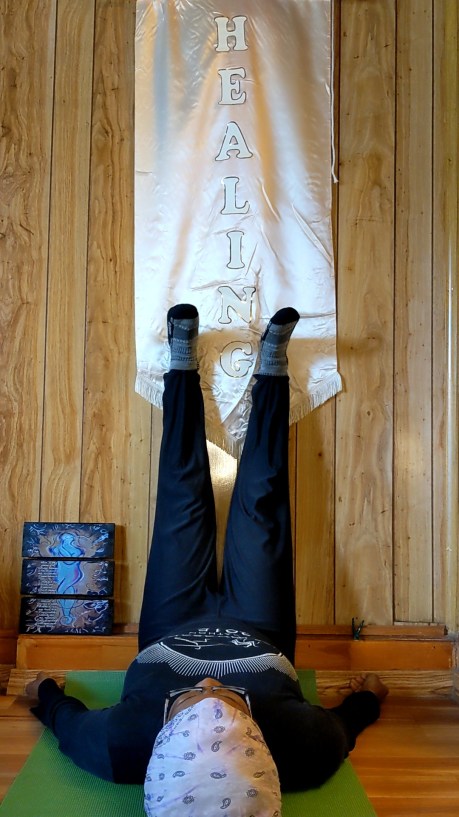
The picture above is part of my 2023 offering for the 10th annual Kiss My Asana yogathon, which benefits Mind Body Solutions (MBS). This week (April 22nd – 28th), I’m dedicated to raising awareness and resources for MBS’ life-affirming work to help people living with disabilities – and you can help too! You can help by joining me as we practice with purpose, by sharing this page, and/or by making a donation that creates opportunities for more people to practice yoga.
Mind Body Solutions provides live, online resources to people living with disabilities, worldwide. In addition to 11 live online yoga classes a week, MBS has also created a comprehensive library of recorded adaptive yoga classes for students, instructional videos for adaptive yoga teachers, and insightful interviews between our founder, Matthew Sanford, and adaptive students. It all helps people with disabilities live more fully, where they are and how they are.
Each year, in addition to hosting a fundraising page and making my personal donation, I offer a blog post and/or a YouTube post – sometimes even a whole practice. This year, part of my offering is a series of poses I’m posting on the Community page of my YouTube channel. Of course, there’s more to the poses (and pictures) than meets the eye. So, keep in mind that they – like the classes I lead – are just the tip of the iceberg.
What happens at Mind Body Solutions is the whole enchilada!
Ultimately, MBS is all about people having better relationships with their mind-body and spreading the message that a greater connection between mind and body can help us all live with improved comfort and ease.
“Happy Riḍván!” to those celebrating “the Most Great Festival.” Many blessings to anyone Counting the Omer or celebrating/observing Eastertide / the Octave of Easter!
For Those Who Missed It: The Following was originally posted as part of my Kiss My Asana offering in 2020. I have adjusted some language, added a couple of critical details, and also added class details and links. Some links connect to sites outside of this blog.
( )
– Title of the third sigur rós album, on which all songs are “sung” by jónsi (born 4/23/1975) in Hopelandic (“Vonlenska” in Icelandic)
A lot of people, myself included, find sigur rós music relaxing. I also find it visceral, something felt deep in the body. So, sometimes, when I want people to really tune in and pay attention to how they are feeling – deep in their bodies – I play sigur rós. There are albums where jónsi, who was born today in 1975, sings in Icelandic. On the third album, however, he sings in an imaginary language known as Vonlenska. Vonlenska, as identified by a journalist, first appeared in the ninth track of the band’s debut album. The song is called “Von,” the Icelandic word for “hope.” Hence the name: Volenska. Hopelandic.
Hopelandic. How can you not love that name, or the idea of a place where the native language is hope?
“it’s of course not an actual language by definition (no vocabulary, grammar, etc.), it’s rather a form of gibberish vocals that fits to the music and acts as another instrument. jónsi likens it with what singers sometimes do when they’ve decided on the melody but haven’t written the lyrics yet.”
– from the faq section of the sigur rós website
When I play sigur rós in class, I remind people that they are hearing an imaginary language, but also point out that if you listen long enough you can not only sing along you can also feel as if you understand what is being sung – if not the words (since they aren’t, technically, words), at least the sentiment. I also explain that it is a little like listening to the mind-body.
Our minds and bodies speak in sensation, that’s how they communicate information. The only problem is, we’re not always fluent in sensation. So, just like we do when we are learning a new language, we need to experience the “vocabulary” in context and then repeat and repeat them until they are ingrained. Living our lives in our bodies is a little like being immersed in a foreign language – except for the part where we can ignore all of the sensation/information and only converse in our native tongue because, in some ways, it is easier than trying to understand this language no one spends a lot of time teaching us how to understand. The physical practice of yoga (hatha yoga, regardless of the style or tradition) is a way to start learning the language.
It’s not that hard to find a yoga class, if you consider yourself able-bodied and/or of sound mind (and/or if you are not marginalized in any way). Even now, under the when there was a worldwide lockdown, there were lots of options. It may take a little effort to find a yoga practice that works for you, but it’s out there. What if, however, you (or someone around you) didn’t consider you able-bodied and/or of sound mind? What if you had been told that because you couldn’t move parts of your body on your own, couldn’t breathe without a machine, and/or didn’t feel sensation the way others felt it, you couldn’t practice yoga? What if your body didn’t look like the teacher’s body? What if you had experienced a loss or a traumatic event so devastating that it was hard to get out of bed? What if you were burnt out from taking care of people? What if a doctor told you that you were all but dead?
“Or do you need to get quiet enough to understand that some person – maybe close to you, maybe you – needs a beautiful place to come to, just to be, to come back to the purity of your existence.
And whatever’s dragged you through your life up to this point, beaten you forward to solve whatever problems, you drop all of that. And find yourself.”
– Robert Boustany describing that ‘Every answer is inside you.’
I started practicing yoga between professional dancers and musicians, people who used their bodies to make a living. They were also people (pardon the pun) very in-tune with their bodies. Then there was me, and on the first day, Robert Boustany explained that I already practiced yoga (philosophically speaking).
Because I knew Robert’s background and knew some of the people who practiced with him under various conditions, it would be decades before it occurred to me that some people thought they couldn’t practice yoga. It was heartbreaking to realize that some people were being denied a really profound internal experience, a profoundly healing experience, because of a misconception about what yoga is and what it is not. It was heartbreaking to realize that there were yoga teachers all of the world who only knew how to teach a single, sometimes stereotypical, person – especially since there are so many people in the world who are not stereotypical.
“As I write this book, I am a yoga teacher, and I still get around in a wheelchair. I teach bodies that can stand when I cannot, that can feel things where I do not. This is possible because I have explored a different kind of connection between mind and body. Although I still cannot move my legs – and have no goal to do so – I do feel a heightened level of presence throughout my entire consciousness, including my paralyzed body.
It is a connection that we all share. Most of us, however, have not needed to bring it fully to consciousness. I believe this shared connection has profound implications not just for the shape and quality of our consciousness, but for the aging process, for the experience of trauma, for our approach to disability and rehabilitation, and even for our survival on this planet.”
– quoted from the Introduction to Waking: A Memoir of Trauma and Transcendence by Matthew Sanford
Matthew Sanford is one of those people who is not stereotypical. He founded Mind Body Solutions to help those who have experienced trauma, loss, and disability find new ways to live by integrating both mind and body. Known for their adaptive yoga classes, MBS provides “traditional yoga” classes, workshops, and outreach programs. They also train yoga teachers and offer highly specialized training for health care professionals. This year’s yogathon, the 10th annual yogathon, kicked off yesterday. Seven days to practice with purpose: to do yoga, share yoga, and help others. By participating in the Kiss My Asana yogathon you join a global movement, but in a personal way. In other words, you practice yoga… for 7 days. And you can start right now!
Please join me for a 65-minute virtual yoga practice on Zoom today (Sunday, April 23rd) at 2:30 PM.Use the link from the “Class Schedules” calendar if you run into any problems checking into the class. You can request an audio recording of this practice via a comment below or by emailing myra (at) ajoyfulpractice.com.
The practices I lead are full of little bits of teaching/practice I’ve picked up from Matthew Sanford and other teachers and students at Mind Body Solutions. Plus, I’ll be posting KMA offerings on the community page on my YouTube channel.
If you’re interested in my previous KMA offerings, check out the following (some links only take you to the beginning of a series):
In the spirit of generosity (“dana”), the Zoom classes, recordings, and blog posts are freely given and freely received. Ifyou are able to support these teachings, please do so as your heart moves you. (NOTE: You can donate even if you are “attending” a practice that is not designated as a “Common Ground Meditation Center” practice, or you can purchase class(es). Donations are tax deductible; class purchases are not necessarily deductible.)
“Happy Riḍván!” to those celebrating “the Most Great Festival.” Many blessings to anyone Counting the Omer or celebrating/observing Eastertide / the Octave of Easter!
This is a “missing” post for Saturday, April 22nd. It includes some recycled quotes and re-purposed information from earlier posts. Some embedded links will take you outside of the blog. You can request an audio recording of this practice via a comment below or (for a slightly faster reply) you can email me at myra (at) ajoyfulpractice.com.
“Those who contemplate the beauty of the earth find reserves of strength that will endure as long as life lasts. There is something infinitely healing in the repeated refrains of nature — the assurance that dawn comes after night, and spring after winter.”
– quoted from Silent Spring by Rachel Carson (published 1962)
So, this week we considered the power found in waiting, waiting in community and also the power of water and light – which is akin to fire – (plus there were some references to wind). But what about Earth… and Space? And what does any of this have to do with grace, particularly shastra kripa (or, at least, one of the definitions of shastra kripa)? To get to all that we have to get grounded, dig deep, and take a little detour through another celebration related to waiting and through a yogathon.
Notice, however, that all of the references below are centered and grounded in community.
“But it seems reasonable to believe — and I do believe — that the more clearly we can focus our attention on the wonders and realities of the universe about us the less taste we shall have for the destruction of our race. Wonder and humility are wholesome emotions, and they do not exist side by side with a lust for destruction.”
– Rachel Carson accepting the John Burroughs Medal (April 1952) and printed in Lost Woods: The Discovered Writing of Rachel Carson
In addition to being the beginning of the 10th annual Kiss My Asana yogathon, today was Earth Day. While the roots of Earth Day can be found in the 1962 publication of Rachel Carson’s Silent Spring, an actual day dedicated to Earth and peace was initially proposed by John McConnell during a 1969 conferenced hosted by the United Nations Educational, Scientific and Cultural Organization (UNESCO). The very first Earth Day, as he proposed it, was held in San Francisco on March 21, 1970, to coincide with the first day of spring in the northern hemisphere. Gaylord Nelson, a United States Senator from Wisconsin, proposed a nationwide environmental teach-in and hired a young activist named Denis Hayes to organize the first national Earth Day, which was held on April 22, 1970. More than 20 million people, including then-President Richard Nixon and First Lady Pat Nixon, participated in the events on April 22, 1970, making that day one of the largest protests in the United States. (The 1970 Earth Day teach-in was the largest recorded protest until the 2020 protest after the murder of George Floyd.)
“In these troubled times it is a wholesome and necessary thing for us to turn again to the earth and in the contemplation of her beauties to know the sense of wonder and humility. There is modern truth to the ancient wisdom of the psalmist: `I will lift up mine eyes unto the hills, from whence cometh my help.’”
– quoted from Rachel Carson’s original submission to “Words to Live By” for This Week Magazine (1951)
“A determination to be outward looking in the process of community building had already become an established aspect of culture in many, many places; it has now blossomed, in a rising number of communities, into a sense of real responsibility for the spiritual and material progress of larger and larger groups within society, well beyond the membership of the Bahá’í community itself. The efforts of the friends to build communities, to engage in social action, and to contribute to the prevalent discourses of society have cohered into one global enterprise, bound together by a common framework for action, focused on helping humanity to establish its affairs on a foundation of spiritual principles.”
– quoted from the Riḍván 2022 message from the Universal House of Justice “To the Bahá’is of the World”
Thursday night marked the beginning of the twelve-day festival of Ridván, “the Most Great Festival” in the Baháʼí Faith. As I mentioned last month, the Baháʼí Faith is a monotheistic faith that believes in the oneness of God and religion, as well as the oneness and nobility of humanity. The community believes that, historically, there has been a “progressive revelation of religious truth” which has been shared with the world through the voices of the prophets or Divine Messengers, known as “Manifestations of God” (which include “Braham, Krishna, Zoroaster, Moses, Buddha, Jesus Christ, Muhammad, and, in more recent times, the Báb and Bahá’u’lláh”). People within the faith are taught to honor the value of different religious and philosophical traditions as well as the value of education, especially in science (which is viewed by some faiths as being contrary to religion).
The Bahá’í calendar begins around the Vernal (Spring) Equinox in the Northern Hemisphere and has 19 months with 19 days – each named for one of the 19 names/manifestations/attributes of God. For example, “Splendor” and “Glory” are the English translations for Bahá and Jalál, the first two months (and days) of this solar calendar. There are also 4 or 5 intercalary days that occur just before the final month and which are considered “transcendent” in nature. The calendar is partially tied to the Gregorian calendar, in that days on each calendar always correspond with each other; however, the Bahá’í calendar is very much focused around its own historical liturgy. Hence, why 2023 is the year 180 BE (Bahá’í Era).
The twelve-day festival of Ridván, one of the holiest times within the Bahá’í community, is celebrated during the second month and begins exactly one Gregorian-month after the new year. This “Most Great Festival” in the Baháʼí Faith honors the time that the founder of the Bahá’i Faith, Bahá’u’lláh waited in the original garden of Ridván prior to being exiled to Constantinople. The Arabic word ridván means “paradise” and I indicated “the original garden,” because in addition to the garden outside of Baghdad, where the great spiritual leader (considered a manifestation of the Divine) prepared for his exile, there is a second garden with the same name in Israel, which Bahá’u’lláh visited after years of exile.
The festival is a time of a sacred time of prayer, reflection, and celebration. This year’s celebrations began two hours before sunset on Thursday – with the specific timing meant to commemorate the actual time, in 1863, when Bahá’u’lláh entered the Najíbíyyih Garden with his three sons and his secretary and began to receive the visitors who wanted to wish him well before his departure. It was during this time, in the space he called “paradise,” that Bahá’u’lláh declared himself as the most recent manifestation of God; that all religious wars were repealed; that there would not be another manifestation of the God for another 1,000 years; and that the names of God (or attributes of the divine) are manifested in all things. To honor the fact that he made these announcements, the Universal House of Justice issues an annual Ridván message. They also hold elections held during this time. The first day (yesterday), the ninth day (next Saturday), and the twelfth day are considered the most holy of days. The ninth day is auspicious because it is the day the rest of Bahá’u’lláh’s family joined him in the garden and it is also the beginning of the third month, Jamál (“Beauty”).
“Besides my involvement with the Investor’s Circle, I temporarily put aside my plan for an institute and returned to the basics – an almost exclusive focus on my yoga practice. After a couple of years, I decided that it was time to share my experience with yoga and paralysis. If nothing else, I could help others who lived with disability. I started teaching an adapted yoga class at the Courage Center, a leading rehabilitation facility in a suburb of Minneapolis.
My idea was that by teaching this class, I could give something back – an obvious means to make my experience useful. What I found was much more. I thought I was teaching these students, when, in fact, they were teaching me. Neurological deficit is a frontier of mind-body integration. Working with these students has taught me that the principles of yoga are nondiscriminating – they can travel though any body.”
– quoted from “16, Falling Gracefully” in “Part Three: Yoga, Bodies, and Baby Boys” of Waking: A Memoir of Trauma and Transcendence by Matthew Sanford
As I have mentioned before, my first exposure to the physical practice of yoga was also my first exposure to Yoga Philosophy and to the fact that anyone and everyone can practice yoga. Sometimes we stumble upon the practice that works for us. However, sometimes it takes an extra effort to find the practice (and the teacher) that works for our particular mind-bod-spirit. In fact, it wasn’t until I took my first yoga teacher training that I really realized how many people weren’t practicing, because they didn’t know they could practice. Even worse, some people had been told that they couldn’t practice – which is heartbreaking.
Still, I believed (and continue to believe) in the transformative, healing, and joyful experience of yoga. I also still believe there is a practice for every mind/body/spirit – every veteran, every person with disability, every survivor of sexual assault and other trauma, every elderly person, every person living with chronic pain, every person with a terminal illness, and every caregiver. I am joyfully participating in the Kiss My Asana yogathon for the 10th year in a row, because Mind Body Solutions is helping people find their practice!
The Kiss My Asana yogathon is an annual event that raises awareness and resources for Mind Body Solutions and their life-affirming work to help people living with disabilities. Best known for their Adaptive Yoga Program, which provides adapted yoga opportunities for people around the globe, MBS currently provides live, online resources to people living with disabilities, worldwide. In addition to 11 live online yoga classes a week, MBS has also created a comprehensive library of recorded adaptive yoga classes for students, instructional videos for adaptive yoga teachers, and insightful interviews between the founding teacher, Matthew Sanford, and adaptive students. In the past, MBS has also offered training and workshops for yoga teachers, healthcare professionals, and caregivers (so they can share this work in their communities, too).
All of this helps people with disabilities live more fully, where they are and how they are. Ultimately, however, Mind Body Solutions is all about everyone having better relationships with their mind-body and spreading the message that a greater connection between mind and body can help us all live with improved comfort and ease. So, we can all benefit from the practice, because we all experience trauma, loss, and disability in some way shape or form.
The yogathon started as a month-long endeavor, but switched to a 7-day yogathon in 2020. This week (April 22nd – 28th) I’m planning to practice with purpose. I’m going to “Do Yoga. Share Yoga. Help Others.” – and you can join me! The practices I lead will be full of little bits of teaching/practice I’ve picked up from Matthew Sanford and other teachers and students at Mind Body Solutions. Plus, I’ll be posting on the community page on my YouTube channel.
If you’re interested in my previous KMA offerings, check out the following (some links only take you to the beginning of a series):
Saturday’s playlist is available on YouTube and Spotify. [Look for “0422020 Earth Day”]
What’s this?
Dandasana (“Staff Pose”)
Have you subscribed to my YouTube page? It’s mostly playlists, plus a few mini-practices and videos from previous yogathons. Starting later tonight, I’m also going to be posting on my community page as part of my 2023 Kiss My Asana offering. So, check it out if you want to know more about the pose pictured above (and why we’re doing it).
“[The president of the Tuscaloosa Branch of the NAACP, Lisa Young,] she was ‘angry and part of me feels like we failed our students. We want to see what we can do to assist them, and make their school a safe place.’”
– quoted from the Tuscaloosa News article entitled “Hillcrest High students say they were told to limit Black History Month program” by The Associated Press (pub. Feb. 9, 2023)
This past Wednesday (2/8), about 200 students from Hillcrest High School, part of Tuscaloosa County Schools System in Alabama, staged a walkout. According to some of the students, they were told to focus their special Black History Month program on “recent history.” School officials have denied the allegations. No one, however, is denying that a lot of students were protesting… something.
It’s hard to know if the allegations are true – except for the fact that it passes the sniff test. There are a lot of people, even in education, who might not see the idea as problematic. To me, it’s problematic, because the idea of focusing on “recent” Black history reminds me a little to much of the recent use of the phrase “make America great again.” The inevitable (and unavoidable) question is: When was America great? No shade, and this isn’t even about my opinions on the matter. It’s more about defining a statement that is very vague and open to interpretation. Everyone has a different idea of when the country was great and/or if it’s ever been great (whatever that word means to you at this moment). It’s a very subjective idea – as is the concept of “recent history.”
In the Tuscaloosa County situation, students were allegedly given very specific parameters: focus on Black history after 1970; so, nothing related to slavery, the Civil War and the end of legal slavery in the United States; and/or anything related to the Civil Rights Movement.
That’s weird, right? I mean, Black History – just like the history of every other group in America – is part of American History. How weird would it be if you attended a celebration of American History and there was no mention of the Declaration of Independence, the American Revolutionary War, and/or the moon landing?
Oh, “Wait,” you say? Summer of 1969 is close enough to 1970 to talk about the moon landing? (Well, it’s OK, unless you don’t believe it happened.) But, how do you explain that Project Apollo was conceived during President Dwight D. Eisenhower’s administration (in the 1950s) and that President John F. Kennedy mentioned it in a speech to the joint sessions of the United States Congress in 1961? After all, history does not exist in a vacuum.
“Mexican-Americans, Mexican youth who were born in this country, whose heritage is this country, are not accepted. At the City Council of which I am a member at this time, we have not a single Mexican down there in a policy-making position. I am concerned because I think that they should have representation. If taxation without representation was important in the founding of this country, it is important now.
I had a woman say to me one day that, ‘I think these Mexicans should go back to Mexico where they came from.’ Immediately I said to her, ‘This is Mexico – this part of Mexico has been sold to us. These people have a right here, just like every other ethnic group.’ It‘s amazing to me that this country is a melting pot, made up of people from all over the world – of lands all over the world – and yet they would want to deny those of color, they‘re rights and privileges.”
– Mrs. Juanita Jewel Craft, quoted from The Black Women Oral History Project, Schlesinger Library on the History of Women in America, at the Radcliffe Institute for Advanced Study at Harvard University (interview conducted by Mrs. Dorothy R. Robinson (01/20/1977)
History, as we experience it, is a linear, one-dimension continuum – even though, we are able to learn about it in a multi-dimensional way. We are simultaneously able to learn about things that happened at the same time, but in different parts of the country or world – just as we are able to comprehend how one event layers over another event… and then another, to bring us to the present moment. In fact, in Yoga Sūtra 3.53, Patanjali wrote that the highest form of discernment comes from applying concentrated awareness on “the moment and its sequence/succession.”
Again, it’s important to remember that nothing happening now is happening in a vacuum. For instance, when we talk about women who influence politics today, we have to acknowledge, on some level, that women in this country have always been influencing politics – even when they couldn’t vote and/or run for office. Women like Stacy Abrams are directly connected to women like Mrs. Phoebe E. Burn, a.k.a.“Miss Feeb” or “Feeb” (not to mention Susan B. Anthony and Elizabeth Cady Stanton). They are connected through their activism and by way of a lot of unnamed women throughout history. Of course, that comparison may rankle if you know the history of Black women and the suffragist movement so, maybe we don’t go back that far. Maybe we stick to “recent history” and just say that the women of today (regardless of their race and/or ethnicity), are directly connected to Mrs. Juanita Craft of east Texas.
“Mrs. Craft, on behalf of the project, I want to thank you for lending yourself to this interview. Personally, I think it is a tremendous project and that it fills an urgent need in our nation. It isn‘t that Black women have not made history; it is that the history they made has not been extensively recorded and carefully preserved.”
– Mrs. Dorothy R. Robinson, quoted from The Black Women Oral History Project, Schlesinger Library on the History of Women in America, at the Radcliffe Institute for Advanced Study at Harvard University (Juanita Jewel Craft interview conducted by Mrs. Dorothy R. Robinson (01/20/1977)
Born in Round Rock, Texas on February 9, 1902, Juanita Jewel Craft (née Shanks) was on only child for most of her life. Her grandparents were enslaved people transported directly from Virginia and by way of Tennessee. Her father, David Shanks, was a high school principal. Her mother, Eliza Shanks (née Balfour), was a teacher and seamstress who taught her daughter the skills that she valued. Given that background, it makes sense that, after graduating from high school in Austin, the future Mrs. Craft went to Prairie View State Normal and Industrial College (now Prairie View A&M University), where she earned a certificate in dressmaking and millinery (in 1921) and then went back to Austin in order to earn a teaching certificate from Samuel Huston College (now Huston-Tillotson College). She taught kindergarten in Columbus (about halfway between Austin and Houston) and then she moved to Galveston, where she got married. Unfortunately, here first marriage ended and moved to Dallas, where she worked as a maid at the Adolphus Hotel, as well as as a dressmaker.
By her own account, she didn’t make a lot of money, but she figured out a way to manage. She wanted, however, to do more than just manage. So, in 1935, she joined the local branch of the National Association for the Advancement of Colored People (NAACP). She married Johnny Edward Craft (on October 2, 1937), but that didn’t stop her activism. in fact, her marriage just allowed her to focus on the activism without having to work and she was appointed the Dallas NAACP membership chairman in 1942. Two years later, when the Supreme Court of the United States (SCOTUS) ruled in Smith v. Allwright, 321 U.S. 649 (1944) that Texas laws allowing things like “white primaries” were unconstitutional, Juanita Craft became the first African American* woman in Dallas County to vote in a Democratic Party primary.
Several things happened, in 1946, that started advancing Juanita Craft’s prominence in the state and in the country. In addition to being named the Texas NAACP field organizer, she was also named as Youth Council advisor of the Dallas NAACP, and became the first African American woman deputized by the State of Texas to collect the poll tax. During this same time period, she and Lulu Belle White (of the Houston chapter of the NAACP) began organizing new Texas chapters of the NAACP. Over an eleven year period, they would organize 182 Texas branches.
“In 1961, we started working on the theatres and the lunch counters. At which time, we picketed. We stood-in at the theatres. And you know, it got to be quite interesting. The way we performed. A youth would walk up to the window at the theatre and ask for an admission ticket. And when that youth was denied – without any further conversation – he would walk back to the end of the line, and go right through it again.
There was a complete circle. Students from SMU and other areas around Dallas joined us in our protest.
The thing that would worry me was that a lot of older people could not see our need, or did not join us. I‘ve had friends to say, ‘I came down to see the line.’ I would immediately ask them, ‘Did you bring a bottle of Coke? Or did you bring a sandwich to one of those kids?’
And I have seen those kids so dedicated to breaking the chain that was binding them. But they were, would [pause] – They would walk until their shoes became unbearable and they would continue to walk until they‘d worn out the feet of their hose.”
– Mrs. Juanita Jewel Craft, quoted from The Black Women Oral History Project, Schlesinger Library on the History of Women in America, at the Radcliffe Institute for Advanced Study at Harvard University (interview conducted by Mrs. Dorothy R. Robinson (01/20/1977)
The impact of Juanita Craft’s organizing is most obvious when you look at her work with the Youth Council, work that made the Dallas group a model for other chapters. She fought to get African American students enrolled at North Texas State College (now North Texas State University). Then, as more educational opportunities opened up for African American students, she fought to ensure that the students were physically safe and given what they had been promised. When fraudulent trade schools were promising luxury dorms, meals, and jobs – but providing none of what was promised – she fought for better housing and found jobs for the students. She also fed them. Sometimes you took meals to the students who were facing discrimination at the universities. Other times, the students came to her home for meals. All the while, she was feeding information to officials.
She organized protests at the State Fair of Texas – which, at the time, only admitting Blacks on “Negro Achievement Day” – and organized anti-segregation protests at lunch counters, restaurants, theaters, and public transportation to protest segregation. There were sit-ins, stand-ins, and freedom walks. In one instance, members of the Youth Council would buy something inside of a store and then take their purchase to the store’s lunch counter (where they could not be served), each student would politely ask why they could buy something like poster board in the store, but not be served. After asking the server, they would ask for a manager. Then, after speaking to the manager, they would leave and the next student would enter, also with a purchase of some kind.
The systems the Youth Council used were effective and adopted by adults who continued the fight, but everything the council did was not overt activism. Above and beyond anything else, Juanita Craft mentored the youth of Dallas. She raised money in order to take members of the council, as well as integrated student groups, on field trips to learn about running a business, to visit NAACP chapters in other states, and to visit members of Congress in order to better understand how the state and country were governed. She also took the kids sightseeing to see places like the Grand Canyon, Carlsbad Caverns, the Pacific Ocean, and the Eastern seaboard. On every trip, she ensured that the students visited colleges and universities in the area. She also ran “Stay in School” and “Anti-Riot” campaigns that featured bumper stickers and placards with catchy slogans in English and Spanish, including: “Learn and Earn; Stay in School.”, “I’m Going Back to School. What About You?”, “Keep It Cool. Don’t Be Fool.”, “Think Before You Act.” and “Don’t.”
“The only thing that I could say, in defense of my being on the [City] Council, is an old stupid woman who wasn‘t satisfied with those persons that were running to fill the unexpired term left on the Council in this district. I think that that‘s a slogan that I‘ve carried with me – If I don’t like what the other fellow‘s doing, I get up and do it myself.”
– Mrs. Juanita Jewel Craft, quoted from The Black Women Oral History Project, Schlesinger Library on the History of Women in America, at the Radcliffe Institute for Advanced Study at Harvard University (interview conducted by Mrs. Dorothy R. Robinson (01/20/1977)
Her civic engagement continued even after her husband died in 1950. Juanita Craft served as Democratic precinct chairman (1952 – 1975) and served two terms on the Dallas City Council for District 6 (1975 – 1979). While on the City Council, she focused on a major drug and alcohol reduction program, subsidized housing, historic preservation, strengthening code enforcement and environmental ordinances, and animal control. Additional , she was an active member of the Munger Avenue Baptist Church, the Democratic Women’s Club, the YWCA, the League of Women Voters, and the National Council of Negro Women, as well as local, state, and national boards of the Urban League of Greater Dallas, Goals for Dallas, Dallas United Nations, and the Governor’s Human Relations Committee. Her took her from Dallas to San Francisco to St. Paul, Minnesota, to Washington, D. C. to Arlington, Virginia, and then back down to the South. Through it all, she continued to work with the NAACP.
Much of Juanita Craft’s activism led to litigation that led to new legislation on the local, state, and federal level – like aforementioned investigation into fraudulent trade-schools in Dallas – and that kind of legal activism meant students were not the only people congregating around her dining room table. People like future SCOTUS Associate Justice Thurgood Marshall (then-lead council for the NAACP’s national office) and Martin Luther King Jr. were frequent visitors. They were not, however, the only political luminaries that graced her presence. By the end of her life, she would meet Presidents John F. Kennedy, Lyndon B. Johnson, Richard Nixon, and Jimmy Carter, and she would be invited to the White House on multiple occasions.
Mrs. Juanita Jewel Craft received a lot praise and accolades in her day. However, when she was asked to name one of the awards that was most significant, she couldn’t do it; saying instead that “all of them are precious to me because all of them have had… a little something that was indeed outstanding. It would be hard for me to say which one was most important or which activity had been most important.” Then, she related a story about a horrible incident in Dallas that led to activism that resulted in people being able to vote. She didn’t care about the awards; she cared about the rewards of people having the Constitutional rights.
“I was really disturbed when they told me there that there wasn‘t a law in the State of Texas that would protect them. Well, I said, ‘If we don‘t have a law, we‘re going to get some laws, because this is ridiculous.”
– Mrs. Juanita Jewel Craft, quoted from The Black Women Oral History Project, Schlesinger Library on the History of Women in America, at the Radcliffe Institute for Advanced Study at Harvard University (interview conducted by Mrs. Dorothy R. Robinson (01/20/1977)
Practice Notes:My maternal grandmother was passionate about a lot of things, including registering people to vote. I never thought to ask her if she knew Juanita Craft, because the fact that they ran in the same Texas circles was not on my radar. That said, if I led a class dedicated to Mrs. Craft, I might think about what kind of practice my grandmother would have appreciated and what kind of practice might be appropriate for those students standing in the picket lines. So, it would be something “restorative” in nature, maybe with supported backbends, “Humble Warriors,” something for the hips, and something for the feet (like a little ball rolling). I would encourage props – especially for some prone heart-releasing – and there would definitely be “Legs-Up-the-Wall/Chair” (variations of Viparita Karani).
Remember, activism takes it’s toll and you can not be of use to anyone if you burn out.
“My life does not belong to me. I have no particular family, some cousins, but I have nobody that I‘m particularly responsible to. Therefore, I have adopted everybody. and I feel that if I can make any contribution to the lives of any person I want to be about that.”
– Mrs. Juanita Jewel Craft, quoted from The Black Women Oral History Project, Schlesinger Library on the History of Women in America, at the Radcliffe Institute for Advanced Study at Harvard University (interview conducted by Mrs. Dorothy R. Robinson (01/20/1977)
*NOTE:Regarding nomenclature, I have spoken before about the different names legally applied to people of color in the United States, as well as how those legal terms are adopted and/or rejected by the people to whom they are applied. The names, just like the idea of race, are social constructed and have changed over time. Most biographies about Juanita Craft use the word “Black,” but she was very clear that she did not appreciate the term and, therefore, I have not used it here in the way I have in other notes.
### “I wish I could share all the love that’s in my heart / Remove all the bars that keep us apart / I wish you could know what it means to be me / Then you’d see and agree /
That every man should be free” ~ Nina Simone ###
This is a “missing” post for Saturday, October 29th. You can request an audio recording of a related practice via a comment below or (for a slightly faster reply) you can email me at myra (at) ajoyfulpractice.com.
In the spirit of generosity (“dana”), the Zoom classes, recordings, and blog posts are freely given and freely received. If you are able to support these teachings, please do so as your heart moves you. (NOTE: You can donate even if you are “attending” a practice that is not designated as a “Common Ground Meditation Center” practice, or you can purchase class(es). Donations are tax deductible; class purchases are not necessarily deductible.
“Violence is clearly destructive. It springs from fear, one of the fundamental afflictions. According to this sutra, the practice of non-violence requires us to arrest our violent tendencies by cultivating thoughts opposite to violence.”
*
– quoted from the commentary on Yoga Sūtra 2.33 from The Practice of the Yoga Sutra: Sadhana Pada by Pandit Rajmani Tigunait, PhD
By all accounts, it started off simply and innocently enough. Just a few childish pranks at the end of Thanksgiving: knocking at the door that opened to reveal no one; random, unexplained noises, cabbage being uprooted and then tossed around; patio furniture inexplicably shifting and moving to a neighbor’s porch. You know, things that ghost, goblins, and devils might do when the veil between worlds was lifted. It was so simple and innocent, in fact, that in 1790, a headmaster at Saint John’s College in Oxford even ended a school play with a little encouragement: “an Ode to Fun which praises children’s tricks on Mischief Night in most approving terms.”
Mischief Night, the night before Halloween, is also known as Hell Night, Cabbage Night, Gate Night, Moving Night, Devil’s Night, and a variety of other names throughout the United Kingdom, Canada, and the United States. It was just supposed to be a little “trick” before the treats. References to Devil’s Night and Mischief Night in Michigan can be found as early as the 1910’s – when college students reportedly started bonfires and then handed cigars to the firefighters who came to put out the flames. However, the vandalism and arson increased in the 1930’s and 1940’s. By the 1970’s, the simple and innocent pranks in Detroit turned into criminal mischief and started extending into October 29th. From the 1970’s through the 1990’s, there was serious vandalism and arson that resulted in thousands of dollars worth of damage. In 1983, over 550 fires were reported. In 1984, the number of reported fires was more than 800. Some officials started theorizing that some people were using the reputation of Devil’s Night to commit insurance fraud. And, speaking of that reputation, by the mid-1980’s, people were not only driving into town from other states to watch the fires, they were flying in from other countries.
“Fire buffs, newspeople and just plain gawkers came to watch Detroit burn Wednesday night.
They even came all the way from Tokyo.
Director Nobi Shigemoto was here with an eight-person crew from Asahi national TV network. The crew planned to follow fire trucks Wednesday night and do a live shot from in front of Highland park fire headquarters before returning to Japan.”
*
“Shigemoto said Detroiters ask him why he is ‘looking at bad things.’
His reply:
This is the truth. US (is a) most rich country. When you look at Detroit, it looks nothing like rich.’”
*
– quoted from the Detroit Free Press article “Keeping the watch – Reporters, fire buffs, gawkers come to track night’s events” by Bill McGraw (printed in the “Devil’s Night” section, dated 31 Oct 1985, Thu)
In the mid-1980’s, then-Detroit mayor Coleman Young and city officials created the “No More Devil’s Night” campaign, which included a dusk-to-dawn curfew for teenagers, neighborhood watches, the opportunity to “adopt” empty properties, and a coordinated “patrol” effort by police officers, firefighters, and miscellaneous city workers. Over 11,000 volunteers participated that first year – and the number of reported fires was cut in half. Local cable television offered free access to premium channels so that more people would stay home. News outlets agreed not to air footage that might glamorize arson and/or encourage copycats – and the number of fires dropped. The number of volunteers rose (to ~17,000) in 1987, and again the number of reported fires dropped.
Detroit’s “No More Devil’s Night” campaign was so successful that when Dennis Archer was elected mayor, in January of 1994, he decided his predecessor’s official campaign was no longer needed. People warned him he was wrong. Unfortunately, those people were right. According to a New York Times article (dated November 1, 1994), there were 40,000 volunteers working to combat the arson and other criminal mischief in 1993 versus 8,000 in 1994. That difference in volunteers reflected a trend well established in previous years: more volunteers resulted in less arson and criminal mischief; less volunteers meant more arson. While there were significantly less fires in 1994 than there had been in 1984, one of those fires – set on October 30, 1994, in the same suburb Nobi Shigemoto filmed nine years earlier – resulted in the death of 1-year old Destiny Wilson and the serious injury of several others, including Destiny’s mother, 3-year old sister Ivory, and two older siblings. Then-mayor Archer and other city officials rebranded the original campaign and got more serious about cultivating the opposite energy; being angels instead of devils.
“However, if the process of non-violence is to be effective in counteracting violence, we must first describe and outline it clearly and methodically. Because violent thoughts always precede a violent act, an act of non-violence will be effective only if it is preceded by non-violent thoughts. Violence is an active phenomenon, whereas non-violence is mistakenly thought to be passive – simply the absence of violence. Non-violence must be as active as violence itself.”
*
– commentary on Yoga Sūtra 2.33 from The Practice of the Yoga Sutra: Sadhana Pada by Pandit Rajmani Tigunait, PhD
The rebranded Angels’ Night(s) encouraged volunteers to do what they could to actively combat the violence with non-violence, from October 29th – 31st. It was based on the idea that if everyone cared, everyone could do something to make a difference. Some people volunteered to patrol their neighborhood with flashing amber lights on their vehicles. Others agreed to wear orange ribbons and participated in neighborhood watches – even adopting an “empty” property. Still others agreed to leave their lights on and to enforce – or honor – the curfew. Official activities were organized at recreation and community centers. Bottom line, there was a way for everyone, regardless of age or ability, to stay alert and stay connected. In 1995, 40,000 – 50,000 volunteers agreed to be “angels.” As before, arson and vandalism steadily declined.
While there was a spike in arsons around Halloween 2010, the overall decline in “devilish” activity continued through the 2000’s and 2010’s. In 2005, official “Angels’ Night” activities were cancelled as the entire city mourned the death of Rosa Parks. In 2015, there were “only” 52 fires (with 24 appearing to be arson). Interestingly, this steady decline around Halloween was paralleled by a slight increase in fires around the 4th of July. In 2018, there were only three reported fires and the city officially ended the campaign. Citizens, however, continue to be angels.
“The earliest recorded instance of someone saying ‘Hurt people hurt people’ appears in the Feb. 26, 1959, edition of a local Texas newspaper, the Amarillo Globe-Times, in its review of a lecture program put on by the Parent Teacher Association of Fannin Junior High School. The Globe-Times attributes the line to a speaker named Charles Eads, who, judging from the article’s description, spoke in the manner of vaudeville satirist and cowboy Will Rogers:…’”Hurt people hurt people.’ So, maybe before I wound someone next time, I’ll stop and think if it’s because I’ve been hurt, myself.’”
*
– quoted from the article “The History of ‘Hurt People Hurt People’ – The adage has been credited to everyone from pastors to self-help gurus to Andrew Garfield. It’s much older.” By Matthew Phelan (posted on slate.com, Sept 17, 2019)
We’ve all been hurt. We all suffer. According to the Yoga Philosophy, dysfunctional/afflicted thought patterns create suffering. The question – which is also addressed in philosophies like Buddhism, and even in the major religions – is, “What do we do with our own suffering?” Do we alleviate it? That’s the next question, because the philosophies say that we have the ability to alleviate our own suffering? Of course, there’s always the flipside, where our hurt/suffering becomes the foundation for more suffering and “devilish” behavior?
To answer the questions, take a moment to do a little svādhyāya (“self-study”) or discernment – what some might call “metacognition.”Consider your own reaction to the aforementioned Devil’s Night, especially with regard to the arson and vandalism. Consider, who you think was responsible – not only for the problem, but also for the solution. Are you keeping in mind that the initial fires, even in Detroit, were set by college students? Have you thought about what was happening in the world when the arson first increased? Did you remember that the Wilson family lived in the suburbs?
Consider how you feel when you take it all in and then consider how those feelings translate into thoughts that precede your words and then your deeds. Given the opportunity to counteract violence and destruction, would your active response to the “devilish” behavior be functional and skillful – or would it be just another form of damage?
In the first section of the Yoga Sūtras, there are several different ways in which we can achieve transparency of mind. One way is to focus on the breath. (YS 1.34) Another way is to “focus on someone who is free from all desire.” (YS 1.37) This is what people are ostensibly doing when they ask themselves, “What would … do?” Of course, the commentary indicates that in the absence of resonating with some great figure – from religion, philosophy, or mythology – we could focus on the best version of ourselves: What would we do/say if we were free from desire? What would we do/say if we were not attached to a particular outcome?
“Then concentrate upon [the] heart. Try to imagine how it must feel to be a great saint; pure and untroubled by sense-objects….”
*
– quoted from the commentary on Yoga Sūtra 1.37 from How To Know God: The Yoga Aphorisms of Patanjali translated and with commentary by Swami Prabhavananda and Christopher Isherwood
Another method for achieving clarity of mind, according to Patanjali’sYoga Sūtras, is to offer friendliness to those who are happy, compassion to those who are suffering, happiness to those who are virtuous, and indifference/non-judgement to those who (we consider) are non-virtuous. (YS 1.33) I personally love this idea, but I also know it can be challenging. Different parts may be challenging for different people – and under different circumstances – but the part that is usually challenging for me is the last part: offering indifference/non-judgement to someone (I consider) non-virtuous – or whose actions are not virtuous. Sure, ideally, we could ignore those non-virtuous people/actions and they would go away or stop their “devilish” behavior; but, life doesn’t always work that way. Sometimes we have to directly engage and actively combat the violence in a non-violent way.
My non-violent way is logic. While I often believe that (my) logic will resolve conflict and/or get people to do what I think is right, that is not actually how the world works – because that’s not how the human mind works. Remember, according to Yoga Sūtra 2.20, we can only see/comprehend what our mind-intellect is ready to show us. This is not an idea restricted to the people we think are wrong in their thinking; this also applies to each and every one of us.
Don’t get me wrong. I’m not saying that logic doesn’t work. I’m saying that if someone we consider to be non-virtuous, or acting in a way that is non-virtuous, were to think (and feel) the way we think (and feel) they would speak and act the way we do. So, applying our own logic on someone else does not work. They have to apply their own logic. While we may be able to help someone apply their own logic, we can only do so with a clear mind.
In other words, to truly alleviate suffering, we have to turn inward. We have to understand our own feelings and thoughts and how those become our words and deeds. In turn, we have to understand the impact/effect of our words and deeds. It is only then that we can effectively, as Patanjali said in Yoga Sūtra 2.44, be in the company of angels.
“No, don’t give up
I won’t give up
‘Cause there must be angels”
*
– quoted from the song “Angels” by Tom Walker (written by Emma Davidson-Dillon / James Eliot / Thomas Alexander Walker)
Saturday’s playlist is available on YouTube and Spotify.
(NOTE: The Spotify playlist contains one track that may not play without a subscription. My apologies for the inconvenience.)
“We’re kind of a family – a huge, expanded family. And we can do any number of things, because each one of us is going to do a different thing. But mostly we’re just going to try and be groovy, and (uh) spread that grooviness to everybody.”
*
– Wavy Gravy being interviewed at the John F. Kennedy airport in August 1969 (about Hog Farm’s participation at the Woodstock Music and Art Fair)
Please join mefor a 65-minutevirtual yoga practiceon Zoom today(Sunday, May 15th)at 2:30 PM. You can use the link from the “Class Schedules” calendar if you run into any problems checking into the class. You can request an audio recording of this practice via a comment belowor (for a slightly faster reply) you can email me at myra (at) ajoyfulpractice.com.
Sunday’s is available on YouTube and Spotify. [Look for ”05152022 Still (Not) Clowning Around”]
NOTE: Due to artist protests, one song may not play on Spotify. As I support artists in their efforts to bring about change, I am not re-mixing affected playlists because of the protests. This particular remix was due to additional content.
In the spirit of generosity (“dana”), the Zoom classes, recordings, and blog posts are freely given and freely received. If you are able to support these teachings, please do so as your heart moves you. (NOTE: You can donate even if you are “attending” a practice that is not designated as a “Common Ground Meditation Center” practice, or you can purchase class(es). Donations are tax deductible; class purchases are not necessarily deductible.)
Happy Riḍván!” to those celebrating the “the Most Great Festival.” “Ramadān Mubarak, Blessed Ramadān!” to anyone observing the holy month of Ramadān. Many blessings to all, and especially to those celebrating or observing Eastertide or Counting the Omer!
I’m excited to once again participate in the Kiss My Asana yogathon, which is Mind Body Solutions‘ biggest fundraiser and a way to spread the message that a greater connection between mind and body can help all of us live with improved comfort and ease, no matter our condition, age, or ability.
I started Joyfully participating in the 2014 yogathon because I believe in the transformative, healing, and joyful experience of yoga. I also believe there is a practice for every mind/body/spirit – every veteran, every person with disability, every survivor of sexual assault and other trauma, every elderly person, every person living with chronic pain, every person with a terminal illness – and Mind Body Solutions is helping people find their practice!
Mind Body Solutions’ mission and message reach all walks of life – people living with disabilities, terminal illness, chronic pain, trauma, and PTSD – to name a few. Best known for their Adaptive Yoga Program, which provides adapted yoga opportunities for people around the globe. MBS also offers training and workshops for yoga teachers, healthcare professionals, and caregivers (so they can share this work in their communities, too).
Each year, in addition to hosting a fundraising page and making my personal donation, I offer a blog post and/or a YouTube post – sometimes even a whole practice. This year, I am making videos highlighting different parts of our bodies and, in doing so, different parts of our lived experience. Many more connections exist than the ones I’m highlighting. So, keep in mind that these videos – like the classes I lead – are just the tip of the iceberg.
What happens at Mind Body Solutions is the whole enchilada!
If you have two more minutes to spare, I’d recommend you also check out the Mind Body Solutions video (below) so you can see exactly how your donation will help! Thank you for taking the time and for showing your support – and don’t forget to forward this to anyone who you think might want to donate or join!
Happy Riḍván!” to those celebrating the “the Most Great Festival.” “Ramadān Mubarak, Blessed Ramadān!” to anyone observing the holy month of Ramadān. Many blessings to all, and especially to those celebrating or observing Eastertide or Counting the Omer!
The links in this particular post will take you outside of my blog. Quick Update: Thanks to all of you, I have helped raise 1% of the yogathon’s overall goal! If a few more people donate, I could double my personal goal and help raise 2% of the overall goal. Please consider donating today!
I’m excited to once again participate in the Kiss My Asana yogathon, which is Mind Body Solutions‘ biggest fundraiser and a way to spread the message that a greater connection between mind and body can help all of us live with improved comfort and ease, no matter our condition, age, or ability.
I started Joyfully participating in the 2014 yogathon because I believe in the transformative, healing, and joyful experience of yoga. I also believe there is a practice for every mind/body/spirit – every veteran, every person with disability, every survivor of sexual assault and other trauma, every elderly person, every person living with chronic pain, every person with a terminal illness – and Mind Body Solutions is helping people find their practice!
Mind Body Solutions’ mission and message reach all walks of life – people living with disabilities, terminal illness, chronic pain, trauma, and PTSD – to name a few. Best known for their Adaptive Yoga Program, which provides adapted yoga opportunities for people around the globe. MBS also offers training and workshops for yoga teachers, healthcare professionals, and caregivers (so they can share this work in their communities, too).
Each year, in addition to hosting a fundraising page and making my personal donation, I offer a blog post and/or a YouTube post – sometimes even a whole practice. This year, I am making videos highlighting different parts of our bodies and, in doing so, different parts of our lived experience. Many more connections exist than the ones I’m highlighting. So, keep in mind that these videos – like the classes I lead – are just the tip of the iceberg.
What happens at Mind Body Solutions is the whole enchilada!
If you have two more minutes to spare, I’d recommend you also check out the Mind Body Solutions video (below) so you can see exactly how your donation will help! Thank you for taking the time and for showing your support – and don’t forget to forward this to anyone who you think might want to donate or join!
Happy Riḍván!” to those celebrating the “the Most Great Festival.” “Ramadān Mubarak, Blessed Ramadān!” to anyone observing the holy month of Ramadān. Many blessings to all, and especially to those celebrating or observing Eastertide or Counting the Omer!
I’m excited to once again participate in the Kiss My Asana yogathon, which is Mind Body Solutions‘ biggest fundraiser and a way to spread the message that a greater connection between mind and body can help all of us live with improved comfort and ease, no matter our condition, age, or ability.
I started Joyfully participating in the 2014 yogathon because I believe in the transformative, healing, and joyful experience of yoga. I also believe there is a practice for every mind/body/spirit – every veteran, every person with disability, every survivor of sexual assault and other trauma, every elderly person, every person living with chronic pain, every person with a terminal illness – and Mind Body Solutions is helping people find their practice!
Mind Body Solutions’ mission and message reach all walks of life – people living with disabilities, terminal illness, chronic pain, trauma, and PTSD – to name a few. Best known for their Adaptive Yoga Program, which provides adapted yoga opportunities for people around the globe. MBS also offers training and workshops for yoga teachers, healthcare professionals, and caregivers (so they can share this work in their communities, too).
Each year, in addition to hosting a fundraising page and making my personal donation, I offer a blog post and/or a YouTube post – sometimes even a whole practice. This year, I am making videos highlighting different parts of our bodies and, in doing so, different parts of our lived experience. Many more connections exist than the ones I’m highlighting. So, keep in mind that these videos – like the classes I lead – are just the tip of the iceberg.
What happens at Mind Body Solutions is the whole enchilada!
If you have two more minutes to spare, I’d recommend you also check out the Mind Body Solutions video (below) so you can see exactly how your donation will help! Thank you for taking the time and for showing your support – and don’t forget to forward this to anyone who you think might want to donate or join!
Happy Riḍván!” to those celebrating the “the Most Great Festival.” “Ramadān Mubarak, Blessed Ramadān!” to anyone observing the holy month of Ramadān. Many blessings to all, and especially to those celebrating or observing Eastertide or Counting the Omer!
I’m excited to once again participate in the Kiss My Asana yogathon, which is Mind Body Solutions‘ biggest fundraiser and a way to spread the message that a greater connection between mind and body can help all of us live with improved comfort and ease, no matter our condition, age, or ability.
I started Joyfully participating in the 2014 yogathon because I believe in the transformative, healing, and joyful experience of yoga. I also believe there is a practice for every mind/body/spirit – every veteran, every person with disability, every survivor of sexual assault and other trauma, every elderly person, every person living with chronic pain, every person with a terminal illness – and Mind Body Solutions is helping people find their practice!
Mind Body Solutions’ mission and message reach all walks of life – people living with disabilities, terminal illness, chronic pain, trauma, and PTSD – to name a few. Best known for their Adaptive Yoga Program, which provides adapted yoga opportunities for people around the globe. MBS also offers training and workshops for yoga teachers, healthcare professionals, and caregivers (so they can share this work in their communities, too).
Each year, in addition to hosting a fundraising page and making my personal donation, I offer a blog post and/or a YouTube post – sometimes even a whole practice. This year, I am making videos highlighting different parts of our bodies and, in doing so, different parts of our lived experience. Many more connections exist than the ones I’m highlighting. So, keep in mind that these videos – like the classes I lead – are just the tip of the iceberg.
What happens at Mind Body Solutions is the whole enchilada!
If you have two more minutes to spare, I’d recommend you also check out the Mind Body Solutions video (below) so you can see exactly how your donation will help! Thank you for taking the time and for showing your support – and don’t forget to forward this to anyone who you think might want to donate or join!

 ###
### A Joyful Practice