Every time we step on the mat and move into a pose we are sitting. Asana, literally means “seat” and if we refer to the “poses” in Sanskrit, almost everything we practice ends in the word asana, seat. So, here we are – sitting and breathing on a mat, not unlike so many other meditation practitioners who sit and breathe on a cushion.
As we sit, and breath, sensation/information bombards us. We are met with physical information in the form of physical sensation. Then, just as we get comfortable, we are met with mental and emotional information in the form of thoughts and memories. The mind wanders; the breath gets shallow; the body shakes or slouches; we judge the moment and then remember, “Oh, yes, I’m sitting and breathing. Get back to the breath!”
We have a moment of peace – maybe a second, maybe a minute, maybe more, maybe less – and then the sensation/information calls to us again and again. Again and again, we do what we need to do to focus our awareness back on the breath. That is the practice.
Too often, we forget that the sensation/information is part of the practice. Too often, we forget to be grateful for the sensation/information. Too often we take for granted our ability to feel and think.
What happens if we sit, breathe, and express gratitude not only for the breath, but also for everything that pulls our awareness away from the breath?
It is a blessing to feel – anything. It is a blessing to smell, to taste, to see, to feel, to hear, to think. On the mat, it is a gift to notice where you feel strong, flexible, able, or not able, powerful, or weak; because, that information informs our practice and brings awareness to what needs to happen in order for us to find balance. It brings awareness to what needs to happen in order for us to breathe deeply in, and breathe deeply out.
This body is a guest house / This being human is a guest house – by Rumi (see 2 translations above)
After a few minutes, prepare yourself to move into Savasana, the Seat of the Corpse. Find a position on your back where you can be still and quiet. Get rid of your physical fidgets, even if that requires some shifting, micro-movements, or the addition of props. Then, get rid of your mental fidgets by fixing your eyes on something that’s not moving: your third eye (the space between your eyebrows, about an inch into your forehead, and half an inch above there), your heart center, or the tip of your nose.
Again, notice what you notice. Bring awareness to your awareness. Express gratitude for your sense organs: nose, mouth/tongue, eyes, skin, ears, and mind. Count how many different things you sense and express gratitude for your ability to experience all this sensation. Visualize your body as a guest house and greet each sensation/information warmly.
Just as the beginning of life is full of possibilities the end of life means leaving everything behind. Consider Savasana to be the death of your practice. As you relax your body and deepen your breath, visualize each part of your body (and the accompanying sensation/information) as a guest going to bed or leaving your guest house. Relax, release, breathe, bid them rest or adieu – with gratitude for their visit. Here is one possible order:
Toes, feet, ankles, shins, knees, thighs – sense of smell
Hips (back and front), genital organs – sense of taste
Belly, low back, abdominal organs – sight
Chest, upper back, organs of the torso, fingers, hands, wrists, forearms, elbows, upper arms, shoulders – sense of touch
Breathe, and remember, we are just visiting these bodies. We are just visiting these minds.
Part of my offering for the 2018 Kiss My Asana yogathon is to post a poem, which you can explore on the mat. I encourage you to set aside at least 5 minutes a day during April, to practice with the poem as inspiration. You can practice in a class or on your own, but since the Kiss My Asana yogathon raises resources as well as awareness for Mind Body Solutions, I invite you to join me at one of the donation-based classes listed (April 7th and April 28th).
I also challenge you to set aside a certain amount every day that you practice with a poem in mind. It doesn’t matter if you set aside one dollar per practice or $25 – set aside that amount each time you practice and donate it by April 30th.
Founded by Matthew Sanford, Mind Body Solutions helps those who have experienced trauma, loss, and disability find new ways to live by integrating both mind and body. They provide classes, workshops, and outreach programs. They also train yoga teachers and offer highly specialized training for health care professionals. By participating in the Kiss My Asana yogathon you join a global movement, but in a personal way. In other words, you practice yoga. Or, as this year’s tag line states….
I am deeply grateful to everyone who participated in this year’s Kiss My Asana yogathon to benefit Mind Body Solutions. It doesn’t matter if you made a donation online, attended a donation-based class, hosted a donation-based class, or asked a question (and, maybe, are still waiting on my answer) – either way, you made a difference in how we view yoga and how we, as part of the yoga community, keep our sacred circle open to all bodies and all minds. During one class in particular, when I listed all the types of people who can benefit from adaptive yoga, I found myself referencing every person in the room. Just a reminder that it’s not about modifications, it’s about the practice.
Thank you, also, to Sandra Razieli for spending part of her birthday weekend co-teaching with me!
May the 4th is with us! While I am sad to report that I will not be leading any Star Wars yoga classes this year, I am very excited about returning to the Walker Art Center to facilitate meditation during MN Artists Presents: Marcus Young (5 – 9 PM). This free event is kid-friendly and has a lot of mindfully interactive moments. For more information, check out the event page or the Walker’s Facebook page. (Please note: road closures may create delays and detours. Breathe deeply. And may the force be with you.)
Finally, my YMCA classes will have subs on Friday night (5/5), Saturday morning (5/6), and all day Sunday (5/7). Enjoy!
“If you could recommend one book about yoga that really impacted your practice, what book would that be?”
“If you could recommend one book about meditation, what would it be?”
“Is there a book that would help a beginner like me establish a daily practice?”
– E
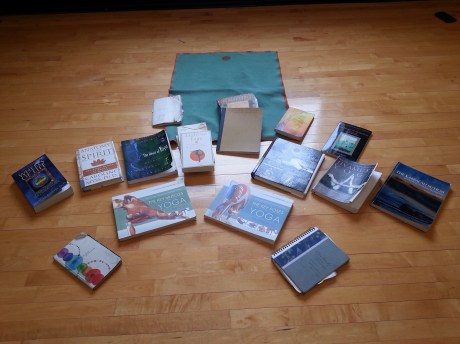
There might be more books on yoga and meditation than there are ways to practice yoga and meditation. I know for sure that there are so many books on each it is sometimes hard to narrow things down to a single recommendation. Even if I had read everything that’s ever been printed – and nothing else was ever printed (which would be a shame since one of my teachers is currently working on her first book) – and even if I only focused on books that really impacted my practice, I would still end up with a bag full of books.
(NOTE: The picture above is missing Leslie Kaminoff’s Yoga Anatomy, Steve Ross’s Happy Yoga, Stephen Cope’s The Wisdom of Yoga, all my Yin Yoga and Taoist texts, a copy of the Ramayana, and Alanna Kaivalya’s Myths of the Asanas, at the very least.)
Part of me wants to break this down into a book on the physical practice versus a book on the philosophy; however, sitting with WHY I want to make that distinction, brings me to one very comprehensive option: T. K. V. Desikachar’s The Heart of Yoga: Developing A Personal Practice.
Desikachar was the son of Sri Krishnamacharya, who was the teacher responsible for the resurgence of yoga in 20th Century India. Krishnamacharya taught Desikachar, B. K. S. Iyengar, Sri Pattabhi Jois, and Indra Devi – who all had a hand in bringing the physical practice of yoga to the West. Each of the teachers mentioned above wrote at least one book which impacted someone’s yoga practice (including mine), and all of them have had books written about them. Desikachar’s The Heart of Yoga is simultaneously about yoga and about a teacher’s teacher. It is also a practice manual with a heavy focus on the philosophy. Unlike some other books I might refer to as practice manuals, The Heart of Yoga not only offers an overview of the 8-limb philosophy of yoga, it includes a translation of the Patanjali’s Yoga Sutras. (NOTE: Patanjali’s Yoga Sutras are 196 aphorisms. Most books on the sutras include each aphorism, plus a translation and commentary for each aphorism. I use several sources for translation/commentary comparative analysis; however, my go-to resource is a website by Swami J, of the Himalayan tradition.) The Heart of Yoga gives practitioners of any fitness or experience level the opportunity to build a physical practice, while also maintaining a connection to the overall philosophical practice.
My similar dilemma regarding a book on meditation could be resolved by recommending a book on yoga mediation… and a book from each of several different Buddhist traditions…plus a book on the Kabbalah…and a book on Catholic contemplation and…..You get the idea. But, when it gets right down to it, there’s one book I am continually giving away – and it’s the same book used when I guided meditation with Dr. Thomas Bushlack’s University of St. Thomas classes: The Miracle of Mindfulness: A Manual on Meditationby Thich Nhat Hahn.
I first came across The Miracle of Mindfulness when I was babysitting for some friends in Minneapolis. One day, when the kids were napping, this little violet paperback on the bookshelf in the living room caught my eye. I pulled it down, and found…stillness.
OK, I’m being dramatic. I had, of course, already experienced stillness in both yoga and seated meditation. However, Nhat Hahn’s The Miracle of Mindfulness made me pause, sit, and contemplate my overall practice and its connection to meditation. Over the last ten years, it has played an instrumental part in my re-commitment to the physical practice of yoga as a form of meditation.
Let me be clear: Nhat Hahn is not known as a yoga teacher and The Miracle of Mindfulness is not a book related to hatha yoga (the physical practice of yoga). Nhat Hanh is a Vietnamese Buddhist monk most commonly associated with Zen Buddhism, but whose training includes several traditions. His Miracle of Mindfulness is based on Buddhist principles and practices, but is not teaching Buddhism, per se. Some might argue that it is not even teaching meditation (but, rather, mindfulness). Still, it accessible to people regardless of their background or experience and includes personal anecdotes as well as a series of practices that are simultaneously simple and profound.
To answer E’s final question, The Miracle of Mindfulness definitely has the tools to help a beginner establish a daily practice. Tools, however, do not build a mansion – and the mansion will not be built overnight.
“Practice, practice, practice – all is coming.” ~ Sri Pattabhi Jois
“If you don’t like something, change it. If you can’t change it, change your attitude. ”
– Maya Angelou
“You must take personal responsibility. You cannot change the circumstances, the seasons, or the wind, but you can change yourself. That is something you have charge of.”
– Jim Rohn
Knowing that change is constant doesn’t always make it easier to accept. Change is especially hard when you don’t feel ready for it and/or it is thrust upon you unexpectedly. And sometimes the worst part about the latter kind of change is the scary feeling which comes from not knowing what comes next.
I’ve been there. I get it. On a certain level, we’ve all been there. But, even if you lose your job, lose a loved one, or lose both in close proximity, don’t lose hope.
Easier said than done (that not losing hope thing) – especially when we define hope as “feeling expectation and desire for a certain thing to happen.” But, what happens if we let go of our attachment to things being a certain way and looking a certain way? What happens if we have the old fashioned kind of hope?
Trust is implied in the modern definition of hope, and it is also an archaic definition of hope.
Again, I get it: It is hard to know what or who to trust when the rug has been pulled out from under you. So, start with what is inside of you. Trust that if you can take a deep breath in, you can take a deeper breath out. Have faith that if you take that deeper breath out, and follow it with a deeper breath in, you can look forward to that even deeper breath out. Keep going and feelings of hopelessness will (slowly, but surely) dissipate.
This is not a quick fix or a miracle cure. Neither is it a medical treatment. It’s a practice. Interested in taking the practice deeper? Close your eyes and imagine your breath as light – moving down your spine as you inhale, back up your spine as you exhale. Want to kick it up another notch? Focus on your breath while listening to one of the following mantras (see first links for translations) focused on removing obstacles and darkness: