Walk with me…a mile, or 54. March 24, 2020
Posted by ajoyfulpractice in Buddhism, Changing Perspectives, Dharma, Dr. Martin Luther King, Jr., Faith, Gandhi, Gratitude, Healing Stories, Hope, One Hoop, Pain, Rabbi Abraham Joshua Heschel, Suffering, Tragedy, Uncategorized, Yoga.Tags: body prayer, inspiration, Martin Luther King Jr, MLK, Rabbi Abraham Joshua Heschel, Selma to Montgomery, yoga
2 comments
Thank you to everyone who helped me beta test Zoom on Sunday! More streaming classes are coming and I will post a recording of the class later this week.
In the meantime, remember this: 55 years ago today, Tuesday, March 24th, Civil Rights protesters stepped into Montgomery County (Alabama). The next morning they would stand in front of (but not on) the steps of the Alabama State Capital Building. It had been a long journey…even longer than the 5 days and 54 miles it took them to arrive from Selma, Alabama. And as he stood in front of (but not on) the steps of the capital, Martin Luther King, Jr. spoke of how much longer the journey would be.
For anyone who is interested, here are two (2) posts I wrote (in January 2019 and January 2016)about the experience of some of those marchers, and how it works out on the mat.
### NAMASTE ###
So Many Birthdays, So Many Stories, So Much Music… March 22, 2020
Posted by ajoyfulpractice in Books, Changing Perspectives, Gratitude, Healing Stories, Hope, Life, Men, Music, One Hoop, Peace, Poetry, Science, Super Heroes, Wisdom, Writing, Yoga.Tags: #Savewithstories, Andrew Lloyd Webber, Barbra Streisand, Billy Collins, James Patterson, Maty Ezraty, Stephen Sondheim, storytellers, yoga, yoga sequencing
4 comments
This post contains a link for “Save with Stories” – a partnership with Save the Children and No Kid Hungry. You’ll find the link in the sentence (below), “Being read to as a child is one of the great experiences in life.”
Maty Ezraty, a yoga teacher of teachers, who died last summer, once told a teacher, “A good sequence is like a good story. There is a beginning (an introduction), the middle (the heart of the story), and the end (the conclusion)”
Take a moment to go little deeper into the middle of your story, because that’s where we are: the middle of our stories.
People often tell me (as someone told me just this weekend) that one of the things they like about my classes is the story, as well as the way the poses and the music tell the story. The practice is always a way to tell our stories. It is also a way to process our stories, every time we inhale, every time we exhale. As I was reviewing Sunday’s playlist (March 22nd), I realized it not only tells the stories of some great storytellers celebrating birthdays today (as I intended) and is a way to process our current life-plot (as I intended), it also reflects my story as a lover of stories.
James Patterson (b. 1947, in Newburgh, NY), is a bestselling novelist and children’s book author whose books can always be found in my parents bookshelves. Doesn’t matter if it is mystery, suspense, romance, or science, Patterson keeps you in the moment and keeps a Chekhovian promise (which we’ll get to in the end). One of his protagonists is a 12-year old orphan named Max Einstein. Like her namesake, this Einstein is a genius with wild (in her case red) curly hair. She is told that her story combined with her emotional and intellectual quotients are why she is considered the world’s “last great hope.” Patterson wrote, “If we are to help save the human race, we must recognize the humanity in all, no matter their station in life.”
For his part, Patterson has donated over 300 million books to school-aged children and the military, over $70 million to support education, and endowed over 5,000 scholarships for teachers.
Stephen Sondheim (b. 1930, in New York City, NY) is a legendary musical theater composer and lyrics, as well as an award-winning film composer. He has won 8 Tony Awards (more than any other composer), 8 Grammy Awards, a Pulitzer Prize, a Laurence Olivier Award, and was awarded a 2015 Presidential Medal of Freedom. In all my time working in theater, I can’t say that I ever worked on any of Sondheim’s musicals (or the musicals of our final birthday composer), but I’ve seen my fair share of both their works – and can definitely sing along.
Also born in New York City, NY, in 1941, poet Billy Collins has been called “The most popular poet in America” and has served as United States Poet Laureate (2001 – 2003) and New York State Poet (2004 – 2006). Collins considers “humor a doorway into the serious” and begins his poem “Picnic, Lightning” by quoting Vladimir Nabokov. In Lolita, the protagonist says, “My very photogenic mother died in a freak accident (picnic, lightning)…”
The poem’s title is also the title of a collection of poems which my friend Mimi gave me in a moment when I was overwhelmed by grief. Fast forward almost a decade and, as if in a poem, I was dancing with Billy Collins on Nicollet Island and giving him a piece of Collins-inspired poetry. Even now, I can feel it…I can feel it…the joy of the moment, the joy of being alive; which fits in with his secret theory.
In a 2001 interview with The Paris Review, Billy Collins said, “I have a secret theory that people who are addicted to reading are almost trying to recreate the joy, the comfortable joy of being read to as a child…. Being read to as a child is one of the great experiences in life.”
Our final birthday storyteller is Baron Lloyd-Webber, or more properly styled, The Lord Lloyd-Webber…better known as the EGOT Andrew Lloyd Webber (no hyphen). Born today in 1948 (in Kensington, London), he has composed 13 musicals, a song cycle, a set of variations, 2 film scores, and a Latin Requiem Mass. He is an EGOT because he has won an Emmy Award, 4 Grammy Awards, an Academy Award (Oscar), and 7 Tony Awards – as well as 8 Laurence Olivier Awards and a plethora of other awards.
And now, back to that Chekhovian promise.
It was Anton Chekov who said that if there is a rifle (or a pistol) hanging on the wall in the first chapter/act, it must go off in the second or third. He told another playwright, “It’s wrong to make promises you don’t mean to keep.”
Whenever we step on the mat, there’s a part of us that is making a promise. Whenever, I put together a sequence there’s a part of me that thinks about that promise, as well as about that second Sondheim song (“Putting it together…bit by bit…piece by piece”) and Maty Ezraty’s sequencing advice about the middle (the heart) of the story. I consider how can I build up to a big heart opener and how we each need to process our own personal story in order to not only lift and open our hearts, but to also support our lifted and open hearts – especially in a time when it is so easy to close off.
Maty Ezraty said, “Practicing yoga is a privilege. And with this privilege comes a duty to be kind, to share a smile, and to offer yoga from the mat into the rest of your life.”
Here’s a mini-practice (5 minutes) which you can use it as your whole practice as the beginning/introduction portion of your practice and finish with a deeper back bend (even if it’s the same back bend – just with more awareness, more breath, and more smile.
### NAMASTE ###
It’s Bach’s Day Too! March 21, 2020
Posted by ajoyfulpractice in Abhyasa, Bhakti, Books, Buddhism, Changing Perspectives, Dharma, Faith, Fitness, Gratitude, Healing Stories, Hope, Karma, Life, Meditation, Minneapolis, Minnesota, Music, Mysticism, One Hoop, Pain, Peace, Philosophy, Suffering, Tragedy, Twin Cities, Vairagya, Wisdom.Tags: Johann Sebastian Bach, kriya yoga, Pandit Rajmani Tigunait, Philosophy, Ram Das, samadhi, Swamij, yoga, yoga sutras
5 comments
NOTE: Some embedded links connect to sites outside of this blog.
“[Music] should have no other end and aim than the glory of God and the re-creation of the soul, where this is not kept in mind, there is no true music, but only an infernal clamour and ranting.”
– Johann Sebastian Bach (b. 1685)
According to the Old Style / Julian calendar, March 21st, is the anniversary of the birth of the composer Johann Sebastian Bach. Born in 1685, Bach’s statement about music also works as a statement for yoga: ‘[Philosophically speaking, yoga] should have no other end and aim than the glory of God and the re-creation of the soul, where this is not kept in mind, there is no true [yoga], but only an infernal clamour and ranting.’ People who think of yoga only as a form of exercise are often surprised that there’s more. One can only imagine their surprise if they walk into one of my classes – especially on March 21st, when the playlist starts with Bach and then becomes a soundtrack for other events that correspond to this date in history. Imagine their further surprise when all of that is just the background to a deeper practice.
On Saturdays, I typically teach a 90-minute practice that is primarily attended by a dedicated group who are interested in the yoga philosophy as well as asana and asana philosophy. For the past few years, we’ve started in January and then we “build a practice from the ground up” physically as well as philosophically. Physically, we start with the beginning of a specific practice or sequence and either explore it for about 30-weeks before continuing to a new practice built on the original or – as we did this year – we start with a basic set of poses and start building around it. Philosophically, in years past, we have explored the 8-limbs of yoga, as well as how the 7 chakras correspond with 7 yoga paths (hatha, tantra, karma, bhakti, mantra, yantra, and jnana). Last year, we started moving through the Yoga Sūtras – which worked perfectly as there are 51 sūtras in the first chapter.
This year, we started physically moving through the warm-up and asanas that Ram Dass illustrated in Be Here Now, and just recently started using that sequence as a “finishing sequence.” (If you’ve been attending the Saturday practices and/or are familiar with the sequence, that’s your practice today.)
Philosophically, we decided to continue last year’s work and make our way through the second chapter of the Yoga Sūtras. Today, March 21st, is the 12th Saturday of 2020. I am including a bit of background for those who are just now joining this journey and a bit of last week’s commentary since so many had to miss the class. For more on the sūtras, you can check out Swami J’s website or purchase the series of books by Pandit Rajmani Tigunait, PhD – both associated with the traditions of the Himalayan Masters.
Yoga Sūtra 1.1: atha yogānuśānam
– “Right here, right now (in this auspicious moment), yoga (or union) instruction begins”
Yoga Sūtra 1.2: yogaścittavŗttinirodaha
– “Yoga (or union) ceases the fluctuations of the mind”
The first chapter of the Yoga Sūtras is the “Chapter (or, more literally, Foundation) on Concentration,” in which Patanjali began by explaining how the mind works; atha, right here, right now. In this present moment, each of our minds is processing multi-bazillion bits of information/sensation – which results in a constant fluctuation of the mind (cittavŗtti). This restlessness and agitation of the mind, in turn becomes restlessness and agitation in the body – and this becomes obstacles to the practice (or to our goals). At the same time, he explained that our thoughts fall into two (2) categories: afflicted thoughts (i.e., thoughts which cause pain) and not afflicted thoughts (which may ease pain, or at least not cause pain). Finally, Patanjali explained how to work the mind – using the mind’s own ability to concentration/meditate – in order to rest the mind and, therefore, the body.
This is why, I often say, “What happens in the mind happens in the body. What happens in the body happens in the mind. And both affect the breath.” If you take a deep breath in (right here, right now) and a deeper breath out (right here, right now), you not only bring your awareness to the present moment (right here, right now; every time you consciously inhale and every time you consciously exhale), you also, affect the body and the mind. In fact, that is one of the ten practices Patanjali described in the first chapter: focus on your breath.
Yoga Sūtra 2.11: dhyānaheyāstadvŗttayah
– “Meditation destroys the mental tendencies (associated with affliction/pain)”
The second chapter of the Yoga Sūtras is (the “Chapter (or, more literally, Foundation) on Practice. It is basically where Patanjali – way back in the 2nd, 3rd, or 4th BCE – recognized and acknowledged that everyone on the planet can’t just drop into a deep-seated meditative state. So he started explaining the elements of kriya yoga (“yoga in action”) and how the practice of training the senses, exploring within, and letting go of aversions and attractions attenuates the effect of afflicted/pain-producing thoughts. To do this, however, he first gave us a deeper understanding of how afflicted thoughts produce pain.
“Samskaras – the drivers of our mental tendencies – manifest in the form of memory. We are able to remember something because the subtle impressions related to the object have been stored in our mind. Because they are hidden beneath thick layers of the forces of time, the mind is not aware of their existence. But like a seed that lies dormant until spring brings moisture and warmth, samskaras awaken when the conditions inside and outside the mind are conducive.”
– Pandit Rajmani Tigunait’s commentary on sūtra 2.11
Using seeds as a metaphor or a simile for our thoughts, words, and deeds is a very common teaching tool. In previous weeks, the metaphor I used was a backpack containing a still soft, but sculpted, piece of clay. Let’s say you’ve molded a little figurine (whatever comes to mind) or a tiny cup; but, something causes you to place the molded clay into your backpack. For some reason, the clay stays in your backpack, getting tossed around, even a little mushed, as you go about your days. Every once in awhile you brush your finger across it when you’re looking for something and you think, “What’s that? Oh, yeah….” And whatever emotions you were feeling in relation to making the piece, or having to toss it in your bag before it was finished, flash up.
Later, you might even pull the piece of clay out, notice that it’s smashed, and decide to completely smash it and start again. Or, you may restore it to some close proximity of what you did before. Someone else could feel it or see it, or see you remolding it, and have a completely different experience, but this is your experience – and now this new layer of experience is attached to the clay, just like the oils from your skin. Even if you “buy a new backpack,” a piece of the clay finds its way inside. (YS 2.10) Unless, of course, you have “trained your senses, explored within, and given up your aversions and attractions” – in which case you can discard the clay when you switch backpacks or you can recognize what it was and decide to treat it as a fresh piece of clay ready for a new project. (YS 2.11)
Yoga Sūtra 2.12: kleśamūlah karmāśayo dŗşţādŗşţjanmavedanīyah
– “The reservoir of our actions is rooted in affliction/pain that is experienced in seen and unseen lives”
For anyone wondering: Nope, I had no idea this week’s sūtra was going to keep us firmly grounded in the “seen and unseen.” Previous translations I’ve used for comparative analysis talk about “current life and future life,” “this life and the lives to come,” and “at the time of the action or (another time).” The bottom line, though, is still the same.
All of our experiences, thoughts, words, and deeds have consequences. Some consequences occur “immediately” and we easily see the connection between cause and effect. Other times, there is the distance of time, space, memory, and/or ignorance (or lack of awareness), which causes the connection to be “unseen” by us. Yet, cause and effect is still there, and so it becomes even more important to recognize that, as Pandit Tigunait points out, “Impure karmic impressions cloud our mind with desire, greed, confusion, and anger, and become the drivers of negative, destructive actions. Pure karmic impressions create a positive mental atmosphere, awakening virtues such as love, compassion, kindness, and selflessness, which then become drivers of positive, constructive actions…. Causing intense pain to someone who is fearful, diseased, or stingy engenders a highly, negatively charged karmic reality. Betraying someone who trusts you or harming a high-caliber soul committed to intense austerity also engenders a highly potent negative karmic reality. This potent negative karma ripens quickly.”
We don’t always have control over our circumstances, but we always have control over our actions (thoughts, words, and deed). We don’t, however, make decisions in a vacuum. Part of the practice is recognizing that our current actions are informed by our previous experiences, thoughts, words, and deeds – and that what we do in this moment is going to inform what happens to us (and what we do) in our next moments… even if those moments are years away.
2023 Note: This post has been slightly revised to clean-up a type-o (or three) and some syntax.
### BE KIND TO YOURSELF & TO OTHERS ###
Happy First Friday of Spring! March 20, 2020
Posted by ajoyfulpractice in Books, Buddhism, Changing Perspectives, Depression, Faith, Healing Stories, Hope, James Baldwin, Life, Loss, Meditation, Men, Minneapolis, Minnesota, One Hoop, Pain, Peace, Poetry, Religion, Suffering, Tragedy, Uncategorized, Vairagya, Yoga.Tags: Alison McGhee, Franz Wright, hatha yoga, inspiration, silence, somatic, somayoga, vinyasa, yoga
4 comments
“The long silences need to be loved, perhaps more than the words which arrive to describe them in time.”
– from God’s Silence by Franz Wright
Yes, it is hard to believe: Yesterday was gray, rainy, cold – even snow for some – and it was the first day of Spring in the Northern Hemisphere. I know, hard to believe. Some folks had forgotten all about Spring, it seems. Still others were expecting it to bring some great change… And maybe it did. But, like the old saying (April showers bring May flowers) implies, we have to wait for the beauty.
In waiting for the beauty of being able to offer a video practice inspired by Franz Wright, I was reminded that Wright’s collection after winning the 2004 Pulitzer Prize was entitled God’s Silence. I haven’t read it (yet), but I am suddenly fascinated by the idea of 144 pages worth of Franz Wright poetry curated around the idea of “God’s Silence.” Notice, that’s 144 pages – not 144 poems. (Poets everywhere are now doing the math.) This is the kind of the thing that gets me oddly excited, especially right now, because there is so much I want to know!
I want to know if he is referring to silence that is the response to a prayer or a request (or even a curse); the silence that precedes an answer; the silence that follows the answer (when the questioner is dumbfounded or in awe of the response); the silence when one is pondering the best way to phrase something and therefore measuring their words; the silence of shock (can we shock God?); the silence of disappointment; the silence of wonder; the silence when no one is around; the silence of sleeping children; the silence between one breath and the next; the silence of meditation; the silence of peace; the silence honoring the dead; the silence just before a newborn declares itself alive; or….The list goes on. He could be talking about all of the above. Or none of the above. There are so many possibilities!
What I know is that he starts off with “The telephone ringing / in the deserted city ––– ” and and that one of the poems is called “Solitary Play: Minnesota, 1961.” I feel like this is where we are at, and I’m here for it.
“You survive this and in some terrible way, which I suppose no one can ever describe, you are compelled, you are corralled, you are bullwhipped into dealing with whatever it is that hurt you. And what is crucial here is that if it hurt you, that is not what’s important. Everybody’s hurt. What is important, what corrals you, what bullwhips you, what drives you, torments you, is that you must find some way of using this to connect you with everyone else alive. This is all you have to do it with. You must understand that your pain is trivial except insofar as you can use it to connect with other people’s pain; and insofar as you can do that with your pain, you can be released from it, and then hopefully it works the other way around too; insofar as I can tell you what it is to suffer, perhaps I can help you to suffer less.”
– James Baldwin speaking at Community Church in NYC on Nov. 29, 1962
Besides an ultimate love for poetry that gets you through hard times (because you realize someone has been through harder – or, as hard of a time), maybe one of the reasons I’m here for it is because part of my practice involves silence. The kind of silence and stillness that can make people uncomfortable, because it is so powerful. But, simultaneously, the kind of silence and stillness that is the epitome of peace. When Patanjali codified the philosophy of yoga in the Yoga Sutras, he wrote, “yogash citta vritti nirodah.” Yoga ceases the fluctuations of the mind.
Silence.
Perhaps, God’s silence.
It’s 2 days late and $2 dollars short, but I offer you a video of Wednesday’s practice (inspired by Franz Wright). It’s nowhere near perfect, but I hope it brings you a moment of peace, a moment of ease. I hope it brings you stillness and yes, silence.
###
A Prize-Winning Solution March 18, 2020
Posted by ajoyfulpractice in Books, Buddhism, Changing Perspectives, Depression, Faith, Gratitude, Healing Stories, Hope, Life, Loss, Love, Meditation, Men, Minneapolis, Minnesota, Music, One Hoop, Pain, Poetry, Religion, Suffering, Tragedy, Uncategorized, Vipassana, Yoga.Tags: Alison McGhee, discernment, Franz Wright, heart, Hope, kindness, loneliness, Poetry, yoga
1 comment so far
“I am in no way different from anyone else, that my predicament, my sense of aloneness or isolation may be precisely what unites me with everyone.”
– Franz Wright
It seems very fitting to me, somehow, that what we sometimes think of as one of the hardest days of the week – Hump Day – during this first week of major league social distancing coincides with the anniversary of the birth of a man who wrote about isolation, loneliness, longing, and death intersecting with kindness, love, faith, and hope. If you are not familiar with Franz Wright, born today (3/18) in 1953, then you might be interested to know that he is the son-half of (I believe) the only father and son to win Pulitzer Prizes in the same category and that Chicago Tribune critic Julia Keller once described one of his collections as being “ultimately about joy and grace and the possibility of redemption, about coming out whole on the other side of emotional catastrophe,” while Denis Johnson supposedly compared his poems to “tiny jewels shaped by blunt, ruined fingers – miraculous gifts.” I know, that’s a lot to take in (and you might need to read that Va. Woolf-like sentence again). The thing is; I think we are in the middle of a Franz Wright poem. So, brace yourself.
I first came across Wright’s poem “Solution” in a 2015 blog post written by Alison McGhee, a New York Times bestselling author who writes and teaches up the street from me. In the post (which I strongly recommend), McGhee wrote about an encounter she had with someone best described as her exterior opposite. Yet the interior movements of the heart, all of our hearts, are ultimately the same – something both McGhee’s short post and Wright’s poem illustrate bluntly, beautifully, and miraculously.
Franz Wright’s “Solution” is something we could all use right now.
“What is the meaning of kindness?
Speak and listen to others, from now on,
as if they had recently died.
At the core the seen and unseen worlds are one.”
Wright’s poems are full of natural spirituality and that oftentimes “heartbreaking human conflict between religion and spirit. The final line of the poem reminds me of 2 Corinthians 4:18 where Saint Paul wrote, “So we fix our eyes not on what is seen, but on what is unseen, since what is seen is temporary, but what is unseen is eternal.” NOTE: The New Living Translation translates this passage as “So we don’t look at the troubles we can see now; rather, we fix our gaze on things that cannot be seen. For the things we see now will soon be gone, but the things we cannot see will last forever.”
PRACTICE NOTES:
Start seated or lying on your back. As your move through your practice today, focus on what is unseen. What are you feeling in your heart, in your mind, in your body? How does what you feel move, shift, and change as you inhale – and, especially, as you exhale? Is what distracts you from this present moment seen or unseen, temporary or eternal? At one point in your body (or mind) does everything – including your breath – overlap and become one?
Prior to this week, Wednesdays were one of my busy days, because I would teach three (3) classes in three (3) different locations: a 60-minute YIN Yoga practice, a 60-minute open-level vinyasa practice, and a 60-minute “slow flow” vinyasa practice. My “Franz Wright inspired” sequences would be heart, lung (as Wright died of lung cancer), and core focused, with some emphasis on arm movements and position since arms are an extension of the heart chakra and also contain the heart and lung meridians.
As I am not currently able to post three (3) different practices, the YIN Yoga link above directs you to a Bernie Clark playlist on YouTube. I have posted a 60-minute vinyasa playlist (see here or below) for anyone who wants it and will email a Soma Yoga/Vinyasa practice to people who normally attend the studio classes.
(This is freely given and freely received. I do not own the rights to these songs, but highly encourage you to buy them!)
“Soon, soon, between one instant and the next, you will be well.”
– from “Nude with Handgun and Rosary by Franz Wright
### OM SHANTI SHANTI SHANTIHI OM ###
Exploring the Wren Cycle on Saint Patrick’s Day 2020 March 17, 2020
Posted by ajoyfulpractice in Books, Changing Perspectives, Depression, Faith, Healing Stories, Life, Loss, Minneapolis, Minnesota, Music, Mysticism, Religion, Uncategorized, Yoga.Tags: ceili, craic, gaelic, inspiration, Irish, King of the Birds, Robert Boustany, Saint Patrick, Saint Stephen, Wren, Wren Singers, yoga
6 comments
“So listen people what I tell you now
Life is hard but it’s worth keeping on
Listen people what I can tell you straight
It’s not too late to
Try and get through
I’m just trying to get through”
– from “Trying to Get Through” by Hothouse Flowers
All of my in-studio classes are officially cancelled for at least 2 weeks.
When I taught what turned out to be my last few in-studio classes for a bit, I ended by explaining that one of the reasons I was doing my regular March 15th theme, based on President Lyndon B. Johnson’s “American Promise” (aka “We Shall Overcome”) speech, was because I recognize that sometimes we step on the mat to help us deal with what’s going on off the mat and, also, sometimes to just have a moment away from what we’re dealing with off the mat. It is a few minutes, or hour, where the practice requires us to be fully present, right in the here and now – without getting sucked into what happened in the past or what might happen in the future. Those much needed respites … they are part of how we get through all this. So, keeping that in mind…
“Beannachti na fėile Pádraig, dia dhui. Mise Myra. Conas ata tu? Happy Saint Patrick’s Day, everyone. My name is Myra. How are you? OK, since it doesn’t seem like anyone else speaks Gaelic, I’ll stick to English and Sanskrit for the rest of the practice.”
– My usual introduction on March 17th”
The physical practice of yoga features a lot of bird poses. I mean, there are a lot, a lot, a lot of poses inspired by birds. Ergo, on Saint Patrick’s Day I usually guide a practice that tells the story of how the wren became the King of the Birds. The legend is usually associated with the Saint Stephen’s Day (instead of Saint Patrick’s Day) and the wren is the villain. However, I first heard about the legend in relation to “wren singers” singing in the round and the idea that it’s great “craic” for the music to never end at a “ceili.” So, when I tell the story, the wren is the heroine…and there are lots and lots of bird poses. (Not all of them, but a lot.)
You can read more about the ideas behind the physical sequence in a post from 2012. At some point on Tuesday, I will record a class for people who would normally attend on Tuesdays at Nokomis. (I apologize for not having it together in time for you to practice at your regular scheduled time.) If you’re not on my Tuesday list (you can message me) or you want to practice now, you can use the poses and playlist below to create your own sequence.
FEATURED BIRD POSES IN THE WREN CYCLE:
- The Ruddy Goose: There are two (2) so-called “Ruddy Goose” poses or sequences. Today we’ll just do the first. Come to your hands and knees – or into a standing squat if you need to modify. Stack shoulders over elbows, elbows over wrists, hips over knees. This is a good place to do a little cat-cow. Balance the weight in all form limbs, even as you curl your right toes under and stretch the right leg back. Use your core to lift the back leg up and then, if it’s accessible to you, lift the left arm up. Now, to turn your 2-Legged Table into Ruddy Goose, bend your lifted knee as if you are standing on the ceiling. Hold here for a few breaths and then repeat on the other side (including the cat-cow).
- The Wren: My so-called Wren Pose doesn’t really exist, except in the Wren Cycle and maybe in some kids yoga classes. From standing or Downward Facing Dog, make your way into a standing forward fold. Look up and lengthen into a “Half-Lift, Flat Back” position. Find that place where your spine is long, shoulders are relaxed, and core is engaged. On an inhale, stretch your arms back behind you, so wrists are beside the hips. In “Wren Pose” you can wiggle your fingers to “shake your tail feathers.” In a vinyasa practice, “Half-Lift, Flat Back” is one of the repeated poses so whenever you inhale into the half-lift on Saint Patrick’s Day, simultaneously extend your heart-gaze forward and your arms backwards. To release, exhale into a Standing Forward Fold. (NOTE: You can also turn a low lunge into a modified “Flying Wren.”)
- Flamingo: Yes, yes, I know, you’re unlikely to see a Flamingo in Ireland outside of a zoo. That said, it’s in my version of the story and comes courtesy of my first teacher, Robert Boustany. It’s a big hip pose, so be warned. If you are not familiar with the sequence, just stick to Standing Splits (from a Standing Forward Fold), which is the beginning of the sequence.
- Eagle: Come into Chair Pose, knees over ankles, shoulders over hips, big awkward smile on your face (just cause). Take a deep breath in and the exhale your right arm under your left, taking the double bind or the single bind. Lift the bound elbows up and the move the bound hands away from your face. As you inhale, step your right leg over your left (taking the double bind or using your right toes as a kickstand). Squeeze the thighs together and press the right hip back. Hold the pose for several breaths and then make your way through any additional (2 – 3) standing poses on the right.
- “Flying Eagle”: From Warrior I on the right side, making sure hips are balanced (right hip back, left hip forward), stretch up as you inhale and then cross LEFT arm under the right for “Eagle arms.” Exhale and bring elbows to the right knee so that back is flat. Shift your weight forward as you inhale. Engage your core on the exhale and then use your inhale to soar into Warrior III with Eagle Arms. Stretch the arms out on an inhale (as the Eagle spreads out its wings and turns around to claim its crown). On an exhale, sweep the arms backwards into “Flying Wren” and hold. I usually add a Tree Pose here or before the first Eagle (so the other birds can watch the end of the competition). Repeat the Eagle/Flying Eagle/ Flying Wren section on the other side.
- Pigeon and Royal Pigeon: These are fully puffed-up Pigeon poses (not one of the One-Legged Royal Pigeon variations). These are big heart openers, so if they are not in your practice modify with the prep pose. For Royal Pigeon, set yourself up for Floor Bow (prep pose) and then bring your head and feet together. For Pigeon, come into Camel Pose and then, if this variation is in your practice, work your head and elbows down to the floor behind you. Bind off with the feet and shins.
- Heron: Come into Staff Pose, sitting on the floor with your legs stretched out in front of you. Bend your left knee to the left, with the knee on the ground, if you need more support. Hug your right knee into your chest and then use your hands (or a strap) to hold onto your arches or ankles. In Heron Pose, it is more important for your back to be straight (spine long) and for your to be balanced on your sit bones (fully upright, not leaning back) than it is to have your leg straight. So, first align your head, neck, and trunk. If you can keep your back straight, shoulders over the hips, use an inhale to straighten out your right leg. If it’s accessible to you, you can bring your shin to your chin. Hold for a few breaths, then release into a twist to the right (prenatal is to the left) before repeating on the other side.
- Crow: Here’s one of the poses everyone expected. If it’s in your practice, use your Crow for one final vinyasa into Savasana.
Below is a playlist that features Irish artist and tells the story in 65 – 90 minutes (with or without the featured bird poses). Some songs on my in-class playlist are not available on YouTube so I’ve left them out. Also, you can easily skip a few towards the end to fit a shorter time frame. The HemiSync track is the last Savasana track. Garth, of course, marks the after party!
(This is freely given and freely received. I do not own the rights to these songs, but highly encourage you to buy them!)
### LET’S SOAR ###
We Interrupt Your Regularly Scheduled Life…. March 13, 2020
Posted by ajoyfulpractice in Books, Buddhism, Faith, Fitness, Food, Healing Stories, Health, Hope, Life, Mantra, Minneapolis, Minnesota, Pain, Peace, Science, Suffering, Tragedy, Twin Cities, Wisdom, Yoga.Tags: anxiety, CDC, coronavirus, COVID-19, epidemic, fear, Health, pandemic, phobia, wellness, WHO, yoga
10 comments
“Life is like stepping into a boat that is about to sail out to sea and sink.”
– Shunryu Suzuki Roshi
Right now, in this moment, I am prepared to do what I can do, but also accepting that there is a lot I cannot do. However, all of that can change in the next moment – because that’s life; as long as we are alive everything changes.
(Say that first part with me: Right now, in this moment, I am prepared to do what I can do, but also accepting that there is a lot I cannot do.)
Right now, we are all on a sinking boat. There’s a chance we’re close to shore and can touch bottom and there’s also a chance we are way out to sea, but no one knows for sure. Some folks are screaming and jumping into what might be shark infested waters. Some folks are sitting back pretending like nothing is happening. There are folks frantically trying to bail out the water. Still others are putting on their life jackets and preservers and inflating their life boats. Bottom line: The boat is still sinking.
“The transcripts of our conversation also show how Patrick’s choice of phrasing was helpful to me. Rather than telling me what airport I had to aim for, he asked me what airport I wanted. His words let me know that he understood that these hard choices were mine to make, and it wasn’t going to help if he tried to dictate a plan to me.”
– from Highest Duty: My Search for What Really Matters by Chelsey B.”Sully” Sullenberger
Some people, most people, will survive and it is up to each and every one of us to do what we can do to increase the possibility of survival. In accordance with the U.S. Centers for Disease Control (CDC), World Health Organization (WHO), and Yoga Alliance, consider doing the following:
- Wash your hands with soap and water for 20 seconds (or use appropriate hand sanitizer for 20 seconds).
- Clean mats, props, and gym equipment (as well as desks, phones, and door handles) frequently.
- If you’re using a studio/gym mat or other equipment, clean it before and after usage.
- If you don’t already own and use one, consider buying your own mat and/or purchasing a skidless yoga “towel” you can place over a studio mat.
- Cover props with a towel, bring your own props, or (when appropriate) reduce your props.
- Space and stagger your mats if you are coming to a group class. Take a deep breath if a class is cancelled or you are turned away because class size is limited.
- Practice good health and wellness habits by getting plenty of sleep, staying physically active, managing your stress, drinking plenty of (hydrating) fluids, and eating heart healthy foods.
- If you have been traveling (especially internationally), practice at home and avoid large groups of people for at least a week. (WHO and CDC are recommending 14 day self-isolation for people who have traveled internationally or been in contact with someone who may be ill.)
- If you are sick (and/or coming down with or getting over a respiratory illness), practice at home. There are lots of online resources for various types of yoga and other physical activities. (I will add links and post some sequences.)
- Monitor daily reports from WHO or the CDC only as much as you are able without increasing your anxiety.
- Practice compassion. Acknowledge that there are a lot of people suffering, in a lot of different ways. If you can help someone, without undue risk to yourself, do so.
- Avoid touching your face and practice coughing/sneezing etiquette.
- Be mindful. Be patient. Be kind. Breathe.
As I post this, my classes at the YMCA, Nokomis Yoga, and Flourish are continuing as scheduled. If, however, you purchased a Flourish package and elect not to attend classes in the next few weeks, you will be given a studio credit. Common Ground Meditation Center has cancelled all programming through March 29th. I will update my calendar as things change.
I will continue to give people the option (at the beginning of class) to opt out of hands-on assists, but the reality is that I am extremely limiting assists for the foreseeable future.
(Let’s say it again: Right now, in this moment, I am prepared to do what I can do, but also accepting that there is a lot I cannot do.)
### OM SHANTI SHANTI SHANTIHI ###
Practicing Gratitude November 26, 2019
Posted by ajoyfulpractice in Changing Perspectives, Gratitude, Healing Stories, Health, Hope, Life, Minneapolis, Minnesota, Music, Texas, Twin Cities, Yoga.Tags: Garth, giving thanks, gratitude, Thanksgiving, yoga
6 comments
“Just for today I’m going to see the opportunity instead of the obstacle. Just for today I am going to recognize the kindness instead of the apathy, the light instead of the dark, the love instead of the hate, the beauty instead of the chaos, the blessing instead of the lack.
Just for today, I want to say thank You. For the rising sun and the autumn leaves. For the shelter, the water and the food. For my arms, my legs, my eyes, my heart and for every breath You grant me. For the gift of my children. For the Torah and all the myriad blessings it brings into my life. For all this and for so much more.”
– Sara Debbie Gutfreund, on cultivating gratitude
Some governments, like the United States and Canada, dedicate one day a year to giving thanks. Some religions also include giving thanks during certain holidays and then prescribe practicing gratitude before and/or after every meal. Some even command giving thanks at least once a week on top of that. Then social convention dictates expressing gratitude when you receive a gift, a boon, or a kindness from another person. Science, however, indicates that we should give thanks every day – and multiple times a day at that.
I’m not going to go into the science (you can read about some of the research here and here); however, I am going to take a moment to practice a little gratitude.
One of my favorite songs, by one of my favorite musicians is “Unanswered Prayers” by Garth Brooks. This, I know, is a big surprise to absolutely no one who knows me. The song, like all great songs, is also a great story and so, in that spirit, I’m going to tell you a little story.
About 13 years ago, I was at loose ends. I wanted my life to go in a certain direction and it just didn’t seem to be going that way – not professionally and definitely not personally. Don’t get me wrong, my life was mostly good, but I was definitely floundering. I prayed, I mediated, I wrote, I cried for a change – but I also put limits on that change: I wanted things to be the way I wanted things to be.
Around this same time, I was recruited for a job in the Twin Cities. It was the kind of theater job I didn’t expect to do again, in a city I had only ever been to on tour. Ironically, it was one of three cities I had been to while on various tours that had me thinking, “I could live here.” I didn’t consider that whispered thought as a prayer, but it kind of was – and there was definitely some intense emotion behind the thought. Fast forward and, after visiting the Cities (again during REALLY warm weather), I took the job.
Things did not go as planned.
I had a hard time finding an apartment to rent and a hard time acclimating to the Mid-West culture, not to mention the cold climate. Despite a lot of great experiences and the kindness of a lot of great people, I was ready to head South within a matter of months.
At loose ends again, I prayed, mediated, visualized, wrote, sighed, cried, sang, danced around various ideas about what would come next. I decided I would take a yoga teacher training class – because I had the time and the money at the same time that a course was coming up. I wanted to deepen my practice and, while I didn’t plan on teaching, I wanted the ability to answer people’s questions or point them in a help direction. (SIDE NOTE: I had been practicing yoga for almost 10 years and knew a lot of people whose only intersection with yoga was knowing that I practiced.) Also, I had no other plans or, as I might have said at the time, “nothing better to do.” Smile.
The yoga teacher training focused on teaching us how to teach yoga. Within a few months, that’s exactly what I was doing: teaching yoga. I started teaching two to three classes a week in the homes of some friends to whom I will always be grateful (Thank you, Erin! Thank you, Kirsten! Thank you, Inger!).
I said I would keep teaching classes until I went back to Texas. Then I thought, I wonder what life would be like if I did this teaching thing on purpose. I applied to the YMCA (Thank you, Daniella!); set up an interview/audition (Thank you, Courtney!); and also met with a teacher who was starting a new studio (Thank you, Solveig!) I went from three classes in three spaces, to 15 in 5, and now am back to 13 in 5 – give or take in any given week. Along the way, I have met some of the most incredible people – some students and some the friends and family of students – and some of these incredible people I have the extra pleasure of calling my friends. (Thank you, everybody!)
And, if even one of the aforementioned prayers had been answered the way I wanted them to be answered, I wouldn’t be here, doing what I’m doing, surrounded by the amazing people I’ve met on and off the mat.
“Sometimes I thank God for unanswered prayers. Remember when you’re talking to the man upstairs, that just because he may not answer, doesn’t mean he don’t care. Some of God’s greatest gifts are unanswered…some of God’s greatest gifts are all too often unanswered…some of God’s greatest gifts are unanswered prayers.”
– Garth Brooks
Just in case, I missed the point, this morning the Universe peeled back the curtain and winked. On my way to a class (I wouldn’t have been teaching if my holiday plans had gone as planned), I sat on the train next to a woman a lot like the women from my grandmother’s neighborhood – women who used to ask me the questions about yoga that I didn’t know how to answer. We spent about 15 minutes talking about her low back pain, her knee replacements, and her balancing challenges – especially during winter – and yoga might help her.
Not for the first time, I turn to the Universe…and wink back. Thank you.
(Click here if you don’t see the video.)
I’m teaching my regular classes tonight at 7:15 PM and Wednesday at 12:45 PM.
No classes for me on Thursday and Friday, but I’ll be back to my regular schedule on Saturday.
Peace and A Million Thanks to All of You!
###
Foundations 2019 July 29, 2019
Posted by ajoyfulpractice in 31-Day Challenge, Abhyasa, Books, Changing Perspectives, Fitness, Healing Stories, Health, Japa-Ajapa, Meditation, Men, Minneapolis, Minnesota, Music, Peace, Philosophy, Science, Surya Namaskar, Twin Cities, Vairagya, Wisdom, Yoga.Tags: Abhyasa, asana, B.K.S. Iyengar, Krishnamacharya, Sri Pattabhi Jois, Vairagya, YMCA, yoga
2 comments
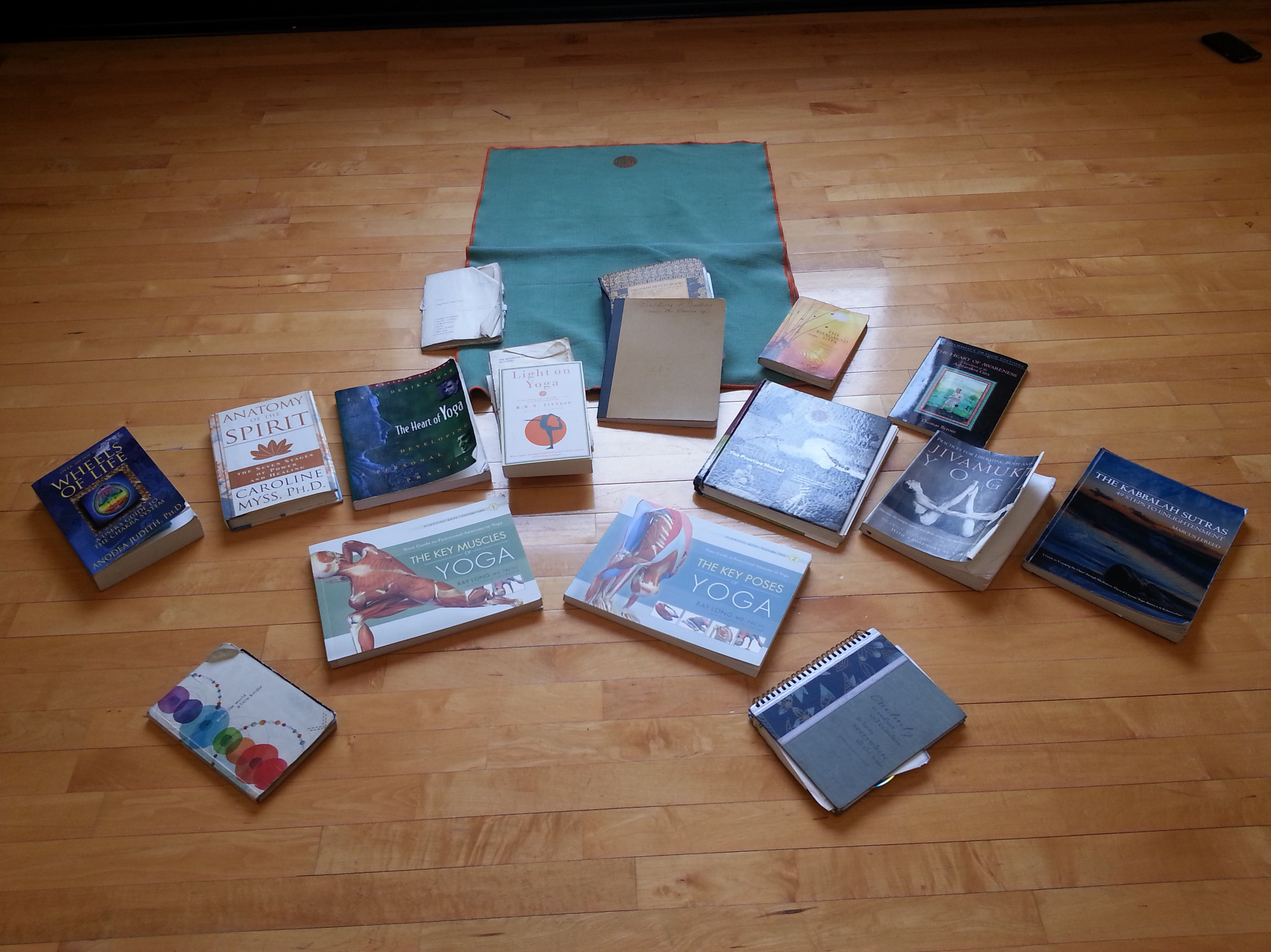
(NOTE: The picture above is missing Leslie Kaminoff’s Yoga Anatomy, Steve Ross’s Happy Yoga, Stephen Cope’s The Wisdom of Yoga, all my Yin Yoga and Taoist texts, a copy of the Ramayana, and Alanna Kaivalya’s Myths of the Asanas, at the very least.)
“Form follows function – that has been misunderstood. Form and function should be one, joined in a spiritual union.”
– Frank Lloyd Wright
“If something is boring after two minutes, try it for four. If still boring, then eight. Then sixteen. Then thirty-two. Eventually one discovers that it is not boring at all.”
– John Cage
Saturday mornings at the Y, just like any morning, is a great time to explore the physical and philosophical practice of yoga. However, I am partial to my Saturdays since I have 90 minutes to engage in the practice of exploration. For the last few years, I have started the new year with a “Building From the Ground Up” sequence – each Saturday adding more poses and another layer of the philosophy. Sometimes I still tie-in a meditation point specific to the date, and to whatever aspect of the philosophy is on tap for the day. Sometimes, however, it’s just straight philosophy and an opportunity to consider the meditation through movement. Whatever I plan for the year, usually wraps up around the end of July – when we start breaking down a different physical practice, the Ashtanga Primary Series.
This year, philosophically, I decided to sequentially move through Patanjali’s Yoga Sutras. Each week breaking down a sutra with commentary. (This week will be YS 1.31.) Physically, we have been breaking down a course of poses outlined by B. K. S. Iyengar in Light On Yoga.
The Saturday class is not an Iyengar class; however, (as teachers like Seane Corn have pointed out) if you are going to practice vinyasa, it’s a good idea to practice Iyengar as it will give you the solid foundation and insight into the asanas (poses).
Iyengar’s Course I is 30 weeks of detailed practice, specifically intended to build a physical practice from the ground up. While they are not limbs themselves, abhyasa (continuous practice with devotion) and vairagya (actively practicing the art of letting go or non-attachment) definitely make up the fertile soil from which the 8-limbs of yoga grow and thrive. And, they are key elements to the courses that appear in the appendix of Light On Yoga. At first, each set of poses is practiced for two (2) weeks before additional poses are added to the sequence. Later, some sequences are repeated for three (3) or four (4) weeks – and sometimes the order of the sequence changes. The 30-week course is followed by a 3-day course, which is slightly different from the 30-day course since the asanas are timed. Finally, there is some guidance on adding sun salutations (surya namaskar) to the physical practice and a list entitled “Important asanas in Course I.”
“If these asanas are mastered then the others given in this course will come even without regular practice.
– B. K. S. Iyengar writing about the “Impostant asanas in Course I”
The important asanas list, when followed by the sun salutations, looks and feels a lot like one of the first vinyasa practices to appear in the West, the Ashtanga Primary Series introduced to Sri Pattabhi Jois. This is not a random coincidence. While Iyengar and Jois were in very different physical/health conditions when they started practicing yoga, they practiced at the same time and with the same teacher: Sri Krishnamacharya. The practices they introduced to the West – just like the physical practices introduced by some of Krishnamacharya’s other students (including Indra Devi, T. K. V. Desikichar, and A. G. Mohan) reflect their own personal practices – which were the result of the physical and mental needs. Remember, classically, the physical practice of yoga (hatha yoga, regardless of the style or tradition) prepares the practitioner for deep-seated meditation. Ergo, even though they might practice the same poses, a very sickly young boy may use a different method of practice than a very active teenage boy.
(Side Note: It is also not a random coincidence that we generally start exploring the Ashtanga Primary series at the end of July: instead the timing coincides with the birthday of Sri Pattabhi Jois.)
YMCA classes are always open to members and their guests. If you are a member, please feel free to join us for class at any time throughout the year – and, feel free to bring a guest.
For further reading, check out Light on Yoga by B. K. S. Iyengar; Heart of Yoga by T. K. V. Desikichar; Ashtanga Yoga the Practice Manual by David Swenson; The Secret of the Yoga Sutra: Samadhi Pada by Pandit Rajmani Tigunait, PhD (Note: This is Part 1 of a series and only includes the first section of the sutras. There are many translations of the sutras, a great online resource is Patanjali’s Yoga Sutras on swamij.com.)
“Talent works, genuis creates.”
– Robert Schumann
~~~ AUM ~~~
MOVING INTO STILLNESS: 2019 Kiss My Asana Offering #18 (for Day 29) April 30, 2019
Posted by ajoyfulpractice in 31-Day Challenge, Bhakti, Books, Buddhism, Changing Perspectives, Donate, Faith, Healing Stories, Karma Yoga, Life, Meditation, Men, Minneapolis, Minnesota, Music, Mysticism, Peace, Poetry, Religion, Twin Cities, Wisdom, Writing.Tags: cello, cello music, Guy Johnston, Hero Pose, Hilary Tann, inspiration, KISS MY ASANA, kneeling, meditation, Mind Body Solutions, Poetry, R. S. Thomas, stillness, Thunderbolt, Vajrasana, Virasana
add a comment
The
(slightly belated)“practicepreview” below is part of my offering for the 2019 Kiss My Asana yogathon. I encourage you to set aside at least 5 minutes a day during April, to practice with today’s theme or concept as inspiration. You can practice in a class or on your own, but since the Kiss My Asana yogathon raises resources as well as awareness, I invite you to join me at a donation-based class on May 4th.I also challenge you to set aside a certain amount every day that you practice with this concept/theme in mind. It doesn’t matter if you set aside one dollar per practice or $25 – set aside that amount each time you practice and donate it by April 30th.
Founded by Matthew Sanford, Mind Body Solutions helps those who have experienced trauma, loss, and disability find new ways to live by integrating both mind and body. They provide classes, workshops, and outreach programs. They also train yoga teachers and offer highly specialized training for health care professionals. By participating in the Kiss My Asana yogathon you join a global movement, but in a personal way. In other words, you practice yoga. Or, as this year’s tag line states….
do yoga. share yoga. help others.
***
“Movement is a language spoken by us all. Movement is a universal language that belongs to everybody If only we open our senses and listen. Listening is what is required, listening without interference, listening without judgment, listening in silence and allowing the movement to pass through the body in the moment, because everything inside us and around us is in motion, constant motion. This is when the body doesn’t lie because it is listening to its truth and manifesting it.”
– excerpt from Karima Monsour’s message for 2019 International Dance Day
“….Then there is movement,
Change, as slowly the cloud bruises
Are healed by sunlight, or snow caps
A black mood; but gold at evening
To cheer the heart. All through history”
– from “The Other View from the Window” by R. S. Thomas, with accompanying music composed by Hilary Tann, featuring Guy Johnston
It may seem odd, to some, that on International Dance Day (4/29) I was thinking about stillness – and silence. The thing is, as a yoga teacher and practitioner who likes to keep things in context, I am hyper aware that the physical practice of yoga is traditionally a way to prepare the mind-body for stillness and silence. Not for nothing that Patanjali defined yoga as “citta vritti nirodaha” (ceasing the fluctuations of the mind). Also remember, the practice is a mirror of our lives and we are, from the moment we are born, moving towards stillness. In that context, our “final pose” is always our peak pose.
Yes, yes, I know – the “final pose” is the pose that people routinely skip or that teachers (myself included) sometimes give the least amount of time. And yet, the “final pose” is the most important pose; it is the time when the mind-body has an opportunity to absorb and process the work/effort of the practice. It is when we rest, when the parasympathetic nervous system is paramount, that we digest. We digest what we consume physically – in terms of food, drink, air, etc. – and also what we consume through experience. The parasympathetic nervous system is also associated with creation.
“For the first twenty years you are still growing,
Bodily that is; as a poet, of course,
You are not born yet. It’s the next ten
You cut your teeth on to emerge smirking
For your brash courtship of the muse.”
– from “To a Young Poet” by R. S. Thomas*
“early April
out in my bathrobe
and gardening boots”– Hilary Tann
R. S. Thomas was a Welsh poet and Anglican priest whose poetry is often compared to the landscape of Wales and the work ethic of the Welsh people. He was born March 29, 1913 – so, not an April poet to the date, but the timing of his birthday does get me thinking about poetry and poets at their essence.
Hilary Tann was born November 2, 1947 – so not an April poet either. But, she is a Welsh-born composer who lives and teaches in Upstate New York. In 2015, Tann released a composition set to seven (7) of Thomas’s poems. The music manages to capture the essence of the poems – as well as the poet. Perhaps it helps that Tann is also a published haiku poet who has been inspired by the same natural elements as Thomas. It definitely doesn’t hurt that Thomas himself recites the poems. But regardless of why it works, practicing to Seven Poems of Stillness is like practicing in an empty, abandoned cathedral with the wind carrying in a voice and notes that seem to echo one another. When one ends and the other begins you might question that you ever heard the other: it is as if they are one and the same.
“There are nights that are so still
that I can hear the small owl
calling
far off and a fox barking
miles away.”
– from “The Other” by R. S. Thomas, with accompanying music composed by Hilary Tann, featuring Guy Johnston
Above I placed the words “final pose” in quotes, because although I often refer to Savasana (or its modification) as the final pose, the truth is it’s really the penultimate pose: Every practice inevitably ends not with Savasana, but with a seated (on your sits-bones) pose. The physical practice ends where the breathing practice and the seated meditation practice begin.
“…It is then that I lie
in the lean hours awake listening
to the swell born somewhere in
the Atlantic
rising and falling, rising and
falling”
– from “The Other” by R. S. Thomas, with accompanying music composed by Hilary Tann, featuring Guy Johnston
FEATURED POSE for April 29th: Thunderbolt Pose (Vajrasana) or Hero Pose (Virasana)
As I mentioned in this year’s April 8th offering, seiza (which literally means “proper sitting”) in Zen Buddhism is a kneeling position. It places the body in a similar position to one the body is in when kneeling on a kneeler in a church pew or at a prie-dieu (literally “pray to God”) desk. It is one of the few poses not contraindicated by a full stomach and is prenatal approved. With modifications, these poses are accessible to almost anyone. (The big exception to practice these poses would be certain – but not all – knee issues.)
The big differences between Thunderbolt Pose (Vajrasana) and Hero Pose (Virasana) are the placement of the knees and feet, which in turn affects the placement of the hips. For Thunderbolt Pose, both the feet and the knees are pressed together. For Hero Pose, the knees touch, but the feet (and shins) are spread wider than the hips. If you have tight quads, tight hips, and or knee issues, you will need props for these poses. Helpful props for Thunderbolt and Hero include a bench, meditation cushion, blankets, and/or blocks. You do not necessarily need all of these – and you can definitely get creative with common household objects instead of using “yoga props.” If you feel these poses are not for you, even with props, you can practice by sitting in a chair.
To come into either pose, start on your hands and knees, with your toes pointed away from the knees. You’ll either bring your knees and feet together, for Thunderbolt, or bring your knees together and spread your feet apart, for Hero. (Note, the position of the knees and feet is the opposite of the Auspicious Pose described in the April 8th offering.) For Thunderbolt, sit on the heels. For Hero Pose, sit in the space between the heels. If the hips don’t touch the ground in Hero Pose, place a prop underneath the hips. In both poses, you want the hips grounded. If the ankles are uncomfortable (in either pose), place a rolled up blanket, towel, or shirt (even socks) under the ankles and feet. Another ankle option (for Thunderbolt only) is to curl the toes under so that the toes point towards the knees. If there is too much pressure on the knees (in either pose) place rolled up blankets, towels, or shirts between the hips and the shins/heels.
Once you’re seated in the pose, spread the toes and press down into your foundation in order to extend the spine. Ribs and hips are reaching away from each other. Engage your pelvic floor and your core. Relax your shoulders and jaw. Hands rest on the thighs, with palms up if you want a little energy or palms down if you want to be grounded. With the chin parallel to your legs, close your eyes if that is comfortable for you. Listen to at least one (1) of the Seven Poems of Stillness.
Each track of Seven Poems of Stillness is 2:25 – 4.36 minutes long. The entire composition is 24:53 – which is a pretty nice length for a seated meditation. Whenever you feel like you’re done with the pose, lean forward and ease out of the pose. Take a moment to stretch out your legs, maybe rotate your ankles or flex and point your toes. If you are practicing both poses, start with Thunderbolt.
“Moments of great calm,
Kneeling before an alter
Of wood in a stone church”
– from “Kneeling” by R. S. Thomas, with accompanying music composed by Hilary Tann, featuring Guy Johnston
(*NOTE: To a Young Poet is not one of the seven featured “stillness” poems, but as a little something extra, here’s a beautiful variation of it.)
 A Joyful Practice