Posted by ajoyfulpractice in 7-Day Challenge, Buddhism, Changing Perspectives, Dharma, Faith, Healing Stories, Hope, Life, Mantra, Meditation, Mysticism, New Year, One Hoop, Peace, Philosophy, Poetry, Religion, Wisdom, Yoga.
Tags: 12 Days of Christmas, 988, Art, Books, Cornelius Eady, James Baldwin, Jhumpa Lahiri, Johannes Mercurius, mantra, New Year, Oscar Hammerstein II, Pope John II, Richard Rodgers, sankalpa, shabda, Swami Vivekananda, travel, Twelvetide, William Shakespeare, Yoga Sutra 3.17, Yoga Sutra 4.1
Happy 2026 to Everyone!
May you be safe and protected / May you be peaceful and happy / May you be healthy and strong!
“The power of words. There are certain sacred words called Mantras, which have power, when repeated under proper conditions, produce these extraordinary powers. We are living in the midst of such a mass of miracles, day and night, that we do not think anything of them. There is no limit to man’s power, the power of words and the power of mind.”
— commentary on Yoga Sūtra 4.1 from Raja Yoga by Swami Vivekananda
Shabda (“Word”) is one of the six siddhis (“powers” or “abilities”) described in Yoga and Sankhya as “unique to being human”. According to the Yoga Sūtras, our words have an external vibration and an internal vibration that leads to internal/external reaction — meaning their power is layered. They are also described as one of the things that can lead to someone attaining great powers. For instance, we can focus/concentrate/meditate on a word to gain insight and a deeper understanding of words and language in general. In fact, there is a practice — and a sūtra (YS 3.17) — for that. However, when we talk about the power of words, we don’t always recognize or appreciate that a name is a word that has power.
Oh, sure, we may consider a (surface level) meaning of a name if we are naming a child or a pet and/or a business. People who choose a new name or nickname for themselves may, naturally, choose something that sends a message. However, most of us don’t deliberately and intentionally choose a name to send a message. Most of us are not like Johannes Mercurius — even though we are living in a time that is as interesting as his time.
Today in 533 AD, Johannes Mercurius quite literally made a name for himself. He changed his name to John II and, in doing so, became the first pope to change his name at the beginning of his papacy. Pope John II was very deliberate in his decision to change his name and in the name he chose. He understood the power of words and was sending a message about how he was planning to move forward as a leader. He was also sending a message about what he would not tolerate.
CLICK ON THE EXCERPT TITLE FOR MORE.
FTWMI: “The Purpose of Naming”
Nom de Destiné (the “missing” Sunday post *with and update*)
“Me, a name I call myself”
— quoted from the song “Do-Re-Mi” by Richard Rodgers and Oscar Hammerstein II
Today is a day when I usually suggest you contemplate a name you would use to indicate how you plan to show up in this new year. Normally, the suggestion focuses on a personal name. This year, however, I want you to (also) consider a business name. As you go about your business this year — the business of living your life, what is a name that reflects the alignment of your deepest desires, beliefs, and actions? What is a name that sends the message, as Pope John II sent, about what no longer serves a purpose?
Just imagine the name that is proof of what you will do this year.
“You have to imagine it.
Who said you must keep quiet?
Who heard your story, then rolled their eyes?
Who tried to change your name to invisible?
You’ve got to imagine.
Who heard your name and refused to pronounce it?
Who checked their watch and said, ‘Not now’?
James Baldwin wrote,
‘The place in which I’ll fit will not exist until I make it.’”
— quoted from the poem “Proof” by Cornelius Eady, recited at the New York mayoral inauguration of Zohran Mamdani (01/01/2026) and dedicated to the poet’s “…trans, queer, foreign, students of color at the University of Tennessee, Knoxville. So they have, so they can see this is possible.”
Please join me (tonight) Friday, January 2, 2025, 7:15 PM – 8:20 PM (CST) for “The Purpose of Naming [the Business]” for a (virtual or in-person) yoga practice. You must be registered and confirmed to attend in person.
You can use the link from the “Class Schedules” calendar if you run into any problems checking into the class. You can request an audio recording of this practice via a comment below or (for a slightly faster reply) you can email myra (at) ajoyfulpractice.com.
This practice is scheduled as a Yin Yoga practice. If the room is heated (as it was last night), it will be a Restorative Yoga practice. Either is accessible and open to all.
Friday’s playlist is available on YouTube and Spotify.
Music Note: You can start with Track #1, #2, or #3 (which will include #4). Track #24 is also an option.
Prop wise, this is a kitchen sink practice. You can practice without props or you can use “studio” and/or “householder” props. Example of “Studio” props: 1 – 2 blankets, 2 – 3 blocks, a bolster, a strap, and an eye pillow. Example of “Householder” props: 1 – 2 blankets or bath towels, 2 – 3 books (similar in size), 2 standard pillows (or 1 body pillow), a belt/tie/sash, and a face towel.
You may want extra layers (as your body may cool down during this practice). Having a wall, chair, sofa, or coffee table may be handy.
“In Bengali the word for pet name is daknam, meaning, literally, the name by which one is called , by friends, family, and other intimates, at home and in other private, unguarded moments. Pet names are a persistent remnant of childhood, a reminder that life is not always so serious, so formal, so complicated. They are a reminder, too, that one is not all things to all people.”
— quoted from The Namesake by Jhumpa Lahiri
If you are thinking about suicide, worried about a friend or loved one, or would like emotional support, you can dial 988 (in the US) or call 1-800-273-TALK (8255) for the Suicide and Crisis Lifeline. You can also call this TALK line if you are struggling with addiction or involved in an abusive relationship. The Lifeline network is free, confidential, and available to all 24/7. YOU CAN TALK ABOUT ANYTHING.
White Flag is an app, which I have not yet researched, but which may be helpful if you need peer-to-peer (non-professional) support.
If you are a young person in crisis, feeling suicidal, or in need of a safe and judgement-free place to talk, you can also click here to contact the TrevorLifeline (which is staffed 24/7 with trained counselors).
In the spirit of generosity (“dana”), the Zoom classes, recordings, and blog posts are freely given and freely received. If you are able to support these teachings, please do so as your heart moves you. (NOTE: You can donate even if you are “attending” a practice that is not designated as a “Common Ground Meditation Center” practice, or you can purchase class(es).
Donations are tax deductible; class purchases are not necessarily deductible.
Check out the “Class Schedules” calendar for upcoming classes.
### Trusting, Aligning, Releasing ###
Posted by ajoyfulpractice in Bhakti, Changing Perspectives, Donate, Faith, Healing Stories, Health, Hope, Japa, Japa-Ajapa, Karma Yoga, Life, Love, Mala, Mantra, Meditation, Mysticism, New Year, One Hoop, Peace, Philosophy, Traditional Chinese Medicine, Vipassana, Wisdom, Writing, Yin Yoga, Yoga.
Tags: 108 Sun Salutations, Anthony Shumate, Kwanzaa, New Year's Day, Nguzo Saba, Nia, Sun Salutations, Surya Namaskar
“Happy New Year!” “Kwanzaa, yenu iwe na heri!” – “May your Kwanzaa be happy!” to everyone who is celebrating!
Many blessings to all!

Part of the 6-piece “Monumental Moments” series
by Anthony Shumate, 2015
(located in Buffalo Bayou Park, along the Kinder Footpaths)
TRANSFORM • RENEW • HEAL • ENERGIZE
Celebrate the New Year with 108 Sun Salutations 10:00 AM – 1:00 PM CST!
AND/OR
RELAX • RELEASE • REST • RENEW • HEAL
Celebrate the New Year with Restorative Yoga+Meditation
5:00 PM – 7:00 PM CST!
The New Year is a beginning and an ending… and it is also a middle. On New Year’s Day we honor and celebrate transition with 108 Sun Salutations in the morning (10 AM – 1 PM, CST) and/or a Restorative* Yoga plus Meditation practice in the evening (5 – 7 PM, CST). We also put things in perspective.
These practices are open and accessible to all, regardless of experience.
*NOTE: In previous years, the evening practice has been Yin Yoga.
Please wear loose, comfortable clothing and make sure you are well hydrated before the practice. It is best to practice on an empty stomach (especially for the 108 ajapa-japa mala), but if you must eat less than 1 hour before the practice, make sure to keep it light. Make sure to have a towel (at the very least) for the 108 practice. For Restorative Yoga, a pillow/cushion or two, blocks or (hardcover) books, and a blanket or towel will be useful. I always recommend having something handy (pen and paper) that you can use to note any reflections (and will have some supplies handy).
IN-PERSON IS FULL! Use the link above for login information (or click here for more details about these practices and other practice opportunities related to the New Year).
The 108 playlist is available on YouTube and Spotify. [Look for “New Year’s Day 108 Ajapa-Japa Mala.”] NOTE: This playlist was revised for 2024, but should still sync up with the 2021 — 2023 recordings.
The Restorative playlist is available on YouTube and Spotify. [Look for “01072022 A Reflective Moment”]
Both practices are available in-person (if you are registered) and online. They are also donation based. If you don’t mind me knowing your donation amount you can donate to me directly. You can also email me to request my Venmo or Ca$hApp ID. If you want your donation to be anonymous (to me) and/or tax deductible, please donate through Common Ground Meditation Center (type my name under “Teacher”).
Please note that there is still no late admittance and you must log in before the beginning of the practice (so, by 9:45 AM for the 108 or by 4:45 PM for the Restorative Yoga+Meditation). You will be re-admittance if you get dumped from the call.)
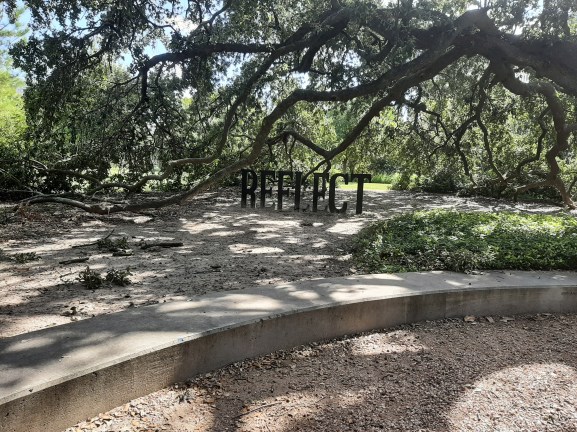
Part of the 6-piece “Monumental Moments” series
by Anthony Shumate, 2015
(located in Buffalo Bayou Park, along the Kinder Footpaths)
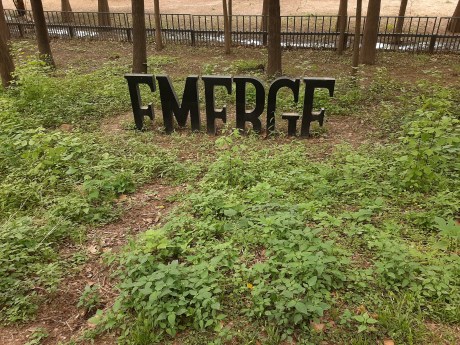
Part of the 6-piece “Monumental Moments” series
by Anthony Shumate, 2015
(located in Buffalo Bayou Park, along the Kinder Footpaths)
*Anthony Shumate’s “Monumental Moments” sculptures are located in Buffalo Bayou Park, along the Kinder Footpaths in Houston, Texas. They are unexpected reminders to “Explore,” “Pause,” “Reflect,” “Listen,” “Emerge,” and “Observe” – all things we do in our practice!
### NAMASTE ###
Posted by ajoyfulpractice in 7-Day Challenge, Changing Perspectives, Christmas, Faith, Healing Stories, Health, Hope, Japa, Japa-Ajapa, Life, Loss, Meditation, Mysticism, New Year, One Hoop, Peace, Philosophy, Religion, Science, Wisdom, Yoga.
Tags: 12 Days of Christmas, 988, catechism, Christmas, Dr. Nick Hobson, holidays, Imani, Kuumba, Kwanzaa, New Year's, Nguzo Saba, Nia, Sita (Joan Weiner) Bordow, Surya Namaskar, Swami Satchidananda, Twelvetide, Yoga Sutras 1.12-1.14
“Kwanzaa, yenu iwe na heri!” – “May your Kwanzaa be happy!” to everyone who is celebrating!
“My research over the last decade has helped understand why rituals in particular (and not any other behaviors like habits, for instance) are effective at battling negative emotions. Be it anxiety, stress, fear, doubt, sadness, grief – you name it. Rituals are there to save the day. The dread we feel after experiencing a loss happens because it feels like the situation is outside our control (and it usually is). Rituals reinstate that control.”
— quoted from “The emerging science of ritual – a new look on an ancient behavior: And how you can use it to live life to the fullest” by Dr. Nick Hobson (contributing to the ThriveGlobal.com, Dec. 7, 2017)
There is something to be said for a good ritual. I don’t just mean a habit, something you do repeatedly — even if it’s something you are in the habit of doing at a particular time. Neither am I just referring to a tradition — which could be a group habit and/or a ritual that has been passed down through generations, but has lost some of it’s deeper meaning. No, I am referring to something that is more like a ceremony; something infused with purpose and meaning.
Consider your exercise routine. You may be in the habit of doing a certain kind of physical activity at a certain time on certain day(s). Changes in your routine (and the resulting cancellations during the holidays) may leave you feeling off kilter. However, you know you will return to that routine (or something similar) because it serves a purpose and you value the experience. It may even connect you to a community.
No matter what you do, if you have that regular routine, you probably experience something more than physical well-being. You may notice mental and emotional benefits that serve you on multiple levels of your life. You may even do the thing you do for those specific benefits. In this way, what you do could be considered abhyasa (“[continuous and deliberate] practice, [engaged with sincere devotion]”) (YS. 1.12-1.14) However, those extra benefits are just that — lagniappe (“a little (something) extra”). They are gifts that are not intentionally part of the exercise.
Now, consider the physical practice of yoga, which you could consider a ritual within a ritual. It is part of a larger practice, and that larger practice intentional includes benefits beyond the physical. If you go to a different class; use one of my videos or recordings; and/or practice on your own, the ritual of the practice — i.e., the order in which we do the practice and the meaning behind the order and what we do within the sequences — still includes the deeper meaning and serves a deeper purpose, one that is beyond the physical-mental. One of my teachers once argued that this is true even if/when the meaning and purpose are not explicitly stated.
The meaning and purpose are baked in; they were part of the creation process.
Click on the excerpt title below for more about these holidays and our New Year’s Day tradition that is also a ritual!
Updated & Revised! Purpose Driven (a Friday post, that’s also for Saturday and Sunday!)
“Nia (purpose) — To make our collective vocation the building and development of our community in order to restore our people to their traditional greatness.”
— The fifth of the Nguzo Saba (or “Seven Essential Pillars”) of Kwanzaa
For people celebrating Kwanzaa, “Nia (Purpose)” is the focus for the fifth day (today, Tuesday); “Kuumba (creativity)” is the focus for the sixth day; and “Imani (faith)” is the focus for the sixth day. These final three days of Kwanzaa coincide with the fifth, sixth, seventh (or eighth) days of the “12 Days of Christmas” (depending on when you start counting).
If you are following along with the symbolic meaning of the gifts in the song, you will notice that the 5th, 6th, and 7th gifts are infused with purpose, meaning, creativity, and (of course) faith: “five gold rings” are the first Five Books of the Hebrew Bible and the Christian Old Testament (which provide the back story for the three Abrahamic religions); “six geese a-laying” for the six days of creation; and “seven swans a-swimming”, the consistently most expensive gift, stand for the seven gifts of the Holy Spirit (wisdom, understanding, knowledge, counsel, fortitude, piety, and fear of the Lord) or the seven sacraments (Baptism, Eucharist, Confirmation, Reconciliation, Anointing of the Six, Marriage, and Ordination). As for the eighth day, those could be considered extra (spiritual) gifts: “eight maids a-milking” for the eight beatitudes (or blessings).
“Kuumba (creativity) — To do always as much as we can, in the way we can, in order to leave our community more beautiful and beneficial than we inherited it.
Imani (faith) — To believe with all our heart in our people, our parents, our teachers, our leaders, and the righteousness and victory of our struggle.”
— The sixth and seventh of the Nguzo Saba (or “Seven Essential Pillars”) of Kwanzaa
Online (Zoom) classes are cancelled today through Wednesday, December 31st.
People on the recording email list(s) receive backup recordings. There are also some practice videos on my YouTube channel. You can check the “Class Schedules” calendar for upcoming classes. You can also request an audio recording of this practice via a comment below or (for a slightly faster reply) you can email me at myra (at) ajoyfulpractice.com.
The playlist for the fifth day of Kwanzaa is available on YouTube and Spotify. [Look for “12302020 Purpose Driven”]
“Consider, for instance, in moments of grief, rituals help ease our pain and suffering. But, again I ask, how do they do this, and why rituals in particular? As my collaborators Mike Norton and Francesca Gino have shown, rituals alleviate feeling of grief and loss by increasing a feelings of control.”
— quoted from “The emerging science of ritual – a new look on an ancient behavior: And how you can use it to live life to the fullest” by Dr. Nick Hobson (contributing to the ThriveGlobal.com, Dec. 7, 2017)
If you are thinking about suicide, worried about a friend or loved one, or would like emotional support, you can dial 988 (in the US) or call 1-800-273-TALK (8255) for the Suicide and Crisis Lifeline. You can also call this TALK line if you are struggling with addiction or involved in an abusive relationship. The Lifeline network is free, confidential, and available to all 24/7. YOU CAN TALK ABOUT ANYTHING.
White Flag is an app, which I have not yet researched, but which may be helpful if you need peer-to-peer (non-professional) support.
If you are a young person in crisis, feeling suicidal, or in need of a safe and judgement-free place to talk, you can also click here to contact the TrevorLifeline (which is staffed 24/7 with trained counselors).
In the spirit of generosity (“dana”), the Zoom classes, recordings, and blog posts are freely given and freely received. If you are able to support these teachings, please do so as your heart moves you. (NOTE: You can donate even if you are “attending” a practice that is not designated as a “Common Ground Meditation Center” practice, or you can purchase class(es).
Donations are tax deductible; class purchases are not necessarily deductible.
Check out the “Class Schedules” calendar for upcoming classes.
“You can perform japa, repetition of a mantra or Sacred Word, in the midst of your day-to-day work. Then, when it becomes a habit, even when you are working intensely a portion of the mind will keep repeating the mantra always. That means you have locked one end of your chain to a holy place, while the rest of the chain remains still in the outside world.”
— a note written by Swami Satchidananda, quoted in Sri Swami Satchidananda: Apostle of Peace by Sita (Joan Weiner) Bordow
### OM AUM ###
Posted by ajoyfulpractice in 108 Sun Salutations, 7-Day Challenge, Fitness, Health, Hope, Meditation, Minneapolis, Minnesota, New Year, One Hoop, Surya Namaskar, Twin Cities, Yin Yoga, Yoga.
Tags: 108 Sun Salutations, asana, in-person classes, meditation, Restorative Yoga, studio classes, vinyasa, Winter is coming, yoga, Zoom classes
Happy, Peaceful, Joyful Holidays, to all!
At this point, pulling out all my gear to deal with January in Minnesota has become a tradition. So…

I’m Gearing Up Again for Another New Year!
For a limited time only, I will be back in the Twin Cities. In-person practices (also available on Zoom) will be held at various locations Thursday, January 1st until Wednesday, January 7th — with an Open House on Friday, January 9th.
In the spirit of generosity (“dana”), the Zoom classes, recordings, and blog posts are freely given and freely received. If you are able to support these teachings, please do so as your heart moves you. (NOTE: You can donate even if you are “attending” a practice that is not designated as a “Common Ground Meditation Center” practice, or you can purchase class(es). Donations are tax deductible; class purchases are not necessarily deductible.)
### Let’s Go! ###
Posted by ajoyfulpractice in "Impossible" People, Advent, Faith, Healing Stories, Hope, Life, Meditation, Music, One Hoop, Philosophy, Suffering, Wisdom, Women, Yoga.
Tags: 988, Advent, Bhagavad Gita, Feast Day of Saint Lucia, Feast of Saint Lucia, Jack Hawley, light, Nativity Fast, novena, Saint Lucia, Saint Lucy, Saint Lucy's Day, Saint Philip's Fast, Yoga Sutra 1.36, Yoga Sutra 2.44
Many blessings to all and especially those observing the Feast Day of Saint Lucia, Advent, the Nativity / Saint Philip’s Fast, and/or just living in this month of Questions.
May you be safe and protected / May you be peaceful and happy / May you be healthy and strong!
“‘Remember, dear friend, that I am subtly inherent in everything, everything in the universe! I am the all-illuminating light of the sun, the light in the moon, the brilliance in the fire – all light is Mine. I am even the consciousness of light, and indeed, I am the consciousness of the entire cosmos.’”
— Krishna, speaking to Arjuna (15:12) of The Bhagavad Gita: A Walkthrough for Westerners by Jack Hawley
Today is the Feast Day of Saint Lucia (also known as Saint Lucy’s Day) in Western Christian traditions. Since different traditions around the world use different calendars, other light festivals are sometimes also celebrated on December 13th — which I joked gave us double (or triple) the light. But, that isn’t actually how this works.
CLICK ON THE EXCERPT TITLE BELOW FOR MORE.
(Note: The blog post excerpted below is year-specific.)
Light in the Darkness (a Monday post practice post)
“O St Lucy, preserve the light of my eyes so that I may see the beauties of creation, the glow of the sun, the colour of the flowers and the smile of children.
Preserve also the eyes of my soul, the faith, through which I can know my God, understand His teachings, recognize His love for me and never miss the road that leads me to where you, St Lucy, can be found in the company of the angels and saints.”
— quoted from A Novena Prayer to St Lucy, Protector of the Eyes
Please join me for a virtual yoga practice on Zoom, today (Saturday, December 13th) at 12:00 PM. You can use the link from the “Class Schedules” calendar if you run into any problems checking into the class. You can request an audio recording of this practice via a comment below or (for a slightly faster reply) you can email me at myra (at) ajoyfulpractice.com.
Saturday’s playlist is available on YouTube and Spotify. [Look for “12132022 Lucy’s Light”]
If you are thinking about suicide, worried about a friend or loved one, or would like emotional support, you can dial 988 (in the US) or call 1-800-273-TALK (8255) for the Suicide and Crisis Lifeline. You can also call this TALK line if you are struggling with addiction or involved in an abusive relationship. The Lifeline network is free, confidential, and available to all 24/7. YOU CAN TALK ABOUT ANYTHING.
White Flag is an app, which I have not yet researched, but which may be helpful if you need peer-to-peer (non-professional) support.
If you are a young person in crisis, feeling suicidal, or in need of a safe and judgement-free place to talk, you can also click here to contact the TrevorLifeline (which is staffed 24/7 with trained counselors).
In the spirit of generosity (“dana”), the Zoom classes, recordings, and blog posts are freely given and freely received. If you are able to support these teachings, please do so as your heart moves you. (NOTE: You can donate even if you are “attending” a practice that is not designated as a “Common Ground Meditation Center” practice, or you can purchase class(es).
Donations are tax deductible; class purchases are not necessarily deductible.
Check out the “Class Schedules” calendar for upcoming classes.
### LET YOUR LIGHT SHINE! ###
Posted by ajoyfulpractice in Changing Perspectives, Healing Stories, Hope, Life, Meditation, Music, One Hoop, Peace, Philosophy, Suffering, Tragedy, Wisdom, Women, Yin Yoga, Yoga.
Tags: 13th Amendment, 16 Days of Activism Against Gender-based Violence, 1989 Montreal Massacre, 988, Abraham Lincoln, Advent, Government of Canada, National Day of Remembrance and Action on Violence Against Women, Nativity Fast, St. Philip's Fast, State of the Union, White Ribbon Day
Many blessings to everyone and especially to anyone appreciating kindness, friendship, peace, freedom, understanding, gratitude, and wisdom during Advent; during the Nativity/Saint Philip’s Fast; and on the National Day of Remembrance and Action on Violence Against Women / “White Ribbon Day” (in Canada), one of the “16 Days of Activism against Gender-Based Violence”.
NOTE: This post references a violent act, but does not go into explicit details.
May you be safe and protected / May you be peaceful and happy / May you be healthy and strong!
“At the last session of Congress a proposed amendment of the Constitution abolishing slavery throughout the United States passed the Senate, but failed for lack of the requisite two-thirds vote in the House of Representatives. Although the present is the same Congress and nearly the same members, and without questioning the wisdom or patriotism of those who stood in opposition, I venture to recommend the reconsideration and passage of the measure at the present session. Of course the abstract question is not changed; but an intervening election shows almost certainly that the next Congress will pass the measure if this does not. Hence there is only a question of time as to when the proposed amendment will go to the States for their action. And as it is to so go at all events, may we not agree that the sooner the better?”
— quoted from State of the Union 1864, delivered to the United States Congress by President Abraham Lincoln (on 12/6/1864)
Yoga means union and, every time we step on the mat, we have the opportunity to check in with the state of that union. In the United States, we typically think of Presidents giving a State of the Union address towards the beginning of their term and towards the beginning of the year. However, on December 6, 1864, then-President Abraham Lincoln gave a State of the Union address in which he urged Congress and the States to take action “the sooner the better” on an amendment to abolish slavery. He proceeded to very actively, more actively than had previously been witnessed in other presidencies, work towards securing the votes needed to pass and ratify what would become the 13th Amendment — which was, in fact, ratified exactly one year later, on December 6, 1865.
CLICK ON THE EXCERPT TITLE BELOW FOR MORE.
FTWMI: When Do You Feel Free?
In addition to those U. S. anniversaries (which are related to efforts to end a violent period of history), December 6th is one of the “16 Days of Activism against Gender-Based Violence”. It is also the anniversary of mass gender-based violence that occurred in Canada. Fourteen women were murdered, while an additional ten women and four men were injured by someone who said he was against feminism. In the aftermath of the 1989 Montreal Massacre, many people took stock of the state of Canada’s union. While some say that the media (in particular) arrived at the wrong conclusions, Canada recognizes this day as the National Day of Remembrance and Action on Violence Against Women / “White Ribbon Day”.
“The National Day of Remembrance and Action on Violence Against Women is about remembering those who have experienced gender-based violence and those who we have lost to it. It is also a time to take action. Achieving a Canada free from gender-based violence requires everyone living in this country to educate themselves and their families and communities on gender-based violence, centre the voices of survivors in our actions and speak up against harmful behaviours.”
— quoted from the National Day of Remembrance and Action on Violence Against Women statement by the Government of Canada
Please join me for a virtual yoga practice on Zoom, today (Saturday, December 6th) at 12:00 PM. You can use the link from the “Class Schedules” calendar if you run into any problems checking into the class. You can request an audio recording of this practice via a comment below or (for a slightly faster reply) you can email me at myra (at) ajoyfulpractice.com.
Saturday’s playlist is available on YouTube and Spotify. [Look for “12062022 Freedom, XIII”]
NOTE: This is a remix based on the 4th of July and Juneteenth playlists. The playlists are slightly different, but mostly with regard to the before/after class music. The biggest difference is that the videos posted on the blog on July 4th do not appear on Spotify.
An instrumental playlist is also available on YouTube and Spotify. [Look for “12062024 Reflect, Remember, & Act for a Peaceful Union”]
NOTE: Start with track 1 or 6. Either option leads to a variation of a song that some view as liberating.
If you are thinking about suicide, worried about a friend or loved one, or would like emotional support, you can dial 988 (in the US) or call 1-800-273-TALK (8255) for the Suicide and Crisis Lifeline. You can also call this TALK line if you are struggling with addiction or involved in an abusive relationship. The Lifeline network is free, confidential, and available to all 24/7. YOU CAN TALK ABOUT ANYTHING.
White Flag is an app, which I have not yet researched, but which may be helpful if you need peer-to-peer (non-professional) support.
If you are a young person in crisis, feeling suicidal, or in need of a safe and judgement-free place to talk, you can also click here to contact the TrevorLifeline (which is staffed 24/7 with trained counselors).
In the spirit of generosity (“dana”), the Zoom classes, recordings, and blog posts are freely given and freely received. If you are able to support these teachings, please do so as your heart moves you. (NOTE: You can donate even if you are “attending” a practice that is not designated as a “Common Ground Meditation Center” practice, or you can purchase class(es).
Donations are tax deductible; class purchases are not necessarily deductible.
Check out the “Class Schedules” calendar for upcoming classes.
### FIND YOUR PEACEFUL SEAT ###
Posted by ajoyfulpractice in Abhyasa, Books, Changing Perspectives, Dharma, Faith, Gratitude, Healing Stories, Health, Karma Yoga, Life, Love, Meditation, One Hoop, Philosophy, Suffering, Vairagya, Wisdom, Yoga.
Tags: 988, Abhyasa, asana, Bhagavad Gita, Christopher Isherwood, Dharma, gratitude, hatha yoga, Jack Hawley, John Metcalfe, Karma Yoga, Lisa Bloom, meditation, Merrick Rosenberg, Mindfulness, Pandit Rajmani Tigunait, Patrick Lencioni, Paul Barrera, pranayama, santosha, sva-dharma, Swami Prabhavananda, vinyasa, vinyāsa, Yoga Sutra 1.20, Yoga Sutra 3.38, Yoga Sutras 1.21-1.22, Yoga Sutras 1.23-1.24
Many blessings to everyone and especially to anyone sitting (& speaking) with kindness, friendship, peace, freedom, understanding, wisdom, and gratitude.
May you be safe and protected / May you be peaceful and happy / May you be healthy and strong!
This is the “missing” post, for Sunday, November 23rd. One link embedded in the text will direct you to a site outside of this blog. You can request an audio recording of this practice or a previous practice via a comment below or (for a slightly faster reply) you can email myra (at) ajoyfulpractice.com.
In the spirit of generosity (“dana”), the Zoom classes, recordings, and blog posts are freely given and freely received. If you are able to support these teachings, please do so as your heart moves you. (NOTE: You can donate even if you are “attending” a practice that is not designated as a “Common Ground Meditation Center” practice, or you can purchase class(es).
Donations are tax deductible; class purchases are not necessarily deductible.
Check out the “Class Schedules” calendar for upcoming classes.
“For many of us, filling a segment of our day with a prescribed set of disciplines is practice. This type of practice is comprised of a list of techniques and injunctions, and we undertake it because we have been told it will bring us a specific result. It is a recipe for solving a problem. As a result, the value of the practice is dependent on when and to what extent it meets our expectations. If it does not meet our expectations, we dump it without hesitation.”
— commentary on Yoga Sūtra 1.20, from The Secret of the Yoga Sutra: Samadhi Pada by Pandit Rajmani Tigunait, PhD
We could make it complicated. However, when we really get down to it, this practice is simple. It’s not always easy, but it is simple. Combine your ethics, morals, and awareness; find a comfortable (and steady) seat; and, then, sit and breathe (with awareness). That’s it really. That’s the practice. In the Yoga Sūtras, Patanjali indicated that a “[continuous] practice” (abhyasa) and “non-attachment” (vairagya) ultimately lead to mental and physical vitality, as well as freedom and liberation from suffering. (YS 1.2 – 1.4; 1.12 – 1.15; 1.29 – 1.40; 2.18)
Our physical practice of yoga (hatha yoga, regardless of the style or tradition) is the way we get our mind-body ready for deep-seated meditation. Of course, we make it a little more complicated; because we move between seats. In a vinyāsa, we “place [things] in a special way” in order to flow in and out of poses/seats. So, that’s another complication. Some of the poses and sequences can be challenging — intense even — and one of my earliest yoga teachers use to say that our “yoga practice should be the most intense part of our day.”
Funny thing about my teacher Paul B’s statement: He never indicated the type intensity. Was the practice meant to be the most intense physically, mentally, emotionally, and/or spiritually? Was it meant to be intensely vigorous or intensely relaxing? Was it all of the above?
Or, was there some other level of intensity that we were missing? Could the intensity come from our devotion?
“Love for practice comes from knowing its importance.”
“The more convinced we are about the key role of our practice in enabling us to live a purposeful and meaningful life, the more we love and respect it. Love and respect springing from a true understanding of our practice is shraddha [faith]. We are joyful at the prospect of doing our practice. The reasons for delaying or dispensing with it become meaningless. We no longer care whether our practice lowers our blood pressure or relaxes our nervous system—we do it for the simple joy of doing it. According to Vyasa, shraddha is the joy that accompanies a practice. It is more than faith—it is the thrill of realizing that we are fortunate to have a practice that helps restore the pristine nature of our mind, takes us inward, and gives us a vision of life’s purpose.”
— commentary on Yoga Sūtra 1.20, from The Secret of the Yoga Sutra: Samadhi Pada by Pandit Rajmani Tigunait, PhD
According to Yoga Sūtras 1.20 – 1.22, there are five types of effort; nine ways to practice (the overall philosophy) based on our “…intensity of feeling, vigor, and firm conviction…”; and how long it takes us to reach our goal(s) will be based on how much time, effort, and intensity we put into the practice. Swami J, in the Himalayan tradition, compares this paradigm to the race between the tortoise and the hare and has a great breakdown of the different ways to practice (which you can find here).
You may also consider, as one of my teachers (Lisa B.) once explained, that you don’t have to believe in (or understand) every aspect of the practice for those aspects to work. However, if you believe (i.e., have firm conviction), you will be more diligent about what your actions — and you may spend more time doing the things that are beneficial.
Your diligence may also serve as a reminder to practice non-attachment and remember that the challenges in our practice — such as poses and sequences we aspire to achieve — can be a distraction or obstacle to our ultimate goal.
“‘To work without desire may seem impossible, but the way to do it is to substitute thoughts of Divinity for thoughts of desire. Do your work in this world with your heart fixed on the Divine instead of on outcomes. Do not worry about results. Be even tempered in success or failure. This mental evenness is what is meant by yoga…. Indeed, equanimity is yoga!’”
— Krishna speaking to Arjuna (2.48) in The Bhagavad Gita: A Walkthrough for Westerners by Jack Hawley
The dangers of an achievement simultaneously being an impediment is reinforced in texts like the Yoga Sūtras and the Bhagavad Gita (the “Song of the Lord”), which emphasize “non-attachment” (vairagya) and “non-grasping”/“non-hording” (āparigrahā). In fact, Yoga Sūtra 3.38 explicitly states that “They are powers/achievements in the worldly state, but the are obstacles to samadhi.” Both the Yoga Sutras and the Bhagavad Gita (as noted above) instruct us to offer our efforts up (with trustful surrender) as if our very efforts are a gift to the Universe.
The Gita goes even further, because it highlights the fact that we are all given gifts (e.g., temperaments, personalities, experiences, perspectives, and skills) that make us well-suited for certain jobs and responsibilities. (BG 18.41 – 18.49) If we think about everything we do in this way, we have the opportunity to appreciate giving and receiving the same gifts.
And, surely, that much gratitude multiplies the joy.
“‘I accept with joy whatever I am offered in true devotion: fruit or water, leaf or flower. The gift is love, the dedication of your heart. Devotion alone gains access to Divinity.’”
— Krishna speaking to Arjuna (9.26) in The Bhagavad Gita: A Walkthrough for Westerners by Jack Hawley
Throughout the Bhagavad Gita, Krishna (as an embodiment of the Divine) breaks down different yoga paths and, in doing so, highlights the fact that everything we do can be an gift/offering. I thought about this idea as I was reading The 6 Types of Working Genius: A Better Way to Understand Your Gifts, Your Frustrations, and Your Team by Patrick Lencioni, which was recommended by my yoga buddy Carl (in a discussion that included a similar book that I love). The parallels between these modern books on management and these ancient texts made me think about how often we express (or neglect to express) gratitude for the things someone else does that we’re glad we don’t have to do.
It also made me think about how often we take those things (and people) for granted — and how, in taking people (and things) for granted, we miss an opportunity to give thanks.
“And in the Gita [9.27], we read:
Whatever your action,
Food or worship;
Whatever the gift
That you give to another;
Whatever you vow
To the work of the spirit:…
Lay these also
As offerings before Me.”
— quoted from the commentary for Yoga Sūtra 1.23 – 1.24, in How to Know God: The Yoga Aphorisms of Patanjali, translated and with commentary by Swami Prabhavananda and Christopher Isherwood
Sunday’s playlist is available on YouTube and Spotify. [Look for “09012024 Deep Listening”]
NOTE: The playlist contains John Metcalfe’s album Tree (with the remixes); however, one track has been moved. The story behind the album is beautiful. Additionally, I encourage you to deeply listen to Track #11 (which was the inspiration for the playlist and the September practice).
If you are thinking about suicide, worried about a friend or loved one, or would like emotional support, you can dial 988 (in the US) or call 1-800-273-TALK (8255) for the Suicide and Crisis Lifeline. You can also call this TALK line if you are struggling with addiction or involved in an abusive relationship. The Lifeline network is free, confidential, and available to all 24/7. YOU CAN TALK ABOUT ANYTHING.
White Flag is an app, which I have not yet researched, but which may be helpful if you need peer-to-peer (non-professional) support.
If you are a young person in crisis, feeling suicidal, or in need of a safe and judgement-free place to talk, you can also click here to contact the TrevorLifeline (which is staffed 24/7 with trained counselors).
Correction (& Errata &): During the 2025 practice (& on the music post) inadvertently cited the wrong Yoga Sūtra chapter for YS 1.23-1.24. (11/23/2025)
NOTE: In anticipation of the holiday(s), I have cancelled classes on November 26th – December 3rd.
Don’t forget to be grateful.
### AUM / OM ###
Posted by ajoyfulpractice in Abhyasa, Changing Perspectives, Faith, Gratitude, Healing Stories, Karma Yoga, Life, Love, Meditation, One Hoop, Philosophy, Wisdom, Yoga.
Tags: Abhyasa, Bhagavad Gita, Christopher Isherwood, Jack Hawley, John Metcalfe, meditation, Mindfulness, Swami Prabhavananda, Yoga Sutras 1.21-1.22, Yoga Sutras 1.23-1.24
Many blessings to everyone and especially to anyone sitting (& speaking) with kindness, friendship, peace, freedom, understanding, wisdom, and gratitude.
May you be safe and protected / May you be peaceful and happy / May you be healthy and strong!
“‘I accept with joy whatever I am offered in true devotion: fruit or water, leaf or flower. The gift is love, the dedication of your heart. Devotion alone gains access to Divinity.’”
— Krishna speaking to Arjuna (9.26) in The Bhagavad Gita: A Walkthrough for Westerners by Jack Hawley
Please join me today (Sunday, November 23rd) at 2:30 PM for a yoga practice on Zoom. You can use the link from the “Class Schedules” calendar if you run into any problems checking into the class. You can request an audio recording of this practice via a comment below or (for a slightly faster reply) you can email myra (at) ajoyfulpractice.com.
Sunday’s playlist is available on YouTube and Spotify. [Look for “09012024 Deep Listening”]
NOTE: The playlist contains John Metcalfe’s album Tree (with the remixes); however, one track has been moved. The story behind the album is beautiful. Additionally, I encourage you to deeply listen to Track #11 (which was the inspiration for the playlist and the September practice).
“And in the Gita [9.27], we read:
Whatever your action,
Food or worship;
Whatever the gift
That you give to another;
Whatever you vow
To the work of the spirit:…
Lay these also
As offerings before Me.”
— quoted from the commentary for Yoga Sūtra 1.23 – 1.24, in How to Know God: The Yoga Aphorisms of Patanjali, translated and with commentary by Swami Prabhavananda and Christopher Isherwood
If you are thinking about suicide, worried about a friend or loved one, or would like emotional support, you can dial 988 (in the US) or call 1-800-273-TALK (8255) for the Suicide and Crisis Lifeline. You can also call this TALK line if you are struggling with addiction or involved in an abusive relationship. The Lifeline network is free, confidential, and available to all 24/7. YOU CAN TALK ABOUT ANYTHING.
White Flag is an app, which I have not yet researched, but which may be helpful if you need peer-to-peer (non-professional) support.
If you are a young person in crisis, feeling suicidal, or in need of a safe and judgement-free place to talk, you can also click here to contact the TrevorLifeline (which is staffed 24/7 with trained counselors).
In the spirit of generosity (“dana”), the Zoom classes, recordings, and blog posts are freely given and freely received. If you are able to support these teachings, please do so as your heart moves you. (NOTE: You can donate even if you are “attending” a practice that is not designated as a “Common Ground Meditation Center” practice, or you can purchase class(es).
Donations are tax deductible; class purchases are not necessarily deductible.
Check out the “Class Schedules” calendar for upcoming classes.
NOTE: In anticipation of the holiday(s), I have cancelled classes on November 26th – December 3rd.
Don’t forget to be grateful.
Errata & Correction: I inadvertently cited the wrong Yoga Sūtra chapter for the last quote. (11/23/2025)
###  ###
###
Posted by ajoyfulpractice in Faith, Fitness, Health, Life, Meditation, One Hoop, Philosophy, Wisdom, Yoga.
Tags: 988, A. G. Mohan, Equal Pay Day, Fernando Pagés Ruiz, haṭha yoga, hatha yoga, Health, Krishnamacharya, T. K. V. Desikachar, yoga, yoga practice, Yoga Sutra 1.2, Yogeshwara Ramamohana Brahmachari
Many blessings to everyone and especially to anyone cultivating friendship, peace, freedom, understanding, and wisdom.
May you be peaceful and happy / May you be healthy and strong!
“Yoga is awareness, a type of knowing. Yoga will end in awareness. Yoga is arresting the fluctuations of the mind as said in the Yoga Sutras (of Patanjali): citta vritti nirodha. When the mind is without any movement, maybe for a quarter of an hour, or even a quarter of a minute, you will realize that yoga is of the nature of infinite awareness, infinite knowing. There is no other object there.”
— Sri T. Krishnamacharya at 100, in an interview with A. G. Mohan
Sri. T. Krishnamacharya was born today in 1888. CLICK THE EXCERPT TITLE BELOW FOR MORE.
More Sitting and Breathing
“[T. K. V.] Desikachar realized that his father felt that every action should be an act of devotion, that every asana should lead toward inner calm. Similarly, [Sri. T.] Krishnamacharya’s emphasis on the breath was meant to convey spiritual implications along with psychological benefits. According to Desikachar, Krishnamacharya described the cycle of breath as an act of surrender: ‘Inhale, and God approaches you. Hold the inhalation, and God remains with you. Exhale, and you approach God. Hold the exhalation, and surrender to God.’”
— quoted from the May/June 2001 Yoga Journal article entitled “Krishnamacharya’s Legacy” by Fernando Pagés Ruiz
Please join me today (Tuesday, November 18th) at 12:00 PM or 7:15 PM for a yoga practice on Zoom. You can use the link from the “Class Schedules” calendar if you run into any problems checking into in the class. You can request an audio recording of this practice via a comment below or by emailing myra (at) ajoyfulpractice.com.
Tuesday’s playlist is available on YouTube and Spotify. [Look for “07112020 An Introduction”]
Today is Native Women’s Equal Pay Day in 2025. Click here for more information about equal pay days.
If you are thinking about suicide, worried about a friend or loved one, or would like emotional support, you can dial 988 (in the US) or call 1-800-273-TALK (8255) for the Suicide and Crisis Lifeline. You can also call this TALK line if you are struggling with addiction or involved in an abusive relationship. The Lifeline network is free, confidential, and available to all 24/7. YOU CAN TALK ABOUT ANYTHING.
White Flag is an app, which I have not yet researched, but which may be helpful if you need peer-to-peer (non-professional) support.
If you are a young person in crisis, feeling suicidal, or in need of a safe and judgement-free place to talk, you can also click here to contact the TrevorLifeline (which is staffed 24/7 with trained counselors).
In the spirit of generosity (“dana”), the Zoom classes, recordings, and blog posts are freely given and freely received. If you are able to support these teachings, please do so as your heart moves you. (NOTE: You can donate even if you are “attending” a practice that is not designated as a “Common Ground Meditation Center” practice, or you can purchase class(es).
Donations are tax deductible; class purchases are not necessarily deductible.
Check out the “Class Schedules” calendar for upcoming classes.
### BREATHE WITH AWARENESS ###
Posted by ajoyfulpractice in Buddhism, Changing Perspectives, Healing Stories, Hope, Life, Mantra, Meditation, Music, One Hoop, Peace, Philosophy, Suffering, Wisdom, Yoga.
Tags: mantra, meditation, Mindfulness, Pandit Rajmani Tigunait, peace, Peace of the Pyrenees, Restorative Yoga, yoga, Yoga Sutra 2.33, Yoga Sutra 2.46
Many blessings to everyone and especially to anyone gathering friendship, peace, freedom, understanding, and wisdom.
May you be peaceful and happy / May you be healthy and strong!
This (backdated) “missing” invitation for the “First Friday Night Special” on November 7th, includes some related excerpts. You can request an audio recording of this Restorative Yoga practice (with a little SYE) via a comment below or (for a slightly faster reply) you can email myra (at) ajoyfulpractice.com.
In the spirit of generosity (“dana”), the Zoom classes, recordings, and blog posts are freely given and freely received. If you are able to support these teachings, please do so as your heart moves you. (NOTE: You can donate even if you are “attending” a practice that is not designated as a “Common Ground Meditation Center” practice, or you can purchase class(es).
Donations are tax deductible; class purchases are not necessarily deductible.
Check out the “Class Schedules” calendar for upcoming classes.
“SECTION I
CONTAINING THE PRELIMINARY ARTICLES FOR PERPETUAL PEACE AMONG STATES
1. ‘No Treaty of Peace Shall Be Held Valid in Which There Is Tacitly Reserved Matter for a Future War’
Otherwise a treaty would be only a truce, a suspension of hostilities but not peace, which means the end of all hostilities–so much so that even to attach the word ‘perpetual’ to it is a dubious pleonasm.”
— quoted from the 1795 essay “Perpetual Peace: A Philosophical Sketch” by Immanuel Kant
Signed today (November 7th) in 1659, on the Isle of Pheasants, the “Peace of the Pyrenees” was a peace treaty that ended 24 years of warfare between France and Spain. The warfare was part of the 30 Years War, which started as a religious conflict between Catholic and Protestants. The treaty required the personal compromise and sacrifice of some country leaders and some members of the general populace. The treaty did not, however, fit Immanuel Kant’s definition of a true treaty; because, at its very foundation we find the seeds for more conflict and hostility.
The Yoga Sūtras outline several ways to uproot the seeds (and roots) of conflict, hostility, and suffering. Those methods include the practice of “codes of self-regulation or restraint (yamas) and observances or practices of self-training (niyamas)”. In Yoga Sūtra 2.33, Patanjali acknowledged that we may not always be able to practice the ethical components perfectly (or at all). In such situations, we are instructed to “cultivate the opposite [thought or action]” — a practice which we also find in Buddhism. The key to this type of practice is to build on a foundation of peace and infuse every thought, word, and deed with peace.
In other words, “To Have Peace In The World / True Peace / We Must Work for Peace in the World / and Breathe Peace In & Breathe Peace Out….”
“However, if the process of non-violence is to be effective in counteracting violence, we must first describe and outline it clearly and methodically. Because violent thoughts always precede a violent act, an act of non-violence will be effective only if it is preceded by non-violent thoughts. Violence is an active phenomenon, whereas non-violence is mistakenly thought to be passive – simply the absence of violence. But passive non-violence has no power to extinguish the fire if violence. Non-violence must be as active as violence itself.”
— commentary on Yoga Sūtra 2.33, from The Practice of the Yoga Sutra: Sadhana Pada by Pandit Rajmani Tigunait, PhD
CLICK ON THE EXCERPT TITLE BELOW FOR MORE.
To Have Peace In the World…
“In the conventional practice of non-violence we are not led to entertain a stream of structured, organized non-violent thoughts. For example, when someone slaps us on the right cheek, we are told to offer the left one also—this is said to be practicing non-violence. But this approach to non-violence does not free us from pain, nor does it purify our mind. According to Vyasa, we must design a system of practice that neutralizes the force of violence, step-by-step and point-by-point.”
— quoted from the commentary on Yoga Sūtra 2.33, from The Practice of the Yoga Sutra: Sadhana Pada by Pandit Rajmani Tigunait, PhD
This Restorative Yoga practice is accessible and open to all.
(NOTE: There will be a little bit of quiet space in this practice.)
Friday’s playlist is available on YouTube and Spotify. [Look for “Movember / November Friday 2025”]
NOTE: Start with Track 1; Track 10; Track 11; Track 12; or Track 13 on either platform or Track 14 on the YouTube version.
Prop wise, we will start with a chair, sofa, or coffee table and this is a kitchen sink practice. You can practice without props or you can use “studio” and/or “householder” props. Example of “Studio” props: 1 – 2 blankets, 2 – 3 blocks, a bolster, a strap, and an eye pillow. Example of “Householder” props: 1 – 2 blankets or bath towels, 2 – 3 books (similar in size), 2 standard pillows (or 1 body pillow), a belt/tie/sash, and a face towel.
You may want extra layers (as your body may cool down during this practice). Having a wall, chair, sofa, or coffee table will also be handy.
If you are thinking about suicide, worried about a friend or loved one, or would like emotional support, you can dial 988 (in the US) or call 1-800-273-TALK (8255) for the Suicide and Crisis Lifeline. You can also call this TALK line if you are struggling with addiction or involved in an abusive relationship. The Lifeline network is free, confidential, and available to all 24/7. YOU CAN TALK ABOUT ANYTHING.
White Flag is an app, which I have not yet researched, but which may be helpful if you need peer-to-peer (non-professional) support.
If you are a young person in crisis, feeling suicidal, or in need of a safe and judgement-free place to talk, you can also click here to contact the TrevorLifeline (which is staffed 24/7 with trained counselors).
### OM SHANTI, SHANTI, SHANTIHI OM ###
 A Joyful Practice