PLEASE NOTE: This post involves a theoretical discussion on non-COVID related death.”
“People ask me how I find hope. I answer that I don’t believe in hope, and I don’t believe in hopelessness. I believe in compassion and pragmatism, in doing what is right for its own sake. Hope can be lethal when you are fighting an autocracy because hope is inextricable from time. An enduring strategy of autocrats is to simply run out the clock.”
– from Hiding in Plain Sight by Sarah Kendzior
“As spring is nature’s season of hope, so Easter is the Church’s season of hope. Hope is an active virtue. It’s more than wishful thinking….. My hope in the Resurrection is not an idle hope like wishing for good weather but an active hope. It requires something on my part – work. Salvation is a gift from God for which I hope, but Saint Paul told the Philippians to ‘work out your salvation with fear and trembling’ (2:12). My hope in the resurrection and eternal life in heaven requires work on my part.”
– from A Year of Daily Offerings by Rev. James Kubicki
Serendipitously, I received two texts from the same Austin suburb last night. One was from a friend, sharing the quote above. The other was from my brother, asking why people were celebrating the same thing at different times. The quote sharpened my focus. The question brings me to you.
Even though he didn’t ask the question in an all encompassing way, I am going to answer his question here in a broader sense, and in a pretty basic way. On Sunday, April 12th, Western Christians are celebrating Easter, Orthodox Christians are celebrating Palm Sunday (the Sunday before Easter), the Jewish community is observing Passover and there are some people in the world celebrating both Easter (or Palm Sunday) and Passover. When you consider that this observations and celebrations are occurring all over the world – and keep in mind different time zone – it can get really confusing. Hence my brothers question.
As you remember, Passover is a commemoration of the Exodus story, which is the story of the Jewish people being freed from slavery in Egypt. The Jewish liturgical calendar is lunar-based and therefore Passover happens at a slightly different time each year on the Gregorian (i.e., secular) calendar. According to all four canonical Gospels of the New Testament, Jesus spent the last week of his life preparing for Passover (and what he knew was coming in terms of the Crucifixion and Resurrection). Three of the four indicate that what Christians (and artists) refer to as the “Last Supper” was actually a Passover Seder – so we are back to a lunar calendar, although it’s a different lunar calendar. Orthodox Christians operate under the old-school Julian calendar, so now we have a third timeline.
Just to add a little spice to the mix, consider that, dogmatically speaking, the concept of a Messiah originates within Judaism and includes specific qualifications for how the Messiah would be identified. According to the Christian paradigm, Jesus meets the qualifications. According to most Jews, he does not. Most modern Christians focus exclusively on the New Testament and observe holy times accordingly. Some Christians, however, also follow the observations commanded in Deuteronomy and Leviticus.
Got it? Be honest. If you need a scorecard, I’m happy to provide one – especially since I’m about to go down the (metaphorical) rabbit hole.
Whenever I think about Easter, the waiting that happens on the Saturday between Good Friday and Easter, and the moment when the rock is rolled away to reveal the empty tomb, I think of one thing: Wigner’s friend taking care of Schrödinger’s Cat.
For those of you not familiar with physicist Erwin Schrödinger’s thought experiment (or paradox), it goes like this. The (imaginary) cat is closed up in a box with an unstable radioactive element that has a 50-50 chance of killing the cat before the box is opened. According to quantum mechanics, there is a moment when the cat is simultaneously alive and dead. This is called superposition and it could be considered the scientific equivalent of non-duality. When the box is opened, revealing the state of the cat, the superposition collapses into a single reality. (There is also the possibility that opening the box changes the percentage, but that’s a whole different tunnel.)
Physicist Eugene Wigner took things a bit farther by adding a friend. According to the Wigner’s thought experiment, instead of doing the experiment, the scientist leaves it all in the hands of a friend and waits for a report. Now, there is the superposition inside of the box and there is a separate superposition inside the lab, which means the wave (or superposition) collapses into a single reality when the box is opened (creating reality as the friend knows it) and collapses again when the (imaginary) friend reports to the scientist (establishing the original scientist’s reality). Let’s not even get into what happens if the friend opens the box and leaves the lab without reporting back to the original scientist, but has a certain expectation – i.e., understanding of reality – about what the scientist will find in the lab. Through it all, the cat exists (and ceases to exist) within its own reality. It never experiences the superposition others experience. It just is.
That state of being, existing, takes us back to Passover, and eventually to the Resurrection of Jesus.
“’And know also, Arjuna, that as the Divinity in all creatures and all nature, I am birthless and deathless. And yet, from time to time I manifest Myself in worldly form and live what seems an earthly life. I may appear human but that is only my “mya” (power of illusion), because in truth I am beyond humankind; I just consort with nature, which is Mine.’”
– The Bhagavid Gita: A Walkthrough for Westerners (4:6), by Jack Hawley
“And He said, ‘For I will be with you, and this is the sign for you that it was I Who sent you. When you take the people out of Egypt, you will worship God on this mountain.’”
– Shemot / Exodus 3:12
“God said to Moses, ‘Ehyeh asher ehyeh (I will be what I will be),’ and He said, ‘So shall you say to the children of Israel, “Ehyeh (I will be) has sent me to you.’””
– Shemot / Exodus 3:14
In the Exodus story, the Jewish people are slaves in Egypt and G-d commands Moses to go to Pharaoh and demand they be released. Moses takes his brother Aaron along and then, when their show of power doesn’t convince Pharaoh of the authority of G-d, everyone is subject to nine plagues: blood, frogs, lice, wild beasts in the streets, pestilence, boils, hail, locusts, and day(s) of darkness. Remember it’s not only Pharaoh and the Egyptians who suffer. The Jews, who are already suffering the hardship of slavery, also have to endure these additional hardships. On the evening of the tenth plague, the death of the first born male child, the Jewish families are told they are to smear lambs blood on their doors – so their households will be passed over. They are also commanded to celebrate and give thanks for their freedom – even though they are still slaves.
Yes, it is a little mind boggling, but what passes as the first Passover Seder happens in Egypt and during a time of slavery. Considering Pharaoh had changed his mind before, they had no way of knowing (with any certainty) that they would be freed immediately after the tenth plague. See where this is going? In that moment, the Jewish people are simultaneously free and not free.
Furthermore, Rabbi David Fohrman, quoting Shlomo Yitzchaki, the medieval French rabbi known as Rashi, points out that when G-d initial speaks to Moses and Moses asks for G-d’s identity, Moses is told three times that the One who speaks is the One who will be with Moses and the Jewish people always. Regardless of what they are experiencing, Rashi explains, G-d will be with them. This is the very definition of compassion, which literally means “to suffer with.”
“’Whenever goodness and “dharma” (right action) weaken and evil grows stronger, I make Myself a body. I do this to uplift and transform society, reestablish the balance of goodness over wickedness, explain the sublime plan and purpose of life, and serve as the model for others to follow. I come age after age in times of spiritual and moral crisis for this purpose.’”
– The Bhagavid Gita: A Walkthrough for Westerners (4:7-8), by Jack Hawley
Jesus (during his time), and future Christians, are kind of in the same boat. In the last week of his life, he is betrayed, crucified, dead, buried, and resurrected – and he simultaneously is not. However, most of that is semantics. What is critical is the dead/buried, and resurrected part. In those moments, even right after the tomb is opened and there is some confusion about what has happened, Jesus is essentially Schrödinger’s Cat – and Christians, as well as non-believers, are either the original scientist or the friend.
Yet, when everything is said and done (stay with me here), this is all head stuff. What people are observing, commemorating, and/or celebrating right now, isn’t really about the head. Faith never is. It’s all about the heart. It’s all about love. Specifically, in these examples, it all comes back to G-d’s love expressed as compassion.
“For God so loved the world that he gave his one and only Son, that whoever believes in him shall not perish but have eternal life.”
– John 3:16 (NIV)
“’Strange? Yes. It is difficult for most people to comprehend that the Supreme Divinity is actually moving about in human form. But for those few who dare to learn the secret that is I, Divinity, who is the Operator within them, their own Self, My coming in human form is a rare opportunity to free themselves from the erroneous belief that they are their bodies.’”
– The Bhagavid Gita: A Walkthrough for Westerners (4:9), by Jack Hawley
Please join me today (April 12th)for my first every Easter Sunday service/practice, 2:30 PM – 3:35 PM, on Zoom. Some of the new security protocols are definitely kicking in so, please use the link from the “Class Schedules” calendar if you run into any problems. The playlist is available on YouTube and Spotify.
If you are following the Orthodox Christian calendar and would like a recording of last week’s classes, please comment or email me.
For more ways you can practice pragmatism and self-compassion, please join me and a special guest for “Lung Health and How We Cope Right Now ((viewing COVID-19 through Traditional Chinese Medicine and YIN Yoga),” a discussion on the importance of the lungs in our overall wellbeing as well as how to just friggin’ cope right now. The conversation will include a brief overview of Traditional Chinese Medicine and YIN Yoga, as well as a brief Q&A followed by a little YIN Yoga.
If you are struggling with your physical or mental health, if you’ve always been curious about “alternative” medicine, and/or if you are missing your yoga practice, this special one hour event is for you. Please join us on YouTube, Wednesday, April 15th, 3:00 PM to 4:00 PM,
Also, mark your calendar for April 25th – the beginning of Kiss My Asana!
Speaking of Kiss My Asana…
Founded by Matthew Sanford, Mind Body Solutions helps those who have experienced trauma, loss, and disability find new ways to live by integrating both mind and body. They provide classes, workshops, and outreach programs. They also train yoga teachers and offer highly specialized training for health care professionals. This year’s yogathon is only a week long. Seven days, at the end of the month, to do yoga, share yoga, and help others. By participating in the Kiss My Asana yogathon you join a global movement, but in a personal way. In other words, you practice yoga… for 7 days.
Kissing My Asana is pragmatic and compassionate!
You don’t need to wait until the end of the month, however, to consider how you might participate. Start thinking now about how you can add 5 minutes of yoga (or meditation) to your day, how you can learn something new about your practice, or even how you would teach a pose to someone close to you – or even to one of your Master Teachers/Precious Jewels.
To give you some ideas, consider that in past years my KMA offerings have included donation-based classes and (sometimes) daily postings. Check out one of my previous offerings dated April 12th (or thereabouts):
“And how many times can a man turn his head And pretend that he just doesn’t see – the answer The answer, my friend, is blowin’ in the wind The answer is blowin’ in the wind”
– “Blowin in the Wind” sung by Joan Baez, lyrics by Bob Dylan
Every year, I say that May 1st is one of the hardest working days of the year, because so many people use that day to celebrate so many things. That being said, this year, April 8th may be the most revered day of the year as it coincides with several religious or philosophical observations: Spy Wednesday in the Roman Catholic and Western Christian traditions, the beginning of Passover (at sunset) in the Jewish tradition, Hanuman Jayanti in some Hindu traditions, and the Buddha’s birthday in some culturally Buddhist traditions (specifically in parts of Japan). These observations don’t always stack up like this since different traditions and cultures base their holy days on different calendars. This year; however, the super pink moon shines over the world in a way that is uniquely auspicious.
I am always up for a good auspicious story, one that is simultaneously inspiring and enlightening, and a reason to practice the splits. The question is: How do we honor so much in the short amount of time that is a 60-minute class? That’s an especially tricky challenge when some of these are not even remotely connected on paper. The answer, of course, is to find the common denominator.
When considering different people’s experiences with the divine – or even what is best in mankind – we start with what is universal to the human experience: doubt and fear, passion/suffering, faith, and change. Everything changes and, in moments of great suffering – in moments when we doubt and fear ourselves and those around us – it is important to have faith in the fact that things will change. That faith can, sometimes, bring hope – and the power of hope is another common denominator. But, let’s step back for a moment and consider doubt and fear plus passion/suffering.
“It’s not the case that when there is the view, ‘The soul & the body are the same,’ there is the living of the holy life. And it’s not the case that when there is the view, ‘The soul is one thing and the body another,’ there is the living of the holy life. When there is the view, ‘The soul & the body are the same,’ and when there is the view, ‘The soul is one thing and the body another,’ there is still the birth, there is the aging, there is the death, there is the sorrow, lamentation, pain, despair, & distress whose destruction I make known right in the here & now.”
– from Cula-Malunkyovada Sutta: The Shorter Instructions Malunkya (translated from the Pali by Thanissaro Bhikkhu)
The Buddha (whose birthday is celebrated in May by some traditions) said that he taught only two things: suffering and the end of suffering. In fact, the Four Noble Truths outline exactly that. “I have heard” two parables the Buddha used to differentiate between (physical) pain and (mental) suffering. Both parables also point to the ways in which we can alleviate our own suffering.
In one parable, a man is shot with a poisoned arrow. As the poison enters the man’s bloodstream, he is surrounded by people who can and want to help him, to save his life. The problem is that the man wants to know why he was shot. In fact, before the arrow is removed he wants to know why he was shot, by whom he was shot, and all the minutia about the archer and their life. While the information is being gathered, the poison is moving through the man’s body; the man is dying. In fact, the man will die before he has the answers to all his questions.
In another parable, a man is shot by an arrow (no poison this time) and then, in the very next breath, the man is shot by a second arrow. The Buddha explains that the first arrow is physical pain, and we can’t always escape or avoid that. The second arrow, however, is the mental suffering (or pain) that is caused when “the uninstructed run-of-the-mill person sorrows, grieves, & laments, beats his breast, becomes distraught.” How we respond to moments of pain and suffering determines how much more pain and suffering we will endure.
“How many ears must one person have Before he can hear people cry? And how many deaths will it take ’till he knows That too many people have died? The answer, my friends, is blowin’ in the wind The answer is blowin’ in the wind”
– “Blowin in the Wind” lyrics by Bob Dylan
When we look the observations that are happening around the world today (Wednesday, April 8th) from the perspective of the human experience (instead of looking at them from the perspective of cultural or historical differences), we find they are more alike than different. In these stories there are two recognized teachers of wisdom (Jesus and the Buddha) and two heroes who lack confidence in their own ability to shine and help to save others (Hanuman and Moses). All four experience great suffering. All four have great faith (although, arguable in the Buddha’s case, not in G-d, whatever that means to you at this moment). All four are known for their devoted service to their community. All four are the unlikely heroes in stories about freedom from suffering. All four are sources of great inspiration.
Finally, all four offer very practical lessons related to what we are all experiencing right now. If you’re interested in the stories, the lessons, and a little bit of the splits, join me for one of the following Wednesday yoga practices on Zoom:
4:30 PM – The Nokomis Yoga class is a 60-minute, open-level vinyasa practices using vinyasa karma, which means we will move with the breath and progress in intensity as we make our way to a final and/or peak pose. All are welcome!
The playlist for Wednesday is available on YouTube and Spotify.
As Zoom has changed some security protocols, please use the link on the “Class Schedules” calendar if you encounter any access problems. During this quarantine experience, you can make a donation through Common Ground Meditation Center, which operates on dana/generosity, or you can purchase a package on my Squarespace. Either option can be applied to any class. If you are worried about finances, do not add this to your worry list – I got you, just come to the virtual practice.
Speaking of our virtual practice, Kiss My Asana, the yogathon that benefits Mind Body Solutions and their adaptive yoga program is coming online at the end of this month. Founded by Matthew Sanford, Mind Body Solutions helps those who have experienced trauma, loss, and disability find new ways to live by integrating both mind and body. They provide classes, workshops, and outreach programs. They also train yoga teachers and offer highly specialized training for health care professionals. This year’s yogathon is only a week long. Seven days, at the end of the month, to do yoga, share yoga, and help others. By participating in the Kiss My Asana yogathon you join a global movement, but in a personal way. In other words, you practice yoga… for 7 days.
You can totally do that!
You don’t need to wait until the end of the month, however, to consider how you might participate. Start thinking now about how you can add 5 minutes of yoga (or meditation) to your day, how you can learn something new about your practice, or even how you would teach a pose to someone close to you – or even to one of your Master Teachers/Precious Jewels.
To give you some ideas, consider that in past years my KMA offerings have included donation-based classes and (sometimes) daily postings. Check out one of my previous offerings dated April 8th (or thereabouts):
“And what is declared by me? ‘This is stress,’ is declared by me. ‘This is the origination of stress,’ is declared by me. ‘This is the cessation of stress,’ is declared by me. ‘This is the path of practice leading to the cessation of stress,’ is declared by me. And why are they declared by me? Because they are connected with the goal, are fundamental to the holy life. They lead to disenchantment, dispassion, cessation, calming, direct knowledge, self-awakening, Unbinding. That’s why they are declared by me.
“So, Malunkyaputta, remember what is undeclared by me as undeclared, and what is declared by me as declared.”
– from Cula-Malunkyovada Sutta: The Shorter Instructions Malunkya (translated from the Pali by Thanissaro Bhikkhu)
Happy, happy birthday, to three amazing women – two of whom I know (and you know who you are) and one of whom is Barbara Kingsolver, today’s featured poet!
“Sometimes, however, we do things – or don’t do things – that sap our energy and drag us down. If our mind-bodies are temples, then the things that sap our energy are like thieves in the temple. Thieves can be eating the wrong foods; drinking too much of the wrong beverages and/or not drinking enough water; not resting; not exercising; partaking in illicit drugs; not managing stress; and/or being surrounded by negative opinions. Doesn’t matter what they are though, because at some point we have to throw the thieves out of the temple in order to restore the temple to its original purpose.”
– me, blogging about Passion/Holy Monday in 2019
Sometimes I feel like the embodiment of an Adam Ant song: “Don’t drink, don’t smoke, what do you do?” Well, I do a lot of yoga. That doesn’t mean, however, that I don’t have my vices. I have a bit of a sweet tooth (cue the laughter from my friends) and while I endeavor to stick to really good quality chocolate, or pastries without a lot of preservatives, I have been known – not often, but occasionally – to grab what’s handy. And then, the suffering ensues. Because, as much as I love it, processed sugar is not our friend and when you mix it with a bunch of additives it might as well be one of the deadlier vices.
Years ago, on one of my busiest days, I was feeling lethargic, hungry, and a little spacey, but I still had one more class to teach. Rather than choose wisely and do something I knew would be helpful, but would take a bit of time, I went for the quick fix: chocolate, but not the good kind. One of the lifeguards at the Blaisdell Y saw me pull my poor choice out of the vending machine and asked if my students knew I ate stuff like that. I shrugged and said I was only going to eat half. Needless to say, I ate it all. While I felt “better” in the short term, the next morning I woke up feeling awful. I felt like I had thieves in my personal temple.
“And Jesus went into the temple of God, and cast out all them that sold and bought in the temple, and overthrew the tables of the moneychangers, and the seats of them that sold doves,” (Matthew 21:12 KJV)
“And said unto them, It is written, My house shall be called the house of prayer; but ye have made it a den of thieves.” (Matthew 21:13 KJV)
– The Gospel According to Matthew
When we don’t treat our mind-bodies as respected temples, we suffer and are sometimes not able to do the things we need and want to do. Even if you’re getting some exercise, resting, and drinking a lot of water, the very nature of our current world quarantine is full of all the things that get us out of balance: extra sitting around, lack of routine, poor eating choices, stress, and isolation. When we get out of balance, we need more of something to get back into balance. Sometimes we need more rest, sometimes more water, sometimes more movement.
I will often refer to the fact that our bodies are mostly water as a reason why movement feels good. We are meant to flow and slosh all that salty water around a little. It’s a great visual, and it’s true on a certain level; however, there are even more scientific reasons why it’s good to stay active. One of those reasons is our lymphatic system.
The lymphatic system is a vital part of our immune system. It helps keep us healthy by providing proteins and other nutrients to healthy cells, while simultaneously brushing away dead, damaged, and infected cells. It also maintains the balance of fluid between the blood and tissues, as well as aiding in the absorption of fats and fat-soluble nutrients. Unlike the cardiovascular system, however, the lymphatic system does not have its own pump. If we want lymph to bring nutrients to healthy cells and also brush/rinse away dead or damaged cells, we have to move our bodies. Any kind of movement is helpful, especially if it engages the whole body. Most physical practices of yoga engage and move your whole body in a very systematic way. So, you could say that the physical practice of yoga almost always has an element of detoxification. There are, however, certain poses and sequences that are considered detoxifying in nature.
Today, Monday, April 6th, is Passion Monday or Holy Monday in the Roman Catholic and Western Christian traditions. It is the last Monday of Lent, which is a period of fasting and prayer within the aforementioned traditions. Part of the Passion Week or Holy Week observation is to remember the stories and parables associated with the last week of Jesus’ life. The story I most closely associate with this day is the story of Jesus throwing the thieves out of the temple and then having his authority questioned.
Lent and Easter are movable feasts, meaning Passion Monday does not always fall on April 6th as it does this year. April 6th is the anniversary of the end of Mahatma Gandhi’s Salt Satyagraha, a 24-day march to protest the British Salt Tax. On that Sunday morning in 1930, Gandhi prayed, raised a handful of salty mud and proceeded to break the law. He said, “With this, I am shaking the foundations of the British Empire” – which, according to the Gospels, is pretty much what Jesus did when he returned home for Passover and found the temple all awry.
If you are available and interested in a little detox flow and storytelling, please join me for the Common Ground Meditation Center yoga practice on Zoom, today (Monday, April 6th) at 5:30 PM – 7:45 PM.
As Zoom has changed some security protocols, please use the link (here) or on the “Class Schedules” calendar if you encounter any access problems. During this quarantine experience, you can make a donation through Common Ground Meditation Center, which operates on dana/generosity, or you can purchase a package on my Squarespace. Either option can be applied to any class. If you are worried about finances, do not add this to your worry list – I got you, just come to the virtual practice.
There is no music for this practice. However, I have included a couple of songs from my Passion Monday playlist and my April 6th playlist, which you will find below the Kiss My Asana highlights. That’s right; Kiss My Asana, the yogathon that benefits Mind Body Solutions and their adaptive yoga program is coming at the end of this month. Consider all the information above about the importance of movement and then consider the challenges to staying healthy when your ability to move requires the assistance of other people.
Founded by Matthew Sanford, Mind Body Solutions helps those who have experienced trauma, loss, and disability find new ways to live by integrating both mind and body. They provide classes, workshops, and outreach programs. They also train yoga teachers and offer highly specialized training for health care professionals. This year’s yogathon is only a week long. Seven days, at the end of the month, to do yoga, share yoga, and help others. By participating in the Kiss My Asana yogathon you join a global movement, but in a personal way. In other words, you practice yoga… for 7 days.
Are you ready to move?
You don’t need to wait until the end of the month, however, to consider how you might participate. Start thinking now about how you can add 5 minutes of yoga (or meditation) to your day, how you can learn something new about your practice, or even how you would teach a pose to someone close to you – or even to one of your Master Teachers/Precious Jewels.
To give you some ideas, consider that in past years my KMA offerings have included donation-based classes and (sometimes) daily postings. Check out one of my previous offerings dated April 5th (or thereabouts):
“In the beginner’s mind there are many possibilities, in the expert’s mind there are few.”
– from Zen Mind, Beginner’s Mind by Shunryū Suzuki
At some point, we are all beginners, doing something for the first time… or the 51st time. That’s why, on a good day, I love beginners – and I’m always a fan of the wonder that comes with beginner’s mind. Ironically (to some), I am not a fan of beginner’s classes when it comes to yoga. Unless, of course, you consider every class a beginner class, and remember that there’s a reason it’s called a practice. That said, I believe beginners should respect the fact that if someone says a class or a pose is advanced then it is not something you do on your first day…or your 51st day. But, just because a particular class or pose is not intended for someone, doesn’t mean that person can’t practice yoga.
During a practice Bryan Kest said that if there are 60 million people on the planet doing yoga then there are at least 60 million different ways to do a pose. That’s the reason there are different styles and traditions.
“Every age. Every race & ethnicity. Every class & socioeconomic status. Every gender identity & sexual orientation. Every size, shape, height, weight & dis/ability.
Every body is a yoga body.”
– statement from the Yoga and Body Image Coalition
One of my favorite t-shirts (“This is what a yogi looks like”) came from the Yoga and Body Image Coalition, which “is committed to dismantling stereotypes about who practices yoga, who should practice yoga, + what a “yoga body” looks like.” Bottom line: the coalition was established to create awareness so that (a) yoga teachers like me do not have to constantly deal with people walking in the studio and playing some version of the “Oh, you’re the teacher?” game; (b) people can practice yoga anywhere without judgment (or expensive yoga pants that let other people see your expensive underwear); and (c) so that more people recognize that they too can practice – and even teach – yoga.
Historically, yoga was primarily a practice taught for and by men. That’s not to say that women didn’t practice, secretly and quietly, but in the public sphere it was a practice taught for and by men…brown-skinned men, who (early on) often engaged in an ascetic lifestyle. Indra Devi started to change that, but the idea that someone who practices yoga is a thin, very flexible, light-skinned woman with “shampoo commercial” hair and a disposable income is very much a modern stereotype. Not only is it a modern stereotype – it’s a Western stereotype – one around which a whole industry has grown. And that underlying concept is one of the things that can make it challenging for new people to get started in the practice; that, plus the idea that you have to be flexible to practice yoga.
I tell people all the time: most people don’t practice yoga because they are flexible; they are flexible because they practice yoga. Focusing on physical flexibility, however, ignores the fact that the physical practice is also a way to cultivate strength and balance (even flexibility) – in the mind as well as in the body. But, sticking with the body for a moment, consider for a moment that while every pose may not be for each and every body, there is a practice for everybody and a way to practice that allows you to experience the benefits of every pose (even if you have to modify).
Late in 1983, Sri Dharma Mittra, a master yoga teacher based in New York City, started a deep dive into his practice and then started photographing himself every morning. Those 72 photos-a-day eventually became an amazingly iconic illustration of 908 yoga asanas. If you look closely, you can tell that the pictures were not taken at the same time, because in some pictures he is a completely different weight than in others. Like a method actor preparing for a major role, Dharma Mittra reportedly gained, lost, or maintained weight in order to practice certain poses. Because, again, each and every pose is not for each and every body. To force yourself into a position for which the body is not prepared to go isn’t yoga, its torture (and detrimental to your well-being). It is also detrimental to ignore what your body is feeling. One of the big problems with our modern practice, however, is that we are not always reminded to trust what we are feeling.
There is a lot of reasons we don’t trust the way we feel, on and off the mat. On the mat, one of the big reasons we don’t trust ourselves is because we are often faced with the idea that there are beginner, intermediate, and advanced poses. It’s all a matter ratings and perceptions. Grab practice manuals from a variety of different styles, however, and you will find huge differences in how a single pose is ranked according to difficulty. If you want to add a layer of awareness to that, compare those ratings to your own perception of the pose.
For example, in the United States, a common way to test or think about flexibility resides in a person’s ability to touch their toes. Uttānāsana (a standing forward bend) and Paschimottānāsana (a seated forward bend) are often featured in a beginners’ class. In Light on Yoga (Iyengar), however, the standing forward fold is considered an 8, the seated version is considered a 6, and the supine version (which I often suggest as a modification for people with certain back issues) is considered a 10. In Jivamukti Yoga, which is a form of vinayasa, the standing variation is considered a 1, while the seated is considered a 2. On the flip side, in Ashtanga, which is a progressive practice and one of the first vinyasa poses introduced to the West, the standing variation appears at the very beginning of the practice (it is part of the warm-up), while the seated variation is considered part of the finishing sequence (ergo, practiced after the body is significantly warmed up). Now compare those ratings to your own perception, and maybe even your own experience.
What’s the difference? How you practice – and part of how you practice is what you do and what you don’t do as you practice.
Today in 1930, the Motion Picture Code, also known as the Hays Code, was adopted by Hollywood. Inspired by a document created by a lay Catholic and Jesuit priest, Hollywood censor Will Hays initially came up with a list of 36 “Don’ts” and “Be Carefuls.” The code was officially enforced from1934 until 1968, when it was replaced by the Motion Picture Association of America rating system that is still in place today. Today’s practice is inspired by this concept of ratings. While today’s playlist (available on Spotify and YouTube) is not full of soundtracks, it is cinematic.
My advice to beginners is my same advice to people who have been away from their practice for a while and/or people who have to come up with a new practice schedule:
Respect yourself and the space. Again, if someone refers to their class as advanced, believe them. (To paraphrase Maya Angelou, if someone tells you what they are about, believe them the first time.)
Find a time and place (when we are able to go out and about again) that is convenient so that you commit to your practice.
Don’t worry about what we call the poses; pretend like you’re playing Simon Says, but…
Listen to your body!!!! If your body says don’t do it, then Simon didn’t say it. Some things will be uncomfortable, but don’t ignore pain. Pain is your body telling you something is not right.
If you can breathe, even with a machine, you can practice yoga.
Ask questions. Question everything. If you can’t do it during the practice, talk to the teacher before or after the practice. There’s no shame in not knowing something you don’t know.
Trust your practice. Even if it’s your first day, take a moment to breathe and remember the words of Saint Teresa of Avila…
“If you want to make progress on the path and ascend to the places you have longed for, the important thing is not to think much but to love much, and so to do whatever best awakens you to love.”
– from The Interior Castle by Saint Teresa of Avila
I’m offering two (2) classes on Tuesdays. These are open-level vinyasa practices using vinyasa karma, which means we will move with the breath and progress in intensity as we make our way to a final and/or peak pose. All are welcome!
You can access either of today’s practices live via the ZOOM app, your internet browser, or your telephone. (For additional details, check the “class schedule” tab.)
The Meeting ID for Tuesdays, 12 Noon – 1:00 PM CST is 610-189-542, https://zoom.us/j/610-189-542 ONE TAP: +13126266799,,610-189-542# US (Chicago).
The Meeting ID for Tuesdays, 7:15 PM – 8:30 PM CST is 216-720-410, https://zoom.us/j/216-720-410 ONE TAP: +13126266799,,216720410# US (Chicago)
Also, Wednesday is the beginning of April, which means Kiss My Asana is coming to you! Keep an eye out for how this year’s yogathon has changed, and how it’s still all about keeping the practice accessible.
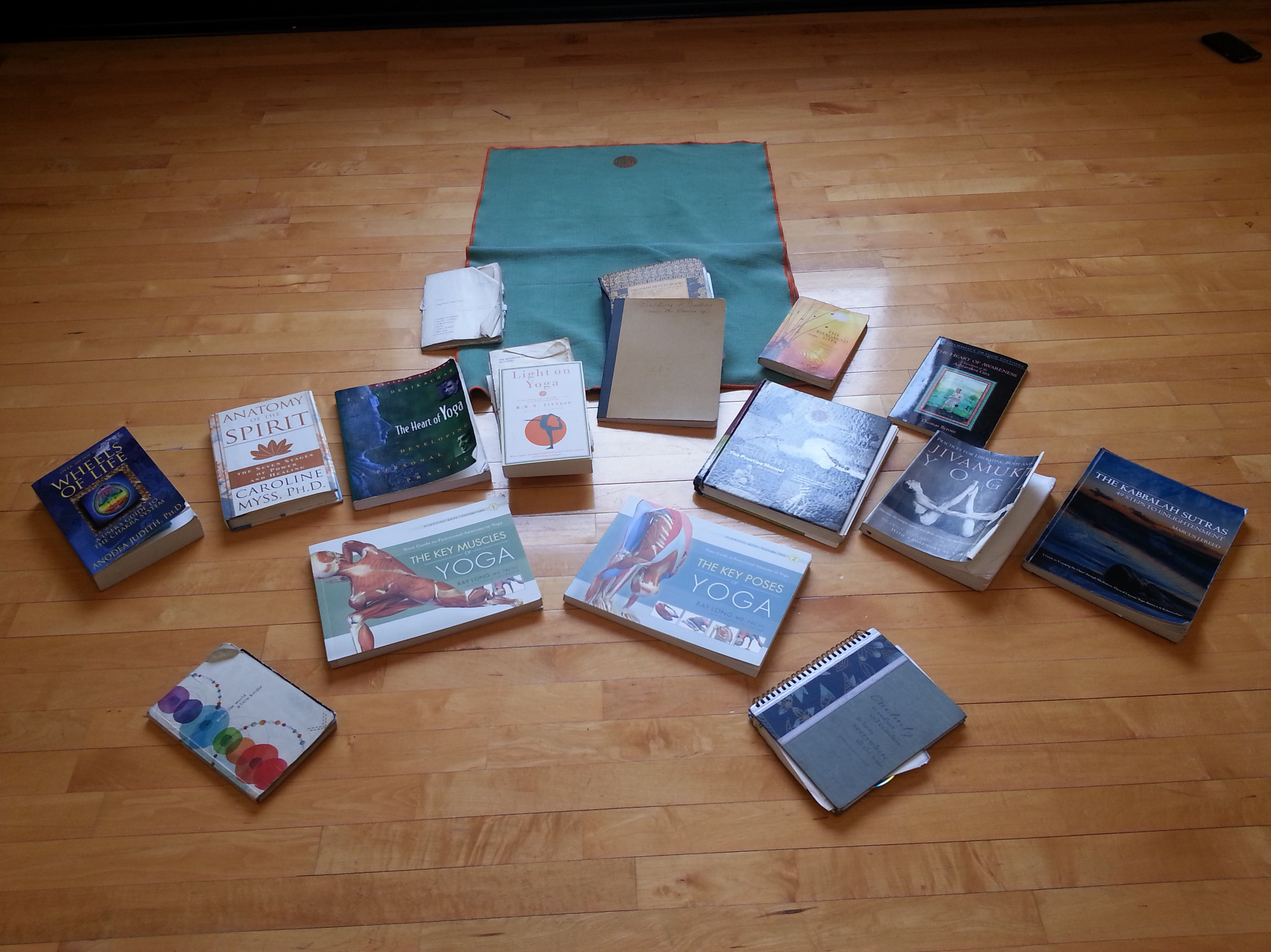
(NOTE: The picture above is missing Leslie Kaminoff’s Yoga Anatomy, Steve Ross’s Happy Yoga, Stephen Cope’s The Wisdom of Yoga, all my Yin Yoga and Taoist texts, a copy of the Ramayana, and Alanna Kaivalya’s Myths of the Asanas, at the very least.)
“Form follows function – that has been misunderstood. Form and function should be one, joined in a spiritual union.”
– Frank Lloyd Wright
“If something is boring after two minutes, try it for four. If still boring, then eight. Then sixteen. Then thirty-two. Eventually one discovers that it is not boring at all.”
– John Cage
Saturday mornings at the Y, just like any morning, is a great time to explore the physical and philosophical practice of yoga. However, I am partial to my Saturdays since I have 90 minutes to engage in the practice of exploration. For the last few years, I have started the new year with a “Building From the Ground Up” sequence – each Saturday adding more poses and another layer of the philosophy. Sometimes I still tie-in a meditation point specific to the date, and to whatever aspect of the philosophy is on tap for the day. Sometimes, however, it’s just straight philosophy and an opportunity to consider the meditation through movement. Whatever I plan for the year, usually wraps up around the end of July – when we start breaking down a different physical practice, the Ashtanga Primary Series.
This year, philosophically, I decided to sequentially move through Patanjali’s Yoga Sutras. Each week breaking down a sutra with commentary. (This week will be YS 1.31.) Physically, we have been breaking down a course of poses outlined by B. K. S. Iyengar in Light On Yoga.
The Saturday class is not an Iyengar class; however, (as teachers like Seane Corn have pointed out) if you are going to practice vinyasa, it’s a good idea to practice Iyengar as it will give you the solid foundation and insight into the asanas (poses).
Iyengar’s Course I is 30 weeks of detailed practice, specifically intended to build a physical practice from the ground up. While they are not limbs themselves, abhyasa (continuous practice with devotion) and vairagya (actively practicing the art of letting go or non-attachment) definitely make up the fertile soil from which the 8-limbs of yoga grow and thrive. And, they are key elements to the courses that appear in the appendix of Light On Yoga. At first, each set of poses is practiced for two (2) weeks before additional poses are added to the sequence. Later, some sequences are repeated for three (3) or four (4) weeks – and sometimes the order of the sequence changes. The 30-week course is followed by a 3-day course, which is slightly different from the 30-day course since the asanas are timed. Finally, there is some guidance on adding sun salutations (surya namaskar) to the physical practice and a list entitled “Important asanas in Course I.”
“If these asanas are mastered then the others given in this course will come even without regular practice.
– B. K. S. Iyengar writing about the “Impostant asanas in Course I”
The important asanas list, when followed by the sun salutations, looks and feels a lot like one of the first vinyasa practices to appear in the West, the Ashtanga Primary Series introduced to Sri Pattabhi Jois. This is not a random coincidence. While Iyengar and Jois were in very different physical/health conditions when they started practicing yoga, they practiced at the same time and with the same teacher: Sri Krishnamacharya. The practices they introduced to the West – just like the physical practices introduced by some of Krishnamacharya’s other students (including Indra Devi, T. K. V. Desikichar, and A. G. Mohan) reflect their own personal practices – which were the result of the physical and mental needs. Remember, classically, the physical practice of yoga (hatha yoga, regardless of the style or tradition) prepares the practitioner for deep-seated meditation. Ergo, even though they might practice the same poses, a very sickly young boy may use a different method of practice than a very active teenage boy.
(Side Note: It is also not a random coincidence that we generally start exploring the Ashtanga Primary series at the end of July: instead the timing coincides with the birthday of Sri Pattabhi Jois.)
YMCA classes are always open to members and their guests. If you are a member, please feel free to join us for class at any time throughout the year – and, feel free to bring a guest.
For further reading, check outLight on Yoga by B. K. S. Iyengar; Heart of Yoga by T. K. V. Desikichar; Ashtanga Yoga the Practice Manual by David Swenson; The Secret of the Yoga Sutra: Samadhi Pada by Pandit Rajmani Tigunait, PhD (Note: This is Part 1 of a series and only includes the first section of the sutras. There are many translations of the sutras, a great online resource is Patanjali’s Yoga Sutras on swamij.com.)

 A Joyful Practice