Posted by ajoyfulpractice in Faith, Health, Hope, Lent / Great Lent, Life, Meditation, Music, Mysticism, One Hoop, Philosophy, Religion, Science, Wisdom, Yoga.
Tags: 988, citizenship, Corneille Heymans, Mahatma Gandhi Canadian Foundation for World Peace, Mirabai Starr, Saint Teresa of Ávila, Season for Nonviolence
Many blessings to all, and especially to those observing Lent or Great Lent (and Laudation of the Mother of God) and/or participating in No Kings Day (in a way that makes sense for you)!
Peace, ease, and citizenship to all, throughout this “Season for Nonviolence” and all other seasons!
“To be a citizen means to help your community be the best it can be. You are a member of many communities: your family, your place of work or school, your place of worship, your city, your country, and the planet. Participation in your community presents an opportunity to model nonviolent action, peaceful resolution, and how each of us can and do make a difference.”
— quoted from the “Reflection” section of the “Day 58 ~ March 28 ~ Citizenship” page for the “Season for Nonviolence,” provided by the Mahatma Gandhi Canadian Foundation for World Peace
Please join me for a virtual yoga practice on Zoom, today (Saturday, March 28th) at 12:00 PM. You can use the link from the “Class Schedules” calendar if you run into any problems checking into the class. You can request an audio recording of this practice via a comment below or (for a slightly faster reply) you can email me at myra (at) ajoyfulpractice.com.
Saturday’s playlist is available on YouTube and Spotify. [Look for “03282023 Moving in 7 Mysterious Ways” ]
“Remember: If you want to make progress on the path and ascend to the places you have longed for, the important thing is not to think much but to love much, and so to do whatever best awakens you to love.”
— quoted from “The Fourth Dwelling .1.” of The Interior Castle by Saint Teresa of Ávila (New Translation and Introduction by Mirabai Starr)
If you are thinking about suicide, worried about a friend or loved one, or would like emotional support, you can dial 988 (in the US) or call 1-800-273-TALK (8255) for the Suicide and Crisis Lifeline. You can also call this TALK line if you are struggling with addiction or involved in an abusive relationship. The Lifeline network is free, confidential, and available to all 24/7. YOU CAN TALK ABOUT ANYTHING.
White Flag is an app, which I have not yet researched, but which may be helpful if you need peer-to-peer (non-professional) support.
If you are a young person in crisis, feeling suicidal, or in need of a safe and judgement-free place to talk, you can also click here to contact the TrevorLifeline (which is staffed 24/7 with trained counselors).
In the spirit of generosity (“dana”), the Zoom classes, recordings, and blog posts are freely given and freely received. If you are able to support these teachings, please do so as your heart moves you. (NOTE: You can donate even if you are “attending” a practice that is not designated as a “Common Ground Meditation Center” practice, or you can purchase class(es).
Donations are tax deductible; class purchases are not necessarily deductible.
Check out the “Class Schedules” calendar for upcoming classes.
###  BE MOVED & (ALSO) MOVE YOURSELF ###
Posted by ajoyfulpractice in "Impossible" People, Books, Buddhism, Changing Perspectives, Dharma, Faith, Healing Stories, Health, Hope, Life, One Hoop, Philosophy, Religion, Science, Suffering, Wisdom, Women, Writing, Yoga.
Tags: 988, Cambridge University, Carnival, Dr. Dean Ornish, Dr. Rachel Naomi Remen, Dr. Rebecca Lee Crumpler, faith, god, humanity, Lisa Depaulo, Lisa Perez Jackson, Martin Buber, Rachel Naomi Remen, Rebecca Lee Crumpler, Ronald Gregor Smith, Science, Season for Nonviolence, Sunday of the Prodigal Son, Walter Kaufmann, Zulu
“Happy Carnival!” to those who are celebrating! Many blessings to everyone, and especially those observing the Sunday of the Prodigal Son.
Peace, ease, contemplation, and a little faith throughout this “Season for Nonviolence” and all other seasons!
This quick note with excerpts is the “missing” post for February 8th. Some of the quotations are remixed from earlier posts. You can request an audio recording for a related practice via a comment below or (for a slightly faster reply) you can email myra (at) ajoyfulpractice.com.
In the spirit of generosity (“dana”), the Zoom classes, recordings, and blog posts are freely given and freely received. If you are able to support these teachings, please do so as your heart moves you. (NOTE: You can donate even if you are “attending” a practice that is not designated as a “Common Ground Meditation Center” practice, or you can purchase class(es).
Donations are tax deductible; class purchases are not necessarily deductible.
Check out the “Class Schedules” calendar for upcoming classes.
“What we believe about ourselves can hold us hostage. Over the years I have come to respect the power of people’s beliefs. The thing that has amazed me is that a belief is more than just an idea—it seems to shift the way in which we actually experience ourselves and our lives. According to Talmudic teaching, ‘We do not see things as they are. We see them as we are.’ A belief is like a pair of sunglasses. When we wear a belief and look at life through it, it is difficult to convince ourselves that what we see is not what is real. With our sunglasses on, life looks green to us. Knowing what is real requires that we remember that we are wearing glasses, and take them off. One of the great moments in life is the moment we recognize we have them on in the first place. Freedom is very close to us then. It is a moment of great power. Sometimes because of our beliefs we may have never seen ourselves or life whole before.”
— quoted from “Healing at a Distance” in “III. Traps” of Kitchen Table Wisdom: Stories That Heal by Rachel Naomi Remen, M.D. (Forward by Dean Ornish, M. D.)
In talking about “dreaming” (Saturday’s principle of the day for the “Season for Nonviolence”), I actually referenced today’s principle several times: “Faith”. One could even argue — and there’s some science to back this up — that having faith is part of being human. However, before you get it twisted, remember that faith is not necessarily religious.
Faith is defined as “great trust or confidence in something or someone” — which means, you can have faith even if your belief is based on disbelief. No matter where we come from or how we were raised, we all believe in something (or someone). For some people it is science and/or Nature. For others it is community and/or God (whatever that means to at this moment). People can also have faith in themselves and in their own abilities. In fact, this year’s group Sankalpa (on Saturdays) begins with the words “I trust…” — in other words, it begins with faith.
“The basic word I-Thou can only be spoken with one’s whole being. The concentration and fusion into a whole being can never be accomplished by me, can never be accomplished without me. I require a You/Thou to become; becoming I, I say you.”
— quoted from Ich und Du by Martin Buber (English translation by Walter Kaufmann)
The February 8th practice is usually inspired by people of faith who were born on this date.1 Martin Buber (who was born today in 1878, in Vienna, Austria-Hungary) was an Jewish, existential philosopher who did not consider himself a philosopher or a theologian; because, he said, he “was not interested in ideas, only personal experience, and could not discuss God, but only relationships with God”.
CLICK ON THE EXCERPT TITLE BELOW FOR MORE.
Being Human, the prequel (the “missing” Wednesday post)
“Let us strive to know more about ourselves, –it is human, it is Christian-like to do so. Then there will be minds from which to select students for the college, that may come forth to the community graduates in Pharmacy, Surgery, Dentistry, and Medicine. It is well known that many noble-minded women have graced the chambers of the sick with good service, in different conditions of need, too; but at the present women appear to shrink from any responsibilities demanding patience and sacrifice, or rather seem not to rely on the union of their strength with that of our great Creator, in time of need.
What we need o-day in every community, is, not a shrinking or flagging of womanly usefulness in this field of labor, but renewed and courageous readiness to do when and whatever duty calls.”
— quoted from “Chapter XIX. General Remarks.” in A Book of Medical Discourses, In Two Parts by Rebecca Crumpler, M. D.
Dr. Rebecca Lee Crumpler (who was born today in 1831, in Christiana, Delaware) was the first African American woman to earn a medical degree in the United States — way back in 1864. Her focus on children and belief in healing very much dovetail with those of the pediatrician Dr. Rachel Naomi Remen (born today in 1938, in New York, New York), who is known for her emphasis on alternative medicine and integrative medicine.
Similarly, Lisa Perez Jackson (who was born today in 1962, in Philadelphia, Pennsylvania) has structured her life around her belief in science (specifically as it relates to the environment) and preparing children to be the leaders of the future.
CLICK ON THE EXCERPT TITLE BELOW FOR MORE.
From the Earth (a special Black History 2.5-for-1 note)
“The first girls to attend [the Coretta Scott King Young Women’s Leadership Academy] were previously at the city’s lowest-ranked middle school. This year the school’s eighth graders earned one of the highest scores of all public schools in Atlanta on a state exam.
They’re Jackson’s sweet spot, these kids. African-American girls, who, like her, may have faced obstacles but are full of promise. ‘Listen,’ she says, ‘if these young women don’t grow up strong and talented and committed to our environment, then our country’s gonna suffer, not just them.’
Her speech hits home: ‘You have a right to clean air and clean water,’ she tells the girls, touching on one of her core initiatives, environmental justice—that is, to give a voice to the people, usually poor minorities, who are most severely affected by environmental hazards and calamities. ‘You have a right to have a healthy school to learn in.’ But such heady rights come with responsibility. The girls must be willing to do their part, she tells them—to blow past the wheezing stereotypes that only young men wearing pocket protectors are good at math and science, and that black women don’t set policy or lead. ‘You will bring clean air to your community,’ she tells them. ‘Which you can’t do if you don’t have the education.’”
— quoted from the O, The Oprah Magazine (June 2011) article “Clean Power: Lisa Jackson Fights for Our Right to Healthy Air, Water and Land: Somebody has to do it. We’re lucky it’s her.” by Lisa Depaulo
You may notice that the people I highlighted above2 did not grow up in the same place or within the same faith community; nor are their lives necessarily characterized by faith in the same things. However, it is notable that they all believe(d) in the power of human connection (i.e., relationships) and in human possibilities.
Take a moment to also notice that their beliefs led all of them to teach.
“The Hindus use the greeting ‘Namaste’ instead of our more noncommittal ‘Hello.’ The connotation of this is roughly, whatever your outer appearance, I see and greet the soul in you. There is a wisdom in such ways of relating. Sometimes we can best help other people by remembering that what we believe about them may be reflected back to them in our presence and may affect them in ways we do not fully understand.”
— quoted from “How We See One Another” in “VII. Live and Help Live” of Kitchen Table Wisdom: Stories That Heal by Rachel Naomi Remen, M.D. (Forward by Dean Ornish, M. D.)
Sunday’s playlist is available on YouTube and Spotify. [Look for “02082023 Being Human, prequel”]
If you are thinking about suicide, worried about a friend or loved one, or would like emotional support, you can dial 988 (in the US) or call 1-800-273-TALK (8255) for the Suicide and Crisis Lifeline. You can also call this TALK line if you are struggling with addiction or involved in an abusive relationship. The Lifeline network is free, confidential, and available to all 24/7. YOU CAN TALK ABOUT ANYTHING.
White Flag is an app, which I have not yet researched, but which may be helpful if you need peer-to-peer (non-professional) support.
If you are a young person in crisis, feeling suicidal, or in need of a safe and judgement-free place to talk, you can also click here to contact the TrevorLifeline (which is staffed 24/7 with trained counselors).
NOTES:
1February 8th sometimes overlaps with religious and/or culture observations that are related to faith and, to a certain degree, to what it means to be human. While I will often incorporate stories related to these celebrations into the practice, I did not reference the fact that today (in 2026) was the Sunday of the Prodigal Son in some (Orthodox) Christian traditions. I will note here, however, that the story of the prodigal son (Luke 15:11-32) is a story about faith, specifically about one’s belief in repentance, forgiveness, family, home, and community.
2Although I quoted Dr. Rachel Naomi Remen today (and on Friday, when the principle was “healing”), I have not yet written a post about her. That said, I am officially putting her books on my reading list!
“Alles wirkliche Leben ist Begegnung.”
“All real life is meeting.”
“All actual life is encounter.”
— quoted from Ich und Du by Martin Buber (English translations by Ronald Gregor Smith and Walter Kaufmann, respectively)
### As they say in Zulu, “Sawubona!” [“I see you!”] and “Yebo, sawubona!” [“I see you seeing me.”] ###
### I See Du ###
Posted by ajoyfulpractice in "Impossible" People, Books, Dharma, Faith, Healing Stories, Health, Life, One Hoop, Philosophy, Religion, Yoga.
Tags: 988, Carnival, Sunday of the Prodigal Son
“Happy Carnival!” to those who are celebrating! Many blessings to everyone, and especially those observing the Sunday of the Prodigal Son.
Peace, ease, contemplation, and a little faith throughout this “Season for Nonviolence” and all other seasons!
CLICK ON THE EXCERPT TITLE FOR MORE.
A Quick Note & Excerpts RE: Being Human & Having Faith (the “missing” Sunday post)
Please join me today (Sunday, February 8th) at 2:30 PM for a yoga practice on Zoom. You can use the link from the “Class Schedules” calendar if you run into any problems checking into the class. You can request an audio recording of this practice via a comment below or (for a slightly faster reply) you can email myra (at) ajoyfulpractice.com.
Sunday’s playlist is available on YouTube and Spotify. [Look for “02082023 Being Human, prequel”]
If you are thinking about suicide, worried about a friend or loved one, or would like emotional support, you can dial 988 (in the US) or call 1-800-273-TALK (8255) for the Suicide and Crisis Lifeline. You can also call this TALK line if you are struggling with addiction or involved in an abusive relationship. The Lifeline network is free, confidential, and available to all 24/7. YOU CAN TALK ABOUT ANYTHING.
White Flag is an app, which I have not yet researched, but which may be helpful if you need peer-to-peer (non-professional) support.
If you are a young person in crisis, feeling suicidal, or in need of a safe and judgement-free place to talk, you can also click here to contact the TrevorLifeline (which is staffed 24/7 with trained counselors).
In the spirit of generosity (“dana”), the Zoom classes, recordings, and blog posts are freely given and freely received. If you are able to support these teachings, please do so as your heart moves you. (NOTE: You can donate even if you are “attending” a practice that is not designated as a “Common Ground Meditation Center” practice, or you can purchase class(es).
Donations are tax deductible; class purchases are not necessarily deductible.
Check out the “Class Schedules” calendar for upcoming classes.
### ###
Posted by ajoyfulpractice in "Impossible" People, Baha'i, Changing Perspectives, Dharma, Faith, Healing Stories, Health, Hope, Life, Meditation, One Hoop, Pain, Philosophy, Science, Suffering, Vairagya, Wisdom, Women, Yoga.
Tags: 988, Baháʼí, brain, breathing, Charles E. Wheaton, cortical homunculus, Dominion, Florangela Davila, healing, Health, Inez Maxine Pitter Haynes, International Day of Zero Tolerance for Female Genital Mutilation, Mahatma Gandhi Canadian Foundation for World Peace, Maya Angelou, mental health, Mulk, nervous system, pranayama, primary somatosensory cortex, prāṇāyāma, Rachel Naomi Remen, Restorative Yoga, Season for Nonviolence, siddhis, somatosensory map, Sāmkhya Karika, Tantra Yoga, wellness, World Interfaith Harmony Week
Happy Carnival (to those who are already celebrating)! Peace, ease, and healing on International Day of Zero Tolerance for Female Genital Mutilation, the penultimate day of World Interfaith Harmony Week (WIHW), throughout this “Season for Nonviolence” and all other seasons!!!
May we all have a sense of dominion when it comes to our health.
This “missing” invitation for the “First Friday Night Special” on February 6th, includes a related excerpt. You can request an audio recording of this Hatha/Tantra-inspired Restorative Yoga practice (with a little movement) via a comment below or (for a slightly faster reply) you can email myra (at) ajoyfulpractice.com.
In the spirit of generosity (“dana”), the Zoom classes, recordings, and blog posts are freely given and freely received. If you are able to support these teachings, please do so as your heart moves you. (NOTE: You can donate even if you are “attending” a practice that is not designated as a “Common Ground Meditation Center” practice, or you can purchase class(es).
Donations are tax deductible; class purchases are not necessarily deductible.
Check out the “Class Schedules” calendar for upcoming classes.
“Poet and activist Maya Angelou turned a traumatic childhood experience into a catalyst for creativity and achievement. Healing involves the process of seeing the potential that still exists despite all that has been lost. When we shift from suffering and anguish toward integrity, wholeness and inner peace, we are experiencing healing.”
— quoted from the “Reflection” section of the “Day 8 ~ February 6 ~ Healing” 2026 page for the “Season for Non-violence,” provided by the Mahatma Gandhi Canadian Foundation for World Peace
Healing begins with people. While I often highlight healers like Inez Maxine Pitter Haynes (who was born today today in 1919), one of the siddhis (“powers”) described as “unique to being human” in the Sāmkhya Karika is the “the power to eliminate three-fold sorrow – physical, mental, and spiritual” — which means we are all healers. We can all participate (and have some dominion) in the healing process. Our mind-body systems include healing mechanisms, like our immune system, our lymphatic system, our digestive system, our parasympathetic nervous system, and our brain.
Yes, even our brain comes with healing technology!
For instance, did you know that when I say that “what happens in the body, happens in the mind and what happens in the mind happens in the body…” , I mean that literally, physiologically, and neurologically?
Every part of your body is “mapped” in your brain and each side of the brain’s primary somatosensory cortex has a representation of the opposite side of the body. This representation, known as the cortical homunculus (the “little man [or miniature human] of the brain”), is based on motor processing and sensory processing of the mind-body and is distorted, like a cartoon caricature that someone might draw of you at a fair. Just as (physically) touching a part of the body will activate a specific part of the brain’s somatosensory map, (mentally and mindfully) bringing awareness to a certain parts of the body — in a systematic way that corresponds with our “little man [or miniature human]” — can enhance our ability to relax the body. Research has also shown that certain meditation techniques can even use this brain technology to decrease pain.
Additionally, certain types of prāṇāyāma (awareness of breath, extension of breath) can activate the parasympathetic nervous system, which is related to our ability to “rest and digest [and be creative]”. Many people (all over the world) currently have overstimulated sympathetic nervous systems, which means we are consistently in “fight or flight or freeze/collapse” mode. This is like constantly putting the “pedal to the metal” and pressing the accelerator of a car all the way down to the floor — which is dangerous, on a lot of different levels, and not sustainable. In order to heal, we need to be able to put on the brakes, ease into stillness, and rest in order to process (i.e., digest) what we have experienced.
“Wounding and healing are not opposites. They’re part of the same thing. It is our wounds that enable us to be compassionate with the wounds of others. It is our limitations that make us kind to the limitations of other people. It is our loneliness that helps us to find other people or to even know they’re alone with an illness. I think I have served people perfectly with parts of myself I used to be ashamed of.”
— Rachel Naomi Remen (b. 2/8/1938) as quoted in At Your Service: Living the Lessons of Servant Leadership by Charles E. Wheaton
When it comes to healing, there are times that we just need the knowledge to know how things work. At other times, we also need assistance from caregivers and professional healers who are committed to the healing process — people like Maxine Pitter Haynes and Dr. Rachel Naomi Remen. Finally, there are times when we need to get together and share information — as people do annually on February 6th, the International Day of Zero Tolerance for Female Genital Mutilation.
This year’s theme, “Towards 2030: No End To FGM Without Sustained Commitment and Investment”, is a reminder and an opportunity to commit and invest in the healing process.
Click on the excerpt title below for more about Inez Maxine Pitter Haynes (b. 2/6/1919) and her sisters.
Salt of the Earth, the 2024 remix (the “missing” Tuesday post)
“‘I wasn’t soured by what happened to me,’ she was quoted in a June 1994 article in Columns, the UW alumni magazine. ‘I talk to people all the time about my experiences, and tell them they can’t be bitter. You have to pass over it, and go on…. It isn’t productive to hold on to it.’”
— quoted from The Seattle Times (March 26, 2004) obituary “Maxine Haynes, longtime educator and nurse in area” by Florangela Davila
This Hatha/Tantra-inspired Restorative Yoga practice (with some movement) is accessible and open to all. (It is also a sequence intended to prepare you for bed!)
(NOTE: There will be a little bit of quiet space in this practice.)
Friday’s playlist is also available on YouTube and Spotify. [Look for “12042020 Bedtime Yoga”]
NOTE: The playlist is slightly different on each platform. You can start with almost any track (and extra tracks have been added for 2026).
Prop wise, I suggest using a chair, sofa, or coffee table towards the end of this practice and this is a kitchen sink practice. You can practice without props or you can use “studio” and/or “householder” props. Example of “Studio” props: 1 – 2 blankets, 2 – 3 blocks, a bolster, a strap, and an eye pillow. Example of “Householder” props: 1 – 2 blankets or bath towels, 2 – 3 books (similar in size), 2 standard pillows (or 1 body pillow), a belt/tie/sash, and a face towel.
You may want extra layers (as your body may cool down during this practice). Having a wall, chair, sofa, or coffee table will also be handy.
If you are thinking about suicide, worried about a friend or loved one, or would like emotional support, you can dial 988 (in the US) or call 1-800-273-TALK (8255) for the Suicide and Crisis Lifeline. You can also call this TALK line if you are struggling with addiction or involved in an abusive relationship. The Lifeline network is free, confidential, and available to all 24/7. YOU CAN TALK ABOUT ANYTHING.
White Flag is an app, which I have not yet researched, but which may be helpful if you need peer-to-peer (non-professional) support.
If you are a young person in crisis, feeling suicidal, or in need of a safe and judgement-free place to talk, you can also click here to contact the TrevorLifeline (which is staffed 24/7 with trained counselors).
### Sitting, Breathing, Healing ###
Posted by ajoyfulpractice in Art, Baseball, Faith, Football, Healing Stories, Health, Hope, Loss, Minnesota, Music, One Hoop, Philosophy, Religion, Science, Suffering, Tragedy, Yoga.
Tags: 988, Believing, Bill Griggs, Branch Rickey, Buddy Holly, Carl Rogers Young, Carnival, Charles Follis, Charles Follis Foundation, David Shul, Don McLean, Dr. Mike Miller, J. P. "The Big Bopper" Richardson, Jonathan Cain, Journey, Lenny Kaye, Michael Franti, Mishlei, music, Neal Joseph Schon, Proverbs, Ritchie Valens, Roger Peterson, Season for Nonviolence, Spearhead, Stephen Ray Perry, Val Willingham, Yoga Sutra 3.35
“Happy Carnival!” to those who are celebrating! Many blessings to everyone, everywhere.
Peace, ease, contemplation, and a little faith (believing) throughout this “Season for Nonviolence” and all other seasons!!!
This is the “missing” compilation post for Tuesday, February 3rd. It includes a little note and a series of date-related excerpts. You can request an audio recording of this practice or a previous practice via a comment below or (for a slightly faster reply) you can email myra (at) ajoyfulpractice.com.
In the spirit of generosity (“dana”), the Zoom classes, recordings, and blog posts are freely given and freely received. If you are able to support these teachings, please do so as your heart moves you. (NOTE: You can donate even if you are “attending” a practice that is not designated as a “Common Ground Meditation Center” practice, or you can purchase class(es).
Donations are tax deductible; class purchases are not necessarily deductible.
Check out the “Class Schedules” calendar for upcoming classes.
“For as he thinks in his heart, so is he.”
— Proverbs (New King James Version, 23:7)
Bring your awareness to what you believe, in your heart of hearts and in the back of your mind. “Believing” is the “Season for Nonviolence” principle of the day and it highlights the fact that what we believe, in our heart of hearts, shapes our thoughts, words, and deeds — and, by extension, the world. Patanjali made this point in Yoga Sūtra 3.35 (which is 3.33 or 3.34 in some translations), when he indicated that “By practicing samyama (focus-concentration-meditation] on the heart, knowledge of the mind is attained.”
So, what (or who) is in your heart? Do you believe “the Father, Son, and Holy Ghost”? Do you believe “in God above”? Some people do and some of those people (in the Western Christian traditions) are finishing up the final weeks of their pre-Lenten season, while others (in the Orthodox Christian traditions) are just beginning their pre-Lenten season. Regardless of which calendar they use (or the different ways they do it), these are all people who are preparing for the weeks-long ritual Lent, which is a very intentional — and, sometimes, very public-facing — expression of what they believe.
We can believing in things that are limiting our possibilites and/or things that expand our horizons. For instance, do you you can make a difference in the world? Do you believe you can make a difference in the world doing something you love? If not, have I got a story for you.
“On October 17, 1903, [Branch] Rickey felt the ‘Black Cyclone’s’ full power when he ran their ends dizzy for 20, 25, 35 and 70 yard gains, the last being a touchdown. After that game Rickey praised Follis, calling him ‘a wonder.’ It was the power of his example, his character, and his grace that convinced Rickey, that color could not belie his greatness. The rest is history….”
— quoted from the “Background” section of the Charles Follis Foundation website
Click on the excerpt title to learn about Charles “The Black Cyclone” Follis, born today in 1879.
The Black Cyclone (a special Black History note)
“For years, [Dr. Mike Miller], a research cardiologist, has been studying the effects of happiness — or things that make people happy — on our hearts. He began his research with laughter, and found watching funny movies and laughing at them could actually open up blood vessels, allowing blood to circulate more freely.
Miller thought, if laughter can do that, why not music? So, he tested the effects of music on the cardiovascular system. ‘Turns out music may be one of the best de-stressors — either by playing or even listening to music,’ said Miller.”
— quoted from a 2009 CNN Health segment entitled, “The power of music: It’s a real heart opener” by Val Willingham, CNN Medical Producer
“Now do you believe in rock and roll / Can music save your mortal soul?” And, what happens if the music died, as it did today in 1959? Would you believe that the show must go on?
Click on the excerpt title to learn more about the music, the musicians, and the tragic accident that happened today in 1959.
Today, 1959 (the Wednesday post about the music that died)
“Everyone deserves music, sweet music”
— quoted from the song “Everyone Deserves Music” by Michael Franti & Spearhead (written by Michael Franti, David Shul, Carl Rogers Young)
Tuesday’s playlist is available on YouTube and Spotify. [Look for “02032021 The Day the Music Died”]
NOTE: The YouTube playlist has the Tommy Dee version of “Three Stars” during the practice and the Eddie Cochran version in the before/after music. The Spotify playlist has Cochran’s version during the practice and Charlie Gracie’s song “I’m Alright,” a tribute to Eddie Cochran, in the before/after music.
If you are thinking about suicide, worried about a friend or loved one, or would like emotional support, you can dial 988 (in the US) or call 1-800-273-TALK (8255) for the Suicide and Crisis Lifeline. You can also call this TALK line if you are struggling with addiction or involved in an abusive relationship. The Lifeline network is free, confidential, and available to all 24/7. YOU CAN TALK ABOUT ANYTHING.
White Flag is an app, which I have not yet researched, but which may be helpful if you need peer-to-peer (non-professional) support.
If you are a young person in crisis, feeling suicidal, or in need of a safe and judgement-free place to talk, you can also click here to contact the TrevorLifeline (which is staffed 24/7 with trained counselors).
### “Don’t Stop Believin’!” ~J ###
Posted by ajoyfulpractice in Healing Stories, Health, Life, Love, One Hoop, Yoga.
Tags: 988, Catherine Caruso, Chase’s Calendar of Events, Health, hugs, International Hugging Day, Kevin Zaborney, Life, Love, Martin Buber, mental health, National Hugging Day, touch, Virginia Satir
Many blessings to everyone, everywhere. May everyone breathe deeply and receive the love you need (the way you need it)!
May you be safe and protected / May you be peaceful and happy / May you be healthy and strong!
For Those Who Missed It: The following was originally posted in 2025, and I decided to repost it rather than excerpt it. Class details, links, and some formatting have been updated.
“The world is not comprehensible, but it is embraceable: through the embracing of one of its beings.”
— Martin Buber
You can hug yourself (and embrace yourself) every day!
There is, also, something to be said for being hugged (and embraced) by others. Humans are sensational beings (i.e., creatures full of sensation) and the largest organ of the human body is skin: the sense organ associated with touch. In a 2024 Harvard University article entitled, “Exploring Our Sense of Touch from Every Angle: Harvard Medical School researchers are illuminating one of the most mysterious — and most essential — senses”, Catherine Caruso wrote, “Touch is the process by which specialized neurons sense tactile information from the skin and other organs and convey this information to the brain, where it is perceived as sensations such as pressure, temperature, vibration, and pain.”
Touch can be healing. While there are times when we don’t notice touch — and/ or take it for granted — and there are times when touch can be too much sensation, there are definitely times when we can have too little touch. There are times when we need touch. Sometimes, we even need a specific kind of touch: a hug. Hugs activate our sense of touch and have the added benefit of putting a little compression on the nervous system, which can be particularly helpful in certain situations.
Keeping all of that in mind, Kevin Zaborney, who was friends with the granddaughter of the owner of Chase’s Calendar of Events, created National Hugging Day. Now celebrated all over the world, it was first celebrated in 1986 in Clio, Michigan and today is the day! So, hug yourself and hug someone else (physically, with their permission) and hug everyone (metaphorically)!! Happy International Hugging Day!!!
“We need 4 hugs a day for survival. We need 8 hugs a day for maintenance. We need 12 hugs a day for growth.”
— Virginia Satir
Please join me today (Wednesday, January 21st) at 4:30 PM or 7:15 PM for a yoga practice on Zoom. You can use the link from the “Class Schedules” calendar if you run into any problems checking into the class. You can request an audio recording of this practice via a comment below or (for a slightly faster reply) you can email myra (at) ajoyfulpractice.com.
Wednesday’s playlist is available on YouTube and Spotify. [Look for “02082022 Celebrating Being Humans”]
If you are thinking about suicide, worried about a friend or loved one, or would like emotional support, you can dial 988 (in the US) or call 1-800-273-TALK (8255) for the Suicide and Crisis Lifeline. You can also call this TALK line if you are struggling with addiction or involved in an abusive relationship. The Lifeline network is free, confidential, and available to all 24/7. YOU CAN TALK ABOUT ANYTHING.
White Flag is an app, which I have not yet researched, but which may be helpful if you need peer-to-peer (non-professional) support.
If you are a young person in crisis, feeling suicidal, or in need of a safe and judgement-free place to talk, you can also click here to contact the TrevorLifeline (which is staffed 24/7 with trained counselors).
In the spirit of generosity (“dana”), the Zoom classes, recordings, and blog posts are freely given and freely received. If you are able to support these teachings, please do so as your heart moves you. (NOTE: You can donate even if you are “attending” a practice that is not designated as a “Common Ground Meditation Center” practice, or you can purchase class(es).
Donations are tax deductible; class purchases are not necessarily deductible.
Check out the “Class Schedules” calendar for upcoming classes.
### ((o0)) ###
Posted by ajoyfulpractice in Bhakti, Changing Perspectives, Donate, Faith, Healing Stories, Health, Hope, Japa, Japa-Ajapa, Karma Yoga, Life, Love, Mala, Mantra, Meditation, Mysticism, New Year, One Hoop, Peace, Philosophy, Traditional Chinese Medicine, Vipassana, Wisdom, Writing, Yin Yoga, Yoga.
Tags: 108 Sun Salutations, Anthony Shumate, Kwanzaa, New Year's Day, Nguzo Saba, Nia, Sun Salutations, Surya Namaskar
“Happy New Year!” “Kwanzaa, yenu iwe na heri!” – “May your Kwanzaa be happy!” to everyone who is celebrating!
Many blessings to all!
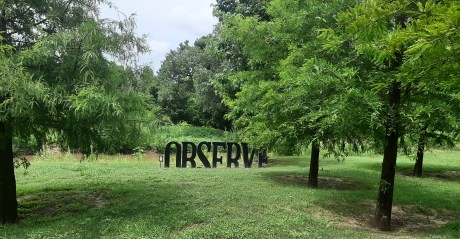
Part of the 6-piece “Monumental Moments” series
by Anthony Shumate, 2015
(located in Buffalo Bayou Park, along the Kinder Footpaths)
TRANSFORM • RENEW • HEAL • ENERGIZE
Celebrate the New Year with 108 Sun Salutations 10:00 AM – 1:00 PM CST!
AND/OR
RELAX • RELEASE • REST • RENEW • HEAL
Celebrate the New Year with Restorative Yoga+Meditation
5:00 PM – 7:00 PM CST!
The New Year is a beginning and an ending… and it is also a middle. On New Year’s Day we honor and celebrate transition with 108 Sun Salutations in the morning (10 AM – 1 PM, CST) and/or a Restorative* Yoga plus Meditation practice in the evening (5 – 7 PM, CST). We also put things in perspective.
These practices are open and accessible to all, regardless of experience.
*NOTE: In previous years, the evening practice has been Yin Yoga.
Please wear loose, comfortable clothing and make sure you are well hydrated before the practice. It is best to practice on an empty stomach (especially for the 108 ajapa-japa mala), but if you must eat less than 1 hour before the practice, make sure to keep it light. Make sure to have a towel (at the very least) for the 108 practice. For Restorative Yoga, a pillow/cushion or two, blocks or (hardcover) books, and a blanket or towel will be useful. I always recommend having something handy (pen and paper) that you can use to note any reflections (and will have some supplies handy).
IN-PERSON IS FULL! Use the link above for login information (or click here for more details about these practices and other practice opportunities related to the New Year).
The 108 playlist is available on YouTube and Spotify. [Look for “New Year’s Day 108 Ajapa-Japa Mala.”] NOTE: This playlist was revised for 2024, but should still sync up with the 2021 — 2023 recordings.
The Restorative playlist is available on YouTube and Spotify. [Look for “01072022 A Reflective Moment”]
Both practices are available in-person (if you are registered) and online. They are also donation based. If you don’t mind me knowing your donation amount you can donate to me directly. You can also email me to request my Venmo or Ca$hApp ID. If you want your donation to be anonymous (to me) and/or tax deductible, please donate through Common Ground Meditation Center (type my name under “Teacher”).
Please note that there is still no late admittance and you must log in before the beginning of the practice (so, by 9:45 AM for the 108 or by 4:45 PM for the Restorative Yoga+Meditation). You will be re-admittance if you get dumped from the call.)
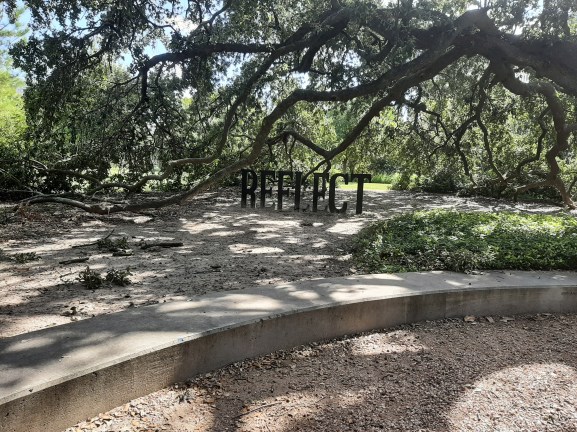
Part of the 6-piece “Monumental Moments” series
by Anthony Shumate, 2015
(located in Buffalo Bayou Park, along the Kinder Footpaths)
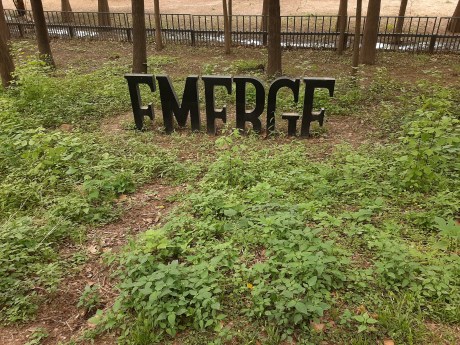
Part of the 6-piece “Monumental Moments” series
by Anthony Shumate, 2015
(located in Buffalo Bayou Park, along the Kinder Footpaths)
*Anthony Shumate’s “Monumental Moments” sculptures are located in Buffalo Bayou Park, along the Kinder Footpaths in Houston, Texas. They are unexpected reminders to “Explore,” “Pause,” “Reflect,” “Listen,” “Emerge,” and “Observe” – all things we do in our practice!
### NAMASTE ###
Posted by ajoyfulpractice in 7-Day Challenge, Changing Perspectives, Christmas, Faith, Healing Stories, Health, Hope, Japa, Japa-Ajapa, Life, Loss, Meditation, Mysticism, New Year, One Hoop, Peace, Philosophy, Religion, Science, Wisdom, Yoga.
Tags: 12 Days of Christmas, 988, catechism, Christmas, Dr. Nick Hobson, holidays, Imani, Kuumba, Kwanzaa, New Year's, Nguzo Saba, Nia, Sita (Joan Weiner) Bordow, Surya Namaskar, Swami Satchidananda, Twelvetide, Yoga Sutras 1.12-1.14
“Kwanzaa, yenu iwe na heri!” – “May your Kwanzaa be happy!” to everyone who is celebrating!
“My research over the last decade has helped understand why rituals in particular (and not any other behaviors like habits, for instance) are effective at battling negative emotions. Be it anxiety, stress, fear, doubt, sadness, grief – you name it. Rituals are there to save the day. The dread we feel after experiencing a loss happens because it feels like the situation is outside our control (and it usually is). Rituals reinstate that control.”
— quoted from “The emerging science of ritual – a new look on an ancient behavior: And how you can use it to live life to the fullest” by Dr. Nick Hobson (contributing to the ThriveGlobal.com, Dec. 7, 2017)
There is something to be said for a good ritual. I don’t just mean a habit, something you do repeatedly — even if it’s something you are in the habit of doing at a particular time. Neither am I just referring to a tradition — which could be a group habit and/or a ritual that has been passed down through generations, but has lost some of it’s deeper meaning. No, I am referring to something that is more like a ceremony; something infused with purpose and meaning.
Consider your exercise routine. You may be in the habit of doing a certain kind of physical activity at a certain time on certain day(s). Changes in your routine (and the resulting cancellations during the holidays) may leave you feeling off kilter. However, you know you will return to that routine (or something similar) because it serves a purpose and you value the experience. It may even connect you to a community.
No matter what you do, if you have that regular routine, you probably experience something more than physical well-being. You may notice mental and emotional benefits that serve you on multiple levels of your life. You may even do the thing you do for those specific benefits. In this way, what you do could be considered abhyasa (“[continuous and deliberate] practice, [engaged with sincere devotion]”) (YS. 1.12-1.14) However, those extra benefits are just that — lagniappe (“a little (something) extra”). They are gifts that are not intentionally part of the exercise.
Now, consider the physical practice of yoga, which you could consider a ritual within a ritual. It is part of a larger practice, and that larger practice intentional includes benefits beyond the physical. If you go to a different class; use one of my videos or recordings; and/or practice on your own, the ritual of the practice — i.e., the order in which we do the practice and the meaning behind the order and what we do within the sequences — still includes the deeper meaning and serves a deeper purpose, one that is beyond the physical-mental. One of my teachers once argued that this is true even if/when the meaning and purpose are not explicitly stated.
The meaning and purpose are baked in; they were part of the creation process.
Click on the excerpt title below for more about these holidays and our New Year’s Day tradition that is also a ritual!
Updated & Revised! Purpose Driven (a Friday post, that’s also for Saturday and Sunday!)
“Nia (purpose) — To make our collective vocation the building and development of our community in order to restore our people to their traditional greatness.”
— The fifth of the Nguzo Saba (or “Seven Essential Pillars”) of Kwanzaa
For people celebrating Kwanzaa, “Nia (Purpose)” is the focus for the fifth day (today, Tuesday); “Kuumba (creativity)” is the focus for the sixth day; and “Imani (faith)” is the focus for the sixth day. These final three days of Kwanzaa coincide with the fifth, sixth, seventh (or eighth) days of the “12 Days of Christmas” (depending on when you start counting).
If you are following along with the symbolic meaning of the gifts in the song, you will notice that the 5th, 6th, and 7th gifts are infused with purpose, meaning, creativity, and (of course) faith: “five gold rings” are the first Five Books of the Hebrew Bible and the Christian Old Testament (which provide the back story for the three Abrahamic religions); “six geese a-laying” for the six days of creation; and “seven swans a-swimming”, the consistently most expensive gift, stand for the seven gifts of the Holy Spirit (wisdom, understanding, knowledge, counsel, fortitude, piety, and fear of the Lord) or the seven sacraments (Baptism, Eucharist, Confirmation, Reconciliation, Anointing of the Six, Marriage, and Ordination). As for the eighth day, those could be considered extra (spiritual) gifts: “eight maids a-milking” for the eight beatitudes (or blessings).
“Kuumba (creativity) — To do always as much as we can, in the way we can, in order to leave our community more beautiful and beneficial than we inherited it.
Imani (faith) — To believe with all our heart in our people, our parents, our teachers, our leaders, and the righteousness and victory of our struggle.”
— The sixth and seventh of the Nguzo Saba (or “Seven Essential Pillars”) of Kwanzaa
Online (Zoom) classes are cancelled today through Wednesday, December 31st.
People on the recording email list(s) receive backup recordings. There are also some practice videos on my YouTube channel. You can check the “Class Schedules” calendar for upcoming classes. You can also request an audio recording of this practice via a comment below or (for a slightly faster reply) you can email me at myra (at) ajoyfulpractice.com.
The playlist for the fifth day of Kwanzaa is available on YouTube and Spotify. [Look for “12302020 Purpose Driven”]
“Consider, for instance, in moments of grief, rituals help ease our pain and suffering. But, again I ask, how do they do this, and why rituals in particular? As my collaborators Mike Norton and Francesca Gino have shown, rituals alleviate feeling of grief and loss by increasing a feelings of control.”
— quoted from “The emerging science of ritual – a new look on an ancient behavior: And how you can use it to live life to the fullest” by Dr. Nick Hobson (contributing to the ThriveGlobal.com, Dec. 7, 2017)
If you are thinking about suicide, worried about a friend or loved one, or would like emotional support, you can dial 988 (in the US) or call 1-800-273-TALK (8255) for the Suicide and Crisis Lifeline. You can also call this TALK line if you are struggling with addiction or involved in an abusive relationship. The Lifeline network is free, confidential, and available to all 24/7. YOU CAN TALK ABOUT ANYTHING.
White Flag is an app, which I have not yet researched, but which may be helpful if you need peer-to-peer (non-professional) support.
If you are a young person in crisis, feeling suicidal, or in need of a safe and judgement-free place to talk, you can also click here to contact the TrevorLifeline (which is staffed 24/7 with trained counselors).
In the spirit of generosity (“dana”), the Zoom classes, recordings, and blog posts are freely given and freely received. If you are able to support these teachings, please do so as your heart moves you. (NOTE: You can donate even if you are “attending” a practice that is not designated as a “Common Ground Meditation Center” practice, or you can purchase class(es).
Donations are tax deductible; class purchases are not necessarily deductible.
Check out the “Class Schedules” calendar for upcoming classes.
“You can perform japa, repetition of a mantra or Sacred Word, in the midst of your day-to-day work. Then, when it becomes a habit, even when you are working intensely a portion of the mind will keep repeating the mantra always. That means you have locked one end of your chain to a holy place, while the rest of the chain remains still in the outside world.”
— a note written by Swami Satchidananda, quoted in Sri Swami Satchidananda: Apostle of Peace by Sita (Joan Weiner) Bordow
### OM AUM ###
Posted by ajoyfulpractice in 108 Sun Salutations, 7-Day Challenge, Fitness, Health, Hope, Meditation, Minneapolis, Minnesota, New Year, One Hoop, Surya Namaskar, Twin Cities, Yin Yoga, Yoga.
Tags: 108 Sun Salutations, asana, in-person classes, meditation, Restorative Yoga, studio classes, vinyasa, Winter is coming, yoga, Zoom classes
Happy, Peaceful, Joyful Holidays, to all!
At this point, pulling out all my gear to deal with January in Minnesota has become a tradition. So…

I’m Gearing Up Again for Another New Year!
For a limited time only, I will be back in the Twin Cities. In-person practices (also available on Zoom) will be held at various locations Thursday, January 1st until Wednesday, January 7th — with an Open House on Friday, January 9th.
In the spirit of generosity (“dana”), the Zoom classes, recordings, and blog posts are freely given and freely received. If you are able to support these teachings, please do so as your heart moves you. (NOTE: You can donate even if you are “attending” a practice that is not designated as a “Common Ground Meditation Center” practice, or you can purchase class(es). Donations are tax deductible; class purchases are not necessarily deductible.)
### Let’s Go! ###
Posted by ajoyfulpractice in "Impossible" People, Books, Changing Perspectives, Faith, Healing Stories, Health, Hope, Life, Loss, Music, One Hoop, Pain, Peace, Philosophy, Suffering, Tragedy, Wisdom, Yoga.
Tags: 988, Advent, B.K.S. Iyengar, Chanukah, David Wilton, ethics, light, Nativity Fast, New Year, niyamas, Saint Lucy, St. Philip's Fast, Thomas Murner, yamas, yoga
Many blessings to everyone and especially to anyone observing Advent, the Nativity / St. Philip’s Fast, Chanukah, and/or sustaining kindness, friendship, peace, freedom, understanding, gratitude, and wisdom.
May you be safe and protected / May you be peaceful and happy / May you be healthy and strong! May you be nourished!
“Yoga is for all of us. To limit yoga to national or cultural boundaries is the denial of universal consciousness.”
— quoted from Yoga: The Path to Holistic Health by B. K. S. Iyengar
You may not think twice about how you sit or stand. However, how you sit and how you stand (on and off the mat) informs how you move through the world;, how you interact with people and how people interact with you; as well as how people perceive you and how you perceive a moment. Just as we can “cultivate a steady and stable; easy, comfortable, or joyful seat or pose” (YS 2.46) on the mat, we can work to do the same off the mat. Of course, to do this, we must keep in mind that none of this is just about the physical body and/or the mind.
The Yoga Philosophy is an 8-limbed practice that includes an ethical component, the elements of a physical practice, and an awareness of something spiritual, something energetic — something more than an individual person and their body. Even when we just focus on the asana and pranayama — the third and fourth limbs that make up hatha yoga, the physical practice of yoga (regardless of style or tradition), we cannot escape that there is something more, something deeper.
Practicing without the ethical components has the potential to create great harm — sometimes to ourselves and sometimes to others. This truth has, unfortunately, been demonstrated again and again by some of the greatest teachers and practitioners in the world. (See post excerpted below.) I would also argue that practicing without the awareness of the spiritual and energetic elements makes it easier to ignore the ethical components and, therefore, easier to create harm. (Again, see post excerpted below.)
Yesterday, while talking about Saint Lucy, I mentioned:
“When we practice āsanas (“seats” or poses), a significant amount of energy and awareness goes into how we sit (or stand). This deliberation and intention allows us to pay attention to our breath (which is a symbol of our spirit and life force) and also to extend and direct our breath (and therefore our spirit and life force). In a sense, we are careful about how we stand specifically so that we can be intentional about how we use our energy. Another way to think of this is that how we move and hold our body, as well as how we breathe and pay attention to our breath, allows us to very intentionally, deliberately, and mindfully start to focus on our inner light. When we focus-concentrate-meditate on our inner light, it appears to get brighter. In fact, over time, our inner light begins to shine out into the world – but, first we have to be able to see it.”
Sometimes, we do not see the light because we are focusing on the darkness. That is a very real danger here in the United States and overseas where, even as people began celebrating light, darkness encroached. Tragic and traumatic events can lead us to even darker places and, if you find yourself being drawn into the dark, seek out some help.
Help can come from many sources. Just as light can come from many sources.
“Yoga is a light which, once lit, will never dim. The better your practice, the brighter the flame.”
— quoted from Yoga: The Path to Holistic Health by B. K. S. Iyengar
For Those Who Missed It: The following reminder and excerpt were previously posted.
“Throw the baby out with the bathwater (or more accurately das Kind mit dem Bade ausschütten) is a German proverb that dates to 1512. It was first recorded by Thomas Murner in his satire Narrenbbeschwörung (Appeal to Fools), in which he uses it as a chapter title. Murner uses the phrase several times in his chapter and the original manuscript even has a woodcut of a woman tossing a baby out with the wastewater.”
— quoted from Word Myths: Debunking Linguistic Urban Legends by David Wilton
B. K. S. Iynegar was born today in 1918, in Pune, India. Click on the excerpt title below for a related post (which includes a popular word myth).
Practice Responsibly
Please join me today (Sunday, December 14th) at 2:30 PM for a yoga practice on Zoom. You can use the link from the “Class Schedules” calendar if you run into any problems checking into the class. You can request an audio recording of this practice via a comment below or (for a slightly faster reply) you can email myra (at) ajoyfulpractice.com.
Sunday’s playlist is available on YouTube and Spotify. [Look for “04192020 Noticing Things”]
NOTE: These are double playlists. You can start with Track #1, Track #11, or Track #12
If you are thinking about suicide, worried about a friend or loved one, or would like emotional support, you can dial 988 (in the US) or call 1-800-273-TALK (8255) for the Suicide and Crisis Lifeline. You can also call this TALK line if you are struggling with addiction or involved in an abusive relationship. The Lifeline network is free, confidential, and available to all 24/7. YOU CAN TALK ABOUT ANYTHING.
White Flag is an app, which I have not yet researched, but which may be helpful if you need peer-to-peer (non-professional) support.
If you are a young person in crisis, feeling suicidal, or in need of a safe and judgement-free place to talk, you can also click here to contact the TrevorLifeline (which is staffed 24/7 with trained counselors).
In the spirit of generosity (“dana”), the Zoom classes, recordings, and blog posts are freely given and freely received. If you are able to support these teachings, please do so as your heart moves you. (NOTE: You can donate even if you are “attending” a practice that is not designated as a “Common Ground Meditation Center” practice, or you can purchase class(es).
Donations are tax deductible; class purchases are not necessarily deductible.
Check out the “Class Schedules” calendar for upcoming classes.
### PRACTICE & TEACH RESPONSIBLY ###
 A Joyful Practice