This post contains a link for “Save with Stories” – a partnership with Save the Children and No Kid Hungry. You’ll find the link in the sentence (below), “Being read to as a child is one of the great experiences in life.”
Maty Ezraty, a yoga teacher of teachers, who died last summer, once told a teacher, “A good sequence is like a good story. There is a beginning (an introduction), the middle (the heart of the story), and the end (the conclusion)”
Take a moment to go little deeper into the middle of your story, because that’s where we are: the middle of our stories.
People often tell me (as someone told me just this weekend) that one of the things they like about my classes is the story, as well as the way the poses and the music tell the story. The practice is always a way to tell our stories. It is also a way to process our stories, every time we inhale, every time we exhale. As I was reviewing Sunday’s playlist (March 22nd), I realized it not only tells the stories of some great storytellers celebrating birthdays today (as I intended) and is a way to process our current life-plot (as I intended), it also reflects my story as a lover of stories.
James Patterson (b. 1947, in Newburgh, NY), is a bestselling novelist and children’s book author whose books can always be found in my parents bookshelves. Doesn’t matter if it is mystery, suspense, romance, or science, Patterson keeps you in the moment and keeps a Chekhovian promise (which we’ll get to in the end). One of his protagonists is a 12-year old orphan named Max Einstein. Like her namesake, this Einstein is a genius with wild (in her case red) curly hair. She is told that her story combined with her emotional and intellectual quotients are why she is considered the world’s “last great hope.” Patterson wrote, “If we are to help save the human race, we must recognize the humanity in all, no matter their station in life.”
For his part, Patterson has donated over 300 million books to school-aged children and the military, over $70 million to support education, and endowed over 5,000 scholarships for teachers.
Stephen Sondheim (b. 1930, in New York City, NY) is a legendary musical theater composer and lyrics, as well as an award-winning film composer. He has won 8 Tony Awards (more than any other composer), 8 Grammy Awards, a Pulitzer Prize, a Laurence Olivier Award, and was awarded a 2015 Presidential Medal of Freedom. In all my time working in theater, I can’t say that I ever worked on any of Sondheim’s musicals (or the musicals of our final birthday composer), but I’ve seen my fair share of both their works – and can definitely sing along.
Also born in New York City, NY, in 1941, poet Billy Collins has been called “The most popular poet in America” and has served as United States Poet Laureate (2001 – 2003) and New York State Poet (2004 – 2006). Collins considers “humor a doorway into the serious” and begins his poem “Picnic, Lightning” by quoting Vladimir Nabokov. In Lolita, the protagonist says, “My very photogenic mother died in a freak accident (picnic, lightning)…”
The poem’s title is also the title of a collection of poems which my friend Mimi gave me in a moment when I was overwhelmed by grief. Fast forward almost a decade and, as if in a poem, I was dancing with Billy Collins on Nicollet Island and giving him a piece of Collins-inspired poetry. Even now, I can feel it…I can feel it…the joy of the moment, the joy of being alive; which fits in with his secret theory.
In a 2001 interview with The Paris Review, Billy Collins said, “I have a secret theory that people who are addicted to reading are almost trying to recreate the joy, the comfortable joy of being read to as a child…. Being read to as a child is one of the great experiences in life.”
Our final birthday storyteller is Baron Lloyd-Webber, or more properly styled, The Lord Lloyd-Webber…better known as the EGOT Andrew Lloyd Webber (no hyphen). Born today in 1948 (in Kensington, London), he has composed 13 musicals, a song cycle, a set of variations, 2 film scores, and a Latin Requiem Mass. He is an EGOT because he has won an Emmy Award, 4 Grammy Awards, an Academy Award (Oscar), and 7 Tony Awards – as well as 8 Laurence Olivier Awards and a plethora of other awards.
And now, back to that Chekhovian promise.
It was Anton Chekov who said that if there is a rifle (or a pistol) hanging on the wall in the first chapter/act, it must go off in the second or third. He told another playwright, “It’s wrong to make promises you don’t mean to keep.”
Whenever we step on the mat, there’s a part of us that is making a promise. Whenever, I put together a sequence there’s a part of me that thinks about that promise, as well as about that second Sondheim song (“Putting it together…bit by bit…piece by piece”) and Maty Ezraty’s sequencing advice about the middle (the heart) of the story. I consider how can I build up to a big heart opener and how we each need to process our own personal story in order to not only lift and open our hearts, but to also support our lifted and open hearts – especially in a time when it is so easy to close off.
Maty Ezraty said, “Practicing yoga is a privilege. And with this privilege comes a duty to be kind, to share a smile, and to offer yoga from the mat into the rest of your life.”
Here’s a mini-practice (5 minutes) which you can use it as your whole practice as the beginning/introduction portion of your practice and finish with a deeper back bend (even if it’s the same back bend – just with more awareness, more breath, and more smile.
NOTE: Some embedded links connect to sites outside of this blog.
“[Music] should have no other end and aim than the glory of God and the re-creation of the soul, where this is not kept in mind, there is no true music, but only an infernal clamour and ranting.”
– Johann Sebastian Bach (b. 1685)
According to the Old Style / Julian calendar, March 21st, is the anniversary of the birth of the composer Johann Sebastian Bach. Born in 1685, Bach’s statement about music also works as a statement for yoga: ‘[Philosophically speaking, yoga] should have no other end and aim than the glory of God and the re-creation of the soul, where this is not kept in mind, there is no true [yoga], but only an infernal clamour and ranting.’ People who think of yoga only as a form of exercise are often surprised that there’s more. One can only imagine their surprise if they walk into one of my classes – especially on March 21st, when the playlist starts with Bach and then becomes a soundtrack for other events that correspond to this date in history. Imagine their further surprise when all of that is just the background to a deeper practice.
On Saturdays, I typically teach a 90-minute practice that is primarily attended by a dedicated group who are interested in the yoga philosophy as well as asana and asana philosophy. For the past few years, we’ve started in January and then we “build a practice from the ground up” physically as well as philosophically. Physically, we start with the beginning of a specific practice or sequence and either explore it for about 30-weeks before continuing to a new practice built on the original or – as we did this year – we start with a basic set of poses and start building around it. Philosophically, in years past, we have explored the 8-limbs of yoga, as well as how the 7 chakras correspond with 7 yoga paths (hatha, tantra, karma, bhakti, mantra, yantra, and jnana). Last year, we started moving through the Yoga Sūtras – which worked perfectly as there are 51 sūtras in the first chapter.
This year, we started physically moving through the warm-up and asanas that Ram Dass illustrated in Be Here Now, and just recently started using that sequence as a “finishing sequence.” (If you’ve been attending the Saturday practices and/or are familiar with the sequence, that’s your practice today.)
Philosophically, we decided to continue last year’s work and make our way through the second chapter of the Yoga Sūtras. Today, March 21st, is the 12th Saturday of 2020. I am including a bit of background for those who are just now joining this journey and a bit of last week’s commentary since so many had to miss the class. For more on the sūtras, you can check out Swami J’s website or purchase the series of books by Pandit Rajmani Tigunait, PhD – both associated with the traditions of the Himalayan Masters.
Yoga Sūtra 1.1: atha yogānuśānam
– “Right here, right now (in this auspicious moment), yoga (or union) instruction begins”
Yoga Sūtra 1.2: yogaścittavŗttinirodaha
– “Yoga (or union) ceases the fluctuations of the mind”
The first chapter of the Yoga Sūtras is the “Chapter (or, more literally, Foundation) on Concentration,” in which Patanjali began by explaining how the mind works; atha, right here, right now. In this present moment, each of our minds is processing multi-bazillion bits of information/sensation – which results in a constant fluctuation of the mind (cittavŗtti). This restlessness and agitation of the mind, in turn becomes restlessness and agitation in the body – and this becomes obstacles to the practice (or to our goals). At the same time, he explained that our thoughts fall into two (2) categories: afflicted thoughts (i.e., thoughts which cause pain) and not afflicted thoughts (which may ease pain, or at least not cause pain). Finally, Patanjali explained how to work the mind – using the mind’s own ability to concentration/meditate – in order to rest the mind and, therefore, the body.
This is why, I often say, “What happens in the mind happens in the body. What happens in the body happens in the mind. And both affect the breath.” If you take a deep breath in (right here, right now) and a deeper breath out (right here, right now), you not only bring your awareness to the present moment (right here, right now; every time you consciously inhale and every time you consciously exhale), you also, affect the body and the mind. In fact, that is one of the ten practices Patanjali described in the first chapter: focus on your breath.
Yoga Sūtra 2.11: dhyānaheyāstadvŗttayah
– “Meditation destroys the mental tendencies (associated with affliction/pain)”
The second chapter of the Yoga Sūtras is (the “Chapter (or, more literally, Foundation) on Practice. It is basically where Patanjali – way back in the 2nd, 3rd, or 4th BCE – recognized and acknowledged that everyone on the planet can’t just drop into a deep-seated meditative state. So he started explaining the elements of kriya yoga (“yoga in action”) and how the practice of training the senses, exploring within, and letting go of aversions and attractions attenuates the effect of afflicted/pain-producing thoughts. To do this, however, he first gave us a deeper understanding of how afflicted thoughts produce pain.
“Samskaras – the drivers of our mental tendencies – manifest in the form of memory. We are able to remember something because the subtle impressions related to the object have been stored in our mind. Because they are hidden beneath thick layers of the forces of time, the mind is not aware of their existence. But like a seed that lies dormant until spring brings moisture and warmth, samskaras awaken when the conditions inside and outside the mind are conducive.”
– Pandit Rajmani Tigunait’s commentary on sūtra 2.11
Using seeds as a metaphor or a simile for our thoughts, words, and deeds is a very common teaching tool. In previous weeks, the metaphor I used was a backpack containing a still soft, but sculpted, piece of clay. Let’s say you’ve molded a little figurine (whatever comes to mind) or a tiny cup; but, something causes you to place the molded clay into your backpack. For some reason, the clay stays in your backpack, getting tossed around, even a little mushed, as you go about your days. Every once in awhile you brush your finger across it when you’re looking for something and you think, “What’s that? Oh, yeah….” And whatever emotions you were feeling in relation to making the piece, or having to toss it in your bag before it was finished, flash up.
Later, you might even pull the piece of clay out, notice that it’s smashed, and decide to completely smash it and start again. Or, you may restore it to some close proximity of what you did before. Someone else could feel it or see it, or see you remolding it, and have a completely different experience, but this is your experience – and now this new layer of experience is attached to the clay, just like the oils from your skin. Even if you “buy a new backpack,” a piece of the clay finds its way inside. (YS 2.10) Unless, of course, you have “trained your senses, explored within, and given up your aversions and attractions” – in which case you can discard the clay when you switch backpacks or you can recognize what it was and decide to treat it as a fresh piece of clay ready for a new project. (YS 2.11)
– “The reservoir of our actions is rooted in affliction/pain that is experienced in seen and unseen lives”
For anyone wondering: Nope, I had no idea this week’s sūtra was going to keep us firmly grounded in the “seen and unseen.” Previous translations I’ve used for comparative analysis talk about “current life and future life,” “this life and the lives to come,” and “at the time of the action or (another time).” The bottom line, though, is still the same.
All of our experiences, thoughts, words, and deeds have consequences. Some consequences occur “immediately” and we easily see the connection between cause and effect. Other times, there is the distance of time, space, memory, and/or ignorance (or lack of awareness), which causes the connection to be “unseen” by us. Yet, cause and effect is still there, and so it becomes even more important to recognize that, as Pandit Tigunait points out, “Impure karmic impressions cloud our mind with desire, greed, confusion, and anger, and become the drivers of negative, destructive actions. Pure karmic impressions create a positive mental atmosphere, awakening virtues such as love, compassion, kindness, and selflessness, which then become drivers of positive, constructive actions…. Causing intense pain to someone who is fearful, diseased, or stingy engenders a highly, negatively charged karmic reality. Betraying someone who trusts you or harming a high-caliber soul committed to intense austerity also engenders a highly potent negative karmic reality. This potent negative karma ripens quickly.”
We don’t always have control over our circumstances, but we always have control over our actions (thoughts, words, and deed). We don’t, however, make decisions in a vacuum. Part of the practice is recognizing that our current actions are informed by our previous experiences, thoughts, words, and deeds – and that what we do in this moment is going to inform what happens to us (and what we do) in our next moments… even if those moments are years away.
2023 Note: This post has been slightly revised to clean-up a type-o (or three) and some syntax.
“I’ve seen love go by my door It’s never been this close before Never been so easy or so slow I’ve been shooting in the dark too long When somethin’s not right it’s wrong You’re gonna make me lonesome when you go”
– “You’re Gonna Make Me Lonesome” by Bob Dylan (covered by Shawn Colvin, Elvis Costello, Miley Cyrus (with Johnzo West) and a host of other artists)
Happy Spring Everyone! Also, I offer many blessings to those of you who are finishing the 19-Day Bahá’i Fast, and many blessings to all.
Thursday is normally my day off – unless I’m subbing prenatal yoga – and a great day for me to work on my own seated meditation practice. I had planned on posting some meditation audio recorded by my friend-who-is-my-twin; however, as I ran into some technical issues getting Wednesday’s video ready, I’m a little behind schedule.
But, fear not! I still have something fun for you! In addition to being the Spring Equinox, today is a special day for Bob Dylan fans. Today (March 19th) in 1962, Bob Dylan released his self-titled debut album. As Andy Greene points out in a 2012 Rolling Stones article, Bob Dylan’s Bob Dylan came out when everybody – and I mean, everybody – was doing the twist. So, dust off your favorite Bob Dylan vinyl, add a cover (or two) of Bob Dylan songs made famous by other artists, and either practice some twists – open twists if you’re pregnant; do the twist; or (in honor of the Vernal Equinox) practice 108 Sun Salutations.
“I see my light come shining From the west down to the east Any day now, any day now I shall be released”
– “I Shall Be Released” by Bob Dylan (covered by Nina Simone, The Band, and a host of other artists)
### (THIS, ALL THIS, IS) “TO MAKE YOU FEEL MY LOVE” ###
“Life is like stepping into a boat that is about to sail out to sea and sink.”
– Shunryu Suzuki Roshi
Right now, in this moment, I am prepared to do what I can do, but also accepting that there is a lot I cannot do. However, all of that can change in the next moment – because that’s life; as long as we are alive everything changes.
(Say that first part with me: Right now, in this moment, I am prepared to do what I can do, but also accepting that there is a lot I cannot do.)
Right now, we are all on a sinking boat. There’s a chance we’re close to shore and can touch bottom and there’s also a chance we are way out to sea, but no one knows for sure. Some folks are screaming and jumping into what might be shark infested waters. Some folks are sitting back pretending like nothing is happening. There are folks frantically trying to bail out the water. Still others are putting on their life jackets and preservers and inflating their life boats. Bottom line: The boat is still sinking.
“The transcripts of our conversation also show how Patrick’s choice of phrasing was helpful to me. Rather than telling me what airport I had to aim for, he asked me what airport I wanted. His words let me know that he understood that these hard choices were mine to make, and it wasn’t going to help if he tried to dictate a plan to me.”
– from Highest Duty: My Search for What Really Matters by Chelsey B.”Sully” Sullenberger
Wash your hands with soap and water for 20 seconds (or use appropriate hand sanitizer for 20 seconds).
Clean mats, props, and gym equipment (as well as desks, phones, and door handles) frequently.
If you’re using a studio/gym mat or other equipment, clean it before and after usage.
If you don’t already own and use one, consider buying your own mat and/or purchasing a skidless yoga “towel” you can place over a studio mat.
Cover props with a towel, bring your own props, or (when appropriate) reduce your props.
Space and stagger your mats if you are coming to a group class. Take a deep breath if a class is cancelled or you are turned away because class size is limited.
Practice good health and wellness habits by getting plenty of sleep, staying physically active, managing your stress, drinking plenty of (hydrating) fluids, and eating heart healthy foods.
If you have been traveling (especially internationally), practice at home and avoid large groups of people for at least a week. (WHO and CDC are recommending 14 day self-isolation for people who have traveled internationally or been in contact with someone who may be ill.)
If you are sick (and/or coming down with or getting over a respiratory illness), practice at home. There are lots of online resources for various types of yoga and other physical activities. (I will add links and post some sequences.)
Monitor daily reports from WHO or the CDC only as much as you are able without increasing your anxiety.
Practice compassion. Acknowledge that there are a lot of people suffering, in a lot of different ways. If you can help someone, without undue risk to yourself, do so.
Avoid touching your face and practice coughing/sneezing etiquette.
Be mindful. Be patient. Be kind. Breathe.
As I post this, my classes at the YMCA, Nokomis Yoga, and Flourish are continuing as scheduled. If, however, you purchased a Flourish package and elect not to attend classes in the next few weeks, you will be given a studio credit. Common Ground Meditation Center has cancelled all programming through March 29th.I will update my calendar as things change.
I will continue to give people the option (at the beginning of class) to opt out of hands-on assists, but the reality is that I am extremely limiting assists for the foreseeable future.
(Let’s say it again: Right now, in this moment, I am prepared to do what I can do, but also accepting that there is a lot I cannot do.)
I can see clearly now the rain is gone I can see all obstacles in my way Gone are the dark clouds that had me blind It’s gonna be a bright (bright) Bright (bright) sunshiny day
– “I Can See Clearly Now” by Johnny Nash
“You look at where you’re going and where you are and it never makes sense, but then you look back at where you’ve been and a pattern seems to emerge.”
― Robert M. Pirsig, Zen and the Art of Motorcycle Maintenance: An Inquiry Into Values
The filmmaker Billy Wilder famously said, “Hindsight is always twenty-twenty.” Wilder’s statement relies on the idea that 20-20 is perfect vision and implies that stepping back gives us the perspective to see things more clearly because we take in the bigger picture. In other words, once we see the pattern and how everything fits together as a whole, we gain an understanding of the parts. It’s like understanding a word’s meaning when it’s used in a sentence. Context is everything. Or is it? After all, if we start off with an incorrect understanding of past events, the pattern that emerges is still slightly off. We may see ourselves and our situation better than we did when we were in the middle of everything, but seeing things better doesn’t mean we see them perfectly.
As someone in the United States who has worn glasses for most of my life, I am very familiar with the idea that 20/20 vision is perfect vision (and the experience of feeling like you’re seeing a brand new world when you get new glasses). However, the reality is that that particular gold standard is not only not perfect vision; it’s not even the best vision. 20/20 vision – what is considered normal or average vision is, by definition, what is clearly or sharply seen at 20 feet by the so-called average person. If you have your eyes examined and the second number is higher than 20 (let’s say, 89) than that higher number means you would have to be 20 feet away from something to see it with the same clarity that someone else (someone with “normal” eyesight) sees clearly from a distance of 89 feet. On the flip side, someone with 20/2 vision has the eyesight of an eagle and can sharply see something from 20 feet away that mere mortals can only see clearly from 2 feet. While 20/2 vision may seem unlikely in a human, there are definitely people with 20/10 vision. (And, also, there are people with 20/8.)
I say all of this just to point out that, as we enter a new year and a new decade that lends itself to people talking about vision and insight, don’t get too caught up in the metaphor of seeing better in the year ahead just because it’s 20/20. It’s an imperfect metaphor. And, if you insist on using it – for political reasons – keep in mind that we had better “vision” in 2008. (But, that’s another story for another day.) The point I’m making here is that what we really need is more clarity and more insight.
“I think I can make it now the pain is gone All of the bad feelings have disappeared Here is that rainbow I’ve been praying for It’s gonna be a bright (bright) Bright (bright) sunshiny day”
– Hothouse Flowers cover of “I Can See Clearly Now” by Johnny Nash
The Sanskrit word “vipassana” is often translated into English as “insight.” A more literal translation is “to see in a special way.” The practice is not just about stepping back; it’s also about letting go. Paying attention to your breath while simultaneously observing your thoughts and physical sensations creates the opportunity to experience everything without getting attached to anything. It’s a bit like riding a motorcycle through your life. As Robert Pirsig describes it in Zen and the Art of Motorcycle Maintenance, “In a car you’re always in a compartment, and because you’re used to it you don’t realize that through that car window everything you see is just more TV. You’re a passive observer and it is all moving by you boringly in a frame. / On a cycle the frame is gone. You’re completely in contact with it all. You’re in the scene, not just watching it anymore, and the sense of presence is overwhelming.”
Like vipassana, the Sanskrit word “vinyasa” (“to place in a special way”) refers to a technique as well as to a style or tradition. The most classical example of vinyasa is Surya Namaskar (Sun Salutation), which is 12 asanas (seats or poses) linked to the breath. Each pose is an exaggeration of the spine’s natural inclination – to extend on the inhale and to flex on the exhale. Practicing a few Sun Salutations at the beginning of a practice is a little like getting in a car to go somewhere specific. The more Sun Salutations you do, the more it feels like a road trip. If, however, you’re only practicing 5 or 10 Sun Salutations (every once in a while), you’re still traveling in the car. Practice 108…now you’re traveling long distance on a cycle. And, yes, that means you have to do your own maintenance. It also means you have to let go of some baggage.
“But our mistakes also carry our largest lessons. I’m wiser now. I guess the real trick in life is to turn hindsight into foresight that reveals insight.”
“Nice way to put it, Cal. What I really hear you saying is that it’s important in life to let our past serve us. Is that right?”
“Very well put. That’s it exactly. There’s nothing wrong with making a mistake – that’s how human beings grow. We’re designed to make mistakes, for mistakes carry growth. We just shouldn’t keep repeating the same one. Turn a wound into wisdom, or, as you said, let your past serve you.”
– Cal and Jack in The Saint, the Surfer, and the CEO by Robert Sharma
Practicing 108 Sun Salutations is a great way to mark a transition, like the end of a year and/or the end of the decade. While it is a tradition for some to practice the ajapa-japa mala (repeat-remember garland) for a solstice and equinox, many people also practice at the beginning of a new year. My 2020 mala, as well as my Yin Yoga + Meditation, practices are full. However, if you are looking for clarity and insight in this New Year and new decade consider practicing on your own or joining one of the following*:
*NOTE: Reservations are generally required for these events. My apologies to any teachers or studios in the Twin Cities who are hosting an event not listed.
The original, by Johnny Nash, which I love because it feels happy, like a blue sky day!
The cover, by Hothouse Flowers, which I love because it feels like the storm just ended and you’re taking the deepest breath of petrichor you’ve taken all day!
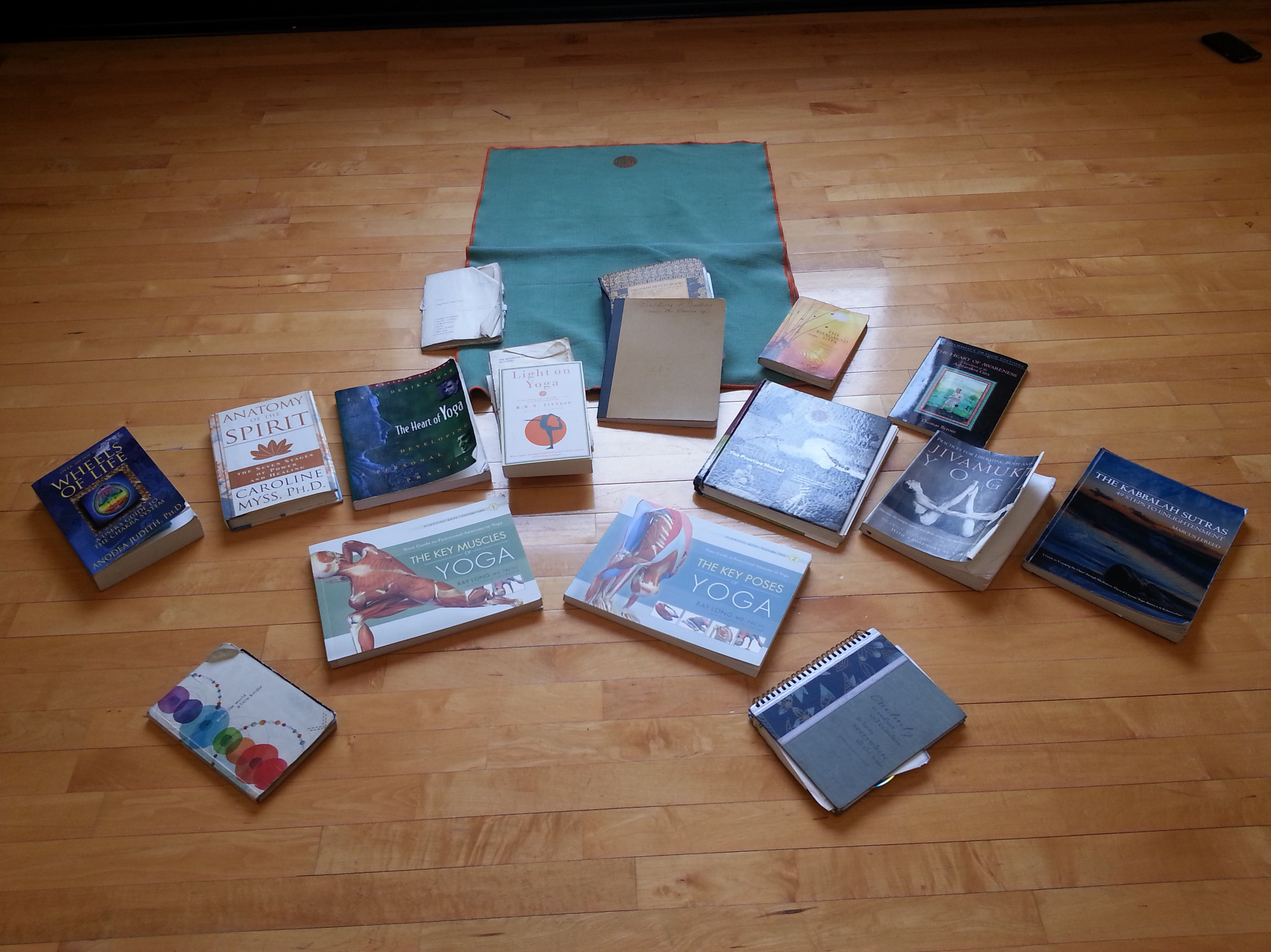
(NOTE: The picture above is missing Leslie Kaminoff’s Yoga Anatomy, Steve Ross’s Happy Yoga, Stephen Cope’s The Wisdom of Yoga, all my Yin Yoga and Taoist texts, a copy of the Ramayana, and Alanna Kaivalya’s Myths of the Asanas, at the very least.)
“Form follows function – that has been misunderstood. Form and function should be one, joined in a spiritual union.”
– Frank Lloyd Wright
“If something is boring after two minutes, try it for four. If still boring, then eight. Then sixteen. Then thirty-two. Eventually one discovers that it is not boring at all.”
– John Cage
Saturday mornings at the Y, just like any morning, is a great time to explore the physical and philosophical practice of yoga. However, I am partial to my Saturdays since I have 90 minutes to engage in the practice of exploration. For the last few years, I have started the new year with a “Building From the Ground Up” sequence – each Saturday adding more poses and another layer of the philosophy. Sometimes I still tie-in a meditation point specific to the date, and to whatever aspect of the philosophy is on tap for the day. Sometimes, however, it’s just straight philosophy and an opportunity to consider the meditation through movement. Whatever I plan for the year, usually wraps up around the end of July – when we start breaking down a different physical practice, the Ashtanga Primary Series.
This year, philosophically, I decided to sequentially move through Patanjali’s Yoga Sutras. Each week breaking down a sutra with commentary. (This week will be YS 1.31.) Physically, we have been breaking down a course of poses outlined by B. K. S. Iyengar in Light On Yoga.
The Saturday class is not an Iyengar class; however, (as teachers like Seane Corn have pointed out) if you are going to practice vinyasa, it’s a good idea to practice Iyengar as it will give you the solid foundation and insight into the asanas (poses).
Iyengar’s Course I is 30 weeks of detailed practice, specifically intended to build a physical practice from the ground up. While they are not limbs themselves, abhyasa (continuous practice with devotion) and vairagya (actively practicing the art of letting go or non-attachment) definitely make up the fertile soil from which the 8-limbs of yoga grow and thrive. And, they are key elements to the courses that appear in the appendix of Light On Yoga. At first, each set of poses is practiced for two (2) weeks before additional poses are added to the sequence. Later, some sequences are repeated for three (3) or four (4) weeks – and sometimes the order of the sequence changes. The 30-week course is followed by a 3-day course, which is slightly different from the 30-day course since the asanas are timed. Finally, there is some guidance on adding sun salutations (surya namaskar) to the physical practice and a list entitled “Important asanas in Course I.”
“If these asanas are mastered then the others given in this course will come even without regular practice.
– B. K. S. Iyengar writing about the “Impostant asanas in Course I”
The important asanas list, when followed by the sun salutations, looks and feels a lot like one of the first vinyasa practices to appear in the West, the Ashtanga Primary Series introduced to Sri Pattabhi Jois. This is not a random coincidence. While Iyengar and Jois were in very different physical/health conditions when they started practicing yoga, they practiced at the same time and with the same teacher: Sri Krishnamacharya. The practices they introduced to the West – just like the physical practices introduced by some of Krishnamacharya’s other students (including Indra Devi, T. K. V. Desikichar, and A. G. Mohan) reflect their own personal practices – which were the result of the physical and mental needs. Remember, classically, the physical practice of yoga (hatha yoga, regardless of the style or tradition) prepares the practitioner for deep-seated meditation. Ergo, even though they might practice the same poses, a very sickly young boy may use a different method of practice than a very active teenage boy.
(Side Note: It is also not a random coincidence that we generally start exploring the Ashtanga Primary series at the end of July: instead the timing coincides with the birthday of Sri Pattabhi Jois.)
YMCA classes are always open to members and their guests. If you are a member, please feel free to join us for class at any time throughout the year – and, feel free to bring a guest.
For further reading, check outLight on Yoga by B. K. S. Iyengar; Heart of Yoga by T. K. V. Desikichar; Ashtanga Yoga the Practice Manual by David Swenson; The Secret of the Yoga Sutra: Samadhi Pada by Pandit Rajmani Tigunait, PhD (Note: This is Part 1 of a series and only includes the first section of the sutras. There are many translations of the sutras, a great online resource is Patanjali’s Yoga Sutras on swamij.com.)
The (slightly belated) “practice preview” below is part of my offering for the 2019 Kiss My Asana yogathon. I encourage you to set aside at least 5 minutes a day during April, to practice with today’s theme or concept as inspiration. You can practice in a class or on your own, but since the Kiss My Asana yogathon raises resources as well as awareness, I invite you to join me at a donation-based class on May 4th.
I also challenge you to set aside a certain amount every day that you practice with this concept/theme in mind. It doesn’t matter if you set aside one dollar per practice or $25 – set aside that amount each time you practice and donate it by April 30th.
Founded by Matthew Sanford, Mind Body Solutions helps those who have experienced trauma, loss, and disability find new ways to live by integrating both mind and body. They provide classes, workshops, and outreach programs. They also train yoga teachers and offer highly specialized training for health care professionals. By participating in the Kiss My Asana yogathon you join a global movement, but in a personal way. In other words, you practice yoga. Or, as this year’s tag line states….
do yoga. share yoga. help others.
***
“Movement is a language spoken by us all. Movement is a universal language that belongs to everybody If only we open our senses and listen. Listening is what is required, listening without interference, listening without judgment, listening in silence and allowing the movement to pass through the body in the moment, because everything inside us and around us is in motion, constant motion. This is when the body doesn’t lie because it is listening to its truth and manifesting it.”
“….Then there is movement, Change, as slowly the cloud bruises Are healed by sunlight, or snow caps A black mood; but gold at evening To cheer the heart. All through history”
– from “The Other View from the Window” by R. S. Thomas, with accompanying music composed by Hilary Tann, featuring Guy Johnston
It may seem odd, to some, that on International Dance Day (4/29) I was thinking about stillness – and silence. The thing is, as a yoga teacher and practitioner who likes to keep things in context, I am hyper aware that the physical practice of yoga is traditionally a way to prepare the mind-body for stillness and silence. Not for nothing that Patanjali defined yoga as “citta vritti nirodaha” (ceasing the fluctuations of the mind). Also remember, the practice is a mirror of our lives and we are, from the moment we are born, moving towards stillness. In that context, our “final pose” is always our peak pose.
Yes, yes, I know – the “final pose” is the pose that people routinely skip or that teachers (myself included) sometimes give the least amount of time. And yet, the “final pose” is the most important pose; it is the time when the mind-body has an opportunity to absorb and process the work/effort of the practice. It is when we rest, when the parasympathetic nervous system is paramount, that we digest. We digest what we consume physically – in terms of food, drink, air, etc. – and also what we consume through experience. The parasympathetic nervous system is also associated with creation.
“For the first twenty years you are still growing, Bodily that is; as a poet, of course, You are not born yet. It’s the next ten You cut your teeth on to emerge smirking For your brash courtship of the muse.”
– from “To a Young Poet” by R. S. Thomas*
“early April out in my bathrobe and gardening boots”
– Hilary Tann
R. S. Thomas was a Welsh poet and Anglican priest whose poetry is often compared to the landscape of Wales and the work ethic of the Welsh people. He was born March 29, 1913 – so, not an April poet to the date, but the timing of his birthday does get me thinking about poetry and poets at their essence.
Hilary Tann was born November 2, 1947 – so not an April poet either. But, she is a Welsh-born composer who lives and teaches in Upstate New York. In 2015, Tann released a composition set to seven (7) of Thomas’s poems. The music manages to capture the essence of the poems – as well as the poet. Perhaps it helps that Tann is also a published haiku poet who has been inspired by the same natural elements as Thomas. It definitely doesn’t hurt that Thomas himself recites the poems. But regardless of why it works, practicing to Seven Poems of Stillness is like practicing in an empty, abandoned cathedral with the wind carrying in a voice and notes that seem to echo one another. When one ends and the other begins you might question that you ever heard the other: it is as if they are one and the same.
“There are nights that are so still that I can hear the small owl calling far off and a fox barking miles away.”
– from “The Other” by R. S. Thomas, with accompanying music composed by Hilary Tann, featuring Guy Johnston
Above I placed the words “final pose” in quotes, because although I often refer to Savasana (or its modification) as the final pose, the truth is it’s really the penultimate pose: Every practice inevitably ends not with Savasana, but with a seated (on your sits-bones) pose. The physical practice ends where the breathing practice and the seated meditation practice begin.
“…It is then that I lie in the lean hours awake listening to the swell born somewhere in the Atlantic rising and falling, rising and falling”
– from “The Other” by R. S. Thomas, with accompanying music composed by Hilary Tann, featuring Guy Johnston
FEATURED POSE for April 29th: Thunderbolt Pose (Vajrasana) or Hero Pose (Virasana)
As I mentioned in this year’s April 8th offering, seiza (which literally means “proper sitting”) in Zen Buddhism is a kneeling position. It places the body in a similar position to one the body is in when kneeling on a kneeler in a church pew or at a prie-dieu (literally “pray to God”) desk. It is one of the few poses not contraindicated by a full stomach and is prenatal approved. With modifications, these poses are accessible to almost anyone. (The big exception to practice these poses would be certain – but not all – knee issues.)
The big differences between Thunderbolt Pose (Vajrasana) and Hero Pose (Virasana) are the placement of the knees and feet, which in turn affects the placement of the hips. For Thunderbolt Pose, both the feet and the knees are pressed together. For Hero Pose, the knees touch, but the feet (and shins) are spread wider than the hips. If you have tight quads, tight hips, and or knee issues, you will need props for these poses. Helpful props for Thunderbolt and Hero include a bench, meditation cushion, blankets, and/or blocks. You do not necessarily need all of these – and you can definitely get creative with common household objects instead of using “yoga props.” If you feel these poses are not for you, even with props, you can practice by sitting in a chair.
To come into either pose, start on your hands and knees, with your toes pointed away from the knees. You’ll either bring your knees and feet together, for Thunderbolt, or bring your knees together and spread your feet apart, for Hero. (Note, the position of the knees and feet is the opposite of the Auspicious Pose described in the April 8th offering.) For Thunderbolt, sit on the heels. For Hero Pose, sit in the space between the heels. If the hips don’t touch the ground in Hero Pose, place a prop underneath the hips. In both poses, you want the hips grounded. If the ankles are uncomfortable (in either pose), place a rolled up blanket, towel, or shirt (even socks) under the ankles and feet. Another ankle option (for Thunderbolt only) is to curl the toes under so that the toes point towards the knees. If there is too much pressure on the knees (in either pose) place rolled up blankets, towels, or shirts between the hips and the shins/heels.
Once you’re seated in the pose, spread the toes and press down into your foundation in order to extend the spine. Ribs and hips are reaching away from each other. Engage your pelvic floor and your core. Relax your shoulders and jaw. Hands rest on the thighs, with palms up if you want a little energy or palms down if you want to be grounded. With the chin parallel to your legs, close your eyes if that is comfortable for you. Listen to at least one (1) of the Seven Poems of Stillness.
Each track of Seven Poems of Stillness is 2:25 – 4.36 minutes long. The entire composition is 24:53 – which is a pretty nice length for a seated meditation. Whenever you feel like you’re done with the pose, lean forward and ease out of the pose. Take a moment to stretch out your legs, maybe rotate your ankles or flex and point your toes. If you are practicing both poses, start with Thunderbolt.
“Moments of great calm, Kneeling before an alter Of wood in a stone church”
– from “Kneeling” by R. S. Thomas, with accompanying music composed by Hilary Tann, featuring Guy Johnston
(*NOTE: To a Young Poet is not one of the seven featured “stillness” poems, but as a little something extra, here’s a beautiful variation of it.)
The “practice preview” below is part of my offering for the 2019 Kiss My Asana yogathon. I encourage you to set aside at least 5 minutes a day during April, to practice with today’s theme or concept as inspiration. You can practice in a class or on your own, but since the Kiss My Asana yogathon raises resources as well as awareness, I invite you to join me at a donation-based class on April 27th or May 4th.
I also challenge you to set aside a certain amount every day that you practice with this concept/theme in mind. It doesn’t matter if you set aside one dollar per practice or $25 – set aside that amount each time you practice and donate it by April 30th.
Founded by Matthew Sanford, Mind Body Solutions helps those who have experienced trauma, loss, and disability find new ways to live by integrating both mind and body. They provide classes, workshops, and outreach programs. They also train yoga teachers and offer highly specialized training for health care professionals. By participating in the Kiss My Asana yogathon you join a global movement, but in a personal way. In other words, you practice yoga. Or, as this year’s tag line states….
“[I’m] surprised that the words of Coretta Scott King are not suitable for debate in the United States Senate….”
– Senator Elizabeth Warren (2/7/2017)
Sometimes triumph comes because someone surrenders; sometimes it comes because someone persisted. If you go back in history you will find examples of both happening on any given day – including this day.
For all intensive purposes, the American Civil War ended today in 1865. Contrary to what some might say or believe, the war effectively ended when Confederate General Robert E Lee surrendered 28,000 rag-tagged and starving troops to Union General Ulysses S. Grant in Appomattox, Virginia. Sure, some resistance continued then (and now), but Lee really didn’t have a choice.
Being out-manned and outgunned was nothing new for the Confederate army. Previously, however, they had food, supplies, reinforcements, and spirit – so they could rally. This time was different. Lee had been forced to abandon the Confederate capital of Richmond and the Union army stood between him and Confederate reinforcements in North Carolina. They were surrounded. They were starving. They were weary. 6,000 troops had been captured at Sailor’s (or Saylers) Creek just a few days before (on April 6th). And, if we’re being honest, the Confederate troops had fought longer, harder, and more strategically than anyone had expected. But, they had also gotten really lucky – and it looked like their luck had run out.
Lee and Grant were the highest ranking officers in their respective armies and they were acquaintances (having both fought during the Mexican War). After arranging a time and a place to meet, Lee showed up in full dress and attire, complete with sash and sword; while Grant showed up in his muddy field uniform. Grant’s actions throughout the exchange (not to mention his overall personality and tendencies) may indicate that he meant no disrespect in the way that he dressed. It’s entirely possible that it never occurred to him to dress up – or that it didn’t occur to him that Lee could dress up. Either way, Grant stated that he remembered everything about Lee from the last time they had met (and been on the same side of a battle). Lee, on the other hand, said he didn’t remember a single thing about Grant. Lee asked for the terms for his surrender and Grant wrote them out: all officers and enlisted men would be pardoned and allowed to return home with their private property (basically their horse, if they had one), officers could keep their side arms, and all troops would receive Union rations. Grant stated, “The war is over. The Rebels are our countrymen again.”
The end of the American Civil War led to the end of legal slavery in the United States, but there was/is still a battle for equality. Throughout the decades, the most obvious battle has been that of civil rights and the most obvious battlefield has been segregation and equal access. One of those battles was won today in 1866 when Congress enacted the Civil Rights Act of 1866 (defining citizenship and rights therein), despite President Andrew Johnson’s double veto. Another of those battles was won today in 1939. This time, because someone persisted.
April 9, 1939 was a Sunday – Easter Sunday to be precise – and over 75,000 people gathered on the mall of the Lincoln Memorial to hear a woman sing. But, this wasn’t just any crowd – it was an integrated crowd in a segregated city. And, Marian Anderson wasn’t just any woman. Even though the legendary Italian conductor Arturo Toscanini said she had “a voice such as one hears once in a hundred years [,]” she also wasn’t just any singer. Marian Anderson was the descendant of slaves: an African-American contralto whose talent would eventually earn her the Presidential Medal of Freedom (1963), the Congressional Gold Medal (1977), the Kennedy Center Honors (1978), the National Medal of Arts (1986), a Grammy Lifetime Achievement Award (1991), and recognition as an international diplomat. Anderson had been scheduled to perform at Constitution Hall in Washington, D. C., but then told, by the Daughters of the American Revolution, that she could not sing in “their” venue because of her race. Additionally, Constitution Hall did not have the segregated public bathrooms that were required by law. The D. C. Board of Education also withheld a venue for the event. Thus, the battle had begun.
Charles Edward Russell, co-founder of the NAACP and the chair of the D.C. Inter-Racial Committee rallied church leaders, activist, and organizations such as the Brotherhood of Sleeping Car Porters, the Washington Industrial Council CIO, American Federation of Labor, and the National Negro Congress to form the Marian Anderson Citizens Committee (MACC). Led by Charles Hamilton Houston (whose legal prowess would later earn him the title “The Man Who Killed Jim Crow”), the MACC picketed the board of education, collected signatures on petitions, and planned mass protests. This grassroots effort led several DAR members, including First Lady Eleanor Roosevelt, to resign from the DAR.
“You had an opportunity to lead in an enlightened way and it seems to me that your organization has failed.”
–excerpt from DAR resignation letter written by First Lady Eleanor Roosevelt
The First Lady went on to enlist her husband, then President Franklin Delano Roosevelt; members of his cabinet; Walter White of the NAACP; and Anderson’s manager, impresario Sol Hurok in order to organize a free, open-air concert. The concert, held today in 1939, attracted more than 75,000 people of various races, ethnicities, ages, genders, sexualities, and political affiliations. Additionally, the concert was broadcast live to millions. (Here’s a picture, just in case you’re one of those people interested in crowd sizes on the D. C. mall.)
FEATURED POSE for April 9th: Equal Standing / Mountain Pose (Samastithi / Tadasana)
Equal Standing (Samstithi), also known as Mountain Pose (Tadasana) is one of the foundational poses in the physical practice of yoga. It is the first pose highlighted in B. K. S. Iyengar’s Light on Yoga. And, as I often say, there is an element of Samastithi/Tadasana in every pose. Whether you are seated, standing, kneeling, or lying down, start to notice where elements of this pose reoccur throughout your practice.
Begin by noticing how you carry your weight. Rock all your weight onto your toes and then rock it all onto your heels. Sway side to side. Play with being out of balance and then stand or sit so that weight is balanced on either side of your spine. If you are standing or sitting with your feet flat on a surface, spread the big toes and little toes away from each other and then down into the ground. Press both sides of the heels down. If you are seated with legs crossed, or kneeling, get grounded though your base.
Now that the arches are starting to activate and the ankles are starting to stabilize, bring awareness to the knees. If you are standing upright (or if seated with legs stretched out in front of you), engage the quadriceps in order to lift the kneecaps up. Thighs will be firm. In all variations of Mountain Pose, press your sit bones away from your ribs, and vice versa. Lift your pelvic floor (squeezing your perineum muscles as if you are trying not to go to the bathroom) and draw your belly button up and back.
As you extend your spine, as your heart and sternum lift up, be mindful about your low back. Make sure you are not bending over backwards. While keeping the heart open and lifted, soften the lower ribs and draw them down into the belly – so that the core becomes more engaged.
Relax the shoulders and jaw. Spread your collarbones wide so that palms either turn forward or rest by your sides facing the body. If the hands face the body, make sure the collarbones, shoulders, and chest are still spreading left to right. Keep the chin parallel to your toes.
Note, this is a great stance for singing or speaking to large groups of people.
Breathe here for a couple of minutes, extending the spine as you inhale and making sure you’re all zipped up as you exhale. Repeat this same sequence while lying on your back.
{SIDE NOTE: Marian Anderson’s mother was a Rucker; so I’m claiming her as my own. SAD NOTE: Martin Luther King Jr. was buried today in 1968. CURIOUS NOTE: Marian Anderson died at the age of 96. Having performed on this date (4-9-39), I found it curious to note that she died on 4-8-93.}
The “practice preview” below is part of my offering for the 2019 Kiss My Asana yogathon. I encourage you to set aside at least 5 minutes a day during April, to practice with today’s theme or concept as inspiration. You can practice in a class or on your own, but since the Kiss My Asana yogathon raises resources as well as awareness, I invite you to join me at a donation-based class on April 27th or May 4th.
I also challenge you to set aside a certain amount every day that you practice with this concept/theme in mind. It doesn’t matter if you set aside one dollar per practice or $25 – set aside that amount each time you practice and donate it by April 30th.
Founded by Matthew Sanford, Mind Body Solutions helps those who have experienced trauma, loss, and disability find new ways to live by integrating both mind and body. They provide classes, workshops, and outreach programs. They also train yoga teachers and offer highly specialized training for health care professionals. By participating in the Kiss My Asana yogathon you join a global movement, but in a personal way. In other words, you practice yoga. Or, as this year’s tag line states….
do yoga. share yoga. help others.
***
“Who is the happy Warrior? Who is he That every man in arms should wish to be?
Patanjali, who outlines the 8-limbed philosophy of yoga in the Yoga Sutras, does not spend a lot of time talking about the physical practice of yoga (hatha yoga, regardless of the style or tradition), which is a combination of asana and pranayama. About asana, the third limb, he indicates that one should cultivate – or continuously maintain – steadiness and ease. He goes on to explain that this cultivation, or “perfecting,” requires relaxing the effort and “allowing the attention to merge with the infinite,” which, in turn, brings a sense of “freedom from suffering.” Furthermore, he states that pranayama, the fourth limb of yoga, begins to occur as a result of the perfected and balanced pose.
At first glance this all sounds really odd. How do you relax the effort without falling over? And, if you’re worried about falling over, how can you possibly pay attention to anything other than not falling over?
“Simple causal reasoning about the feedback system is difficult because the first system influences the second and the second system influences the first, leading to a circular argument. This makes reasoning based upon cause and effect tricky, and it is necessary to analyze the system as a whole.”
– Karl Johan Aström and Richard Murray, Feedback Systems: An Introduction for Scientists and Engineers
It turns out that the two limbs create a feedback loop: if you can find balance between effort and relaxation (steadiness and ease), you will start to notice the breath, the parts of the breath and (as Patanjali points out in II.50-51) the breath becomes long, fine, and seamlessly continuous (or infinite). Simultaneously, if you observe the breath and adjust your body in order to find the position where the breath is long, fine, and seamlessly continuous, you will have found the physical balance between effort and relaxation. Finally, finding that physical balance will result in mental balance and clarity which, Patanjali explains, reveals inner light. (II.52)
“Whose high endeavors are an inward light That makes the path before him always bright;”
– from “Character of the Happy Warrior” by William Wordsworth
While Virabhadrasana literally means “Hero Friend or Brave Person Seat,” in English we almost always translate it to “Warrior Pose.” Yoga practices which utilize standing poses (even if you’re seated in a chair) will inevitably include at least one of three Virabhadrasanas. However, there is also a seated pose (Virasana, accurately translated as “Hero Pose,”), a “Humble Warrior,” a “Shackled Warrior, and there are several poses associated with Hanuman, the monkey king, which all may also be referred to as “Warrior” poses. We may think of any number of warrior-like attributes we want to embody when practicing these poses. The question is, how often do those attributes include balance, generosity of Spirit, self-knowledge, happiness – or any of the other qualities William Wordsworth (born today in 1770) uses to describe the character of Vice-Admiral Horatio Nelson?
Wordsworth’s poem “Character of the Happy Warrior” (circa 1806) is similar in context to W. H. Auden’s poem “The Unknown Citizen” (circa 1939). They are both intended to eulogize and memorialize. The biggest difference in the two poems, however, is that Auden’s poem is pure satire and reveals a person who cannot actually exist. Nothing negative can be or is said about Auden’s “citizen.” On the flip side, Wordsworth was honoring the recently deceased Lord Nelson, who was praised for his leadership skills and persistence, and was known as a British hero of the Napoleonic Wars – despite being a strong proponent of slavery. Still, the flattering depiction in the poem is a legacy that lives beyond the man himself. The term “the happy warrior” enjoys a place in the English lexicon as a great way to summarize the character of a person (usually a man) who exhibits “our human nature’s highest dower” (or gift).
“We can perhaps change the whole world but it will not help us. On the contrary, if we change ourselves, then the world is automatically changed. Change in the world will come naturally, inevitably, spontaneously, as we bring about this change to ourselves.”
– Shri Brahmananda Sarasvati *
FEATURED POSE for April 7th: “Happy Warrior,” II variation (Ananda Virabhadrasana)
{*A quick shout out and thank you to Elias Lopez Garcia of Happy Warrior Yoga, for (unknowingly) helping me narrow down which warrior pose to feature today. If you appreciate this experience, please “like” his video, linked here and embedded below.}
This “Happy Warrior” variation can be done with or without warming up the body. Keep in mind, however, that this pose is asymmetrical and requires externally rotated hips. If you have hip and/or balance issues, use cat/cow or some sun or moon salutations as a warm up. You can also move into a wide-legged seated pose like Bound Angle (Baddha Konasana) or a squat – either Yogi Prayer Squat or Horse/Goddess Pose – with all four corners of your feet grounded, plus toes and knees turned out for external rotation and abduction.
When you are ready to practice “Happy Warrior,” spread your legs so that the ankles are underneath the wrists or between each elbow and wrist. Make sure the toes are all pointed in the same direction and that the feet are parallel to each other. With the arms spread wide, breathe deeply in and out, making sure that you feel open and grounded. Notice your breath. Adjust your position if you are not feeling stable and comfortable, or if the breath is not naturally deepening.
After a few moments, lift your arms up and out, making a “V” shape for “5-Pointed Star” (also known as “Big Asana” and “Hallelujah Asana”). Crown of your head is the fifth point of the star so press down to lift the body up. Inhale the corners of your mouth up towards your ears and exhale, relax your jaw, for “5-Pointed Smile.” Breathe here and notice how you feel as the sensation of the smile spreads out through your fingers and toes, as well as the corners of your mouth and the crown of your head.
Maintaining the internal sensation of the smile, even as the expression on your face softens, exhale to turn the right toes out so that the right heel lines up with the middle (or center) of the left foot. You may need to bring your hands down to your hips for balance. Once you establish this heel-to-arch alignment, bend your right knee as close to 90 degrees as you are able to reach. Make sure that the knee is over the ankle, tracking the pinky toe. Check to make sure that you are balancing your weight between both feet, both legs, and both hips. Double check the hips to make sure the back (left) hip isn’t getting cocky and sitting higher than the right.
Inhale and lift your arms straight up in the air over your head. Check to make sure that your hips are open wide (away from each other) and that the shoulders are directly over your hips so that when your arms are raised the upper body looks like it’s in Mountain Pose (Tadasana)/Arms Over Head Pose (Urdhva Hastasana). On an exhale, lower the arms just enough to go back to the “V” position. Gaze up, straight over your heart, and press down in order to lift your head up.
Embody the internalized sensation of the smile. Simultaneously, think of your favorite warrior, agape or otherwise, and embody what you see as their best characteristics. Now, embody your best characteristics – all simply in the way your hold your body. After 5 – 7 breaths, release the pose and move back into the starting position. Repeat the pose on the other side.
The “practice preview” below is part of my offering for the 2019 Kiss My Asana yogathon. I encourage you to set aside at least 5 minutes a day during April, to practice with today’s theme or concept as inspiration. You can practice in a class or on your own, but since the Kiss My Asana yogathon raises resources as well as awareness, I invite you to join me at a donation-based class on April 27th or May 4th.
I also challenge you to set aside a certain amount every day that you practice with this concept/theme in mind. It doesn’t matter if you set aside one dollar per practice or $25 – set aside that amount each time you practice and donate it by April 30th.
Founded by Matthew Sanford, Mind Body Solutions helps those who have experienced trauma, loss, and disability find new ways to live by integrating both mind and body. They provide classes, workshops, and outreach programs. They also train yoga teachers and offer highly specialized training for health care professionals. By participating in the Kiss My Asana yogathon you join a global movement, but in a personal way. In other words, you practice yoga. Or, as this year’s tag line states….
do yoga. share yoga. help others.
***
“When Emily Dickinson wrote, “I dwell in Possibility – / A fairer House than Prose” she used capital P’s to juxtapose possibility and prose. (Yes, she capitalizes house as well, but we’ll get to that in a moment.) Her Possibility was Poetry; it allowed her to move beyond the confines of her physical house, as well as beyond the limits of her physical body and mind. Poetry allowed her to move beyond her seemingly mundane, commonplace (dare I say it…), prosaic life. It took her deeper.
Every April, I ask my classes, “What if the “P” stood for Pose? What if it stood for Prana? Could you dwell in that possibility? Could you go deeper?”
Since 1996, April has been National Poetry Month.”
The beginning of a practice is full of possibilities. There is the possibility that the practice will (to paraphrase Robert Frost) begin with delight and end with wisdom. Of course, the minute you come into the first pose, you start to limit your next set of movements. After all, how many different ways can you move out of a comfortable seated position, Equal Standing (Samastithi), Corpse Pose (Savasana), or Child’s Pose (Balasana)? OK, ok, the standard starting poses are the standard starting poses for a reason: while there are only so many ways you can move out of them, they still provide a good starting point for an infinite number of possibilities.
But, what if you never really came out of the pose?
The aforementioned starting poses still seem to provide ample opportunity for a lot of possibilities. After all, you can do a variation of the standing pose Triangle (Trikonansana) in a seated position – on the floor or in a chair or on your back. The question is: If Child’s Pose is the modification for every pose (as I say at the beginning of almost every practice), how do you “do” Triangle Pose in Child’s Pose?
“Come away, O human child! To the waters and the wild With a faery, hand in hand”
FEATURED POSE for April 5th: Child’s Pose, variations (Balasana)
NOTE: Even though Child’s Pose (Balasana) is considered a foundational or “beginner” pose, it is not for everyone. You can definitely place a bolster, pillow, blanket, or block between your hips and heels in order to take pressure off of the knees. You can also put a blanket under the knees. Sometimes it is helpful to place your hands or a prop under your head. For some, however, these options are still not enough to make Child’s Pose accessible. If you need another option, lie down on your back with your feet flat on the wall in a way that is comfortable for your knees. Another supine option is to bend the knees with the heels resting on a stable surface in such a way that your knees are comfortable (ideally, you want to make sure the surface is wider than your hips). Either way, follow the cues below as it makes sense from the supine position.
Stand on your hands and knees, stacking shoulders over elbows, elbows over wrists, and hips over knees. Bring your big toes to touch and spread your knees as wide as you feel comfortable – which may mean your knees are touching, as far apart as the mat, or somewhere in between. Sink your hips to your heels and lower your forehead and nose to the mat. Arms can be by your sides or reaching on the floor over your head.
As noted above, you can cross your arms or use a prop to support your forehead and use any combination of props to support your hips and knees. Take a moment to get comfortable and then allow the breath to deepen.
Keeping the breath steady, bring your awareness to how your body feels and what it might need to be a little more comfortable, a little more stable, and a little more joyful. Visualize yourself practicing a simple twist, Downward Facing Dog (Adho Mukha Svanasana), Forward Fold (Uttanasana), Horse/Goddess Pose, Warrior I & II (Virabhadrasana I & II ), Triangle Pose (Trikonasana), and Revolving Triangle Pose (Parvritta Trikonasana). Consider how you work your body in each pose and how you feel when you come out of the pose. Now, you’re going to do all of those poses while still in Chid’s Pose.
Simple Twist: Inhale and reach the arms overhead as you also stretch the ribs and hips away from each other. As you exhale, thread the right arm under your left armpit so that the right palm faces up on the left side of your mat. Turn your head to the left so that the right cheek and shoulder are on the mat. Adjust as needed to make sure the knees, right arm, and neck are comfortable. You can always place a prop or the left arm under your head in order to support the neck. The left arm can also stay on the floor – reaching overhead – or you can lift the left arm straight up in the air, opening a little more into the twist. Another option is to lift the left arm on an inhale and then exhale and bring it behind your back, reaching for your right hip or thigh. Make sure the hips and heels stay as neutral as possible. If you are on your back, you may need to brace the left forearm against the right upper arm.
This is “Thread the Needle.” Breathe here for 5 – 7 breaths and then release and switch to the other side.
Downward Facing Dog & Forward Fold: Return to your hands and knees for a moment. Either separate the knees and the feet so they are the same distance apart, or bring the knees together and feet together. Inhale to Cow Pose and as you exhale curl your toes under. Inhale and walk your hands as far forward as they will go without the hips moving away from the heels and with the elbows coming to the ground. As you exhale, let your heart melt down. If you are not feeling a bit of a back bend, start over and check your alignment as you go. If you are feeling too much of a back bend, place something under your forehead. If you want to feel more of a back bend, look up. Once you have extended your spine, press through your arms and heels, keeping the hips high, and breathe here for 5 – 7 breaths. This is a “Puppy Dog” variation.
Release the back bend by letting your whole body melt down. Arms can be reaching on the floor over your head or down by your sides. Relax everything. This is your modified Forward Fold. Breathe here for 5 – 7 breaths.
Horse/Goddess Pose & Warrior I: Spread the feet and knees as wide as is comfortable for you. Stretch the arms out like a “T” and then bend the elbows to 90 degrees, keeping the elbows in-line with the shoulders and palms facing the floor (or ceiling, if you are on your back). This is your modified Horse/Goddess. Breathe here for 5 – 7 breaths.
Release into modified Warrior I by inhaling your arms overhead (still on the floor). Warrior I typically creates an opportunity to stretch out the front of the back hip and thigh, as well as the back of the back calf. To modify this engagement, stretch your left leg straight back and curl the toes under. Focus on reaching the hips and heels away from the arms and heart (and vice versa) for 5 – 7 breaths. Hug the left knee back in towards the chest and repeat on the right side for the same length of time.
Warrior II & Triangle: Return to your most comfortable version of Child’s Pose. Stretch the arms out like a “T” and gaze to the right. Breathe in this modified Warrior II for 5 – 7 breaths. If you want to experience the back leg engagement, again stretch the left leg straight back and breathe.
Moving from modified Warrior II, you may need to bend your elbows in order to stretch your right leg out like a “T”. See if you can get the right knee and ankle up as high as the hip. Once you have reached your limit, press the foot down (either big toe side down or foot flat) and gaze in the direction that feels most comfortable for your neck and shoulders. Again, left leg can be bent or extended. Breathe in this modified Triangle for 5 – 7 breaths.
Return to your most comfortable version of Child’s Pose for a few breaths and then repeat on the other side.
Revolving Triangle: Starting with your most comfortable variation of Child’s Pose, move into the earlier twist (“Thread the Needle”) with right arm threading under the left arm pit. Bend the left elbow so the left hand is flat on the floor under your nose. Using the left hand for support, take a deep breath in and stretch the left leg out like a “T” so that right fingers and left toes are reaching toward each other. Brace the foot into the floor. The left hand can stay in a support position or move into one of the positions described at the beginning. Breathe here for 5 – 7 breaths. (NOTE: It is possible to do this modified Revolving Triangle with the right leg extended back, but that variation of Universal Yoga’s “Dragonfly” requires quite a bit of hip and low back flexibility.)
To unravel the twist, bring the left hand back into its support position (in front of the nose) and unthread the needle before hugging the left knee into the body (which brings you back into Child’s Pose). Spend a few breaths in your most comfortable variation of Child’s Pose and then repeat on the second side.
Stay in Child’s Pose or move into Savasana or a comfortable seated position. Spend some time in the stillness, allowing the breath to be “the air a staircase” and notice how you feel.
“Moments of great calm, Kneeling before an altar Of wood in a stone church”
As I’ve mentioned before, during Poetry Month I like to highlight poets and poems in some classes with playlists featuring poems and music inspired by a single poet, their poetry, and their life – or, a playlist featuring a variety of music-poem combinations. The music-poem combinations referenced throughout this post are part of my playlists.
### Dr. Maya Angelou said, “When you learn, teach. When you get, give.” If you are getting something from this practice/offering, please consider what you can give. ###
 A Joyful Practice