“24. Take the purport of my discourse in such manner, as to leave out what is unintelligible, and lay hold on its substance; as the swan separates and sucks the milk which is mixed with water.
25. Ponder upon it repeatedly, and consider it well in thy mind, and go on in this way to conduct yourself in life (viz by suppression of your desires, weakening the mind, restraining the breathing, and acquiring of knowledge).
26. By going on in this manner, you are sure to evade all dangers; or else you must fall ere long like the heavy elephant, in some pitfall of the Vindhya mountain. (Pitfalls are the only means of catching elephants).
27. If you do not receive my words with attention, and act accordingly, you are sure to fall into the pit like a blind man left to go alone in the dark; and to be blown away like a lighted lamp, exposed in the open air.”
– quoted from (Book 6) “CHAPTER I. Description of the evening and Breaking of the Assembly.” of The Yoga-Vasishtha Maharamayana of Valmiki (translated from the original Sanskrit by VIHARI-LALA MITRA)
Here’s an excerpt from today’s date-related 2020 post:
“How do we keep from becoming, to paraphrase Joseph Campbell, a screaming paranoid person? How do we face trauma, loss, and disability with a smile on our face, as Wayman Tisdale did? Maybe we have to go all the way back to the womb to figure out why some people survive the challenging circumstances they face in life. Maybe we have to go back even farther than that to see why some people just inherently know how to stay connected to their ‘inside stuff’ even when life throws them one curve ball after another fast ball. Whatever the reason some people rebound and some people don’t (or don’t as easily as others), trying to figure out that reason has fascinated people since the beginning of time.
Children’s book author and illustrator Maurice Sendak, born today in 1928, in Brooklyn, New York, once said, ‘I only have one subject. The question I am obsessed with is: How do children survive?’”
Please join me for a 90-minute virtual yoga practice on Zoom today (Saturday, June 10th) at 12:00 PM.Use the link from the “Class Schedules” calendar if you run into any problems checking into the class. You can request an audio recording of this practice via a comment below or by emailing myra(at) ajoyfulpractice.com.
Since music soothes the wild beasts, the goblins, and the cooks, Saturday’s playlist is available on YouTube and Spotify. [Look for “06102020 Here Be The Wild Things”]
NOTE: YouTube is the original playlist and includes the video below.
In the spirit of generosity (“dana”), the Zoom classes, recordings, and blog posts are freely given and freely received. If you are able to support these teachings, please do so as your heart moves you. (NOTE: You can donate even if you are “attending” a practice that is not designated as a “Common Ground Meditation Center” practice, or you can purchase class(es). Donations are tax deductible; class purchases are not necessarily deductible.)
Pardon me as I catch up on some “long lost” posts. It looks like the first Saturday I missed in 2021 was June 5th. So, here is the “long lost” post related to Saturday, June 5th. My apologies for the delay. It is the second of three posts (so far) dedicated to Bill Moyers (and the first of two being posted for the first time). You can request an audio recording of this practice via a comment below or (for a slightly faster reply) you can email me at myra (at) ajoyfulpractice.com. TRIGGER WARNING: This post is a philosophical exploration of death.
In the spirit of generosity (“dana”), the Zoom classes, recordings, and blog posts are freely given and freely received. If you are able to support these teachings, please do so as your heart moves you. (NOTE: You can donate even if you are “attending” a practice that is not designated as a “Common Ground Meditation Center” practice, or you can purchase class(es). Donations are tax deductible; class purchases are not necessarily deductible.
“Still; all that close throng Of spirits waiting, as I, For the message. Prompt me, God; But not yet. When I speak, Though it be you who speak Through me, something is lost. The meaning is in the waiting.”
– quoted from the poem “Kneeling” by R. S. Thomas
Most physical practices of yoga conclude with Śavāsana (“Seat of the Corpse” or Dead Man’s Pose). I often refer to it as the final pose, even though it’s more like the penultimate pose – if you don’t count the fact that we usually roll over into a “recovery pose” before we sit up and seal in the practice (in which case it’s the third to last pose). I don’t do them often, but I especially appreciate practices where there is more than one moment to lie down and be still. On the flip side, I know people who say they only come for Śavāsana. Then there are those people who habitually skip Śavāsana (not because they can’t lie down on their backs, but because they don’t like the stillness and the silence). How ever you look at it, though, there is symbolism in the practice and so that moment, lying in stillness, is an important part of the practice for several reasons. Some people say it is THE most important part of the practice. It’s a moment to rest and digest what we’ve done/accomplished. It also marks the “death” of our practice. It’s a moment when we let go of everything we’ve done and everything we could have done. It is also, depending on your beliefs, a moment of waiting.
Waiting… for what comes next.
We can get super metaphysical, religious, and/or spiritual about what comes next. Since the Yoga Philosophy comes to us by way of India, we could even get into the fact that – for someone who believes in reincarnation – Śavāsana marks an ending and a beginning. Or, we can just stick to the simplest reality, which is that what comes next is this present moment, right here and right now, or… no more moments (at least as we know them). Those options are a great starting point for meditation. So, bring your awareness to this present moment and, on another existential level, bring your awareness to how you’re engaging the gift that is this present moment.
ATHA [Sanskrit] – Here or Now, often used at the beginning of a story or sacred text, such as Patanjali’s Yoga Sūtras, to indicate an “auspicious moment” and a beginning that is the culmination of previous trainings, teachings, moments, and/or preparation.
Saying that that we call it the “present” (in English), because it is a gift may be one of those trite, pithy sayings that some people are sick of hearing. But, the statement is also a reminder that this time we have been given is not promised. It’s also a reminder that, once it’s gone, we never get it back. There will never be a moment like this exact moment. Even if you do something more than once, it’s never exactly the same – if for no other reason than that you’ve done it before and that, in and of itself, makes things different: your brain is different, your experiences are different. You are different. So, as trite as the statement may be, it can bring awareness to how we spend our time.
In the Yoga Sūtras, Patanjali spent a lot of time talk about how the mind works and how we can work the mind. His treatise can help us understand the sheer power of the mind/brain, the power of the mind-body-spirit connection, and how we can use all of that power to alleviate three-fold suffering (physical, mental, and spiritual). Of course, to really understand how everything comes together, we have to understand the nature of our suffering. So, just as the Buddha would do, Patanjali sketched out a road map to – and away from – suffering. This road map moves through five afflicted/dysfunctional thought patterns, beginning with avidyā (“ignorance”) and leading straight to abhiniveśaḥ (which is often translated as “fear of death/loss”). In truth, that last afflicted/dysfunctional thought pattern is literally a desire for and attachment to this life we are living, even when/though it is a life of suffering. While avidyā is the bedrock of the thoughts and behaviors that lead to suffering, abhiniveśaḥ is the culmination and the fruit. Or, you can think of it as the end.
– “Fear of death carries its own essence and rides [the consciousness] of even the wise.”
An alternate variation of Yoga Sūtra 2.9: svarasavāhī viduṣo ‘pi samārūḍho ‘bhiniveśaḥ
– “Flowing through its own nature, and established even in the learned, is the clinging to life.”
Ah, yes, Death.
It’s interesting to note that there are (at least) two different variations of this sūtra (in Sanskrit) and that the translations and commentaries from various scholars range from an emphasis on the fear to an emphasis on the clinging/attachment and from an emphasis on death to an emphasis on life. In either case, there are two consistent factors: (1) things change and (2) it is human nature not to like change. The subtext, of course, is that no matter how wise you are; how learned you how are; how rich, powerful, and/or beautiful you are, you have an appointment with Death. We all do. In fact, it doesn’t matter if we have a digital calendar, an analog calendar, or if we just keep events in your head, it is our final appointment.
Ancient philosophers, like Patanjali and the Buddha, are not the only ones who have contemplated this final appointment. Modern philosophers, anthropologists, psychiatrists, and teachers, like those interviewed the 2003 documentary Flight from Death: The Quest for Immortality, have also considered our relationship with this final appointment. In fact, the documentary focused on research showing how the very human fear of death manifests as xenophobic behaviors that mirror the two different translations of Yoga Sūtra 2.9. Even subtle reminders, like this blog post, can cause some people to cling to those they love and cause others to lash out (sometimes violently) at those they perceive as being different from them. Overt, violent, and/or unexpected reminders can produce extreme manifestations of these two types of behavior.
Storytellers from many different cultures have played around with the idea that we can escape (or reschedule) death. Every year during Diwali, I tell the story of the clever wife who saves her husband from Yama (in the guise of a snake) by lighting up the bedroom and singing songs and telling stories all night. It is similar to the story of Scheherazade, who tells the king 1,000 stories over 1,001 nights in order to save her own life. Another very popular variation on this theme is the story of a servant (or sometimes it’s a business person or a rich and powerful person) who tries to escape when their in the marketplace and they see Death making a threatening gesture. Only later, the reader learns, Death was just shopping (or, perhaps, there for someone else) and was simply startled because they didn’t expect to the servant until another time… and in another place.
There’s no escaping it. In fact, from the moment we are born and take our first breath, we are on a journey towards death and our last breath. We just don’t know when it’s going to happen. Would you want to know? Would knowing change the way you handled your other “appointments” or the manner in which you engage other people you encounter?
For some, the answer to the first question is absolutely not. Still, there’s no denying that having a time limit, as it were, will change some behaviors. Just thinking about the possibility causes some people to metaphorically stop living and causes others to live each day as if it is their last – even though, in most cases, they “know” that it is not and so there’s a little cognitive dissonance there. For those, however, who would like to know the date and time of their last appointment, there’s a yoga sūtra for that.
Yoga Sūtra 3.23: sopakramaṃ nirupakramaṃ ca karma tatsaṃyamādaparāntajñānamariṣñebhyo vā
– “Karma is of two kinds — soon to come to fruition and late to come to fruition. By making Samyana on these, or by the signs called Arishta, portents, the Yogis know the exact time of separation from their bodies.”
Remember, karma is a Sanskrit word that means “work,” “effort,” or “action.” It refers to everything we think, say, and do, as well everything we experience. Or, more accurately, it refers to everything we thought, said, did, and experienced. Because, unlike kriya – which is similarly translated into English – karma specifically refers to the effect of work/effort/action completed in the past. Hence, we often think of karma as a seed that has been planted. It can take root, it can blossom, and it can grow – regardless of if it results in a fruit tree, a root vegetable, a shade true, a flower, a bush, or an unsightly weed. The key here is to remember that not everything grows the same way and/or at the same rate. Some things are like the Chinese bamboo tree. Other things are like night-blooming jasmine or cherry blossoms.
If we look at the idea of karma from the perspective of reincarnation, then our actions in this lifetime determine our next lifetime. If we look at it through the lens of some Abrahamic religious traditions, then our actions in this lifetime determine if we go to heaven or “hell” or some form of purgatory. More often than not, I tend to look at karma through a more immediate lens – that is to say, how have our past actions determined this present moment and how do our actions in this present moment inform our future moments? According the Yoga Sūtra 3.16, if we apply samyama – the combined force of focus plus concentration plus meditation – to three kinds of changes, we gain knowledge of the past and the future. By that same token, if we apply samyama to certain signs (related to our actions), we will know the exact moment of our death. Again, you could look at this in relation to past lives and reincarnation; however, it is much easier to grasp Patanjali’s intention when we focus on the here and now, this present moment.
Go deeper still and you will find that the things to which we must pay attention are specifically “warning signs.” The instruction in Yoga Sūtra 3.23 is to focus-concentrate-meditate on signs of something bad, calamitous, distressing, wretched, and even evil. In some ways it’s like the ancient version of “if you see something, say something.” So, in the natural world, we could look at things that don’t grow as expected; scavengers that circle around dying prey; flooding; and/or draught. Patanjali, though, was emphasizing contemplation and introspection that leads to how we show up in the world. It’s “when you see something, do something.” In other words, turn inward and notice how some of your thoughts, words, deeds, and experiences are signs and/or roots of demise, decay, suffering, and destruction. Again, turn inward in order to turn outward.
“I’ve always been interested in the relations of mind and body, growing up as I did in a culture that separated them distinctly. In science class we studied the material world, which we expected would someday be understood and predicted down to the last molecule. In philosophy we studied models of reality, based on the rational mind, that took no notice of conditions male and female, sick and well, rich and poor. And then in church we learned that we would someday take off this body as we might a suit of clothes and live as disembodied souls. Yet every day in this divided world of mind and body, our language betrayed our limitations of our categories.”
– quoted from the “Introduction” of Healing and the Mind by Bill Moyers (Editor, Betty Sue Flowers; Executive Editor, David Grubin; Art Research, Elizabeth Meryman-Brunner)
Ideally, we are all living life in a way that reflects our beliefs. The reality, however, is that we sometimes compromise our beliefs because our actions contradict them and/or because our fear of failure – which can manifest in a lot of different ways – freezes us in limbo. It can happen in the most subtle and insidious ways: We hang around someone who is constantly saying, “I don’t know,” (even when they do); then we get in the habit of saying, “I don’t know,” (even when we do); and suddenly we find we have abdicated our own expertise and given up our opportunities. Somehow, being reminded that we have a limited amount of time in these mind-bodies, flips the script. We start thinking about our legacy and how we will be remembered. We start re-aligning our mind-body-spirit and our thoughts, words, and deeds.
Think about it: What would you do (or not do) if you knew you only had a day, a week, a month, or a year or two? Yes, of course, some time would be spent coming to grips with the change in your circumstances – or, really, the change in your awareness of your circumstances. At some point you would go through all, some, or most of the stages of grief – maybe more than once. But, then what? Does knowing how much (or how little) time we have with our mind-body change the way we engage our mind-body? It must, right? I mean, for most people, that sense of urgency creates a shift in priorities. But, when (or how) does the general awareness of our temporal nature change the way we spend our time? When or how do we live as if we are dying? Do we only cherish our lives when we are confronted with death?
Questions about life and death, faith and reason, and the stories we tell about our lives and our beliefs inevitably come up when people talk to Bill Moyers, who was born in Hugo Oklahoma on June 5, 1934. Primarily raised in Marshall, Texas, Bill Moyers is more than a journalist. He is also an ordained minister who served as the 13th White House Press Secretary (working with both Presidents John F. Kennedy and Lyndon B. Johnson). Along with his wife, Judith Suzanne Davidson Moyers, he has produced a variety of programming, including Joseph Campbell and the Power of Myth (filmed on George Lucas’s Skywalker Ranch, in 1988); The Mythology of Star Wars, with George Lucas (also filmed at Skywalker Ranch, in 1999); Faith and Reason; and Healing and the Mind. He has also produced and facilitated conversations about a wide range of topics, including evil, racism, prayer, democracy, poetry, art, and the experiences of U. S. Supreme Court Associate Justice Ruth Bader Ginsberg. His many books include Listening to America: A Traveler Rediscovers His Country, A World of Ideas : Conversations With Thoughtful Men and Women About American Life Today and the Ideas Shaping Our Future, A World of Ideas II: Public Opinions from Private Citizens, The Language of Life (which is a conversation with poets), Genesis: A Living Conversation, and the book based on the series Healing and the Mind.
Intimacy and vulnerability are two of the beautiful and amazing attributes found in Bill Moyers work. For example, in the introduction to the book Healing and the Mind, he wrote about the seemingly contradictory things he grew up hearing, his brother’s death, the way his father reacted to his brother’s death, and the way he (Bill Moyers) reacted to his father’s reaction. What he shared highlighted the mind-body connection and explained his own fascination with the power of that connection. His observations and insights can be a jumping off point for anyone who wants to explore their own connection to life, death, healing, living, and dying, as well as their connections to other people.
“All my life I’ve prayed the Lord’s Prayer, but I’ve never prayed, ‘Give me this day my daily bread.’ It is always, ‘Give us this day our daily bread.’ Bread and life are shared realities. They do not happen in isolation.”
– from “Pass the Bread,” baccalaureate address at Hamilton College (20 May 2006), as quoted in “Moyers on Democracy” by Bill Moyers
Lots of people have had different views and philosophies about the best way to live (and even the best way to live while dying). The ancient stoics believed in acknowledging what was, in any given moment; accepting their circumstances; and then making the most of the situation. Modern stoicism has interpreted this to mean that one should stuff down and/or ignore their emotions, but that often leads to mental and emotional instability. On the flip side, old-fashioned stoicism emphasized being content, happy, even joyful (depending on what that means to you in this moment) within a given fate. To be “independently happy,” requires philosophical and emotional stability that supports your through anything. It requires a foundation of faith that can be applied to any situation. On a certain level, it requires a story – a certain kind of “healing story,” as Matthew Sanford calls them,” which is a story that makes sense of every situation within which we find ourselves.
As a society, as communities, and as individuals, we all have stories that bring us comfort, especially in challenging and troubling times, and we use those stories to make sense of the world (especially in challenging and troubling times). Our stories explain why we do the things we do or don’t do the things we don’t do. Our stories are the way our brains create certainty where there is uncertainty, reason when there seems to be no reason. Since most people fear the unknown, and fear can be our strongest (and most motivating) emotion, our stories create something known out of the unknown. Philosophy, religion, science are all different ways that we tell these stories. Sometimes, we even have stories about not having stories – or not believing someone else’s stories.
“When my brother died in 1966, my father began a grieving process that lasted almost twenty-five years. For all that time he suffered from chronic, debilitating headaches. I took him to some of the country’s major medical facilities, but no one could cure him of his pain. At one point during that ongoing search for a help, a doctor tried to teach him that his headaches were somehow related to his grief. But my father persisted in treating his pain exclusively as a medical problem, and the headaches continued to torment him.”
– quoted from the “Introduction” of Healing and the Mind by Bill Moyers (Editor, Betty Sue Flowers; Executive Editor, David Grubin; Art Research, Elizabeth Meryman-Brunner)
The details may be different; however, we ultimately have the same story that moves through the same cycle or journey. It’s the hero’s journey that Joseph Campbell outlined in books like The Hero with a Thousand Faces and that Bill Moyers discussed with him and with George Lucas during visits to Skywalker Ranch. Part of that journey is fear of the unknown and grief over what the hero(ine) has lost by leaving the “Ordinary World” and “Crossing the Threshold” (both coming and going). Another part of the of the journey is the “Apotheosis,” which is a moment of death. This can be a physical death and a period of time where the protagonists “lives in spirit” or it can be the death of one’s ego. It is a divine state of being, a moment infused with knowledge, love, compassion, and bliss – which, through the existential philosophy lens, is the exact opposite of the lives we are currently living… the very state of being to which we cling with all of our being.
Moving beyond the “Apotheosis” results in receiving/earning the “Ultimate Boon” and marks the beginning of the end of the journey. Once we reach this point in our story, it is time to return to the “Ordinary World.” Only, when we return, everything is different; we are different. As Patanjali points out in the Yoga Sūtra 2.20-2.26, once we realize certain things, we cannot un-see them; once we reach a certain point in our practice, we achieve great powers (the siddhis) and attain a previously unexperienced freedom. This freedom is freedom from ignorance and freedom from suffering, which means it is also freedom from fear.
How would you spend your time if you were fearless? How would you live your life? What risks would you take? What risks would not make sense? How would you treat your mind-body and the mind-bodies around you?
Note that while there are certain individuals in society who are described as having no conscience – and, therefore, no fear – these individuals are not concerned with moral and/or ethical consequences. They only focus on cause and effect as it relates to “winning” or besting someone. This is not wholesome, skillful, or functional. In fact, it is the exact opposite. Remember, the hero’s “Ultimate Boon” is not only something that serves the individual who achieves/earns it, it is something that serves their whole community.
“Our very lives depend on the ethics of strangers, and most of us are always strangers to other people.”
– Bill Moyers
Saturday’s playlist is available on YouTube and Spotify. [Look for “06052021 The Last Appointment”]
“[At the Institute of Medicine at the National Academy of Sciences] Experts in the field of endocrinology, immunology, neuroscience, psychology, psychiatry, and epidemiology gathered to compare notes, findings, and doubts. Why is it, they wondered, that about 60 percent of the outpatient visits to primary care physicians are related to stress or mind/body interactions? That perhaps one in five primary care visits are attributable ‘to major depressive anxiety disorders’? I read of one such meeting where a notable declared that ‘if this were a medical disorder that wasn’t being diagnosed or treated, the situation would be regarded as scandalous.”
– quoted from the “Introduction” of Healing and the Mind by Bill Moyers (Editor, Betty Sue Flowers; Executive Editor, David Grubin; Art Research, Elizabeth Meryman-Brunner)
### “Your life is now / in this undiscovered moment” ~ JM ###
Happy Pride! Many blessings to everyone, especially those celebrating Jyeshta Purnima.
“2. It is gross ignorance which is known as nescience, and it becomes compact by the accumulated erroneous knowledge of previous births and past life (namely; the errors of the dualities of matter and spirit and of the living and Supreme soul, and the plurality of material and sensible objects).
3. The perceptions of the external and internal senses of body, both in the states of sensibility and insensibility, are also the causes of great errors or ignorance crasse of embodied beings. (i.e. The sensible perceptions are preventives of spiritual knowledge which transcends the senses and is called [Sanskrit: atíndriya]).
4. Spiritual knowledge is far beyond the cognizance of the senses, and is only to be arrived at after subjection of the five external organs of sense, as also of the mind which is the sixth organ of sensation.
5. How then is it possible to have a sensible knowledge of the spirit, whose essence is beyond the reach of our faculties of sense, and whose powers transcend those of all our sensible organs? (i.e. Neither is the spirit perceptible by our senses, nor does it perceive all things by senses like ours). So the Srutis He is not to be perceived by the faculties of our sense, who does and perceives all with our organs. ([Sanskrit: na tatra vaggacchati namani ápanipádau yavanagtahítá]).
6. You must cut off this creeper of ignorance, which has grown up in the hollow of the tree of your heart, with the sharp sword of your knowledge, if you should have your consummation as an adept in divine wisdom.”
– quoted from (Book 6) “CHAPTER XI. Ascertainment of Living Liberation.” of The Yoga-Vasishtha Maharamayana of Valmiki (translated from the original Sanskrit by VIHARI-LALA MITRA)
When Dr. Torsten Wiesel, born today in 1924, started working with Dr. David Hubel in the 1950’s, they were under the impression that animals (people included) saw whole images. We might call their lack of knowledge “ignorance;” however, there can be a slight disconnect between the Sanskrit word “avidyā” and “ignorance,” the English word most often used in translations. Ignorance can mean that something is being ignored and we could go down a whole rabbit hole regarding what we are unconsciously and subconsciously ignoring, however, Drs. Wiesel and Hubel were scientist who did not ignore new information – even when it contradicted their original beliefs.
In translating The Yoga-Vasishtha, Vihari-Lala Mitra used the “nescience” and this, perhaps, is the better word. It indicates that the lack of knowledge is “without science” or pre-science. In other words, it is what we know before the work is done to know. Of course, doing the work requires going down the rabbit hole.
For Those Who Missed It:The following was originally posted in 2022.
“A straggling few got up to go in deep despair. The rest
Clung to the hope which springs eternal in the human breast;
They thought, ‘If only….'”
– quoted from the poem “Casey at the Bat: A Ballad of the Republic, Sung in the Year 1888” by Ernest Lawrence Thayer
In October 1967, American Heritage (volume 18, issue 6) featured an excerpt from Martin Gardner’s The Annotated Casey at the Bat: A Collection of Ballads about the Mighty Casey. Mr. Gardner was a popular mathematics and popular science writer – whose life and work is fascinating enough to have it’s own theme – and he was known for his work in recreational mathematics, magic, and criticism of fringe or pseudoscience. He was also known for annotating works that were popular with the masses, but not always understood by the masses. His book about a very popular baseball poem includes a history of how the poem became so popular, as well as a biography of the poem’s author. At times, it is also just as scathing and hilarious as the actual poem.
The poem, “Casey at the Bat: A Ballad of the Republic, Sung in the Year 1888,” was originally published in The Daily Examiner (now The San Francisco Examiner) today in 1888. It was published under the pen name “Phin,” a diminutive of the nickname “Phinney,” which is what Ernest Lawrence Thayer was called when he attended Harvard University. Like Mr. Thayer, Martin Gardner studied philosophy (albeit at the University of Chicago rather than Harvard) and both landed in the publishing world. But they lived in different times, pursued different interests, and – I’m willing to bet – had really different egos. What is interesting to note, however, is how egos come up in their work – especially with regard to “Casey,” which is (ultimately) a poem about egos, emotions, and how our judgement and behavior can be swayed by our egos and emotions.
– “The Seer is the pure power of seeing, yet its understanding is through the mind/intellect.” [Translation by Pandit Rajmani Tigunait (for comparative analysis), “The sheer power of seeing is the seer. It is pure, and yet it sees only what the mind shows it.”]
“I stopped explaining myself when I realized other people only understand from their level of perception.”
– Anonymous
Human beings are sensational beings. This means a few different things. First, it means that we are infused with sensation – we feel things. We have sense organs that soak up information and communicate via sensation or “feelings,” which the mind-intellect processes. Second, we place value on things (and people) that make us feel things; we call them sensational. Finally, we find sensational things appealing – meaning, we are drawn towards people and things that provoke a visceral reaction, (i.e., that make us feel things). Being sensational beings can be amazing; however, it can also be problematic. The problematic part is that our intellect can sometimes be so overwhelmed by sensation that we find ourselves doing irrational things, while simultaneously believing they are rational things. Sometimes, being sensational beings means we don’t “see” clearly.
To be transparent, part of the problem may be that we don’t always understand how we “see” things. We assume that we have the full picture and that what we see – and understand – is exactly what someone else sees, but for some reason doesn’t understand. (“I mean, for goodness sake, it’s right in front of them! How can they not see that?”) This disconnect can manifest as people arguing even though they are on the same side of a debate and/or “agreeing to disagree” and coming to a stalemate in a situation where movement towards resolution and reconciliation is vital to survival.
In these situations, everyone ultimately loses.
It would be great if we could take a deep breath, step back, and get more perspective. It would be great if we couldreally talk with each other and ask the right questions. But, there are certain things about which we are quite impassioned – which means we are quite literally infused with suffering. We don’t want to (or can’t) ignore what we’re feeling – especially in times when we are feeling quite a bit (or when we are feeling quite numb). Instead, we need to balance the mind-body experience – and, gain some insight into our sight (i.e., how we “see” things and why we “see” things the way we do when others “see” things in a different way).
“Intuition is important, knowing what questions to ask. The other thing is a passion for getting to the core of the problem.”
– Dr. Torsten Wiesel, co-winner of the 1981 Nobel Prize in Physiology or Medicine
Please join me for a 90-minute virtual yoga practice on Zoom today (Saturday, June 3rd) at 12:00 PM.Use the link from the “Class Schedules” calendar if you run into any problems checking into the class. You can request an audio recording of this practice via a comment below or by emailing myra(at) ajoyfulpractice.com.
Saturday’s playlist is available onYouTube and Spotify. [Look for “06032020 How Can We See, Dr Wiesel”]
NOTE: The 2022 First Friday Night Special (Baseball-inspired) playlist is also available on YouTube and Spotify. [Look for “04012022 An “Important” Story””]
“‘Every act of perception,’ Edelman writes, ‘is to some degree an act of creation, and every act of memory is to some degree an act of imagination.’”
– Dr. Oliver Sacks, quoting Dr. Gerald Edelman (co-winner of the 1927 Nobel Prize in Physiology or Medicine)
(NOTE: Some blog quotes by Drs. Wiesel and Hubel are from a short biography produced by National Science & Technology Medals Foundation when Dr. Wiesel was awarded the 2005 National Medal of Science.)
In the spirit of generosity (“dana”), the Zoom classes, recordings, and blog posts are freely given and freely received. If you are able to support these teachings, please do so as your heart moves you. (NOTE: You can donate even if you are “attending” a practice that is not designated as a “Common Ground Meditation Center” practice, or you can purchase class(es). Donations are tax deductible; class purchases are not necessarily deductible.)
Many blessings to everyone, and especially to anyone Counting the Omer!
“Life is difficult. This is a great truth, one of the greatest truths.* It is a great truth because once we truly see this truth, we transcend it. Once we truly know that life is difficult-once we truly understand and accept it-then life is no longer difficult. Because once it is accepted, the fact that life is difficult no longer matters.”
– quoted from “I: DISCIPLINE, Problems and Pain” in The Road Less Traveled: A New Psychology of Love, Traditional Values, and Spiritual Growth by M. Scott Peck, M. D.
*Dr. Peck noted that he was essentially paraphrasing the first of the Four Noble Truths from Buddhism.
Sir Arthur Conan Doyle (b. 1859) and Dr. M. Scott Peck (b. 1936) had several things in common. In addition to sharing a birthday (today, May 22nd), enduring suffering during their early schooling, and earning medical degrees, they also both had a penchant for paying attention, bringing awareness to awareness. Additionally, they both used their attention to detail in ways that benefited the world.
Yes, they did it in different ways – one used fictional characters who became larger than life and one used case studies of his own life and the real life characters in his practice – and, yet, they both encouraged a habit that we also cultivate in yoga, a habit that might be the hardest part of the practice.
What is “elementary” and “difficult” at the same time? Taking a look at yourself, on and off the mat.
“Once you eliminate the impossible, whatever remains, however improbable, must be the truth.”
Please join me for a 75-minute virtual yoga practice on Zoom today (Monday, May 22nd) at 5:30 PM. You can use the link from the “Class Schedules” calendar if you run into any problems checking into the class. You can request an audio recording of this practice via a comment below or (for a slightly faster reply) you can email me at myra (at) ajoyfulpractice.com.
There is no playlist for the Common Ground Meditation Center practices.
A 2021 playlist is available on YouTube and Spotify. [Look for ”05222021 Take A Look At Yourself”]
In the spirit of generosity (“dana”), the Zoom classes, recordings, and blog posts are freely given and freely received. If you are able to support these teachings, please do so as your heart moves you. (NOTE: You can donate even if you are “attending” a practice that is not designated as a “Common Ground Meditation Center” practice). Donations are tax deductible; class purchases are not necessarily deductible.)
### “Being entirely honest with oneself is a good exercise.” ~ Dr. Sigmund Freud ###
Many blessings to everyone, and especially to anyone Counting the Omer!
“Thus are Nature and Grace of one accord: for Grace is God, as Nature is God: He is two in manner of working and one in love; and neither of these worketh without other: they be not disparted.”
– quoted from Chapter 63 Revelations of Divine Love (Revelations of Love in 16 Shewings) by Julian of Norwich
As noted below, I get super excited about the wisdom of Julian of Norwich. Even though I am not teaching live on Zoom today, I will send a previously recorded practice (from 2020) to everyone on the Saturday mailing list. You can request an audio recording of this practice via a comment below or by emailing myra(at) ajoyfulpractice.com.
Since we have been exploring the four kinds of grace (“kripa”) this year, and recently started focusing on “shastra kripa,” I want to anchor the anchoress and her work in this context. First, remember that, in some traditions, “shastra” refers to a collection of knowledge or laws of nature that are true, that have “always been and will always be” true, and that can only be communicated directly from the Divine to someone who has done the work to reach a certain state of enlightenment and/or awareness. In other words, the information may be written down at some point – thus becoming sacred text – but, initially, it must be shown (or shewn) to an individual anchored in their practice. While she was not an Indian or Hindu mystic, considering Julian (as well as her revelations and the way they were shared) in this context, may help us go a little deeper into the meaning and importance of shastra kripa.
“And when through God’s mercy and with his help we put ourselves into harmony with nature and grace, we shall truly see that sin is more more vile and painful than hell, without comparison….”
– quoted from Chapter 63 Revelations of Divine Love (Revelations of Love in 16 Shewings) by Julian of Norwich*
For Those Who Missed It: The following was originally posted in May 2020. I have edited it slightly and added a note at the end with additional context the manuscripts quoted in this post. There are no class details since the Zoom class was cancelled.
“We are kept all as securely in Love in woe as in weal, by the Goodness of God.”
“All shall be well, and all shall be well, and (in) all manner of thing(s) shall be well.”
– quoted from Chapters 1 and 27 Revelations of Divine Love (Revelations of Love in 16 Shewings) by Julian of Norwich
Hurray! It’s finally here; one of my favorite days, devoted to one of my favorite people: the Roman Catholic feast day for St. Julian of Norwich. (Her Lutheran feast day is May 8th.) Julian (which may or may not have been her given name) was a 14th century anchoress who is always going to make my Top 10 list of favorite mystics/contemplatives. Scratch that, she always makes my ever-changing Top 5. Let’s be honest; she’s always in the Top 3. And her life and writing are very relevant – and very similar – to what we are experiencing today.
Julian is noteworthy not only because she is the author of the oldest surviving book written in English by a woman, but also because she lived an extraordinary life – most of it in seclusion. As an anchoress (sometimes referred to as anchorite or anchoret) she withdrew from the secular world, for religious reasons, and spent the majority of her life in a tiny cell in the “corner” of a church in the city of Julian. You can think of her as a hermit-in-place. Taking a vow of stability, as anchoresses did, and even being given a symbolic funeral – as anchorites would be considered “dead to the world” – were very common practice in the Middle Ages. Julian’s experience, however, was a little atypical.
While we typically think of anchorites as living in seclusion, with even more isolation than people who retreat into an abbey or convent, Julian lived in the bustling city of Norwich. As a spiritual counselor and model of devout life, she was permitted to engage with the populace through the window of her cell and provide people with what they needed, whether that be clothing for the poor, spiritual advice, and/or prayers. She could also accept alms, food, and other gifts as she served the community. We have it on great authority that not only did the locals take advantage of Julian’s spiritual guidance, but that she also was sought out by mystics and others, like Margery Kempe, who would be remembered in their own right. Additionally, the city of Norwich was full of poverty, famine, social conflict, religious schism, and disease during her lifetime. So, we can conclude that, for a hermit, Julian was quite busy.
“These Revelations were shewed to a simple creature unlettered, the year of our Lord 1373, the Thirteenth day of May. Which creature afore desired three gifts of God. The First was mind of His Passion; the Second was bodily sickness in youth, at thirty years of age; the Third was to have of God’s gift three wounds.”
– quoted from Chapter 2 of Revelations of Divine Love (Revelations of Love in 16 Shewings) by Julian of Norwich
At some point in her life, Julian asked God for three gifts. At 30-and-a-half, Julian became so ill that she believed she was going to die. Her conclusion was based, in part, by the fact that in her short lifetime Norwich had experienced the Black Death three times – the first time when she was 6 years old. At one point, the Black Death resulted in the death of a third of the population. Also, she was very, very sick. She was so sick that she was given last rites on May 8, 1373.
During these very scary and traumatic moments – moments all believed would be her last – Julian received her three gifts from God: (1) to experience the Passion (“suffering”) and love of Christ; (2) to experience personal suffering/illness in youth; and (3) to receive the spiritual wounds of true contrition, genuine compassion, and a sincere longing for God. She received her gifts in the form of 16 “shewings” and, wrote them all down when she recovered.
“He shewed me a little thing, the quantity of an hazel-nut, in the palm of my hand; and it was as round as a ball. I looked thereupon with eye of my understanding, and thought: What may this be? And it was answered generally thus: It is all that is made. I marvelled how it might last, for methought it might suddenly have fallen to naught for little. And I was answered in my understanding: It lasteth, and ever shall for that God loveth it. And so All-thing hath the Being by the love of God.”
“In this Little Thing I saw three properties. The first is that God made it, the second is that God loveth it, the third, that God keepeth it. But what is to me verily the Maker, the Keeper, and the Lover, — I cannot tell; for till I am Substantially oned to Him, I may never have full rest nor very bliss: that is to say, till I be so fastened to Him, that there is right nought that is made betwixt my God and me.”
– quoted from Chapter 5 of Revelations of Divine Love (Revelations of Love in 16 Shewings) by Julian of Norwich
There are two official copies of Julian’s Revelations of Divine Love (A Revelation of Love in 16 Shewings): a short version (“short text”) and a longer version (“long text”). The Short Text is believed to be the one she initially wrote after her recovery and the Long Text is believed to have been written over time, and with some encouragement. Both versions were copied many times, during Julian’s lifetime, and sometimes given as gifts.*
One might expect that Julian’s writings were scary and filled with doom and horror, but they are not. In fact, both versions are full of hope and trust in God’s goodness. Additionally, Julian comes across as intelligent, sensitive, and very much grounded in reality. Even though she includes theological points, like presenting God as Father and Mother, which were not authorized by the Church, Julian was neither sanctioned nor criticized as a heretic. In fact, like Saint Teresa of Ávila – another remarkable Christian mystic who happened to be a woman – Julian was encouraged by the church to write and distribute her work. Both women, within their texts, downplayed their intellect and influence and, yet, they are remembered while some of the religious leaders of their time have been forgotten. Another curious thing to note is that, unlike other scholars and religious authors of the time, Julian wrote in English (not Latin).
“We shall suddenly be taken from all our pain and from all our woe, and of His Goodness we shall come up above, where we shall have our Lord Jesus for our meed and be fulfilled with joy and bliss in Heaven.”
“I saw that God rejoiceth that He is our Father, and God rejoiceth that He is our Mother, and God rejoiceth that He is our Very Spouse and our soul is His loved Wife. And Christ rejoiceth that He is our Brother, and Jesus rejoiceth that He is our Saviour. These are five high joys, as I understand, in which He willeth that we enjoy; Him praising, Him thanking, Him loving, Him endlessly blessing.”
– quoted from Chapters 1 and 52 of Revelations of Divine Love (Revelations of Love in 16 Shewings) by Julian of Norwich
Over the years, my friend Lori and I have discussed Julian and her work, and the circumstances within which she worked her spiritual magic. We have, over the years, craved the ability to retreat while simultaneously still serving a purpose in the world. We have also, over the years, wondered at the mindset and fortitude required to not only ask for the gifts Julian requested, but also to receive them and utilize them as she did. This, to paraphrase the Rev. Dr. Cynthia Bourgeault (a modern day contemplative and mystic), is not for sissies.
Now, here we are, and Lori and I recently discussed – via the wonders of technology – that we are all experiencing some of Julian’s circumstances. The whole world is experiencing some of Julian’s circumstances and, while we may not request or even want her gifts, we can definitely appreciate her lessons and what they have to teach us. Regardless of our spirituality or religiosity, we can definitely benefit from her “shewings” of divine love.
“It is thus logical that God, being our Father, be also our Mother. Our Father desires, our Mother operates and our good Lord the Holy Ghost confirms; we are thus well advised to love our God through whom we have our being, to thank him reverently and to praise him for having created us and to pray fervently to our Mother, so as to obtain mercy and compassion, and to pray to our Lord, the Holy Ghost, to obtain help and grace.
I then saw with complete certainty that God, before creating us, loved us, and His love never lessened and never will. In this love he accomplished all his works, and in this love he oriented all things to our good and in this love our life is eternal.
With creation we started but the love with which he created us was in Him from the very beginning and in this love is our beginning.”
– quoted from Chapter 59 of Revelations of Divine Love (Revelations of Love in 16 Shewings) by Julian of Norwich
Saturday’s playlist is available on YouTube and Spotify. [Look for “05132020 All Will Be Well Wednesday”]
*NOTE: One thing I neglected to mention (in 2020) is that the single surviving copy of the “short text” was copied in the fifteenth century from an original dated 1413 and is located in the British Museum Library. The three surviving copies of the “long text” are later copies and are located in the British Library Museum and the Paris Bibliothèque Nationale. The first quote above is from a copy edited by Grace Warrack, which is also the source of at least one other quote. The second quote is from a Penguin Classics edition translated and edited by Elizabeth Spearing and A. C. Spearing, which is based on a manuscript edited by Barry Windeatt.
In the spirit of generosity (“dana”), the Zoom classes, recordings, and blog posts are freely given and freely received. If you are able to support these teachings, please do so as your heart moves you. (NOTE: You can donate even if you are “attending” a practice that is not designated as a “Common Ground Meditation Center” practice, or you can purchase class(es). Donations are tax deductible; class purchases are not necessarily deductible.)
Many blessings to everyone, and especially to anyone Counting the Omer!
“The mind is like an iceberg, it floats with one-seventh of its bulk above water.”
– possibly Sigmund Freud, as quoted in his New York Times obituary (09/24/1939)
Last week’s explanation of different traditions having different understandings of the meaning of shastra, might have induced fever dreams. However, the essence of the different meanings – as it relates to our practice and the concept of “grace of shastra” – is the same: Shastra is a collection of knowledge or laws of nature that are true, that have “always been and will always be” true, and that can be communicated directly. Some of the difference in meanings comes from how the knowledge or rules of nature are communicated – and to whom. Because, for some, the knowledge can only be communicated directly from the Divine to someone who has done the work to reach a certain state of enlightenment and/or awareness.
Of course, a teacher can then communicate the truth to others; however, those others must also do the work in order to truly understand the knowledge or precepts. Today, let’s consider one of the ways in which someone could initially and directly receive the truth. (Warning: Yoga Sūtra 1.10 is a bit of a caveat.)
Yoga Sūtra 1.38: svapna nidrā jñānālambanaṁ
– “Or by meditating on the knowledge gained from dreams and sleep, one acquires stability of mind.”
For Those Who Missed It: The following was originally posted on May 6, 2020. Other than moving the very first quote (above), I have added a link and updated the class details, but the content is the same.
“The conscious mind may be compared to a fountain playing in the sun and falling back into the great subterranean pool of subconscious from which it rises.”
– Sigmund Freud, as quoted in his New York Times obituary (09/24/1939)
“The interpretation of dreams is the royal road to knowledge of the unconscious activities of the mind.”
– from The Interpretation of Dreams by Sigmund Freud
Let’s talk about our dreams. During this pandemic, some people have mentioned having particularly wild dreams – even when they weren’t sick. People have also talked about either remembering or not remembering their dreams, but in the opposite way than what is normal for them. I recently dreamed there was a brown rabbit sitting at the foot of my bed. It wasn’t doing anything; just hopped up and sat there for a bit. Not touching me, or biting me – not even really looking at me or wiggling its nose – just sitting there.
Prior to seeing the movie US, a dream like that would have had me running to search for Freud’s take on the symbolism of rabbits. Rather than going down that particular (and surprising) rabbit hole, let’s just stick with the work and the history.
Born today (May 6th) in 1856, Dr. Sigmund Freud was a neurologist who studied researched cerebral paralysis or cerebral palsy, as it is known today. In an attempt to better understand the workings of the brain, Freud collaborated with Dr. Josef Breuer, a physician who utilized a type of hypnosis very different from what Freud had previously studied. Breuer’s work, especially with a patient referred to as “Anna O,” laid the foundation for psychoanalysis – the development of which would lead to Freud’s legacy as the “Father of Psychoanalysis” and dream interpretation.
“…here we have another limitation to the effectiveness of analysis; after all, analysis does not set out to make pathological reaction impossible, but to give the patient’s ego freedom to decide one way or the other.”
– from The Ego and the Id by Sigmund Freud
“Psychoanalysis in the hands of the physician is what confession is in the hands of the Catholic priest. It depends on its user and its use, whether it becomes a beneficial tool or a two-edged sword.”
– Bertha Pappenheim (also known as “Anna O”)
Bertha Pappenheim (a.k.a. “Anna O” and “Only A Girl”) was a Jewish Austrian feminist, education organizer, and writer who was born into a wealthy and prestigious family. She was highly educated, cultured, and spoke multiple languages. She was immersed in a variety of cultures throughout her childhood. In her twenties, around the same time that her father became ill, she started experiencing a variety of physical and mental ailments. The ailments became worse after her father’s death. Breuer initially diagnosed her with hysteria (a pretty common diagnosis for women at that time, regardless of how they presented) and started her on a new type of hypnosis therapy. Rather than trying to cure or “correct” her, however, Breuer placed “Anna O” under hypnosis and encouraged her to talk in order to reveal the underlying causes of her symptoms. Breuer believed that the underlying causes were childhood traumas, suppressed memories, and suppressed thoughts. “Anna O’ referred to this therapy as her “talking cure” and it did in fact alleviate some of her symptoms and reduce the intensity of others. (NOTE: She discontinued her therapy with Breuer after accusing him of getting her pregnant; an accusation that is either not mentioned in either of their biographies or dismissed as a symptom of her illness. Later in life, as an educator, Pappenheim would not allow girls in her care to utilize the therapy that had become commonplace.)
By the time Freud (who never met Bertha Pappenheim) started collaborating with Breuer, he had pretty much given up on the possibility of hypnosis being a consistently viable treatment for his patients. Breuer’s method, however, was different and so Freud began to encourage his patients to speak freely about whatever came up in whatever manner it came up. He referred to this stream of consciousness as “free association” and eventually concluded that dreams were the key to the subconscious and repressed memories. His clinical experience evolved into the development of psychoanalysis.
“Neurosis is the inability to tolerate ambiguity.”
– Sigmund Freud
Keep in mind that during the bulk of this work on a new form of treatment, Freud himself was experiencing symptoms that, had he been a woman, would have led to a diagnosis of hysteria. Naturally, he started using his new treatment on himself and ultimately codified a system of symbols and dream interpretation that supported his theories about sexual development and its correlation to maturity; an understanding of “wish fulfillment” and the desires of the ego and super ego; his seduction theory, which explained certain neurosis as the result of repressed sexual trauma and abuse; and postulation of the Oedipus Complex, which he said manifested as “castration anxiety” in men and “penis envy” in women. (NOTE: Freud firmly dismissed Dr. Carl Jung’s discussions of an “Electra complex,” positing that there was one issue experienced by different genders in different ways, as opposed to multiple issues which could be experienced by any gender.)
As I started reading Freud at a tender age, I could go on like this all night… especially since the history is just as interesting as the clinical concepts. But, at some point I need to go to sleep – perchance to dream. And if you ask me if you’re in my dreams, the answer may surprise you. (Or not: after all, a little over half of small business professionals dream about work and the vast majority who dream of work, put those dreams into action when the wake. Keep that in mind next time you think I dreamed up a sequence.)
“Dreams are often most profound when they seem the most crazy.”
– from The Interpretation of Dreams by Sigmund Freud
If you’re curious about what I might “dream up” next, please join me for a 90-minute virtual yoga practice on Zoom today (Saturday, May 6th) at 12:00 PM.Use the link from the “Class Schedules” calendar if you run into any problems checking into the class. You can request an audio recording of this practice via a comment below or by emailing myra(at) ajoyfulpractice.com.
Saturday’s playlist is available on YouTube and Spotify. [Look for “05062020 What Dreams May Come”]
In the spirit of generosity (“dana”), the Zoom classes, recordings, and blog posts are freely given and freely received. If you are able to support these teachings, please do so as your heart moves you. (NOTE: You can donate even if you are “attending” a practice that is not designated as a “Common Ground Meditation Center” practice, or you can purchase class(es). Donations are tax deductible; class purchases are not necessarily deductible.)
“Being entirely honest with oneself is a good exercise.”
– from a letter written by Sigmund Freud to Dr. Wilhelm Fleiss, otolaryngologist (dated 10/15/1897)
### SOMETIMES THE APPLE STAYS CLOSE TO THE TREE ###
“Happy Riḍván!” to those celebrating “the Most Great Festival.” Many blessings to everyone, and especially to anyone Counting the Omer!
For Those Who Missed It: The following was originally posted in 2021. In addition to a few revisions, I have updated the class details and music links, as well as information related to this year’s Kiss My Asana yogathon. Some embedded links will direct you outside of this blog. Astronomical details related to April 26, 2021 have not been changed. WARNING: There is passing reference to people with mental health issues.You can request an audio recording of this practice via a comment below or (for a slightly faster reply) you can email me at myra (at) ajoyfulpractice.com.
“‘My main point today is that usually one gets what one expects, but very rarely in the way one expected it.’”
– quoted from a draft of Charles Richter’s 1970 retirement speech, as printed in the Appendix of Richter’s Scale: Measure of an Earthquake, Measure of a Man by Susan Elizabeth Hough
Over the last month (or so) I have developed a new guilty pleasure: watching the Lock Picking Lawyer’s YouTube videos. To be completely transparent, I will admit that I have known people who spent their down time at work picking locks from the “lost and found” (or locks that someone on staff had to break, because the owner locked themselves out). I will also admit that I found it an odd and eyebrow raising hobby – especially when they did it in full view of the very people who relied on locks for security. However, my previous opinions haven’t stopped me from getting hooked by these videos, starting with the first one I watched (which I will link at the end of this post).
The first video was the Lock Picking Lawyer’s annual April 1st video, which is slightly different from his regular offering (in that it is a joke); but still contains some of the same elements that are, frankly speaking, compelling and addictive. First, the videos are witty, logical, informative, and low-key ASMR. (ASMR stands for Autonomous Sensory Meridian Response and is used to describe content that provides a calming experience for the brain and spine; what some people call a “brain massage.”) Second, the videos are philosophical on several different levels and reinforce some critical elements of our physical practice of yoga.
“Philosophy is like trying to open a safe with a combination lock: each little adjustment of the dials seems to achieve nothing, only when everything is in place does the door open.”
– Ludwig Wittgenstein, philosopher
Born in Vienna, Austria today in 1889, Dr. Ludwig Wittgenstein was part of one of the richest families in Europe and (although he was the youngest of nine) he inherited his father’s fortune at the age of 24. Many people associate great wealth with great ease and comfort, but none of that wealth prevented Dr. Wittgenstein from suffering severe depression, contemplating suicide, or losing three of his brothers to mental health issues. He made anonymous donations to artists and writers (including Rainer Maria Rilke). Then he gave his entire fortune to his brothers and sisters. Throughout his lifetime, he worked in several different areas in an attempt to find some ease to his suffering, but he ultimately said that philosophy saved him and was “the only work that gave me real satisfaction.” His work in logic, the philosophy of mathematics, the philosophy of the mind, and the philosophy of language is recognized as some of the most important works of philosophy of the twentieth century.
As I have previously mentioned (specifically in the 2020 blog post on this date), “The word philosophy comes to us from Greek, by way of Latin, Old French, and Middle English, from a word that means “love of wisdom.” It is the study of the fundamental nature of knowledge, thought, reality, and existence. It provides a way to think about and understand the world, the universe, and everything. As stated in Wikipedia, it “is the study of general and fundamental questions about existence, knowledge, values, reason, mind, and language.” The most basic question being, “Why?” which spirals out as:
Who/What are you?
Why do you exist?
Where does the world come from? / Why does the world exist?
The philosophy of yoga addresses all of these questions, and the follow-up questions (like, “Why do we/I/other people do the things we/I/they do?” and “How do I find balance in my life/relationships/pose?”). Yoga addresses philosophical questions even when someone only practices the physical practice, because, ultimately, the physical practice is a container in which we can consider these questions.
One of the questions that we address – especially through the physical practice – is the question of security/stability and comfort/ease. Many commentaries on Patanjali’s Yoga Sūtras (in particular, commentary related to YS 2.46 – 49) point out that “stability and comfort go hand in hand.” We see this on and off the mat. There is a bit of a dichotomy, however, between what we think will bring us security/stability and comfort/ease versus what actually gives us those feelings. We could, for instance, have all the wealth of Ludwig Wittgenstein and, just as he did, suffer greatly.
One way people with stuff suffer is when they don’t feel their stuff is secure. For instance, consider the uncomfortable feeling some people have when they think they have forgotten to lock their front door after leaving home. Since the emotional (fear) response is connected to the perception of a threat, the feeling that they may have left the door unlocked is similar to returning home and finding the door wide open. Although the latter may, understandably, be more intense and acute – and combined with the fear that someone with nefarious intentions is inside – both sensations can be eliminated if we are secure in the knowledge that the door is locked (maybe because we checked before we left) and that the door is closed and locked upon our return.
What becomes very clear after a watching a few of the videos from the Locking Picking Lawyer is that in most cases locks are “easily” picked. On one level, they provide a deterrent, but – more importantly – they are manifested maya (“illusion”). And, philosophically speaking, because they can be opened by someone you may not want to open them, the lock and the closed door only give us the illusion of security – and that illusion (or perception) is what gives us the feeling of ease/comfort.
One of the things I appreciate about the Locking Picking Lawyer’s content is that while he readily “picks” apart the illusion, he also provides information that can make us better consumers. In being better informed – about the reality of locks – we make better decisions and, also, may experience more stable comfort and ease. Remember, in the Eastern philosophies, like Yoga and Buddhism, suffering comes from attachment and the end of suffering comes from the practice of non-attachment. No one wants someone to steal or mess with their stuff – that’s why people lock their stuff up! However, letting go of the illusion of the lock (and key or combination) can alleviate some suffering. Not only can letting alleviate mental and emotional suffering, it can be one of the keys to unlocking physical suffering.
“The human body is the best picture of the human soul.”
– Ludwig Wittgenstein, philosopher
I don’t know much about the Locking Picking Lawyer (other than the obvious and the fact that he’s married to Mrs. Lock Picking Lawyer, who apparently has no interest in picking locks). However, I definitely appreciate that his videos (unintentionally) reinforce the following critical elements which are directly applicable to our physical practice of yoga:
You need the right tools.
You can access almost anything with the right skills/knowledge.
You have to start with stability (i.e., secure what you’re accessing the way you would access it “in the wild”).
It’s important to access the core.
Take your time and go by the numbers / step by step.
It’s important to listen (and pay attention to what’s “clicking” and “binding”).
More knowledge comes from the inside than the outside.
Sometimes you have to turn things around.
Never underestimate the power of a good wiggle/jiggle.
It’s important to have a sense of humor.
Also, as an aside, you can do something again to show it wasn’t a fluke.
“The most remarkable feature about the magnitude scale was that it worked at all and that it could be extended on a worldwide basis. It was originally envisaged as a rather rough-and-ready procedure by which we could grade earthquakes. We would have been happy if we could have assigned just three categories, large, medium, and small; the point is, we wanted to avoid personal judgments. It actually turned out to be quite a finely tuned scale.”
– quoted from the Earthquake Information Bulletin (January- February 1980, Volume 12, Number 1) article, “Charles F. Richter – An Interview” by Henry Spall, U. S. Geological Survey, Reston, Va. (regarding the scale Mr. Richter developed with Beno Gutenberg)
With regard to those last two bullet points, today is also the anniversary of the births of the seismologist and physicist Charles Richter (b. 1900, Overpeck, Ohio) and the award-winning Carol Burnett (b. 1933, San Antonio, Texas). Mr. Richter, along with Beno Gutenberg, developed the Richter Magnitude Scale in 1935. Prior to their creation, shock measurement was based on The Mercalli intensity scale, which was developed by the Italian priest Giuseppe Mercalli and used Roman numerals (I to XII) to rate shocks based on how buildings and people were affected. The Richter-Gutenberg collaboration was designed to measure displacement in a non-subjective manner. The idea of using “magnitude” came from Mr. Richter’s interest in astronomy. (There’s a good possibility that if he were alive today he would spend some part of this evening and the next checking out the “Super” Pink Moon.) In addition to being remembered for his knowledge and ingenuity, Charles Richter is remembered as being a little prickly on the outside, but warm on the inside and for having a sense of humor – although he didn’t often laugh at himself.
Maybe Carol Burnett, one of the funniest people on the face of the Earth, could have helped Charles Richter laugh at the fact that a man who wasn’t planning to become a seismologist became synonymous with seismology. She has won 6 Primetime Emmy Awards (out of 23 nominations); 7 Golden Globe Awards (out of 18 nominations); 3 Tony Awards; and 3 Grammy Awards. An actress, comedian, singer, and writer, she has also received everything from 2 Peabody Awards to a Screen Actors Guild (SAG) Life Achievement Award; a Presidential Medal of Freedom; and the Mark Twain Prize for American Humor. She was even awarded the very first Golden Globes Carol Burnett Lifetime Achievement Award (for Television) and has a star on the Hollywood Walk of Fame. But, before all of that, she endured a lot of suffering as a child because of the instability of her first family – specifically her parents, who were alcoholics. Then she suffered as an adult when her oldest child suffered from drug addiction (and then died of pneumonia at the age of 39).
A natural born performer, even before she “went into show business,” Carol Burnett sang, created characters, and developed the imagination that would lead her to a career that has spanned 7 decades. One of the things that “saved” her from a life of complete misery and insecurity was her grandmother Mabel – who not only raised her when her parents moved to Hollywood, but also regularly took her to the movies. As a secret “I love you” to her grandmother, Ms. Burnett would tug on her left ear at the end of every episode of The Carol Burnett Show.
“The first time someone said, ‘What are your measurements?’ I answered, ’37, 24, 38 – but not necessarily in that order.’”
– Carol Burnett, comedian
Wednesday playlist is available on YouTube and Spotify. (Look for “04262020 Philosophy of Locks”)
If you are thinking about suicide, worried about a friend or loved one, or would like emotional support, you can dial 988 (in the US) or call 1-800-273-TALK (8255). You can also call the TALK line if you are struggling with addiction or involved in an abusive relationship. The Lifeline network is free, confidential, and available to all 24/7. YOU CAN TALK ABOUT ANYTHING.
The picture above is part of my 2023 offering for the 10th annual Kiss My Asana yogathon, which benefits Mind Body Solutions (MBS). This week (April 22nd – 28th), I’m dedicated to raising awareness and resources for MBS’ life-affirming work to help people living with disabilities – and you can help too! You can help by joining me as we practice with purpose, by sharing this page, and/or by making a donation that creates opportunities for more people to practice yoga.
Mind Body Solutions provides live, online resources to people living with disabilities, worldwide. In addition to 11 live online yoga classes a week, MBS has also created a comprehensive library of recorded adaptive yoga classes for students, instructional videos for adaptive yoga teachers, and insightful interviews between our founder, Matthew Sanford, and adaptive students. It all helps people with disabilities live more fully, where they are and how they are.
Each year, in addition to hosting a fundraising page and making my personal donation, I offer a blog post and/or a YouTube post – sometimes even a whole practice. This year, part of my offering is a series of poses I’m posting on the Community page of my YouTube channel. Of course, there’s more to the poses (and pictures) than meets the eye. So, keep in mind that they – like the classes I lead – are just the tip of the iceberg.
What happens at Mind Body Solutions is the whole enchilada!
Ultimately, MBS is all about people having better relationships with their mind-body and spreading the message that a greater connection between mind and body can help us all live with improved comfort and ease.
The pictures above are part of my 2023 offering for the 10th annual Kiss My Asana yogathon, which benefits Mind Body Solutions (MBS). This week (April 22nd – 28th), I’m dedicated to raising awareness and resources for MBS’ life-affirming work to help people living with disabilities – and you can help too! You can help by joining me as we practice with purpose, by sharing this page, and/or by making a donation that creates opportunities for more people to practice yoga.
Mind Body Solutions provides live, online resources to people living with disabilities, worldwide. In addition to 11 live online yoga classes a week, MBS has also created a comprehensive library of recorded adaptive yoga classes for students, instructional videos for adaptive yoga teachers, and insightful interviews between our founder, Matthew Sanford, and adaptive students. It all helps people with disabilities live more fully, where they are and how they are.
Each year, in addition to hosting a fundraising page and making my personal donation, I offer a blog post and/or a YouTube post – sometimes even a whole practice. This year, part of my offering is a series of poses I’m posting on the Community page of my YouTube channel. Of course, there’s more to the poses (and pictures) than meets the eye. So, keep in mind that they – like the classes I lead – are just the tip of the iceberg.
What happens at Mind Body Solutions is the whole enchilada!
Ultimately, MBS is all about people having better relationships with their mind-body and spreading the message that a greater connection between mind and body can help us all live with improved comfort and ease.
“Happy Riḍván!” to those celebrating “the Most Great Festival.” Many blessings to anyone Counting the Omer or celebrating/observing Eastertide / the Octave of Easter!
The picture above is part of my 2023 offering for the 10th annual Kiss My Asana yogathon, which benefits Mind Body Solutions (MBS). This week (April 22nd – 28th), I’m dedicated to raising awareness and resources for MBS’ life-affirming work to help people living with disabilities – and you can help too! You can help by joining me as we practice with purpose, by sharing this page, and/or by making a donation that creates opportunities for more people to practice yoga.
Mind Body Solutions provides live, online resources to people living with disabilities, worldwide. In addition to 11 live online yoga classes a week, MBS has also created a comprehensive library of recorded adaptive yoga classes for students, instructional videos for adaptive yoga teachers, and insightful interviews between our founder, Matthew Sanford, and adaptive students. It all helps people with disabilities live more fully, where they are and how they are.
Each year, in addition to hosting a fundraising page and making my personal donation, I offer a blog post and/or a YouTube post – sometimes even a whole practice. This year, part of my offering is a series of poses I’m posting on the Community page of my YouTube channel. Of course, there’s more to the poses (and pictures) than meets the eye. So, keep in mind that they – like the classes I lead – are just the tip of the iceberg.
What happens at Mind Body Solutions is the whole enchilada!
Ultimately, MBS is all about people having better relationships with their mind-body and spreading the message that a greater connection between mind and body can help us all live with improved comfort and ease.
“Happy Riḍván!” to those celebrating “the Most Great Festival.” Many blessings to anyone Counting the Omer or celebrating/observing Eastertide / the Octave of Easter!
For Those Who Missed It: The Following was originally posted as part of my Kiss My Asana offering in 2020. I have adjusted some language, added a couple of critical details, and also added class details and links. Some links connect to sites outside of this blog.
( )
– Title of the third sigur rós album, on which all songs are “sung” by jónsi (born 4/23/1975) in Hopelandic (“Vonlenska” in Icelandic)
A lot of people, myself included, find sigur rós music relaxing. I also find it visceral, something felt deep in the body. So, sometimes, when I want people to really tune in and pay attention to how they are feeling – deep in their bodies – I play sigur rós. There are albums where jónsi, who was born today in 1975, sings in Icelandic. On the third album, however, he sings in an imaginary language known as Vonlenska. Vonlenska, as identified by a journalist, first appeared in the ninth track of the band’s debut album. The song is called “Von,” the Icelandic word for “hope.” Hence the name: Volenska. Hopelandic.
Hopelandic. How can you not love that name, or the idea of a place where the native language is hope?
“it’s of course not an actual language by definition (no vocabulary, grammar, etc.), it’s rather a form of gibberish vocals that fits to the music and acts as another instrument. jónsi likens it with what singers sometimes do when they’ve decided on the melody but haven’t written the lyrics yet.”
– from the faq section of the sigur rós website
When I play sigur rós in class, I remind people that they are hearing an imaginary language, but also point out that if you listen long enough you can not only sing along you can also feel as if you understand what is being sung – if not the words (since they aren’t, technically, words), at least the sentiment. I also explain that it is a little like listening to the mind-body.
Our minds and bodies speak in sensation, that’s how they communicate information. The only problem is, we’re not always fluent in sensation. So, just like we do when we are learning a new language, we need to experience the “vocabulary” in context and then repeat and repeat them until they are ingrained. Living our lives in our bodies is a little like being immersed in a foreign language – except for the part where we can ignore all of the sensation/information and only converse in our native tongue because, in some ways, it is easier than trying to understand this language no one spends a lot of time teaching us how to understand. The physical practice of yoga (hatha yoga, regardless of the style or tradition) is a way to start learning the language.
It’s not that hard to find a yoga class, if you consider yourself able-bodied and/or of sound mind (and/or if you are not marginalized in any way). Even now, under the when there was a worldwide lockdown, there were lots of options. It may take a little effort to find a yoga practice that works for you, but it’s out there. What if, however, you (or someone around you) didn’t consider you able-bodied and/or of sound mind? What if you had been told that because you couldn’t move parts of your body on your own, couldn’t breathe without a machine, and/or didn’t feel sensation the way others felt it, you couldn’t practice yoga? What if your body didn’t look like the teacher’s body? What if you had experienced a loss or a traumatic event so devastating that it was hard to get out of bed? What if you were burnt out from taking care of people? What if a doctor told you that you were all but dead?
“Or do you need to get quiet enough to understand that some person – maybe close to you, maybe you – needs a beautiful place to come to, just to be, to come back to the purity of your existence.
And whatever’s dragged you through your life up to this point, beaten you forward to solve whatever problems, you drop all of that. And find yourself.”
– Robert Boustany describing that ‘Every answer is inside you.’
I started practicing yoga between professional dancers and musicians, people who used their bodies to make a living. They were also people (pardon the pun) very in-tune with their bodies. Then there was me, and on the first day, Robert Boustany explained that I already practiced yoga (philosophically speaking).
Because I knew Robert’s background and knew some of the people who practiced with him under various conditions, it would be decades before it occurred to me that some people thought they couldn’t practice yoga. It was heartbreaking to realize that some people were being denied a really profound internal experience, a profoundly healing experience, because of a misconception about what yoga is and what it is not. It was heartbreaking to realize that there were yoga teachers all of the world who only knew how to teach a single, sometimes stereotypical, person – especially since there are so many people in the world who are not stereotypical.
“As I write this book, I am a yoga teacher, and I still get around in a wheelchair. I teach bodies that can stand when I cannot, that can feel things where I do not. This is possible because I have explored a different kind of connection between mind and body. Although I still cannot move my legs – and have no goal to do so – I do feel a heightened level of presence throughout my entire consciousness, including my paralyzed body.
It is a connection that we all share. Most of us, however, have not needed to bring it fully to consciousness. I believe this shared connection has profound implications not just for the shape and quality of our consciousness, but for the aging process, for the experience of trauma, for our approach to disability and rehabilitation, and even for our survival on this planet.”
– quoted from the Introduction to Waking: A Memoir of Trauma and Transcendence by Matthew Sanford
Matthew Sanford is one of those people who is not stereotypical. He founded Mind Body Solutions to help those who have experienced trauma, loss, and disability find new ways to live by integrating both mind and body. Known for their adaptive yoga classes, MBS provides “traditional yoga” classes, workshops, and outreach programs. They also train yoga teachers and offer highly specialized training for health care professionals. This year’s yogathon, the 10th annual yogathon, kicked off yesterday. Seven days to practice with purpose: to do yoga, share yoga, and help others. By participating in the Kiss My Asana yogathon you join a global movement, but in a personal way. In other words, you practice yoga… for 7 days. And you can start right now!
Please join me for a 65-minute virtual yoga practice on Zoom today (Sunday, April 23rd) at 2:30 PM.Use the link from the “Class Schedules” calendar if you run into any problems checking into the class. You can request an audio recording of this practice via a comment below or by emailing myra (at) ajoyfulpractice.com.
The practices I lead are full of little bits of teaching/practice I’ve picked up from Matthew Sanford and other teachers and students at Mind Body Solutions. Plus, I’ll be posting KMA offerings on the community page on my YouTube channel.
If you’re interested in my previous KMA offerings, check out the following (some links only take you to the beginning of a series):
In the spirit of generosity (“dana”), the Zoom classes, recordings, and blog posts are freely given and freely received. Ifyou are able to support these teachings, please do so as your heart moves you. (NOTE: You can donate even if you are “attending” a practice that is not designated as a “Common Ground Meditation Center” practice, or you can purchase class(es). Donations are tax deductible; class purchases are not necessarily deductible.)
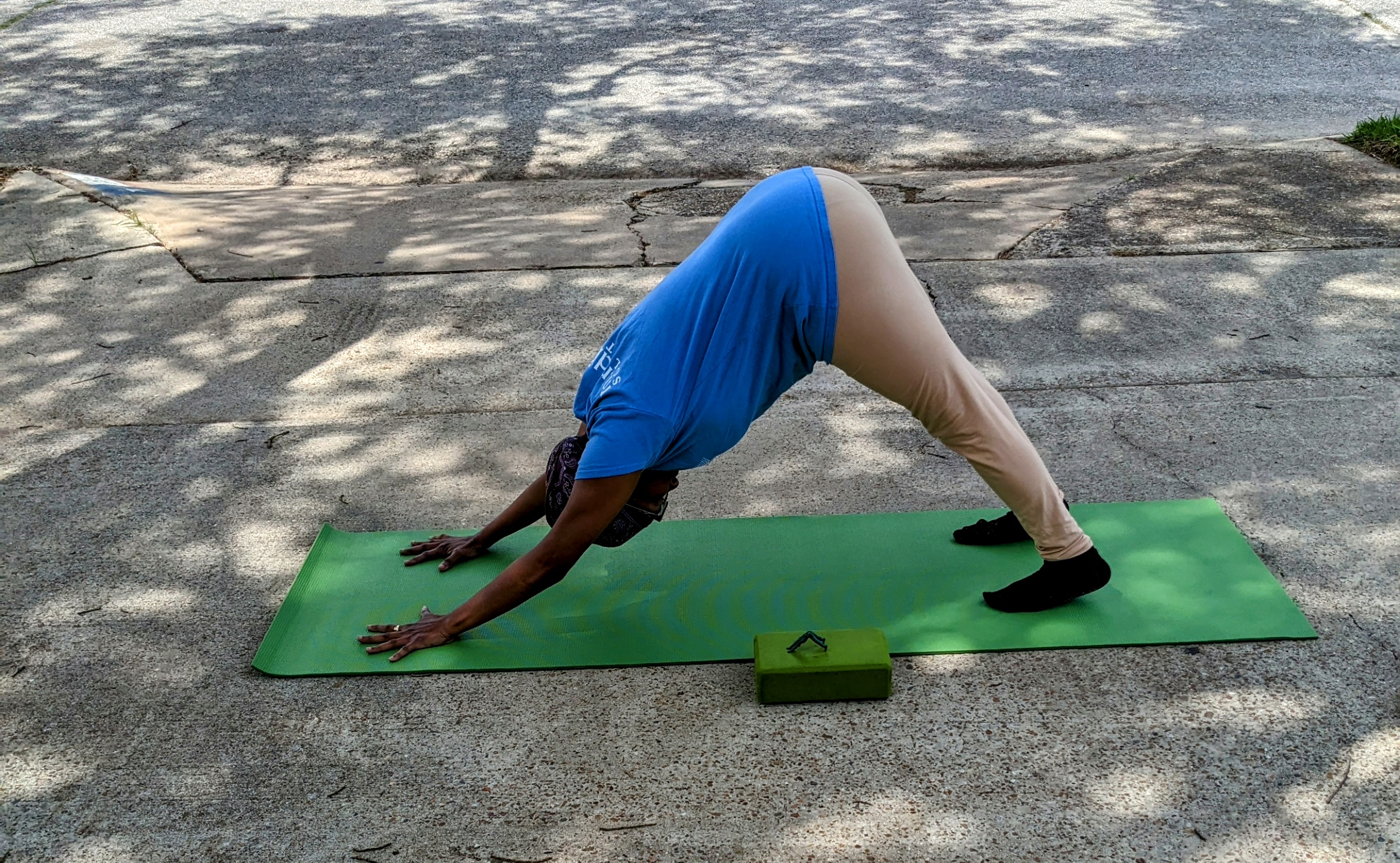


 A Joyful Practice