jump to navigation

(just the music, related to locks, philosophy, & internal movement) April 26, 2023

Posted by ajoyfulpractice in 7-Day Challenge, Baha'i, Changing Perspectives, Donate, Karma Yoga, Music, Philosophy, Riḍván, Volunteer, Yoga.
Tags:
add a comment

“Happy Riḍván!” to those celebrating “the Most Great Festival.” Many blessings to everyone, and especially to anyone Counting the Omer!

Please join me today (Wednesday, April 26th) at 4:30 PM or 7:15 PM for a yoga practice on Zoom. Use the link from the “Class Schedules” calendar if you run into any problems checking into the class. You will need to register for the 7:15 PM class if you have not already done so. You can request an audio recording of this practice via a comment below or by emailing myra (at) ajoyfulpractice.com.

Wednesday playlist is available on YouTube and Spotify. (Look for “04262020 Philosophy of Locks”)

In the spirit of generosity (“dana”), the Zoom classes, recordings, and blog posts are freely given and freely received. If you are able to support these teachings, please do so as your heart moves you. (NOTE: You can donate even if you are “attending” a practice that is not designated as a “Common Ground Meditation Center” practice, or you can purchase class(es).
This week you can also click here to Kiss My Asana Now! (Or, you can also click here to join my team and get people to kiss [your] asana!)

Donations are tax deductible; class purchases are not necessarily deductible.

### 🎶 ###

FTWMI: Shy & Fearless, Take 2 April 25, 2023

Posted by ajoyfulpractice in "Impossible" People, 7-Day Challenge, Abhyasa, Baha'i, Changing Perspectives, Dharma, Donate, Faith, Gratitude, Healing Stories, Hope, Karma Yoga, Life, Loss, Music, Philosophy, Riḍván, Vairagya, Volunteer, Wisdom, Women, Yoga.
Tags: , , , , , , , , , , , ,
add a comment

“Happy Riḍván!” to those celebrating “the Most Great Festival.” Many blessings to everyone, and especially to anyone Counting the Omer!

For Those Who Missed It: The following post (from 2021) is about one of my favorite storytellers and her “healing story.” Class details, yogathon details, and some links have been updated. Some embedded links connect outside of this blog.

“To me, fearless is having fears. Fearless is having doubts. Lots of them. To me, fearless is living in spite of those things that scare you to death. Fearless is falling madly in love again, even though you’ve been hurt before. Fearless is walking into your freshman year of high school at fifteen. Fearless is getting back up and fighting for what you want over and over again … even though every time you’ve tried before, you’ve lost. It’s fearless to have faith that someday things will change.”

– quoted from the liner notes for the album Fearless by Taylor Swift

Everyone from Taylor Swift (who I quote one more time, below) to South African President Nelson Mandela have stated that “being fearless is not the absence of fear.” So, what is it if it’s not being with “less” fear?

Turns out everyone from President Franklin D. Roosevelt and First Lady Eleanor Roosevelt to Ashley Graham and Thich Nhat Hanh agree that the most important part of “being fearless” is being – and, in some cases, doing, moving, playing.

“This is based on a true story. While hiking in the hills of Rishikesh in India, we encountered a holy man who approached with light in his eyes and love in his heart… just beaming with inspiration. He spoke as if he were channeling the divinity ever present in that wonderful country and spoke these words… ‘Light of sun in the sky sends the message: Be Fearless and Play!’ We were fascinated and inspired by his simple but insightful words.”

– quoted from the liner notes for the song “Be Fearless and Play” by Wookiefoot

Despite some really divine encounters with a couple of people affiliated with the band/circus/non-profit/adventure that is Wookiefoot, I had never heard the song (or the album) “Be Fearless and Play” before today in 2021. However, the inspiration and the lyrics definitely fit in with my overall philosophy on being fearless – that is to say, it always involves a certain amount of “play.”

Don’t get me wrong, I am not encouraging recklessness. Instead, I am encouraging a little improvisation. See, when I think of being fearless, I think of improve – comedy; yes, yes! And also, mostly, jazz. I think about the kind of play that involves knowing the rules in order to break (or at least bend) the rules. I think about scat. I think about “mak[ing] the moves up as [you] go.” I think about facing the obstacle that is your own self and knowing that today is not a good day for self defeat. I think about people like Ella Fitzgerald.


A portion of this post was part of my 2020 Kiss My Asana offering, which was directly tied to the Saturday sūtra exploration.

Born today (April 25th) in 1917, Fitzgerald would eventually become a bandleader known as the First Lady of Jazz, Mama of Jazz, Lady Ella, and the Queen of Jazz. She would be championed by musicians like Benny Carter and Chick Webb (who gave her one of her big shots); composers like Ira Gershwin (who once said, “I never knew how good our songs were until I heard Ella Fitzgerald sing them”); and celebrities like Marilyn Monroe and Frank Sinatra (both of whom challenged segregation laws and racial bias, in their own ways, on Ella’s behalf). She would be heralded by universities and heads of state, awarded the National Medal of Arts (by President Ronald Reagan in 1987), and presented France’s Commander of Arts and Letters award in 1990.

On November 21, 1934, however, when she stood on the stage at the Apollo, Ella Fitzgerald was just a shy, reserved, self-conscious 17-year old orphan with a reportedly disheveled appearance.  She hadn’t become a legendary scat artist, hadn’t recorded a single song (let alone over 200 albums) and hadn’t performed at Carnegie Hall once (let along 26 times). In fact, the woman who would eventually be known for her ability to mimic any horn in the orchestra wasn’t even planning to sing!

“They were the dancingest sisters around.”

– Ella Fitzgerald describing Ruth and Louise Edwards (known as the Edwards Sisters)

Yes, you read that right: Ella Fitzgerald didn’t enter the Apollo’s Amateur Night as a singer. She intended to dance. The problem was the main event concluded with the Edwards Sisters, a crowd favorite. Seeing the Edwards Sisters’ tap dancing bring the house down – and knowing the critical (and vocal) reputation of the Apollo audience – young Ella froze, and asked herself some variation of those aforementioned questions.

“Once up there, I felt the acceptance and love from my audience. I knew I wanted to sing before people the rest of my life.”

– Ella Fitzgerald on how it felt after she sang one of her mother’s favorite songs at the Apollo

It’s a weird dichotomy to think of Ella Fitzgerald as both shy and fearless; yet, that is exactly who and what she was. Out of context it sounds odd. When you know more of her story, however, it is inspiring and encouraging. After all, every one of us can make the decision to climb on, to celebrate, and to persevere. All we need is to recognize what is already inside of us, what has gotten us this far. At the same time, what has gotten us this far is also what might have us giving up and turning back….

In that moment of questioning, young Ella’s consciousness, her awareness of herself and her awareness of what she could do, merged with all the possible outcomes and in that moment there was fear of failing on the stage and also, as a teenager already taking care of herself in the world, there was the fear of failing in life. So, there was suffering – and, in this case, (mental) suffering that could also lead to (physical) pain. In that same moment, she also recognized a way to succeed and to alleviate (or avoid) some of her suffering.

“We are very afraid of being powerless. But we have the power to look deeply at our fears, and then fear cannot control us. We can transform our fear. Fear keeps us focused on the past or worried about the future. If we can acknowledge our fear, we can realize that right now we are okay. Right now, today, we are still alive, and our bodies are working marvelously. Our eyes can still see the beautiful sky. Our ears can still hear the voices of our loved ones.”

– quoted from Fear: Essential Wisdom for Getting Through the Storm by Thich Nhat Hanh

Please join me today (Tuesday, April 25th) at 12:00 PM or 7:15 PM for a yoga practice on Zoom. You can use the link from the “Class Schedules” calendar if you run into any problems checking into the class. You can request an audio recording of this practice via a comment below or (for a slightly faster reply) you can email me at myra (at) ajoyfulpractice.com.

Tuesday’s playlist is available on YouTube and Spotify. [Look for “04252020 Ella’s Shy & Fearless Day”]

“Be Fearless and Play
You could live for tomorrow and still live here in today

When i would play when i was a child
I swore that i would never forget no
I will never forget no!

Be Fearless and Play
This is one thing that no one can ever take away”

– quoted from the song “Be Fearless and Play” by Wookiefoot

…& don’t forget to fearlessly Kiss My Asana!!

You can click here to Kiss My Asana Now! (Or, you can also click here to join my team and get people to kiss [your] asana!) 

Yes, yes, it’s that time again! The 10th Annual Kiss My Asana yogathon benefits Mind Body Solutions (MBS), which was founded by Matthew Sanford to help those who have experienced trauma, loss, and disability find new ways to live by integrating both mind and body. Known for their adaptive yoga classes, MBS provides live, online resources to people living with disabilities, worldwide. In addition to 11 live online yoga classes a week, MBS has also created a comprehensive library of recorded adaptive yoga classes for students, instructional videos for adaptive yoga teachers, and insightful interviews between Matthew Sanford, and adaptive students. It all helps people with disabilities live more fully, where they are and how they are.

This year’s yogathon is only a week long! Seven days (which started on Saturday to do yoga, share yoga, and help others. By participating in the Kiss My Asana yogathon you join a global movement, but in a personal way. In other words, you practice yoga… for 7 days. And you can start today!!

The yogathon raises resources and awareness. So, I’m posting on my YouTube Community page and dedicated to raising $300 for Mind Body Solutions. You can do yoga starting today. You can share yoga be inviting a friend to one of my classes or by forwarding one of the blog posts. You can help others by donating.

You can add 5 minutes of yoga (or meditation) to your day; you can learn something new about your practice; you can even teach a pose to someone close to you – or even to one of your Master Teachers/Precious Jewels. Consider, as First Lady Eleanor Roosevelt said, doing “the thing you think you cannot do.”

If you’re interested in my previous Kiss My Asana (KMA) offerings, check out the following (some links only take you to the beginning of a series ad/or to YouTube):

In the spirit of generosity (“dana”), the Zoom classes, recordings, and blog posts are freely given and freely received. If you are able to support these teachings, please do so as your heart moves you. (NOTE: You can donate even if you are “attending” a practice that is not designated as a “Common Ground Meditation Center” practice, or you can purchase class(es).
This week you can also click here to Kiss My Asana Now! (Or, you can also click here to join my team and get people to kiss [your] asana!)
Donations are tax deductible; class purchases are not necessarily deductible.

Updated 2023.

### YOU’VE GOT THIS ###

What’s [Today’s] Story? (a Monday post-practice note) April 24, 2023

Posted by ajoyfulpractice in Baha'i, Books, Changing Perspectives, Donate, Healing Stories, Karma Yoga, Life, Music, One Hoop, Riḍván, Volunteer, Wisdom, Writing, Yoga.
Tags: , , , , , , , , , ,
add a comment

“Happy Riḍván!” to those celebrating “the Most Great Festival.” Many blessings to everyone, and especially to anyone Counting the Omer!

This is a post-practice note related to Monday, April 24th. Some embedded links will take you outside of the blog. You can request an audio recording of this practice via a comment below or (for a slightly faster reply) you can email me at myra (at) ajoyfulpractice.com.

In the spirit of generosity (“dana”), the Zoom classes, recordings, and blog posts are freely given and freely received. If you are able to support these teachings, please do so as your heart moves you. (NOTE: You can donate even if you are “attending” a practice that is not designated as a “Common Ground Meditation Center” practice, or you can purchase class(es).
This week you can also click here to Kiss My Asana Now! (Or, you can also click here to join my team and get people to kiss [your] asana!)
Donations are tax deductible; class purchases are not necessarily deductible.

Check out the “Class Schedules” calendar for upcoming classes.)

“Everybody knows a thousand stories. But only one cocklebur catches in your fur and that subject is your question. You live with that question. You may not even know what that question is. It hangs around a long time. I’ve carried a novel as long as twenty years, and some poems longer than that.”

Robert Penn Warren quoted from a 1981 interview

Looking back at some old blog posts related to April 24th, it took me a second to realize why the 2021 post wasn’t just a copy or and expanded version of the 2020 post. Then I remembered. In 2020, I focused on telling the story of the Library of Congress, which was established today 1800, and preserves by (and about) people like including Anthony Trollope (b. 1815), Carl Spitteler (b. 1845), Robert Penn Warren (b. 1905), Sue Grafton (b. 1940), Eric Bogosian (b. 1953), and Kelly Clarkson (b. 1982). In 2021, I focused on telling the story of Robert Penn Warren.

In both cases, however, the practice was all about how our minds and bodies tell stories.

Whether we realize it or not, we are constantly telling stories. We tell stories verbally, visually, and viscerally. We tell stories in the ways we move and, also, in the ways we don’t move. We tell stories about where we’ve been, where we are, and where we’re going – and we do this on and off the mat. Whether we realize it or not. On the mat, the storytelling is done through the poses and sequences. Since our bodies are different, we can each tell (and understand) the same “story” in different ways. Since our bodies change over time, we can learn different things about ourselves each time we tell the “story.”

“Social tensions have a parallel in the personal world. The individual is an embodiment of external circumstances, so that a personal story is a social story.”

Robert Penn Warren quoted from “A Conversation with Robert Penn Warren [with] Frank Gado / 1966 (From First Person: Conversations on Writers and Writing, by Frank Gado” as printed in Conversations with Robert Penn Warren, edited by Gloria L. Cronin and Ben Siegel   

Just as literal and physical storytelling is a big part of my practice, it is a big part of what happens at Mind Body Solutions (MBS). Matthew Sanford, the founding teacher of MBS, calls the stories we tell “healing stories.” If you click on the link above for the 2021, you will find the healing stories of people who have directly benefited from practicing adaptive yoga and who directly benefit from the Kiss My Asana yogathon. If you click on the link above for 2020, you will find a “piece” of a healing story that is still being told.

Then there’s this….

PXL_20230425_002629640~2

What’s the story here? Check out the Community Page on my YouTube channel to find out.

There is no playlist for the Common Ground Meditation Center practices.

A 2021 playlist is available on YouTube and Spotify. [Look for “04242021 All Sides of the Story”]

You can click here to Kiss My Asana Now! (Or, you can also click here to join my team and get people to kiss [your] asana!) 

If you’re interested in my previous Kiss My Asana (KMA) offerings, check out the following (some links only take you to the beginning of a series ad/or to YouTube):

### YOU COULD KISS MY ASANA… RIGHT NOW! ###

FTWMI: Speaking the Language of Hope April 23, 2023

Posted by ajoyfulpractice in Baha'i, Changing Perspectives, Donate, Faith, Fitness, Gratitude, Healing Stories, Health, Hope, Karma Yoga, Life, Music, One Hoop, Pain, Peace, Religion, Riḍván, Suffering, Volunteer, Wisdom, Yoga.
Tags: , , , , , , , , ,
add a comment

“Happy Riḍván!” to those celebrating “the Most Great Festival.” Many blessings to anyone Counting the Omer or celebrating/observing Eastertide / the Octave of Easter!

For Those Who Missed It: The Following was originally posted as part of my Kiss My Asana offering in 2020. I have adjusted some language, added a couple of critical details, and also added class details and links. Some links connect to sites outside of this blog.

( )

– Title of the third sigur rós album, on which all songs are “sung” by jónsi (born 4/23/1975) in Hopelandic (“Vonlenska” in Icelandic)

A lot of people, myself included, find sigur rós music relaxing. I also find it visceral, something felt deep in the body. So, sometimes, when I want people to really tune in and pay attention to how they are feeling – deep in their bodies – I play sigur rós. There are albums where jónsi, who was born today in 1975, sings in Icelandic. On the third album, however, he sings in an imaginary language known as Vonlenska. Vonlenska, as identified by a journalist, first appeared in the ninth track of the band’s debut album. The song is called “Von,” the Icelandic word for “hope.” Hence the name: Volenska.  Hopelandic.

Hopelandic. How can you not love that name, or the idea of a place where the native language is hope?

“it’s of course not an actual language by definition (no vocabulary, grammar, etc.), it’s rather a form of gibberish vocals that fits to the music and acts as another instrument. jónsi likens it with what singers sometimes do when they’ve decided on the melody but haven’t written the lyrics yet.”

– from the faq section of the sigur rós website

When I play sigur rós in class, I remind people that they are hearing an imaginary language, but also point out that if you listen long enough you can not only sing along you can also feel as if you understand what is being sung – if not the words (since they aren’t, technically, words), at least the sentiment. I also explain that it is a little like listening to the mind-body.

Our minds and bodies speak in sensation, that’s how they communicate information. The only problem is, we’re not always fluent in sensation. So, just like we do when we are learning a new language, we need to experience the “vocabulary” in context and then repeat and repeat them until they are ingrained. Living our lives in our bodies is a little like being immersed in a foreign language – except for the part where we can ignore all of the sensation/information and only converse in our native tongue because, in some ways, it is easier than trying to understand this language no one spends a lot of time teaching us how to understand. The physical practice of yoga (hatha yoga, regardless of the style or tradition) is a way to start learning the language.

It’s not that hard to find a yoga class, if you consider yourself able-bodied and/or of sound mind (and/or if you are not marginalized in any way). Even now, under the when there was a worldwide lockdown, there were lots of options. It may take a little effort to find a yoga practice that works for you, but it’s out there. What if, however, you (or someone around you) didn’t consider you able-bodied and/or of sound mind? What if you had been told that because you couldn’t move parts of your body on your own, couldn’t breathe without a machine, and/or didn’t feel sensation the way others felt it, you couldn’t practice yoga? What if your body didn’t look like the teacher’s body? What if you had experienced a loss or a traumatic event so devastating that it was hard to get out of bed? What if you were burnt out from taking care of people? What if a doctor told you that you were all but dead?

“Or do you need to get quiet enough to understand that some person – maybe close to you, maybe you – needs a beautiful place to come to, just to be, to come back to the purity of your existence.

And whatever’s dragged you through your life up to this point, beaten you forward to solve whatever problems, you drop all of that. And find yourself.”

– Robert Boustany describing that ‘Every answer is inside you.’

I started practicing yoga between professional dancers and musicians, people who used their bodies to make a living. They were also people (pardon the pun) very in-tune with their bodies. Then there was me, and on the first day, Robert Boustany explained that I already practiced yoga (philosophically speaking).

Because I knew Robert’s  background and knew some of the people who practiced with him under various conditions, it would be decades before it occurred to me that some people thought they couldn’t practice yoga. It was heartbreaking to realize that some people were being denied a really profound internal experience, a profoundly healing experience, because of a misconception about what yoga is and what it is not. It was heartbreaking to realize that there were yoga teachers all of the world who only knew how to teach a single, sometimes stereotypical, person – especially since there are so many people in the world who are not stereotypical.

“As I write this book, I am a yoga teacher, and I still get around in a wheelchair. I teach bodies that can stand when I cannot, that can feel things where I do not. This is possible because I have explored a different kind of connection between mind and body. Although I still cannot move my legs – and have no goal to do so – I do feel a heightened level of presence throughout my entire consciousness, including my paralyzed body.

It is a connection that we all share. Most of us, however, have not needed to bring it fully to consciousness. I believe this shared connection has profound implications not just for the shape and quality of our consciousness, but for the aging process, for the experience of trauma, for our approach to disability and rehabilitation, and even for our survival on this planet.”

– quoted from the Introduction to Waking: A Memoir of Trauma and Transcendence by Matthew Sanford

Matthew Sanford is one of those people who is not stereotypical. He founded Mind Body Solutions to help those who have experienced trauma, loss, and disability find new ways to live by integrating both mind and body. Known for their adaptive yoga classes, MBS provides “traditional yoga” classes, workshops, and outreach programs. They also train yoga teachers and offer highly specialized training for health care professionals. This year’s yogathon, the 10th annual yogathon, kicked off yesterday. Seven days to practice with purpose: to do yoga, share yoga, and help others.  By participating in the Kiss My Asana yogathon you join a global movement, but in a personal way. In other words, you practice yoga… for 7 days. And you can start right now!

You can click here to Kiss My Asana Now! (Or, you can also click here to join my team and get people to kiss [your] asana!)

Please join me for a 65-minute virtual yoga practice on Zoom today (Sunday, April 23rd) at 2:30 PM. Use the link from the “Class Schedules” calendar if you run into any problems checking into the class. You can request an audio recording of this practice via a comment below or by emailing myra (at) ajoyfulpractice.com.

Sunday’s playlist is available on YouTube and Spotify.

Pucker Up & Kiss My Asana!!!

The practices I lead are full of little bits of teaching/practice I’ve picked up from Matthew Sanford and other teachers and students at Mind Body Solutions. Plus, I’ll be posting KMA offerings on the community page on my YouTube channel.

If you’re interested in my previous KMA offerings, check out the following (some links only take you to the beginning of a series):

In the spirit of generosity (“dana”), the Zoom classes, recordings, and blog posts are freely given and freely received. If you are able to support these teachings, please do so as your heart moves you. (NOTE: You can donate even if you are “attending” a practice that is not designated as a “Common Ground Meditation Center” practice, or you can purchase class(es). Donations are tax deductible; class purchases are not necessarily deductible.)

### ( ) ###

But What About Earth…and Space (and Grace)? (the “missing” Saturday post) April 22, 2023

Posted by ajoyfulpractice in "Impossible" People, 7-Day Challenge, Baha'i, Books, Changing Perspectives, Donate, Faith, Fitness, Healing Stories, Health, Hope, Karma Yoga, Life, Minnesota, Music, One Hoop, Peace, Philosophy, Religion, Riḍván, Science, Twin Cities, Uncategorized, Volunteer, Wisdom, Yoga.
Tags: , , , , , , , , , , , , , , , , , , ,
add a comment

“Happy Riḍván!” to those celebrating “the Most Great Festival.” Many blessings to anyone Counting the Omer or celebrating/observing Eastertide / the Octave of Easter!

This is a “missing” post for Saturday, April 22nd. It includes some recycled quotes and re-purposed information from earlier posts. Some embedded links will take you outside of the blog. You can request an audio recording of this practice via a comment below or (for a slightly faster reply) you can email me at myra (at) ajoyfulpractice.com.

In the spirit of generosity (“dana”), the Zoom classes, recordings, and blog posts are freely given and freely received. If you are able to support these teachings, please do so as your heart moves you. (NOTE: You can donate even if you are “attending” a practice that is not designated as a “Common Ground Meditation Center” practice, or you can purchase class(es).
This week you can also click here to Kiss My Asana Now! (Or, you can also click here to join my team and get people to kiss [your] asana!)
Donations are tax deductible; class purchases are not necessarily deductible.

Check out the “Class Schedules” calendar for upcoming classes.)

“Those who contemplate the beauty of the earth find reserves of strength that will endure as long as life lasts. There is something infinitely healing in the repeated refrains of nature — the assurance that dawn comes after night, and spring after winter.”

– quoted from Silent Spring by Rachel Carson (published 1962)

So, this week we considered the power found in waiting, waiting in community and also the power of water and light – which is akin to fire – (plus there were some references to wind). But what about Earth… and Space? And what does any of this have to do with grace, particularly shastra kripa (or, at least, one of the definitions of shastra kripa)? To get to all that we have to get grounded, dig deep, and take a little detour  through another celebration related to waiting and through a yogathon.

Notice, however, that all of the references below are centered and grounded in community.

“But it seems reasonable to believe — and I do believe — that the more clearly we can focus our attention on the wonders and realities of the universe about us the less taste we shall have for the destruction of our race. Wonder and humility are wholesome emotions, and they do not exist side by side with a lust for destruction.”

– Rachel Carson accepting the John Burroughs Medal (April 1952) and printed in Lost Woods: The Discovered Writing of Rachel Carson

In addition to being the beginning of the 10th annual Kiss My Asana yogathon, today was Earth Day. While the roots of Earth Day can be found in the 1962 publication of Rachel Carson’s Silent Spring, an actual day dedicated to Earth and peace was initially proposed by John McConnell during a 1969 conferenced hosted by the United Nations Educational, Scientific and Cultural Organization (UNESCO). The very first Earth Day, as he proposed it, was held in San Francisco on March 21, 1970, to coincide with the first day of spring in the northern hemisphere. Gaylord Nelson, a United States Senator from Wisconsin, proposed a nationwide environmental teach-in and hired a young activist named Denis Hayes to organize the first national Earth Day, which was held on April 22, 1970. More than 20 million people, including then-President Richard Nixon and First Lady Pat Nixon, participated in the events on April 22, 1970, making that day one of the largest protests in the United States. (The 1970 Earth Day teach-in was the largest recorded protest until the 2020 protest after the murder of George Floyd.)

“In these troubled times it is a wholesome and necessary thing for us to turn again to the earth and in the contemplation of her beauties to know the sense of wonder and humility. There is modern truth to the ancient wisdom of the psalmist: `I will lift up mine eyes unto the hills, from whence cometh my help.’”

– quoted from Rachel Carson’s original submission to “Words to Live By” for This Week Magazine (1951)

Click here to read my 2020 Earth Day post about healing.

“A determination to be outward looking in the process of community building had already become an established aspect of culture in many, many places; it has now blossomed, in a rising number of communities, into a sense of real responsibility for the spiritual and material progress of larger and larger groups within society, well beyond the membership of the Bahá’í community itself. The efforts of the friends to build communities, to engage in social action, and to contribute to the prevalent discourses of society have cohered into one global enterprise, bound together by a common framework for action, focused on helping humanity to establish its affairs on a foundation of spiritual principles.”

– quoted from the Riḍván 2022 message from the Universal House of Justice “To the Bahá’is of the World”

Thursday night marked the beginning of the twelve-day festival of Ridván, “the Most Great Festival” in the Baháʼí Faith.  As I mentioned last month, the Baháʼí Faith is a monotheistic faith that believes in the oneness of God and religion, as well as the oneness and nobility of humanity. The community believes that, historically, there has been a “progressive revelation of religious truth” which has been shared with the world through the voices of the prophets or Divine Messengers, known as “Manifestations of God” (which include “Braham, Krishna, Zoroaster, Moses, Buddha, Jesus Christ, Muhammad, and, in more recent times, the Báb and Bahá’u’lláh”). People within the faith are taught to honor the value of different religious and philosophical traditions as well as the value of education, especially in science (which is viewed by some faiths as being contrary to religion).

The Bahá’í calendar begins around the Vernal (Spring) Equinox in the Northern Hemisphere and has 19 months with 19 days – each named for one of the 19 names/manifestations/attributes of God. For example, “Splendor” and “Glory” are the English translations for Bahá and Jalál, the first two months (and days) of this solar calendar. There are also 4 or 5 intercalary days that occur just before the final month and which are considered “transcendent” in nature. The calendar is partially tied to the Gregorian calendar, in that days on each calendar always correspond with each other; however, the Bahá’í calendar is very much focused around its own historical liturgy. Hence, why 2023 is the year 180 BE (Bahá’í  Era).

The twelve-day festival of Ridván, one of the holiest times within the Bahá’í community, is celebrated during the second month and begins exactly one Gregorian-month after the new year. This “Most Great Festival” in the Baháʼí Faith honors the time that the founder of the Bahá’i Faith, Bahá’u’lláh waited in the original garden of Ridván prior to being exiled to Constantinople. The Arabic word ridván means “paradise” and I indicated “the original garden,” because in addition to the garden outside of Baghdad, where the great spiritual leader (considered a manifestation of the Divine) prepared for his exile, there is a second garden with the same name in Israel, which Bahá’u’lláh visited after years of exile.

The festival is a time of a sacred time of prayer, reflection, and celebration. This year’s celebrations began two hours before sunset on Thursday – with the specific timing meant to commemorate the actual time, in 1863, when Bahá’u’lláh entered the Najíbíyyih Garden with his three sons and his secretary and began to receive the visitors who wanted to wish him well before his departure. It was during this time, in the space he called “paradise,” that Bahá’u’lláh declared himself as the most recent manifestation of God; that all religious wars were repealed; that there would not be another manifestation of the God for another 1,000 years; and that the names of God (or attributes of the divine) are manifested in all things. To honor the fact that he made these announcements, the Universal House of Justice issues an annual Ridván message. They also hold elections held during this time. The first day (yesterday), the ninth day (next Saturday), and the twelfth day are considered the most holy of days. The ninth day is auspicious because it is the day the rest of Bahá’u’lláh’s family joined him in the garden and it is also the beginning of the third month, Jamál (“Beauty”).

“Besides my involvement with the Investor’s Circle, I temporarily put aside my plan for an institute and returned to the basics – an almost exclusive focus on my yoga practice. After a couple of years, I decided that it was time to share my experience with yoga and paralysis. If nothing else, I could help others who lived with disability. I started teaching an adapted yoga class at the Courage Center, a leading rehabilitation facility in a suburb of Minneapolis.

My idea was that by teaching this class, I could give something back – an obvious means to make my experience useful. What I found was much more. I thought I was teaching these students, when, in fact, they were teaching me. Neurological deficit is a frontier of mind-body integration. Working with these students has taught me that the principles of yoga are nondiscriminating – they can travel though any body.”

– quoted from “16, Falling Gracefully” in “Part Three: Yoga, Bodies, and Baby Boys” of Waking: A Memoir of Trauma and Transcendence by Matthew Sanford

As I have mentioned before, my first exposure to the physical practice of yoga was also my first exposure to Yoga Philosophy and to the fact that anyone and everyone can practice yoga. Sometimes we stumble upon the practice that works for us. However, sometimes it takes an extra effort to find the practice (and the teacher) that works for our particular mind-bod-spirit. In fact, it wasn’t until I took my first yoga teacher training that I really realized how many people weren’t practicing, because they didn’t know they could practice. Even worse, some people had been told that they couldn’t practice – which is heartbreaking.

Still, I believed (and continue to believe) in the transformative, healing, and joyful experience of yoga. I also still believe there is a practice for every mind/body/spirit – every veteran, every person with disability, every survivor of sexual assault and other trauma, every elderly person, every person living with chronic pain, every person with a terminal illness, and every caregiver. I am joyfully participating in the Kiss My Asana yogathon for the 10th year in a row, because Mind Body Solutions is helping people find their practice!

The Kiss My Asana yogathon is an annual event that raises awareness and resources for Mind Body Solutions and their life-affirming work to help people living with disabilities. Best known for their Adaptive Yoga Program, which provides adapted yoga opportunities for people around the globe, MBS currently provides live, online resources to people living with disabilities, worldwide. In addition to 11 live online yoga classes a week, MBS has also created a comprehensive library of recorded adaptive yoga classes for students, instructional videos for adaptive yoga teachers, and insightful interviews between the founding teacher, Matthew Sanford, and adaptive students. In the past, MBS has also offered training and workshops for yoga teachers, healthcare professionals, and caregivers (so they can share this work in their communities, too).

All of this helps people with disabilities live more fully, where they are and how they are. Ultimately, however, Mind Body Solutions is all about everyone having better relationships with their mind-body and spreading the message that a greater connection between mind and body can help us all live with improved comfort and ease. So, we can all benefit from the practice, because we all experience trauma, loss, and disability in some way shape or form.

The yogathon started as a month-long endeavor, but switched to a 7-day yogathon in 2020. This week (April 22nd – 28th) I’m planning to practice with purpose. I’m going to “Do Yoga. Share Yoga. Help Others.” – and you can join me! The practices I lead will be full of little bits of teaching/practice I’ve picked up from Matthew Sanford and other teachers and students at Mind Body Solutions. Plus, I’ll be posting on the community page on my YouTube channel.

If you’re interested in my previous KMA offerings, check out the following (some links only take you to the beginning of a series):

You can click here to Kiss My Asana Now! (Or, you can also click here to join my team and get people to kiss [your] asana!)

Saturday’s playlist is available on YouTube and Spotify[Look for “0422020 Earth Day”]

What’s this?

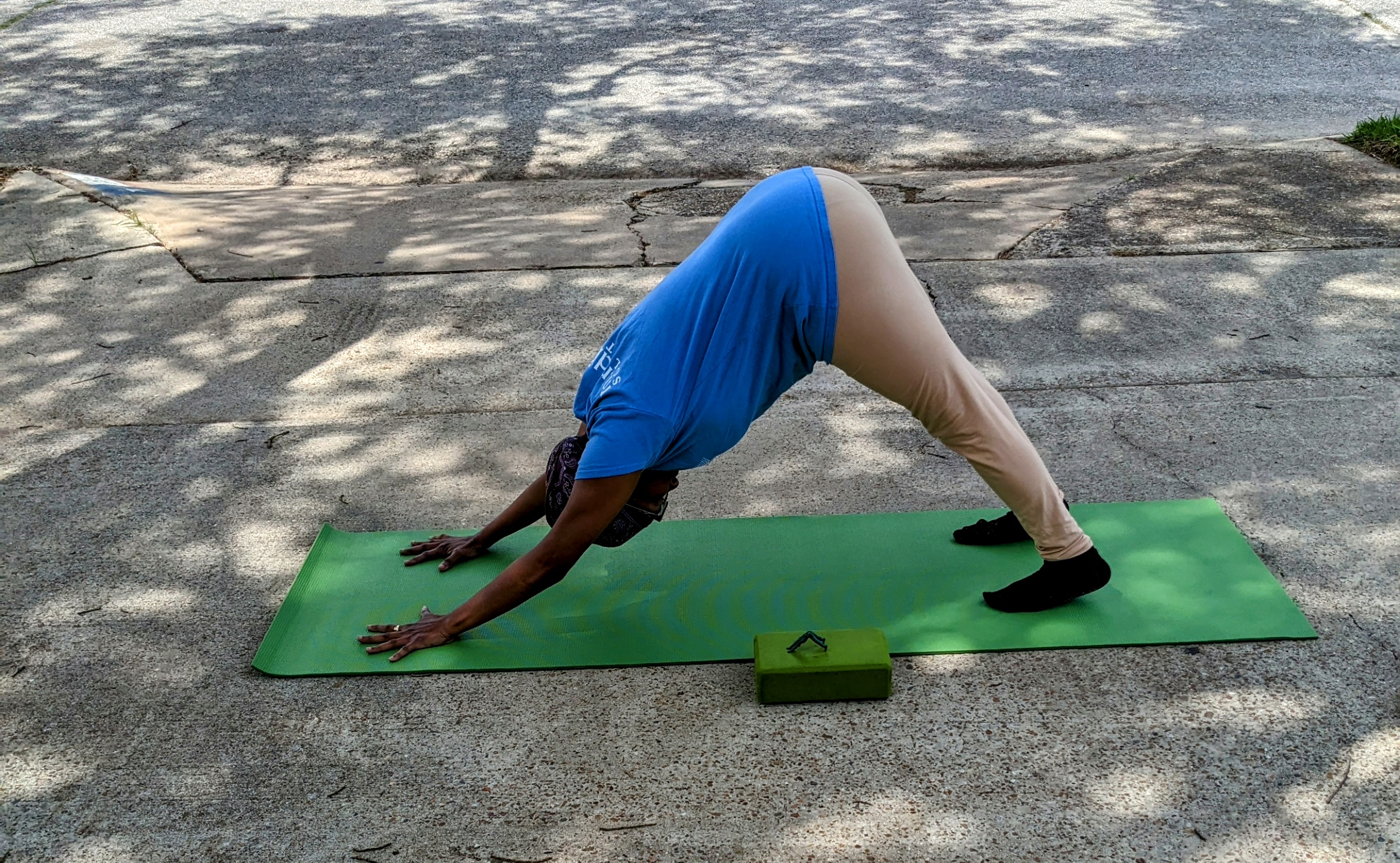
Have you subscribed to my YouTube page? It’s mostly playlists, plus a few mini-practices and videos from previous yogathons. Starting later tonight, I’m also going to be posting on my community page as part of my 2023 Kiss My Asana offering. So, check it out if you want to know more about the pose pictured above (and why we’re doing it).

Thanks to MW!

### GET CENTERED & GROUNDED ###

But What About Earth…and Space… and Grace? (mostly the music w/Kiss My Asana links) April 22, 2023

Posted by ajoyfulpractice in Baha'i, Books, Changing Perspectives, Faith, Healing Stories, Hope, Life, Music, One Hoop, Peace, Philosophy, Riḍván, Science, Wisdom, Yoga.
Tags: , , , , , ,
add a comment

“Happy Riḍván!” to those celebrating “the Most Great Festival.” Many blessings to anyone Counting the Omer or celebrating/observing Eastertide / the Octave of Easter! Also, “Happy Earth Day!” to everyone.

“But it seems reasonable to believe — and I do believe — that the more clearly we can focus our attention on the wonders and realities of the universe about us the less taste we shall have for the destruction of our race. Wonder and humility are wholesome emotions, and they do not exist side by side with a lust for destruction.”

– Rachel Carson accepting the John Burroughs Medal (April 1952) and printed in Lost Woods: The Discovered Writing of Rachel Carson

Please join me for a 90-minute virtual yoga practice on Zoom today (Saturday, April 22nd) at 12:00 PM. Use the link from the “Class Schedules” calendar if you run into any problems checking into the class. You can request an audio recording of this practice via a comment below or by emailing myra (at) ajoyfulpractice.com.

Saturday’s playlist is available on YouTube and Spotify[Look for “0422020 Earth Day”]

You can click here to Kiss My Asana Now! (Or, you can also click here to join my team and get people to kiss [your] asana!)

In the spirit of generosity (“dana”), the Zoom classes, recordings, and blog posts are freely given and freely received. If you are able to support these teachings, please do so as your heart moves you. (NOTE: You can donate even if you are “attending” a practice that is not designated as a “Common Ground Meditation Center” practice, or you can purchase class(es). Donations are tax deductible; class purchases are not necessarily deductible.)

### 🎶 ###

Auspicious and Holy Stories (the “missing” Wednesday post) March 22, 2023

Posted by ajoyfulpractice in 19-Day Fast, Abhyasa, Art, Baha'i, Bhakti, Books, Buddhism, Changing Perspectives, Faith, Healing Stories, Hope, Kirtan, Lent / Great Lent, Life, Music, Mysticism, New Year, One Hoop, Pain, Philosophy, Ramadan, Religion, Suffering, Vairagya, Wisdom, Women, Yoga.
Tags: , , , , , , , , , , , , , , , , , , , , , , ,
add a comment

Many blessings to all! “Happy Ugadi, Happy New Year!” to those who are celebrating! “Nine days and nine nights of blessings and happiness if you are celebrating Chaitra Navaratri!” “Ramadān Mubarak, Blessed Ramadān!” to anyone who is observing the holy month of Ramadān. Blessings to anyone observing Lent or Great Lent during this “Season for Non-violence” and all other seasons! Happy Spring to those in the Northern Hemisphere & Happy Fall to those in the Southern Hemisphere.

This is the “missing” post for Wednesday, March 22nd. You can request an audio recording of this practice via a comment below or (for a slightly faster reply) you can email me at myra (at) ajoyfulpractice.com.

In the spirit of generosity (“dana”), the Zoom classes, recordings, and blog posts are freely given and freely received. If you are able to support these teachings, please do so as your heart moves you. (NOTE: You can donate even if you are “attending” a practice that is not designated as a “Common Ground Meditation Center” practice, or you can purchase class(es). Donations are tax deductible; class purchases are not necessarily deductible.

Check out the “Class Schedules” calendar for upcoming classes.)

“A good sequence is like a good story. There is a beginning (an introduction), the middle (the heart of the story), and the end (the conclusion)”

– Maty Ezraty

People often tell me that one of the things they like about my classes are the stories, as well as the way the poses and the music tell the stories. They may even wonder why I tell such stories. Bottom line: I come from a long line of teachers who think the practice is a way to tell our stories and also a way to process our stories, every time we inhale, every time we exhale. It’s a way to go deeper into our stories.

But, since we all have different stories, we need to get on the same page – and I just happen to have the privilege of turning that page.

Today is a day when I normally tell the stories of four very famous storytellers born on March 22nd. These storytellers tell/told their stories in different ways; however, the storytellers themselves have something in common – other than the fact that they are all, as it turns out, the same gender and race and share the same profession and birthday. They all know/knew how to tell a good story. Regardless of if you read the adult novels or children’s books of one of my parents’ favorite authors; the poetry of one of my favorite poets; or listen to the brilliant lyrics and music of the two composers on the list, you will find that they follow a simple structure. It is the same structure we follow in the practice; a structure containing the three parts highlighted by Maty Ezraty and, also, a Chekhovian promise (which we’ll get to in the end).

As I said before, today is a day when I normally tell their stories. However, this year, I feel compelled to tell a few different stories. They are the stories being told, celebrated, and observed all over the world today. They are auspicious stories. They are holy stories. They are stories filled with their own promise: a promise of hope and renewal.

Some elements of the following were posted in 2020 and 2021, in a slightly different combination and context. You can click on the years to find the original posts. There are also some embedded links below, which connect to additional context.

“The truth, from my perspective, is that the world, indeed, is ending — and is also being reborn.  It’s been doing that all day, every day, forever.  Each time we exhale, the world ends; when we inhale, there can be, if we allow it, rebirth and spiritual renewal.  It all transpires inside of us.  In our consciousness, in our hearts.  All the time.”

– Tom Robbins quoted in the Reality Sandwich article “The Syntax of Sorcery: An Interview with Tom Robbins” by Tony Vigorito (posted online June 6, 2012)

“Renewal” is a funny word, because I don’t think it is (technically) a homonym (i.e., a word that has multiple meanings), but it is a word that can conjure up very different sentiments. Simply stated, a “renewal” is the continuation or extension of something. Sometimes we think of it in the context of an activity or state that has been continuous, but had a set ending date – like when we borrow a book from a public library. Other times, we think of it in the context of continuing something that has been interrupted. Renewal can also be used to refer to something that has been repaired and/or restored to its original state… so that it can continue fulfilling its purpose.

Regardless of how you think of the word, “renewal” is a concept that we often associate with Spring. In fact, similar to how cultures all over the world celebrate light overcoming darkness during the darkest times of the year, cultures all over the world spend some portion of Spring celebrating renewal. In many cases, these celebrations mark a renewal of faith and a celebration of the continuation of a covenant with God.

Today, March 22, 2023, is a time when at least five different communities around the world are observing rituals related to renewal. While people within the Bahá’i Faith just finished observing the Bahá’i 19-Day Fast and celebrating the Nowruz (the New Year) –  and have a few weeks before their most holy festival, Western Christian and Eastern Orthodox Christian communities are observing the last few weeks of Lent and Great Lent. At this same time, some people in India and the Indian diaspora are celebrating Ugadi, the Hindu (or Indian) New Year, which is also the beginning of Chaitra Navaratri. Finally, the holy month of Ramadān in Islām is scheduled to begin tonight at sunset. (In countries that do not have sightings of the crescent moon, the holy month will begin on Thursday or Friday). Some of these celebrations and observations will extend into April, overlapping even more auspicious and holy times for even more communities around the world. Each ritual has different customs, traditions, and significances; however, what is important to note is how each observation renews people’s connection with their faith, their community, and the deepest parts of themselves.

“Jesus, full of the Holy Spirit, left the Jordan and was led by the Spirit into the wilderness, where for forty days he was tempted by the devil. He ate nothing during those days, and at the end of them he was hungry.”

– quoted from The Gospel According to St. Luke (4:1-2, NIV)

NOTE: This is almost identical to The Gospel According to St. Matthew (4:1-2, NIV)

As I’ve mentioned before, the word “Lent” comes from the Old English word for “spring season” and is a period of 40 days meant to mirror the 40 days Jesus spent fasting in the wilderness prior to being betrayed, crucified, and resurrected. For Christians, it is seen as a period of preparation (for Easter) and involves fasting, prayer, reflection, redemption, and (yes) renewal. While the story is the same, the Roman Catholic and Western Christian traditions use a different calendar than the Eastern / Orthodox Christian traditions. The way the Sundays are counted is another difference in the way Lent and Great Lent are observed. In Roman Catholic and Protestant traditions, Sundays are considered “Feast Days” – anniversaries of Easter and the Resurrection – and, therefore, they are not counted as days of penance. In Orthodox traditions, Sundays are included in the count.

The holy month of Ramadān is another observation within an Abrahamic religion – and it also involves yet another different calendar; so, the overlap in holy times is not always the same. Ramadān is an Arabic word derived from a root word meaning “scorching heat” or “dryness.” In addition to being the name of the 9th month of the Islāmic calendar, which is a month of fasting, prayer, reflection, and community, it is also one of the 99 “Beautiful Names of Allah” (also known as “99 Attributes of Allah”). While the fasting from sunrise to sunset during the holy month is a holy obligation (for those who are physically able) and one of the Five Pillars of Faith in Islām, I normally don’t focus on this particular ritual and tradition until the end of the holy month – which includes a night that is considered the holiest night of the month, a night of revelation and destiny.

“I know I’m waiting
Waiting for something
Something to happen to me
But this waiting comes with
Trials and challenges
Nothing in life is free”

“My Lord, show me right from wrong
Give me light, make me strong
I know the road is long
Make me strong”

– quoted from the song “Make Me Strong” by Sami Yusuf

There are several calendars used in India and Southeast Asia which may be referred to as the Hindu calendar (or, in some cases the Buddhist calendar). For the most part, these are lunisolar calendars. Some, like those used in Nepal and certain regions of India, emphasize the lunar cycles and start with the (spring) harvest season. On the flip side, the Tamil calendar emphasizes the solar cycle and begins around the Vernal (Spring) Equinox. (In fact, I have seen the Tamil calendar described as a purely solar calendar.)

The Indian calendars tend to have twelve months, however, in some areas (particularly in the North) a month begins the day after a full moon and in other areas (often in the South) the month begins at sunrise after the “no moon” or new moon. The months are usually divided into the bright half (waxing, when the crescent appears after the new moon) and the darker half (waning, the day after the full moon). Because of the different starting points, the same lunar-oriented religious holidays may start at slightly different times throughout the continent. Either way you look at it, many people are beginning their observations and celebrations of Navaratri.

Navaratri (which means “nine nights” in Sanskrit) technically occurs four times on the Hindu calendar, although extra emphasis is put on the one beginning today and the one in the fall. Like the others, the fall celebration of Sharada Navaratri is a celebration of divine feminine energy – specifically of Durga, the divine mother, in various manifestations. It is considered the most celebrated. Magha Navaratri and Ashada Navaratri are the least celebrated, although they have special significance in certain regions. The second most celebrated Navaratri is Chaitra Navaratri, which begins today and is also Ugadi, the Hindu or Indian New Year.

Like the others, Chaitra Navaratri begins by celebrating Durga as Shailaputri (“Daughter of Mountain”). Shailputri is the daughter of Himavat, the Mountain King or Guardian God of Himalayan Mountains, and is recognized as a divine manifestation of Mahadevi and a reincarnation of Sati (the wife of Shiva), who then reincarnates as Parvati. In art, she holds a trishula or trident in her right hand and a lotus in her left hand, all while riding Shiva’s bull Nandi*, whose name means “happy, joy, and satisfaction.” In some regions, this spring celebration culminates on the final day with Rama Navami – a celebration of the birth of Lord Rama.

“Lord Ram gave Hanuman a quizzical look and said, ‘What are you, a monkey or a man?’ Hanuman bowed his head reverently, folded his hands and said, ‘When I do not know who I am, I serve You and when I do know who I am, You and I are One.’”

– quoted from the epic Sanskrit poem Ramacharitmanas (Lake of the Deeds of Rama) by Goswami Tulsidas

All of the rituals and traditions mentioned above could be considered vigils (or feature vigils at some point during the observation) – as they are periods of time when people are “keeping awake during the time usually spent asleep, especially to keep watch or pray.” Even when people are not literally staying up all night, they are required to be mindful (i.e., awake) to how they can fulfill the obligations of their faith on a day-to-day basis. All of these rituals and traditions are practiced in community. Finally, they all fit into the rubric of kriyā yoga, as described by Patanjali in Yoga Sūtra 2.1-2. They all involve a combination of tapah (“heat, austerity, or discipline” and the practices that cultivate heat, discipline, and austerity on a number of levels), svādhyāya (“self-study”), and īśvarapraņidhāna (“trustful surrender to [God]”). Furthermore, they all have the intention or goal of bringing about that ultimate “union” and the end of suffering – which is, on a certain level, a promise made by all the major religious, spiritual, and/or philosophical traditions.

Which brings us back to that Chekhovian promise.

Anton Chekov said that if there is a rifle (or a pistol) hanging on the wall in the first chapter/act, it must go off in the second or third. He told another playwright, “It’s wrong to make promises you don’t mean to keep.”

Whenever we step on the mat, there’s a part of us that is making a promise (to ourselves). We are also, on a certain level, keeping a promise. Whenever I put together a sequence, there’s a part of me that thinks about that promise and how I can honor it. I also think about a song by Stephen Sondheim (“Putting it together…bit by bit…piece by piece”), as well as about Maty Ezraty’s sequencing advice about the middle (the heart) of the story. I consider how I can build up to a big heart opener (and/or a big hip opener). I also think about how we each need to process our own personal story in order to not only lift and open our hearts, but also to support our lifted and open hearts – especially in times when it is so easy to close off. Then I think about what best moves us into stillness and a period of reflection, after all that we’ve done to get to the middle (the heart). Finally, I think about rituals and traditions.

I often indicate that traditions are rituals that have lost a little bit of their meaning. Saying that may, sometimes, take away from the fact that both rituals and traditions are powerful. They have powerful affects on our minds, our bodies, and our spirits. They are part of our stories – and, also part of the ways we tell and share our stories. They can also be the ways in which we process our stories. Similarly, our practice is full of rituals and traditions that – on and off the mat – renew our connections with our beliefs, our communities, and the deepest parts of ourselves.

“Practicing yoga is a privilege. And with this privilege comes a duty to be kind, to share a smile, and to offer yoga from the mat into the rest of your life.”

– Maty Ezraty

Wednesday’s playlist is available on YouTube and Spotify.

Two quick notes about the music: First, some of the songs on the playlist are, or could be considered, Nasheeds (meaning they are religiously moral songs) that, in some traditions, are meant to be sung without instrumentation or only with percussion. I have, however, included orchestrated versions of these songs, because this seems to have worked best in an in-studio setting. I mean no disrespect by this choice. As far as I know, percussion or voice only recordings of each song are available (if you want to build your own playlist). Alternatively, you can practice without the music. Second, I broke one of my personal rules and included a song (in Hindi) for which I only have a partial translation. I’m still searching and seeking.

*CORRECTION: During the 4:30 practice, I mixed up Nandi and Nandini, the cow of plenty in the Mahabharata. My apologies for the confusion.

### Unity yields Equity and Equality ###

FTWMI: Another New Year, Another New Season (a “renewed” post) March 20, 2023

Posted by ajoyfulpractice in 19-Day Fast, Art, Baha'i, Books, Changing Perspectives, Faith, Healing Stories, Hope, Lent / Great Lent, Life, Loss, Meditation, Music, New Year, Philosophy, Religion, Suffering, Wisdom, Yoga.
Tags: , , , , , ,
add a comment

“Nowruz Mubarak!” Happy New Year to those who are celebrating and Happy Spring to those in the Northern Hemisphere. Many blessings to all, and especially to those observing Lent, Great Lent, and/or completing the Baháʼí 19-Day Fast!

For Those Who Missed It: The following was originally posted in 2022. Dates and class details have been updated. Some links were updated after the 2023 posting. Since the “Season for Non-violence” word for today is “Choice,” consider what choices you want to make in this new year and new season.

“At a time of another crisis, ‘Abdu’l-Bahá offered these words of counsel: ‘In a day such as this, when the tempests of trials and tribulations have encompassed the world, and fear and trembling have agitated the planet, ye must rise above the horizon of firmness and steadfastness with illumined faces and radiant brows in such wise that, God willing, the gloom of fear and consternation may be entirely obliterated, and the light of assurance may dawn above the manifest horizon and shine resplendently.’ The world stands more and more in need of the hope and the strength of spirit that faith imparts. Beloved friends, you have of course long been occupied with the work of nurturing within groups of souls precisely the attributes that are required at this time: unity and fellow feeling, knowledge and understanding, a spirit of collective worship and common endeavour. Indeed, we have been struck by how efforts to reinforce these attributes have made communities especially resilient, even when faced with conditions that have necessarily limited their activities. Though having to adapt to new circumstances, the believers have used creative means to strengthen bonds of friendship, and to foster among themselves and those known to them spiritual consciousness and qualities of tranquillity, confidence, and reliance on God.”


– quoted from a rare “New Year” message from the Universal House of Justice “To the Bahá’is of the World,” dated Naw-Ruz 177 (March 20, 2020, in reference to COVID-19 recommendations)

I mentioned in my last a “9 Days” video that we all have patterns. One of my patterns seems to be falling behind at certain points in the year. Maybe you have noticed that same pattern in yourself. Maybe, like me, there are times when you can pinpoint reasons, explanations, stories about why your engagement in the world changes – e.g., those years when Februarys were extra challenging and the fact that my maternal grandparents and my mother all died during (different) summers. Then there are times when the pattern seems odd (i.e., when you forget that those extra challenging Februarys still have a hold on you). Either way, when you start noticing those patterns, you may also start noticing correlating patterns – like when you start catching back up.

The following is a revised, updated, and abridged version of a 2021 post. The original post included information about the March 6th and 13th practices. 

Today, March 20th, is the Vernal (or Spring) Equinox in the Northern Hemisphere – which coincides with Nowruz, also known as the Persian New Year or Iranian New Year, which is also the Zoroastrian and the Bahá’i New Year. Nowruz is a compound of two Persian words and literally means “new day.” As this is a new beginning for so many around the world, it feels like an auspicious time to start catching back up on my blog posts!

The date of this New Year (and of the Vernal Equinox) is established every year through the astronomical observations that result in the Solar Hijri (Persian) calendar, which is the oldest and most accurate solar calendar. Technically, today is the end of the Bahá’i 19-Day Fast and the beginning of the Bahá’i New Year is at sunset this evening; but it is also a moveable based on the change in seasons.

In “the Most Holy Book” of the Bahá’i faith, the Kitáb-i-Agdas, the prophet Bahá’u’lláh explained that the equinox was a “Manifestation of God” and, therefore, would mark the new day/year. He also indicated that the actual date would be based on a “standard” place chosen by the Universal House of Justice (the nine-member ruling body of the worldwide community) in Haifa, Israel. In 2014 (which was year 171 in their community), the Universal House of Justice chose Tehran as the special place in the world that would serve as the observational standard. This is year 178 180.

People within the Bahá’i community spend the last month of the year preparing for the New Year by observing the 19-Day Fast. Throughout various parts of Asia, the Caucasus, the Black Sea Basin, and the Balkans people from a variety of faiths have traditions which sometimes include a month’s worth of (preparatory) celebrations. These celebrations include “spoon-banging” and costumed visitors in a practice similar to Halloween’s trick-or-treaters; rituals related to light; a celebration of the elements; a celebration of ancestors; and stories about how light (literally and symbolically) overcomes darkness.

“But his splendid son, Jamshid, his heart filled with his father’s precepts, then prepared to reign. He sat on his father’s throne, wearing a golden crown according to the royal custom. The imperial [divine glory] was his. The world submitted to him; quarrels were laid to rest, and all demons, birds and fairies obeyed Jamshid’s commands. The royal throne shone with luster, and the wealth of the world increased. He said, ‘God’s glory is with me; I am both prince and priest. I hold evildoers back from their evil, and I guide souls towards the light.’”


– quoted from “The First Kings” in Shanameh – The Persian Book of Kings by Abolqasem Ferdowsi (translated by Dick Davis)

One such story appears in the Shāhnāma (“The Book of Kings”), an epic Persian poem written by Abul-Qâsem Ferdowsi Tusione around the 10th and 11th centuries and one of the world’s longest poems attributed to a single author. According to the legend, there was a time when the world was plunged into darkness and a deadly winter that caused most people to lose hope. However, the mythical King Jamshid, who spent over 100 years building a great kingdom, saved the world and restored hope by building a throne out of gems and precious metals. He then sat on the throne and had “demons” lift him up to catch the dying light so that he became as bright as the sun. More gems were gathered around him and he became even brighter. This became the “New Day.”

I often mention that every day, every inhale, and every exhale is the beginning of a New Year. We don’t often think of it that way, and we certainly don’t (as a whole) view and celebrate life that way. But, the bottom line is that every moment of our lives is a “liminal” moment: a transitional or threshold moment that serves as a doorway between times. We may notice we have more daylight, more sunshine, and we call it “Spring!” But, in some ways, this moment is arbitrary because we have been getting more daylight since the Winter Solstice.

Sometimes, when the winter is really cold and really dark (or we’ve been cooped-up inside too much) we pay attention to the little incremental differences between one day and the next. We notice the lengthening shadows and the extra seconds. Most times, however, we don’t start noticing the changes until we are told to notice the changes. Even then, however, what we notice is the end result – the culmination of all the little changes; not the transitions themselves. In the Yoga Sūtras, however, Patanjali underscored the importance of paying attention to the transitions.

In fact, when detailing how the practice of “concentration” “progresses,” Patanjali highlighted the final three limbs of the Yoga Philosophy (dhāranā, dhyāna, and samādhi) and referred to them collectively as samyama. Once he explained how each one flows from the previous ones (all stemming from the earlier practices of prāņāyāma and pratyāhāra) – and cautioned against efforts to skip the stages of progression – he delineated the difference between external and internal experiences. We often think of these as being very obviously related to things that are happening outside of the body and/or separate from us versus things happening inside the body and/or directly related to us. We may even break things down as things we can touch/hold versus things that are not tangible. However, there is also an aspect of the practice that transcends these arbitrary delineations: outside becomes inside.

Endings become beginnings.

“The transition from one year to the next year happens in an infinitely short moment that is actually non-existent in time. So too, there are transitions in the moments of life and the moments of meditation. Mindfulness of transitions in daily life and during meditation time is extremely useful on the spiritual journey to enlightenment.”


– quoted from the commentary on “Yoga Sutras 3.9-3.16: Witnessing Subtle Transitions With Samyama” by Swami Jnaneshvara Bharati (“Swami J”)

Please join me on the virtual mat today (Monday, March 20th) at 5:30 PM for a 75-minute virtual yoga practice. You can use the link from the Class Schedules” calendar if you run into any problems checking into the class. You can request an audio recording of this practice via a comment below.

There is no playlist for the Common Ground Meditation Center practices.

The playlist for Sunday, March 20, 2022, is available on YouTube and Spotify. [Look for “032021 New Year, New Season”]

NOTE: Due to artist protests, one song may not play on Spotify. As I support artists in their efforts to bring about change, I am not re-mixing affected playlists.


This is a 75-minute Common Ground Meditation Center practice that, in the spirit of generosity (dana), is freely given and freely received. If you are able to support the center and its teachings, please do so as your heart moves you. (NOTE: You can donate even if you are “attending” my other practices. Donations are tax deductible)


### RIDE THESE WAVES ###

The Grace of Kindness & God’s Silence March 18, 2023

Posted by ajoyfulpractice in 19-Day Fast, Baha'i, Books, Changing Perspectives, Faith, Healing Stories, Health, Hope, Lent / Great Lent, Life, Love, Minnesota, Movies, Music, One Hoop, Pain, Peace, Poetry, Religion, Suffering, Twin Cities, Wisdom, Writing, Yoga.
Tags: , , , , , , , , , , , ,
add a comment

Peace and blessings to all, and especially to those observing Lent, Great Lent, and the Baháʼí 19-Day Fast during this “Season for Non-violence” and all other seasons!

“You could call someone
where it’s still early.

Go out and look at the stars
shining
in the past

Or open the Joachim Jeremias to the densely printed
page, it’s corner folded
for some reason
not yet remembered

before you set the clock.

You have to set the clock—
for a moment that doesn’t exist yet”

– quoted from the poem “Home Remedy” in God’s Silence by Franz Wright

Do you remember this week, three years ago? Do you remember today?

I know, I know, some parts of the last three years are a blur; but, three years ago today, I was putting together a full-length practice video, to post on YouTube. It was a Wednesday, everything was shutting down, and I was posting the video so people could keep up their practice. I had no real plans to do anything else… other than post on the blog for two weeks and maybe post a couple of more videos. Goodness. Do you remember when…?

It’s a little surreal to realize that – not counting my videos on the Carry prenatal yoga and meditation app – my first full-length (physical) practice video, with all it’s flaws, is still my only full-length (physical) practice video. What is super surreal is to think about the hundreds of full-length audio recordings I’ve made in the meantime and, also, to realize that 2019 was the last time I taught a live class on the anniversary of the birth of Franz Wright.

“I am here to learn
to bear
the beams of love,
what else

              Bells
through the leaves, I am here to endure the

bells tolling
underground”

– quoted from the poem “Introduction” in God’s Silence by Franz Wright

Born in Vienna, today in 1953, Franz Wright spent portions of his childhood in Washington (state), California, and the Midwestern United States (in particular, Minnesota). In addition to sharing similar poetic themes, he and his father, James Wright, are the only parent and child to win a Pulitzer Prize in the same category. The elder Wright suffered from depression, bipolar disorders, and alcoholism and focused on the emotional suffering he saw around him, especially that suffering experienced by the disenfranchised in America. The younger Wright wrote about isolation, loneliness, longing, insomnia, and death intersecting with kindness, love, faith, hope, and peace. Three years ago today, I thought it oddly and serendipitously appropriate that my first virtual offering focused on Franz Wright’s work.

Three years later, I find his words still ring true and, oddly, still fit our current circumstances.

Versions of the following were original posted on March 18th and 20th of 2020. You can click on the dates (to the left) to view the original posts. Some links (below) will take you away from my blog.

Chicago Tribune critic Julia Keller once described one of Franz Wright’s collections as being “ultimately about joy and grace and the possibility of redemption, about coming out whole on the other side of emotional catastrophe,” while Denis Johnson supposedly compared his poems to “tiny jewels shaped by blunt, ruined fingers – miraculous gifts.” I know, that’s a lot to take in (and you might need to read that Va. Woolf-like sentence again). The thing is; I think we are (still) in the middle of a Franz Wright poem. So, brace yourself.

I first came across Franz Wright’s poem “Solution” in a 2015 blog post written by Alison McGhee, a New York Times bestselling author and Pulitzer Prize-nominee, who writes and teaches up the street from where I was in March of 2020. In the post (which I strongly recommend), Professor McGhee wrote about an encounter she had with someone best described as her exterior opposite. Yet the interior movements of the heart, all of our hearts, are ultimately the same – something both Alison McGhee’s short post and Franz Wright’s poem illustrate bluntly, beautifully, and miraculously.

Both the post and the poem contain reminders we could all use right now.

“What is the meaning of kindness?
Speak and listen to others, from now on,
as if they had recently died.
At the core the seen and unseen worlds are one.”

– “Solution” by Franz Wright

Franz Wright’s poems are full of natural spirituality and that oftentimes “heartbreaking human conflict between religion and spirit.” The final line of the poem “Solution” reminds me of 2 Corinthians 4:18 where Saint Paul and Saint Timothy wrote, “So we fix our eyes not on what is seen, but on what is unseen, since what is seen is temporary, but what is unseen is eternal.” NOTE: The New Living Translation translates this passage as “So we don’t look at the troubles we can see now; rather, we fix our gaze on things that cannot be seen. For the things we see now will soon be gone, but the things we cannot see will last forever.” In 2020, I suggested focusing on what is unseen (during the practice). Today, I suggest focusing on the unseen as grace (how ever that resonates for you).

“II

The long silences need to be loved, perhaps
more than the words
which arrive
to describe them
in time.”

– quoted from the poem “Home Remedy” in God’s Silence by Franz Wright

Franz Wright won two National Endowment for the Arts grants (1985 and 1992), a Guggenheim Fellowship (1989), a Whiting Award (1991), the PEN/Voelcker Award for Poetry, (1996), and the aforementioned Pulitzer Prize for Poetry. His first collection after winning the 2004 Pulitzer Prize was entitled God’s Silence. I haven’t read all of it (yet), but I am still fascinated by the idea of 144 pages worth of Franz Wright poetry curated around the idea of “God’s Silence.” Notice, that it’s 144 pages – not 144 poems. (Poets everywhere are now doing the math.) This is the kind of the thing that gets me oddly excited, because there is so much I want to know!

I want to know if he was referring to silence that is the response to a prayer or a request (or even a curse); the silence that precedes an answer; the silence that follows the answer (when the questioner is dumbfounded or in awe of the response); the silence when one is pondering the best way to phrase something and therefore measuring their words; the silence of shock (can we shock God?); the silence of disappointment; the silence of wonder; the silence when no one is around; the silence of sleeping children; the silence between one breath and the next; the silence of meditation; the silence of peace; the silence honoring the dead; the silence just before a newborn declares itself alive; or….The list goes on.

He could have been talking about all of the above. Or none of the above. There are so many possibilities – and they are all full of grace (whatever that means to you in this moment)!

“I

Armed Conflict

Snowy light fills the room
pronouncing itself

softly. The telephone ringing

in the deserted city— ”

– the poem “Armed Conflict” quoted from God’s Silence by Franz Wright

The first section of God’s Silence is entitled “East Boston, 1996” and the first poem in that section, “Armed Conflict,” sets the stage for the other poems, including “Solitary Play: Minnesota, 1961” – which is a dark and twisted coming of age poem. The latter feels even darker and more twisted given so many current events related to children and our conflicts about the 2nd Amendment. And that’s the thing, again, about Franz Wright’s poetry: We don’t have to go through the things he went through to feel, deep inside of our own hearts, the gut-wrenching things he felt.

We don’t have to be the son of James Wright to understand what it is like to stand in the shadow and the light of a parent who struggled every day with their own darkness and light. Neither do we have to be abandoned by said parent to see the poignant irony of living (and dying) in much the same ways. Nor do we have to spend our finally days, dealing with terminal lung cancer and writing what are essentially love poems to our spouse*, to understand why a collection of memories is named Kindertotenwald (essentially, a forest of ones who will never age). We all get it, can get it; especially, if we read (or listen to) Franz Wright’s poetry.

Maybe, possibly, we can also get the grace that was his kindness, love, faith, hope, and peace.

“After all, it was only a blizzard in Minneapolis in 1959. How are you supposed to describe something like me? And when you think about it, why should you try, why should you even care?”

– quoted from the prose poem “Wintersleep” in Kindertotenwald by Franz Wright

I not only care about poetry that gets you through hard times, I love it. In part, because it makes you realize that someone has been through harder – or, as hard of a time as you. Additionally, I think one of the reasons I was/am so fascinated with the idea of God’s Silence is that part of my practice involves silence, moving into silence and stillness. The kind of silence and stillness that can make people uncomfortable, because it is so powerful. Yet, it is simultaneously the kind of silence and stillness that is the epitome of peace. When Patanjali codified the philosophy of yoga in the Yoga Sūtras, he wrote, “yogash citta vritti nirodah.” (YS 1.2) Yoga ceases the fluctuations of the mind.

Silence.

Perhaps, God’s silence.

“Like you a guest, a ghost here

Everything will be forgotten

And either I am too alone
or I am not
alone enough
to make each moment
holy

(no one bats 1,000 friend
no one
bats 500)

And I have heard God’s silence like the sun
and sought to change

                                       Now
I’m just going to listen to the silence
till the Silence.”

– quoted from the poem “Introduction” in God’s Silence by Franz Wright

Please join me for a 90-minute virtual yoga practice on Zoom today (Saturday, March 18th) at 12:00 PM. Use the link from the “Class Schedules” calendar if you run into any problems checking into the class. You can request an audio recording of this practice via a comment below or by emailing myra (at) ajoyfulpractice.com.

Saturday’s playlist is available on YouTube and Spotify. [Look for “07082020 On Death & Dying”]

*NOTE: Franz Wright was married to the translator Elizabeth Oehlkers Wright. In addition to writing and recording some of his poems (including the Clem Snide song  “Encounter at 3AM,”) Mr. Wright recorded some of his final thoughts and conversations before he died in 2015. Last Words, is a documentary featuring those final recordings.

“All of this is for your benefit. And as God’s grace reaches more and more people, there will be great thanksgiving, and God will receive more and more glory.

That is why we never give up. Though our bodies are dying, our spirits are being renewed every day.

For our present troubles are small and won’t last very long. Yet they produce for us a glory that vastly outweighs them and will last forever!

So we don’t look at the troubles we can see now; rather, we fix our gaze on things that cannot be seen. For the things we see now will soon be gone, but the things we cannot see will last forever.”

– The Second Epistle of Paul the Apostle to the Corinthians 4:15 – 18 (NLT)

This playlist includes the full-length practice from 2020 and music for that practice. The music is similar to the playlists above.

In the spirit of generosity (“dana”), the Zoom classes, recordings, and blog posts are freely given and freely received. If you are able to support these teachings, please do so as your heart moves you. (NOTE: You can donate even if you are “attending” a practice that is not designated as a “Common Ground Meditation Center” practice, or you can purchase class(es). Donations are tax deductible; class purchases are not necessarily deductible.)

### Ecology ###

Keeping the Overcome Promise (the “missing” Wednesday post) March 16, 2023

Posted by ajoyfulpractice in 19-Day Fast, Baha'i, Changing Perspectives, Dr. Martin Luther King, Jr., Faith, Healing Stories, Hope, Lent / Great Lent, Life, Music, One Hoop, Pain, Peace, Rabbi Abraham Joshua Heschel, Religion, Suffering, Tragedy, Twin Cities, Wisdom, Yoga.
Tags: , , , , , , , , , , , , , , , , , , , , , , , , , , , , , , ,
add a comment

Peace and blessings to all, and especially to those observing Lent, Great Lent, and the Baháʼí 19-Day Fast during this “Season for Non-violence” and all other seasons!

This is the “missing” post for Wednesday, March 15th. NOTE: I have maintained the language of the quotes. You can request an audio recording of this practice via a comment below or (for a slightly faster reply) you can email me at myra (at) ajoyfulpractice.com.

In the spirit of generosity (“dana”), the Zoom classes, recordings, and blog posts are freely given and freely received. If you are able to support these teachings, please do so as your heart moves you. (NOTE: You can donate even if you are “attending” a practice that is not designated as a “Common Ground Meditation Center” practice, or you can purchase class(es). Donations are tax deductible; class purchases are not necessarily deductible.

Check out the “Class Schedules” calendar for upcoming classes.)

“Mr. Speaker, Mr. President, Members of the Congress:

I speak tonight for the dignity of man and the destiny of democracy.

I urge every member of both parties, Americans of all religions and colors, from every section of this country to join me in that cause.

At times history and fate meet at a single time in a single place to shape a turning point in man’s unending search for freedom. So it was at Lexington and Concord. So it was a century ago at Appomattox. So it was last week in Selma, Alabama.

There, long-suffering men and women peacefully protested the denial of their rights as Americans. Many were brutally assaulted. One good man, a man of God, was killed.

There is no cause for pride in what has happened in Selma. There is no cause for self-satisfaction in the long denial of equal rights of millions of Americans. But there is cause for hope and for faith in our democracy in what is happening here tonight.”

– quoted from “Special Message to the Congress on Voting Rights and the American Promise,” original draft by Richard Goodwin; delivered by President Lyndon B. Johnson, March 15, 1965

Other than some legal action, Monday, March 8,1965, was a relatively peaceful day in Selma, Alabama. I say “relatively,” because the day before was what is now known as “Sunday Blood Sunday” – when non-violent protestors, like future Congressman John Lewis, Reverend Hosea Williams, and Amelia Boynton, were beaten as attempted to cross the Edmund Pettus Bridge – and the following day, March 9th, would become known as “Turnaround (or Turnback) Tuesday” – when the Reverend Dr. Martin Luther King Jr. led Civil Rights activists to the middle of the bridge for a moment of prayer. After the second march, three white Unitarian Universalist ministers, Reverends Clark Olsen, Orloff Miller, and James Reeb were attacked by members of the Ku Klux Klan, and Reverend James Reeb was killed.

Two days after Reverend Reeb was murdered, on Thursday, March 11th, students staged the first sit-in at 1600 Pennsylvania Ave NW. Six Black students and six white students entered the White House during regular visitor hours and sat down near the Library and Vermeil Room about 45 minutes before the White House was closed to visitors. Soon after they arrived, President Lyndon B. Johnson was notified of their presence and, around the same time, the Chief of the White House Police told them they would need to move or be arrested for unlawful entry. The students stated their position and most refused to leave.

The last few minutes of tours were cancelled and, about two hours after they arrived, the student protestors were moved to East Garden Room. Aware of the sensitivity of the situation, President Johnson waited several hours before instructing white and Black police officers (in street clothes) to remove the students to different police stations and charge them with “illegal entry.” As the president left and then, later, as the police officers removed the remaining 10 students, more protestors gathered at Lafayette Park. For days, Civil Rights activists would hold protest rallies and vigils in full view of the White House – and there is no doubt that the president was watching. In fact, on Monday, March 15, 1965, he told the world that he was watching and some of what he thought about what was happening all over the country.

“Our mission is at once the oldest and the most basic of this country: to right wrong, to do justice, to serve man.

In our time we have come to live with moments of great crisis. Our lives have been marked with debate about great issues; issues of war and peace, issues of prosperity and depression. But rarely in any time does an issue lay bare the secret heart of America itself. Rarely are we met with a challenge, not to our growth or abundance, our welfare or our security, but rather to the values and the purposes and the meaning of our beloved nation.

The issue of equal rights for American Negroes is such an issue. And should we defeat every enemy, should we double our wealth and conquer the stars, and still be unequal to this issue, then we will have failed as a people and as a nation.

For with a country as with a person, ‘What is a man profited, if he shall gain the whole world, and lose his own soul?’”

– quoted from “Special Message to the Congress on Voting Rights and the American Promise,” original draft by Richard Goodwin; delivered by President Lyndon B. Johnson, March 15, 1965

In an effort to unify the country, President Johnson unequivocally said, “There is no Negro problem. There is no Southern problem. There is no Northern problem. There is only an American problem. And we are met here tonight as Americans to solve that problem.” Yet, he knew he had to do more than point out what should have been obvious. He knew he had to break it down and spell it out. He also knew that the conflict in the country was a reflection of conflict in the capital and that some people did not want him to weigh in on the issue at all.

Some congressional leaders did not think it was appropriate for President Johnson to order Congress to pass legislation. Sure, President Abraham Lincoln did it (in person) with regards to the issue of slavery and President; President Dwight D. Eisenhower did it (in writing) with regard to funding the interstate highway system; and, on a certain level, presidents did it all the time. However, the president’s job is to approve or veto legislation passed by Congress and then to ensure the enforcement of said laws – and some people saw (and see) that in very limited terms. In 1965, Speaker of the House John McCormack thought it was important for the president to speak, publicly and unequivocally about the issue of civil rights and, so, President Johnson prepared to do so. Several people were initially tasked with writing the speech, but none of those people (or their speeches) were approved by the president. In fact, he was reportedly quite upset that his favorite speechwriter, Richard “Dick” Goodwin, wasn’t initially given the task.

On the morning of March 15, 1965, however, Dick Goodwin arrived at the White House to the news that he had a few hours to draft (and then revise) a speech that the president would deliver that same evening to the joint sessions of Congress. Mr. Goodwin drew from his own experiences of facing racism, in the form of anti-Semitism, and President Johnson made sure that his experiences as a teacher of young Mexican-American in Texas was included. The President and his aides reviewed the first draft and offered revisions. Bill Moyers and Harry McPherson suggested revisions that the president did not appreciate. Lady Bird Johnson made a note in her diary that the president, Mr. Goodwin, and the staff worked on the speech all the way up until 7 o’clock PM. The speech was at 9, which meant only half of the speech was loaded into the teleprompter. President Johnson had to read the last half of the speech from a notebook.

“This was the first nation in the history of the world to be founded with a purpose. The great phrases of that purpose still sound in every American heart, North and South: ‘All men are created equal’—‘government by consent of the governed’—‘give me liberty or give me death.’ Those are not just clever words. Those are not just empty theories. In their name Americans have fought and died for two centuries, and tonight around the world they stand there as guardians of our liberty, risking their lives.

Those words are a promise to every citizen that he shall share in the dignity of man. This dignity cannot be found in a man’s possessions; it cannot be found in his power, or in his position. It rests on his right to be treated as a man equal in opportunity to all others. It says that he shall share in freedom, choose his leaders, educate his children, and provide for his family according to his ability and his merits as a human being.

To apply any other test–to deny a man his hopes because of his color or race, his religion or the place of his birth–is not only to do injustice, it is to deny America and to dishonor the dead who gave their lives for American freedom.”

– quoted from “Special Message to the Congress on Voting Rights and the American Promise,” original draft by Richard Goodwin; delivered by President Lyndon B. Johnson, March 15, 1965

As a former teacher, and as a Southerner, President Johnson knew that some people might not understand the challenges and obstacles faced by African Americans. So he pointed out the importance of the right to vote and then said, “Every device of which human ingenuity is capable has been used to deny this right.” Then, he laid out the “systematic and ingenious discrimination” in explicit detail – pointing out that “[The] fact is that the only way to pass these barriers is to show a white skin.” – and stated that he was going to send a law to Congress (that Wednesday) “designed to eliminate illegal barriers to the right to vote.” He even spelled out line items he intended to be included.

Of course, being from the South, LBJ was very clear about the kind of reaction his words would bring up from his kinsmen. So, he spoke directly to people who would end up on the wrong side of history, people who believed that states rights’ include the right to disenfranchise American citizens and people legally within the country’s borders and/or to dehumanize anyone (regardless of the status of their citizenship).

“To those who seek to avoid action by their national government in their own communities; who seek to maintain purely local control over elections, the answer is simple:

Open your polling places to all your people.

Allow men and women to register and vote whatever the color of their skin.

Extend the rights of citizenship to every citizen of this land.

There is no constitutional issue here. The command of the Constitution is plain.

There is no moral issue. It is wrong to deny any of our fellow Americans the right to vote.

There is no issue of states rights or national rights. There is only the struggle for human rights.”

– quoted from “Special Message to the Congress on Voting Rights and the American Promise,” original draft by Richard Goodwin; delivered by President Lyndon B. Johnson, March 15, 1965

“This time, on this issue, there must be no delay, no hesitation and no compromise with out purpose.”

– quoted from “Special Message to the Congress on Voting Rights and the American Promise,” original draft by Richard Goodwin; delivered by President Lyndon B. Johnson, March 15, 1965

“But even if we pass this bill, the battle will not be over. What happened in Selma is part of a far larger movement which reaches into every section and state of America. It is the effort of the American Negro to secure for themselves the full blessings of American life.

Their cause must be our cause too. it is not just Negroes, but it is all of us, who must overcome the crippling legacy of bigotry and injustice.

[pause]

And we shall overcome.”

– quoted from “Special Message to the Congress on Voting Rights and the American Promise,” original draft by Richard Goodwin; delivered by President Lyndon B. Johnson, March 15, 1965

While the speech is official known as “The American Promise” speech, four words forever changed the way people remember the speech: “And we shall overcome.”

When President Lyndon B. Johnson uttered what was essential the battle cry of the Civil Rights Movement, people were shocked. First there was silence; then there was cheering and applause. There were also tears and, at least from the Southern contingent, there were curses. Remember, though, that people all over the country (and all of the world) were watching – and were equally stunned. It was one thing for a president to indicate he supported the citizens he represented. It was another thing all together for a president to so closely align himself with a cause.

Some of the leaders of the Civil Rights Movement, including Dr. King and John Lewis, were at the home of Sullivan Jackson, the only Black dentist in Selma, Alabama. When they heard what followed President Johnson’s dramatic pause, they couldn’t believe it. Dr. King reportedly wept; knowing that LBJ’s words were a sign of things to come. The president had previously told the leaders of the Civil Rights Movement that they had to be patient; but, with this speech he made it clear (at least publicly) that the time for patience was over. It was time to get to work and solidify change.

Which brings me to the questions I asked at the beginning of today’s practice: Where does change begin? In particular, where does societal change begin? There are two obvious answers. Some people – mostly politicians – say that change begins with policy and legislation. But, time and time again, history has shown us that people break unjust laws and protest against inhuman policies. The other answer is that change begins in the hearts and minds of the people within the society. So, President Johnson appealed to the hearts and the minds of the people in the United States.

“As a man whose roots go deeply into Southern soil I know how agonizing racial feelings are. I know how difficult it is to reshape the attitudes and the structure of society.

But a century has passed, more than a hundred years, since the Negro was freed. And he is not fully free tonight.”

“A century has passed, more than a hundred years, since equality was promised. And yet the Negro is not equal.

A century has passed since the day of promise. And the promise is still unkept.

The time of justice has now come. I tell you I believe sincerely that no force can hold it back. It is right in the eyes of man and God that it should come. And when it does, I think that day will brighten the lives of every American.”

– quoted from “Special Message to the Congress on Voting Rights and the American Promise,” original draft by Richard Goodwin; delivered by President Lyndon B. Johnson, March 15, 1965

President Johnson spoke longer than planned or expected. He pointed out that all of the time, energy, and resources dedicated to “maintain the barriers of hatred and terror” could be put to better use; that not doing so actually hurt white children and families in poverty-stricken areas. He made the effort to put people in different situations on equal footing, noting that poverty, disease, and ignorance were the true enemies. Then, for anyone who missed it, he said, “And these enemies too, poverty, disease, and ignorance, we shall overcome.”

By the time he finished speaking, even some of the people who disagreed with him understood the need and urgency for change. The Voting Rights Act of 1965 would be a bipartisan bill that passed both houses of Congress and that the president would sign into law on August 6, 1965. But, there was a lot more that happened between March and August. For instance, two days later, on Wednesday, March 17th – the same day President Johnson planned to submit a bill to Congress – Judge Frank Minis Johnson (no known relation to the president) issued a judgement in Williams v. Wallace, 240 F. Supp. 100 (M.D. Ala. 1965).

On that relatively peaceful Monday, March 8th (as I described it before), plaintiffs Reverend Hosea Williams, John Lewis and Amelia Boynton, (“on behalf of themselves and others similarly situated”) were joined by the United States (s plaintiff-intervenor) in a suit filed against George C. Wallace, as Governor of the State of Alabama; Al Lingo, as Director of Public Safety for the State of Alabama; and James G. Clark, as Sheriff of Dallas County, Alabama, Defendants. The case was in direct response to violence of March 7, 1965 and was an appeal to the courts on the grounds of the First Amendment. Judge Johnson, who served as a judge for the U. S. District Court of the Middle District of Alabama from October 1955 until June 1979, ruled in favor of the plaintiffs. A few days later, President Lyndon B. Johnson issued a press release stating that he was ordering the Alabama National Guard to supervise and protect the protestors planning to march from Selma to Montgomery.

“The law is clear that the right to petition one’s government for the redress of grievances may be exercised in large groups. Indeed, where, as here, minorities have been harassed, coerced and intimidated, group association may be the only realistic way of exercising such rights.”

“This Court recognizes, of course, that government authorities have the duty and responsibility of keeping their streets and highways open and available for their regular uses. Government authorities are authorized to impose regulations in order to assure the safety and convenience of the people in the use of public streets and highways provided these regulations are reasonable and designed to accomplish that end.”

“As has been demonstrated above, the law in this country constitutionally guarantees that a citizen or group of citizens may assemble and petition their government, or their governmental authorities, for redress of their grievances even by mass demonstrations as long as the exercise of these rights is peaceful. These rights may also be exercised by marching, even along public highways, as long as it is done in an orderly and peaceful manner; and these rights to assemble, demonstrate and march are not to be abridged by arrest or other interference so long as the rights are asserted within the limits of not unreasonably interfering with the exercise of the rights by other citizens to use the sidewalks, streets and highways, and where the protestors and demonstrators are conducting their activities in such a manner as not to deprive the other citizenry of their police protection.”

– quoted from Williams v. Wallace, 240 F. Supp. 100 (M.D. Ala. 1965),  March 17, 1965. Order March 19, 1965.

Four days after Judge Johnson’s ruling, on March 21, 1965, approximately 8,000 people gathered at Brown Chapel AME Church in Selma, Alabama, and began the march that would take them across the Edmund Pettus Bridge; through counties where there were no Black people registered to vote (even though the population was overwhelmingly Black); and all the way up to (but not on) the steps of the capital in Montgomery, Alabama. By the time the movement reached the City of St. Jude, on March 24th, approximately 25,000 people were participating in the protest. While most of the marchers were African American (and Protestant Christian), like Reverend Fred Shuttlesworth, there were some notable exceptions. There were white Americans like Richard Quinn (from the Twin Cities); Asian Americans and Latino Americans; Greek Orthodox Archbishop Iakovos; Rabbis Maurice Davis and Abraham Joshua Heschel; and several Catholic nuns, including some from the Sisters of the Blessed Sacrament for Indians and Colored People (now known as Sisters of the Blessed Sacrament [SBS]). The Dutch priest Henri Nouwen joined the march on the the 24th.

There were also celebrities that joined at various points along the way. Harry Belafonte; Tony Bennett; Frankie Laine; Peter, Paul, & Mary; Sammy Davis Jr.; Joan Baez; Nina Simone; and the Chad Mitchell Trio all performed on the evening of Wednesday, March 24th, during the Stars of Freedom rally. The next morning, on March 24th, approximately 25,000 people marched from St. Jude to the capital in Montgomery. Once, there, the Reverend Dr. Martin Luther King Jr. gave his “How Long? Not Long” speech in front of (but not on) the steps of the capital.

While the national guard ensured the safety of the participants during the days of the march, this moment of nonviolent protest also ended in violence. Viola Fauver Liuzzo (née Gregg) was a white mother of five, from Detroit, who participated in the march and then volunteered to drive other protestors to the airport. During one of those shuttle trips, Mrs. Liuzzo was shot and killed by members of the Klan. Later, her character would be assassinated by the FBI, in an effort to distract from the fact that one of the four people involved in her murder was an FBI informant.

“Let none of us look with proudful righteousness on the trouble in another section, or on the problems of our neighbors. There is no part of America where the promise of equality has been fully kept. In Buffalo as well as in Birmingham, in Philadelphia as well as in Selma, Americans are struggling for the fruits of freedom.

This is one nation. What happens in Selma or in Cincinnati is a matter of legitimate concern to every American. But let each of us look within our own hearts and our own communities, and let each of us out our shoulder to the wheel to root out injustice wherever it exists.

– quoted from “Special Message to the Congress on Voting Rights and the American Promise,” original draft by Richard Goodwin; delivered by President Lyndon B. Johnson, March 15, 1965

Wednesday’s playlist is available on YouTube and Spotify. [Look for “03152022 The Overcome Promise”]

“In Selma as elsewhere we seek and pray for peace. We seek order. We seek unity. But we will not accept the peace of suppressed rights, or the order imposed by fear, or the unity that stifles protest. For peace cannot be purchased at the cost of liberty.

In Selma tonight, as in every city, we are working for just and peaceful settlement.

– quoted from “Special Message to the Congress on Voting Rights and the American Promise,” original draft by Richard Goodwin; delivered by President Lyndon B. Johnson, March 15, 1965

### Some Day ###