Because Every Vote Counted (Part 2) July 2, 2020
Posted by ajoyfulpractice in Books, Changing Perspectives, Dharma, Faith, Healing Stories, Hope, Pain, Philosophy, Suffering, Yoga.Tags: Abigail Adams, Caesar Rodney, Committee of Five, Delaware, freedom, George Read, Hero's Journey, history, independence, Jivamukti, jivan-mukti, John Adams, liberation, Mayor Mike Purzycki, Philadelphia, story, Thomas McKean, Thomas Rodney, truth, Wilmington
add a comment
[While each sequence is slightly different on July 1st and 2nd, this is essentially an expanded version of the story I tell about Caesar Rodney’s Ride and why John Adams thought future generations would celebrate July 2nd.]
“You are the witness of all things, and are always totally free. The cause of your bondage (suffering) is that you see the witness as something other than this.”
– quoted from the Aşțāvakra Gītā 1.7 (“The Song of the Man with 8 Bends-In-His-Limbs”)
Freedom. Liberty. Independence. There are certain times throughout the year when these ideas are front and center in the consciousness of people in and around the United States of America. We talk about them around Memorial Day and Veterans Day. We talk about them around the anniversaries of tragic events like 9/11, D-Day, and the attack on Pearl Harbor. In recent years, they’ve come up in conversations, debates, and arguments related to athletes protesting during the national anthem. I talk about these ideas all the time, as they are related to Eastern philosophies like yoga and Buddhism. And, of course, we talk about them as we approach the Fourth of July, a theoretical celebration of freedom, liberty, and independence. However, as I mentioned in yesterday’s post, most of these conversations leave out a two big pieces of the discussion:
(1) what people did to ensure the freedom, liberty, and independence (of some) and
(2) all the people who were not included in that initial declaration of independence (and the subsequent revolution that followed).
“We hold these truths to be self-evident, that all men are created equal, that they are endowed by their Creator with certain unalienable Rights, that among these are Life, Liberty and the pursuit of Happiness.”
– quoted from “The Declaration of Independence” drafted by the Committee of Five and (eventually) signed by delegates of the Second Continental Congress
“The Declaration of Independence” was the formal announcement and explanation of the “Lee Resolution” (aka “The Resolution for Independence).” Its second sentence is often referenced as “one of the best-known sentences in the English language” and is possibly the most quoted sentence in American history. It provided justification for revolution and the building blocks for a new nation. It was, however, not completely true.
While we may want to delude ourselves into thinking the founding fathers meant all humans when they signed off on the declaration – or even all males – the “all men” was very specific in that it meant “white men only.” And, if we are being honest, there was also a religious subtext which further restricted who would be granted the subsequently mentioned Rights. (Yes, yes, we can go around and around about religious freedom, but there was a definite assumption within the text that “all men” (see above) believed in one God – even if they had slightly different ways of worshiping said God.)
The Second Continental Congress approved the resolution and the declaration unanimously, but it was never a sure thing. There was debate within the Committee of Five as to how to present their argument to the other delegates in a way that would sway things in their favor. Remember, everyone on the committee and every one of the delegates was, at the time, a subject of the Crown – meaning they were citizens of the British Commonwealth – and what they were proposing was straight-up treason. They knew this would be evidence of treason. Furthermore, they knew that they were placing their family, friends, and neighbors at great risk. They also thought that freedom, liberty, and independence were worth the risk. So, they drafted the resolution and prepared to take a vote.
The vote was scheduled to take place in Philadelphia at the beginning of July 1776. There was one problem: a unanimous vote was not guaranteed. The Delaware territory was represented by Caesar Rodney, Thomas McKean, and George Read. Rodney and McKean were for independence; Reed was against. While this looks like a slam dunk on paper, Rodney was not in Philadelphia when the vote was announced. He was in Delaware, and if he didn’t vote, Delaware’s vote would not be counted for independence.
“If one thinks of oneself as free, one is free, and if one thinks of oneself as bound, one is bound. Here the saying is true, ‘Thinking makes it so.’”
– quoted from the Aşțāvakra Gītā 1.11 (“The Song of the Man with 8 Bends-In-His-Limbs”)
If you talk about freedom, liberty, and independence, and then reference a significant horse ride, most people in America will think about Paul Revere and his midnight ride (of April 18, 1775). If you ask someone from Delaware, however, they might also mention Caesar Rodney, whose ride is depicted on the back of the “Delaware quarter.”
Caesar Rodney was a life-long bachelor who spent his life in public service. He was a soldier, a lawyer, and a judge, whose many roles included Brigadier General of Delaware Militia, Sheriff of Kent County, Justice of the Peace, and delegate and Speaker of the Colonial Assembly of the Delaware Counties (as was his grandfather before him). Rodney would eventually serve as President of Delaware and, as I previously mentioned, he was also a delegate to the American Continental Congress. When Rodney heard the vote for independence had been called he was resolving Militia issues in Delaware, 70 – 80 miles away from Philadelphia, depending on the route.
Keep in mind that this was before planes, trains, and automobiles. There were no paved roads or freeways as we know them today. Still, there is no indication that Caesar Rodney hesitated. He heard the call to adventure and set off to ensure freedom, liberty, and independence for his family, friends, neighbors, and future generations (of “men”). Some (including his brother) that say he spent part of the trip in a carriage, which makes sense given the situation. However, he is depicted and remembered as riding his horse 70 – 80 miles from Monday, July 1, 1776, until later afternoon on Tuesday, July 2, 1776. He rode across muddy roads, rickety bridges, slippery cobblestones, and swollen streams. He endured extreme heat, dust, and thunderstorms. And he did it all while wearing a mask, in the form of a handkerchief, across the lower portion of his face.
Let me repeat that last part in case you missed it: He rode for two days, over rough terrain and in inclement weather while wearing a face mask.
“This Forenoon, Mr. Caesar Rodney, of the lower Counties on Delaware River, two Mr. Tilghmans from Maryland, were introduced to us…. Caesar Rodney is the oddest looking Man in the World. He is tall—thin and slender as a Reed—pale—his Face is not bigger than a large Apple. Yet there is Sense and Fire, Spirit, Wit and Humour in his Countenance.
He made himself very merry with Ruggles and his pretended Scruples and Timidities, at the last Congress.”
– quoted from a diary entry dated 1774. Saturday. Sept. 3, by John Adams
“[He was] remarkably genteel and elegant in his person, dress, and manners, had a great fund of wit and humor of the pleasing kind, so that his conversation was always bright & strong and Conducted by Wisdom… He always lived a bachelor, was generally Esteemed, and indeed very popular.”
– Thomas Rodney, in describing his older brother (after Caesar Rodney died)
Caesar Rodney suffered from asthma and facial cancer. The cancer would eventually kill him, but in the latter part of his life he was in a great deal of pain and the cancer ravaged his face. While there are no portraits of him, people like John Adams wrote about him and described him in letters and journals.
Read that passage from the diary of John Adams again. Get a picture in your head of Caesar Rodney: tired, dusty, and still wearing his boots and spurs – as well as a green handkerchief or scarf across his nose and mouth. Imagine such a man walking into a congressional assembly in order to cast his vote for independence.
“As I believe the voice of my constituents and all sensible and honest men is in favor of independence, and as my own judgment concurs with them, I give my vote for independence.”
– Caesar Rodney, Delaware delegate to the Second Continental Congress, July 2, 1776
When I teach on July 1st and 2nd, I tell the story of Caesar Rodney as we move through a sequence of poses inspired by Jivamukti Yoga. Jivamukti Yoga takes its name from the term “jivan-mukti,” a soul liberated while living. So, we are literally, physically, metaphorically, and energetically on the road/path to freedom. The poses would be good recovery poses if you had just spent two days riding on a horse and, when we are in the studio, the soundtrack features music that would have been popular back in the day.
By “back in the day,” I mean today in 1776.
Delaware is known as “The First State” and therefore, when the United States Mint started its “50 State Quarters Program” it started with Delaware. If you look at the back of the Delaware quarter you will find an image of Caesar Rodney, riding his horse, in order to ensure the boon of freedom, liberty, and independence. Delaware school children learn about his ride to Philadelphia, sometimes in schools and/or in school districts named after him. His name can also be found on town squares, parks, church monuments, streets, and various institutions. There are also statues, in Delaware and elsewhere. One of those statues, in Wilmington’s Rodney Square, was recently taken down by order of the mayor. (The city also removed a statue of Christopher Columbus and the state has removed “whipping posts” from city centers.) Part of the discussion” surrounding what to do with the statue from Rodney Square includes the idea of putting it in a museum and putting his (and Delaware’s) history into context.
“We cannot erase history, as painful as it may be, but we can certainly discuss history with each other and determine together what we value and what we feel is appropriate to memorialize. In this period of awakening for our City, State, and country, we should be listening more to each other and building a more just City and a better America.”
– quoted from the Press Statement from Wilmington, Delaware Mayor Mike Purzycki regarding removal of statues and the related “overdue discussion”
Some of the historical context is included in the story above. Here’s a little more, and this is the part that directly relates to why the Wilmington statue was taken down.
Caesar Rodney was born in 1728, on family’s farm, “Poplar Grove” (now known as “Byfield”) on St. Jones Neck in East Dover Hundred, Kent County, Delaware. Both sides of his family were fairly prominent and Byfield was a successful 800-acre farm. It was a successful, even described as “prosperous,” farm that sold wheat and barley. Needless to say, there were enslaved people. At some point the farm expanded to 1,000 acres with at least 200 enslaved people. Caesar Rodney, named for his father, was the oldest of 8. His father died (when Rodney was 17) and while he “officially” became head of the household, he was also placed under a guardianship by the Delaware Orphan’s Court.
There was some debate about slavery in Delaware in 1767 (when Rodney was 39). While records indicate that he was on the side that wanted to end or limit slavery, a closer look implies that such a decision might not have been in his family’s best financial interest. Caesar Rodney was 48 when he made that famous trek to Philadelphia. In 1776, he was clearly and legally a slave owner. While I am not sure when he made the provision, his last will and testament included provisions for the education of his nephew and instructions to free all of his “slaves” when he died, “or shortly thereafter.”
“I arrived in Congress (tho detained by thunder and rain) time enough to give my voice in the matter of independence… We have now got through the whole of the declaration and ordered it to be printed so that you will soon have the pleasure of seeing it.”
– quoted from Caesar Rodney’s letter to his younger brother Thomas, dated July 4, 1776
Caesar Rodney cast the deciding vote on July 2, 1776, and signed the Declaration of Independence on August 2, 1776. (Yes, that’s correct.) Believe it or not, the “2nd” is very important in this history. In fact, on July 3, 1776, John Adams, who would go on to become president, spent the day writing letters – including the one quoted (below) to his wife Abigail Adams.
“But on the other Hand, the Delay of this Declaration to this Time, has many great Advantages attending it…. This will cement the Union, and avoid those Heats and perhaps Convulsions which might have been occasioned, by such a Declaration Six Months ago.
But the Day is past. The Second Day of July 1776, will be the most memorable Epocha, in the History of America.
I am apt to believe that it will be celebrated, by succeeding Generations, as the great anniversary Festival. It ought to be commemorated, as the Day of Deliverance by solemn Acts of Devotion to God Almighty. It ought to be solemnized with Pomp and Parade, with Shews, Games, Sports, Guns, Bells, Bonfires and Illuminations from one End of this Continent to the other from this Time forward forever more.
You will think me transported with Enthusiasm but I am not. — I am well aware of the Toil and Blood and Treasure, that it will cost Us to maintain this Declaration, and support and defend these States. — Yet through all the Gloom I can see the Rays of ravishing Light and Glory. I can see that the End is more than worth all the Means. And that Posterity will tryumph in that Days Transaction, even altho We should rue it, which I trust in God We shall not.”
– quoted from letter John Adams wrote to Abigail Adams, with the heading “Philadelphia July 3d, 1776”
Now, if you’re wondering why we celebrate the 4th of July… you’ll have to come back.
Revised July 2, 2023.
### LET FREEDOM RING ###
In the beginning… June 28, 2020
Posted by ajoyfulpractice in "Impossible" People, Books, Changing Perspectives, Healing Stories, Life, Love, Men, One Hoop, Pain, Suffering, Super Heroes, Wisdom, Women, Yoga.Tags: Craig Rodwell, Dave Van Ronk, Dick Leitsch, Fred Sargent, Howard Smith, Jackie Hormona, John O'Brien, John O’ Brian, Marsha P. Johnson, Martha Shelley, Marty Boyce, PRIDE, Raymond Castro, Stonewall Inn, Stormé DeLarverie, Sylvia Rivera, yoga, Yvonne “Maria” / “Butch” Ritter, Zazu Nova
add a comment
“[It was] a perfect event in my life because it let me live the kinds of dreams I had of seeing an equitable society. I was able to live my life, which I would have done anyway, but without Stonewall I would have had more opposition. So it turns out the times were on my side, which left me with a basically happy life.”
– Martin “Marty” Boyce
It started off like any other regular Friday. People got up, got dressed, went to work (on Wall Street) or to school. Some wrote poetry or songs in a café. Some gathered on a street corner hoping to score their next meal. It was a regular Friday, and people were looking forward to the weekend. They came home or went to a friend’s place. They changed clothes – that was the first spark of something special… but it was still just a regular Friday. People were going to go out, have a good time, sing, dance, gather with friends (maybe do it again on Saturday night), and then spend some time recovering so that, on Monday, they could go back to being regular.
It was a regular Friday… that became an extraordinary Saturday, because at around 1:20 AM on Saturday, June 28, 1969, four policeman dressed in dark suits, two patrol officers in uniform, a detective, and a deputy inspector from the New York Police Department walked into the Stonewall Inn and announced that they were “taking the place!” It was a raid.
“I was never afraid of the cops on the street, because I was not an obvious person. I was not flaunting my homosexuality to anyone. I wasn’t holding hands. It would never have occurred to me to try and have a confrontation with them [because] you don’t want to be arrested for any stupid reason. I never had any problems with the police. I never had problems with anyone anywhere, until that night…. I never ever gave it a thought of [Stonewall] being a turning point. All I know is enough was enough. You had to fight for your rights. And I’m happy to say whatever happened that night, I was part of it. Because [at a moment like that] you don’t think, you just act.”
– Raymond Castro
In some ways, there was still nothing special. The Stonewall Inn, located on Christopher Street in the Greenwich Village neighborhood of Lower Manhattan was a Mafia owned “private bottle bar” frequented by members of the GLBTQIA+ community. It was raided on a regular basis, usually at a standard time. Because the bar was Mafia owned, it would normal get a heads up (from someone who knew the raid was coming – wink, wink, nudge, nudge) and just before the raid was scheduled the lights would come up so people could stop holding hands or dancing (both of which were illegal for same sex partners) and any illegal alcohol could be hidden. The police would separate people based on clothing and then a female officer would take anyone wearing a dress into the bathroom in order to check their genitalia. Some people were arrested, but many would go back to the party once the police had taken their leave.
The raid that happened this morning in 1969 was different. There was no warning. No lights came up. No then-illegal activity was hidden. Unbeknownst to the patrons, four undercover officers (two men and two women) had previously been in the bar gathering visual evidence. The police started rounding people up and, also, letting some people go. They were planning to close the bar down. The only problem was…people didn’t leave. The people who were released stayed outside in the street, watching what was happening, and they were eventually joined by hundreds more.
“I changed into a black and white cocktail dress, which I borrowed from my mother’s closet. It was mostly black, empire-waisted, with a white collar. I used to dress with a bunch of older queens and one of them lent me black fishnet stockings and a pair of black velvet pumps…. The cop looked at me and said, ‘Hey, you!’ and I said, ‘Please, it’s my birthday, I’m just about to graduate from high school, I’m only 18,’ and he just let me go! [I was] scared to death that my father would see me on the television news in my mother’s dress.”
– Yvonne (also known as Maria) Ritter
At times the crowd was eerily quiet. But then, as Mafia members were brought out, they started to cheer. When employees were brought out, someone yelled, “Gay power,” and someone started to sing. An officer shoved a person in a dress and she started hitting him over the head with her purse. The crowd was becoming larger… and more restless. At some point people started throwing beer bottles and pennies (as a reference to the police being bribed by the Mafia.) This was becoming a problem, but an even bigger problem was when the police found out the second van was delayed. They were stuck.
Then, things went from bad to worse when some of the 13 people arrested (including employees and people not wearing what was considered “gender appropriate clothing”) resisted. One of the women, a lesbian of color, managed to struggle and escape multiple times. At some point there were four officers trying to contain her. When a police officer hit her over the head, she yelled at the crowd, “Why don’t you guys do something?” And they did.
Police officers barricaded themselves and several people they were arresting (some of whom were just in the neighborhood) inside of the bar for safety. The NYPD’s Tactical Patrol Force was called out to free the officers and detainees trapped inside the Stonewall Inn. One witness said that the police were humiliated…and out for blood. The police’s own escalation, in trying to contain the violence, was met with a Broadway chorus style kick-line… and more violence. The escalation continued. At times, people were chasing the police.
The ensuing protests/riots lasted through the weekend and, to a lesser degree, into the next week. The bar re-opened that next night and thousands lined up to get inside. There was more vandalism and more violence, but on Saturday night (June 28th) there were also public displays of affection: at that time, illegal same-sex public displays of affection. People were out.
“It was a rebellion, it was an uprising, it was a civil rights disobedience – it wasn’t no damn riot!”
– Stormé DeLarverie
The Stonewall Uprising, the riots and the ensuing protests and celebrations were not the first of their kind. Three years earlier, the Mattachine Society had organized “sip-ins” where people met at bars and openly declared themselves as gay. That kind of organized, peaceful civil disobedience was happening all over the country during the 60’s. It was a way to break unjust laws and it temporarily reduced the number of police raids. However, the raids started up again.
Stormé DeLarverie, Marsha P. Johnson, Zazu Nova, Jackie Hormona, Martin “Marty” Boyce, Sylvia Rivera, Raymond Castro, John O’ Brian, and Yvonne “Maria” / “Butch” Ritter were among the people involved in the Stonewall Uprising. The musician Dave Van Ronk (who famously arranged the version of “House of the Rising Sun” made famous by Bob Dylan) was not gay, but he was arrested. Alan Ginsberg, who was gay, would witness the riots and applaud the people who were taking a stand. Village Voice columnist Howard Smith was a straight man who had never been inside the Stonewall Inn until he grabbed his press credentials and made his way into the center of the uprising. Craig Rodwell (owner of the Oscar Wilde Memorial Bookshop) and Fred Sargent (the bookstores manager) started writing and distributing leaflets on behalf of the Mattachine Society. They also drummed up media interest. In addition to Rodwell and Sargent, Dick Leitsch (a member of the Mattachine Society), John O’Brien, and Martha Shelley (a member of the Daughters of Bilitis) would start organizing so that the protest that turned into a riot would come full circle as a protest that created change.
A year later, June 28, 1970, thousands of people returned to Stonewall Inn. They marched from the bar to Central Park in what was then called “Christopher Street Liberation Day.” The official chant was, “Say it loud, gay is proud.” And, I’m betting there was at least one kick line.
Please join me for a 65-minute virtual yoga practice on Zoom today (Sunday, June 28th) at 2:30 PM to celebrate Pride. You can use the link from the “Class Schedules” calendar if you run into any problems checking into the class. PLEASE NOTE: Zoom 5.0 is in effect. If you have not upgraded, you will need to give yourself extra time to log into Zoom. You can always request an audio recording of this practice (or any practice) via email or a comment below.
Today’s playlist is available on YouTube and Spotify.
*
Errata: Categories have been added and a typo has been corrected.
### SAY IT LOUD ###
It’s There (Even When You Can’t See It) June 27, 2020
Posted by ajoyfulpractice in "Impossible" People, Books, Changing Perspectives, Healing Stories, Helen Keller, Hope, Life, Love, One Hoop, Pain, Philosophy, Suffering, Wisdom, Women, Yoga.Tags: adoption, Anne Sullivan, asana, Changing Perspectives, disability, family therapy, Helen Keller, Martha Washington, Pearl S Buck, Polly Thomson, Sai Zhenzhu, Swami Vivekananda, Virginia Satir, yoga philosophy, yoga practice, Yoga Sutra 2.26
4 comments
Making contact
I believe
The greatest gift
I can conceive of having
is
to be seen by them,
to be understood
and
touched by them.
The greatest gift
I can give
is
to see, hear, understand
and to touch
another person.
When this is done
I feel
contact has been made.
– from the poem “Making Contact” by Virginia Satir
For those of you who missed the memo: I am a huge fan of the work of therapist and author Virginia Satir. Born yesterday (June 26th) in 1916, she is known as the “Mother of Family Therapy” and placed her work in “family reconstruction” and “family sculpting” under the umbrella of “Becoming More Fully Human.” She developed the Virginia Satir Change Process Model, which was adopted by corporations in the 1990’s and 2000s as a change management model, and the Human Validation Process Model. Similar to other existential therapist (although I’m not sure she ever used such a label), Satir found that when people came into therapy the presenting, or “surface,” problem was seldom the real problem. Instead, her work revolved around the idea that the real issue was how they coped with situations in their lives. Additionally, she documented that people’s self-esteem played a part in how they coped with conflict and challenges. So, here again, the issue comes down to functional versus dysfunctional thought patterns and how those thought patterns manifest into words and deeds that alleviate suffering or cause suffering.
When Satir worked with patients she would utilize role playing as well as meditations. The role playing was to get family members to consider each other’s perspectives and, in doing so, cultivate empathy and better understanding. The guided meditations were a way for people to recognize that they already had (inside of themselves) the tools/toolkit – or abilities – needed to overcome challenges and obstacles within their relationships. They also empowered people to use the tools that were inside of them, and to cultivate those tools. However, Satir did not see her work as being limited to “traditional” families; she believed that if her work could heal a family unit, it could also heal the world. They key, again, was offering people that “greatest gift” and figuring out what people really wanted and/or needed.
“It is now clear to me that the family is a microcosm of the world. To understand the world, we can study the family: issues such as power, intimacy, autonomy, trust, and communication skills are vital parts underlying how we live in the world. To change the world is to change the family.”
– from The New Peoplemaking by Virginia Satir
Satir was born on the anniversary of the birth of the award winning novelist Pearl S. Buck, who was also known as Sai Zhenzhu. Born in Hillsboro, West Virginia in 1892, Buck spent most of her life in China. Her experiences in China, both as a young child of missionaries and as an adult, resulted in a plethora of novels, short stories, children’s books, and biographies that exposed Western readers to the people, culture, and landscape of China. She won the Nobel Prize in Literature and was the first woman to win the Pulitzer Prize.
Buck was a humanitarian who wrote about everything from women’s rights and immigration to Communism, war and the atomic bomb. Her work was a form of activism, but she didn’t regulate her actions to the page alone. When it came to Asian, mixed-race, special needs, and international adoptions, Buck was more than a writer – she was a parent. In addition to advocating against racial and religious matching in adoptions, Buck adopted six children of various ethnicities and nationalities. (Previously, she had given birth to one special needs daughter. So, she was a mother of seven.) She also co-founded Welcome House, Inc., the first international, inter-racial adoption agency (with author James Michener, lyricist and producer Oscar Hammerstein II, and interior designer and decorator Dorothy Hammerstein); established the Pearl S. Buck Foundation to support children who were not eligible for adoption, and opened Opportunity Center and Orphanage (aka Opportunity House) to advocate for the rights of orphans in South Korea, Thailand, Philippines, and Vietnam. Buck believed that families formed from love (as opposed to blood, race, religion, or nationality) and that they were living expressions of democracy – something she felt the United States could not unequivocally express during the Jim Crow era. In 1991, Welcome House and the foundation merged to form Pearl S. Buck International to continue Buck’s legacy.
“I was indignant, so I started my own damned agency!”
– Pearl S. Buck explaining why she started Welcome House in 1949 (after multiple agencies told she could not adopt Robbie, a mixed race 15-month old boy, because his skin was brown)
“What lingers from the parent’s individual past, unresolved or incomplete, often becomes part of her or his irrational parenting.”
– from Peoplemaking by Virginia Satir
Take another look at the poem at the top of this post. No, don’t read it… just look at it. What do you see? More specifically, who do you see? Granted, your device, your eyes, or even your brain may not see what I see. But, consider what you might see. What if you saw yourself? What if you saw someone you loved? What if you saw someone you didn’t like? Even if you don’t see what I see, the underlying meaning is the same: there is an individual, with open arms, wanting, needing, and waiting to be seen.
“We need 4 hugs a day for survival. We need 8 hugs a day for maintenance. We need 12 hugs a day for growth.”
– Virginia Satir
“We must not allow other people’s limited perceptions to define us.”
– from The New Peoplemaking by Virginia Satir
If you want to talk about people who did not let other people’s limited perceptions define them, let’s talk about Helen Keller and the people that surrounded her. Born in Tuscumbia, Alabama, today in 1880, Keller lost both her ability to see and her ability to hear when she was 19 months old. She fell ill with what might have been scarlet fever or meningitis and while she lost two of her senses, Keller was far from dumb. She figured out a way to use signs to communicate with Martha Washington (the Black six-year old daughter of her family’s cook, not to be confused with the 1st lady) and by the age of seven she had developed more than 60 signs – which her family also understood. Furthermore, she could identify people walking near her based on the vibrations and patterns of their steps – she could even identify people by sex and age.
“When one door of happiness closes, another opens; but often we look so long at the closed door that we do not see the one which has been opened for us… Happiness is a state of mind, and depends very little on outward circumstances.”
– from To Love This Life: Quotations by Helen Keller by Helen Keller (with Forward by Jimmy Carter)
Keller’s mother, Kate Adams Keller, learned about Laura Bridgman (who was a deaf and blind adult) from Charles Dickens’ travelogue American Notes for General Circulation. The Kellers were eventually referred to Alexander Graham Bell who, in turn, introduced them to Anne Sullivan (who was also visually impaired, due to a bacterial infection). Keller and Sullivan would form a 49-year relationship that evolved over time. Even when Sullivan got married, Keller (possibly) got engaged, and illness required additional assistance from Polly Thomson, the women worked and lived together. Keller would go on to learn to speak and became a lecturer, as well as an author and activist. Sullivan would be remembered as an extraordinary educator whose devotion and ability to adjust to her student’s needs is memorialized in school names and movies like The Miracle Worker and Monday After the Miracle. Keller (d. 06/01/1968), Sullivan (10/20/1936), and Thomson (03/20/1960) are interred together at the Washington National Cathedral.
“At that time the compliments he paid me were so generous that I blush to remember them. But now that I have come out for socialism he reminds me and the public that I am blind and deaf and especially liable to error. I must have shrunk in intelligence during the years since I met him.”
– from “How I Became a Socialist” by Helen Keller (published in The New York Call 11/03/1912)
Helen Keller, like Pearl S. Buck, is notable for many reasons, but both women were (and still can be) considered controversial when you think about their family histories and some of their views. Buck was described as “a thorn in the side of the welfare establishment” and her award-winning novel The Good Earth is considered by some to be literary propaganda. Keller’s father, and at least one of her grandfathers, served in the Confederate Army and she was a related to Robert E. Lee. She was a suffragist, a pacifist, a radical socialist, an advocate for people with disabilities, and a supporter of birth control – but/and she also believed in eugenics. Yes, history has shown us some pretty messed up examples of people believing in eugenics, the idea that we could genetically pre-select character traits in order to create a better society. Besides the basic humanitarian issues, one of the problems with eugenics is that at its core there is a lack of faith in humanity.
In referencing the coincidence that she was related to the first teacher of the deaf in Zurich, Keller wrote in her autobiography, “… it is true that there is no king who has not had a slave among his ancestors, and no slave who has not had a king among his.” There is clarity in knowing, deep inside, that you are connected to both sides of the coin. That clarity comes from going deep inside one’s self. If we pay attention to what’s going on inside of our own hearts we have a compass that steers us right – at least, that is the message of contemplatives.
“After long searches here and there, in temples and in churches, in earths and in heavens, at last you come back, completing the circle from where you started, to your own soul and find that He for whom you have been seeking all over the world, for whom you have been weeping and praying in churches and temples, on whom you were looking as the mystery of all mysteries shrouded in the clouds, is nearest of the near, is your own Self, the reality of your life, body, and soul. That is your own nature. Assert it, manifest it.”
– from “ The Real Nature of Man” speech, delivered in London and published in The Complete Works of Swami Vivekananda (Volume 2, Jnana-Yoga) by Swami Vivekananda
Yoga Sutra 2.26: vivekakhyātiraviplavā hānopāyah
– “The clear, unshakeable awareness of discerning knowledge (insight) is the means to nullifying sorrow (created by ignorance).”
Please join me for a little discernment in the form of a 90-minute virtual yoga practice on Zoom today (Saturday, June 27th) at 12:00 PM. You can use the link from the “Class Schedules” calendar if you run into any problems checking into the class. Give yourself extra time to log in if you have not upgraded to Zoom 5.0. You can request an audio recording of this practice via a comment below.
Today’s playlist is available on YouTube and Spotify. (This playlist is dated 06032020.)
### STILL HUMAN ###
LIFT YOUR LIGHT, LET YOUR POWER SHINE! June 17, 2020
Posted by ajoyfulpractice in Art, Changing Perspectives, Faith, Gratitude, Healing Stories, Hope, Life, Love, Music, One Hoop, Pain, Peace, Philosophy, Suffering, Tragedy, Wisdom, Yoga.Tags: "The New Colossus", Abraham Lincoln, Antoinette Sithole, Bramaviharas, Caroline Myss, Emma Lazarus, Frédéric-Auguste Bartholdi, Gustave Eiffel, Hectore Pieterson, Imam Khalid Latif, Joseph Pulitzer, Ma'makhubu, Mbuyisa Makhubo, Pandit Rajmani Tigunait, sankhya, siddhis, Statue of Liberty, yoga philosophy, Yoga Sutra 2.24, yoga sutras
2 comments
FRIEND [Old English, with Germanic origin; related to Dutch and German words “to love,” also related to “free”] 1. One who is attached to another by affection; one who entertains for another sentiments of esteem, respect and affection, which lead him to desire his company, and to seek to promote his happiness and prosperity; opposed to foe or enemy.
“FRIEND’SHIP, noun frend’ship. 1. An attachment to a person, proceeding from intimate acquaintance, and a reciprocation of kind offices, or from a favorable opinion of the amiable and respectable qualities of his mind. friendship differs from benevolence, which is good will to mankind in general, and from that love which springs from animal appetite. True friendship is a noble and virtuous attachment, springing from a pure source, a respect for worth or amiable qualities. False friendship may subsist between bad men, as between thieves and pirates. This is a temporary attachment springing from interest, and may change in a moment to enmity and rancor.”
– partially excerpted from Webster’s Dictionary 1828
“Physically speaking, we can not separate. We can not remove our respective sections from each other nor build an impassable wall between them. A husband and wife may be divorced and go out of the presence and beyond the reach of each other, but the different parts of our country can not do this. They can not but remain face to face, and intercourse, either amicable or hostile, must continue between them. Is it possible, then, to make that intercourse more advantageous or more satisfactory after separation than before? Can aliens make treaties easier than friends can make laws? “
– quoted from President Abraham Lincoln’s first inaugural address (March 4, 1861)
Let’s talk about cultivating friendships and tokens of friendship. For the last few days, I have focused on the siddhis (“powers” or “accomplishments”) we all have and, in particular, those powers or abilities which are considered by Indian philosophy to be “unique to humans.” You can read what I’ve already posted here, here, and here. Now, however, I’m going to hone in a little more on how we use those “supernormal” powers and how we express or manifest those powers.
Whenever I talk about the symbolic and energetic aspects of the chakra system, I tie each chakra to the preceding chakras in order to highlight the connection between biography and biology. Hence, when I talk about making relationships “outside of our first family, tribe, or community of birth,” I mention that how and/or if we make friends with people we (and the world) perceive as being different from us is partially determined by where we come from – our first family. (Remember, as always, that just as we are genetically connected to people we have never met and will never meet, we are energetically connected to people we have never met and will never meet.)
“Sacred Truth: Honor one another. Every relationship you develop, from casual to intimate, helps you become more conscious. No union is without spiritual value.”
– quoted from “Morning Visual Meditation” by Caroline Myss
Geography, general proximity, definitely plays a part. Even with the internet “bringing” people closer together – and despite the pandemic enforced social distancing – our strongest bonds tend to be with people in close physical proximity with us. We meet people in the middle of their stories, and we get to know them backwards and forwards (literally and metaphorically) by spending time together. The more time we spend with someone the more vulnerable we are together and the more we know each other’s hearts. The stronger the bond, the tighter it holds when friends are not physically together.
Another thing that plays a part in cultivating friendships is a common thread. We may share a common ideology, based on a correct or incorrect understanding of the world – an understanding that we started learning as a child (see first family). More often than not, however, the common thread is something we like or dislike. Whether it is a shared love of tortillas, yoga, movies, music, books, sports in general, and/or a specific sport, musician, or author, people form bonds around an attachment that is rooted in pleasure. Conversely, we can also form really strong bonds around something we don’t like, an aversion or attachment rooted in pain. And, yes, if you are following along, I’m using the same descriptions that are used to explain two of the three afflicted or dysfunctional thought patterns. But, before we get to that, there’s another way we bond: We bond over a shared experience.
“All people who died on that day, to me, it is like they did not die in vain. As people we managed to take out good things from bad things, to live by today, to shape ourselves and our country.”
– Antoinette Sithole talking about the Soweto student Uprising (06/17/1976) and the unknown “gentleman” (Mbuyisa Makhubo) and woman who helped her after her 12-year old brother Hector Pieterson was killed
“Mbuyisa is or was my son. But he is not a hero. In my culture, picking up Hector is not an act of heroism. It was his job as a brother. If he left him on the ground and somebody saw him jumping over Hector, he would never be able to live there.”
– quoted from Mbuyisa Makhubo’s mother Ma’makhubu explaining why her son picked up a stranger during the Soweto student Uprising (06/17/1976)
Sometimes we bond over a beautiful experience. However, more often than not, really strong relationships form over a shared experience involving a very tragic or traumatic experience. Think of people that came together, and stayed together, after 9/11 or any number of mass shootings. Yesterday, at the end of class, I mentioned that it was “Youth Day” in Soweto, South Africa, a commemoration of the anti-apartheid student uprising that occurred on June 16, 1976. It was a horrible day that brought people together – just as so many horrible events are bringing people in the United States, and around the world, together today. And that’s the other thing: people can become friends because they went through similar experiences – like a terrorist attack, a natural disaster, or a war – even when they didn’t go through the experiences together.
If you look back, you will note that all of the ways I mentioned about friendship involve at least one of the five afflicted or dysfunctional thought patterns; thought patterns that create suffering – and all of those afflicted thought patterns are born out of ignorance. That is not to say that friendship is ignorant. In fact, it is easy to argue that friendship, community, and belonging are wise. There is a definite reason why the Buddha described sangha (“community”) as one of the three jewels. But, when we look at how we become friends with someone it is almost always based on the outside. How we stay friends, however, is based on the inside.
Granted, sometimes we stay friends with someone, because of that final afflicted thought pattern: fear of loss or death. We can all look in our circle of friends and find people we have known for some extended period of time. We may even still spend time with them. However, if we’re being honest, we don’t spend a lot of time with these people. We don’t call them – or even have a strong desire – to call them when we are struggling. They are not our go-to people in troubling times. If they reach out to us, we may wrap up the conversation quickly. These are the people that make us think, “Wait, why am I still friends with this person?” These are the people you have recently “unfriended” if you are on social media. Be honest: You’re still “friends” with some people simply because you’ve known them since preschool, grade school, high school, college, or your first job. While seem interacting with some friends may leave you feeling lighter and brighter, interactions with this latter group of friends leaves you feeling a little dull, disempowered.
“Because of these powers we are able to comprehend the invisible forces of nature and harness them to improve the quality of life. With the decline of our inner luminosity, we lose these powers to a significant degree.”
– quoted from the commentary on Yoga Sūtra 2.24 (as it relates to “dana”) from The Practice of the Yoga Sutra: Sadhana Pada by Pandit Rajmani Tigunait, PhD
I have mentioned this week, that the first three “powers unique to humans” are mental abilities that are directly related to the final three. These final three are the ability to eliminate three-fold sorrow (which requires being able to identify the cause of these sorrows), the ability to cultivate “a good heart; finding friends,” and dana (“generosity” or the ability to give). I have described the last three as “heart powers,” but really and truly all six are heart powers – as they are related to discernment, the interior movements of the heart. When we look at our friendships though this lens, we can definitely see the power of our hearts. We can also see times when, and the ways in which, we are disempowered by ignorance. Society will definitely allow, even condone, a rural Republican, white man in law enforcement (who grills over 50 types of burgers on the side) to not be friends with a liberal black, vegetarian woman from a big city in the South. But, thanks in part to geography, a friendship formed – and I, for one, am richer and more powerful for it. What initially connects people is on the outside, and that may also be what inevitable separates people. What keeps people connected, however, is on the inside.
“There are many of selfish people in this world. People who think first of themselves. Don’t be like them. Don’t give in to the tyranny of your ego and self. Don’t be hateful, don’t be racist, don’t be ignorant or foolish. Learn to appreciate diversity by actually experiencing it and not just talking about it or watching it on TV or in a movie. Talk to and build a relationship with someone that the world would fully let you get away with not interacting with, simply because it’s the right thing to do and you understand that it will benefit you. It’s harder to stereotype when you actually learn someone’s name.”
– Imam Khalid Latif in a 2013 “Ramadān Reflection” for Huffington Post
What is on the inside is something that can only be felt. It doesn’t always have an external reference point. Yes, we can see an expression of love, a token of friendship, and understand it from our own experiences. However, when we see a parent and a child hugging, or even two children hugging, we don’t exactly know what they are feeling. We can only know how we have felt in similar circumstances. We can use those first three “powers unique to humans” (“intuitive knowledge,” words/meanings, and the ability to “study, analyze, and comprehend”) in order to have an emotional, embodied experience. So, we feel the love. And, when we feel the love, we may eliminate some sorrow of our own; cultivate friendship; and/or “have both the wisdom and the courage to share what lawfully belongs to us with others.”
“Our power of discernment and intuitive wisdom enables us to distinguish good thoughts and feelings from bad ones, and cultivate the good ones further to enrich the virtues of our heart. The same capacity enables us to see beyond the boundaries of our little world and share our goodness with others. This capacity also motivates us to pass our achievements on to future generations.”
– quoted from the commentary on Yoga Sūtra 2.24 (as it relates to “finding friends”) from The Practice of the Yoga Sutra: Sadhana Pada by Pandit Rajmani Tigunait, PhD
Today in 1885, the Statue of Liberty arrived in New York Harbor. It was a token of friendship from France and the sculptor Frédéric-Auguste Bartholdi. Bartholdi wanted to commemorate the anniversary of the American Revolution and also acknowledge its connection to the French Revolution. He felt kinship between the nations because of how each populace had overthrown royal sovereignty and oppression. He wanted also to honor the concepts of liberty, freedom, and equality smashing the chains of slavery. Initially inspired by the image of an Arab peasant woman and his own mother, he called the statue “Liberty Enlightening the World” and felt the words and symbols of the statue would do just that – enlighten the world.
The 450,000-pound copper-colored statue arrived in 350 individual pieces shipped in over 200 cases. This included the iron scaffolding created by Gustave Eiffel, who would later create the Eiffel Tower. Lady Liberty would be reassembled and dedicated the following year; but, there was a moment where this symbol of freedom and democracy seemed destined to collect dust like a puzzle someone decided not to put together. The project ran out of money. Who knows what would have happened if not for the general populace in both countries. The statue cost France an estimated $250,000 (about $5.5 million today). The United States was responsible for funding and building the pedestal, another $250,000 – $300,000. Fundraising efforts on both sides of the Atlantic included auctions, a lottery, and boxing matches. Publisher Joseph Pulitzer started a drive that attracted over 120,000 contributors. Remember, this was long before the internet and social media. Some people could only donate a dollar, but most donated less than that.
Emma Lazarus, an author and Jewish activist, wrote the sonnet “The New Colossus” in 1883 and auctioned it off during one of the fundraising efforts featuring original art and manuscripts. Lines from the poem would eventually be inscribed on the pedestal, but Lazarus initial declined the opportunity to participate in the auction. She said she couldn’t write a poem about a statue. In fact, what she eventually wrote was a gift of empathetic friendship for Jewish refugees. Part of her philanthropic efforts in the world included helping refugees who had fled anti-Semetic pogroms in Europe and Lazarus saw the refugees living in conditions that were outside of her privileged experience. Lazurus used her first three powers to supercharge her final three powers and, in doing so, she empowered the heart encased in Bartholdi’s statue and generations of hearts who have since read her words.
“‘Keep, ancient lands, your storied pomp!’ cries she
With silent lips. ‘Give me your tired, your poor,
Your huddled masses yearning to breathe free,
The wretched refuse of your teeming shore.
Send these, the homeless, tempest-tost to me,
I lift my lamp beside the golden door!’”
– from the poem “The New Colossus” by Emma Lazarus
Please join me today (Wednesday, June 17th) at 4:30 PM or 7:15 PM for a practice where we will empower the extensions of our hearts. Use the link from the “Class Schedules” calendar if you run into any problems checking into the class. You will need to register for the 7:15 PM class if you have not already done so. Give yourself extra time to log in if you have not upgraded to Zoom 5.0. You can request an audio recording of this practice via a comment below.
Wednesday’s playlist is available on YouTube and Spotify. (The playlist starts with instrumental music. If your Spotify is on shuffle, you will want your music volume low at the beginning of the practice.)
### MO’ METTĀ, LESS BLUES ###
How Ignorant Are You? June 13, 2020
Posted by ajoyfulpractice in First Nations, Healing Stories, Life, Loss, Love, One Hoop, Pain, Philosophy, Suffering, Tragedy, Vairagya, Wisdom, Yoga.Tags: Anne Frank, Committee of Five, Dr. Irvin Yalom, existentialism, ignorance, Medgar Evers, Mildred Loving, Orlando Pulse, psychiatry, psychotherapy, Pulse nightclub, truth, yoga philosophy, Yoga Sutra 2.17, yoga sutra 2.18, Yoga Sutra 2.23., Yoga Sutra 2.24, Yoga Sutra 2.3
add a comment
Yoga Sutra 2.3: Avidyāsmitārāgadveşābhiniveśāh kleśāh
– “Ignorance (or lack of knowledge), false sense of self, attachment (rooted in pleasure), aversion (which is attachment rooted in pain), and fear of death or loss are the afflicted thoughts.”
Yoga Sutra 2.17: draşțŗdŗśyayoh samyogo heyahetuh
– “The union of the seer and the seeable is the cause of pain (that may be avoidable).”
Yoga Sutra 2.18: prakāśkriyāsthitiśīlam bhūtendriyāmakam bhogāpavargārtham dŗśyam
“The objective world (what is seen), consisted of a combination of elements and senses, and having a nature of illumination, activity, and stability, has two purposes: fulfillment and freedom.”
Prepare yourself for some information that may seem surprisingly harsh and brutal. (Fair warning, some of this may be difficult to read.)
Thursday (6/11) was the anniversary of formation of the Committee of Five. Consisting of John Adams (Massachusetts), Roger Sherman (Connecticut), Robert Livingston (New York), Benjamin Franklin (Pennsylvania), and Thomas Jefferson (Virginia), the committee was charged, back in 1776, with drafting a document which would be approved by the Second Continental Congress and presented to England as a Declaration of Independence. The committee worked from until July 5thand, contrary to what many believe, the approved document was signed over the next several months by the various delegates. There was no single day of signing. Both the fact that people believe there was a single day of signing, as well as the fact that the committee excluded their original language criticizing slavery, is a sign of ignorance. The fact that a declaration of independence stated “We hold these truths to be self-evident, that all men are created equal, that they are endowed by their Creator with certain unalienable Rights, that among these are Life, Liberty and the pursuit of Happiness….” but did not consider that these truths applied to women and people of color is a sign of ignorance.
Yesterday (6/12) was the anniversary of the birth of a young girl. Born in Frankfurt, Germany in 1929, Anne Frank would die in the Bergen-Belsen concentration camp at the age of 14. Her death, as well as the deaths of her family, friends, community, and millions of others is a sign of ignorance.
“It’s difficult in times like these: ideals, dreams and cherished hopes rise within us, only to be crushed by grim reality. It’s a wonder I haven’t abandoned all my ideals, they seem so absurd and impractical. Yet I cling to them because I still believe, in spite of everything, that people are truly good at heart. I simply can’t build my hopes on a foundation of confusion, misery, and death. I hear the approaching thunder that, one day, will destroy us too. I feel the suffering of millions. And yet, when I look up at the sky, I somehow feel that this cruelty too shall end, and that peace & tranquility will return once again.”
— Anne Frank, written in her diary (“Kitty”) on July 15, 1944
Yesterday was also the anniversary of the assassination of Medgar Evers in 1963. Evers was an African American civil rights activist in Mississippi, who worked as the state’s field secretary for the NAACP, worked to overturn segregation, and worked to ensure voters’ rights. He was shot (in the back and clear through the heart) in his front yard by a member of the KKK and the White Citizens’ Council. The fact that Evers had to do the work he did, as well as the fact that he was killed for doing that work, is a sign of ignorance. The fact that two all-white juries failed to convict the person how killed Evers is a sign of ignorance. The fact Evers and his wife Myrlie Evers had to teach their young children (ages: 3, 7, and 9) how to tell the difference between firecrackers and gunshots, as well as how to hide when they heard gunshots, is a sign of ignorance. The fact that many people don’t know about the thousands who marched in protest after Medger Evers was killed is a sign of ignorance.
“Freedom has never been free… I love my children and I love my wife with all my heart. And I would die, die gladly, if that would make a better life for them.”
– Medger Evers, June 7, 1963 (just days before his death)
Yesterday was also the anniversary of the United States Supreme Court decision in Loving v. Virginia in 1967. The court declared any state laws prohibiting interracial marriage to be unconstitutional. The fact that states like Virginia had considered people like Richard Loving (a white man) and his wife Mildred Loving (a black and Indigenous American woman) to be criminals – even sentencing them to prison – is a sign of ignorance. The fact that they faced hate from people in their community is a sign of ignorance.
“I understand it and I believe it.”
– Mildred Loving (in 2003) when asked if she understood she was “putting her name behind the idea that two men or two women should have the right to marry each other”
Yesterday, in 2016, a man walked into the Pulse nightclub in Orlando, Florida, and started shooting. Pulse was a gay nightclub that often, as they were that night, held theme nights which attracted a wide variety of people. 49 people were killed and over 50 were wounded in what was the deadliest (single) incident of violence against GLBTQIA+ in the United States and the second deadliest terrorist attack on U. S. soil since 9/11. Until the Las Vegas shooting in October 2017, it was the deadliest single mass gunman shooting in U. S. history. The fact that the shooting happened, that people couldn’t just go out for an evening of dancing with family and friends, is a sign of ignorance. The fact that a little over a year later there would be another mass shooting, let alone the countless before and since, is a sign of ignorance.
“There is so much love out there. I want the legacy of these kids to be that. To show the world that [being LGBTQ] is more than a label – these are people that were loved, they were caring, they were human and these hate crimes are just totally uncalled for. Unnecessary. We are here because God created us and he created us all equal – and some people don’t seem to have this kind of vision. I don’t know what kind of world they want to live in.”
– Mayra Alvear, one year after her youngest daughter Amanda was killed in the Pulse Orlando shooting
Today is the 89th birthday of Dr. Irvin Yalom. Born today in 1931, he is Emeritus Professor of Psychiatry at Stanford and an author who pioneer of existentialist psychotherapy, who was featured in the 2003 documentary Flight from Death. His therapy and research are based on his belief that “we are here, through random events; that we are here alone…. that we are responsible for carving out own life pattern, our own meaning… we have no predestined fate…” Dr. Yalom outlines four givens: Isolation, Mortality, Meaninglessness, and Freedom (which comes with responsibility). He indicates that we are deal with inner conflict around the four givens and that our responses are either functional or dysfunctional.
“I am using the term [existential] in a very simple, straightforward way; simply to refer to existence. [As an adjective] Existential Psychotherapy means simply, a therapy focused on concerns emerging from the nature of existence.”
– Dr. Irvin Yalom, speaking at a 2009 Evolution of Psychotherapy Conference
Yoga Sutra 2.23: svasvāmiśaktyoh svarūpopalabdhihetuh samyoga
– “The union (yoga), alliance, or relationship between our power to see (and what we see) is the way to experiencing our own true nature.”
Yoga Sutra 2.24: tasya heturavidyā
– “The cause of that [union, alliance, or relationship] is ignorance.”
In the philosophy of yoga, we might describe what Dr. Yalom calls as “functional or dysfunctional” as klişțāklişțāh (“afflicted and not afflicted”), and we can see the correlation between dysfunctional or afflicted thoughts and actions and suffering. As indicated in earlier sutras (see above), the first afflicted thought pattern is the bedrock for all the others: ignorance. Today’s sutra goes deeper into the nature of ignorance. Going deeper may help you answer the question, “How ignorant are you?”
Please join me a 90-minute virtual yoga practice on Zoom today (Saturday, June 13th) at 12:00 PM. You can use the link from the “Class Schedules” calendar if you run into any problems checking into the class.
Today’s playlist is available on YouTube and Spotify. (Links are available during the Zoom call and I have updated this post.)
### ??? ###
Here Be The Wild Things June 10, 2020
Posted by ajoyfulpractice in Art, Books, Changing Perspectives, Faith, Healing Stories, Life, Music, Pain, Philosophy, Religion, Suffering, Vairagya, Wisdom, Writing, Yoga.Tags: addiction, Alcoholics Anonymous, Anne Smith, asana, Bill Wilson, disability, Dr. Bob Smith, Eugene Glenn, G. Alan Marlatt, Holocaust, In the Night Kitchen, Loss, Maurice Sendak, Mindfulness, Outside Over There, psychiatry, psychoanalysis, recovery, Richard Gottlieb, Stanton Peele, survivors, trauma, Where The Wild Things Are, yoga practice
1 comment so far
“And so we have…this critical problem as human beings of seeing to it that the mythology—the constellation of sign signals, affect images, energy-releasing and -directing signs—that we are communicating to our young will deliver directive messages qualified to relate them richly and vitally to the environment that is to be theirs for life, and not to some period of man already past, some piously desiderated future, or—what is worst of all—some querulous, freakish sect or momentary fad. And I call this problem critical because, when it is badly resolved, the result for the miseducated individual is what is known, in mythological terms, as a Waste Land situation. The world does not talk to him; he does not talk to the world. When that is the case, there is a cut-off, the individual is thrown back on himself, and he is in prime shape for that psychotic break-away that will turn him into either an essential schizophrenic in a padded cell, or a paranoid screaming slogans at large, in a bughouse without walls.”
– from A Joseph Campbell Companion: Reflections on the Art of Living by Joseph Campbell
How do we keep from becoming, to paraphrase Joseph Campbell, a screaming paranoid person? How do we face trauma, loss, and disability with a smile on our face, as Wayman Tisdale did? Maybe we have to go all the way back to the womb to figure out why some people survive the challenging circumstances they face in life. Maybe we have to go back even farther than that to see why some people just inherently know how to stay connected to their “inside stuff” even when life throws them one curve ball after another fast ball. Whatever the reason some people rebound and some people don’t (or don’t as easily as others), trying to figure out that reason has fascinated people since the beginning of time.
Children’s book author and illustrator Maurice Sendak, born today in 1928, in Brooklyn, New York, once said, “I only have one subject. The question I am obsessed with is: How do children survive?” Like the poets mentioned during Sunday’s class (06/07/2020), Sendak wrote about what he saw – and what he saw was a family decimated by the Holocaust and trying to acclimate to a new country and a new culture. He saw kids being kids, being alive and full of so much life despite the overwhelming and pervasive feeling of perpetual mourning. The adults called the unruly children “vilde chaya,” which is Yiddish for “wild animal.” Sendak turned it into “wild things” and wrote a children’s book that become the center of a trilogy about (you guessed it) how children survive and thrive.
“I grew up in a house that was in a constant state of mourning.”
– Maurice Sendak in a 2002 interview with children’s book historian Leonard Marcus
“’And now,’ cried Max, ‘let the wild rumpus start!’”
– from Where The Wild Things Are by Maurice Sendak
Where The Wild Things Are, published in 1963, tells the story of preschool-age Max who, as adults would have said during my childhood, gets a little too big for his britches. He is sent to his room without his dinner because he can’t behave and, as children do, he lets his imagination take over. His bedroom becomes a magical land full of wild animals, beasts, monsters….
My amazing friend Julie K just sent me a recent essay in The New Yorker about metaphorical monsters. I found it problematic because the identity of the monsters is too vague. Sendak, however, was always very clear; the monsters in his first book were the perpetually mourning and stern adults in his family. He just exaggerated them into something endearingly grotesque. As Max manages his emotions, becoming “king of all wild things” (a. k. a. the “most wild thing of all”), he finds his way back to the regular world. Managing one’s emotions, it turns out, is the secret to making one’s way back to the regular world.
“Your sacred space is where you can find yourself again and again. You really don’t have a sacred space, a rescue land, until you find somewhere to be that’s not a wasteland, some field of action where there is a spring of ambrosia—a joy that comes from inside, not something external that puts joy into you—a place that lets you experience your own will and your own intention and your own wish so that, in small, the Kingdom is there. I think everybody, whether they know it or not, is in need of such a place.”
– from A Joseph Campbell Companion: Reflections on the Art of Living by Joseph Campbell
“There should be a place where only the things you want to happen, happen.”
– from Where The Wild Things Are by Maurice Sendak
As I mentioned before, Where The Wild Things Are was the first of a three-part series to be published, but it is actually the centerpiece to the trilogy. In The Night Kitchen (published in 1970) follows toddler-age Mickey as he falls, naked, into the Night Kitchen, where he has to avoid getting baked into the cake batter and eaten up. Max, again, is preschool-age. Outside Over There (published in 1981) features pre-adolescent Ida, who shirks her responsibility and then has to face the consequences of making things right. It is interesting to note that while there is always a symbol of a mother and evidence of a mother’s love in all three books, Ida is the only real-live human girl featured prominently in the books and she is given (in the book) the mother’s role of caregiver – a role she initially fails to take seriously.
“When Papa was away at sea and Mama in the arbor, Ida played her wonder horn to rock the baby still – but never watched.”
– from Outside Over There by Maurice Sendak
Maurice Sendak’s trilogy is recognized as a series which traces the psychological development of children. Each protagonist has age appropriate responsibilities, feelings, thoughts, and emotions. Each protagonist also has to navigate and find balance between the (age appropriate) expectations of the simultaneously present yet absent parent(s) and their feelings, thoughts, and emotions. One of the emotions that figures prominently, especially in Where The Wild Things Are, is rage and one of the themes that figures prominently in the books is how to manage emotions like rage. Because, as I sated before, managing one’s emotions is the secret to making one’s way back to the regular world. It is the boon, as it were, of this particular hero’s journey/cycle.
“But it is more than mere survival that Sendak aspires to, for his children and for himself. He asks the question of resilience: How do children surmount and transform in order to prosper and create? It is tempting to imagine that Sendak conceives of the trajectory of his own life and art as a model for the way he has handled these questions in his works.”
– from a 2009 The Psychologist article by psychoanalyst Richard Gottlieb
When Where The Wild Things Are was turned into a movie, therapists like Richard Gottlieb offered their clinical take on the book and the movie. Psychoanalyst and attorney Stanton Peele noted in a 2009 article for Psychology Today that Dr. G. Alan Marlatt, a psychologist who focused on addiction, “specifically developed mindfulness as a relapse prevention technique, one that assists addicted people to combat cravings. In brief, a user may imagine the urge to use again as a physical challenge – like a wave – that he or she rides out.” Then, Peele called Sendak’s work “a model of mindfulness.” For his part, Gottlieb did not think it was an accident that Sendaks’ work was so psychologically applicable. In fact, he specifically highlights various “psychological proddings and teachings” which influenced Sendak’s life – including the fact that his partner (for over 50 years) was psychoanalyst Eugene Glenn – and shares bits of conversations with colleagues who also see the value in the book.
“I’m not the milk and the milk’s not me. I’m Mickey!”
– Mickey in In The Night Kitchen by Maurice Sendak
Call it a coincidence, a coinkydink, God winking, or serendipity, but it is interesting to note that Maurice Sendak, whose seminal book has been hailed and praised by addiction experts, was born on the anniversary of Dr. Bob Smith’s last drink, which is also the anniversary of Alcoholics Anonymous. Today in 1935, Bill Wilson and Smith’s wife Anne gave a severely hung-over Smith (a. k. a. “Dr. Bob”) a beer so that he would be “steady enough” to go into surgery. Hours beyond when the surgery should have ended, Smith announced that yes, the surgery was successful and that he had spent the remaining time reaching out to creditors and others he had hurt when he was drinking. Founded by Smith and Wilson, with support from Smith’s wife Anne, Alcoholics Anonymous is a 12-step rehabilitation program that has helped some people cope with alcoholism. It is also the model for other 12-step programs. While I have not counted the steps as they apply to Maurice Sendak’s work, there are very definite parallels in the way the main characters acknowledge their problems, turn inward, and offer restitution and express remorse. There are also, in the books and in recovery, humongous amounts of love and forgiveness (in particular, self-love and self-forgiveness).
“Quiet down there!”
– Mickey In The Night Kitchen by Maurice Sendak
“If Ida backwards in the rain would only turn around again and catch those goblins with a tune, she’d spoil their kidnap honeymoon!”
– Papa’s song in Outside Over There
Please join me today (Wednesday, June 10th) at 4:30 PM or 7:15 PM for a practice inspired by the inner workings of a child’s heart and mind. Use the link from the “Class Schedules” calendar if you run into any problems checking into the class. You will need to register for the 7:15 PM class if you have not already done so. Give yourself extra time to log in if you have not upgraded to Zoom 5.0. You can request an audio recording of this practice via a comment below.
Since music soothes the wild beasts, the goblins, and the cooks, Wednesday’s playlist is available on YouTube and Spotify. (NOTE: YouTube is the original playlist and includes the video below.)
My all time favorite rendition!
### “I’LL EAT YOU UP!”• “I LOVE YOU!” ###
BE THE HERO(INE) THE STORY June 5, 2020
Posted by ajoyfulpractice in Books, Buddhism, Changing Perspectives, Healing Stories, Hope, Life, One Hoop, Pain, Peace, Philosophy, Suffering, Super Heroes, Tragedy, Wisdom, Writing, Yoga.Tags: Bill Moyers, Buddhism, Changing Perspectives, George Floyd, George Lucas, Gina Sharpe, Hero's Journey, inspiration, Joseph Campbell, pandemic, truth, Van Morrison, yoga
add a comment
“The best way to help mankind is through the perfection of yourself.”
– from A Joseph Campbell Companion: Reflections on the Art of Living by Joseph Campbell
“Democracy doesn’t work without citizen activism and participation. Tickle-down politics doesn’t work much better than trickle-down economics. Moreover, civilization happens because we don’t leave things to other people. What’s right and good doesn’t come naturally. You have to stand up and fight for it as if the cause depends on you, because it does.”
– from Moyers on America: A Journalist and His Times by Bill Moyers
Bill Moyers, born today in 1934, is more than a journalist. He is an ordained minister who served as the 13th White House Press Secretary (working with both Presidents John F. Kennedy and Lyndon B. Johnson) and produced, along with his wife, “Joseph Campbell and the Power of Myth” (filmed on George Lucas’s Skywalker Ranch, in 1988), “Mythology of Star Wars, with George Lucas” (also filmed at Skywalker Ranch, in 1999), and “Faith and Reason.” A big fan of Moyers, Campbell, Lucas – as well as faith and reason – I look forward to celebrating June 5th of every year with a yoga practice which features the symbols and archetypes of the Hero’s Journey / Cycle. Even when I don’t teach on the 5th, I usually practice the mandala, which moves through the core elements of every adventure story, as outlined by Joseph Campbell: Being in the Ordinary World, Call to Adventure, Refusal of Call, Supernatural Aid, Crossing the Threshold, Belly of the Whale, Road of Trials, Meeting the Goddess, Temptation, Atonement (usually with the Father), Apotheosis, Refusal of Return, Magic Flight, Rescue from Without, Crossing the Return Threshold, Master of Two Worlds, and Freedom to Live.
In mid-April, my friend Julie K. sent me this pandemic version of the hero’s journey, which I was going to use as a fun way to highlight today’s post. Fast forward to the last couple of weeks and this very creative take on an old classic seems dated and, for some, not that relevant.
“All my life I’ve prayed the Lord’s Prayer, but I’ve never prayed, ‘Give me this day my daily bread.’ It is always, ‘Give us this day our daily bread.’ Bread and life are shared realities. They do not happen in isolation.”
– from “Pass the Bread,” baccalaureate address at Hamilton College (20 May 2006), as quoted in “Moyers on Democracy” by Bill Moyers
Don’t get me wrong. How each of us recognizes ourselves as the hero of our own story and how we engage each stage of the hero’s cycle is still relevant. We can still identify our version of the “Ordinary World” – it’s just that how we defined that world on Memorial Day or May 26th is very different from the way we defined it on April 15th. Now, we’ve all heard the Call and, while some answered the call right away and started moving into the mythical world that eventually leads us to a boon/reward for society, some of us are still in the “Refusal of Call” stage. Which is, dare I say, OK; because we are all going to get there. Part of the Role of the “Supernatural Aid” is to pull, us, drag us, push us – sometimes, kicking and screaming – into this experience.
“We must be willing to get rid of the life we’ve planned, so as to have the life waiting for us. The old skin has to be shed before the new one can come.”
– from A Joseph Campbell Companion: Reflections on the Art of Living by Joseph Campbell
What happens next is always painful, often dangerous, consistently challenging, and (eventually) satisfying/rewarding. (At least, that’s the promise of the myth.) There will be moments when we are not sure we can (or want) to keep going and times when we experience some relief (or the great love of the Goddess) and we want to stay right where we are – even if it is in the “Belly of the Whale.” But, in the end, we are promised a boon, a reward, something that we can bring back to our community – something that serves all of mankind. We are also promised that, through this experience, we will become the “Master of Two Worlds,” and that mastery leads to the ultimate freedom: Freedom to Live. This final stage is partially defined as the freedom to live “in the moment, neither anticipating the future, nor regretting the past” – which is also one of the goals of Eastern philosophies like yoga and Buddhism, to be fully present in the moment.
“…really pay attention to what’s happening internally…. Meditation is learning how to get so still, and so calm, tranquil, through the directing of the attention, to this present moment, that we begin to see really deeply…. And so we go more and more and more deeply into the nature of things, and when that happens, and reactivity ceases, then responsiveness arises.”
– Gina Sharpe, Suffering and the End of Suffering
“Allow yourself that conceit – to believe that the flame of democracy will never go out as long as there’s one candle in one citizen’s hand.”
– from Moyers on America: A Journalist and His Times by Bill Moyers
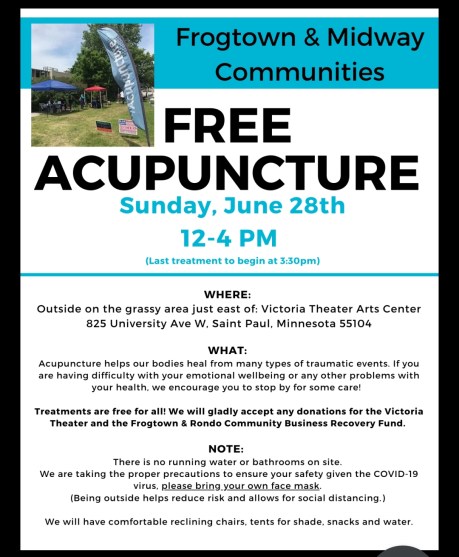
If you need a little of that “Supernatural Aid” or to feel the divine love of the Goddess, get on the mat or the cushion. Take a walk. Sit by the water. Or, check out the free (outdoor) acupuncture happening on Saturday (11 AM – 5 PM, see details here). Either way, I’ll see you when you cross the threshold.
### “I’M A DWELLER ON THE THRESHOLD” (VM) ###
Being Brown May 17, 2020
Posted by ajoyfulpractice in "Impossible" People, Books, Changing Perspectives, Dharma, Gratitude, Healing Stories, Hope, Life, Music, One Hoop, Pain, Suffering, Wisdom, Yoga.Tags: Brown v Board, chitilin' circuit, Club Supreme, desegregation, Dowling Street, Linda Brown, Linda Carol Brown, Perception, perspective, Plessy v Ferguson, SCOTUS, segregation, Supreme Court, The Sportsman, Thurgood Marshall, union, yoga
4 comments
(“Ramadan Mubarak, Blessed Ramadan!” to anyone who is observing Ramadan. I typically talk about Ramadan at the end of the season, so keep your eyes open.)
“I stopped explaining myself when I realized other people only understand from their level of perception.”
– Anonymous
“…we lived in an integrated neighborhood and I had all of these playmates of different nationalities…. I just couldn’t understand what was happening because I was so sure that I was going to go to school with Mona and Guinevere, Wanda, and all of my playmates.”
– Linda Brown, quoted in a “Black/White and Brown” produced by KTWU Channel 11 (May 3, 2004)
For a long time, most of my life, I didn’t get it. How could I get it, as odd as it is to understand, it was outside of my experience.
I am related to some of the smartest people I know –and I know a lot of really smart people. My father has a PhD and taught doctors, his mother was a school teacher, my maternal great-grandmother and both grandmothers taught Sunday school, and my mother worked with doctors and lawyers – so I didn’t get why they made such a big deal about my grades or my education. I appreciated it when my parents arranged things so I could enroll in special programming (like “Research and Development”), but sometimes I kind of took it for granted. Going to a private school, for instance, was just what my brothers and I did sometimes. Granted, one of my brothers ended up in private school after my parents were informed he would be bused to a “Black school” as part of a desegregation plan in the 80’s (which I thought was beyond silly, but I didn’t spend too much time thinking about why the plan existed (in the mid-80’s!!!). I didn’t get it; it was outside of my experience.
My maternal grandfather owned bars in Houston, like the Sportsman, and supper clubs, like The Club Supreme, which was part of the “Chitlin’ Circuit” (venues owned and operated by and for African-American audiences during segregation). I grew up hearing about the great talents he booked and about people like Sammy Davis, Jr., Harry Belafonte, and the Supremes stopping by the house for dinner. Sometimes I would walk into Club Supreme, look down the dark and dusty ballroom to the stage at the back and imagine what it was like in its heyday. When I walked next door to the Sportsman, owners/editors of newspapers, bankers, and business owners seemed to not only know my name, but also my GPA. Sometimes I thought it was weird – especially when they would tell me they were holding a job for me when I graduated from college – but mostly I just thought part of being a grandfather was being proud of your grandchildren; I figured he must talk about me to his customers because that’s what grandfathers did. I didn’t get it; it was outside of my experience.
“I was kind of afraid at first. I didn’t talk about it very much, I guess, because I was afraid it would get back to someone who would make trouble.”
– Linda Brown, age 17, in a 1961 New York Times interview
In May 2004, I finally started to get it. It was the 50th Anniversary of Brown v. Board of Education of Topeka and as people were celebrating, remembering, and producing documentaries, I was doing the math. In doing the math, I finally really understood that Black people not being able to go to the school of their choice wasn’t part of some distant history lesson. It was part of living history – it was part of my family history. The teachers, administrators, farmers, businessmen and businesswomen, police officers, doctors, nurses, insurance agents, authors, truckers, military personnel, farmers, and preachers in my family successfully did what they did – not because they had the economic and educational advantages that they gave me, but in spite of not having what I took for granted. My parents grew up in the South, in the shadow of Brown v Board, in a state where the Attorney General actively worked to keep school segregation legal despite the U. S. Supreme Court’s landmark ruling. The people who worked behind the bar and sat on the barstools at my grandfather’s clubs knew me not because my Paw-Paw was some random grandfather proud of his random grandchildren, but because they all understood what I did not: my brothers, cousins, and I were symbols of progress and change. We were proof that the world – or at least our little corner of the world – was getting better, more equitable and more just.
When my grandfather died, people seemed to come out the woodwork. I kind of expected the elders. What I didn’t expect were the people my age, people who wanted to remember and celebrate a businessman in the community who had financially supported the education of young people in the community. They came to celebrate and remember, because they got it.
“None of us got where we are solely by pulling ourselves up by our bootstraps. We got here because somebody – a parent, a teacher, an Ivy League crony or a few nuns – bent down and helped us pick up our boots.”
– Supreme Court Justice (and former NAACP chief counsel) Thurgood Marshall referencing his SCOTUS successor in a Newsweek interview (dated October 28, 1991)
Linda Brown, the student at the center of Brown v Board, was actually part of three school segregation related lawsuits: the one SCOTUS ruled on today in 1954; Brown II in 1955; and a case filed by the adult Linda Brown in 1978 (Brown III), which was re-opened and appealed through the late 80’s / early 90’s. The first case, officially filed as “Oliver Brown, et al v Board of Education of Topeka, et al,” was a class action lawsuit filed by Thurgood Marshall, the NAACP’s chief counsel, for thirteen parents on behalf of 20 school-aged children. However, the case itself was a test case and symbolic of several cases across the country. The case in Kansas was selected by the NAACP as the pilot case, because it was considered more Midwestern than Southern, the Brown’s neighborhood was desegregated (but the local school was not), and Oliver Brown was selected as the named plaintiff because he was a man. (The idea being that a male plaintiff might be considered more seriously by the courts and the ruling might carry more national weight if inequality could be proven outside of the South.)
While the unanimous 1954 ruling is celebrated as a landmark victory, it was more symbolic than anything else. The Supreme Court first ruled that there was no such thing as “separate, but equal” – at least not as schools existed at that time. Then, in 1955, SCOTUS ordered states to desegregate “with all deliberate speed” – but, here again there was no timetable and the interpretation of the very poetic phrase was left not to the NAACP or the plaintiffs, but to the states.
“It’s disheartening that we are still fighting. But we are dealing with human beings. As long as we are, there will always be those who feel the races should be separate.”
– Linda Brown, in a 1994 New York Times article (around 40th anniversary)
Look around today and you will see the legacy of Brown v Board. There is some positive, some signs of progress; there is also some negative. Were Linda Brown still alive today, she could easily file another lawsuit…on behalf of her grandchildren or even her great-grandchildren. Part of the legacy of Brown v Board is living in the shadow of the Plessy v Ferguson concept of “separate but equal.” We can say it’s the shadow that makes us appreciate the light; but, at some point we need more light.
“I didn’t understand what was happening then, but it was clear that Brown versus Board of Education was a necessary victory. It might have been a little flame, but it served to set off a mighty flame. To me, the impact of Brown is best seen in the increasing numbers of black professionals today. These are the people that, after 1954, were able to have some degree of choice. This surely made a difference in their aspirations and their achievements.”
– Linda Brown, in a April 29, 2004 speech (marking the 50th anniversary) at Chautauqua Institution
Please join me for a 65-minute virtual yoga practice on Zoom today (Sunday, May 17th) at 2:30 PM, to celebrate progress, to remember those who made it possible, and to raise awareness so that we understand what is needed to move forward together. You can use the link from the “Class Schedules” calendar if you run into any problems checking into the class. Today’s playlist is available on YouTube and Spotify.
### NAMASTE ###
An “All Will Be Well” Wednesday May 13, 2020
Posted by ajoyfulpractice in "Impossible" People, Books, Faith, Healing Stories, Health, Hope, Life, Love, Music, Mysticism, One Hoop, Pain, Philosophy, Religion, Suffering, Tragedy, Wisdom, Writing, Yoga.Tags: Contemplate This!, Contemplation, Hope, Julian of Norwich, KISS MY ASANA, Love, Mystic, pandemic, plague, Rev. Dr. Cynthia Bourgeault, Saint Teresa of Ávila
1 comment so far
(“Ramadan Mubarak, Blessed Ramadan!” to anyone who is observing Ramadan. I typically talk about Ramadan at the end of the season, so keep your eyes open.)
“We are kept all as securely in Love in woe as in weal, by the Goodness of God.”
“All shall be well, and all shall be well, and (in) all manner of thing(s) shall be well.”
– from Chapters 1 and 27 Revelations of Divine Love (Revelations of Love in 16 Shewings) by Julian of Norwich
Hurray! It’s finally here; one of my favorite days, devoted to one of my favorite people: the Roman Catholic feast day for St. Julian of Norwich. (Her Lutheran feast day is May 8th.) Julian (which may or may not have been her given name) was a 14th century anchoress who is always going to make my Top 10 list of favorite mystics/contemplatives. Scratch that, she always makes my ever-changing Top 5. Let’s be honest; she’s always in the Top 3. And her life and writing are very relevant – and very similar – to what we are experiencing today.
Julian is noteworthy not only because she is the author of the oldest surviving book written in English by a woman, but also because she lived an extraordinary life – most of it in seclusion. As an anchoress (sometimes referred to as anchorite or anchoret) she withdrew from the secular world, for religious reasons, and spent the majority of her life in a tiny cell in the “corner” of a church in the city of Julian. You can think of her as a hermit-in-place. Taking a vow of stability, as anchoresses did, and even being given a symbolic funeral – as anchorites would be considered “dead to the world” – were very common practice in the Middle Ages. Julian’s experience, however, was a little atypical.
While we typically think of anchorites as living in seclusion, with even more isolation than people who retreat into an abbey or convent, Julian lived in the bustling city of Norwich. As a spiritual counselor and model of devout life, she was permitted to engage with the populace through the window of her cell and provide people with what they needed, whether that be clothing for the poor, spiritual advice, and/or prayers. She could also accept alms, food, and other gifts as she served the community. We have it on great authority that not only did the locals take advantage of Julian’s spiritual guidance, but that she was sought out by mystics and others, like Margery Kempe, who would be remembered in their own right. Additionally, the city of Norwich was full of poverty, famine, social conflict, religious schism, and disease during her lifetime so, we can conclude that, for a hermit, Julian was quite busy.
“These Revelations were shewed to a simple creature unlettered, the year of our Lord 1373, the Thirteenth day of May. Which creature afore desired three gifts of God. The First was mind of His Passion; the Second was bodily sickness in youth, at thirty years of age; the Third was to have of God’s gift three wounds.”
– from Chapter 2 of Revelations of Divine Love (Revelations of Love in 16 Shewings) by Julian of Norwich
At some point in her life, Julian asked God for three gifts. At 30-and-a-half, Julian became so ill that she believed she was going to die. Her conclusion was based, in part, by the fact that in her short lifetime Norwich had experienced the Black Death three times – the first time when she was 6 years old and at one point resulting in the death of a third of the population. Also, she was very, very sick. She was so sick that she was given last rites on May 8, 1373. During these very scary and traumatic moments – moments all believed would be her last – Julian received her three gifts from God: (1) to experience the Passion (“suffering”) and love of Christ; (2) to experience personal suffering/illness in youth; and (3) to receive the spiritual wounds of true contrition, genuine compassion, and a sincere longing for God. She received her gifts in the form of 16 “shewings” and, when she recovered wrote them all down.
“He shewed me a little thing, the quantity of an hazel-nut, in the palm of my hand; and it was as round as a ball. I looked thereupon with eye of my understanding, and thought: What may this be? And it was answered generally thus: It is all that is made. I marvelled how it might last, for methought it might suddenly have fallen to naught for little. And I was answered in my understanding: It lasteth, and ever shall for that God loveth it. And so All-thing hath the Being by the love of God.”
“In this Little Thing I saw three properties. The first is that God made it, the second is that God loveth it, the third, that God keepeth it. But what is to me verily the Maker, the Keeper, and the Lover, — I cannot tell; for till I am Substantially oned to Him, I may never have full rest nor very bliss: that is to say, till I be so fastened to Him, that there is right nought that is made betwixt my God and me.”
– from Chapter 5 of Revelations of Divine Love (Revelations of Love in 16 Shewings) by Julian of Norwich
There are two official copies of Julian’s Revelations of Divine Love (A Revelation of Love in 16 Shewings), a short version (“short text”) and a longer version (“long text”). The Short Text is believed to be the one she initially wrote after her recovery and the Long Text is believed to have been written over time, and with some encouragement. Both versions were copied over time, during Julian’s lifetime, and sometimes given as gifts.
One might expect that Julian’s writings were scary and filled with doom and horror, but they are not. In fact, both versions are full of hope and trust in God’s goodness. Additionally, Julian comes across as intelligent, sensitive, and very much grounded in reality. Even though she includes theological points, like presenting God as Father and Mother, which were not authorized by the Church, Julian was neither sanctioned nor criticized as a heretic. In fact, like Saint Teresa of Ávila, another remarkable Christian mystic who happened to be a woman, Julian was encouraged by the church to write and distribute her work. Both women, within their texts, downplayed their intellect and influence and yet are remembered while some of the religious leaders of their time have been forgotten. Another curious thing to note is that, unlike other scholars and religious authors of the time, Julian wrote in English (not Latin).
“We shall suddenly be taken from all our pain and from all our woe, and of His Goodness we shall come up above, where we shall have our Lord Jesus for our meed and be fulfilled with joy and bliss in Heaven.”
“I saw that God rejoiceth that He is our Father, and God rejoiceth that He is our Mother, and God rejoiceth that He is our Very Spouse and our soul is His loved Wife. And Christ rejoiceth that He is our Brother, and Jesus rejoiceth that He is our Saviour. These are five high joys, as I understand, in which He willeth that we enjoy; Him praising, Him thanking, Him loving, Him endlessly blessing.”
– from Chapters 1 and 52 of Revelations of Divine Love (Revelations of Love in 16 Shewings) by Julian of Norwich
Over the years, my friend Lori and I have discussed Julian and her work, and the circumstances within which she worked her spiritual magic. We have, over the years, craved the ability to retreat while simultaneously still serving a purpose in the world. We have also, over the years, wondered at the mindset and fortitude required to not only ask for the gifts Julian requested, but also to receive them and utilize them as she did. This, to paraphrase the Rev. Dr. Cynthia Bourgeault (a modern day contemplative and mystic), is not for sissies.
Now, here we are, and Lori and I recently discussed – via the wonders of technology – that we are all experiencing some of Julian’s circumstances. The whole world is experiencing some of Julian’s circumstances and, while we may not request or even want her gifts, we can definitely appreciate her lessons and what they have to teach us. Regardless of our spirituality or religiosity, we can definitely benefit from her “shewings” of divine love.
“It is thus logical that God, being our Father, be also our Mother. Our Father desires, our Mother operates and our good Lord the Holy Ghost confirms; we are thus well advised to love our God through whom we have our being, to thank him reverently and to praise him for having created us and to pray fervently to our Mother, so as to obtain mercy and compassion, and to pray to our Lord, the Holy Ghost, to obtain help and grace.
I then saw with complete certainty that God, before creating us, loved us, and His love never lessened and never will. In this love he accomplished all his works, and in this love he oriented all things to our good and in this love our life is eternal.
With creation we started but the love with which he created us was in Him from the very beginning and in this love is our beginning.”
– from Chapter 59 of Revelations of Divine Love (Revelations of Love in 16 Shewings) by Julian of Norwich
Please join me today (Wednesday, May 13th) at 4:30 PM or 7:15 PM, if you are interested in seeing what may be “shewn.” Use the link from the “Class Schedules” calendar if you run into any problems checking into the class. You will need to register for the 7:15 PM class if you have not already done so. Wednesday’s playlist is available on YouTube and Spotify.
Kiss My Asana, the yogathon that benefits Mind Body Solutions and their adaptive yoga program is officially over. But, I still owe you two posts and you can still do yoga, share yoga, help others by donating to my KMA campaign through May 15th.
You can also check out the all-humanity, Kick-Off gathering featuring insights from MBS founder Matthew Sanford, conversation with MBS students, and a mind-body practice for all. If you’re not familiar with MBS, this will give you a glimpse into the work, the people, and the humanity of the adaptive yoga program which I am helping to raise $50K of essential support.
### SHEW ME THE LOVE! (BUT SHOW IT GENTLY) ###
[Love] Letter to the World May 11, 2020
Posted by ajoyfulpractice in Art, Books, Buddhism, Changing Perspectives, Dharma, Gratitude, Healing Stories, Hope, Life, Love, Music, One Hoop, Pain, Philosophy, Suffering, Wisdom, Yoga.Tags: Agnes de Mille, Buddhism, Charity, compassion, Dana, Denishawn, Diamond Sutra, Doris Humphrey, Emily Dickinson, Genorosity, Graham Technique, Gregory Peck, inspiration, James Grissom, Karuna, KISS MY ASANA, Life, Martha Graham, Matthew Sanford, Ruth St Denis, Tom Waits, Wang Jie, Wassily Kandinsky
4 comments
(“Ramadan Mubarak, Blessed Ramadan!” to anyone who is observing Ramadan. I typically talk about Ramadan at the end of the season, so keep your eyes open.)
“Furthermore, Subhūti, in the practice of compassion and charity a disciple should be detached. That is to say, he should practice compassion and charity without regard to appearances, without regard to form, without regard to sound, smell, taste, touch, or any quality of any kind. Subhuti, this is how the disciple should practice compassion and charity. Why? Because practicing compassion and charity without attachment is the way to reaching the Highest Perfect Wisdom, it is the way to becoming a living Buddha.”
– The Diamond Sutra (4)
“By this name it shall be revered and studied and observed. What does this name mean? It means that when the Buddha named it, he did not have in mind any definite or arbitrary conception, and so named it. This Sutra is hard and sharp, like a diamond that will cut away all arbitrary conceptions and bring one to the other shore of Enlightenment.”
– The Diamond Sutra (13)
I have heard that the oldest (surviving) book with a printed date is a Chinese copy of The Diamond That Cuts Through Illusion, a sacred Buddhist text commonly known as The Diamond Sutra. It was translated from Sanskrit and printed today (May 11th) in 868 A. D. on a 17-and-a-half-foot-long grey scroll using a block printer commissioned by one Wang Jie. A handwritten note along the lower right hand side of the scroll indicates that it was “Reverently made for universal free distribution by Wand Jie on behalf of his two parents.” The text itself indicates that there is great merit in being a “person who simply observed and studied this Sutra and, out of kindness, explained it to others.” (DS 24)
While the merit is great even if a person only understands and explains “four lines of this Sutra” (DS 8 & 12), it is a relatively accessible and short text, at about 6,000 words. The Diamond Sutra consists of a conversation between the Buddha and his pupil Subhūti, during which there is a continuous emphasis on the temporal and illusory nature of all things – including the teachings within the text! Despite the temporal and illusory nature of all things (including the teachings within the text) – or maybe because of it – there is great wisdom here. Wisdom that is summed up in the Tom Waits song “Diamond in Your Mind:” always keep a diamond in your mind (no matter the situation or circumstance).
This text can be studied and explained, out of kindness, with dialogue similar to the Buddha and Subhūti’s conversation. It can be explored through a deep seated mediation. Or, it can be studied, explained, and explored through a little movement – maybe even a little heart-centered dance.
“They say that dance and architecture are the two primary arts. That means that you have to have the gesture, the effort – the real effort – to communicate with another being and you must also have a tree to shelter under in case of storm or sun.”
– Martha Graham on Technique
“To walk out of one’s door each morning requires that you believe you are needed beyond your four walls and can offer something. To be grateful for the opportunity to simply walk out and live a life offers blessings and insight.”
– Martha Graham in 1990 telephone and in-person interviews with James Grissom
Martha Graham, born today (May 11th) in 1894 was a revolutionary dancer and choreographer, whose passion was partially inspired by her father’s work as a doctor, who used movement as a treatment for nervous disorders, and the art of Russian abstract artist Wassily Kandinsky. Her greatest influence, however, was the work of Ruth St. Denis and Ted Shawn. Graham once said, “Everything I did was influenced by Denishawn.” And, like St. Denis, Graham would go on to leave an indelible mark not only on dance, but also on music, theatre, and performance art.
Graham developed a technique based on the importance of breathing and movement that was, she said, “fraught with inner meaning, with excitement and surge.” The Graham Technique is based on the idea of “contraction and release” (which is one way to describe the body’s natural response to breathing); combined with “spiraling” (diagonally positioning parts of the body, via a 45⁰ rotation of the spine, that is reminiscent of Kandinsky’s paintings) and Doris Humphrey’s “fall and recovery” (Humphrey’s principle regarding an individual’s constant engagement with gravity, as well as the life-death experience of living). Even though a Graham dancer’s hands and feet can have specific placement, the movement of the arms and legs (as well as the hands and feet) begins in the core, with awareness of the heart.
“The palm of the hand should be forward, and straight out (in) the audience. I give you myself, I give you what I have to give; that’s what it really means.”
– Martha Graham instructing dancers during rehearsal
“When I was young I studied with Martha Graham; not to learn to dance, but to learn to move on the stage. If Martha Graham could have had her way, she would have taught us all how to move – through life. That has been and will be her goal: proper movement through life, the relationship of the body to the mind and the body to the spirit. Martha Graham is a compulsive student of the human heart.”
–actor Gregory Peck on Martha Graham (in a documentary)
The mind needs what it needs to understand something, even ourselves, until it no longer needs a reference point. (People who attended Saturday’s practice will notice a theme here.) The Diamond Sutra tells us that the concepts of a self or no-self, as well as the ideas that all beings are separated or connected, are such reference points. They are used in the text “the way that a raft is used to cross the river. Once the river has been crossed over, the raft is of no more use, and should be discarded.” (DS 6) Martha Graham used dance as a bridge – a way to express life experiences and emotions, as they were simultaneously shared and unique. Here, with the bridge as well as with the raft, there is the opportunity to go back and forth until you have what you need to live nobly through this thing we call life.
“Each one of us has all of life in us. And it is our choice to decide what we will reveal…. How many drops of blood have gone into the making of you? How much memory is in that drop of blood?”
– Martha Graham on life, living, and dancing
“Art is memory. It is the excavation of so many memories we have had–of our mothers, our best and worst moments, of glorious experiences we have had with friends or films or music or dance or a lovely afternoon on a sloping, green hill. All of this enters us and, if we are artists, must be shared, handed over to others. This is why it is so important to know what came before you. It is also important to understand that things will follow you, and they may come along and make your work look pedestrian and silly. This is fine; this is progress. We have to work with what life presents to us, and we have to work as well as we can while we can”
– Martha Graham in a 1990 telephone interview with James Grissom
Please join me for Graham-Diamond-Sutra inspired virtual yoga practice on Zoom today (Monday, May 11th) at 5:30 PM. This is a 75-minute Common Ground Meditation Center practice that, in the spirit of generosity (dana), is freely given and freely received. You can use the link from the “Class Schedules” calendar if you run into any problems checking into the class. If you are able to support the center and its teachings, please do so as your heart moves you. (NOTE: You can donate even if you are “attending” my other practices, or you can purchase class(es). Donations are tax deductible, class purchases are not necessarily.)
There is no playlist for the Common Ground practices (however, today, I do offer additional inspiration).
Kiss My Asana, the yogathon that benefits Mind Body Solutions and their adaptive yoga program is officially over. But, I still owe you two posts and you can still do yoga, share yoga, help others by donating to my KMA campaign through May 15th.
You can also check out the all-humanity, Kick-Off gathering featuring insights from MBS founder Matthew Sanford, conversation with MBS students, and a mind-body practice for all. This practice is all about the compassion the Buddha speaks of in The Diamond Sutra and includes a focus on spinal breathing that would make Martha Graham dance. If you’re not familiar with MBS, this will give you a glimpse into the work, the people, and the humanity of the adaptive yoga program which I am helping to raise $50K of essential support.
 A Joyful Practice