Passion & Salt on a Monday April 6, 2020
Posted by ajoyfulpractice in 7-Day Challenge, Abhyasa, Bhakti, Buddhism, Changing Perspectives, Confessions, Dharma, Donate, Faith, Fitness, Food, Gratitude, Healing Stories, Health, Hope, Japa, Japa-Ajapa, Karma Yoga, Lent / Great Lent, Meditation, Minneapolis, Minnesota, Music, Pain, Peace, Philosophy, Poetry, Religion, Suffering, Texas, Twin Cities, Wisdom, Writing.Tags: asana, detox flow, hatha yoga, Holy Monday, KISS MY ASANA, lymph, Matthew Sanford, Passion Monday, yoga
2 comments
“Sometimes, however, we do things – or don’t do things – that sap our energy and drag us down. If our mind-bodies are temples, then the things that sap our energy are like thieves in the temple. Thieves can be eating the wrong foods; drinking too much of the wrong beverages and/or not drinking enough water; not resting; not exercising; partaking in illicit drugs; not managing stress; and/or being surrounded by negative opinions. Doesn’t matter what they are though, because at some point we have to throw the thieves out of the temple in order to restore the temple to its original purpose.”
– me, blogging about Passion/Holy Monday in 2019
Sometimes I feel like the embodiment of an Adam Ant song: “Don’t drink, don’t smoke, what do you do?” Well, I do a lot of yoga. That doesn’t mean, however, that I don’t have my vices. I have a bit of a sweet tooth (cue the laughter from my friends) and while I endeavor to stick to really good quality chocolate, or pastries without a lot of preservatives, I have been known – not often, but occasionally – to grab what’s handy. And then, the suffering ensues. Because, as much as I love it, processed sugar is not our friend and when you mix it with a bunch of additives it might as well be one of the deadlier vices.
Years ago, on one of my busiest days, I was feeling lethargic, hungry, and a little spacey, but I still had one more class to teach. Rather than choose wisely and do something I knew would be helpful, but would take a bit of time, I went for the quick fix: chocolate, but not the good kind. One of the lifeguards at the Blaisdell Y saw me pull my poor choice out of the vending machine and asked if my students knew I ate stuff like that. I shrugged and said I was only going to eat half. Needless to say, I ate it all. While I felt “better” in the short term, the next morning I woke up feeling awful. I felt like I had thieves in my personal temple.
“And Jesus went into the temple of God, and cast out all them that sold and bought in the temple, and overthrew the tables of the moneychangers, and the seats of them that sold doves,” (Matthew 21:12 KJV)
“And said unto them, It is written, My house shall be called the house of prayer; but ye have made it a den of thieves.” (Matthew 21:13 KJV)
– The Gospel According to Matthew
When we don’t treat our mind-bodies as respected temples, we suffer and are sometimes not able to do the things we need and want to do. Even if you’re getting some exercise, resting, and drinking a lot of water, the very nature of our current world quarantine is full of all the things that get us out of balance: extra sitting around, lack of routine, poor eating choices, stress, and isolation. When we get out of balance, we need more of something to get back into balance. Sometimes we need more rest, sometimes more water, sometimes more movement.
I will often refer to the fact that our bodies are mostly water as a reason why movement feels good. We are meant to flow and slosh all that salty water around a little. It’s a great visual, and it’s true on a certain level; however, there are even more scientific reasons why it’s good to stay active. One of those reasons is our lymphatic system.
The lymphatic system is a vital part of our immune system. It helps keep us healthy by providing proteins and other nutrients to healthy cells, while simultaneously brushing away dead, damaged, and infected cells. It also maintains the balance of fluid between the blood and tissues, as well as aiding in the absorption of fats and fat-soluble nutrients. Unlike the cardiovascular system, however, the lymphatic system does not have its own pump. If we want lymph to bring nutrients to healthy cells and also brush/rinse away dead or damaged cells, we have to move our bodies. Any kind of movement is helpful, especially if it engages the whole body. Most physical practices of yoga engage and move your whole body in a very systematic way. So, you could say that the physical practice of yoga almost always has an element of detoxification. There are, however, certain poses and sequences that are considered detoxifying in nature.
Today, Monday, April 6th, is Passion Monday or Holy Monday in the Roman Catholic and Western Christian traditions. It is the last Monday of Lent, which is a period of fasting and prayer within the aforementioned traditions. Part of the Passion Week or Holy Week observation is to remember the stories and parables associated with the last week of Jesus’ life. The story I most closely associate with this day is the story of Jesus throwing the thieves out of the temple and then having his authority questioned.
Lent and Easter are movable feasts, meaning Passion Monday does not always fall on April 6th as it does this year. April 6th is the anniversary of the end of Mahatma Gandhi’s Salt Satyagraha, a 24-day march to protest the British Salt Tax. On that Sunday morning in 1930, Gandhi prayed, raised a handful of salty mud and proceeded to break the law. He said, “With this, I am shaking the foundations of the British Empire” – which, according to the Gospels, is pretty much what Jesus did when he returned home for Passover and found the temple all awry.
If you are available and interested in a little detox flow and storytelling, please join me for the Common Ground Meditation Center yoga practice on Zoom, today (Monday, April 6th) at 5:30 PM – 7:45 PM.
As Zoom has changed some security protocols, please use the link (here) or on the “Class Schedules” calendar if you encounter any access problems. During this quarantine experience, you can make a donation through Common Ground Meditation Center, which operates on dana/generosity, or you can purchase a package on my Squarespace. Either option can be applied to any class. If you are worried about finances, do not add this to your worry list – I got you, just come to the virtual practice.
There is no music for this practice. However, I have included a couple of songs from my Passion Monday playlist and my April 6th playlist, which you will find below the Kiss My Asana highlights. That’s right; Kiss My Asana, the yogathon that benefits Mind Body Solutions and their adaptive yoga program is coming at the end of this month. Consider all the information above about the importance of movement and then consider the challenges to staying healthy when your ability to move requires the assistance of other people.
Founded by Matthew Sanford, Mind Body Solutions helps those who have experienced trauma, loss, and disability find new ways to live by integrating both mind and body. They provide classes, workshops, and outreach programs. They also train yoga teachers and offer highly specialized training for health care professionals. This year’s yogathon is only a week long. Seven days, at the end of the month, to do yoga, share yoga, and help others. By participating in the Kiss My Asana yogathon you join a global movement, but in a personal way. In other words, you practice yoga… for 7 days.
Are you ready to move?
You don’t need to wait until the end of the month, however, to consider how you might participate. Start thinking now about how you can add 5 minutes of yoga (or meditation) to your day, how you can learn something new about your practice, or even how you would teach a pose to someone close to you – or even to one of your Master Teachers/Precious Jewels.
To give you some ideas, consider that in past years my KMA offerings have included donation-based classes and (sometimes) daily postings. Check out one of my previous offerings dated April 5th (or thereabouts):
30 Poses in 30 Days (scroll down to see April 6th)
A Musical Preview (scroll down to see March 6th)
A Preview of the April 6th Practice OR (A Preview of the 2019 Passion Monday Practice)
Music for a Passion Monday practice
Music for a Salt Satyagraha practice
### OM OM AUM ###
It’s a Kiss My Asana “Throwback Thursday” April 2, 2020
Posted by ajoyfulpractice in 7-Day Challenge, Bhakti, Books, Changing Perspectives, Dharma, Donate, Faith, Fitness, Gratitude, Healing Stories, Health, Hope, Karma Yoga, Loss, Meditation, Minneapolis, Minnesota, Music, One Hoop, Pain, Poetry, Suffering, Traditional Chinese Medicine, Tragedy, Twin Cities, Wisdom.Tags: adaptive yoga, children's books, Hans Christian Andersen, hatha yoga, Healing Stories, inspiration, Iyengar, KISS MY ASANA, Rumi
2 comments
“The rest of the dojo’s floor is covered with a hard white mat. No shoes, let alone wheels, traverse this ground. This is a place where bodies tumble and twist and fall. A martial art is practiced here, and its imprint is tangible felt.
But now there is another problem. ‘Can you get down on the mat?’ Jo asks.
I pause with uncertainty. I didn’t expect to be separated from my wheelchair so quickly. ‘I can get down, but who knows about up.’
She nods and smiles. ‘Obviously, there is plenty of help around.’”
– from Waking by Matthew Sanford
Consider what your yoga practice means to you at this moment. Consider how you would experience, how you would cope, with all the changes we are experiencing, if you didn’t have a practice. Now consider what if would be like if part of your practice relied on the facilitation of other people. Many people who experienced trauma, loss, and disability – long before our current shared experience of trauma, loss, and disability – may be experiencing an interruption in their regular practice not only because brick and mortar studios are closed, but also because their practice includes being touched by other people.
Founded by Matthew Sanford, Mind Body Solutions helps those who have experienced trauma, loss, and disability find new ways to live by integrating both mind and body. They provide classes, workshops, and outreach programs. They also train yoga teachers and offer highly specialized training for health care professionals.
Kiss My Asana is an annual yogathon, to raise awareness and resources for Mind Body Solutions and their adaptive yoga program. This year’s yogathon is only a week long. Seven days, at the end of the month, to do yoga, share yoga, and help others. By participating in the Kiss My Asana yogathon you join a global movement, but in a personal way. In other words, you practice yoga… for 7 days.
We can do this, right?
You don’t need to wait until the end of the month, however, to consider how you might participate. Start thinking now about how you can add 5 minutes of yoga (or meditation) to your day, how you can learn something new about your practice, or even how you would teach a pose to someone close to you – or even to one of your Master Teachers/Precious Jewels.
To give you some ideas, consider that in past years my KMA offerings have included donation-based classes and (sometimes) daily postings. Since it’s “Throwback Thursday,” check out one of my previous offerings dated April 2nd (or thereabouts):
- 30 Poses in 30 Days (scroll down to see April 1st and 2nd)
- A Musical Preview (scroll down to see March 1st and 2nd)
- A 5-Minute Practice
- 5 Questions Answered by Yogis
- Answers to Yogis Questions
- A Poetry Practice
- A Preview of the April 2nd Practice
My next virtual practice is on Saturday. Use the same Meeting ID as last week’s class or, if you were unable to attend last week, check out the “Class Schedules” tab. You’ll find access details in the calendar description for Saturday, April 4th. I’ll post the playlists by Saturday morning.
Also, if you are interested in YIN Yoga, plan to join me and a special guest on Wednesday (April 8th) for a special webinar/mini-practice at 3 PM. Details to be announced.
### PUCKER UP, PEOPLE! ###
It’s April, ya’ll! You know what that means… April 1, 2020
Posted by ajoyfulpractice in 7-Day Challenge, Abhyasa, Baseball, Books, Changing Perspectives, Donate, Faith, Fitness, Healing Stories, Karma Yoga, Loss, Minneapolis, Minnesota, Music, Philosophy, Poetry, Twin Cities, Vairagya, Writing, Yoga.Tags: adaptive yoga, hatha yoga, inspiration, KISS MY ASANA, Mind Body Solutions, truth, yoga
2 comments
“Whan that Aprill, with his shoures soote
The droghte of March hath perced to the roote
And bathed every veyne in swich licour,
Of which vertu engendred is the flour;”
– from Geoffrey Chaucer’s The Canterbury Tales -“The General Prologue” (1387 – 1400)
“wéete April showers,
Doo spring Maie flowers.”
– from Thomas Tusser’s Five Hundred Points of Good Husbandry (published in 1610, as an expansion of Tussler’s A Hundreth Points of Good Husbandrie , published 1557)
April doesn’t just bring showers (or, sometimes, snow in Minnesota – I see you Prince fans), it also brings poetry and an opportunity to Kiss My Asana. Since 1996, April has been National Poetry Month, an opportunity to read, write, and share poetry. I general observe the month by sharing at least one “April is Poetry Month” practice with each of my classes. One year, for Kiss My Asana, I also posted poetry-centered practices on this blog.
For most of the last decade, the Kiss My Asana yogathon was held in April. (One year, KMA occurred in February.) This is an annual yogathon which raises resources and awareness for Mind Body Solutions and their adaptive yoga program. Founded by Matthew Sanford, Mind Body Solutions helps those who have experienced trauma, loss, and disability find new ways to live by integrating both mind and body. They provide classes, workshops, and outreach programs. They also train yoga teachers and offer highly specialized training for health care professionals. By participating in the Kiss My Asana yogathon you join a global movement, but in a personal way. In other words, you practice yoga. Or, as we say during Kiss My Asana, do yoga. share yoga. help others.
April is usually the only time that I regularly blog, because daily blog posts have, historically, been part of the way I participate in the yogathon. In addition to the poetry-centered practices, I’ve posted 5-minute practices, a musical preview, interviews with my fellow yogis, answered questions from my fellow yogis, and previewed daily practice themes. I’ve also offer 1 or 2 donation-based classes each year. I don’t always make it all the way to the end of the month when it comes to the blog; however, thanks to your generosity, I usually meet my fundraising and participation goals.
This year, Kiss My Asana is a little different – and not just because we are practicing social distancing. At some point last year, as Matthew Sanford and the other Mind Body Solutions teachers started organizing the 2020 yogathon, they decided to only ask people to commit to a week: 7 days of doing yoga, sharing yoga, and helping others.
We can do that, right?
The 2020 Kiss My Asana Yogathon begins with a virtual “all humanity” kick-off class on April 25th. The yogathon will run through May 2nd. Keep your eyes here to find out how to participate on my team and what special offerings are coming your way. In the meantime, you can click on the highlighted items listed above to explore my past offerings.
I’m offering two (2) classes on Wednesdays (listed below). You can access either of today’s practices live via the ZOOM app, your internet browser, or your telephone. (For additional details, check the “class schedule” tab.) The playlist is available on Spotify and YouTube.
The Nokomis class (@ 4:30 PM) is an open-level vinyasa practices using vinyasa karma, which means we will move with the breath and progress in intensity as we make our way to a final and/or peak pose. All are welcome!
The Meeting ID for Wednesdays at Nokomis, 4:30 PM – 5:30 PM CST, is 549-044-593, https://zoom.us/j/549-044-593 ONE TAP: +13126266799,,549-044-593# US (Chicago).
The Flourish class (Wednesdays at 7:15 PM – 8:30 PM) is a “Slow Flow,” with the same elements found in the open-level vinyasa practice. This class requires registration, but all are welcome. (You only need to register once.)
Here’s last year’s KMA “preview” of today’s class. It’s a baseball classic!
### do yoga. share yoga. help others. ###
What Are You Doing (or Not Doing)? March 31, 2020
Posted by ajoyfulpractice in Abhyasa, Books, Changing Perspectives, Confessions, Dharma, Faith, Fitness, Gratitude, Healing Stories, Life, Meditation, One Hoop, Peace, Philosophy, Vairagya, Wisdom, Yoga.Tags: asana, Ashtanga, B.K.S. Iyengar, Beginner's Mind, beginners, Bryan Kest, Dharma Mittra, yoga
1 comment so far
“In the beginner’s mind there are many possibilities, in the expert’s mind there are few.”
– from Zen Mind, Beginner’s Mind by Shunryū Suzuki
At some point, we are all beginners, doing something for the first time… or the 51st time. That’s why, on a good day, I love beginners – and I’m always a fan of the wonder that comes with beginner’s mind. Ironically (to some), I am not a fan of beginner’s classes when it comes to yoga. Unless, of course, you consider every class a beginner class, and remember that there’s a reason it’s called a practice. That said, I believe beginners should respect the fact that if someone says a class or a pose is advanced then it is not something you do on your first day…or your 51st day. But, just because a particular class or pose is not intended for someone, doesn’t mean that person can’t practice yoga.
During a practice Bryan Kest said that if there are 60 million people on the planet doing yoga then there are at least 60 million different ways to do a pose. That’s the reason there are different styles and traditions.
“Every age.
Every race & ethnicity.
Every class & socioeconomic status.
Every gender identity & sexual orientation.
Every size, shape, height, weight & dis/ability.Every body is a yoga body.”
– statement from the Yoga and Body Image Coalition
One of my favorite t-shirts (“This is what a yogi looks like”) came from the Yoga and Body Image Coalition, which “is committed to dismantling stereotypes about who practices yoga, who should practice yoga, + what a “yoga body” looks like.” Bottom line: the coalition was established to create awareness so that (a) yoga teachers like me do not have to constantly deal with people walking in the studio and playing some version of the “Oh, you’re the teacher?” game; (b) people can practice yoga anywhere without judgment (or expensive yoga pants that let other people see your expensive underwear); and (c) so that more people recognize that they too can practice – and even teach – yoga.
Historically, yoga was primarily a practice taught for and by men. That’s not to say that women didn’t practice, secretly and quietly, but in the public sphere it was a practice taught for and by men…brown-skinned men, who (early on) often engaged in an ascetic lifestyle. Indra Devi started to change that, but the idea that someone who practices yoga is a thin, very flexible, light-skinned woman with “shampoo commercial” hair and a disposable income is very much a modern stereotype. Not only is it a modern stereotype – it’s a Western stereotype – one around which a whole industry has grown. And that underlying concept is one of the things that can make it challenging for new people to get started in the practice; that, plus the idea that you have to be flexible to practice yoga.
I tell people all the time: most people don’t practice yoga because they are flexible; they are flexible because they practice yoga. Focusing on physical flexibility, however, ignores the fact that the physical practice is also a way to cultivate strength and balance (even flexibility) – in the mind as well as in the body. But, sticking with the body for a moment, consider for a moment that while every pose may not be for each and every body, there is a practice for everybody and a way to practice that allows you to experience the benefits of every pose (even if you have to modify).
Late in 1983, Sri Dharma Mittra, a master yoga teacher based in New York City, started a deep dive into his practice and then started photographing himself every morning. Those 72 photos-a-day eventually became an amazingly iconic illustration of 908 yoga asanas. If you look closely, you can tell that the pictures were not taken at the same time, because in some pictures he is a completely different weight than in others. Like a method actor preparing for a major role, Dharma Mittra reportedly gained, lost, or maintained weight in order to practice certain poses. Because, again, each and every pose is not for each and every body. To force yourself into a position for which the body is not prepared to go isn’t yoga, its torture (and detrimental to your well-being). It is also detrimental to ignore what your body is feeling. One of the big problems with our modern practice, however, is that we are not always reminded to trust what we are feeling.
There is a lot of reasons we don’t trust the way we feel, on and off the mat. On the mat, one of the big reasons we don’t trust ourselves is because we are often faced with the idea that there are beginner, intermediate, and advanced poses. It’s all a matter ratings and perceptions. Grab practice manuals from a variety of different styles, however, and you will find huge differences in how a single pose is ranked according to difficulty. If you want to add a layer of awareness to that, compare those ratings to your own perception of the pose.
For example, in the United States, a common way to test or think about flexibility resides in a person’s ability to touch their toes. Uttānāsana (a standing forward bend) and Paschimottānāsana (a seated forward bend) are often featured in a beginners’ class. In Light on Yoga (Iyengar), however, the standing forward fold is considered an 8, the seated version is considered a 6, and the supine version (which I often suggest as a modification for people with certain back issues) is considered a 10. In Jivamukti Yoga, which is a form of vinayasa, the standing variation is considered a 1, while the seated is considered a 2. On the flip side, in Ashtanga, which is a progressive practice and one of the first vinyasa poses introduced to the West, the standing variation appears at the very beginning of the practice (it is part of the warm-up), while the seated variation is considered part of the finishing sequence (ergo, practiced after the body is significantly warmed up). Now compare those ratings to your own perception, and maybe even your own experience.
What’s the difference? How you practice – and part of how you practice is what you do and what you don’t do as you practice.
Today in 1930, the Motion Picture Code, also known as the Hays Code, was adopted by Hollywood. Inspired by a document created by a lay Catholic and Jesuit priest, Hollywood censor Will Hays initially came up with a list of 36 “Don’ts” and “Be Carefuls.” The code was officially enforced from1934 until 1968, when it was replaced by the Motion Picture Association of America rating system that is still in place today. Today’s practice is inspired by this concept of ratings. While today’s playlist (available on Spotify and YouTube) is not full of soundtracks, it is cinematic.
My advice to beginners is my same advice to people who have been away from their practice for a while and/or people who have to come up with a new practice schedule:
- Respect yourself and the space. Again, if someone refers to their class as advanced, believe them. (To paraphrase Maya Angelou, if someone tells you what they are about, believe them the first time.)
- Find a time and place (when we are able to go out and about again) that is convenient so that you commit to your practice.
- Don’t worry about what we call the poses; pretend like you’re playing Simon Says, but…
- Listen to your body!!!! If your body says don’t do it, then Simon didn’t say it. Some things will be uncomfortable, but don’t ignore pain. Pain is your body telling you something is not right.
- If you can breathe, even with a machine, you can practice yoga.
- Ask questions. Question everything. If you can’t do it during the practice, talk to the teacher before or after the practice. There’s no shame in not knowing something you don’t know.
- Trust your practice. Even if it’s your first day, take a moment to breathe and remember the words of Saint Teresa of Avila…
“If you want to make progress on the path and ascend to the places you have longed for, the important thing is not to think much but to love much, and so to do whatever best awakens you to love.”
– from The Interior Castle by Saint Teresa of Avila
I’m offering two (2) classes on Tuesdays. These are open-level vinyasa practices using vinyasa karma, which means we will move with the breath and progress in intensity as we make our way to a final and/or peak pose. All are welcome!
You can access either of today’s practices live via the ZOOM app, your internet browser, or your telephone. (For additional details, check the “class schedule” tab.)
The Meeting ID for Tuesdays, 12 Noon – 1:00 PM CST is 610-189-542, https://zoom.us/j/610-189-542 ONE TAP: +13126266799,,610-189-542# US (Chicago).
The Meeting ID for Tuesdays, 7:15 PM – 8:30 PM CST is 216-720-410, https://zoom.us/j/216-720-410 ONE TAP: +13126266799,,216720410# US (Chicago)
Also, Wednesday is the beginning of April, which means Kiss My Asana is coming to you! Keep an eye out for how this year’s yogathon has changed, and how it’s still all about keeping the practice accessible.
### INHALE, EXHALE ###
Meditation Monday March 30, 2020
Posted by ajoyfulpractice in Books, Buddhism, Changing Perspectives, Depression, Dharma, Faith, Fitness, Gratitude, Healing Stories, Health, Hope, Karma, Life, Loss, Love, Meditation, Minneapolis, Minnesota, Movies, Music, Mysticism, Pain, Peace, Philosophy, Poetry, Suffering, Texas, Traditional Chinese Medicine, Tragedy, Twin Cities, Wisdom, Writing.Tags: anesthesia, Celine Dion, Dr. Crawford M. Long, Eric Clapton, Guns N' Roses, inspiration, loving-kindness, meditation, Meditation Monday, National Doctors Day, Norah Jones, Pete Remm, The Mourning Bride, Tracy Chapman, vinyasa, William Congreve, Yin Yoga, yoga
2 comments
“Musick has Charms to sooth a savage Breast,
To soften Rocks, or bend a knotted Oak.
I’ve read, that things inanimate have mov’d,
And, as with living Souls, have been inform’d,
By Magick Numbers and persuasive Sound.
What then am I? Am I more senseless grown
Than Trees, or Flint? O force of constant Woe!
‘Tis not in Harmony to calm my Griefs.”
– the opening line of The Mourning Bride (Act I, scene i), by William Congreve
Right about now, one of the most misquoted (and misattributed) lines in the history of live theatre*, has several people thinking I am not getting enough sleep (because clearly I didn’t type that quote correctly). But, when Almeria (daughter of the King of Granada) spoke the opening line of The Mourning Bride back in February or March 1697, no one anticipated confusion about the first line – they were anticipating laughter. Playwright and poet William Congreve was known for brilliantly engaging, high-brow, sexual comedy of manners with satirical dialogue (and sometimes mistaken identities). The idea that inanimate objects could be moved (or animated) by music while a woman in grief would be stuck with her emotions, could be played for laughs – and Congreve even follows the idea up with the suggestion that Almeria is being melodramatic – then, however, there is a turn in events and the audience is made aware that her emotions are very real, very valid, and very hard to endure (because she can’t change the events that led to the emotions).
We’ve all been there. In times like these, we find ourselves there again and again: stricken by very real, very valid, and very hard to endure emotions. We may have the desire to run from those emotions, maybe even to keep busy so that we don’t have to feel much or deal with the emotions. However, escapism only works for so long. And, it can be nearly impossible as people all over the world are social distancing and self quarantining. Rather than making it harder, consider settling in for a moment – just a moment – and breathe. You can do that 90-second thing. Notice how you’re feeling, how the emotion feels in your body. Notice what happens if instead of building a story around it – or running from it – you stay still, breathe, notice what changes and how it changes.
Yoga Sutra 1.2: yogaścittavŗttinirodaha
– “Yoga (or union) ceases the fluctuations of the mind”
I think of Mondays as Meditation Monday, because for several years now, I have led a YIN Yoga practice (which is very meditative in quality) followed by a vinyasa practice at Common Ground Meditation Center. The vinyasa practice is followed by Buddhist Studies and so I am constantly aware that many people in the group are using their physical practice (hatha yoga) as it was classically intended: as preparation for deep seated meditation. The movement in the physical practice not only helps to strengthen and relax the body, it also helps to strengthen and relax the mind, thereby enabling the mind to do one of the things it is made to do: focus-concentrate-meditate.
Patanjali begins the Yoga Sutras with the Chapter (or Foundation) on Concentration, in which he outlines several different concentration/mediation techniques. These include (but are not limited to):
- focusing on the breath {YS 1.35};
- focusing on the sensations being experienced by the body-mind (smell, taste, form, touch, and sound) {YS 1.35};
- focusing on any sense of lightness or joy one may be experiencing {YS 1.36};
- focusing on whatever “well-considered object” brings peace and ease {YS 1.39}
All of these techniques are intended to cultivate transparency in the mind, as well as clarity and ease in the body.
The second chapter of the Yoga Sutras in some ways acknowledges that not everyone can just drop down into a seated meditation for hours on end. Many people – most people even – need a little preparation. So, Patanjali then focuses on preparation (this is the practice). Along the way, he explains that when there is no clarity, peace, joy, and kindness in the mind-body we create more suffering, for ourselves and others – in this lifetime, and the next.
Yoga Sutra 2.13: sati mūle tadvipāko jātyāyurbhogāh
– “As long as the root cause exists [ignorance/lack of knowledge, false sense of self,-identity, attachment, aversion, and fear of loss/death]karma must bear fruit, such as birth in a particular species, life span, and life experience. ”
“Yes, thou shalt know, spite of thy past Distress,
And all those Ills which thou so long hast mourn’d;
Heav’n has no Rage, like Love to Hatred turn’d,
Nor Hell a Fury, like a Woman scorn’d.”
– Zara (the Moor princess or queen) in The Mourning Bride (Act III, scene ii), by William Congreve
While The Mourning Bride was very popular back in 1697, and even featured some of the things for which William Congreve was famous, it was the playwright’s only dramatic tragedy and has pretty much faded into obscurity…except for those two misquoted (and often misattributed) lines.
The practice for today (Monday, March 30th), is inspired by an altogether different way of soothing the body and the mind – a way that can come with some significant side effects. Today in 1842, Dr. Crawford W Long used sulphuric ether as he removed a tumor from the neck of James M. Venable. This became the first successful surgical procedure using general ether anesthetic.
In honor of this anesthesia anniversary, March 30th became National Doctors Day back in 1933. Today, more than ever, is a great day to thank a doctor for their dedication, perseverance, and contributions to society. As we all are dealing with our emotions over the current pandemic, take a moment to also say thank you to the nurses, technicians, first responders, and personal caretakers, as well as to the administrators, cooks, servers, and medical custodial staff that are enduring so much right now. Notice how that gratitude feels in your mind-body.
If you are directly encountering any of the people listed above as you go about your day, one very small act of kindness (that has a huge impact) is to take three deep breaths before you engage in conversation.
- Inhale love, exhale kindness.
- Inhale patience, exhale compassion.
- Inhale peace, exhale peace.
You can access tonight’s practice live (5:30 – 6:45 PM CST) via the ZOOM app, your internet browser, or your telephone. The ID for tonight is 111-660-355. (For additional details, check out the calendar.)
Ironically, there’s no playlist for today (because I rarely play music for the Common Ground practice). When, however, March 30th falls on a day other than Monday, I play “music to soothe the savage beast,” by some musicians who celebrate their birthdays on my anesthesia day. As you listen, wish them well too!
Eric Clapton (b.1945) & Tracy Chapman (b. 1964)
*NOTE: I’m making a definite distinction (above) between live theatre and cinematic theatre, because clearly this is one of the most misquoted lines in the history of film.
### OM SHANTI SHANTI SHANTIHI OM ###
THROWBACK THURSDAY! March 26, 2020
Posted by ajoyfulpractice in Books, Buddhism, Changing Perspectives, Depression, Dharma, Faith, Fitness, Gratitude, Healing Stories, Hope, Karma Yoga, Life, Loss, Love, Minneapolis, Music, Mysticism, One Hoop, Pain, Passover, Philosophy, Poetry, Religion, Robert Frost, Suffering, Tantra, Tennessee Williams, Texas, Traditional Chinese Medicine, Tragedy, Twin Cities, Wisdom, Writing, Yoga.Tags: chesed, Counting of the Omer, inspiration, kabbalah, Life, Love, loving-kindness, Robert Frost, Tennessee Williams, truth, yoga
4 comments
“Lonely . . . When so many are lonely as seem to be lonely, it would be inexcusably selfish to be lonely alone.”
– Don Quixote in the Prologue to Camino Real by Tennessee Williams (b. 3/26/1911)
Just because we are alone – and in some cases lonely – is not a reason to go it alone. Tennessee Williams wrote, “For time is the longest distance between places.” “Throwback Thursday” is a way to look back, but we can’t actually go back in time, we can’t bridge that distance of which Williams speaks. We can, however, bridge the physical distance of social isolation by reaching out (virtually speaking, of course).
Call, text, email, write a letter, make a chalk drawing, or use any of a variety of technological advances to connect to a stranger or a friend. Remember, we are all in this together – and we will succeed or fail based on how we are together, even when we are apart. Remember, in A Streetcar Named Desire, Blanche DuBois says, “I always depended on the kindness of strangers.” Right now, we are all Blanche…but we are also those strangers.
Love/ loving-kindness (chesed in Hebrew) is an aspect of the Divine. In fact, not only is it one of the ten ways (according to Jewish mysticism) that G-d is revealed to the world, it is one of the 7 aspects people contemplate if they are counting the Omer during Passover. Just like in Eastern philosophies, like yoga, Kabbalism associates loving-kindness with the arms (specifically, the right arm). As you go through your practice – or through your day – bring awareness to how you use your right arm. Are you using it to express your heart or withhold your heart?
“(1) If I could speak all the languages of earth and of angels, but didn’t love others, I would only be a noisy gong or a clanging cymbal. (2) If I had the gift of prophecy, and if I understood all of God’s secret plans and possessed all knowledge, and if I had such faith that I could move mountains, but didn’t love others, I would be nothing. (3) If I gave everything I have to the poor and even sacrificed my body, I could boast about it; but if I didn’t love others, I would have gained nothing.”
– 1st Corinthians 13:1 – 3 (the part just before all the “famous parts” people use in weddings, movies, and songs)
Consider, for a moment, that when Saint Paul and Sosthenes wrote their letter to the church in Corinth, before they spoke of what love was, they spoke of what love was not. This is very similar to passages which appear in the Upanishads, ancient Sanskrit texts, where a teacher – and then his spouse – point out that the Divine is not this or that (neti, neti) thing that is so obvious. The Divine is not (just) what is obviously seen, but what is unseen, what is felt. (Yes, yes, but neti,neti: this is not the throwback you’re looking for.)
We can never really know how much it means to someone when we do something nice for them simply out of the kindness of our hearts. They can say thank you a million times – and we may even feel the sincerity of their gratitude – and yet that feeling pales in comparison to the love they felt from the kindness.
“Something we were withholding made us weak
Until we found out that it was ourselves
We were withholding from our land of living,
And forthwith found salvation in surrender.”
– excerpt from the poem “The Gift Outright” by Robert Frost (b. 3/26/1874)
While I am not teaching today (Thursday), I am going to spend part of today and Friday updating my schedule to reflect streaming classes I will start offering Saturday – Wednesday.
Right now I am planning to offer seven (7) classes on Zoom. These are (mostly) during times when I had studio classes and they will be (mostly) open for anyone to attend. You can purchase or renew a package on my online store or you can make a donation to Common Ground. (Donations are tax deductible and I will receive the bulk of the donation.)
I want you to practice; so don’t let any financial issues be an obstacle you can’t get over! If you need it, I got you. Yoga means union.
### BETTER & BETTER ###
It’s Bach’s Day Too! March 21, 2020
Posted by ajoyfulpractice in Abhyasa, Bhakti, Books, Buddhism, Changing Perspectives, Dharma, Faith, Fitness, Gratitude, Healing Stories, Hope, Karma, Life, Meditation, Minneapolis, Minnesota, Music, Mysticism, One Hoop, Pain, Peace, Philosophy, Suffering, Tragedy, Twin Cities, Vairagya, Wisdom.Tags: Johann Sebastian Bach, kriya yoga, Pandit Rajmani Tigunait, Philosophy, Ram Das, samadhi, Swamij, yoga, yoga sutras
5 comments
NOTE: Some embedded links connect to sites outside of this blog.
“[Music] should have no other end and aim than the glory of God and the re-creation of the soul, where this is not kept in mind, there is no true music, but only an infernal clamour and ranting.”
– Johann Sebastian Bach (b. 1685)
According to the Old Style / Julian calendar, March 21st, is the anniversary of the birth of the composer Johann Sebastian Bach. Born in 1685, Bach’s statement about music also works as a statement for yoga: ‘[Philosophically speaking, yoga] should have no other end and aim than the glory of God and the re-creation of the soul, where this is not kept in mind, there is no true [yoga], but only an infernal clamour and ranting.’ People who think of yoga only as a form of exercise are often surprised that there’s more. One can only imagine their surprise if they walk into one of my classes – especially on March 21st, when the playlist starts with Bach and then becomes a soundtrack for other events that correspond to this date in history. Imagine their further surprise when all of that is just the background to a deeper practice.
On Saturdays, I typically teach a 90-minute practice that is primarily attended by a dedicated group who are interested in the yoga philosophy as well as asana and asana philosophy. For the past few years, we’ve started in January and then we “build a practice from the ground up” physically as well as philosophically. Physically, we start with the beginning of a specific practice or sequence and either explore it for about 30-weeks before continuing to a new practice built on the original or – as we did this year – we start with a basic set of poses and start building around it. Philosophically, in years past, we have explored the 8-limbs of yoga, as well as how the 7 chakras correspond with 7 yoga paths (hatha, tantra, karma, bhakti, mantra, yantra, and jnana). Last year, we started moving through the Yoga Sūtras – which worked perfectly as there are 51 sūtras in the first chapter.
This year, we started physically moving through the warm-up and asanas that Ram Dass illustrated in Be Here Now, and just recently started using that sequence as a “finishing sequence.” (If you’ve been attending the Saturday practices and/or are familiar with the sequence, that’s your practice today.)
Philosophically, we decided to continue last year’s work and make our way through the second chapter of the Yoga Sūtras. Today, March 21st, is the 12th Saturday of 2020. I am including a bit of background for those who are just now joining this journey and a bit of last week’s commentary since so many had to miss the class. For more on the sūtras, you can check out Swami J’s website or purchase the series of books by Pandit Rajmani Tigunait, PhD – both associated with the traditions of the Himalayan Masters.
Yoga Sūtra 1.1: atha yogānuśānam
– “Right here, right now (in this auspicious moment), yoga (or union) instruction begins”
Yoga Sūtra 1.2: yogaścittavŗttinirodaha
– “Yoga (or union) ceases the fluctuations of the mind”
The first chapter of the Yoga Sūtras is the “Chapter (or, more literally, Foundation) on Concentration,” in which Patanjali began by explaining how the mind works; atha, right here, right now. In this present moment, each of our minds is processing multi-bazillion bits of information/sensation – which results in a constant fluctuation of the mind (cittavŗtti). This restlessness and agitation of the mind, in turn becomes restlessness and agitation in the body – and this becomes obstacles to the practice (or to our goals). At the same time, he explained that our thoughts fall into two (2) categories: afflicted thoughts (i.e., thoughts which cause pain) and not afflicted thoughts (which may ease pain, or at least not cause pain). Finally, Patanjali explained how to work the mind – using the mind’s own ability to concentration/meditate – in order to rest the mind and, therefore, the body.
This is why, I often say, “What happens in the mind happens in the body. What happens in the body happens in the mind. And both affect the breath.” If you take a deep breath in (right here, right now) and a deeper breath out (right here, right now), you not only bring your awareness to the present moment (right here, right now; every time you consciously inhale and every time you consciously exhale), you also, affect the body and the mind. In fact, that is one of the ten practices Patanjali described in the first chapter: focus on your breath.
Yoga Sūtra 2.11: dhyānaheyāstadvŗttayah
– “Meditation destroys the mental tendencies (associated with affliction/pain)”
The second chapter of the Yoga Sūtras is (the “Chapter (or, more literally, Foundation) on Practice. It is basically where Patanjali – way back in the 2nd, 3rd, or 4th BCE – recognized and acknowledged that everyone on the planet can’t just drop into a deep-seated meditative state. So he started explaining the elements of kriya yoga (“yoga in action”) and how the practice of training the senses, exploring within, and letting go of aversions and attractions attenuates the effect of afflicted/pain-producing thoughts. To do this, however, he first gave us a deeper understanding of how afflicted thoughts produce pain.
“Samskaras – the drivers of our mental tendencies – manifest in the form of memory. We are able to remember something because the subtle impressions related to the object have been stored in our mind. Because they are hidden beneath thick layers of the forces of time, the mind is not aware of their existence. But like a seed that lies dormant until spring brings moisture and warmth, samskaras awaken when the conditions inside and outside the mind are conducive.”
– Pandit Rajmani Tigunait’s commentary on sūtra 2.11
Using seeds as a metaphor or a simile for our thoughts, words, and deeds is a very common teaching tool. In previous weeks, the metaphor I used was a backpack containing a still soft, but sculpted, piece of clay. Let’s say you’ve molded a little figurine (whatever comes to mind) or a tiny cup; but, something causes you to place the molded clay into your backpack. For some reason, the clay stays in your backpack, getting tossed around, even a little mushed, as you go about your days. Every once in awhile you brush your finger across it when you’re looking for something and you think, “What’s that? Oh, yeah….” And whatever emotions you were feeling in relation to making the piece, or having to toss it in your bag before it was finished, flash up.
Later, you might even pull the piece of clay out, notice that it’s smashed, and decide to completely smash it and start again. Or, you may restore it to some close proximity of what you did before. Someone else could feel it or see it, or see you remolding it, and have a completely different experience, but this is your experience – and now this new layer of experience is attached to the clay, just like the oils from your skin. Even if you “buy a new backpack,” a piece of the clay finds its way inside. (YS 2.10) Unless, of course, you have “trained your senses, explored within, and given up your aversions and attractions” – in which case you can discard the clay when you switch backpacks or you can recognize what it was and decide to treat it as a fresh piece of clay ready for a new project. (YS 2.11)
Yoga Sūtra 2.12: kleśamūlah karmāśayo dŗşţādŗşţjanmavedanīyah
– “The reservoir of our actions is rooted in affliction/pain that is experienced in seen and unseen lives”
For anyone wondering: Nope, I had no idea this week’s sūtra was going to keep us firmly grounded in the “seen and unseen.” Previous translations I’ve used for comparative analysis talk about “current life and future life,” “this life and the lives to come,” and “at the time of the action or (another time).” The bottom line, though, is still the same.
All of our experiences, thoughts, words, and deeds have consequences. Some consequences occur “immediately” and we easily see the connection between cause and effect. Other times, there is the distance of time, space, memory, and/or ignorance (or lack of awareness), which causes the connection to be “unseen” by us. Yet, cause and effect is still there, and so it becomes even more important to recognize that, as Pandit Tigunait points out, “Impure karmic impressions cloud our mind with desire, greed, confusion, and anger, and become the drivers of negative, destructive actions. Pure karmic impressions create a positive mental atmosphere, awakening virtues such as love, compassion, kindness, and selflessness, which then become drivers of positive, constructive actions…. Causing intense pain to someone who is fearful, diseased, or stingy engenders a highly, negatively charged karmic reality. Betraying someone who trusts you or harming a high-caliber soul committed to intense austerity also engenders a highly potent negative karmic reality. This potent negative karma ripens quickly.”
We don’t always have control over our circumstances, but we always have control over our actions (thoughts, words, and deed). We don’t, however, make decisions in a vacuum. Part of the practice is recognizing that our current actions are informed by our previous experiences, thoughts, words, and deeds – and that what we do in this moment is going to inform what happens to us (and what we do) in our next moments… even if those moments are years away.
2023 Note: This post has been slightly revised to clean-up a type-o (or three) and some syntax.
### BE KIND TO YOURSELF & TO OTHERS ###
We Interrupt Your Regularly Scheduled Life…. March 13, 2020
Posted by ajoyfulpractice in Books, Buddhism, Faith, Fitness, Food, Healing Stories, Health, Hope, Life, Mantra, Minneapolis, Minnesota, Pain, Peace, Science, Suffering, Tragedy, Twin Cities, Wisdom, Yoga.Tags: anxiety, CDC, coronavirus, COVID-19, epidemic, fear, Health, pandemic, phobia, wellness, WHO, yoga
10 comments
“Life is like stepping into a boat that is about to sail out to sea and sink.”
– Shunryu Suzuki Roshi
Right now, in this moment, I am prepared to do what I can do, but also accepting that there is a lot I cannot do. However, all of that can change in the next moment – because that’s life; as long as we are alive everything changes.
(Say that first part with me: Right now, in this moment, I am prepared to do what I can do, but also accepting that there is a lot I cannot do.)
Right now, we are all on a sinking boat. There’s a chance we’re close to shore and can touch bottom and there’s also a chance we are way out to sea, but no one knows for sure. Some folks are screaming and jumping into what might be shark infested waters. Some folks are sitting back pretending like nothing is happening. There are folks frantically trying to bail out the water. Still others are putting on their life jackets and preservers and inflating their life boats. Bottom line: The boat is still sinking.
“The transcripts of our conversation also show how Patrick’s choice of phrasing was helpful to me. Rather than telling me what airport I had to aim for, he asked me what airport I wanted. His words let me know that he understood that these hard choices were mine to make, and it wasn’t going to help if he tried to dictate a plan to me.”
– from Highest Duty: My Search for What Really Matters by Chelsey B.”Sully” Sullenberger
Some people, most people, will survive and it is up to each and every one of us to do what we can do to increase the possibility of survival. In accordance with the U.S. Centers for Disease Control (CDC), World Health Organization (WHO), and Yoga Alliance, consider doing the following:
- Wash your hands with soap and water for 20 seconds (or use appropriate hand sanitizer for 20 seconds).
- Clean mats, props, and gym equipment (as well as desks, phones, and door handles) frequently.
- If you’re using a studio/gym mat or other equipment, clean it before and after usage.
- If you don’t already own and use one, consider buying your own mat and/or purchasing a skidless yoga “towel” you can place over a studio mat.
- Cover props with a towel, bring your own props, or (when appropriate) reduce your props.
- Space and stagger your mats if you are coming to a group class. Take a deep breath if a class is cancelled or you are turned away because class size is limited.
- Practice good health and wellness habits by getting plenty of sleep, staying physically active, managing your stress, drinking plenty of (hydrating) fluids, and eating heart healthy foods.
- If you have been traveling (especially internationally), practice at home and avoid large groups of people for at least a week. (WHO and CDC are recommending 14 day self-isolation for people who have traveled internationally or been in contact with someone who may be ill.)
- If you are sick (and/or coming down with or getting over a respiratory illness), practice at home. There are lots of online resources for various types of yoga and other physical activities. (I will add links and post some sequences.)
- Monitor daily reports from WHO or the CDC only as much as you are able without increasing your anxiety.
- Practice compassion. Acknowledge that there are a lot of people suffering, in a lot of different ways. If you can help someone, without undue risk to yourself, do so.
- Avoid touching your face and practice coughing/sneezing etiquette.
- Be mindful. Be patient. Be kind. Breathe.
As I post this, my classes at the YMCA, Nokomis Yoga, and Flourish are continuing as scheduled. If, however, you purchased a Flourish package and elect not to attend classes in the next few weeks, you will be given a studio credit. Common Ground Meditation Center has cancelled all programming through March 29th. I will update my calendar as things change.
I will continue to give people the option (at the beginning of class) to opt out of hands-on assists, but the reality is that I am extremely limiting assists for the foreseeable future.
(Let’s say it again: Right now, in this moment, I am prepared to do what I can do, but also accepting that there is a lot I cannot do.)
### OM SHANTI SHANTI SHANTIHI ###
Foundations 2019 July 29, 2019
Posted by ajoyfulpractice in 31-Day Challenge, Abhyasa, Books, Changing Perspectives, Fitness, Healing Stories, Health, Japa-Ajapa, Meditation, Men, Minneapolis, Minnesota, Music, Peace, Philosophy, Science, Surya Namaskar, Twin Cities, Vairagya, Wisdom, Yoga.Tags: Abhyasa, asana, B.K.S. Iyengar, Krishnamacharya, Sri Pattabhi Jois, Vairagya, YMCA, yoga
2 comments
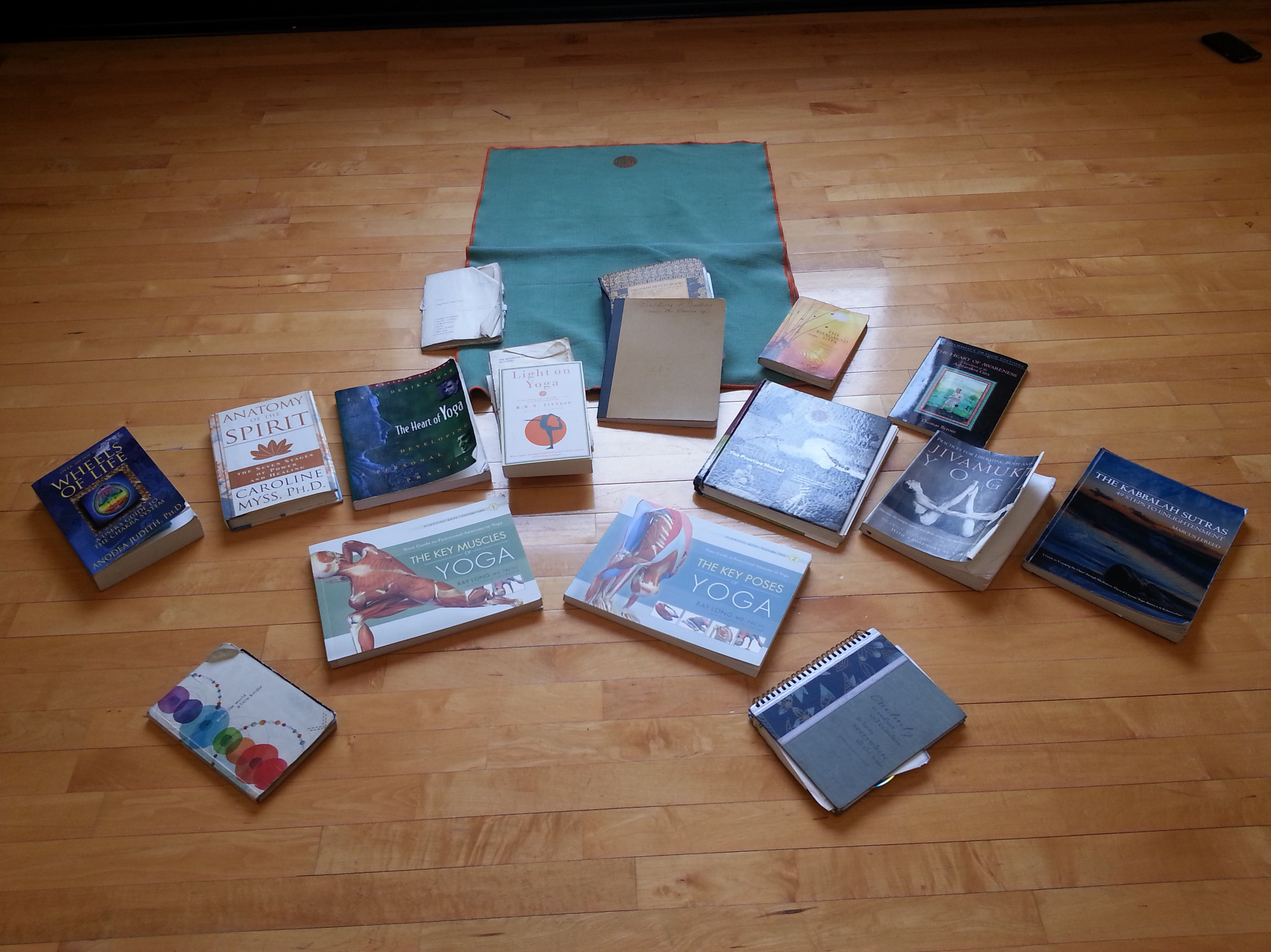
(NOTE: The picture above is missing Leslie Kaminoff’s Yoga Anatomy, Steve Ross’s Happy Yoga, Stephen Cope’s The Wisdom of Yoga, all my Yin Yoga and Taoist texts, a copy of the Ramayana, and Alanna Kaivalya’s Myths of the Asanas, at the very least.)
“Form follows function – that has been misunderstood. Form and function should be one, joined in a spiritual union.”
– Frank Lloyd Wright
“If something is boring after two minutes, try it for four. If still boring, then eight. Then sixteen. Then thirty-two. Eventually one discovers that it is not boring at all.”
– John Cage
Saturday mornings at the Y, just like any morning, is a great time to explore the physical and philosophical practice of yoga. However, I am partial to my Saturdays since I have 90 minutes to engage in the practice of exploration. For the last few years, I have started the new year with a “Building From the Ground Up” sequence – each Saturday adding more poses and another layer of the philosophy. Sometimes I still tie-in a meditation point specific to the date, and to whatever aspect of the philosophy is on tap for the day. Sometimes, however, it’s just straight philosophy and an opportunity to consider the meditation through movement. Whatever I plan for the year, usually wraps up around the end of July – when we start breaking down a different physical practice, the Ashtanga Primary Series.
This year, philosophically, I decided to sequentially move through Patanjali’s Yoga Sutras. Each week breaking down a sutra with commentary. (This week will be YS 1.31.) Physically, we have been breaking down a course of poses outlined by B. K. S. Iyengar in Light On Yoga.
The Saturday class is not an Iyengar class; however, (as teachers like Seane Corn have pointed out) if you are going to practice vinyasa, it’s a good idea to practice Iyengar as it will give you the solid foundation and insight into the asanas (poses).
Iyengar’s Course I is 30 weeks of detailed practice, specifically intended to build a physical practice from the ground up. While they are not limbs themselves, abhyasa (continuous practice with devotion) and vairagya (actively practicing the art of letting go or non-attachment) definitely make up the fertile soil from which the 8-limbs of yoga grow and thrive. And, they are key elements to the courses that appear in the appendix of Light On Yoga. At first, each set of poses is practiced for two (2) weeks before additional poses are added to the sequence. Later, some sequences are repeated for three (3) or four (4) weeks – and sometimes the order of the sequence changes. The 30-week course is followed by a 3-day course, which is slightly different from the 30-day course since the asanas are timed. Finally, there is some guidance on adding sun salutations (surya namaskar) to the physical practice and a list entitled “Important asanas in Course I.”
“If these asanas are mastered then the others given in this course will come even without regular practice.
– B. K. S. Iyengar writing about the “Impostant asanas in Course I”
The important asanas list, when followed by the sun salutations, looks and feels a lot like one of the first vinyasa practices to appear in the West, the Ashtanga Primary Series introduced to Sri Pattabhi Jois. This is not a random coincidence. While Iyengar and Jois were in very different physical/health conditions when they started practicing yoga, they practiced at the same time and with the same teacher: Sri Krishnamacharya. The practices they introduced to the West – just like the physical practices introduced by some of Krishnamacharya’s other students (including Indra Devi, T. K. V. Desikichar, and A. G. Mohan) reflect their own personal practices – which were the result of the physical and mental needs. Remember, classically, the physical practice of yoga (hatha yoga, regardless of the style or tradition) prepares the practitioner for deep-seated meditation. Ergo, even though they might practice the same poses, a very sickly young boy may use a different method of practice than a very active teenage boy.
(Side Note: It is also not a random coincidence that we generally start exploring the Ashtanga Primary series at the end of July: instead the timing coincides with the birthday of Sri Pattabhi Jois.)
YMCA classes are always open to members and their guests. If you are a member, please feel free to join us for class at any time throughout the year – and, feel free to bring a guest.
For further reading, check out Light on Yoga by B. K. S. Iyengar; Heart of Yoga by T. K. V. Desikichar; Ashtanga Yoga the Practice Manual by David Swenson; The Secret of the Yoga Sutra: Samadhi Pada by Pandit Rajmani Tigunait, PhD (Note: This is Part 1 of a series and only includes the first section of the sutras. There are many translations of the sutras, a great online resource is Patanjali’s Yoga Sutras on swamij.com.)
“Talent works, genuis creates.”
– Robert Schumann
~~~ AUM ~~~
WHAT MAKES A WARRIOR HAPPY: 2019 Kiss My Asana Offering #7 April 7, 2019
Posted by ajoyfulpractice in 31-Day Challenge, Abhyasa, Black Elk, Books, Changing Perspectives, Dharma, Donate, Faith, Fitness, Gratitude, Healing Stories, Hope, Karma Yoga, Life, Loss, Meditation, Men, Minneapolis, Minnesota, Music, One Hoop, Pain, Peace, Philosophy, Poetry, Suffering, Twin Cities, Uncategorized, Vairagya, William Wordsworth, Wisdom, Women, Writing, Yoga.Tags: Elias Lopez Garcia, eulogy, inspiration, KISS MY ASANA, Lord Nelson, Poetry, poetry month, The Happy Warrior, William Wordsworth
add a comment
The “practice preview” below is part of my offering for the 2019 Kiss My Asana yogathon. I encourage you to set aside at least 5 minutes a day during April, to practice with today’s theme or concept as inspiration. You can practice in a class or on your own, but since the Kiss My Asana yogathon raises resources as well as awareness, I invite you to join me at a donation-based class on April 27th or May 4th.
I also challenge you to set aside a certain amount every day that you practice with this concept/theme in mind. It doesn’t matter if you set aside one dollar per practice or $25 – set aside that amount each time you practice and donate it by April 30th.
Founded by Matthew Sanford, Mind Body Solutions helps those who have experienced trauma, loss, and disability find new ways to live by integrating both mind and body. They provide classes, workshops, and outreach programs. They also train yoga teachers and offer highly specialized training for health care professionals. By participating in the Kiss My Asana yogathon you join a global movement, but in a personal way. In other words, you practice yoga. Or, as this year’s tag line states….
do yoga. share yoga. help others.
***
“Who is the happy Warrior? Who is he
That every man in arms should wish to be?
– from “Character of the Happy Warrior” by William Wordsworth
“sthira sukham asanam” (YS II.46)
sthira steady, stable
sukham easy, comfortable, joyful
asanam seat (meditation posture or pose)
Patanjali, who outlines the 8-limbed philosophy of yoga in the Yoga Sutras, does not spend a lot of time talking about the physical practice of yoga (hatha yoga, regardless of the style or tradition), which is a combination of asana and pranayama. About asana, the third limb, he indicates that one should cultivate – or continuously maintain – steadiness and ease. He goes on to explain that this cultivation, or “perfecting,” requires relaxing the effort and “allowing the attention to merge with the infinite,” which, in turn, brings a sense of “freedom from suffering.” Furthermore, he states that pranayama, the fourth limb of yoga, begins to occur as a result of the perfected and balanced pose.
At first glance this all sounds really odd. How do you relax the effort without falling over? And, if you’re worried about falling over, how can you possibly pay attention to anything other than not falling over?
“Simple causal reasoning about the feedback system is difficult because the first system influences the second and the second system influences the first, leading to a circular argument. This makes reasoning based upon cause and effect tricky, and it is necessary to analyze the system as a whole.”
– Karl Johan Aström and Richard Murray, Feedback Systems: An Introduction for Scientists and Engineers
It turns out that the two limbs create a feedback loop: if you can find balance between effort and relaxation (steadiness and ease), you will start to notice the breath, the parts of the breath and (as Patanjali points out in II.50-51) the breath becomes long, fine, and seamlessly continuous (or infinite). Simultaneously, if you observe the breath and adjust your body in order to find the position where the breath is long, fine, and seamlessly continuous, you will have found the physical balance between effort and relaxation. Finally, finding that physical balance will result in mental balance and clarity which, Patanjali explains, reveals inner light. (II.52)
“Whose high endeavors are an inward light
That makes the path before him always bright;”
– from “Character of the Happy Warrior” by William Wordsworth
While Virabhadrasana literally means “Hero Friend or Brave Person Seat,” in English we almost always translate it to “Warrior Pose.” Yoga practices which utilize standing poses (even if you’re seated in a chair) will inevitably include at least one of three Virabhadrasanas. However, there is also a seated pose (Virasana, accurately translated as “Hero Pose,”), a “Humble Warrior,” a “Shackled Warrior, and there are several poses associated with Hanuman, the monkey king, which all may also be referred to as “Warrior” poses. We may think of any number of warrior-like attributes we want to embody when practicing these poses. The question is, how often do those attributes include balance, generosity of Spirit, self-knowledge, happiness – or any of the other qualities William Wordsworth (born today in 1770) uses to describe the character of Vice-Admiral Horatio Nelson?
Wordsworth’s poem “Character of the Happy Warrior” (circa 1806) is similar in context to W. H. Auden’s poem “The Unknown Citizen” (circa 1939). They are both intended to eulogize and memorialize. The biggest difference in the two poems, however, is that Auden’s poem is pure satire and reveals a person who cannot actually exist. Nothing negative can be or is said about Auden’s “citizen.” On the flip side, Wordsworth was honoring the recently deceased Lord Nelson, who was praised for his leadership skills and persistence, and was known as a British hero of the Napoleonic Wars – despite being a strong proponent of slavery. Still, the flattering depiction in the poem is a legacy that lives beyond the man himself. The term “the happy warrior” enjoys a place in the English lexicon as a great way to summarize the character of a person (usually a man) who exhibits “our human nature’s highest dower” (or gift).
“We can perhaps change the whole world but it will not help us. On the contrary, if we change ourselves, then the world is automatically changed. Change in the world will come naturally, inevitably, spontaneously, as we bring about this change to ourselves.”
– Shri Brahmananda Sarasvati *
FEATURED POSE for April 7th: “Happy Warrior,” II variation (Ananda Virabhadrasana)
{*A quick shout out and thank you to Elias Lopez Garcia of Happy Warrior Yoga, for (unknowingly) helping me narrow down which warrior pose to feature today. If you appreciate this experience, please “like” his video, linked here and embedded below.}
This “Happy Warrior” variation can be done with or without warming up the body. Keep in mind, however, that this pose is asymmetrical and requires externally rotated hips. If you have hip and/or balance issues, use cat/cow or some sun or moon salutations as a warm up. You can also move into a wide-legged seated pose like Bound Angle (Baddha Konasana) or a squat – either Yogi Prayer Squat or Horse/Goddess Pose – with all four corners of your feet grounded, plus toes and knees turned out for external rotation and abduction.
When you are ready to practice “Happy Warrior,” spread your legs so that the ankles are underneath the wrists or between each elbow and wrist. Make sure the toes are all pointed in the same direction and that the feet are parallel to each other. With the arms spread wide, breathe deeply in and out, making sure that you feel open and grounded. Notice your breath. Adjust your position if you are not feeling stable and comfortable, or if the breath is not naturally deepening.
After a few moments, lift your arms up and out, making a “V” shape for “5-Pointed Star” (also known as “Big Asana” and “Hallelujah Asana”). Crown of your head is the fifth point of the star so press down to lift the body up. Inhale the corners of your mouth up towards your ears and exhale, relax your jaw, for “5-Pointed Smile.” Breathe here and notice how you feel as the sensation of the smile spreads out through your fingers and toes, as well as the corners of your mouth and the crown of your head.
Maintaining the internal sensation of the smile, even as the expression on your face softens, exhale to turn the right toes out so that the right heel lines up with the middle (or center) of the left foot. You may need to bring your hands down to your hips for balance. Once you establish this heel-to-arch alignment, bend your right knee as close to 90 degrees as you are able to reach. Make sure that the knee is over the ankle, tracking the pinky toe. Check to make sure that you are balancing your weight between both feet, both legs, and both hips. Double check the hips to make sure the back (left) hip isn’t getting cocky and sitting higher than the right.
Inhale and lift your arms straight up in the air over your head. Check to make sure that your hips are open wide (away from each other) and that the shoulders are directly over your hips so that when your arms are raised the upper body looks like it’s in Mountain Pose (Tadasana)/Arms Over Head Pose (Urdhva Hastasana). On an exhale, lower the arms just enough to go back to the “V” position. Gaze up, straight over your heart, and press down in order to lift your head up.
Embody the internalized sensation of the smile. Simultaneously, think of your favorite warrior, agape or otherwise, and embody what you see as their best characteristics. Now, embody your best characteristics – all simply in the way your hold your body. After 5 – 7 breaths, release the pose and move back into the starting position. Repeat the pose on the other side.
### Jai Jai Gurudev Jai Jai ###

