How Do You Respond? September 14, 2020
Posted by ajoyfulpractice in Books, Changing Perspectives, Japa-Ajapa, Life, Philosophy, Science, Wisdom, Writing, Yoga.Tags: Dr. Ivan Pavlov, Pandit Rajmani Tigunait, Pavlov's dog, Pavlovian, samskaras, Swami Jnaneshvara, yoga philosophy, Yoga Sutra 1.12
add a comment
“According to Yoga philosophy, the causes of our thought patterns have a much deeper source than we normally realize. Our inner world is propelled by our habits, which in turn govern and determine the nature of our emotions, thoughts, speech, and actions. Our habits form our personality. They have a powerful influence on our unconscious behavior, as well as on our conscious decisions.”
– commentary on Yoga Sūtra 1.12 from The Secret of the Yoga Sutra: Samadhi Pada by Pandit Rajmani Tigunait, PhD
Habits: The things we do repeatedly, routinely, sometimes without thought or consideration. There are habits we label as “good” and others we label as “bad” – and then there are the ones that just are. There are habits we cultivate and others we may attempt to break. Even as people talk about all the different external factors to cultivating or breaking a habit – like how many days it takes (20, 30, or 40) and what life hacks enable them (like leaving your running shoes by the door, pre-packing your gym bag, or setting your phone to shut down media after a certain time) – habits, like all muscle memory, are ultimately mental exercises.
Even though we may not think very much about certain habits, they are happening because of what’s going on inside of our brains. We do something for the first time and a neural pathway is formed. We repeat the behavior enough times and the pathway is hardwired. Suddenly we feel compelled to do something or we think “it’s just what I/we do.” Even sometimes when the behavior is detrimental, harmful, to ourselves and others; we may not give it a second thought. In the Yoga Philosophy, such deeply ingrained or embedded habits (regardless of if we consider them “good” or “bad”) are considered vāsanās (“dwelling places”), which are based on samskaras (“mental impressions”). While such habits can feel instinctual, they are in fact conditioned.
“It is not accidental that all phenomena of human life are dominated by the search for daily bread – the oldest link connecting all living things, man included, with the surrounding nature.”
– quoted from the Dec. 12, 1904 Nobel Lecture “Physiology of Digestion” by Dr. Ivan Pavlov, winner of the Nobel Prize in Physiology or Medicine
For most of his life, Dr. Ivan Petrovich Pavlov celebrated his birthday today, September 14th. It was his habit. Born in Ryazan in 1849, he would be 68 when the Russian Empire switched from the Julian to the Gregorian calendar (at which point his date of birth would be recognized as September 26th). Imagine if you had lived 68 years, doing things with a certain reference point in mind and then, suddenly, that reference point changed. Now, I can’t say for sure that it phased the Nobel laureate one way or the other – I don’t even know how (or if) he celebrated his birthday. What I do know is that Dr. Pavlov knew a thing or two about habits.
The oldest of 11, and known as a curious and active child, Ivan Pavlov started school late because of an accident. He went to theological seminary for a bit, but his curiosity ultimately led him to the university at St. Petersburg and the field of medical research. He won several awards throughout his career, including the 1904 Nobel Prize for Physiology and Medicine “in recognition of his work on the physiology of digestion, through which knowledge on vital aspects of the subject has been transformed and enlarged.” The Nobel Committee’s description of why Dr. Pavlov won was in part a nod to the fact that he had been nominated four years in a row (starting in 1901). His ultimate win, however, was the direct result of experiments exploring the gastric function of dogs (and children).
Dr. Pavlov first noted that dogs started salivating before their food was actually delivered. He initially called the physiological anticipation, “psychic secretion,” but eventually his reflex system work would be viewed within the paradigm of classical conditioning, respondent conditioning, or Pavlovian conditioning. He was one of the first scientists to associate behavioral responses to environmental stimuli, and his research has been extended into various aspects of psychology, behavior modification therapy, and learning theory. Literally right up until his death, he hosted “Wednesday meetings,” where he discussed everything from physiology and psychology to his views on the treatment of animals by research scientists. While other scientists routinely cited him and his work, Dr. Pavlov has also been immortalized by fiction writers like Aldus Huxley, Anthony Burgess, and Thomas Pynchon. In fact, his work was so instrumental in our understanding of the mind-body connection that people who have never studied medical physiology are aware of “the Pavlovian response.
“When the dog is repeatedly teased with the sight of objects inducing salivary secretion from a distance, the reaction of the salivary glands grows weaker and weaker and finally drops to zero. The shorter the intervals between repeated stimulations the quicker the reaction reaches zero, and vice versa. These rules apply fully only when the conditions of the experiment are kept unchanged…. These relations also explain the real meaning of the above-mentioned identity of experimental conditions; every detail of the surrounding objects appears to be a new stimulus. If a certain stimulus has lost its influence, it can recover the latter only after a long resting that has to last several hours.
The lost action, however, can also be restored with certainty at any time by special measures.”
– quoted from the Dec. 12, 1904 Nobel Lecture “Physiology of Digestion” by Dr. Ivan Pavlov, winner of the Nobel Prize in Physiology or Medicine
While Ivan Pavlov and the Pavlovian response are often associated with the ringing of a bell, his written records indicate a plethora of external stimuli, including visual stimuli. Ultimately, he explains that what is most important is that the conditions are controlled and that the test subjects had control of their faculties. In fact, he used the global platform of his Nobel lecture to state, categorically, “Our success was mainly due to the fact that we stimulated the nerves of animals that easily stood on their own feet and were not subjected to any painful stimulus either during or immediately before stimulation of their nerves.” On another occasion, Dr. Pavlov encouraged scientists to be curious and not “a mere recorder of facts.” His lessons and research run parallel to the elements of practice which Patanjali described thousands of years before as being a method of controlling the activities of the mind, including those deeply embedded habits known as samskaras.
“abhyāsa vairāgyābhyāṁ tat nirodhaḥ” (YS 1.12)
abhyāsa Practice over a long period/without interruption
vairāgyābhyāṁ Non-attachment, without attraction or aversion
tat Those (referring to the “fluctuations of the mind” as described in previous sutras)
nirodhaḥ Ceases, controls, quiets, stills, regulates, masters
For months now, we have been developing habits we may or may not have intended to cultivate. Please join me on the virtual mat today (Monday, September 14th) at 5:30 PM for a 75-minute virtual yoga practice, where we will consider the process of forming (and changing) habits.
This is a 75-minute Common Ground Meditation Center practice that, in the spirit of generosity (dana), is freely given and freely received. You can use the link from the “Class Schedules” calendar if you run into any problems checking into the class. You can request an audio recording of this practice via a comment below.
If you are able to support the center and its teachings, please do so as your heart moves you. (NOTE: You can donate even if you are “attending” my other practices, or you can purchase class(es). Donations are tax deductible, class purchases are not necessarily.)
There is no playlist for the Common Ground practices.
### “NEVER GIVE UP / ALWAYS LET GO” (Swami J) ###
The Cagey Truth About Nothing September 5, 2020
Posted by ajoyfulpractice in Art, Books, Buddhism, Changing Perspectives, Faith, Japa-Ajapa, Life, Meditation, Music, Mysticism, Philosophy, Wisdom, Writing, Yoga.Tags: I Ching, John Cage, Philosophy, Robert Rauschenberg, Zen Buddhism
add a comment
“Every moment is an echo of nothing.”
– John Cage
Listen. Do that 90-second thing. Just for a moment, be still and be quiet.
Notice what you hear.
Notice what you see.
Notice what you feel.
Because, as long as you are alive, these things are always happening.
“Everything we do is music.”
“The world is teeming; anything can happen.”
– John Cage
We refer to the absence of something as nothing, but in actuality there is always something. Our understanding of nothing or emptiness is based on our perception and awareness of the truth. Zen Buddhism, which John Cage practiced, focuses on self-restraint, meditation, insight into the nature of the mind and the nature of things, and the personal expression of this insight – especially as it benefits others. This, truly, parallels the focus of the yoga philosophy. It’s tricky, cagey even; however, if we pay attention we start to notice that the truth about nothing leads to the truth about everything – and Patanjali tells us that being dedicated to to the truth leads to everything.
Yoga Sūtra 2.36: satyapratişţhāyām kriyāphalāśrayatvam
– “When a yogi is established in truthfulness, actions begin to bear fruit. [Truth is the foundation for fruitful action.]”
Born today in 1912, John Cage was an artist and composer who’s most well-known work is often misinterpreted. Even as musicians – even heavy metal musicians – who understand the piece take it on, there is often a level of interpretation and improvisation that changes the tenure of the piece. Some say Mr. Cage would approve of such things. Others say otherwise, but the truth of the matter is that he was a student not only of art and music, but also of Zen Buddhism, Indian philosophy, chance, and (yes) improvisation. He turned more towards music than art because more people commented on his music and, in some ways, music was harder for him. He combined his two art forms by composing music for “prepared piano,” a piano that had been altered with blocks, pins, and other objects – and essentially turned into a percussion instrument. He also collaboration with his partner Merce Cunningham, the choreographer, and spent years composing via the I Ching, a resource for divination.
Divination comes from the Latin word for “to foresee, to foretell, to predict, to prophesy” and, it is related to the Latin word for “divine,” it can be translated as “to be inspired by God.” It is, like randomly opening a page in the Bible or your favorite book, a way to gain insight into a particular situation. The I Ching or Book of Changes (sometimes translated as Classic of Changes) is an ancient resource for Chinese divination and one of the oldest Chinese classics. It became one of the “Five Classics” in the 2nd Century B.C. and has provided influenced art, literature, philosophy, and religion around the world since the Western Zhou period (1000 – 750 B. C.).
The text is the primary reference for interpreting a sequence of hexagrams which can be formed with numbers or by throwing coins containing the symbols for “yin” (a broken line) or “yang” (an unbroken line). Just like other users of Chinese divination, John Cage would form a question, throw the coins, and then create a musical interpretation of the resulting hexagon sequence and its corresponding message. While he had previously composed “by chance,” using the I Ching became his standard method of composing music after one of his students gave him a copy of the sacred text in 1951. In a 1957 lecture, he described music as “purposeless play” and “a way of waking up to the very life we’re living.”
“If something is boring after 2 minutes, try it for 4. If still boring, then 8. Then 16. Then 38. Eventually one discovers that it is not boring at all.”
– John Cage
It was also in 1951 that Mr. Cage had two other highly influential experiences. His friend and colleague Robert Rauschenberg produced a series of white paintings which appeared to be “blank” canvases, but which actually changed based on lighting and the shadows of the people viewing them. Around this same time, Mr. Cage spent some time in an anechoic chamber at Harvard University. The chamber was designed so that every part of the room absorbed sound, rather than reflecting it, so that it was meant to be completely silent and externally sound-proof. He expected to hear silence but, instead, he heard a high pitched sound and a low pitched sound. The engineer in charge of the room told him the high pitch was his nervous system and the low pitch was his blood circulation. Instead of silence, he was treated to the music of his own existence.
“There is no such thing as an empty space or an empty time. There is always something to see, something to hear. In fact, try as we may to make a silence, we cannot.”
– John Cage
Please join me for a 90-minute virtual yoga practice on Zoom today (Saturday, September 5th) at 12:00 PM. You can use the link from the “Class Schedules” calendar if you run into any problems checking into the class. Give yourself extra time to log in if you have not upgraded to Zoom 5.0.
Today’s playlist is available on YouTube and Spotify. (FAIR WARNING: The volume on these tracks is quite dynamic, more so on the Spotify list. I love this music, however, I know some folks hate it; so, feel free to “randomly” pick another list or…practice in “silence.”)
You can request an audio recording of this practice via a comment below or (for a slightly faster reply) you can email me at myra (at) ajoyfulpractice.com.
Pure Cage
“Get yourself out of whatever cage you find yourself.”
– John Cage
### UNCAGED ###
.
So Much Suffering, on a Monday the 13th April 13, 2020
Posted by ajoyfulpractice in 7-Day Challenge, Bhakti, Books, Buddhism, Changing Perspectives, Depression, Dharma, Donate, Faith, Gratitude, Healing Stories, Health, Hope, Japa-Ajapa, Karma Yoga, Lent / Great Lent, Life, Loss, Love, Meditation, Music, Mysticism, One Hoop, Pain, Passover, Peace, Philosophy, Poetry, Religion, Suffering, Traditional Chinese Medicine, Tragedy, Wisdom, Women, Writing.Tags: Beresh't, Bhagavad Gita, Buddha, Common Ground Meditation Center, Exodus, Genesis, Iyov, Job, KISS MY ASANA, Moses, Mumford and Sons, Passover, Shemot, Siddhartha, Suffering, Timshel, yoga, yoga sutras
add a comment
“First and foremost, we believe creation of the world, G-d created a world in which he wanted the human being to actually be able to do something – that is to say, to exercise free will, to be like G-d, meaning to be a creator, not to be lab rats…. He wants us to have a relationship with Him. But to have a relationship with G-d requires that I have an exercise of my free will…. Free will means an environment in which not necessarily do I always have pleasure when I make the right decisions and not necessarily does someone always suffer when they make the wrong decision. Free will is having real power to create stuff. Free will is having real power to alleviate suffering.”
– Rabbi Mordechai Becher, in vlog explaining one of several reasons why suffering exists
If you look back over this last week of blog posts, you will see a lot of different takes on suffering. So much suffering, in the midst of so much that is holy. I could point back to any number of quotes from this week’s post, any number of quotes from various traditions and belief systems. But, just focus on something simple…a simple list, the Four Noble Truths from Buddhism:
- Suffering exists
- Suffering is caused by attachment, clinging, craving
- There is an end to suffering
- The Noble Eight-fold Path is the way to end suffering
In the Passover story, Moses has similar experiences and a similar journey as Prince Siddhartha has in relation to Buddhism. (Both also have parallels to Arjuna’s experience at the center of the battlefield during The Bhagavad Gita.) There are some obvious differences, but let’s focus on the similarities for a moment. Both were raised in wealthy households, lived lives of privilege, experienced the suffering of others, and – instead of turning away, as some would do – both took the opportunity to alleviate themselves and others from suffering.
According to an oft quoted proverb, G-d is in the details – or, in the detail. And, it turns out, that the element of G-d is one of the big differences between the two stories. Another big difference is that while both heroes were raised in wealth, Moses was born a slave – and knew his connection to the Jewish people, people who were suffering. Prince Siddhartha, who becomes the Buddha (or “Enlightened One”) was 29 years old when he left the palace gates and saw suffering for the first time. At 35, when he became enlightened, the Buddha codified the 4 Noble Truths and began teaching. He died at the age of 80. This all happened in India, during the 6th Century (~563) BCE.
On the other hand, Moses was born into suffering during the 14th Century (placing Exodus between 1446 – 1406) BCE. Not only are the Jewish people, his people, enslaved when he is born, but because Pharaoh declared that all baby boys should be killed, Moses was born during greater than normal suffering. Theoretically, he always knew some amount of suffering existed. He was 40 years old when he had to flee his home after stepping in to protect a Jewish man was being beaten; he was 80 when G-d in the form of the burning bush commanded him to return to Egypt and speak to Pharaoh about freeing the Jewish people; and, subsequently, when he received the Torah, G-d’s truth for his people. He was 120 when he died.
Yoga Sutra 1.5: vŗttayah pañcatayyah klişțāklişțāh
– “The tendencies that cause the mind to fluctuate (or rotate) are fivefold, and are either afflicting or non-afflicting.”
Yoga Sutra 2.3: Avidyāmitārāgadveşābhiniveśāh kleśāh
– “Ignorance (or lack of knowledge), false sense of identity, attachment (rooted in pleasure), aversion (attachment rooted in pain), and fear of death or loss are the afflictions.”
In the Yoga Sutras Patanjali outlined how the mind works and how to work the mind. The mind, he explained, has a tendency to wander, move around, and get caught up in those fluctuations. Those fluctuations are either afflicted or not afflicted – meaning some thoughts bring us pain/suffering and others alleviate or don’t cause pain/suffering. He goes on to describe how to afflicted thoughts cause nine obstacles, which lead to five conditions (or states of suffering). Eventually, he describes exactly what he means by “afflicted thoughts.” Throughout these first two chapters of the text, he gives examples on how to overcome the afflicted thoughts; on how to alleviate the suffering they cause; and on how to overcome the obstacles and painful states of suffering. His recommendation: Various forms of meditation.
One technique Patanjali suggests (YS 1.33) is to offer loving-kindness/friendliness to those who are happy, compassion to those who are sad, happiness to those who are virtuous, and indifference to those who are non-virtuous. (Metta meditation is a great way to start this practice.) Knowing, however, that everyone can’t just drop into a deep seated meditation, Patanjali offers physical techniques to prepare the mind-body for meditation; this is the physical practice.
I find the yoga philosophy particularly practical. But then again, I tell my own stories.
Historically speaking, Patanjali was in India compiling the Yoga Sutras, which outlines the philosophy of yoga, during the Buddha’s lifetime. I have heard, that at some point in his life, the Buddha was aware of yoga – but that doesn’t mean he was aware of the yoga sutras, simply that he was aware of the lifestyle and the codes of that lifestyle. Perhaps he even had a physical practice. The Buddha, however, did not think the yoga philosophy was practical enough. In theory, this explains some of the parallels between yoga and Buddhism. It also may help explain why there are so many lists in Buddhism and why the Buddha taught in stories.
I have no knowledge of (and no reason to believe that) Moses knew anything about yoga, the yoga philosophy, or the sutras. However, he can be considered a “desert brother” or Jewish mystic for much of his adult life – meaning that he undoubtedly engaged in prayer, meditation, and contemplation. Even if he didn’t attribute certain aspects of the body to the aspects of the Divine that are found on the Tree of Life, and even if he didn’t physically move his body with the intention of connecting with G-d, Moses spent much of his adult life as a shepherd. As a shepherd, moving around the hills with his ship, Moses connected with nature and with G-d, which is the ultimate dream of some philosophers and truth seekers.
“Then Job stood up, and rent his robe and tore his hair; then he fell to the ground and prostrated himself. And he said, ‘From my mother’s womb, I emerged naked, and I will return there naked. The Lord gave and the Lord took; may the name of the Lord be blessed.'”
– Job, upon learning that how much he’s lost in a single moment (Iyov / Job 1.20-21)
Moses probably didn’t know the story of the Buddha. He would have, however, known the story of Job. The Book of Job takes place around the 6th Century BCE – the same time as Prince Siddhartha’s evolution into the Buddha. It is the story of a man who endures great suffering. From Job’s perspective, there is a point when it could even be considered pointless suffering. But only to a point, because eventually Job’s suffering is alleviated and the way in which he endures the suffering is rewarded.
Job clings to his faith, believes that G-d is always with him. Moses, as I mentioned in yesterday’s post, is told by the burning bush that G-d will always be with him and with the Jewish people. So the lesson is, “[we] are not alone in this. / As brothers [and sisters] we will stand and we’ll hold your hand.”
Sometimes, when I sing-along to the Mumford and Sons’ Timshel (even when I embellish the lyrics, see above) I don’t point out that the title of the song does not translate to “you are not alone in this.” There is a reference in John Steinbeck’s East of Eden that refers back to Beresh’t / Genesis 4:7 and the story of Cain and Abel. Steinbeck translates G-d’s words to Cain as “thou mayest.” In reality, if you’re going to use Steinbeck’s reference, it’s “thou mayest rule;” but it is sometimes translated as “you can rule/master” or “you will rule /master” and the object of this command or explanation is “sin.” As in: You can (or will, or mayest) rule (or overcome, or master) Sin.
I’m not going to get into the various understandings and meanings of sin. Suffice to say, anything one would categorize as a sin can also categorized as an affliction and therefore something which causes suffering. The key part here is that many translations of “timshel” reinforce the concept of free will. We choose how we deal with suffering. Even when we don’t realize we are choosing, our choice can alleviate or increase our suffering.
The Buddha’s parables about the second arrow and the poisoned arrow brilliantly illustrate how this works. So too, do the stories of Cain and Able, Job, and Moses and the Jewish people during Exodus. Even the story of the Passion of the Christ – the story of Jesus and his last week of life – illustrates this same principle.
Yesterday, I finished class by quoting Pope Francis’s Easter vigil homily. Even though this week marks the end of Passover and takes us into Vaisakhi (in the Sikh tradition) and Ridvan (in the Hindu tradition), this is also the Holy Week or Passion Week in the Orthodox Christian traditions and so I’m going to end with that same bit of the Easter vigil homily.
“This year however, we are experiencing, more than ever, the great silence of Holy Saturday. We can imagine ourselves in the position of the women on that day. They, like us, had before their eyes the drama of suffering, of an unexpected tragedy that happened all too suddenly. They had seen death and it weighed on their hearts. Pain was mixed with fear: would they suffer the same fate as the Master? Then too there was fear about the future and all that would need to be rebuilt. A painful memory, a hope cut short. For them, as for us, it was the darkest hour.
Yet in this situation the women did not allow themselves to be paralyzed. They did not give in to the gloom of sorrow and regret, they did not morosely close in on themselves, or flee from reality. They were doing something simple yet extraordinary: preparing at home the spices to anoint the body of Jesus. They did not stop loving; in the darkness of their hearts, they lit a flame of mercy. Our Lady spent that Saturday, the day that would be dedicated to her, in prayer and hope. She responded to sorrow with trust in the Lord. Unbeknownst to these women, they were making preparations, in the darkness of that Sabbath, for “the dawn of the first day of the week”, the day that would change history. Jesus, like a seed buried in the ground, was about to make new life blossom in the world; and these women, by prayer and love, were helping to make that hope flower. How many people, in these sad days, have done and are still doing what those women did, sowing seeds of hope! With small gestures of care, affection and prayer.”
– Homily of His Holiness Pope Francis, Easter Vigil, Holy Saturday, 11 April 2020
If you are interested and available, please join me for the virtual Common Ground Meditation Center yoga practice on Zoom, today (Monday, April 13th), 5:30 PM – 6:45 PM. Some of the new Zoom security protocols are definitely kicking in; so, please use the link from the “Class Schedules”calendar if you run into any problems. There is no music for this practice.
If you are following the Orthodox Christian calendar and would like a recording of last week’s classes, please comment or email me.
If you are interested in combining a physical practice (yoga or weightlifting) with the Counting of the Omer, you can purchase a copy of Marcus J. Freed’s The Kabbalh Sutras: 49 Steps to Enlightenment.

A LITTLE YIN… & A LOTTA YANG
For more ways you can offer yourself “small gestures of care, affection and prayer,” please join me and a special guest for “Lung Health and How We Cope Right Now (viewing COVID-19 through Traditional Chinese Medicine and YIN Yoga),” a discussion on the importance of the lungs in our overall wellbeing as well as how to just friggin’ cope right now. The conversation will include a brief overview of Traditional Chinese Medicine and YIN Yoga, as well as a brief Q&A followed by a little YIN Yoga.
If you are struggling with your physical or mental health, if you’ve always been curious about “alternative” medicine, and/or if you are missing your yoga practice, this special one hour event is for you. Please join us on YouTube, Wednesday, April 15th, 3:00 PM to 4:00 PM,
Also, mark your calendar for April 25th – the beginning of Kiss My Asana!
Speaking of Kiss My Asana…
Founded by Matthew Sanford, Mind Body Solutions helps those who have experienced trauma, loss, and disability find new ways to live by integrating both mind and body. They provide classes, workshops, and outreach programs. They also train yoga teachers and offer highly specialized training for health care professionals. This year’s yogathon is only a week long. Seven days, at the end of the month, to do yoga, share yoga, and help others. By participating in the Kiss My Asana yogathon you join a global movement, but in a personal way. In other words, you practice yoga… for 7 days.
Kissing My Asana is definitely a small gesture of care, affection, and prayer!
You don’t need to wait until the end of the month, however, to consider how you might participate. Start thinking now about how you can add 5 minutes of yoga (or meditation) to your day, how you can learn something new about your practice, or even how you would teach a pose to someone close to you – or even to one of your Master Teachers/Precious Jewels.
To give you some ideas, consider that in past years my KMA offerings have included donation-based classes and (sometimes) daily postings. Check out one of my previous offerings dated April 13th (or thereabouts):
30 Poses in 30 Days (scroll down to see April 13th)
A Musical Preview (scroll down to see March 13th)
A Preview of the April 13th Practice
### AMEN, SELAH ###
Seeing Clearly Now (or New Vision for a New Year) December 30, 2019
Posted by ajoyfulpractice in 108 Sun Salutations, Abhyasa, Books, Changing Perspectives, Donate, Hope, Japa, Japa-Ajapa, Kirtan, Life, Mala, Mantra, Meditation, Minneapolis, Minnesota, Music, New Year, Pain, Suffering, Surya Namaskar, Twin Cities, Vairagya, Vipassana, Wisdom, Women, Writing.Tags: 108, 108 Sun Salutations, 20-20, 2020, clarity, Hothouse Flowers, inspiration, Johnny Nash, New Year, perspective, Robert Pirsig, Surya Namaskar, vision
3 comments
I can see clearly now the rain is gone
I can see all obstacles in my way
Gone are the dark clouds that had me blind
It’s gonna be a bright (bright)
Bright (bright) sunshiny day
– “I Can See Clearly Now” by Johnny Nash
“You look at where you’re going and where you are and it never makes sense, but then you look back at where you’ve been and a pattern seems to emerge.”
― Robert M. Pirsig, Zen and the Art of Motorcycle Maintenance: An Inquiry Into Values
The filmmaker Billy Wilder famously said, “Hindsight is always twenty-twenty.” Wilder’s statement relies on the idea that 20-20 is perfect vision and implies that stepping back gives us the perspective to see things more clearly because we take in the bigger picture. In other words, once we see the pattern and how everything fits together as a whole, we gain an understanding of the parts. It’s like understanding a word’s meaning when it’s used in a sentence. Context is everything. Or is it? After all, if we start off with an incorrect understanding of past events, the pattern that emerges is still slightly off. We may see ourselves and our situation better than we did when we were in the middle of everything, but seeing things better doesn’t mean we see them perfectly.
As someone in the United States who has worn glasses for most of my life, I am very familiar with the idea that 20/20 vision is perfect vision (and the experience of feeling like you’re seeing a brand new world when you get new glasses). However, the reality is that that particular gold standard is not only not perfect vision; it’s not even the best vision. 20/20 vision – what is considered normal or average vision is, by definition, what is clearly or sharply seen at 20 feet by the so-called average person. If you have your eyes examined and the second number is higher than 20 (let’s say, 89) than that higher number means you would have to be 20 feet away from something to see it with the same clarity that someone else (someone with “normal” eyesight) sees clearly from a distance of 89 feet. On the flip side, someone with 20/2 vision has the eyesight of an eagle and can sharply see something from 20 feet away that mere mortals can only see clearly from 2 feet. While 20/2 vision may seem unlikely in a human, there are definitely people with 20/10 vision. (And, also, there are people with 20/8.)
I say all of this just to point out that, as we enter a new year and a new decade that lends itself to people talking about vision and insight, don’t get too caught up in the metaphor of seeing better in the year ahead just because it’s 20/20. It’s an imperfect metaphor. And, if you insist on using it – for political reasons – keep in mind that we had better “vision” in 2008. (But, that’s another story for another day.) The point I’m making here is that what we really need is more clarity and more insight.
“I think I can make it now the pain is gone
All of the bad feelings have disappeared
Here is that rainbow I’ve been praying for
It’s gonna be a bright (bright)
Bright (bright) sunshiny day”
– Hothouse Flowers cover of “I Can See Clearly Now” by Johnny Nash
The Sanskrit word “vipassana” is often translated into English as “insight.” A more literal translation is “to see in a special way.” The practice is not just about stepping back; it’s also about letting go. Paying attention to your breath while simultaneously observing your thoughts and physical sensations creates the opportunity to experience everything without getting attached to anything. It’s a bit like riding a motorcycle through your life. As Robert Pirsig describes it in Zen and the Art of Motorcycle Maintenance, “In a car you’re always in a compartment, and because you’re used to it you don’t realize that through that car window everything you see is just more TV. You’re a passive observer and it is all moving by you boringly in a frame. / On a cycle the frame is gone. You’re completely in contact with it all. You’re in the scene, not just watching it anymore, and the sense of presence is overwhelming.”
Like vipassana, the Sanskrit word “vinyasa” (“to place in a special way”) refers to a technique as well as to a style or tradition. The most classical example of vinyasa is Surya Namaskar (Sun Salutation), which is 12 asanas (seats or poses) linked to the breath. Each pose is an exaggeration of the spine’s natural inclination – to extend on the inhale and to flex on the exhale. Practicing a few Sun Salutations at the beginning of a practice is a little like getting in a car to go somewhere specific. The more Sun Salutations you do, the more it feels like a road trip. If, however, you’re only practicing 5 or 10 Sun Salutations (every once in a while), you’re still traveling in the car. Practice 108…now you’re traveling long distance on a cycle. And, yes, that means you have to do your own maintenance. It also means you have to let go of some baggage.
“But our mistakes also carry our largest lessons. I’m wiser now. I guess the real trick in life is to turn hindsight into foresight that reveals insight.”
“Nice way to put it, Cal. What I really hear you saying is that it’s important in life to let our past serve us. Is that right?”
“Very well put. That’s it exactly. There’s nothing wrong with making a mistake – that’s how human beings grow. We’re designed to make mistakes, for mistakes carry growth. We just shouldn’t keep repeating the same one. Turn a wound into wisdom, or, as you said, let your past serve you.”
– Cal and Jack in The Saint, the Surfer, and the CEO by Robert Sharma
Practicing 108 Sun Salutations is a great way to mark a transition, like the end of a year and/or the end of the decade. While it is a tradition for some to practice the ajapa-japa mala (repeat-remember garland) for a solstice and equinox, many people also practice at the beginning of a new year. My 2020 mala, as well as my Yin Yoga + Meditation, practices are full. However, if you are looking for clarity and insight in this New Year and new decade consider practicing on your own or joining one of the following*:
Tuesday, December 31st – New Year’s Eve:
7:30 PM – 12:15 AM, Common Ground Meditation Center Potluck
7:30 PM – 12:00 AM, Joy Fest (Kirtan) at Saint Paul Yoga Center
Wednesday, January 1st – New Year’s Day:
9:00 AM – 11:00 AM, 108 Sun Salutations with Susan Meyer, Yoga Center Retreat
10:00 AM – 1:00 PM, 108 Sun Salutations with Myra (reservations required, THIS EVENT IS FULL)
10:00 AM – 11:30 AM, Restorative Yoga + Yoga Nidra with Shelly Pagitt, Yoga Sanctuary
10:00 AM – 11:30 AM, New Beginnings (vinyasa) with Mike, Minnehaha Yoga
AM – PM, Yoga with Nancy Boler (reservations required, THIS EVENT IS FULL)
11:00 AM – 12:30 PM, 108 Sun Salutations + Champagne with Meghan Foley, UP Yoga
11:00 AM – 1:45 PM, Sankalpa Shakti: The Power of Inspired Intention with Ben Vincent, One Yoga
12:00 PM – 2:00 PM, 108 Sun Salutations with Tracy Vacura & live Cello music by Emily Dantama, Yoga Sanctuary
12:00 PM – 2:00 PM, Revolution 2020: Reflect, Release, and Manifest Your Dreams with Drew Sambol, Radiant Life Yoga
1:00 PM – 2:30 PM, Finding Balance in the New Year with Pam, Minnehaha Yoga
1:00 PM – 3:15 PM, 108 Sun Salutations with Chance York, One Yoga
1:00 PM – 3:00 PM, Ganesha and New Beginnings for 2020 with Tara Cindy Sherman, Yoga Center Retreat
2:00 PM – 4:00 PM, New Year’s Day Kundalini with Nicole Nardone, One Yoga
2:10 PM – 3:40 PM, 108 Sun Salutations with Jennifer Davis, Blaisdell YMCA
4:00 PM – 6:00 PM, Restorative with Yoga Nidra with Tara Cindy Sherman, Yoga Center Retreat
5:00 PM – 7:00 PM, YIN Yoga + Meditation with Myra, Nokomis Yoga (reservations required)
Friday, January 3rd:
6:00 PM – 8:00 PM, Aerial – Turning the New Year Upside Down with Stephanie Kenney, Yoga Center Retreat
Saturday, Januray 4th:
1:00 PM – 3:00 PM, Post Holiday Total Restoration With Essential Oils with Moya Matthews, Yoga Center Retreat
1:00 PM – 4:00 PM, Sankalpa Cultivation – Vision Board with Tara Cindy Sherman, Yoga Center Retreat
4:00 PM – 6:00 PM, 6:00 PM – 8:00 PM, Aerial – Turning the New Year Upside Down with Stephanie Kenney, Yoga Center Retreat
*NOTE: Reservations are generally required for these events. My apologies to any teachers or studios in the Twin Cities who are hosting an event not listed.
The original, by Johnny Nash, which I love because it feels happy, like a blue sky day!
The cover, by Hothouse Flowers, which I love because it feels like the storm just ended and you’re taking the deepest breath of petrichor you’ve taken all day!
### HAPPY NEW YEAR ###
Foundations 2019 July 29, 2019
Posted by ajoyfulpractice in 31-Day Challenge, Abhyasa, Books, Changing Perspectives, Fitness, Healing Stories, Health, Japa-Ajapa, Meditation, Men, Minneapolis, Minnesota, Music, Peace, Philosophy, Science, Surya Namaskar, Twin Cities, Vairagya, Wisdom, Yoga.Tags: Abhyasa, asana, B.K.S. Iyengar, Krishnamacharya, Sri Pattabhi Jois, Vairagya, YMCA, yoga
2 comments
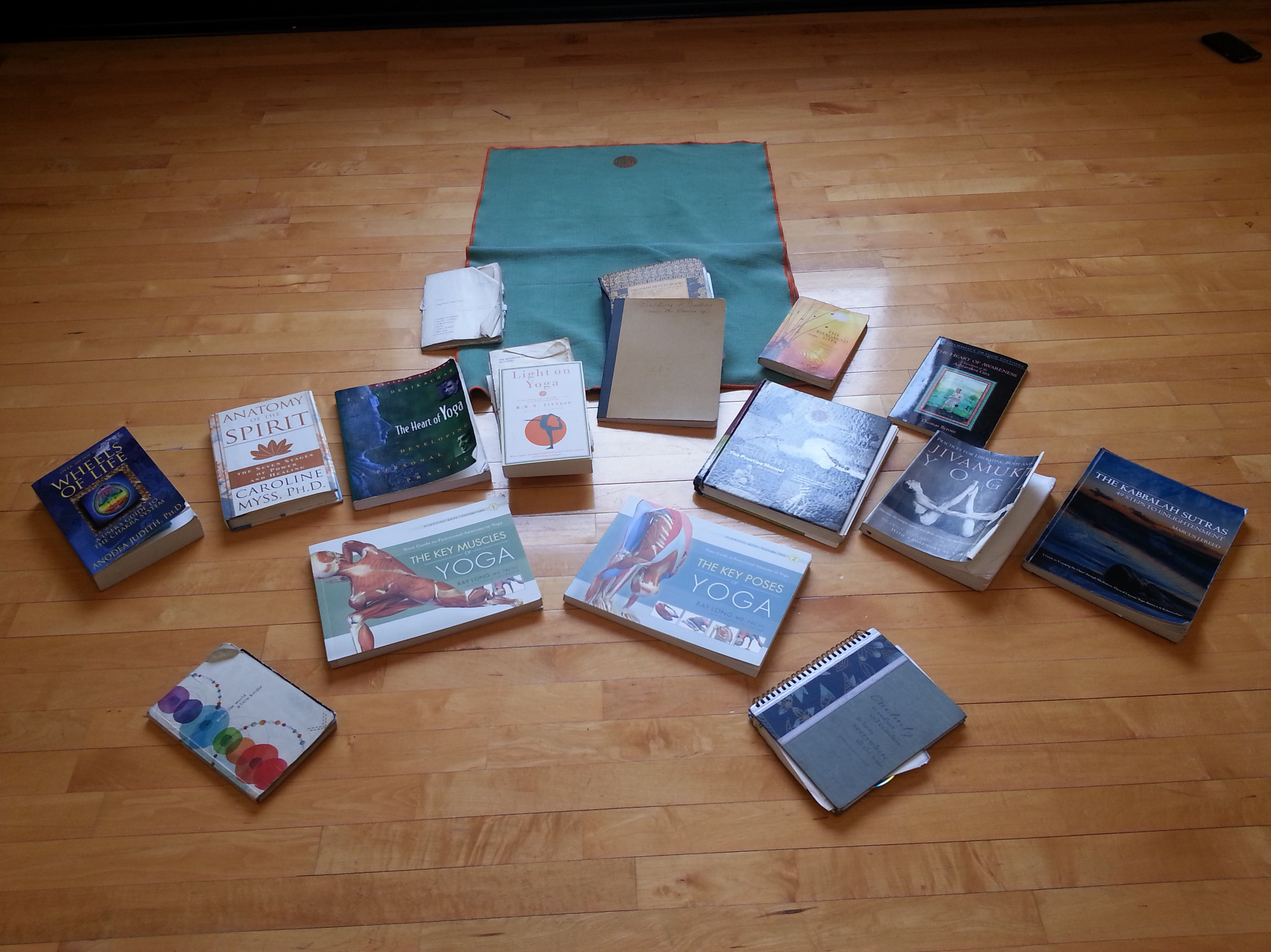
(NOTE: The picture above is missing Leslie Kaminoff’s Yoga Anatomy, Steve Ross’s Happy Yoga, Stephen Cope’s The Wisdom of Yoga, all my Yin Yoga and Taoist texts, a copy of the Ramayana, and Alanna Kaivalya’s Myths of the Asanas, at the very least.)
“Form follows function – that has been misunderstood. Form and function should be one, joined in a spiritual union.”
–
“If something is boring after two minutes, try it for four. If still boring, then eight. Then sixteen. Then thirty-two. Eventually one discovers that it is not boring at all.”
–
Saturday mornings at the Y, just like any morning, is a great time to explore the physical and philosophical practice of yoga. However, I am partial to my Saturdays since I have 90 minutes to engage in the practice of exploration. For the last few years, I have started the new year with a “Building From the Ground Up” sequence – each Saturday adding more poses and another layer of the philosophy. Sometimes I still tie-in a meditation point specific to the date, and to whatever aspect of the philosophy is on tap for the day. Sometimes, however, it’s just straight philosophy and an opportunity to consider the meditation through movement. Whatever I plan for the year, usually wraps up around the end of July – when we start breaking down a different physical practice, the Ashtanga Primary Series.
This year, philosophically, I decided to sequentially move through Patanjali’s Yoga Sutras. Each week breaking down a sutra with commentary. (This week will be YS 1.31.) Physically, we have been breaking down a course of poses outlined by B. K. S. Iyengar in Light On Yoga.
The Saturday class is not an Iyengar class; however, (as teachers like Seane Corn have pointed out) if you are going to practice vinyasa, it’s a good idea to practice Iyengar as it will give you the solid foundation and insight into the asanas (poses).
Iyengar’s Course I is 30 weeks of detailed practice, specifically intended to build a physical practice from the ground up. While they are not limbs themselves, abhyasa (continuous practice with devotion) and vairagya (actively practicing the art of letting go or non-attachment) definitely make up the fertile soil from which the 8-limbs of yoga grow and thrive. And, they are key elements to the courses that appear in the appendix of Light On Yoga. At first, each set of poses is practiced for two (2) weeks before additional poses are added to the sequence. Later, some sequences are repeated for three (3) or four (4) weeks – and sometimes the order of the sequence changes. The 30-week course is followed by a 3-day course, which is slightly different from the 30-day course since the asanas are timed. Finally, there is some guidance on adding sun salutations (surya namaskar) to the physical practice and a list entitled “Important asanas in Course I.”
“If these asanas are mastered then the others given in this course will come even without regular practice.
– B. K. S. Iyengar writing about the “Impostant asanas in Course I”
The important asanas list, when followed by the sun salutations, looks and feels a lot like one of the first vinyasa practices to appear in the West, the Ashtanga Primary Series introduced to Sri Pattabhi Jois. This is not a random coincidence. While Iyengar and Jois were in very different physical/health conditions when they started practicing yoga, they practiced at the same time and with the same teacher: Sri Krishnamacharya. The practices they introduced to the West – just like the physical practices introduced by some of Krishnamacharya’s other students (including Indra Devi, T. K. V. Desikichar, and A. G. Mohan) reflect their own personal practices – which were the result of the physical and mental needs. Remember, classically, the physical practice of yoga (hatha yoga, regardless of the style or tradition) prepares the practitioner for deep-seated meditation. Ergo, even though they might practice the same poses, a very sickly young boy may use a different method of practice than a very active teenage boy.
(Side Note: It is also not a random coincidence that we generally start exploring the Ashtanga Primary series at the end of July: instead the timing coincides with the birthday of Sri Pattabhi Jois.)
YMCA classes are always open to members and their guests. If you are a member, please feel free to join us for class at any time throughout the year – and, feel free to bring a guest.
For further reading, check out Light on Yoga by B. K. S. Iyengar; Heart of Yoga by T. K. V. Desikichar; Ashtanga Yoga the Practice Manual by David Swenson; The Secret of the Yoga Sutra: Samadhi Pada by Pandit Rajmani Tigunait, PhD (Note: This is Part 1 of a series and only includes the first section of the sutras. There are many translations of the sutras, a great online resource is Patanjali’s Yoga Sutras on swamij.com.)
 A Joyful Practice