WARNING: There are no explicit details in this post, but there are references that may trigger trauma.
“Quedé viva para contarles la historia.” [“I stayed alive to tell the story.”]
— Dedé Mirabal, author of Vivas en su Jardín
“Since the outbreak of COVID-19, emerging data and reports from those on the front lines, have shown that all types of violence against women and girls, particularly domestic violence, has intensified.
This is the Shadow Pandemic growing amidst the COVID-19 crisis and we need a global collective effort to stop it. As COVID-19 cases continue to strain health services, essential services, such as domestic violence shelters and helplines, have reached capacity. More needs to be done to prioritize addressing violence against women in COVID-19 response and recovery efforts.”
— quoted from the United Nations website for International Day for the Elimination of Violence against Women (2020 #OrangetheWorld)
There’s nothing pretty about violence — and statistics about violence against women are particularly ugly. 1 in 3 women, worldwide experience physical or sexual violence. Prior to 2020, about 243 million women and girls (ages 15 – 49) reported experiencing sexual and/or physical abuse by an intimate partner within a 12-month period. That number has gone up during the COVID-19 pandemic and, in some countries, hotline and emergency calls regarding domestic abuse increased to 5 times the average numbers. The United Nations Educational, Scientific and Cultural Organization (UNESCO) considers violence against women and girls (VAWG) a human rights violation — in fact, they consider it “one of the most widespread, persistent and devastating human violations in our world today.”
To combat this violence (and the accompanying stigma) that can manifest physically, sexually, and psychological – and that happens to people around the world regardless of education, socioeconomic status, race, ethnicity, age, health, or nationality — UNESCO designated November 25th as the International Day for the Elimination of Violence against Women. The 2020 theme is “Orange the World: Fund, Respond, Prevent, Collect!” and focuses on “amplifying the call for global action to bridge funding gaps, ensure essential services for survivors of violence during the pandemic, [prevention measures,] and collection of data that can improve life-saving services for women and girls.” Today’s observation kicks off “16 Days of Activism against Gender-Based Violence” which culminates with International Human Rights Day on December 10th.
“For the purposes of this Declaration, the term “violence against women” means any act of gender-based violence that results in, or is likely to result in, physical, sexual or psychological harm or suffering to women, including threats of such acts, coercion or arbitrary deprivation of liberty, whether occurring in public or in private life.”
— “Article 1” of the Declaration on the Elimination of Violence Against Women, issued by the United Nations General Assembly, December 20, 1993
When UNESCO started observing the International Day for the Elimination of Violence against Women in 1999, November 25th wasn’t randomly selected because it was 16 days before International Human Rights Day. Today was specifically selected to honor the lives and legacy of the Mirabal sisters (Las Hermanas Mirabal), three of whom were assassinated today in 1960.
Patria Mercedes Mirabal Reyes, Bélgica “Dedé” Adela Mirabal Reyes, María Argentina Minerva Mirabal Reyes (known as Minerva), and Antonia María Teresa Mirabal Reyes (known as María Teresa) were married, Catholic-educated young mothers who had been raised in a middle-class household in the Dominican Republic. Three of the sisters (Patria, Minerva, and María Teresa) were also college educated professionals who actively and publicly opposed the dictator Rafael Trujillo (known as El Jefe), who’s fascist regime lasted 31 years.
“We cannot allow our children to grow up in this corrupt and tyrannical regime. We have to fight against it, and I am willing to give up everything, even my life if necessary”
— Patria Mirabal Reyes
The sisters became known as Las Mariposas (“The Butterflies”) and they (and their husbands) were often harassed and even incarcerated because of their activism. There were many activists who spoke out against the dictator before the sisters — including organizers of the “Movement of the Fourteenth of June” and the sisters’ own uncle. But part of the reason the sisters (and their husbands) may have been targeted was because Minerva had turned down Trujillo’s sexual advances when she was in her early 20’s.
International attention on their plight may have saved Minerva and María Teresa from being tortured during their last incarceration — and definitely led to them being released. Their high profile, however, did not secure the release of their husbands. It also did not save them. As they returned from a visit to the prison where two of their husbands were being held, Patria, Minerva, María Teresa, and their driver Rufino de la Cruz were stopped by people associated with Trujillo’s regime (including members of his secret police force). There was an attempt to make their murders look like a car accident, but evidence to the contrary was very obvious.
Dedé, the surviving sister lived to the age of 88. She was also the only one of the sisters who did not go to college and the only one who did not publicly participate in the resistance. She was a “traditional” homemaker who also took care of the family business. After her sisters were murdered, she continued to take care of their children and started the Mirabal Sisters Foundation. She also turned the home they last lived in together into a museum and wrote a book, Vivas en su Jardín, as she saw that her legacy was to preserve herstory.
“Perhaps what we have most near is death, but that idea does not frighten me. We shall continue to fight for that which is just.”
— María Teresa Mirabel Reyes
“If they kill me, I’ll reach my arms out from the tomb and I’ll be stronger.”
— Minerva Mirabel Reyes
If you see a building or landmark being “oranged” in the next few days, it is a reminder of campaign against gender-based violence and a reminder of the importance of everyone coming together to promote a violence-free world. Curious about why the color for International Day for the Elimination of Violence against Women is orange. I thought maybe it would be tied to the symbol of the butterfly, but I could only find a UNESCO site that says “The color orange symbolizes a bright future, free of violence. It also serves as a means of demonstrating your solidarity in eliminating all forms of violence and…. As a show of solidarity, the UNESCO globe will be illuminated orange.”
Of course, the reason I was curious about the color choice is because in yoga and Áyurveda, as they come to us from India, orange is associated with the second chakra — which is the energetic center of our relationships. From the yoga perspective, our mind-bodies are a microcosm representing the macrocosm that is the world. So, from the yoga perspective, physical, mental, emotional, energetic, and spiritual healing begins on the inside and if we want to truly “orange” the world, we must find a way to physically, emotionally, and energetically honor a sacred truth.
“Sacred Truth: Honor one another. Every relationship you develop, from casual to intimate, helps you become more conscious. No union is without spiritual value.”
— from “Morning Visual Meditation” by Caroline Myss
Please join me today (Wednesday, November 25th) at 4:30 PM or 7:15 PM for a yoga practice on Zoom. Use the link from the “Class Schedules” calendar if you run into any problems checking into the class. You will need to register for the 7:15 PM class if you have not already done so. Give yourself extra time to log in if you have not upgraded to Zoom 5.0. You can request an audio recording of this practice via a comment below or by emailing myra (at) ajoyfulpractice.com.
Wednesday’s playlist is available on YouTube and Spotify. [Look for “Mother’s Day 2020”]
In the spirit of generosity (“dana”), the Zoom classes, recordings, and blog posts are freely given and freely received. If you are able to support these teachings, please do so as your heart moves you. (NOTE: You can donate even if you are “attending” a practice that is not designated as a “Common Ground Meditation Center” practice, or you can purchase class(es). Donations are tax deductible; class purchases are not necessarily deductible.)
“Article 2
Violence against women shall be understood to encompass, but not be limited to, the following:
(a) Physical, sexual and psychological violence occurring in the family, including battering, sexual abuse of female children in the household, dowry-related violence, marital rape, female genital mutilation and other traditional practices harmful to women, non-spousal violence and violence related to exploitation;
(b) Physical, sexual and psychological violence occurring within the general community, including rape, sexual abuse, sexual harassment and intimidation at work, in educational institutions and elsewhere, trafficking in women and forced prostitution;
(c) Physical, sexual and psychological violence perpetrated or condoned by the State, wherever it occurs.
Article 3
Women are entitled to the equal enjoyment and protection of all human rights and fundamental freedoms in the political, economic, social, cultural, civil or any other field. These rights include, inter alia:
(a) The right to life;
(b) The right to equality;
(c) The right to liberty and security of person;
(d) The right to equal protection under the law;
(e) The right to be free from all forms of discrimination;
(f) The right to the highest standard attainable of physical and mental health;
(g) The right to just and favourable conditions of work;
(h) The right not to be subjected to torture, or other cruel, inhuman or degrading treatment or punishment.”
— quoted from the Declaration on the Elimination of Violence Against Women, issued by the United Nations General Assembly, December 20, 1993
– “When walking in awareness of the highest reality is firmly established, then great strength, capacity, or vitality (‘virya’) is acquired.”
So, just to be up front, I’m not going to spend a lot of time talking about sex today.
As a point of clarification, I will point out that when many people in the West talk about brahmacarya, the fourth yamā (“restraint” or universal commandment) they talk about it as celibacy – which is more of an effect of the practice than the practice itself. This idea occurs, first, because it is hard to see the practice. Since it is hard to see what is going on inside of someone’s head and heart, we look to see the outward effect and, in this case, it means that the Sanskrit is sometimes translated as “continence,” which is the control of one’s bodily fluids; specifically as it relates to the bladder and bowels. Then the explanation gets extended to fluid exchanged during sex. This is all relevant; however, it’s also like saying monks shave their heads so they don’t have to wash their hair.
In truth, brahmacarya is more literally translated as “following G-d” or “chasing G-d.” I, more often than not, will explain it as conducting one’s self with the awareness that everyone and everything are connected. In other words, the fourth external restraint or universal commandment is to think, speak, and act justly and divinely.
So, today, I’m going to talk about a couple of people who lived their lives justly (even righteously) and divinely – and with an awareness of how we are all connected. The fact that one of these individuals was Jewish and that some believe the other should be recognized by Yad Vashem (The World Holocaust Remembrance Center) as “Righteous Among Nations” is not a coincidence. According to the Jewish tradition, today is Rosh Hashanah, “the Head of the Year” and the beginning of the High Holidays, also known as the “Ten Days of Awe” or “Ten Days of Repentance” which culminate with Yom Kippur, the Day of Atonement. It is one of the holiest of times on the Jewish calendar. Additionally, for many around the world, it is the only time during the year when they attend services. It is a time of reflection, remembrance, and repentance.
It is also a time of preparation…. But we’ll get to that in a moment.
First, we remember: “The Notorious R. B. G.” – Ruth Bader Ginsburg of the Supreme Court of the United States (SCOTUS), who died yesterday (Friday, September 18th) and Calvary Captain Witold Pilecki (also known as Tomasz Serafiński) who allowed himself to be captured by the Nazis today in 1940, in order to report the truth about what was going on in concentration camps like Auschwitz.
Let’s start with Calvary Captain Pilecki, who served as an officer in the Polish Army during the Polish-Soviet War (1919 – 1920) and during World War II. As part of the Resistance to Nazi Occupied Poland, he co-founded the Secret Polish Army (along with Lieutenant Colonel Jan Henryk “Darwicz” Włodarkiewicz and Lieutenant Colonel Władysław “Stefan” Surmacki ), which eventually became part of the Home Army. When Germany invaded Poland at the end of 1939, very little was known about the concentration camps, but Captail Pilecki had a plan. His idea, which was approved by his Polish Army superiors, was to come out of hiding during a Warsaw roundup in order to be arrested and shipped to Auschwitz, where he could organize the resistance and report on the situation from the inside.
“I’ve been trying to live my life so that in the hour of my death I would rather feel joy, than fear.”
– Witold Pilecki’s statement to the judge after his sentencing, May 15, 1948
He was given a false identity card and was arrested on September 19, 1940. Arrested with him were 2,000 civilians, including journalist and historian Władysław Bartoszewski (who was designated “Righteous Among Nations” in 1965). After being detained for two days, “Tomasz Serafiński” was assigned number 4859 and shipped to Auschwitz, where he would document the difference between the way the Nazis treated Jewish people versus non-Jewish people and the escalating move towards genocide. During his two and a half years at Auschwitz, Witold Pilecki would form Union of Military Organizations (ZOW), a resistance organization within the camp, which set up intelligence networks; distributed extra food, clothing, and medical supplies; boosted morale; and prepared for a possible Home Army coup. At one point, ZOW was even able to construct and use a secret radio receiver and help at least 4 Polish men escape (with one of Witold’s reports).
“Witold’s Report” (also known as “Pilecki’s Report”) was information that was regularly smuggled through the Polish resistance to London and even to the British government. It provided the outside world with the first “official” documentation of the Nazi’s atrocities. For much of the war, however, the reports of genocide were considered too unbelievable. As the Nazi’s plans became more and more obvious, and as his calls for the Allies to bomb the camps were denied, Captain Pilecki realized he was running out of time. He was receiving word from the outside that the Allies supported the idea of a prisoner insurrection –which he too had one time suggested. However, by 1943, those inside were too weakened to mount an attack. He thought could be more convincing in person, so he put a new plan in motion.
After he escaped in April 1943, Captain Pilecki wrote “Report W,” outlining the conditions of the camps, as well as details about the gas chambers, the selection process, the crematorias, and the sterilization experiments. His report was signed by other escapees and included the names of ZOW members. He continued to work and organize the resistance, while also expanding “Report W.” He participated in the Warsaw Uprising and was reassigned to Italy, but eventually returned to Communist-controlled Poland. In May of 1947, he was arrested by Communist government and tortured, but he would not reveal other members of the resistance. He was eventually “tried” and executed. His most comprehensive version of the “W Report” (from 1945) was published in 2012 as The Auschwitz Volunteer: Beyond Bravery and his life has been the subject of a number of books, songs, and articles.
“Who will be calm and who will be tormented? Who will become poor and who will get rich? Who will be made humble and who will be raised up? But teshuvah and tefillah and tzedakah [return and prayer and righteous acts] deflect the evil of the decree.”
– quoted from the poem “Unetaneh Tokef” (“Let Us Speak of the Awesomeness”)
Even if you are not Jewish, even if you’ve never attended services during the High Holidays, there’s a good chance you’ve heard some of the words from the liturgical poem “Unetaneh Tokef” (“Let Us Speak of the Awesomeness”). It begins with the belief that on Rosh Hashanah G-d writes people’s names and fates in the “Book of Life” and that book is sealed on Yom Kippur. Then there is a litany of fates. Some people will go to services specifically to hear the poem, some will avoid it (as parts are explicit and can be triggering). Many of the fates are included in a beautifully haunting song by a young Leonard Cohen – which will stick with you! However, outside of the tradition, people don’t really focus on the end of the poem, which highlights the fact that (in theory) we have 10 days to ensure our name and fate are sealed favorably. The end of the poem outlines three key elements to the observation of this holiest of times. These three key elements can also be described as key elements to living a good life.
Supreme Court of the United States Justice Ruth Bader Ginsburg lived a good life. She was a trailblazer who’s life, legacy, and style –as a lawyer, a judge, a woman, a working mom, a wife, and a fitness wonder – is the reason she’s “notorious.” She had the ability to stay open-minded, even when her mind was made up, and to hear out people with opposing views. “We are different, we are one,” a line from the opera Scalia/Ginsberg, perfectly sums up her close friendship with the ultra conservative Supreme Court Justice Antonin Scalia and also her approach to how the law should be applied. In some ways, she was small, quiet, and unassuming. In other ways, she was larger-than-life,” determined to keep dreams alive,” and defiantly righteous.
She had what can best be described as “the ultimate partnership” or “an atypical 1950’s marriage” with her husband Martin “Marty” Ginsburg. During their 56 years of marriage (until his cancer-related death), they raised a family while she made sure he graduated from law school despite his first bout with cancer and he campaigned for her to be nominated to the federal court and SCOTUS. She was the highest ranking woman in her graduating class at Cornell University and only one of nine women (with about 500 men) enrolled at Harvard Law School in 1956. She had made Harvard Law Review, transferred and graduated (at the top of her class) from Columbia Law School, taught law at a major university, argued before the Supreme Court, and endured anti-Semitism and sexism by the time her name was put on the short list for the Supreme Court. She was the second woman and the first Jewish woman appointed to SCOTUS and one of eight Jewish justices who have severed on the USA’s highest court.
“I have a last thank you. It is to my mother, Celia Amster Bader, the bravest and strongest person I have ever known, who was taken from me much too soon. I pray that I may be all that she would have been had she lived in an age when women could aspire and achieve, and daughters are cherished as much as sons.”
– quoted from Justice Ruth Bader Ginsburg’s SCOTUS nomination speech, June 14, 1993
Celia Bader died of cancer when the young high school cheerleader known as “Kiki Bader” was just about to graduate from high school. Because she was a girl, the young teen was excluded from some of the traditional Jewish mourning rituals – a fact that would fuel her desire to see change in the world. While she did, eventually, turn back to the faith of her youth, I don’t know how devout Supreme Court Justice Ruth Bader Ginsburg was; so I don’t know for sure the part that prayer played in her life. As to the other two elements, however, we see them again and again in her story.
Teshuvah is Hebrew for “return” and also “repentance.” In truth, the two translations go hand-on-hand, because to repent is to return to G-d, community, your true self. First as a Civil Rights lawyer for the American Civil Liberties Union (ACLU) and then as a Supreme Court Justice, Ruth Bader Ginsburg was in the business of returning to the spirit of the law and the Constitution. She was also in the business of giving people, companies, and the country an opportunity to be better than the worst versions of ourselves. Many people find it ironic that so much of her early work, work that strengthened the rights of women, was actually on behalf of men. To me, though, that work is reminiscent of Captain Witold Pilecki, who wrote, “When marching along the gray road towards the tannery in a column raising clouds of dust, one saw the beautiful red light of the dawn shining on the white flowers in the orchards and on the trees by the roadside, or on the return journey we would encounter young couples out walking, breathing in the beauty of springtime, or women peacefully pushing their children in prams — then the thought uncomfortably bouncing around one’s brain would arise . . . swirling around, stubbornly seeking some solution to the insoluble question: Were we all . . . people?”
“I tell law students… if you are going to be a lawyer and just practice your profession, you have a skill—very much like a plumber. But if you want to be a true professional, you will do something outside yourself… something that makes life a little better for people less fortunate than you.”
– United States Supreme Court Justice Ruth Bader Ginsburg (quoted from The Mercury News, Feb. 6, 2017)
Tzedakah is a Hebrew word that can be translated as “righteousness,” “righteous acts,” or “charity” and comes from the word tzedek, which means “righteousness,” “fairness,” and “justice.” Now, Biblically speaking, references to charity are related to harvests. While it is easy to see how helping someone less fortunate is righteous; how is it justice? The answer is found in The Notorious RBG’s own words and actions. The answer is also found in Jewish tradition where there is an obligation to do what one can to “heal” or “repair” the world – and there is no arguing that Justice Bader Ginsburg did her part. Again and again, she worked to fix what was broken in our legal system and ultimately in our adherence to the spirit of the Constitution.
“You shall set up judges and law enforcement officials for yourself in all your cities that the Lord, your God, is giving you, for your tribes, and they shall judge the people [with] righteous judgment.
You shall not pervert justice; you shall not show favoritism, and you shall not take a bribe, for bribery blinds the eyes of the wise and perverts just words.
Justice, justice shall you pursue, that you may live and possess the land the Lord, your God, is giving you.”
– Devarim – Deuteronomy (16:18 – 20)
Pardon me, while we jump to October.
In the Hebrew Bible and the Christian Old Testament, the book of Deuteronomy contains a list of observations commanded by G-d. They are pretty specific and in chronological order. Then, at the end of the list, after Sukkot, the “Festival of Booths” – which includes the commandment not to come empty-handed – there is an interesting passage that is directly tied to being blessed. And, that order to establish a fair and justice society are the words Supreme Court Justice Ruth Bader Ginsberg had in her office: “Zedek, zedel, tirdof” (“Justice, justice, shall you pursue”).
Out of context, the words seem simple and obvious. Of course, those words would resonate with a world-renowned judicial expert, But, go back; look again. What the Bible tells us is that we have an obligation, a responsibility, to pursue what is just and fair. Go back; look again at the poem. The poem tells is that our fate is sealed (in a positive way) when our thoughts, words, and deeds are in pursuit of what is fair and right. Not for a second did the Brooklyn-born and raised R. B. G. take those words for granted.
Sunrise
Sunset
In my family’s religious and cultural tradition, a person’s birth is marked as “sunrise” and their physical death is marked as “sunset.” Growing up, I was also surrounded by people – Jewish people – who’s new day dawned at as the sun set. The dichotomy was always oddly beautiful to me: a reminder that something is always beginning as something ends. For obvious reasons, I felt sick when I heard that Justice Bader Ginsburg would not be going into the New Year with us. Like my maternal grandmother, she battled cancer for a long time and so, sad as I am for her family, her friends, and the world, I am grateful she no longer has to deal with the pain.
There are many people, from many demographics, that may be asking, why right now; trying to make sense of something that is hard to believe. I think, though, that this is not the time to question or reason. This is a time to celebrate and grieve. Celebrate a woman who was blessed with an inspirational life. Remember how she lived in a way that defied convention and established a way of being that some people take for granted. But, never take it for granted. Plan how you can live life on your terms – in a way that is fair and justice, righteous and inspiring. Divine.
“… don’t give way to emotions that sap your energy, like anger. Take a deep breath and speak calmly.”
– Supreme Court Justice Ruth Bader Ginsberg, sharing advice from her mother, in a 2016 “CBS Sunday Morning” interview with Jane Pauley
This week’s sūtra indicates that there is power in following in the footsteps of the divine. Another translation, however, indicates that when we achieve that power (from following in the footsteps of the divine) we have “the capacity to transmit knowledge.” The Notorious R. B. G. did both. In 2016, she not only share wisdom from her mother, Celia, but also mentioned advice from Justice Sandra Day O’Connor (the first woman on the high court) who essentially shared the secret to serving on the high court while dealing with cancer: use your time wisely.
When we look back, we can clearly see that the Notorious R. B. G. spent her whole life following good advice, while transmitting knowledge and wisdom. Let’s do the same; and move forward.
“Dissents speak to a future age. It’s not simply to say, ‘My colleagues are wrong and I would do it this way.’ But the greatest dissents do become court opinions and gradually over time their views become the dominant view. So that’s the dissenter’s hope: that they are writing not for today, but for tomorrow.”
– Supreme Court Justice Ruth Bader Ginsberg in a 2002 interview with NPR
Please join me for a 90-minute virtual yoga practice on Zoom today (Saturday, September 19th) at 12:00 PM. You can use the link from the “Class Schedules” calendar if you run into any problems checking into the class. Give yourself extra time to log in if you have not upgraded to Zoom 5.0.
You can request an audio recording of this practice via a comment below or (for a slightly faster reply) you can email me at myra (at) ajoyfulpractice.com.
“We have a vibrant and energetic body and are firm and confident.”
– commentary on Yoga Sūtra 2.38 from The Practice of the Yoga Sūtra: Sadhana Pada by Pandit Rajmani Tigunait, PhD
Everything gives rise to its opposite, therefore we work without conscious effort and teach without agenda.
We enjoy everything and possess nothing.
Our accomplishments do not emerge from our ego, so we do not cling to them.
Thus they benefit all beings.”
– (2) quoted from A Path and A Practice: Using Lao-tzu’s Tao Te Ching as a Guide to an Awakened Spiritual Life by William Martin
A few months back, I posted about chaos theory; and if you watch one of the pendulum models (see below it can seem like so much craziness. However, when faced with so much confusion, I have to remind myself of the following:
we’ve seen this pattern before;
it makes no sense if you get caught up in the momentum;
all the movement is, in fact, moving towards stillness;
and that, from the perspective of natural law, there is a moment when all of the movement is, in fact, “effortless effort.”
As someone with a type-A personality, I sometimes struggle with the idea of “effortless effort.” Don’t get me wrong; I can be still, I can relax. However, there are certain times where “doing nothing” feels like the wrong choice. I’ve been conditioned and socialized to believe this. Many in the Western world have been conditioned and socialized to believe this. But, not doing is still doing and “effortless effort” is not the same as doing nothing. In fact, sometimes, it takes a great deal of effort to let go.
In a 2009 blog post, Meditation Oasis (Mary and Richard Maddux) refers to a the Wikipedia description of “Wu Wei” – which literally means “not-doing doing” – as “’natural action’ giving the example of a tree growing. It is doing growing, and yet it is not doing.” This makes me think of Alan Watts meditation where he describes breathing as something that happens to us, but also something we can engage – and, once engaged, it is something we do deeply without effort. Meditation is like this. Life is like this too, and Taoist philosophy points to “Wu Wei” as a way to act and/or experience action in daily life. On Meditation Oasis’s blog, they describe meditation as “the art of allowing the mind to experience a natural state.” This too, is what Patanjali advocates in the Yoga Sūtras, “resting in your own true nature.” (YS 1.3)
“The most fluid and yielding substance will flow past the most rigid with the speed of a racehorse.
That which does not hold a particular form can enter even that which seems impenetrable.
This is why we practice “effortless effort.”
We act without ado.
We teach without arguments.
This is the way of true happiness, but because people prefer distractions and noise, it is not a popular way.”
– (43) quoted from A Path and A Practice: Using Lao-tzu’s Tao Te Ching as a Guide to an Awakened Spiritual Life by William Martin
In commentary on wu-wei, Dr. Martin says, “This phrase implies pure action in the present moment without any accompanying resistance, second-guessing, or worry. In the practice of wu-wei we just “do what we do.” The more awareness and acceptance we bring to the present moment, the more wu-wei is possible. This can take the form of either energetic activity or relaxed waiting. Like acceptance, wu-wei is not passive….” The sounds great, but I wonder how it works in situations where things are steadily spiraling out of control, where there is deadly chaos and we can’t seem to find the center point. I think of Dr. Martin Luther King paraphrasing the abolitionist minister Theodore Parker and am reminded that we have to bend the arc. But, how do we do that without more harm? How do we do that with ‘effortless effort?”
“I do not pretend to understand the moral universe. The arc is a long one. My eye reaches but little ways. I cannot calculate the curve and complete the figure by experience of sight. I can divine it by conscience. And from what I see I am sure it bends toward justice.”
– quoted from an 1853 sermon by Theodore Parker
Dr. William Martin wrote a book on the Tao and activism, which I have not read yet. However, Eastern philosophies like Taoism, Buddhism, and Yoga are philosophies that encourage experiencing the present moment – which requires stillness. So, today we are going to move into stillness.
Please join me today (Tuesday, September 1st) at 12 Noon or 7:15 PM for a virtual yoga practice on Zoom, where we will do what we do. Use the link from the “Class Schedules” calendar if you run into any problems checking into the class. Give yourself extra time to log in if you have not upgraded to Zoom 5.0. You can request an audio recording of this practice via a comment below.
Tuesday’s playlist is available on YouTube and Spotify. (Today’s playlist is dated March 29th or 03292020.)
“‘Keep, ancient lands, your storied pomp!’ cries she
With silent lips. ‘Give me your tired, your poor,
Your huddled masses yearning to breathe free,
The wretched refuse of your teeming shore.
Send these, the homeless, tempest-tost to me,
I lift my lamp beside the golden door!’”
– from the poem “The New Colossus” by Emma Lazarus
Today (August 5th) in 1884, when the cornerstone of the Statue of Liberty’s pedestal was placed on a rainy Bedloe’s Island, it seemed impossible to complete the project meant to be a testament to freedom, friendship, and the spirit of the people. People in France provided the funds for the statue designed by the sculptor Frédéric-Auguste Bartholdi (with scaffolding created by Gustave Eiffel), while people in the United States were meant to pay for the base and pedestal designed by Richard Morris Hunt. The only problem was that the Americans were short…about $100,000 short.
Hunt’s design for the pedestal and base incorporated the eleven-point star foundation of the army fort (Fort Wood) which had been built in 1807 and abandoned during the Civil War. He always intended his design to be simple, so as not to take away from the statue itself, but raising money for his design turned out to be such a challenge that he scrapped twenty-five feet from the height of his original design. He also cut back on materials so that instead of the pedestal and base being constructed entirely out of granite, he had to make do with concrete walls covered with a granite-block face. His cost cutting measures still might not have been enough if a certain newspaper man hadn’t decided to tap into the spirit of the people and, in doing so, overcame what some viewed as an impossible obstacle. That newspaper man was Joseph Pulitzer and on March 16, 1885 he implored people in the United States to give what they could, even if it was a penny, in order to pay for the base and pedestal of the Statue of Liberty. Starting with an ad and a series of front page editorials, he was able to crowd fund over $100,000 in about 5 months.
“We must raise the money! The World is the people’s paper, and now it appeals to the people to come forward and raise the money. The $250,000 that the making of the Statue cost was paid in by the masses of the French people – by the working men, the tradesmen, the shop girls, the artisans – by all, irrespective of class or condition. Let us respond in like manner. Let us not wait for the millionaires to give us this money. It is not a gift from the millionaires of France to the millionaires of America, but a gift of the whole people of France to the whole people of America.
Take this appeal to yourself personally. It is meant for every reader of The World. Give something, however little. Send it to us. We will receive it and see that it is properly applied.”
– quoted from The New York World editorial by Joseph Pulitzer, 1885
Joseph Pulitzer offered people a six inch metal replica of Lady Liberty (described as a “perfect fac-simile”) if they donated a dollar to the “Pedestal Fund” established by Pulitzer’s paper the New York World and a twelve inch replica if they donated $5. While that may not seem like a lot today, keep in mind that this was after the Financial Panic of 1873 (which created a depression in the United States and Europe). Also, interest seemed to be in short supply since the United States was still trying to recover from the Civil War – which left many Americans desiring heroic public art rather than allegorical public art. But, Joseph Pulitzer had a way with words and there were a group of people – immigrants – who were inspired to donate specifically because of the symbolism of the statue. Ultimately, over 125,000 people donated – most donating a dollar or less. They not only donated to receive the replicas, they donated via auctions, lotteries, and boxing matches. They donated by depriving themselves of things they needed or things they wanted. Some kids donated by pooling their “circus” and candy money. Some adults donated what they would normally spend on drinks. At the end of the fundraising, Joseph Pulitzer printed every donor’s name in the New York World – regardless of how little or how much they donated.
The cornerstone is the first stone set in the foundation of a building or structure. All other stones are set in reference to the cornerstone; thereby making it the very foundation of the foundation. It determines the overall position of the structure and is often placed with a certain amount of pomp and circumstance. It is usually inscribed with the date of its placement and often includes a time capsule, which includes some clues as to what was important to the people who attended the ceremony. Such was the case with Lady Liberty’s pedestal cornerstone, which was placed over a square hole dug for a copper time capsule. The time capsule contained a number of articles, including the Declaration of Independence and the Constitution of the United States – both documents considered to be the cornerstones of the United States and the ultimate law of the land.
Although we don’t always think of it this way, one of the cornerstones of the legal system in a commonwealth is a bar. It might be wooden railing, it might be metal railing; however, historically, this bar separated those within the legal profession (specifically the judge and those who had business with the court) from everyone else. In particular, “everyone else” referred to law students whose aspirations were to “pass the bar” – meaning they would be on the other side of the symbolic railing. This symbolic railing is also used to refer to professional organizations, membership in which is sometimes required in order for an attorney to practice law in a particular jurisdiction. Let’s skip “state bars” for a second and just focus on “voluntary” bar associations – which, in the United States are private organizations which serve as social, educational, and lobbying organizations. Legal professionals can not only use these bar associations to network with other professionals and the general public (hence expanding their practice), they can also advocate for law reform. I place “voluntary” in quotes, because I’m not sure how possible it is to practice law in the United States without being a member of a “bar association” (not to be confused with a state bar).
Even if it’s possible to practice without being a member of a bar association – and I trust one of you lawyer yogis will educate me with a comment below – I imagine it would be quite challenging (maybe even impossible) to successfully practice. Especially, back when there was only one major bar association in the United States. And, especially back in the 1920’s when your race and gender prevented you from joining said association. Such was the plight of Gertrude Rush (née Durden), born today (August 5th) in 1880 in Navasota, Texas. Ms. Rush not only became the first African-American woman to be admitted to the Iowa (state) bar, for about 32 years she was (sometimes) the ONLY female attorney practicing in the state of Iowa (1918 – 1950). She placed a particular emphasis on women’s (legal) rights in estate cases and had a passion for religion, extensively studying the 240 women whose stories are featured in the Bible. Many within the local court referred to her as the “Sunday school lawyer.” She took over her husband’s law practice and, in 1921 (just a year after women’s right to vote was ratified by the United States Congress) she was elected the president of the Colored Bar Association; however, it was impossible for her to be admitted to the American Bar Association. She tried. So, did several other African-American lawyers. They tried because the ABA had one Black lawyer and was, therefore “integrated.” Eventually, however, they stopped trying to join an organization that didn’t want them and started their own organization.
“…a very worn Bible is almost as prominent as the well-thumbed Iowa code on the desk of Mrs. Gertrude E. Rush.”
– quoted from “Iowa’s Only Negro Woman Lawyer Firmly on the Golden Rule” article about Gertrude Rush, located in Iowa Public Library (excerpt printed in Notable Black American Women, Book 2 by Jessie Carney Smith
Gertrude Rush was one of the founding members of the Negro Bar Association, which was incorporated on August 1, 1925 with 120 members (which was about 11 – 12% of the Black lawyers in the US at the time). Eventually renamed, the National Bar Association, the NBA ” addressed issues such as professional ethics, legal education, and uniform state laws, as well as questions concerning the civil rights movement in transportation discrimination, residential segregation, and voting rights.” The NBA supported civil rights groups by providing legal information, filing outside legal briefs (amicus curiae), and blocking federal court nominees who opposed racial equality. As a bar association, however, the NBA did not directly participate in civil rights activities. Instead, NBA members like Gertrude Rush and (eventual) Supreme Court Justice Thurgood Marshall became members of the NAACP (National Association for the Advancement of Colored People).
It was as part of the NAACP’s legal team that Justice Marshall argued cases like Donald Gaines Murray in Murray v. Pearson, 169 Md. 478, 182 A. 590 (1936) and Brown v. Board of Education of Topeka, 347 U.S. 483 (1954). Raymond Pace Alexander founded the National Bar Journal (1941), which became a way for Black lawyers to challenge legal principles which conflicted with the interest of African-Americans. The Rev. W. Harold Flowers, a co-founder with Ms. Rush and a former president of the NBA (who would eventually be appointed as an associate justice of the state Court of Appeals), was the attorney whose motions in 1947 resulted in a reconfigured jury after he pointed out that the Arkansas court had not had a Black juror in 50 years. Additionally, the NBA established free legal clinics in 12 states, thereby creating the foundational cornerstone for the poverty law and legal clinics of today.
Gertrude Rush was also one of the organizers of the Charity League, which coordinated the hiring of a Black probation officer for the Des Moines Juvenile Court; created the Protection Home for Negro Girls, a shelter; and served on the boards of a host of other women’s organizations.
Stay tuned for news about when I will resume classes. If you want to practice with one of the previously recorded classes, I would suggest June 17th (a Lady Liberty class with a lot of arm movement, good for the brain and shoulders – some of you call it a “sobriety test”). The playlist is available on YouTube and Spotify. (The playlist starts with instrumental music. If your Spotify is on shuffle, you will want your music volume low at the beginning of the practice.)
Feel free to email me at Myra (at) ajoyfulpractice.com if you would like a copy of the recordings from Wednesday, June 17th.
As I running late, this August 5th post is actually being published on August 6th, which the anniversary of President Lyndon B. Johnson signing the Voting Rights Act of 1965 into law. The act has been amended at least five times, to close legal loopholes and reinforce the rule of law.
Today, August 6th, is also the anniversary of President Abraham Lincoln signing the Confiscation Act of 1861 and the U. S. bombing of Hiroshima in 1945. President Lincoln wasn’t sure of the legality and effects of the Confiscations Acts of 1861 and 1862, he signed them into law anyway. To this day, people are still debating the effects of the bombings on August 6th and 9th (Nagasaki), both of which clearly broke the Golden Rule (and the not then established Geneva Convention).
As you practice today, hold a neighbor in your hearts and minds with friendship and kindness. Offer your efforts, no matter how small, as a token of that friendship and kindness. As so many people suffer due to current events, may we take a moment to remember those who are still suffering due to our shared past. Let us not forget those who are still grieving and healing from past wounds. May our efforts bring us all closer to peace, harmony, and benevolence.
ERRATA: The original post listed the wrong year for the Statue of Liberty’s cornerstone placement.
“Impossible is just a word thrown around by small men who find it easier to live in the world they’ve been given than to explore the power they have to change it. Impossible is not a fact. It’s an opinion. Impossible is potential. Impossible is temporary. Impossible is nothing.”
– quoted from a 2004 Adidas ad campaign written by Aimee Lehto (with final tag line credited to Boyd Croyner), often attributed to Muhammad Ali
Yesterday I referred to Maria Mitchell as an impossible woman. Back in 2016, thanks to Justin Timberlake quoting Muhammad Ali to a bunch of teens, I started thinking about what it meant to be an impossible person and spent the first week in August highlighting impossible people. Born today in Harlem, New York, in 1924, the author James Baldwin is – by his own words – my second impossible person.
“Given the conditions in this country to be a black writer was impossible. When I was young, people thought you were not so much wicked as sick, they gave up on you. My father didn’t think it was possible—he thought I’d get killed, get murdered. He said I was contesting the white man’s definitions, which was quite right.”
– James Baldwin, quoted from the interview “James Baldwin, The Art of Fiction No. 78” by Jordan Elgrably (printed in The Paris Review, Issue 91, Spring 1984)
Mr. Baldwin’s life (and career) were, in so many ways, shaped by a combination of opinions. There were the opinions of his stepfather David Baldwin (who he referred to as his father) about life in general plus his stepfather’s opinion of how the world would view him, how the world actually viewed him, and his own ideas about what was possible – or, what was necessary. He spent the ages of 14 – 17 following his father’s footsteps into the ministry and then, when his father died, he took a giant leap. He said, “Those were three years [preaching] which probably turned me to writing.”
Leaping into writing was not Mr. Baldwin’s only leap. He leapt across the pond to Paris, France, twice, even as his writing challenged Western society’s conceptions about race, class, gender, and sexuality. His essays, novels, and plays include Giovanni’s Room, Notes of a Native Son, The Fire Next Time, If Beale Street Could Talk (which was recently made into a movie) and the unfinished manuscript Remember This House (which was adapted to create the 2016 Academy Award-nominated documentary I Am Not Your Negro). Mr. Baldwin first went to Paris with $40 and not a lick of French. He was 24 years old, coming to grips with his sexuality, and escaping what he viewed – what he had witnessed – was a death sentence at the hands of American society.
“Not so metaphorically. Looking for a place to live. Looking for a job. You begin to doubt your judgment, you begin to doubt everything. You become imprecise. And that’s when you’re beginning to go under. You’ve been beaten, and it’s been deliberate. The whole society has decided to make you nothing. And they don’t even know they’re doing it.”
– James Baldwin, quoted from the interview “James Baldwin, The Art of Fiction No. 78” by Jordan Elgrably (printed in The Paris Review, Issue 91, Spring 1984)
From Paris, he was able to not only gain perspective about his experiences of being Black in America (and of being Black and Gay in America), but also to offer those experience back to the United States – in the form of a literary mirror. In words that very much echo Miss Maria Mitchell’s words, he said wanted to see himself, and be seen as, more than “merely a Negro; or, merely a Negro writer.”
In his late 30’s/early 40’s, Mr. Baldwin briefly returned to the United States and physically participated in the Civil Rights Movement and Gay Liberation Movement that he had (from Paris) helped to literally inspire. He became friends with Langston Hughes, Martin Luther King, Malcolm X, Medgar Evers, Lorraine Hansberry, Nikki Giovanni, and Nina Simone (who he and Mr. Hughes convinced to become active in the Civil Rights Movement). He worked with Drs. Kenneth and Mamie Clark, as well as Lena Horne and Miss Hansberry, to discuss the importance of civil rights legislation with President John F. Kennedy.
His friendships, however, were not only with Black artists and activists. He worked with his childhood friend Richard Avedon, marched with Marlon Brando and Charlton Heston, collaborated with Margaret Mead and Sol Stein, and also knew Rip Torn, Jean-Paul Sartre, and Dorothea Tanning. In fact, to read a biography or autobiography of James Baldwin is to read a Who’s Who of activism and artistry in the 20th century. But, you don’t have to settle for a reading a measly biography. If you can get your hands on the 1,884 pages of documents compiled by the FBI, you would be in for quite a treat.
Yes, you read that correctly. For a little over a decade, the FBI collected nearly two thousand pages worth of documents on a man that many Americans may not realize helped convince President Kennedy to send federal troops to defend the civil rights activists marching from Selma to Montgomery. True, it’s not the well-over 17,000 pages they compiled on Martin Luther King (not including the wire-tap documents). Here, however, is some perspective: the FBI only collected 276 pages on authors like Richard Wright (Native Son) and 110 pages on authors like Truman Capote (In Cold Blood) and Henry Miller (Tropic of Cancer). Additionally, FBI Director J. Edgar Hoover showed a particular interest in Mr. Baldwin and actually worked with agents to figure out ways they could ban Mr. Baldwin’s 1962 novel Another Country – despite the fact that the report of the Justice Department’s General Crimes Section “concluded that the book contains literary merit and may be of value to students of psychology and social behavior.”
“The occurrence of an event is not the same thing as knowing what it is that one has lived through. Most people had not lived — nor could it, for that matter, be said that they had died– through any of their terrible events. They had simply been stunned by the hammer. They passed their lives thereafter in a kind of limbo of denied and unexamined pain. The great question that faced him this morning was whether or not had had ever, really, been present at his life.”
– quoted from Another Country by James Baldwin
“I imagine one of the reasons people cling to their hates so stubbornly is because they sense, once hate is gone, they will be forced to deal with pain.”
– quoted from The Fire Next Time by James Baldwin
When so many of his friends, who were also the leaders of the Civil Rights Movement, were killed, Mr. Baldwin made his second leap back to Paris. Again, it was a leap made out of fear and the basic desire to survive. His grief, anger, horror, and disappointment are all on full display in later works like If Beale Street Could Talk, Just Above My Head, and the 1985 non-fiction book Evidence of Things Not Seen (about the Atlanta child murders). Yet, until his dying day he wrote about love and hope – even using a portion of the Epistle to the Hebrews, from the Christian New Testament, as the title of his book about the Atlanta child murders.
Another place where you can see Mr. Baldwin’s devotion to love, life, and humanity is in the words of his friends; people, who actually knew him, were inspired by him, and some of whom called him Jim or Jimmy. When he died in 1987, Maya Angelou wrote a tribute for The New York Times, entitled “James Baldwin: His Voice Remembered; Life In His Language.” In addition to describing how Mr. Baldwin introduced her to his family as his mother’s newest daughter, she explained that he “opened the [unusual] door” and encouraged her to tell her story.
“Well, the season was always Christmas with you there and, like one aspect of that scenario, you did not neglect to bring at least three gifts. You gave me a language to dwell in, a gift so perfect it seems my own invention….
The second gift was your courage, which you let us share: the courage of one who would go as a stranger in the village and transform the distances between people into intimacy with the whole world; courage to understand that experience in ways that made it a personal revelation for each of us…. Yours was the courage to live life in and from its belly as well as beyond its edges, to see and say what was, to recognize and identify evil, but never fear or stand in awe of it….
The third gift was hard to fathom and even harder to accept. It was your tenderness – a tenderness so delicate that I thought it could not last, but last it did and envelop me it did. In the midst of anger it tapped me lightly like the child in Tish’s womb…. Yours was a tenderness, of vulnerability, that asked everything, expected everything and, like the world’s own Merlin, provided us with the ways and means to deliver. I suppose that was why I was always a bit better behaved around you, smarter, more capable, wanting to be worth the love you lavished, and wanting to be steady enough to bear while it broke your heart, wanting to be generous enough to join your smile with one of my own, and reckless enough to jump on in that laugh you laughed. Because our joy and our laughter were not only all right, they were necessary.”
– quoted from “James Baldwin: His Voice Remembered; Life In His Language” by Maya Angelou (printed in The New York Times Book Review December 20, 1987)
I have cancelled class today and tomorrow night, but encourage you to practice.Practice with those aforementioned gifts and especially the second and third gifts – with courage and tenderness that has you lifting the corners of your mouth up to your ears and laughing out loud.
In the past, I have used a variation of my “Langston Hughes” playlist, which features Miles Davis, Charles Mingus, Charlie Parker, and a whole lot of Bach. You are welcome to use my “Selma to Montgomery” playlist, which is available on YouTube and Spotify. However, if you have time, I would encourage you to grab some Nina Simone, Lena Horne, Harry Belafonte (“Merci Bon Dieu” comes to mind, of course), Sammy Davis, Jr., and Joan Baez – and then mix in some of the aforementioned jazz.
“I love America more than any other country in this world, and, exactly for this reason, I insist on the right to criticize her perpetually.”
“Love takes off masks that we fear we cannot live without and know we cannot live within. I use the word love here not merely in the personal sense but as a state of being or a state of grace – not in the infantile American sense of being made happy but in the tough and universal sense of quest and daring and growth….Love is a growing up.”
– James Baldwin
2022 Errata: This post has been updated to correctly credit the Adidas ad associated with Muhammad Ali and to clarify that all references to James Baldwin’s “father” and “stepfather” refer to David Baldwin. Additionally, some syntax has been revised and music links have been update.
“[It was] a perfect event in my life because it let me live the kinds of dreams I had of seeing an equitable society. I was able to live my life, which I would have done anyway, but without Stonewall I would have had more opposition. So it turns out the times were on my side, which left me with a basically happy life.”
– Martin “Marty” Boyce
It started off like any other regular Friday. People got up, got dressed, went to work (on Wall Street) or to school. Some wrote poetry or songs in a café. Some gathered on a street corner hoping to score their next meal. It was a regular Friday, and people were looking forward to the weekend. They came home or went to a friend’s place. They changed clothes – that was the first spark of something special… but it was still just a regular Friday. People were going to go out, have a good time, sing, dance, gather with friends (maybe do it again on Saturday night), and then spend some time recovering so that, on Monday, they could go back to being regular.
It was a regular Friday… that became an extraordinary Saturday, because at around 1:20 AM on Saturday, June 28, 1969, four policeman dressed in dark suits, two patrol officers in uniform, a detective, and a deputy inspector from the New York Police Department walked into the Stonewall Inn and announced that they were “taking the place!” It was a raid.
“I was never afraid of the cops on the street, because I was not an obvious person. I was not flaunting my homosexuality to anyone. I wasn’t holding hands. It would never have occurred to me to try and have a confrontation with them [because] you don’t want to be arrested for any stupid reason. I never had any problems with the police. I never had problems with anyone anywhere, until that night…. I never ever gave it a thought of [Stonewall] being a turning point. All I know is enough was enough. You had to fight for your rights. And I’m happy to say whatever happened that night, I was part of it. Because [at a moment like that] you don’t think, you just act.”
– Raymond Castro
In some ways, there was still nothing special. The Stonewall Inn, located on Christopher Street in the Greenwich Village neighborhood of Lower Manhattan was a Mafia owned “private bottle bar” frequented by members of the GLBTQIA+ community. It was raided on a regular basis, usually at a standard time. Because the bar was Mafia owned, it would normal get a heads up (from someone who knew the raid was coming – wink, wink, nudge, nudge) and just before the raid was scheduled the lights would come up so people could stop holding hands or dancing (both of which were illegal for same sex partners) and any illegal alcohol could be hidden. The police would separate people based on clothing and then a female officer would take anyone wearing a dress into the bathroom in order to check their genitalia. Some people were arrested, but many would go back to the party once the police had taken their leave.
The raid that happened this morning in 1969 was different. There was no warning. No lights came up. No then-illegal activity was hidden. Unbeknownst to the patrons, four undercover officers (two men and two women) had previously been in the bar gathering visual evidence. The police started rounding people up and, also, letting some people go. They were planning to close the bar down. The only problem was…people didn’t leave. The people who were released stayed outside in the street, watching what was happening, and they were eventually joined by hundreds more.
“I changed into a black and white cocktail dress, which I borrowed from my mother’s closet. It was mostly black, empire-waisted, with a white collar. I used to dress with a bunch of older queens and one of them lent me black fishnet stockings and a pair of black velvet pumps…. The cop looked at me and said, ‘Hey, you!’ and I said, ‘Please, it’s my birthday, I’m just about to graduate from high school, I’m only 18,’ and he just let me go! [I was] scared to death that my father would see me on the television news in my mother’s dress.”
– Yvonne (also known as Maria) Ritter
At times the crowd was eerily quiet. But then, as Mafia members were brought out, they started to cheer. When employees were brought out, someone yelled, “Gay power,” and someone started to sing. An officer shoved a person in a dress and she started hitting him over the head with her purse. The crowd was becoming larger… and more restless. At some point people started throwing beer bottles and pennies (as a reference to the police being bribed by the Mafia.) This was becoming a problem, but an even bigger problem was when the police found out the second van was delayed. They were stuck.
Then, things went from bad to worse when some of the 13 people arrested (including employees and people not wearing what was considered “gender appropriate clothing”) resisted. One of the women, a lesbian of color, managed to struggle and escape multiple times. At some point there were four officers trying to contain her. When a police officer hit her over the head, she yelled at the crowd, “Why don’t you guys do something?” And they did.
Police officers barricaded themselves and several people they were arresting (some of whom were just in the neighborhood) inside of the bar for safety. The NYPD’s Tactical Patrol Force was called out to free the officers and detainees trapped inside the Stonewall Inn. One witness said that the police were humiliated…and out for blood. The police’s own escalation, in trying to contain the violence, was met with a Broadway chorus style kick-line… and more violence. The escalation continued. At times, people were chasing the police.
The ensuing protests/riots lasted through the weekend and, to a lesser degree, into the next week. The bar re-opened that next night and thousands lined up to get inside. There was more vandalism and more violence, but on Saturday night (June 28th) there were also public displays of affection: at that time, illegal same-sex public displays of affection. People were out.
“It was a rebellion, it was an uprising, it was a civil rights disobedience – it wasn’t no damn riot!”
– Stormé DeLarverie
The Stonewall Uprising, the riots and the ensuing protests and celebrations were not the first of their kind. Three years earlier, the Mattachine Society had organized “sip-ins” where people met at bars and openly declared themselves as gay. That kind of organized, peaceful civil disobedience was happening all over the country during the 60’s. It was a way to break unjust laws and it temporarily reduced the number of police raids. However, the raids started up again.
Stormé DeLarverie, Marsha P. Johnson, Zazu Nova, Jackie Hormona, Martin “Marty” Boyce, Sylvia Rivera, Raymond Castro, John O’ Brian, and Yvonne “Maria” / “Butch” Ritter were among the people involved in the Stonewall Uprising. The musician Dave Van Ronk (who famously arranged the version of “House of the Rising Sun” made famous by Bob Dylan) was not gay, but he was arrested. Alan Ginsberg, who was gay, would witness the riots and applaud the people who were taking a stand. Village Voice columnist Howard Smith was a straight man who had never been inside the Stonewall Inn until he grabbed his press credentials and made his way into the center of the uprising. Craig Rodwell (owner of the Oscar Wilde Memorial Bookshop) and Fred Sargent (the bookstores manager) started writing and distributing leaflets on behalf of the Mattachine Society. They also drummed up media interest. In addition to Rodwell and Sargent, Dick Leitsch (a member of the Mattachine Society), John O’Brien, and Martha Shelley (a member of the Daughters of Bilitis) would start organizing so that the protest that turned into a riot would come full circle as a protest that created change.
A year later, June 28, 1970, thousands of people returned to Stonewall Inn. They marched from the bar to Central Park in what was then called “Christopher Street Liberation Day.” The official chant was, “Say it loud, gay is proud.” And, I’m betting there was at least one kick line.
Please join me for a 65-minute virtual yoga practice on Zoom today (Sunday, June 28th) at 2:30 PM to celebrate Pride. You can use the link from the “Class Schedules” calendar if you run into any problems checking into the class. PLEASE NOTE: Zoom 5.0 is in effect. If you have not upgraded, you will need to give yourself extra time to log into Zoom. You can always request an audio recording of this practice (or any practice) via email or a comment below.
“But not until recently has it been recognized that in living organisms, as in the realm of crystals, chemical differences parallel the variation in structure.”
*
– Dr. Karl Landsteiner, winner of the 1930 Nobel Prize in Physiology or Medicine
Pause for a moment. Consider the idea that “blood will tell” or “blood will out.” These are phrases, along with “blue-blood” that date back at least as far as the Battle of Hastings in 1066, when it was believed you could tell who was an “pure-bred” aristocrat and who was of Norse or Celtic descent by the way one fought on the battlefield. Your view of which was preferred depended on which side of the battle you fell.
Now, consider the idea that you can tell something about someone’s heritage just by looking at their outside – or at their actions. Don’t click yet, but consider the idea that in this picture you can see “humanity at its best and at its worst.” Even before you click on the link, you may have a feeling. Now, when you click on the link, pause before you read the headline or the caption.
Did your first impression match what you were seeing? Did it match what you were expecting?
I always say, go deeper. Go deeper than what is on the surface and you will find that we all breathe – even when we do it on a machine; we all have hearts; we all have the same blood pumping through our veins and arteries. Except we don’t…
Go deeper.
Dr. Karl Landsteiner, born today in 1868, was an Austrian biologist and physician known for identifying and classifying the main blood groups, based on the presence of different agglutinins (the substance which causes blood particles to coagulate and aggregate, i. e., clot). Even though Dr. Jean-Baptiste Denys documented successful blood transfusions as far back in 1667, the success of those surgeries was most likely the result of luck and/or the small amounts of blood that were used. Landsteiner’s research in 1900, as well as his work with Dr. Alexander S. Wierner to identify the Rhesus factor (in 1937), enable physicians to transfuse blood without the allergic reaction that proved fatal when blood types were mixed. In between his work with blood types, he worked with Drs. Constantin Levaditi and Erwin Popper to discover the polio virus (1909). He has been awarded several prestigious science awards, including the 1930 Nobel Prize in Physiology or Medicine, and is known as the “Father of Transfusion Medicine.”
“I have recently observed and stated that the serum of normal people is capable of clumping the red cells of other healthy individuals… As commonly expressed, it can be said that in these cases at least two different kinds of agglutinins exist, one kind in A, the other in B, both together in C. The cells are naturally insensitive to the agglutinins in their own serum.”
*
– Dr. Karl Landsteiner, winner of the 1930 Nobel Prize in Physiology or Medicine
In honor of Dr. Landsteiner’s birthday, today is World Blood Donor Day. (Coincidentally, it falls just the day before the anniversary of Dr. Denys’s 1667 surgery on a 15-year old boy, using sheep’s blood.) Established in 2005 by the World Health Organization and the International Federation of Red Cross and Red Crescent Societies, World Blood Donor Day is a celebration of and an expression of gratitude for the millions of donors worldwide. It is also an opportunity to raise awareness for the need for safe blood and blood products, which is a universal need. According to WHO, 42% of the world’s blood supply is collected in high income countries, which are home to only 16% of the world’s population. Additionally, as of 2014, only 60 countries have the majority (99-100%) of their blood supplied by voluntary, unpaid donors. Over 70 countries depend on family and paid donors. Go deeper and you will find that even in countries that can depend on voluntary donations, certain parts of the country experience shortages which can only be alleviated by a mobilized network. One of the goals of World Blood Donor Day is to “mobilize support at national, regional, and global levels among governments and development partners to invest in, strengthen and sustain national blood programmes.”
“The last category of our innate siddhis is dana, “the ability to give.” We have both the wisdom and the courage to share what lawfully belongs to us with others. We are designed to experience the joy of giving. This joy is the architect of human civilization, characterized by self-sacrifice and selflessness.”
*
– commentary on Yoga Sutra 2.24 from The Practice of the Yoga Sutra: Sadhana Pada by Pandit Rajmani Tigunait, PhD
If you want to get your blood pumping, please join me for a 65-minute virtual yoga practice on Zoom today (Sunday, June 14th) at 2:30 PM. You can use the link from the “Class Schedules” calendar if you run into any problems checking into the class. PLEASE NOTE: Zoom 5.0 has gone into effect yesterday. If you have not upgraded, you will need to give yourself extra time to log into Zoom. You can always request an audio recording of this practice (or any practice) via email or a comment below.
“I found that Landsteiner and I had a much different approach to science: Landsteiner would ask, ‘What do these experimental observations force us to believe about the nature of the world?’ and I would ask, ‘What is the most simple, general and intellectually satisfying picture of the world that encompasses these observations and is not incompatible with them?‘”
*
– from “Fifty Years of Progress in Structural Chemistry and Molecular Biology.” By Dr. Linus Pauling (published in Daedalus, 99, 1005. 1970)
“The best way to help mankind is through the perfection of yourself.”
– from A Joseph Campbell Companion: Reflections on the Art of Living by Joseph Campbell
“Democracy doesn’t work without citizen activism and participation. Tickle-down politics doesn’t work much better than trickle-down economics. Moreover, civilization happens because we don’t leave things to other people. What’s right and good doesn’t come naturally. You have to stand up and fight for it as if the cause depends on you, because it does.”
– from Moyers on America: A Journalist and His Times by Bill Moyers
Bill Moyers, born today in 1934, is more than a journalist. He is an ordained minister who served as the 13th White House Press Secretary (working with both Presidents John F. Kennedy and Lyndon B. Johnson) and produced, along with his wife, “Joseph Campbell and the Power of Myth” (filmed on George Lucas’s Skywalker Ranch, in 1988), “Mythology of Star Wars, with George Lucas” (also filmed at Skywalker Ranch, in 1999), and “Faith and Reason.” A big fan of Moyers, Campbell, Lucas – as well as faith and reason – I look forward to celebrating June 5th of every year with a yoga practice which features the symbols and archetypes of the Hero’s Journey / Cycle. Even when I don’t teach on the 5th, I usually practice the mandala, which moves through the core elements of every adventure story, as outlined by Joseph Campbell: Being in the Ordinary World, Call to Adventure, Refusal of Call, Supernatural Aid, Crossing the Threshold, Belly of the Whale, Road of Trials, Meeting the Goddess, Temptation, Atonement (usually with the Father), Apotheosis, Refusal of Return, Magic Flight, Rescue from Without, Crossing the Return Threshold, Master of Two Worlds, and Freedom to Live.
In mid-April, my friend Julie K. sent me this pandemic version of the hero’s journey, which I was going to use as a fun way to highlight today’s post. Fast forward to the last couple of weeks and this very creative take on an old classic seems dated and, for some, not that relevant.
“All my life I’ve prayed the Lord’s Prayer, but I’ve never prayed, ‘Give me this day my daily bread.’ It is always, ‘Give us this day our daily bread.’ Bread and life are shared realities. They do not happen in isolation.”
– from “Pass the Bread,” baccalaureate address at Hamilton College (20 May 2006), as quoted in “Moyers on Democracy” by Bill Moyers
Don’t get me wrong. How each of us recognizes ourselves as the hero of our own story and how we engage each stage of the hero’s cycle is still relevant. We can still identify our version of the “Ordinary World” – it’s just that how we defined that world on Memorial Day or May 26th is very different from the way we defined it on April 15th. Now, we’ve all heard the Call and, while some answered the call right away and started moving into the mythical world that eventually leads us to a boon/reward for society, some of us are still in the “Refusal of Call” stage. Which is, dare I say, OK; because we are all going to get there. Part of the Role of the “Supernatural Aid” is to pull, us, drag us, push us – sometimes, kicking and screaming – into this experience.
“We must be willing to get rid of the life we’ve planned, so as to have the life waiting for us. The old skin has to be shed before the new one can come.”
– from A Joseph Campbell Companion: Reflections on the Art of Living by Joseph Campbell
What happens next is always painful, often dangerous, consistently challenging, and (eventually) satisfying/rewarding. (At least, that’s the promise of the myth.) There will be moments when we are not sure we can (or want) to keep going and times when we experience some relief (or the great love of the Goddess) and we want to stay right where we are – even if it is in the “Belly of the Whale.” But, in the end, we are promised a boon, a reward, something that we can bring back to our community – something that serves all of mankind. We are also promised that, through this experience, we will become the “Master of Two Worlds,” and that mastery leads to the ultimate freedom: Freedom to Live. This final stage is partially defined as the freedom to live “in the moment, neither anticipating the future, nor regretting the past” – which is also one of the goals of Eastern philosophies like yoga and Buddhism, to be fully present in the moment.
“…really pay attention to what’s happening internally…. Meditation is learning how to get so still, and so calm, tranquil, through the directing of the attention, to this present moment, that we begin to see really deeply…. And so we go more and more and more deeply into the nature of things, and when that happens, and reactivity ceases, then responsiveness arises.”
– Gina Sharpe, Suffering and the End of Suffering
“Allow yourself that conceit – to believe that the flame of democracy will never go out as long as there’s one candle in one citizen’s hand.”
– from Moyers on America: A Journalist and His Times by Bill Moyers
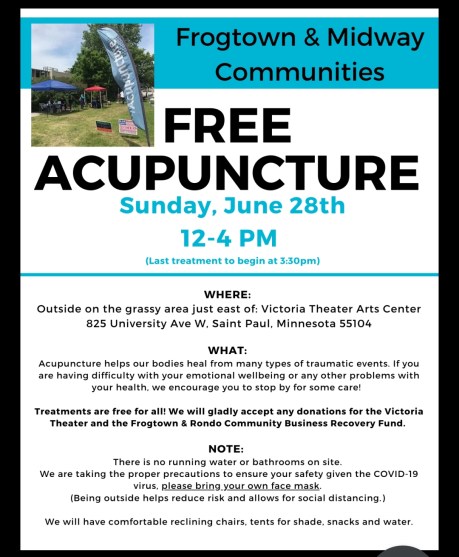
If you need a little of that “Supernatural Aid” or to feel the divine love of the Goddess, get on the mat or the cushion. Take a walk. Sit by the water. Or, check out the free (outdoor) acupuncture happening on Saturday (11 AM – 5 PM, see details here). Either way, I’ll see you when you cross the threshold.
Thank you to everyone who helped me beta test Zoom on Sunday! More streaming classes are coming and I will post a recording of the class later this week.
In the meantime, remember this: 55 years ago today, Tuesday, March 24th, Civil Rights protesters stepped into Montgomery County (Alabama). The next morning they would stand in front of (but not on) the steps of the Alabama State Capital Building. It had been a long journey…even longer than the 5 days and 54 miles it took them to arrive from Selma, Alabama. And as he stood in front of (but not on) the steps of the capital, Martin Luther King, Jr. spoke of how much longer the journey would be.
This post contains a link for “Save with Stories” – a partnership with Save the Children and No Kid Hungry. You’ll find the link in the sentence (below), “Being read to as a child is one of the great experiences in life.”
Maty Ezraty, a yoga teacher of teachers, who died last summer, once told a teacher, “A good sequence is like a good story. There is a beginning (an introduction), the middle (the heart of the story), and the end (the conclusion)”
Take a moment to go little deeper into the middle of your story, because that’s where we are: the middle of our stories.
People often tell me (as someone told me just this weekend) that one of the things they like about my classes is the story, as well as the way the poses and the music tell the story. The practice is always a way to tell our stories. It is also a way to process our stories, every time we inhale, every time we exhale. As I was reviewing Sunday’s playlist (March 22nd), I realized it not only tells the stories of some great storytellers celebrating birthdays today (as I intended) and is a way to process our current life-plot (as I intended), it also reflects my story as a lover of stories.
James Patterson (b. 1947, in Newburgh, NY), is a bestselling novelist and children’s book author whose books can always be found in my parents bookshelves. Doesn’t matter if it is mystery, suspense, romance, or science, Patterson keeps you in the moment and keeps a Chekhovian promise (which we’ll get to in the end). One of his protagonists is a 12-year old orphan named Max Einstein. Like her namesake, this Einstein is a genius with wild (in her case red) curly hair. She is told that her story combined with her emotional and intellectual quotients are why she is considered the world’s “last great hope.” Patterson wrote, “If we are to help save the human race, we must recognize the humanity in all, no matter their station in life.”
For his part, Patterson has donated over 300 million books to school-aged children and the military, over $70 million to support education, and endowed over 5,000 scholarships for teachers.
Stephen Sondheim (b. 1930, in New York City, NY) is a legendary musical theater composer and lyrics, as well as an award-winning film composer. He has won 8 Tony Awards (more than any other composer), 8 Grammy Awards, a Pulitzer Prize, a Laurence Olivier Award, and was awarded a 2015 Presidential Medal of Freedom. In all my time working in theater, I can’t say that I ever worked on any of Sondheim’s musicals (or the musicals of our final birthday composer), but I’ve seen my fair share of both their works – and can definitely sing along.
Also born in New York City, NY, in 1941, poet Billy Collins has been called “The most popular poet in America” and has served as United States Poet Laureate (2001 – 2003) and New York State Poet (2004 – 2006). Collins considers “humor a doorway into the serious” and begins his poem “Picnic, Lightning” by quoting Vladimir Nabokov. In Lolita, the protagonist says, “My very photogenic mother died in a freak accident (picnic, lightning)…”
The poem’s title is also the title of a collection of poems which my friend Mimi gave me in a moment when I was overwhelmed by grief. Fast forward almost a decade and, as if in a poem, I was dancing with Billy Collins on Nicollet Island and giving him a piece of Collins-inspired poetry. Even now, I can feel it…I can feel it…the joy of the moment, the joy of being alive; which fits in with his secret theory.
In a 2001 interview with The Paris Review, Billy Collins said, “I have a secret theory that people who are addicted to reading are almost trying to recreate the joy, the comfortable joy of being read to as a child…. Being read to as a child is one of the great experiences in life.”
Our final birthday storyteller is Baron Lloyd-Webber, or more properly styled, The Lord Lloyd-Webber…better known as the EGOT Andrew Lloyd Webber (no hyphen). Born today in 1948 (in Kensington, London), he has composed 13 musicals, a song cycle, a set of variations, 2 film scores, and a Latin Requiem Mass. He is an EGOT because he has won an Emmy Award, 4 Grammy Awards, an Academy Award (Oscar), and 7 Tony Awards – as well as 8 Laurence Olivier Awards and a plethora of other awards.
And now, back to that Chekhovian promise.
It was Anton Chekov who said that if there is a rifle (or a pistol) hanging on the wall in the first chapter/act, it must go off in the second or third. He told another playwright, “It’s wrong to make promises you don’t mean to keep.”
Whenever we step on the mat, there’s a part of us that is making a promise. Whenever, I put together a sequence there’s a part of me that thinks about that promise, as well as about that second Sondheim song (“Putting it together…bit by bit…piece by piece”) and Maty Ezraty’s sequencing advice about the middle (the heart) of the story. I consider how can I build up to a big heart opener and how we each need to process our own personal story in order to not only lift and open our hearts, but to also support our lifted and open hearts – especially in a time when it is so easy to close off.
Maty Ezraty said, “Practicing yoga is a privilege. And with this privilege comes a duty to be kind, to share a smile, and to offer yoga from the mat into the rest of your life.”
Here’s a mini-practice (5 minutes) which you can use it as your whole practice as the beginning/introduction portion of your practice and finish with a deeper back bend (even if it’s the same back bend – just with more awareness, more breath, and more smile.