POSING – 2018 Kiss My Asana Offering #6 April 6, 2018
Posted by ajoyfulpractice in 31-Day Challenge, Abhyasa, Art, Baseball, Books, Buddhism, Changing Perspectives, Dharma, Donate, Faith, Fitness, Gratitude, Healing Stories, Hope, Karma Yoga, Life, Love, Meditation, Men, Minneapolis, Minnesota, One Hoop, Pain, Peace, Philosophy, Poetry, Texas, Twin Cities, Vairagya, Volunteer, Wisdom, Women, Writing, Yoga.Tags: Downward Facing Dog, existentialism, Gwendolyn Brooks, Jose Ortega y Gasset, KISS MY ASANA, Mind Body Solutions
add a comment
“Each body has its art, its precious prescribed
Pose, that even in passion’s droll contortions, waltzes,
Or push of pain–or when a grief has stabbed
Or hatred hacked–is its and nothing else’s.
Each body has its pose. “
– from “Still Do I Keep My Look, My Identity…” by Gwendolyn Brooks
In Man and Crisis, the Spanish philosopher José Ortega y Gasset wrote, “Tell me to what you pay attention and I will tell you who you are.” The same concept applies to yoga. Some yoga teachers can watch someone practice and recognize what style and tradition the person normally practices. Some teachers, master teachers, can tell what other activities a person does besides yoga and/or what occupied the majority of their time when they were a child. Still other teachers (again, master teachers) can look at a practitioner in a pose and describe certain psychological and emotional aspects of the person’s personality and life.
I’ve witnessed teachers do all of the above. And, it’s fascinating! It seems magical! But, what quickly becomes obvious is that these teachers aren’t magic – they are simply describing what they see in the body. Our biology is our biography, because everything we experience has a place in the body and in the mind. Therefore, everything we experience is in us and in our poses.
Consider, for a moment, the first pose you loved to practice. Ask yourself why you loved that pose and remember how you felt in that pose. Consider how that pose (and you in that pose) reflected that particular time in your life. Now, consider how the pose, your body, you, and your life have changed over time. You can do the same with the first pose you hated to practice.
You can do the same with a pose you barely consider important to your practice, even though you do it on a regular basis. Write down your thoughts and then have someone take a picture of you in the pose. When you come into the pose, really focus on how you practice the pose. Notice what you notice when you look at the picture.
“Still Do I Keep My Look, My Identity…” by Gwendolyn Brooks
Move into Child’s Pose (Balasana) as if you are moving into a new house. Take your time to balance the effort and relaxation inherent in the pose. Watch the breath. Pause and take in the landscape that is your mind and your body in this present moment.
When you move into Table Top – hands and knees to the mat with shoulders over elbows and wrists, hips over knees – or into a seated position if that is more accessible, move as if you are taking a leisurely stroll. Take your time, and pause to get the lay of the land. Double check your alignment. Press down so that the shoulders and shoulder blades are even with the rest of the back and your belly is firm. Engage your locks (bandhas) if that is part of your practice. Notice how you feel in the pose (physically, mentally, emotionally, and energetically).
Move through Cat/Cow or the “Un-Cat” sequence precisely matching the movement to the breath. So that, as the breath gets long and fine and deep, the movement gets richer – whatever that means to you in this moment.
Pause with the spine back in Table Top position and then move into Staff Pose (Dandasana). Sit down with your legs straight out in front of you. Sit up on a blanket or a block if you have a lot of tightness/stiffness in the back of your body. Press your heels down into the ground, flex the ankles so the toes reach for the nose, and then spread the toes. At the same time, fire up your thighs and engage the quadriceps (the four muscles at the top of your things) in order to lift the knee caps into their full extended position. Press the sit bones and hands down (with the hands next to the hips). If this engagement is too extreme, bend knees or place the hands behind the hips (but still wide enough to just barely be outside of the hips).
As if they are seeds you are planting, push your shoulders and everything touching the floor, the mat, or a prop down into the earth. Allow your heart to blossom. With your eyes on your nose, watch your breath and notice how you feel in the pose (physically, mentally, emotionally, and energetically).
Engage your locks (bandhas) as described yesterday’s practice. Changing as little as possible, lift the arms over the head, with wrists in line with the shoulders, and turn the palms up so that the finger tips point towards the wall behind you. Extend the elbows and, as much as you are able, rotate them towards your nose. Keeping the shoulders down the back, push the whole body down to lift the heart and the arms up. If this is too much intensity for the shoulders, modify by bending the elbows to 90 degrees and extending the wrists rather than flexing them. Again, notice how you feel in the pose (physically, mentally, emotionally, and energetically).
NOTE: If you want to skip the arm balancing below, move back into Staff Pose (Dandasana) and then repeat the arm positioning above before moving into the Sage Twist. Another modification would be to do the pose on the wall.
For the arm balance Downward Facing Dog (Adho Mukha Svanasana), return to Table Top – engaging as you did at the beginning of the practice. Curl your toes under; then use your arms and legs, hands and feet to lift your hips up in the air. Check to make sure all your fingers are spread wide, with the majority of the weight/pressure in your hands moving into the thumb and first finger. (So that, there is less weight/pressure applied to your outer wrists.) When you relax your head and shoulders, make sure your big toes are parallel to each other and at least a foot apart. Big toes can be behind the thumbs or behind the middle fingers. Notice if you feel lighter or heavier when your feet are spaced further apart. Hips are high, heels are low (reaching, but not necessarily touching the mat); and neck is long. Even if you have to bend your knees, find Cow Pose in this position (so that you have a straight line from your middle fingers all the way up to your hips and then a second straight line from your hips to the back of your knees). Eyes are on your nose, your belly button, or the space between your toes.
If you are staying off of your wrists or need something to minimize stress on the shoulders, bring the elbows to the mat when you are in Table Top and lift your hips up for “Dolphin Dog.”
No matter which variation you choose, notice how and what you feel (physically, mentally, emotionally, and energetically). Downward Facing Dog is simultaneously an arm balance and a standing pose; a forward bend, as well as a back bend; and an inversion. The only category missing from the pose is a twist (and, some would say, a hip opener) which you can add in several different ways. Just explore, play. Notice if you access some aspects of the pose more than others. Notice how you feel about the suggestion to explore, play.
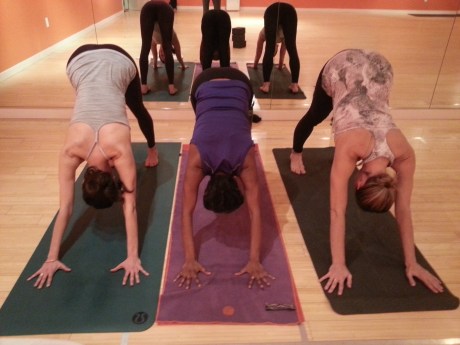
Move back into Staff Pose. Keep the left leg extended and bend the right knee in order to set up the Sage Twist. Remember to keep the left heel and the right foot flat on the floor. You can place the right foot next to the inside or the outside of the left leg, as long as the knees are comfortable and the right foot is flat on the floor.
On an inhale, lift your right arm up and, as you watch it, reach the right arm back to the floor behind your hips. As you settle into the twist, adjust your left arm to provide additional support wherever you need it. You can always sit on a block and/or place a block under your hand if you’re hips and low back are really tight. If you don’t have a block, substitute a book.
Watch how you engage your base, your core, and your breath. Remember to start the twist in your base (not in your neck). Do not allow your body to collapse or untwist until you complete 3 – 5 complete breaths. After the third or fifth exhale, inhale to center, give the lifted knee a squeeze, and return to Staff Pose. Repeat the Sage Twist instructions for the Sage Twist (replacing right with left).
After the third or fifth exhale on the left, inhale to center and give the lifted knee a squeeze. Bend or extend both, as needed, and lower down onto your back for Corpse Pose (Savasana). Allow your whole self to take up space. Notice how it feels to breath, to live, in this space.
This opportunity to explore a poem on the mat is part of my offering for the 2018 Kiss My Asana yogathon. I encourage you to set aside at least 5 minutes a day during April, to practice with the poem as inspiration. You can practice in a class or on your own, but since the Kiss My Asana yogathon raises resources as well as awareness, I invite you to join me at one of the donation-based classes listed (April 7th and April 28th).
I also challenge you to set aside a certain amount every day that you practice with a poem in mind. It doesn’t matter if you set aside one dollar per practice or $25 – set aside that amount each time you practice and donate it by April 30th.
Founded by Matthew Sanford, Mind Body Solutions helps those who have experienced trauma, loss, and disability find new ways to live by integrating both mind and body. They provide classes, workshops, and outreach programs. They also train yoga teachers and offer highly specialized training for health care professionals. By participating in the Kiss My Asana yogathon you join a global movement, but in a personal way. In other words, you practice yoga. Or, as this year’s tag line states, “do yoga. share yoga. help others.”
Side Note: Although, I’m not the girl in the picture, I met Gwendolyn Brooks around this same time. She smiled, signed a book, for me; said words I don’t remember. What I do remember was feeling joy and the sheer power of her presence. I also remember wondering how in the world so much power, beauty, strength, wisdom, and intellect could be contained in such a small body.
## do yoga. share yoga. help others. ##
Quick Announcements and A Thank You! May 3, 2017
Posted by ajoyfulpractice in Art, Black Elk, Buddhism, California, Changing Perspectives, Depression, Donate, Faith, Fitness, Gratitude, Healing Stories, Health, Hope, Karma, Karma Yoga, Life, Loss, Meditation, Men, Minneapolis, Minnesota, Music, One Hoop, Pain, Peace, Philosophy, Suffering, Texas, Tragedy, Twin Cities, Vipassana, Volunteer, Wisdom, Women, Yoga.Tags: KISS MY ASANA, Marcus Young, May the Fourth, meditation, Mind Body Solutions, Mindfulness, Star Wars, Walker Art Center
add a comment
First, the thank you:
I am deeply grateful to everyone who participated in this year’s Kiss My Asana yogathon to benefit Mind Body Solutions. It doesn’t matter if you made a donation online, attended a donation-based class, hosted a donation-based class, or asked a question (and, maybe, are still waiting on my answer) – either way, you made a difference in how we view yoga and how we, as part of the yoga community, keep our sacred circle open to all bodies and all minds. During one class in particular, when I listed all the types of people who can benefit from adaptive yoga, I found myself referencing every person in the room. Just a reminder that it’s not about modifications, it’s about the practice.
Thank you, also, to Sandra Razieli for spending part of her birthday weekend co-teaching with me!
Thus far, we’ve raised $855 this year to support the Mind Body Solutions Solutions, where awakening the connection between mind and body transforms trauma, loss, and disability into hope and potential.
Oh, and by the way, you can still donate here!
And now, the quick announcements:
May the 4th is with us! While I am sad to report that I will not be leading any Star Wars yoga classes this year, I am very excited about returning to the Walker Art Center to facilitate meditation during MN Artists Presents: Marcus Young (5 – 9 PM). This free event is kid-friendly and has a lot of mindfully interactive moments. For more information, check out the event page or the Walker’s Facebook page. (Please note: road closures may create delays and detours. Breathe deeply. And may the force be with you.)

Finally, my YMCA classes will have subs on Friday night (5/5), Saturday morning (5/6), and all day Sunday (5/7). Enjoy!
###
2017 KISS MY ASANA QUESTIONS #5, 6, & 7: IF YOU COULD RECOMMEND ONE BOOK…? April 15, 2017
Posted by ajoyfulpractice in 31-Day Challenge, Books, Buddhism, California, Changing Perspectives, Daoism, Donate, Faith, Fitness, Healing Stories, Health, Karma Yoga, Life, Meditation, Men, Minneapolis, Minnesota, Peace, Philosophy, Science, Tantra, Taoism, Texas, Twin Cities, Volunteer, Wisdom, Women, Writing, Yin Yoga, Yoga.Tags: inspiration, KISS MY ASANA, meditation, Mind Body Solutions, yoga books, yoga practice
add a comment
“If you could recommend one book about yoga that really impacted your practice, what book would that be?”
“If you could recommend one book about meditation, what would it be?”
“Is there a book that would help a beginner like me establish a daily practice?”
– E
There might be more books on yoga and meditation than there are ways to practice yoga and meditation. I know for sure that there are so many books on each it is sometimes hard to narrow things down to a single recommendation. Even if I had read everything that’s ever been printed – and nothing else was ever printed (which would be a shame since one of my teachers is currently working on her first book) – and even if I only focused on books that really impacted my practice, I would still end up with a bag full of books.
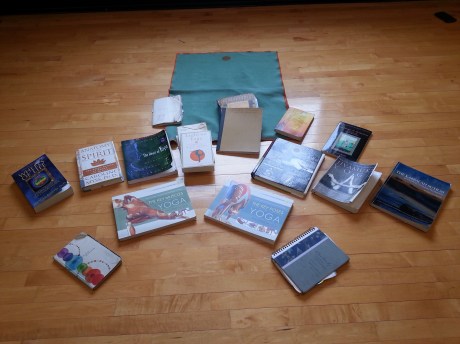
(NOTE: The picture above is missing Leslie Kaminoff’s Yoga Anatomy, Steve Ross’s Happy Yoga, Stephen Cope’s The Wisdom of Yoga, all my Yin Yoga and Taoist texts, a copy of the Ramayana, and Alanna Kaivalya’s Myths of the Asanas, at the very least.)
Part of me wants to break this down into a book on the physical practice versus a book on the philosophy; however, sitting with WHY I want to make that distinction, brings me to one very comprehensive option: T. K. V. Desikachar’s The Heart of Yoga: Developing A Personal Practice.
Desikachar was the son of Sri Krishnamacharya, who was the teacher responsible for the resurgence of yoga in 20th Century India. Krishnamacharya taught Desikachar, B. K. S. Iyengar, Sri Pattabhi Jois, and Indra Devi – who all had a hand in bringing the physical practice of yoga to the West. Each of the teachers mentioned above wrote at least one book which impacted someone’s yoga practice (including mine), and all of them have had books written about them. Desikachar’s The Heart of Yoga is simultaneously about yoga and about a teacher’s teacher. It is also a practice manual with a heavy focus on the philosophy. Unlike some other books I might refer to as practice manuals, The Heart of Yoga not only offers an overview of the 8-limb philosophy of yoga, it includes a translation of the Patanjali’s Yoga Sutras. (NOTE: Patanjali’s Yoga Sutras are 196 aphorisms. Most books on the sutras include each aphorism, plus a translation and commentary for each aphorism. I use several sources for translation/commentary comparative analysis; however, my go-to resource is a website by Swami J, of the Himalayan tradition.) The Heart of Yoga gives practitioners of any fitness or experience level the opportunity to build a physical practice, while also maintaining a connection to the overall philosophical practice.
My similar dilemma regarding a book on meditation could be resolved by recommending a book on yoga mediation… and a book from each of several different Buddhist traditions…plus a book on the Kabbalah…and a book on Catholic contemplation and…..You get the idea. But, when it gets right down to it, there’s one book I am continually giving away – and it’s the same book used when I guided meditation with Dr. Thomas Bushlack’s University of St. Thomas classes: The Miracle of Mindfulness: A Manual on Meditation by Thich Nhat Hahn.
I first came across The Miracle of Mindfulness when I was babysitting for some friends in Minneapolis. One day, when the kids were napping, this little violet paperback on the bookshelf in the living room caught my eye. I pulled it down, and found…stillness.
OK, I’m being dramatic. I had, of course, already experienced stillness in both yoga and seated meditation. However, Nhat Hahn’s The Miracle of Mindfulness made me pause, sit, and contemplate my overall practice and its connection to meditation. Over the last ten years, it has played an instrumental part in my re-commitment to the physical practice of yoga as a form of meditation.
Let me be clear: Nhat Hahn is not known as a yoga teacher and The Miracle of Mindfulness is not a book related to hatha yoga (the physical practice of yoga). Nhat Hanh is a Vietnamese Buddhist monk most commonly associated with Zen Buddhism, but whose training includes several traditions. His Miracle of Mindfulness is based on Buddhist principles and practices, but is not teaching Buddhism, per se. Some might argue that it is not even teaching meditation (but, rather, mindfulness). Still, it accessible to people regardless of their background or experience and includes personal anecdotes as well as a series of practices that are simultaneously simple and profound.
To answer E’s final question, The Miracle of Mindfulness definitely has the tools to help a beginner establish a daily practice. Tools, however, do not build a mansion – and the mansion will not be built overnight.
“Practice, practice, practice – all is coming.” ~ Sri Pattabhi Jois
If you find this information helpful, insightful, validating, and/or curious, please Kiss My Asana by making a donation, joining the team, asking a question, and/or joining me for a donation-based class to benefit Mind Body Solutions.
Sandra Razieli and I will co-host a donation-based class on Saturday, April 22nd (6:30 PM – 8:00 PM) at Flourish Pilates+Yoga+Bodywork. I will host a second class on Saturday, April 29th (3:30 PM – 5:30 PM) at Nokomis Yoga. Please RSVP via email (Myra at ajoyfulpractice.com). All donations will benefit Mind Body Solutions, where awakening the connection between mind and body transforms trauma, loss, and disability into hope and potential.
### OM SHANTI, SHANTI, SHANTIHI OM ##
2017 KISS MY ASANA QUESTION #4: IS THERE A WAY TO MODIFY…? April 10, 2017
Posted by ajoyfulpractice in 31-Day Challenge, Abhyasa, Books, Dharma, Donate, Faith, Fitness, Gratitude, Healing Stories, Health, Hope, Karma Yoga, Life, Men, Minneapolis, Minnesota, Pain, Peace, Philosophy, pro, Science, Suffering, Texas, Twin Cities, Vairagya, Volunteer, Women, Yoga.Tags: Downward Facing Dog, Iyengar, KISS MY ASANA, Matthew Sanford, Mind Body Solutions
2 comments
“I’m not very flexible and when I do yoga, every pose seems to stretch/work the backs of my legs. They are definitely my limiting factor. Is there a way to modify poses, down dog for example, to work/stretch other muscles?” – YogaNovice
YogaNovice’s question about modifying a pose, like down dog, in order to work/stretch other muscles required a little follow-up, because (a) I’m not familiar with the practitioner’s body or practice and (b) the words “stretch” and “work” convey different engagements to me. However, even before asking some follow-up questions, my answers came down to intention and alignment.
Before practicing a pose, consider the purpose of the pose in general and then the specific purpose of the pose within the sequence. Adho Mukha Svanasana (Downward Facing Dog) is a standing pose, an arm balance, a forward bend, an inversion, and includes a slight back bend. It can be used to strengthen the limbs of the body, alleviate pain and stiffness in the legs, ankles, feet, arms, wrists, and shoulders – while also helping a practitioner engage core muscles. In vinyasa, it often feels like the least strenuous pose and therefore becomes a re-set moment. As an inversion, it can be exhilarating, since the head is below the heart, but does not require pressure on the head and neck. I refer to it as “a full body stretch” – and yet, all the benefits of the pose may be lost if the pose is misaligned.
As my friend Tom Bushlack pointed out in a recent post on alignment (and misalignment), B. K. S. Iyengar and his Light On Yoga are the first resources many people in the West mention when discussing alignment. Other great alignment resources include Leslie Kaminoff and his Yoga Anatomy, as well as Dr. Ray Long’s series of books. Many of these may be a little much for a yoga novice and, therefore, I also recommend Iyengar’s Yoga: The Path to Holistic Health. Ultimately, however, the greatest alignment resource is practicing with an anatomy-focused teacher (like Matthew Sanford or the other teachers at Mind Body Solutions).
Alignment-focused yoga offers the opportunity to use props for better engagement. So, rather than muscling into a pose and experiencing strain or injury, props enable a practitioner to find the balance between effort and relaxation and to, as Patanjali states in the Yoga Sutras (2:46 – 2:48), cultivate a steady (or stable), easy (or joyful) seat (or pose). A person could use a wall, blocks, blankets, an extra mat, a strap, and/or another person in order to find more balance in pose.
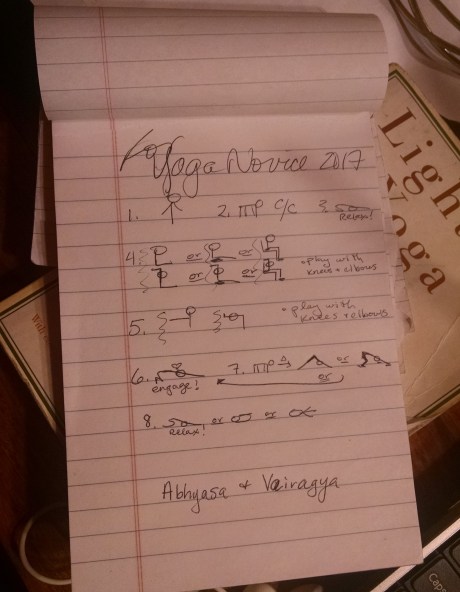
Here’s a practice to help YogaNovice find more ease in Downward Facing Dog. Read through the sequence before practicing it, and remember to check with your health care practitioner before starting any new exercise. Each step below may be practiced in 1 minute increments.
- Establish what your body feels like when standing in a neutral (spine and hip) position, like Tadasana/Samasthiti (Mountain Pose/Equal Standing).
- Establish what your body feels like when the spine is in neutral Table Top (on hands and knees, with shoulders and elbows over wrists and hips over knees) versus when inhaling into Cow Pose (spinal extension), exhaling into Cat Pose (spinal flexion).
- If it is accessible to you, move into Puppy Dog variation of Balasana (Child’s Pose) with feet and knees the same distance apart and extended on the floor over your head. Release/relax.
- Sitting on a block or blanket (for extra support) and with your hips and back against a wall – or sitting on a chair with spine in a neutral position, lift your arms overhead with fingers pointed toward the wall (palms will be facing the ceiling). Play with how the arms and back feel when the legs are fully extended versus when the legs are slightly bent (at the knees). Once you’ve established a leg position that feels like balanced effort, then, play with how the arms and back feel when the arms are fully extended versus slightly bent (at the elbows). (Again, you want to experience a kind of lightness in the final pose that indicates balanced effort.)
- Stand, facing a wall, with feet 18 inches (45 centimeters)* apart and arms extended at shoulder height so that the fingers barely touch the wall. Then, maintaining the established arms’ length, flatten the palms and fold until the back is “parallel” to the ceiling. Now, notice how it feels when the knees are bent versus straight, (Again, you want to experience a kind of lightness in the final pose that indicates balanced effort.) Next, experiment with the arm position to find balanced effort. Don’t forget: Balance comes from all accessible limbs sharing your body weight!
- If it is accessible to you, move back into Puppy Dog variation of Balasana (Child’s Pose) with feet and knees the same distance apart and extended on the floor over your head. This time, curl the toes under and actively press the hands and feet down while actively extending the spine into a mini-back bend. Relax after a few breaths.
- From Table Top (on hands and knees with a neutral spine), curl the toes under and lift the hips up into an upside down “V” for victory, with spine and thighs pressing towards the space behind you. Now that you’ve moved into the shape of Downward Facing Dog, active the pose as follows:
- Make sure middle fingers are pointing forward (with fingers spread wide), pressing into the thumb and first finger (so there is less weight on the outer wrist). As much as you’re able, maintain the hand position and rotate the elbows towards the knees.
- If experiencing wrist issues, use a wrist guard or return to hands and knees to set-up Dolphin Dog.
- As you lower your head and shoulders, make sure big toes are parallel to each other. In Yoga: The Path to Holistic Health, Iyengar recommends placing feet 18 inches (45 centimeters)* apart. Note that in an actual Iyengar class, Matthew Sanford has commented on how people have their feet too close together – in part, because we’re often practicing someone else’s alignment (versus our own body’s alignment). (This kind of individual instruction is why practicing with an alignment-focused teacher is invaluable!)
- Spread the toes and let the heels reach towards the earth, but don’t focus on pressing/forcing the heels into the earth. Bend the knees, as needed, to achieve the previously experienced lightness of balanced effort. (Extreme knee flexion may mean you bring knees to the mat and practice an active Puppy Dog.)
- You’ll find in an Iyengar practice that props may be added under the head, heels, and hands to provide support. A teacher can provide hands-on assistance to encourage the hips to lift as the spine extends.
- Release/relax in Balasana (Child’s Pose) with toes pointed behind the body and arms resting by the hips. If Child’s Pose is not accessible, lie on your back.
Yoga requires patience and dedication. In the Yoga Sutras (1:12 – 1:16), Patanjali emphasizes that mastery comes from combining abhyasa (repeated and consistent practiced) and vairagya (non-attachment). Consistently practicing the above over a period of time is one way to experience abhyasa; practicing any of the steps above as an alternative to practicing Downward Facing Dog as it appears in a book or a magazine is a form of vairagya.
Thank you, YogaNovice, for helping me fulfill my 2017 Kiss My Asana commitment. If you haven’t already, I strongly encourage you to check out one of the classes at Mind Body Solutions, where awakening the connection between mind and body transforms trauma, loss, and disability into hope and potential.
Please consider joining the yogathon by making a donation, joining the team, and asking a question.
### JAI JAI GURU DEV (SHINE ON) ###
Seriously, Is That All You’ve Got? December 31, 2016
Posted by ajoyfulpractice in 108 Sun Salutations, Books, Changing Perspectives, Depression, Faith, Fitness, Gratitude, Health, Hope, Japa-Ajapa, Karma, Life, Loss, Mala, Meditation, Minneapolis, Minnesota, Mysticism, New Year, One Hoop, Pain, Peace, Philosophy, Science, Suffering, Surya Namaskar, Texas, Twin Cities, Whirling Dervish, Wisdom, Yoga.Tags: awareness, community, confidence, devotion, gratitude, inspiration, kindness, New Year, recovery, yoga practice
6 comments
It is New Year’s Eve eve. And, while I still have things to do in anticipation of the New Year, I am more than ready for the arrival of 2017. Funny thing is, all of us who are “D-O-N-E, stick-a-fork-in-it, done” with 2016, have to admit that it hasn’t all been bad. There have been some memorable and very personal highlights and there have been many changes for the better. Oh, then there’s the fact that this whole “new year” thing is completely arbitrary.
Yes, yes, there are reasons and explanations for why the Western world celebrates a beginning and an ending at this time of year. But, in some ways those reasons and explanations are beside the point. What’s important is that change is always happening – and most of it is beyond our control. Since being out of control can be psychologically uncomfortable, we take control by choosing a transition to celebrate. The celebration is a reminder that everything, including hard times, ends and that the end of one thing marks the beginning of another thing.
We can only hope the new thing is better than the old thing.
Even when, it’s the same thing over and over again.
Throughout history, different cultures have had different ways of marking transitions. One yoga tradition is to practice 108 Sun Salutations (Surya Namaskar) when the seasons change on the equinoxes and solstices. Here in the West, we have also taken to practice this yoga variation of a marathon when the calendar year changes. (I am again leading the Surya Namaskar malas at Nokomis Yoga (this practice is full) and at the Downtown Minneapolis YMCA (3 PM – 6 PM).)
Sun Salutations (Surya Namaskar) are a moving meditation consisting of 12 poses. The series of poses are linked with breath so that we mimic our bodies’ natural inclination to extend the spine and open the heart as we inhale, to flex the spine and engage the core as we exhale. Or, you could think of it symbolically: as reaching for the sun as you inhale, drawing its energy to the earth as you exhale. Or, you could reach to the Source of all the things as you inhale, surrender to that Source as you exhale. Or…you get the idea. Whether you come to the practice from a physical-mental, psychic-symbolic, or emotional-energetic perspective, this series of poses engages your whole being: mind, body, and spirit.
Since the practice mirrors the cycle of time – the beginning of each breath marking the end of another, the end of each pose marking the beginning of the next – we inevitably find ourselves appreciating it, enjoying it, and then wishing it were done. We can be lost in/absorbed by the effortless repetition (ajapa japa), but then find our brains want a delineated break.
We seek the break, not because we’re tired, per se, but because it’s a way for our brains to absorb the pattern. And, in that moment, we may create the break by asking the question that has been coming up a lot in my practice: Is that all you’ve got? Seriously, is that all you’ve got?
I can’t remember if it was during an interview or during a teacher training, but I very clearly remember Seane Corn describing a conversation where she said to the Universe, “Bring it; but, bring it gently.” I love that sentiment. It acknowledges that throughout our lives we are going to be faced with challenges, and it simultaneously reinforces the idea that we can be ready to meet those challenges head on. It is a statement sourced in strength, courage, and wisdom – without being braggadocios. In fact, it embodies the splendor of humility.
This secular calendar year, 2016, New Year’s Eve happens to fall on the 8th Night of Chanukah. (Therefore, New Year’s Day 2017 is the 8th Day of Chanukah 5777.) Hod (humility, splendor, surrender, or gratitude) is the eighth aspect of the Divine found on the Tree of Life (in Jewish mysticism, Kabbalah). Physically it is symbolized by the left foot and leg. Energetically it is directly connected to Gevurah (Strength, discipline), Tiferet (Balance, Compassion), Netzach (Endurance), and Yesod (Foundation or Bonding). It can also be energetically connected to the 3rd Chakra, our physical core, which is related to our personality, our sense of self, and our self esteem.
I could go on, but what I’m getting at here is that the question (Is that all you’ve got?) isn’t something I’m asking the Universe. I know the Universe has more in store for us. I know it’s going to bring it (hopefully, gently). What I’m really doing, at those moments when I want to throw in the towel, is asking myself the question: Is that all you’ve got? Seriously, is that all you’ve got?
My early teachers often said, “How you do yoga is how you do life.” Whether we are in the middle of 1 hour, 90 minutes, or 3 hours of yoga – or anything else – we all have that moment where we want to throw in the towel. But, if we pace ourselves, we inevitably get a second wind. And, while I don’t always feel this way after I other physical things I do, in yoga and in life I almost always feel like I could have handled a little bit more. Not that I want to or need to – but, that if I had to, I could dig deep and pull up a little bit more of whatever I need to face the challenge.
The first day of 2017, is just another day on the calendar; just another day in our lives. It’s a beginning and it’s an ending. So, yes, celebrate, set an intention, and move on.
But, don’t forget that this liminal or transitional moment is also a middle. And, ultimately, the most significant thing that’s changing is your awareness and your perspective. Start noticing what you’re doing when you ask a question like “Is that all you’ve got?” Start noticing what you’re doing when your answer to the question changes.
Feel free to share your experiences by commenting below!
~ Happy New Year, Happy New Perspective ~
REAL(LY), TRU(e)LY GRATEFUL (Thanksgiving Schedule & News) November 22, 2016
Posted by ajoyfulpractice in Books, Buddhism, Faith, Fitness, Gratitude, Health, Life, Mantra, Minneapolis, Philosophy, Suffering, Texas, Twin Cities, Wisdom, Yoga.Tags: cultivating gratitude, gratitude, Texas, yoga practice
8 comments
When I first got back to Houston, a man I didn’t know inserted himself in a conversation with my mother; I only got to see a handful of friends; it took a really long time to walk a few blocks; I ate way too much sugar; and I took a yoga class many of my students would hate.
Wait! What? That doesn’t sound right. In fact, it doesn’t even sound like me. And the truth is that while the facts above real(ly) happened; they are not true.
In his book Open Heart, Open Mind, the Nepalese Tibetan Buddhist teacher Tsoknyi Rinpoche describes how something can be “real but not true” – and offers the words as a mantra which allows us to check in with our attitudes, our perspectives, and the past conditions which establish both. The bottom line being that we view our current circumstances through the lens of past experiences. Mindfulness-based practices like yoga and Buddhism create the opportunity to examine our kleshas – or, how our thought patterns color our experiences.
So, if I were to re-frame what happened as I actually perceived it: When I first got back home to Houston, a man I’d never met before asked if I needed help with my bags (I did); I made plans to spend the day with friends who are like family to me; I spent part of the afternoon on a walkabout with two of those friends, exploring their neighborhood and quacking as we ducked; I ate a lot of dessert; and I took a yoga class with some super groovy hip openers!
Yeah, still colored, but suddenly the events are joyful. Suddenly there is room for gratitude.
“Gratitude awakens another way of being in the world, one that nurtures the heart and helps to create a life of meaning and purpose. The old barriers no longer confine us and the old fears no longer constrict or claim us. Gratitude opens us to freedom, a sense of generosity, and connection to the wider world.” – Angeles Arrien
“I didn’t say, ‘We can be grateful for everything.’ I said, ‘We can be grateful in every given moment for the opportunity. And even when we are confronted with something that is terribly difficult we can rise to this occasion and respond to the opportunity that’s given to us…. Most of the time what s given to us is the opportunity to enjoy, and we only miss it because we are rushing through life.”
– Brother David Steindl-Rast
Right now, a lot of people are struggling to be grateful. That’s super real. It’s so real that we sometimes forget there is more to life than struggle. We struggle so much we actually look forward…to more struggles. However, it’s also true that each of us has something for which we can be grateful – and, we get to choose how we spend our time and energy. We get to choose how we look forward.
“There’s only one thing more precious than our time and that’s who we spend it on.” – Leo Christopher
When someone gives us a precious gift, we give thanks. So, thank you to all the people who have spent time with me this year – on and off the mat. Your presence reminds me to appreciate every aspect of the practice, and every aspect of life. Your presence reminds me of all the ways one can practice. Thank you also, to the very talented teachers covering my classes this week – and to the people who show up for those classes. Thank you all for the opportunity to learn and grow and love within this practice.
Every time I step on a mat, I learn something new. Maybe I learn it from the teacher that’s leading the group; maybe I learn it from the teacher on the mat; maybe I learn it from the teacher within – either way, my future self is grateful. This week, “Do something that your future self will thank you for.” (unknown)
The Nokomis Yoga schedule will be as follows:
- Tuesday, Nov. 22nd @ 12:00 PM (60 minutes with SARAH)
- Tuesday, Nov. 22nd @ 7:15 PM (75 minutes with ERIKA)
- Wednesday, Nov. 23rd @ 4:30 PM (60 minutes – CANCELLED)
Sarah Kalweit and Erika Peterson both teach regular classes at Nokomis Yoga. For more on their teaching, check out their bios.
The Wednesday night Slow Flow at Flourish will be cancelled on November 23rd. Please join me on November 30th.
Weather permitting, I’ll return to Common Ground on Monday, November 30th.
For information on my incredible YMCA subs, please check the online schedules. (Also, please note that the Downtown Minneapolis will run an alternate schedule 11/24 – 11/275)

