“And now I see with eye with eye serene The very pulse of the machine; A being breathing thoughtful breath, A traveler between life and death; The reason firm, the temperate will, Endurance, foresight, strength, and skill;”
The more you practice yoga the more insight you gain, insight into yourself and, also, more insight into the practice. The more you practice the more you may start to appreciate the beauty and the perfection of the human mind-body-spirit. For instance, the body and mind are constantly striving to maintain balance. You can see the natural balancing act in the way we process food and waste, as well as in the way we breathe.
Let’s say, for instance, that a person consumed the perfect amount of calories, proteins, carbohydrates, vitamins, minerals, and fluids for their body type and activity level. That person with the perfect dietary habit would still produce waste – a good amount of waste, in fact. Because, the body is a machine that uses what it needs, in order to flush out what it does not need. It may be hard to view the food/waste analogy on the mat, but part of the practice is observing the process of breathing (which is another way the body takes in fuel and releases waste). Part of the practice is noticing how the inhale and exhale are opposite and equal reactions – and how the body reacts to the breath.
Since we were in the womb, our bodies have responded to breathing by extending on the inhale and flexing on the exhale. The reactions are subtle and autonomous, and they mirror the breath in that they are opposite and equal. So, here again is an example of the body-mind seeking balance within the imbalance.
In most physical yoga practices (hatha yoga, regardless of the style or tradition), poses are engaged in a way that exaggerates the body’s natural tendencies – extending on the inhale, flexing on the exhale. This is true even in static poses: we press down to go up or find a backbend on the inhale and engage the core or fold forward on the exhale. Vinyasa literally means “to place in a special way” and is a technique, as well as a style of yoga (sometimes referred to as flow, whereby the poses are linked with the breath – again, in a way that exaggerates the body’s natural tendencies. Vipassana literally means “to see in a spacial way” and is a technique, as well as a style of Buddhist meditation (sometimes referred to as Insight Meditation).
William Wordsworth’s poem Perfect Woman, also known as “She was a phantom of delight,” chronicles the poet’s growing perception and understanding of his wife. When they first meet, Wordsworth (born today in 1770) views Mary as “a lovely apparition” and very literarily refers to her as eye candy, an object that looks good on his arm. But, as they get to know each other better, Wordsworth starts to recognize his future wife as a multi-dimensional human being. Even though he is still slightly in awe of her otherness, in the end Wordsworth’s esteem reaches a point where he can describe her in the same way he might (as a Romantic poet) describe a peer. He develops insight.
People new to yoga often experience a similar evolution of perspective. At first, they may just see the top surface of the practice; they see the obvious physical benefits. Over time, people may start to notice that there is something more going on than just the physical elements. They get more in touch with their emotions and become more of how to manage their emotions. They also start to notice that the practices changes as the body and mind change, and that every day is different. Ultimately, people begin to see things in a special way. They start to recognize the symbolic elements of the practice; how the sequences often mimics life – like “A traveller between life and death;” – and how there is “something of angelic light” in all beings everywhere. As they gain insight into themselves, they may also gain insight into the world.
Perfect Woman– by William Wordsworth
Placing your body parts in a special way, move into Child’s Pose (Balasana). Notice how much of what you do is now automatic and how much is mindful of the way your mind and your body are in this present moment. Has your understanding of Child’s Pose changed over the last week? Has your understanding changed over the entire lifetime of your practice? Does your appreciation of the pose – even as a simple possibility – change throughout any given practice?
When you move into Table Top again check to ensure you are moving with full awareness of your mind and body in the present moment. Double check your alignment. Press down so that the shoulders and shoulder blades are even with the rest of the back and your belly is firm. Engage your locks (bandhas) if that is part of your practice. Notice how you feel in the pose (physically, mentally, emotionally, and energetically).
Move through Cat/Cow or the “Un-Cat” sequence precisely matching the movement to the breath. So that, as the breath gets long and fine and deep, the movement gets richer – whatever that means to you in this moment. This is the first vinyasa in this practice, notice all the ways you are mimicking your body’s natural tendencies (e.g., extending/flexing, lifting/grounding, creating/engaging, rising/falling, etc.).
Pause with the spine back in Table Top position and then move into Staff Pose (Dandasana). Sit down with your legs straight out in front of you. Sit up on a blanket or a block if you have a lot of tightness/stiffness in the back of your body.
Press your heels down into the ground, flex the ankles so the toes reach for the nose, and then spread the toes. At the same time, fire up your thighs and engage the quadriceps (the four muscles at the top of your things) in order to lift the knee caps into their full extended position. Press the sit bones and hands down (with the hands next to the hips). If this engagement is too extreme, bend knees or place the hands behind the hips (but still wide enough to just barely be outside of the hips).
As if they are seeds you are planting, push your shoulders and everything touching the floor, the mat, or a prop down into the earth. Allow your heart to blossom. With your eyes on your nose, watch your breath and notice how you feel in the pose (physically, mentally, emotionally, and energetically).
Engage your locks (bandhas) as described in earlier practices. Changing as little as possible, lift the arms over the head, with wrists in line with the shoulders, and turn the palms up so that the finger tips point towards the wall behind you.
Extend the elbows and, as much as you are able, rotate them towards your nose. Keeping the shoulders down the back, push the whole body down to lift the heart and the arms up. If this is too much intensity for the shoulders, modify by bending the elbows to 90 degrees and extending the wrists rather than flexing them. Again, notice how you feel in the pose (physically, mentally, emotionally, and energetically).
NOTE: If you want to skip the arm balancing below, move back into the poses after Downward Facing Dog. Another modification would be to do the Downward Facing Dog or “Dolphin Dog” with hands on the on the wall.
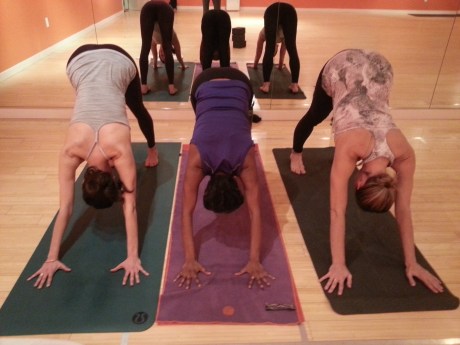
For the arm balance Downward Facing Dog (Adho Mukha Svanasana), return to Table Top – engaging as you did at the beginning of the practice. Curl your toes under; then use your arms and legs, hands and feet to lift your hips up in the air.
Check to make sure all your fingers are spread wide, with the majority of the weight/pressure in your hands moving into the thumb and first finger. (So that, there is less weight/pressure applied to your outer wrists.) When you relax your head and shoulders, make sure your big toes are parallel to each other and at least a foot apart. Big toes can be behind the thumbs or behind the middle fingers. Notice if you feel lighter or heavier when your feet are spaced further apart. Hips are high, heels are low (reaching, but not necessarily touching the mat); and neck is long. Even if you have to bend your knees, find Cow Pose in this position (so that you have a straight line from your middle fingers all the way up to your hips and then a second straight line from your hips to the back of your knees). Eyes are on your nose, your belly button, or the space between your toes.
If you are staying off of your wrists or need something to minimize stress on the shoulders, bring the elbows to the mat when you are in Table Top and lift your hips up for “Dolphin Dog.”
No matter which variation you choose, notice how and what you feel (physically, mentally, emotionally, and energetically). Notice how Downward Facing Dog is simultaneously an arm balance and a standing pose; a forward bend, as well as a back bend; and an inversion. Notice how much of the engagement in the Staff Pose variations you can also feel here. How and what can you adjust to experience more of the sensations of Staff Pose?
Stretch back (meaning, push your spine towards your thighs) and on an exhale walk your hands to your feet or bring your hands and feet together. Once hands are in line with the toes and heels are flat to the mat, inhale to a Half Lift/Flat Back or Extended Forward Bend. (This pose may be called Ardha Uttanasana or Urdhva Uttanasana.) Place your hands on your thighs and press the shoulders into the metaphorical back pockets. Again, you want to engage in a similar fashion to Cow Pose, Staff Pose, and Downward Facing Dog. In fact, inhale and find a little bit of Cow Pose (even if you have to bend your knees). Now, press the heels down and – as much as you are able without losing the extension of the spine – engage the quadriceps to extend through the knees and press the thigh bones into the wall behind you. Engage your locks (bandhas) as you are able. You can play with the position of the arms for a moment; again, noticing the similarities between this pose and the other two poses.
If you have unregulated blood pressure, low back issues, eye issues like glaucoma, or if this is already challenging, stay here with knees bent. Otherwise, if it is not contraindicated, bend the knees and flex from the hips to prep Forward Bend (Uttanasana). Keeping the upper back extended, place the hands on the floor or a block and begin to extend through the legs while pressing the thigh bones into the backs of your legs. Do not force the extension. Use the exhales to settle the heart on the thighs (as much as you are able without losing the extension of the spine.) If your legs are completely straight, make sure the knee caps are lifted and that you are not hyper-extending the knees. Also double check to ensure that if the knees are straight the hips are over the knees, not behind the ankles. Engage your locks (bandhas). When you reach your edge, take a moment to notice you feel (physically, mentally, emotionally, and energetically).
On an inhale, extend to Half Lift/Flat Back and on an exhale fold into the Forward Bend. If you are modifying and using the Half Lift throughout, keep the back in the position that feels similar to an intense Table Top and use the breath to extend the knees on an inhale and flex/bend them on an exhale. This is the second vinyasa. Move through the sequence precisely matching the movement to the breath. So that, as the breath gets long and fine and deep, the movement gets richer – whatever that means to you in this moment. Notice all the ways you are mimicking your body’s natural tendencies (e.g., extending/flexing, lifting/grounding, creating/engaging, rising/falling, etc.).
Move back into Staff Pose. Keep the left leg extended and bend the right knee in order to set up the Sage Twist. Remember to keep the left heel and the right foot flat on the floor. You can place the right foot next to the inside or the outside of the left leg, as long as the knees are comfortable and the right foot is flat on the floor.
On an inhale, lift your right arm up and, as you watch it, reach the right arm back to the floor behind your hips. As you settle into the twist, adjust your left arm to provide additional support wherever you need it. You can always sit on a block and/or place a block under your hand if you’re hips and low back are really tight. If you don’t have a block, substitute a book.
Watch how you engage your base, your core, and your breath. Remember to start the twist in your base (not in your neck). Do not allow your body to collapse or untwist until you complete 3 – 5 complete breaths. After the third or fifth exhale, inhale to center, give the lifted knee a squeeze, and return to Staff Pose. Repeat the Sage Twist instructions for the Sage Twist (replacing right with left).
After the third or fifth exhale on the left, inhale to center and give the lifted knee a squeeze. Bend or extend both, as needed, and lower down onto your back for Corpse Pose (Savasana). Notice the breath, as Spirit, and how it is still moving you towards balance.
This opportunity to explore a poem on the mat is part of my offering for the 2018 Kiss My Asana yogathon. I encourage you to set aside at least 5 minutes a day during April, to practice with the poem as inspiration. You can practice in a class or on your own, but since the Kiss My Asana yogathon raises resources as well as awareness, I invite you to join me at one of the donation-based classes listed (April 7th and April 28th).
I also challenge you to set aside a certain amount every day that you practice with a poem in mind. It doesn’t matter if you set aside one dollar per practice or $25 – set aside that amount each time you practice and donate it by April 30th.
Founded by Matthew Sanford, Mind Body Solutions helps those who have experienced trauma, loss, and disability find new ways to live by integrating both mind and body. They provide classes, workshops, and outreach programs. They also train yoga teachers and offer highly specialized training for health care professionals. By participating in the Kiss My Asana yogathon you join a global movement, but in a personal way. In other words, you practice yoga. Or, as this year’s tag line states…
“Each body has its art, its precious prescribed Pose, that even in passion’s droll contortions, waltzes, Or push of pain–or when a grief has stabbed Or hatred hacked–is its and nothing else’s. Each body has its pose. “
In Man and Crisis, the Spanish philosopher José Ortega y Gasset wrote, “Tell me to what you pay attention and I will tell you who you are.” The same concept applies to yoga. Some yoga teachers can watch someone practice and recognize what style and tradition the person normally practices. Some teachers, master teachers, can tell what other activities a person does besides yoga and/or what occupied the majority of their time when they were a child. Still other teachers (again, master teachers) can look at a practitioner in a pose and describe certain psychological and emotional aspects of the person’s personality and life.
I’ve witnessed teachers do all of the above. And, it’s fascinating! It seems magical! But, what quickly becomes obvious is that these teachers aren’t magic – they are simply describing what they see in the body. Our biology is our biography, because everything we experience has a place in the body and in the mind. Therefore, everything we experience is in us and in our poses.
Consider, for a moment, the first pose you loved to practice. Ask yourself why you loved that pose and remember how you felt in that pose. Consider how that pose (and you in that pose) reflected that particular time in your life. Now, consider how the pose, your body, you, and your life have changed over time. You can do the same with the first pose you hated to practice.
You can do the same with a pose you barely consider important to your practice, even though you do it on a regular basis. Write down your thoughts and then have someone take a picture of you in the pose. When you come into the pose, really focus on how you practice the pose. Notice what you notice when you look at the picture.
“Still Do I Keep My Look, My Identity…” by Gwendolyn Brooks
Move into Child’s Pose (Balasana) as if you are moving into a new house. Take your time to balance the effort and relaxation inherent in the pose. Watch the breath. Pause and take in the landscape that is your mind and your body in this present moment.
When you move into Table Top – hands and knees to the mat with shoulders over elbows and wrists, hips over knees – or into a seated position if that is more accessible, move as if you are taking a leisurely stroll. Take your time, and pause to get the lay of the land. Double check your alignment. Press down so that the shoulders and shoulder blades are even with the rest of the back and your belly is firm. Engage your locks (bandhas) if that is part of your practice. Notice how you feel in the pose (physically, mentally, emotionally, and energetically).
Move through Cat/Cow or the “Un-Cat” sequence precisely matching the movement to the breath. So that, as the breath gets long and fine and deep, the movement gets richer – whatever that means to you in this moment.
Pause with the spine back in Table Top position and then move into Staff Pose (Dandasana). Sit down with your legs straight out in front of you. Sit up on a blanket or a block if you have a lot of tightness/stiffness in the back of your body. Press your heels down into the ground, flex the ankles so the toes reach for the nose, and then spread the toes. At the same time, fire up your thighs and engage the quadriceps (the four muscles at the top of your things) in order to lift the knee caps into their full extended position. Press the sit bones and hands down (with the hands next to the hips). If this engagement is too extreme, bend knees or place the hands behind the hips (but still wide enough to just barely be outside of the hips).
As if they are seeds you are planting, push your shoulders and everything touching the floor, the mat, or a prop down into the earth. Allow your heart to blossom. With your eyes on your nose, watch your breath and notice how you feel in the pose (physically, mentally, emotionally, and energetically).
Engage your locks (bandhas) as described yesterday’s practice. Changing as little as possible, lift the arms over the head, with wrists in line with the shoulders, and turn the palms up so that the finger tips point towards the wall behind you. Extend the elbows and, as much as you are able, rotate them towards your nose. Keeping the shoulders down the back, push the whole body down to lift the heart and the arms up. If this is too much intensity for the shoulders, modify by bending the elbows to 90 degrees and extending the wrists rather than flexing them. Again, notice how you feel in the pose (physically, mentally, emotionally, and energetically).
NOTE: If you want to skip the arm balancing below, move back into Staff Pose (Dandasana) and then repeat the arm positioning above before moving into the Sage Twist. Another modification would be to do the pose on the wall.
For the arm balance Downward Facing Dog (Adho Mukha Svanasana), return to Table Top – engaging as you did at the beginning of the practice. Curl your toes under; then use your arms and legs, hands and feet to lift your hips up in the air. Check to make sure all your fingers are spread wide, with the majority of the weight/pressure in your hands moving into the thumb and first finger. (So that, there is less weight/pressure applied to your outer wrists.) When you relax your head and shoulders, make sure your big toes are parallel to each other and at least a foot apart. Big toes can be behind the thumbs or behind the middle fingers. Notice if you feel lighter or heavier when your feet are spaced further apart. Hips are high, heels are low (reaching, but not necessarily touching the mat); and neck is long. Even if you have to bend your knees, find Cow Pose in this position (so that you have a straight line from your middle fingers all the way up to your hips and then a second straight line from your hips to the back of your knees). Eyes are on your nose, your belly button, or the space between your toes.
If you are staying off of your wrists or need something to minimize stress on the shoulders, bring the elbows to the mat when you are in Table Top and lift your hips up for “Dolphin Dog.”
No matter which variation you choose, notice how and what you feel (physically, mentally, emotionally, and energetically). Downward Facing Dog is simultaneously an arm balance and a standing pose; a forward bend, as well as a back bend; and an inversion. The only category missing from the pose is a twist (and, some would say, a hip opener) which you can add in several different ways. Just explore, play. Notice if you access some aspects of the pose more than others. Notice how you feel about the suggestion to explore, play.
Move back into Staff Pose. Keep the left leg extended and bend the right knee in order to set up the Sage Twist. Remember to keep the left heel and the right foot flat on the floor. You can place the right foot next to the inside or the outside of the left leg, as long as the knees are comfortable and the right foot is flat on the floor.
On an inhale, lift your right arm up and, as you watch it, reach the right arm back to the floor behind your hips. As you settle into the twist, adjust your left arm to provide additional support wherever you need it. You can always sit on a block and/or place a block under your hand if you’re hips and low back are really tight. If you don’t have a block, substitute a book.
Watch how you engage your base, your core, and your breath. Remember to start the twist in your base (not in your neck). Do not allow your body to collapse or untwist until you complete 3 – 5 complete breaths. After the third or fifth exhale, inhale to center, give the lifted knee a squeeze, and return to Staff Pose. Repeat the Sage Twist instructions for the Sage Twist (replacing right with left).
After the third or fifth exhale on the left, inhale to center and give the lifted knee a squeeze. Bend or extend both, as needed, and lower down onto your back for Corpse Pose (Savasana). Allow your whole self to take up space. Notice how it feels to breath, to live, in this space.
This opportunity to explore a poem on the mat is part of my offering for the 2018 Kiss My Asana yogathon. I encourage you to set aside at least 5 minutes a day during April, to practice with the poem as inspiration. You can practice in a class or on your own, but since the Kiss My Asana yogathon raises resources as well as awareness, I invite you to join me at one of the donation-based classes listed (April 7th and April 28th).
I also challenge you to set aside a certain amount every day that you practice with a poem in mind. It doesn’t matter if you set aside one dollar per practice or $25 – set aside that amount each time you practice and donate it by April 30th.
Founded by Matthew Sanford, Mind Body Solutions helps those who have experienced trauma, loss, and disability find new ways to live by integrating both mind and body. They provide classes, workshops, and outreach programs. They also train yoga teachers and offer highly specialized training for health care professionals. By participating in the Kiss My Asana yogathon you join a global movement, but in a personal way. In other words, you practice yoga. Or, as this year’s tag line states, “do yoga. share yoga. help others.”
Side Note: Although, I’m not the girl in the picture, I met Gwendolyn Brooks around this same time. She smiled, signed a book, for me; said words I don’t remember. What I do remember was feeling joy and the sheer power of her presence. I also remember wondering how in the world so much power, beauty, strength, wisdom, and intellect could be contained in such a small body.
“Practice, practice, practice…all is coming.” – Sri Pattabhi Jois
“It comes in its own good time and in its own way to the one who will go where it lives, and wait, and be ready, and watch. Hurry is beside the point, useless, an obstruction. The thing is to be attentively present. To sit and wait is as important as to move.”
We’ve been here before, and we will be here again – that is the nature of the practice. Practicing hatha yoga (the physical practice, regardless of style or tradition) can be a little like being in an old Western where characters pass the same rock again and again. In the movies, the only thing that changes is the characters’ bodies and their awareness.
Come to think of it, the same thing is true of our practice.
Some practices (e.g., Ashtanga – one of the earliest forms of vinyasa, introduced to the West by Sri Pattabhi Jois; Bikram Choudhury’s hot yoga sequence; and Sivananda Yoga – based on the teachings of Swami Sivananda) include the same poses in the same order every time. These practices give people a standardized measure by which to gauge their practice and their evolution within the practice.
On the flip side, some practices include an ever rotating set of poses and sequences so that we keep coming at the metaphorical rock from a different direction.
Either way, as the body and the mind change, the practice also changes. The body and the teacher will repeat the same information again and again, but we won’t “hear” the information until we’re ready to process and synthesize it. That’s why, when people new to yoga ask me how they can hurry up and get up to speed, I tell them to keep practicing.
“And then I began to learn perhaps the most important lesson that nature had to teach me: that I could not learn about her in a hurry.
– from “Being Watchful” by Wendell Berry
We’ve been here before…but now something is different. It may be a while before we notice the difference, but it’s there…just waiting for us to be ready. In some ways, this is all like walking the land.
Walking the land is not unusual for a farmer – it’s what they do after all. They walk the land, pausing to assess something or just to soak it all in. Sometimes they just walk for the sake of walking. And, anyone who has walked just for the sake of walking will tell you, it is not unusual for the mind to open up on a walk.
Wendell Berry is a poet, a farmer, a novelist, an environmentalist, a Christian, an activist, and a Kentuckian. He is also a walker – and by that I mean, he walks. Naturally, being a farmer who is also a poet, he writes poems inspired on his walks. He calls them “Sabbath poems.” Consider today’s practice a “Sabbath poem.”
Being Watchful – by Wendell Berry
Move into Child’s Pose (Balasana) as if you are moving into a new house. Take your time to balance the effort and relaxation inherent in the pose. Watch the breath. Pause and take in the landscape that is your mind and your body in this present moment.
When you move into Table Top – hands and knees to the mat with shoulders over elbows and wrists, hips over knees – or into a seated position if that is more accessible, move as if you are taking a leisurely stroll. Take your time, and pause to get the lay of the land. Move through Cat/Cow or the “Un-Cat” sequence precisely matching the movement to the breath. So that, as the breath gets long and fine and deep, the movement gets richer – whatever that means to you in this moment.
Pause with the spine back in Table Top position. Sit down with your legs straight out in front of you. Sit up on a blanket or a block if you have a lot of tightness/stiffness in the back of your body. This is Staff Pose (Dandasana), which appears on the Top 10 Poses People Overlook/Underestimate.
Press your heels down into the ground, flex the ankles so the toes reach for the nose, and then spread the toes. At the same time, fire up your thighs and engage the quadriceps (the four muscles at the top of your things) in order to lift the knee caps into their full extended position. Press the sit bones and hands down (with the hands next to the hips). If this engagement is too extreme, bend knees or place the hands behind the hips (but still wide enough to just barely be outside of the hips).
As if they are seeds you are planting, push your shoulders and everything touching the floor, the mat, or a prop down into the earth. Watch how the engagement of your feet, your legs, your hips, your core, your hands, and your arms allows you to lift the heart and the ribs away from the lower body. You are actively creating space. Now, engage the space: squeeze your perineum muscles for the root lock (mula bandha); draw the belly button up and back for the core lock (uddiyana bandha); and press the chin into your throat for the chin lock (jalandhara bandha). With your eyes on your nose, watch your breath.
Keep the left leg extended and bend the right knee in order to set up the Sage Twist. Remember to keep the left heel and the right foot flat on the floor. You can place the right foot next to the inside or the outside of the left leg, as long as the knees are comfortable and the right foot is flat on the floor.
On an inhale, lift your right arm up and, as you watch it, reach the right arm back to the floor behind your hips. As you settle into the twist, adjust your left arm to provide additional support wherever you need it. You can always sit on a block and/or place a block under your hand if you’re hips and low back are really tight. If you don’t have a block, substitute a book.
Watch how you engage your base. Again, like you a planting, use every inhale to press down in order to lift up – creating more space between your ribs and your hips. Use every exhale to twist and rinse – engaging that space. Remember to start the twist in your base (not in your neck). Do not allow your body to collapse or untwist until you complete 3 – 5 complete breaths. After the third or fifth exhale, inhale to center, give the lifted knee a squeeze, and return to Staff Pose. Repeat the Sage Twist instructions for the Sage Twist (replacing right with left).
After the third or fifth exhale on the left, inhale to center and give the lifted knee a squeeze. Bend or extend both, as needed, and lower down onto your back for Corpse Pose (Savasana). Be here, and be watchful.
This opportunity to explore a poem on the mat is part of my offering for the 2018 Kiss My Asana yogathon. I encourage you to set aside at least 5 minutes a day during April, to practice with the poem as inspiration. You can practice in a class or on your own, but since the Kiss My Asana yogathon raises resources as well as awareness, I invite you to join me at one of the donation-based classes listed (April 7th and April 28th).
I also challenge you to set aside a certain amount every day that you practice with a poem in mind. It doesn’t matter if you set aside one dollar per practice or $25 – set aside that amount each time you practice and donate it by April 30th.
Founded by Matthew Sanford, Mind Body Solutions helps those who have experienced trauma, loss, and disability find new ways to live by integrating both mind and body. They provide classes, workshops, and outreach programs. They also train yoga teachers and offer highly specialized training for health care professionals. By participating in the Kiss My Asana yogathon you join a global movement, but in a personal way. In other words, you practice yoga. Or, as this year’s tag line states, “do yoga. share yoga. help others.”
*Yes, clock watchers, the extra poem in this post is just for you!
Once upon a time, there was a little girl who didn’t have the best start in life. In fact, you could say that much of her early life was very twisted, and “rooted in pain.”
She was separated from her parents at the age of 3. But, the separation wasn’t all bad; she went to live with her grandmother, who was quite prosperous – for a black woman in the South, during the Great Depression.
Life was better, for about four years, but then she was once again unexpectedly torn from her home. She was 7. At age 8 she was sexually abused and raped by a grown man, her mother’s boyfriend. When she reported the assault, the man was arrested, sentenced to 1 day in jail, and then murdered. The little girl blamed her voice for her assailant’s death and so, for about 5 years, she didn’t speak.
This little girl moved back and forth between her mother and grandmother at least twice more before, in the span of three weeks, she graduated from school and gave birth to her son – all at the age of 17.
Given her background, few would be surprised to learn that this little girl grew up to be a streetcar conductor, a fry cook, a sex worker, a singer, and a dancer. All noble endeavors; however, the real twist to the story is that this little girl rose above the expectations of herself and others.
This little, whose older brother called her Maya (as in, “Mya Sister”), grew up to become a writer, a poet, a journalist, an activist, and an inspirational teacher known around the world for and by her voice – a voice of wisdom, courage, love, and light.
My first yoga teachers use to say, “How you do yoga, is how you do life.” On the yoga mat, everything has a purpose. Bringing your awareness to the importance of the moment – even when you’re not sure of the purpose – is part of the practice.
Remember: No matter how twisted the situation, never underestimate what you can do with an inhale, a pause, an exhale, or a pause. No matter how twisted the situation, never underestimate the ability of your heart and spirit to rise above.
Still I Rise – by Maya Angelou
Move into Child’s Pose (Balasana) as if you are moving into a new house. Notice how the front of your heart is protected, but the back of your heart is exposed. Feel the breath moving through your heart as you inhale and, also, as you exhale. Let the breath create space, awareness, around your heart center.
After a few minutes in Balasana, make your way into Table Top – hands and knees to the mat with shoulders over elbows and wrists, hips over knees – or into a seated position if that is more accessible. As you exaggerate your body’s natural tendencies with Cat/Cow or the “Un-Cat” sequence, notice how the inhale opens your heart to the world and the exhale turns your heart inward. Here is the “bowed head and lowered eyes,” but here are also the gifts, the hope, and the dream of being alive.
Once you feel the physical and emotional connection between your mind-body-spirit, set up for a Sage Twist*. Move into a seated position with the left leg extended in front of you (so that the left heel is on the floor) and the right knee bent (so that the right foot is flat on the floor). You can place the right foot next to the inside or the outside of the left leg, as long as the knees are comfortable and the right foot is flat on the floor. (Feeling like you’ve got diamonds at the meeting of your thighs is all on you!)
On an inhale, lift your right arm up and, as you watch it, reach the right arm back to the floor behind your hips. As you settle into the twist, adjust your left arm to provide additional support wherever you need it. You can always sit on a block and/or place a block under your hand if you’re hips and low back are really tight. If you don’t have a block, substitute a book.
Use every inhale to press down in order to lift up – creating more space between your ribs and your hips. Use every exhale to twist and rinse – engaging that space. Remember to start the twist in your base (not in your neck). Do not allow your body to collapse or untwist until you complete 3 – 5 complete breaths. After the third or fifth exhale, inhale to center and give the lifted knee a squeeze. Switch the legs and repeat the Sage Twist instructions in this paragraph (replacing right with left).
After the third or fifth exhale on the left, inhale to center and give the lifted knee a squeeze. Bend or extend both, as needed, and lower down onto your back for Savasana. Maya Angelou wrote, “But still, like air, I’ll rise.” (In the first link above, you can hear her son recite, “But still, life LIFE, I’ll rise.”)
Notice that as long as you are breathing (i.e., as long as you are alive), your heart will always rise.
This opportunity to explore a poem on the mat is part of my offering for the 2018 Kiss My Asana yogathon. I encourage you to set aside at least 5 minutes a day during April, to practice with the poem as inspiration. You can practice in a class or on your own, but since the Kiss My Asana yogathon raises resources as well as awareness, I invite you to join me at one of the donation-based classes listed (April 7th and April 28th).
I also challenge you to set aside a certain amount every day that you practice with a poem in mind. It doesn’t matter if you set aside one dollar per practice or $25 – set aside that amount each time you practice and donate it by April 30th.
Founded by Matthew Sanford, Mind Body Solutions helps those who have experienced trauma, loss, and disability find new ways to live by integrating both mind and body. They provide classes, workshops, and outreach programs. They also train yoga teachers and offer highly specialized training for health care professionals. By participating in the Kiss My Asana yogathon you join a global movement, but in a personal way. In other words, you practice yoga. Or, as this year’s tag line states, “do yoga.share yoga. help others.”
*NOTE: The Sage Twist video features Dianne Bondy, another one of my favorite teachers focused on keeping/making yoga accessible.
Regardless of what you practice or how you practice yoga, breathing is an essential part of the practice. In fact, the physical practice of yoga, Hatha Yoga (regardless of the style or tradition) is a combination of the third and fourth limbs of the philosophy of yoga: asana (“seat”) and pranayama (“awareness” or “extension” of breath). As the body is a container for the breath, the asana is a way to direct the breath, as well as a way to connect the mind and body.
Connecting through the breath is also a way to bring about change in the mind and body. Literally speaking, Hatha Yoga may be translated as “sun-moon union” or “by-force union.” The power of the practice comes from the uniting of opposites. It is by the force of the breath that we bring about change.
Sir Isaac Newton stood on the shoulders of giants, in particular Nicolaus Copernicus, Galileo Galilei and Johannes Kepler, and published his laws of motion in 1687. Three hundred and thirty-one years later, these physical laws first published in the Philosophiae Naturalis Principia Mathematica still hold up: (1) that an object at rest remains at rest and an object in motion remains in motion – unless acted upon by a force; (2) that the rate of change in momentum is directly related to the force applied, and the direction applied; and (3) that there is an equal and opposite reaction to every action.
Every time we breathe, especially if we observe the body’s natural reaction to the breath, we are seeing these laws at work. Take a deeper breath in and that action results in a deeper breath out. As, the breath enters the body the belly rises; as the breath leaves, the belly falls. Simultaneously, the diaphragm rises and falls, enters and leaves – but, in the opposite direction of the belly. Also, on a much deeper level, the spine extends as we inhale and flexes as we exhale. Our physical practice of yoga is simply a way to observe natural phenomena at work.
Our physical practice is also a way to observe natural phenomena from a philosophical standpoint. For example, Daoism views everything in existence as the manifestation of four (4) actions: entering and leaving, rising and falling. As we inhale, things and people come into our lives, things happen around us. As we exhale, things and people leave our lives, things change around us. Notice the thoughts and emotions that arise. Notice how the thoughts and emotions settle.
Sonnets to Orpheus II, 29 – by Rainer Maria Rilke
Move into Child’s Pose (Balasana) as if you are moving into a new house. Make yourself comfortable and stable enough to focus on the breath. Notice the inhale, the pause, the exhale, the pause. Notice how the body reacts to each part of the breath. Notice how the inhale creates space and the exhale allows you to engage that space.
After a few minutes in Balasana, make your way into Table Top – hands and knees to the mat with shoulders over elbows and wrists, hips over knees – or into a seated position if that is more accessible. Begin to move with the breath in an exaggeration of your body’s natural tendencies: Inhale and extend the spine into a back-bend with the belly dropping down (this is Cow Pose). Exhale and flex the spine so the belly is drawn up into the spine (this is Cat Pose). If you sit hunched over a computer all day, you might try the “un-Cat” instead.
As Rainer Maria Rilke writes, “Move back and forth into the change.” Match the movement to the breath and notice the natural balance of the breath being reflected in the movement. Notice how your mind settles into the rising and falling, the ebbing and flowing. Notice how your mind settles into the present moment – even as it changes.
After a few minutes of Cat/Cow or the “un-Cat” (from the link above), move into Corpse Pose (Savasana). Notice the rising and falling of the belly as the breath enters and leaves the body. Feel the breath in your spine. Notice the breath that leaves the body is entering the world, and vice versa.
Breath is spirit. In fact, in the old languages, people used the same words for breath that they used for spirit: Prana in Sanskrit, Qi in Chinese, Pneuma in Greek, Ruach (in the body) in Hebrew, and Spiritus in Latin. So, feel the force of your spirit in the body and in the world.
This opportunity to explore a poem on the mat is part of my offering for the 2018 Kiss My Asana yogathon. I encourage you to set aside at least 5 minutes a day during April, to practice with the poem as inspiration. You can practice in a class or on your own, but since the Kiss My Asana yogathon raises resources as well as awareness, I invite you to join me at one of my donation-based classes (April 7th and April 28th).
I also challenge you to set aside a certain amount every day that you practice with a poem in mind. It doesn’t matter if you set aside one dollar per practice or $25 – set aside that amount each time you practice and donate it by April 30th.
Founded by Matthew Sanford, Mind Body Solutions helps those who have experienced trauma, loss, and disability find new ways to live by integrating both mind and body. They provide classes, workshops, and outreach programs. They also train yoga teachers and offer highly specialized training for health care professionals. By participating in the Kiss My Asana yogathon you join a global movement, but in a personal way. In other words, you practice yoga. Or, as this year’s tag line states….
Every time we step on the mat and move into a pose we are sitting. Asana, literally means “seat” and if we refer to the “poses” in Sanskrit, almost everything we practice ends in the word asana, seat. So, here we are – sitting and breathing on a mat, not unlike so many other meditation practitioners who sit and breathe on a cushion.
As we sit, and breath, sensation/information bombards us. We are met with physical information in the form of physical sensation. Then, just as we get comfortable, we are met with mental and emotional information in the form of thoughts and memories. The mind wanders; the breath gets shallow; the body shakes or slouches; we judge the moment and then remember, “Oh, yes, I’m sitting and breathing. Get back to the breath!”
We have a moment of peace – maybe a second, maybe a minute, maybe more, maybe less – and then the sensation/information calls to us again and again. Again and again, we do what we need to do to focus our awareness back on the breath. That is the practice.
Too often, we forget that the sensation/information is part of the practice. Too often, we forget to be grateful for the sensation/information. Too often we take for granted our ability to feel and think.
What happens if we sit, breathe, and express gratitude not only for the breath, but also for everything that pulls our awareness away from the breath?
It is a blessing to feel – anything. It is a blessing to smell, to taste, to see, to feel, to hear, to think. On the mat, it is a gift to notice where you feel strong, flexible, able, or not able, powerful, or weak; because, that information informs our practice and brings awareness to what needs to happen in order for us to find balance. It brings awareness to what needs to happen in order for us to breathe deeply in, and breathe deeply out.
This body is a guest house / This being human is a guest house – by Rumi (see 2 translations above)
After a few minutes, prepare yourself to move into Savasana, the Seat of the Corpse. Find a position on your back where you can be still and quiet. Get rid of your physical fidgets, even if that requires some shifting, micro-movements, or the addition of props. Then, get rid of your mental fidgets by fixing your eyes on something that’s not moving: your third eye (the space between your eyebrows, about an inch into your forehead, and half an inch above there), your heart center, or the tip of your nose.
Again, notice what you notice. Bring awareness to your awareness. Express gratitude for your sense organs: nose, mouth/tongue, eyes, skin, ears, and mind. Count how many different things you sense and express gratitude for your ability to experience all this sensation. Visualize your body as a guest house and greet each sensation/information warmly.
Just as the beginning of life is full of possibilities the end of life means leaving everything behind. Consider Savasana to be the death of your practice. As you relax your body and deepen your breath, visualize each part of your body (and the accompanying sensation/information) as a guest going to bed or leaving your guest house. Relax, release, breathe, bid them rest or adieu – with gratitude for their visit. Here is one possible order:
Toes, feet, ankles, shins, knees, thighs – sense of smell
Hips (back and front), genital organs – sense of taste
Belly, low back, abdominal organs – sight
Chest, upper back, organs of the torso, fingers, hands, wrists, forearms, elbows, upper arms, shoulders – sense of touch
Breathe, and remember, we are just visiting these bodies. We are just visiting these minds.
Part of my offering for the 2018 Kiss My Asana yogathon is to post a poem, which you can explore on the mat. I encourage you to set aside at least 5 minutes a day during April, to practice with the poem as inspiration. You can practice in a class or on your own, but since the Kiss My Asana yogathon raises resources as well as awareness for Mind Body Solutions, I invite you to join me at one of the donation-based classes listed (April 7th and April 28th).
I also challenge you to set aside a certain amount every day that you practice with a poem in mind. It doesn’t matter if you set aside one dollar per practice or $25 – set aside that amount each time you practice and donate it by April 30th.
Founded by Matthew Sanford, Mind Body Solutions helps those who have experienced trauma, loss, and disability find new ways to live by integrating both mind and body. They provide classes, workshops, and outreach programs. They also train yoga teachers and offer highly specialized training for health care professionals. By participating in the Kiss My Asana yogathon you join a global movement, but in a personal way. In other words, you practice yoga. Or, as this year’s tag line states….
When Emily Dickinson wrote, “I dwell in Possibility – / A fairer House than Prose” she used capital P’s to juxtapose possibility and prose. (Yes, she capitalizes house as well, but we’ll get to that in a moment.) Her Possibility was Poetry; it allowed her to move beyond the confines of her physical house, as well as beyond the limits of her physical body and mind. Poetry allowed her to move beyond her reclusive, mundane, commonplace, and (dare I say it…), prosaic life. It took her deeper.
Every April, I ask my classes, “What if the “P” stood for Pose? What if it stood for Prana? Could you dwell in that possibility? Could you go deeper?”
Since 1996, April has been National Poetry Month. For four of the last five years April has also been the month for the Kiss My Asana yogathon. This year, I’m joining the two and offering you the possibility to experience poetry as you practice more yoga and support Mind Body Solutions and their adaptive yoga programs.
Founded by Matthew Sanford, Mind Body Solutions helps those who have experienced trauma, loss, and disability find new ways to live by integrating both mind and body. They provide classes, workshops, and outreach programs. They also train yoga teachers and offer highly specialized training for health care professionals. By participating in the Kiss My Asana yogathon you join a global movement, but in a personal way. In other words, you practice yoga. Or, as this year’s tag line states, “do yoga. share yoga. help others.”
Part of my offering for the 2018 Kiss My Asana yogathon is to post a poem, which you can explore on the mat. I encourage you to set aside at least 5 minutes a day during April, to practice with the poem as inspiration. You can practice in a class or on your own, but since the Kiss My Asana yogathon raises resources as well as awareness, I invite you to join me at one of the donation-based classes listed below.
I also challenge you to set aside a certain amount every day that you practice with a poem in mind. It doesn’t matter if its one dollar per practice or $25 – set aside that amount each time you practice and donate it by April 30th.
Move into Child’s Pose (Balasana) as if you are moving into a new House. Come to your hands and knees; bring your big toes to touch; spread your knees as wide as you feel comfortable. Try it with knees together, then knees as wide as your mat, then knees somewhere in between – the same way you might move furniture around until you find what works. Sink your hips to your heels and bring your forehead and nose to your mat. Hands may be overhead, stretched out wide, by your hips– or you can use them as a pillow. Shift around until you are comfortable enough to be still. If there’s a lot of pressure on your knees, put something under your hips. (Other options for this pose include lying down on your back, curling up in a fetal position, or folding over while seated in a chair.)
Now, consider the Possibilities. In my vinyasa classes I say, “Remember that Child’s Pose, Balasana, is your modification for every pose,” because there are elements of everything in Child’s Pose. Take a moment to consider the difference aspects of the pose:
Child’s Pose is a baby Downward Facing Dog, which is a standing pose, an arm balance, a forward bend, a back bend, and an inversion.
It stretches out your quadriceps, front of thighs, knees, shins, ankles and feet.
Curling the toes under (with knees and feet together or the same distance apart) addresses the fascia on the soles of your feet.
Knees-wide adds a little hip opening, while bringing the knees together creates hip adduction and gives extra support for the low back.
Knees together also creates a massage for the belly and internal organs.
You can add a twist by threading one arm under the opposite arm pit.
You can use Child’s Pose to move into almost any pose – including Splits (Hanumanasana).
They say our eyes are the Windows to the soul, but here your eyes are shielded, maybe even closed, forcing your awareness inward. Even the other senses (which may be considered Doors into the world) turn your awareness inward.
Next inhale, go deeper: Start to notice your breath or Prana. One of the most Prosaic things we do is breath and yet, as the Upanishads point out, Prana as breath is Superior to the other functions of the body – because without breath, we cease to be.
We can go days without food, water, shelter, sleep, company, and movement. It won’t be comfortable. In fact, going without those essentials will ultimately become painful and eventually lead to our demise. But, we can do it; we can go without those particular essentials. On the flip side, our bodies and mind will not allow us to be without breath/spirit/prana for more the a few minutes. Breathing is an autonomous Occupation, but consciously receiving the breath and letting go of the breath takes us deeper into ourselves and into the practice.
Go deeper still. Follow the breath as it moves from your nose into all the Chambers of your body: into your Cedar-like legs; into the Roof that is your mind, the Gambrels of your hips as they touch the back that now serves as your body’s Sky. Notice what happens when the breath moves out of these same areas.
Breathe, as if you are drawing Paradise into your body and mind – because you are!
Notice something missing from today’s practice? It’s not an April Fool’s Joke…it’s the next poem!
Please join me for a donation-based class to benefit Mind Body Solutions and their adaptive yoga programs. Inspired by the teachings of Matthew Sanford, this special donation-based practice will explore the connections between centering, grounding, expansion, rhythm, and balance. Please RSVP via myra(at)ajoyfulpractice(dot)com.
Saturday, April 7th (2:30 PM – 4:30 PM) at Nokomis Yoga (2722 E 50th Street, Minneapolis)
“The word Karma literally means action. It may appear that Karma is happening to us, as if some outside force is causing good things or bad things to come to us. However, it is really our own inner conditionings and processes that are leading us to experience outer effects or consequences in relation to our own actions.” – Swami Jnaneshvara Bharati
a karma yogi devoted to service to spread truth & peace” – from Be The Change by MC Yogi
When Rachel Guvenc started teaching at Nokomis Yoga she noticed we were missing something…something important…an opportunity to give back, as a community.
She could have just sat back and done her own thing, as many of the rest of us have done. She could have held her own classes to supported a cause or two that had a special place in her heart and left it at that. But Rachel decided to practice yoga (union) and bring us together.
She rallied instructors. She joined forces with Solveig Corbin. They publicize classes. People practiced yoga. Sounds so simple, but that simple required action. And, as a direct result of that action, the Nokomis Yoga community participated in 5 classes which donated a total of $900 to 5 non-profits in 2017.
If we learned nothing else in the last year, it was that things don’t always go according to (our) plan. 2017 was a year that, for some of us, seemed to go awry even before it started. There were times when we fell down and wanted to throw our hands up. But, instead, many got up…and kept moving forward. There’s merit in that.
I didn’t think I needed a personal reminder of the merit of moving forward, no matter the obstacles. But then I started confirming my plans for the New Year’s Day 108 Sun Salutations and well…let’s just say William Butler Yeats had it right:
Turning and turning in the widening gyre The falcon cannot hear the falconer; Things fall apart; the centre cannot hold;
In 2013, I started leading a New Year’s Day morning japa-ajapa mala practice of 108 Sun Salutations. A year later I added an afternoon practice. At times I thought about renting a space and combining the two, but I ignored the writing on the wall. I was in the flow of my own making, totally and utterly attached to the momentum that worked for me.
So, this year I was thrown into a bit of a tailspin when I discovered I needed to relocate the morning practice. I kept moving forward, confirmed a new location, and, for the sixth year, the practice is full.
Then, on Wednesday, I learned about a scheduling issue that resulted in the cancellation of the afternoon 108 practice at the Downtown Minneapolis YMCA. Thankfully, anyone who was planning to attend that practice can scroll to the end of this blog post for options which will allow them to keep moving forward.
And there’s merit in that. Not just merit in the idea that we keep moving forward, no matter the obstacles. There’s something to be said for letting go of our attachments and going with the flow.
Don’t get me wrong. I’m not suggesting that we rollover and play dead when things don’t go our way. Nor am I suggesting that we jump on a band wagon headed for Hades just because there’s a lot of momentum pushing us in that direction. Instead, what I’m suggesting requires going a little deeper – into ourselves and into the situation – in order to leverage the momentum in a skillful manner. What I’m suggesting requires understanding the powerful dynamics of movement(s).
Vinyasa, a popular form of Hatha Yoga (the physical practice of yoga) is often referred to in English as “Flow” or “Yoga Flow.” Three (3) of the 12 poses in Surya Namaskar (Sun Salutation) are so ubiquitous in the West that some practitioners think those poses are what makes something a vinyasa practice. All of which contributes to people overlooking a key element of the style and tradition: the meaning/intention underlying the practice.
The word “vinyasa” comes from the words “nyasa, “ which means “to place, to touch, to apply” and “vi,” which means “in a special way.” In a Vinyasa yoga practice, poses are placed so that, in theory, the movement matches the human body’s natural tendencies (to extend/expand on an inhale; to flex/contract on an exhale) and practitioners can move one breath (to) one motion (i.e., flow). When we match the movement to the breath, the movement becomes seamless and very much like a dance – or a moving meditation.
Similarly, the name of the insight meditation technique and tradition “vipassana” literally means “to see or to recognize” (“passana”) “in a special way” (“vi”). In Insight Yoga, Sarah Powers wrote, “So vipassana is the art of seeing or relating to life freed from the mesmerizing power of our entrenched prejudices and preferences. This unconstricted view breeds insight into the underlying nature of things.”
Therefore, if we can see and/or recognize the underlying nature of ourselves and our surroundings (causes and conditions), if we have insight into the evolution of ideas (starting with the desires, which are the seeds of these ideas), then we may place or apply ourselves in a way that works with the flow of energy, rather than against it. The very thing that stood in our way (the obstacle) becomes our way. Or, as Marcus Aurelius wrote is his personal notebook, “Our actions may be impeded, but there can be no impeding our intentions or dispositions. Because we can accommodate and adapt. The mind adapts and converts to its own purposes the obstacle to our acting. The impediment to action advances action. What stands in the way becomes the way.”
In a 2014 Psychology Today review of Ryan Holiday’s The Obstacle is the Way(which is a great handbook on old fashioned stoicism), Dr. Alex Lickerman refers to situations that train us to deal with challenges, stating, “… when victory over external barriers is contingent upon victory over internal ones, the greatest benefit a situation has to offer us is training—by which I mean a challenge that forces us to grow in a way that makes achieving our goal possible.”
To me, the physical practice of yoga (any style or tradition) or a seated meditation practice are ways to train the body and mind for the challenges of life. Each practice comes with a different set of challenges, and a different set of obstacles. Every practice, in its own way, pairs internal barriers with external barriers, and (because so many of my practices are vinyasa practices) a different set of ways to go with the flow.
I am deeply grateful to everyone who participated in this year’s Kiss My Asana yogathon to benefit Mind Body Solutions. It doesn’t matter if you made a donation online, attended a donation-based class, hosted a donation-based class, or asked a question (and, maybe, are still waiting on my answer) – either way, you made a difference in how we view yoga and how we, as part of the yoga community, keep our sacred circle open to all bodies and all minds. During one class in particular, when I listed all the types of people who can benefit from adaptive yoga, I found myself referencing every person in the room. Just a reminder that it’s not about modifications, it’s about the practice.
Thank you, also, to Sandra Razieli for spending part of her birthday weekend co-teaching with me!
May the 4th is with us! While I am sad to report that I will not be leading any Star Wars yoga classes this year, I am very excited about returning to the Walker Art Center to facilitate meditation during MN Artists Presents: Marcus Young (5 – 9 PM). This free event is kid-friendly and has a lot of mindfully interactive moments. For more information, check out the event page or the Walker’s Facebook page. (Please note: road closures may create delays and detours. Breathe deeply. And may the force be with you.)
Finally, my YMCA classes will have subs on Friday night (5/5), Saturday morning (5/6), and all day Sunday (5/7). Enjoy!

 A Joyful Practice