First Friday Night Special #64 — Invitation for “More of That Sweet Ability of 3-Fold Healing” & EXCERPT: “Salt of the Earth, the 2024 remix” (the “missing” invitation) February 6, 2026
Posted by ajoyfulpractice in "Impossible" People, Baha'i, Changing Perspectives, Dharma, Faith, Healing Stories, Health, Hope, Life, Meditation, One Hoop, Pain, Philosophy, Science, Suffering, Vairagya, Wisdom, Women, Yoga.Tags: 988, Baháʼí, brain, breathing, Charles E. Wheaton, cortical homunculus, Dominion, Florangela Davila, healing, Health, Inez Maxine Pitter Haynes, International Day of Zero Tolerance for Female Genital Mutilation, Mahatma Gandhi Canadian Foundation for World Peace, Maya Angelou, mental health, Mulk, nervous system, pranayama, primary somatosensory cortex, prāṇāyāma, Rachel Naomi Remen, Restorative Yoga, Season for Nonviolence, siddhis, somatosensory map, Sāmkhya Karika, Tantra Yoga, wellness, World Interfaith Harmony Week
add a comment
Happy Carnival (to those who are already celebrating)! Peace, ease, and healing on International Day of Zero Tolerance for Female Genital Mutilation, the penultimate day of World Interfaith Harmony Week (WIHW), throughout this “Season for Nonviolence” and all other seasons!!!
May we all have a sense of dominion when it comes to our health.
This “missing” invitation for the “First Friday Night Special” on February 6th, includes a related excerpt. You can request an audio recording of this Hatha/Tantra-inspired Restorative Yoga practice (with a little movement) via a comment below or (for a slightly faster reply) you can email myra (at) ajoyfulpractice.com.
In the spirit of generosity (“dana”), the Zoom classes, recordings, and blog posts are freely given and freely received. If you are able to support these teachings, please do so as your heart moves you. (NOTE: You can donate even if you are “attending” a practice that is not designated as a “Common Ground Meditation Center” practice, or you can purchase class(es).
Donations are tax deductible; class purchases are not necessarily deductible.
Check out the “Class Schedules” calendar for upcoming classes.
“Poet and activist Maya Angelou turned a traumatic childhood experience into a catalyst for creativity and achievement. Healing involves the process of seeing the potential that still exists despite all that has been lost. When we shift from suffering and anguish toward integrity, wholeness and inner peace, we are experiencing healing.”
— quoted from the “Reflection” section of the “Day 8 ~ February 6 ~ Healing” 2026 page for the “Season for Non-violence,” provided by the Mahatma Gandhi Canadian Foundation for World Peace
Healing begins with people. While I often highlight healers like Inez Maxine Pitter Haynes (who was born today today in 1919), one of the siddhis (“powers”) described as “unique to being human” in the Sāmkhya Karika is the “the power to eliminate three-fold sorrow – physical, mental, and spiritual” — which means we are all healers. We can all participate (and have some dominion) in the healing process. Our mind-body systems include healing mechanisms, like our immune system, our lymphatic system, our digestive system, our parasympathetic nervous system, and our brain.
Yes, even our brain comes with healing technology!
For instance, did you know that when I say that “what happens in the body, happens in the mind and what happens in the mind happens in the body…” , I mean that literally, physiologically, and neurologically?
Every part of your body is “mapped” in your brain and each side of the brain’s primary somatosensory cortex has a representation of the opposite side of the body. This representation, known as the cortical homunculus (the “little man [or miniature human] of the brain”), is based on motor processing and sensory processing of the mind-body and is distorted, like a cartoon caricature that someone might draw of you at a fair. Just as (physically) touching a part of the body will activate a specific part of the brain’s somatosensory map, (mentally and mindfully) bringing awareness to a certain parts of the body — in a systematic way that corresponds with our “little man [or miniature human]” — can enhance our ability to relax the body. Research has also shown that certain meditation techniques can even use this brain technology to decrease pain.
Additionally, certain types of prāṇāyāma (awareness of breath, extension of breath) can activate the parasympathetic nervous system, which is related to our ability to “rest and digest [and be creative]”. Many people (all over the world) currently have overstimulated sympathetic nervous systems, which means we are consistently in “fight or flight or freeze/collapse” mode. This is like constantly putting the “pedal to the metal” and pressing the accelerator of a car all the way down to the floor — which is dangerous, on a lot of different levels, and not sustainable. In order to heal, we need to be able to put on the brakes, ease into stillness, and rest in order to process (i.e., digest) what we have experienced.
“Wounding and healing are not opposites. They’re part of the same thing. It is our wounds that enable us to be compassionate with the wounds of others. It is our limitations that make us kind to the limitations of other people. It is our loneliness that helps us to find other people or to even know they’re alone with an illness. I think I have served people perfectly with parts of myself I used to be ashamed of.”
— Rachel Naomi Remen (b. 2/8/1938) as quoted in At Your Service: Living the Lessons of Servant Leadership by Charles E. Wheaton
When it comes to healing, there are times that we just need the knowledge to know how things work. At other times, we also need assistance from caregivers and professional healers who are committed to the healing process — people like Maxine Pitter Haynes and Dr. Rachel Naomi Remen. Finally, there are times when we need to get together and share information — as people do annually on February 6th, the International Day of Zero Tolerance for Female Genital Mutilation.
This year’s theme, “Towards 2030: No End To FGM Without Sustained Commitment and Investment”, is a reminder and an opportunity to commit and invest in the healing process.
Click on the excerpt title below for more about Inez Maxine Pitter Haynes (b. 2/6/1919) and her sisters.
Salt of the Earth, the 2024 remix (the “missing” Tuesday post)
“‘I wasn’t soured by what happened to me,’ she was quoted in a June 1994 article in Columns, the UW alumni magazine. ‘I talk to people all the time about my experiences, and tell them they can’t be bitter. You have to pass over it, and go on…. It isn’t productive to hold on to it.’”
— quoted from The Seattle Times (March 26, 2004) obituary “Maxine Haynes, longtime educator and nurse in area” by Florangela Davila
This Hatha/Tantra-inspired Restorative Yoga practice (with some movement) is accessible and open to all. (It is also a sequence intended to prepare you for bed!)
(NOTE: There will be a little bit of quiet space in this practice.)
Friday’s playlist is also available on YouTube and Spotify. [Look for “12042020 Bedtime Yoga”]
NOTE: The playlist is slightly different on each platform. You can start with almost any track (and extra tracks have been added for 2026).
Prop wise, I suggest using a chair, sofa, or coffee table towards the end of this practice and this is a kitchen sink practice. You can practice without props or you can use “studio” and/or “householder” props. Example of “Studio” props: 1 – 2 blankets, 2 – 3 blocks, a bolster, a strap, and an eye pillow. Example of “Householder” props: 1 – 2 blankets or bath towels, 2 – 3 books (similar in size), 2 standard pillows (or 1 body pillow), a belt/tie/sash, and a face towel.
You may want extra layers (as your body may cool down during this practice). Having a wall, chair, sofa, or coffee table will also be handy.
If you are thinking about suicide, worried about a friend or loved one, or would like emotional support, you can dial 988 (in the US) or call 1-800-273-TALK (8255) for the Suicide and Crisis Lifeline. You can also call this TALK line if you are struggling with addiction or involved in an abusive relationship. The Lifeline network is free, confidential, and available to all 24/7. YOU CAN TALK ABOUT ANYTHING.
White Flag is an app, which I have not yet researched, but which may be helpful if you need peer-to-peer (non-professional) support.
If you are a young person in crisis, feeling suicidal, or in need of a safe and judgement-free place to talk, you can also click here to contact the TrevorLifeline (which is staffed 24/7 with trained counselors).
### Sitting, Breathing, Healing ###
FTWMI: “A Christmas Prelude” (revised*) December 23, 2025
Posted by ajoyfulpractice in Bhakti, Christmas, Faith, Healing Stories, Hope, Music, One Hoop, Peace, Poetry, Religion, Wisdom, Writing, Yoga.Tags: 4Him, 988, Carola, Christmas carols, David Allen Clark, Donald A. Koch, healing, Healing Stories, Katherine Kennicott Davis, Mark R. Harris, New Year's Day, story, yoga
add a comment
Peace and good will!” to all. “Happy Holidays!” and “Merry Christmas!” to all who are celebrating.
For Those Who Missed It: The following is the slightly revised version of a post from December 23, 2020. Some formatting, musical credits, and dates have been adjusted accordingly.
“Why me, I’m just a simple man of trade
Why Him with all the rulers in the world
Why here inside this stable filled with hay
Why her, she’s just an ordinary girl
Now I’m not one to second guess
What angels have to say
But this is such a strange way to save the
World”
— quoted from the song “What a Strange Way to Save the World” by 4Him (written by Mark R. Harris, Donald A. Koch, David Allen Clark)
Almost everyone has a favorite Christmas carol — even if they don’t celebrate Christmas! And the carols not only tell the story of Christmas, they are a great way to tell the story. For a little over a decade, I have used a variation of today’s playlist to do just that: tell the story of Christmas. Sometimes, Christmastide overlaps Chanukah and the playlist expands accordingly. It’s not that hard, really. After all, they are both celebrations of light that focus us on the 25th.
This year’s variation, as it appears on YouTube and Spotify, is a little different. There’s no Garth; however, my favorite Garth “carol” makes an appearance in a surprisingly endearing format — and delivered by someone dearly loved. Both formats include an a cappella version of “The Little Drummer Boy” (which holds a special place in my heart), but they are different versions. Another variation on a theme: the two different versions of “Hark! The Herald Angels Sing!” The version on YouTube includes an introduction to a live performance by a choir in London (and concludes with a prayer). The version on Spotify is the one I used to play in my (in-person) classes just before we start the practice.
Which brings me to another change: the beginning of the playlist. Just as so many set the tone this time of year by playing holiday music, I usually have two or three tracks at the beginning of the playlist that are not actually intended for the practice. They are simply to establish a feeling of reverence and celebration consistent with the time. The version of “Hark! The Herald Angels Sing!” (by Carola) that I typically use is amazing and makes every space feel a little like a cathedral. But, since there is no way to really time things out the way I normally would, you can enjoy the music after the practice.
“Mary nodded
Pa rum pum pum pum
The ox and lamb kept time
Pa rum pum pum pum
I played my drum for him
Pa rum pum pum pum
I played my best for him
Pa rum pum pum pum,
Rum pum pum pum,
Rum pum pum pum
Then he smiled at me
Pa rum pum pum pum
Me and my drum”
— quoted from the song “The Little Drummer Boy” (originally written as “”Carol of the Drum” by Katherine Kennicott Davis)
Please join me today (Tuesday, December 23rd) at 12:00 PM or 7:15 PM for a yoga practice on Zoom. You can use the link from the “Class Schedules” calendar if you run into any problems checking into in the class. You can request an audio recording of this practice via a comment below or by emailing myra (at) ajoyfulpractice.com.
Tuesday’s playlist is available on YouTube and Spotify. [Look for “12232020 A Christmas Prelude”]
*2025 Music Note: I updated the playlist for the longer (evening practice). The Spotify playlist includes extra tracks, since the longer Winter Solstice track was not yet available.
If you are thinking about suicide, worried about a friend or loved one, or would like emotional support, you can dial 988 (in the US) or call 1-800-273-TALK (8255) for the Suicide and Crisis Lifeline. You can also call this TALK line if you are struggling with addiction or involved in an abusive relationship. The Lifeline network is free, confidential, and available to all 24/7. YOU CAN TALK ABOUT ANYTHING.
White Flag is an app, which I have not yet researched, but which may be helpful if you need peer-to-peer (non-professional) support.
If you are a young person in crisis, feeling suicidal, or in need of a safe and judgement-free place to talk, you can also click here to contact the TrevorLifeline (which is staffed 24/7 with trained counselors).
In the spirit of generosity (“dana”), the Zoom classes, recordings, and blog posts are freely given and freely received. If you are able to support these teachings, please do so as your heart moves you. (NOTE: You can donate even if you are “attending” a practice that is not designated as a “Common Ground Meditation Center” practice, or you can purchase class(es).
Donations are tax deductible; class purchases are not necessarily deductible.
Check out the “Class Schedules” calendar for upcoming classes.
CHECK OUT THE CALENDAR! You can kick off New Year’s Day 2026 in two ways (and in two spaces): with the very active practice of 108 Sun Salutations at 10:00 AM or with the very “chill” practice of a Restorative Yoga+Meditation practice beginning at 5:00 PM. All times are Central Standard.
Register to practice in-person (or join us via Zoom). Details are posted on the “Class Schedules” calendar.
### “AND HAVE YOURSELF A MERRY LITTLE CHRISTMAS, NOW” ###
A Quick Note & EXCERPT: “A Date We Remember” (with an extra post link) December 7, 2025
Posted by ajoyfulpractice in "Impossible" People, Changing Perspectives, Healing Stories, Health, Hope, Life, Loss, Music, One Hoop, Pain, Peace, Suffering, Tragedy, Wisdom, Yoga.Tags: 16 Days of Activism Against Gender-based Violence, 988, Advent, Amy Greene, Blackened Canteen Ceremony, healing, Healing Stories, Heather Cox Richardson, Life, meditation, mental health, Nativity Fast, OAR, Pearl Harbor, St. Philip's Fast, USS Arizona, World War II
add a comment
Many blessings to everyone and especially to anyone cultivating healing, kindness, friendship, peace, freedom, understanding, gratitude, and wisdom during Advent; during the Nativity / St. Philip’s Fast; and on one of the “16 Days of Activism against Gender-Based Violence”.
May you be safe and protected / May you be peaceful and happy / May you be healthy and strong!
“I was beginning to see then what I have learned now. It’s not forgetting that heals. It’s remembering.”
— quoted from Bloodroot by Amy Greene
Silence and stillness. They are such powerful things and, yet, we can take them for granted. We sometimes take for granted that peace and healing and God (whatever that means to you at this moment) are found in silence and stillness.
Since today is the anniversary of the 1941 attack on Pearl Harbor, we begin with a moment of silence (and stillness). As we remember those that died during the attack, we also remember those who survived. We remember survivors like Quartermaster Lou Conter, Fire Control Chief Petty Officer Lauren Bruner, and Petty Officer Second Class Doris “Dorie” Miller — all three of whom survived the attack and went on to continue their service (even though Petty Officer Second Class Miller would be killed later in the war).
Throughout this practice, in moments of silence and stillness (as well as in the movement), we are reminded that as individuals, as groups, as peoples and nations, we just need a little recovery time to heal. However, in our overstimulated, trigger-happy, litigious society, there are times when we have to very mindfully, deliberately, and intentionally cultivate silence and stillness. We very mindfully, deliberately, and intentionally cultivate these moments of remembering and healing.
CLICK ON THE EXCERPT TITLE BELOW FOR MORE.
“Of the more than 16 million Americans who served in the war, more than 1.2 million were Black American men and women, 500,000 were Latinos, and more than 550,000 Jews were part of the military. Among the many ethnic groups who fought, Indigenous Americans served at a higher percentage than any other ethnic group—more than a third of able-bodied Indigenous men between the ages of 18 and 50 joined the service—and among those 25,000 soldiers were the men who developed the famous “Code Talk,” based in tribal languages, that codebreakers never cracked.”
— quoted from December 6, 2025 Substack post by Heather Cox Richardson
Please join me today (Sunday, December 7th) at 2:30 PM for a yoga practice on Zoom. You can use the link from the “Class Schedules” calendar if you run into any problems checking into the class. You can request an audio recording of this practice via a comment below or (for a slightly faster reply) you can email myra (at) ajoyfulpractice.com.
Sunday’s playlist is available on YouTube and Spotify. [Look for “12/7 and Healing 2021”]
If you are thinking about suicide, worried about a friend or loved one, or would like emotional support, you can dial 988 (in the US) or call 1-800-273-TALK (8255) for the Suicide and Crisis Lifeline. You can also call this TALK line if you are struggling with addiction or involved in an abusive relationship. The Lifeline network is free, confidential, and available to all 24/7. YOU CAN TALK ABOUT ANYTHING.
White Flag is an app, which I have not yet researched, but which may be helpful if you need peer-to-peer (non-professional) support.
If you are a young person in crisis, feeling suicidal, or in need of a safe and judgement-free place to talk, you can also click here to contact the TrevorLifeline (which is staffed 24/7 with trained counselors).
In the spirit of generosity (“dana”), the Zoom classes, recordings, and blog posts are freely given and freely received. If you are able to support these teachings, please do so as your heart moves you. (NOTE: You can donate even if you are “attending” a practice that is not designated as a “Common Ground Meditation Center” practice, or you can purchase class(es).
Donations are tax deductible; class purchases are not necessarily deductible.
Check out the “Class Schedules” calendar for upcoming classes.
### LENGTHEN YOUR SPINE & BREATHE ###
FTWMI: A Quick Note & EXCERPT: “Caught In The Middle” (a post-practice Monday post) November 10, 2025
Posted by ajoyfulpractice in Books, Changing Perspectives, Faith, Healing Stories, Hope, Life, Men, Movies, One Hoop, Philosophy, Religion, Science, Wisdom, Writing, Yoga.Tags: Catch-22, Double Bind, healing, Joseph Heller, Life, Lutheran Church, Lutherism, Martin Luther, mental health, Mindfulness, The Bateson Project, wellness
add a comment
Many blessings to everyone and especially to looking for friendship, peace, freedom, understanding, and wisdom.
Stay safe! Hydrate and nourish your heart, body, and mind. CONTINUE TO BREATHE!
For Those Who Missed It: The following was originally posted on November 10, 2024. Date-specific items have been revised. The 2025 prompt question was, “What is on your heart and mind?” You can request an audio recording of this practice or a previous practice via a comment below or (for a slightly faster reply) you can email myra (at) ajoyfulpractice.com.
In the spirit of generosity (“dana”), the Zoom classes, recordings, and blog posts are freely given and freely received. If you are able to support these teachings, please do so as your heart moves you. (NOTE: You can donate even if you are “attending” a practice that is not designated as a “Common Ground Meditation Center” practice, or you can purchase class(es).
Donations are tax deductible; class purchases are not necessarily deductible.
Check out the “Class Schedules” calendar for upcoming classes.
“You are not only responsible for what you say, but also for what you do not say.”
— Martin Luther (b. 1483)
There is often a contradiction between what someone thinks they will do in a situation and what they actually do in that situation. Sometimes this is because our ideals don’t line up with our actual actions (i.e., thoughts, words, and deeds). Sometimes it is because the situation is much messier than what we imagined. That messiness can come from our own hearts and minds — and it can also come from the hearts and minds of others.
For a lot of people, things are messy right now. You might find — even if things are [quote-unquote] going your way — that your sympathetic nervous system is kicking in and that you want to fight, flee, or freeze (collapse). Take a moment to breathe and come back to (a variation of) the “formula” I mentioned [this week in 2024]:
-
What are you seeing/hearing?
-
What are you thinking?
-
What are you feeling?
-
What do you want?
-
What can you do?
It is in this moment, this liminal or threshold moment, that we choose how we untangle this double bind of Catch-22 situation.
CLICK ON THE EXCERPT TITLE BELOW FOR A RELATED POST.
“‘The enemy,’ retorted Yossarian with weighted precision, ‘is anybody who’s going to get you killed, no matter which side he’s on, and that includes Colonel Cathcart. And don’t you forget that, because the longer you remember it, the longer you might live.’”
— quoted from Catch-22 (Chapter 12) by Joseph Heller (pub. 1961)
There is no playlist for the Common Ground Meditation Center practices.
NOTE: In previous years, we have used different pratyahara playlists. In 2024, we used a playlist available on YouTube and Spotify [Look for “05252022 Pratyahara II”]. Click on the excerpt title above for the previous playlist.
If you are thinking about suicide, worried about a friend or loved one, or would like emotional support, you can dial 988 (in the US) or call 1-800-273-TALK (8255) for the Suicide and Crisis Lifeline. You can also call this TALK line if you are struggling with addiction or involved in an abusive relationship. The Lifeline network is free, confidential, and available to all 24/7. YOU CAN TALK ABOUT ANYTHING.
White Flag is an app, which I have not yet researched, but which may be helpful if you need peer-to-peer (non-professional) support.
If you are a young person in crisis, feeling suicidal, or in need of a safe and judgement-free place to talk, you can also click here to contact the TrevorLifeline (which is staffed 24/7 with trained counselors).
### “Everything that is done in the world is done by hope.” (ML) ###
A Quick Note & EXCERPT: “How Do You Respond…?” September 14, 2025
Posted by ajoyfulpractice in Abhyasa, Changing Perspectives, Food, Healing Stories, Japa-Ajapa, Life, One Hoop, Philosophy, Science, Vairagya, Wisdom, Yoga.Tags: 988, Dr. Ivan Pavlov, healing, meditation, Pavlovian, samskāras, Swami Jnaneshvara, vasana, yoga, yoga philosophy, Yoga Sutra 1.12
add a comment
Happy Church New Year, to those who are celebrating. Many blessings to everyone and especially to anyone responding with friendship, peace, freedom, understanding, and wisdom.
Stay safe! Hydrate and nourish your heart, body, and mind.
“If a certain stimulus has lost its influence, it can recover the latter only after a long resting that has to last several hours.
The lost action, however, can also be restored with certainty at any time by special measures.”
— quoted from the Dec. 12, 1904 Nobel Lecture “Physiology of Digestion” by Dr. Ivan Pavlov, winner of the Nobel Prize in Physiology or Medicine
A “Habit Loop” — the connection between a trigger, behavior, and reward — can also be considered “the Pavlovian response”, which was named after Dr. Ivan Pavlov (b. 1849).
Click on the excerpt title below to discover why Dr. Pavlov might have been in the habit of celebrating his birthday today (rather than on September 26th).
The post excerpted above includes a link to my video series about cultivating habits!
“abhyāsa vairāgyābhyāṁ tat nirodhaḥ” (YS 1.12)
abhyāsa Practice over a long period/without interruption
vairāgyābhyāṁ Non-attachment, without attraction or aversion
tat Those (referring to the “fluctuations of the mind” as described in previous sutras)
nirodhaḥ Ceases, controls, quiets, stills, regulates, masters
Please join me today (Sunday, September 14th) at 2:30 PM for a yoga practice on Zoom. You can use the link from the “Class Schedules” calendar if you run into any problems checking into the class. You can request an audio recording of this practice via a comment below or (for a slightly faster reply) you can email myra (at) ajoyfulpractice.com.
Sunday’s playlist available on YouTube and Spotify. [Look for “09042021 Experiencing the Mind”]
If you are thinking about suicide, worried about a friend or loved one, or would like emotional support, you can dial 988 (in the US) or call 1-800-273-TALK (8255) for the Suicide and Crisis Lifeline. You can also call this TALK line if you are struggling with addiction or involved in an abusive relationship. The Lifeline network is free, confidential, and available to all 24/7. YOU CAN TALK ABOUT ANYTHING.
White Flag is a new app, which I have not yet researched, but which may be helpful if you need peer-to-peer (non-professional) support.
If you are a young person in crisis, feeling suicidal, or in need of a safe and judgement-free place to talk, you can also click here to contact the TrevorLifeline (which is staffed 24/7 with trained counselors).
In the spirit of generosity (“dana”), the Zoom classes, recordings, and blog posts are freely given and freely received. If you are able to support these teachings, please do so as your heart moves you. (NOTE: You can donate even if you are “attending” a practice that is not designated as a “Common Ground Meditation Center” practice, or you can purchase class(es).
Donations are tax deductible; class purchases are not necessarily deductible.
Check out the “Class Schedules” calendar for upcoming classes.
### How Do You Respond In 2025? ###
First Friday Night Special #52: An Invitation to “The Sweet Ability of 3-Fold Healing” (the “missing” invitation w/excerpts & links) February 7, 2025
Posted by ajoyfulpractice in "Impossible" People, Art, Books, Changing Perspectives, Dharma, Faith, Gratitude, Healing Stories, Hope, Kumbh Mela, Life, Loss, Music, New Year, One Hoop, Pain, Peace, Philosophy, Religion, Suffering, Taoism, Tragedy, Wisdom, Women, Yin Yoga, Yoga.Tags: 988, Ardhanaranari, Ardhanarishvara, Black History Month, Carnival, Datuk Teh Kim Teh, Grace Chen, Gupta Navaratri, healing, Healing Stories, Hokkien, Jade Emperor, Kumbh Mela, Lunar New Year, Magha Navaratri, Maha Kumbh Mela, Mahā Kumbha Mēlā, Matthew Sanford, Navaratri, Nina Simone, Oscar William Adams Jr., Season for Nonviolence, Shi Fa Zhuo, Siddhidhatri, siddhis, Swami Vivekananda, Year of the Snake, Yoga Sutra 2.1
add a comment
“Nine days and nine nights of blessings and happiness if you are celebrating Magha Gupta Navaratri!” “Happy (Lunar) New Year!”, “Happy Hokkien New Year!”, and/or “Happy Carnival!” to those who are celebrating! Many blessings to everyone, and especially those observing Maha Kumbh Mela.
Peace, ease, and contemplation throughout this “Season for Nonviolence” and all other seasons!!!
This is the “missing” invitation for the “First Friday Night Special” on February 7th. It is a compilation of related excerpts and some previously posted content. You can request an audio recording of this Restorative Yoga practice via a comment below or (for a slightly faster reply) you can email myra (at) ajoyfulpractice.com.
In the spirit of generosity (“dana”), the Zoom classes, recordings, and blog posts are freely given and freely received. If you are able to support these teachings, please do so as your heart moves you. (NOTE: You can donate even if you are “attending” a practice that is not designated as a “Common Ground Meditation Center” practice, or you can purchase class(es).
Donations are tax deductible; class purchases are not necessarily deductible.
Check out the “Class Schedules” calendar for upcoming classes.
“‘Although we may not have an image of this deity in our temple, as long as devotees have the Jade Emperor in their hearts, their prayers will be heard,’ said [the Kwan Imm Temple’s] principal Shi Fa Zhuo.”
— quoted from The Star article entitled “Legend Behind Hokkien New Year emphasizes unity and solidarity” by Grace Chen (2/24/2018)
There are many people around the world who are currently engaged — or are about to be engaged — in rituals and traditions that are based on the belief that there is a connection between heaven and earth. For instance, Friday the 7th was the final night/day of Navaratri; the eleventh day of the Lunar New Year / Spring Festival; and a time when people are still celebrating and observing Carnival and Maha Kumbh Mela. Also, it is still the “Season for Nonviolence” and Black History Month.
Each of these events is full of stories. While the purely culture observations primarily involve stories about people who are earthbound, the religious and philosophical stories are about the inhabitants of heaven and earth. Additionally, all of these stories involve quite a bit of trauma and, as a result, a bit of healing and restoration. Sometimes (not all the time, but sometimes), however, I think that some people (not all the people, but some people) forget about the earth and (the inhabitants of earth) part. Sometimes I think that people forget that we can have an active role in our own healing.
According to Yoga and Sāmkhya (two of the 6 Indian philosophies), there are six siddhis (“powers” or “abilities”) that are described as “powers unique to being human.” One of those abilities is “the power to eliminate “three-fold sorrow – physical, mental, and spiritual”. To varying degrees, we all have this power and the related powers that support it — as well as the ability (through the practice) to enhance our abilities. Since the “Season for Nonviolence” principle of the day is “Healing”, I was reflecting on how healing shows up in these “healing stories” (as Matthew Sanford would call them) and how the stories not only reinforce the fact that we can participate in the healing, they highlight some modes and methods.
“Those Samâdhis with which we ended our last chapter are very difficult to attain; so we must take them up slowly. The first step, the preliminary step, is called Kriya-yoga. Literally this means work, working towards Yoga.”
— quoted from the commentary on Yoga Sūtra 2.1, in Raja Yoga by Swami Vivekananda
During Navaratri, each of manifestation of Durga/Parvati manifestation is a symbolic milestone (and a reminder that women “contain multitudes”). The final day is devoted to Siddhidhatri, whose name literally means “land/earth of achievements”. Her name can also be translated as “Giver of Perfection”, as She is believed to be endowed with all the siddhis (“abilities” or “powers”) in the Universe and, also, to be able to bestow all of them. Typically, however, She only gives nine of the multitudes — some of which are referenced in the Yoga Sūtras.
In art and literature, she is sometimes depicted as being half of Shiva (with Him being half of Her), meaning that they are the embodiment the yin/yang symbol. When they are shown together in this way, they are each known as Ardhanarishvara, Ardhanaranari, or similar names that all highlight the fact that They are partially a woman.
During the big celebrations of Navaratri (in the Spring and Fall) the final day is a double celebration — which may mean more feasting in some regions and more fasting in others. Magha Navaratri is one of the celebrations referred to as Gupta Navaratri meaning it is “hidden/secret” — again, not because no one knows about it, but because it is not as obvious as the bigger celebrations. Even one of the biggest days during this particular Gupta Navaratri is hidden in the middle! Vasant Panchami or Sri Panchami, a festival marking the beginning of Spring, occurs on the fifth day of Magha Navaratri.
“‘From this story, we learn that unity, solidarity and the active participation of the community is necessary when it comes to facing challenges,’ said [Klang Hokkien Association president Datuk Teh Kim] Teh.”
— quoted from The Star article (about a version of the story where only some hide) entitled “Legend Behind Hokkien New Year emphasizes unity and solidarity” by Grace Chen (2/24/2018)
Thursday was the ninth day of the Lunar New Year and the birthday of the Jade Emperor, who is known as the “Ruler of Heaven and Earth”. While he is a prominent figure some religious traditions and is honored throughout in the Lunar New Year celebrations, most people — even people who celebrate the 15-day Spring Festival — have gone back to business as usual by the ninth day of the Lunar New Year. People may do something in private, especially if they are hosting their son-in-law(s); but, for most people, it is not a special day off. There are, however, some people whose celebrations of the Jade Emperor’s birthday are so significant that they rival the festivities at the beginning of the Lunar New Year and the end of the Spring Festival.
For those people, the tenth day (Friday) is a continuation of the celebration… and a day full of leftovers.
The following (revised) excerpt is from a 2021 post:
“Legend has it that the Hokkien people (also known as Hoklo, Banlam, and Minnan people) found themselves under attack. The Hokkien were not warriors, but they came in close proximity with warriors because they were known for building great ships. One version of their story states that the events occurred while they were being hunted and killed during the Song Dynasty (between 960 and 1279 CE). Another version indicates that they were caught between warring factions. Ultimately, to escape the carnage, they decided to hide in a sugar cane field — which, in some versions of the story, just miraculously appeared. The whole community hid until there were no more sounds of horses, warriors, or battle. Legend has it that they emerged on the ninth day of the Lunar New Year, which is the Jade Emperor’s Birthday.Sometimes referred to as ‘Heavenly Grandfather’ and ‘Heavenly Duke’, the Jade Emperor is recognized as the ruler of heaven and earth in some Chinese religions and mythology. In Taoism, he is one of the Three Pure Ones or the Three Divine Teachers. Fujian province (in China), Penang (in Malayasia), and Taiwan are three areas where there is a large concentration of Hokkien people and, therefore, places where the ninth day of the Lunar New Year is a large celebration. In some places the celebrations begin at 11 PM on the eighth night and can be so large that they eclipse the celebrations of the first day of the Lunar New Year (in those areas). In fact, the ninth day is actually called ‘Hokkien New Year’.
Those who are religious will go to a temple and engage in a ritual involving prostration, kneeling, bowing, incense, and offerings. For many there is a great feast full of fruits, vegetables, noodles, and (of course) sugar cane. The sugar cane is an important element of the Jade Emperor’s birthday celebrations and rituals — not only because of the aforementioned story of survival, but also because the Hokkien word for ‘sugarcane’ (kam-chià, 甘蔗) is a homonym for (or sounds like) a Hokkien word for ‘thank you’ (kamsiā, 感谢), which literally means ‘feeling thankful’.
Every version of the Hokkien people’s survival story is a great reminder that we can give thanks no matter how hard, how challenging, how infuriating, and/or how tragic our situation. Take [2020, or last year], for instance: When we look back at all the hard stuff, all the grief, all the fear, all the anger, all the disappointment, and all of the trauma, we can get distracted and forget that there were moments of sweetness. There were moments of kindness, moments of love, moments of birth and rebirth, moments of compassion, moments of hope, and moments of joy. In other words, in spite of all the hard stuff, there were moments of sweetness. Take a moment to remember one of those moments; and feel thankful.”
CLICK ON THE EXCERPT TITLE BELOW FOR THE ENTIRE POST.
Focus+Concentrate+Meditate = Sweet Heaven (the “missing” post)
“The black man does not wish to be the pet of the law. The more blacks become enmeshed in meaningful positions in our society, then the more that society will be come non-discriminatory. His goals and ideals will become identical with goals and ideals of the rest of society. To insist on special treatment, and demand and get integration in other aspects of society is to pursue inconsistent approaches. If a black man is allowed to go as far as his talents will carry him, he will not need special protection from the courts. If he is not, the courts will once again be asked for special protection.”
— quoted from the special concurrence opinion for Beck v. State, 396 So. 2d 645 (1980) by Alabama Supreme Court Justice Oscar W. Adams
During a vinyasa practice, I usually reference several people born on February 7th — and parts of their stories are very much about healing (and explaining experiences in a way that can lead to healing). However, for the 2025 First Friday practice, I only referenced one person. Born in Birmingham, Alabama, today in 1925, Oscar Williams Adams, Jr. was a lawyer, a judge, and an Alabama Supreme Court Justice. What is as interesting as all of his achievements, is the fact that his story is the case of someone who observed a miscarriage of justice (i.e., trauma and loss) and worked his way into a position where he could right wrongs (i.e., facilitate healing)
CLICK ON THE EXCERPT BELOW FOR MORE.
Space and the Power of Hearing(s) (a special Black History note, w/a Tuesday link)
The February First Friday Night Special features a Yin Yoga practice. It is accessible and open to all.
(NOTE: There will be a little bit of quiet space in this practice.)
Friday’s playlist is available on YouTube and Spotify. [Look for “Lunar New Year Day 10 KM/N 2025”]
Prop wise, this is a kitchen sink practice and there are times when I suggest using a wall, chair, sofa, or coffee table. You may want extra layers (as your body may cool down during this practice). Having a wall, chair, sofa, or coffee table will be handy for this practice. Example of “Studio” props: 1 – 2 blankets, 2 – 3 blocks, a bolster, a strap, and an eye pillow. Examples of “householder” props: 1 – 2 blankets or bath towels, 2 – 3 books (similar in size), 2 standard pillows (or 1 body pillow), a belt/tie/sash, and a face towel.
You may want extra layers (as your body may cool down during this practice). Having a wall, chair, sofa, or coffee table may be handy for this practice.
If you are thinking about suicide, worried about a friend or loved one, or would like emotional support, you can dial 988 (in the US) or call 1-800-273-TALK (8255) for the Suicide and Crisis Lifeline. You can also call this TALK line if you are struggling with addiction or involved in an abusive relationship. The Lifeline network is free, confidential, and available to all 24/7. YOU CAN TALK ABOUT ANYTHING.
White Flag is a new app, which I have not yet researched, but which may be helpful if you need peer-to-peer (non-professional) support.
If you are a young person in crisis, feeling suicidal, or in need of a safe and judgement-free place to talk, you can also click here to contact the TrevorLifeline (which is staffed 24/7 with trained counselors).
### “I want a little sugar in my bowl
I want a little sweetness down in my soul
I could stand some lovin’, oh so bad
Feel so funny, I feel so sad” ~Nina Simone ###
JUST SITTING & BREATHING – 2018 Kiss My Asana Offering #3 April 3, 2018
Posted by ajoyfulpractice in 31-Day Challenge, Abhyasa, Books, Changing Perspectives, Daoism, Donate, Faith, Fitness, Healing Stories, Health, Hope, Karma Yoga, Mathmatics, Meditation, Minneapolis, Minnesota, Peace, Philosophy, Poetry, Science, Tantra, Taoism, Traditional Chinese Medicine, Twin Cities, Vairagya, Volunteer, Wisdom, Writing, Yoga.Tags: breath, healing, inspiration, KISS MY ASANA, Mind Body Solutions, recovery, spine, vinyasa
add a comment
“To breathe! Oh poem we cannot see!
Pure space exchanged continually
For one’s own being. Counterpoise,
In which I come to be, a rhythm.”
– from Sonnets to Orpheus II, 1 by Rainer Maria Rilke
“feel how your breathing makes more space around you”
– from Sonnets to Orpheus II, 29 by Rainer Maria Rilke
Regardless of what you practice or how you practice yoga, breathing is an essential part of the practice. In fact, the physical practice of yoga, Hatha Yoga (regardless of the style or tradition) is a combination of the third and fourth limbs of the philosophy of yoga: asana (“seat”) and pranayama (“awareness” or “extension” of breath). As the body is a container for the breath, the asana is a way to direct the breath, as well as a way to connect the mind and body.
Connecting through the breath is also a way to bring about change in the mind and body. Literally speaking, Hatha Yoga may be translated as “sun-moon union” or “by-force union.” The power of the practice comes from the uniting of opposites. It is by the force of the breath that we bring about change.
Sir Isaac Newton stood on the shoulders of giants, in particular Nicolaus Copernicus, Galileo Galilei and Johannes Kepler, and published his laws of motion in 1687. Three hundred and thirty-one years later, these physical laws first published in the Philosophiae Naturalis Principia Mathematica still hold up: (1) that an object at rest remains at rest and an object in motion remains in motion – unless acted upon by a force; (2) that the rate of change in momentum is directly related to the force applied, and the direction applied; and (3) that there is an equal and opposite reaction to every action.
Every time we breathe, especially if we observe the body’s natural reaction to the breath, we are seeing these laws at work. Take a deeper breath in and that action results in a deeper breath out. As, the breath enters the body the belly rises; as the breath leaves, the belly falls. Simultaneously, the diaphragm rises and falls, enters and leaves – but, in the opposite direction of the belly. Also, on a much deeper level, the spine extends as we inhale and flexes as we exhale. Our physical practice of yoga is simply a way to observe natural phenomena at work.
Our physical practice is also a way to observe natural phenomena from a philosophical standpoint. For example, Daoism views everything in existence as the manifestation of four (4) actions: entering and leaving, rising and falling. As we inhale, things and people come into our lives, things happen around us. As we exhale, things and people leave our lives, things change around us. Notice the thoughts and emotions that arise. Notice how the thoughts and emotions settle.
Sonnets to Orpheus II, 29 – by Rainer Maria Rilke
Move into Child’s Pose (Balasana) as if you are moving into a new house. Make yourself comfortable and stable enough to focus on the breath. Notice the inhale, the pause, the exhale, the pause. Notice how the body reacts to each part of the breath. Notice how the inhale creates space and the exhale allows you to engage that space.
After a few minutes in Balasana, make your way into Table Top – hands and knees to the mat with shoulders over elbows and wrists, hips over knees – or into a seated position if that is more accessible. Begin to move with the breath in an exaggeration of your body’s natural tendencies: Inhale and extend the spine into a back-bend with the belly dropping down (this is Cow Pose). Exhale and flex the spine so the belly is drawn up into the spine (this is Cat Pose). If you sit hunched over a computer all day, you might try the “un-Cat” instead.
As Rainer Maria Rilke writes, “Move back and forth into the change.” Match the movement to the breath and notice the natural balance of the breath being reflected in the movement. Notice how your mind settles into the rising and falling, the ebbing and flowing. Notice how your mind settles into the present moment – even as it changes.
After a few minutes of Cat/Cow or the “un-Cat” (from the link above), move into Corpse Pose (Savasana). Notice the rising and falling of the belly as the breath enters and leaves the body. Feel the breath in your spine. Notice the breath that leaves the body is entering the world, and vice versa.
Breath is spirit. In fact, in the old languages, people used the same words for breath that they used for spirit: Prana in Sanskrit, Qi in Chinese, Pneuma in Greek, Ruach (in the body) in Hebrew, and Spiritus in Latin. So, feel the force of your spirit in the body and in the world.
This opportunity to explore a poem on the mat is part of my offering for the 2018 Kiss My Asana yogathon. I encourage you to set aside at least 5 minutes a day during April, to practice with the poem as inspiration. You can practice in a class or on your own, but since the Kiss My Asana yogathon raises resources as well as awareness, I invite you to join me at one of my donation-based classes (April 7th and April 28th).
I also challenge you to set aside a certain amount every day that you practice with a poem in mind. It doesn’t matter if you set aside one dollar per practice or $25 – set aside that amount each time you practice and donate it by April 30th.
Founded by Matthew Sanford, Mind Body Solutions helps those who have experienced trauma, loss, and disability find new ways to live by integrating both mind and body. They provide classes, workshops, and outreach programs. They also train yoga teachers and offer highly specialized training for health care professionals. By participating in the Kiss My Asana yogathon you join a global movement, but in a personal way. In other words, you practice yoga. Or, as this year’s tag line states….
# do yoga. share yoga. help others. #
2017 KISS MY ASANA QUESTION #3: IS IT POSSIBLE TO GET A LIST OF LAST MONDAY’S POSES…? April 5, 2017
Posted by ajoyfulpractice in 31-Day Challenge, Books, Daoism, Depression, Donate, Faith, Fitness, Gratitude, Healing Stories, Health, Hope, Karma Yoga, Life, Loss, Meditation, Men, Minneapolis, Minnesota, Music, Mysticism, Pain, Peace, Philosophy, Science, Suffering, Taoism, Traditional Chinese Medicine, Twin Cities, Volunteer, Wisdom, Women, Yin Yoga, Yoga.Tags: gratitude, healing, KISS MY ASANA, Mind Body Solutions, neuropathy, recovery, Yin Yoga
2 comments
“Your last Monday Yin Yoga class was the best class I’ve experienced in a long time. Today’s class was almost just as good. Is it possible to get a list of poses from last Mon, or, might you have a repeat of the class sometime & I could make a list of the poses?
By the way, the Yin classes are more frequently & for longer periods lowering my neuropathy pain in my feet. Thanks for your medicinal touch.”
– G
Yin Yoga has its roots in Traditional Chinese Medicine, which maps out the vitality of the body’s organs through a system of meridians located in the deep tissue of the body. As we move into spring, my Yin Yoga classes are focusing on the gall bladder Meridian (running down the outer perimeter of the body) and liver Meridian (running up the inner thigh) – which means lots of hip opening.
The long, prop-supported holds (typically, 3 – 5 minutes) in Yin Yoga may appear similar to poses in a restorative practice; however, Yin Yoga can be significantly more “intense” than a restorative practice. By “intense,” I don’t mean active. In fact, Yin Yoga is, in some ways, the opposite of our other Hatha Yoga (physical yoga) practices. Rather than addressing the outer musculature (the muscles we can see, shape, and tone), Yin Yoga addresses the body’s fascia, deep tissue, and connective tissues. The practice may also decompress areas around the joints. One of the best online resources for Yin Yoga is Bernie Clark’s aptly named yinyoga.com, where you will find pose details, a community forum, and links to Clark’s YouTube channel.
My regular students are always welcome to take a picture of my “playbook” (see below).
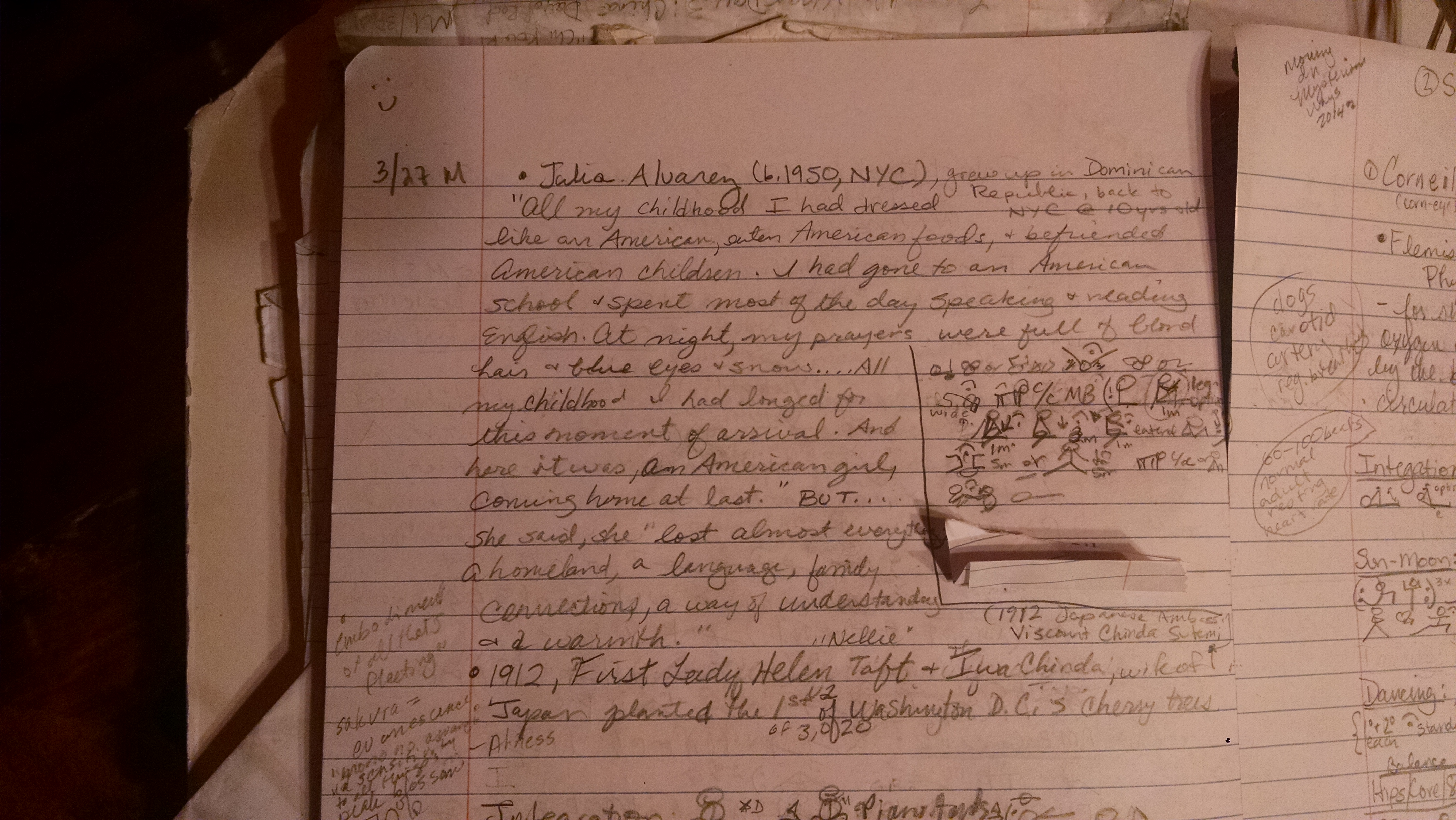
(Please note: These practice details are intended for individuals who already have a Yin Yoga practice. Before starting a new practice, be sure to check in with your health care provider. Most importantly, remember that although you may experience health benefits from your practice, this practice information is not intended as medical advice or as a means to replace medical care.)
Since my so-called hieroglyphics can be a little tiny or hard to read, here is an outline of the Monday Yin Yoga class from March 27, 2017 a.k.a. Julia Alvarez’s Big Day, a.k.a. the anniversary of the day First Lady Helen Taft and Viscountess Iwa Chinda planted cherry blossoms in D.C.:
- Legs-Up-The Wall (for centering and integration): Sit sideways on the mat, so that the side of your hip is up against the wall; then pivot the body so the legs swing up and the back reclines on the mat. The trick is to keep your bottom on the wall. (For more release in the hamstrings, back, and hips, place the feet on a chair or table so that hips, knees, and ankles are resting at 90 degree angles.) Hold for about 2 minutes with back on the floor or a blanket. For additional decompression, bend the knees in order to use the legs to lift the hips and add a block, making sure not to pinch the spine. Hold for another 3 minutes.
- “Sleeping Butterfly” – on the wall (counter-pose): Remove the block and move into Butterfly (feet together like a prayer, knees open up like the pages of a book) with legs on the wall for about one minute. Use “Sleeping Butterfly” or a Squat on the wall to set a personal intention, which will keep you on the wall for another minute.
- Dragonfly, on the wall: Stretch your legs out (on the wall) as wide as they’ll go, and support the legs by placing a block between the wall and each thigh or by placing blocks or a bolster on the outside of each thigh. Hold for 3 – 5 minutes.
- “Sleeping Butterfly” (transitional pose) and Fetal Position (transitional pose)
- Wide Legged Child’s Pose (with arms bent on floor over head): Props may be placed under the hips and/or under your chest. If you have a bolster, you can recline your whole body on it. Hold for 2 – 3 minutes.
- Counter-pose Moment: Inhale to table top and use Cat/Cow to transition into about 1 minute of gentle movement to break up the stillness.
- Half Shoelace or Half Square sequence: Sit with legs extended in front of you. If there’s compression in the low back and/or hips, sit up on top of a blanket or block. Hug right knee in and lift it over extended left leg. You can either rotate the top leg so the knee points to the left foot or slide the top leg to the side so the ankle rests on the bottom thigh, right below the knee. (If elevated, you can place a blanket or towel under the extended shin – to soften the experience at the back of the knee. If you have a hamstring issue, you could sub “Full” Shoelace or Square by bending the bottom knee into the appropriate position.) Twist upper body to the right and hold for at least 1 minute. Rotate back to center and fold until you feel a change, support the change and hold for at least 3 minutes.
- Counter-pose Moment: Inhale to lift the body, unravel the legs and give them a rub or a hug. Lean back on the forearms or recline with back on the floor, windshield wiper bent knees for about 1 minute.
- Repeat “Half Shoelace or Half Square” sequence on opposite side and Counter-pose Moment.
- (Prone) Frog or Dragonfly: Face the long side of the mat and set up props as needed. For (Prone) Frog, come into table top; spread the knees as wide as they’ll go, with ankles under the knees (when you look down the legs) and hips pressing back. Extend the chest forward and recline on forearms and/or props. Prop the thighs. For Dragonfly, sit with legs in front of you and spread wide; prop as needed for low back and lean forward until you feel a change; prop the change. Hold for 5 minutes
- Counter-pose Moment: (Prone) Frogs Inhale to table top and use Cat/Cow to transition; Dragonflies use inhale to rise up, hug the knees into the chest and then recline to windshield wiper bent knees. Gentle movement for about 1 minute.
- “Sleeping Butterfly”: Set up props so upper back is supported, behind shoulder blades, and head us raised slightly above the chest by a prop that supports the nape of the neck (where head meets the spine). If thighs do not touch the ground when legs rest in position, place a block under each thigh. Hold for 5 minutes.
- Counter-pose Moment: Mindfully, move off the props.
- Savasana (with props, as needed): Hold for at least 5 minutes.
- Counter-pose Moment: Be easy and gentle as you move out of Savasana and into a fetal position. Give yourself a moment before sitting up and closing out your practice. Namaste.
Thanks, G, for your question. I’m always so glad to see you in class and (of course) super grateful your yoga practice is helping you feel good!
If anyone else out there is grateful for the way yoga helps you feel, please share your practice and consider Kiss(ing) My Asana with a joyful donation.
 A Joyful Practice