Happy Carnival (to those who are already celebrating)! Peace and ease on the final day of World Interfaith Harmony Week (WIHW) and throughout this “Season for Nonviolence” and all other seasons!!!
May your dreams come true.
This is the “missing” post & excerpt for February 7th. My apologies for the delay and for not posting music before the practice. You can request an audio recording for a related practice via a comment below or (for a slightly faster reply) you can email myra(at) ajoyfulpractice.com.
In the spirit of generosity (“dana”), the Zoom classes, recordings, and blog posts are freely given and freely received. If you are able to support these teachings, please do so as your heart moves you. (NOTE: You can donate even if you are “attending” a practice that is not designated as a “Common Ground Meditation Center” practice, or you can purchase class(es).
Donations are tax deductible; class purchases are not necessarily deductible.
“It is necessary that we dream now and then. No one achieved anything, from the smallest object to the greatest, unless the dream was dreamed first, yet those who stop at dreaming never accomplish anything. We must first see the vision in order to realize it; we must have the ideal or we cannot approach it; but when once the dream is dreamed it is time to wake up ‘get busy.’ We must ‘do great deed, not dream them all day long.’
The dream is only the beginning.”
— quoted from the “1918: Make Your Dreams come True ~ February 5, 1918” by Laura Ingalls Wilder (b. 1867), published in Laura Ingalls Wilder, Farm Journalist: Writings from the Ozarks, Edited by Stephen W. Hines
“Dreaming” is the “Season for Nonviolence” principle of the day and, according to the Yoga Sūtras, can be the source of wisdom. However, some types of dreaming can also be a form of grasping or craving — which is antithetical to the practice. So, as is so often the case, the practice becomes about finding balance.
It can be challenging to find the balance between dreaming and that “trustful surrender” that is letting go and having faith in your efforts (and in what has already been written). In our physical practice, it can be the balance between effort and relaxation. In our philosophical Yoga practice, it is the balance between abhyasa(“[continuous and deliberate] practice, [engaged with sincere devotion]”) and vairagya(“non-attachment”). (YS. 1.12-1.14) In a spiritual and/or religious practice, it is having faith in yourself and in God (whatever that means to you at this moment).
When we find that balance, things get done. According to the Yoga Sūtras, the process by which we find that balance leads to mental and physical vitality, as well as freedom and liberation from suffering. (YS 1.2 – 1.4; 1.12 – 1.15; 1.29 – 1.40; 2.18) This process — which is the Yoga Philosophy — includes the practice of santoşā(“contentment”), which leads to “…happiness without equal.” (YS 2.42)
And there’s the twist: How do you dream or desire (which can be a form of craving) and also be satisfied/content? How do you find balance when you may think of contentment as “settling” — as if there is something more and you are missing out?
“At this second Carol realized that for all Guy’s love and dead elegances his timidity was as depressing to her as the bulkiness of Sam Clark. She realized that he was not a mystery, as she had excitedly believed; not a romantic messenger from the World Outside on whom she could count for escape. He belonged to Gopher Prairie, absolutely. She was snatched back from a dream of far countries, and found herself on Main Street.”
— quoted from Main Street by Sinclair Lewis (b. 1885)
I think of both santoşā and the Zen Buddhist practice of shoshin(“beginner’s mind”) as practices that encourage us to stay in the present moment — with a sense of awe and wonder about what comes next. These practices also create the opportunity for us to be grateful for what we have been able to do in the past, present, and in the future.
During the practice, I reference several people born on February 7th; people who dreamed of “something more”. Three of them found their something more by writing about what they knew and about what they dreamed. Like their father, the fourth birthday person also worked to create the world of which they dreamed, a more just world, a more equitable world… but (unlike the others) their writing was “brief”.
“In the early seventies, blacks argued for bifurcated jury trials, and this Court today has mandated such for the State of Alabama. In the seventies, blacks asked that sentences for rape and other offenses be not discriminatorily and freakishly imposed.”
— quoted from the special concurrence opinion for Beck v. State, 396 So. 2d 645 (1980) by Alabama Supreme Court Justice Oscar W. Adams (b. 1925)
“Are you happy in this modern world? Or do you need more? Is there something else you’re searchin’ for?
I’m falling In all the good times, I find myself longin’ for change And in the bad times, I fear myself”
— quoted from the song “Shallow” written by Mark Ronson, Anthony Rossomando, Andrew Wyatt, Stefani J. Germanotta
Saturday’s playlist is available on YouTube and Spotify. [Look for “07092022 Awareness of the Mind’s Awareness”]
Music Note: There are two (going on three) playlists on YouTube and Spotify with today’s date. However, due to circumstances beyond my control, I decided to substitute the playlist highlighted above.
If you are thinking about suicide, worried about a friend or loved one, or would like emotional support, you can dial 988 (in the US) or call 1-800-273-TALK (8255)for the Suicide and Crisis Lifeline. You can also call this TALK line if you are struggling with addiction or involved in an abusive relationship. The Lifeline network is free, confidential, and available to all 24/7. YOU CAN TALK ABOUT ANYTHING.
White Flag is an app, which I have not yet researched, but which may be helpful if you need peer-to-peer (non-professional) support.
Many blessings to everyone and especially to anyone observing the Dormition (Theotokos) Fast; and/or working to cultivate friendship, peace, freedom, understanding, and wisdom — especially when it gets hot (inside and outside).
Stay hydrated & be kind, y’all!
This is the “missing” for Sunday, August 25th. Technically, it is also the “long lost” post for the 2021 practice. You can request an audio recording of this practice via a comment below or (for a slightly faster reply) you can email myra(at) ajoyfulpractice.com.
In the spirit of generosity (“dana”), the Zoom classes, recordings, and blog posts are freely given and freely received. If you are able to support these teachings, please do so as your heart moves you. (NOTE: You can donate even if you are “attending” a practice that is not designated as a “Common Ground Meditation Center” practice, or you can purchase class(es).
Donations are tax deductible; class purchases are not necessarily deductible.
“III.24. Extraordinary strength, resulting from samyama on the concept of physical strength (the aphorism specifically mentions the strength of an elephant, which was undoubtedly the strongest creature in Patanjali’s world), but it might also include mental, moral, or spiritual strength. This could be interpreted as an exceptional form of mind-body control or as a mind-matter interaction effect. Swami Satchidananda sums up this siddhi with the comment, ‘You can lighten yourself; you can make yourself heavy. It’s all achieved by samyama. Do it; try it. Nice things will happen’ (p.188).”
“III.37. Siddhis may appear to be supernormal, but they are normal. This is not a description of a siddhi, but rather a caution to avoid regarding or attaining the siddhis as unnatural or supernormal, as that could become a distraction to sustaining and deepening samadhi.”
— quoted from the “Taxonomy” section of “Part I: From Legendary Yoga Superpowers… Chapter 7: The Siddhis” in Supernormal: Science, Yoga, and the Evidence for Extraordinary Psychic Abilities by Dean Radin, PhD
In the Yoga Sūtras, Patanjali defined yoga (“union”) as a moment when all the internal chatter fades away (YS 1.2) and devoted a whole chapter to describing the powers that come when you focus-concentrate-meditate on a single thing and harness the power of the entire mind-body. He also outlined a process by which one can become completely absorbed into (or merged with) the point of their focus-concentration-meditation. Some of it sounds magical, extraordinary, or supernatural; but, it’s actually extra ordinary and very much supernormal. The ability to be single-minded and absorbed into something (or someone) is something we all do at various times in our lives.
We do it when we are “in the zone” and we do it when we are in the “first blush” of love.
Being in the zone is what athletes call it when you are in the moment, see exactly what needs to be done, and can do it in a way that almost appears effortless. Things just fall into place. Sometimes it even feels effortless and magical to the person that is in the zone. (YS 4.29) Other times, an athlete may find themselves running into the same obstacles and hinderances described in the Yoga Sūtras (YS 1.30-1.31) — not realizing that they need to practice non-attachment. Patanjali recommended focusing on the breath and, thousands of years later, a tennis player and coach recommended the same thing.
“It is said that in breathing humans recapitulate the rhythm of the universe. When the mind is fastened to the rhythm of breathing, it tends to become absorbed and calm. Whether on or off the court, I know of no better way to begin to deal with anxiety than to place the mind on one’s breathing process.”
— quoted from the “Focus During a Match” section of “7. Concentration: Learning to Focus” in The Inner Game of Tennis: The Classic Guide to the Mental Side of Peak Performance by W. Timothy Gallwey
Letting go of your own ego and getting out of your own way are foundational lessons in The Inner Game of Tennis: The Classic Guide to the Mental Side of Peak Performance (1974) by W. Timothy Gallwey. A tennis player and coach, Mr. Gallwey used his own experiences to help others play better psychologically — because sometimes you can up your game by changing what you are doing mentally, emotionally, and even energetically. Years after The Inner Game of Tennis was published (and after he published a companion book in 1976), Mr. Gallwey found that people were applying his book to other areas and in other disciplines. So he wrote Inner Skiing (1977), The Inner Game of Golf (1981), The Inner Game of Winning (1985), The Inner Game of Music (1986), and The Inner Game of Work: Focus, Learning, Pleasure, and Mobility in the Workplace (1999), and The Inner Game of Stress: Outsmart Life’s Challenges, Fulfill Your Potential, Enjoy Yourself (2009). In each book, the bottom line is to get to a place where the mind is quiet.
Which brings us back to the other time when everything else disappears: love.
Love, nothing else matters — except in tennis.
“Perhaps this is why it is said that great poetry is born in silence. Great music and art are said to arise from the quiet depths of the unconscious, and true expressions of love are said to come from a source which lies beneath words and thoughts. So it is with the greatest efforts in sports; they come when the mind is as still as a glass lake.
Such moments have been called ‘peak experiences’ by the humanistic psychologist Dr. Abraham Maslow.”
— quoted from the “‘Trying Hard’: A Questionable Virtue” section of “3. Quieting Self 1” in The Inner Game of Tennis: The Classic Guide to the Mental Side of Peak Performance by W. Timothy Gallwey
Full disclosure: When I was growing up, I was the only person in my immediate family who didn’t play tennis. So, there are a bunch of things about tennis that just don’t make sense to me. For instance, why does “love” mean “zero” in tennis? There are a lot of different theories about why “love” equals “zero” in tennis. Some of these theories don’t have a lot of supporting evidence; they just seem like old wives tales that may or may not be true. They stick around, however, because they are funny. For instance, there is the idea that English speakers were mispronouncing the French word l’ œuf (“egg”) — so it sounded like they were saying “love” — and that the number zero looks like an egg. This is sometimes paired with the idea that if you make a bunch of mistakes (and score no points) you’ve laid a goose egg. The biggest problem with this theory is that when in France, where tennis was first developed, people simply used the word zéro.
Another prevalent (and possibly more credible) theory about the term, that dates back to the 1700s, is that when you have no score, but you still give it all you’ve got, then you are playing for the love of the game. This is a slightly more credible theory, because, according to the Webster’s 1828 Dictionary, the word “amateur” comes from the Latin words anator (“a lover”) and amo (“to love”), referring to a person who does something for love rather than for money.
Of course, every professional begins as an amateur and one could argue that every professional wants to feel the way they did when they were an amateur — as if nothing else matters, but that moment and the love of the game in that moment. And, this is where things get interesting; because, in tennis, the most prestigious tournaments are “open” to amateurs and professionals. They all play for the same stakes. They all play with love so palpable it can make other people fall in love with the game. Some even play with the kind of passion that can also change the face of the game.
“I always wanted to be somebody. If I made it, it’s half because I was game enough to take a lot of punishment along the way and half because there were a lot of people who cared enough to help me.”
— quoted I Always Wanted to Be Somebody by Althea Gibson, edited by Ed Fitzgerald
Born today in 1927, Althea Gibson was a professional tennis player as well as a professional golfer. In 1949, she was the first Black woman and the second Black athlete (after Dr. Reggie Weir) to play in the National Indoor Championships hosted by the United States Lawn Tennis Association (USLTA, now known as the USTA). While she earned a full athletic scholarship to Florida A&M University (FAMU) and was considered an elite athlete all around the world, her race and ethnicity meant that she was not able to play in some of the most prestigious competitions in the world. To be clear, USTA had anti-discrimination rules in the 1950s; however, to qualify for certain tournaments, a player had to have a certain amount of points. In order to earn those points, a player had to play (and place) at a number of tournaments. Of course, some tournaments were held at clubs that were white-only — which meant that a player like Althea Gibson couldn’t play.
The first crack in that glass ceiling came when American Tennis Association (ATA) officials and 18 time Grand Slam championship-winner Alice Marble very publicly lobbied for Althea Gibson to be the first African-American to receive an invitation to the Nationals. Three days after her 23rd birthday, Ms. Gibson made her debut at Forest Hills and won. The world took notice; even though she ultimately lost the next match (in a delayed round) to Louise Brough, the then three-time defending Wimbledon champion, who also lobbied for inclusion.
Six years later, in 1956, Althea Gibson became the first African-American to win a Grand Slam event when she won the singles crown at the French Championships (now known as the French Open). She and Angela Buxton (from the United Kingdom) also won the doubles. Later that season, she won the championships in Rome, Italy; New Delhi, India; and Ceylon (now Sri Lanka). The following year, and the year after that, she won both Wimbledon and the US Nationals (which preceded the US Open) and was named “Female Athlete of the Year” by the Associated Press. (1957 was also the year she beat Louise Brough, who by then had won 35 major championships.)
“According to [American sculpture Eric] Goulder, each [of the five granite blocks] represents the ‘boxes’ society puts people in. [Althea] Gibson’s image emerges from the highest one, which balances on its corner to emphasize how she transformed the world’s view of African American athletes.
‘Her shoulder is exposed to make clear that those who followed stand on her shoulder,’ said Goulder. The final box, which is aligned differently from the others, is meant to show that the world has changed, but not entirely.
Its inscription reads: ‘I hope that I have accomplished just one thing: that I have been a credit to tennis and my country.’”
— quoted from the August 26, 2019, Reuters article “Trailblazer Althea Gibson honoured with statue at U.S. Open” by Arlyn Gajilan
Overall, Althea Gibson won a total of 11 Grand Slam events — including five singles titles, five doubles titles, and one mixed doubles title. In 1964, she became the first African-American woman to join the Ladies Professional Golf Association (LPGA) tour, where she broke course records and was among the 50 money winners for fives years. She was inducted into the International Tennis Hall of Fame (in 1971); was one of the first six inductees into the International Women’s Sports Hall of Fame (in 1980); and, in 2007, on the 50th anniversary of her first victory at the US National Championships, she was inducted into the US Open Court of Champions.
Althea Gibson was also inducted into the the Florida Sports Hall of Fame, the Black Athletes Hall of Fame, the Sports Hall of Fame of New Jersey, the New Jersey Hall of Fame, the International Scholar-Athlete Hall of Fame, and the National Women’s Hall of Fame. Additionally, she received a Candace Award from the National Coalition of 100 Black Women (in 1988) and was the first woman to receive the National Collegiate Athletic Association’s Theodore Roosevelt Award (in 1991). In 2000, Sports Illustrated placed her at #30 on their “100 Greatest Female Athletes” list. In 2013, the United States Postal Service honored her with a postage stamp and, in 2019, a bust of her was unveiled outside of the USTA Billie Jean King National Tennis Center in Flushing Meadows, where the US Open is now held.
“In a statement Sunday, tennis champion and activist Billie Jean King had this to say: ‘We all know people who influence us and, if we are lucky, we meet a few in our lives who improve us. Althea Gibson improved my life and the lives of countless others. She was the first to break so many barriers, and from the first time I saw her play, when I was 13 years old, she became, and remained, one of my true heroines.
‘It was truly an inspiration for me to watch her overcome adversity. Her road to success was a challenging one, but I never saw her back down. Althea did a lot for people in tennis, but she did even more for people in general.’”
— quoted from the September 29, 2003, Chicago Tribune article “Althea Gibson” (by the Chicago Tribune staff)
Even though Ms. Gibson broke so many color barriers that people compared her to Jackie Robinson, she couldn’t overcame all the obstacles put in her way. Despite winning multiple times at Wimbledon, she and her doubles partner, Angela Buxton, who was Jewish, were denied membership to the All England Club on more than one occasion.1 While many of the competitors that she beat were receiving endorsement deals, similar deals never came her way. That sort of racism and prejudice led her to join the LPGA, but even there she ran into literal barriers to entry. Sometimes she was not allowed to compete. Sometimes she had to change clothes in her car, because the clubs, hotels, and dressing rooms were segregated and no accommodations were available to her. While the highest earners (during the years she played on the tour) averaged, almost $35,000 a year, Althea Gibson’s lifetime golf earnings were under $25,000 (plus or minus a car she won at a Dinah Shore tournament).
Despite the ongoing challenges, Althea Gibson kept persevering. Maybe one of the reasons she never seemed to back down was because she was always fighting to survive. She dropped out of school when she was 13 years old and ran away from home because her father was abusive. At one point she lived in a Catholic shelter for abused children. By that time, she was already a paddle tennis champion in New York City and her neighbors had pooled their resources together to purchase her a junior membership and lessons at the Cosmopolitan Tennis Club in the Sugar Hill section of Harlem. But, young Althea didn’t initially love tennis. It was a means to an end; it was one of her many means of escape.
“‘Being a champ is all well and good,’ I would tell the well-meaning people who asked me about my retirement, ‘but you can’t eat a crown. Nor can you send the Internal Revenue Service a throne clipped to their tax forms. The landlord and grocer and tax collector are funny that way: they like cold cash. I may be the Queen of Tennis right now, but I reign over an empty bank account, and I’m not going to fill it by playing amateur tennis, even if I remain champ from now until Judgement Day.’”
— quoted from “So Much to Live For” in So Much to Live For by Althea Gibson with Richard Curtis
In addition to being an accomplished athlete, Althea Gibson was also a singer, a saxophone player, an actor, a sports analyst, and an author. She turned to all of those mediums in an effort to support herself and pushed the limits of everything she did so that each industry was better than she found it. She even opened for the Harlem Globetrotters by playing exhibition games with Karol Fageros and ran for public office. For much of her adult life, she was also a mentor and coach. She facilitated Pepsi Cola’s national mobile tennis project in underprivileged areas and ran multiple other clinics and tennis outreach programs. She inspired her competitors, as well as players in subsequent generations: like Billie Jean King and Serena and Venus Williams.
The Williams sisters, in particular, sought advice on how to play and how to deal with racism (on and off the court). In fact, Serena Williams won her first (of six) US Open titles in 1999, shortly after faxing a letter and a series of questions to Ms. Gibson. In 2000 and 2001, Venus Williams followed in Althea Gibson’s footsteps by winning back-to-back championships at Wimbledon and the US Open. Like Evonne Goolagong, the Australian Aboriginal (Wiradjuri) athlete who became the second non-White woman to win a Grand Slam championship (in 1971), the Williams Sisters and other African-American athletes experienced a different financial landscape than Althea Gibson, but they still had to deal with racism and prejudice.
“You can’t compare tennis with baseball, basketball, or football. When Jackie Robinson broke the color line in 1947 with the Brooklyn Dodgers, dozens of good baseball players in the Negro leagues were waiting to follow. When Althea Gibson, the first prominent black in tennis, won national grass-court titles at Forest Hills in 1957 and 1958, there was no reservoir of black talent waiting to walk in if the door ever opened. Blacks had no identification the sport — on or off the court.”
— quoted from “3. The Passage” in Off the Court by Arthur Ashe with Neil Amdur
Another person Althea Gibson inspired was Arthur Ashe, who who won the US Amateur Championships today in 1968. A couple of weeks later, on September 9th, the Army lieutenant at West Point, followed in Althea Gibson’s footsteps: winning the first US Open and becoming the first African-American man to win a Grand Slam event. He also became the first person (period) to win the US Amateur and the US Open in the same calendar year. These were not his first, nor his last, groundbreaking achievements in tennis. In 1963, he was the first Black player selected for the US Davis Cup team and, so far, he has been the only Black man to win the singles titles at Wimbledon, the US Open, and the Australian Open.
Up until 1968, the US National Championship events were held at a variety of locations and only open to amateurs. When it became the US Open, it was open to professionals as well as to amateurs — which is what Arthur Ashe was at the time. In fact, he was the underdog, going up against a professional. He was also active duty, during a war — his younger brother Johnnie accepted an extra tour in Vietnam, which allowed him to compete since the United States had a policy against sending brothers into a war zone. First Lieutenant Ashe’s amateur status meant that his prize money went to the runner up.
“‘Money makes me happy.’ Who would make such a crass remark? I did, in my book Portrait in Motion, written with Frank DeFord. But the truth is that I’m glad I have enough money to live comfortably, and I enjoyed adding to my bank account as I earned money on the tennis court and in various business deals when I was a professional. I was not born poor, but my father was hardly rich. I long ago decided that, on the whole, I much prefer having money to not having it. In that sense, it makes me happy.
On the other hand, I also learned a long time ago what money can and cannot do for me. From what we get, we can make a living; what we give, however, makes a life.”
— quoted from “6. The Striving and Achieving” in Days of Grace: A Memoir by Arthur Ashe and Arnold Rampersad
Arthur Ashe was inducted into the Virginia Sports Hall of Fame (in 1979), the Intercollegiate Tennis Association (ITA) Hall of Fame (in 1983), and the International Tennis Hall of Fame (in 1985). In 1975, he received the inaugural Player of the Year Award from the Association of Tennis Professionals (ATP) and was named the BBC Overseas Sports Personality of the Year. In 1977, other players on the ATP-tour awarded him the ATP Sportsmanship Award. In December 1992, just a few months before he died, he received the “Sports Legend” Award from the American Sportscasters Association. In 1993, he was posthumously awarded the Presidential Medal of Freedom by President Bill Clinton, the Congressional Black Caucus Foundation’s George Thomas “Mickey” Leland Award, and ATP’s Arthur Ashe Humanitarian of the Year Award by the ATP. He was also an author and an Emmy Award winner. In 1997, the newly constructed Arthur Ashe Stadium became the largest venue at the USTA Billie Jean King National Tennis Center in Flushing Meadows, home of the US Open. “Soul in Flight,” a statue sculpted by Eric Fishl, was unveiled in 2000 as a memorial to Arthur Ashe and to the spirit of sportsmanship and humanitarianism that he embodied. In 2005, the United States Postal Service issued a commemorative stamp in his honor.
Throughout his career, Arthur Ashe was an activist. He was part of the Civil Rights Movement in the United States and also part of the anti-apartheid movement in South Africa. He also advocated for Haitian refugees and was a campaign chairman for the American Heart Association. In 1983, he contracted HIV after a blood transfusion during heart bypass surgery and, when he announced his diagnosis in April of 1992, he became a very public HIV/AIDS advocate and educator. He also founded the Arthur Ashe Foundation for the Defeat of AIDS and the Arthur Ashe Institute for Urban Health.
“Perhaps my favorite prayer-poem by Howard Thurman is ‘The Threads In My Hand.’ The speaker of the poem says that he holds only one end of a number of threads, which come to him from ‘many ways, linking my life with others.’ Some threads come from the sick and troubled, some from the dreaming and ambitious; still others are knotted beyond the speaker’s power to understand and unravel. But one thread is different from all others:
One thread is a strange thread—it is my steadying thread;
When I am lost, I pull it hard and find my way.
When I am saddened, I tighten my grip and gladness glides along its quivering path;
When the waste places of my spirit appear in arid confusion,
the thread becomes a channel of newness in life.
One thread is a strange thread—it is my steadying thread.
God’s hand holds the other end…”
— quoted from “10. The Threads in My Hands” in Days of Grace: A Memoir by Arthur Ashe and Arnold Rampersad
In chapter 10 of Days of Grace: A Memoir, Arthur Ashe described himself as “a fortunate, blessed man… [with] no problems” — aside from two really major health problems. Those two health problems were not the one’s most commonly associated with tennis players. In fact, neither Arthur Ashe nor Althea Gibson seemed to have dealt with the one of the health issues most commonly associated with a non-contact sports like tennis: “tennis elbow” — which is a bit of misnomer. While 50% of tennis players report elbow pain — 75% of which is considered true “tennis elbow” — tennis players only make up about 10% of all the cases of nationwide. In other words, you can have “tennis elbow” even if you’ve never played tennis. It’s simply a repetitive stress issue. So, if you do certain movements repeatedly, without stability, you could end up with tendonitis or tendinosis. Tennis, even when done on a table, is very asymmetrical; making unilateral stability a priority.
But, neither of these record-breaking seemed to have a problem with tendonitis or tendinosis. Unfortunately and ironically, Althea Gibson and Arthur Ashe both had cardiovascular issues.
Two cerebral hemorrhages, in the late 1980s, a stroke in 1992, and related medical expenses left Althea Gibson in dire straits. No help was forthcoming when she reached out to various tennis organizations; however, Angela Buxton, her former doubles partner, was able to engage the tennis community and raised nearly $1 million in donations from around the world. In 2003, she suffered a heart attack and then, later that year, died from complications related to respiratory and bladder infections.
Arthur Ashe had a family history of cardiovascular disease and was 36 years old when he suffered his first heart attack in 1979. His heart was in such bad condition, despite his athleticism, that he needed a quadruple bypass. A few months later, he had to delay his return to tennis, because of chest pains. In 1983, he had a second bypass surgery — which is when it is believed he contracted HIV. Paralysis in his right arm led to a battery of tests, exploratory brain surgery, and the HIV diagnosis. Due to the stigma associated with HIV and AIDS, Arthur Ashe and his wife initially decided that the best way to protect their young daughter was by not publicly disclosing his diagnosis. In the fall of 1992, he had a second heart attack and learned that a newspaper was planning to release his diagnosis. A few months later, in 1993, he died from AIDS-related pneumonia.
“By the time you read this letter from me to you for the first time, I may not be around to discuss with you what I have written here. Perhaps I will still be with you and your mother, sharing in your daily lives, in your joys and in your sorrows. However, I may be gone. You would doubtless be sad that I am gone, and remember me clearly for a while. Then I will exist only as a memory already beginning to fade in your mind. Although it is natural for memories to fade, I am writing this letter in the hope that your recollection of me will never fade completely.”
— quoted from “11. My Dear Camera” in Days of Grace: A Memoir by Arthur Ashe and Arnold Rampersad
As I mentioned before, I grew up as the non-playing member of a tennis-loving family. Most of the time I didn’t mind not playing tennis, because I was absorbed in other things. I loved other things. There was one time, however, when I was really grateful that I didn’t play — and so were my parents.
It was during a time when we were living in the Maryland-D.C. area, late 70s or early 80s. If memory serves me2 — and if I go by the 1981 publication date of Off the Court — I was probably have been as old as 12 or 13. Either way, I was small (spoiler alert: I have always been small). Since I wasn’t playing in the tournament, I wasn’t restricted to certain areas the way my brothers were restricted. So, my parents lifted me over the fence with a copy of Arthur Ashe’s autobiography. Being the man that he was, he didn’t hesitate to sign it.
It was a very memorable day that I will never forget, but, to him, it was: “Just another day at the office…”
“…he told the Baltimore Sun’s Jim Caffrey[,] ‘I never get too excited about winning anything; it’s just my philosophy of life.’”
— quoted from the August 13, 2017, Andscape (“#RememberWhensdays”) article, “The day Arthur Ashe became the first black man to win the US Open: Ashe earned the top ranking in the country with the five-set victory” by Rhiannon Walker
Sunday’s playlist is available on YouTube and Spotify. [Look for “08252021 Love from Althea & Arthur”]
NOTES: 1The All England Lawn Tennis and Croquet Club (AELTC), also known as the All England Club, is a private members’ club in Wimbledon, London, England. Established on July 23, 1868, the majority of the nearly 600 members are are Full Members — who, along with Life Members and Honorary Members, make up no more than 500 members. A little over 50 members are Temporary Members of Junior Temporary Members.
To be placed on the waiting list, full and temporary membership candidates must submit an application with formal letters of support from four existing full members, “two of whom must have known the applicant for at least three years.” While some honorary members are occasionally elected by the club’s committee, “past [Wimbledon] Singles Champions, other eminent Lawn Tennis players…” are typically (and automatically) invited to become honorary members. While Black players and Jewish players were theoretically eligible to join the club in 1951 and 1952, respectively, neither Althea Gibson nor her doubles partner Angela Buxton (who retired at the age of 22, because of tenosynovitis) ever made the cut.
2In July 2025, my father randomly texted me about getting Arthur Ashe’s autograph. He remembered it being on a program, which would have made me a lot younger than the age I remembered.
CORRECTION: During the 2024 practice, I referred to Arthur Ashe as a photographer; however, I was confusing him with his wife, the photographer and graphic artist Jeanne Moutoussamy.
Extreme heat can not only make people lethargic and unmotivated, it can also lead to extreme agitation and anxiety-based fear. We may find it hard to think, hard to feel (or process our feelings), and/or hard to control our impulses. If you are struggling in the US, help is available just by dialing 988.
If you are thinking about suicide, worried about a friend or loved one, or would like emotional support, you can dial 988 (in the US) or call 1-800-273-TALK (8255)for the Suicide and Crisis Lifeline. You can also call this TALK line if you are struggling with addiction or involved in an abusive relationship. The Lifeline network is free, confidential, and available to all 24/7. YOU CAN TALK ABOUT ANYTHING.
White Flag is a new app, which I have not yet researched, but which may be helpful if you need peer-to-peer (non-professional) support.
This is the post for Sunday, October 17th.You can request an audio recording of Sunday’s practice via a comment below or (for a slightly faster reply) you can email me at myra (at) ajoyfulpractice.com.
In the spirit of generosity (“dana”), the Zoom classes, recordings, and blog posts are freely given and freely received. If you are able to support these teachings, please do so as your heart moves you. (NOTE: You can donate even if you are “attending” a practice that is not designated as a “Common Ground Meditation Center” practice, or you can purchase class(es). Donations are tax deductible; class purchases are not necessarily deductible.
– quoted from the poem “DIFFERENTLY” by Donna Garrett
Ancient philosophies like Yoga and Buddhism share common histories, roots and concepts, just as certain religions overlap. So, it’s not surprising to find similar recommendations in contemplative and mindfulness-based practices. For instance, it isn’t surprising that the aforementioned philosophies recommended consistency and a dedication to the practice. We find this also in religion. Hence the idea that we can do something religiously. I have heard, time and time again, that the Buddha recommended an adherence to the path even when faced with obstacles and resistance from others. For instance, according to the back story for metta (“lovingkindness”) meditation, the Buddha instructed monks to continue practicing the lovingkindness meditation even when they were being bombarded with insults (and fruit).
In Yoga Sūtra 1.12-14, Patanjali recommended abhyāsa: a dedicated, regular practice of making the “effort to retain the peaceful flow of mind….” Regular practice is also defined as something undertaken over a long period of time, without interruption, and with passion, devotion, and reverence. (As always, note that the recommendation is related to the entirety of the philosophy, not just the physical practice.) English translations of the sūtras usually include the word “ardent,” which means “enthusiastic or passionate.” This can conjure up the the picture of a hamster on a wheel, frantically working towards peace – which seems like an oxymoron.
Yet, we all find ourselves in that contradiction. We hurry up to get to yoga. We rush to slow down. We do in order to undo or not do. In some ways, it’s the human condition. The funny thing is, that in both Yoga and Buddhism, we find a balancing recommendation: vairāgya, the practice of non-attachment. Of course, letting go is easier said than done.
“Withdrawing the mind from the external world and turning it inward is difficult. There are two reasons for this. The first is our deep familiarity with the external world. This is what we know. This is where we were born. We live here and we will die here. Our concepts of loss and gain, failure and success, are defined by the external world and confined to it. We experience it as complete, solid….
The second reason we find it so hard to turn the mind inward is that we know very little about the inner dimension of life. The little we do know is based on momentary intuitive flashes or on what others have said. Because we have no direct experience of inner reality, we are not fully convinced it exists. For most of us, our inner world has no substance. Our belief in it is undermined by doubt. We are curious about it, but the idea of becoming established in it seems far-fetched.”
– commentary on Yoga Sūtra 1.14 from The Secret of the Yoga Sutra: Samadhi Pada by Pandit Rajmani Tigunait, PhD
Underlying the Metta Sutta background is the idea that the monks had to give up the idea that there was a more suitable place for them to meditate and practice lovingkindness. We sometimes think that the ideal place to meditate is quiet and the ideal place to practice lovingkindness is surrounded by people who are loving and kind – and there is some truth in that. However, as Rabbi Abraham Joshua Heschel pointed out in Between God and Man: An Interpretation of Judaism, “Our concern is not how to worship in the catacombs but how to remain human in the skyscrapers.” Remember, the Buddha was invested in offering a liberating path to everyone regardless of their class or social status. Not everyone can practice under “ideal” circumstances. Additionally, even if we could, we still bring our minds and our previous (obstacle-inducing and suffering-producing) conditioning to the practice.
Patanjali was also interested in a practical practice, not just theory. So, he recommended cultivating opposites throughout the sūtras. In the first section, he described specific meditation practices around the idea (YS 1.33-39) and in Yoga Sūtra 2.33 he specifically defined the idea as a way to practice when “perverse, unwholesome, troublesome, or deviant thoughts” prevent one from following the entirety of the practice. When we look at the effect of practicing the different limbs, as described by Patanjali, we may view the practice of non-attachment as the opposite of the ardent practice. In fact, Swami Jnaneshvara Bharati, of the Himalayan tradition, illustrates these foundational principles of the Yoga Philosophy as elements balancing each other on a scale, recommending that we put equal weight and effort into giving our all and letting everything go.
Giving our all, in the moment, and then letting go as we flow our entire awareness into the next moment is the very essence of living in the moment. And while we are, in the base case, capable of living in that way, it can seem counterintuitive to our modern (Western) society. We are taught at an early age to be the ants not the grasshoppers, to be the little pig who takes the time to build the stone house as opposed to the two who use sticks and straw because they want to party. Inherent in our concept of responsibility is the idea that we can plan ahead and have some foresight. Yet, we can get bogged down in the planning and the doing. Conversely, even when we are aware of the psychological benefits of delayed gratification, we can want our cupcake now! And where these attitudes really get us into trouble, and really steep us in suffering is when they dovetail with abhiniveśaḥ, the afflicted/dysfunctional thought pattern that is fear of loss or fear of death.
“Music seems to have a special power to animate us. Kant called music, ‘…the quickening art.’ There’s something about rhythm, as a start, compels one to move…with the beat…. There’s something about the rhythm of the music, which has a dynamic, animated, propulsive effect that gets people moving in sympathy with it; and gets people moving in sympathy with one another. So…the rhythm of music has a strong bonding thing. People dance together, move together…”
– quoted from an interview with Dr. Oliver Sacks
“There is certainly a universal and unconscious propensity to impose a rhythm even when one hears a series of identical sounds at constant intervals… We tend to hear the sound of a digital clock, for example, as “tick-tock, tick-tock” – even though it is actually “tick tick, tick tick.”
– from Musicophilia: Tales of Music and the Brain by Dr. Oliver Sacks
Remember, the brain likes patterns, repetition, and rhythm. The brain also likes solving puzzles and filling in the gaps. Even when our solutions or lacuna (gap-fillers) don’t make sense, they bring us some comfort. If we look at this from a Western science perspective, the brain creates a neural pathway when we do something for the first time and then reinforces, or hardwires, the pathway the more we repeat the activity, habit, or behavior. This is what we call muscle memory. If we look at this same thing from the perspective of the Yoga Philosophy, everything we do/experience creates “mental impressions” (samskaras) through which we view and understand every subsequent activity. Either way, we condition ourselves to feel, think, and be a certain way. In other words, we get into a groove, very much like a needle on a record.
Then something happens, our metaphorical record gets scratched and we skip a beat. Sometimes there’s enough momentum for the music to continue. But, sometimes, we get stuck. The groove becomes a rut or a rake (or a record that skips) and we resist the change that would alleviate our suffering. We find ourselves “stuck” even though we are doing the things that have helped us or others in the past. My yoga buddy Dave has a great joke about a groove, a rut, and a rake. What’s the difference? Perspective. Or how long you’ve been in it.
“Consequently, [René] Descartes has employed a Scholastic/Medieval argument to ground what is possibly the most important concept in the formation of modern physics, namely inertia. Yet, it is important to note that Descartes’ first and second laws do not correspond to the modern concept of inertia, since he incorrectly regards (uniform, non-accelerating) motion and rest as different bodily states, whereas modern theory dictates that they are the same state.”
– quoted from “4. The Laws of Motion and the Cartesian Conservation Principle” of “Descartes’ Physics” by Edward Slowik, published in The Stanford Encyclopedia of Philosophy (Winter 2021 Edition), edited by Edward N. Zalta
Sir Isaac Newton’s first Law of Motion, also called the Law of Inertia, states that “An object at rest remains at rest, and an object in motion remains in motion at a constant speed and in a straight line unless acted on by an unbalanced force.” Even before Newton codified it in this way, this natural phenomenon had been observed by people like Galileo Galilei and René Descartes. We can even observe it in ourselves and each other. Especially when we are engaged in a contemplative or mindfulness-based practice. Practices like Yoga and Buddhism allow us to notice when we are spiraling out of control and also when we are stuck. They also give us the tools, the force, to get unstuck. One of those tools is the practice of non-attachment. In fact, one of the lojong or “mind training” techniques in Tibetan Buddhism is to “Self-liberate even the antidote.” (4) That is to say, don’t hold on to or grasp anything ” – even the realization that there’s nothing solid to hold onto.”
The question is: How do you even do that? It seems impossible.
In fact, the idea that “It’s impossible,” is Arjuna’s exact argument in the Bhagavad Gita (6.33-34). His reasons (or excuses) are very relatable – that his mind is restless, turbulent, and “a nursery of waywardness, so strong it can drag an elephant, full of stubborn desires for worldly things. Indeed it’s like a mule.” He goes on, even, describing how his mind works when it doesn’t get its way. And, just like, a good kindergarten teacher, Krishna takes the time (and the crayons) to break it down – and he does so with a smile. While Krishna points to four elements (regular practice, relentless inquiry, non-attachment, and firm faith), it quickly becomes evident that Patanjali combined the first and the fourth elements in his outline. Additionally, Krishna’s explanation parallels Patanjali’s description of kriya yoga (YS 2.1), which involves discipline, self-study, and trustful surrender to a higher power (other than one’s self).
The thing to remember is that what happens in the mind, happens in the body; what happens in the body, happens in the mind; and both affect the breath. Since we can’t all automatically change the mind-body, these practices recommend we start with the breath. That’s the “force” by which we cultivate awareness and also change. Similar to the monks in the forest, the practice isn’t (only) being able to focus-concentrate-meditate on the parts of the breath when there is no distraction or interruption. Abhyāsa is about coming back again and again. Coming back to the breath, back to the ethical components, back to the mat, back to the cushion again and again – in spite of and specifically because of the distractions and interruptions. This, Krishna tells Arjuna, creates “raw force of determination, will.”
“Now begin to slowly shape your breath. Breathing through your nostrils, have the intention to lengthen the inhale and exhale. / Stay smooth and effortless. / Inhale and exhale, so as to resolve or refine any involuntary pauses. / Or any rough stages in the flow of the breath. // The slower this rhythm, the more healing it is. / The more you sense body and mind becoming quiet. / Continue to shape your breath for about one minute. // Be aware that you are using your mind to shape the breath… and the breath is shaping the mind. / Please continue. // Sense how your mind has become more calm and clear, at ease.”
– quoted from ” Para Yoga Nidra Practice 1: The Essential Steps” by Rod Stryker
Of course, when you are feeling stuck, unmotivated, and possibly unloved / unappreciated, it’s hard to get moving – even in the metaphorical sense. This is when we go back to the lojong technique, as well as to Patanjali’s recommendation to cultivate the opposites. Remember to give yourself permission to take care of yourself and then ask yourself the following questions:
What can I do, right now – today, in this moment – that is different from what I did yesterday (or in a previous moment)?
What is consistent with my practice and also shakes things up a little?
What haven’t I done in a long time?
What have I only done once?
With whom can I call, text, or otherwise engage? This is not to complain or explain what’s happening (unless that’s what you need), but to remind yourself that someone is in your corner. (Or to remember that you are in someone else’s corner.)
Once you have an answer that checks at least three out of five boxes, do it! Make a commitment to yourself. Even if it is only 2 minutes a day, those 2 minutes can change how you move through the rest of your day(s).
And, when everything is said and done, don’t forget to give thanks!
“33-34. Arjuna interrupts again: ‘It’s impossible, Krishna! My mind is so restless, so turbulent I can’t imagine ever being able to achieve the loftiness you’re teaching. The human mind is a nursery of waywardness, so strong it can drag an elephant, full of stubborn desires for worldly things. Indeed, it’s like a mule. If it doesn’t get what it wants it turns petulant and scheming. My mind can never be caught; it never halts in one place. Trying to catch and tame it is like trying to restrain the wild wind.’
35. Krishna breaks into a smile. ‘You know the nature of the mind, Arjuna. It is restless and hard to subdue, but it can be done. There are four main ways to do it : through regular practice, relentless inquiry, non-attachment, and firm faith. Let Me explain.
‘Through regular practice (abhyasa) you can draw the mind away from worldly attractions and back into the Atma. As it becomes more interior it becomes calmer. Relentless inquiry into the Self (vichara) leads to knowledge of Atma, the True Self Within. Non-attachment (vairagya) results from self-inquiry and discrimination (viveka). When you actively turn your thoughts to all the bad consequences of the desires as they arise in you, the passion for them gradually dries up. As your passion diminishes, your mind comes under control. Firm, dedicated faith (sraddha) brings you the raw force of determination, will. All four methods are subsidiaries of the practice of meditation.
36. ‘Those who have no mastery over their ego will find it difficult to control the mind. But those who struggle hard by the correct means (relentless practice and nonattachment) will prevail over their wayward minds.'”
– quoted from 6.33-36 of The Bhagavad Gita: A Walkthrough for Westerners by Jack Hawley
NOTE: This playlist contains Easter eggs! Did you find them. The three birthday ones are stacked together – and one is actually a double. But there’s one I didn’t mention in the practice. (They are all related to the date, and the theme, but don’t be surprised if you notice there’s one or two that are obviously missing.)
“It is far more creative to work with the idea of mindfulness rather than the idea of will. Too often people try to change their lives by using the will as a kind of hammer to beat their lives into proper shape. This way of approaching the sacredness of one’s own presence is externalist and violent. It brings you falsely outside yourself, and you can spend years lost in the wilderness of your own mechanical, spiritual programs. You can perish in a famine of your own making. If you work with a different rhythm, you will come easily and naturally home to yourself. Your soul knows the geography of your destiny. Your soul alone has the map of your future, therefore you can trust this indirect, oblique side of yourself. If you do, it will take you where you need to go, but more important it will teach you a kindness of rhythm in your journey. There are no general principles for this art of being. Yet the signature of this unique journey is inscribed deeply in each soul. If you attend to yourself and seek to come into your presence, you will find exactly the right rhythm for your life.”
– quoted from Anam Cara: A Book of Celtic Wisdom by John O’Donohue
Thanks, TH, for reminding me of this little bit of sweetness!
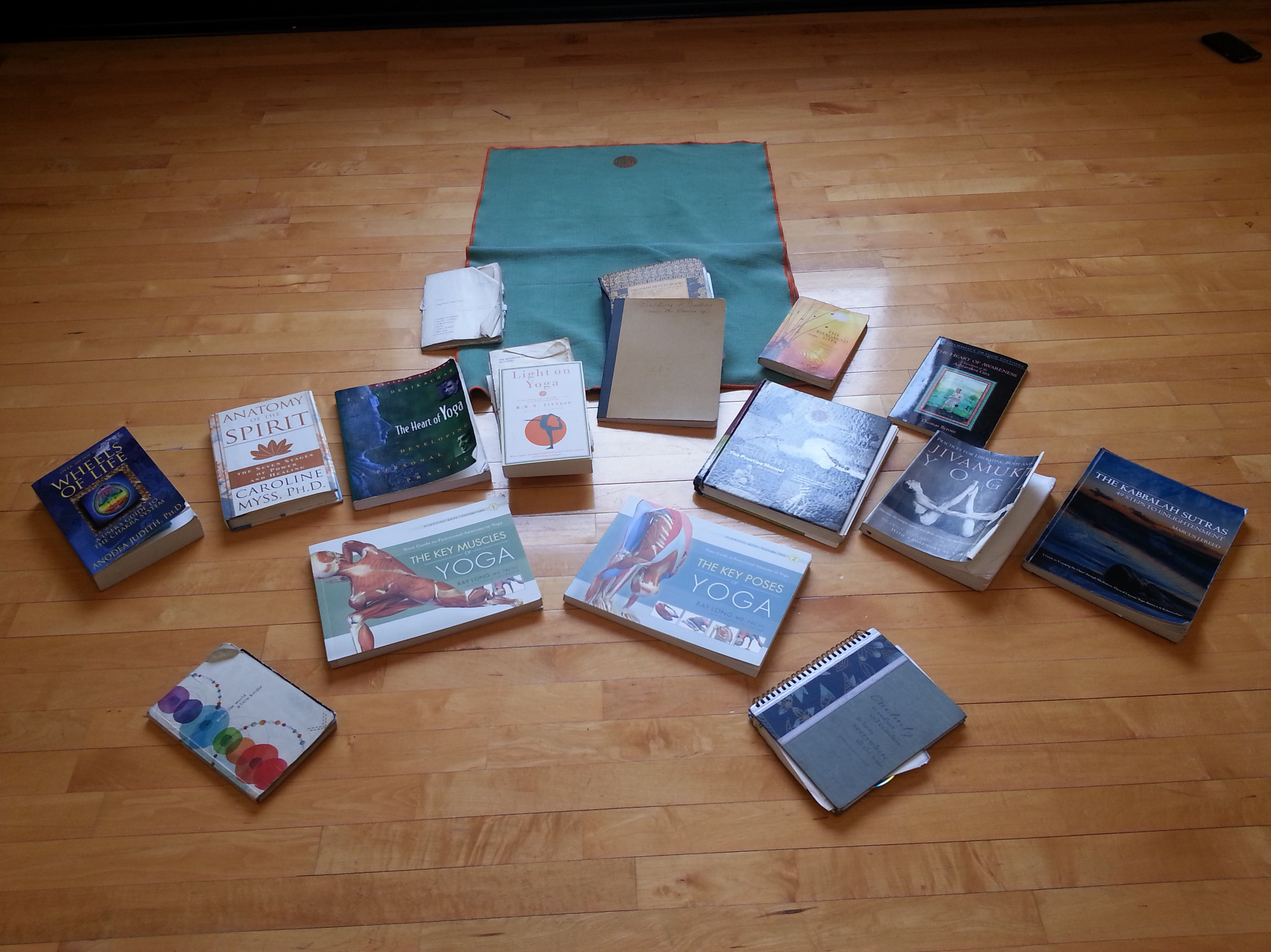
(NOTE: The picture above is missing Leslie Kaminoff’s Yoga Anatomy, Steve Ross’s Happy Yoga, Stephen Cope’s The Wisdom of Yoga, all my Yin Yoga and Taoist texts, a copy of the Ramayana, and Alanna Kaivalya’s Myths of the Asanas, at the very least.)
“Form follows function – that has been misunderstood. Form and function should be one, joined in a spiritual union.”
– Frank Lloyd Wright
“If something is boring after two minutes, try it for four. If still boring, then eight. Then sixteen. Then thirty-two. Eventually one discovers that it is not boring at all.”
– John Cage
Saturday mornings at the Y, just like any morning, is a great time to explore the physical and philosophical practice of yoga. However, I am partial to my Saturdays since I have 90 minutes to engage in the practice of exploration. For the last few years, I have started the new year with a “Building From the Ground Up” sequence – each Saturday adding more poses and another layer of the philosophy. Sometimes I still tie-in a meditation point specific to the date, and to whatever aspect of the philosophy is on tap for the day. Sometimes, however, it’s just straight philosophy and an opportunity to consider the meditation through movement. Whatever I plan for the year, usually wraps up around the end of July – when we start breaking down a different physical practice, the Ashtanga Primary Series.
This year, philosophically, I decided to sequentially move through Patanjali’s Yoga Sutras. Each week breaking down a sutra with commentary. (This week will be YS 1.31.) Physically, we have been breaking down a course of poses outlined by B. K. S. Iyengar in Light On Yoga.
The Saturday class is not an Iyengar class; however, (as teachers like Seane Corn have pointed out) if you are going to practice vinyasa, it’s a good idea to practice Iyengar as it will give you the solid foundation and insight into the asanas (poses).
Iyengar’s Course I is 30 weeks of detailed practice, specifically intended to build a physical practice from the ground up. While they are not limbs themselves, abhyasa (continuous practice with devotion) and vairagya (actively practicing the art of letting go or non-attachment) definitely make up the fertile soil from which the 8-limbs of yoga grow and thrive. And, they are key elements to the courses that appear in the appendix of Light On Yoga. At first, each set of poses is practiced for two (2) weeks before additional poses are added to the sequence. Later, some sequences are repeated for three (3) or four (4) weeks – and sometimes the order of the sequence changes. The 30-week course is followed by a 3-day course, which is slightly different from the 30-day course since the asanas are timed. Finally, there is some guidance on adding sun salutations (surya namaskar) to the physical practice and a list entitled “Important asanas in Course I.”
“If these asanas are mastered then the others given in this course will come even without regular practice.
– B. K. S. Iyengar writing about the “Impostant asanas in Course I”
The important asanas list, when followed by the sun salutations, looks and feels a lot like one of the first vinyasa practices to appear in the West, the Ashtanga Primary Series introduced to Sri Pattabhi Jois. This is not a random coincidence. While Iyengar and Jois were in very different physical/health conditions when they started practicing yoga, they practiced at the same time and with the same teacher: Sri Krishnamacharya. The practices they introduced to the West – just like the physical practices introduced by some of Krishnamacharya’s other students (including Indra Devi, T. K. V. Desikichar, and A. G. Mohan) reflect their own personal practices – which were the result of the physical and mental needs. Remember, classically, the physical practice of yoga (hatha yoga, regardless of the style or tradition) prepares the practitioner for deep-seated meditation. Ergo, even though they might practice the same poses, a very sickly young boy may use a different method of practice than a very active teenage boy.
(Side Note: It is also not a random coincidence that we generally start exploring the Ashtanga Primary series at the end of July: instead the timing coincides with the birthday of Sri Pattabhi Jois.)
YMCA classes are always open to members and their guests. If you are a member, please feel free to join us for class at any time throughout the year – and, feel free to bring a guest.
For further reading, check outLight on Yoga by B. K. S. Iyengar; Heart of Yoga by T. K. V. Desikichar; Ashtanga Yoga the Practice Manual by David Swenson; The Secret of the Yoga Sutra: Samadhi Pada by Pandit Rajmani Tigunait, PhD (Note: This is Part 1 of a series and only includes the first section of the sutras. There are many translations of the sutras, a great online resource is Patanjali’s Yoga Sutras on swamij.com.)
The “practice preview” below is part of my offering for the 2019 Kiss My Asana yogathon. I encourage you to set aside at least 5 minutes a day during April, to practice with today’s theme or concept as inspiration. You can practice in a class or on your own, but since the Kiss My Asana yogathon raises resources as well as awareness, I invite you to join me at a donation-based class on April 27th or May 4th.
I also challenge you to set aside a certain amount every day that you practice with this concept/theme in mind. It doesn’t matter if you set aside one dollar per practice or $25 – set aside that amount each time you practice and donate it by April 30th.
Founded by Matthew Sanford, Mind Body Solutions helps those who have experienced trauma, loss, and disability find new ways to live by integrating both mind and body. They provide classes, workshops, and outreach programs. They also train yoga teachers and offer highly specialized training for health care professionals. By participating in the Kiss My Asana yogathon you join a global movement, but in a personal way. In other words, you practice yoga. Or, as this year’s tag line states….
do yoga. share yoga. help others.
***
“All you have to do is open up a little bit and then you’ll be experiencing a part of that person’s soul. It’s just there – in the presence of a beautiful painting, a creation, something created by someone else. This is insight into not who they are physically, but who they are on this other plane. So, what makes it magical, always, is to hear music performed live.”
– Bill Conti
“When the audience and the performers become one, it is almost nearly divine, where this oneness can actually meet in some, not physical place, but in some spiritual place, in the middle, not the performers performing, not the audience receiving, but all of a sudden that contact is made and it becomes wonderful.”
– Bill Conti
Everyone does it at some point or another. It doesn’t matter if we sit down to watch a movie, a play, or a television show – or maybe we’re reading a book or listening to a show on the radio – at some point we suspend disbelief. We open ourselves to the possibility of the possibilities being laid out before us…without expectation, without attachment, and without aversion. Just for a moment, we let go of what we know and open to what is.
The job of an artist, like composer Bill Conti (born 4/12/1942), is to create something that serves as a layer or filter, a lens through which the audience sees the world unfold. Composers like Conti will often use motifs (a brief melody that is part of a longer passage) and leitmotifs (a brief melody or motif that is directly tied to a person or event) to reinforce a certain concept or emotion that the creative team wants the audience to experience. In other words, the creative team is creating samskars (mental impressions) and vasanas (in this case, a habitual subconscious reaction). And, when the creative element is iconic – like so many of Conti’s compositions are – we develop an inescapable habitual (and visceral) response to the music that exists long after the music ends. Without even knowing it, the music shapes the way we think, act, and speak – again, long after the movie ends. Think about what happens when you hear part of the theme from Rocky – even when it’s played on a piano.
But, what happens if we notice what happens? What happens if we start studying our habits and noticing the things that appeal to us and the things to which we have an aversion? What happens if we investigate why we do the things we do? What happens if we practice a little non-attachment and look at ourselves from an objective vantage point – one without the veils of our experiences (i.e., without the samskaras and vasanas?
vairāgyam non-attachment, neutral, without attachment or aversion
“We are all ready to read / Just as we are born knowing what we like”
– from “The Foundation” by Thievery Corporation
In order to master the mind and the fluctuations of the mind, one needs to not only practice continuously and with reverence (abhyasa), as Patanjali indicates in Yoga Sutra II.14, but also with non-attachment (vairagya). Since, however, we have attachments – meaning things and people to which we have attraction or aversion – part of the practice is observing our behaviors and then gradually detaching, or letting go, of our attachments. As we consistently practice letting go, it becomes a habit so that the attachments do not form. This means that, like so many other elements in the Eastern philosophies, the practice of non-attachment is a technique as well as a state of being.
The easy misconception is that practicing non-attachment means that one forcing everything away and becoming numb. In fact, the opposite is true. When we move through our days without noticing why we lean one way or the other, then we are numb to our true nature and, in the process, we miss certain elements of our lives. If, however, we can lift the veils of our habits we start to notice more about ourselves and the world around us. We start to notice cause and effect, but we also start to interrupt behaviors and patterns that lead to suffering.
“In the back of your mind, when you say you want to write music for the movies, you’re saying that you want a big house, a big car, and a boat. If you just wanted to write music, you could live in Kansas and do that.”
– Bill Conti
An example that Swami J uses to explain the difference between detachment and non-attachment is that of two (2) ex-smokers. In this example, they both stopped smoking years ago. One smoker, however, sees a cigarette or smells smoke and immediately begins craving the cigarette. When the first former smoker recognizes that craving, resists acting upon it, and then let’s go of the desire (or allows the desire to pass) this person is practicing detachment. On the flip side, the second former smoker no longer has the craving; when there is no conscious or subconscious desire to smoke there is nothing to release and that is the state of non-attachment. (Anybody want to go down this particular rabbit hole?)
“There’s a higher place that I have no illusions about reaching. There’s a sophistication and aesthetic about composers who only write only for the music’s sake.”
– Bill Conti
FEATURED POSE for April 13th: Half Lift or Upward Forward Fold Pose (Ardha or Urdhva Uttanasana)
There are certain poses that are easy to overlook when moving through poses one-breath-one motion or when you are predisposed to think some poses are more important than other poses. One such overlooked pose is Half Forward Fold (Ardha Uttanasana), which is also referred to as Upward Facing Forward Fold (Urdhva Uttanasana). In Sun Salutations it may be considered a “gateway pose” – because it bridges the gap between standing only on the feet and the inclined series where you are standing on hands and feet (or only on hands). If you take a moment to let go of your attachment or aversion to the pose and really examine it, you will start to notice that it’s not only a bridge, it’s also a ferry.
From a standing (or seated) position, exhale and bring your heart to your thighs (bending your knees if you have low back issues and or tight hamstrings). As you inhale, look up and lengthen the spine. Place your hands on your thighs, or bend your knees and place your elbows on your thighs. Making sure that your shoulders are pressing back, find a little bit of Cow Pose (to make sure you have a “flat back”) and then gaze at your nose or third eye center. Engage your core by zipping up (spreading toes and balancing on all corners of the feet; squeezing the perineum muscles together and up; drawing the belly button up and back). Breathe here for 3 – 5 breaths (inhale + exhale = 1 breath).
As you’re breathing here, see if you can maintain length in the spine while also starting to lengthen the legs. If it is accessible to you, reach the hands down to the floor or a block – but only if you can do so without losing the extension in the spine. Notice how you react to being in this pose.
After the requisite number of breaths, exhale and see if you can bring your heart to your thighs without losing the extension in the spine. Inhale, use the whole breath to look up and lengthen again. Exhale, and use the whole breath to fold. Inhale to your flat back; bring hands to hips as you exhale and then lift the torso up as one unit.
Consider how Upward Facing Forward Fold contains elements of Equal Standing / Mountain Pose. If Sun Salutations are in your practice, move through a couple of sets and see if you can maintain your flat back (looking forward) position all the way through Chaturanga Dandasana. This is a fun practice to do with a small ball balanced on your low back! (See if you can keep the ball on your low back until Downward Facing Dog (or your back bend).
Upward Facing Forward Fold is a great pose to do with hands up against the wall and arms extended. It is prenatal approved; just widen the legs to make room for the baby. If you have low back issues, unregulated blood pressure, eye issues like glaucoma, or certain types of osteoarthritis you may find that Upward Facing Forward Fold is a better option for you than Forward Fold (Uttanasana). If that is the case, you can do the above sequence just by bending the knees on the exhale and straightening them on the inhale. Honor your body, but also watch your aversion (or attraction) to modifying your practice.
 A Joyful Practice