“Remember the moon survives, draws herself out crescent-thin, a curved woman. Untouchable, she bends around the shadow that pushes himself against her, and she
Barbara Kingsolver, born today in 1955, always seems to point her pen in the direction of struggle and suffering. Sometimes the struggle is within a single community, sometimes it involves multiple communities; sometimes it involves an individual struggling to find balance between a community; and other times the struggle is between man’s desires and the needs of the natural world. But, always, there is struggle, suffering…and hope.
The Buddha, whose birthday is also celebrated today by some Buddhists, pointed his heart towards struggle and suffering as well. Unlike Kingsolver, Prince Siddhartha Guatama didn’t grow up with awareness of the suffering of others. However, once he was aware of it, he started considering how to alleviate it. And so, like Kingsolver, the Buddha’s work includes the promise of hope.
The Buddha outlined Four Noble Truths: There is suffering/suffering exists; suffering is caused by desire and an attachment to ignorance; there is an end to suffering; and there is a path to the end of suffering. (Specifically, he points to the Noble Eightfold Path.) So again, there is suffering, there is struggle, and there is hope. However, in the middle of struggling and suffering, it is easy to get stuck in the middle of that second noble truth and forget all about the promise. In the middle of suffering, it is easy to forget all about the hope, and be filled with doubt – even when you’re on the road that promises freedom.
Just the other day, a friend of mine mentioned her rosary. “In Islam,” Mya said, “using the rosary [for prayer/meditation/contemplation] is called dhikr (“remembering”).” As the devoted move through the beads, they are constantly “remembering” God and the nature of God.
The words may be different, but this practice of “remembering” is the same in Catholicism. Hindus and Yogis use mala beads, also a rosary, to count out a mantra – this too is “remembering” what the practitioner views as important.
The Jewish tradition does not include beads; instead, some wear a prayer shawl (tallit) or small tallit (tallit katan) with a knotted fringe or tassels of blue (tzitzit). Jews do not count with them, but the tassels are intended as a reminder of what is important within the Jewish tradition.
Whether you are on the mat, on the cushion, on the pew, or on the rug, part of the practice is to remember. The question is: What are you remembering? Go back to that José Ortega y Gasset statement from the 6th offering, “Tell me to what you pay attention and I will tell you who you are.”
“You are the one who knows, behind the rising, falling tide of shadow, the moon is always
whole.”
– from Remember the Moon Survives, by Barbara Kingsolver
Remember the Moon Survives – by Barbara Kingsolver
Remember how to move into Child’s Pose (Balasana), but also remember it is the beginning and full of possibilities. Remember to soften into the breath and allow the breath to flow freely in and ebb gently out. Remember your intention.
When you move into Table Top remember to move with full awareness of your mind and body in the present moment. Remember to check your alignment. Press down so that the shoulders and shoulder blades are even with the rest of the back and your belly is firm. Engage your locks (bandhas) if that is part of your practice. Remember this is an opportunity to remember the connection between your mind, body, and spirit.
Remember to move through Cat/Cow or the “Un-Cat” sequence precisely matching the movement to the breath. So that, as the breath gets long and fine and deep, the movement gets richer – whatever that means to you in this moment.
On an inhale, stretch the right leg back, remembering to keep the hips level – even and equal to each other so that the low back doesn’t struggle. On an exhale, step the right foot in between the hands so that the foot is flat on the floor (with the right toes pointed forward). If the foot doesn’t easily land between the hands, scoop it forward with your hands. If needed, add a knee pad under the back knee. Pressing down evenly into both feet, lift your torso up and place hands on your right thigh. This is a form of Crescent Lunge (Anjaneyasana).
Use an exhale to slide the hips over the back knee and then place the back of the right hand on your sacrum (the flat part of your bum/hips) and place your left hand on the front of your pelvic bones. Your hands are now bracketing your hips. Slide the back hand down in order to direct the sit bones down. You may feel the front hand lifting as the pelvic bones lift. You may feel space opening up in your low back. You may also feel engagement in your left hip and thigh. Stay here or bend the front knee deeper into the lunge – remembering to maintain the space in your low back. Hands can come to your front thigh or reach the hands over head. If you have Hot Half Moon (Ardha Chandrasana) in your practice, feel free add it by lifting the left arm up and reaching it towards the right.
Remember to breathe. Remember to breathe into the heart. Crescent Lunge is one of the poses inspired by Hanuman, the monkey king in the epic poem The Ramayana. In the great adventure, Hanuman is asked to take giant leaps to save or rescue others. He hesitates, he doubts…and then he leaps. Again and again, he does what needs to be done to help others. At the end of the poem he revels what is in his heart: a devotion to God. Take a moment to remember what is in your heart.
After a few breaths, place the hands on the mat and step back to Child’s Pose. From Child’s Pose repeat the sequence again (from Cow Pose) , this time on the left side.
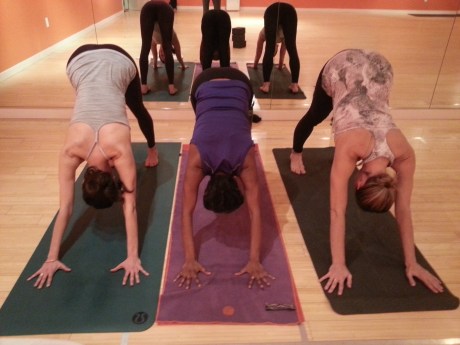
Once you’ve completed the second side and returned to Child’s Pose, inhale to Cow Pose and then exhale into Downward Facing Dog (Adho Mukha Svanasana). Remember your can skip the arm balancing, by moving into Staff Pose (Dandasana) and positioning the arms accordingly or using “Dolphin Dog.”. Another modification would be to do the pose on the wall. Either way, remember to check your alignment – make sure your body is in the shape of capital A.
Remember to make sure all your fingers are spread wide, with the majority of the weight/pressure in your hands moving into the thumb and first finger. (So that, there is less weight/pressure applied to your outer wrists.) When you relax your head and shoulders, remember to place your big toes are parallel to each other and at least a foot apart. Big toes can be behind the thumbs or behind the middle fingers. Notice if you feel lighter or heavier when your feet are spaced further apart. Hips are high, heels are low (reaching, but not necessarily touching the mat); and neck is long. Even if you have to bend your knees, remember to find Cow Pose in this position (so that you have a straight line from your middle fingers all the way up to your hips and then a second straight line from your hips to the back of your knees). Remember, eyes are on your nose, your belly button, or the space between your toes.
Remember Downward Facing Dog is simultaneously an arm balance and a standing pose; a forward bend, as well as a back bend; and an inversion. Stretch back (meaning, push your spine towards your thighs) and on an exhale walk your hands to your feet or bring your hands and feet together. Once hands are in line with the toes and heels are flat to the mat, inhale to a Half Lift/Flat Back or Extended Forward Bend. (This pose may be called Ardha Uttanasana or Urdhva Uttanasana.) Place your hands on your thighs and press the shoulders into the metaphorical back pockets. Remember, you want to engage in a similar fashion to Cow Pose, Staff Pose, and Downward Facing Dog. In fact, inhale and find a little bit of Cow Pose (even if you have to bend your knees). Now, press the heels down and – as much as you are able without losing the extension of the spine – engage the quadriceps to extend through the knees and press the thigh bones into the wall behind you. Engage your locks (bandhas) as you are able.
If you have unregulated blood pressure, low back issues, eye issues like glaucoma, or if this is already challenging, remember to stay here with knees bent. Otherwise, if it is not contraindicated, bend the knees and flex from the hips to prep Forward Bend (Uttanasana). Keeping the upper back extended, place the hands on the floor or a block and begin to extend through the legs while pressing the thigh bones into the backs of your legs. Do not force the extension. Use the exhales to settle the heart on the thighs (as much as you are able without losing the extension of the spine.) If your legs are completely straight, make sure the knee caps are lifted and that you are not hyper-extending the knees. Also double check to ensure that if the knees are straight the hips are over the knees, not behind the ankles. Remember to engage your locks (bandhas).
On an inhale, extend to Half Lift/Flat Back and on an exhale fold into the Forward Bend. If you are modifying and using the Half Lift throughout, keep the back in the position that feels similar to an intense Table Top and use the breath to extend the knees on an inhale and flex/bend them on an exhale. Remember to precisely match the movement to the breath. Remember all the ways you are mimicking your body’s natural tendencies (e.g., extending/flexing, lifting/grounding, creating/engaging, rising/falling, etc.).
Move into Staff Pose. Keep the left leg extended and bend the right knee in order to set up the Sage Twist. Remember to keep the left heel and the right foot flat on the floor. You can place the right foot next to the inside or the outside of the left leg, as long as the knees are comfortable and the right foot is flat on the floor.
On an inhale, lift your right arm up and, as you watch it, reach the right arm back to the floor behind your hips. As you settle into the twist, adjust your left arm to provide additional support wherever you need it. You can always sit on a block and/or place a block under your hand if you’re hips and low back are really tight. If you don’t have a block, substitute a book.
Watch how you engage your base, your core, and your breath. Remember to start the twist in your base (not in your neck). Do not allow your body to collapse or untwist until you complete 3 – 5 complete breaths. After the third or fifth exhale, inhale to center, give the lifted knee a squeeze, and return to Staff Pose. Repeat the Sage Twist instructions for the Sage Twist (replacing right with left).
After the third or fifth exhale on the left, inhale to center and give the lifted knee a squeeze. Bend or extend both, as needed, and lower down onto your back for Corpse Pose (Savasana). Remember, just as the end of the inhale is the beginning of the exhale and the end of the exhale is the beginning of the inhale, this final pose is a beginning and an ending. Remember you are on the right path.
This opportunity to explore a poem on the mat is part of my offering for the 2018 Kiss My Asana yogathon. I encourage you to set aside at least 5 minutes a day during April, to practice with the poem as inspiration. You can practice in a class or on your own, but since the Kiss My Asana yogathon raises resources as well as awareness, I invite you to join me for a donation-based classes on Saturday, April 28th.
I also challenge you to set aside a certain amount every day that you practice with a poem in mind. It doesn’t matter if you set aside one dollar per practice or $25 – set aside that amount each time you practice and donate it by April 30th.
Founded by Matthew Sanford, Mind Body Solutions helps those who have experienced trauma, loss, and disability find new ways to live by integrating both mind and body. They provide classes, workshops, and outreach programs. They also train yoga teachers and offer highly specialized training for health care professionals. Thank you to everyone who attended the class on April 7th, and thank you to everyone who has already donated. By participating in the Kiss My Asana yogathon you join a global movement, but in a personal way. In other words, you practice yoga. Or, as this year’s tag line states…
Once upon a time, there was a little girl who didn’t have the best start in life. In fact, you could say that much of her early life was very twisted, and “rooted in pain.”
She was separated from her parents at the age of 3. But, the separation wasn’t all bad; she went to live with her grandmother, who was quite prosperous – for a black woman in the South, during the Great Depression.
Life was better, for about four years, but then she was once again unexpectedly torn from her home. She was 7. At age 8 she was sexually abused and raped by a grown man, her mother’s boyfriend. When she reported the assault, the man was arrested, sentenced to 1 day in jail, and then murdered. The little girl blamed her voice for her assailant’s death and so, for about 5 years, she didn’t speak.
This little girl moved back and forth between her mother and grandmother at least twice more before, in the span of three weeks, she graduated from school and gave birth to her son – all at the age of 17.
Given her background, few would be surprised to learn that this little girl grew up to be a streetcar conductor, a fry cook, a sex worker, a singer, and a dancer. All noble endeavors; however, the real twist to the story is that this little girl rose above the expectations of herself and others.
This little, whose older brother called her Maya (as in, “Mya Sister”), grew up to become a writer, a poet, a journalist, an activist, and an inspirational teacher known around the world for and by her voice – a voice of wisdom, courage, love, and light.
My first yoga teachers use to say, “How you do yoga, is how you do life.” On the yoga mat, everything has a purpose. Bringing your awareness to the importance of the moment – even when you’re not sure of the purpose – is part of the practice.
Remember: No matter how twisted the situation, never underestimate what you can do with an inhale, a pause, an exhale, or a pause. No matter how twisted the situation, never underestimate the ability of your heart and spirit to rise above.
Still I Rise – by Maya Angelou
Move into Child’s Pose (Balasana) as if you are moving into a new house. Notice how the front of your heart is protected, but the back of your heart is exposed. Feel the breath moving through your heart as you inhale and, also, as you exhale. Let the breath create space, awareness, around your heart center.
After a few minutes in Balasana, make your way into Table Top – hands and knees to the mat with shoulders over elbows and wrists, hips over knees – or into a seated position if that is more accessible. As you exaggerate your body’s natural tendencies with Cat/Cow or the “Un-Cat” sequence, notice how the inhale opens your heart to the world and the exhale turns your heart inward. Here is the “bowed head and lowered eyes,” but here are also the gifts, the hope, and the dream of being alive.
Once you feel the physical and emotional connection between your mind-body-spirit, set up for a Sage Twist*. Move into a seated position with the left leg extended in front of you (so that the left heel is on the floor) and the right knee bent (so that the right foot is flat on the floor). You can place the right foot next to the inside or the outside of the left leg, as long as the knees are comfortable and the right foot is flat on the floor. (Feeling like you’ve got diamonds at the meeting of your thighs is all on you!)
On an inhale, lift your right arm up and, as you watch it, reach the right arm back to the floor behind your hips. As you settle into the twist, adjust your left arm to provide additional support wherever you need it. You can always sit on a block and/or place a block under your hand if you’re hips and low back are really tight. If you don’t have a block, substitute a book.
Use every inhale to press down in order to lift up – creating more space between your ribs and your hips. Use every exhale to twist and rinse – engaging that space. Remember to start the twist in your base (not in your neck). Do not allow your body to collapse or untwist until you complete 3 – 5 complete breaths. After the third or fifth exhale, inhale to center and give the lifted knee a squeeze. Switch the legs and repeat the Sage Twist instructions in this paragraph (replacing right with left).
After the third or fifth exhale on the left, inhale to center and give the lifted knee a squeeze. Bend or extend both, as needed, and lower down onto your back for Savasana. Maya Angelou wrote, “But still, like air, I’ll rise.” (In the first link above, you can hear her son recite, “But still, life LIFE, I’ll rise.”)
Notice that as long as you are breathing (i.e., as long as you are alive), your heart will always rise.
This opportunity to explore a poem on the mat is part of my offering for the 2018 Kiss My Asana yogathon. I encourage you to set aside at least 5 minutes a day during April, to practice with the poem as inspiration. You can practice in a class or on your own, but since the Kiss My Asana yogathon raises resources as well as awareness, I invite you to join me at one of the donation-based classes listed (April 7th and April 28th).
I also challenge you to set aside a certain amount every day that you practice with a poem in mind. It doesn’t matter if you set aside one dollar per practice or $25 – set aside that amount each time you practice and donate it by April 30th.
Founded by Matthew Sanford, Mind Body Solutions helps those who have experienced trauma, loss, and disability find new ways to live by integrating both mind and body. They provide classes, workshops, and outreach programs. They also train yoga teachers and offer highly specialized training for health care professionals. By participating in the Kiss My Asana yogathon you join a global movement, but in a personal way. In other words, you practice yoga. Or, as this year’s tag line states, “do yoga.share yoga. help others.”
*NOTE: The Sage Twist video features Dianne Bondy, another one of my favorite teachers focused on keeping/making yoga accessible.
Every time we step on the mat and move into a pose we are sitting. Asana, literally means “seat” and if we refer to the “poses” in Sanskrit, almost everything we practice ends in the word asana, seat. So, here we are – sitting and breathing on a mat, not unlike so many other meditation practitioners who sit and breathe on a cushion.
As we sit, and breath, sensation/information bombards us. We are met with physical information in the form of physical sensation. Then, just as we get comfortable, we are met with mental and emotional information in the form of thoughts and memories. The mind wanders; the breath gets shallow; the body shakes or slouches; we judge the moment and then remember, “Oh, yes, I’m sitting and breathing. Get back to the breath!”
We have a moment of peace – maybe a second, maybe a minute, maybe more, maybe less – and then the sensation/information calls to us again and again. Again and again, we do what we need to do to focus our awareness back on the breath. That is the practice.
Too often, we forget that the sensation/information is part of the practice. Too often, we forget to be grateful for the sensation/information. Too often we take for granted our ability to feel and think.
What happens if we sit, breathe, and express gratitude not only for the breath, but also for everything that pulls our awareness away from the breath?
It is a blessing to feel – anything. It is a blessing to smell, to taste, to see, to feel, to hear, to think. On the mat, it is a gift to notice where you feel strong, flexible, able, or not able, powerful, or weak; because, that information informs our practice and brings awareness to what needs to happen in order for us to find balance. It brings awareness to what needs to happen in order for us to breathe deeply in, and breathe deeply out.
This body is a guest house / This being human is a guest house – by Rumi (see 2 translations above)
After a few minutes, prepare yourself to move into Savasana, the Seat of the Corpse. Find a position on your back where you can be still and quiet. Get rid of your physical fidgets, even if that requires some shifting, micro-movements, or the addition of props. Then, get rid of your mental fidgets by fixing your eyes on something that’s not moving: your third eye (the space between your eyebrows, about an inch into your forehead, and half an inch above there), your heart center, or the tip of your nose.
Again, notice what you notice. Bring awareness to your awareness. Express gratitude for your sense organs: nose, mouth/tongue, eyes, skin, ears, and mind. Count how many different things you sense and express gratitude for your ability to experience all this sensation. Visualize your body as a guest house and greet each sensation/information warmly.
Just as the beginning of life is full of possibilities the end of life means leaving everything behind. Consider Savasana to be the death of your practice. As you relax your body and deepen your breath, visualize each part of your body (and the accompanying sensation/information) as a guest going to bed or leaving your guest house. Relax, release, breathe, bid them rest or adieu – with gratitude for their visit. Here is one possible order:
Toes, feet, ankles, shins, knees, thighs – sense of smell
Hips (back and front), genital organs – sense of taste
Belly, low back, abdominal organs – sight
Chest, upper back, organs of the torso, fingers, hands, wrists, forearms, elbows, upper arms, shoulders – sense of touch
Breathe, and remember, we are just visiting these bodies. We are just visiting these minds.
Part of my offering for the 2018 Kiss My Asana yogathon is to post a poem, which you can explore on the mat. I encourage you to set aside at least 5 minutes a day during April, to practice with the poem as inspiration. You can practice in a class or on your own, but since the Kiss My Asana yogathon raises resources as well as awareness for Mind Body Solutions, I invite you to join me at one of the donation-based classes listed (April 7th and April 28th).
I also challenge you to set aside a certain amount every day that you practice with a poem in mind. It doesn’t matter if you set aside one dollar per practice or $25 – set aside that amount each time you practice and donate it by April 30th.
Founded by Matthew Sanford, Mind Body Solutions helps those who have experienced trauma, loss, and disability find new ways to live by integrating both mind and body. They provide classes, workshops, and outreach programs. They also train yoga teachers and offer highly specialized training for health care professionals. By participating in the Kiss My Asana yogathon you join a global movement, but in a personal way. In other words, you practice yoga. Or, as this year’s tag line states….
I am deeply grateful to everyone who participated in this year’s Kiss My Asana yogathon to benefit Mind Body Solutions. It doesn’t matter if you made a donation online, attended a donation-based class, hosted a donation-based class, or asked a question (and, maybe, are still waiting on my answer) – either way, you made a difference in how we view yoga and how we, as part of the yoga community, keep our sacred circle open to all bodies and all minds. During one class in particular, when I listed all the types of people who can benefit from adaptive yoga, I found myself referencing every person in the room. Just a reminder that it’s not about modifications, it’s about the practice.
Thank you, also, to Sandra Razieli for spending part of her birthday weekend co-teaching with me!
May the 4th is with us! While I am sad to report that I will not be leading any Star Wars yoga classes this year, I am very excited about returning to the Walker Art Center to facilitate meditation during MN Artists Presents: Marcus Young (5 – 9 PM). This free event is kid-friendly and has a lot of mindfully interactive moments. For more information, check out the event page or the Walker’s Facebook page. (Please note: road closures may create delays and detours. Breathe deeply. And may the force be with you.)
Finally, my YMCA classes will have subs on Friday night (5/5), Saturday morning (5/6), and all day Sunday (5/7). Enjoy!
“I’m not very flexible and when I do yoga, every pose seems to stretch/work the backs of my legs. They are definitely my limiting factor. Is there a way to modify poses, down dog for example, to work/stretch other muscles?” – YogaNovice
YogaNovice’s question about modifying a pose, like down dog, in order to work/stretch other muscles required a little follow-up, because (a) I’m not familiar with the practitioner’s body or practice and (b) the words “stretch” and “work” convey different engagements to me. However, even before asking some follow-up questions, my answers came down to intention and alignment.
Before practicing a pose, consider the purpose of the pose in general and then the specific purpose of the pose within the sequence. Adho Mukha Svanasana (Downward Facing Dog) is a standing pose, an arm balance, a forward bend, an inversion, and includes a slight back bend. It can be used to strengthen the limbs of the body, alleviate pain and stiffness in the legs, ankles, feet, arms, wrists, and shoulders – while also helping a practitioner engage core muscles. In vinyasa, it often feels like the least strenuous pose and therefore becomes a re-set moment. As an inversion, it can be exhilarating, since the head is below the heart, but does not require pressure on the head and neck. I refer to it as “a full body stretch” – and yet, all the benefits of the pose may be lost if the pose is misaligned.
Alignment-focused yoga offers the opportunity to use props for better engagement. So, rather than muscling into a pose and experiencing strain or injury, props enable a practitioner to find the balance between effort and relaxation and to, as Patanjali states in the Yoga Sutras (2:46 – 2:48), cultivate a steady (or stable), easy (or joyful) seat (or pose). A person could use a wall, blocks, blankets, an extra mat, a strap, and/or another person in order to find more balance in pose.
Here’s a practice to help YogaNovice find more ease in Downward Facing Dog. Read through the sequence before practicing it, and remember to check with your health care practitioner before starting any new exercise. Each step below may be practiced in 1 minute increments.
Establish what your body feels like when the spine is in neutral Table Top (on hands and knees, with shoulders and elbows over wrists and hips over knees) versus when inhaling into Cow Pose (spinal extension), exhaling into Cat Pose (spinal flexion).
If it is accessible to you, move into Puppy Dog variation of Balasana (Child’s Pose) with feet and knees the same distance apart and extended on the floor over your head. Release/relax.
Sitting on a block or blanket (for extra support) and with your hips and back against a wall – or sitting on a chair with spine in a neutral position, lift your arms overhead with fingers pointed toward the wall (palms will be facing the ceiling). Play with how the arms and back feel when the legs are fully extended versus when the legs are slightly bent (at the knees). Once you’ve established a leg position that feels like balanced effort, then, play with how the arms and back feel when the arms are fully extended versus slightly bent (at the elbows). (Again, you want to experience a kind of lightness in the final pose that indicates balanced effort.)
Stand, facing a wall, with feet 18 inches (45 centimeters)* apart and arms extended at shoulder height so that the fingers barely touch the wall. Then, maintaining the established arms’ length, flatten the palms and fold until the back is “parallel” to the ceiling. Now, notice how it feels when the knees are bent versus straight, (Again, you want to experience a kind of lightness in the final pose that indicates balanced effort.) Next, experiment with the arm position to find balanced effort. Don’t forget: Balance comes from all accessible limbs sharing your body weight!
If it is accessible to you, move back into Puppy Dog variation of Balasana (Child’s Pose) with feet and knees the same distance apart and extended on the floor over your head. This time, curl the toes under and actively press the hands and feet down while actively extending the spine into a mini-back bend. Relax after a few breaths.
From Table Top (on hands and knees with a neutral spine), curl the toes under and lift the hips up into an upside down “V” for victory, with spine and thighs pressing towards the space behind you. Now that you’ve moved into the shape of Downward Facing Dog, active the pose as follows:
Make sure middle fingers are pointing forward (with fingers spread wide), pressing into the thumb and first finger (so there is less weight on the outer wrist). As much as you’re able, maintain the hand position and rotate the elbows towards the knees.
If experiencing wrist issues, use a wrist guard or return to hands and knees to set-up Dolphin Dog.
As you lower your head and shoulders, make sure big toes are parallel to each other. In Yoga: The Path to Holistic Health, Iyengar recommends placing feet 18 inches (45 centimeters)* apart. Note that in an actual Iyengar class, Matthew Sanford has commented on how people have their feet too close together – in part, because we’re often practicing someone else’s alignment (versus our own body’s alignment). (This kind of individual instruction is why practicing with an alignment-focused teacher is invaluable!)
Spread the toes and let the heels reach towards the earth, but don’t focus on pressing/forcing the heels into the earth. Bend the knees, as needed, to achieve the previously experienced lightness of balanced effort. (Extreme knee flexion may mean you bring knees to the mat and practice an active Puppy Dog.)
You’ll find in an Iyengar practice that props may be added under the head, heels, and hands to provide support. A teacher can provide hands-on assistance to encourage the hips to lift as the spine extends.
Release/relax in Balasana (Child’s Pose) with toes pointed behind the body and arms resting by the hips. If Child’s Pose is not accessible, lie on your back.
Yoga requires patience and dedication. In the Yoga Sutras (1:12 – 1:16), Patanjali emphasizes that mastery comes from combining abhyasa (repeated and consistent practiced) and vairagya (non-attachment). Consistently practicing the above over a period of time is one way to experience abhyasa; practicing any of the steps above as an alternative to practicing Downward Facing Dog as it appears in a book or a magazine is a form of vairagya.
“Your last Monday Yin Yoga class was the best class I’ve experienced in a long time. Today’s class was almost just as good. Is it possible to get a list of poses from last Mon, or, might you have a repeat of the class sometime & I could make a list of the poses?
By the way, the Yin classes are more frequently & for longer periods lowering my neuropathy pain in my feet. Thanks for your medicinal touch.”
– G
Yin Yoga has its roots in Traditional Chinese Medicine, which maps out the vitality of the body’s organs through a system of meridians located in the deep tissue of the body. As we move into spring, my Yin Yoga classes are focusing on the gall bladder Meridian (running down the outer perimeter of the body) and liver Meridian (running up the inner thigh) – which means lots of hip opening.
The long, prop-supported holds (typically, 3 – 5 minutes) in Yin Yoga may appear similar to poses in a restorative practice; however, Yin Yoga can be significantly more “intense” than a restorative practice. By “intense,” I don’t mean active. In fact, Yin Yoga is, in some ways, the opposite of our other Hatha Yoga (physical yoga) practices. Rather than addressing the outer musculature (the muscles we can see, shape, and tone), Yin Yoga addresses the body’s fascia, deep tissue, and connective tissues. The practice may also decompress areas around the joints. One of the best online resources for Yin Yoga is Bernie Clark’s aptly named yinyoga.com, where you will find pose details, a community forum, and links to Clark’s YouTube channel.
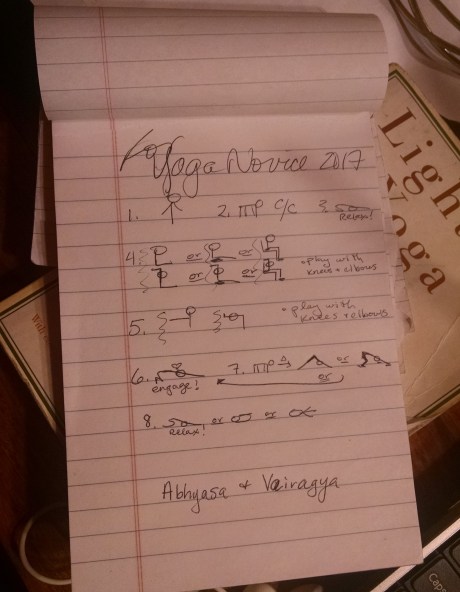
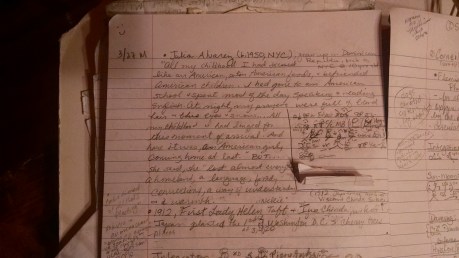
My regular students are always welcome to take a picture of my “playbook” (see below).
(Please note: These practice details are intended for individuals who already have a Yin Yoga practice. Before starting a new practice, be sure to check in with your health care provider. Most importantly, remember that although you may experience health benefits from your practice, this practice information is not intended as medical advice or as a means to replace medical care.)
Since my so-called hieroglyphics can be a little tiny or hard to read, here is an outline of the Monday Yin Yoga class from March 27, 2017 a.k.a. Julia Alvarez’s Big Day, a.k.a. the anniversary of the day First Lady Helen Taft and Viscountess Iwa Chinda planted cherry blossoms in D.C.:
Legs-Up-The Wall (for centering and integration): Sit sideways on the mat, so that the side of your hip is up against the wall; then pivot the body so the legs swing up and the back reclines on the mat. The trick is to keep your bottom on the wall. (For more release in the hamstrings, back, and hips, place the feet on a chair or table so that hips, knees, and ankles are resting at 90 degree angles.) Hold for about 2 minutes with back on the floor or a blanket. For additional decompression, bend the knees in order to use the legs to lift the hips and add a block, making sure not to pinch the spine. Hold for another 3 minutes.
“Sleeping Butterfly” – on the wall (counter-pose): Remove the block and move into Butterfly (feet together like a prayer, knees open up like the pages of a book) with legs on the wall for about one minute. Use “Sleeping Butterfly” or a Squat on the wall to set a personal intention, which will keep you on the wall for another minute.
Dragonfly, on the wall: Stretch your legs out (on the wall) as wide as they’ll go, and support the legs by placing a block between the wall and each thigh or by placing blocks or a bolster on the outside of each thigh. Hold for 3 – 5 minutes.
“Sleeping Butterfly” (transitional pose) and Fetal Position (transitional pose)
Wide Legged Child’s Pose (with arms bent on floor over head): Props may be placed under the hips and/or under your chest. If you have a bolster, you can recline your whole body on it. Hold for 2 – 3 minutes.
Counter-pose Moment: Inhale to table top and use Cat/Cow to transition into about 1 minute of gentle movement to break up the stillness.
Half Shoelace or Half Square sequence: Sit with legs extended in front of you. If there’s compression in the low back and/or hips, sit up on top of a blanket or block. Hug right knee in and lift it over extended left leg. You can either rotate the top leg so the knee points to the left foot or slide the top leg to the side so the ankle rests on the bottom thigh, right below the knee. (If elevated, you can place a blanket or towel under the extended shin – to soften the experience at the back of the knee. If you have a hamstring issue, you could sub “Full” Shoelace or Square by bending the bottom knee into the appropriate position.) Twist upper body to the right and hold for at least 1 minute. Rotate back to center and fold until you feel a change, support the change and hold for at least 3 minutes.
Counter-pose Moment: Inhale to lift the body, unravel the legs and give them a rub or a hug. Lean back on the forearms or recline with back on the floor, windshield wiper bent knees for about 1 minute.
Repeat “Half Shoelace or Half Square” sequence on opposite side and Counter-pose Moment.
(Prone) Frog or Dragonfly: Face the long side of the mat and set up props as needed. For (Prone) Frog, come into table top; spread the knees as wide as they’ll go, with ankles under the knees (when you look down the legs) and hips pressing back. Extend the chest forward and recline on forearms and/or props. Prop the thighs. For Dragonfly, sit with legs in front of you and spread wide; prop as needed for low back and lean forward until you feel a change; prop the change. Hold for 5 minutes
Counter-pose Moment: (Prone) Frogs Inhale to table top and use Cat/Cow to transition; Dragonflies use inhale to rise up, hug the knees into the chest and then recline to windshield wiper bent knees. Gentle movement for about 1 minute.
“Sleeping Butterfly”: Set up props so upper back is supported, behind shoulder blades, and head us raised slightly above the chest by a prop that supports the nape of the neck (where head meets the spine). If thighs do not touch the ground when legs rest in position, place a block under each thigh. Hold for 5 minutes.
Counter-pose Moment: Mindfully, move off the props.
Savasana (with props, as needed): Hold for at least 5 minutes.
Counter-pose Moment: Be easy and gentle as you move out of Savasana and into a fetal position. Give yourself a moment before sitting up and closing out your practice. Namaste.
Thanks, G, for your question. I’m always so glad to see you in class and (of course) super grateful your yoga practice is helping you feel good!
“The number of words you use to answer these questions is going to be divisible by 108? Why 108?” – the obvious questions
The significance of 108 is something pondered pretty much whenever people get ready to practice 108 Sun Salutations (for New Year’s Day, Spring/Fall Equinox, and Summer/Winter Solstice). It is considered an auspicious number in a variety of disciplines and traditions. So much so that if I listed 108 reasons, I might still be missing some. Swami J has a pretty comprehensive list; however, here are some of my favorites:
108 is a harshad (or, “great joy” bringer) number in mathematics, meaning that it is divisible by the sum of its parts (1+0+8=9; 108/9 = 12)
Note also 1+2 = 3; 12/3 = 4 and 108/3 = 36; 3+6 = 9; 36/9 = 6
108 is a prime example of numbers being exponentially powerful {(1, raised to the 1st power) multiplied times (2, raised to the 2nd power) multiplied times (3, raised to the 3rd power), i.e., 1*4*27}
In Buddhism, the 108 feelings or sensations humans experience result from external/physical and internal/mental stimuli (2) being received through our senses and consciousness (5+1) multiplied times our perception of sensation as positive/pleasant, negative/painful, or neutral (3) multiplied times our ability to experience feelings or sensations in the past, present, and future (3). {2*(5+1)*3*3}
In Eastern religions and philosophies, a mala used to count repetitions during meditation contains 108 beads – or a fraction of 108, and this coincides with an old school Catholic rosary which allows you to count out 10 decades, and provides 8 additional beads (for mistakes). The cross would be considered the guru bead.
In some religions there is only one God; however there are 101-108 names for God.
In an Indian creation story, God as Dance (Nataraja) creates the universe through a dance containing 108 steps or poses; and, there are 108 forms of dance in Indian traditions.
Some martial arts forms contain 108 steps or poses.
According to some yoga texts, there are 108 nadis (energy rivers carrying the bodies vitality) intersecting at the heart chakra.
Since I’m writing this on opening day 2017:
The 108 double stitches on a Major League baseball are hand stitched; AND
Finally, it would be seriously auspicious if a couple of people (2) Kiss(ed) My Asana by clicking here and donating $54 each. Or, you know what would be a real joy bringer? If a certain number of individuals (108) clicked above and donated $108 each.
For those of you doing the math: $25 shares a “Beyond Disability” DVD with a home-bound person living with a disability; $250 provides four yoga classes at a battered women’s shelter or veterans center; $500 provides full tuition for an Opening Yoga Teacher Training Workshop; and $1000 transforms the life of someone living with a disability by providing them an entire year of adaptive yoga. While these numbers focus on the people directly receiving the service, consider how yoga affects not only the individual on the mat, but everyone that individual encounters off the mat.
“Are you ready? Are you ready? / For what’s to come…Oh, I said Are you ready? / Are you ready? For what’s to come / Ten, nine, eight, seven, six, five, four, three, two, one / Count down to…”
It’s that time again! Spring? Yes, but also it’s time for Kiss My Asana. For the fourth year in a row, I am joining joyful yogis everywhere to raise awareness and resources for Mind Body Solutions and their adaptive yoga programs.
Matthew Sanford and the other teachers at Mind Body Solutions are committed to a yoga practice which “transcends ability and disability, opens people’s lives to new possibilities, and transforms the delivery of health care.” The annual yogathon is a virtual four-week challenge open to anyone, anywhere, and it’s pretty much open to any way you want to do more yoga, learn more about yoga, and share more yoga.
“Are you ready? For what’s to come?”
Then let’s get started. There are a lot of ways to help raise awareness and resources during the month of April. Here are just a few suggestions.
If you join the “A Joyful Practice” donation team, you will receive a studio passport which will enable you to practice at participating passport studios for free. You may also use the joyful link above to donate to Mind Body Solutions and the 2017 Kiss My Asana Yogathon (without committing to raising additional resources).
You can attend one or more than one of the donation-based yoga classes being offered during Kiss My Asana.
I will host donation-based classes at Flourish on Saturday, April 22nd (6:30 PM – 8:00 PM) and at Nokomis Yoga on Saturday, April 29th (3:30 PM – 5:30 PM).
Erika teaches a Vin-Yin class at Nokomis, and her KMA class will be a Slow Flow Vinyasa. The classes I host (or co-host) will be inspired by the practice principles featured in the adaptive yoga DVD “Beyond Disability” as led by Matthew Sanford. (Please RSVP using the links above if you would like to join one of these donation-based classes.)
You can challenge yourself by practicing one thing (an asana, pranayama, or a meditation) every day for 30 days.
You can use yoga to embody your favorite story, song, emotion, poem, prayer, visual art, person, or moment in time.
You can blog, tweet, instagram, or Facebook link about how your yoga practice on the mat transforms your experiences off the mat.
This is all good, but “What,” you might ask, “are you (Myra) doing as the virtual part of this year’s Kiss My Asana?”
In my favorite “Letters To A Young Poet” passage, Rainer Maria Rilke urges Franz Kappus: “… try to love the questions themselves…. the point is, to live everything. Live the questions now.”
Oh, and did I mention that questions led me to yoga teacher training?
When I started practicing in Texas, I often encountered people whose only intersection with yoga was me. These people had questions – lots and lots of questions. I, unfortunately, had no answers…other than telling people they could come with me to practice. When some of my teachers suggested teacher training, I thought, “Sure, someday. Then I’ll know some answers – or, at least, know a resource where someone could live (or practice) their way into their own answers.” Flash forward to “someday” and I’m in Minneapolis attending a teacher training focused on teaching people how to teach – and everybody had to teach.
So, last year I asked people questions. This year, you get to ask me questions. Answer word count will be divisible by 108.
Want to ask me a question? You can make a comment below, ask me before or after a class, or send an email to myra at ajoyfulpractice.com. Subscribers to ajoyfulpractice.com will receive my answers as they are posted – or, you can check back here throughout April.
It is New Year’s Eve eve. And, while I still have things to do in anticipation of the New Year, I am more than ready for the arrival of 2017. Funny thing is, all of us who are “D-O-N-E, stick-a-fork-in-it, done” with 2016, have to admit that it hasn’t all been bad. There have been some memorable and very personal highlights and there have been many changes for the better. Oh, then there’s the fact that this whole “new year” thing is completely arbitrary.
Yes, yes, there are reasons and explanations for why the Western world celebrates a beginning and an ending at this time of year. But, in some ways those reasons and explanations are beside the point. What’s important is that change is always happening – and most of it is beyond our control. Since being out of control can be psychologically uncomfortable, we take control by choosing a transition to celebrate. The celebration is a reminder that everything, including hard times, ends and that the end of one thing marks the beginning of another thing.
We can only hope the new thing is better than the old thing.
Even when, it’s the same thing over and over again.
Throughout history, different cultures have had different ways of marking transitions. One yoga tradition is to practice 108 Sun Salutations (Surya Namaskar) when the seasons change on the equinoxes and solstices. Here in the West, we have also taken to practice this yoga variation of a marathon when the calendar year changes. (I am again leading the Surya Namaskar malas at Nokomis Yoga (this practice is full) and at the Downtown Minneapolis YMCA (3 PM – 6 PM).)
Sun Salutations (Surya Namaskar) are a moving meditation consisting of 12 poses. The series of poses are linked with breath so that we mimic our bodies’ natural inclination to extend the spine and open the heart as we inhale, to flex the spine and engage the core as we exhale. Or, you could think of it symbolically: as reaching for the sun as you inhale, drawing its energy to the earth as you exhale. Or, you could reach to the Source of all the things as you inhale, surrender to that Source as you exhale. Or…you get the idea. Whether you come to the practice from a physical-mental, psychic-symbolic, or emotional-energetic perspective, this series of poses engages your whole being: mind, body, and spirit.
Since the practice mirrors the cycle of time – the beginning of each breath marking the end of another, the end of each pose marking the beginning of the next – we inevitably find ourselves appreciating it, enjoying it, and then wishing it were done. We can be lost in/absorbed by the effortless repetition (ajapa japa), but then find our brains want a delineated break.
We seek the break, not because we’re tired, per se, but because it’s a way for our brains to absorb the pattern. And, in that moment, we may create the break by asking the question that has been coming up a lot in my practice: Is that all you’ve got? Seriously, is that all you’ve got?
I can’t remember if it was during an interview or during a teacher training, but I very clearly remember Seane Corn describing a conversation where she said to the Universe, “Bring it; but, bring it gently.” I love that sentiment. It acknowledges that throughout our lives we are going to be faced with challenges, and it simultaneously reinforces the idea that we can be ready to meet those challenges head on. It is a statement sourced in strength, courage, and wisdom – without being braggadocios. In fact, it embodies the splendor of humility.
This secular calendar year, 2016, New Year’s Eve happens to fall on the 8th Night of Chanukah. (Therefore, New Year’s Day 2017 is the 8th Day of Chanukah 5777.) Hod (humility, splendor, surrender, or gratitude) is the eighth aspect of the Divine found on the Tree of Life (in Jewish mysticism, Kabbalah). Physically it is symbolized by the left foot and leg. Energetically it is directly connected to Gevurah (Strength, discipline), Tiferet (Balance, Compassion), Netzach (Endurance), and Yesod (Foundation or Bonding). It can also be energetically connected to the 3rd Chakra, our physical core, which is related to our personality, our sense of self, and our self esteem.
I could go on, but what I’m getting at here is that the question (Is that all you’ve got?) isn’t something I’m asking the Universe. I know the Universe has more in store for us. I know it’s going to bring it (hopefully, gently). What I’m really doing, at those moments when I want to throw in the towel, is asking myself the question: Is that all you’ve got? Seriously, is that all you’ve got?
My early teachers often said, “How you do yoga is how you do life.” Whether we are in the middle of 1 hour, 90 minutes, or 3 hours of yoga – or anything else – we all have that moment where we want to throw in the towel. But, if we pace ourselves, we inevitably get a second wind. And, while I don’t always feel this way after I other physical things I do, in yoga and in life I almost always feel like I could have handled a little bit more. Not that I want to or need to – but, that if I had to, I could dig deep and pull up a little bit more of whatever I need to face the challenge.
The first day of 2017, is just another day on the calendar; just another day in our lives. It’s a beginning and it’s an ending. So, yes, celebrate, set an intention, and move on.
But, don’t forget that this liminal or transitional moment is also a middle. And, ultimately, the most significant thing that’s changing is your awareness and your perspective. Start noticing what you’re doing when you ask a question like “Is that all you’ve got?” Start noticing what you’re doing when your answer to the question changes.
Feel free to share your experiences by commenting below!
When I first got back to Houston, a man I didn’t know inserted himself in a conversation with my mother; I only got to see a handful of friends; it took a really long time to walk a few blocks; I ate way too much sugar; and I took a yoga class many of my students would hate.
Wait! What? That doesn’t sound right. In fact, it doesn’t even sound like me. And the truth is that while the facts above real(ly) happened; they are not true.
In his book Open Heart, Open Mind, the Nepalese Tibetan Buddhist teacher Tsoknyi Rinpoche describes how something can be “real but not true” – and offers the words as a mantra which allows us to check in with our attitudes, our perspectives, and the past conditions which establish both. The bottom line being that we view our current circumstances through the lens of past experiences. Mindfulness-based practices like yoga and Buddhism create the opportunity to examine our kleshas – or, how our thought patterns color our experiences.
So, if I were to re-frame what happened as I actually perceived it: When I first got back home to Houston, a man I’d never met before asked if I needed help with my bags (I did); I made plans to spend the day with friends who are like family to me; I spent part of the afternoon on a walkabout with two of those friends, exploring their neighborhood and quacking as we ducked; I ate a lot of dessert; and Itook a yoga class with some super groovy hip openers!
Yeah, still colored, but suddenly the events are joyful. Suddenly there is room for gratitude.
“Gratitude awakens another way of being in the world, one that nurtures the heart and helps to create a life of meaning and purpose. The old barriers no longer confine us and the old fears no longer constrict or claim us. Gratitude opens us to freedom, a sense of generosity, and connection to the wider world.” – Angeles Arrien
“I didn’t say, ‘We can be grateful for everything.’ I said, ‘We can be grateful in every given moment for the opportunity. And even when we are confronted with something that is terribly difficult we can rise to this occasion and respond to the opportunity that’s given to us…. Most of the time what s given to us is the opportunity to enjoy, and we only miss it because we are rushing through life.”
– Brother David Steindl-Rast
Right now, a lot of people are struggling to be grateful. That’s super real. It’s so real that we sometimes forget there is more to life than struggle. We struggle so much we actually look forward…to more struggles. However, it’s also true that each of us has something for which we can be grateful – and, we get to choose how we spend our time and energy. We get to choose how we look forward.
“There’s only one thing more precious than our time and that’s who we spend it on.” – Leo Christopher
When someone gives us a precious gift, we give thanks. So, thank you to all the people who have spent time with me this year – on and off the mat. Your presence reminds me to appreciate every aspect of the practice, and every aspect of life. Your presence reminds me of all the ways one can practice. Thank you also, to the very talented teachers covering my classes this week – and to the people who show up for those classes. Thank you all for the opportunity to learn and grow and love within this practice.
Every time I step on a mat, I learn something new. Maybe I learn it from the teacher that’s leading the group; maybe I learn it from the teacher on the mat; maybe I learn it from the teacher within – either way, my future self is grateful. This week, “Do something that your future self will thank you for.” (unknown)
The Nokomis Yoga schedule will be as follows:
Tuesday, Nov. 22nd @ 12:00 PM (60 minutes with SARAH)
Tuesday, Nov. 22nd @ 7:15 PM (75 minutes with ERIKA)
The Wednesday night Slow Flow at Flourish will be cancelled on November 23rd. Please join me on November 30th.
Weather permitting, I’ll return to Common Ground on Monday, November 30th.
For information on my incredible YMCA subs, please check the online schedules. (Also, please note that the Downtown Minneapolis will run an alternate schedule 11/24 – 11/275)
~~ HAVE A PEACEFUL, GRACEFUL, GRATEFUL, & JOYFUL HOLIDAY SEASON ~~

 A Joyful Practice