Regardless of what you practice or how you practice yoga, breathing is an essential part of the practice. In fact, the physical practice of yoga, Hatha Yoga (regardless of the style or tradition) is a combination of the third and fourth limbs of the philosophy of yoga: asana (“seat”) and pranayama (“awareness” or “extension” of breath). As the body is a container for the breath, the asana is a way to direct the breath, as well as a way to connect the mind and body.
Connecting through the breath is also a way to bring about change in the mind and body. Literally speaking, Hatha Yoga may be translated as “sun-moon union” or “by-force union.” The power of the practice comes from the uniting of opposites. It is by the force of the breath that we bring about change.
Sir Isaac Newton stood on the shoulders of giants, in particular Nicolaus Copernicus, Galileo Galilei and Johannes Kepler, and published his laws of motion in 1687. Three hundred and thirty-one years later, these physical laws first published in the Philosophiae Naturalis Principia Mathematica still hold up: (1) that an object at rest remains at rest and an object in motion remains in motion – unless acted upon by a force; (2) that the rate of change in momentum is directly related to the force applied, and the direction applied; and (3) that there is an equal and opposite reaction to every action.
Every time we breathe, especially if we observe the body’s natural reaction to the breath, we are seeing these laws at work. Take a deeper breath in and that action results in a deeper breath out. As, the breath enters the body the belly rises; as the breath leaves, the belly falls. Simultaneously, the diaphragm rises and falls, enters and leaves – but, in the opposite direction of the belly. Also, on a much deeper level, the spine extends as we inhale and flexes as we exhale. Our physical practice of yoga is simply a way to observe natural phenomena at work.
Our physical practice is also a way to observe natural phenomena from a philosophical standpoint. For example, Daoism views everything in existence as the manifestation of four (4) actions: entering and leaving, rising and falling. As we inhale, things and people come into our lives, things happen around us. As we exhale, things and people leave our lives, things change around us. Notice the thoughts and emotions that arise. Notice how the thoughts and emotions settle.
Sonnets to Orpheus II, 29 – by Rainer Maria Rilke
Move into Child’s Pose (Balasana) as if you are moving into a new house. Make yourself comfortable and stable enough to focus on the breath. Notice the inhale, the pause, the exhale, the pause. Notice how the body reacts to each part of the breath. Notice how the inhale creates space and the exhale allows you to engage that space.
After a few minutes in Balasana, make your way into Table Top – hands and knees to the mat with shoulders over elbows and wrists, hips over knees – or into a seated position if that is more accessible. Begin to move with the breath in an exaggeration of your body’s natural tendencies: Inhale and extend the spine into a back-bend with the belly dropping down (this is Cow Pose). Exhale and flex the spine so the belly is drawn up into the spine (this is Cat Pose). If you sit hunched over a computer all day, you might try the “un-Cat” instead.
As Rainer Maria Rilke writes, “Move back and forth into the change.” Match the movement to the breath and notice the natural balance of the breath being reflected in the movement. Notice how your mind settles into the rising and falling, the ebbing and flowing. Notice how your mind settles into the present moment – even as it changes.
After a few minutes of Cat/Cow or the “un-Cat” (from the link above), move into Corpse Pose (Savasana). Notice the rising and falling of the belly as the breath enters and leaves the body. Feel the breath in your spine. Notice the breath that leaves the body is entering the world, and vice versa.
Breath is spirit. In fact, in the old languages, people used the same words for breath that they used for spirit: Prana in Sanskrit, Qi in Chinese, Pneuma in Greek, Ruach (in the body) in Hebrew, and Spiritus in Latin. So, feel the force of your spirit in the body and in the world.
This opportunity to explore a poem on the mat is part of my offering for the 2018 Kiss My Asana yogathon. I encourage you to set aside at least 5 minutes a day during April, to practice with the poem as inspiration. You can practice in a class or on your own, but since the Kiss My Asana yogathon raises resources as well as awareness, I invite you to join me at one of my donation-based classes (April 7th and April 28th).
I also challenge you to set aside a certain amount every day that you practice with a poem in mind. It doesn’t matter if you set aside one dollar per practice or $25 – set aside that amount each time you practice and donate it by April 30th.
Founded by Matthew Sanford, Mind Body Solutions helps those who have experienced trauma, loss, and disability find new ways to live by integrating both mind and body. They provide classes, workshops, and outreach programs. They also train yoga teachers and offer highly specialized training for health care professionals. By participating in the Kiss My Asana yogathon you join a global movement, but in a personal way. In other words, you practice yoga. Or, as this year’s tag line states….
Every time we step on the mat and move into a pose we are sitting. Asana, literally means “seat” and if we refer to the “poses” in Sanskrit, almost everything we practice ends in the word asana, seat. So, here we are – sitting and breathing on a mat, not unlike so many other meditation practitioners who sit and breathe on a cushion.
As we sit, and breath, sensation/information bombards us. We are met with physical information in the form of physical sensation. Then, just as we get comfortable, we are met with mental and emotional information in the form of thoughts and memories. The mind wanders; the breath gets shallow; the body shakes or slouches; we judge the moment and then remember, “Oh, yes, I’m sitting and breathing. Get back to the breath!”
We have a moment of peace – maybe a second, maybe a minute, maybe more, maybe less – and then the sensation/information calls to us again and again. Again and again, we do what we need to do to focus our awareness back on the breath. That is the practice.
Too often, we forget that the sensation/information is part of the practice. Too often, we forget to be grateful for the sensation/information. Too often we take for granted our ability to feel and think.
What happens if we sit, breathe, and express gratitude not only for the breath, but also for everything that pulls our awareness away from the breath?
It is a blessing to feel – anything. It is a blessing to smell, to taste, to see, to feel, to hear, to think. On the mat, it is a gift to notice where you feel strong, flexible, able, or not able, powerful, or weak; because, that information informs our practice and brings awareness to what needs to happen in order for us to find balance. It brings awareness to what needs to happen in order for us to breathe deeply in, and breathe deeply out.
This body is a guest house / This being human is a guest house – by Rumi (see 2 translations above)
After a few minutes, prepare yourself to move into Savasana, the Seat of the Corpse. Find a position on your back where you can be still and quiet. Get rid of your physical fidgets, even if that requires some shifting, micro-movements, or the addition of props. Then, get rid of your mental fidgets by fixing your eyes on something that’s not moving: your third eye (the space between your eyebrows, about an inch into your forehead, and half an inch above there), your heart center, or the tip of your nose.
Again, notice what you notice. Bring awareness to your awareness. Express gratitude for your sense organs: nose, mouth/tongue, eyes, skin, ears, and mind. Count how many different things you sense and express gratitude for your ability to experience all this sensation. Visualize your body as a guest house and greet each sensation/information warmly.
Just as the beginning of life is full of possibilities the end of life means leaving everything behind. Consider Savasana to be the death of your practice. As you relax your body and deepen your breath, visualize each part of your body (and the accompanying sensation/information) as a guest going to bed or leaving your guest house. Relax, release, breathe, bid them rest or adieu – with gratitude for their visit. Here is one possible order:
Toes, feet, ankles, shins, knees, thighs – sense of smell
Hips (back and front), genital organs – sense of taste
Belly, low back, abdominal organs – sight
Chest, upper back, organs of the torso, fingers, hands, wrists, forearms, elbows, upper arms, shoulders – sense of touch
Breathe, and remember, we are just visiting these bodies. We are just visiting these minds.
Part of my offering for the 2018 Kiss My Asana yogathon is to post a poem, which you can explore on the mat. I encourage you to set aside at least 5 minutes a day during April, to practice with the poem as inspiration. You can practice in a class or on your own, but since the Kiss My Asana yogathon raises resources as well as awareness for Mind Body Solutions, I invite you to join me at one of the donation-based classes listed (April 7th and April 28th).
I also challenge you to set aside a certain amount every day that you practice with a poem in mind. It doesn’t matter if you set aside one dollar per practice or $25 – set aside that amount each time you practice and donate it by April 30th.
Founded by Matthew Sanford, Mind Body Solutions helps those who have experienced trauma, loss, and disability find new ways to live by integrating both mind and body. They provide classes, workshops, and outreach programs. They also train yoga teachers and offer highly specialized training for health care professionals. By participating in the Kiss My Asana yogathon you join a global movement, but in a personal way. In other words, you practice yoga. Or, as this year’s tag line states….
When Emily Dickinson wrote, “I dwell in Possibility – / A fairer House than Prose” she used capital P’s to juxtapose possibility and prose. (Yes, she capitalizes house as well, but we’ll get to that in a moment.) Her Possibility was Poetry; it allowed her to move beyond the confines of her physical house, as well as beyond the limits of her physical body and mind. Poetry allowed her to move beyond her reclusive, mundane, commonplace, and (dare I say it…), prosaic life. It took her deeper.
Every April, I ask my classes, “What if the “P” stood for Pose? What if it stood for Prana? Could you dwell in that possibility? Could you go deeper?”
Since 1996, April has been National Poetry Month. For four of the last five years April has also been the month for the Kiss My Asana yogathon. This year, I’m joining the two and offering you the possibility to experience poetry as you practice more yoga and support Mind Body Solutions and their adaptive yoga programs.
Founded by Matthew Sanford, Mind Body Solutions helps those who have experienced trauma, loss, and disability find new ways to live by integrating both mind and body. They provide classes, workshops, and outreach programs. They also train yoga teachers and offer highly specialized training for health care professionals. By participating in the Kiss My Asana yogathon you join a global movement, but in a personal way. In other words, you practice yoga. Or, as this year’s tag line states, “do yoga. share yoga. help others.”
Part of my offering for the 2018 Kiss My Asana yogathon is to post a poem, which you can explore on the mat. I encourage you to set aside at least 5 minutes a day during April, to practice with the poem as inspiration. You can practice in a class or on your own, but since the Kiss My Asana yogathon raises resources as well as awareness, I invite you to join me at one of the donation-based classes listed below.
I also challenge you to set aside a certain amount every day that you practice with a poem in mind. It doesn’t matter if its one dollar per practice or $25 – set aside that amount each time you practice and donate it by April 30th.
Move into Child’s Pose (Balasana) as if you are moving into a new House. Come to your hands and knees; bring your big toes to touch; spread your knees as wide as you feel comfortable. Try it with knees together, then knees as wide as your mat, then knees somewhere in between – the same way you might move furniture around until you find what works. Sink your hips to your heels and bring your forehead and nose to your mat. Hands may be overhead, stretched out wide, by your hips– or you can use them as a pillow. Shift around until you are comfortable enough to be still. If there’s a lot of pressure on your knees, put something under your hips. (Other options for this pose include lying down on your back, curling up in a fetal position, or folding over while seated in a chair.)
Now, consider the Possibilities. In my vinyasa classes I say, “Remember that Child’s Pose, Balasana, is your modification for every pose,” because there are elements of everything in Child’s Pose. Take a moment to consider the difference aspects of the pose:
Child’s Pose is a baby Downward Facing Dog, which is a standing pose, an arm balance, a forward bend, a back bend, and an inversion.
It stretches out your quadriceps, front of thighs, knees, shins, ankles and feet.
Curling the toes under (with knees and feet together or the same distance apart) addresses the fascia on the soles of your feet.
Knees-wide adds a little hip opening, while bringing the knees together creates hip adduction and gives extra support for the low back.
Knees together also creates a massage for the belly and internal organs.
You can add a twist by threading one arm under the opposite arm pit.
You can use Child’s Pose to move into almost any pose – including Splits (Hanumanasana).
They say our eyes are the Windows to the soul, but here your eyes are shielded, maybe even closed, forcing your awareness inward. Even the other senses (which may be considered Doors into the world) turn your awareness inward.
Next inhale, go deeper: Start to notice your breath or Prana. One of the most Prosaic things we do is breath and yet, as the Upanishads point out, Prana as breath is Superior to the other functions of the body – because without breath, we cease to be.
We can go days without food, water, shelter, sleep, company, and movement. It won’t be comfortable. In fact, going without those essentials will ultimately become painful and eventually lead to our demise. But, we can do it; we can go without those particular essentials. On the flip side, our bodies and mind will not allow us to be without breath/spirit/prana for more the a few minutes. Breathing is an autonomous Occupation, but consciously receiving the breath and letting go of the breath takes us deeper into ourselves and into the practice.
Go deeper still. Follow the breath as it moves from your nose into all the Chambers of your body: into your Cedar-like legs; into the Roof that is your mind, the Gambrels of your hips as they touch the back that now serves as your body’s Sky. Notice what happens when the breath moves out of these same areas.
Breathe, as if you are drawing Paradise into your body and mind – because you are!
Notice something missing from today’s practice? It’s not an April Fool’s Joke…it’s the next poem!
Please join me for a donation-based class to benefit Mind Body Solutions and their adaptive yoga programs. Inspired by the teachings of Matthew Sanford, this special donation-based practice will explore the connections between centering, grounding, expansion, rhythm, and balance. Please RSVP via myra(at)ajoyfulpractice(dot)com.
Saturday, April 7th (2:30 PM – 4:30 PM) at Nokomis Yoga (2722 E 50th Street, Minneapolis)
“The word Karma literally means action. It may appear that Karma is happening to us, as if some outside force is causing good things or bad things to come to us. However, it is really our own inner conditionings and processes that are leading us to experience outer effects or consequences in relation to our own actions.” – Swami Jnaneshvara Bharati
a karma yogi devoted to service to spread truth & peace” – from Be The Change by MC Yogi
When Rachel Guvenc started teaching at Nokomis Yoga she noticed we were missing something…something important…an opportunity to give back, as a community.
She could have just sat back and done her own thing, as many of the rest of us have done. She could have held her own classes to supported a cause or two that had a special place in her heart and left it at that. But Rachel decided to practice yoga (union) and bring us together.
She rallied instructors. She joined forces with Solveig Corbin. They publicize classes. People practiced yoga. Sounds so simple, but that simple required action. And, as a direct result of that action, the Nokomis Yoga community participated in 5 classes which donated a total of $900 to 5 non-profits in 2017.
I am deeply grateful to everyone who participated in this year’s Kiss My Asana yogathon to benefit Mind Body Solutions. It doesn’t matter if you made a donation online, attended a donation-based class, hosted a donation-based class, or asked a question (and, maybe, are still waiting on my answer) – either way, you made a difference in how we view yoga and how we, as part of the yoga community, keep our sacred circle open to all bodies and all minds. During one class in particular, when I listed all the types of people who can benefit from adaptive yoga, I found myself referencing every person in the room. Just a reminder that it’s not about modifications, it’s about the practice.
Thank you, also, to Sandra Razieli for spending part of her birthday weekend co-teaching with me!
May the 4th is with us! While I am sad to report that I will not be leading any Star Wars yoga classes this year, I am very excited about returning to the Walker Art Center to facilitate meditation during MN Artists Presents: Marcus Young (5 – 9 PM). This free event is kid-friendly and has a lot of mindfully interactive moments. For more information, check out the event page or the Walker’s Facebook page. (Please note: road closures may create delays and detours. Breathe deeply. And may the force be with you.)
Finally, my YMCA classes will have subs on Friday night (5/5), Saturday morning (5/6), and all day Sunday (5/7). Enjoy!
When do you practice? – B (who practices “about once a week,” but not with me – yet)
About once a quarter, someone expresses gratitude for their practice and then asks me when I find time to practice. The question is usually associated with their appreciation of the benefits they experience from yoga and their observation of me not practicing the physical poses when I lead a yoga practice. The “quick and dirty” answer to B’s question is that I practice before I teach. The “not so quick and dirty” answer is that I practice before I teach, while I’m teaching, and after I’m teaching.
The physical practice before I teach may happen in a variety of ways. Sometimes I take a class or a workshop, sometimes I stream a class or use some other form of media. However, since I currently teach six (6) days a week, and teach during peak hours, I find it challenging to take a class. So, more often than not, I find a quiet spot and hit the mat on my own.
When I take a class or workshop, I gravitate towards alignment-focused yoga classes or intensely physical yoga practices with a teacher who emphasizes the emotional, energetic, philosophical and/or spiritual aspects of yoga. (Hmm, sound familiar?) When I practice on my own, the physical elements change based on how I’m feeling and what I’m teaching. In general, I practice a template of the first sequence I’m going to teach. My current practice schedule looks a little like this:
Monday – Yin Yoga
Tuesday – Vinyasa
Wednesday – Yin Yoga
Thursday – open day; rest day, Yin, Vinyasa, meditation and/or other physical activity
Friday – Vinyasa
Saturday – rest day, Yin, Vinyasa, or some other tradition
Sunday – Vinyasa
That’s the “quick and dirty” answer, but there’s a story behind why I practice before I teach.
During my initial yoga teacher training, I was fortunate enough to be part of a small group talking to a teacher named Kim. A few things to note about Kim: first, she was not one of the teachers leading or facilitating the teacher training; second, she was not the stereotypical CorePower teacher; third, she had the brightest smile and one of the biggest spirits. It’s her spirit, I think, that instigated the conversation where she shared with us something she wished she had been told during her teacher training: take a class for every class you teach.
Being young pups, full of the enthusiasm and power that comes from being in an intense learning situation, parts of us dismissed Kim’s advice. We were in teacher training because we loved yoga and couldn’t imagine a time when we wouldn’t take a class (or practice on our own) on a daily basis. We couldn’t imagine that teaching yoga creates a scheduling dynamic which is really different from the scheduling dynamic of squeezing our yoga practice in between our work and family life. We hadn’t yet grasped that once the learning-teaching brain engaged we might not be capable of getting back to a learning-only brain. Many of us, also, didn’t yet understood that teaching hath yoga (the physical practice of yoga) requires actively practicing the yoga philosophy. And that’s where my “not so quick and dirty” answer comes into play.
The 8-limb philosophy of Yoga begins with an ethical component: 5 yamas (external restraints or universal commandments) and 5 niyamas (or internal observations). The yamas and niyamas, like any other moral compass, may guide a person on and off the mat. In the philosophy, these ethical considerations precede the asana (seat or pose) and pranayama (awareness or extension of breath), which means we can use our time on the mat as a way to practice our ethics in a controlled environment. For example, the first and second yamas – ahimsa (non-harming) and satya (truth) – may be practiced by being honest about the mind-body strengths and weakness in order to practice a pose safely. At the same time, second, third, and fourth niyamas – santosha (contentment), tapas (heat, discipline, and/or austerity) and svadyaya (self-study) – may be observed by focusing on the alignment of a challenging pose while also noticing how you react to using a prop, needing/taking a modification, or not completing the pose and, simultaneously, accepting where you are in the practice.
I practice these elements while I’m physically on the mat, but I also need to practice them when I’m leading other people. For example, I need to consider if the options I’m suggesting are safe for the individuals in the room and if I’m providing enough options to meet and accept everyone in the room – all while noticing my reaction to things not going the way I planned when my mind-body on the mat was the only consideration. If I’m demonstrating a peak pose, I need to make sure I’ve prepared myself along the way (despite not doing all the preparatory poses) to demonstrate without injuring myself. Finally, after I teach, there are several things I do as a kind of mental Savasana (Corpse Pose), to decompress and allow the mind-body to absorb the work.
Even though I didn’t initial understand them, Kim’s words really stuck with me. In fact, they were some of the most important words I heard during yoga teacher training.
Thanks for the wisdom, Kim!
The teachers at Mind Body Solutions are awakening the connection between mind and body in a way that transforms trauma, loss, and disability into hope and potential. They say the practice is humanity disguised as yoga. So, clicking here to Kiss My Asana with a donation practices humanity off the mat, in a way that allows someone to practice humanity on the mat. When I’m able, I drop-in to Matthew Sanford’s Monday morning class. Maybe I’ll see you practicing your humanity on the mat!
“If you could recommend one book about yoga that really impacted your practice, what book would that be?”
“If you could recommend one book about meditation, what would it be?”
“Is there a book that would help a beginner like me establish a daily practice?”
– E
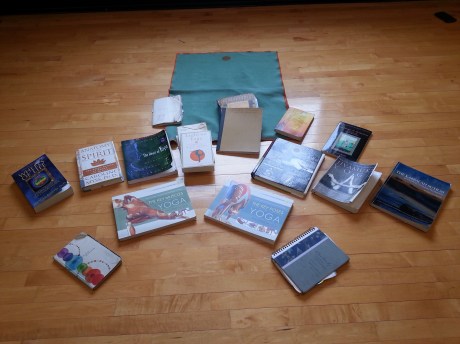
There might be more books on yoga and meditation than there are ways to practice yoga and meditation. I know for sure that there are so many books on each it is sometimes hard to narrow things down to a single recommendation. Even if I had read everything that’s ever been printed – and nothing else was ever printed (which would be a shame since one of my teachers is currently working on her first book) – and even if I only focused on books that really impacted my practice, I would still end up with a bag full of books.
(NOTE: The picture above is missing Leslie Kaminoff’s Yoga Anatomy, Steve Ross’s Happy Yoga, Stephen Cope’s The Wisdom of Yoga, all my Yin Yoga and Taoist texts, a copy of the Ramayana, and Alanna Kaivalya’s Myths of the Asanas, at the very least.)
Part of me wants to break this down into a book on the physical practice versus a book on the philosophy; however, sitting with WHY I want to make that distinction, brings me to one very comprehensive option: T. K. V. Desikachar’s The Heart of Yoga: Developing A Personal Practice.
Desikachar was the son of Sri Krishnamacharya, who was the teacher responsible for the resurgence of yoga in 20th Century India. Krishnamacharya taught Desikachar, B. K. S. Iyengar, Sri Pattabhi Jois, and Indra Devi – who all had a hand in bringing the physical practice of yoga to the West. Each of the teachers mentioned above wrote at least one book which impacted someone’s yoga practice (including mine), and all of them have had books written about them. Desikachar’s The Heart of Yoga is simultaneously about yoga and about a teacher’s teacher. It is also a practice manual with a heavy focus on the philosophy. Unlike some other books I might refer to as practice manuals, The Heart of Yoga not only offers an overview of the 8-limb philosophy of yoga, it includes a translation of the Patanjali’s Yoga Sutras. (NOTE: Patanjali’s Yoga Sutras are 196 aphorisms. Most books on the sutras include each aphorism, plus a translation and commentary for each aphorism. I use several sources for translation/commentary comparative analysis; however, my go-to resource is a website by Swami J, of the Himalayan tradition.) The Heart of Yoga gives practitioners of any fitness or experience level the opportunity to build a physical practice, while also maintaining a connection to the overall philosophical practice.
My similar dilemma regarding a book on meditation could be resolved by recommending a book on yoga mediation… and a book from each of several different Buddhist traditions…plus a book on the Kabbalah…and a book on Catholic contemplation and…..You get the idea. But, when it gets right down to it, there’s one book I am continually giving away – and it’s the same book used when I guided meditation with Dr. Thomas Bushlack’s University of St. Thomas classes: The Miracle of Mindfulness: A Manual on Meditationby Thich Nhat Hahn.
I first came across The Miracle of Mindfulness when I was babysitting for some friends in Minneapolis. One day, when the kids were napping, this little violet paperback on the bookshelf in the living room caught my eye. I pulled it down, and found…stillness.
OK, I’m being dramatic. I had, of course, already experienced stillness in both yoga and seated meditation. However, Nhat Hahn’s The Miracle of Mindfulness made me pause, sit, and contemplate my overall practice and its connection to meditation. Over the last ten years, it has played an instrumental part in my re-commitment to the physical practice of yoga as a form of meditation.
Let me be clear: Nhat Hahn is not known as a yoga teacher and The Miracle of Mindfulness is not a book related to hatha yoga (the physical practice of yoga). Nhat Hanh is a Vietnamese Buddhist monk most commonly associated with Zen Buddhism, but whose training includes several traditions. His Miracle of Mindfulness is based on Buddhist principles and practices, but is not teaching Buddhism, per se. Some might argue that it is not even teaching meditation (but, rather, mindfulness). Still, it accessible to people regardless of their background or experience and includes personal anecdotes as well as a series of practices that are simultaneously simple and profound.
To answer E’s final question, The Miracle of Mindfulness definitely has the tools to help a beginner establish a daily practice. Tools, however, do not build a mansion – and the mansion will not be built overnight.
“Practice, practice, practice – all is coming.” ~ Sri Pattabhi Jois
“I’m not very flexible and when I do yoga, every pose seems to stretch/work the backs of my legs. They are definitely my limiting factor. Is there a way to modify poses, down dog for example, to work/stretch other muscles?” – YogaNovice
YogaNovice’s question about modifying a pose, like down dog, in order to work/stretch other muscles required a little follow-up, because (a) I’m not familiar with the practitioner’s body or practice and (b) the words “stretch” and “work” convey different engagements to me. However, even before asking some follow-up questions, my answers came down to intention and alignment.
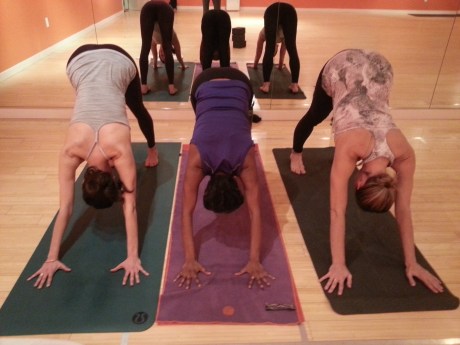
Before practicing a pose, consider the purpose of the pose in general and then the specific purpose of the pose within the sequence. Adho Mukha Svanasana (Downward Facing Dog) is a standing pose, an arm balance, a forward bend, an inversion, and includes a slight back bend. It can be used to strengthen the limbs of the body, alleviate pain and stiffness in the legs, ankles, feet, arms, wrists, and shoulders – while also helping a practitioner engage core muscles. In vinyasa, it often feels like the least strenuous pose and therefore becomes a re-set moment. As an inversion, it can be exhilarating, since the head is below the heart, but does not require pressure on the head and neck. I refer to it as “a full body stretch” – and yet, all the benefits of the pose may be lost if the pose is misaligned.
Alignment-focused yoga offers the opportunity to use props for better engagement. So, rather than muscling into a pose and experiencing strain or injury, props enable a practitioner to find the balance between effort and relaxation and to, as Patanjali states in the Yoga Sutras (2:46 – 2:48), cultivate a steady (or stable), easy (or joyful) seat (or pose). A person could use a wall, blocks, blankets, an extra mat, a strap, and/or another person in order to find more balance in pose.
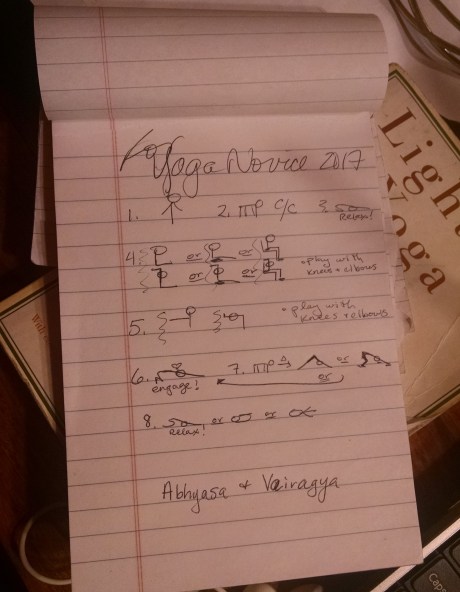
Here’s a practice to help YogaNovice find more ease in Downward Facing Dog. Read through the sequence before practicing it, and remember to check with your health care practitioner before starting any new exercise. Each step below may be practiced in 1 minute increments.
Establish what your body feels like when the spine is in neutral Table Top (on hands and knees, with shoulders and elbows over wrists and hips over knees) versus when inhaling into Cow Pose (spinal extension), exhaling into Cat Pose (spinal flexion).
If it is accessible to you, move into Puppy Dog variation of Balasana (Child’s Pose) with feet and knees the same distance apart and extended on the floor over your head. Release/relax.
Sitting on a block or blanket (for extra support) and with your hips and back against a wall – or sitting on a chair with spine in a neutral position, lift your arms overhead with fingers pointed toward the wall (palms will be facing the ceiling). Play with how the arms and back feel when the legs are fully extended versus when the legs are slightly bent (at the knees). Once you’ve established a leg position that feels like balanced effort, then, play with how the arms and back feel when the arms are fully extended versus slightly bent (at the elbows). (Again, you want to experience a kind of lightness in the final pose that indicates balanced effort.)
Stand, facing a wall, with feet 18 inches (45 centimeters)* apart and arms extended at shoulder height so that the fingers barely touch the wall. Then, maintaining the established arms’ length, flatten the palms and fold until the back is “parallel” to the ceiling. Now, notice how it feels when the knees are bent versus straight, (Again, you want to experience a kind of lightness in the final pose that indicates balanced effort.) Next, experiment with the arm position to find balanced effort. Don’t forget: Balance comes from all accessible limbs sharing your body weight!
If it is accessible to you, move back into Puppy Dog variation of Balasana (Child’s Pose) with feet and knees the same distance apart and extended on the floor over your head. This time, curl the toes under and actively press the hands and feet down while actively extending the spine into a mini-back bend. Relax after a few breaths.
From Table Top (on hands and knees with a neutral spine), curl the toes under and lift the hips up into an upside down “V” for victory, with spine and thighs pressing towards the space behind you. Now that you’ve moved into the shape of Downward Facing Dog, active the pose as follows:
Make sure middle fingers are pointing forward (with fingers spread wide), pressing into the thumb and first finger (so there is less weight on the outer wrist). As much as you’re able, maintain the hand position and rotate the elbows towards the knees.
If experiencing wrist issues, use a wrist guard or return to hands and knees to set-up Dolphin Dog.
As you lower your head and shoulders, make sure big toes are parallel to each other. In Yoga: The Path to Holistic Health, Iyengar recommends placing feet 18 inches (45 centimeters)* apart. Note that in an actual Iyengar class, Matthew Sanford has commented on how people have their feet too close together – in part, because we’re often practicing someone else’s alignment (versus our own body’s alignment). (This kind of individual instruction is why practicing with an alignment-focused teacher is invaluable!)
Spread the toes and let the heels reach towards the earth, but don’t focus on pressing/forcing the heels into the earth. Bend the knees, as needed, to achieve the previously experienced lightness of balanced effort. (Extreme knee flexion may mean you bring knees to the mat and practice an active Puppy Dog.)
You’ll find in an Iyengar practice that props may be added under the head, heels, and hands to provide support. A teacher can provide hands-on assistance to encourage the hips to lift as the spine extends.
Release/relax in Balasana (Child’s Pose) with toes pointed behind the body and arms resting by the hips. If Child’s Pose is not accessible, lie on your back.
Yoga requires patience and dedication. In the Yoga Sutras (1:12 – 1:16), Patanjali emphasizes that mastery comes from combining abhyasa (repeated and consistent practiced) and vairagya (non-attachment). Consistently practicing the above over a period of time is one way to experience abhyasa; practicing any of the steps above as an alternative to practicing Downward Facing Dog as it appears in a book or a magazine is a form of vairagya.
“Your last Monday Yin Yoga class was the best class I’ve experienced in a long time. Today’s class was almost just as good. Is it possible to get a list of poses from last Mon, or, might you have a repeat of the class sometime & I could make a list of the poses?
By the way, the Yin classes are more frequently & for longer periods lowering my neuropathy pain in my feet. Thanks for your medicinal touch.”
– G
Yin Yoga has its roots in Traditional Chinese Medicine, which maps out the vitality of the body’s organs through a system of meridians located in the deep tissue of the body. As we move into spring, my Yin Yoga classes are focusing on the gall bladder Meridian (running down the outer perimeter of the body) and liver Meridian (running up the inner thigh) – which means lots of hip opening.
The long, prop-supported holds (typically, 3 – 5 minutes) in Yin Yoga may appear similar to poses in a restorative practice; however, Yin Yoga can be significantly more “intense” than a restorative practice. By “intense,” I don’t mean active. In fact, Yin Yoga is, in some ways, the opposite of our other Hatha Yoga (physical yoga) practices. Rather than addressing the outer musculature (the muscles we can see, shape, and tone), Yin Yoga addresses the body’s fascia, deep tissue, and connective tissues. The practice may also decompress areas around the joints. One of the best online resources for Yin Yoga is Bernie Clark’s aptly named yinyoga.com, where you will find pose details, a community forum, and links to Clark’s YouTube channel.
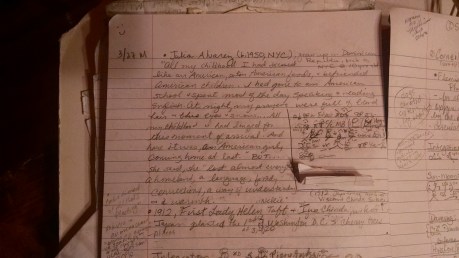
My regular students are always welcome to take a picture of my “playbook” (see below).
(Please note: These practice details are intended for individuals who already have a Yin Yoga practice. Before starting a new practice, be sure to check in with your health care provider. Most importantly, remember that although you may experience health benefits from your practice, this practice information is not intended as medical advice or as a means to replace medical care.)
Since my so-called hieroglyphics can be a little tiny or hard to read, here is an outline of the Monday Yin Yoga class from March 27, 2017 a.k.a. Julia Alvarez’s Big Day, a.k.a. the anniversary of the day First Lady Helen Taft and Viscountess Iwa Chinda planted cherry blossoms in D.C.:
Legs-Up-The Wall (for centering and integration): Sit sideways on the mat, so that the side of your hip is up against the wall; then pivot the body so the legs swing up and the back reclines on the mat. The trick is to keep your bottom on the wall. (For more release in the hamstrings, back, and hips, place the feet on a chair or table so that hips, knees, and ankles are resting at 90 degree angles.) Hold for about 2 minutes with back on the floor or a blanket. For additional decompression, bend the knees in order to use the legs to lift the hips and add a block, making sure not to pinch the spine. Hold for another 3 minutes.
“Sleeping Butterfly” – on the wall (counter-pose): Remove the block and move into Butterfly (feet together like a prayer, knees open up like the pages of a book) with legs on the wall for about one minute. Use “Sleeping Butterfly” or a Squat on the wall to set a personal intention, which will keep you on the wall for another minute.
Dragonfly, on the wall: Stretch your legs out (on the wall) as wide as they’ll go, and support the legs by placing a block between the wall and each thigh or by placing blocks or a bolster on the outside of each thigh. Hold for 3 – 5 minutes.
“Sleeping Butterfly” (transitional pose) and Fetal Position (transitional pose)
Wide Legged Child’s Pose (with arms bent on floor over head): Props may be placed under the hips and/or under your chest. If you have a bolster, you can recline your whole body on it. Hold for 2 – 3 minutes.
Counter-pose Moment: Inhale to table top and use Cat/Cow to transition into about 1 minute of gentle movement to break up the stillness.
Half Shoelace or Half Square sequence: Sit with legs extended in front of you. If there’s compression in the low back and/or hips, sit up on top of a blanket or block. Hug right knee in and lift it over extended left leg. You can either rotate the top leg so the knee points to the left foot or slide the top leg to the side so the ankle rests on the bottom thigh, right below the knee. (If elevated, you can place a blanket or towel under the extended shin – to soften the experience at the back of the knee. If you have a hamstring issue, you could sub “Full” Shoelace or Square by bending the bottom knee into the appropriate position.) Twist upper body to the right and hold for at least 1 minute. Rotate back to center and fold until you feel a change, support the change and hold for at least 3 minutes.
Counter-pose Moment: Inhale to lift the body, unravel the legs and give them a rub or a hug. Lean back on the forearms or recline with back on the floor, windshield wiper bent knees for about 1 minute.
Repeat “Half Shoelace or Half Square” sequence on opposite side and Counter-pose Moment.
(Prone) Frog or Dragonfly: Face the long side of the mat and set up props as needed. For (Prone) Frog, come into table top; spread the knees as wide as they’ll go, with ankles under the knees (when you look down the legs) and hips pressing back. Extend the chest forward and recline on forearms and/or props. Prop the thighs. For Dragonfly, sit with legs in front of you and spread wide; prop as needed for low back and lean forward until you feel a change; prop the change. Hold for 5 minutes
Counter-pose Moment: (Prone) Frogs Inhale to table top and use Cat/Cow to transition; Dragonflies use inhale to rise up, hug the knees into the chest and then recline to windshield wiper bent knees. Gentle movement for about 1 minute.
“Sleeping Butterfly”: Set up props so upper back is supported, behind shoulder blades, and head us raised slightly above the chest by a prop that supports the nape of the neck (where head meets the spine). If thighs do not touch the ground when legs rest in position, place a block under each thigh. Hold for 5 minutes.
Counter-pose Moment: Mindfully, move off the props.
Savasana (with props, as needed): Hold for at least 5 minutes.
Counter-pose Moment: Be easy and gentle as you move out of Savasana and into a fetal position. Give yourself a moment before sitting up and closing out your practice. Namaste.
Thanks, G, for your question. I’m always so glad to see you in class and (of course) super grateful your yoga practice is helping you feel good!
“The number of words you use to answer these questions is going to be divisible by 108? Why 108?” – the obvious questions
The significance of 108 is something pondered pretty much whenever people get ready to practice 108 Sun Salutations (for New Year’s Day, Spring/Fall Equinox, and Summer/Winter Solstice). It is considered an auspicious number in a variety of disciplines and traditions. So much so that if I listed 108 reasons, I might still be missing some. Swami J has a pretty comprehensive list; however, here are some of my favorites:
108 is a harshad (or, “great joy” bringer) number in mathematics, meaning that it is divisible by the sum of its parts (1+0+8=9; 108/9 = 12)
Note also 1+2 = 3; 12/3 = 4 and 108/3 = 36; 3+6 = 9; 36/9 = 6
108 is a prime example of numbers being exponentially powerful {(1, raised to the 1st power) multiplied times (2, raised to the 2nd power) multiplied times (3, raised to the 3rd power), i.e., 1*4*27}
In Buddhism, the 108 feelings or sensations humans experience result from external/physical and internal/mental stimuli (2) being received through our senses and consciousness (5+1) multiplied times our perception of sensation as positive/pleasant, negative/painful, or neutral (3) multiplied times our ability to experience feelings or sensations in the past, present, and future (3). {2*(5+1)*3*3}
In Eastern religions and philosophies, a mala used to count repetitions during meditation contains 108 beads – or a fraction of 108, and this coincides with an old school Catholic rosary which allows you to count out 10 decades, and provides 8 additional beads (for mistakes). The cross would be considered the guru bead.
In some religions there is only one God; however there are 101-108 names for God.
In an Indian creation story, God as Dance (Nataraja) creates the universe through a dance containing 108 steps or poses; and, there are 108 forms of dance in Indian traditions.
Some martial arts forms contain 108 steps or poses.
According to some yoga texts, there are 108 nadis (energy rivers carrying the bodies vitality) intersecting at the heart chakra.
Since I’m writing this on opening day 2017:
The 108 double stitches on a Major League baseball are hand stitched; AND
Finally, it would be seriously auspicious if a couple of people (2) Kiss(ed) My Asana by clicking here and donating $54 each. Or, you know what would be a real joy bringer? If a certain number of individuals (108) clicked above and donated $108 each.
For those of you doing the math: $25 shares a “Beyond Disability” DVD with a home-bound person living with a disability; $250 provides four yoga classes at a battered women’s shelter or veterans center; $500 provides full tuition for an Opening Yoga Teacher Training Workshop; and $1000 transforms the life of someone living with a disability by providing them an entire year of adaptive yoga. While these numbers focus on the people directly receiving the service, consider how yoga affects not only the individual on the mat, but everyone that individual encounters off the mat.

 A Joyful Practice