Trust & EXCERPT: “What We Need to Live Well” (the “missing” Saturday post) January 17, 2026
Posted by ajoyfulpractice in Books, Changing Perspectives, Faith, First Nations, Healing Stories, Hope, Japa, Japa-Ajapa, Life, Mantra, Meditation, One Hoop, Philosophy, Vairagya, Wisdom, Writing, Yoga.Tags: 988, Benjamin Franklin, Dakota, Diné, Japa-Ajapa, Navajo, Noah Webster, Ojibwe, sankalpa, Sanskrit, Sebastian Junger, trust, trustful surrender, Webster's 1828, Yoga Sutra 1.23, Yoga Sutra 2.45
2 comments
Many blessings to everyone, and especially to anyone celebrating the Forefeast of the Theophany.
May all beings everywhere experience a trustful surrender. May all beings everywhere feel a sense of belonging!
This is the “missing” post for Saturday, January 17th. The practice and the first post excerpted below include references to mental health issues and connected traumas. There are no graphic descriptions. You can request an audio recording of this practice or a previous practice via a comment below or (for a slightly faster reply) you can email myra (at) ajoyfulpractice.com.
In the spirit of generosity (“dana”), the Zoom classes, recordings, and blog posts are freely given and freely received. If you are able to support these teachings, please do so as your heart moves you. (NOTE: You can donate even if you are “attending” a practice that is not designated as a “Common Ground Meditation Center” practice, or you can purchase class(es).
Donations are tax deductible; class purchases are not necessarily deductible.
Check out the “Class Schedules” calendar for upcoming classes.
“TRUST, noun
-
Confidence; a reliance or resting of the mind on the integrity, veracity, justice, friendship or other sound principle of another person.
He that putteth his trust in the Lord shall be safe. Proverbs 29:25.
-
He or that which is the ground of confidence.
O Lord God, thou art my trust from my youth. Psalms 71:1.
-
Charge received in confidence.
Reward them well, if they observe their trust
-
That which is committed to one’s care. Never violate a sacred trust….”
— quoted from Webster’s Dictionary 1828: American Dictionary of the English Language
The root words of the Sanskrit word sankalpa are “truth” and “vow” and the word itself is often translated into English as “vow or highest vow”, “will”, or “determination”. In various religious and philosophical traditions, it has additional meanings, including (in the Yoga Philosophy) “intentional thought”. It can also be considered a “ritual intention” (in religious law). During the Saturday practices, I often explain it as “a positive, active statement, in the present tense, that comes from the heart.” It is a mantra or “tool”; although, not every mantra is a sankalpa.
While I usually just incorporate the group sankalpa into the last portion of the practice — as a form of japa-ajapa (“repeat and repeat” or “repeat and remember”) that integrates the idea into our being — this year is a little different. This year, I plan to use the (2026) Saturday practices to breakdown the group sankalpa, which begins with something you might find hard to do during these challenging times: “I trust….”
“TRUST, verb transitive To place confidence in; to rely on. We cannot trust those who have deceived us.
He that trusts every one without reserve, will at last be deceived.
-
To believe; to credit.”
— quoted from Webster’s Dictionary 1828: American Dictionary of the English Language
In the 1828 version of his American Dictionary of the English Language, Noah Webster included 12 definitions of the word “trust” as a noun and five (5) definitions for verb forms, plus examples of how the word can be used in a sentence (based on each definition). Some of these definitions relate to legal entities, which I’m not getting into just yet. Neither am I going to spend a lot of time on these 17 different definitions, since most are still understood and used by modern audiences. You may remember, however, that Noah Webster studied (and incorporated) a variety of languages, including Sanskrit and Indigenous / Native / First Nation languages in order to create a dictionary and spelling and grammar tools that were uniquely American — and it is interesting to note how some words in other languages are translated into English as things other than “trust”.
For instance, apenimowin+an (in Ojibwe) can also mean “confidence”, “esteem”, “hope”, “optimism”, and “reliance”. Similarly, wac̣iƞye (in one of the Dakota Languages) can also be used to mean “depend on something” and “appreciate someone”. In Navajo (the language of Diné), one of the words used for “trust” can also be translated as “responsibility” or “duty”.
Whether you consciously realize it or not, these meanings underlie your ability to trust yourself and your skills — especially when you endeavor to do something “‘…of use to Mankind’”, as encouraged by Benjamin Franklin (born today in 1706, according to the Gregorian calendar).
While they may not have used these exact words, this multi-faceted understanding of “trust” is also integral to observations about community made by Mr. Franklin and by Sebastian Junger (born today in 1962).
Click on the excerpt title below for more about Benjamin Franklin and Sebastian Junger.
The post excerpted below references mental health issues and connected traumas. There are no graphic descriptions.
Yoga Sūtra 1.23: īśvarapraņidhānādvā
— “[A perfectly still, pristine state of mind] also comes from trustful surrender to Ishvara [the Divine],”
Yoga Sūtra 2.45: samādhisiddhirīśvarapraņidhānāt
— “From trustful surrender to Ishvara [the Divine], [a perfectly still, pristine state of mind] comes.”
Saturday’s playlist is available on YouTube and Spotify. [Look for “01172021 Franklin Junger”]
If you are thinking about suicide, worried about a friend or loved one, or would like emotional support, you can dial 988 (in the US) or call 1-800-273-TALK (8255) for the Suicide and Crisis Lifeline. You can also call this TALK line if you are struggling with addiction or involved in an abusive relationship. The Lifeline network is free, confidential, and available to all 24/7. YOU CAN TALK ABOUT ANYTHING.
White Flag is an app, which I have not yet researched, but which may be helpful if you need peer-to-peer (non-professional) support.
If you are a young person in crisis, feeling suicidal, or in need of a safe and judgement-free place to talk, you can also click here to contact the TrevorLifeline (which is staffed 24/7 with trained counselors).
### FAITH ###
HAPPY New Year 2026! ** UPDATED** January 1, 2026
Posted by ajoyfulpractice in Bhakti, Changing Perspectives, Donate, Faith, Healing Stories, Health, Hope, Japa, Japa-Ajapa, Karma Yoga, Life, Love, Mala, Mantra, Meditation, Mysticism, New Year, One Hoop, Peace, Philosophy, Traditional Chinese Medicine, Vipassana, Wisdom, Writing, Yin Yoga, Yoga.Tags: 108 Sun Salutations, Anthony Shumate, Kwanzaa, New Year's Day, Nguzo Saba, Nia, Sun Salutations, Surya Namaskar
add a comment
“Happy New Year!” “Kwanzaa, yenu iwe na heri!” – “May your Kwanzaa be happy!” to everyone who is celebrating!
Many blessings to all!
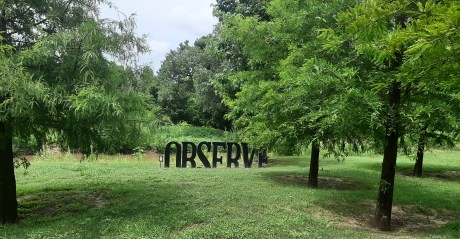
Part of the 6-piece “Monumental Moments” series
by Anthony Shumate, 2015
(located in Buffalo Bayou Park, along the Kinder Footpaths)
TRANSFORM • RENEW • HEAL • ENERGIZE
Celebrate the New Year with 108 Sun Salutations 10:00 AM – 1:00 PM CST!
AND/OR
RELAX • RELEASE • REST • RENEW • HEAL
Celebrate the New Year with Restorative Yoga+Meditation
5:00 PM – 7:00 PM CST!
The New Year is a beginning and an ending… and it is also a middle. On New Year’s Day we honor and celebrate transition with 108 Sun Salutations in the morning (10 AM – 1 PM, CST) and/or a Restorative* Yoga plus Meditation practice in the evening (5 – 7 PM, CST). We also put things in perspective.
These practices are open and accessible to all, regardless of experience.
*NOTE: In previous years, the evening practice has been Yin Yoga.
Please wear loose, comfortable clothing and make sure you are well hydrated before the practice. It is best to practice on an empty stomach (especially for the 108 ajapa-japa mala), but if you must eat less than 1 hour before the practice, make sure to keep it light. Make sure to have a towel (at the very least) for the 108 practice. For Restorative Yoga, a pillow/cushion or two, blocks or (hardcover) books, and a blanket or towel will be useful. I always recommend having something handy (pen and paper) that you can use to note any reflections (and will have some supplies handy).
IN-PERSON IS FULL! Use the link above for login information (or click here for more details about these practices and other practice opportunities related to the New Year).
The 108 playlist is available on YouTube and Spotify. [Look for “New Year’s Day 108 Ajapa-Japa Mala.”] NOTE: This playlist was revised for 2024, but should still sync up with the 2021 — 2023 recordings.
The Restorative playlist is available on YouTube and Spotify. [Look for “01072022 A Reflective Moment”]
Both practices are available in-person (if you are registered) and online. They are also donation based. If you don’t mind me knowing your donation amount you can donate to me directly. You can also email me to request my Venmo or Ca$hApp ID. If you want your donation to be anonymous (to me) and/or tax deductible, please donate through Common Ground Meditation Center (type my name under “Teacher”).
Please note that there is still no late admittance and you must log in before the beginning of the practice (so, by 9:45 AM for the 108 or by 4:45 PM for the Restorative Yoga+Meditation). You will be re-admittance if you get dumped from the call.)
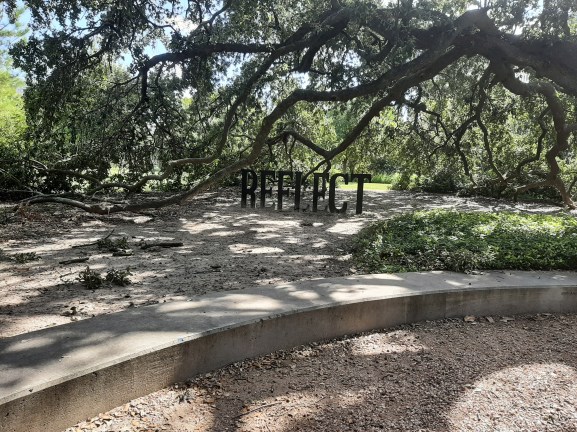
Part of the 6-piece “Monumental Moments” series
by Anthony Shumate, 2015
(located in Buffalo Bayou Park, along the Kinder Footpaths)
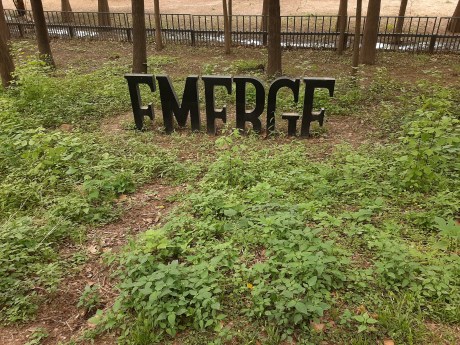
Part of the 6-piece “Monumental Moments” series
by Anthony Shumate, 2015
(located in Buffalo Bayou Park, along the Kinder Footpaths)
*Anthony Shumate’s “Monumental Moments” sculptures are located in Buffalo Bayou Park, along the Kinder Footpaths in Houston, Texas. They are unexpected reminders to “Explore,” “Pause,” “Reflect,” “Listen,” “Emerge,” and “Observe” – all things we do in our practice!
### NAMASTE ###
A Quick Note & EXCERPT: “Purpose Driven” (a Tuesday post, that’s also for Wednesday and Thursday!) December 30, 2025
Posted by ajoyfulpractice in 7-Day Challenge, Changing Perspectives, Christmas, Faith, Healing Stories, Health, Hope, Japa, Japa-Ajapa, Life, Loss, Meditation, Mysticism, New Year, One Hoop, Peace, Philosophy, Religion, Science, Wisdom, Yoga.Tags: 12 Days of Christmas, 988, catechism, Christmas, Dr. Nick Hobson, holidays, Imani, Kuumba, Kwanzaa, New Year's, Nguzo Saba, Nia, Sita (Joan Weiner) Bordow, Surya Namaskar, Swami Satchidananda, Twelvetide, Yoga Sutras 1.12-1.14
add a comment
“Kwanzaa, yenu iwe na heri!” – “May your Kwanzaa be happy!” to everyone who is celebrating!
“My research over the last decade has helped understand why rituals in particular (and not any other behaviors like habits, for instance) are effective at battling negative emotions. Be it anxiety, stress, fear, doubt, sadness, grief – you name it. Rituals are there to save the day. The dread we feel after experiencing a loss happens because it feels like the situation is outside our control (and it usually is). Rituals reinstate that control.”
— quoted from “The emerging science of ritual – a new look on an ancient behavior: And how you can use it to live life to the fullest” by Dr. Nick Hobson (contributing to the ThriveGlobal.com, Dec. 7, 2017)
There is something to be said for a good ritual. I don’t just mean a habit, something you do repeatedly — even if it’s something you are in the habit of doing at a particular time. Neither am I just referring to a tradition — which could be a group habit and/or a ritual that has been passed down through generations, but has lost some of it’s deeper meaning. No, I am referring to something that is more like a ceremony; something infused with purpose and meaning.
Consider your exercise routine. You may be in the habit of doing a certain kind of physical activity at a certain time on certain day(s). Changes in your routine (and the resulting cancellations during the holidays) may leave you feeling off kilter. However, you know you will return to that routine (or something similar) because it serves a purpose and you value the experience. It may even connect you to a community.
No matter what you do, if you have that regular routine, you probably experience something more than physical well-being. You may notice mental and emotional benefits that serve you on multiple levels of your life. You may even do the thing you do for those specific benefits. In this way, what you do could be considered abhyasa (“[continuous and deliberate] practice, [engaged with sincere devotion]”) (YS. 1.12-1.14) However, those extra benefits are just that — lagniappe (“a little (something) extra”). They are gifts that are not intentionally part of the exercise.
Now, consider the physical practice of yoga, which you could consider a ritual within a ritual. It is part of a larger practice, and that larger practice intentional includes benefits beyond the physical. If you go to a different class; use one of my videos or recordings; and/or practice on your own, the ritual of the practice — i.e., the order in which we do the practice and the meaning behind the order and what we do within the sequences — still includes the deeper meaning and serves a deeper purpose, one that is beyond the physical-mental. One of my teachers once argued that this is true even if/when the meaning and purpose are not explicitly stated.
The meaning and purpose are baked in; they were part of the creation process.
Click on the excerpt title below for more about these holidays and our New Year’s Day tradition that is also a ritual!
Updated & Revised! Purpose Driven (a Friday post, that’s also for Saturday and Sunday!)
“Nia (purpose) — To make our collective vocation the building and development of our community in order to restore our people to their traditional greatness.”
— The fifth of the Nguzo Saba (or “Seven Essential Pillars”) of Kwanzaa
For people celebrating Kwanzaa, “Nia (Purpose)” is the focus for the fifth day (today, Tuesday); “Kuumba (creativity)” is the focus for the sixth day; and “Imani (faith)” is the focus for the sixth day. These final three days of Kwanzaa coincide with the fifth, sixth, seventh (or eighth) days of the “12 Days of Christmas” (depending on when you start counting).
If you are following along with the symbolic meaning of the gifts in the song, you will notice that the 5th, 6th, and 7th gifts are infused with purpose, meaning, creativity, and (of course) faith: “five gold rings” are the first Five Books of the Hebrew Bible and the Christian Old Testament (which provide the back story for the three Abrahamic religions); “six geese a-laying” for the six days of creation; and “seven swans a-swimming”, the consistently most expensive gift, stand for the seven gifts of the Holy Spirit (wisdom, understanding, knowledge, counsel, fortitude, piety, and fear of the Lord) or the seven sacraments (Baptism, Eucharist, Confirmation, Reconciliation, Anointing of the Six, Marriage, and Ordination). As for the eighth day, those could be considered extra (spiritual) gifts: “eight maids a-milking” for the eight beatitudes (or blessings).
“Kuumba (creativity) — To do always as much as we can, in the way we can, in order to leave our community more beautiful and beneficial than we inherited it.
Imani (faith) — To believe with all our heart in our people, our parents, our teachers, our leaders, and the righteousness and victory of our struggle.”
— The sixth and seventh of the Nguzo Saba (or “Seven Essential Pillars”) of Kwanzaa
Online (Zoom) classes are cancelled today through Wednesday, December 31st.
People on the recording email list(s) receive backup recordings. There are also some practice videos on my YouTube channel. You can check the “Class Schedules” calendar for upcoming classes. You can also request an audio recording of this practice via a comment below or (for a slightly faster reply) you can email me at myra (at) ajoyfulpractice.com.
The playlist for the fifth day of Kwanzaa is available on YouTube and Spotify. [Look for “12302020 Purpose Driven”]
“Consider, for instance, in moments of grief, rituals help ease our pain and suffering. But, again I ask, how do they do this, and why rituals in particular? As my collaborators Mike Norton and Francesca Gino have shown, rituals alleviate feeling of grief and loss by increasing a feelings of control.”
— quoted from “The emerging science of ritual – a new look on an ancient behavior: And how you can use it to live life to the fullest” by Dr. Nick Hobson (contributing to the ThriveGlobal.com, Dec. 7, 2017)
If you are thinking about suicide, worried about a friend or loved one, or would like emotional support, you can dial 988 (in the US) or call 1-800-273-TALK (8255) for the Suicide and Crisis Lifeline. You can also call this TALK line if you are struggling with addiction or involved in an abusive relationship. The Lifeline network is free, confidential, and available to all 24/7. YOU CAN TALK ABOUT ANYTHING.
White Flag is an app, which I have not yet researched, but which may be helpful if you need peer-to-peer (non-professional) support.
If you are a young person in crisis, feeling suicidal, or in need of a safe and judgement-free place to talk, you can also click here to contact the TrevorLifeline (which is staffed 24/7 with trained counselors).
In the spirit of generosity (“dana”), the Zoom classes, recordings, and blog posts are freely given and freely received. If you are able to support these teachings, please do so as your heart moves you. (NOTE: You can donate even if you are “attending” a practice that is not designated as a “Common Ground Meditation Center” practice, or you can purchase class(es).
Donations are tax deductible; class purchases are not necessarily deductible.
Check out the “Class Schedules” calendar for upcoming classes.
“You can perform japa, repetition of a mantra or Sacred Word, in the midst of your day-to-day work. Then, when it becomes a habit, even when you are working intensely a portion of the mind will keep repeating the mantra always. That means you have locked one end of your chain to a holy place, while the rest of the chain remains still in the outside world.”
— a note written by Swami Satchidananda, quoted in Sri Swami Satchidananda: Apostle of Peace by Sita (Joan Weiner) Bordow
I am offering in-person classes during January 2026. Click here for more details and to reserve your spots now. Let’s start the 2026 together!
### OM AUM ###
FTWMI: “Have Light, Let It Shine” October 19, 2025
Posted by ajoyfulpractice in Art, Bhakti, Books, Changing Perspectives, Dharma, Faith, Food, Healing Stories, Hope, Japa, Japa-Ajapa, Kirtan, Life, Mantra, Meditation, Music, Mysticism, One Hoop, Philosophy, Religion, Wisdom, Women, Yoga.Tags: 988, Babul Sharma, Choti Diwali, Diwali, Elizabeth Cady Stanton, Garth Brooks, Gayatri Mantra, Gāyatrī Mantra, Kali Puja, light, Mahābhārata, mantra, puja, Rig Veda, Rāmāyaņa, The Ramayana, Tom Walker, Yoga Sutra 1.36, Yoga Sutras 2.46-2.53
add a comment
Happy Choti Diwali, Diwali, and Kali Puja! Blessings, light, love, and peace to everyone, everywhere!
For Those Who Missed It: The following is the 2024 version of a 2023 post. Date related details and links have been updated/revised.
“oṃ bhūr bhuvaḥ svaḥ
tat savitur vareṇyaṃ
bhargo devasya dhīmahi
dhiyo yo naḥ pracodayāt”
[Conscious, subconscious, unconscious mind, and every plane of existence, we meditate on the (adorable) Light, that it may inspire us, enlighten us, and remove our obstacles.]
— “Gāyatrī Mantra” from the Rig Veda (from Mandala 3.62.10)
During the darkest times of the year, people all over the world celebrate light. In each culture’s stories and traditions, light overcoming darkness is a metaphor for good overcoming evil; life overcoming death, wisdom overcoming fear; love overcoming hate; hope overcoming despair, and knowledge overcoming ignorance. Once again, the celebrations kick off with Diwali, the Indian festival of lights.
Diwali is a five-day celebration which takes its name from Deepavali, which are rows and rows of lamps. It is a lunar calendar based holiday observed throughout India, parts of Southeast Asia, and the diaspora by Hindus, Sikhs, Jains, and Newar Buddhists. Each day has different rituals and customs, which may vary between religious, cultural, and regional traditions. But, the common threads are the (clay) lamps and other great displays of light; pujas (“offerings”); feasts and sweets; epic tales of heroes and heroines prevailing; and a focus on relationships and also on wealth.
While some communities start earlier, most people’s Diwali celebrations begin with Dhanteras (October 18, 2025), a day that the Indian ministry of Ayurveda, Yoga and Naturopathy, Unani, Siddha and Homeopathy designated as “National Ayurveda Day” (in 2016). Many pujans (“offering ceremonies”) are dedicated to Lakshmi, the goddess of wealth and prosperity, fertility and abundant crops, and overall good fortunate. People also create decorations, including rangolas, which are associated with Lakshmi; clean their homes; and buy something new — usually gold, silver, clothes, and gadgets.
The second day of Diwali (which is today in 2025) is known as Choti (“little”) Diwali and, also, as Naraka Chaturdasi. Naraka is a Sanskrit word for “hell” and the day is associated with the story of Krishna defeating the asura (“demon”) Narakasura. Again, the elements of the story — as well as the rituals and traditions of the day — have symbolic significance related to the ways people live their lives and the ways their souls can be liberated from suffering (i.e., hell). Some people spend the day praying to the souls of their ancestors, sending light for their afterlife journey. In some regions (e.g., Tamil Nadu, Goa, and Karnataka), Choti Diwali is the main Diwali day. People get oil massages and take ritual baths. Some people also spend part of the day visiting their temple. For people celebrating the “little” Diwali, the second day is a day to visit friends and family and share sweets and gifts.
“Fiery-eyed Durga astride a golden lion; Saraswati resplendent in white along with her swan; a glowing Lakshmi seated on a lotus in bloom; and Kali with her frightening garland of skulls. The legends that surround them are told over and over again and soon the children know them by heart. For them, as it is for me, these beautiful lotus-eyed goddesses are not just religious icons but part of one’s family. They laugh and cry, quarrel with each other over petty things, they have fragile natures despite their powerful forms. They are often jealous, angry, greedy and plot deviously against their enemies but still they need to be loved by their devotees, Then they appear, splendid, glorious and benevolent, to dazzle us with their all-pervading light.”
— quoted from the “Introduction” to The Book of Devi by Bubul Sharma
The third day (tomorrow, October 20, 2025) is the biggest day for most: Diwali! It coincides with the darkest night of the festival and is normally marked by people getting together, feasting and celebrating. In fact, this is a time when the youngest members of the family visit their elders; businesses owners give gifts to their employees; and, instead of the fasts that are commonly associated with some Indian religious rituals, there are great feasts. Pujas are again made to Lakshmi. For some people, however, pujans are dedicated to Kali, the goddess of time and change, creation, power, war, destruction, and death. In many ways, making an offering to Kali highlights the fact that Diwali is a day of renewal, new beginnings, and starting over.
The stories in the Rāmāyaņa highlight all of the themes associated with Diwali — and the end is particularly pertinent to the third day. In the epic poem (which is part of the Mahābhārata), Rāma, his wife Sītā, and his brother Lakshmana are exiled by the brothers’ father. Their great adventure includes Sītā being kidnapped by the demon king Ravana (and rescued with help from Hanuman, the monkey king); a great battle where an entire army gets sick (and ultimately healed, thanks to Hanuman); the defeat of Ravana; and the revelation that Hanuman overcame his doubts, insecurities, and fears by focusing on the love and devotion for Lord Rama that shined (like a bright light) in his heart. Finally, after 14 years of exile, Rāma, Sītā, and Lakshmana returned home to Ayodhya — on the day that is now celebrated as Diwali. According to the legends, people lit up the city in order to guide the travelers home and also to celebrate their return. So, every year, people from all of the different religions light up their homes, businesses, and temples to commemorate this auspicious homecoming.
SIDE NOTE: As they travelled home, Sītā requested a pit stop in Kishkindha, because she wanted to enter Ayodhya with a company of women as her escorts. The request and fulfillment are conveyed in just a few lines, making up a minuscule portion of the epic poem. Normally, I would not mention this tiny passage — even though, if you think about it, it is a powerful moment when a woman who has suffered trauma and drama asks for (and receives) what she needs before facing what could be more trauma, drama, and judgement.
It also highlights the power of a group of women standing up for each other — which I highlighted in 2023, because Diwali fell on the anniversary of the birth of the birth of Elizabeth Cady Stanton (the social activist, abolitionist, and suffragist who was born on November 12, 1815, in Johnstown, New York). I’m mentioning here it again, in 2025, just in case someone needs the subliminal message.
“The moment we begin to fear the opinions of others and hesitate to tell the truth that is in us, and from motives of policy are silent when we should speak, the divine floods of light and life no longer flow in our souls. Every truth we see is ours to give the world, not to keep to ourselves alone, for in so doing we cheat humanity out of their rights and check our own development.”
— quoted from Elizabeth Cady Stanton’s speech at the National American Woman Suffrage Association convention (and birthday celebration for Susan B. Anthony), February 18, 1890
Please join me today (Sunday, October 19th) at 2:30 PM for a yoga practice on Zoom. You can use the link from the “Class Schedules” calendar if you run into any problems checking into the class. You can request an audio recording of this practice via a comment below or (for a slightly faster reply) you can email myra (at) ajoyfulpractice.com.
Sunday’s playlist is available on YouTube and Spotify. [Look for “Diwali (2-3) 2022”]
If you are thinking about suicide, worried about a friend or loved one, or would like emotional support, you can dial 988 (in the US) or call 1-800-273-TALK (8255) for the Suicide and Crisis Lifeline. You can also call this TALK line if you are struggling with addiction or involved in an abusive relationship. The Lifeline network is free, confidential, and available to all 24/7. YOU CAN TALK ABOUT ANYTHING.
White Flag is an app, which I have not yet researched, but which may be helpful if you need peer-to-peer (non-professional) support.
If you are a young person in crisis, feeling suicidal, or in need of a safe and judgement-free place to talk, you can also click here to contact the TrevorLifeline (which is staffed 24/7 with trained counselors).
In the spirit of generosity (“dana”), the Zoom classes, recordings, and blog posts are freely given and freely received. If you are able to support these teachings, please do so as your heart moves you. (NOTE: You can donate even if you are “attending” a practice that is not designated as a “Common Ground Meditation Center” practice, or you can purchase class(es).
Donations are tax deductible; class purchases are not necessarily deductible.
Check out the “Class Schedules” calendar for upcoming classes.
### “I will leave a light on” ~ TW/GB ###
Quick Notes & 3 Excerpts RE: Work & Listening (the post-practice Monday post) September 1, 2025
Posted by ajoyfulpractice in Abhyasa, Bhakti, Books, Changing Perspectives, Faith, Healing Stories, Japa, Japa-Ajapa, Karma, Mantra, Meditation, Music, One Hoop, Philosophy, Poetry, Religion, Vipassana, Wisdom, Yoga.Tags: 988, Dharma Singh Khalsa M. D., Ek Ong Kaar Kaur Khalsa, Eugene V. Debs, Guru Granth Sahib, Guru Nanak, history, Japa-Ajapa, Japji Sahib, John Metcalfe, Labor Action Tracker, Labor Day, meditation, Pullman Strike, sikh, Sikhism, Song of the Soul, spirituality, stillness, unions
add a comment
Many blessings to everyone and especially to anyone cultivating friendship, peace, freedom, understanding, and wisdom — especially when it gets hot (inside and outside).
Stay safe! Hydrate and nourish your heart, body, and mind.
The following post-practice compilation post is related to Monday, September 1st, which was Labor Day in the United States and parts of Canada. Some of the excerpted posts include videos.
The 2025 prompt question was, “What part of your mind-body or life does a little, but gets a lot of your attention & what part does a lot of work, but doesn’t get commensurate attention?” You can request an audio recording of this practice or a previous practice via a comment below or (for a slightly faster reply) you can email myra (at) ajoyfulpractice.com.
In the spirit of generosity (“dana”), the Zoom classes, recordings, and blog posts are freely given and freely received. If you are able to support these teachings, please do so as your heart moves you. (NOTE: You can donate even if you are “attending” a practice that is not designated as a “Common Ground Meditation Center” practice, or you can purchase class(es).
Donations are tax deductible; class purchases are not necessarily deductible.
Check out the “Class Schedules” calendar for upcoming classes.
“I am opposing a social order in which it is possible for one man who does absolutely nothing that is useful to amass a fortune of hundreds of millions of dollars, while millions of men and women who work all the days of their lives secure barely enough for a wretched existence.”
— Eugene V. Debs, quoted from his statement to the Federal Court (Cleveland, Ohio), after being convicted of violating the Sedition Act, September 18, 1918
The first Monday in September is Labor Day in the United States and parts of Canada.
CLICK ON THE EXCERPT TITLE BELOW FOR MORE.
2025 Update:
Between September 1, 2024 and September 1, 2025, the Labor Action Tracker counted strikes in 586 locations, plus additional labor protests in 683 locations; bringing the labor actions total to 1296 locations.
(NOTE: The total locations matches the same total locations as last year, however, the summary mechanism has changed.)
Click on the excerpt below for more details about the Labor Action Tracker and how modern day strikes and protests can lead to better working conditions.
FTWMI: Working Together (a post–practice Monday post w/ an extra excerpt)
“Deeply Listening,
Yoga
And the hidden systems
Of the body
Make themselves known.
Deeply Listening,
The wisdom
Of all sacred scriptures in the world
Is revealed.
Oh my soul,
Those who surrender themselves in Love
To the Divine
Continuously blossom and bloom.
Deeply Listening
Sorrows
And errors
Depart.”
— quoted from Japji Sahib: The Song of the Soul by Guru Nanak (Translated by Ek Ong Kaar Kaur Khalsa)
Our practices, on and off the mat or cushion, give us the opportunity to pay attention to how the mind-body works — and to really listen, deeply.
Listening deeply is one of the important lessons in the Japji Sahib (known in English as The Song of the Soul) an ancient Sikh text at the beginning of the Guru Granth Sahib, which is the Adi Granth or primary sacred text / scripture in Sikhism. Originally compiled and printed by Guru Arjan, the fifth Sikh guru, on August 29, 1604, it was placed in the Golden Temple in the city of Amritsar, Punjab, India, today (September 1st) in 1604.
CLICK ON THE EXCERPT TITLE BELOW FOR MORE.
FTWMI: Deep Listening (*Revised) – the post-practice Friday post
There is no playlist for the Common Ground Meditation Center practices.
The following (2) playlists include the Japji Sahib:
MUSIC NOTE: The playlist contains John Metcalfe’s album Tree (with the remixes); however, one track has been moved. The story behind the album is beautiful (and it is about working). Additionally, I encourage you to deeply listen to Track #11 (which is the Japji Sahib).
- A First Friday playlist is available on YouTube and Spotify. [Look for “09012023 Trusting, Listening… Deeply”]
MUSIC NOTE: You can start with Track #1, #2, #3, or #5. These are instrumental tracks. Track #4 is the Japji Sahib.
“If you
Trust what you hear
When you listen,
Then you will know
What you see,
How to understand
And act.”
— quoted from Japji Sahib: The Song of the Soul by Guru Nanak (Translated by Ek Ong Kaar Kaur Khalsa)
Extreme heat can not only make people lethargic and unmotivated, it can also lead to extreme agitation and anxiety-based fear. We may find it hard to think, hard to feel (or process our feelings), and/or hard to control our impulses. If you are struggling in the US, help is available just by dialing 988.
If you are thinking about suicide, worried about a friend or loved one, or would like emotional support, you can dial 988 (in the US) or call 1-800-273-TALK (8255) for the Suicide and Crisis Lifeline. You can also call this TALK line if you are struggling with addiction or involved in an abusive relationship. The Lifeline network is free, confidential, and available to all 24/7. YOU CAN TALK ABOUT ANYTHING.
White Flag is an app, which I have not yet researched, but which may be helpful if you need peer-to-peer (non-professional) support.
If you are a young person in crisis, feeling suicidal, or in need of a safe and judgement-free place to talk, you can also click here to contact the TrevorLifeline (which is staffed 24/7 with trained counselors).
NOTE: The translation by Ek Ong Kaar Kaur Khalsa is the foundation for The End of Karma: 10 Days to Perfect Peace, Tranquility, and Joy by Dharma Singh Khalsa, M. D., which I quote during the practice.
### BREATHE, WORK, LISTEN, REST (& do it all over again) ###
HAPPY New Year 2025! ** UPDATED** January 1, 2025
Posted by ajoyfulpractice in Bhakti, Changing Perspectives, Donate, Faith, Healing Stories, Health, Hope, Japa, Japa-Ajapa, Karma Yoga, Life, Love, Mala, Mantra, Meditation, Mysticism, New Year, One Hoop, Peace, Philosophy, Traditional Chinese Medicine, Vipassana, Wisdom, Writing, Yin Yoga, Yoga.Tags: 108 Sun Salutations, Anthony Shumate, Chanukah, Kwanzaa, New Year's Day, Nguzo Saba, Nia, Sun Salutations, Surya Namaskar
add a comment
“Happy New Year!” “Kwanzaa, yenu iwe na heri!” – “May your Kwanzaa be happy!” to everyone who is celebrating! “Happy Chanukah!” to all who are celebrating!
Many blessings to all!

Part of the 6-piece “Monumental Moments” series by Anthony Shumate, 2015 (located in Buffalo Bayou Park, along the Kinder Footpaths)
TRANSFORM • RENEW • HEAL • ENERGIZE
Celebrate the New Year with 108 Sun Salutations 10:00 AM – 1:00 PM CST!
AND/OR
RELAX • RELEASE • REST • RENEW • HEAL
Celebrate the New Year with Restorative Yoga+Meditation
5:00 PM – 7:00 PM CST!
The New Year is a beginning and an ending… and it is also a middle. On New Year’s Day we honor and celebrate transition with 108 Sun Salutations in the morning (10 AM – 1 PM, CST) and/or a Restorative* Yoga plus Meditation practice in the evening (5 – 7 PM, CST). We also put things in perspective. These practices are open and accessible to all, regardless of experience.
*NOTE: In previous years, the evening practice has been Yin Yoga.
Please wear loose, comfortable clothing and make sure you are well hydrated before the practice. It is best to practice on an empty stomach (especially for the 108 ajapa-japa mala), but if you must eat less than 1 hour before the practice, make sure to keep it light. Make sure to have a towel (at the very least) for the 108 practice. For Restorative Yoga, a pillow/cushion or two, blocks or (hardcover) books, and a blanket or towel will be useful. I always recommend having something handy (pen and paper) that you can use to note any reflections (and will have some supplies handy).
IN-PERSON IS FULL! Use the link above for login information (or click here for more details about these practices and other practice opportunities related to the New Year).
The 108 playlist is available on YouTube and Spotify. [Look for “New Year’s Day 108 Ajapa-Japa Mala.”] NOTE: This playlist was been revised for 2024, but should still sync up with the 2021 — 2023 recordings.
The Restorative playlist is available on YouTube and Spotify. [Look for “01072022 A Reflective Moment”]
Both practices are available in-person (if you are registered) and online. They are also donation based. If you don’t mind me knowing your donation amount you can donate to me directly. You can also email me to request my Venmo or Ca$hApp ID. If you want your donation to be anonymous (to me) and/or tax deductible, please donate through Common Ground Meditation Center (type my name under “Teacher”).
Please note that there is still no late admittance and you must log in before the beginning of the practice (so, by 9:45 AM for the 108 or by 4:45 PM for the Restorative Yoga+Meditation). You will be re-admittance if you get dumped from the call.)

Part of the 6-piece “Monumental Moments” series by Anthony Shumate, 2015 (located in Buffalo Bayou Park, along the Kinder Footpaths)

Part of the 6-piece “Monumental Moments” series by Anthony Shumate, 2015 (located in Buffalo Bayou Park, along the Kinder Footpaths)
*Anthony Shumate’s “Monumental Moments” sculptures are located in Buffalo Bayou Park, along the Kinder Footpaths in Houston, Texas. They are unexpected reminders to “Explore,” “Pause,” “Reflect,” “Listen,” “Emerge,” and “Observe” – all things we do in our practice!
### NAMASTE ###
A Quick Note & Excerpts About Light, Shadows, “Houdini’s Last Month (and Allhallowtide)” October 31, 2024
Posted by ajoyfulpractice in "Impossible" People, Art, Bhakti, Changing Perspectives, Dharma, Faith, Food, Healing Stories, Health, Hope, Japa, Japa-Ajapa, Life, Mala, Meditation, Mysticism, One Hoop, Pain, Peace, Religion, Wisdom, Women, Yoga.Tags: 988, All Hallows' Eve, Allhallowtide, Babul Sharma, Choti Diwali, Dhanteras, Diwali, Elizabeth Cady Stanton, fear, Halloween, Harry Houdini, Kali Puja, light, mantra, puja, Rig Veda, Rāmāyaņa, Samhain, seance, Susan B. Anthony, The Ramayana
add a comment
Happy Diwali and Kali Puja! Blessings, light, love, and peace to everyone, everywhere!
Peace, blessings, and treats for all, especially those observing or celebrating Samhain, Halloween, and/or Allhallowtide.
For Those Who Missed It: This compilation post contains previously posted (and updated) content. It is an extra “treat,” because it is Halloween. It is also a bit of an apology since I didn’t mention Diwali on Tuesday and Wednesday. NOTE: Some links will direct you to sites outside of WordPress.
“My chief task has been to conquer fear. The public sees only the thrill of the accomplished trick; they have no conception of the tortuous preliminary self-training that was necessary to conquer fear.”
— Harry Houdini
During the darkest times of the year, people all over the world celebrate light. In each culture’s stories and traditions, light overcoming darkness is a metaphor for good overcoming evil; life overcoming death, wisdom overcoming fear; love overcoming hate; hope overcoming despair, and knowledge overcoming ignorance. Once again, the celebrations kick off with Diwali, the Indian festival of lights.
This year (2024), Diwali overlaps Halloween, Allhallowtide, and Samhain.
Click on the excerpt title above for more about Halloween, Allhallowtide, Samhain, and Harry Houdini.
The Houdini Museum’s annual Houdini Séance will be online at 12:30 PM EST. CLICK HERE FOR DETAILS.
“oṃ bhūr bhuvaḥ svaḥ
tat savitur vareṇyaṃ
bhargo devasya dhīmahi
dhiyo yo naḥ pracodayāt”
[Conscious, subconscious, unconscious mind, and every plane of existence, we meditate on the (adorable) Light, that it may inspire us, enlighten us, and remove our obstacles.]
— “Gāyatrī Mantra” from the Rig Veda (from Mandala 3.62.10)
Diwali is a five-day celebration which takes its name from Deepavali, which are rows and rows of lamps. It is a lunar calendar based holiday observed throughout India, parts of Southeast Asia, and the diaspora by Hindus, Sikhs, Jains, and Newar Buddhists. Each day has different rituals and customs, which may vary between religious, cultural, and regional traditions. But, the common threads are the (clay) lamps and other great displays of light; pujas (“offerings”); feasts and sweets; epic tales of heroes and heroines prevailing; and a focus on relationships and also on wealth.
While some communities start earlier, most people’s Diwali celebrations begin with Dhanteras (October 29, 2024), a day that the Indian ministry of Ayurveda, Yoga and Naturopathy, Unani, Siddha and Homeopathy designated as “National Ayurveda Day” (in 2016). Many pujans (“offering ceremonies”) are dedicated to Lakshmi, the goddess of wealth and prosperity, fertility and abundant crops, and overall good fortunate. People also create decorations, including rangolas, which are associated with Lakshmi; clean their homes; and buy something new — usually gold, silver, clothes, and gadgets.
The second day of Diwali (which was Wednesday in 2024) is known as Choti (“little”) Diwali and, also, as Naraka Chaturdasi. Naraka is a Sanskrit word for “hell” and the day is associated with the story of Krishna defeating the asura (“demon”) Narakasura. Again, the elements of the story — as well as the rituals and traditions of the day — have symbolic significance related to the ways people live their lives and the ways their souls can be liberated from suffering (i.e., hell). Some people spend the day praying to the souls of their ancestors, sending light for their afterlife journey. In some regions (e.g., Tamil Nadu, Goa, and Karnataka), Choti Diwali is the main Diwali day. People get oil massages and take ritual baths. Some people also spend part of the day visiting their temple. For people celebrating the “little” Diwali, the second day is a day to visit friends and family and share sweets and gifts.
“Fiery-eyed Durga astride a golden lion; Saraswati resplendent in white along with her swan; a glowing Lakshmi seated on a lotus in bloom; and Kali with her frightening garland of skulls. The legends that surround them are told over and over again and soon the children know them by heart. For them, as it is for me, these beautiful lotus-eyed goddesses are not just religious icons but part of one’s family. They laugh and cry, quarrel with each other over petty things, they have fragile natures despite their powerful forms. They are often jealous, angry, greedy and plot deviously against their enemies but still they need to be loved by their devotees, Then they appear, splendid, glorious and benevolent, to dazzle us with their all-pervading light.”
— quoted from the “Introduction” to The Book of Devi by Bubul Sharma
The third day (today, October 31st) is the biggest day for most: Diwali! It coincides with the darkest night of the festival and is normally marked by people getting together, feasting and celebrating. In fact, this is a time when the youngest members of the family visit their elders; businesses owners give gifts to their employees; and, instead of the fasts that are commonly associated with some Indian religious rituals, there are great feasts. Pujas are again made to Lakshmi. For some people, however, pujans are dedicated to Kali, the goddess of time and change, creation, power, war, destruction, and death. In many ways, making an offering to Kali highlights the fact that Diwali is a day of renewal, new beginnings, and starting over.
The stories in the Rāmāyaņa highlight all of the themes associated with Diwali — and the end is particularly pertinent to the third day. In the epic poem (which is part of the Mahābhārata), Rāma, his wife Sītā, and his brother Lakshmana are exiled by the brothers’ father. Their great adventure includes Sītā being kidnapped by the demon king Ravana (and rescued with help from Hanuman, the monkey king); a great battle where an entire army gets sick (and ultimately healed, thanks to Hanuman); the defeat of Ravana; and the revelation that Hanuman overcame his doubts, insecurities, and fears by focusing on the love and devotion for Lord Rama that shined (like a bright light) in his heart. Finally, after 14 years of exile, Rāma, Sītā, and Lakshmana returned home to Ayodhya — on the day that is now celebrated as Diwali. According to the legends, people lit up the city in order to guide the travelers home and also to celebrate their return. So, every year, people from all of the different religions light up their homes, businesses, and temples to commemorate this auspicious homecoming.
SIDE NOTE: As they travelled home, Sītā requested a pit stop in Kishkindha, because she wanted to enter Ayodhya with a company of women as her escorts. The request and fulfillment are conveyed in just a few lines, making up a minuscule portion of the epic poem. Normally, I would not mention this tiny passage — even though, if you think about it, it is a powerful moment when a woman who has suffered trauma and drama asks for (and receives) what she needs before facing what could be more trauma, drama, and judgement.
It also highlights the power of a group of women standing up for each other — which I highlighted in 2023, because Diwali fell on the anniversary of the birth of the birth of Elizabeth Cady Stanton (the social activist, abolitionist, and suffragist who was born on November 12, 1815, in Johnstown, New York). I’m mentioning here it again, in 2024, just in case someone needs the subliminal message.
“The moment we begin to fear the opinions of others and hesitate to tell the truth that is in us, and from motives of policy are silent when we should speak, the divine floods of light and life no longer flow in our souls. Every truth we see is ours to give the world, not to keep to ourselves alone, for in so doing we cheat humanity out of their rights and check our own development.”
— quoted from Elizabeth Cady Stanton’s speech at the National American Woman Suffrage Association convention (and birthday celebration for Susan B. Anthony), February 18, 1890
No Zoom classes today, but the Houdini Museum’s annual Houdini Séance will be online at 12:30 PM, EST (see link highlighted earlier in this post).
If you are interested, I will be hosting a First Friday Night Special tomorrow, 7:15 — 8:20 PM, CST. Details and a link are available on the “Class Schedules” calendar. You can request an audio recording of a practice related to the stories above via a comment below or (for a slightly faster reply) you can email myra (at) ajoyfulpractice.com.
You can find my “Diwali” and “All Hallows’ Eve” playlists on YouTube and Spotify.
NOTE: You can use the search feature on YouTube. You may need to scroll through Spotify.
If you are thinking about suicide, worried about a friend or loved one, or would like emotional support, you can dial 988 (in the US) or call 1-800-273-TALK (8255) for the Suicide and Crisis Lifeline. You can also call this TALK line if you are struggling with addiction or involved in an abusive relationship. The Lifeline network is free, confidential, and available to all 24/7. YOU CAN TALK ABOUT ANYTHING.
White Flag is a new app, which I have not yet researched, but which may be helpful if you need peer-to-peer (non-professional) support.
If you are a young person in crisis, feeling suicidal, or in need of a safe and judgement-free place to talk, you can also click here to contact the TrevorLifeline (which is staffed 24/7 with trained counselors).
In the spirit of generosity (“dana”), the Zoom classes, recordings, and blog posts are freely given and freely received. If you are able to support these teachings, please do so as your heart moves you. (NOTE: You can donate even if you are “attending” a practice that is not designated as a “Common Ground Meditation Center” practice, or you can purchase class(es).
Donations are tax deductible; class purchases are not necessarily deductible.
Check out the “Class Schedules” calendar for upcoming classes.
### Trick or Treat? / Trick of Light? / How About More Light? ###
Breathing & A Little Teacher Appreciation (a post-practice Monday post of compilations) September 30, 2024
Posted by ajoyfulpractice in Buddhism, Changing Perspectives, Gratitude, Healing Stories, Hope, Japa, Japa-Ajapa, Life, Meditation, One Hoop, Peace, Philosophy, Science, Suffering, Wisdom, Yoga.Tags: 90 seconds, 988, Alan Watts, breath, breathing, Caroline Myss, master teachers, nervous system, pranayama, precious jewels, somatic, Stacey Flowers, svadyaya, svādhyāya, Yoga Sutras 2.46-2.54
add a comment
Many blessings to everyone and especially to anyone coming together in friendship, peace, freedom, understanding, and wisdom.
Stay safe! Live well! Hydrate and nourish your heart, body, and mind.
This is post-practice post related to the practice on Monday, September 30th is a compilation post of previously posted content (with one little extra note). Some embedded links will direct you outside of WordPress. The 2024 prompt question was, “If you notice it, when during your day do you notice your breath? You can request an audio recording of this practice via a comment below or (for a slightly faster reply) you can email myra (at) ajoyfulpractice.com.
In the spirit of generosity (“dana”), the Zoom classes, recordings, and blog posts are freely given and freely received. If you are able to support these teachings, please do so as your heart moves you. (NOTE: You can donate even if you are “attending” a practice that is not designated as a “Common Ground Meditation Center” practice, or you can purchase class(es).
Donations are tax deductible; class purchases are not necessarily deductible.
Check out the “Class Schedules” calendar for upcoming classes.
I. Breathing (or, For Those Who Missed It: Reflect + Remember)
“Your thoughts are happening, just like the sounds going on outside and everything is simply a happening and all you’re doing is watching it.
Now, in this process, another thing that is happening that is very important is that you’re breathing. And as you start meditation. You allow your breath to run just as it wills. In other words, don’t do at first any breathing exercise, but just watch your breath breathing the way it wants to breathe. And then notice a curious thing about this. You say in the ordinary way, I breathe. Because you feel that breathing is something that you are doing voluntarily just in the same way as you might be walking or talking. But you will also notice that when you are not thinking about breathing, your breathing goes on just the same. So, the curious thing about breath is that it can be looked at both as a voluntary and an involuntary action. You can feel on the one hand I am doing it, and on the other hand, it is happening to me. And that is why breathing is a most important part of meditation, because it is going to show you as you become aware of your breath, that the hard and fast division that we make between what we do on the one hand and what happens to us on the other is arbitrary. So that as you watch your breathing you will become aware that both the voluntary and the involuntary aspects of your experience are all one happening.”
— quoted from “2.5.4 Meditation” by Alan Watts
Our breath is a symbol of our life, a symbol of our life-force, and a symbol of our spirit. I say something to that affect almost every day. Yet, when that first part is combined with the perspective offered by Alan Watts, it takes on a slightly different (maybe even deeper connotation): Life is happening. Life is happening to us. Life is happening all around us. Life is a happening…whether we are engaged in it or not. But, before we start rushing off to do…life (or anything else); I just want to pause for a moment and consider the three parts of the breath.
Just breathe. Do that 90-second thing. Let your breath naturally flow in and naturally ebb out. Notice where you feel the breath; where it naturally goes — where there is awareness and presence, where it’s happening. Also, notice where there is resistance — where maybe you need to cultivate awareness, where something different is happening.
One thing you may notice, if you practice, is that pretty much every type of “breathing exercise” is an exaggeration of a natural breathing pattern. There are situations when we are breathing deeply, richly. The mind-body is focused and relaxed. Other times, we may find ourselves panting, short of breath. The mind-body may still be focused, but in this second case it is also agitated. There are times when our inhale is longer than our exhale and still other times when our exhale is longer than our inhale. There are moments in life when we find we are holding our breath — retaining the inhale or the exhale — and other times when we sigh a heavy breath out. And every one of these natural breathing patterns occurs because of something that happens in/to the mind-body.
Remember: What happens to the mind happens to the body; what happens to the body happens to the mind; and both affect the breath. In turn, what happens to the breath affects the mind and the body. In our practice, we harness the power of the breath in order to harness the power of the mind and body.
To actively and mindfully harness the power of the mind-body-spirit we have to cultivate awareness. The thing is, when you take a moment to focus, concentrate, meditate — even become completely absorbed by the breath — you may start to notice that just cultivating awareness changes the way you breathe (just as cultivating awareness can change the way you sit or stand, walk or talk). Bringing awareness to how you breathe in certain situations — or even when thinking/remembering certain situations — can give you insight into what’s happening to your mind-body. That insight provides better information for decision-making. So that you can respond in the most skillful way possible, instead of just reacting.
In other words, sometimes the best thing we can do is pay attention to our breath — and figure out what we need to do to keep breathing. Because that’s what we do: We breathe.
Remember: As long as we are breathing, we are alive; as long as we are alive, we have the opportunity to live, learn, grow, love, and really thrive. So, the first question(s) to ask yourself in a stressful and challenging situation is: What’s happening with my breath and what do I need to do, in this moment, to keep breathing?
In this way, your breath becomes a great teacher and breathing becomes a lesson in yourself.
A key element to practicing svādhyāya (“self-study”) is to observe what happens to your mind, your body, and (yes) your spirit/breath when you are in certain situations. You may notice what thoughts and/or emotions come up when you hear passages from sacred text. You may notice how your body reacts to certain music/sounds. You may notice how your breathing changes in certain poses and/or sequences. You may notice how your mind-body-spirit reacts when you imagine yourself (figuratively) walking in the footsteps of a historical or fictional person. You may notice any other combination of the above. You can also practice this important niyama (internal “observation”) by bring awareness to what happens when you remember a moment in (your) history.
Maybe the memory is something that seems to randomly pop up in your mind when you’re practicing or maybe, like with Marcel Proust, when you bite into a biscuit.
II. A Little Teacher Appreciation (or, For Those Who Missed It: Future Teacher Appreciation)
“Every relationship you develop, from casual to intimate, helps you become more conscious. No union is without spiritual value.”
— quoted from “Morning Visual Meditation” (Chakra 2) by Caroline Myss
In 99.99% of my classes, I reference “master teachers and precious jewels.” These are the people who push our buttons and “get us hooked.” These are the people we might think of as pains in our necks (or bums) and with whom we associate our suffering. These are the people around whom we find it hard to breathe. These are the people we wish would see things our way (and/or do things the quote-unquote right way). You know who I mean; the brick walls in our lives.
In her 2016 Tedx Talk about “The 5 People You Need to Be Happy” (cheerleader, mentor, coach, friend, and peer), Stacey Flowers identified this type of person as a “coach.” These are the people who give us master classes in our selves and teach us some of the most precious things about our selves and about the way we interact with the world. If we look back over our lives, there are undoubtedly people who taught us lessons for which we are now grateful — even though, at the time we were interacting with those people, we might have wished they were not in our lives.
Take a moment to express a little gratitude for those master teachers and precious jewels in your past, and for the things you learned because of them.
Now, fair warning, this part is a little more challenging: Give thanks for your future master teachers and precious jewels. Express gratitude for someone you haven’t yet encountered who will challenge you and, in the process, make you a better version of yourself.
There is no playlist for the Common Ground Meditation Center practices.
If you are struggling, thinking about suicide, worried about a friend or loved one, or would like emotional support, you can dial 988 (in the US) or call 1-800-273-TALK (8255) for the Suicide and Crisis Lifeline. You can also call this TALK line if you are struggling with addiction or involved in an abusive relationship. The Lifeline network is free, confidential, and available to all 24/7. YOU CAN TALK ABOUT ANYTHING.
White Flag is a new app, which I have not yet researched, but which may be helpful if you need peer-to-peer (non-professional) support.
If you are a young person in crisis, feeling suicidal, or in need of a safe and judgement-free place to talk, you can also click here to contact the TrevorLifeline (which is staffed 24/7 with trained counselors).
### KEEP BREATHING (& VOTE) ###
First Friday Night Special #47: An Invitation to “A Little Maintenance & A Little Playful Inquiry” (the “missing” invitation w/excerpt & links) September 6, 2024
Posted by ajoyfulpractice in Art, Books, Buddhism, California, Changing Perspectives, Depression, Faith, Fitness, Gratitude, Healing Stories, Health, Hope, Japa, Japa-Ajapa, Life, Loss, Love, Meditation, Minneapolis, Minnesota, Music, Mysticism, One Hoop, Pain, Philosophy, Suffering, Traditional Chinese Medicine, Tragedy, Twin Cities, Vairagya, Vipassana, Wisdom, Writing, Yin Yoga, Yoga.Tags: 988, Atma, Chris Foster, mental health, Peggy, Phaedrus, Philosophy, Plato, psyche, Robert Pirsig, Self, Sigmund Freud, Socrates, Soul, yoga, Zen Buddhism
add a comment
Many blessings to everyone and especially to anyone working to maintain friendship, peace, freedom, understanding, and wisdom — especially when it gets hot (inside and outside).
Stay safe! Hydrate and nourish your heart, body, and mind.
This is the “missing” invitation for the “First Friday Night Special” on September 6th. It includes a related excerpt. You can request an audio recording of this Somatic Yoga Experience (SYE) practice via a comment below or (for a slightly faster reply) you can email myra (at) ajoyfulpractice.com.
In the spirit of generosity (“dana”), the Zoom classes, recordings, and blog posts are freely given and freely received. If you are able to support these teachings, please do so as your heart moves you. (NOTE: You can donate even if you are “attending” a practice that is not designated as a “Common Ground Meditation Center” practice, or you can purchase class(es).
Donations are tax deductible; class purchases are not necessarily deductible.
Check out the “Class Schedules” calendar for upcoming classes.
“How you do yoga is how you do life.”
— my first yoga teachers
Earlier this week, I referenced a classical, philosophical analogy which identifies the senses as wild mustangs (or elephants); the mind/brain as reins; the body as a chariot; the mind/intellect as the charioteer; and the Atman-Self as the passenger along for the ride. You may consider your mind-body in a very pragmatic and utilitarian way — as the vehicle that gets you from point A to point B; from the place where you are born to your final destination. On the other hand, you could be someone who is more about the journey than the destination; someone who likes joy rides and scenic routes. Either way, having a mind-body is just like having anything else: maintenance is required. Sometimes you will seek out a professional; however, there are times when it behooves you to do something yourself — or, at the very least, to know what needs to be done.
While I used the analogy as it appears in the Indian philosophies, my yoga buddy Peggy mentioned that a similar (albeit, slightly different) analogy appears in Plato’s Phaedrus, in which Socrates and Phaedrus discuss the parts of the soul/psyche* (i.e., the charioteer as the intellect; one winged horse as the rational or moral mind; and one winged horse as the passionate, sense-driven mind). Her comments were particularly serendipitous since “Phaedrus” is the name that Robert Pirsig used to refer to his younger self in Zen and the Art of Motorcycle Maintenance: An Inquiry into Values.
Born in Minneapolis, Minnesota, today (September 6th) in 1928, Robert Pirsig noticed that one’s philosophy about motorcycle maintenance can extend into other types of maintenance. In fact, in Zen and the Art of Motorcycle Maintenance: An Inquiry into Values, he wrote as much (if not more) about the physical and mental health of the riders on the road trip as he did about the health of the motorcycles they rode and the society in which they rode.
He also illustrated how a slightly irritating, little thing (like a drip of water) can become the source of great frustration when not addressed; how that frustration can manifest as anger towards others; and that — even when you need a professional to take care of the big things — there is wisdom in taking care of the little things along the way.
“It occurred to me that maybe I was the odd one on the subject, but that was disposed of too. Most touring cyclists know how to keep their machines tuned. Car owners usually won’t touch the engine, but every town of any size at all has a garage with expensive lifts, special tools and diagnostic equipment that the average owner can’t afford. And a car engine is more complex and inaccessible than a cycle engine so there’s more sense to this. But for John’s cycle, a BMW R60, I’ll bet there’s not a mechanic between here and Salt Lake City. If his points or plugs burn out, he’s done for. I know he doesn’t have a set of spare points with him. He doesn’t know what points are. If it quits on him in western South Dakota or Montana I don’t know what he’s going to do.”
“I might have thought this was just a peculiar attitude of theirs about motorcycles but discovered later that it extended to other things — .”
— quoted from Zen and the Art of Motorcycle Maintenance: An Inquiry into Values by Robert Pirsig
The following excerpt is from the 2022 version of a 2020 post:
“It’s like a road trip. The vehicle is moving but we are still inside the vehicle; the scenery is still, but appears to be moving. Everything merges and converges while we are still. Do you see where we’re going?
It’s OK if you don’t. This is kind of like that old joke where someone says, ‘I’m not lost. I know exactly where we are. We’re in the car.’ Now, consider what happens if we could get out of the box or cage we’re in and become part of the scenery. Not walking necessarily, but riding. So that the scenery is simultaneously still and moving… but so are we. And, just like with a moving meditation, there is some part of us that always stays still.”
Click here to read the 2022 post about Robert Pirsig (b. 09/06/1928).
“The real cycle you’re working on is a cycle called yourself. The machine that appears to be ‘out there’ and the person that appears to be ‘in here’ are not two separate things. They grow toward Quality or fall away from Quality together.”
— quoted from Zen and the Art of Motorcycle Maintenance: An Inquiry into Values by Robert Pirsig
The September First Friday Night Special features a Somatic Yoga Experience (SYE) with some Yin Yoga. It is accessible and open to all.
NOTE: There is a little more movement during this practice than in a typical First Friday Night Special.
Prop wise, you may need props at the beginning and end of the practice. A chair is recommended for this practice if you have low back issues. You can practice without props or use “studio” props and/or “householder” props. Example of Commercial props: 1 – 2 blankets, 2 – 3 blocks, a bolster, a strap, and an eye pillow. Example of Householder props: 1 – 2 blankets or bath towels, 2 – 3 books (similar in size), 2 standard pillows (or 1 body pillow), a belt/tie/sash, and a face towel. A water bottle can be used if a ball is not handy.
You may want extra layers (as your body may cool down during this practice). Having a wall, chair, sofa, or coffee table may be handy for this practice.
Friday’s playlist is available on YouTube and Spotify. [Look for “09062024 The Art of Moving Maintenance”]
NOTE: On the YouTube playlist, the outro for the practice is “Pirsig’s Pursuit” by Chris Foster, which I did not find on Spotify.
If you are thinking about suicide, worried about a friend or loved one, or would like emotional support, you can dial 988 (in the US) or call 1-800-273-TALK (8255) for the Suicide and Crisis Lifeline. You can also call this TALK line if you are struggling with addiction or involved in an abusive relationship. The Lifeline network is free, confidential, and available to all 24/7. YOU CAN TALK ABOUT ANYTHING.
White Flag is a new app, which I have not yet researched, but which may be helpful if you need peer-to-peer (non-professional) support.
If you are a young person in crisis, feeling suicidal, or in need of a safe and judgement-free place to talk, you can also click here to contact the TrevorLifeline (which is staffed 24/7 with trained counselors).
“The place to improve the world is first in one’s own heart and head and hands, and then work outward from there.”
— quoted from Zen and the Art of Motorcycle Maintenance: An Inquiry into Values by Robert Pirsig
*NOTE: When Dr. Sigmund Freud used Plato’s analogy to refer to the parts of the psyche, he identified the charioteer as the ego; the superego as the critical and moralizing horse; and the id as the horse motivated by the desires of the senses.
### BREATHE: You need air in your tires and wind in your sails. ###
EXCERPT: “Deep Listening (*Revised)” September 1, 2024
Posted by ajoyfulpractice in Bhakti, Books, Faith, Healing Stories, Japa, Japa-Ajapa, Karma, Life, Meditation, Music, Mysticism, One Hoop, Peace, Wisdom, Yoga.Tags: 988, Ek Ong Kaar Kaur Khalsa, Guru Granth Sahib, Guru Nanak, Japji Sahib, John Metcalfe, Sikhism
add a comment
Many blessings to everyone and especially to anyone cultivating friendship, peace, freedom, understanding, and wisdom — especially when it gets hot (inside and outside).
Stay safe! Hydrate and nourish your heart, body, and mind.
“Deeply Listening,
Yoga
And the hidden systems
Of the body
Make themselves known.
Deeply Listening,
The wisdom
Of all sacred scriptures in the world
Is revealed.
Oh my soul,
Those who surrender themselves in Love
To the Divine
Continuously blossom and bloom.
Deeply Listening
Sorrows
And errors
Depart.”
— quoted from Japji Sahib: The Song of the Soul by Guru Nanak (Translated by Ek Ong Kaar Kaur Khalsa)
CLICK ON THE EXCERPT TITLE ABOVE FOR MORE.
FTWMI: Deep Listening (*Revised) – the post-practice Friday post
Please join me for a 65-minute virtual yoga practice on Zoom today (Sunday, September 1st) at 2:30 PM. Use the link from the “Class Schedules” calendar if you run into any problems checking into the class. You can request an audio recording of this practice via a comment below or by emailing myra (at) ajoyfulpractice.com.
Sunday’s playlist is available on YouTube and Spotify. [Look for “09012024 Deep Listening”]
NOTE: The playlist contains John Metcalfe’s album Tree (with the remixes); however, one track has been moved. The story behind the album is beautiful. Additionally, I encourage you to deeply listen to Track #11 (which is the inspiration for this practice).
Extreme heat can not only make people lethargic and unmotivated, it can also lead to extreme agitation and anxiety-based fear. We may find it hard to think, hard to feel (or process our feelings), and/or hard to control our impulses. If you are struggling in the US, help is available just by dialing 988.
If you are thinking about suicide, worried about a friend or loved one, or would like emotional support, you can dial 988 (in the US) or call 1-800-273-TALK (8255) for the Suicide and Crisis Lifeline. You can also call this TALK line if you are struggling with addiction or involved in an abusive relationship. The Lifeline network is free, confidential, and available to all 24/7. YOU CAN TALK ABOUT ANYTHING.
White Flag is a new app, which I have not yet researched, but which may be helpful if you need peer-to-peer (non-professional) support.
If you are a young person in crisis, feeling suicidal, or in need of a safe and judgement-free place to talk, you can also click here to contact the TrevorLifeline (which is staffed 24/7 with trained counselors).
In the spirit of generosity (“dana”), the Zoom classes, recordings, and blog posts are freely given and freely received. If you are able to support these teachings, please do so as your heart moves you. (NOTE: You can donate even if you are “attending” a practice that is not designated as a “Common Ground Meditation Center” practice, or you can purchase class(es).
Donations are tax deductible; class purchases are not necessarily deductible.
Check out the “Class Schedules” calendar for upcoming classes.
 A Joyful Practice