“There are, of course, inherent tendencies to repetition in music itself. Our poetry, our ballads, our songs are full of repetition; nursery rhymes and the little chants and songs we use to teach young children have choruses and refrains. We are attracted to repetition, even as adults; we want the stimulus and the reward again and again, and in music we get it.”
– from Musicophilia: Tales of Music and the Brain by Dr. Oliver Sacks
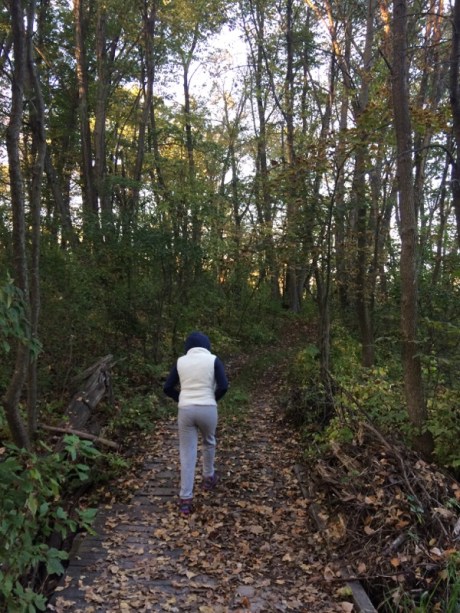
There is something about repetition and the repetition of movement. It is something you find in Nature, something you find in music, and it is something you find in the visual arts. That something was felt by Henry David Thoreau when he went into the woods and its one of the reasons Walt Whitman perambulated. It is part of what Rainer Maria Rilke recommended again and again in his letters to the young poet Franz Kappus and it is the key that unlocks Wendell Berry’s “Sabbath Poems” when he walks his Kentucky lands. That something is what Diane Ackerman references when she talks about the creativity of walking and bicycling in her book Play – and it’s something you find in the practice.
In Light on Yoga, B. K. S. Iyengar systematically broke down over 200 yoga poses and their benefits. Iyengar started off his exploration with Samasthiti / Tadasana (Equal Standing / Mountain Pose), which seems like a pretty disposable pose. In fact, it is all too easy to discount the pose – people do it all the time. You might even find yourself doing it if you aren’t encouraged to pause and notice where you’re going.
If your time on the mat is an in-depth exploration of you and your practice, you will find yourself going into Samasthiti/Tadasana again and again. It turns out that there is an element of the pose in almost every other pose. Another element that appears again and again in the practice is Cow Pose. Finally, you’ll keep coming back the connection to the breath that allows you to mimic your body’s natural tendencies.
“As many times as I forget, catch myself charging forward without even knowing where I’m going, that many times I can make the choice to stop, to breathe, and be, and walk slowly into the mystery.
Bryan Kest refers to walking as the best exercise known to man. When you move through your practice, move like you are strolling through the woods. Keep finding that Tadasana spine so that you find that Tadasana smile.
Go In and In & Walk Slowly– by Danna Faulds
Take a moment to breathe, be still, and then soften into Child’s Pose (Balasana). Settle in as if this is your whole practice. Notice the extension of the spine. Notice the deep breath in and the deeper breath out. Allow your breath to move through the spine. Allow your mind to follow the breath. Notice the rhythm of the breath. Notice the breath as music.
Once the mind is focused on the breath and the body’s reaction to the breath, use the breath as your pace. The inhale allows you to meander into Table Top: stack shoulders over elbows, elbows over wrists, hips over knees. Check your interior landscape to make sure it supports the exterior. Notice the length of the spine. Move through Cat/Cow or the “Un-Cat” sequence precisely matching the movement to the breath. This is a moving meditation. Just like in a seated meditation, when the brain wanders away from this present moment, use the breath to bring it back.
Again, find the place where you mind is focused on the rhythm and then curl your toes under and exhale into Downward Facing Dog (Adho Mukha Svanasana). Scan the exterior and interior landscapes. Make sure all your fingers are spread wide, with the majority of the weight/pressure in your hands moving into the thumb and first finger. (So that, there is less weight/pressure applied to your outer wrists.) When you relax your head and shoulders, make sure your big toes are parallel to each other and at least a foot apart. Big toes can be behind the thumbs or behind the middle fingers. Hips are high, heels are low (reaching, but not necessarily touching the mat); and neck is long. Even if you have to bend your knees, find Cow Pose in this position (so that you have a straight line from your middle fingers all the way up to your hips and then a second straight line from your hips to the back of your knees). Eyes are on your nose, your belly button, or the space between your toes. Notice the length of the spine.
Feel free to walk your dog!
Remember your can skip the arm balancing, by moving into Staff Pose (Dandasana) and positioning the arms accordingly or using “Dolphin Dog.” Another modification would be to do the pose on the wall. Either way, you can still walk your dog!
Stretch back (meaning, push your spine towards your thighs) and on an exhale walk your hands to your feet or bring your hands and feet together. Once hands are in line with the toes and heels are flat to the mat, inhale to a Half Lift/Flat Back or Extended Forward Bend. (This pose may be called Ardha Uttanasana or Urdhva Uttanasana.) Place your hands on your thighs and press the shoulders into the metaphorical back pockets. Remember, you want to engage in a similar fashion to Cow Pose, Staff Pose, and Downward Facing Dog. In fact, inhale and find a little bit of Cow Pose (even if you have to bend your knees). Now, press the heels down and – as much as you are able without losing the extension of the spine – engage the quadriceps to extend through the knees and press the thigh bones into the wall behind you. Engage your locks (bandhas) as you are able.
If you have unregulated blood pressure, low back issues, eye issues like glaucoma, or if this is already challenging, remember to stay here with knees bent. Otherwise, if it is not contraindicated, bend the knees and flex from the hips to prep Forward Bend (Uttanasana). Keeping the upper back extended, place the hands on the floor or a block and begin to extend through the legs while pressing the thigh bones into the backs of your legs. Do not force the extension. Use the exhales to settle the heart on the thighs (as much as you are able without losing the extension of the spine.) If your legs are completely straight, make sure the knee caps are lifted and that you are not hyper-extending the knees. Also double check to ensure that if the knees are straight the hips are over the knees, not behind the ankles. Remember to engage your locks (bandhas). Notice the length of the spine. Soften into yourself and into the stillness of the moment.
Inhale to Half Lift / Flat Back and use the exhale to engage your core. With hands on the hips, maintain the length of the spine and lift up to standing. Relax your arms by your sides. Balance the weight between all four corners of both feet. Feel free to move side-to-side or back and forth on the feet until you feel you are centered. Spread the toes, press big toes and little toes down, as well as both sides of the heels. (This establishes “all four corners of both feet.”) Engage the quadriceps in order to lift the knee caps and firm up the thighs. Sit bones point down so that the pelvic bones lift up. Engage your locks (bandhas). As you press down in order to lift the sternum up, use the core abdominal to draw the lower rib cage down. Relax the shoulders and gaze straight ahead. This is Equal Standing / Mountain Pose (Samasthiti/Tadasana). Notice the length of your spine.
Changing as little as possible, stretch the arms out like the letter T. Scan the interior and exterior landscape, checking to ensure you have maintained balance and alignment. Now, take the next few steps: Turn the palms up and inhale your arms overhead. (Many traditions refer to this as Arms Reaching Overhead (Urdhva Hastasana), but I tend to call this Tadasana). Scan the interior and exterior landscape, checking to ensure you have maintained balance and alignment. Notice the length of your spine. After several breaths, lower the arms to your sides on an exhale.
Now, use the whole inhale to lift the arms overhead and the whole exhale to press the hands together through heart center. On the exhale of the third centering breath, walk to the front of the mat with hands through heart center. Equal Standing is like a soldier in the “Ready” position. You are now ready for the next part of the practice.
Moving through half of a Sun Salutation (Surya Namaskar), inhale arms over head into Arms Reaching Overhead; exhale and stretch the arms out wide as you dive between the hands into a Forward Bend; inhale to a Half Lift / Flat Back; exhale back to Forward Bend. Keeping the knees bent and the core engaged, inhale to reverse swan dive and then exhale hands back to your sides. Repeat the sequence until you feel the natural rising and flowing, ebbing and flowing. Notice the similarities between Cat/Cow. Notice the length of the spine in every pose.
After the final exhale into Forward Bend, inhale into a Half Lift/ Flat Back and then step your left leg way back into a low lunge. Make sure the feet are in two separate lanes. Inhale to lengthen the spine and then exhale the back knee to the mat. Give yourself cushion under the back knee, as needed. Pressing down evenly into both feet, lift your torso up and place hands on your right thigh for a variation of Crescent Lunge (Anjaneyasana).
Use an exhale to slide the hips over the back knee and then place the back of the right hand on your sacrum (the flat part of your bum/hips) and place your left hand on the front of your pelvic bones. Your hands are now bracketing your hips. Slide the back hand down in order to direct the sit bones down. You may feel the front hand lifting as the pelvic bones lift. Notice the length of your spine, especially your low back. You may also feel engagement in your left hip and thigh. Stay here or bend the front knee deeper into the lunge – remembering to maintain the space in your low back. Hands can come to your front thigh or reach the hands over head. If you have Hot Half Moon (Ardha Chandrasana) in your practice, feel free to add it by lifting the left arm up and reaching it towards the right.
As many times as you forget, remind yourself to breath in and out of the length of your spine. When you are ready to move on, place the hands on the mat and step back to Child’s Pose. From Child’s Pose, inhale to Cow Pose and exhale to Downward Facing Dog. Repeat standing sequence from
Once you’ve completed the second side and returned to Child’s Pose, inhale to Cow Pose and then exhale into Downward Facing Dog. Repeat the sequence of standing poses (starting with the first Forward Bend after Downward Facing Dog, substituting left for right.
After the second side of standing poses, move into Staff Pose (Dandasana). Remember, this pose is not disposable. Consider the length of your spine and how you maintain it.
Keep the left leg extended and bend the right knee in order to set up the Sage Twist. Remember to keep the left heel and the right foot flat on the floor. You can place the right foot next to the inside or the outside of the left leg, as long as the knees are comfortable and the right foot is flat on the floor.
On an inhale, lift your right arm up and, as you watch it, reach the right arm back to the floor behind your hips. As you settle into the twist, adjust your left arm to provide additional support wherever you need it. You can always sit on a block and/or place a block under your hand if you’re hips and low back are really tight. If you don’t have a block, substitute a book.
Watch how you engage your base, your core, and your breath in order to lengthen your spine. Remember to start the twist in your base (not in your neck). Do not allow your body to collapse or untwist until you complete 3 – 5 complete breaths. After the third or fifth exhale, inhale to center, give the lifted knee a squeeze, and return to Staff Pose. Repeat the Sage Twist instructions for the Sage Twist (replacing right with left).
After the third or fifth exhale on the left, inhale to center and give the lifted knee a squeeze. Bend or extend both, as needed, and lower down onto your back for Corpse Pose (Savasana). Allow your body to settle into the spaces around your spine. Allow your breath to move through the spine. Allow your mind to follow the breath. Notice the rhythm of the breath. Notice the breath as music.
“Music seems to have a special power to animate us. Kant called music, ‘…the quickening art.’ There’s something about rhythm, as a start, compels one to move…with the beat…. There’s something about the rhythm of the music, which has a dynamic, animated, propulsive effect that gets people moving in sympathy with it; and gets people moving in sympathy with one another. So…the rhythm of music has a strong bonding thing. People dance together, move together…”
“There is certainly a universal and unconscious propensity to impose a rhythm even when one hears a series of identical sounds at constant intervals… We tend to hear the sound of a digital clock, for example, as “tick-tock, tick-tock” – even though it is actually “tick tick, tick tick.”
– from Musicophilia: Tales of Music and the Brain by Dr. Oliver Sacks
This opportunity to explore a poem on the mat is part of my offering for the 2018 Kiss My Asana yogathon. I encourage you to set aside at least 5 minutes a day during April, to practice with the poem as inspiration. You can practice in a class or on your own, but since the Kiss My Asana yogathon raises resources as well as awareness, I invite you to join me at the donation-based classes on April 28th.
I also challenge you to set aside a certain amount every day that you practice with a poem in mind. It doesn’t matter if you set aside one dollar per practice or $25 – set aside that amount each time you practice and donate it by April 30th.
Founded by Matthew Sanford, Mind Body Solutions helps those who have experienced trauma, loss, and disability find new ways to live by integrating both mind and body. They provide classes, workshops, and outreach programs. They also train yoga teachers and offer highly specialized training for health care professionals. By participating in the Kiss My Asana yogathon you join a global movement, but in a personal way. In other words, you practice yoga. Or, as this year’s tag line states, “do yoga. share yoga. help others.”
*Yes, it’s another two (2) poem day. It’s also a two (2) video day! Happy Monday!
If we learned nothing else in the last year, it was that things don’t always go according to (our) plan. 2017 was a year that, for some of us, seemed to go awry even before it started. There were times when we fell down and wanted to throw our hands up. But, instead, many got up…and kept moving forward. There’s merit in that.
I didn’t think I needed a personal reminder of the merit of moving forward, no matter the obstacles. But then I started confirming my plans for the New Year’s Day 108 Sun Salutations and well…let’s just say William Butler Yeats had it right:
Turning and turning in the widening gyre The falcon cannot hear the falconer; Things fall apart; the centre cannot hold;
In 2013, I started leading a New Year’s Day morning japa-ajapa mala practice of 108 Sun Salutations. A year later I added an afternoon practice. At times I thought about renting a space and combining the two, but I ignored the writing on the wall. I was in the flow of my own making, totally and utterly attached to the momentum that worked for me.
So, this year I was thrown into a bit of a tailspin when I discovered I needed to relocate the morning practice. I kept moving forward, confirmed a new location, and, for the sixth year, the practice is full.
Then, on Wednesday, I learned about a scheduling issue that resulted in the cancellation of the afternoon 108 practice at the Downtown Minneapolis YMCA. Thankfully, anyone who was planning to attend that practice can scroll to the end of this blog post for options which will allow them to keep moving forward.
And there’s merit in that. Not just merit in the idea that we keep moving forward, no matter the obstacles. There’s something to be said for letting go of our attachments and going with the flow.
Don’t get me wrong. I’m not suggesting that we rollover and play dead when things don’t go our way. Nor am I suggesting that we jump on a band wagon headed for Hades just because there’s a lot of momentum pushing us in that direction. Instead, what I’m suggesting requires going a little deeper – into ourselves and into the situation – in order to leverage the momentum in a skillful manner. What I’m suggesting requires understanding the powerful dynamics of movement(s).
Vinyasa, a popular form of Hatha Yoga (the physical practice of yoga) is often referred to in English as “Flow” or “Yoga Flow.” Three (3) of the 12 poses in Surya Namaskar (Sun Salutation) are so ubiquitous in the West that some practitioners think those poses are what makes something a vinyasa practice. All of which contributes to people overlooking a key element of the style and tradition: the meaning/intention underlying the practice.
The word “vinyasa” comes from the words “nyasa, “ which means “to place, to touch, to apply” and “vi,” which means “in a special way.” In a Vinyasa yoga practice, poses are placed so that, in theory, the movement matches the human body’s natural tendencies (to extend/expand on an inhale; to flex/contract on an exhale) and practitioners can move one breath (to) one motion (i.e., flow). When we match the movement to the breath, the movement becomes seamless and very much like a dance – or a moving meditation.
Similarly, the name of the insight meditation technique and tradition “vipassana” literally means “to see or to recognize” (“passana”) “in a special way” (“vi”). In Insight Yoga, Sarah Powers wrote, “So vipassana is the art of seeing or relating to life freed from the mesmerizing power of our entrenched prejudices and preferences. This unconstricted view breeds insight into the underlying nature of things.”
Therefore, if we can see and/or recognize the underlying nature of ourselves and our surroundings (causes and conditions), if we have insight into the evolution of ideas (starting with the desires, which are the seeds of these ideas), then we may place or apply ourselves in a way that works with the flow of energy, rather than against it. The very thing that stood in our way (the obstacle) becomes our way. Or, as Marcus Aurelius wrote is his personal notebook, “Our actions may be impeded, but there can be no impeding our intentions or dispositions. Because we can accommodate and adapt. The mind adapts and converts to its own purposes the obstacle to our acting. The impediment to action advances action. What stands in the way becomes the way.”
In a 2014 Psychology Today review of Ryan Holiday’s The Obstacle is the Way(which is a great handbook on old fashioned stoicism), Dr. Alex Lickerman refers to situations that train us to deal with challenges, stating, “… when victory over external barriers is contingent upon victory over internal ones, the greatest benefit a situation has to offer us is training—by which I mean a challenge that forces us to grow in a way that makes achieving our goal possible.”
To me, the physical practice of yoga (any style or tradition) or a seated meditation practice are ways to train the body and mind for the challenges of life. Each practice comes with a different set of challenges, and a different set of obstacles. Every practice, in its own way, pairs internal barriers with external barriers, and (because so many of my practices are vinyasa practices) a different set of ways to go with the flow.
When do you practice? – B (who practices “about once a week,” but not with me – yet)
About once a quarter, someone expresses gratitude for their practice and then asks me when I find time to practice. The question is usually associated with their appreciation of the benefits they experience from yoga and their observation of me not practicing the physical poses when I lead a yoga practice. The “quick and dirty” answer to B’s question is that I practice before I teach. The “not so quick and dirty” answer is that I practice before I teach, while I’m teaching, and after I’m teaching.
The physical practice before I teach may happen in a variety of ways. Sometimes I take a class or a workshop, sometimes I stream a class or use some other form of media. However, since I currently teach six (6) days a week, and teach during peak hours, I find it challenging to take a class. So, more often than not, I find a quiet spot and hit the mat on my own.
When I take a class or workshop, I gravitate towards alignment-focused yoga classes or intensely physical yoga practices with a teacher who emphasizes the emotional, energetic, philosophical and/or spiritual aspects of yoga. (Hmm, sound familiar?) When I practice on my own, the physical elements change based on how I’m feeling and what I’m teaching. In general, I practice a template of the first sequence I’m going to teach. My current practice schedule looks a little like this:
Monday – Yin Yoga
Tuesday – Vinyasa
Wednesday – Yin Yoga
Thursday – open day; rest day, Yin, Vinyasa, meditation and/or other physical activity
Friday – Vinyasa
Saturday – rest day, Yin, Vinyasa, or some other tradition
Sunday – Vinyasa
That’s the “quick and dirty” answer, but there’s a story behind why I practice before I teach.
During my initial yoga teacher training, I was fortunate enough to be part of a small group talking to a teacher named Kim. A few things to note about Kim: first, she was not one of the teachers leading or facilitating the teacher training; second, she was not the stereotypical CorePower teacher; third, she had the brightest smile and one of the biggest spirits. It’s her spirit, I think, that instigated the conversation where she shared with us something she wished she had been told during her teacher training: take a class for every class you teach.
Being young pups, full of the enthusiasm and power that comes from being in an intense learning situation, parts of us dismissed Kim’s advice. We were in teacher training because we loved yoga and couldn’t imagine a time when we wouldn’t take a class (or practice on our own) on a daily basis. We couldn’t imagine that teaching yoga creates a scheduling dynamic which is really different from the scheduling dynamic of squeezing our yoga practice in between our work and family life. We hadn’t yet grasped that once the learning-teaching brain engaged we might not be capable of getting back to a learning-only brain. Many of us, also, didn’t yet understood that teaching hath yoga (the physical practice of yoga) requires actively practicing the yoga philosophy. And that’s where my “not so quick and dirty” answer comes into play.
The 8-limb philosophy of Yoga begins with an ethical component: 5 yamas (external restraints or universal commandments) and 5 niyamas (or internal observations). The yamas and niyamas, like any other moral compass, may guide a person on and off the mat. In the philosophy, these ethical considerations precede the asana (seat or pose) and pranayama (awareness or extension of breath), which means we can use our time on the mat as a way to practice our ethics in a controlled environment. For example, the first and second yamas – ahimsa (non-harming) and satya (truth) – may be practiced by being honest about the mind-body strengths and weakness in order to practice a pose safely. At the same time, second, third, and fourth niyamas – santosha (contentment), tapas (heat, discipline, and/or austerity) and svadyaya (self-study) – may be observed by focusing on the alignment of a challenging pose while also noticing how you react to using a prop, needing/taking a modification, or not completing the pose and, simultaneously, accepting where you are in the practice.
I practice these elements while I’m physically on the mat, but I also need to practice them when I’m leading other people. For example, I need to consider if the options I’m suggesting are safe for the individuals in the room and if I’m providing enough options to meet and accept everyone in the room – all while noticing my reaction to things not going the way I planned when my mind-body on the mat was the only consideration. If I’m demonstrating a peak pose, I need to make sure I’ve prepared myself along the way (despite not doing all the preparatory poses) to demonstrate without injuring myself. Finally, after I teach, there are several things I do as a kind of mental Savasana (Corpse Pose), to decompress and allow the mind-body to absorb the work.
Even though I didn’t initial understand them, Kim’s words really stuck with me. In fact, they were some of the most important words I heard during yoga teacher training.
Thanks for the wisdom, Kim!
The teachers at Mind Body Solutions are awakening the connection between mind and body in a way that transforms trauma, loss, and disability into hope and potential. They say the practice is humanity disguised as yoga. So, clicking here to Kiss My Asana with a donation practices humanity off the mat, in a way that allows someone to practice humanity on the mat. When I’m able, I drop-in to Matthew Sanford’s Monday morning class. Maybe I’ll see you practicing your humanity on the mat!
“The number of words you use to answer these questions is going to be divisible by 108? Why 108?” – the obvious questions
The significance of 108 is something pondered pretty much whenever people get ready to practice 108 Sun Salutations (for New Year’s Day, Spring/Fall Equinox, and Summer/Winter Solstice). It is considered an auspicious number in a variety of disciplines and traditions. So much so that if I listed 108 reasons, I might still be missing some. Swami J has a pretty comprehensive list; however, here are some of my favorites:
108 is a harshad (or, “great joy” bringer) number in mathematics, meaning that it is divisible by the sum of its parts (1+0+8=9; 108/9 = 12)
Note also 1+2 = 3; 12/3 = 4 and 108/3 = 36; 3+6 = 9; 36/9 = 6
108 is a prime example of numbers being exponentially powerful {(1, raised to the 1st power) multiplied times (2, raised to the 2nd power) multiplied times (3, raised to the 3rd power), i.e., 1*4*27}
In Buddhism, the 108 feelings or sensations humans experience result from external/physical and internal/mental stimuli (2) being received through our senses and consciousness (5+1) multiplied times our perception of sensation as positive/pleasant, negative/painful, or neutral (3) multiplied times our ability to experience feelings or sensations in the past, present, and future (3). {2*(5+1)*3*3}
In Eastern religions and philosophies, a mala used to count repetitions during meditation contains 108 beads – or a fraction of 108, and this coincides with an old school Catholic rosary which allows you to count out 10 decades, and provides 8 additional beads (for mistakes). The cross would be considered the guru bead.
In some religions there is only one God; however there are 101-108 names for God.
In an Indian creation story, God as Dance (Nataraja) creates the universe through a dance containing 108 steps or poses; and, there are 108 forms of dance in Indian traditions.
Some martial arts forms contain 108 steps or poses.
According to some yoga texts, there are 108 nadis (energy rivers carrying the bodies vitality) intersecting at the heart chakra.
Since I’m writing this on opening day 2017:
The 108 double stitches on a Major League baseball are hand stitched; AND
Finally, it would be seriously auspicious if a couple of people (2) Kiss(ed) My Asana by clicking here and donating $54 each. Or, you know what would be a real joy bringer? If a certain number of individuals (108) clicked above and donated $108 each.
For those of you doing the math: $25 shares a “Beyond Disability” DVD with a home-bound person living with a disability; $250 provides four yoga classes at a battered women’s shelter or veterans center; $500 provides full tuition for an Opening Yoga Teacher Training Workshop; and $1000 transforms the life of someone living with a disability by providing them an entire year of adaptive yoga. While these numbers focus on the people directly receiving the service, consider how yoga affects not only the individual on the mat, but everyone that individual encounters off the mat.
It is New Year’s Eve eve. And, while I still have things to do in anticipation of the New Year, I am more than ready for the arrival of 2017. Funny thing is, all of us who are “D-O-N-E, stick-a-fork-in-it, done” with 2016, have to admit that it hasn’t all been bad. There have been some memorable and very personal highlights and there have been many changes for the better. Oh, then there’s the fact that this whole “new year” thing is completely arbitrary.
Yes, yes, there are reasons and explanations for why the Western world celebrates a beginning and an ending at this time of year. But, in some ways those reasons and explanations are beside the point. What’s important is that change is always happening – and most of it is beyond our control. Since being out of control can be psychologically uncomfortable, we take control by choosing a transition to celebrate. The celebration is a reminder that everything, including hard times, ends and that the end of one thing marks the beginning of another thing.
We can only hope the new thing is better than the old thing.
Even when, it’s the same thing over and over again.
Throughout history, different cultures have had different ways of marking transitions. One yoga tradition is to practice 108 Sun Salutations (Surya Namaskar) when the seasons change on the equinoxes and solstices. Here in the West, we have also taken to practice this yoga variation of a marathon when the calendar year changes. (I am again leading the Surya Namaskar malas at Nokomis Yoga (this practice is full) and at the Downtown Minneapolis YMCA (3 PM – 6 PM).)
Sun Salutations (Surya Namaskar) are a moving meditation consisting of 12 poses. The series of poses are linked with breath so that we mimic our bodies’ natural inclination to extend the spine and open the heart as we inhale, to flex the spine and engage the core as we exhale. Or, you could think of it symbolically: as reaching for the sun as you inhale, drawing its energy to the earth as you exhale. Or, you could reach to the Source of all the things as you inhale, surrender to that Source as you exhale. Or…you get the idea. Whether you come to the practice from a physical-mental, psychic-symbolic, or emotional-energetic perspective, this series of poses engages your whole being: mind, body, and spirit.
Since the practice mirrors the cycle of time – the beginning of each breath marking the end of another, the end of each pose marking the beginning of the next – we inevitably find ourselves appreciating it, enjoying it, and then wishing it were done. We can be lost in/absorbed by the effortless repetition (ajapa japa), but then find our brains want a delineated break.
We seek the break, not because we’re tired, per se, but because it’s a way for our brains to absorb the pattern. And, in that moment, we may create the break by asking the question that has been coming up a lot in my practice: Is that all you’ve got? Seriously, is that all you’ve got?
I can’t remember if it was during an interview or during a teacher training, but I very clearly remember Seane Corn describing a conversation where she said to the Universe, “Bring it; but, bring it gently.” I love that sentiment. It acknowledges that throughout our lives we are going to be faced with challenges, and it simultaneously reinforces the idea that we can be ready to meet those challenges head on. It is a statement sourced in strength, courage, and wisdom – without being braggadocios. In fact, it embodies the splendor of humility.
This secular calendar year, 2016, New Year’s Eve happens to fall on the 8th Night of Chanukah. (Therefore, New Year’s Day 2017 is the 8th Day of Chanukah 5777.) Hod (humility, splendor, surrender, or gratitude) is the eighth aspect of the Divine found on the Tree of Life (in Jewish mysticism, Kabbalah). Physically it is symbolized by the left foot and leg. Energetically it is directly connected to Gevurah (Strength, discipline), Tiferet (Balance, Compassion), Netzach (Endurance), and Yesod (Foundation or Bonding). It can also be energetically connected to the 3rd Chakra, our physical core, which is related to our personality, our sense of self, and our self esteem.
I could go on, but what I’m getting at here is that the question (Is that all you’ve got?) isn’t something I’m asking the Universe. I know the Universe has more in store for us. I know it’s going to bring it (hopefully, gently). What I’m really doing, at those moments when I want to throw in the towel, is asking myself the question: Is that all you’ve got? Seriously, is that all you’ve got?
My early teachers often said, “How you do yoga is how you do life.” Whether we are in the middle of 1 hour, 90 minutes, or 3 hours of yoga – or anything else – we all have that moment where we want to throw in the towel. But, if we pace ourselves, we inevitably get a second wind. And, while I don’t always feel this way after I other physical things I do, in yoga and in life I almost always feel like I could have handled a little bit more. Not that I want to or need to – but, that if I had to, I could dig deep and pull up a little bit more of whatever I need to face the challenge.
The first day of 2017, is just another day on the calendar; just another day in our lives. It’s a beginning and it’s an ending. So, yes, celebrate, set an intention, and move on.
But, don’t forget that this liminal or transitional moment is also a middle. And, ultimately, the most significant thing that’s changing is your awareness and your perspective. Start noticing what you’re doing when you ask a question like “Is that all you’ve got?” Start noticing what you’re doing when your answer to the question changes.
Feel free to share your experiences by commenting below!
“in the Bhagavad Gita you teach us Bhakti your divine past times are so sublime / they open the heart and reassure the mind providing us shelter when the monsoon lingers”
a peaceful soldier who used his mind / to fight for the rights of human kind but not just people, animals too / and his basic teaching “God is Truth” he joined Muslims, Sikhs, & Hindus / Christians, Buddhists, Jains, and Jews all the many paths that lead into / the light that shines bright inside of me and you
(chorus) Be the change that you wanna see / in the world, just like Gandhi
We live in a world where people think power has to be loud, obnoxious, and brash. That change has to come like a tornado or a monsoon, dramatically altering everything in its path. But, change is always happening – even when we don’t notice it happening. And, some of the most powerful people I know are doing powerful things in the world – quietly. Listen, really listen; look, really look – and you will find little seeds of change deliberately (and quietly) taking root, blossoming, and making the world a better place.
Like a seed taking root, Yogi #8, the aptly named Krishna, quietly strolled into class one day a couple of years ago and quietly blossomed. Truth be known, he had blossomed long ago – but he won’t tell you that unless you press him. In fact, most of what I know about the truly amazing things Krishna has done in industry, in our community, and in the world, I learned by paying attention: listening to other people toot Krishna’s horn; noticing when he had meetings with people planning community outreach; or realizing an amazing show of support during a personal crisis was all organized by Krishna. In appreciating some of the feedback he has given me over the years, I recognize that Krishna has more dharma wisdom and knowledge in his pinkie toes than I have in my mind and that he could easily teach my classes, but for some reason he’s listening, practicing, learning, and being present with me.
Some days you will see him front and center; some days he is anchoring a back corner or making up one part of a 108 surya namaskar circle. Sometimes he is contemplating the teachings with a group; sometimes silently letting his thoughts settle between laps in the pool; sometimes putting the dharma into action by wiping down another person’s mat; and sometimes he is laughing hysterically in amazement (at how I explain ancient wisdom for the modern mind to grasp). But he is definitely present. And, in being present, he is definitely contributing.
Engage in action, do your work, but with full control of your mind and senses. And be aware that the work you do should contribute in some way, directly or indirectly, to the higher good of humanity.”
– Krishna’s advice to Arjuna in The Bhagavad Gita 2:7
It’s no accident that Mathea’s and Kirshna’s posts feel like a call to service. This week, as MC Yogi says, is “Dedicated to all Spiritual Activists, Truth Seekers, and Peaceful Warriors Worldwide.” The people I’m highlighting are in our midst. Pay attention, listen, bring a friend or family member to class, and please consider making a donation to KISS MY ASANA! Every bit of action (karma) makes a difference.
“(1, raised to the first power) times (2, raised to the second power) times (3, raised to the third power)”
– One of John G’s responses to my question about other people’s favorite reasons 108 is significant
“That’s the way, I remember it, I remember it that way / From the day, I was living there, I remember it that way / Some of our stories fade as we grow older / Some get sweeter every time they’re told / That’s the way, I’ll remember you that way”
– “That’s The Way I Remember It” by Chris Gaines (aka Garth Brooks)
Memory is a funny thing. It is more about perspective than reality – and, as such, the days and moments we remember change as we remember them. On the flip side, our perspective shapes our reality.
So, if we remember ourselves overcoming obstacles and meeting challenges, we will put on our big boy/girl panties, keep our chin up, and ride through the next storm. If, however, we forget we survived the challenge, forget that we found a way to make the obstacle the way (to paraphrase Marcus Aurelius), and only remember how hard it was to ride while soaking wet, we’ll stop riding – which is just another way to say we stop living.
Doing 108 Sun Salutations is a wet and wild ride! While doing it, people experience all kinds of things. There are moments when they aren’t sure they’ll make it one more breath – let alone 6. 12. Or 20. There are moments when they wonder how they got talked into doing it in the first place. There are moments when they feel like I’m a toddler saying, “Again!” There are moments when they can’t believe they aren’t done – or that they’re still standing. There are moments when they feel vibrant and alive. There are moments when they are amazed at everyone moving and breathing together. There are moments when everything outside of the present moment ceases, stops.
Then, there is the moment when they finish – and, as Patricia and Elizabeth said first, they feel a great sense of accomplishment. And that’s what most people remember. That’s the reason people keep coming back to do it again, and again, and again.
A feeling of accomplishment, especially when it comes from harnessing the power of awareness (mind), community (body), and breath (spirit), produces a combination of momentum and clarity. Momentum and clarity are one way to consider the two kinds of energy that make things happen: Shakti (Prakriti) and Shiva (Purusha).
Shakti (Prakriti) is nature in action and stillness. Like the seasons, it is the power of change and movement. It is symbolically female and thus gives birth to ideas so that they move from the brain or heart and into the world. Shiva (Purusha) is pure consciousness. It is arrogantly untainted by doubt, fear, or prejudice. It is symbolically male and thus provides seeds of awareness. Everything and everyone in the world is created when an idea – which is a single (or series) of electrical impulse(s) in the mind – meets the step-by-step plan that makes the way for things to happen.
“As my teacher Pandit Rajmani Tigunait explains: Tantric masters discovered long ago that the success in both the outer world and the spiritual realm is possible only if we awaken our latent power, because any meaningful accomplishment and especially the attainment of the ultimate spiritual goal requires great strength and stamina. The key to success is “shakti” – the power of the soul, the power of the divine force within. Everyone possesses an infinite (and indomitable) “shakti”, but for the most part it remains dormant. And those whose “shakti” is largely unawakened have neither the capacity to be successful in the world nor the capacity to enjoy worldly pleasures. Without access to our “shakti”, true spiritual illumination is not possible. Awakening and using “shakti” is the goal of tantra.”
A few Sundays ago I ended a conversation (with Terre and Jill at the Blaisdell Y) by saying, “Everything is tantra.” Meaning: Everything is the weaving of “the richness of spiritual experience and the fabric of everyday life into a single vibrant tapestry.” (Rod Striker, The Four Desires). You feel this weaving in the 108 mala when you have to deal with your personal limitations (physical, mental, and emotional) in order to connect the movement with the breath, and your mind-body with the spirit of the group. You feel the weaving when you recognize your heart’s desire – and start making it a real thing in the world. In The Heart of Yoga, T. K. V. Desikachar says “to attain what was previously unattainable” (i.e., coming together with your goal) is one way to define yoga.
Yoga and Hindu philosophies, however, are not the only places where you find this idea of weaving the seen and the unseen, the profane and the sacred. It is a fundamental aspect of Jewish, Christian, and Muslim mysticism. It is why the Dervishes whirl; it is why anchorites and anchoresses (like Julian of Norwich) withdrew from the world; it is, on a certain level, why people say Mazel tov!
As I mentioned at the end of the 2016 New Year’s Day practices, I often find myself wanting to wish someone, including myself, “Mazel tov!” Just before New Year’s Eve 2015, I ended a journal page with the above blessing and then thought, “Good luck…that doesn’t sound quite right in this context.” But it felt right. So, I went deeper.
“The word mazel literally means ‘a drip from above’ (in reference to the zodiac)….Thus mazel is the influence dripping down from the stars.”
“There is another meaning of the word mazel that is more relevant to the phrase Mazel Tov. Mazel is the term used in Jewish mysticism to describe the root of the soul. The mystics say that only a ray of our soul actually inhabits our body. The main part of the soul, our mazel, remains above shining down on us from a distance.”
On special occasions, Moss says, we feel the power of that drop splashing down into us. It is a moment when we are consciously aware of our unlimited possibilities. It is a moment when we feel we can accomplish anything. And a critical part of success is remembering that feeling!
Completing 108 Sun Salutations is as much a symbolic accomplishment as it is a physical/mental/emotional accomplishment. That symbolic feeling may last for a few hours, a few days, or – like a drop of mazel – you may feel it splashing into you throughout the year.
I hope the latter will be the case for everyone reading this.
If you were not one of the 51 people who started 2016 with me or with a sense of accomplishment, do something now (!!!) that is the symbolic equivalent. Try something new, something you didn’t realize you could do, and (maybe) do it with some friends. Most importantly, do it with awareness. Then, once you’ve harnessed your power, set an intention (not a resolution, but a promise to yourself) to remember this powerful feeling.
2015 Group Sankalpa (Intention): “I am an instrument of peace and love. I am healthy, happy, and whole.”
2016 Group Sankalpa (Intention): “I have what I need to fill the world with love and light. I am healthy, happy, and whole.”
I am humbled, honored, and continually amazed by the presence of the people who share their practice with me. Know that you will be a great source of inspiration to me - and others this year. Thank you, thank you, thank you - 108 times over!
Aron Moss ends his mazel article with the following blessing, which I offer to you:
“May this drip of inspiration from your soul above not dissipate, but rather have a positive and lasting effect, that from this event onwards you should live your life with higher consciousness. You should be aware of the blessings in your life and be ready to receive more and more…. Good mazel!”
We are closing in on the end of 2015. And many of us are wondering, “Where do we go from here?” or “How do I go on without him/her/them?” or “Now what?”
It’s those unseen (and unspoken) questions lingering between our readiness to be done with some parts of this year; our desires to move on; and our need to let go of the old – so some healing can begin – that can create fear-based behavior and make us move into deep hibernation. But, as much as I’m a fan of hibernating in order to heal, I’m more of a fan of putting things in perspective and moving on. So, let’s remember that this year hasn’t been all bad.
Remember, for instance, if you set an intention at the beginning of the year and now realize the “stars aligned” to help you reach your goal. Maybe you wanted a new experience, a new job, a new love – or maybe you wanted to heal as an old experience, job, or love passed out of your life. Either way, with all the craziness (and scariness) we’ve seen in the world this year, I think it’s important to remember our own personal highs-and-lows, ebbs-and-flows, risings-and-fallings.
Sun Salutations (surya namaskar) are a moving meditation which mimics the natural tendencies of our bodies and our lives. We rise, we fall, we ebb, we flow – and, if we do enough of them, we experience highs and lows. Practicing a 108 Sun Salutations is the yoga equivalent of a marathon. Like a distance runner, we repeat the same steps over and over again; finding our breath, finding our rhythm – until there is no difference between our breath, our rhythm, our minds, our bodies. We become the cycle, we become the circle or ring (mala). In essence, we are practicing effortless repetition (ajapa japa): where a whisper becomes a scream and then drifts away to silence. (See link above; it’s so worth it!)
“Thanks to everyone who came out to support Mind Body Solutions on a beautiful Saturday afternoon. The essence of Matthew Sanford’s teaching is transformation. It was deeply inspiring to see everyone open their minds and bodies to this exploration.” – Kari Anderson’s message to the yogis who donated $315 at our April 18th donation-based event.
As we approach the end of the 2015 KISS MY ASANA yogathon, I find myself overwhelmed on so many occasions that I sometimes feel like I have lost my “big girl words.” Time and time again, I have been blown away by the generosity and kindness of people on the mat. I set my 2015 donation goal thinking I could raise a few more dollars than last year – and already some joyful yogis from at least two (2) states have more than doubled my initial goal! (Thank you all for that!)
Time and time again, I have been moved by an encounter with a Mind Body Solutions teacher, student, or volunteer. And, every time – every single time – I take a class from Matthew Sanford, I am blown away and my mind is completely boggled. In fact, I shudder to think how many times I said, “I was blown away…” or described something as “mind boggling” during last Saturday’s donation-based class. Maybe it’s cute at first, especially if you’re expecting further explanation down the road; however, some things can only be experienced to be fully understood. So, I invite people to catch a Monday class with Matt and, every once in awhile, I mention Mind Body Solutions in class and try to channel a little Matt the way I sometimes channel a little Yoda. During last Saturday’s donation-based class, I felt my words were so inadequate I relied on words written by Bruce Kramer and Cathy Wurzer in We Know How This Ends.
For those of you unfamiliar with his story, Bruce Kramer was a former dean at the University of St Thomas Twin Cities who chronicled his life with ALS on Cathy Wurzer’s Minnesota Public Radio show. We Know How This Ends describes their parallel journeys through this process of living and dying, while sharing the process of living and dying. The book is raw, and rich, and so real I had to set it aside for a moment after I first received it from a mutual friend and student of Bruce and mine. But, before Saturday’s KISS MY ASANA class, I read the chapter where Bruce and Cathy talk about “Dis Ease Yoga.” And I was so moved (read, “blown away”), I decided to share Cathy Wurzer’s words as part of our introduction and Bruce’s words as our conclusion.
“There’s a darkness upon me that’s flooded in light / And I’m frightened by those that don’t see it” – Head Full of Doubt / Road Full of Promise by Avett Brothers
In We Know How This Ends, Bruce Kramer describes aspects of yoga that are very familiar to me – even though I’ve never been in a wheelchair or felt the extreme decline of my body. He describes benefits from and challenges in his yoga practice that may be familiar to anyone who spends a little time on a mat. And, like me, he was a big music fan. (Thank him for the Avett Brothers song referenced here! And like it on YouTube!) He and Cathy Wurzer also talk about a point before ALS, before “Dis Ease Yoga,” when they didn’t really get the significance of the practice.
“If you’re loved by someone, you’re never rejected / Decide what to be and go be it” – Head Full of Doubt / Road Full of Promise by Avett Brothers
I was fortunate in that my introduction to yoga included an introduction to yoga as a philosophy and to the idea that yoga can be practiced by anyone – you just have to find your practice. It wasn’t until I started teaching that I discovered people who would stop practicing yoga, because of an injury or an unfortunate circumstance. And, it never fails to break my heart when someone gives up what can be a healing practice, because their body (and/or their doctor) says, “No more push-ups.” That’s when a yoga teacher can step in and say, “OK, you’re not doing that anymore, but you can do this!” Only, I remember hearing former paratrooper Arthur Boorman’s healing story and thinking, “How is it possible that Diamond Dallas was the only yoga teacher willing to help this guy?!?” Well, bottom line, too many Western yoga teachers are ill-equipped to teach the physical practice (let alone the meta-physical practice) to someone who isn’t already considered physically and/or mentally “able.” Thankfully, Matthew Sanford and the other teachers at Mind Body Solutions are changing that!
“There was a dream and one day I could see it / Like a bird in a cage I broke in and demanded that somebody free it / And there was a kid with a head full of doubt / So I’ll scream till I die and the last of those bad thoughts are finally out” – Head Full of Doubt / Road Full of Promise by Avett Brothers
Mind Body Solutions is on “a mission to transform trauma, loss and disability into hope and potential by awakening the connection between mind and body.” It sounds all lofty and wonderful, right? But, it’s also very real and very raw. It’s a mission that, as the Avett Brothers sing, gets “the last of those bad thoughts” out so we can realize that as long as we’re breathing there is a mind-body-spirit connection. And it’s there, even when machines are helping us breathe.
Despite occasionally practicing with Matt; implementing some of what he teaches in my own practice and teaching; and having a few personal connections to people being served by the mission, I am slightly removed from the very real and very raw experiences found in adaptive yoga. If you’re not living the mission or deeply connected to someone being served by the mission, I think it is easy to fall into a space where this whole adaptive yoga thing just sounds like a good idea – you know, a worthy cause – but somehow separate from what the rest of us are doing. As I mentioned earlier, reading the “Dis Ease Yoga” chapter in We Know How This Ends helped remind me that we are all in bodies together and so, therefore, we are all in this yoga thing together. It’s not the style or the tradition that makes something yoga, it’s the coming together.
“ I feel part of the universe open up to meet me / My emotion so submerged, broken down to kneel in/Once listening, the voices they came / Had to somehow greet myself, read myself /Heard vibrations within my cells, in my cells “ – Better Days by Eddie Vedder
There are plenty of times when I feel part of the universe – and I feel connected to every other part of the universe. There are times I relish that feeling. Superficial as it may seem, I sometimes relish that feeling when it comes from seeing someone with a yoga mat and thinking, “Hey, that person’s a yogi, like me!” Even without knowing anything about them, or their practice – even knowing sometimes the person could be going to Pilates or something else altogether – I still have that moment of affinity; that moment when I feel connected and want to go deeper, find out more about them. But, it’s very rare that I have that feeling about someone in a wheelchair, or someone on a ventilator, or someone missing a limb. Cognitive, I know we are connected – but I very rarely have that visceral, bone-deep, cellular feeling like I do with someone with whom I have a shared experience.
Last Sunday I had a one of those rare bone-deep, visceral yoga/union moments.
I wore my Yoga and Body Image Coalition “This is what a yogi looks like” t-shirt while teaching, but (y’all know how I layer) between classes I wore my long sleeved 2015 KISS MY ASANA shirt. Somehow, despite my hoodie and my winter coat, a woman in a wheelchair spotted my yogathon t-shirt. We were going in opposite directions, but as we passed one another she shouted, “I practice there too!” I said, “It’s awesome.” She sighed, “I know,” with a big smile on her face.
About twenty minutes later, Carrie and I ended up in the same coffee shop – and we got to talk about yoga. She encouraged me to try a practice at Courage Center and told me about her teachers, only two (2) of whom were familiar to me. For a moment I thought about how by supporting the yogathon, teachers and students like me create opportunities for more teachers and students like Carrie, and her teachers.
But, ultimately, when I remember my discussion with Carrie, I will remember her saying she loved how friendly everyone is when she practices. I will remember that big Cheshire grin on her face when she said her favorite part of class was the relaxation part – and how her grin looked exactly like the big Cheshire grin my regulars get when they ask if we can do a 60-minute Savasana. I will also remember how that feeling I had when she first noticed my shirt, was the same feeling I have when I notice someone carrying a yoga mat: I will remember that moment when we were one and the same.
If your computer, iPod, Cd player, or other music maker is on repeat – and you’re listening to D. J. Shadow’s debut album – the end is the beginning, and the last words are prophetic. Sometimes when I play this song in class, everything syncs up and we are starting the second side of a challenging sequence: so, we are at the beginning, the end, and the middle – and the words are highly prophetic. Last year, as I prepared to lead 108 Sun Salutations for New Year’s Day, I realized everything was syncing up: we were at the end of one year, the beginning of a new year, and in the middle of a week – and I was getting ready to do 108 Sun Salutations three (count them, 3!!!) times. Suddenly, D. J. Shadow’s chuckle was highly prophetic.
But, the fact that I counted out 324 Sun Salutations – and that several people (myself included) spent part of New Year’s Day thinking D. J. Shadow’s highly prophetic words with utter disbelief – isn’t what started me thinking this song should be one of our 2014 theme songs. No, my reasoning was a little deeper than that.
“Why would we want to go back to where we were so many years ago?” (D. J. Shadow)
We just can’t seem to help ourselves. On the mat, we find our thoughts involuntarily wandering to situations and people seemingly out of context. Try as hard as we might to stay focused on the here and now – as opposed to that arbitrary thing that happened in 1979, with that person who shall remain nameless – our mind seems to have, well, a mind of its own. It goes back again, and again, and again, like a random paragraph from Swann’s Way.
Somatically speaking, such thoughts may not be as random as they appear. Yoga teaches us that we hold our experiences in our bodies. So, it stands to reason, when we’re working the body we are also working though our years. The physical practice sometimes becomes a practice of systematic reflection. Pose-wise, we often move from Child’s Pose (Balasana) or Corpse Pose (Savasana); through the approximation of learning to stand and walk – think Table Pose to Downward Facing Dog (Adho Mukha Svanasana) to Forward Fold (Uttanasana) to Equal Standing/Mountain Pose (Samasthiti/Tadasana) (video); then we explore and play; until we slow down, move into Corpse Pose (Savasana), and ultimately roll over to start all over again. Energy-wise, we typically move from our childhood (first chakra/wheel), through our developmental stages (second and third chakras/wheels), into our “maturity” stages (fourth and fifth chakras/wheels), and then to the unknown that lies beyond (sixth and seventh chakras/wheels).
But, even people who don’t practice yoga spend a fair amount of time reflecting on their lives. At the beginning and end of a year, right around our birthdays, whenever we experience one of life’s big milestones, and/or when the seasons change, we think about where we’ve been and where we’re going. Making resolutions (or just good old-fashioned planning) seems like a natural part of this reflection process, because as long as we are are actually living there is some part of us wanting to learn and grow. Yet, a good portion of us will get stuck thinking about the past, and approximately 80% of us will set goals we won’t achieve – which, at some point will have us lamenting the past. Perhaps equally significant is the fact that regardless of when we celebrate a new year or a birthday – or even observe the changing of the seasons – we will almost always find ourselves in situations we’ve dealt with in the past.
“And why should we want to live a life that’s past and never more?” (D. J. Shadow)
The wise old wives tell us we’ll repeat the same situations until we learn the lessons. And, let’s be honest, sometimes we’re that kid who keeps failing the class. What the wise old wives don’t tell us is that we can move on to the next grade, but we’re still going to be struggling with the same material. We can blame our (master) teachers, we can blame life, we can even blame the wise old wives; however, at some point we need to cowboy (or cowgirl) up and take responsibility for being where you are.
Karma is a word we throw around, sometimes without really thinking about what it literally means. We focus on the idea of destiny, fate, or retribution and reward. However, karma is the Sanskrit word for work, action, deed. It is everything we think, say, and do. Obviously, one way to think about karma is in the context of reincarnation. But, what if you don’t believe in reincarnation or the idea that you will keep living lives until you live (or get it) “right” – whatever that means? Have you considered what happens if you just look at this life you’re living and the ramifications of the work/karma you’re doing? Have you considered the fact that everything you think, say, do in this moment leads to another thought, word, and deed in the next moment? Look back at that last link where Don Juan speaks to Carlos Castaneda in Journey to Ixtlan.
So, in that interest, have you assumed responsibility for being here?
“This is not a dream….We are unable to transmit due to conscious neural interference….You are receiving this broadcast in order to alter the events you are….” (D. J. Shadow)
At some point, on or off the mat, we all want to skip to the end and reap our rewards. We want to ignore the seemingly random thoughts and sensations so we can get to the good stuff. We want, not only a passing grade, but all the accolades which come with it. We want, not only what we’ve earned, but also what we desire. And, at some point, on and off the mat, we are confronted with….what we’ve already done.
I started this post on January 3rd (2014). It was intended as a “sample” of themes and motifs for the year (2014). But, the year got away from me – and this post sat over in the draft column…waiting to see if I’d dust it off and update it. Or, if I’d just trash it. I’d like to say it was waiting patiently. But, that’s not how my mind works. So, sometimes, it was taunting me. Other times it was encouraging me. Finally, it was speaking to me.
Not surprisingly, a year later (to the date) it sounds a lot like D. J. Shadow….
Things that are happening again:
108 Sun Salutations – New Year’s Day 2015
7 Saturdays – Journey On and Off the Mat (Dates TBA)
 A Joyful Practice