May you be safe and protected / May you be peaceful and happy, during the 16 Days of Activism Against Gender-based Violence (November 25th – December 10th) and on all the other days of your life.
“As for him who neither possesses nor can acquire them, let him take to heart the words of Hesiod; ‘He is the best of all who thinks for himself in all things. He, too, is good who takes advice from a wiser. But he who neither thinks for himself, nor lays to heart another’s wisdom, this is a useless man.’”
— quoted from “Book I, Chapter II” of The Ethics of Aristotle: Volume The First by Aristotle (London: Arthur L. Humphreys 1902, Revised from the translation by D. P. Chase, published at Oxford in 1847)
Everyone needs a moment (or two) of discernment; a moment (or two) to pause, reflect, and reevaluate. Part of me wishes I could say that that is all I did over this last week. However, I am very grateful to note that my week away from teaching include a lot of craic: good food, music, laughter, and stories (sometimes in the form of movies) with some of my chosen family, friends, and a couple of wonderful doggies.
There were also some unexpected complications and those, it turns out, led to quite a bit of insight. Some of which I will share with you at a later date. In the meantime, here are excerpts (and a video) from some of the blog posts related to the last week of classes.
THANKSGIVING
“Enter into his gates with thanksgiving, and into his courts with praise: be thankful unto him, and bless his name.”
“Will Rogers, billed as the Oklahoma Cowboy, in a rope act is a feature at the Orpheum this week. He does wonders in rope spinning but you get so much interested in his ‘patter’ that you forget to watch the tricks, as he calls them. He is a monolinguist disguised in chaps, and one of the best ever….
PD. Printed in Kansas City Post and Journal, ca. 26 October 1914. Scrapbook 1914, CPpR”
— quoted from The Papers of Will Rogers: From Vaudeville to Broadway: Volume Three, September 1908 – August 1915 by Will Rogers, edited by Arthur Frank Wertheim and Barbara Bair
“The reader who finds these three episodes of no interest need read this book no further, for in a sense the central theme of my life is about nothing else. For those who are still disposed to proceed I will only underline the quality common to the three experiences; it is that of an unsatisfied desire which is itself more desirable than any other satisfaction. I call it Joy, which is here a technical term and must be sharply distinguished both from Happiness and Pleasure. Joy (in my sense) has indeed one characteristic, and one only, in common with them; the fact that anyone who has experienced it will want it again. Apart from that, and considered only in its quality, it might almost equally well be called a particular kind of unhappiness or grief. But then it is a kind we want. I doubt whether anyone who has tasted it would ever, if both were in his power, exchange it for all the pleasures in the world. But then Joy is never in our power and pleasure often is.”
— quoted from Surprised by Joy: The Shape of My Early Life by C. S. Lewis
“‘Mine was the first cry for justice, and a loud one. I made it so that our own adult leaders couldn’t just be nice anymore. Back then, as a teenager, I kept thinking, Why don’t the adults around here just say something?’”
— quoted from Claudette Colvin: Twice Toward Justice by Phillip Hoose
We shall breathe and break things down (i.e., metabolize things) during the First Friday Night Special on December 5th, 7:15 PM – 8:20 PM, CST)
&
I will offer in-person classes at the beginning of January 2026. (*DETAILS COMING SOON!*)
If you are thinking about suicide, worried about a friend or loved one, or would like emotional support, you can dial 988 (in the US) or call 1-800-273-TALK (8255)for the Suicide and Crisis Lifeline. You can also call this TALK line if you are struggling with addiction or involved in an abusive relationship. The Lifeline network is free, confidential, and available to all 24/7. YOU CAN TALK ABOUT ANYTHING.
White Flag is an app, which I have not yet researched, but which may be helpful if you need peer-to-peer (non-professional) support.
In the spirit of generosity (“dana”), the Zoom classes, recordings, and blog posts are freely given and freely received. If you are able to support these teachings, please do so as your heart moves you. (NOTE: You can donate even if you are “attending” a practice that is not designated as a “Common Ground Meditation Center” practice, or you can purchase class(es). Donations are tax deductible; class purchases are not necessarily deductible.)
May you be safe and protected / May you be peaceful and happy (and curious about all the ways you can breathe), during the 16 Days of Activism Against Gender-based Violence (November 25th – December 10th) and on all the other days of your life.
“Let us go forth awhile, and get better air in our lungs.”
— Walt Whitman writing about the new game, baseball, in the Brooklyn Eagle (07/23/1846)
Today‘s practice begins with the question at the end of yesterday‘s blog post — “What Helps You Breathe Deeply In and Breathe Deeply Out?” — and it becomes another opportunity to live, breathe, and explore questions about how we breathe and what helps us breathe deeply, every time we inhale and every time we exhale. It is, also, another opportunity to consider the situations when we shallow breathe and/or hold our breath due to situational or chronic stress, trauma, and grief (or even breathtaking beauty); to notice when those little moments become conditioned habits; and to begin playing around with different ways to break bad habits and/or change habitual patterns that no longer serve us. Finally, it is part of the process that allows each of us to more fully engage the vitality of our mind-body and the wisdom of our heart and spirit.
While we can do this together, it is very much an individual practice. Each of us has to acknowledge our own history and sore spots; each of us has to figure out what works for us based on what we have experienced in the past; and each of us has to put on our own (metaphorical) oxygen mask.
For Those Who Missed It: The following is a slightly revised version of a post from Saturday, December 5, 2020. The playlist has been updated with more “air” (so that the timing is the same, but it may feel different). Some embedded links will direct you to another site.
“There are thousands of postures. In order to heal our physical and psychological injuries we must learn to select the postures suitable to our specific needs and arrange them in the proper sequence. Sequencing of asana is crucial because, as with anything else, a change in sequence drastically changes the result. (YS 3:15). Next, we have to practice these properly sequenced postures while staying within the boundaries of our comfort. Then, we must take our practice to the point where we are able to feel and touch the threshold of our discomfort. We refine our practices as we apply the principle of effortless effort described in the previous sutra.”
— commentary on Yoga Sūtra 2.48 from The Practice of the Yoga Sūtra: Sadhana Pada by Pandit Rajmani Tigunait, PhD
All the cues on moving into and activating a pose can be really overwhelming. It can seem constant and continuous… because it is. I often tell beginners not to worry about doing what they don’t understand — or even, to an extent, what doesn’t make sense. Do what you can do, as much as you can do it, for as long as you can do it (to paraphrase a very wise man) and eventually things start falling into place. Literally, the more you practice, the more parts of you start aligning. Yes, it’s true, that you can practice incorrectly — and you can do it for a really long time. It’s also true that when doing something wrong becomes the habit (and the practice) things don’t fall into place… things fall apart. We see that in our mind-bodies and we see it in the world.
Do you ever wonder where all this information came from? Do you every think about that first yogi, Adiyoga, and those first seven students? Initially, no one told anyone how to do anything. The first seven were inspired by seeing someone else do something they thought had value — and then they listened to their own mind-body! The question is always: How can I breathe deeply here? Or, what can I do to breathe more deeply here? And the answer is already inside of us. We just have to “listen,” which in the case of our mind-body requires paying attention to sensation, to how we’re feeling and how we are responding to what’s happening inside of us and all around us. That’s the practice.
“You are so young, so much before all beginning, and I would like to beg you, dear Sir, as well as I can, to have patience with everything unresolved in your heart and to try to love the questions themselves as if they were locked rooms or books written in a very foreign language. Don‘t search for the answers, which could not be given to you now, because you would not be able to live them. And the point is, to live everything. Live the questions now. Perhaps then, someday far in the future, you will gradually, without even noticing it, live your way into the answer.”
— quoted from Letter #4 (dated July 16, 1903) addressed to 19-year old officer cadet Franz Xaver Kappus, published in Letters to a Young Poet by Rainer Maria Rilke
Being human, we have the ability to play, explore, and experiment; to see what works, when and where it works; and to notice for how long something works. Thus, someone started moving their body into different shapes and then breathing into those different shapes, which had different effects. Then they would move into the shapes in a different way, breathe into that different way, and noticed the different effects. Then they saw other people could do the same and experience similar effects. Then people, like Patanjali and Vyasa, started to codify the practice by writing it down. And this whole process and practice comes back to the breath, the spirit, the life force — and different ways to breathe, engage the spirit, and expand life.
— “Prāṇāyāma, which is expanding the life force by controlling the movement of the inhalation and exhalation, can be practiced after completely mastering [the seat or pose].”
— “The breath may be stopped externally, internally, or checked in mid-motion, and regulated according to place, time and a fixed number of moments, so that the [pause] is either protracted or brief.”
In the commentary for Yoga Sūtra 2.50, Swami Jnaneshvara Bharati is quick to point out that while stambha (“cessation” or “transition”) is often translated into English as retention and therefore equated with kumbhaka (which is retention), there is a subtle difference in the usage here. First, the practice involves awareness of three parts of the breath: inhalation, exhalation, and the transition (or pause) between the first two parts — which is repeated twice. Next, there is the slowing or expansion of the breath (as described in YS. 2.49). Finally, there is awareness and regulation of the breath in different places in the body — even directing it to those places; controlling the time (or length and duration of the breath); and counting (or numbering) each part of the breath.
Breath regulation in place, time, and by numbering can involve the practice of kumbhaka, which is breath retention achieved by holding the breath on the inhalation or exhalation, and/or stambha vŗitti kumbhaka, which is breath retention achieved in the middle of an inhalation or exhalation. Notice that the breath retention highlights transition.
Any breath retention is considered an advanced practice and, just as is instructed with more “basic” types of prāņāyāma, should only be practiced after mastering previous elements. Some teachers advise only practicing kumbhaka after it naturally arises in your practice. This does not mean that you are ready to practice breath retention when you finding yourself holding your breath or shallow breathing because you are overly challenged in a pose or sequence. In fact, it means quite the opposite.
“Patanjali assumes that aspirants who reached this level of yoga sadhana are familiar wth the practice of the seven pranayamas, which together constitute the practice of prana anusandhana. Therefore, these aspirants have built a strong foundation for practicing the three advanced pranayama techniques he is presenting here.”
— commentary on Yoga Sūtra 2.48 from The Practice of the Yoga Sūtra: Sadhana Pada by Pandit Rajmani Tigunait, PhD
The practicing of connecting the breath — and connecting to the breath — is broken down into the following seven steps:
Aharana prāņāyāma – which is “to bring back” and revolves around awareness of the breath and how it feels in the body, as well as positioning the body so there is no shakiness, interruption, or abnormal breathing.
Samikarana prāņāyāma – which is “to equalize,” and involves maintaining an equal calmness in the breathing and in the mind-body. There is also focus on certain areas of the mind-body.
Dirge-prashvasa prāņāyāma – which is “long exhalation,” and involves focus on certain areas of the mind-body.
Nadi shodhana prāņāyāma – which is alternate energy channel or alternate nasal breathing, and involves alternating the exhale and inhale between nostrils.
Anuloma prāņāyāma – which is “to follow the same path,” and involves rapidly inhaling and exhaling through only one nostril.
Viloma prāņāyāma – which is “to follow the reverse path,” and involves exhaling through one nostril and then inhaling through the other.
Pratlioma prāņāyāma – which is “to switch paths back and forth,” and is only practiced after the previous two are mastered.
Note that the last three are practices only intended for people who are healthy and have no underlying conditions. Additionally, please note that these terms are also sometimes used when referring to a specific pattern of breathing related to length and duration of each part of the breath.
Please join me today (Tuesday, December 5th) at 12:00 PM or 7:15 PM for a yoga practice on Zoom. You can use the link from the “Class Schedules”calendar if you run into any problems checking into the class. You can request an audio recording of this practice via a comment below or (for a slightly faster reply) you can email myra(at) ajoyfulpractice.com.
Tuesday’s playlist is available on YouTube and Spotify. [Look for “10272020 Pranayama II”]
In the spirit of generosity (“dana”), the Zoom classes, recordings, and blog posts are freely given and freely received. If you are able to support these teachings, please do so as your heart moves you. (NOTE: You can donate even if you are “attending” a practice that is not designated as a “Common Ground Meditation Center” practice, or you can purchase class(es). Donations are tax deductible; class purchases are not necessarily deductible.)
### To live is to breathe. To breathe with intention is the practice. To live with intention is the goal. ###
May you be safe and protected / May you be peaceful and happy (and curious), during the 16 Days of Activism Against Gender-based Violence (November 25th – December 10th) and on all the other days of your life.
This is just a reflection related to Monday, December 4th. There is no recording for 2023; however, you can request an audio recording of a related practice (as listed below) via a comment below or (for a slightly faster reply) you can email me at myra (at) ajoyfulpractice.com.
In the spirit of generosity (“dana”), the Zoom classes, recordings, and blog posts are freely given and freely received. If you are able to support these teachings, please do so as your heart moves you. (NOTE: You can donate even if you are “attending” a practice that is not designated as a “Common Ground Meditation Center” practice, or you can purchase class(es). Donations are tax deductible; class purchases are not necessarily deductible.
“Here, where I am surrounded by an enormous landscape, which the winds move across as they come from the seas, here I feel that there is no one anywhere who can answer for you those questions and feelings which, in their depths, have a life of their own; for even the most articulate people are unable to help, since what words point to is so very delicate, is almost unsayable. But even so, I think that you will not have to remain without a solution if you trust in Things that are like the ones my eyes are now resting upon. If you trust in Nature, in what is simple in Nature, in the small Things that hardly anyone sees and that can so suddenly become huge, immeasurable; if you have this love for what is humble and try very simply, as someone who serves, to win the confidence of what seems poor: then everything will become easier for you, more coherent and somehow more reconciling, not in your conscious mind perhaps, which stays behind, astonished, but in your innermost awareness, awakeness, and knowledge. You are so young, so much before all beginning, and I would like to beg you, dear Sir, as well as I can, to have patience with everything unresolved in your heart and to try to love the questions themselves as if they were locked rooms or books written in a very foreign language. Don’t search for the answers, which could not be given to you now, because you would not be able to live them. And the point is, to live everything. Live the questions now. Perhaps then, someday far in the future, you will gradually, without even noticing it, live your way into the answer.”
— quoted from Letter #4 (dated July 16, 1903) addressed to 19-year old officer cadet Franz Xaver Kappus, published in Letters to a Young Poet by Rainer Maria Rilke
Look back over the years (or check out the links indexed below) and you will see that I often reference and quote Rainer Maria Rilke, who was born today in 1875. I am particularly fond of the aforementioned advice the poet gave the 19-year old officer cadet Franz Xaver Kappus in the fourth letter, dated July 16, 1903. I go back to them again and again, in every season of every year of my life (to paraphrase Walt Whitman); because, I think it is great advice for everyone: “Live the questions….”
Of course, to live the questions requires us to breathe (into) the questions and notice what happens.
“To breathe! Oh poem we cannot see! Pure space exchanged continually For one’s own being. Counterpoise, In which I come to be, a rhythm.”
— quoted from Sonnets to Orpheus, II.1 by Rainer Maria Rilke (translated by Robert Temple)
Just as there is something divine (universal and sacred) about the breath, there is something divine about questions. I am not sure we can be alive and not have questions. Additionally, in the Bahá’í Faith, each month is named after a virtue or attribute of God. One of the months is Masáʼil, which means “questions,” and it begins at sunset exactly a week after Rilke’s birthday. How serendipitous! So, I think this is the perfect time to ask ourselves questions; to live those questions; to breathe those questions; and to change with those questions.
That, as it turns out, is also good advice from Rilke. It is advice we can take on and off the mat.
“Want the change. Be inspired by the flame where everything shines as it disappears. The artist, when sketching, loves nothing so much as the curve of the body as it turns away.
What locks itself in sameness has congealed. Is it safer to be gray and numb? What turns hard becomes rigid and is easily shattered.
Pour yourself like a fountain. Flow into the knowledge that what you are seeking finishes often at the start, and, with ending, begins.
Every happiness is the child of a separation it did not think it could survive. And Daphne, becoming a laurel, dares you to become the wind.”
— quoted from Sonnets to Orpheus, II.12 by Rainer Maria Rilke
If you are interested in previous posts (and practices) related to Rainer Maria Rilke, check out the following:
feel how your breathing makes more space around you. Let this darkness be a bell tower and you the bell. As you ring,
what batters you becomes your strength. Move back and forth into the change. What is it like, such intensity of pain? If the drink is bitter, turn yourself to wine.
In this uncontainable night, be the mystery at the crossroads of your senses, the meaning discovered there.
And if the world has ceased to hear you, say to the silent earth: I flow. To the rushing water, speak: I am”
— quoted from Sonnets to Orpheus, II.29 by Rainer Maria Rilke (translated by Joanna Macy)
### What Helps You Breathe Deeply In and Breathe Deeply Out? ###
May you be safe and protected. May you know you are loved.
For Those Who Missed It: The following was originally posted in 2020. Class details and links (some of which direct you outside of this blog) have been updated.
“Love is the only way to rescue humanity from all ills, and in it you too have the only method of saving your people from enslavement. In very ancient times love was proclaimed with special strength and clearness among your people to be the religious basis of human life.”
– quoted from section V of “A Letter to a Hindu” by Leo Tolstoy (dated 12/14/1908)
Consider that if you practice ahimsā (“non-harming” or “non-violence”) and satya (a dedication to “truth”), there are times when telling the brutal honest truth, creates harm. So, the questions become (1) how to mitigate the harm – while also being dedicated to the truth – and (2) how to be honest without telling the truth. Someone who would have strived to find the balance was Leo Tolstoy who, in my humble opinion, sometimes failed miserably to find the balance.
Going by the Gregorian calendar, Leo Tolstoy was born today in 1828. He was born into nobility near Tula, Russia and, in many ways, his story could mirror that of Prince Siddhartha’s story of enlightenment… if it weren’t for those pesky trips to the brothel. Yes, born into wealth and privilege, Tolstoy indulged himself. Then he fell in love and very quickly married the 18-year old Sophia Behrs, the daughter of a court physician. There was a difference in their social status and a 16-year age difference; however, those were not the problems. Their marital strife started before they even got married when, under the guise of full disclosure, Tolstoy forced Sophia to read his diaries – filled with his sexual exploits – the night before their wedding. In a similar vein, he would later tell his favorite daughter Maria, known as “Masha,” that although it was sad that she had experienced another failed birth, “it is clearly a benefit to your spiritual life.”
Yeah, Tolstoy kinda sucked like that.
He was also, by all accounts, incredibly moody.
If you only know of Tolstoy as the Nobel Prize nominated author of giant Russian novels that many consider the greatest literature ever written, then my earlier statement about his story mirroring the Buddha’s story may come as a surprise – especially given his interpersonal skills as described above.
I completely understand if, given the above information, you don’t want to read anything more. (Especially considering the fact that I don’t think the rest of the story redeems him.) Here’s the thing though: Tolstoy spent much of his adult life in the middle of a spiritual crisis and his efforts to resolve this crisis led him to “start” a spiritual movement that inspired people from all over the world – including Mahatma Gandhi, Dr. Martin Luther King, Jr., & Rev. James Bevel. Gandhi even named a spiritual settlement in South Africa after Tolstoy.
“I believe that such a time has now arrived—not in the sense that it has come in the year 1908, but that the inherent contradiction of human life has now reached an extreme degree of tension: on the one side there is the consciousness of the beneficence of the law of love, and on the other the existing order of life which has for centuries occasioned an empty, anxious, restless, and troubled mode of life, conflicting as it does with the law of love and built on the use of violence. This contradiction must be faced, and the solution will evidently not be favourable to the outlived law of violence, but to the truth which has dwelt in the hearts of men from remote antiquity: the truth that the law of love is in accord with the nature of man.
But men can only recognize this truth to its full extent when they have completely freed themselves from all religious and scientific superstitions and from all the consequent misrepresentations and sophistical distortions by which its recognition has been hindered for centuries.”
– quoted from section VI of “A Letter to a Hindu” by Leo Tolstoy (dated 12/14/1908)
But, I’m jumping ahead. So, let’s back up a minute. Before we get to the part where Leo Tolstoy was rooted in pacifism and Christian anarchism, we have to go back…even before the brothels.
At an early age, Tolstoy’s teacher wrote him off as not being too smart. Yet, he taught himself twelve languages. His brother suggested that he enlist in the army and also encouraged him to write. The fighting that he saw at the front during the Crimean War, combined with an execution he witness in Paris (1857), and his brother’s death around 1859, caused Tolstoy to question his faith and his place in the world. In particular, he questioned “superstitious belief in progress,” which led to a moral crisis and spiritual awakening.
Part of his questioning led him to the desire to marry and have a family. His marriage with Sophia, while full of conflict, was instrumental in the completion and publication of the novel “1805,” which was renamed War and Peace. Sophia Tolstoya rewrote each revision of the novel by hand. She wrote out the entire novel eight times in seven years, although she had to rewrite some sections 30 times – all while giving birth to four of their 13 children and taking care of the day-to-day operations of their home and business affairs. Despite their personal conflicts (which included Tolstoy’s insistence that she continue having children even after a doctor said it was detrimental to her health), Tolstoya continued to support her husband’s literary efforts throughout their marriage.
The couple’s ultimate split occurred after their estate was essentially turned into a de-facto settlement for “Tolstoyans” (who wanted to be closer to their “spiritual leader”) and Sophia Tolstoya demanded Tolstoy sign over control of his publishing royalties (because she feared he would bankrupt the family). The ultimate split between the couple caused quite a public scandal, but that’s towards the end of the story. In between, there were the novels (including Anna Karenina, which Tolstoy considered his “first novel”). The Kingdom of God is Within You (the title of which references John 17:21), a series of short stories collected under the title What Men Live By (which includes more questions), and his 1908 “Letter to a Hindu” (addressed to Tarak Nath Das).
“All that exists is One. People only call this One by different names. ~The Vedas
God is love, and he who abides in love abides in God, and God abides in him. ~ 1 John 4:16
God is one whole; we are the parts. ~ Exposition of the teaching of the Vedas by Vivekananda”
– quoted from “A Letter to a Hindu” by Leo Tolstoy (dated 12/14/1908)
All of Leo Tolstoy’s work can come under that heading of “what men live by.” The Kingdom of God is Within You highlights Jesus’ teaching to turn the other cheek. It also questions what Tolstoy viewed as hypocrisy, corruption, and moral contradictions within organized religion. Although it was banned in Russia, it was published in Germany several years after Tolstoy was placed under police surveillance by the czarist government and excommunicated by the Russian Orthodox Church. “A Letter to a Hindu” draws quotes from a plethora of sacred text and shows the parallels between religious traditions many people may not realize have shared teachings.
There’s more to the story, of course there is more, but just this little bit brings up the original questions above plus some particular to the author: Was Tolstoy the ultimate hypocrite? Is he the perfect cautionary tale? Did he spend his life becoming/being what he most despised and criticized?
Then, there are the questions that, perhaps, you have found yourself asking over the last few years: Do we disregard the message/teaching because of the messenger’s bad behavior? Should we excuse bad behavior because nobody is perfect, but some people have good intentions? How much should someone be condemned if they are doing their best to work towards a better world, but their bad (suffering-causing) behavior is rooted in years of privilege?
At each point, I think we have to come back to the beginning: ahimsā and satya. At each point, we have to turn inward and ask ourselves: What creates the least amount of harm while simultaneously allowing us to maintain our dedication to the truth?
“Undisturbed calmness of mind is attained by cultivating feelings of friendliness toward the happy, compassion for the unhappy, delight in the virtuous, and indifference toward the wicked [ or non-virtuous].”
– quoted from How to Know God: The Yoga Aphorisms of Patanjali (1.33), translated and with commentary by Swami Prabhavananda and Christopher Isherwood
“As soon as men live entirely in accord with the law of love natural to their hearts and now revealed to them, which excludes all resistance by violence, and therefore hold aloof from all participation in violence —as soon as this happens, not only will hundreds be unable to enslave millions, but not even millions will be able to enslave a single individual. Do not resist the evil-doer and take no part in doing so, either in the violent deeds of the administration, in the law courts, the collection of taxes, or above all in soldiering, and no one in the world will be able to enslave you.”
– quoted from section V of “A Letter to a Hindu” by Leo Tolstoy (dated 12/14/1908)
Please join me today (Saturday, September 9th) at 12:00 PM, for a 90-minute yoga practice on Zoom (featuring “Three Questions,” one of Tolstoy’s short stories). Use the link from the “Class Schedules” calendar if you run into any problems checking into the class. You can request an audio recording of this practice via a comment below.
Saturday’s playlist is available on YouTube and Spotify. [Look for “09092020 Tolstoy’s Theory”]
NOTE: The penultimate track is different in the before/after music on each platform.
“O ye who sit in bondage and continually seek and pant for freedom, seek only for love. Love is peace in itself and peace which gives complete satisfaction. I am the key that opens the portal to the rarely discovered land where contentment alone is found.” ~KRISHNA.
– quoted from section VI of “A Letter to a Hindu” by Leo Tolstoy (dated 12/14/1908)
In the spirit of generosity (“dana”), the Zoom classes, recordings, and blog posts are freely given and freely received. If you are able to support these teachings, please do so as your heart moves you. (NOTE: You can donate even if you are “attending” a practice that is not designated as a “Common Ground Meditation Center” practice, or you can purchase class(es). Donations are tax deductible; class purchases are not necessarily deductible.)
“Happy Riḍván!” to those celebrating “the Most Great Festival.” Many blessings to everyone, and especially to anyone Counting the Omer!
For Those Who Missed It: The following was originally posted in 2021. In addition to a few revisions, I have updated the class details and music links, as well as information related to this year’s Kiss My Asana yogathon. Some embedded links will direct you outside of this blog. Astronomical details related to April 26, 2021 have not been changed. WARNING: There is passing reference to people with mental health issues.You can request an audio recording of this practice via a comment below or (for a slightly faster reply) you can email me at myra (at) ajoyfulpractice.com.
“‘My main point today is that usually one gets what one expects, but very rarely in the way one expected it.’”
– quoted from a draft of Charles Richter’s 1970 retirement speech, as printed in the Appendix of Richter’s Scale: Measure of an Earthquake, Measure of a Man by Susan Elizabeth Hough
Over the last month (or so) I have developed a new guilty pleasure: watching the Lock Picking Lawyer’s YouTube videos. To be completely transparent, I will admit that I have known people who spent their down time at work picking locks from the “lost and found” (or locks that someone on staff had to break, because the owner locked themselves out). I will also admit that I found it an odd and eyebrow raising hobby – especially when they did it in full view of the very people who relied on locks for security. However, my previous opinions haven’t stopped me from getting hooked by these videos, starting with the first one I watched (which I will link at the end of this post).
The first video was the Lock Picking Lawyer’s annual April 1st video, which is slightly different from his regular offering (in that it is a joke); but still contains some of the same elements that are, frankly speaking, compelling and addictive. First, the videos are witty, logical, informative, and low-key ASMR. (ASMR stands for Autonomous Sensory Meridian Response and is used to describe content that provides a calming experience for the brain and spine; what some people call a “brain massage.”) Second, the videos are philosophical on several different levels and reinforce some critical elements of our physical practice of yoga.
“Philosophy is like trying to open a safe with a combination lock: each little adjustment of the dials seems to achieve nothing, only when everything is in place does the door open.”
– Ludwig Wittgenstein, philosopher
Born in Vienna, Austria today in 1889, Dr. Ludwig Wittgenstein was part of one of the richest families in Europe and (although he was the youngest of nine) he inherited his father’s fortune at the age of 24. Many people associate great wealth with great ease and comfort, but none of that wealth prevented Dr. Wittgenstein from suffering severe depression, contemplating suicide, or losing three of his brothers to mental health issues. He made anonymous donations to artists and writers (including Rainer Maria Rilke). Then he gave his entire fortune to his brothers and sisters. Throughout his lifetime, he worked in several different areas in an attempt to find some ease to his suffering, but he ultimately said that philosophy saved him and was “the only work that gave me real satisfaction.” His work in logic, the philosophy of mathematics, the philosophy of the mind, and the philosophy of language is recognized as some of the most important works of philosophy of the twentieth century.
As I have previously mentioned (specifically in the 2020 blog post on this date), “The word philosophy comes to us from Greek, by way of Latin, Old French, and Middle English, from a word that means “love of wisdom.” It is the study of the fundamental nature of knowledge, thought, reality, and existence. It provides a way to think about and understand the world, the universe, and everything. As stated in Wikipedia, it “is the study of general and fundamental questions about existence, knowledge, values, reason, mind, and language.” The most basic question being, “Why?” which spirals out as:
Who/What are you?
Why do you exist?
Where does the world come from? / Why does the world exist?
The philosophy of yoga addresses all of these questions, and the follow-up questions (like, “Why do we/I/other people do the things we/I/they do?” and “How do I find balance in my life/relationships/pose?”). Yoga addresses philosophical questions even when someone only practices the physical practice, because, ultimately, the physical practice is a container in which we can consider these questions.
One of the questions that we address – especially through the physical practice – is the question of security/stability and comfort/ease. Many commentaries on Patanjali’s Yoga Sūtras (in particular, commentary related to YS 2.46 – 49) point out that “stability and comfort go hand in hand.” We see this on and off the mat. There is a bit of a dichotomy, however, between what we think will bring us security/stability and comfort/ease versus what actually gives us those feelings. We could, for instance, have all the wealth of Ludwig Wittgenstein and, just as he did, suffer greatly.
One way people with stuff suffer is when they don’t feel their stuff is secure. For instance, consider the uncomfortable feeling some people have when they think they have forgotten to lock their front door after leaving home. Since the emotional (fear) response is connected to the perception of a threat, the feeling that they may have left the door unlocked is similar to returning home and finding the door wide open. Although the latter may, understandably, be more intense and acute – and combined with the fear that someone with nefarious intentions is inside – both sensations can be eliminated if we are secure in the knowledge that the door is locked (maybe because we checked before we left) and that the door is closed and locked upon our return.
What becomes very clear after a watching a few of the videos from the Locking Picking Lawyer is that in most cases locks are “easily” picked. On one level, they provide a deterrent, but – more importantly – they are manifested maya (“illusion”). And, philosophically speaking, because they can be opened by someone you may not want to open them, the lock and the closed door only give us the illusion of security – and that illusion (or perception) is what gives us the feeling of ease/comfort.
One of the things I appreciate about the Locking Picking Lawyer’s content is that while he readily “picks” apart the illusion, he also provides information that can make us better consumers. In being better informed – about the reality of locks – we make better decisions and, also, may experience more stable comfort and ease. Remember, in the Eastern philosophies, like Yoga and Buddhism, suffering comes from attachment and the end of suffering comes from the practice of non-attachment. No one wants someone to steal or mess with their stuff – that’s why people lock their stuff up! However, letting go of the illusion of the lock (and key or combination) can alleviate some suffering. Not only can letting alleviate mental and emotional suffering, it can be one of the keys to unlocking physical suffering.
“The human body is the best picture of the human soul.”
– Ludwig Wittgenstein, philosopher
I don’t know much about the Locking Picking Lawyer (other than the obvious and the fact that he’s married to Mrs. Lock Picking Lawyer, who apparently has no interest in picking locks). However, I definitely appreciate that his videos (unintentionally) reinforce the following critical elements which are directly applicable to our physical practice of yoga:
You need the right tools.
You can access almost anything with the right skills/knowledge.
You have to start with stability (i.e., secure what you’re accessing the way you would access it “in the wild”).
It’s important to access the core.
Take your time and go by the numbers / step by step.
It’s important to listen (and pay attention to what’s “clicking” and “binding”).
More knowledge comes from the inside than the outside.
Sometimes you have to turn things around.
Never underestimate the power of a good wiggle/jiggle.
It’s important to have a sense of humor.
Also, as an aside, you can do something again to show it wasn’t a fluke.
“The most remarkable feature about the magnitude scale was that it worked at all and that it could be extended on a worldwide basis. It was originally envisaged as a rather rough-and-ready procedure by which we could grade earthquakes. We would have been happy if we could have assigned just three categories, large, medium, and small; the point is, we wanted to avoid personal judgments. It actually turned out to be quite a finely tuned scale.”
– quoted from the Earthquake Information Bulletin (January- February 1980, Volume 12, Number 1) article, “Charles F. Richter – An Interview” by Henry Spall, U. S. Geological Survey, Reston, Va. (regarding the scale Mr. Richter developed with Beno Gutenberg)
With regard to those last two bullet points, today is also the anniversary of the births of the seismologist and physicist Charles Richter (b. 1900, Overpeck, Ohio) and the award-winning Carol Burnett (b. 1933, San Antonio, Texas). Mr. Richter, along with Beno Gutenberg, developed the Richter Magnitude Scale in 1935. Prior to their creation, shock measurement was based on The Mercalli intensity scale, which was developed by the Italian priest Giuseppe Mercalli and used Roman numerals (I to XII) to rate shocks based on how buildings and people were affected. The Richter-Gutenberg collaboration was designed to measure displacement in a non-subjective manner. The idea of using “magnitude” came from Mr. Richter’s interest in astronomy. (There’s a good possibility that if he were alive today he would spend some part of this evening and the next checking out the “Super” Pink Moon.) In addition to being remembered for his knowledge and ingenuity, Charles Richter is remembered as being a little prickly on the outside, but warm on the inside and for having a sense of humor – although he didn’t often laugh at himself.
Maybe Carol Burnett, one of the funniest people on the face of the Earth, could have helped Charles Richter laugh at the fact that a man who wasn’t planning to become a seismologist became synonymous with seismology. She has won 6 Primetime Emmy Awards (out of 23 nominations); 7 Golden Globe Awards (out of 18 nominations); 3 Tony Awards; and 3 Grammy Awards. An actress, comedian, singer, and writer, she has also received everything from 2 Peabody Awards to a Screen Actors Guild (SAG) Life Achievement Award; a Presidential Medal of Freedom; and the Mark Twain Prize for American Humor. She was even awarded the very first Golden Globes Carol Burnett Lifetime Achievement Award (for Television) and has a star on the Hollywood Walk of Fame. But, before all of that, she endured a lot of suffering as a child because of the instability of her first family – specifically her parents, who were alcoholics. Then she suffered as an adult when her oldest child suffered from drug addiction (and then died of pneumonia at the age of 39).
A natural born performer, even before she “went into show business,” Carol Burnett sang, created characters, and developed the imagination that would lead her to a career that has spanned 7 decades. One of the things that “saved” her from a life of complete misery and insecurity was her grandmother Mabel – who not only raised her when her parents moved to Hollywood, but also regularly took her to the movies. As a secret “I love you” to her grandmother, Ms. Burnett would tug on her left ear at the end of every episode of The Carol Burnett Show.
“The first time someone said, ‘What are your measurements?’ I answered, ’37, 24, 38 – but not necessarily in that order.’”
– Carol Burnett, comedian
Wednesday playlist is available on YouTube and Spotify. (Look for “04262020 Philosophy of Locks”)
If you are thinking about suicide, worried about a friend or loved one, or would like emotional support, you can dial 988 (in the US) or call 1-800-273-TALK (8255). You can also call the TALK line if you are struggling with addiction or involved in an abusive relationship. The Lifeline network is free, confidential, and available to all 24/7. YOU CAN TALK ABOUT ANYTHING.
The picture above is part of my 2023 offering for the 10th annual Kiss My Asana yogathon, which benefits Mind Body Solutions (MBS). This week (April 22nd – 28th), I’m dedicated to raising awareness and resources for MBS’ life-affirming work to help people living with disabilities – and you can help too! You can help by joining me as we practice with purpose, by sharing this page, and/or by making a donation that creates opportunities for more people to practice yoga.
Mind Body Solutions provides live, online resources to people living with disabilities, worldwide. In addition to 11 live online yoga classes a week, MBS has also created a comprehensive library of recorded adaptive yoga classes for students, instructional videos for adaptive yoga teachers, and insightful interviews between our founder, Matthew Sanford, and adaptive students. It all helps people with disabilities live more fully, where they are and how they are.
Each year, in addition to hosting a fundraising page and making my personal donation, I offer a blog post and/or a YouTube post – sometimes even a whole practice. This year, part of my offering is a series of poses I’m posting on the Community page of my YouTube channel. Of course, there’s more to the poses (and pictures) than meets the eye. So, keep in mind that they – like the classes I lead – are just the tip of the iceberg.
What happens at Mind Body Solutions is the whole enchilada!
Ultimately, MBS is all about people having better relationships with their mind-body and spreading the message that a greater connection between mind and body can help us all live with improved comfort and ease.
“Eid Mubarak, Blessed Festival!” to anyone who is (or was) celebrating. Many blessings to anyone Counting the Omer or celebrating/observing Eastertide / the Octave of Easter! “Happy Riḍván!” to those celebrating “the Most Great Festival.”
This is a “missing” post for Wednesday, April 19th. Scroll to the bottom to find links related to Eid-al Fitr. You can request an audio recording of this practice (or any of the related practices) via a comment below or (for a slightly faster reply) you can email me at myra (at) ajoyfulpractice.com.
In the spirit of generosity (“dana”), the Zoom classes, recordings, and blog posts are freely given and freely received. If you are able to support these teachings, please do so as your heart moves you. (NOTE: You can donate even if you are “attending” a practice that is not designated as a “Common Ground Meditation Center” practice, or you can purchase class(es). Donations are tax deductible; class purchases are not necessarily deductible.
“Kuraib reported that Ibn ‘Abbas spent a night in the house of the Messenger of Allah (may peace be upon him) and he said: The Messenger of Allah may peace be upon him) stood near the water-skin and poured water out of that and performed ablution in which he neither used excess of water nor too little of it, and the rest of the hadith is the same, and in this mention is also made (of the fact) that on that night the Messenger of Allah (may peace be upon him) made supplication before Allah in nineteen words. Kuraib reported: I remember twelve words out of these, but have forgotten the rest. The Messenger of Allah said: ‘Place light in my heart, light in my tongue, light in my hearing, light in my sight, light above me, light below me, light on my right, light on my left, light in front of me, light behind me, place light in my soul, and make light abundant for me.’”
– Sahih Muslim 7673 (Book 4, Hadith Muslim 1680)
In some ways, Wednesday’s practice picked up in the middle of the Tuesday practices – with a look at what we do (or what we can do) when we are waiting for something powerful. This time, the focus was on connecting with the power of the elements. Just like so many other teachers (and poets, not to mention health care practitioners), I often recommend connecting with the elements. In fact, I recommend connecting with the elements all around you – as well as the elements (and the way they show up) inside you and in the practice. Light and water (as well as wind), are elements that are often associated with certain physical practices of yoga. For example, in our vinyasa practice, we move (or “flow”) like water to the pace of our breath as we “salute” the sun (or the moon). Light and water (as well as wind) also show up in different religious practices. They show up, um, in their element and they also show up as symbols. They show up in various sacred texts and they also show up in various rituals.
One of the things I find interesting is that just as science uses similar language to explore and investigate all three (e. g. waves), different religions use similar language and context with regard to light and water (as well as wind). I have mentioned before how water is associated with wisdom in Hasidic Jewish traditions and, also, how “the spirit that lives on the water” is a concept that shows up in the Abrahamic religions as well as in indigenous religions, medicine, and philosophy from around the world. In other practices, I have focused on how water takes the shape of its container (or boundaries) and how, when it moves, it is also powerful enough to change the shape of that which contains it. Similarly, I have focused on how water is associated with so many different creation stories – including stories from India, China, Hawaii, and the First Nations – and how rituals and traditions that celebrate those stories rely heavily on water. Sometimes, however, we are missing the context.
Recently, a friend told me about an incredible water-related ritual they experienced in Thailand. After sharing the story, they lamented that we didn’t have such practices here in the United States. To which I responded that of course we do! It’s all about context. Consider the ritual washing of hands and feet in Judaism, as well as practices around the Mikveh (or mikvah). Consider the practice of baptism, winter swimming, and the significance of holy water in Christianity. Consider ritual washing in Islām and how (like in Judaism) there are certain prayers that are said before washing hands and certain that are said after ablutions.
Part of what makes an experience powerful is the connection to the elements. Part of the power, however, comes from the knowledge (and one’s belief in the knowledge).
The highlighted quote above and the following post appeared on the blog as a “renewed” post in April 2022. Some syntax and links have been updated. (NOTE: Some embedded links will take you outside of the blog.)
“‘Remember, dear friend, that I am subtly inherent in everything, everything in the universe! I am the all-illuminating light of the sun, the light in the moon, the brilliance in the fire – all light is Mine. I am even the consciousness of light, and indeed, I am the consciousness of the entire cosmos.’”
– The Bhagavad Gita: A Walkthrough for Westerners (15:12) by Jack Hawley
Yoga Sutra 1.36: viśokā vā jyotişmatī
– “Or [fixing the mind] on the inner state free of sorrow and infused with light, anchors the mind in stability and tranquility.”
In Huffington Post “Ramadān Reflection” in 2012, Imam Khalid Latif mentioned the importance of searching for the Night of Power when it comes to the last days of Ramadān. My understanding is that, regardless of our faith or overall beliefs, we have to actively participate in our fate and in our practices. We have to actively seek in order to find. So, while, I could point out all the different ways in which “light” comes up in different religious and spiritual practices, while I could outline a little comparative analysis between the sacred texts of the Abrahamic religions and songs by Yusuf Islam, Santana and Everlast, Matisyahu, and the Maccabeats, I’m not going to do it. Instead, I’m going to encourage you to seek and see what you find.
True, you can follow the links (above) and maybe find something new (or remember something you had forgotten). However, more than anything, I encourage you to sit with your own history and tradition for a moment and consider what comes up. How does light come up? When and where does light come up? How do your internalized references to light compare to those I’ve mentioned (above and below)? How do you describe those moments when you put your light on and let it shine?
2023: Now ask yourself the same questions about water.
“I used to trust nobody, trusting even less their words, Until I found somebody, there was no one I preferred, My heart was made of stone, my eyes saw only misty grey, Until you came into my life girl, I saw everyone that way. Until I found the one I needed at my side, I think I would have been a sad man all my life.
I think I see the light coming to me, Coming through me giving me a second sight. So shine, shine, shine, Shine, shine, shine, Shine, shine, shine.”
– from “I Think I See the Light” by Cat Stevens/Yusuf Islam
As I recently (and virtually) discussed with two dear friends (as well as in classes), the similarities between the three Abrahamic religions – Judaism, Christianity, and Islam – is no coincidence. These traditions share historical, spiritual, and liturgical roots. How do we explain, however, these same similarities when they come up in non-Abrahamic religions? Yes, yes, the cynical parts of us can say that language and customs were co-opted in order for missionaries to more easily conquer and convert. But, how do we explain that the elemental foundations – the opportunity to co-opt – already existed? How do we explain, for instance, the focus on light other than it is a fundamental and universal experience? We can be cynical for days, but at some point we have to “step into the light, baby.”
“‘O Allah ! place light in my heart, light in my hearing, light in my sight, light on my right, light on my left, light in front of me, light behind me, light above me, light below me, make light for me,’ or he said: ‘Make me light.’”
– Sahih Muslim 7673 (Book 4 Hadith Muslim 1677)
Wednesday playlist is available on YouTube and Spotify.[Look for “Ramadan 2023”]
Two quick notes about the music: First, while the most of the musicians featured on the playlists during these final days of Ramadān are Muslim there are some exceptions. One of the notable exceptions – notable, because she is the only female soloist and the only non-Muslim singer on the list – is Reba McEntire. Her song “Pray for Peace” is on the playlist because she re-released it during the month of Ramadān in 2014 – but not just randomly in the month, the song was released in the last ten days of the month! Second, there are some songs on the playlist that are Nasheeds (meaning they are religiously moral songs) that, in some traditions, are meant to be sung without instrumentation or only with percussion. I have, however, included orchestrated versions of these songs, because this seems to have worked best in an in-studio setting. I mean no disrespect by this choice. As far as I know, percussion or voice only recordings of each song are available (if you want to build your own playlist). Alternatively, you can practice without the music.
feel how your breathing makes more space around you. Let this darkness be a bell tower and you the bell. As you ring,
what batters you becomes your strength. Move back and forth into the change. What is it like, such intensity of pain? If the drink is bitter, turn yourself to wine.
In this uncontainable night, be the mystery at the crossroads of your senses, the meaning discovered there.
And if the world has ceased to hear you, say to the silent earth: I flow. To the rushing water, speak: I am”
– quoted from Sonnets to Orpheus, II.29 by Rainer Maria Rilke
Please join me for a 65-minute virtual yoga practice on Zoom today (Sunday, December 4th) at 2:30 PM. You can use the link from the “Class Schedules” calendar if you run into any problems checking into the class. You can request an audio recording of this practice via a comment below or by emailing myra (at) ajoyfulpractice.com.
“Happy (Lunar) New Year!” to those celebrating the Spring Festival.
This is the “missing” post for Sunday, February 6th.You can request an audio recording of the practice via a comment belowor (for a slightly faster reply) you can email me at myra (at) ajoyfulpractice.com.
In the spirit of generosity (“dana”), the Zoom classes, recordings, and blog posts are freely given and freely received. If you are able to support these teachings, please do so as your heart moves you. (NOTE: You can donate even if you are “attending” a practice that is not designated as a “Common Ground Meditation Center” practice, or you can purchase class(es). Donations are tax deductible; class purchases are not necessarily deductible.
“Ultimately, man should not ask what the meaning of his life is, but rather must recognize that it is he who is asked. In a word, each man is questioned by life; and he can only answer to life by answering for his own life; to life he can only respond by being responsible.”
*
– quoted from “Part Two: Logotherapy in a Nutshell” in Man’s Search for Meaning by Viktor E. Frankl (b. 03/26/1905)
I don’t know about you, but this morning I woke up and I was looking for something. It took me a moment to realize that what I was looking for was someone to give me answers; someone who could make sense of things that just don’t make sense; someone who could offer me a little comfort – reassuring me that every thing is going to be OK – and a little encouragement. I was looking for a little hope.
Do you ever find yourself doing that? Scroll through your browser or your email or pulling books off of your shelf and then putting them back? Do you ever find yourself looking for the music that will fit your mood, but then deciding silence is better… only to discover the silence is a little annoying? I don’t know about you, but every once in a while I do. And, I definitely did this morning.
As soon as I realized what I was doing, I also recognized that what I was looking for was (already) inside of me. I think it’s natural – human, even – to seek answers and solace. We all do it and, more often than not, we look at something we may consider to be an external source. However, all the major religions and philosophies instruct us to turn inward. As we are part of the natural world, even turning to science can involve turning inward.
“Here, where I am surrounded by an enormous landscape, which the winds move across as they come from the seas, here I feel that there is no one anywhere who can answer for you those questions and feelings which, in their depths, have a life of their own; for even the most articulate people are unable to help, since what words point to is so very delicate, is almost unsayable. But even so, I think that you will not have to remain without a solution if you trust in Things that are like the ones my eyes are now resting upon. If you trust in Nature, in what is simple in Nature, in the small Things that hardly anyone sees and that can so suddenly become huge, immeasurable; if you have this love for what is humble and try very simply, as someone who serves, to win the confidence of what seems poor: then everything will become easier for you, more coherent and somehow more reconciling, not in your conscious mind perhaps, which stays behind, astonished, but in your innermost awareness, awakeness, and knowledge.”
*
– quoted from Letter #4 (dated July 16, 1903) addressed to 19-year old officer cadet Franz Xaver Kappus, published in Letters to a Young Poet by Rainer Maria Rilke
Before we go any further, let me acknowledge the elephant (or cow) in the room: God (or gods). God, is the elephant or cow in the room, because people of certain religions – even some atheists or agnostics – may view the (big-D) Divine as something external. Without getting into a big theological debate or explanation, I’m going to humbly disagree with that perspective. I’m going to disagree, in part, because all of the major religions acknowledge that humans are created with some element of the Divine. We’re also capable of expressing those divine attributes. Additionally, I think the instructions that we find in sacred texts like the Hebrew Bible (or Christian Old Testament), as well as the Japji Sahib, support the idea that turning inward is the path outward.
And, while we’re on the subject, I will also admit that while we may differ in our conceptualization of God (whatever that means to you at this moment) I believe that every one believes in something (or someone). You can say that you don’t – but that’s a belief. You can say that you believe in Nature, community, the laws of science, or the laws of karma and I will happily point out that all of these systems have overlapping principles. In a nutshell, one of the big overlaps is the idea that what we put out into the world is what we get back.
“Cast your bread upon the water and it shall return to you.”
*
– My great-grandmother Pam, quoting Ecclesiastes 11:1
“The law of Karma is a universal process, whereby causes lead to effects. This is something that all of us are already familiar with, whether or not we use the word Karma to describe it. Newton’s third law of motion, that every action leads to a reaction, is an application of the law of Karma.”
*
– Swami Jnaneshvara Bharati
Today was the sixth day of the Lunar New Year. For many people who have been celebrating, things have gone back to the ordinary. There are, however, some people celebrating the Spring Festival who attribute special significance to this sixth day. Instead of re-opening their businesses (and welcoming the God of Wealth) on the fifth day, some shop owners will wait until the sixth day. Some folks will celebrate the birthday of all horses, based on the creation story whereby different animals were created on each day. Finally, some associate the sixth day with kicking out the Ghost of Poverty and/or welcoming the Clear-Water Grand Master.*
The Ghost of Poverty is remembered as the son of a wealthy man – possibly Zhuan Xu, one of the Three Emperor and Five Sovereigns. This son was short in stature, poor in health, and eschewed any signs of wealth. Legend has it that he ate plain food and that even when he was offered nice clothing, he would refuse the gift unless it was distressed. In other words, he was shrouded in poverty throughout his life and assigned the name “Ghost of Poverty” after his death. Since people want the exact opposite of what he had (or didn’t have), they take steps to rid themselves of things that remind them of his scarcity. Bottom line, they get rid of the rubbish.
People accumulate a lot of trash during the the initial celebrations to bring in the new year, welcome in the God of Wealth, and then welcome back the Kitchen God. However, throwing out the trash or doing a lot of cleaning before the fifth day (which is also associated with “breaking taboos”), is considered unlucky – or, just misguided, as you might throw out your good fortune. So, on the sixth day, people clean up, take out the trash, and get rid of accumulated waste. The house cleaning may be very simple and straightforward. Or, it may involve some rituals to highlight the symbolism of getting rid of what no longer serves the family (or the business) while making room for more prosperity, health, and well-being.
One such ritual involves candles lighting up the path away from the house or business (so the Ghost of Poverty can see himself out). Another ritual is cleaning the toilet – which ties back to an ancient tradition of cleaning out latrines and manure pits every three to five days. Cleaning the toilet is usually needed after big celebrations with family and friends. Additionally, a clean toilet simultaneously ushers out the Ghost of Poverty and curries favor with the Clear-Water Grand Master.
“Actually Qingshui was not a beginner. He was a monk who had already awakened to his essential nature. He engaged Coashan in a dialogue in order to see if he could refine or expand his insight. When Qingshui said he was solitary and poor, he was referring to the experience of emptiness – the experience of essential nature or ‘no thing.'”
*
– quoted from “3. Skillful Means for Nurturing Relationships: Gratitude and Generosity” in Waking Up Together: Intimate Partnership on the Spiritual Path by Ellen and Charles Birx
Born Chen Zhaoyin, Qing-Shui Zushi was a Chán Buddhist monk who lived during the Sung dynasty (960-1279 C.E.). Chán Buddhism is a Chinese form of Mahāyāna Buddhism that is rooted in meditation (or a “meditative state”) and is one of the predecessors of modern day Zen Buddhism. In addition to being called the Clear-Water Grand Master, he is also known as “Dropping Nose Ancestor” and “Black Faced Ancestor.” According to the legends, the monk** lived near Clear-Water Rock Mountain and traveled the countryside praying for rain during draughts. He also taught people to build bridges and plant trees in order to insure clean water in the villages and towns. Additionally, he was reportedly well-versed in herbal medicine and associated with the idea that ensuring the good health of one benefits those around them. When he passed, many miracles were attributed to him and to consecrated water.
Qingshui is particularly revered in Taiwan and in the Hokkien diaspora. In fact, there are temples dedicated to him in Taiwan, Malaysia, Myanmar, Thailand, and Singapore. Many people will gather at the temple to pray for what they need in the coming year. At at least one of the temples in Taiwan, the celebrations involve a lot of pageantry, traditional Chinese opera, and even a contest for the largest pig.
Given the fact that the Grand Master of Clear-Water was a vegetarian, it’s kind of odd to me that this contest involves a pig. Then again, I’m on the outside looking in. Also, maybe it’s not so odd when you consider that Qingshui was all about what sustained the people and this contest sustains the people. Furthermore, the contest is a perfect example of how cultures overlap.
“When Caoshan called Qingshui’s name , he drew Qingshui’s attention to emptiness, or essential nature, manifesting in the relative world. It manifests in the unique person of Qingshui and in his every action. Each meal he eats, each glass of water he drinks, and each breath he takes is a cup of the finest wine. He wakes us up and helps us see that when we experience the underlying unity of all creation, our eyes are opened and we are able to appreciate the uniqueness of each moment, person, and thing. The light of essential nature shines forth in myriad ways. When we appreciate our many blessings our life is rich and abundant and we are filled with gratitude.”
*
– quoted from “3. Skillful Means for Nurturing Relationships: Gratitude and Generosity” in Waking Up Together: Intimate Partnership on the Spiritual Path by Ellen and Charles Birx
Many rains ago, there were people in a valley who were routinely attacked by wild boars. They also had ongoing conflict with the people in the mountains surrounding them. So, every year, they would sacrifice a pig to the God of the Mountain and pray for safety and protection during the new year. Based on this tradition, the sixth day of the Lunar New Year became the Day of the Pig. People gather at the temple to see the pigs entered in the contest and the heaviest (real) pig earns the title “God of Pig.” The pork from the winner can earn the owner over a million Taiwanese dollars (which converts to over $36,000 USD – and is more than the average household income in Taiwan).
While I’m not sure when it became customary to decorate the slaughtered pigs and present their backs as if they were a framed painting, it is a modern tradition for the pigs to be incredibly oversized. Their abnormally large size is one reason animal rights activists have objected to the contest. It is also one of the reasons why some families have switched to big packets of rice constructed into the shape of a pig. Some believe it is also why the number of entries has diminished over the last 15-20 years.
“We who lived in concentration camps can remember the men who walked through the huts comforting others, giving away their last piece of bread. They may have been few in number, but they offer sufficient proof that everything can be taken from a man but one thing: the last of the human freedoms—to choose one’s attitude in any given set of circumstances, to choose one’s own way.”
*
– quoted from “Part One: Experiences in a Concentration Camp” in Man’s Search for Meaning by Viktor E. Frankl (b. 03/26/1905)
At the end of the day, what do a man who chose to be poor and a monk who focused on sustainability (and who could also be described as one who chose to be poor) have in common with a giant pig, a horse, and our physical practice of yoga?
More, actually, than I can cover in this post.
On the simplest level, both men looked inside of themselves to determine what was the best way to live their lives – and then they lived accordingly. Their personal decisions had profound effects on their communities (for generations) and their stories offer us a moment of svādhyāya (“self-study”), a moment to reflect on how our decisions impact ourselves and those around us. We can consider what no longer serves us and what, metaphorically speaking, constitutes getting rid of the rubbish so that we can make room for more health, more wealth, and more prosperity. In the process, we can also consider when we are overblown or too full of ourselves; when we have more than we need; and when we are doing something all for show.
Yes, we can also do all of that in a seated meditation practice. Similarly, we can let things go as we exhale in a deep-seated meditation practice. However, our moving meditation creates an opportunity to move the muscles and, in doing so, move lymph throughout the body. Remember, the lymphatic fluid washes away dead cells and carries nutrients to the healthy cells. Moving the body helps to detoxify the mind-body. Even though we didn’t do any “horse poses,” we did what constitutes as prep for one of the more challenging “Horse Poses.” We also practiced in a way that “reined in” the wild horses of the mind and (potentially) created the mental and emotional clarity to see our way forward. Finally, the physical practice is a way to engage tapas (“heat,” discipline, and “austerity” and the practices that cultivate heat, discipline, and austerity).
Some believe that engaging tapas burns away karma (past thoughts, words, and deed). In fact, one of my teachers once said that we can burn away karma even when we don’t believe in such things. Think about it like this: If every thought, word, and deed is a seed being planted; then every seed has the possibility of coming to fruition. We may plant flowers, fruit trees, shade trees, lush greens, vegetables and/or weeds. Sometimes it takes a while for things to come to fruition. And, sometimes we don’t know what we’ve planted until it pushes through the soil or we uncover it. There are things that can be both nutritious and delicious, as well as things that are deadly and toxic.
Either way, there comes a time when we nourish and harvest what we’ve planted and there are times when we dig it up and throw it away. The practice is simply a method of gardening. It’s also that good hard rain that keeps the soil hydrated and washes away what we no longer need.
“Physicist Stephen Hawking has remarked that mysticism is for those who can’t do math. In response to Hawking’s remark, my friend George Cairns retorted, ‘Mystics are people who don’t need to do math. They have direct experience!'”
*
– quoted from “Part I. Finding What Unites Us: Introduction. The Mystic Heart: Our Common Heritage – The Parliament of the World’s Religions” in The Mystic Heart: Discovering a Universal Spirituality in the World’s Religions by Wayne Teasdale (b. 01/16/1945)
Sunday’s playlist is available on YouTube and Spotify. [Look for “Lunar New Year Day 6 2022”]
*ERRATA: During the practice I misidentified both the Ghost of Poverty and the Clear-Water Grand Master as “God of….” While some people do worship the latter, many simply honor them as examples of how we can live our lives.
**NOTE: Qīng shuǐ means “fresh water, drinking water, [or] clear water.” The Clear-Water Grand Master should not be confused with Jiang Shichao, who was born poor and made his wealth by building a dam along the Qingshui River. Some said he “mastered” the water and turned it into silver, metaphorically speaking.
*
“You are so young, so much before all beginning, and I would like to beg you, dear Sir, as well as I can, to have patience with everything unresolved in your heart and to try to love the questions themselves as if they were locked rooms or books written in a very foreign language. Don’t search for the answers, which could not be given to you now, because you would not be able to live them. And the point is, to live everything. Live the questions now. Perhaps then, someday far in the future, you will gradually, without even noticing it, live your way into the answer.”
*
– quoted from Letter #4 (dated July 16, 1903) addressed to 19-year old officer cadet Franz Xaver Kappus, published in Letters to a Young Poet by Rainer Maria Rilke
This is the “missing” post for Sunday, December 5th.You can request an audio recording of either practice via a comment belowor (for a slightly faster reply) you can email me at myra (at) ajoyfulpractice.com.
In the spirit of generosity (“dana”), the Zoom classes, recordings, and blog posts are freely given and freely received. If you are able to support these teachings, please do so as your heart moves you. (NOTE: You can donate even if you are “attending” a practice that is not designated as a “Common Ground Meditation Center” practice, or you can purchase class(es). Donations are tax deductible; class purchases are not necessarily deductible.
“You are so young, so much before all beginning, and I would like to beg you, dear Sir, as well as I can, to have patience with everything unresolved in your heart and to try to love the questions themselves as if they were locked rooms or books written in a very foreign language. Don’t search for the answers, which could not be given to you now, because you would not be able to live them. And the point is, to live everything. Live the questions now. Perhaps then, someday far in the future, you will gradually, without even noticing it, live your way into the answer.”
– quoted from Letter #4 (dated July 16, 1903) addressed to 19-year old officer cadet Franz Xaver Kappus, published in Letters to a Young Poet by Rainer Maria Rilke
During the December “First Friday Night Special,” I mentioned that the light-related questions during this year’s Chanukah classes were prompts to get us thinking about our “field of possibilities” and then, on Saturday and Sunday, I revealed that the questions were partially inspired by Rainer Maria Rilke’s advice to the young office cadet and poet Franz Xaver Kappus. If you’ve followed along with the questions, it would be natural to expect that one of the questions would be, “Do you believe in miracles?” It’s an obvious connection when the connected to something like the Chanukah – which, according to the story is all about miracles.
There’s just one problem. Your answer, regardless of what it is, begs another question: “Why?”
Why? Why? Why?
I could be like a three-year old, because all of your answers could lead to another question (albeit the same question), which all comes down to what you believe. The Chanukah story is full of a series of events that could be described or explained as miracles, serendipity, coincidences, and/or really good plot points. For those who believe in Abraham’s God, it doesn’t matter what you call the events, because “with God all things are possible.” [Matthew 19:26] For those who do not believe in God, well, anything is possible…but there’s probably a reasonable (and scientific) explanation. Either way, what you believe determines the probability of certain possibilities.
To be clear, this is not just about what you believe about miracles. This is also about what you believe about your light. Or, a better way to put it is that this is all about what you believe about yourself. Me asking you about the source of your light is really me asking about the source of your life. And what you believe matters, because what you believe bridges the gap between what you think about doing, achieving, and experience and what you actually do, achieve, and experience.
“What’s the reason we’re alive The reason we’re alive
Bound to stumble and fall But my strength comes not from man at all Bound to stumble and fall But my strength comes not from man at all
Do you believe in miracles Am I hearin’ you? Am I seein’ you? Eight nights, eight lights and these rites keep me right Bless me to the highest heights with your miracle
Eight is the number of infinity One more than what you know how to be”
– quoted from the song “Miracle” by Matisyahu
There’s a moment that happens again and again in professional sports and sometimes in the performing arts. Sometimes it even happens when someone is walking across a stage after receiving their diploma. It’s a moment that happens when someone is doing their job – but it’s their dream job, one that many aspire but few achieve – and everybody’s watching. They’ve made mistakes, but they got up, brushed themselves off, and endeavored to win the game and/or take the audience’s breath away. Then they do! they succeed! And when they do, when they score – especially in a phenomenal way – or they receive a standing ovation, we witness a moment of faith. They’ll point a finger to the heavens or make some other gesture that signifies what they believe.
Whether it is a finger to the sky or prayer hands to the sky, it’s a moment that indicates an individual believes that the source of their life (and their light) is God. We may not witness that exact moment in other arenas, like when someone finishes a big project or lands a plum assignment. There may not be witnesses when a student aces a test or a parent gets their toddler to stop climbing out of bed in the middle of the night, but there may be a similar feeling. It’s that same surge of emotion that makes us do the happy dance (even if it’s just on the inside). It’s a combination of success and a feeling of gratitude.
Of course, part of what I’m describing is a dopamine rush. It’s a feeling of greatness and it’s a heady sensation that we humans crave and chase. Here’s the thing, though: We can get that surge of feel-good brain chemicals without doing something at which we might fail. We can get it without taking any risk at all. In fact, to a certain degree, we can get if from watching other people take risks and win. We can get it from being part of a team… even if we’re the 12th man or 12th player.
So, why do some people take the risk? Why do some people do the things at which they might fail? Why do some people show up and shine (or show up and suck until they shine)? Why do some people give it all they’ve got, while others (just) watch?
It all comes back to what some one believes. Which brings us back to the Chanukah story.
Had some Jewish people not truly believed in the God of Abraham, Isaac, and Jacob it’s possible that they would have started assimilating under Alexander the Great. Had Matīṯyāhū, his sons, and the people that followed them not believed it’s probable that they would have become Hellenic Jews under King Antiochus. Had they not studied Torah or believed in the laws and commandments of God, it is possible that Matīṯyāhū would have broken the commandments and sacrificed to the idol – or maybe he would have just allowed the Hellenic Jew to do so in his stead.
Had the Maccabees not believed their history, their fate, and their destiny, perhaps they would have stayed in the wilderness and not taken on the mighty Greek army. Perhaps there would have been no battle cry. Maybe they would have fought and failed. Then, too, there’s always the possibility that they fought and won – despite the odds – and found that single vial of oil, but never considered using it because it wasn’t enough. Then, too, all these centuries later, if people didn’t believe we wouldn’t still be lighting the candles and telling an “impossible” story.
Take a moment, as we did on Sunday, and practice a little svādyāya (“self-study”). Put yourself in the shoes of the Maccabees. Consider how you might have felt and what you might have done given your current beliefs. How might the story be different simply because your beliefs might be different? Now, consider this week’s questions (see below) in that light. Consider how what is in your heart and mind determines your words, actions, and deeds.
“The Maccabees no doubt knew their options, yet decided to light the menorah in the most preferred way. This was done despite the fact that it entailed exhausting their entire supply of pure olive oil on the first day, leaving them with the probability of not being able to maintain the highest standard they so aspired to reach. But they decided to do their maximum with the resources they had, and let the Almighty take care of the rest.
There is a deep message here for us today. How many worthwhile endeavors are cast along the wayside because we are not guaranteed total success? Yet the result of inaction due to fear of failure, is failure by default. We can learn from the Maccabees that when there is a worthwhile goal to achieve, one should let go of immobilizing perfectionism, and instead capitalize on existing assets and do ones utmost under the circumstances.”
– quoted from the article “Give It All You’ve Got: The Maccabees taught us that immobilizing perfectionism leaves no room for God.” by Aliza Kramer (posted at Aish.com Dec 12, 2006)
Today’s playlist is is available on YouTube and Spotify. [“Look for “Chanukah (Day 7-8) 2021”]
NOTE: All of the YouTube playlists (for Chanukah) contain extra videos after the practice music.
“Even if you’re down there for one hour, man, you’re down there.”
– “Tommy” (Kirk Acevedo) to “Vince” (Mark Wahlberg) in the movie Invincible
In 1985, the United Nations General Assembly designated December 5th is International Volunteer Day. The 2021 theme was “Volunteer Now For Our Common Future. The Chanukah story is about people showing up and shining in a way that changed the future of their people. Remember: You too can make a difference!
### “Let me see [your] light / Give me something to live by” ~ Maccabeats ###
“Ramadān Mubarak, Blessed Ramadān!” to anyone who is observing the month of Ramadan. “Happy Ridván!” to those celebrating the “the Most Great Festival.” Many blessings, also, to those who are celebrating Chaitra Purnima (Tithi) / Hanuman Jayanti (and the Pink Super Moon), as well as those who are Counting the Omer.
[You can request an audio recording of today’s 75-minute Common Ground Meditation Center practice via a comment belowor (for a slightly faster reply) you can email me at myra (at) ajoyfulpractice.com.
In the spirit of generosity (“dana”), the Zoom classes, recordings, and blog posts are freely given and freely received. If you are able to support these teachings, please do so as your heart moves you. (NOTE: You can donate even if you are “attending” a practice that is not designated as a “Common Ground Meditation Center” practice, or you can purchase class(es). Donations are tax deductible; class purchases are not necessarily deductible.)
“‘My main point today is that usually one gets what one expects, but very rarely in the way one expected it.’”
– quoted from a draft of Charles Richter’s 1970 retirement speech, as printed in the Appendix of Richter’s Scale: Measure of an Earthquake, Measure of a Man by Susan Elizabeth Hough
Over the last month (or so) I have developed a new guilty pleasure: watching the Lock Picking Lawyer’s YouTube videos. To be completely transparent, I will admit that I have known people who spent their down time at work picking locks from the “lost and found” (or locks that someone on staff had to break, because the owner locked themselves out). I will also admit that I found it an odd and eyebrow raising hobby – especially when they did it in full view of the very people who relied on locks for security. However, my previous opinions haven’t stopped me from getting hooked by these videos, starting with the first one I watched (which I will link at the end of this post).
The first video was the Lock Picking Lawyer’s annual April 1st video, which is slightly different from his regular offering (in that it is a joke); but still contains some of the same elements that are, frankly speaking, compelling and addictive. First, the videos are witty, logical, informative, and low-key ASMR. (ASMR stands for Autonomous Sensory Meridian Response and is used to describe content that provides a calming experience for the brain and spine; what some people call a “brain massage.”) Second, the videos are philosophical on several different levels and reinforce some critical elements of our physical practice of yoga.
“Philosophy is like trying to open a safe with a combination lock: each little adjustment of the dials seems to achieve nothing, only when everything is in place does the door open.”
– Ludwig Wittgenstein, philosopher
Born in Vienna, Austria today in 1889, Dr. Ludwig Wittgenstein was part of one of the richest families in Europe and (although he was the youngest of nine) he inherited his father’s fortune at the age of 24. Many people associate great wealth with great ease and comfort, but none of that wealth prevented Dr. Wittgenstein from suffering severe depression, contemplating suicide, or losing three of his brothers to mental health issues. He made anonymous donations to artists and writers (including Rainer Maria Rilke). Then he gave his entire fortune to his brothers and sisters. Throughout his lifetime, he worked in several different areas in an attempt to find some ease to his suffering, but he ultimately said that philosophy saved him and was “the only work that gave me real satisfaction.” His work in logic, the philosophy of mathematics, the philosophy of the mind, and the philosophy of language is recognized as some of the most important works of philosophy of the twentieth century.
As I have previously mentioned (specifically in last year’s blog post on this date), “The word philosophy comes to us from Greek, by way of Latin, Old French, and Middle English, from a word that means “love of wisdom.” It is the study of the fundamental nature of knowledge, thought, reality, and existence. It provides a way to think about and understand the world, the universe, and everything. As stated in Wikipedia, it “is the study of general and fundamental questions about existence, knowledge, values, reason, mind, and language.” The most basic question being, “Why?” which spirals out as:
Who/What are you?
Why do you exist?
Where does the world come from? / Why does the world exist?
The philosophy of yoga addresses all of these questions, and the follow-up questions (like, “Why do we/I/other people do the things we/I/they do?” and “How do I find balance in my life/relationships/pose?”). Yoga addresses philosophical questions even when someone only practices the physical practice, because, ultimately, the physical practice is a container in which we can consider these questions.”
And, one of the questions that we address – especially through the physical practice – is the question of security/stability and comfort/ease. Many commentaries on Patanjali’s Yoga Sūtras (in particular, commentary related to YS 2.46 – 49) point out that “stability and comfort go hand in hand.” We see this on and off the mat. There is a bit of a dichotomy, however, between what we think will bring us security/stability and comfort/ease versus what actually gives us those feelings. We could, for instance, have all the wealth of Ludwig Wittgenstein and, just as he did, suffer greatly.
One way people with stuff suffer is when they don’t feel their stuff is secure. For instance, consider the uncomfortable feeling some people have when they think they have forgotten to lock their front door after leaving home. Since the emotional (fear) response is connected to the perception of a threat, the feeling that they may have left the door unlocked is similar to returning home and finding the door wide open. Although the latter may, understandably, be more intense and acute – and combined with the fear that someone with nefarious intentions is inside – both sensations can be eliminated if we are secure in the knowledge that the door is locked (maybe because we checked before we left) and that the door is closed and locked upon our return.
What becomes very clear after a watching a few of the videos from the Locking Picking Lawyer is that in most cases locks are “easily” picked. On one level, they provide a deterrent, but – more importantly – they are manifested maya (“illusion”). And, philosophically speaking, because they can be opened by someone you may not want to open them, the lock and the closed door only give us the illusion of security – and that illusion (or perception) is what gives us the feeling of ease/comfort.
One of the things I appreciate about the Locking Picking Lawyer’s content is that while he readily “picks” apart the illusion, he also provides information that can make us better consumers. In being better informed – about the reality of locks – we make better decisions and, also, may experience more stable comfort and ease. Remember, in the Eastern philosophies, like Yoga and Buddhism, suffering comes from attachment and the end of suffering comes from the practice of non-attachment. No one wants someone to steal or mess with their stuff – that’s why people lock their stuff up! However, letting go of the illusion of the lock (and key or combination) can alleviate some suffering. Not only can letting alleviate mental and emotional suffering, it can be one of the keys to unlocking physical suffering.
“The human body is the best picture of the human soul.”
– Ludwig Wittgenstein, philosopher
I don’t know much about the Locking Picking Lawyer (other than the obvious and the fact that he’s married to Mrs. Lock Picking Lawyer, who apparently has no interest in picking locks). However, I definitely appreciate that his videos (unintentionally) reinforce the following critical elements which are directly applicable to our physical practice of yoga:
You need the right tools.
You can access almost anything with the right skills/knowledge.
You have to start with stability (i.e., secure what you’re accessing the way you would access it “in the wild”).
It’s important to access the core.
Take your time and go by the numbers / step by step.
It’s important to listen (and pay attention to what’s “clicking” and “binding”).
More knowledge comes from the inside than the outside.
Sometimes you have to turn things around.
Never underestimate the power of a good wiggle/jiggle.
It’s important to have a sense of humor.
Also, as an aside, you can do something again to show it wasn’t a fluke.
“The most remarkable feature about the magnitude scale was that it worked at all and that it could be extended on a worldwide basis. It was originally envisaged as a rather rough-and-ready procedure by which we could grade earthquakes. We would have been happy if we could have assigned just three categories, large, medium, and small; the point is, we wanted to avoid personal judgments. It actually turned out to be quite a finely tuned scale.”
– quoted from the Earthquake Information Bulletin (January- February 1980, Volume 12, Number 1) article, “Charles F. Richter – An Interview” by Henry Spall, U. S. Geological Survey, Reston, Va. (regarding the scale Mr. Richter developed with Beno Gutenberg)
With regard to those last two bullet points, today is also the anniversary of the births of the seismologist and physicist Charles Richter (b. 1900, Overpeck, Ohio) and the award-winning Carol Burnett (b. 1933, San Antonio, Texas). Mr. Richter, along with Beno Gutenberg, developed the Richter Magnitude Scale in 1935. Prior to their creation, shock measurement was based on The Mercalli intensity scale, which was developed by the Italian priest Giuseppe Mercalli and used Roman numerals (I to XII) to rate shocks based on how buildings and people were affected. The Richter-Gutenberg collaboration was designed to measure displacement in a non-subjective manner. The idea of using “magnitude” came from Mr. Richter’s interest in astronomy. (There’s a good possibility that if he were alive today he would spend some part of this evening and the next checking out the “Super” Pink Moon.) In addition to being remembered for his knowledge and ingenuity, Charles Richter is remembered as being a little prickly on the outside, but warm on the inside and for having a sense of humor – although he didn’t often laugh at himself.
Maybe Carol Burnett, one of the funniest people on the face of the Earth, could have helped Charles Richter laugh at the fact that a man who wasn’t planning to become a seismologist became synonymous with seismology. She has won 6 Primetime Emmy Awards (out of 23 nominations); 7 Golden Globe Awards (out of 18 nominations); 3 Tony Awards; and 3 Grammy Awards. An actress, comedian, singer, and writer, she has also received everything from 2 Peabody Awards to a Screen Actors Guild (SAG) Life Achievement Award; a Presidential Medal of Freedom; and the Mark Twain Prize for American Humor. She was even awarded the very first Golden Globes Carol Burnett Lifetime Achievement Award (for Television) and has a star on the Hollywood Walk of Fame. But, before all of that, she endured a lot of suffering as a child because of the instability of her first family – specifically her parents, who were alcoholics. Then she suffered as an adult when her oldest child suffered from drug addiction (and then died of pneumonia at the age of 39).
A natural born performer, even before she “went into show business,” Carol Burnett sang, created characters, and developed the imagination that would lead her to a career that has spanned 7 decades. One of the things that “saved” her from a life of complete misery and insecurity was her grandmother Mabel – who not only raised her when her parents moved to Hollywood, but also regularly took her to the movies. As a secret “I love you” to her grandmother, Ms. Burnett would tug on her left ear at the end of every episode of The Carol Burnett Show.
“The first time someone said, ‘What are your measurements?’ I answered, ’37, 24, 38 – but not necessarily in that order.’”
– Carol Burnett, comedian
There is no playlist for the Common Ground practice.
Unlock Your Generosity & Kiss My Asana!!
Yes, yes, it’s that time again! The 8th Annual Kiss My Asana yogathon benefits Mind Body Solutions, which was founded by Matthew Sanford to help those who have experienced trauma, loss, and disability find new ways to live by integrating both mind and body. Known for their adaptive yoga classes, MBS provides “traditional yoga” classes, workshops, and outreach programs. They also train yoga teachers and offer highly specialized training for health care professionals. This year’s yogathon is only a week long! Seven days, starting yesterday (Saturday), to do yoga, share yoga, and help others. By participating in the Kiss My Asana yogathon you join a global movement, but in a personal way. In other words, you practice yoga… for 7 days. And you can start today!!
The yogathon raises resources and awareness. So, my goal this year is to post some extended prāņāyāma practices and to raise $400 for Mind Body Solutions. You can do yoga starting today. You can share yoga be inviting a friend to one of my classes or by forwarding one of the blog posts. You can help others by donating or, if you are not able to donate, come to class Saturday – Wednesday (or request a class you can do on your own) and practice the story poses on Thursday and Friday so that I can make a donation on your behalf.
You can add 5 minutes of yoga (or meditation) to your day; you can learn something new about your practice; or even teach a pose to someone close to you – or even to one of your Master Teachers/Precious Jewels. You can also add an extra wiggle to your day.
If you are thinking about suicide, worried about a friend or loved one, or would like emotional support, you can call 1-800-273-TALK (8255). You can also call the TALK line if you are struggling with addiction or involved in an abusive relationship. The Lifeline network is free, confidential, and available to all 24/7. YOU CAN TALK ABOUT ANYTHING.
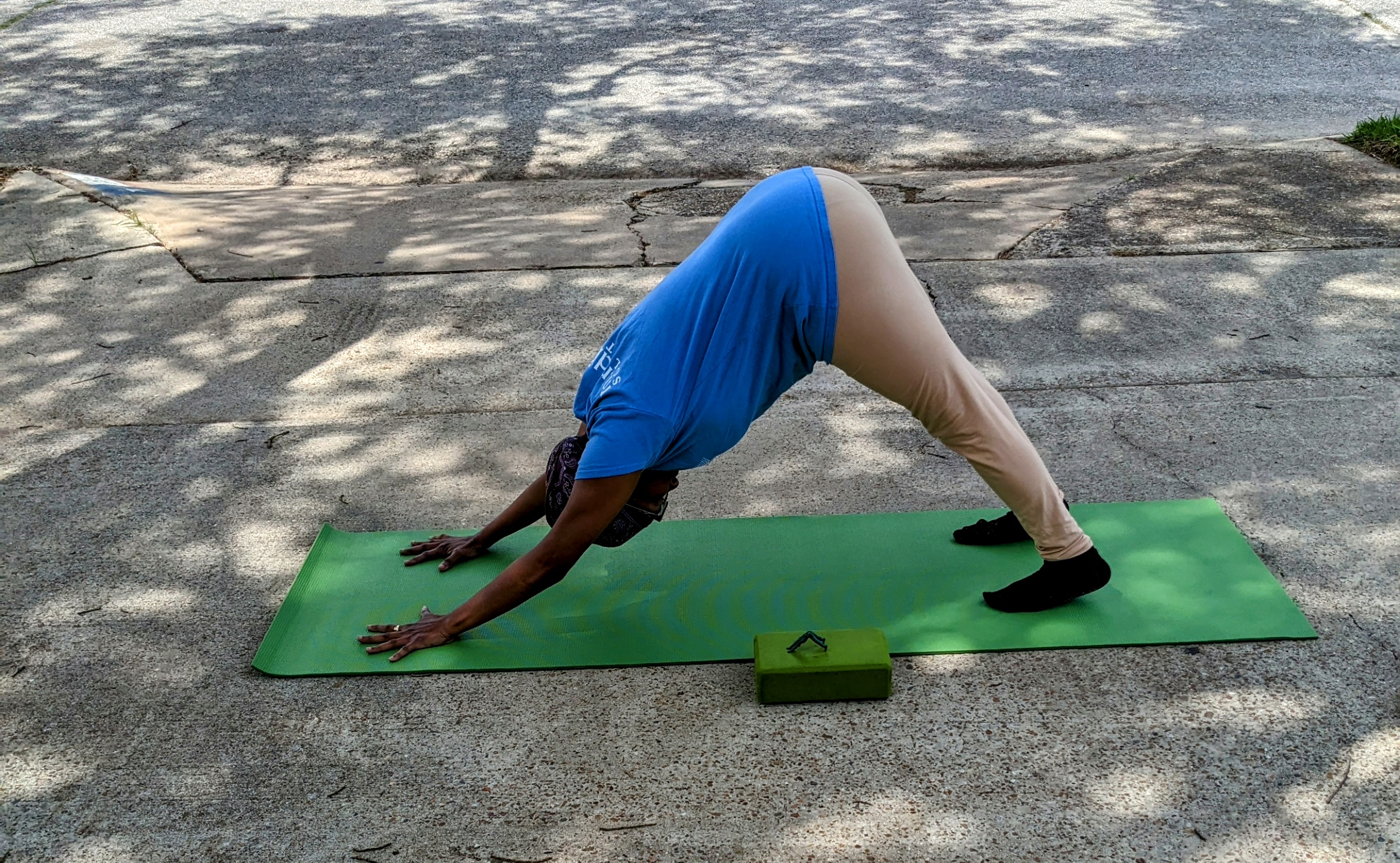
 A Joyful Practice