[My apologies for this very late Wednesday (the 24th) post(which is also a preview for Sunday the 28th). You can request an audio recording of Wednesday’s practices via a comment below or (for a slightly faster reply) you can email me at myra (at) ajoyfulpractice.com.
In the spirit of generosity (“dana”), the Zoom classes, recordings, and blog posts are freely given and freely received. If you are able to support these teachings, please do so as your heart moves you. (NOTE: You can donate even if you are “attending” a practice that is not designated as a “Common Ground Meditation Center” practice, or you can purchase class(es). Donations are tax deductible; class purchases are not necessarily deductible.
Check out the “Class Schedules” calendar for upcoming classes. *** DON’T FORGET THERE’S A “FIRST FRIDAY NIGHT SPECIAL ON MARCH 5th! ***]
“But, before we enter on the subject, let it be observed, that slovenliness is no part of religion; that neither this, nor any text of Scripture, condemns neatness of apparel. Certainly this is a duty, not a sin. ‘Cleanliness is, indeed, next to godliness.’ Agreeably to this, good Mr. Herbert advises every one that fears God: —
Let thy mind’s sweetness have its operation Upon thy person, clothes, and habitation.
And surely every one should attend to this, if he would not have the good that is in him evil spoken of.”
– quoted from Sermon #88 (“On Dress”) by John Wesley, inspired by The First Epistle General of Peter (3:3,4)
There are hundreds of references to washing and being clean in the Hebrew Bible, the Christian New Testament, and in the Qur’an. In Judaism and Islam, people are commanded (by God) to wash before certain acts and, in particular, before certain prayers – and also to avoid certain elements because they are deemed “unclean.” In Judaism, specifically, ritual washing is divided into hand washing and full body immersion. In Islam, ritual cleansing includes washing specific body parts (i.e., face, arms, head, and feet) and also full body immersion. In the Christian New Testament, there is an emphasis placed on ritual feet washing. Yet, for all these references to being clean, one of the most well-known “Biblical” quotes about “cleanliness” doesn’t actually appear in any sacred text associated with the Abrahamic religions. Instead, the earliest recorded English reference is from a sermon John Wesley gave in the mid-to-late 1780’s.
The sermon, “On Dress,” was inspired by a letter addressed to Churches in the Roman provinces of Asia Minor who were experiencing religious persecution. The letter, attributed to Saint Peter the Apostle, not only recommended appropriate conduct in how one should interact with people from different stations (“Honour all….”); live under non-Christian rulers (“Submit yourselves to every ordinance of man for the Lord’s sake”) and deal with false accusations (“… with well doing ye may put to silence the ignorance of foolish men;”); it also outlines how one should conduct one’s self when faced with suffering (“… ye take it patiently…”) and how women should or, more specifically, should not dress. However, The Reverend Wesley’s sermon did not just address the dress of women. Instead, the good reverend spoke of all Christians. He outlined how extreme people could go in their interpretations and applications of Saint Peter’s guidance – and also, emphasized the idea that extreme interpretations and applications miss the point. Then he explained that the importance of the Biblical instruction lies not in outward appearance but on the inward experience.
– “From purity/cleanliness arises sensitivity to the unclean nature of one’s own body and [physical] unmixing.”
Yoga Sūtra 2.41: sattvaśuddhisaumanasyaikāgreyendriyayātmadarśanayogyatvāni ca
– “[From purity/cleanliness arises] pure wisdom of the heart, cheerfulness of mind, the power of concentration, victory over the senses, and the ability to directly experience our Self.”
In outlining and explaining the Yoga Philosophy, Patanjali offered ten ethical components: five “external restraints” or universal commandments (yamā) and five “internal observations” (niyama). The very first internal observation is śaucāt, the practice of “cleanliness.” I have a bad habit of just referencing śaucāt as it relates to the physical body (e.g., food, drink, bathing, etc.); but the practice is intended to cover everything that we consume. And, eons before John Wesley shared his observations from the pulpit, Patanjali offered the same conclusion: to quote the good reverend, “Then only when you have cast off your fondness for dress, will the peace of God reign in your hearts.”
It is all too easy to look back, historically speaking, and focus on hygiene. We can even point to specific historical conditions – or to the fact that certain texts specify what kinds of water are permitted and which kinds are not acceptable (according to religious law). What do we do, however, with the fact that some scripture outlines ritual cleansing that does not involve water? Closer examination reveals, however that these ritual practices are about more than physical hygiene and the elimination of contaminants. The practices are about purification; a fact that is reinforced with the practice of the niyamās in yoga.
“‘Consider purification, tapas, which literally means “to melt,” as in refining ore. The purpose of purification is not pain and penance, but to deliberately refine one’s life, to melt it down and recast it into a higher order of purity and spirituality. The goal is very important; it is not self-punishment but refinement – to shift from human existence into Divinity!
There are three main methods of purification: the refinement of one’s thoughts, words, and deeds – also called the purification, respectively, of one’s instruments of mind, speech, and body. When you modify these three you automatically change for the better.’”
– Krishna speaking to Arjuna (17.14) in The Bhagavad Gita: A Walkthrough for Westerners by Jack Hawley
The purification of mind and speech can be experienced when practicing the second niyamā, santoşā (“contentment”), which is a foundation for the practice of non-attachment. Patanjali combines the final three niyamās – tapa (“austerity or heat”), svādhyāya (“self-study”), and īśvarapraņidhāna (“trustful surrender to [the Divine]”) – and refers to the combination as kriyā yoga or “union in action.” Anyone can practice these elements at any time, but it is interesting to note that these elements – as a combined practice – are found in rituals from around the world. For example, the observations of Lent; Passover; and fasting during the Baha’i 19-Day Fast, the month of Ramadan, and/or for Yom Kippur all full under the rubric of kriyā yoga. Celebrating Kumbh Mela, a Hindu pilgrimage involving a ritual bath in one of four sacred rivers (determined by a 12-year cycle of rotation) also falls under this same umbrella. (Note that, with the exception of Yom Kippur, all of these rituals are either currently being observed or will be observed between now and the 2nd week in May.)
All that being said, Day 13 of the Lunar New Year does not, in and of itself, involve ritual cleansing. It is, however, a day when people who celebrate the 15-day Spring Festival traditionally eat “clean.” A lighter, often vegetarian, meal on day 13, is a way to help the body clean itself after the heavy feasting over the previous two weeks and to prepare for one more round of feasting during the Lantern Festival (on Day 15).
Day 13 is also the day when some people celebrate the birthday of the “God of War.” There are lots of different stories (and names) associated with the “God of War.” Some of the legends relate to a general who showed great loyalty; other stories relate to an acclaimed general who became a goddess who showed great empathy. While this is not seen as a good day to get married or have a big celebration, it is believed that offering prayers and gifts to the God of War on Day 13 will bring peace to a household and give businesses a winning edge. Regardless of the title that is used, the God of War is viewed as a protector of individuals, homes, and businesses; as well as the patron of “fraternities,” including the police (and other brotherhoods).
“‘We three—Liu Bei, Guan Yu, and Zhang Fei—though of different families, swear brotherhood, and promise mutual help to one end. We will rescue each other in difficulty; we will aid each other in danger. We swear to serve the state and save the people. We ask not the same day of birth, but we seek to die together. May Heaven, the all-ruling, and Earth, the all-producing, read our hearts. If we turn aside from righteousness or forget kindliness, may Heaven and Human smite us!’”
– quoted from “Chapter 1. The Oath of the Peach Garden” in Romance of the Three Kingdoms by Luo Guanzhong (English translator unknown)
Wednesday’s playlist is available on YouTube and Spotify.
DON’T FORGET! This Friday (March 5th) there’s a “First Friday Night Special” (7:15 PM – 8:20 PM, CST) – at which time, I will encourage you to “give something up” / “let someone go.” Additional details are posted on the “Class Schedules” calendar!
### “THUS WILL WE ENTER UPON OUR GREAT TASK.” ~LG ###
– The old saying “Gam zeh ya’avor,“ in Hebrew (with Persian and Jewish origins)
“It is said an Eastern monarch once charged his wise men to invent him a sentence, to be ever in view, and which should be true and appropriate in all times and situations. They presented him the words: ‘And this, too, shall pass away.’ How much it expresses! How chastening in the hour of pride! — how consoling in the depths of affliction!”
– Abraham Lincoln speaking to the Wisconsin State Agriculture Society at the Wisconsin State Fair, September 30, 1859
There’s an old saying in Hebrew, “Gam zeh ya’avor. This too shall pass,” that is often associated with a very wise Rabbi of old and also with King Solomon (although the words do not appear in the Bible) and has origins in Persian and Sufi poetry. American historians may hear the words and think of Abraham Lincoln speaking at the Wisconsin State Fair a year before he was elected president – although, he would end his speech with a bit of caveat, saying that he hoped the best things lasted. I think of my grandmother saying those words, a lot, but also of (what I was taught was) a Chinese parable.
In the parable, a farmer reacts to everything that happens to him (and around him) with the words, “We’ll see.” While others get excited for what they believe to be his good fortunate or agitated over what they perceive as unfortunate events, the farmer maintains a steady outlook and an understanding that all things are connected: every beginning is an ending and every ending is a beginning. As the parable progresses, the reader (and the farmer’s neighbors) start to recognize the wisdom in his attitude. Of course, in real life it is a little harder to let go of our desires and accept the present moment. Harder still is appreciating the present moment without judgment. The hardest thing, however, is to be open to appreciating whatever comes.
“Be joyful at your festival – you and your son, and your daughter, and your manservant, and your maid-servant, and the Levite, and the stranger, and the orphan, and the widow who live within your city.
For seven days you must celebrate the Festival to YHVH*, your God, in the place which YHVH* shall choose, because the Lord, your God, will bless you in all your produce, and in all the work of your hands, and you will only be happy.”
(*NOTE: YHVH is commonly translated as “the Lord” in English.)
– quoted from Devarim – Deuteronomy (16:14 – 15)
Five years ago, almost to the day, I was so excited about all the things happening for me. Personally, professionally, and even spiritually, I was riding a high. I would like to think that, in the moment, I truly appreciated everything and everyone around me. I especially would like to think that considering that one of the highlights of that week was co-leading my first weekend-long Sukkot retreat in Darwin, MN, with Sandra Razieli. Sukkot is sometimes referred to as “the Season of Happiness” and there is an extra focus on gratitude. The thing is when I look back, and keep in mind how things changed after that retreat; I realize I wasn’t practicing what I preached. Yes, I was appreciating people and things in the present moment – but I was also attached to how I wanted them to continue.
As is stated in the Hebrew Bible and the Christian Old Testament, there is a period of time – after the harvest – when people are commanded to celebrate. The curious thing is that the passage related to the “Festival of the Booths” or “Festival of the Tabernacles” does not instruct people to celebrate the harvest they just brought in from the fields. Instead, people are commanded to gather and celebrate what will be. So, in some ways, the holiday which the Jewish community began observing last night at sunset, is all about having faith that not only will things pass, but that how things change will be a blessing. “Gam zeu tovah,” is another Hebrew saying. It means, “This too is for the good.”
– “From purity/cleanliness arises sensitivity to the unclean nature of one’s own body and [physical] unmixing.”
Yoga Sūtra 2.41: sattvaśuddhisaumanasyaikāgreyendriyayātmadarśanayogyatvāni ca
– “[From purity/cleanliness arises] pure wisdom of the heart, cheerfulness of mind, the power of concentration, victory over the senses, and the ability to directly experience our Self.”
Normally, when Sukkot rolls around, I am super excited to talk about yoga sūtra 2.42 and the how the second niyamā (“internal observation”) connects to the practice of gratitude and the emotional experience of happiness. However, we are not there yet. There is a preliminary practice, which actually gives us two sūtras on which we will focus. Part of me, was like, “Oo, they are short and connected.” Another part of me remembered something we kept saying back in 2015: “Don’t be greedy, be grateful.”
Please join me for a 90-minute virtual yoga practice on Zoom today (Saturday, October 3rd) at 12:00 PM.You can use the link from the “Class Schedules” calendar if you run into any problems checking into the class. Give yourself extra time to log in if you have not upgraded to Zoom 5.0.
Today’s playlist is available on YouTube and Spotify. (Look for “Sukkot 1+”)YouTube
You can request an audio recording of this practice via a comment below or (for a slightly faster reply) you can email me at myra (at) ajoyfulpractice.com.
### Sunshine, the practice, friends (and family) ###
Everything gives rise to its opposite, therefore we work without conscious effort and teach without agenda.
We enjoy everything and possess nothing.
Our accomplishments do not emerge from our ego, so we do not cling to them.
Thus they benefit all beings.”
– (2) quoted from A Path and A Practice: Using Lao-tzu’s Tao Te Ching as a Guide to an Awakened Spiritual Life by William Martin
A few months back, I posted about chaos theory; and if you watch one of the pendulum models (see below it can seem like so much craziness. However, when faced with so much confusion, I have to remind myself of the following:
we’ve seen this pattern before;
it makes no sense if you get caught up in the momentum;
all the movement is, in fact, moving towards stillness;
and that, from the perspective of natural law, there is a moment when all of the movement is, in fact, “effortless effort.”
As someone with a type-A personality, I sometimes struggle with the idea of “effortless effort.” Don’t get me wrong; I can be still, I can relax. However, there are certain times where “doing nothing” feels like the wrong choice. I’ve been conditioned and socialized to believe this. Many in the Western world have been conditioned and socialized to believe this. But, not doing is still doing and “effortless effort” is not the same as doing nothing. In fact, sometimes, it takes a great deal of effort to let go.
In a 2009 blog post, Meditation Oasis (Mary and Richard Maddux) refers to a the Wikipedia description of “Wu Wei” – which literally means “not-doing doing” – as “’natural action’ giving the example of a tree growing. It is doing growing, and yet it is not doing.” This makes me think of Alan Watts meditation where he describes breathing as something that happens to us, but also something we can engage – and, once engaged, it is something we do deeply without effort. Meditation is like this. Life is like this too, and Taoist philosophy points to “Wu Wei” as a way to act and/or experience action in daily life. On Meditation Oasis’s blog, they describe meditation as “the art of allowing the mind to experience a natural state.” This too, is what Patanjali advocates in the Yoga Sūtras, “resting in your own true nature.” (YS 1.3)
“The most fluid and yielding substance will flow past the most rigid with the speed of a racehorse.
That which does not hold a particular form can enter even that which seems impenetrable.
This is why we practice “effortless effort.”
We act without ado.
We teach without arguments.
This is the way of true happiness, but because people prefer distractions and noise, it is not a popular way.”
– (43) quoted from A Path and A Practice: Using Lao-tzu’s Tao Te Ching as a Guide to an Awakened Spiritual Life by William Martin
In commentary on wu-wei, Dr. Martin says, “This phrase implies pure action in the present moment without any accompanying resistance, second-guessing, or worry. In the practice of wu-wei we just “do what we do.” The more awareness and acceptance we bring to the present moment, the more wu-wei is possible. This can take the form of either energetic activity or relaxed waiting. Like acceptance, wu-wei is not passive….” The sounds great, but I wonder how it works in situations where things are steadily spiraling out of control, where there is deadly chaos and we can’t seem to find the center point. I think of Dr. Martin Luther King paraphrasing the abolitionist minister Theodore Parker and am reminded that we have to bend the arc. But, how do we do that without more harm? How do we do that with ‘effortless effort?”
“I do not pretend to understand the moral universe. The arc is a long one. My eye reaches but little ways. I cannot calculate the curve and complete the figure by experience of sight. I can divine it by conscience. And from what I see I am sure it bends toward justice.”
– quoted from an 1853 sermon by Theodore Parker
Dr. William Martin wrote a book on the Tao and activism, which I have not read yet. However, Eastern philosophies like Taoism, Buddhism, and Yoga are philosophies that encourage experiencing the present moment – which requires stillness. So, today we are going to move into stillness.
Please join me today (Tuesday, September 1st) at 12 Noon or 7:15 PM for a virtual yoga practice on Zoom, where we will do what we do. Use the link from the “Class Schedules” calendar if you run into any problems checking into the class. Give yourself extra time to log in if you have not upgraded to Zoom 5.0. You can request an audio recording of this practice via a comment below.
Tuesday’s playlist is available on YouTube and Spotify. (Today’s playlist is dated March 29th or 03292020.)
“We gather to weep and to remember; to laugh and to contemplate; to learn and to affirm and to imagine”
– Brett Bailey, Stage Director from South Africa, World Theatre Day Message Author 2014
In As You Like It, William Shakespeare famously wrote, “All the world’s a stage, And all the men and women merely players; They have their exits and their entrances; And one man in his time plays many parts.” Art imitates life, which sometimes imitates art (because art can inform our lives). That overlap between inspiration, those being inspired, and those creating the inspiration is one of the beautiful things about art. It’s what makes art alive.
Today, however, the theatres are dark. The front of house is empty. There are no children, über-fans, or well-heeled patrons waiting in the green room, the wings, or at the stage door. On the big stages, there is only a single “ghost light” in place to make sure no one falls in the pit . . . and yet, social distancing means there is no one in danger of falling in the pit. It’s heartbreaking for so many artists and dedicated audience members, and people like me. For most of my adult life, before I started teaching yoga, my professional life was spent behind the scenes – quite literally keeping track of exits and entrances. I worked on legit theatre, musical theatre, dinner theatre, classical and modern dance, as well as opera and musical revues. I worked in different parts of the world; with artists from all of the world, and Friday night was always a big night.
Even if one company was in rehearsals or in a layoff period on Friday, another theatre was performing. Theatres are usually dark on Monday nights. Not Friday nights. Especially not this particular Friday night, as it happens to be World Theatre Day. Since it was initiated in 1961 by the International Theatre Institute, World Theatre Day has been celebrated on March 27th by performing artists all over the world. Today, many theatres will not celebrate. Others have moved their celebration online.
Each year, an artist is selected from a different host country to write a message about theatre’s enduring role in the world community. This year’s message was written by Shahid Nadeem, Pakistan’s leading playwright and the head of the renowned Ajoka Theatre, who partially focused on the spiritual and transcendental power of theatre.
“Our planet is plunging deeper and deeper into a climatic and climactic catastrophe and one can hear the hoof-beats of the horses of the Four Horsemen of the Apocalypse. We need to replenish our spiritual strength; we need to fight apathy, lethargy, pessimism, greed and disregard for the world we live in, the Planet we live on. Theatre has a role, a noble role, in energizing and mobilizing humanity to lift itself from its descent into the abyss. It can uplift the stage, the performance space, into something sacred.”
– Shahid Nadeem, Playwright from Pakistan, World Theatre Day Message Author 2020
It’s weird (and heartbreaking) to think no one in my former role will be asking people to turn off their cellular devices – unless someone jokes about the fact that so many tonight will be watching their “theatre” on their cellular devices. It’s weird (and heartbreaking) to think something I have always taken for granted is suddenly not existing as it did.
And yet, if I learned nothing else from doing live theatre, I definitely learned about the temporal nature of things. Everything changes. That’s one of the beautiful – and also one of the most challenging – things about live theatre. It is always changing. You can have the best, most exhilarating performance of your life, followed by one where everything is just a little off. You can have a horrible final dress rehearsal, followed by a standing ovation on opening night. As a professional – onstage and backstage, as well as front of house – part of the job is to stay in the moment.
Staying in the moment requires being fully present with everyone and everything in the moment. We can look back later and work on fixing what went wrong. We can marvel at the unscripted audience reaction we want to figure out how to cultivate again and again. But, right here and right now it is time to turn up the music, turn down the lights, and breathe. The curtain is going up on this day in our lives, and what happens next can be (will be) simultaneously beautiful and heartbreaking. Like the cherry blossoms (sakura).
Flashback Friday: Today in 1912, First Lady Helen Herron Taft and Viscountess Chinda Iwa, wife of the Japanese ambassador to the United States, each planted a cherry blossom tree on the north bank of the Tidal Basin in West Potomac Park. These trees were part of a larger shipment of cherry blossoms meant to replace the ones initially given as a gift of friendship between the two countries. Normally, at this time of year, thousands of people can be found in D. C. celebrating the brilliance of these trees, just as thousands normally celebrate in parts of Japan and China. Normally….But, today the cherry blossoms are in bloom, while most people are inside, watching the beauty on their screens.
In Japan the fact that blossoms peak at one end of the island at the same time the blossom season is ending on another part of the island is a great illustration of mono no aware (literally “the pathos of things” of “sadness of things”). The fact that we can see this beauty even as we are socially distancing might also be considered the “sadness of things.” However, that very literally translation doesn’t quite work in English because it almost precludes appreciation of the beauty. The Japanese phrase is about simultaneously holding/celebrating/appreciating the beauty and the pain of the change that brings loss. Please check out the following links if you are interested in reading my take on mono no aware as it relates to YIN Yoga (April 5, 2017) or the physical practice of yoga and meditation (April 8, 2019). NOTE: While both posts include a bit of practice, only the 2017 includes a complete (YIN Yoga) practice.
Right now, I am appreciating the beauty of being able to share this practice online. I am also very much aware that this too shall change; however, I endeavor to stay in the moment. With that said, I am currently planning to host 7 online classes as follows:
WEDNESDAY 4:30 – 5:30 PM for Nokomis Yoga & 7:15 – 8:15 PM for Flourish
SATURDAY 12:00 – 1:30 PM (Nokomis)
SUNDAY 2:30 – 3:30 PM (Nokomis)
Everyone is welcome to join any class (although you will need to register in advance for the Flourish class). All online classes will currently be on ZOOM and I will post the meeting IDs on my “class schedule” late Friday afternoon. Each class will have a different ID, but that ID will be the same each week.
If you are new to yoga or new to vinyasa, please send me a message (myra at ajoyfulpractice.com) before joining the group. I apologize to my YIN Yoga folks, but at this time I am not streaming any full YIN practices, I will, however, continue to post or link you to the practice.
The “practice preview” below is part of my offering for the 2019 Kiss My Asana yogathon. I encourage you to set aside at least 5 minutes a day during April, to practice with today’s theme or concept as inspiration. You can practice in a class or on your own, but since the Kiss My Asana yogathon raises resources as well as awareness, I invite you to join me at a donation-based class on April 27th or May 4th.
I also challenge you to set aside a certain amount every day that you practice with this concept/theme in mind. It doesn’t matter if you set aside one dollar per practice or $25 – set aside that amount each time you practice and donate it by April 30th.
Founded by Matthew Sanford, Mind Body Solutions helps those who have experienced trauma, loss, and disability find new ways to live by integrating both mind and body. They provide classes, workshops, and outreach programs. They also train yoga teachers and offer highly specialized training for health care professionals. By participating in the Kiss My Asana yogathon you join a global movement, but in a personal way. In other words, you practice yoga. Or, as this year’s tag line states….
do yoga. share yoga. help others.
***
“πάντα ρεῖ “ (“panta rhei “ everything flows or everything to the stream)
– excerpt from funeral service in The Book of Common Prayer
Shift happens…all the time. Or, as the Greek philosopher Heraclitus once put it, “Everything changes and nothing remains still…you cannot step twice into the same stream.” Recognizing the temporal nature of everything, including ourselves and our experiences, can be very helpful. However, it seems to be human nature to resist change and, in doing so, deny that change is happening – which, as the Buddha pointed out, creates suffering.
(Thus) have I heard that Prince Siddhartha Guatama of India was born into a family of great wealth and great privilege. As pointed out at the beginning of this series, Siddartha means “one who has accomplished his goal” or “one who has achieved his aim” and – as far as his family was concerned his dharma (or goal) was to one day take over as ruler of his father’s lands. (The title “Buddha,” which means “Awakened One,” would come later in his life.)
Siddhartha knew nothing of pain and nothing of suffering, having been shielded from the existence of sickness and death, until the age of 29. Upon seeing the suffering of others, his life trajectory changed and he renounced the life he knew in order to find a path that would alleviate suffering. At the age of 35, tradition tells us, he articulated The Four Noble Truths:
Suffering exists
Suffering is caused by attachment, clinging, craving
In some traditions of Buddhism, understanding and accepting these four noble truths is the key to waking up and there are a number of practices specifically designed to bring awareness to change happening every time you inhale, every time you exhale. In fact, the very act of sitting and watching the breath can illuminate the Four Noble Truths and the temporal nature of our existence.
The history of Japan and Japanese culture is full of change. Depending on where you look you may find an acute juxtaposition between accepting change, keeping a tradition (without change), and actually celebrating change. For example, most of the Buddhist world celebrates the Buddha’s birthday on May 8th or a day determined by a lunar calendar. Many temples in Japan, however, started celebrating on April 8th every year, when the country switched over to the Gregorian calendar in 1873. During the Flower Festival, which is the birthday celebration, people will pour a sweet tea made from fermented hydrangea leaves over where small statues of the Buddha.
For an example of people celebrating change, look no further than the sakura (cherry blossom) season that is beginning. The Cherry Blossom Festivals that are currently kicking off (or ending, depending on the region) is completely separate from the Flower Festival associated with the Buddha’s birthday.
Sakura usually begin blossoming in the southern part of Japan and, over a matter of weeks, eventually blossom across the whole island. However, by the time the blossoms peak in the North they are already out of season in the South. The delicate flowers literally blow away like dust in the wind. For the heart and mind to hold the beauty of the moment when the flowers peak, with the awareness (and sadness) that the moment is already passing, is known as mono no aware (literally, “the pathos of things”). Mono no aware may be translated as “empathy towards things,” but there’s really no set words in English to express the feeling of wonder (“the ahhness”) inextricably tied to the longing and deep sadness that accompanies loss. This is what is – and yet, without some kind of mindfulness practice it is easy to separate the two sensations or to be so overwhelmed by the twin emotions that we focus on one to the complete exclusion of the other. Focusing on what feels good and appealing, while avoiding what doesn’t feel good results in more suffering. It also creates suffering when our longing for what has passed causes us to miss what is. (Not to mention, it causes us to continuously confront the illusion that we can go back to a moment in time, in the same way we think we can cross the same river twice.)
If you look at the history of sitting in Japan, you will also find lots of change – and sometimes a resistance to change. What is now commonly considered the proper way to sit in Zen Buddhism, as well as in day-to-day life, is seiza (which literally means “proper sitting”). Seiza is kneeling so that the big toes overlap (right over left) and then sitting on the heels. Women are taught to sit with the knees together, while men may be taught to spread the knees a little. In the modern times, this type of sitting is ubiquitous and considered respectful; however, prior to the mid 14th century and up to the late 16th century it was consider proper and respectful to either sit with legs to the side or cross-legged. Cross-legged was, in fact, the preference for many warriors as it was believed that a cross-legged position would not hinder a samurai if they needed to draw their sword.
“The way up and the way down are one and the same. Living and dead, waking and sleeping, young and old, are the same.”
– Greek philosopher Heraclitus of Ephesos (DK22A1)
In the physical practice of yoga, the “proper way to sit” is in way that is stable and comfortable enough for you to focus on your breath. Notice that in Yoga Sutra II.46 (broken down in yesterday’s post) Patanjali uses the words sukham asanam which can be translated as “dwelling in a good space.” The flip side of a good space is dukha “a bad space” – or, more acutely, “a space of suffering.” As you move into this next pose, make sure you are not dwelling in a space of suffering.
FEATURED POSE for April 8th: Auspicious or Gracious Pose (Bhadrasana)
Auspicious Pose or Gracious Pose (Bhadrasana) appears in classical texts like Gheranda Samhita (c. 17th century) as a pose similar to seiza. In more modern texts it is depicted as a Bound Angle Pose (Baddha Konasana). Either variation can be in the beginning, middle, and/or the end of a practice. In fact, if you are doing a variety of poses today, you can return to your Auspicious pose the way your return to Downward Facing Dog, or Equal Standing, and notice was changed or shifted.
For the classical variation, be mindful of the knees and hips as you come to your hands and knees and bring the tips of the big toes to touch. Spread the knees as wide as you are able and then sit back on your heels. If there is a lot of pressure on the knees, sit on a block or blanket. You may also need a blanket or towel under the feet for this variation.
For the second variation, bring your feet together, like a prayer, in front of your hips (rather than behind). This variation is easier on the knees and feet. You may still need to sit up on a blanket or block. Especially if the hips are tight, you slump into the low back, and/or the knees are up higher than the hips. In this variation you can also adjust the feet (bring them closer in or further out) to bring more ease to the knees.
You can sit up tall with the hands resting on the thighs. Another option, which is very nice for the shoulders, is to lift your heart up (into the beginning of a backbend) and cross the hands behind the back so that you can grab the toes, the heels, or (if your feet are in front) the opposite hip. Make sure you are not leaning back, but instead are arching your chest up. Be mindful that you are not straining or compressing the low back.
If you have unregulated blood pressure issues, let your breath flow naturally in and ebb naturally out. If you find you are holding your breath or panting, ease out of the pose. If you are in overall good health, and they are in your practice, you can add your bandhas.
Dwell in this good space (sukha asama) until you have to move out of it (because it has become the “bad space” ( dukkhaasanam). Be mindful that you ease out of the pose with the same awareness you used to get into it. Find some gentle, micro-movements to release the joints.
Start the New Year with a 2-hour retreat into yourself. Enfold into the wisdom of your heart and let your heart’s desire unfold. Be inspired.
Despite our modern day penchant for fireworks and parties, a new year begins much as it ends: quietly. Here in the Northern Hemisphere, we observe the secular New Year when much of nature is hibernating. We hustle and bustle, struggling to start, continue, or end. Meanwhile, beneath the surface, things and beings are waiting.
Waiting…it seems so passive and unyielding.
Waiting…it is easy to forget the importance of resting, relaxing, and being still…letting things germinate and take root.
Waiting…. In many philosophies and religions, including the Abrahamic religions, great emphasis is put on the importance of waiting, specifically because something or someone is coming.
Yet, no one really wants to wait for our dreams to come true. We want it now! And, we want to be actively working towards that goal. Unfortunately, sometimes, we forget about the importance of waiting…resting…reflecting…planning.
As one year ends and another begins, we are given the opportunity to reflect and plan. We can reflect on the events of the previous year – and how we dealt with them. We can plan for a new year of events – and how we want to deal with them. Making a resolution, even informally, seems natural to some and inevitable to others. It can also seem futile when you consider that (according to some statistics) only about 8% of people who make a resolution actually follow through with them.
Why are resolutions so hard to keep?
Resolutions are just like any other goal or dream that has a lot of expectation attached to it. In order for us to succeed we have to be all in – otherwise, we falter at the first obstacle. In order to be all in, we have to understand what it is we really want or need.
Ask yourself, how does this goal or desire serve me?
Every goal, every desire, every resolution has a purpose. Tapping into the power of the purpose, how the goal or desire serves us, allows us to connect to the underlying intention. Intention is compelling. Intention is the driving force that allows us to see an opportunity to succeed where we might otherwise falter.
Consider this sports analogy: Let’s say you’re a football team with a stellar passing game. Everybody knows your team has a stellar passing game; but, when you’re in the zone it doesn’t matter that the other team is trying to sack your quarterback or intercept every pass – there’s always a pocket, there’s always a hole. The problem comes in when you’re not in the zone and/or when you’re playing a team with an exceptional defensive line. A professional team, ideally, has practiced other options. However, even the pros play to their strengths and, sometimes strengths become blind spots. When it feels like everything is on the line – but nothing is going their way – that’s when we hit our blind spots. And, even the pros can end up in a situation where they’re strengths no longer serve them. Even the pros may forget that there are different ways to achieve the goal.
In The Four Desires, Rod Stryker outlines a formula for success which he calls the Creation Equation. Simply stated, the sum of the intensity of your desire plus the intensity of your efforts to achieve the goal has to be greater than the intensity of the resistance. Keep in mind, the resistance can come from a lot of different sources – including other people. Another thing to keep in mind is that sometimes the intensity of the resistance increases when your desire gets misplaced or transferred.
In the aforementioned sports analogy, for example, both teams have a strong desire to win. Each team’s desire represents a portion of the other team’s resistance. When practicing, however, the team with the stellar passing game focused their desire on having a stellar passing game. On the other hand, the exceptional defensive line focused on stopping everything. When it’s game time, the latter doesn’t care what you throw at them, they’re intense desire (i.e., their focus and their intention) is on stopping everything – by any means necessary. That intention puts them in the zone.
Every year, at the end of the 108 Sun Salutations, I lead a guided meditation which includes a group sankalpa that I then incorporate into my Saturday classes at the YMCA. The word sankalpa means will, determination, vow or intention. It can also mean resolution. But, the difference between the English and the Sanskrit is that within the Sanskrit word there is the vow and the way to achieve the vow, there is a guiding principle and the dedication to following it. A sankalpa combines the desire with the effort. To connect and to stay connected to that highest vow, it is important to clear the mind and focus/concentration/meditation on the heart’s desire.
When outlining the philosophy of the yoga in the Yoga Sutras, Patanjali put particular emphasis on the combined power of the last three (3) limbs of the practice: focus, concentration, and (perfect) meditation (YS 3:4-6). He also mentioned that there are five (5) ways, including tapah (“training the senses” or “austerity”) and samadhi (“meditation”), to reach higher awareness (YS 4:1).
The New Year’s Day japa-ajapa mala if 108 Sun Salutations is a vigorous practice which fits into the category of tapah and can involve samadhi. While not vigorous, a Yin Yoga practice, which involves settling into a special series of poses for long holds, also fits into the categories of tapah and samadhi. Both can clear the mind so that you can bring your full awareness to your heart’s desire.
My 2019 New Year’s Day mala is full, but I will post other practice opportunities. Also, I am excited to offer a Yin Yoga practice with guided mediation (5 – 7 PM). If you are interested in joining me for this special candlelight practice on New Year’s Day, please email me (Myra at ajoyfulpractice.com).
WHO: Everyone is welcome!
WHAT: A Yin Yoga practice addresses the deep tissue and connective tissue through a special series of supported poses held for 3 – 5 minutes. Props and awareness of the body creates an opportunity to relax the outer musculature. This candlelight practice also includes guided meditation.
Regardless of what you practice or how you practice yoga, breathing is an essential part of the practice. In fact, the physical practice of yoga, Hatha Yoga (regardless of the style or tradition) is a combination of the third and fourth limbs of the philosophy of yoga: asana (“seat”) and pranayama (“awareness” or “extension” of breath). As the body is a container for the breath, the asana is a way to direct the breath, as well as a way to connect the mind and body.
Connecting through the breath is also a way to bring about change in the mind and body. Literally speaking, Hatha Yoga may be translated as “sun-moon union” or “by-force union.” The power of the practice comes from the uniting of opposites. It is by the force of the breath that we bring about change.
Sir Isaac Newton stood on the shoulders of giants, in particular Nicolaus Copernicus, Galileo Galilei and Johannes Kepler, and published his laws of motion in 1687. Three hundred and thirty-one years later, these physical laws first published in the Philosophiae Naturalis Principia Mathematica still hold up: (1) that an object at rest remains at rest and an object in motion remains in motion – unless acted upon by a force; (2) that the rate of change in momentum is directly related to the force applied, and the direction applied; and (3) that there is an equal and opposite reaction to every action.
Every time we breathe, especially if we observe the body’s natural reaction to the breath, we are seeing these laws at work. Take a deeper breath in and that action results in a deeper breath out. As, the breath enters the body the belly rises; as the breath leaves, the belly falls. Simultaneously, the diaphragm rises and falls, enters and leaves – but, in the opposite direction of the belly. Also, on a much deeper level, the spine extends as we inhale and flexes as we exhale. Our physical practice of yoga is simply a way to observe natural phenomena at work.
Our physical practice is also a way to observe natural phenomena from a philosophical standpoint. For example, Daoism views everything in existence as the manifestation of four (4) actions: entering and leaving, rising and falling. As we inhale, things and people come into our lives, things happen around us. As we exhale, things and people leave our lives, things change around us. Notice the thoughts and emotions that arise. Notice how the thoughts and emotions settle.
Sonnets to Orpheus II, 29 – by Rainer Maria Rilke
Move into Child’s Pose (Balasana) as if you are moving into a new house. Make yourself comfortable and stable enough to focus on the breath. Notice the inhale, the pause, the exhale, the pause. Notice how the body reacts to each part of the breath. Notice how the inhale creates space and the exhale allows you to engage that space.
After a few minutes in Balasana, make your way into Table Top – hands and knees to the mat with shoulders over elbows and wrists, hips over knees – or into a seated position if that is more accessible. Begin to move with the breath in an exaggeration of your body’s natural tendencies: Inhale and extend the spine into a back-bend with the belly dropping down (this is Cow Pose). Exhale and flex the spine so the belly is drawn up into the spine (this is Cat Pose). If you sit hunched over a computer all day, you might try the “un-Cat” instead.
As Rainer Maria Rilke writes, “Move back and forth into the change.” Match the movement to the breath and notice the natural balance of the breath being reflected in the movement. Notice how your mind settles into the rising and falling, the ebbing and flowing. Notice how your mind settles into the present moment – even as it changes.
After a few minutes of Cat/Cow or the “un-Cat” (from the link above), move into Corpse Pose (Savasana). Notice the rising and falling of the belly as the breath enters and leaves the body. Feel the breath in your spine. Notice the breath that leaves the body is entering the world, and vice versa.
Breath is spirit. In fact, in the old languages, people used the same words for breath that they used for spirit: Prana in Sanskrit, Qi in Chinese, Pneuma in Greek, Ruach (in the body) in Hebrew, and Spiritus in Latin. So, feel the force of your spirit in the body and in the world.
This opportunity to explore a poem on the mat is part of my offering for the 2018 Kiss My Asana yogathon. I encourage you to set aside at least 5 minutes a day during April, to practice with the poem as inspiration. You can practice in a class or on your own, but since the Kiss My Asana yogathon raises resources as well as awareness, I invite you to join me at one of my donation-based classes (April 7th and April 28th).
I also challenge you to set aside a certain amount every day that you practice with a poem in mind. It doesn’t matter if you set aside one dollar per practice or $25 – set aside that amount each time you practice and donate it by April 30th.
Founded by Matthew Sanford, Mind Body Solutions helps those who have experienced trauma, loss, and disability find new ways to live by integrating both mind and body. They provide classes, workshops, and outreach programs. They also train yoga teachers and offer highly specialized training for health care professionals. By participating in the Kiss My Asana yogathon you join a global movement, but in a personal way. In other words, you practice yoga. Or, as this year’s tag line states….
“If you could recommend one book about yoga that really impacted your practice, what book would that be?”
“If you could recommend one book about meditation, what would it be?”
“Is there a book that would help a beginner like me establish a daily practice?”
– E
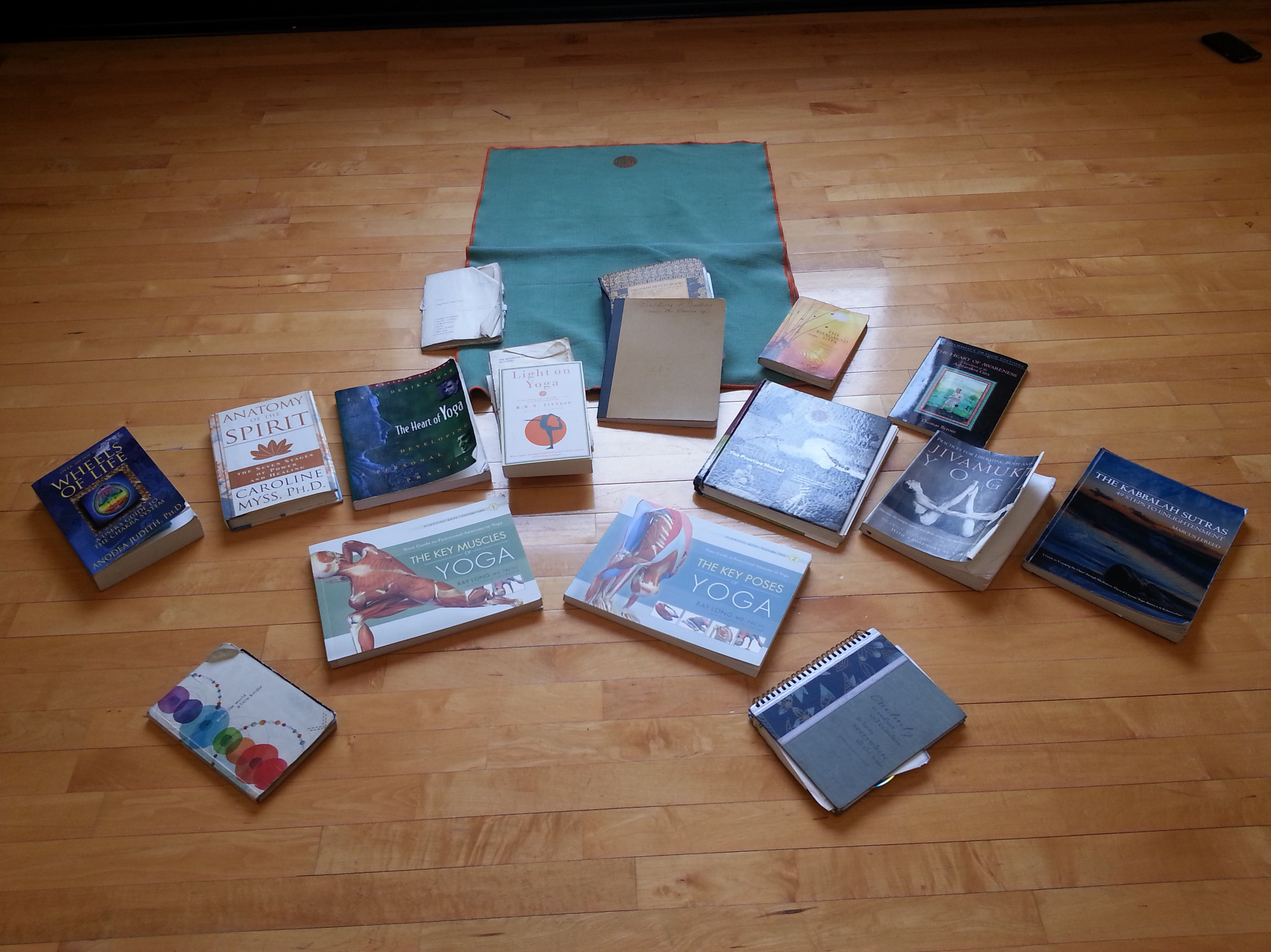
There might be more books on yoga and meditation than there are ways to practice yoga and meditation. I know for sure that there are so many books on each it is sometimes hard to narrow things down to a single recommendation. Even if I had read everything that’s ever been printed – and nothing else was ever printed (which would be a shame since one of my teachers is currently working on her first book) – and even if I only focused on books that really impacted my practice, I would still end up with a bag full of books.
(NOTE: The picture above is missing Leslie Kaminoff’s Yoga Anatomy, Steve Ross’s Happy Yoga, Stephen Cope’s The Wisdom of Yoga, all my Yin Yoga and Taoist texts, a copy of the Ramayana, and Alanna Kaivalya’s Myths of the Asanas, at the very least.)
Part of me wants to break this down into a book on the physical practice versus a book on the philosophy; however, sitting with WHY I want to make that distinction, brings me to one very comprehensive option: T. K. V. Desikachar’s The Heart of Yoga: Developing A Personal Practice.
Desikachar was the son of Sri Krishnamacharya, who was the teacher responsible for the resurgence of yoga in 20th Century India. Krishnamacharya taught Desikachar, B. K. S. Iyengar, Sri Pattabhi Jois, and Indra Devi – who all had a hand in bringing the physical practice of yoga to the West. Each of the teachers mentioned above wrote at least one book which impacted someone’s yoga practice (including mine), and all of them have had books written about them. Desikachar’s The Heart of Yoga is simultaneously about yoga and about a teacher’s teacher. It is also a practice manual with a heavy focus on the philosophy. Unlike some other books I might refer to as practice manuals, The Heart of Yoga not only offers an overview of the 8-limb philosophy of yoga, it includes a translation of the Patanjali’s Yoga Sutras. (NOTE: Patanjali’s Yoga Sutras are 196 aphorisms. Most books on the sutras include each aphorism, plus a translation and commentary for each aphorism. I use several sources for translation/commentary comparative analysis; however, my go-to resource is a website by Swami J, of the Himalayan tradition.) The Heart of Yoga gives practitioners of any fitness or experience level the opportunity to build a physical practice, while also maintaining a connection to the overall philosophical practice.
My similar dilemma regarding a book on meditation could be resolved by recommending a book on yoga mediation… and a book from each of several different Buddhist traditions…plus a book on the Kabbalah…and a book on Catholic contemplation and…..You get the idea. But, when it gets right down to it, there’s one book I am continually giving away – and it’s the same book used when I guided meditation with Dr. Thomas Bushlack’s University of St. Thomas classes: The Miracle of Mindfulness: A Manual on Meditationby Thich Nhat Hahn.
I first came across The Miracle of Mindfulness when I was babysitting for some friends in Minneapolis. One day, when the kids were napping, this little violet paperback on the bookshelf in the living room caught my eye. I pulled it down, and found…stillness.
OK, I’m being dramatic. I had, of course, already experienced stillness in both yoga and seated meditation. However, Nhat Hahn’s The Miracle of Mindfulness made me pause, sit, and contemplate my overall practice and its connection to meditation. Over the last ten years, it has played an instrumental part in my re-commitment to the physical practice of yoga as a form of meditation.
Let me be clear: Nhat Hahn is not known as a yoga teacher and The Miracle of Mindfulness is not a book related to hatha yoga (the physical practice of yoga). Nhat Hanh is a Vietnamese Buddhist monk most commonly associated with Zen Buddhism, but whose training includes several traditions. His Miracle of Mindfulness is based on Buddhist principles and practices, but is not teaching Buddhism, per se. Some might argue that it is not even teaching meditation (but, rather, mindfulness). Still, it accessible to people regardless of their background or experience and includes personal anecdotes as well as a series of practices that are simultaneously simple and profound.
To answer E’s final question, The Miracle of Mindfulness definitely has the tools to help a beginner establish a daily practice. Tools, however, do not build a mansion – and the mansion will not be built overnight.
“Practice, practice, practice – all is coming.” ~ Sri Pattabhi Jois
“Your last Monday Yin Yoga class was the best class I’ve experienced in a long time. Today’s class was almost just as good. Is it possible to get a list of poses from last Mon, or, might you have a repeat of the class sometime & I could make a list of the poses?
By the way, the Yin classes are more frequently & for longer periods lowering my neuropathy pain in my feet. Thanks for your medicinal touch.”
– G
Yin Yoga has its roots in Traditional Chinese Medicine, which maps out the vitality of the body’s organs through a system of meridians located in the deep tissue of the body. As we move into spring, my Yin Yoga classes are focusing on the gall bladder Meridian (running down the outer perimeter of the body) and liver Meridian (running up the inner thigh) – which means lots of hip opening.
The long, prop-supported holds (typically, 3 – 5 minutes) in Yin Yoga may appear similar to poses in a restorative practice; however, Yin Yoga can be significantly more “intense” than a restorative practice. By “intense,” I don’t mean active. In fact, Yin Yoga is, in some ways, the opposite of our other Hatha Yoga (physical yoga) practices. Rather than addressing the outer musculature (the muscles we can see, shape, and tone), Yin Yoga addresses the body’s fascia, deep tissue, and connective tissues. The practice may also decompress areas around the joints. One of the best online resources for Yin Yoga is Bernie Clark’s aptly named yinyoga.com, where you will find pose details, a community forum, and links to Clark’s YouTube channel.
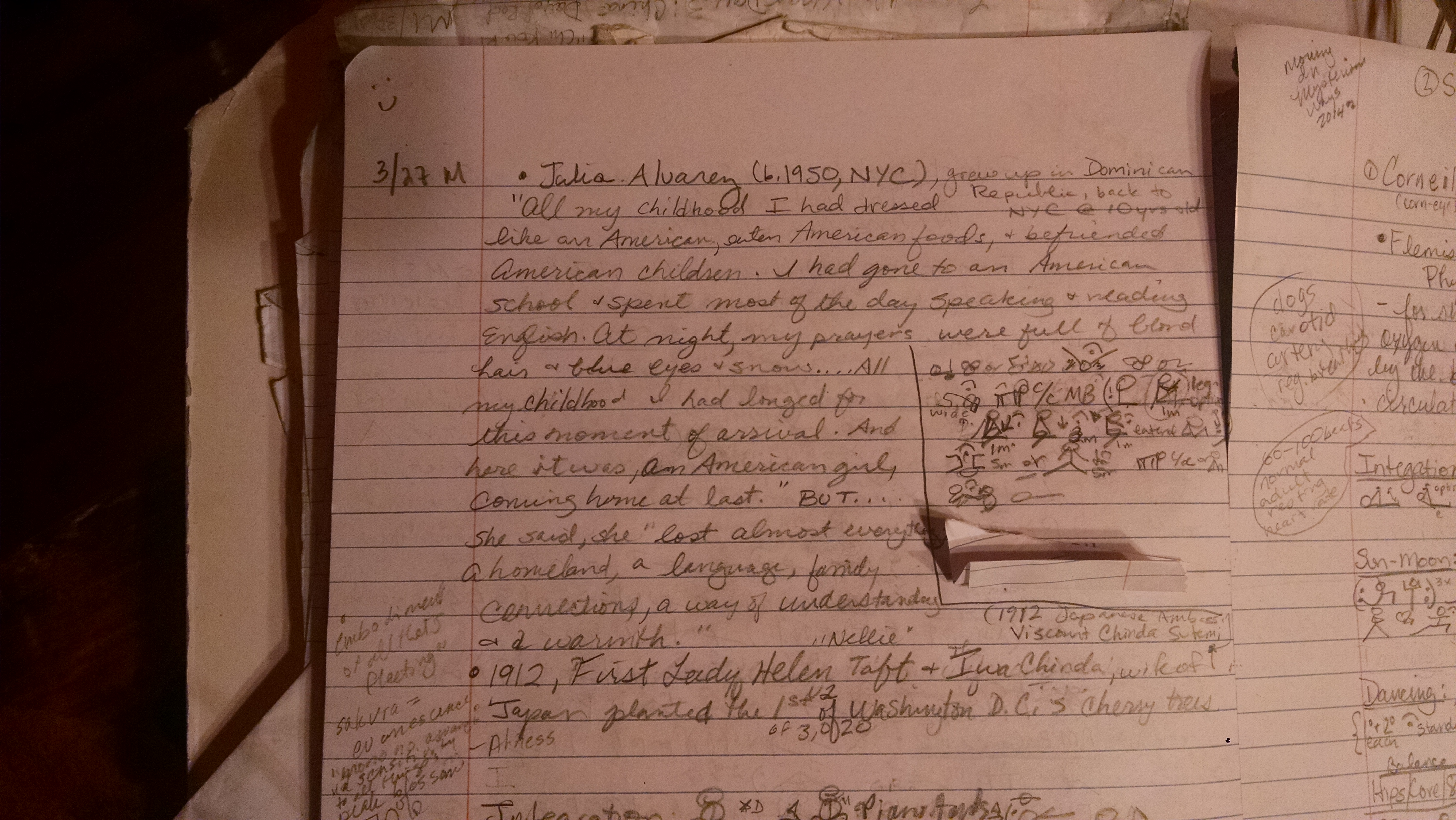
My regular students are always welcome to take a picture of my “playbook” (see below).
(Please note: These practice details are intended for individuals who already have a Yin Yoga practice. Before starting a new practice, be sure to check in with your health care provider. Most importantly, remember that although you may experience health benefits from your practice, this practice information is not intended as medical advice or as a means to replace medical care.)
Since my so-called hieroglyphics can be a little tiny or hard to read, here is an outline of the Monday Yin Yoga class from March 27, 2017 a.k.a. Julia Alvarez’s Big Day, a.k.a. the anniversary of the day First Lady Helen Taft and Viscountess Iwa Chinda planted cherry blossoms in D.C.:
Legs-Up-The Wall (for centering and integration): Sit sideways on the mat, so that the side of your hip is up against the wall; then pivot the body so the legs swing up and the back reclines on the mat. The trick is to keep your bottom on the wall. (For more release in the hamstrings, back, and hips, place the feet on a chair or table so that hips, knees, and ankles are resting at 90 degree angles.) Hold for about 2 minutes with back on the floor or a blanket. For additional decompression, bend the knees in order to use the legs to lift the hips and add a block, making sure not to pinch the spine. Hold for another 3 minutes.
“Sleeping Butterfly” – on the wall (counter-pose): Remove the block and move into Butterfly (feet together like a prayer, knees open up like the pages of a book) with legs on the wall for about one minute. Use “Sleeping Butterfly” or a Squat on the wall to set a personal intention, which will keep you on the wall for another minute.
Dragonfly, on the wall: Stretch your legs out (on the wall) as wide as they’ll go, and support the legs by placing a block between the wall and each thigh or by placing blocks or a bolster on the outside of each thigh. Hold for 3 – 5 minutes.
“Sleeping Butterfly” (transitional pose) and Fetal Position (transitional pose)
Wide Legged Child’s Pose (with arms bent on floor over head): Props may be placed under the hips and/or under your chest. If you have a bolster, you can recline your whole body on it. Hold for 2 – 3 minutes.
Counter-pose Moment: Inhale to table top and use Cat/Cow to transition into about 1 minute of gentle movement to break up the stillness.
Half Shoelace or Half Square sequence: Sit with legs extended in front of you. If there’s compression in the low back and/or hips, sit up on top of a blanket or block. Hug right knee in and lift it over extended left leg. You can either rotate the top leg so the knee points to the left foot or slide the top leg to the side so the ankle rests on the bottom thigh, right below the knee. (If elevated, you can place a blanket or towel under the extended shin – to soften the experience at the back of the knee. If you have a hamstring issue, you could sub “Full” Shoelace or Square by bending the bottom knee into the appropriate position.) Twist upper body to the right and hold for at least 1 minute. Rotate back to center and fold until you feel a change, support the change and hold for at least 3 minutes.
Counter-pose Moment: Inhale to lift the body, unravel the legs and give them a rub or a hug. Lean back on the forearms or recline with back on the floor, windshield wiper bent knees for about 1 minute.
Repeat “Half Shoelace or Half Square” sequence on opposite side and Counter-pose Moment.
(Prone) Frog or Dragonfly: Face the long side of the mat and set up props as needed. For (Prone) Frog, come into table top; spread the knees as wide as they’ll go, with ankles under the knees (when you look down the legs) and hips pressing back. Extend the chest forward and recline on forearms and/or props. Prop the thighs. For Dragonfly, sit with legs in front of you and spread wide; prop as needed for low back and lean forward until you feel a change; prop the change. Hold for 5 minutes
Counter-pose Moment: (Prone) Frogs Inhale to table top and use Cat/Cow to transition; Dragonflies use inhale to rise up, hug the knees into the chest and then recline to windshield wiper bent knees. Gentle movement for about 1 minute.
“Sleeping Butterfly”: Set up props so upper back is supported, behind shoulder blades, and head us raised slightly above the chest by a prop that supports the nape of the neck (where head meets the spine). If thighs do not touch the ground when legs rest in position, place a block under each thigh. Hold for 5 minutes.
Counter-pose Moment: Mindfully, move off the props.
Savasana (with props, as needed): Hold for at least 5 minutes.
Counter-pose Moment: Be easy and gentle as you move out of Savasana and into a fetal position. Give yourself a moment before sitting up and closing out your practice. Namaste.
Thanks, G, for your question. I’m always so glad to see you in class and (of course) super grateful your yoga practice is helping you feel good!
“A good traveler has no fixed plans and is not intent on arriving.”
– Lao Tzu
“He who asks a question is a fool for a minute. He who does not ask remains a fool forever.”
– various sources
When I decided to ask people 7 questions as part of my 2016 Kiss My Asana commitment, I greatly underestimated how many times I would feel foolish and how much I would learn. Even if I had spent more time thinking like a research scientist, I’m not sure I could have anticipated the insights that came up when Yogi #25 (Helen) volunteered to answer the questions.
“All the insight we will ever need to live well will come from fully being who and where we are.”
Aha moments, also known as (intellectual or emotional) epiphanies, require a certain amount of awareness and knowledge. But no matter how prepared one is or how hard one works at it, no one seems to be able to mass produce “Eureka!” moments on demand.
In Your Brain at Work, and his Psychology Today blog of the same name, David Rock relates neuroscience research which indicates that “while it seems unlikely we can ‘control’ when we have an insight, it’s now very clear that we can dramatically increase the likelihood that an insight emerges.” According to the research, the elements required to help your brain produce more “aha” moments are the same elements practiced in meditation: Quiet; Inward-looking; Having a positive mood (i.e., being slightly happy/open/curious); and Non-Attachment/Beginner’s Mind.
Helen didn’t know the questions before I asked them – and I actually asked her an extra question. But, since she brought to the table a strong background in psychology and meditation, perhaps it was pretty natural, instinctual even, for her to do what I always suggest at the beginning of a practice – go deeper.
So often we can invest so much energy trying to repress the thoughts that most trouble and distress us, that we don’t spend the time needed to properly understand, heal and grow from these often insightful and potentially liberating thoughts.”– David Cunliffe
After her final answer, Helen and I spent a few minutes talking about some of the questions. In particular, we discussed Question #5: What words or sounds do you try not to utter in class?
Unbeknownst to Helen, Question #5 was partially inspired by people who have told me they don’t like to practice yoga in groups because they feel self-conscious about farting in public, and it was mirrored after James Lipton’s question about a person’s favorite curse word. If you’ve watched the other videos, you’ll notice that the answers to Question #5 vary; however, one thing the answers have in common is something Helen very insightfully pointed out. The answers to Question #5 inevitably relate to things society pressures people to suppress even though they are things naturally arising (and descending) in our minds/bodies. In other words, they are things are bodies/minds want to release.
Several meditation practices and dharma talks, as well as psychological and neurological studies, focus on what happens when we suppress emotions and natural bodily functions. These discourses often will also detail the ways our bodies and minds become polluted, and methods for cultivating more wholesome habits (i.e., habits which do not lead directly to suffering). However, one of the things that struck me as Helen and I talked is how much energy we humans spend conforming to what society has deemed “normal” – even when society’s scale is skewed, artificial, or incomplete.
We see beautiful people in magazines or posters striking a pose – without any information about what it took for them to achieve that pose. We get annoyed when someone the needs of someone other than ourselves disrupt our desires – without ever considering what’s most important or how we can compromise. We create spaces we say are inclusive, but which are – almost by definition – exclusive. Then we value that exclusivity with our time and money.
“There are times to let things happen, and times to make things happen. Now is that time. You will either make things happen, watch what happens, or wonder what happened.… The choices you make today sow the seeds for the future.”
Dianne Bondy, a Canadian yoga teacher and a leading voice of the Yoga & Body Image Coalition, leads workshops and teacher trainings which remind us that the philosophy of yoga does not describe a yogi as having a particular skin color, body type, socioeconomic or education level. Nor does it prescribe a particular ethnicity, political persuasion, gender or sexuality. Nowhere does it state that you can’t practice (or teach) yoga because you aren’t flexible, strong, and 100% fit. In fact, great teachers like B. K. S. Iyengar (who early in life suffered from malaria, typhoid, and tuberculosis) might not have practiced yoga at all if they had been born in the U. S. in the mid-20th century, because they wouldn’t have been deemed healthy enough to practice. If you feel me, don’t just say “Amen!” or “Ase, ase, ase!” Do it: Kiss My Asana – because we all create the spaces where we practice union (yoga).
My donation-based KISS MY ASANA class on Saturday, February 27th is full; however, I still have spaces available for March 5th (6:30 – 8:00 PM at Flourish). Contact Myra at a joyfulpractice.com to reserve a spot (or two). Space is limited. Bay Area yogis, don’t forget: Sandra Razieli’s KISS MY ASANA class is in Oakland on Sunday, February 28th.
~
HONOR YOUR HEART AS IT’S DESIRES BECOME YOUR THOUGHTS,
 A Joyful Practice