These days everyone comes to yoga seeking something. It might be a healthier body and/or mind. It might be peace, ease, and well-being. It might be better sleep. It might be more flexibility, it might be strength. It might be redemption. It might be___________ (fill in the blank). You name it and we are seeking it.
Then, we get on the mat and discover there’s a plethora of benefits we didn’t even know existed. Thus, we seek more. We desire more, and as much as we set ourselves up for success we are also setting ourselves up for disappointment – and, according to the Buddha’s Four Noble Truths, we are setting ourselves up for suffering.
Historically speaking, the Buddha would have known about (and maybe even practiced) yoga. But he didn’t find it a practical path away from the suffering caused by desire and ignorance. So, he offered the Noble Eightfold Path. While I understand, historically, why yoga was not (and sometimes still is not) accessible and practical for certain individuals we are now surrounded by teachers like Matthew Sanford, Dianne Bondy, Jessamyn Stanley, and even Diamond Dallas Page (yep, that Diamond Dallas) who are committed to remind us that yes, the practice is accessible. And, I firmly believe that if you practice on the mat, you practice off the mat – especially if you start at the beginning.
The first two limbs of the philosophy of yoga make up a moral compass based on 10 ethical components. Even if you have never heard of the yamas (external restraints, also known as the universal commandments) and the niyamas (internal observations), they will sound very familiar to the Western mind, because they are already part of the bedrock of our society. The yamas are a dedication to non-harming, truth, non-stealing, following in the path of God*, and non-hording/non-grasping. The niyamas are a dedication to cleanliness; contentment; practices that build spiritual, mental, and energetic heat (and the heat itself, which is also discipline and austerity); self-study; and letting all efforts return to the source/God.
When Patanjali outlined the philosophy in the Yoga Sutras he referred to the combination of the final three niyamas as Kriya Yoga – union through purification. Q: Of what are you being purified? A:Any and all obstacles that stand in the way of your ultimate Goal. If you practice, on or off the mat, you will find time and time again that one big obstacle is desire.
Desire is tricky, because it can be both helpful (e.g., will and determination) and harmful (e.g., blind ambition or obsession). Some would say that desire leads to progress and survival of the species. However, desire can also bring about our demise. What balances will and determination is a solid connection to our ultimate Goal and the second niyama: contentment (santosha).
In American English we often associate “being content” with “settling” – which implies that there is something more or better that we are missing and (rather than keep struggling to achieve it) we just “settle” for what’s in front of us. But, being content actually means being satisfied, grateful, even happy for what’s in front of us. I associate it with the awe, the wonder, and the curiosity of a child. It is, to me, like the Zen Buddhist concept of “beginner’s mind” (shoshin).
“In the beginner’s mind there are many possibilities, in the expert’s mind there are few.”
– Zen Mind, Beginner’s Mind by Shunryu Suzuki
When we approach the practice with the mind of a child doing something for the first time, everything is fascinating and everything is possible. When we approach the practice with that sense of wonder, we practice whole-heartedly, with our whole bodies, our whole minds, and our whole spirits. When we approach the practice as if we are an expert who has mastered what we have already done and, therefore, will master what we have not yet done, our expectations cloud our overall experience. Sometimes the clouds enhance the sunny day, but sometimes they are storm clouds – covering the sun and moments from drenching us.
“It seems impossible that desire can sometimes transform into devotion; but this has happened. And that is how I’ve survived:”
– from Desire by Alice Walker
Desire + Expect Nothing + Don’t Be Like Those Who Ask For Everything by Alice Walker
(Practice Time ~30 minutes)
Begin as if you are beginning for the first time. Empty your mind of expectations. Be grateful for this moment, which is unlike any other moment. Standing on your hands and knees, bring your big toes to touch. Spread your knee as wide as feels comfortable. Play with the knees and then sink the hips to the heels and lower the forehead and nose to the mat. This is Child’s Pose (Balasana). Notice how you are supported – how the body rests between or on the legs. Make sure your knees are comfortable. You can always place a cushion under the knees, under the hips, or under the chest. Breathe into your heart and consider what is new about this moment. Be present with the sensations/information in and around your body. Bring awareness to your feet. Consider the different directions in which you can move.
Start to engage your locks (bandhas) on the exhale: spread the toes and press the feet down (in this case tops of the feet down) for the Foot Lock (Pada Bandha); squeeze the perineum muscles together, lifting the pelvic floor for the Root Lock (Mula Bandha) – which engages your lower abdominal cavity; belly button up and back for abdominal core lock (Uddiyana Bandha) – which engages your upper abdominal cavity; draw the chin towards the throat and chest, lengthening the neck, for the Throat Lock (Jalandhara Bandha). Notice your awareness of your body when the locks (bandhas) are engaged versus when they are released.
Once you’ve engaged your mind-body-spirit, move into Table Top: stack shoulders over elbows, elbows over wrists, hips over knees. Press down to lift up, activating the arms, the legs, and the lower three (3) locks. Notice the length of the spine, and how you support it. Notice the air shifting around you. As you inhale, lift your heart and hips up for Cow Pose and, on an exhale, round your spine like a Halloween Cat. “Un-Cow” is another option – especially if you work hunched over a computer all day or have a lot of curve in your upper back. For the “Un-Cat,” inhale to Cow (as described above) and then sink the hips to the heels (keeping the feet apart). Move through the sequence precisely matching the movement to the breath. Move from your core so that the gaze is the last thing to come up and the last thing to turn down. Make this is your favorite part of the practice and you are savoring it.
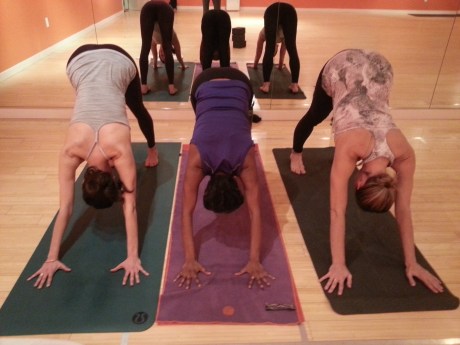
Once your mind, body, and spirit are synchronized, curl your toes under and lift your hips up in the air as you exhale. This is Downward Facing Dog (Adho Mukha Svanasana). Check your engagement of the pose. Make sure all your fingers are spread wide, with the majority of the weight/pressure in your hands moving into the thumb and first finger. (So that, there is less weight/pressure applied to your outer wrists.) When you relax your head and shoulders, make sure your big toes are parallel to each other and at least a foot apart. Big toes can be behind the thumbs or behind the middle fingers. Hips are high, heels are low (reaching, but not necessarily touching the mat); and neck is long. With the arms straight (but not hyper-extended) rotate the elbows towards the nose. Even if you have to bend your knees, find Cow Pose in this position (so that you have a straight line from your middle fingers all the way up to your hips and then a second straight line from your hips to the back of your knees). Eyes are on your nose, your belly button, or the space between your toes. Engage your locks (bandhas) as you are able. Engage the air between your arms, between your legs, and in the space beneath your body. Find something to appreciate about your mind-body at this moment and as you explore the moment.
Notice the feeling of your entire back body (including legs and feet). Spread your legs a little wider (finding similar alignment as described above) and notice how the energy changes. Again, adjust the legs bring them closer and notice where you feel the pressure of the body. Notice, also, where and how you are working the hardest to keep the spine aligned. Separating the legs wider again, adjust the alignment of the spine. Notice where and how the body works in order to maintain length in the spine. Bring the big toes back behind the thumbs or the middle fingers. Align the spine with new awareness.
Still in Downward Facing Dog, point the right toes behind you so that the tops of the toes are on the mat. Lift the leg just enough to flex the ankle so that the toes point down instead of backwards. Now, balancing the weight with both arms and the left leg) making sure you do not dump on the left side) start to mindfully lift the right heel up – as if you are drawing a line up the space behind you. Keep the outer thighs rotated in towards the space beneath the body so that the right knee and toes point down. Pause when you notice the right hip rotating the knee and the toes out to the right; then adjust to find that internal rotation and make sure weight is still balanced in all 3 standing limbs. (Note: If the left elbow starts to bend or the right hand wants to lift up, you are probably dumping the weight on the left.) Continue to lift the heel, pausing as needed, until you can no longer balance the weight and/or control the alignment of the hip. Once you reach your edge, push through the hips and the heels so that you create more space between the right hip and heel and more space between the left hip and heel. After a few breaths in Three-Legged Dog, consider exhaling into Tinkling Dog by bending the right knee and externally rotating the right hip. Still, keep the weight balanced. Play, explore, investigate and then extend the knee and rotate the hip down to return to Three-Legged Dog. Exhale to release back into Downward Facing Dog and then repeat the sequence on the left side.
NOTE: you can skip the arm balancing, by sitting down with legs stretched out in front of you for Staff Pose (Dandasana). In Staff Pose, position the arms over the head as if you are in Downward Facing Dog. Other options include “Dolphin Dog” (forearms on the mat, with elbows right under the shoulders, and hands clasped.) or you can do the pose on the wall. Either way, strongly engage your legs and your core. Notice the feeling of your entire back body (including legs and feet). If you move into Staff Pose, the leg lifts up in front of you and your awareness is focused on keeping the hips grounded and the back straight. Cues for lifting the leg in “Dolphin Dog” or when on the wall are basically the same as in the original cues above.
After the final Three-Legged Down Dog, stretch back (meaning, push your spine towards your thighs) and on an exhale walk your hands to your feet or bring your hands and feet together. Once hands are in line with the toes and heels are flat to the mat, inhale to a Half Lift/Flat Back or Extended Forward Bend. (This pose may be called Ardha Uttanasana or Urdhva Uttanasana.) Place your hands on your thighs and press the shoulders into the metaphorical back pockets. Remember, you want to engage in a similar fashion to Cow Pose, Staff Pose, and Downward Facing Dog. In fact, inhale and find a little bit of Cow Pose (even if you have to bend your knees). Now, press the heels down and – as much as you are able without losing the extension of the spine – engage the quadriceps to extend through the knees and press the thigh bones into the wall behind you. Engage your locks (bandhas) as you are able. Again, notice the feeling of your entire back body (including legs and feet). Give thanks for something about this moment.
If you have unregulated blood pressure, low back issues, eye issues like glaucoma, or if this is already challenging, remember to stay here with knees bent.
Otherwise, if it is not contraindicated, bend the knees and flex from the hips to prep Forward Bend (Uttanasana). Keeping the upper back extended, place the hands on the floor or a block and begin to extend through the legs while pressing the thigh bones into the backs of your legs. Do not force the extension. Use the exhales to settle the heart on the thighs (as much as you are able without losing the extension of the spine.) If your legs are completely straight, make sure the knee caps are lifted and that you are not hyper-extending the knees. Also double check to ensure that if the knees are straight the hips are over the knees, not behind the ankles. Remember to engage your locks (bandhas). Notice the length of the spine. Again, notice the feeling of your entire back body (including legs and feet). Let something roll off your back – and appreciate the process of releasing what no longer serves you.
Inhale to Half Lift / Flat Back and use the exhale to engage your core. With hands on the hips, maintain the length of the spine and lift up to standing. Relax your arms by your sides. Balance the weight between all four corners of both feet. Feel free to move side-to-side or back and forth on the feet until you feel you are centered. Spread the toes, press big toes and little toes down, as well as both sides of the heels. (This establishes “all four corners of both feet.”) Engage the quadriceps in order to lift the knee caps and firm up the thighs. Sit bones point down so that the pelvic bones lift up. Engage your locks (bandhas). As you press down in order to lift the sternum up, use the core abdominal muscles to draw the lower rib cage down. Relax the shoulders and gaze straight ahead. This is Equal Standing / Mountain Pose (Samasthiti/Tadasana).
Changing as little as possible, stretch the arms out like the letter T. Once your arms are wide, root down through your feet and extend out of the center of your chest. Make sure shoulders, lower rib cage, and sits bones are reaching down. Notice the air above and below your arms. Embrace yourself on an exhale, inhale stretch the arms wide and then embrace yourself again (alternating the arms with each exhale).
Now, turn the palms up and inhale your arms overhead. (Many traditions refer to this as Arms Reaching Overhead (Urdhva Hastasana), but I tend to call this Tadasana). Make sure the lower rib cage drops down as the sternum lifts up and notice how that helps you engage your core. After several breaths, lower the arms to your sides on an exhale.
While maintaining the previously established alignment and awareness of breath, use the whole inhale to lift the arms overhead and the whole exhale to press the hands together through heart center. On the exhale of the third centering breath, walk to the front of the mat with hands through heart center.
Equal Standing is like a soldier in the “Ready” position. Appreciate the fact that you are prepared for the next sequence. Moving through half of a Sun Salutation (Surya Namaskar), inhale arms over head into Arms Reaching Overhead; exhale and stretch the arms out wide as you dive between the hands into a Forward Bend; inhale to a Half Lift / Flat Back; exhale back to Forward Bend. Keeping the knees bent and the core engaged, inhale to reverse swan dive and then exhale hands back to your sides. Repeat the sequence until you feel your movement and breath are seamlessly fluid.
After the final exhale into Forward Bend, inhale into a Half Lift/ Flat Back and then step your left leg way back into a Low Lunge. Now is the time to really appreciate this moment and this pose. Make sure the feet are in two separate lanes. Inhale and extend the spine as if you are in Cow Pose of Half Lift / Flat Back. Press the right hip towards the left heel, so that the hips and sacrum are as neutral as possible. As you inhale, squeeze the thighs towards each other for external stability and then engage the locks (bandhas) for internal stability. Appreciate the effect of the effort: Allow the weight to come out of the hands. Appreciate that you are building strength and preparing your lower body for what’s to come. Notice that your heart is open and supported.
Inhale to lengthen the spine and then exhale the back knee to the mat. Give yourself cushion under the back knee, as needed. Pressing down evenly into both feet, lift your torso up and place hands on your right thigh for a variation of Crescent Lunge (Anjaneyasana).
Use an exhale to slide the hips over the back knee and then place the back of the right hand on your sacrum (the flat part of your bum/hips) and place your left hand on the front of your pelvic bones. Your hands are now bracketing your hips. Slide the back hand down in order to direct the sit bones down. You may feel the front hand lifting as the pelvic bones lift. Notice the length of your spine, especially your low back. You may also feel engagement in your left hip and thigh. Stay here or bend the front knee deeper into the lunge – remembering to maintain the space in your low back. Hands can come to your front thigh or reach the hands over head. Again, engage your locks (bandhas). Focus on the stability of the feet, legs, and hips. Focus, also, on the extension of the front of the back hip and thigh. This is the beginning of a backbend
When you are ready to move on, place the hands on the mat and step back to Child’s Pose. From Child’s Pose, you may inhale to Cow Pose or, first time through, slide your body forward so that the legs stretch out behind you. Press the tops of the feet down, push the hands into the floor beneath your shoulders and inhale into Cobra Pose (Bhujangasana). Elbows should be bent behind the back like grasshopper legs (unless you are working on a baby cobra.) Thighs are strongly engaged and pushing into the floor. Hips stay on the ground. Keep the shoulders down the back and either isometrically engage the arms – by pushing the hands down and engaging the arms as if you’re going to pull your body forward – or let your hands hover (breathing into the space between your hands and the mat). Notice how your support your heart with your feet. After a few breaths, consider extending your Cobra by pressing the hands and feet down and lifting the body up until the arms straighten. Shoulders and hips are still pressing down. Notice the difference between how the front of your lift hip and thigh feel versus the right hip and thigh. Again, notice how you are supporting your heart with your feet.
On an exhale, curl your toes under and press back to Downward Facing Dog. Repeat the sequence of standing poses (starting with the first Forward Bend after Downward Facing Dog, substituting left for right). After the Child’s Pose, you may inhale to Cow Pose, Cobra Pose, or, second time through, glide your body up and forward so that the legs stretch out behind you with the arms straight and the hips lifted away from the mat. Press the tops of the feet down, push the hands into the floor beneath your shoulders and inhale into Upward Facing Dog (Urdhva Mukha Svanasana). Thighs are strongly engaged and lifting up towards the ceiling. Kneecaps lift up towards the hips – again, so that the thighs are firm. Again, compare the feeling at the front of the hips and thighs. Again, notice how the engagement of the feet supports your heart.
After the second side of standing poses and backbends, move into Downward Facing Dog and then lift your gaze and hips (by standing on your tip toes) on an inhale. Exhale to bend your knees deeply and quietly step of “float” your feet to the outside of your hands. Turn your toes out to a 45 degree angle so that toes are down and out and heels are down and in for a squat. Knees bend deeply so that you are in a Yogi Pray Squat (hips close to the ground – or even on a block) or you can stay up high for Horse/Goddess Pose. Notice that the upper body and lower body have similar construction. Spread your fingers and press the hands together. Do the same with the toes. Push the hands together and the feet down to create more space between the elbows and the wrists, as well as with the hips and the knees. Elbows and knees are pressed back. Drop the sits bones down toward the Earth, and simultaneously lift the pubic bone and heart. This could be the beginning of several other poses: Empty your mind of those poses and focus on the current inhale and the current exhale.
Staff Pose (Dandasana). As gracefully as possible, sit down sitting down with legs stretched out in front of you. Ths pose is not disposable. Consider the length of your spine and how you use your locks (bandhas) to maintain it. Eyes are on your nose.
Keep the left leg extended and bend the right knee in order to set up the Sage Twist. Remember to keep the left heel and the right foot flat on the floor. You can place the right foot next to the inside or the outside of the left leg, as long as the knees are comfortable and the right foot is flat on the floor.
On an inhale, lift your right arm up and, as you watch it, reach the right arm back to the floor behind your hips. As you settle into the twist, adjust your left arm to provide additional support wherever you need it. You can always sit on a block and/or place a block under your hand if you’re hips and low back are really tight. If you don’t have a block, substitute a book.
Watch how you engage your base, your core, and your breath in order to lengthen your spine. Remember to start the twist in your base (not in your neck). Do not allow your body to collapse or untwist until you complete 3 – 5 complete breaths. Notice how the air moves within you and all around you. Pay particular attention to how the space shifts between your belly and legs. Give thanks for the gentle compression and massage that starts to calm your system and prepare you for the final meditation.
After the third or fifth exhale, inhale to center, give the lifted knee a squeeze, and return to Staff Pose. Repeat the Sage Twist instructions for the Sage Twist (replacing right with left).
After the third or fifth exhale on the left, inhale to center and give the lifted knee a squeeze. Bend both knees, placing the feet flat on the floor. (NOTE: If you’d rather not balance on your sits bones, lie down on your back and follow the cues.) Reach the arms forward with elbows next to the knees. Press down as if you are going to jump forward. Spread your toes, squeeze your perineum muscles together, belly button is up and back, press your shoulders down, and draw the chin towards the neck. Look up and press down to lift the ribs up on the inhale. As you exhale, lean back until the feet are off the ground and you are balancing on your tail bone. Bring legs up parallel to the ground. Check in with your locks (bandhas) – maybe even lifting the corners of your mouth up towards your ears for a smiling bandha. Begin to extend the legs by engaging the quadriceps and pushing through the heels. Keep your nose up and your eyes on your nose. This is Boat Pose (Navasana).
Find your edge, making sure your core works harder than your jaw or your arms. Give thanks. Give A LOT of thanks!
Then, lower down onto your back (with gratitude) for Corpse Pose (Savasana). Find a place where your body and mind can be still. Breathe into the space between your soles, your heart, and your soul. Follow the breath in and follow the breath out. Listen to the song the breath sings.
“Don’t be like those who ask for everything: praise, a blurb, a free ride in my rented limousine. They ask for everything but never offer anything in return.”
This opportunity to explore a poem is part of my offering for the 2018 Kiss My Asana yogathon. It is freely give it. I encourage you to set aside at least 5 minutes a day during April, to practice with the poem as inspiration. You can practice in a class or on your own, but since the Kiss My Asana yogathon raises resources as well as awareness, I invite you to join me at the donation-based class on April 28th.
I also challenge you to set aside a certain amount every day that you practice with a poem in mind. It doesn’t matter if you set aside one dollar per practice or $25 – set aside that amount each time you practice and donate it by April 30th.
Founded by Matthew Sanford, Mind Body Solutions helps those who have experienced trauma, loss, and disability find new ways to live by integrating both mind and body. They provide classes, workshops, and outreach programs. They also train yoga teachers and offer highly specialized training for health care professionals. By participating in the Kiss My Asana yogathon you join a global movement, but in a personal way. In other words, you practice yoga. Or, as this year’s tag line states, “do yoga. share yoga. help others.”
*It is very common for people to refrain from offering an American English translation of Bramcharya, the fourth yama. There is also a tendency to only associate this part of the practice with celibacy (or, as indicated by the similar Buddhist precept, “refraining from illicit sexual activity). Recognizing the observation as being connected to a higher reality, whatever that means to you at this moment, reveals that celibacy is often a by-product of the awareness.
I love you as one loves certain obscure things, secretly, between the shadow and the soul.
I love you as the plant that doesn’t bloom but carries the light of those flowers, hidden, within itself, and thanks to your love the tight aroma that arose from the earth lives dimly in my body.
One of the things I love about practicing yoga is that it is a life-long practice. I love that the practice, like a laboratory or a playground, is a safe place to explore. I love that at the heart of the practice…is more practice, which prepares you for more practice. And, I also love how each part of the philosophy prepares you for the next limb, so that, when practiced simultaneously, each limb takes you deeper and higher. My favorite analogy of this is that it’s similar to climbing a tree:
You use the lower limbs to climb up to point where you can settle in and look around. In settling in, you stand or sit on one limb, while holding on to the trunk and a second limb. You can continue climbing, climb back down, or move out to the side, all depending on how you use the limbs.
I love that even someone new to yoga can recognize it as practice. Just today, in fact, someone commented that it was helpful to think of it as a practice – rather than a habit. I love that! I love too that when you get in the frame mind of “practicing,” (rather than perfecting, or even mastering) you are forced the stay present. The body changes and the mind changes, therefore, the practice changes. Even if you practice a tradition where the sequence stays the same, everything else – including your awareness and understanding – changes from one moment to the next, one breath to the next, one pose to the next, one…. You get the idea.
Truly practicing yoga requires staying present and observing oneself. In fact, svadyaya (self study), is one of the internal observations (niyama) at the beginning of the philosophy of yoga and, as such, it is one of the cornerstones of the practice. If you study yourself, it you invest the time, you will find your practice. I say that, because I truly believe there is a practice for everybody and a practice for each and every body (and a practice for every mind). It is not “one size fits all,” despite how it sometimes appears from the magazines and boutique studios.
There are practices that use a lot of props and practices that barely use props. There are practices where people spend a lot of time lying down on their backs, practices where people spend a lot of time sitting, and practices where people spend a lot of time standing. There are practices where people hold poses for long periods of time and practices where people seem to be in perpetual movement. There are practices where people do the same thing every time and practices that change with the weather. There are practices with music, and practices without music. I could go on, but, let me step back.
In the early part of the 20th Century, when Sri Krishnamacharya started a resurgence of Hatha Yoga practice in India, people practiced together, but they practiced what they needed. So, individual practice in a group setting – something you rarely see in the States, unless you are practicing Ashtanga Mysore-style. When Krishnamacharya started sending his students out into the world to teach, they essentially taught their own personal practice: alignment-focused, vinyasa-focused, breath-focused, and person-focused. Don’t get me wrong, none of those first practices to hit the Western fell very far from the Kirshnamacharya-tree – they all include elements of alignment, vinyasa, pranayama, and individual awareness. However, there is also just enough division for the yoga traditions to look like the various schisms which produced Protestant churches.
And, personally, I love that! Not the division. No, I love that there are so many styles and traditions – so many paths.
all the many paths that lead into / the light that shines bright inside of me and you
Pick up a copy of B. K. S. Iyengar’s Light on Yoga and you will find poses and sequences for targeting certain body parts, various ailments, and for people who want to progress in the practice. Pick up Iyengar’s Yoga: The Path to Holistic Health and you will find the same type of information, plus details on to use props in order to enhance your practice. Pick up David Swenson’s Ashtanga Yoga: The Practice Manual and you will find detailed instructions on how to modify (and progress) within one of the most physically vigorous physical practices. Pick up T. K. V. Desikachar’s The Heart of Yoga or Sharon Gannon and David Life’s Jivamukti Yoga and you will find the physical practice mixing with the philosophy in a way that takes if off the mat. Pick up Judith Lasater’s Living Your Yoga: Finding the Spiritual in Everyday Life or Sarah Power’s Insight Yoga and now, the practice is clearly meditation. Pick up Jinjer’s Stanton’s Yoga For Every Room in Your Houseand you quite literally discover that you can practice yoga anywhere!
On and on it goes – and that’s the point. The practice is perpetual and eternal – if you practice. But it is way too easy not to practice.
I was fortunate in that my first teachers were like Yoda: they focused on what a person could do. They didn’t focus on what they (the teacher) could practice; they focused on what each individual could practice. We were still challenged, but we were challenged in a way that encouraged us to play, explore, study, and practice. The result of such engagement was an awareness of all the different ways someone could practice. And, that awareness, led to a deep acceptance – which is the path to true love.
“I love you like this because I don’t know any other way to love, except in this form in which I am not nor are you,”
– from One Hundred Love Sonnets: XVII by Pablo Neruda (translated by Mark Eisner)
One Hundred Love Sonnets: XVII by Pablo Neruda (translated by Mike Eisner)
(Practice Time ~ 20 – 30 minutes)
Very deliberately and mindfully place yourself in Child’s Pose (Balasana). Notice how you are supported – how the body rests between or on the legs. Make sure your knees are comfortable, and remember that you can always place a cushion under the knees, under the hips, or under the chest. Breathe into your heart and consider what you can appreciate about this moment. Be present with the sensations/information in and around your body. Bring awareness to your feet. Notice what you can love about your body and your mind in this position.
Start to engage your locks (bandhas) on the exhale: spread the toes and press the feet down (in this case tops of the feet down) for the Foot Lock (Pada Bandha); squeeze the perineum muscles together, lifting the pelvic floor for the Root Lock (Mula Bandha) – which engages your lower abdominal cavity; belly button up and back for abdominal core lock (Uddiyana Bandha) – which engages your upper abdominal cavity; draw the chin towards the throat and chest, lengthening the neck, for the Throat Lock (Jalandhara Bandha). Notice your awareness of your body when the locks (bandhas) are engaged versus when they are released.
Once you’ve engaged your mind-body-spirit, move into Table Top: stack shoulders over elbows, elbows over wrists, hips over knees. Press down to lift up, activating the arms, the legs, and the lower three (3) locks. Notice the length of the spine, and how you support it. Notice the air again shifting around you. Move through Cat/Cow or the “Un-Cat” sequence precisely matching the movement to the breath. Move from your core so that the gaze is the last thing to come up and the last thing to turn down. Move, as if this is your favorite part of the practice and you are savoring it.
Once your mind, body, and spirit are synchronized, curl your toes under and exhale into Downward Facing Dog (Adho Mukha Svanasana). Double check your engagement of the pose. Make sure all your fingers are spread wide, with the majority of the weight/pressure in your hands moving into the thumb and first finger. (So that, there is less weight/pressure applied to your outer wrists.) When you relax your head and shoulders, make sure your big toes are parallel to each other and at least a foot apart. Big toes can be behind the thumbs or behind the middle fingers. Hips are high, heels are low (reaching, but not necessarily touching the mat); and neck is long. With the arms straight (but not hyper-extended) rotate the elbows towards the nose. Even if you have to bend your knees, find Cow Pose in this position (so that you have a straight line from your middle fingers all the way up to your hips and then a second straight line from your hips to the back of your knees). Eyes are on your nose, your belly button, or the space between your toes. Engage your locks (bandhas) as you are able. Engage the air between your arms, between your legs, and in the space beneath your body. Find something to appreciate about your mind-body at this moment and as you explore the moment.
Notice the feeling of your entire back body (including legs and feet). Spread your legs a little wider (finding similar alignment as described above) and notice how the energy changes. Again, adjust the legs bring them closer and notice where you feel the pressure of the body. Notice, also, where and how you are working the hardest to keep the spine aligned. Separating the legs wider again, adjust the alignment of the spine. Notice where and how the body works in order to maintain length in the spine. Bring the big toes back behind the thumbs or the middle fingers. Align the spine with new awareness.
Still in Downward Facing Dog, point the right toes behind you so that the tops of the toes are on the mat. Lift the leg just enough to flex the ankle so that the toes point down instead of backwards. Now, balancing the weight with both arms and the left leg) making sure you do not dump on the left side) start to mindfully lift the right heel up – as if you are drawing a line up the space behind you. Keep the outer thighs rotated in towards the space beneath the body so that the right knee and toes point down. Pause when you notice the right hip rotating the knee and the toes out to the right; then adjust to find that internal rotation and make sure weight is still balanced in all 3 standing limbs. (Note: If the left elbow starts to bend or the right hand wants to lift up, you are probably dumping the weight on the left.) Continue to lift the heel, pausing as needed, until you can no longer balance the weight and/or control the alignment of the hip. Once you reach your edge, push through the hips and the heels so that you create more space between the right hip and heel and more space between the left hip and heel. After a few breaths in Three-Legged Dog, consider exhaling into Tinkling Dog by bending the right knee and externally rotating the right hip. Still, keep the weight balanced. Play, explore, investigate and then extend the knee and rotate the hip down to return to Three-Legged Dog. Exhale to release back into Downward Facing Dog and then repeat the sequence on the left side.
Remember you can skip the arm balancing, by moving into Staff Pose (Dandasana) and positioning the arms accordingly or using “Dolphin Dog.” Another modification would be to do the pose on the wall. Either way, strongly engage your legs and your core. Notice the feeling of your entire back body (including legs and feet). If you move into Staff Pose, the leg lifts up in front of you and your awareness is focused on keeping the hips grounded and the back straight. Cues for lifting the leg in “Dolphin Dog” or when on the wall are basically the same as in the original cues above.
After the final Three-Legged Down Dog, stretch back (meaning, push your spine towards your thighs) and on an exhale walk your hands to your feet or bring your hands and feet together. Once hands are in line with the toes and heels are flat to the mat, inhale to a Half Lift/Flat Back or Extended Forward Bend. (This pose may be called Ardha Uttanasana or Urdhva Uttanasana.) Place your hands on your thighs and press the shoulders into the metaphorical back pockets. Remember, you want to engage in a similar fashion to Cow Pose, Staff Pose, and Downward Facing Dog. In fact, inhale and find a little bit of Cow Pose (even if you have to bend your knees). Now, press the heels down and – as much as you are able without losing the extension of the spine – engage the quadriceps to extend through the knees and press the thigh bones into the wall behind you. Engage your locks (bandhas) as you are able. Again, notice the feeling of your entire back body (including legs and feet). Give thanks for something about this moment.
If you have unregulated blood pressure, low back issues, eye issues like glaucoma, or if this is already challenging, remember to stay here with knees bent.
Otherwise, if it is not contraindicated, bend the knees and flex from the hips to prep Forward Bend (Uttanasana). Keeping the upper back extended, place the hands on the floor or a block and begin to extend through the legs while pressing the thigh bones into the backs of your legs. Do not force the extension. Use the exhales to settle the heart on the thighs (as much as you are able without losing the extension of the spine.) If your legs are completely straight, make sure the knee caps are lifted and that you are not hyper-extending the knees. Also double check to ensure that if the knees are straight the hips are over the knees, not behind the ankles. Remember to engage your locks (bandhas). Notice the length of the spine. Again, notice the feeling of your entire back body (including legs and feet). Let something roll off your back – and appreciate the process of releasing what no longer serves you.
Inhale to Half Lift / Flat Back and use the exhale to engage your core. With hands on the hips, maintain the length of the spine and lift up to standing. Relax your arms by your sides. Balance the weight between all four corners of both feet. Feel free to move side-to-side or back and forth on the feet until you feel you are centered. Spread the toes, press big toes and little toes down, as well as both sides of the heels. (This establishes “all four corners of both feet.”) Engage the quadriceps in order to lift the knee caps and firm up the thighs. Sit bones point down so that the pelvic bones lift up. Engage your locks (bandhas). As you press down in order to lift the sternum up, use the core abdominal muscles to draw the lower rib cage down. Relax the shoulders and gaze straight ahead. This is Equal Standing / Mountain Pose (Samasthiti/Tadasana).
Changing as little as possible, stretch the arms out like the letter T. Once your arms are wide, root down through your feet and extend out of the center of your chest. Make sure shoulders, lower rib cage, and sits bones are reaching down. Notice the air above and below your arms. Embrace yourself on an exhale, inhale stretch the arms wide and then embrace yourself again (alternating the arms with each exhale).
Now, turn the palms up and inhale your arms overhead. (Many traditions refer to this as Arms Reaching Overhead (Urdhva Hastasana), but I tend to call this Tadasana). Make sure the lower rib cage drops down as the sternum lifts up and notice how that helps you engage your core. After several breaths, lower the arms to your sides on an exhale.
Maintaining the previously established alignment and awareness of breath, use the whole inhale to lift the arms overhead and the whole exhale to press the hands together through heart center. On the exhale of the third centering breath, walk to the front of the mat with hands through heart center.
Equal Standing is like a soldier in the “Ready” position. Appreciate the fact that you are prepared for the next sequence. Moving through half of a Sun Salutation (Surya Namaskar), inhale arms over head into Arms Reaching Overhead; exhale and stretch the arms out wide as you dive between the hands into a Forward Bend; inhale to a Half Lift / Flat Back; exhale back to Forward Bend. Keeping the knees bent and the core engaged, inhale to reverse swan dive and then exhale hands back to your sides. Repeat the sequence until you feel your movement and breath are seamlessly fluid.
After the final exhale into Forward Bend, inhale into a Half Lift/ Flat Back and then step your left leg way back into a Low Lunge. Now is the time to really appreciate this moment and this pose. Make sure the feet are in two separate lanes. Inhale and extend the spine as if you are in Cow Pose of Half Lift / Flat Back. Press the right hip towards the left heel, so that the hips and sacrum are as neutral as possible. As you inhale, squeeze the thighs towards each other for external stability and then engage the locks (bandhas) for internal stability. Appreciate the effect of the effort: Allow the weight to come out of the hands. Appreciate that you are building strength and preparing your lower body for what’s to come. Notice that your heart is open and supported.
Inhale to lengthen the spine and then exhale the back knee to the mat. Give yourself cushion under the back knee, as needed. Pressing down evenly into both feet, lift your torso up and place hands on your right thigh for a variation of Crescent Lunge (Anjaneyasana).
Use an exhale to slide the hips over the back knee and then place the back of the right hand on your sacrum (the flat part of your bum/hips) and place your left hand on the front of your pelvic bones. Your hands are now bracketing your hips. Slide the back hand down in order to direct the sit bones down. You may feel the front hand lifting as the pelvic bones lift. Notice the length of your spine, especially your low back. You may also feel engagement in your left hip and thigh. Stay here or bend the front knee deeper into the lunge – remembering to maintain the space in your low back. Hands can come to your front thigh or reach the hands over head. Again, engage your locks (bandhas). Focus on the stability of the feet, legs, and hips. Focus, also, on the extension of the front of the back hip and thigh. This is the beginning of a backbend. Again, appreciate this bit of vinyasa-krama (step-by-step progression).
When you are ready to move on, place the hands on the mat and step back to Child’s Pose. From Child’s Pose, you may inhale to Cow Pose or, first time through, slide your body forward so that the legs stretch out behind you. Press the tops of the feet down, push the hands into the floor beneath your shoulders and inhale into Cobra Pose (Bhujangasana). Elbows should be bent behind the back like grasshopper legs (unless you are working on a baby cobra.) Thighs are strongly engaged and pushing into the floor. Hips stay on the ground. Keep the shoulders down the back and either isometrically engage the arms – by pushing the hands down and engaging the arms as if you’re going to pull your body forward – or let your hands hover (breathing into the space between your hands and the mat). Notice how your support your heart with your feet. After a few breaths, consider extending your Cobra by pressing the hands and feet down and lifting the body up until the arms straighten. Shoulders and hips are still pressing down. Notice the difference between how the front of your lift hip and thigh feel versus the right hip and thigh. Again, notice how you are supporting your heart with your feet.
On an exhale, curl your toes under and press back to Downward Facing Dog. Repeat the sequence of standing poses (starting with the first Forward Bend after Downward Facing Dog, substituting left for right). After the Child’s Pose, you may inhale to Cow Pose, Cobra Pose, or, second time through, glide your body up and forward so that the legs stretch out behind you with the arms straight and the hips lifted away from the mat. Press the tops of the feet down, push the hands into the floor beneath your shoulders and inhale into Upward Facing Dog (Urdhva Mukha Svanasana). Thighs are strongly engaged and lifting up towards the ceiling. Kneecaps lift up towards the hips – again, so that the thighs are firm. Again, compare the feeling at the front of the hips and thighs. Again, notice how the engagement of the feet supports your heart.
After the second side of standing poses and backbends, move into Downward Facing Dog, and then into Staff Pose (Dandasana). Sitting tall with legs stretched out in front of you: remember, this pose is not disposable. Consider the length of your spine and how you use your locks (bandhas) to maintain it.
Keep the left leg extended and bend the right knee in order to set up the Sage Twist. Remember to keep the left heel and the right foot flat on the floor. You can place the right foot next to the inside or the outside of the left leg, as long as the knees are comfortable and the right foot is flat on the floor.
On an inhale, lift your right arm up and, as you watch it, reach the right arm back to the floor behind your hips. As you settle into the twist, adjust your left arm to provide additional support wherever you need it. You can always sit on a block and/or place a block under your hand if you’re hips and low back are really tight. If you don’t have a block, substitute a book.
Watch how you engage your base, your core, and your breath in order to lengthen your spine. Remember to start the twist in your base (not in your neck). Do not allow your body to collapse or untwist until you complete 3 – 5 complete breaths. Notice how the air moves within you and all around you. Pay particular attention to how the space shifts between your belly and legs. Give thanks for the gentle compression and massage that starts to calm your system and prepare you for the final meditation.
After the third or fifth exhale, inhale to center, give the lifted knee a squeeze, and return to Staff Pose. Repeat the Sage Twist instructions for the Sage Twist (replacing right with left).
After the third or fifth exhale on the left, inhale to center and give the lifted knee a squeeze. Bend both knees, placing the feet flat on the floor. (NOTE: If you’d rather not balance on your sits bones, lie down on your back and follow the cues.) Reach the arms forward with elbows next to the knees. Press down as if you are going to jump forward. Spread your toes, squeeze your perineum muscles together, belly button is up and back, press your shoulders down, and draw the chin towards the neck. Look up and press down to lift the ribs up on the inhale. As you exhale, lean back until the feet are off the ground and you are balancing on your tail bone. Bring legs up parallel to the ground. Check in with your locks (bandhas) – maybe even lifting the corners of your mouth up towards your ears for a smiling bandha. Begin to extend the legs by engaging the quadriceps and pushing through the heels. Keep your nose up and your eyes on your nose. This is Boat Pose (Navasana).
Find your edge, making sure your core works harder than your jaw or your arms. Give thanks. Give A LOT of thanks!
Then, lower down onto your back (with gratitude) for Corpse Pose (Savasana). Find a place where your body and mind can be still. Breathe into the space between your soles, your heart, and your soul. Take a moment to notice how falling in love with your practice allows you to fall in love with yourself.
This opportunity to explore a poem on the mat is a giant Easter egg (because it’s Valentine’s in April) and part of my offering for the 2018 Kiss My Asana yogathon. I encourage you to set aside at least 5 minutes a day during April, to practice with the poem as inspiration. You can practice in a class or on your own, but since the Kiss My Asana yogathon raises resources as well as awareness, I invite you to join me at the donation-based class on April 28th.
I also challenge you to set aside a certain amount every day that you practice with a poem in mind. It doesn’t matter if you set aside one dollar per practice or $25 – set aside that amount each time you practice and donate it by April 30th.
Founded by Matthew Sanford, Mind Body Solutions helps those who have experienced trauma, loss, and disability find new ways to live by integrating both mind and body. They provide classes, workshops, and outreach programs. They also train yoga teachers and offer highly specialized training for health care professionals. By participating in the Kiss My Asana yogathon you join a global movement, but in a personal way. In other words, you practice yoga. Or, as this year’s tag line states….
Humans are sensational beings; in that, we are beings full of sensation. And there is no shortage of sensation on the mat. We feel our clothes and the mat, the floor, or the cushion. We feel the fluctuating temperature of the breath and the body. We feel weight in our shoulders or soreness in our joints. We feel… That’s what we humans do. But we don’t just feel physical sensations. We also feel things mentally, physically, and emotionally – and all of that sensation is also information.
Whether we are feeling wonderful or puny, weak or strong, flexible or stiff, wise or ignorant, it’s important to be grateful for the sensation/information, because the sensation/information informs the practice. Even misinformation can inform the practice, but that’s not the big problem with teaching yoga.
The big problem with teaching yoga is articulating what we feel when we’re on the mat, while simultaneously holding space for what other people feel on the mat. It’s a matter, to quote Nikki Giovanni, of feeling despite what we think “we should feel.”
On any given day, someone will ask me some variation of the question, “What should I be feeling in…?” As an English major (and the daughter of my parents to boot), my first instinct is to offer some powerful purple prose describing what is happening in the pose – anatomically – and how that feels in my body. My description might be helpful – especially if the person in question is practicing in my body or practicing in my mind. However, since they are not – ever – my response can be problematic. Instead of being helpful and informative, the words I choose may cause the practitioner to feel they are doing something wrong and that they need to adjust their pose. Sometimes, the thought that their pose is not quite right can also lead to the second arrow…they start to think they need to fix their body.
As a teacher of asana, I am not alone in this quandary. Some teachers avoid the issue by never telling people what they should/could/will feel in a pose. Others have an uncanny knack for going to the other extreme. A more skillful middle ground would be channeling Dharma Yoga teacher Kim Jeblick and saying some variation of, “I don’t know. Come into the pose. Now, tell me: What are you feeling?”
Because everybody’s body is different, everybody is going to feel something different. There is no shortage of sensation on the mat: Even if you’re paralyzed.
His book Waking describes Matthew Sanford’s experiences being paralyzed at the age of 13 and the subsequent journey that led him to yoga. The book is full of sensation – it is also full of people telling Sanford, and themselves, that he can’t feel anything. Not feeling is the beginning of the story and, it could have been the end, except, Sanford was aware of feeling presence. Somehow he understood that the feeling of presence was an intimate connection between his mind and his upper body. His lower body, however, presented itself as a brick wall, a place where he was not present:
“I am now living in a body that presents silence rather than tangible sensation…. This silence that I perceive within my body came upon me abruptly through a spinal cord injury. For most people, however, the process is slower. It develops through aging. Over time, the body becomes slower to respond, more likely to sit at rest, more content to observe rather than act. But, in each case, the fundamental healing question remains the same: What aspect of consciousness will transverse the increasing gap between the mind and body? The answer will depend upon our healing stories.”*
Sanford goes on to describe how “I hear(s) silence where there is pain” as a means of protection. This is 60 pages in; it’s still the beginning of the story.
As the story continues, Sanford describes an exploration of presence, which is also an exploration of sensation/information – which is also an exploration of the intimate energetic connection between the mind and the body. This awareness of intimacy, plus the alignment knowledge that comes from Iyengar, is what now informs Sanford’s practice, as well as his teaching.
His awareness of presence is also what makes Sanford such a powerful teacher. While other teachers struggle to define how the pose feels on the outside (in order to feel something on the inside), Sanford focuses on the inner sensations and “how the physical instructions are intended to amplify, guide, and direct the flow of energy. When I teach, I give instructions and then I observe not just whether the physical actions are occurring, but also whether the intended energetic release is happening through the student’s mind-body relationship.”
As I post this, I have been practicing yoga for 18 of my 49+ years. The only thing I have been doing longer is reading and being a black woman.
“If I could make a wish I’d wish for all the knowledge of all the world. Black may be beautiful Professor Micheau says but knowledge is power.
– from The Laws of Motion by Nikki Giovanni
The Laws of Motion & The Song of the Feet by Nikki Giovanni (Practice Time: ~ 15 – 20 minutes)
Very deliberately and mindfully place yourself in Child’s Pose (Balasana). Notice how you are supported – how the body rests between or on the legs. Make sure your knees are comfortable, and remember that you can always place a cushion under the knees, under the hips, or under the chest. Notice where you feel heaviness and notice where you feel lightness. Notice how your head rests so that your neck can lengthen. Breathe and notice how the body expands on the inhale, settles on the exhale. Be present with the sensations/information in and around your body. Bring awareness to your feet.
Start to engage your locks (bandhas) on the exhale: spread the toes and press the feet down (in this case tops of the feet down) for the Foot Lock (Pada Bandha); squeeze the perineum muscles together, lifting the pelvic floor for the Root Lock (Mula Bandha) – which engages your lower abdominal cavity; belly button up and back for abdominal core lock (Uddiyana Bandha) – which engages your upper abdominal cavity; draw the chin towards the throat and chest, lengthening the neck, for the Throat Lock (Jalandhara Bandha). Notice your awareness of your body when the locks (bandhas) are engaged versus when they are released.
Once you’ve engaged your mind-body-spirit, move into Table Top: stack shoulders over elbows, elbows over wrists, hips over knees. Press down to lift up, activating the arms, the legs, and the lower three (3) locks. Notice the length of the spine, and how you support it. Notice the air again shifting around you. Move through Cat/Cow or the “Un-Cat” sequence precisely matching the movement to the breath. Move from your core so that the gaze is the last thing to come up and the last thing to turn down.
Once your mind, body, and spirit are synchronized, curl your toes under and exhale into Downward Facing Dog (Adho Mukha Svanasana). Double check your engagement of the pose. Make sure all your fingers are spread wide, with the majority of the weight/pressure in your hands moving into the thumb and first finger. (So that, there is less weight/pressure applied to your outer wrists.) When you relax your head and shoulders, make sure your big toes are parallel to each other and at least a foot apart. Big toes can be behind the thumbs or behind the middle fingers. Hips are high, heels are low (reaching, but not necessarily touching the mat); and neck is long. With the arms straight (but not hyper-extended) rotate the elbows towards the nose. Even if you have to bend your knees, find Cow Pose in this position (so that you have a straight line from your middle fingers all the way up to your hips and then a second straight line from your hips to the back of your knees). Eyes are on your nose, your belly button, or the space between your toes. Engage your locks (bandhas) as you are able. Engage the air between your arms, between your legs, and in the space beneath your body.
Notice the feeling of your entire back body (including legs and feet). Spread your legs a little wider (finding similar alignment as described above) and notice how the energy changes. Again, adjust the legs bring them closer and notice where you feel the pressure of the body. Notice, also, where and how you are working the hardest to keep the spine aligned. Separating the legs wider again, adjust the alignment of the spine. Notice where and how the body works in order to maintain length in the spine. Bring the big toes back behind the thumbs or the middle fingers. Align the spine with new awareness.
Still in Downward Facing Dog, point the right toes behind you so that the tops of the toes are on the mat. Lift the leg just enough to flex the ankle so that the toes point down instead of backwards. Now, balancing the weight with both arms and the left leg) making sure you do not dump on the left side) start to mindfully lift the right heel up – as if you are drawing a line up the space behind you. Keep the outer thighs rotated in towards the space beneath the body so that the right knee and toes point down. Pause when you notice the right hip rotating the knee and the toes out to the right; then adjust to find that internal rotation and make sure weight is still balanced in all 3 standing limbs. (Note: If the left elbow starts to bend or the right hand wants to lift up, you are probably dumping the weight on the left.) Continue to lift the heel, pausing as needed, until you can no longer balance the weight and/or control the alignment of the hip. Once you reach your edge, push through the hips and the heels so that you create more space between the right hip and heel and more space between the left hip and heel. After a few breaths in Three-Legged Dog, consider exhaling into Tinkling Dog by bending the right knee and externally rotating the right hip. Still, keep the weight balanced. Play, explore, investigate and then extend the knee and rotate the hip down to return to Three-Legged Dog. Exhale to release back into Downward Facing Dog and then repeat the sequence on the left side.
Remember you can skip the arm balancing, by moving into Staff Pose (Dandasana) and positioning the arms accordingly or using “Dolphin Dog.” Another modification would be to do the pose on the wall. Either way, strongly engage your legs and your core. Notice the feeling of your entire back body (including legs and feet). If you move into Staff Pose, the leg lifts up in front of you and your awareness is focused on keeping the hips grounded and the back straight. Cues for lifting the leg in “Dolphin Dog” or when on the wall are basically the same as in the original cues above.
After the final Three-Legged Down Dog, stretch back (meaning, push your spine towards your thighs) and on an exhale walk your hands to your feet or bring your hands and feet together. Once hands are in line with the toes and heels are flat to the mat, inhale to a Half Lift/Flat Back or Extended Forward Bend. (This pose may be called Ardha Uttanasana or Urdhva Uttanasana.) Place your hands on your thighs and press the shoulders into the metaphorical back pockets. Remember, you want to engage in a similar fashion to Cow Pose, Staff Pose, and Downward Facing Dog. In fact, inhale and find a little bit of Cow Pose (even if you have to bend your knees). Now, press the heels down and – as much as you are able without losing the extension of the spine – engage the quadriceps to extend through the knees and press the thigh bones into the wall behind you. Engage your locks (bandhas) as you are able. Again, notice the feeling of your entire back body (including legs and feet).
If you have unregulated blood pressure, low back issues, eye issues like glaucoma, or if this is already challenging, remember to stay here with knees bent.
Otherwise, if it is not contraindicated, bend the knees and flex from the hips to prep Forward Bend (Uttanasana). Keeping the upper back extended, place the hands on the floor or a block and begin to extend through the legs while pressing the thigh bones into the backs of your legs. Do not force the extension. Use the exhales to settle the heart on the thighs (as much as you are able without losing the extension of the spine.) If your legs are completely straight, make sure the knee caps are lifted and that you are not hyper-extending the knees. Also double check to ensure that if the knees are straight the hips are over the knees, not behind the ankles. Remember to engage your locks (bandhas). Notice the length of the spine. Again, notice the feeling of your entire back body (including legs and feet).
Inhale to Half Lift / Flat Back and use the exhale to engage your core. With hands on the hips, maintain the length of the spine and lift up to standing. Relax your arms by your sides. Balance the weight between all four corners of both feet. Feel free to move side-to-side or back and forth on the feet until you feel you are centered. Spread the toes, press big toes and little toes down, as well as both sides of the heels. (This establishes “all four corners of both feet.”) Engage the quadriceps in order to lift the knee caps and firm up the thighs. Sit bones point down so that the pelvic bones lift up. Engage your locks (bandhas). As you press down in order to lift the sternum up, use the core abdominal muscles to draw the lower rib cage down. Relax the shoulders and gaze straight ahead. This is Equal Standing / Mountain Pose (Samasthiti/Tadasana).
Changing as little as possible, stretch the arms out like the letter T. Once your arms are wide, root down through your feet and extend out of the center of your chest. Make sure shoulders, lower rib cage, and sits bones are reaching down. Notice the air above and below your arms. Now, turn the palms up and inhale your arms overhead. (Many traditions refer to this as Arms Reaching Overhead (Urdhva Hastasana), but I tend to call this Tadasana). Make sure the lower rib cage drops down as the sternum lifts up and notice how that helps you engage your core. After several breaths, lower the arms to your sides on an exhale.
Now, maintaining the previously established alignment and awareness of breath, use the whole inhale to lift the arms overhead and the whole exhale to press the hands together through heart center. On the exhale of the third centering breath, walk to the front of the mat with hands through heart center.
Equal Standing is like a soldier in the “Ready” position. Moving through half of a Sun Salutation (Surya Namaskar), inhale arms over head into Arms Reaching Overhead; exhale and stretch the arms out wide as you dive between the hands into a Forward Bend; inhale to a Half Lift / Flat Back; exhale back to Forward Bend. Keeping the knees bent and the core engaged, inhale to reverse swan dive and then exhale hands back to your sides. Repeat the sequence until you feel your movement and breath are seamlessly fluid.
After the final exhale into Forward Bend, inhale into a Half Lift/ Flat Back and then step your left leg way back into a low lunge. Make sure the feet are in two separate lanes. Inhale to lengthen the spine and then exhale the back knee to the mat. Give yourself cushion under the back knee, as needed. Pressing down evenly into both feet, lift your torso up and place hands on your right thigh for a variation of Crescent Lunge (Anjaneyasana).
Use an exhale to slide the hips over the back knee and then place the back of the right hand on your sacrum (the flat part of your bum/hips) and place your left hand on the front of your pelvic bones. Your hands are now bracketing your hips. Slide the back hand down in order to direct the sit bones down. You may feel the front hand lifting as the pelvic bones lift. Notice the length of your spine, especially your low back. You may also feel engagement in your left hip and thigh. Stay here or bend the front knee deeper into the lunge – remembering to maintain the space in your low back. Hands can come to your front thigh or reach the hands over head. Again, engage your locks (bandhas). Focus on the stability of the feet, legs, and hips. Focus, also, on the extension of the front of the back hip and thigh. This is the beginning of a backbend.
When you are ready to move on, place the hands on the mat and step back to Child’s Pose. From Child’s Pose, you may inhale to Cow Pose or, first time through, slide your body forward so that the legs stretch out behind you. Press the tops of the feet down, push the hands into the floor beneath your shoulders and inhale into Cobra Pose (Bhujangasana). Elbows should be bent behind the back like grasshopper legs (unless you are working on a baby cobra.) Thighs are strongly engaged and pushing into the floor. Hips stay on the ground. Keep the shoulders down the back and either isometrically engage the arms – by pushing the hands down and engaging the arms as if you’re going to pull your body forward – or let your hands hover (breathing into the space between your hands and the mat). Notice how your support your heart with your feet. After a few breaths, consider extending your Cobra by pressing the hands and feet down and lifting the body up until the arms straighten. Shoulders and hips are still pressing down. Notice the difference between how the front of your lift hip and thigh feel versus the right hip and thigh. Again, notice how you are supporting your heart with your feet.
On an exhale, curl your toes under and press back to Downward Facing Dog. Repeat the sequence of standing poses (starting with the first Forward Bend after Downward Facing Dog, substituting left for right). After the Child’s Pose, you may inhale to Cow Pose, Cobra Pose, or, second time through, glide your body up and forward so that the legs stretch out behind you with the arms straight and the hips lifted away from the mat. Press the tops of the feet down, push the hands into the floor beneath your shoulders and inhale into Upward Facing Dog (Urdhva Mukha Svanasana). Thighs are strongly engaged and lifting up towards the ceiling. Kneecaps lift up towards the hips – again, so that the thighs are firm. Again, compare the feeling at the front of the hips and thighs. Again, notice how the engagement of the feet supports your heart.
After the second side of standing poses and backbends, move into Downward Facing Dog, and then into Staff Pose (Dandasana). Sitting tall with legs stretched out in front of you: remember, this pose is not disposable. Consider the length of your spine and how you use your locks (bandhas) to maintain it.
Keep the left leg extended and bend the right knee in order to set up the Sage Twist. Remember to keep the left heel and the right foot flat on the floor. You can place the right foot next to the inside or the outside of the left leg, as long as the knees are comfortable and the right foot is flat on the floor.
On an inhale, lift your right arm up and, as you watch it, reach the right arm back to the floor behind your hips. As you settle into the twist, adjust your left arm to provide additional support wherever you need it. You can always sit on a block and/or place a block under your hand if you’re hips and low back are really tight. If you don’t have a block, substitute a book.
Watch how you engage your base, your core, and your breath in order to lengthen your spine. Remember to start the twist in your base (not in your neck). Do not allow your body to collapse or untwist until you complete 3 – 5 complete breaths. Notice how the air moves within you and all around you. Pay particular attention to how the space shifts between your belly and legs. After the third or fifth exhale, inhale to center, give the lifted knee a squeeze, and return to Staff Pose. Repeat the Sage Twist instructions for the Sage Twist (replacing right with left).
After the third or fifth exhale on the left, inhale to center and give the lifted knee a squeeze. Bend both knees, placing the feet flat on the floor. (NOTE: If you’d rather not balance on your sits bones, lie down on your back and follow the cues.) Reach the arms forward with elbows next to the knees. Press down as if you are going to jump forward. Spread your toes, squeeze your perineum muscles together, belly button is up and back, press your shoulders down, and draw the chin towards the neck. Look up and press down to lift the ribs up on the inhale. As you exhale, lean back until the feet are off the ground and you are balancing on your tail bone. Bring legs up parallel to the ground. Check in with your locks (bandhas) – maybe even lifting the corners of your mouth up towards your ears for a smiling bandha. Begin to extend the legs by engaging the quadriceps and pushing through the heels. Keep your nose up and your eyes on your nose. This is Boat Pose (Navasana).
Find your edge, making sure your core works harder than your jaw or your arms. And then, lower down onto your back for Corpse Pose (Savasana). Find a place where your body and mind can be still. Breathe into the space between your soles, your heart, and your soul. Again and again, this practice comes back to the roots, back to the feet. Just as Rabbi Abraham Joshua Heschel did in 1965, give thanks for your feet and how they support your heart.
“It is appropriate that I sing The song of the feet
The weight of the body And what the body chooses to bear Fall on me”
This opportunity to explore a poem on the mat is part of my offering for the 2018 Kiss My Asana yogathon. I encourage you to set aside at least 5 minutes a day during April, to practice with the poem as inspiration. You can practice in a class or on your own, but since the Kiss My Asana yogathon raises resources as well as awareness, I invite you to join me at the donation-based class on April 28th.
I also challenge you to set aside a certain amount every day that you practice with a poem in mind. It doesn’t matter if you set aside one dollar per practice or $25 – set aside that amount each time you practice and donate it by April 30th.
Founded by Matthew Sanford, Mind Body Solutions helps those who have experienced trauma, loss, and disability find new ways to live by integrating both mind and body. They provide classes, workshops, and outreach programs. They also train yoga teachers and offer highly specialized training for health care professionals. By participating in the Kiss My Asana yogathon you join a global movement, but in a personal way. In other words, you practice yoga. Or, as this year’s tag line states, “do yoga. share yoga. help others.”
* Matthew Sanford defines “healing stories” as “…the stories we have come to believe that shape how we think about the world, ourselves, and our place in it.”
“As far as I can tell, daughter, it works like this: You buy bread from a grocery, a bag of apples From a fruit stand, and what coins Are passed on helps others buy pencils, glue, Tickets to a movie in which laughter Is thrown into their faces. If we buy a goldfish, someone tries on a hat. If we buy crayons, someone walks home with a broom. A tip, a small purchase here and there, And things just keep going. I guess.”
If you practice yoga (or anything) long enough – sometimes it only takes a few seconds, sometimes a few hours, sometimes days, sometimes months – you start to notice how things work. If you practice yoga (or anything) long enough – sometimes it only takes a few minutes, sometime a few weeks, sometimes years, sometimes a lifetime – you start to notice how everything is connected. The awareness of interconnectedness develops on and off the mat.
But, let us just begin with awareness on the mat.
The physical practice, hatha yoga, regardless of the style or tradition, is a combination of the third limb of the philosophy (asana, seat) and the fourth limb (pranayama, awareness or extension of breath/life force). Again, regardless of the style or tradition, building a pose starts with establishing a base – that’s the seat – and then building from the ground up so that you can breathe – that’s the awareness of breath. This makes sense, right? I mean, a carpenter does not build a house by magically floating a chandelier over an empty space and then building the ceiling, followed by the walls, and then the foundation. And, even if they used a crane instead of magic (to hold up the chandelier) at some point they have to figure out a way to remove the crane. One method makes sense, and is sustainable. One method might be a fun experiment, but eventually leads to chaos and a big mess.
Vinyasa is a technique as well as a very popular style of physical practice in the West. It involves the linking of breath and poses, but the way in which it is practiced can look and feel very different – depending on how and why things are connected. When we think of vinyasa as “flow,” instead of the literal “to place in a special way,” we may miss why some poses feel natural when linked together and why other sequences feel awkward and clunky.
Vinyasa karma is the science of placing things in a (special) way that leads to a step-by-step progression towards a goal. There is an element of vinyasa karma in every good practice – even when the practice is not a vinyasa practice. Here, I am defining a “good” practice as being one where you feel your time on the mat was well spent and that time leaves you feeling more connected. And, over time, you may notice that it is the sequencing of poses which creates that sense of connectedness.
Sequencing can also help us gain more awareness of how things work, because it brings our awareness to how we prepare. When we are focused only on the outside of the body, and not on the inner engagement or the breath, we miss the opportunity to prepare for the next pose or the next breath. Yes, the body and the mind can do amazing things – including, if we desire it enough, contort into one pretzel shape after another – but, some amazing feats are not sustainable.
For instance, if a non-dancer or non-gymnast starts off a physical practice with a big back bend like Camel Pose (Ustrasana) they may find the legs are a little shaky, the hips sink back, the core collapses, and the upper back is stiff – in fact, they may find the only thing ready for the pose is a hyper-flexible neck: Notice the difference. One the flip side, a person who works hunched over at a desk or an assembly line all day can progress into the pose if they first do something to engage the strength of the legs; the flexibility of the hips; the stability of the core; and the flexibility of the full spine, shoulders, and arms. What they do to achieve these effects depends on the style and tradition and, ideally, on the individual needs of their mind-body-spirit.
As another example, consider how you move into a balancing pose. Some people establish a base, shift the weight, engage the core, and “float” up. They then spend their time in the pose breathing deeply in, breathing deeply out. On the other hand, some people “jump” into balancing poses. They often get lucky – which means they don’t immediately crash and burn, but they may spend the whole time in the pose worried that they are going to crash and burn. Yes, everybody falls down. The question is what did falling down teach you?
The body and the mind have a way of naturally finding balance within the imbalance. When we mimic the body’s natural tendencies, we feel stronger, more flexible, more open and lighthearted, more grounded, and more at ease within ourselves and our surroundings. When we feel more connected to ourselves and our surroundings, we also have more awareness into what is. More awareness leads to more insight, which enables us to respond, rather than react, to the situations in which we find ourselves. (Note: Vipassana is a very popular technique and style of meditation that literally means to see in a special way.)
Great teachers, on and off the mat, have said, “You don’t have to believe me. Try it for yourself.” In“Looking Around, Believing,” Gary Soto wrote, “How strange that we can begin at any time.” Begin now.
How Things Work + Looking around, Believing + Between Words – by Gary Soto
(Practice Time: ~ 15 – 20 minutes)
Very deliberately and mindfully place yourself in Child’s Pose (Balasana). Notice how your body rests between or on your legs, and make sure your knees are comfortable. Remember, you can always place a cushion under the knees, under the hips, or under the chest. Notice how your head rests so that your neck can lengthen. Breathe and notice how the body expands on the inhale, settles on the exhale.
Start to engage your locks (bandhas) on the exhale: spread the toes and press the feet down (in this case tops of the feet down) for the Foot Lock (Pada Bandha); squeeze the perineum muscles together, lifting the pelvic floor for the Root Lock (Mula Bandha) – which engages your lower abdominal cavity; belly button up and back for abdominal core lock (Uddiyana Bandha) – which engages your upper abdominal cavity; draw the chin towards the throat and chest, lengthening the neck, for the Throat Lock (Jalandhara Bandha). Notice your awareness of your body when the locks (bandhas) are engaged versus when they are released.
Once you’ve engaged your mind-body-spirit, move into Table Top: stack shoulders over elbows, elbows over wrists, hips over knees. Press down to lift up, activating the arms, the legs, and the lower three (3) locks. Notice the length of the spine, and how you support it. Notice the air again shifting around you. Move through Cat/Cow or the “Un-Cat” sequence precisely matching the movement to the breath. Move from your core so that the gaze is the last thing to come up and the last thing to turn down.
Once your mind, body, and spirit are synchronized, curl your toes under and exhale into Downward Facing Dog (Adho Mukha Svanasana). Double check your engagement of the pose. Make sure all your fingers are spread wide, with the majority of the weight/pressure in your hands moving into the thumb and first finger. (So that, there is less weight/pressure applied to your outer wrists.) When you relax your head and shoulders, make sure your big toes are parallel to each other and at least a foot apart. Big toes can be behind the thumbs or behind the middle fingers. Hips are high, heels are low (reaching, but not necessarily touching the mat); and neck is long. Even if you have to bend your knees, find Cow Pose in this position (so that you have a straight line from your middle fingers all the way up to your hips and then a second straight line from your hips to the back of your knees). Eyes are on your nose, your belly button, or the space between your toes. Engage your locks (bandhas) as you are able. Engage the air between your arms, between your legs, and in the space beneath your body. Notice the feeling of your entire back body (including legs and feet).
Remember you can skip the arm balancing, by moving into Staff Pose (Dandasana) and positioning the arms accordingly or using “Dolphin Dog.” Another modification would be to do the pose on the wall. Either way, strongly engage your legs and your core. Notice the feeling of your entire back body (including legs and feet).
Stretch back (meaning, push your spine towards your thighs) and on an exhale walk your hands to your feet or bring your hands and feet together. Once hands are in line with the toes and heels are flat to the mat, inhale to a Half Lift/Flat Back or Extended Forward Bend. (This pose may be called Ardha Uttanasana or Urdhva Uttanasana.) Place your hands on your thighs and press the shoulders into the metaphorical back pockets. Remember, you want to engage in a similar fashion to Cow Pose, Staff Pose, and Downward Facing Dog. In fact, inhale and find a little bit of Cow Pose (even if you have to bend your knees). Now, press the heels down and – as much as you are able without losing the extension of the spine – engage the quadriceps to extend through the knees and press the thigh bones into the wall behind you. Engage your locks (bandhas) as you are able. Again, notice the feeling of your entire back body (including legs and feet).
If you have unregulated blood pressure, low back issues, eye issues like glaucoma, or if this is already challenging, remember to stay here with knees bent.
Otherwise, if it is not contraindicated, bend the knees and flex from the hips to prep Forward Bend (Uttanasana). Keeping the upper back extended, place the hands on the floor or a block and begin to extend through the legs while pressing the thigh bones into the backs of your legs. Do not force the extension. Use the exhales to settle the heart on the thighs (as much as you are able without losing the extension of the spine.) If your legs are completely straight, make sure the knee caps are lifted and that you are not hyper-extending the knees. Also double check to ensure that if the knees are straight the hips are over the knees, not behind the ankles. Remember to engage your locks (bandhas). Notice the length of the spine. Again, notice the feeling of your entire back body (including legs and feet).
Inhale to Half Lift / Flat Back and use the exhale to engage your core. With hands on the hips, maintain the length of the spine and lift up to standing. Relax your arms by your sides. Balance the weight between all four corners of both feet. Feel free to move side-to-side or back and forth on the feet until you feel you are centered. Spread the toes, press big toes and little toes down, as well as both sides of the heels. (This establishes “all four corners of both feet.”) Engage the quadriceps in order to lift the knee caps and firm up the thighs. Sit bones point down so that the pelvic bones lift up. Engage your locks (bandhas). As you press down in order to lift the sternum up, use the core abdominal muscles to draw the lower rib cage down. Relax the shoulders and gaze straight ahead. This is Equal Standing / Mountain Pose (Samasthiti/Tadasana).
Changing as little as possible, stretch the arms out like the letter T. Once your arms are wide, extend out of the center of your chest. Make sure shoulders, lower rib cage, and sits bones are reaching down. Notice the air above and below your arms. Now, turn the palms up and inhale your arms overhead. (Many traditions refer to this as Arms Reaching Overhead (Urdhva Hastasana), but I tend to call this Tadasana). Make sure the lower rib cage drops down as the sternum lifts up and notice how that helps you engage your core. After several breaths, lower the arms to your sides on an exhale.
Now, maintaining the previously established alignment and awareness of breath, use the whole inhale to lift the arms overhead and the whole exhale to press the hands together through heart center. On the exhale of the third centering breath, walk to the front of the mat with hands through heart center.
Equal Standing is like a soldier in the “Ready” position. Moving through half of a Sun Salutation (Surya Namaskar), inhale arms over head into Arms Reaching Overhead; exhale and stretch the arms out wide as you dive between the hands into a Forward Bend; inhale to a Half Lift / Flat Back; exhale back to Forward Bend. Keeping the knees bent and the core engaged, inhale to reverse swan dive and then exhale hands back to your sides. Repeat the sequence until you feel your movement and breath are seamlessly fluid.
After the final exhale into Forward Bend, inhale into a Half Lift/ Flat Back and then step your left leg way back into a low lunge. Make sure the feet are in two separate lanes. Inhale to lengthen the spine and then exhale the back knee to the mat. Give yourself cushion under the back knee, as needed. Pressing down evenly into both feet, lift your torso up and place hands on your right thigh for a variation of Crescent Lunge (Anjaneyasana).
Use an exhale to slide the hips over the back knee and then place the back of the right hand on your sacrum (the flat part of your bum/hips) and place your left hand on the front of your pelvic bones. Your hands are now bracketing your hips. Slide the back hand down in order to direct the sit bones down. You may feel the front hand lifting as the pelvic bones lift. Notice the length of your spine, especially your low back. You may also feel engagement in your left hip and thigh. Stay here or bend the front knee deeper into the lunge – remembering to maintain the space in your low back. Hands can come to your front thigh or reach the hands over head. Again, engage your locks (bandhas). Focus on the stability of the feet, legs, and hips. Focus, also, on the extension of the front of the back hip and thigh. This is the beginning of a backbend.
When you are ready to move on, place the hands on the mat and step back to Child’s Pose. From Child’s Pose, you may inhale to Cow Pose or, first time through, slide your body forward so that the legs stretch out behind you. Press the tops of the feet down, push the hands into the floor beneath your shoulders and inhale into Cobra Pose (Bhujangasana). Elbows should be bent behind the back like grasshopper legs (unless you are working on a baby cobra.) Thighs are strongly engaged and pushing into the floor. Hips stay on the ground. Keep the shoulders down the back and either isometrically engage the arms – by pushing the hands down and engaging the arms as if you’re going to pull your body forward – or let your hands hover (breathing into the space between your hands and the mat). After a few breaths, consider extending your Cobra by pressing the hands and feet down and lifting the body up until the arms straighten. Shoulders and hips are still pressing down. Notice the difference between how the front of your lift hip and thigh feel versus the right hip and thigh.
On an exhale, curl your toes under and press back to Downward Facing Dog. Repeat the sequence of standing poses (starting with the first Forward Bend after Downward Facing Dog, substituting left for right). After the Child’s Pose, you may inhale to Cow Pose, Cobra Pose, or, second time through, glide your body up and forward so that the legs stretch out behind you with the arms straight and the hips lifted away from the mat. Press the tops of the feet down, push the hands into the floor beneath your shoulders and inhale into Upward Facing Dog (Urdhva Mukha Svanasana). Thighs are strongly engaged and lifting up towards the ceiling. Kneecaps lift up towards the hips – again, so that the thighs are firm. Again, compare the feeling at the front of the hips and thighs.
After the second side of standing poses and backbends, move into Downward Facing Dog, and then into Staff Pose (Dandasana). Sitting tall with legs stretched out in front of you: remember, this pose is not disposable. Consider the length of your spine and how you use your locks (bandhas) to maintain it.
Keep the left leg extended and bend the right knee in order to set up the Sage Twist. Remember to keep the left heel and the right foot flat on the floor. You can place the right foot next to the inside or the outside of the left leg, as long as the knees are comfortable and the right foot is flat on the floor.
On an inhale, lift your right arm up and, as you watch it, reach the right arm back to the floor behind your hips. As you settle into the twist, adjust your left arm to provide additional support wherever you need it. You can always sit on a block and/or place a block under your hand if you’re hips and low back are really tight. If you don’t have a block, substitute a book.
Watch how you engage your base, your core, and your breath in order to lengthen your spine. Remember to start the twist in your base (not in your neck). Do not allow your body to collapse or untwist until you complete 3 – 5 complete breaths. Notice how the air moves within you and all around you. Pay particular attention to how the space shifts between your belly and legs. After the third or fifth exhale, inhale to center, give the lifted knee a squeeze, and return to Staff Pose. Repeat the Sage Twist instructions for the Sage Twist (replacing right with left).
After the third or fifth exhale on the left, inhale to center and give the lifted knee a squeeze. Bend both knees, placing the feet flat on the floor. (NOTE: If you’d rather not balance on your sits bones, lie down on your back and follow the cues.) Reach the arms forward with elbows next to the knees. Press down as if you are going to jump forward. Spread your toes, squeeze your perineum muscles together, belly button is up and back, press your shoulders down, and draw the chin towards the neck. Look up and press down to lift the ribs up on the inhale. As you exhale, lean back until the feet are off the ground and you are balancing on your tail bone. Bring legs up parallel to the ground. Check in with your locks (bandhas) – maybe even lifting the corners of your mouth up towards your ears for a smiling bandha. Begin to extend the legs by engaging the quadriceps and pushing through the heels. Keep your nose up and your eyes on your nose. This is Boat Pose (Navasana).
Find your edge, making sure your core works harder than your jaw or your arms. And then, lower down onto your back for Corpse Pose (Savasana). Classically, the physical practice is intended to prepare the body and mind for deep seated meditation. This final moment is an opportunity for your body and mind to process and absorb what you’ve done during the practice. Find a place where your body and mind are still. Let the breath naturally ebb and flow. Breathe and allow your mind to follow the breath into the space within you and the space all around you.
“Love, The moon is between clouds, And we’re between words That could deepen But never arrive.”
If you practice long enough, you start to notice how everyone is connected.
Poets, philosophers, preachers, students of dharma are all fascinated by the inner (and outer) workings of the world, how everything and everyone are connected. You see it in the poems of Mark Strand and Misuzu Kaneko, as well as in the poems of Gary Soto. You see it in the sermons of Dr. Martin Luther King Jr. and in the dharma talks of Thich Naht Hanh. You see it in Martin Buber’s concept Ich und Du; that we only truly exist in relationship. You see it, again and again, and yet….It is so easy not to see it.
One of the reasons I practice yoga is to actively and mindfully see the connections. Moving through the practice is like moving through life, with all of its twists, turns, and challenges. Sometimes, like in the practices I’m offering this month, we symbolically move through the stages of life: from the pose of a child we learn to stand up, to walk, to play and explore, and finally to slow down and rest. We do this every day, we day this every lifetime. Still, no part of us does it alone – everything is connected.
This opportunity to explore a poem on the mat is part of my offering for the 2018 Kiss My Asana yogathon. I encourage you to set aside at least 5 minutes a day during April, to practice with the poem as inspiration. You can practice in a class or on your own, but since the Kiss My Asana yogathon raises resources as well as awareness, I invite you to join me at the donation-based class on April 28th.
I also challenge you to set aside a certain amount every day that you practice with a poem in mind. It doesn’t matter if you set aside one dollar per practice or $25 – set aside that amount each time you practice and donate it by April 30th.
Founded by Matthew Sanford, Mind Body Solutions helps those who have experienced trauma, loss, and disability find new ways to live by integrating both mind and body. They provide classes, workshops, and outreach programs. They also train yoga teachers and offer highly specialized training for health care professionals. By participating in the Kiss My Asana yogathon you join a global movement, but in a personal way. In other words, you practice yoga. Or, as this year’s tag line states….
“Remember the moon survives, draws herself out crescent-thin, a curved woman. Untouchable, she bends around the shadow that pushes himself against her, and she
Barbara Kingsolver, born today in 1955, always seems to point her pen in the direction of struggle and suffering. Sometimes the struggle is within a single community, sometimes it involves multiple communities; sometimes it involves an individual struggling to find balance between a community; and other times the struggle is between man’s desires and the needs of the natural world. But, always, there is struggle, suffering…and hope.
The Buddha, whose birthday is also celebrated today by some Buddhists, pointed his heart towards struggle and suffering as well. Unlike Kingsolver, Prince Siddhartha Guatama didn’t grow up with awareness of the suffering of others. However, once he was aware of it, he started considering how to alleviate it. And so, like Kingsolver, the Buddha’s work includes the promise of hope.
The Buddha outlined Four Noble Truths: There is suffering/suffering exists; suffering is caused by desire and an attachment to ignorance; there is an end to suffering; and there is a path to the end of suffering. (Specifically, he points to the Noble Eightfold Path.) So again, there is suffering, there is struggle, and there is hope. However, in the middle of struggling and suffering, it is easy to get stuck in the middle of that second noble truth and forget all about the promise. In the middle of suffering, it is easy to forget all about the hope, and be filled with doubt – even when you’re on the road that promises freedom.
Just the other day, a friend of mine mentioned her rosary. “In Islam,” Mya said, “using the rosary [for prayer/meditation/contemplation] is called dhikr (“remembering”).” As the devoted move through the beads, they are constantly “remembering” God and the nature of God.
The words may be different, but this practice of “remembering” is the same in Catholicism. Hindus and Yogis use mala beads, also a rosary, to count out a mantra – this too is “remembering” what the practitioner views as important.
The Jewish tradition does not include beads; instead, some wear a prayer shawl (tallit) or small tallit (tallit katan) with a knotted fringe or tassels of blue (tzitzit). Jews do not count with them, but the tassels are intended as a reminder of what is important within the Jewish tradition.
Whether you are on the mat, on the cushion, on the pew, or on the rug, part of the practice is to remember. The question is: What are you remembering? Go back to that José Ortega y Gasset statement from the 6th offering, “Tell me to what you pay attention and I will tell you who you are.”
“You are the one who knows, behind the rising, falling tide of shadow, the moon is always
whole.”
– from Remember the Moon Survives, by Barbara Kingsolver
Remember the Moon Survives – by Barbara Kingsolver
Remember how to move into Child’s Pose (Balasana), but also remember it is the beginning and full of possibilities. Remember to soften into the breath and allow the breath to flow freely in and ebb gently out. Remember your intention.
When you move into Table Top remember to move with full awareness of your mind and body in the present moment. Remember to check your alignment. Press down so that the shoulders and shoulder blades are even with the rest of the back and your belly is firm. Engage your locks (bandhas) if that is part of your practice. Remember this is an opportunity to remember the connection between your mind, body, and spirit.
Remember to move through Cat/Cow or the “Un-Cat” sequence precisely matching the movement to the breath. So that, as the breath gets long and fine and deep, the movement gets richer – whatever that means to you in this moment.
On an inhale, stretch the right leg back, remembering to keep the hips level – even and equal to each other so that the low back doesn’t struggle. On an exhale, step the right foot in between the hands so that the foot is flat on the floor (with the right toes pointed forward). If the foot doesn’t easily land between the hands, scoop it forward with your hands. If needed, add a knee pad under the back knee. Pressing down evenly into both feet, lift your torso up and place hands on your right thigh. This is a form of Crescent Lunge (Anjaneyasana).
Use an exhale to slide the hips over the back knee and then place the back of the right hand on your sacrum (the flat part of your bum/hips) and place your left hand on the front of your pelvic bones. Your hands are now bracketing your hips. Slide the back hand down in order to direct the sit bones down. You may feel the front hand lifting as the pelvic bones lift. You may feel space opening up in your low back. You may also feel engagement in your left hip and thigh. Stay here or bend the front knee deeper into the lunge – remembering to maintain the space in your low back. Hands can come to your front thigh or reach the hands over head. If you have Hot Half Moon (Ardha Chandrasana) in your practice, feel free add it by lifting the left arm up and reaching it towards the right.
Remember to breathe. Remember to breathe into the heart. Crescent Lunge is one of the poses inspired by Hanuman, the monkey king in the epic poem The Ramayana. In the great adventure, Hanuman is asked to take giant leaps to save or rescue others. He hesitates, he doubts…and then he leaps. Again and again, he does what needs to be done to help others. At the end of the poem he revels what is in his heart: a devotion to God. Take a moment to remember what is in your heart.
After a few breaths, place the hands on the mat and step back to Child’s Pose. From Child’s Pose repeat the sequence again (from Cow Pose) , this time on the left side.
Once you’ve completed the second side and returned to Child’s Pose, inhale to Cow Pose and then exhale into Downward Facing Dog (Adho Mukha Svanasana). Remember your can skip the arm balancing, by moving into Staff Pose (Dandasana) and positioning the arms accordingly or using “Dolphin Dog.”. Another modification would be to do the pose on the wall. Either way, remember to check your alignment – make sure your body is in the shape of capital A.
Remember to make sure all your fingers are spread wide, with the majority of the weight/pressure in your hands moving into the thumb and first finger. (So that, there is less weight/pressure applied to your outer wrists.) When you relax your head and shoulders, remember to place your big toes are parallel to each other and at least a foot apart. Big toes can be behind the thumbs or behind the middle fingers. Notice if you feel lighter or heavier when your feet are spaced further apart. Hips are high, heels are low (reaching, but not necessarily touching the mat); and neck is long. Even if you have to bend your knees, remember to find Cow Pose in this position (so that you have a straight line from your middle fingers all the way up to your hips and then a second straight line from your hips to the back of your knees). Remember, eyes are on your nose, your belly button, or the space between your toes.
Remember Downward Facing Dog is simultaneously an arm balance and a standing pose; a forward bend, as well as a back bend; and an inversion. Stretch back (meaning, push your spine towards your thighs) and on an exhale walk your hands to your feet or bring your hands and feet together. Once hands are in line with the toes and heels are flat to the mat, inhale to a Half Lift/Flat Back or Extended Forward Bend. (This pose may be called Ardha Uttanasana or Urdhva Uttanasana.) Place your hands on your thighs and press the shoulders into the metaphorical back pockets. Remember, you want to engage in a similar fashion to Cow Pose, Staff Pose, and Downward Facing Dog. In fact, inhale and find a little bit of Cow Pose (even if you have to bend your knees). Now, press the heels down and – as much as you are able without losing the extension of the spine – engage the quadriceps to extend through the knees and press the thigh bones into the wall behind you. Engage your locks (bandhas) as you are able.
If you have unregulated blood pressure, low back issues, eye issues like glaucoma, or if this is already challenging, remember to stay here with knees bent. Otherwise, if it is not contraindicated, bend the knees and flex from the hips to prep Forward Bend (Uttanasana). Keeping the upper back extended, place the hands on the floor or a block and begin to extend through the legs while pressing the thigh bones into the backs of your legs. Do not force the extension. Use the exhales to settle the heart on the thighs (as much as you are able without losing the extension of the spine.) If your legs are completely straight, make sure the knee caps are lifted and that you are not hyper-extending the knees. Also double check to ensure that if the knees are straight the hips are over the knees, not behind the ankles. Remember to engage your locks (bandhas).
On an inhale, extend to Half Lift/Flat Back and on an exhale fold into the Forward Bend. If you are modifying and using the Half Lift throughout, keep the back in the position that feels similar to an intense Table Top and use the breath to extend the knees on an inhale and flex/bend them on an exhale. Remember to precisely match the movement to the breath. Remember all the ways you are mimicking your body’s natural tendencies (e.g., extending/flexing, lifting/grounding, creating/engaging, rising/falling, etc.).
Move into Staff Pose. Keep the left leg extended and bend the right knee in order to set up the Sage Twist. Remember to keep the left heel and the right foot flat on the floor. You can place the right foot next to the inside or the outside of the left leg, as long as the knees are comfortable and the right foot is flat on the floor.
On an inhale, lift your right arm up and, as you watch it, reach the right arm back to the floor behind your hips. As you settle into the twist, adjust your left arm to provide additional support wherever you need it. You can always sit on a block and/or place a block under your hand if you’re hips and low back are really tight. If you don’t have a block, substitute a book.
Watch how you engage your base, your core, and your breath. Remember to start the twist in your base (not in your neck). Do not allow your body to collapse or untwist until you complete 3 – 5 complete breaths. After the third or fifth exhale, inhale to center, give the lifted knee a squeeze, and return to Staff Pose. Repeat the Sage Twist instructions for the Sage Twist (replacing right with left).
After the third or fifth exhale on the left, inhale to center and give the lifted knee a squeeze. Bend or extend both, as needed, and lower down onto your back for Corpse Pose (Savasana). Remember, just as the end of the inhale is the beginning of the exhale and the end of the exhale is the beginning of the inhale, this final pose is a beginning and an ending. Remember you are on the right path.
This opportunity to explore a poem on the mat is part of my offering for the 2018 Kiss My Asana yogathon. I encourage you to set aside at least 5 minutes a day during April, to practice with the poem as inspiration. You can practice in a class or on your own, but since the Kiss My Asana yogathon raises resources as well as awareness, I invite you to join me for a donation-based classes on Saturday, April 28th.
I also challenge you to set aside a certain amount every day that you practice with a poem in mind. It doesn’t matter if you set aside one dollar per practice or $25 – set aside that amount each time you practice and donate it by April 30th.
Founded by Matthew Sanford, Mind Body Solutions helps those who have experienced trauma, loss, and disability find new ways to live by integrating both mind and body. They provide classes, workshops, and outreach programs. They also train yoga teachers and offer highly specialized training for health care professionals. Thank you to everyone who attended the class on April 7th, and thank you to everyone who has already donated. By participating in the Kiss My Asana yogathon you join a global movement, but in a personal way. In other words, you practice yoga. Or, as this year’s tag line states…
“And now I see with eye with eye serene The very pulse of the machine; A being breathing thoughtful breath, A traveler between life and death; The reason firm, the temperate will, Endurance, foresight, strength, and skill;”
The more you practice yoga the more insight you gain, insight into yourself and, also, more insight into the practice. The more you practice the more you may start to appreciate the beauty and the perfection of the human mind-body-spirit. For instance, the body and mind are constantly striving to maintain balance. You can see the natural balancing act in the way we process food and waste, as well as in the way we breathe.
Let’s say, for instance, that a person consumed the perfect amount of calories, proteins, carbohydrates, vitamins, minerals, and fluids for their body type and activity level. That person with the perfect dietary habit would still produce waste – a good amount of waste, in fact. Because, the body is a machine that uses what it needs, in order to flush out what it does not need. It may be hard to view the food/waste analogy on the mat, but part of the practice is observing the process of breathing (which is another way the body takes in fuel and releases waste). Part of the practice is noticing how the inhale and exhale are opposite and equal reactions – and how the body reacts to the breath.
Since we were in the womb, our bodies have responded to breathing by extending on the inhale and flexing on the exhale. The reactions are subtle and autonomous, and they mirror the breath in that they are opposite and equal. So, here again is an example of the body-mind seeking balance within the imbalance.
In most physical yoga practices (hatha yoga, regardless of the style or tradition), poses are engaged in a way that exaggerates the body’s natural tendencies – extending on the inhale, flexing on the exhale. This is true even in static poses: we press down to go up or find a backbend on the inhale and engage the core or fold forward on the exhale. Vinyasa literally means “to place in a special way” and is a technique, as well as a style of yoga (sometimes referred to as flow, whereby the poses are linked with the breath – again, in a way that exaggerates the body’s natural tendencies. Vipassana literally means “to see in a spacial way” and is a technique, as well as a style of Buddhist meditation (sometimes referred to as Insight Meditation).
William Wordsworth’s poem Perfect Woman, also known as “She was a phantom of delight,” chronicles the poet’s growing perception and understanding of his wife. When they first meet, Wordsworth (born today in 1770) views Mary as “a lovely apparition” and very literarily refers to her as eye candy, an object that looks good on his arm. But, as they get to know each other better, Wordsworth starts to recognize his future wife as a multi-dimensional human being. Even though he is still slightly in awe of her otherness, in the end Wordsworth’s esteem reaches a point where he can describe her in the same way he might (as a Romantic poet) describe a peer. He develops insight.
People new to yoga often experience a similar evolution of perspective. At first, they may just see the top surface of the practice; they see the obvious physical benefits. Over time, people may start to notice that there is something more going on than just the physical elements. They get more in touch with their emotions and become more of how to manage their emotions. They also start to notice that the practices changes as the body and mind change, and that every day is different. Ultimately, people begin to see things in a special way. They start to recognize the symbolic elements of the practice; how the sequences often mimics life – like “A traveller between life and death;” – and how there is “something of angelic light” in all beings everywhere. As they gain insight into themselves, they may also gain insight into the world.
Perfect Woman– by William Wordsworth
Placing your body parts in a special way, move into Child’s Pose (Balasana). Notice how much of what you do is now automatic and how much is mindful of the way your mind and your body are in this present moment. Has your understanding of Child’s Pose changed over the last week? Has your understanding changed over the entire lifetime of your practice? Does your appreciation of the pose – even as a simple possibility – change throughout any given practice?
When you move into Table Top again check to ensure you are moving with full awareness of your mind and body in the present moment. Double check your alignment. Press down so that the shoulders and shoulder blades are even with the rest of the back and your belly is firm. Engage your locks (bandhas) if that is part of your practice. Notice how you feel in the pose (physically, mentally, emotionally, and energetically).
Move through Cat/Cow or the “Un-Cat” sequence precisely matching the movement to the breath. So that, as the breath gets long and fine and deep, the movement gets richer – whatever that means to you in this moment. This is the first vinyasa in this practice, notice all the ways you are mimicking your body’s natural tendencies (e.g., extending/flexing, lifting/grounding, creating/engaging, rising/falling, etc.).
Pause with the spine back in Table Top position and then move into Staff Pose (Dandasana). Sit down with your legs straight out in front of you. Sit up on a blanket or a block if you have a lot of tightness/stiffness in the back of your body.
Press your heels down into the ground, flex the ankles so the toes reach for the nose, and then spread the toes. At the same time, fire up your thighs and engage the quadriceps (the four muscles at the top of your things) in order to lift the knee caps into their full extended position. Press the sit bones and hands down (with the hands next to the hips). If this engagement is too extreme, bend knees or place the hands behind the hips (but still wide enough to just barely be outside of the hips).
As if they are seeds you are planting, push your shoulders and everything touching the floor, the mat, or a prop down into the earth. Allow your heart to blossom. With your eyes on your nose, watch your breath and notice how you feel in the pose (physically, mentally, emotionally, and energetically).
Engage your locks (bandhas) as described in earlier practices. Changing as little as possible, lift the arms over the head, with wrists in line with the shoulders, and turn the palms up so that the finger tips point towards the wall behind you.
Extend the elbows and, as much as you are able, rotate them towards your nose. Keeping the shoulders down the back, push the whole body down to lift the heart and the arms up. If this is too much intensity for the shoulders, modify by bending the elbows to 90 degrees and extending the wrists rather than flexing them. Again, notice how you feel in the pose (physically, mentally, emotionally, and energetically).
NOTE: If you want to skip the arm balancing below, move back into the poses after Downward Facing Dog. Another modification would be to do the Downward Facing Dog or “Dolphin Dog” with hands on the on the wall.
For the arm balance Downward Facing Dog (Adho Mukha Svanasana), return to Table Top – engaging as you did at the beginning of the practice. Curl your toes under; then use your arms and legs, hands and feet to lift your hips up in the air.
Check to make sure all your fingers are spread wide, with the majority of the weight/pressure in your hands moving into the thumb and first finger. (So that, there is less weight/pressure applied to your outer wrists.) When you relax your head and shoulders, make sure your big toes are parallel to each other and at least a foot apart. Big toes can be behind the thumbs or behind the middle fingers. Notice if you feel lighter or heavier when your feet are spaced further apart. Hips are high, heels are low (reaching, but not necessarily touching the mat); and neck is long. Even if you have to bend your knees, find Cow Pose in this position (so that you have a straight line from your middle fingers all the way up to your hips and then a second straight line from your hips to the back of your knees). Eyes are on your nose, your belly button, or the space between your toes.
If you are staying off of your wrists or need something to minimize stress on the shoulders, bring the elbows to the mat when you are in Table Top and lift your hips up for “Dolphin Dog.”
No matter which variation you choose, notice how and what you feel (physically, mentally, emotionally, and energetically). Notice how Downward Facing Dog is simultaneously an arm balance and a standing pose; a forward bend, as well as a back bend; and an inversion. Notice how much of the engagement in the Staff Pose variations you can also feel here. How and what can you adjust to experience more of the sensations of Staff Pose?
Stretch back (meaning, push your spine towards your thighs) and on an exhale walk your hands to your feet or bring your hands and feet together. Once hands are in line with the toes and heels are flat to the mat, inhale to a Half Lift/Flat Back or Extended Forward Bend. (This pose may be called Ardha Uttanasana or Urdhva Uttanasana.) Place your hands on your thighs and press the shoulders into the metaphorical back pockets. Again, you want to engage in a similar fashion to Cow Pose, Staff Pose, and Downward Facing Dog. In fact, inhale and find a little bit of Cow Pose (even if you have to bend your knees). Now, press the heels down and – as much as you are able without losing the extension of the spine – engage the quadriceps to extend through the knees and press the thigh bones into the wall behind you. Engage your locks (bandhas) as you are able. You can play with the position of the arms for a moment; again, noticing the similarities between this pose and the other two poses.
If you have unregulated blood pressure, low back issues, eye issues like glaucoma, or if this is already challenging, stay here with knees bent. Otherwise, if it is not contraindicated, bend the knees and flex from the hips to prep Forward Bend (Uttanasana). Keeping the upper back extended, place the hands on the floor or a block and begin to extend through the legs while pressing the thigh bones into the backs of your legs. Do not force the extension. Use the exhales to settle the heart on the thighs (as much as you are able without losing the extension of the spine.) If your legs are completely straight, make sure the knee caps are lifted and that you are not hyper-extending the knees. Also double check to ensure that if the knees are straight the hips are over the knees, not behind the ankles. Engage your locks (bandhas). When you reach your edge, take a moment to notice you feel (physically, mentally, emotionally, and energetically).
On an inhale, extend to Half Lift/Flat Back and on an exhale fold into the Forward Bend. If you are modifying and using the Half Lift throughout, keep the back in the position that feels similar to an intense Table Top and use the breath to extend the knees on an inhale and flex/bend them on an exhale. This is the second vinyasa. Move through the sequence precisely matching the movement to the breath. So that, as the breath gets long and fine and deep, the movement gets richer – whatever that means to you in this moment. Notice all the ways you are mimicking your body’s natural tendencies (e.g., extending/flexing, lifting/grounding, creating/engaging, rising/falling, etc.).
Move back into Staff Pose. Keep the left leg extended and bend the right knee in order to set up the Sage Twist. Remember to keep the left heel and the right foot flat on the floor. You can place the right foot next to the inside or the outside of the left leg, as long as the knees are comfortable and the right foot is flat on the floor.
On an inhale, lift your right arm up and, as you watch it, reach the right arm back to the floor behind your hips. As you settle into the twist, adjust your left arm to provide additional support wherever you need it. You can always sit on a block and/or place a block under your hand if you’re hips and low back are really tight. If you don’t have a block, substitute a book.
Watch how you engage your base, your core, and your breath. Remember to start the twist in your base (not in your neck). Do not allow your body to collapse or untwist until you complete 3 – 5 complete breaths. After the third or fifth exhale, inhale to center, give the lifted knee a squeeze, and return to Staff Pose. Repeat the Sage Twist instructions for the Sage Twist (replacing right with left).
After the third or fifth exhale on the left, inhale to center and give the lifted knee a squeeze. Bend or extend both, as needed, and lower down onto your back for Corpse Pose (Savasana). Notice the breath, as Spirit, and how it is still moving you towards balance.
This opportunity to explore a poem on the mat is part of my offering for the 2018 Kiss My Asana yogathon. I encourage you to set aside at least 5 minutes a day during April, to practice with the poem as inspiration. You can practice in a class or on your own, but since the Kiss My Asana yogathon raises resources as well as awareness, I invite you to join me at one of the donation-based classes listed (April 7th and April 28th).
I also challenge you to set aside a certain amount every day that you practice with a poem in mind. It doesn’t matter if you set aside one dollar per practice or $25 – set aside that amount each time you practice and donate it by April 30th.
Founded by Matthew Sanford, Mind Body Solutions helps those who have experienced trauma, loss, and disability find new ways to live by integrating both mind and body. They provide classes, workshops, and outreach programs. They also train yoga teachers and offer highly specialized training for health care professionals. By participating in the Kiss My Asana yogathon you join a global movement, but in a personal way. In other words, you practice yoga. Or, as this year’s tag line states…
“Each body has its art, its precious prescribed Pose, that even in passion’s droll contortions, waltzes, Or push of pain–or when a grief has stabbed Or hatred hacked–is its and nothing else’s. Each body has its pose. “
In Man and Crisis, the Spanish philosopher José Ortega y Gasset wrote, “Tell me to what you pay attention and I will tell you who you are.” The same concept applies to yoga. Some yoga teachers can watch someone practice and recognize what style and tradition the person normally practices. Some teachers, master teachers, can tell what other activities a person does besides yoga and/or what occupied the majority of their time when they were a child. Still other teachers (again, master teachers) can look at a practitioner in a pose and describe certain psychological and emotional aspects of the person’s personality and life.
I’ve witnessed teachers do all of the above. And, it’s fascinating! It seems magical! But, what quickly becomes obvious is that these teachers aren’t magic – they are simply describing what they see in the body. Our biology is our biography, because everything we experience has a place in the body and in the mind. Therefore, everything we experience is in us and in our poses.
Consider, for a moment, the first pose you loved to practice. Ask yourself why you loved that pose and remember how you felt in that pose. Consider how that pose (and you in that pose) reflected that particular time in your life. Now, consider how the pose, your body, you, and your life have changed over time. You can do the same with the first pose you hated to practice.
You can do the same with a pose you barely consider important to your practice, even though you do it on a regular basis. Write down your thoughts and then have someone take a picture of you in the pose. When you come into the pose, really focus on how you practice the pose. Notice what you notice when you look at the picture.
“Still Do I Keep My Look, My Identity…” by Gwendolyn Brooks
Move into Child’s Pose (Balasana) as if you are moving into a new house. Take your time to balance the effort and relaxation inherent in the pose. Watch the breath. Pause and take in the landscape that is your mind and your body in this present moment.
When you move into Table Top – hands and knees to the mat with shoulders over elbows and wrists, hips over knees – or into a seated position if that is more accessible, move as if you are taking a leisurely stroll. Take your time, and pause to get the lay of the land. Double check your alignment. Press down so that the shoulders and shoulder blades are even with the rest of the back and your belly is firm. Engage your locks (bandhas) if that is part of your practice. Notice how you feel in the pose (physically, mentally, emotionally, and energetically).
Move through Cat/Cow or the “Un-Cat” sequence precisely matching the movement to the breath. So that, as the breath gets long and fine and deep, the movement gets richer – whatever that means to you in this moment.
Pause with the spine back in Table Top position and then move into Staff Pose (Dandasana). Sit down with your legs straight out in front of you. Sit up on a blanket or a block if you have a lot of tightness/stiffness in the back of your body. Press your heels down into the ground, flex the ankles so the toes reach for the nose, and then spread the toes. At the same time, fire up your thighs and engage the quadriceps (the four muscles at the top of your things) in order to lift the knee caps into their full extended position. Press the sit bones and hands down (with the hands next to the hips). If this engagement is too extreme, bend knees or place the hands behind the hips (but still wide enough to just barely be outside of the hips).
As if they are seeds you are planting, push your shoulders and everything touching the floor, the mat, or a prop down into the earth. Allow your heart to blossom. With your eyes on your nose, watch your breath and notice how you feel in the pose (physically, mentally, emotionally, and energetically).
Engage your locks (bandhas) as described yesterday’s practice. Changing as little as possible, lift the arms over the head, with wrists in line with the shoulders, and turn the palms up so that the finger tips point towards the wall behind you. Extend the elbows and, as much as you are able, rotate them towards your nose. Keeping the shoulders down the back, push the whole body down to lift the heart and the arms up. If this is too much intensity for the shoulders, modify by bending the elbows to 90 degrees and extending the wrists rather than flexing them. Again, notice how you feel in the pose (physically, mentally, emotionally, and energetically).
NOTE: If you want to skip the arm balancing below, move back into Staff Pose (Dandasana) and then repeat the arm positioning above before moving into the Sage Twist. Another modification would be to do the pose on the wall.
For the arm balance Downward Facing Dog (Adho Mukha Svanasana), return to Table Top – engaging as you did at the beginning of the practice. Curl your toes under; then use your arms and legs, hands and feet to lift your hips up in the air. Check to make sure all your fingers are spread wide, with the majority of the weight/pressure in your hands moving into the thumb and first finger. (So that, there is less weight/pressure applied to your outer wrists.) When you relax your head and shoulders, make sure your big toes are parallel to each other and at least a foot apart. Big toes can be behind the thumbs or behind the middle fingers. Notice if you feel lighter or heavier when your feet are spaced further apart. Hips are high, heels are low (reaching, but not necessarily touching the mat); and neck is long. Even if you have to bend your knees, find Cow Pose in this position (so that you have a straight line from your middle fingers all the way up to your hips and then a second straight line from your hips to the back of your knees). Eyes are on your nose, your belly button, or the space between your toes.
If you are staying off of your wrists or need something to minimize stress on the shoulders, bring the elbows to the mat when you are in Table Top and lift your hips up for “Dolphin Dog.”
No matter which variation you choose, notice how and what you feel (physically, mentally, emotionally, and energetically). Downward Facing Dog is simultaneously an arm balance and a standing pose; a forward bend, as well as a back bend; and an inversion. The only category missing from the pose is a twist (and, some would say, a hip opener) which you can add in several different ways. Just explore, play. Notice if you access some aspects of the pose more than others. Notice how you feel about the suggestion to explore, play.
Move back into Staff Pose. Keep the left leg extended and bend the right knee in order to set up the Sage Twist. Remember to keep the left heel and the right foot flat on the floor. You can place the right foot next to the inside or the outside of the left leg, as long as the knees are comfortable and the right foot is flat on the floor.
On an inhale, lift your right arm up and, as you watch it, reach the right arm back to the floor behind your hips. As you settle into the twist, adjust your left arm to provide additional support wherever you need it. You can always sit on a block and/or place a block under your hand if you’re hips and low back are really tight. If you don’t have a block, substitute a book.
Watch how you engage your base, your core, and your breath. Remember to start the twist in your base (not in your neck). Do not allow your body to collapse or untwist until you complete 3 – 5 complete breaths. After the third or fifth exhale, inhale to center, give the lifted knee a squeeze, and return to Staff Pose. Repeat the Sage Twist instructions for the Sage Twist (replacing right with left).
After the third or fifth exhale on the left, inhale to center and give the lifted knee a squeeze. Bend or extend both, as needed, and lower down onto your back for Corpse Pose (Savasana). Allow your whole self to take up space. Notice how it feels to breath, to live, in this space.
This opportunity to explore a poem on the mat is part of my offering for the 2018 Kiss My Asana yogathon. I encourage you to set aside at least 5 minutes a day during April, to practice with the poem as inspiration. You can practice in a class or on your own, but since the Kiss My Asana yogathon raises resources as well as awareness, I invite you to join me at one of the donation-based classes listed (April 7th and April 28th).
I also challenge you to set aside a certain amount every day that you practice with a poem in mind. It doesn’t matter if you set aside one dollar per practice or $25 – set aside that amount each time you practice and donate it by April 30th.
Founded by Matthew Sanford, Mind Body Solutions helps those who have experienced trauma, loss, and disability find new ways to live by integrating both mind and body. They provide classes, workshops, and outreach programs. They also train yoga teachers and offer highly specialized training for health care professionals. By participating in the Kiss My Asana yogathon you join a global movement, but in a personal way. In other words, you practice yoga. Or, as this year’s tag line states, “do yoga. share yoga. help others.”
Side Note: Although, I’m not the girl in the picture, I met Gwendolyn Brooks around this same time. She smiled, signed a book, for me; said words I don’t remember. What I do remember was feeling joy and the sheer power of her presence. I also remember wondering how in the world so much power, beauty, strength, wisdom, and intellect could be contained in such a small body.
“The number of words you use to answer these questions is going to be divisible by 108? Why 108?” – the obvious questions
The significance of 108 is something pondered pretty much whenever people get ready to practice 108 Sun Salutations (for New Year’s Day, Spring/Fall Equinox, and Summer/Winter Solstice). It is considered an auspicious number in a variety of disciplines and traditions. So much so that if I listed 108 reasons, I might still be missing some. Swami J has a pretty comprehensive list; however, here are some of my favorites:
108 is a harshad (or, “great joy” bringer) number in mathematics, meaning that it is divisible by the sum of its parts (1+0+8=9; 108/9 = 12)
Note also 1+2 = 3; 12/3 = 4 and 108/3 = 36; 3+6 = 9; 36/9 = 6
108 is a prime example of numbers being exponentially powerful {(1, raised to the 1st power) multiplied times (2, raised to the 2nd power) multiplied times (3, raised to the 3rd power), i.e., 1*4*27}
In Buddhism, the 108 feelings or sensations humans experience result from external/physical and internal/mental stimuli (2) being received through our senses and consciousness (5+1) multiplied times our perception of sensation as positive/pleasant, negative/painful, or neutral (3) multiplied times our ability to experience feelings or sensations in the past, present, and future (3). {2*(5+1)*3*3}
In Eastern religions and philosophies, a mala used to count repetitions during meditation contains 108 beads – or a fraction of 108, and this coincides with an old school Catholic rosary which allows you to count out 10 decades, and provides 8 additional beads (for mistakes). The cross would be considered the guru bead.
In some religions there is only one God; however there are 101-108 names for God.
In an Indian creation story, God as Dance (Nataraja) creates the universe through a dance containing 108 steps or poses; and, there are 108 forms of dance in Indian traditions.
Some martial arts forms contain 108 steps or poses.
According to some yoga texts, there are 108 nadis (energy rivers carrying the bodies vitality) intersecting at the heart chakra.
Since I’m writing this on opening day 2017:
The 108 double stitches on a Major League baseball are hand stitched; AND
Finally, it would be seriously auspicious if a couple of people (2) Kiss(ed) My Asana by clicking here and donating $54 each. Or, you know what would be a real joy bringer? If a certain number of individuals (108) clicked above and donated $108 each.
For those of you doing the math: $25 shares a “Beyond Disability” DVD with a home-bound person living with a disability; $250 provides four yoga classes at a battered women’s shelter or veterans center; $500 provides full tuition for an Opening Yoga Teacher Training Workshop; and $1000 transforms the life of someone living with a disability by providing them an entire year of adaptive yoga. While these numbers focus on the people directly receiving the service, consider how yoga affects not only the individual on the mat, but everyone that individual encounters off the mat.
“Are you ready? Are you ready? / For what’s to come…Oh, I said Are you ready? / Are you ready? For what’s to come / Ten, nine, eight, seven, six, five, four, three, two, one / Count down to…”
It’s that time again! Spring? Yes, but also it’s time for Kiss My Asana. For the fourth year in a row, I am joining joyful yogis everywhere to raise awareness and resources for Mind Body Solutions and their adaptive yoga programs.
Matthew Sanford and the other teachers at Mind Body Solutions are committed to a yoga practice which “transcends ability and disability, opens people’s lives to new possibilities, and transforms the delivery of health care.” The annual yogathon is a virtual four-week challenge open to anyone, anywhere, and it’s pretty much open to any way you want to do more yoga, learn more about yoga, and share more yoga.
“Are you ready? For what’s to come?”
Then let’s get started. There are a lot of ways to help raise awareness and resources during the month of April. Here are just a few suggestions.
If you join the “A Joyful Practice” donation team, you will receive a studio passport which will enable you to practice at participating passport studios for free. You may also use the joyful link above to donate to Mind Body Solutions and the 2017 Kiss My Asana Yogathon (without committing to raising additional resources).
You can attend one or more than one of the donation-based yoga classes being offered during Kiss My Asana.
I will host donation-based classes at Flourish on Saturday, April 22nd (6:30 PM – 8:00 PM) and at Nokomis Yoga on Saturday, April 29th (3:30 PM – 5:30 PM).
Erika teaches a Vin-Yin class at Nokomis, and her KMA class will be a Slow Flow Vinyasa. The classes I host (or co-host) will be inspired by the practice principles featured in the adaptive yoga DVD “Beyond Disability” as led by Matthew Sanford. (Please RSVP using the links above if you would like to join one of these donation-based classes.)
You can challenge yourself by practicing one thing (an asana, pranayama, or a meditation) every day for 30 days.
You can use yoga to embody your favorite story, song, emotion, poem, prayer, visual art, person, or moment in time.
You can blog, tweet, instagram, or Facebook link about how your yoga practice on the mat transforms your experiences off the mat.
This is all good, but “What,” you might ask, “are you (Myra) doing as the virtual part of this year’s Kiss My Asana?”
In my favorite “Letters To A Young Poet” passage, Rainer Maria Rilke urges Franz Kappus: “… try to love the questions themselves…. the point is, to live everything. Live the questions now.”
Oh, and did I mention that questions led me to yoga teacher training?
When I started practicing in Texas, I often encountered people whose only intersection with yoga was me. These people had questions – lots and lots of questions. I, unfortunately, had no answers…other than telling people they could come with me to practice. When some of my teachers suggested teacher training, I thought, “Sure, someday. Then I’ll know some answers – or, at least, know a resource where someone could live (or practice) their way into their own answers.” Flash forward to “someday” and I’m in Minneapolis attending a teacher training focused on teaching people how to teach – and everybody had to teach.
So, last year I asked people questions. This year, you get to ask me questions. Answer word count will be divisible by 108.
Want to ask me a question? You can make a comment below, ask me before or after a class, or send an email to myra at ajoyfulpractice.com. Subscribers to ajoyfulpractice.com will receive my answers as they are posted – or, you can check back here throughout April.
What if you had a day, just a day? A day away from your regular routines, worries, and fears…. A day where everything you need is provided. Would you still worry? Would you still fear? Would you grumble and complain?
Or would you express a little gratitude?
Scientists, meditation practitioners, monks, and nuns have proven a link between gratitude and happiness. Even considering the possibility that there is something in your life for which you can be grateful, can affect your well-being in a positive way. So, what happens if you spend a day giving thanks for what you have – as well as for what you may have in the future?
Be joyful at your festival – you and your son, and your daughter, and your manservant, and your maid-servant, and the Levite, and the stranger, and the orphan, and the widow who live within your city.
For seven days you must celebrate the Festival to YHVH*, your God, in the place which YHVH* shall choose, because the Lord, your God, will bless you in all your produce, and in all the work of your hands, and you will only be happy.
(*NOTE: YHVH is commonly translated as “the Lord” in English.)
– Deuteronomy 16:14 – 15
Every cultural has rituals, meaningful traditions, marking liminal or threshold moments throughout the year. The Hebrew Bible / Old Testament outlines a series of ritual “holidays,” times when people are to gather for reflection, remembrance, and thanksgiving. Sukkot, the Festival of the Tabernacles, is the seventh and final holiday outlined in Deuteronomy, which some people view as a mandate for happiness. In fact, it is sometimes referred to as the Season of Happiness.
But, what is happiness? How is it defined by the sages of various cultures? And how do we make ourselves happy? For that matter, how can we “only be happy” for any given period of time?
The answers to all those questions (and more) are within you. You just have to go deeper.
At the end of Sukkot 2016, join Myra K. Rucker, Meghan Murray, and special guest Kalyani for a day of community, ritual, harvest focused meals, and yoga – all centered around the link between gratitude, mindfulness, and happiness.
WHEN: Saturday, October 22, 2016, 10:30 AM – 9:30 PM (see below for full schedule)
WHO: Everyone (sons, daughters, neighbors, strangers) are welcome.
WHAT: Myra will lead two (2) alignment and breath focused yoga practices focusing on gratitude and the ritual of Sukkot, a walking meditation, and conversation to cultivate gratitude. Meghan will prepare yoga-friendly, vegetarian, gluten-free fall harvest meals guaranteed to tantalize the taste buds. Special guest Kalyani (Colleen Buckman) will close out the festival with breath work and music, including selections from her new album Fertile Ground.
FULL PACKAGE A (Includes all events and meals*): $125, 10% discount available for senior.
+ Meals are not certified Kosher. Refrigeration is available for any attendee.
….and no one shall appear…empty-handed.” – Deuteronomy 16:16
In addition to being a phenomenal chef and baker, Meghan is also an amazing potter, who annually donates bowls to the Powderhorn Empty Bowls fundraiser. You can support this great fundraiser during our retreat by bringing a bowl to donate, purchasing a bowl to donate ($10), or purchasing a bowl as a keepsake ($20, includes donation). Either way, we will use the bowls and fill them with gratitude!
We will provide a limited amount of mats and props. At least one (1) meal and one (1) meditation/yoga practice may be held outdoors. Events are intended to be communal; however, quiet spaces will be reserved for anyone wishing to retreat in silence – and conversation pits will be reserved for anyone wishing to continue dialogue during the silent portions of the weekend.
** St. Luke’s is around the cornder from Mind Body Solutions and less than 2 miles from The Marsh. Contact The Marsh directly if you are interested in reserving a hotel room or utilizing their spa facilities. **
~ We are grateful for your presence ~
Saturday, October 22nd(tentative schedule):
10:30 AM – 12:00 PM Heart Opening Yoga
12:30 PM – 1:45 AM LUNCH & “Guided” Conversation (1 space designated for silence)
2:15 PM – 3:30 PM Journey Meditation (1 space designated for silence / journal writing)
4:00 PM – 5:30 PM YOGA
6:00 PM – 7:15 PM DINNER & “Guided” Conversation (1 space designated for silence)
7:30 PM – 9:00 PM Closing Celebration & “Leave” Taking with Music & Breath by Kalyani (Colleen Buckman)