“Life’s but a walking shadow, a poor player That struts and frets his hour upon the stage, And then is heard no more. It is a tale Told by an idiot, full of sound and fury, Signifying nothing.”
– Macbeth in Act V, Scene V of Macbeth by William Shakespeare
There is so much disinformation, misinformation, manipulated information, lack of information, and fakery in the world that it can seem hard sometimes to know the truth. We can spend an extraordinary amount of time sifting and searching through all the disinformation, misinformation, manipulated information, lack of information, and fakery in the world and, in the end, feel like the aforementioned Scottish king and the inspiration for a novel by William Faulkner. It’s frustrating. We may settle down for a moment and give up or we may rest awhile only to dive back in. But, really, those are two bad choices.
A third option is the oft overlooked option of being still, being quite, and turning inward instead of outward. Yes, every philosophy and major religion in the world emphasizes the importance of being dedicated to the truth. (This is the yamā or external restraint / universal commandment of satya in the 8-limb philosophy of yoga.) Every philosophy and major religion in the world also emphasizes that we carry the truth with us; it is inside of us. So, the key to seeking the truth isn’t turning outward, it is turning inward.
“Be still and know that I am God.”
– Tehillim – Psalms (46:11, in some Hebrew texts; 46:10 in Christian texts)
“…really pay attention to what’s happening internally…. Meditation is learning how to get so still, and so calm, tranquil, through the directing of the attention, to this present moment, that we begin to see really deeply…. And so we go more and more and more deeply into the nature of things, and when that happens, and reactivity ceases, then responsiveness arises.”
– Gina Sharpe, Suffering and the End of Suffering
Japji Sahib, known in English as The Song of the Soul, is an ancient Sikh text composed by Guru Nanak, the 15th Century founder of Sikhism and the first of the ten Sikh Gurus. The text was originally published in 1604 and, as indicated by the name is intended to be chanted. Remember, when we do the 108 Sun Salutations I refer to it as japa-ajapa, which is “repeat and repeat” or “repeat and remember.” Jap also means “understand.” This is a form of meditation which is also recommended in the Yoga Sūtra (1:27 – 1:28) and it allows the mind to use the repetition as a path and gateway into stillness.
I say “a path and gateway” because there are steps. One doesn’t just mumble a few words a few times and find themselves instantly still and quiet. You first have to get through the place where your mind is trying to wrap itself around the fact that you are repeating the same thing, over and over. It has to sift through the object that is the word, the meaning of the word, and the fact that you are focused on the object and the meaning of the word. Then, you start to internalize the word and let go of some of the outside distractions. Finally, you reach a state of pure cognition where, possibly, you and the word are absorbed into each other – in other words, you are the word. A dedicated, uninterrupted practice (also recommended by Patanjali) is helpful in this practice; however, the most important element is trusting and listening.
“By trusting What you hear When you listen, The Truth Of your Inner Consciousness Will saturate your psyche With wisdom And deep understanding.
By trusting What you hear When you listen, You shall dwell In all mansions Of learning.”
– quoted from Japji Sahib: The Song of the Soul by Guru Nanak (Translated by Ek Ong Kaar Kaur Khalsa)
“If you Trust what you hear When you listen, Then you will know What you see, How to understand And act.”
– quoted from Japji Sahib: The Song of the Soul by Guru Nanak (Translated by Ek Ong Kaar Kaur Khalsa)
Please join metoday (Tuesday, July 28th) at 12 Noon or 7:15 PM for a virtual yoga practice on Zoom where we will listen deeply. Use the link from the “Class Schedules” calendar if you run into any problems checking into the class. Give yourself extra time to log in if you have not upgraded to Zoom 5.0. You can request an audio recording of this practice via a comment below.
Tuesday’s playlist is available on YouTube and Spotify. (Since the mantras that I typically use in class are not available, this is an instant replay of the playlist dated 04192020. It is actually two playlists and, if you can handle it, I recommend the “Music for 18 Musicians” – which can also be found without interruptions. Another option is to practice without music, which I also highly recommend.)
“First and foremost, we believe creation of the world, G-d created a world in which he wanted the human being to actually be able to do something – that is to say, to exercise free will, to be like G-d, meaning to be a creator, not to be lab rats…. He wants us to have a relationship with Him. But to have a relationship with G-d requires that I have an exercise of my free will…. Free will means an environment in which not necessarily do I always have pleasure when I make the right decisions and not necessarily does someone always suffer when they make the wrong decision. Free will is having real power to create stuff. Free will is having real power to alleviate suffering.”
– Rabbi Mordechai Becher, in vlog explaining one of several reasons why suffering exists
If you look back over this last week of blog posts, you will see a lot of different takes on suffering. So much suffering, in the midst of so much that is holy. I could point back to any number of quotes from this week’s post, any number of quotes from various traditions and belief systems. But, just focus on something simple…a simple list, the Four Noble Truths from Buddhism:
Suffering exists
Suffering is caused by attachment, clinging, craving
There is an end to suffering
The Noble Eight-fold Path is the way to end suffering
In the Passover story, Moses has similar experiences and a similar journey as Prince Siddhartha has in relation to Buddhism. (Both also have parallels to Arjuna’s experience at the center of the battlefield during The Bhagavad Gita.) There are some obvious differences, but let’s focus on the similarities for a moment. Both were raised in wealthy households, lived lives of privilege, experienced the suffering of others, and – instead of turning away, as some would do – both took the opportunity to alleviate themselves and others from suffering.
According to an oft quoted proverb, G-d is in the details – or, in the detail. And, it turns out, that the element of G-d is one of the big differences between the two stories. Another big difference is that while both heroes were raised in wealth, Moses was born a slave – and knew his connection to the Jewish people, people who were suffering. Prince Siddhartha, who becomes the Buddha (or “Enlightened One”) was 29 years old when he left the palace gates and saw suffering for the first time. At 35, when he became enlightened, the Buddha codified the 4 Noble Truths and began teaching. He died at the age of 80. This all happened in India, during the 6th Century (~563) BCE.
On the other hand, Moses was born into suffering during the 14th Century (placing Exodus between 1446 – 1406) BCE. Not only are the Jewish people, his people, enslaved when he is born, but because Pharaoh declared that all baby boys should be killed, Moses was born during greater than normal suffering. Theoretically, he always knew some amount of suffering existed. He was 40 years old when he had to flee his home after stepping in to protect a Jewish man was being beaten; he was 80 when G-d in the form of the burning bush commanded him to return to Egypt and speak to Pharaoh about freeing the Jewish people; and, subsequently, when he received the Torah, G-d’s truth for his people. He was 120 when he died.
– “Ignorance (or lack of knowledge), false sense of identity, attachment (rooted in pleasure), aversion (attachment rooted in pain), and fear of death or loss are the afflictions.”
In the Yoga Sutras Patanjali outlined how the mind works and how to work the mind. The mind, he explained, has a tendency to wander, move around, and get caught up in those fluctuations. Those fluctuations are either afflicted or not afflicted – meaning some thoughts bring us pain/suffering and others alleviate or don’t cause pain/suffering. He goes on to describe how to afflicted thoughts cause nine obstacles, which lead to five conditions (or states of suffering). Eventually, he describes exactly what he means by “afflicted thoughts.” Throughout these first two chapters of the text, he gives examples on how to overcome the afflicted thoughts; on how to alleviate the suffering they cause; and on how to overcome the obstacles and painful states of suffering. His recommendation: Various forms of meditation.
One technique Patanjali suggests (YS 1.33) is to offer loving-kindness/friendliness to those who are happy, compassion to those who are sad, happiness to those who are virtuous, and indifference to those who are non-virtuous. (Metta meditation is a great way to start this practice.) Knowing, however, that everyone can’t just drop into a deep seated meditation, Patanjali offers physical techniques to prepare the mind-body for meditation; this is the physical practice.
I find the yoga philosophy particularly practical. But then again, I tell my own stories.
Historically speaking, Patanjali was in India compiling the Yoga Sutras, which outlines the philosophy of yoga, during the Buddha’s lifetime. I have heard, that at some point in his life, the Buddha was aware of yoga – but that doesn’t mean he was aware of the yoga sutras, simply that he was aware of the lifestyle and the codes of that lifestyle. Perhaps he even had a physical practice. The Buddha, however, did not think the yoga philosophy was practical enough. In theory, this explains some of the parallels between yoga and Buddhism. It also may help explain why there are so many lists in Buddhism and why the Buddha taught in stories.
I have no knowledge of (and no reason to believe that) Moses knew anything about yoga, the yoga philosophy, or the sutras. However, he can be considered a “desert brother” or Jewish mystic for much of his adult life – meaning that he undoubtedly engaged in prayer, meditation, and contemplation. Even if he didn’t attribute certain aspects of the body to the aspects of the Divine that are found on the Tree of Life, and even if he didn’t physically move his body with the intention of connecting with G-d, Moses spent much of his adult life as a shepherd. As a shepherd, moving around the hills with his ship, Moses connected with nature and with G-d, which is the ultimate dream of some philosophers and truth seekers.
“Then Job stood up, and rent his robe and tore his hair; then he fell to the ground and prostrated himself. And he said, ‘From my mother’s womb, I emerged naked, and I will return there naked. The Lord gave and the Lord took; may the name of the Lord be blessed.'”
– Job, upon learning that how much he’s lost in a single moment (Iyov / Job 1.20-21)
Moses probably didn’t know the story of the Buddha. He would have, however, known the story of Job. The Book of Job takes place around the 6th Century BCE – the same time as Prince Siddhartha’s evolution into the Buddha. It is the story of a man who endures great suffering. From Job’s perspective, there is a point when it could even be considered pointless suffering. But only to a point, because eventually Job’s suffering is alleviated and the way in which he endures the suffering is rewarded.
Job clings to his faith, believes that G-d is always with him. Moses, as I mentioned in yesterday’s post, is told by the burning bush that G-d will always be with him and with the Jewish people. So the lesson is, “[we] are not alone in this. / As brothers [and sisters] we will stand and we’ll hold your hand.”
Sometimes, when I sing-along to the Mumford and Sons’ Timshel (even when I embellish the lyrics, see above) I don’t point out that the title of the song does not translate to “you are not alone in this.” There is a reference in John Steinbeck’s East of Eden that refers back to Beresh’t / Genesis 4:7 and the story of Cain and Abel. Steinbeck translates G-d’s words to Cain as “thou mayest.” In reality, if you’re going to use Steinbeck’s reference, it’s “thou mayest rule;” but it is sometimes translated as “you can rule/master” or “you will rule /master” and the object of this command or explanation is “sin.” As in: You can (or will, or mayest) rule (or overcome, or master) Sin.
I’m not going to get into the various understandings and meanings of sin. Suffice to say, anything one would categorize as a sin can also categorized as an affliction and therefore something which causes suffering. The key part here is that many translations of “timshel” reinforce the concept of free will. We choose how we deal with suffering. Even when we don’t realize we are choosing, our choice can alleviate or increase our suffering.
The Buddha’s parables about the second arrow and the poisoned arrow brilliantly illustrate how this works. So too, do the stories of Cain and Able, Job, and Moses and the Jewish people during Exodus. Even the story of the Passion of the Christ – the story of Jesus and his last week of life – illustrates this same principle.
Yesterday, I finished class by quoting Pope Francis’s Easter vigil homily. Even though this week marks the end of Passover and takes us into Vaisakhi (in the Sikh tradition) and Ridvan (in the Hindu tradition), this is also the Holy Week or Passion Week in the Orthodox Christian traditions and so I’m going to end with that same bit of the Easter vigil homily.
“This year however, we are experiencing, more than ever, the great silence of Holy Saturday. We can imagine ourselves in the position of the women on that day. They, like us, had before their eyes the drama of suffering, of an unexpected tragedy that happened all too suddenly. They had seen death and it weighed on their hearts. Pain was mixed with fear: would they suffer the same fate as the Master? Then too there was fear about the future and all that would need to be rebuilt. A painful memory, a hope cut short. For them, as for us, it was the darkest hour.
Yet in this situation the women did not allow themselves to be paralyzed. They did not give in to the gloom of sorrow and regret, they did not morosely close in on themselves, or flee from reality. They were doing something simple yet extraordinary: preparing at home the spices to anoint the body of Jesus. They did not stop loving; in the darkness of their hearts, they lit a flame of mercy. Our Lady spent that Saturday, the day that would be dedicated to her, in prayer and hope. She responded to sorrow with trust in the Lord. Unbeknownst to these women, they were making preparations, in the darkness of that Sabbath, for “the dawn of the first day of the week”, the day that would change history. Jesus, like a seed buried in the ground, was about to make new life blossom in the world; and these women, by prayer and love, were helping to make that hope flower. How many people, in these sad days, have done and are still doing what those women did, sowing seeds of hope! With small gestures of care, affection and prayer.”
– Homily of His Holiness Pope Francis, Easter Vigil, Holy Saturday, 11 April 2020
If you are interested and available, please join me for the virtual Common Ground Meditation Center yoga practice on Zoom, today (Monday, April 13th), 5:30 PM – 6:45 PM. Some of the new Zoom security protocols are definitely kicking in; so, please use the link from the “Class Schedules”calendar if you run into any problems. There is no music for this practice.
If you are following the Orthodox Christian calendar and would like a recording of last week’s classes, please comment or email me.
For more ways you can offer yourself “small gestures of care, affection and prayer,” please join me and a special guest for “Lung Health and How We Cope Right Now (viewing COVID-19 through Traditional Chinese Medicine and YIN Yoga),” a discussion on the importance of the lungs in our overall wellbeing as well as how to just friggin’ cope right now. The conversation will include a brief overview of Traditional Chinese Medicine and YIN Yoga, as well as a brief Q&A followed by a little YIN Yoga.
If you are struggling with your physical or mental health, if you’ve always been curious about “alternative” medicine, and/or if you are missing your yoga practice, this special one hour event is for you. Please join us on YouTube, Wednesday, April 15th, 3:00 PM to 4:00 PM,
Also, mark your calendar for April 25th – the beginning of Kiss My Asana!
Speaking of Kiss My Asana…
Founded by Matthew Sanford, Mind Body Solutions helps those who have experienced trauma, loss, and disability find new ways to live by integrating both mind and body. They provide classes, workshops, and outreach programs. They also train yoga teachers and offer highly specialized training for health care professionals. This year’s yogathon is only a week long. Seven days, at the end of the month, to do yoga, share yoga, and help others. By participating in the Kiss My Asana yogathon you join a global movement, but in a personal way. In other words, you practice yoga… for 7 days.
Kissing My Asana is definitely a small gesture of care, affection, and prayer!
You don’t need to wait until the end of the month, however, to consider how you might participate. Start thinking now about how you can add 5 minutes of yoga (or meditation) to your day, how you can learn something new about your practice, or even how you would teach a pose to someone close to you – or even to one of your Master Teachers/Precious Jewels.
To give you some ideas, consider that in past years my KMA offerings have included donation-based classes and (sometimes) daily postings. Check out one of my previous offerings dated April 13th (or thereabouts):
PATI [Latin, “suffer” > Late Latin, passio > Old French …> Middle English, PASSION]
PATI [Latin, “suffer”> Latin, patientia, “suffering”> Old French…> Middle English, PATIENCE]
– Etymology (the origin and meaning history) of the words “passion” and “patience”
Ask almost anyone, their family, and their friends if the original person is patient and you will often receive very divergent answers. There are people who cultivate patience, people who practice patience, and people who seem naturally patient. Then there’s everyone else. Or so it seems. The truth, when it comes to patience can be a little more nuanced than a single answer. It turns out we have different definitions / understandings of patience. Furthermore, our ability to be patient has as much (maybe more) to do with our situation (not to mention our neurobiology and perspective) than with our personality or habits.
Serotonin is a naturally produced chemical in the brain that sustains healthy brain and nerve function. Although it is a neurotransmitter, which helps relay signals in the brain, 90% of a person’s serotonin supply is found in the digestive track and in blood platelets. Too much or too little can affect our brain function (especially memory and learning), our overall mood, sexual desire and function, appetite, sleep, temperature regulation, and (on a certain level) engagement with the world. Too much or too little serotonin can adversely affect our cardiovascular system, muscles, endocrine system, and digestive system.
Studies indicate that next time you’re “hangry,” instead of blaming the person (or situation) pushing your buttons, you could blame your serotonin levels. You could also, however, consider your expectations.
In a 2018 Psychology Today article, Christopher Bergland described McDonald’s struggling with the “patience effect” when drive-thru customers didn’t realize their longer wait time was resulting in a higher quality burger. He also pointed out how Heinz struggled with people being irritated by how long it took ketchup to come out of an old-fashioned glass bottle back in the 70’s. Neither company changed their process. Instead, both companies overcame their issues with ad campaigns that changed customers’ expectations and, in the process, customers’ patience.
“Mice in a lab aren’t much different than humans waiting at the drive-thru or for ketchup to dispense from an old glass bottle. In a recent experiment, researchers pinpointed the role that serotonin plays in “the patience effect” depending on the confidence a mouse has that it’s worth waiting a few extra seconds for a delayed food reward…. the researchers found that stimulating serotonin production made the mice willing to wait for a food reward if they knew there was at least a 75% chance of being fed after waiting a maximum of 10 seconds. When the odds of receiving the food reward slipped below this threshold, serotonin failed to increase patience. ‘The patience effect only works when the mouse thinks there is a high probability of reward,’ [ Dr. Katsuhiko] Miyazaki said in a statement.
The main takeaway from this research is that the link between serotonin levels and subsequent behavior appears to be highly dependent on a mouse’s subjective confidence in an expected outcome.”
– Christopher Bergland, a world-class endurance athlete, coach, author, and political activist
Much of what’s happening in the world right now results in experiences that feel like our serotonin levels are out of whack. And that’s not a coincidence – especially when you consider the role emotional and social support play in maintaining healthy serotonin levels. To add insult to injury, unlike the people in the drive-thru, the people with the old-fashioned ketchup bottle, or the mice, we have no real expectations of when our patience will be rewarded. So, frustration – and suffering – increases.
Once again, we are caught in a feedback loop; because, studies show negative thought patterns, hostility, and irritability result in decreased health (including serotonin levels), which in turn causes us to experience an increase in negative thoughts, hostility, and irritability. There is hope, however.
Dr. Simon N Young, in 2007 Journal of Psychiatry and Neuroscience article reviewing neuroscience research, pointed out “alterations in thought, either self-induced or due to psychotherapy, can alter brain metabolism” and hypothesized that it could also increase serotonin levels, He also highlighted the fact that exposure to sunlight (even on a cloudy day) and bright lights can increase serotonin levels. Finally, he pointed to a third and fourth “strategy” for increasing serotonin levels: exercise and diet.
Four ways, right here, that you can do today!
cultivate positive thoughts (maybe through meditation, hint, hint);
step into the bright lights, baby;
exercise (yoga, anyone?);
and be mindful of what you eat.
If you’re available, please join me today (Saturday, April 11th), Noon – 1:30 PM for a live yoga practice on Zoom. The “04112020 LSPW” playlist is available on YouTube and Spotify. My only request is that you let go of some expectations.
If you are following the Orthodox Christian calendar and would like a recording of last week’s classes, please comment or email me.
Meanwhile, regular loving-kindness meditation can improve your mood (hint, hint below). This type of Metta Meditation was part of my daily commute prior to the pandemic. Part I gives you a little background and a partially guided meditation. Part II (coming soon) includes guided meditation for the cardinal and intercardinal directions. These meditations were recorded in the Spring of 2019.
Also, mark your calendar for April 25th – the beginning of Kiss My Asana – and a special YIN Yoga event this Wednesday, April 15th, at 3:00 PM
Speaking of Kiss My Asana…
Founded by Matthew Sanford, Mind Body Solutions helps those who have experienced trauma, loss, and disability find new ways to live by integrating both mind and body. They provide classes, workshops, and outreach programs. They also train yoga teachers and offer highly specialized training for health care professionals. This year’s yogathon is only a week long. Seven days, at the end of the month, to do yoga, share yoga, and help others. By participating in the Kiss My Asana yogathon you join a global movement, but in a personal way. In other words, you practice yoga… for 7 days.
Pucker Up and Kiss My Asana!
You don’t need to wait until the end of the month, however, to consider how you might participate. Start thinking now about how you can add 5 minutes of yoga (or meditation) to your day, how you can learn something new about your practice, or even how you would teach a pose to someone close to you – or even to one of your Master Teachers/Precious Jewels.
To give you some ideas, consider that in past years my KMA offerings have included donation-based classes and (sometimes) daily postings. “Flashback” to one of my previous offerings dated April 11th (or thereabouts):
“You ain’t got no kind of feeling inside I got something that will sho’ ’nuff set your stuff on fire You refuse to put anything before your pride What I got will knock all your pride aside”
– “Tell Me Something Good” by Chaka Khan and Rufus
For the first time in 11 years, I am not teaching on Good Friday. For the first time in 11 years, I am teaching on Easter. It’s a little surreal and bittersweet. Because, while I know some people appreciate a yoga practice that essentially mirrors the Via Dolorosa and walks through the Stations of the Cross; I also know it’s a little much for some folks. Every year, someone asks me if I’m going to do the Good Friday theme and, every year, someone thanks me and says that it’s meaningful, which is good.
Most people think of the word “good” in the modern context, as something that as desired, approved, right, pleasing, and welcome. Non-Christians have a hard time understanding why the day associated with the trial, persecution, crucifixion, and death of Jesus would be considered good. It becomes more obvious when you go a little deeper.
In the Old Testament time, the time in which Jesus lived, saying something was “good” meant that something was meaningful, it had a purpose. In the Christian tradition, Jesus is recognized as the Messiah, the Christ, the one who heralds and ushers in an era of peace and salvation. He serves his purpose, because he lives, suffers, is crucified, dies, is buried, and rises – in order for sins to be forgiven. There is no passion, no crucifixion, no death, no burial, nor resurrection, however, without the betrayal. Implying that the betrayal and Judas, by extension, are good, because they are meaningful (and have a purpose) is one of the things that gets me into trouble.
“And God saw that it was good.”
– Words that appear 7 times in the Creation Story found in Bereish’t /Genesis
Every year, with the exception of last year, someone complains to the YMCA management about one of my Passion Week classes. It doesn’t matter that the complaint often comes up in a class where I’ve also told the Passover story. It doesn’t matter that throughout the year, I talk about a variety of religions and religious observations. It’s always Passion Week that causes someone to say that what I teach and the why I teach are not appropriate.
Keep in mind, people will sometimes tell me that I made them uncomfortable (or even touched them) because of something that was personal only to them. Yoga can be very healing, but in the process it can bring up a lot of trauma. Religion, specifically religious fanaticism, has caused a lot of harm in the history of the world; so it is not surprising that some folks would be upset to hear me talking about a religious practice during a yoga practice – especially if they are not familiar with the history and original intention of the philosophy. On the religious front, though, the complaint always goes through management and it always involves Christianity and Passion Week. The irony is not lost on me that these classes were always at the Young Men’s Christian Association.
“That they all may be one. (John 17:21)”
– YMCA motto adopted, along with the “Paris Basis,” by international delegates at the First World Conference of the YMCA, 1855
I would like to think that I’ve become a little wiser and a little more conscious as a teacher. I definitely appreciate feedback and take it into consideration. That said, I still teach the themes I teach. I still teach with the understanding that everyone doesn’t believe what I believe. I still teach with the understanding that even when I teach from a historical, philosophical, and conceptual perspective, some people will think I am of a certain faith and have a religious agenda.
I hate breaking it to y’all, but I’m neither Jewish, Christian, Muslim, Buddhist, Sikh, Baha’i, Daoist, Hindu, Wiccan, Pagan, nor any number of things you might have considered. But, I do have an agenda.
“Yoga” means union. Throughout the 8-Limb philosophy there is a recognition of and belief in something Divine – G-d. Whatever that means to you at this moment, it is simultaneously that and not that (neti, neti). The end goal of the philosophy is sometimes referred to as “union with the Divine.” That, however, does not mean – or does not only mean – union with an anthropomorphic being. It does, however, mean a state of awareness and existence that understands how everything and everyone is connected. Being connected, working together, that is yoga. Being intentional about our thoughts, words, and deeds, because what we think, say, and do affects everything and everyone around us, that is part of the practice. As a yogi, that’s my agenda: yoga.
“We talk of becoming one with God and many seekers are looking to reach higher spiritual levels, but first we must unify the different parts of ourselves. To see that we are complex beings, often with apparent internal contradictions, but this too is also a form of oneness. Understanding the Divine begins by first understanding ourselves.”
– from the introduction to The Kabbalah Sutras: 49 Steps to Enlightenment, by Marcus J. Freed
While I am not teaching on Good Friday this year, I am teaching on what is considered Lazarus Saturday in the Orthodox Christian traditions and this Sunday (which is Easter in the Roman Catholic and Western Christian traditions and Palm Sunday in the Orthodox Christian traditions). I’m not sure how things will work on Sunday. I haven’t even decided how I will hold space for the practice. But, I would love for you to join me on Zoom, Saturday (12:00 PM – 1:30 PM) and/or Sunday (2:30 PM – 3:35 PM). Playlists will be available on YouTube and Spotify.
If you are following the Orthodox Christian calendar and would like a recording of last week’s classes, please comment or email me.
Meanwhile, I offer you a little taste of my personal practice (see meditation below) and a little peek at what’s to come (see Kiss My Asana “flashbacks” below). Stay tuned for a special YIN Yoga event this Wednesday, April 15th, at 3:00 PM
METTA MEDITATION (with relationships):
Prior to the quarantine, Metta Meditation was part of my daily commute. Part I gives you a little background and a partially guided meditation. Part II (coming soon) includes guided meditation for the cardinal and intercardinal directions. These meditations were recorded in the Spring of 2019.
KISS MY ASANA YOGATHON:
Founded by Matthew Sanford, Mind Body Solutions helps those who have experienced trauma, loss, and disability find new ways to live by integrating both mind and body. They provide classes, workshops, and outreach programs. They also train yoga teachers and offer highly specialized training for health care professionals. This year’s yogathon is only a week long. Seven days, at the end of the month, to do yoga, share yoga, and help others. By participating in the Kiss My Asana yogathon you join a global movement, but in a personal way. In other words, you practice yoga… for 7 days.
I know you wanna Kiss My Asana!
You don’t need to wait until the end of the month, however, to consider how you might participate. Start thinking now about how you can add 5 minutes of yoga (or meditation) to your day, how you can learn something new about your practice, or even how you would teach a pose to someone close to you – or even to one of your Master Teachers/Precious Jewels.
To give you some ideas, consider that in past years my KMA offerings have included donation-based classes and (sometimes) daily postings. “Flashback” to one of my previous offerings dated April 10th (or thereabouts):
“Oh, the gospel train is coming I hear it just at hand I hear the car wheels rumbling And rolling thro’ the land”
– “The Gospel Train (Get On Board),” a traditional Negro Spiritual sung by Marian Anderson on the steps of the Lincoln Memorial, April 9, 1939*
Thursday, April 9, 2020, marks the first full day of Passover in the Jewish tradition and, for Roman Catholics and Western Christians, it marks Maudy Thursday (also known as Holy Thursday). Judaism and Christianity are tied together, historically, as they are both Abrahamic religions. They are also connected, historically, because Jesus was a Jewish teacher, a rabbi, who spent the last week of his life observing Passover and preparing for what only he knew was coming: the Crucifixion and Resurrection. What people believe and how they practice their faiths can seem so different that it’s easy to forget they are connected. Pay attention to the details, however, and you will notice there’s a whole lot of hand washing and feet washing during today’s observations.
During a Passover Seder, when Jewish people commemorate their ancestors’ exodus from slavery in Egypt, they wash their hands before and after the story of exodus is told through the lens of four questions. The first time, hands are washed without a blessing; the second time, hands are washed with a blessing. Like everything else in the Seder, even the name and the questions, the hand washing is crucial and symbolic.
The Hebrew word “Seder” means “order, procedure.” Just like in our yoga practice, everything happens in a very specific order that tells the story of the people, of their faith, and of their exodus. Symbols are used to engage not only the numerically young children at the table, but also those who are spiritually young and may not have studied the Torah. For example, the elements of the four questions (leavened vs. unleavened bread; all vegetables vs. bitter herbs; dipping the herbs in brine or vinegar and also in a sweet paste; eating in a variety of positions vs. eating in a reclining position) are symbolic of how quickly people fled when given the chance to escape Egypt; the bitterness of slavery; the sweat and tears of the enslaved people, as well as the bricks-and-mortar the enslaved were forced to build; and the luxury and privilege implied in eating in a reclining position – as if one has not a care in the world. The symbolic nature of the different aspects of the observation means that the ritual is both a mental experience and a visceral experience. Still, it’s easy to overlook the hand washing, even though it’s in the Bible.
“For Aaron and his sons shall wash their hands and their feet thereat: Whenever they enter the tent of meeting, they shall wash with water so that they will not die. Also, when they approach the altar to minister by presenting a food offering to the LORD, they shall wash their hands and feet so that they will not die. This is to be a lasting ordinance for Aaron and his descendants for the generations to come.”
– Exodus 30:19 – 30:21 (NIV)
In the Eastern philosophies (like yoga) and religions (like Judaism) arms and hands are recognized as extensions of the heart. They are how we reach out to others, embrace others, embrace ourselves, and even embrace a moment. We use our hands and arms to build the world around us. We also use our hands and arms to love one another, or not, and to defend or support what we love (or not). Two of the aspects of the Divine (found on the Tree of Life) are love (chesed) and strength (gevurah). Furthermore, Jewish mysticism identifies these elements of the Divine as being embodied by the right and left arms, respectively. It is no accident then, nor is it only an element of good hygiene, that hands are washed before handling the sacred food. In fact, in the Hasidic tradition, “Water represents the healing power of wisdom. Water flows downward, carrying its essential simplicity to each thing. It brings them together as a single living, growing whole. We pour water over our hands as an expression of wisdom pouring downward passing through our heart and from there to our interaction with the world around us.”
Of the 613 commandments within the Jewish tradition, at least 21 – 27 are directly related to the observation of Passover, the Seder, the Counting of the Omer (which begins on the second night of Passover), and Shavuot (which begins at the end of the Counting of the Omer). The Last Supper (or suppers, depending on who you ask) is acknowledged as Jesus’ last meal and the source of the Eucharist or Holy Communion in Christian faiths. While the one of the four Canonical Gospels (John) places Passover after Jesus’s death, the Synoptic Gospels (Matthew, Mark, and Luke) present The Last Supper as a Passover Seder. Therefore, it would make sense that Jesus – a Rabbi, a teacher, long before he was considered by some to be the Messiah – would make sure everyone washed their hands, twice during the Seder. It’s part of the Law, part of the Commandments. What is interesting is that before the Seder, Jesus washes the feet of his disciples. This is one of the events commemorated by some Christians on Maundy Thursday.
You may recall that one of the events of Spy Wednesday, the day before Maundy Thursday, is Mary of Bethany washing Jesus’ feet with expensive oil (and even before that, a woman offering hospitality by washing Jesus’ feet with her tears and hair). The occasion with Mary, theoretically, causes Judas to betray Jesus for 30 pieces of silver. In John, Judas leaves (after what will be Jesus last meal) and Jesus prepares to wash the feet of the remaining disciples. When Simon Peter objects, Jesus tells him three particularly noteworthy things:
“If I wash thee not, thou hast no part with me.” (John 13:8, KJV )
“Know ye what I have done to you? Ye call me Master and Lord: and ye say well; for so I am. If I then, your Lord and Master, have washed your feet; ye also ought to wash one another’s feet. For I have given you an example, that ye should do as I have done to you.” (John 13:12 – 15, KJV )
“A new command I give you: Love one another. As I have loved you, so you must love one another. By this everyone will know that you are my disciples, if you love one another.” (John 13:34 – 35, KJV)
The word “Maundy” comes to us, by way of Middle English and Old French, from a Latin word that means “command, order” and while it may be associated with the ritual of washing the feet of a saint, showing hospitality, or preparing a body for burial. The command or order associated with this Thursday before Easter is that “new command,” which John reiterates in 15:12 and 15:17. It is a sentiment echoed by one of the last things Jesus says on the cross, when he connects his own mother with one of his disciples as if they are mother and son.
Sunset on Thursday night marks the beginning of the Counting of the Omer in Jewish mysticism (Kabbalism). The Counting of the Omer is a 49-day observation which reflects the days the freed Jews were in the desert and segues into the commemoration of the people receiving the Torah. When people observe the Counting of the Omer there is an extra element of prayer, of offering, and also contemplation on two connected elements of the Divine (from the Tree of Life). The first night the connect elements are Chesed She b’Chesed (Lovingkindness in Lovingkindness).
Even though it is a completely different tradition, my offering to you on this Thursday, April 8th, is a Metta (Loving-Kindness) Meditation:
May you be safe and protected
May you be peaceful and happy
May you be healthy and strong
May you have ease and well-being, today and always.
If you are interested in combining a physical practice (yoga or weightlifting) with the Counting of the Omer, you can purchase a copy of Marcus J. Freed’s The Kabbalh Sutras: 49 Steps to Enlightenment. Meanwhile, I will upload a guided Metta Meditation on my YouTube channel and post information about how you can offer a little metta to yourself by way of Yin Yoga (April 15th) and mo’ metta to Mind Body Solutions and their adaptive yoga programs by way of the Kiss My Asana yogathon (beginning April 25th).
Founded by Matthew Sanford, Mind Body Solutions helps those who have experienced trauma, loss, and disability find new ways to live by integrating both mind and body. They provide classes, workshops, and outreach programs. They also train yoga teachers and offer highly specialized training for health care professionals. This year’s yogathon is only a week long. Seven days, at the end of the month, to do yoga, share yoga, and help others. By participating in the Kiss My Asana yogathon you join a global movement, but in a personal way. In other words, you practice yoga… for 7 days.
That’s plenty of time to Kiss My Asana!
You don’t need to wait until the end of the month, however, to consider how you might participate. Start thinking now about how you can add 5 minutes of yoga (or meditation) to your day, how you can learn something new about your practice, or even how you would teach a pose to someone close to you – or even to one of your Master Teachers/Precious Jewels.
To give you some ideas, consider that in past years my KMA offerings have included donation-based classes and (sometimes) daily postings. Check out one of my previous offerings dated April 9th (or thereabouts):
* NOTE: Despite what is initially said in the introduction, Marian Anderson’s performance on the steps of the Lincoln Memorial on April 9, 1939 was made possible by First Lady Eleanor Roosevelt and President Franklin D. Roosevelt after the Daughters of the American Revolution refused the use of Constitution Hall for a concert with an integrated audience.
### MAY ALL BEINGS EVERYWHERE BE HAPPY & BE FREE ###
“And how many times can a man turn his head And pretend that he just doesn’t see – the answer The answer, my friend, is blowin’ in the wind The answer is blowin’ in the wind”
– “Blowin in the Wind” sung by Joan Baez, lyrics by Bob Dylan
Every year, I say that May 1st is one of the hardest working days of the year, because so many people use that day to celebrate so many things. That being said, this year, April 8th may be the most revered day of the year as it coincides with several religious or philosophical observations: Spy Wednesday in the Roman Catholic and Western Christian traditions, the beginning of Passover (at sunset) in the Jewish tradition, Hanuman Jayanti in some Hindu traditions, and the Buddha’s birthday in some culturally Buddhist traditions (specifically in parts of Japan). These observations don’t always stack up like this since different traditions and cultures base their holy days on different calendars. This year; however, the super pink moon shines over the world in a way that is uniquely auspicious.
I am always up for a good auspicious story, one that is simultaneously inspiring and enlightening, and a reason to practice the splits. The question is: How do we honor so much in the short amount of time that is a 60-minute class? That’s an especially tricky challenge when some of these are not even remotely connected on paper. The answer, of course, is to find the common denominator.
When considering different people’s experiences with the divine – or even what is best in mankind – we start with what is universal to the human experience: doubt and fear, passion/suffering, faith, and change. Everything changes and, in moments of great suffering – in moments when we doubt and fear ourselves and those around us – it is important to have faith in the fact that things will change. That faith can, sometimes, bring hope – and the power of hope is another common denominator. But, let’s step back for a moment and consider doubt and fear plus passion/suffering.
“It’s not the case that when there is the view, ‘The soul & the body are the same,’ there is the living of the holy life. And it’s not the case that when there is the view, ‘The soul is one thing and the body another,’ there is the living of the holy life. When there is the view, ‘The soul & the body are the same,’ and when there is the view, ‘The soul is one thing and the body another,’ there is still the birth, there is the aging, there is the death, there is the sorrow, lamentation, pain, despair, & distress whose destruction I make known right in the here & now.”
– from Cula-Malunkyovada Sutta: The Shorter Instructions Malunkya (translated from the Pali by Thanissaro Bhikkhu)
The Buddha (whose birthday is celebrated in May by some traditions) said that he taught only two things: suffering and the end of suffering. In fact, the Four Noble Truths outline exactly that. “I have heard” two parables the Buddha used to differentiate between (physical) pain and (mental) suffering. Both parables also point to the ways in which we can alleviate our own suffering.
In one parable, a man is shot with a poisoned arrow. As the poison enters the man’s bloodstream, he is surrounded by people who can and want to help him, to save his life. The problem is that the man wants to know why he was shot. In fact, before the arrow is removed he wants to know why he was shot, by whom he was shot, and all the minutia about the archer and their life. While the information is being gathered, the poison is moving through the man’s body; the man is dying. In fact, the man will die before he has the answers to all his questions.
In another parable, a man is shot by an arrow (no poison this time) and then, in the very next breath, the man is shot by a second arrow. The Buddha explains that the first arrow is physical pain, and we can’t always escape or avoid that. The second arrow, however, is the mental suffering (or pain) that is caused when “the uninstructed run-of-the-mill person sorrows, grieves, & laments, beats his breast, becomes distraught.” How we respond to moments of pain and suffering determines how much more pain and suffering we will endure.
“How many ears must one person have Before he can hear people cry? And how many deaths will it take ’till he knows That too many people have died? The answer, my friends, is blowin’ in the wind The answer is blowin’ in the wind”
– “Blowin in the Wind” lyrics by Bob Dylan
When we look the observations that are happening around the world today (Wednesday, April 8th) from the perspective of the human experience (instead of looking at them from the perspective of cultural or historical differences), we find they are more alike than different. In these stories there are two recognized teachers of wisdom (Jesus and the Buddha) and two heroes who lack confidence in their own ability to shine and help to save others (Hanuman and Moses). All four experience great suffering. All four have great faith (although, arguable in the Buddha’s case, not in G-d, whatever that means to you at this moment). All four are known for their devoted service to their community. All four are the unlikely heroes in stories about freedom from suffering. All four are sources of great inspiration.
Finally, all four offer very practical lessons related to what we are all experiencing right now. If you’re interested in the stories, the lessons, and a little bit of the splits, join me for one of the following Wednesday yoga practices on Zoom:
4:30 PM – The Nokomis Yoga class is a 60-minute, open-level vinyasa practices using vinyasa karma, which means we will move with the breath and progress in intensity as we make our way to a final and/or peak pose. All are welcome!
The playlist for Wednesday is available on YouTube and Spotify.
As Zoom has changed some security protocols, please use the link on the “Class Schedules” calendar if you encounter any access problems. During this quarantine experience, you can make a donation through Common Ground Meditation Center, which operates on dana/generosity, or you can purchase a package on my Squarespace. Either option can be applied to any class. If you are worried about finances, do not add this to your worry list – I got you, just come to the virtual practice.
Speaking of our virtual practice, Kiss My Asana, the yogathon that benefits Mind Body Solutions and their adaptive yoga program is coming online at the end of this month. Founded by Matthew Sanford, Mind Body Solutions helps those who have experienced trauma, loss, and disability find new ways to live by integrating both mind and body. They provide classes, workshops, and outreach programs. They also train yoga teachers and offer highly specialized training for health care professionals. This year’s yogathon is only a week long. Seven days, at the end of the month, to do yoga, share yoga, and help others. By participating in the Kiss My Asana yogathon you join a global movement, but in a personal way. In other words, you practice yoga… for 7 days.
You can totally do that!
You don’t need to wait until the end of the month, however, to consider how you might participate. Start thinking now about how you can add 5 minutes of yoga (or meditation) to your day, how you can learn something new about your practice, or even how you would teach a pose to someone close to you – or even to one of your Master Teachers/Precious Jewels.
To give you some ideas, consider that in past years my KMA offerings have included donation-based classes and (sometimes) daily postings. Check out one of my previous offerings dated April 8th (or thereabouts):
“And what is declared by me? ‘This is stress,’ is declared by me. ‘This is the origination of stress,’ is declared by me. ‘This is the cessation of stress,’ is declared by me. ‘This is the path of practice leading to the cessation of stress,’ is declared by me. And why are they declared by me? Because they are connected with the goal, are fundamental to the holy life. They lead to disenchantment, dispassion, cessation, calming, direct knowledge, self-awakening, Unbinding. That’s why they are declared by me.
“So, Malunkyaputta, remember what is undeclared by me as undeclared, and what is declared by me as declared.”
– from Cula-Malunkyovada Sutta: The Shorter Instructions Malunkya (translated from the Pali by Thanissaro Bhikkhu)
Happy, happy birthday, to three amazing women – two of whom I know (and you know who you are) and one of whom is Barbara Kingsolver, today’s featured poet!
“Sometimes, however, we do things – or don’t do things – that sap our energy and drag us down. If our mind-bodies are temples, then the things that sap our energy are like thieves in the temple. Thieves can be eating the wrong foods; drinking too much of the wrong beverages and/or not drinking enough water; not resting; not exercising; partaking in illicit drugs; not managing stress; and/or being surrounded by negative opinions. Doesn’t matter what they are though, because at some point we have to throw the thieves out of the temple in order to restore the temple to its original purpose.”
– me, blogging about Passion/Holy Monday in 2019
Sometimes I feel like the embodiment of an Adam Ant song: “Don’t drink, don’t smoke, what do you do?” Well, I do a lot of yoga. That doesn’t mean, however, that I don’t have my vices. I have a bit of a sweet tooth (cue the laughter from my friends) and while I endeavor to stick to really good quality chocolate, or pastries without a lot of preservatives, I have been known – not often, but occasionally – to grab what’s handy. And then, the suffering ensues. Because, as much as I love it, processed sugar is not our friend and when you mix it with a bunch of additives it might as well be one of the deadlier vices.
Years ago, on one of my busiest days, I was feeling lethargic, hungry, and a little spacey, but I still had one more class to teach. Rather than choose wisely and do something I knew would be helpful, but would take a bit of time, I went for the quick fix: chocolate, but not the good kind. One of the lifeguards at the Blaisdell Y saw me pull my poor choice out of the vending machine and asked if my students knew I ate stuff like that. I shrugged and said I was only going to eat half. Needless to say, I ate it all. While I felt “better” in the short term, the next morning I woke up feeling awful. I felt like I had thieves in my personal temple.
“And Jesus went into the temple of God, and cast out all them that sold and bought in the temple, and overthrew the tables of the moneychangers, and the seats of them that sold doves,” (Matthew 21:12 KJV)
“And said unto them, It is written, My house shall be called the house of prayer; but ye have made it a den of thieves.” (Matthew 21:13 KJV)
– The Gospel According to Matthew
When we don’t treat our mind-bodies as respected temples, we suffer and are sometimes not able to do the things we need and want to do. Even if you’re getting some exercise, resting, and drinking a lot of water, the very nature of our current world quarantine is full of all the things that get us out of balance: extra sitting around, lack of routine, poor eating choices, stress, and isolation. When we get out of balance, we need more of something to get back into balance. Sometimes we need more rest, sometimes more water, sometimes more movement.
I will often refer to the fact that our bodies are mostly water as a reason why movement feels good. We are meant to flow and slosh all that salty water around a little. It’s a great visual, and it’s true on a certain level; however, there are even more scientific reasons why it’s good to stay active. One of those reasons is our lymphatic system.
The lymphatic system is a vital part of our immune system. It helps keep us healthy by providing proteins and other nutrients to healthy cells, while simultaneously brushing away dead, damaged, and infected cells. It also maintains the balance of fluid between the blood and tissues, as well as aiding in the absorption of fats and fat-soluble nutrients. Unlike the cardiovascular system, however, the lymphatic system does not have its own pump. If we want lymph to bring nutrients to healthy cells and also brush/rinse away dead or damaged cells, we have to move our bodies. Any kind of movement is helpful, especially if it engages the whole body. Most physical practices of yoga engage and move your whole body in a very systematic way. So, you could say that the physical practice of yoga almost always has an element of detoxification. There are, however, certain poses and sequences that are considered detoxifying in nature.
Today, Monday, April 6th, is Passion Monday or Holy Monday in the Roman Catholic and Western Christian traditions. It is the last Monday of Lent, which is a period of fasting and prayer within the aforementioned traditions. Part of the Passion Week or Holy Week observation is to remember the stories and parables associated with the last week of Jesus’ life. The story I most closely associate with this day is the story of Jesus throwing the thieves out of the temple and then having his authority questioned.
Lent and Easter are movable feasts, meaning Passion Monday does not always fall on April 6th as it does this year. April 6th is the anniversary of the end of Mahatma Gandhi’s Salt Satyagraha, a 24-day march to protest the British Salt Tax. On that Sunday morning in 1930, Gandhi prayed, raised a handful of salty mud and proceeded to break the law. He said, “With this, I am shaking the foundations of the British Empire” – which, according to the Gospels, is pretty much what Jesus did when he returned home for Passover and found the temple all awry.
If you are available and interested in a little detox flow and storytelling, please join me for the Common Ground Meditation Center yoga practice on Zoom, today (Monday, April 6th) at 5:30 PM – 7:45 PM.
As Zoom has changed some security protocols, please use the link (here) or on the “Class Schedules” calendar if you encounter any access problems. During this quarantine experience, you can make a donation through Common Ground Meditation Center, which operates on dana/generosity, or you can purchase a package on my Squarespace. Either option can be applied to any class. If you are worried about finances, do not add this to your worry list – I got you, just come to the virtual practice.
There is no music for this practice. However, I have included a couple of songs from my Passion Monday playlist and my April 6th playlist, which you will find below the Kiss My Asana highlights. That’s right; Kiss My Asana, the yogathon that benefits Mind Body Solutions and their adaptive yoga program is coming at the end of this month. Consider all the information above about the importance of movement and then consider the challenges to staying healthy when your ability to move requires the assistance of other people.
Founded by Matthew Sanford, Mind Body Solutions helps those who have experienced trauma, loss, and disability find new ways to live by integrating both mind and body. They provide classes, workshops, and outreach programs. They also train yoga teachers and offer highly specialized training for health care professionals. This year’s yogathon is only a week long. Seven days, at the end of the month, to do yoga, share yoga, and help others. By participating in the Kiss My Asana yogathon you join a global movement, but in a personal way. In other words, you practice yoga… for 7 days.
Are you ready to move?
You don’t need to wait until the end of the month, however, to consider how you might participate. Start thinking now about how you can add 5 minutes of yoga (or meditation) to your day, how you can learn something new about your practice, or even how you would teach a pose to someone close to you – or even to one of your Master Teachers/Precious Jewels.
To give you some ideas, consider that in past years my KMA offerings have included donation-based classes and (sometimes) daily postings. Check out one of my previous offerings dated April 5th (or thereabouts):
I can see clearly now the rain is gone I can see all obstacles in my way Gone are the dark clouds that had me blind It’s gonna be a bright (bright) Bright (bright) sunshiny day
– “I Can See Clearly Now” by Johnny Nash
“You look at where you’re going and where you are and it never makes sense, but then you look back at where you’ve been and a pattern seems to emerge.”
― Robert M. Pirsig, Zen and the Art of Motorcycle Maintenance: An Inquiry Into Values
The filmmaker Billy Wilder famously said, “Hindsight is always twenty-twenty.” Wilder’s statement relies on the idea that 20-20 is perfect vision and implies that stepping back gives us the perspective to see things more clearly because we take in the bigger picture. In other words, once we see the pattern and how everything fits together as a whole, we gain an understanding of the parts. It’s like understanding a word’s meaning when it’s used in a sentence. Context is everything. Or is it? After all, if we start off with an incorrect understanding of past events, the pattern that emerges is still slightly off. We may see ourselves and our situation better than we did when we were in the middle of everything, but seeing things better doesn’t mean we see them perfectly.
As someone in the United States who has worn glasses for most of my life, I am very familiar with the idea that 20/20 vision is perfect vision (and the experience of feeling like you’re seeing a brand new world when you get new glasses). However, the reality is that that particular gold standard is not only not perfect vision; it’s not even the best vision. 20/20 vision – what is considered normal or average vision is, by definition, what is clearly or sharply seen at 20 feet by the so-called average person. If you have your eyes examined and the second number is higher than 20 (let’s say, 89) than that higher number means you would have to be 20 feet away from something to see it with the same clarity that someone else (someone with “normal” eyesight) sees clearly from a distance of 89 feet. On the flip side, someone with 20/2 vision has the eyesight of an eagle and can sharply see something from 20 feet away that mere mortals can only see clearly from 2 feet. While 20/2 vision may seem unlikely in a human, there are definitely people with 20/10 vision. (And, also, there are people with 20/8.)
I say all of this just to point out that, as we enter a new year and a new decade that lends itself to people talking about vision and insight, don’t get too caught up in the metaphor of seeing better in the year ahead just because it’s 20/20. It’s an imperfect metaphor. And, if you insist on using it – for political reasons – keep in mind that we had better “vision” in 2008. (But, that’s another story for another day.) The point I’m making here is that what we really need is more clarity and more insight.
“I think I can make it now the pain is gone All of the bad feelings have disappeared Here is that rainbow I’ve been praying for It’s gonna be a bright (bright) Bright (bright) sunshiny day”
– Hothouse Flowers cover of “I Can See Clearly Now” by Johnny Nash
The Sanskrit word “vipassana” is often translated into English as “insight.” A more literal translation is “to see in a special way.” The practice is not just about stepping back; it’s also about letting go. Paying attention to your breath while simultaneously observing your thoughts and physical sensations creates the opportunity to experience everything without getting attached to anything. It’s a bit like riding a motorcycle through your life. As Robert Pirsig describes it in Zen and the Art of Motorcycle Maintenance, “In a car you’re always in a compartment, and because you’re used to it you don’t realize that through that car window everything you see is just more TV. You’re a passive observer and it is all moving by you boringly in a frame. / On a cycle the frame is gone. You’re completely in contact with it all. You’re in the scene, not just watching it anymore, and the sense of presence is overwhelming.”
Like vipassana, the Sanskrit word “vinyasa” (“to place in a special way”) refers to a technique as well as to a style or tradition. The most classical example of vinyasa is Surya Namaskar (Sun Salutation), which is 12 asanas (seats or poses) linked to the breath. Each pose is an exaggeration of the spine’s natural inclination – to extend on the inhale and to flex on the exhale. Practicing a few Sun Salutations at the beginning of a practice is a little like getting in a car to go somewhere specific. The more Sun Salutations you do, the more it feels like a road trip. If, however, you’re only practicing 5 or 10 Sun Salutations (every once in a while), you’re still traveling in the car. Practice 108…now you’re traveling long distance on a cycle. And, yes, that means you have to do your own maintenance. It also means you have to let go of some baggage.
“But our mistakes also carry our largest lessons. I’m wiser now. I guess the real trick in life is to turn hindsight into foresight that reveals insight.”
“Nice way to put it, Cal. What I really hear you saying is that it’s important in life to let our past serve us. Is that right?”
“Very well put. That’s it exactly. There’s nothing wrong with making a mistake – that’s how human beings grow. We’re designed to make mistakes, for mistakes carry growth. We just shouldn’t keep repeating the same one. Turn a wound into wisdom, or, as you said, let your past serve you.”
– Cal and Jack in The Saint, the Surfer, and the CEO by Robert Sharma
Practicing 108 Sun Salutations is a great way to mark a transition, like the end of a year and/or the end of the decade. While it is a tradition for some to practice the ajapa-japa mala (repeat-remember garland) for a solstice and equinox, many people also practice at the beginning of a new year. My 2020 mala, as well as my Yin Yoga + Meditation, practices are full. However, if you are looking for clarity and insight in this New Year and new decade consider practicing on your own or joining one of the following*:
*NOTE: Reservations are generally required for these events. My apologies to any teachers or studios in the Twin Cities who are hosting an event not listed.
The original, by Johnny Nash, which I love because it feels happy, like a blue sky day!
The cover, by Hothouse Flowers, which I love because it feels like the storm just ended and you’re taking the deepest breath of petrichor you’ve taken all day!
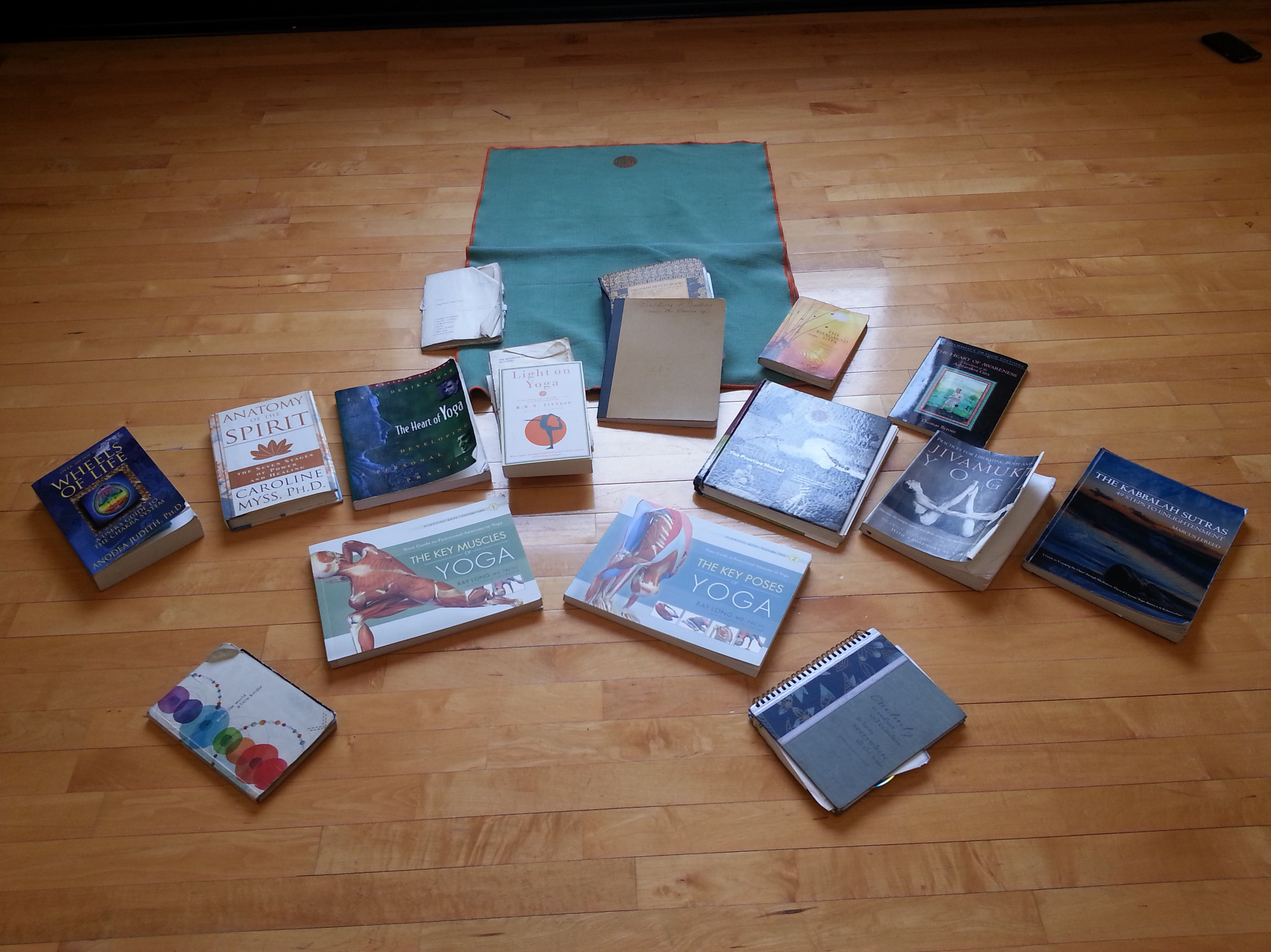
(NOTE: The picture above is missing Leslie Kaminoff’s Yoga Anatomy, Steve Ross’s Happy Yoga, Stephen Cope’s The Wisdom of Yoga, all my Yin Yoga and Taoist texts, a copy of the Ramayana, and Alanna Kaivalya’s Myths of the Asanas, at the very least.)
“Form follows function – that has been misunderstood. Form and function should be one, joined in a spiritual union.”
– Frank Lloyd Wright
“If something is boring after two minutes, try it for four. If still boring, then eight. Then sixteen. Then thirty-two. Eventually one discovers that it is not boring at all.”
– John Cage
Saturday mornings at the Y, just like any morning, is a great time to explore the physical and philosophical practice of yoga. However, I am partial to my Saturdays since I have 90 minutes to engage in the practice of exploration. For the last few years, I have started the new year with a “Building From the Ground Up” sequence – each Saturday adding more poses and another layer of the philosophy. Sometimes I still tie-in a meditation point specific to the date, and to whatever aspect of the philosophy is on tap for the day. Sometimes, however, it’s just straight philosophy and an opportunity to consider the meditation through movement. Whatever I plan for the year, usually wraps up around the end of July – when we start breaking down a different physical practice, the Ashtanga Primary Series.
This year, philosophically, I decided to sequentially move through Patanjali’s Yoga Sutras. Each week breaking down a sutra with commentary. (This week will be YS 1.31.) Physically, we have been breaking down a course of poses outlined by B. K. S. Iyengar in Light On Yoga.
The Saturday class is not an Iyengar class; however, (as teachers like Seane Corn have pointed out) if you are going to practice vinyasa, it’s a good idea to practice Iyengar as it will give you the solid foundation and insight into the asanas (poses).
Iyengar’s Course I is 30 weeks of detailed practice, specifically intended to build a physical practice from the ground up. While they are not limbs themselves, abhyasa (continuous practice with devotion) and vairagya (actively practicing the art of letting go or non-attachment) definitely make up the fertile soil from which the 8-limbs of yoga grow and thrive. And, they are key elements to the courses that appear in the appendix of Light On Yoga. At first, each set of poses is practiced for two (2) weeks before additional poses are added to the sequence. Later, some sequences are repeated for three (3) or four (4) weeks – and sometimes the order of the sequence changes. The 30-week course is followed by a 3-day course, which is slightly different from the 30-day course since the asanas are timed. Finally, there is some guidance on adding sun salutations (surya namaskar) to the physical practice and a list entitled “Important asanas in Course I.”
“If these asanas are mastered then the others given in this course will come even without regular practice.
– B. K. S. Iyengar writing about the “Impostant asanas in Course I”
The important asanas list, when followed by the sun salutations, looks and feels a lot like one of the first vinyasa practices to appear in the West, the Ashtanga Primary Series introduced to Sri Pattabhi Jois. This is not a random coincidence. While Iyengar and Jois were in very different physical/health conditions when they started practicing yoga, they practiced at the same time and with the same teacher: Sri Krishnamacharya. The practices they introduced to the West – just like the physical practices introduced by some of Krishnamacharya’s other students (including Indra Devi, T. K. V. Desikichar, and A. G. Mohan) reflect their own personal practices – which were the result of the physical and mental needs. Remember, classically, the physical practice of yoga (hatha yoga, regardless of the style or tradition) prepares the practitioner for deep-seated meditation. Ergo, even though they might practice the same poses, a very sickly young boy may use a different method of practice than a very active teenage boy.
(Side Note: It is also not a random coincidence that we generally start exploring the Ashtanga Primary series at the end of July: instead the timing coincides with the birthday of Sri Pattabhi Jois.)
YMCA classes are always open to members and their guests. If you are a member, please feel free to join us for class at any time throughout the year – and, feel free to bring a guest.
For further reading, check outLight on Yoga by B. K. S. Iyengar; Heart of Yoga by T. K. V. Desikichar; Ashtanga Yoga the Practice Manual by David Swenson; The Secret of the Yoga Sutra: Samadhi Pada by Pandit Rajmani Tigunait, PhD (Note: This is Part 1 of a series and only includes the first section of the sutras. There are many translations of the sutras, a great online resource is Patanjali’s Yoga Sutras on swamij.com.)
Little did I know how true that statement would be.
Oxford Dictionaries define “true” as an adjective meaning “in accordance with fact or reality…genuine…real or actual…accurate or exact…. in tune.” True can also be used as a verb when applied to something that is bringing “(an object, wheel, or other construction) into the exact shape or position required.” It originates from Old English words meaning “steadfast, loyal” and is related to a Dutch word meaning “faithful” and a German word meaning “loyal to.”
I could continue going down the rabbit hole, examining the meaning and origins of all the target words, but ultimately we know the truth when we see it…or hear it. Or do we?
Blink: The Power of Thinking Without Thinking promotes the power of insight and intuition; of knowing without knowing why we know something is true. Yet, Malcolm Gladwell also points out that, “We have, as human beings, a storytelling problem. We’re a bit too quick to come up with explanations for things we don’t really have an explanation for.” In other words, the brain gets in the way of the heart.
Our brains make us humans notoriously bad witnesses. Our brains fill in the gaps to make sense of puzzles we’ve created and, theoretically, to preserve the idea that we are not ignorant about things we are supposed to know. We make up stories, even when we’re the only one paying attention to the story in our head. In Musicophilia: Tales of Music and the Brain, Dr. Oliver Sacks wrote, “The brain needed to stay incessantly active, and if it was not getting its usual stimulation…, it would create its own stimulation in the form of hallucinations.”
Oxford defines “hallucination” as “an experience involving the apparent perception of something not present.” This last year, really the last two – going on three – years, it’s felt a little like the quality and state of being true was a hallucination. People say one thing and do something completely opposite. People accuse one another of lying. Technology allows us to morph our faces, our voices, our words, and to create realistic holograms of people who are no longer living. More and more it seems that everything real is an illusion.
Of course, the idea that everything we are experiencing is a dream, an illusion, a delusion – or a computer generated program – is nothing new: It’s part of the foundation of many philosophies, including yoga. Another part of philosophies like yoga and Buddhism is that there is a path to seeing things clearly, and that seeing things clearly is liberation.
“To live on a day-to-day basis is insufficient for human beings; we need to transcend, transport, escape; we need meaning, understanding, and explanation; we need to see overall patterns in our lives. We need hope, the sense of a future. And we need freedom (or at least the illusion of freedom) to get beyond ourselves, whether with telescopes and microscopes and our ever-burgeoning technology or in states of mind which allow us to travel to other worlds, to transcend our immediate surroundings. We need detachment of this sort as much as we need engagement in our lives.”
The fourth and final section of the Yoga Sutras focuses on liberation. Liberation, as Patanjali describes it, involves lifting the veil of ignorance and seeing the truth about everything, including ourselves. Patanjali also explains that the barrier/veil of ignorance can be thinned and then dissolved by birth, herbs, mantra (ajapa-japa), tapas (practices of intense discipline/austerity), or meditation. (YS 4:1)
Clarity; right view; seeing the truth – whichever way you describe it, it seems to be lacking in our current version of reality. And, as the war on truth continues, more and more people will desire it. If you are longing for a new year where you are in tune with your core values and connected to your intuition, consider starting 2019 with a practice, like yoga, which fits into that final definition of truth (see above): something that is bringing (an object, wheel, or other construction) into the exact shape or position required.
The following practices include at least three of the liberating methods mentioned by Patanjali in the Yoga Sutras: