STILL CLIMBIN’ – 2018 Kiss My Asana Offering #10 April 10, 2018
Posted by ajoyfulpractice in 31-Day Challenge, Abhyasa, Books, Buddhism, Changing Perspectives, Depression, Dharma, Donate, Faith, Fitness, Gratitude, Healing Stories, Hope, Karma Yoga, Langston Hughes, Life, Loss, Mantra, Meditation, Men, Minneapolis, Minnesota, One Hoop, Pain, Peace, Philosophy, Suffering, Surya Namaskar, Texas, Tragedy, Twin Cities, Vairagya, Volunteer, Wisdom, Women, Writing, Yoga.Tags: Army, Crystal Stair, inspiration, KISS MY ASANA, Langston Hughes, M. Scott Peck, Matthew Sanford, Month of the Military Child, Navy Seals, recovery, Ryan Holiday, SERE, Team 6, trauma
add a comment
Don’t you set down on the steps
’Cause you finds it’s kinder hard.
Don’t you fall now—
For I’se still goin’, honey,
I’se still climbin’,
And life for me ain’t been no crystal stair.
– from Mother to Son by Langston Hughes
“The only easy day was yesterday.”
– from Navy Seals
My early yoga teachers often said, “How you do yoga is how you do life.” I sometimes repeat this statement to myself and to people who come to my class, because I find it’s true. We humans only have so many reactions and responses. Our reactions on the mat are pretty consistent with our reactions off the mat, whether we are dealing with things we enjoy, things we dislike, things that challenge us, things we do well, things we fear, and/or things we don’t understand. (Substitute the word “people” for the word “things” and you see how we end up with some of our current problems.)
We delay gratification or we rush in to quickly experience the things we enjoy. We procrastinate or we push through that which we do not enjoy. We appreciate what we have or we focus on what we don’t have.
When something blocks our progression, we stop and turn back – or, as Marcus Aurelius encouraged, we pause and figure out a way to keep going. When we fall down, we either pick ourselves up – rising above the challenge – or we fall down and stay down. We either, as Thomas Edison did when his warehouse caught fire, learn from past mistakes and enjoy the unexpected – even when it seems catastrophic – or we curl up in a fetal position and watch the world go by. We pick up the pieces and re-build (again, like Edison) or we sweep the debris under the rug and step over the bulge, pretending it’s not there.
We are capable of putting blame behind us and focusing on what is, but (more often than not) blame occupies our minds when something goes wrong. We blame ourselves, we blame others, and/or we blame God and the fates. We live in the past (which is no longer), the future (which is not yet), or we live the present to its fullest.
The details change, but the overall responses are the same: We fight, we flee, or we freeze/collapse. Note that in this case, fighting is not always arguing or coming to fisticuffs; fighting is engaging, which in life can sometimes bring us to a compromise. This all happens in the present moment and, if we experience trauma, we can experience it in the present even after the original situation is in the past.
Benjamin Franklin said, “By failing to prepare, you are preparing to fail.” In life, as in yoga, there are challenges. Some challenges are expected and we mindfully prepare for them. On the flip side, some challenges are expected, but we don’t prepare for them. Finally, there are those challenges we didn’t see coming. When life (or a yoga teacher) throws us a curve ball, we swing or we don’t. In this analogy, it’s not whether or not we hit the ball that matters. What matters is that we are prepared to swing.
This brings us back to Marcus Aurelius, Thomas Edison, and those Navy Seals.
Ryan Holiday’s The Obstacle Is the Way: The Timeless Art of Turning Trials into Triumph, highlights successful people at their most resilient moments. One of the things that stood out to me when I read Holiday’s book, was that many of the people he referenced spent their whole lives preparing for what became a defining moment. It wasn’t that they anticipated the challenge; instead, they lived life to the fullest and it turned out the causes and conditions that caused them to “fall down” also gave them the tools to get back up.
Consider the Navy Seals. An elite combat unit, the Seals only accepts the best of the best. To determine who makes the cut, qualified applicants must successfully complete one of the hardest and toughest 10-day training programs in the world. Because there is no telling what a Navy Seal might encounter in real life, the training is a way to practice scenarios which test their mental, physical, emotional, and spiritual endurance. They are taught to Survive, Evade, Resist, and Escape if confronted with capture. The skills tests become more challenging in and of themselves, but they also become more challenging because applicants are moving closer and closer to their personal edge. Each second, each minute, each hour, each day creates an opportunity for growth. Seals get better, so that the challenges of yesterday seem easier once mastered. Ultimately, though, basic training pushes Navy Seals to engage, escape, evade – or get the heck out of the way for someone who is willing to swing when the curve ball is thrown.
“Life is difficult. This is a great truth, one of the greatest truths. It is a great truth because once we truly see this truth, we transcend it. Once we truly know that life is difficult-once we truly understand and accept it-then life is no longer difficult. Because once it is accepted, the fact that life is difficult no longer matters.”
– from The Road Less Traveled: A New Psychology of Love, Traditional Values and Spiritual Growth by M. Scott Peck
Life, for some, is like basic training in that it can be dangerous, full of pitfalls, and something that must be survived. But, for all of us, life is full of the causes and conditions that result in people to falling down and also full of the tools that help people get back up.
Yoga isn’t intended to be as hard (or as dangerous) as life or basic training. However, the yoga mat is a safe place to notice how you engage challenges, setbacks, and desires. It’s a safe place to explore different ways of being in the world. Every moment, every breath, every pose, every sequence prepares us for the next moment, the next breath, the next pose, and the next sequence. Sometimes we are very aware of how things are put together “in a special way.” Sometimes we are full engaged in the moment and are surprised when we meet a challenge with grace, wisdom, courage, and strength. Other times, we fall flat. Either way, the process starts all over again every time we inhale, every time we exhale.
MOTHER TO SON – by Langston Hughes
Very deliberately, move into Child’s Pose (Balasana). Notice the extension of the spine. Notice the softness of the belly. Notice the deep breath in and the deeper breath out. Allow your breath to move through the spine. Allow your soft belly to rise and fall with the breath. Allow your mind to follow the breath and the body’s reaction the breath. Start to engage your locks (bandhas) on the exhale: spread the toes and press the feet down (in this case tops of the feet down) for the Foot Lock (Pada Bandha); squeeze the perineum muscles together, lifting the pelvic floor for the Root Lock (Mula Bandha) – which engages your lower abdominal cavity; belly button up and back for abdominal core lock (Uddiyana Bandha) – which engages your upper abdominal cavity; draw the chin towards the throat and chest, lengthening the neck, for the Throat Lock (Jalandhara Bandha).
Once you’ve engaged your mind-body-spirit, move into Table Top: stack shoulders over elbows, elbows over wrists, hips over knees. Press down to lift up, activating the arms, the legs, and the lower three (3) locks. Notice the length of the spine, and how you support it. Move through Cat/Cow or the “Un-Cat” sequence precisely matching the movement to the breath. Move from your core so that the gaze is the last thing to come up and the last thing to turn down.
Find the place where your movements are strong, but not forced, and then curl your toes under and exhale into Downward Facing Dog (Adho Mukha Svanasana). Double check your engagement of the pose. Make sure all your fingers are spread wide, with the majority of the weight/pressure in your hands moving into the thumb and first finger. (So that, there is less weight/pressure applied to your outer wrists.) When you relax your head and shoulders, make sure your big toes are parallel to each other and at least a foot apart. Big toes can be behind the thumbs or behind the middle fingers. Hips are high, heels are low (reaching, but not necessarily touching the mat); and neck is long. Even if you have to bend your knees, find Cow Pose in this position (so that you have a straight line from your middle fingers all the way up to your hips and then a second straight line from your hips to the back of your knees). Eyes are on your nose, your belly button, or the space between your toes. Engage your locks (bandhas) as you are able. Notice the length of the spine and how you support it.
Remember your can skip the arm balancing, by moving into Staff Pose (Dandasana) and positioning the arms accordingly or using “Dolphin Dog.” Another modification would be to do the pose on the wall. Either way, strongly engage your legs and your core.
Stretch back (meaning, push your spine towards your thighs) and on an exhale walk your hands to your feet or bring your hands and feet together. Once hands are in line with the toes and heels are flat to the mat, inhale to a Half Lift/Flat Back or Extended Forward Bend. (This pose may be called Ardha Uttanasana or Urdhva Uttanasana.) Place your hands on your thighs and press the shoulders into the metaphorical back pockets. Remember, you want to engage in a similar fashion to Cow Pose, Staff Pose, and Downward Facing Dog. In fact, inhale and find a little bit of Cow Pose (even if you have to bend your knees). Now, press the heels down and – as much as you are able without losing the extension of the spine – engage the quadriceps to extend through the knees and press the thigh bones into the wall behind you. Engage your locks (bandhas) as you are able.
If you have unregulated blood pressure, low back issues, eye issues like glaucoma, or if this is already challenging, remember to stay here with knees bent. Otherwise, if it is not contraindicated, bend the knees and flex from the hips to prep Forward Bend (Uttanasana). Keeping the upper back extended, place the hands on the floor or a block and begin to extend through the legs while pressing the thigh bones into the backs of your legs. Do not force the extension. Use the exhales to settle the heart on the thighs (as much as you are able without losing the extension of the spine.) If your legs are completely straight, make sure the knee caps are lifted and that you are not hyper-extending the knees. Also double check to ensure that if the knees are straight the hips are over the knees, not behind the ankles. Remember to engage your locks (bandhas). Notice the length of the spine. Soften into yourself and into the stillness of the moment.
Inhale to Half Lift / Flat Back and use the exhale to engage your core. With hands on the hips, maintain the length of the spine and lift up to standing. Relax your arms by your sides. Balance the weight between all four corners of both feet. Feel free to move side-to-side or back and forth on the feet until you feel you are centered. Spread the toes, press big toes and little toes down, as well as both sides of the heels. (This establishes “all four corners of both feet.”) Engage the quadriceps in order to lift the knee caps and firm up the thighs. Sit bones point down so that the pelvic bones lift up. Engage your locks (bandhas). As you press down in order to lift the sternum up, use the core abdominal to draw the lower rib cage down. Relax the shoulders and gaze straight ahead. This is Equal Standing / Mountain Pose (Samasthiti/Tadasana). Notice the length of your spine.
Changing as little as possible, stretch the arms out like the letter T. Once your arms are wide, extend out of the center of your chest. Make sure shoulders, lower rib cage, and sits bones are reaching down. Now, turn the palms up and inhale your arms overhead. (Many traditions refer to this as Arms Reaching Overhead (Urdhva Hastasana), but I tend to call this Tadasana.) Double check to ensure you have maintained balance and alignment. Notice the length of your spine. After several breaths, lower the arms to your sides on an exhale.
Now, use the whole inhale to lift the arms overhead and the whole exhale to press the hands together through heart center. On the exhale of the third centering breath, walk to the front of the mat with hands through heart center.
Equal Standing is like a soldier in the “Ready” position. Moving through half of a Sun Salutation (Surya Namaskar), inhale arms over head into Arms Reaching Overhead; exhale and stretch the arms out wide as you dive between the hands into a Forward Bend; inhale to a Half Lift / Flat Back; exhale back to Forward Bend. Keeping the knees bent and the core engaged, inhale to reverse swan dive and then exhale hands back to your sides. Repeat the sequence until you feel you are alignment is strong and your mind is focused (on the breath), and your movement is fluid.
After the final exhale into Forward Bend, inhale into a Half Lift/ Flat Back and then step your left leg way back into a low lunge. Make sure the feet are in two separate lanes. Inhale to lengthen the spine and then exhale the back knee to the mat. Give yourself cushion under the back knee, as needed. Pressing down evenly into both feet, lift your torso up and place hands on your right thigh for a variation of Crescent Lunge (Anjaneyasana).
Use an exhale to slide the hips over the back knee and then place the back of the right hand on your sacrum (the flat part of your bum/hips) and place your left hand on the front of your pelvic bones. Your hands are now bracketing your hips. Slide the back hand down in order to direct the sit bones down. You may feel the front hand lifting as the pelvic bones lift. Notice the length of your spine, especially your low back. You may also feel engagement in your left hip and thigh. Stay here or bend the front knee deeper into the lunge – remembering to maintain the space in your low back. Hands can come to your front thigh or reach the hands over head. Again, engage your locks (bandhas). If you have Hot Half Moon (Ardha Chandrasana) in your practice, feel free to add it by lifting the left arm up and reaching it towards the right.
When you are ready to move on, place the hands on the mat and step back to Child’s Pose. From Child’s Pose, inhale to Cow Pose and exhale to Downward Facing Dog. Repeat the sequence of standing poses (starting with the first Forward Bend after Downward Facing Dog, substituting left for right).
After the second side of standing poses, move into Staff Pose (Dandasana). Remember, this pose is not disposable. Consider the length of your spine and how you use your locks (bandhas) to maintain it.
Keep the left leg extended and bend the right knee in order to set up the Sage Twist. Remember to keep the left heel and the right foot flat on the floor. You can place the right foot next to the inside or the outside of the left leg, as long as the knees are comfortable and the right foot is flat on the floor.
On an inhale, lift your right arm up and, as you watch it, reach the right arm back to the floor behind your hips. As you settle into the twist, adjust your left arm to provide additional support wherever you need it. You can always sit on a block and/or place a block under your hand if you’re hips and low back are really tight. If you don’t have a block, substitute a book.
Watch how you engage your base, your core, and your breath in order to lengthen your spine. Remember to start the twist in your base (not in your neck). Do not allow your body to collapse or untwist until you complete 3 – 5 complete breaths. After the third or fifth exhale, inhale to center, give the lifted knee a squeeze, and return to Staff Pose. Repeat the Sage Twist instructions for the Sage Twist (replacing right with left).
After the third or fifth exhale on the left, inhale to center and give the lifted knee a squeeze. Bend both knees, placing the feet flat on the floor. (NOTE: If you’d rather not balance on your sits bones, lie down on your back and follow the cues.)
Reach the arms forward with elbows next to the knees. Press down as if you are going to jump forward. Spread your toes, squeeze your perineum muscles together, belly button is up and back, press your shoulders down, and draw the chin towards the neck. Look up and press down to lift the ribs up on the inhale. As you exhale, lean back until the feet are off the ground and you are balancing on your tail bone. Bring legs up parallel to the ground. Check in with your locks (bandhas) – maybe even lifting the corners of your mouth up towards your ears for a smiling bandha. Begin to extend the legs by engaging the quadriceps and pushing through the heels. Keep your nose up and your eyes on your nose.
Find your edge, making sure your core works harder than your jaw or your arms. And then, lower down onto your back for Corpse Pose (Savasana). Find a place where your body and mind are still. Let the breath natural ebb and flow. Notice the strength of the body, all it is capable of doing. Give thanks. Notice the strength of the spirit, all it endures. Give thanks. Breathe peace in, breathe peace out. Give thanks.
In addition to being National Poetry Month and the month of when I ask you to Kiss My Asana, April is also Parkinson’s Awareness Month, National Child Abuse Prevention Month, Sexual Assault Awareness and Prevention Month, and the Month of the Military Child. The people whose stories are behind these awareness-building observations are some of the same people benefiting from the programs supported by Mind Body Solutions via your Kiss My Asana donation.
This opportunity to explore a poem on the mat is part of my offering for the 2018 Kiss My Asana yogathon. I encourage you to set aside at least 5 minutes a day during April, to practice with the poem as inspiration. You can practice in a class or on your own, but since the Kiss My Asana yogathon raises resources as well as awareness, I invite you to join me at the donation-based classes on April 28th.
I also challenge you to set aside a certain amount every day that you practice with a poem in mind. It doesn’t matter if you set aside one dollar per practice or $25 – set aside that amount each time you practice and donate it by April 30th.
Founded by Matthew Sanford, Mind Body Solutions helps those who have experienced trauma, loss, and disability find new ways to live by integrating both mind and body. They provide classes, workshops, and outreach programs. They also train yoga teachers and offer highly specialized training for health care professionals. By participating in the Kiss My Asana yogathon you join a global movement, but in a personal way. In other words, you practice yoga. Or, as this year’s tag line states….
### do yoga. share yoga. help others. ###
WALKING IN & IN AGAIN – 2018 Kiss My Asana Offering #9 April 9, 2018
Posted by ajoyfulpractice in 31-Day Challenge, Abhyasa, Art, Bhakti, Books, Changing Perspectives, Dharma, Donate, Faith, Fitness, Gratitude, Healing Stories, Health, Hope, Japa, Japa-Ajapa, Karma Yoga, Kirtan, Life, Mala, Mantra, Mathmatics, Meditation, Men, Minneapolis, Minnesota, Music, Mysticism, Oliver Sacks, One Hoop, Philosophy, Poetry, Surya Namaskar, Twin Cities, Vairagya, Volunteer, Wisdom, Women, Writing, Yoga.Tags: Bobby McFerrin, brain, fibonacci, inspiration, KISS MY ASANA, Mind Body Solutions, Mountain Pose, music, pentatonic scale
add a comment
“Go in and in…
and turn away from
nothing
that you find…”
– from Go In and In by Danna Faulds
“There are, of course, inherent tendencies to repetition in music itself. Our poetry, our ballads, our songs are full of repetition; nursery rhymes and the little chants and songs we use to teach young children have choruses and refrains. We are attracted to repetition, even as adults; we want the stimulus and the reward again and again, and in music we get it.”
– from Musicophilia: Tales of Music and the Brain by Dr. Oliver Sacks
There is something about repetition and the repetition of movement. It is something you find in Nature, something you find in music, and it is something you find in the visual arts. That something was felt by Henry David Thoreau when he went into the woods and its one of the reasons Walt Whitman perambulated. It is part of what Rainer Maria Rilke recommended again and again in his letters to the young poet Franz Kappus and it is the key that unlocks Wendell Berry’s “Sabbath Poems” when he walks his Kentucky lands. That something is what Diane Ackerman references when she talks about the creativity of walking and bicycling in her book Play – and it’s something you find in the practice.
In Light on Yoga, B. K. S. Iyengar systematically broke down over 200 yoga poses and their benefits. Iyengar started off his exploration with Samasthiti / Tadasana (Equal Standing / Mountain Pose), which seems like a pretty disposable pose. In fact, it is all too easy to discount the pose – people do it all the time. You might even find yourself doing it if you aren’t encouraged to pause and notice where you’re going.
If your time on the mat is an in-depth exploration of you and your practice, you will find yourself going into Samasthiti/Tadasana again and again. It turns out that there is an element of the pose in almost every other pose. Another element that appears again and again in the practice is Cow Pose. Finally, you’ll keep coming back the connection to the breath that allows you to mimic your body’s natural tendencies.
“As many times as I
forget, catch myself charging forward
without even knowing where I’m going,
that many times I can make the choice
to stop, to breathe, and be, and walk
slowly into the mystery.– from Walk Slowly by Danna Faulds*
Bryan Kest refers to walking as the best exercise known to man. When you move through your practice, move like you are strolling through the woods. Keep finding that Tadasana spine so that you find that Tadasana smile.
Go In and In & Walk Slowly – by Danna Faulds
Take a moment to breathe, be still, and then soften into Child’s Pose (Balasana). Settle in as if this is your whole practice. Notice the extension of the spine. Notice the deep breath in and the deeper breath out. Allow your breath to move through the spine. Allow your mind to follow the breath. Notice the rhythm of the breath. Notice the breath as music.
Once the mind is focused on the breath and the body’s reaction to the breath, use the breath as your pace. The inhale allows you to meander into Table Top: stack shoulders over elbows, elbows over wrists, hips over knees. Check your interior landscape to make sure it supports the exterior. Notice the length of the spine. Move through Cat/Cow or the “Un-Cat” sequence precisely matching the movement to the breath. This is a moving meditation. Just like in a seated meditation, when the brain wanders away from this present moment, use the breath to bring it back.
Again, find the place where you mind is focused on the rhythm and then curl your toes under and exhale into Downward Facing Dog (Adho Mukha Svanasana). Scan the exterior and interior landscapes. Make sure all your fingers are spread wide, with the majority of the weight/pressure in your hands moving into the thumb and first finger. (So that, there is less weight/pressure applied to your outer wrists.) When you relax your head and shoulders, make sure your big toes are parallel to each other and at least a foot apart. Big toes can be behind the thumbs or behind the middle fingers. Hips are high, heels are low (reaching, but not necessarily touching the mat); and neck is long. Even if you have to bend your knees, find Cow Pose in this position (so that you have a straight line from your middle fingers all the way up to your hips and then a second straight line from your hips to the back of your knees). Eyes are on your nose, your belly button, or the space between your toes. Notice the length of the spine.
Feel free to walk your dog!
Remember your can skip the arm balancing, by moving into Staff Pose (Dandasana) and positioning the arms accordingly or using “Dolphin Dog.” Another modification would be to do the pose on the wall. Either way, you can still walk your dog!
Stretch back (meaning, push your spine towards your thighs) and on an exhale walk your hands to your feet or bring your hands and feet together. Once hands are in line with the toes and heels are flat to the mat, inhale to a Half Lift/Flat Back or Extended Forward Bend. (This pose may be called Ardha Uttanasana or Urdhva Uttanasana.) Place your hands on your thighs and press the shoulders into the metaphorical back pockets. Remember, you want to engage in a similar fashion to Cow Pose, Staff Pose, and Downward Facing Dog. In fact, inhale and find a little bit of Cow Pose (even if you have to bend your knees). Now, press the heels down and – as much as you are able without losing the extension of the spine – engage the quadriceps to extend through the knees and press the thigh bones into the wall behind you. Engage your locks (bandhas) as you are able.
If you have unregulated blood pressure, low back issues, eye issues like glaucoma, or if this is already challenging, remember to stay here with knees bent. Otherwise, if it is not contraindicated, bend the knees and flex from the hips to prep Forward Bend (Uttanasana). Keeping the upper back extended, place the hands on the floor or a block and begin to extend through the legs while pressing the thigh bones into the backs of your legs. Do not force the extension. Use the exhales to settle the heart on the thighs (as much as you are able without losing the extension of the spine.) If your legs are completely straight, make sure the knee caps are lifted and that you are not hyper-extending the knees. Also double check to ensure that if the knees are straight the hips are over the knees, not behind the ankles. Remember to engage your locks (bandhas). Notice the length of the spine. Soften into yourself and into the stillness of the moment.
Inhale to Half Lift / Flat Back and use the exhale to engage your core. With hands on the hips, maintain the length of the spine and lift up to standing. Relax your arms by your sides. Balance the weight between all four corners of both feet. Feel free to move side-to-side or back and forth on the feet until you feel you are centered. Spread the toes, press big toes and little toes down, as well as both sides of the heels. (This establishes “all four corners of both feet.”) Engage the quadriceps in order to lift the knee caps and firm up the thighs. Sit bones point down so that the pelvic bones lift up. Engage your locks (bandhas). As you press down in order to lift the sternum up, use the core abdominal to draw the lower rib cage down. Relax the shoulders and gaze straight ahead. This is Equal Standing / Mountain Pose (Samasthiti/Tadasana). Notice the length of your spine.
Changing as little as possible, stretch the arms out like the letter T. Scan the interior and exterior landscape, checking to ensure you have maintained balance and alignment. Now, take the next few steps: Turn the palms up and inhale your arms overhead. (Many traditions refer to this as Arms Reaching Overhead (Urdhva Hastasana), but I tend to call this Tadasana). Scan the interior and exterior landscape, checking to ensure you have maintained balance and alignment. Notice the length of your spine. After several breaths, lower the arms to your sides on an exhale.
Now, use the whole inhale to lift the arms overhead and the whole exhale to press the hands together through heart center. On the exhale of the third centering breath, walk to the front of the mat with hands through heart center. Equal Standing is like a soldier in the “Ready” position. You are now ready for the next part of the practice.
Moving through half of a Sun Salutation (Surya Namaskar), inhale arms over head into Arms Reaching Overhead; exhale and stretch the arms out wide as you dive between the hands into a Forward Bend; inhale to a Half Lift / Flat Back; exhale back to Forward Bend. Keeping the knees bent and the core engaged, inhale to reverse swan dive and then exhale hands back to your sides. Repeat the sequence until you feel the natural rising and flowing, ebbing and flowing. Notice the similarities between Cat/Cow. Notice the length of the spine in every pose.
After the final exhale into Forward Bend, inhale into a Half Lift/ Flat Back and then step your left leg way back into a low lunge. Make sure the feet are in two separate lanes. Inhale to lengthen the spine and then exhale the back knee to the mat. Give yourself cushion under the back knee, as needed. Pressing down evenly into both feet, lift your torso up and place hands on your right thigh for a variation of Crescent Lunge (Anjaneyasana).
Use an exhale to slide the hips over the back knee and then place the back of the right hand on your sacrum (the flat part of your bum/hips) and place your left hand on the front of your pelvic bones. Your hands are now bracketing your hips. Slide the back hand down in order to direct the sit bones down. You may feel the front hand lifting as the pelvic bones lift. Notice the length of your spine, especially your low back. You may also feel engagement in your left hip and thigh. Stay here or bend the front knee deeper into the lunge – remembering to maintain the space in your low back. Hands can come to your front thigh or reach the hands over head. If you have Hot Half Moon (Ardha Chandrasana) in your practice, feel free to add it by lifting the left arm up and reaching it towards the right.
As many times as you forget, remind yourself to breath in and out of the length of your spine. When you are ready to move on, place the hands on the mat and step back to Child’s Pose. From Child’s Pose, inhale to Cow Pose and exhale to Downward Facing Dog. Repeat standing sequence from
Once you’ve completed the second side and returned to Child’s Pose, inhale to Cow Pose and then exhale into Downward Facing Dog. Repeat the sequence of standing poses (starting with the first Forward Bend after Downward Facing Dog, substituting left for right.
After the second side of standing poses, move into Staff Pose (Dandasana). Remember, this pose is not disposable. Consider the length of your spine and how you maintain it.
Keep the left leg extended and bend the right knee in order to set up the Sage Twist. Remember to keep the left heel and the right foot flat on the floor. You can place the right foot next to the inside or the outside of the left leg, as long as the knees are comfortable and the right foot is flat on the floor.
On an inhale, lift your right arm up and, as you watch it, reach the right arm back to the floor behind your hips. As you settle into the twist, adjust your left arm to provide additional support wherever you need it. You can always sit on a block and/or place a block under your hand if you’re hips and low back are really tight. If you don’t have a block, substitute a book.
Watch how you engage your base, your core, and your breath in order to lengthen your spine. Remember to start the twist in your base (not in your neck). Do not allow your body to collapse or untwist until you complete 3 – 5 complete breaths. After the third or fifth exhale, inhale to center, give the lifted knee a squeeze, and return to Staff Pose. Repeat the Sage Twist instructions for the Sage Twist (replacing right with left).
After the third or fifth exhale on the left, inhale to center and give the lifted knee a squeeze. Bend or extend both, as needed, and lower down onto your back for Corpse Pose (Savasana). Allow your body to settle into the spaces around your spine. Allow your breath to move through the spine. Allow your mind to follow the breath. Notice the rhythm of the breath. Notice the breath as music.
“Music seems to have a special power to animate us. Kant called music, ‘…the quickening art.’ There’s something about rhythm, as a start, compels one to move…with the beat…. There’s something about the rhythm of the music, which has a dynamic, animated, propulsive effect that gets people moving in sympathy with it; and gets people moving in sympathy with one another. So…the rhythm of music has a strong bonding thing. People dance together, move together…”
– from an interview with Dr. Oliver Sacks
“There is certainly a universal and unconscious propensity to impose a rhythm even when one hears a series of identical sounds at constant intervals… We tend to hear the sound of a digital clock, for example, as “tick-tock, tick-tock” – even though it is actually “tick tick, tick tick.”
– from Musicophilia: Tales of Music and the Brain by Dr. Oliver Sacks
This opportunity to explore a poem on the mat is part of my offering for the 2018 Kiss My Asana yogathon. I encourage you to set aside at least 5 minutes a day during April, to practice with the poem as inspiration. You can practice in a class or on your own, but since the Kiss My Asana yogathon raises resources as well as awareness, I invite you to join me at the donation-based classes on April 28th.
I also challenge you to set aside a certain amount every day that you practice with a poem in mind. It doesn’t matter if you set aside one dollar per practice or $25 – set aside that amount each time you practice and donate it by April 30th.
Founded by Matthew Sanford, Mind Body Solutions helps those who have experienced trauma, loss, and disability find new ways to live by integrating both mind and body. They provide classes, workshops, and outreach programs. They also train yoga teachers and offer highly specialized training for health care professionals. By participating in the Kiss My Asana yogathon you join a global movement, but in a personal way. In other words, you practice yoga. Or, as this year’s tag line states, “do yoga. share yoga. help others.”
*Yes, it’s another two (2) poem day. It’s also a two (2) video day! Happy Monday!
### do yoga. share yoga. help others. ###
POSING – 2018 Kiss My Asana Offering #6 April 6, 2018
Posted by ajoyfulpractice in 31-Day Challenge, Abhyasa, Art, Baseball, Books, Buddhism, Changing Perspectives, Dharma, Donate, Faith, Fitness, Gratitude, Healing Stories, Hope, Karma Yoga, Life, Love, Meditation, Men, Minneapolis, Minnesota, One Hoop, Pain, Peace, Philosophy, Poetry, Texas, Twin Cities, Vairagya, Volunteer, Wisdom, Women, Writing, Yoga.Tags: Downward Facing Dog, existentialism, Gwendolyn Brooks, Jose Ortega y Gasset, KISS MY ASANA, Mind Body Solutions
add a comment
“Each body has its art, its precious prescribed
Pose, that even in passion’s droll contortions, waltzes,
Or push of pain–or when a grief has stabbed
Or hatred hacked–is its and nothing else’s.
Each body has its pose. “
– from “Still Do I Keep My Look, My Identity…” by Gwendolyn Brooks
In Man and Crisis, the Spanish philosopher José Ortega y Gasset wrote, “Tell me to what you pay attention and I will tell you who you are.” The same concept applies to yoga. Some yoga teachers can watch someone practice and recognize what style and tradition the person normally practices. Some teachers, master teachers, can tell what other activities a person does besides yoga and/or what occupied the majority of their time when they were a child. Still other teachers (again, master teachers) can look at a practitioner in a pose and describe certain psychological and emotional aspects of the person’s personality and life.
I’ve witnessed teachers do all of the above. And, it’s fascinating! It seems magical! But, what quickly becomes obvious is that these teachers aren’t magic – they are simply describing what they see in the body. Our biology is our biography, because everything we experience has a place in the body and in the mind. Therefore, everything we experience is in us and in our poses.
Consider, for a moment, the first pose you loved to practice. Ask yourself why you loved that pose and remember how you felt in that pose. Consider how that pose (and you in that pose) reflected that particular time in your life. Now, consider how the pose, your body, you, and your life have changed over time. You can do the same with the first pose you hated to practice.
You can do the same with a pose you barely consider important to your practice, even though you do it on a regular basis. Write down your thoughts and then have someone take a picture of you in the pose. When you come into the pose, really focus on how you practice the pose. Notice what you notice when you look at the picture.
“Still Do I Keep My Look, My Identity…” by Gwendolyn Brooks
Move into Child’s Pose (Balasana) as if you are moving into a new house. Take your time to balance the effort and relaxation inherent in the pose. Watch the breath. Pause and take in the landscape that is your mind and your body in this present moment.
When you move into Table Top – hands and knees to the mat with shoulders over elbows and wrists, hips over knees – or into a seated position if that is more accessible, move as if you are taking a leisurely stroll. Take your time, and pause to get the lay of the land. Double check your alignment. Press down so that the shoulders and shoulder blades are even with the rest of the back and your belly is firm. Engage your locks (bandhas) if that is part of your practice. Notice how you feel in the pose (physically, mentally, emotionally, and energetically).
Move through Cat/Cow or the “Un-Cat” sequence precisely matching the movement to the breath. So that, as the breath gets long and fine and deep, the movement gets richer – whatever that means to you in this moment.
Pause with the spine back in Table Top position and then move into Staff Pose (Dandasana). Sit down with your legs straight out in front of you. Sit up on a blanket or a block if you have a lot of tightness/stiffness in the back of your body. Press your heels down into the ground, flex the ankles so the toes reach for the nose, and then spread the toes. At the same time, fire up your thighs and engage the quadriceps (the four muscles at the top of your things) in order to lift the knee caps into their full extended position. Press the sit bones and hands down (with the hands next to the hips). If this engagement is too extreme, bend knees or place the hands behind the hips (but still wide enough to just barely be outside of the hips).
As if they are seeds you are planting, push your shoulders and everything touching the floor, the mat, or a prop down into the earth. Allow your heart to blossom. With your eyes on your nose, watch your breath and notice how you feel in the pose (physically, mentally, emotionally, and energetically).
Engage your locks (bandhas) as described yesterday’s practice. Changing as little as possible, lift the arms over the head, with wrists in line with the shoulders, and turn the palms up so that the finger tips point towards the wall behind you. Extend the elbows and, as much as you are able, rotate them towards your nose. Keeping the shoulders down the back, push the whole body down to lift the heart and the arms up. If this is too much intensity for the shoulders, modify by bending the elbows to 90 degrees and extending the wrists rather than flexing them. Again, notice how you feel in the pose (physically, mentally, emotionally, and energetically).
NOTE: If you want to skip the arm balancing below, move back into Staff Pose (Dandasana) and then repeat the arm positioning above before moving into the Sage Twist. Another modification would be to do the pose on the wall.
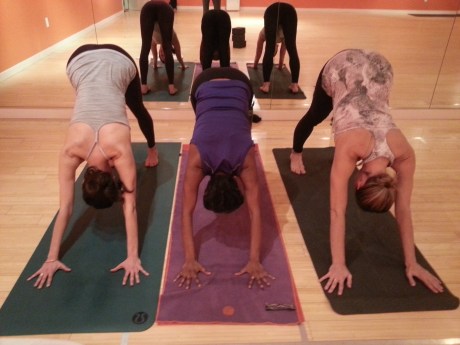
For the arm balance Downward Facing Dog (Adho Mukha Svanasana), return to Table Top – engaging as you did at the beginning of the practice. Curl your toes under; then use your arms and legs, hands and feet to lift your hips up in the air. Check to make sure all your fingers are spread wide, with the majority of the weight/pressure in your hands moving into the thumb and first finger. (So that, there is less weight/pressure applied to your outer wrists.) When you relax your head and shoulders, make sure your big toes are parallel to each other and at least a foot apart. Big toes can be behind the thumbs or behind the middle fingers. Notice if you feel lighter or heavier when your feet are spaced further apart. Hips are high, heels are low (reaching, but not necessarily touching the mat); and neck is long. Even if you have to bend your knees, find Cow Pose in this position (so that you have a straight line from your middle fingers all the way up to your hips and then a second straight line from your hips to the back of your knees). Eyes are on your nose, your belly button, or the space between your toes.
If you are staying off of your wrists or need something to minimize stress on the shoulders, bring the elbows to the mat when you are in Table Top and lift your hips up for “Dolphin Dog.”
No matter which variation you choose, notice how and what you feel (physically, mentally, emotionally, and energetically). Downward Facing Dog is simultaneously an arm balance and a standing pose; a forward bend, as well as a back bend; and an inversion. The only category missing from the pose is a twist (and, some would say, a hip opener) which you can add in several different ways. Just explore, play. Notice if you access some aspects of the pose more than others. Notice how you feel about the suggestion to explore, play.
Move back into Staff Pose. Keep the left leg extended and bend the right knee in order to set up the Sage Twist. Remember to keep the left heel and the right foot flat on the floor. You can place the right foot next to the inside or the outside of the left leg, as long as the knees are comfortable and the right foot is flat on the floor.
On an inhale, lift your right arm up and, as you watch it, reach the right arm back to the floor behind your hips. As you settle into the twist, adjust your left arm to provide additional support wherever you need it. You can always sit on a block and/or place a block under your hand if you’re hips and low back are really tight. If you don’t have a block, substitute a book.
Watch how you engage your base, your core, and your breath. Remember to start the twist in your base (not in your neck). Do not allow your body to collapse or untwist until you complete 3 – 5 complete breaths. After the third or fifth exhale, inhale to center, give the lifted knee a squeeze, and return to Staff Pose. Repeat the Sage Twist instructions for the Sage Twist (replacing right with left).
After the third or fifth exhale on the left, inhale to center and give the lifted knee a squeeze. Bend or extend both, as needed, and lower down onto your back for Corpse Pose (Savasana). Allow your whole self to take up space. Notice how it feels to breath, to live, in this space.
This opportunity to explore a poem on the mat is part of my offering for the 2018 Kiss My Asana yogathon. I encourage you to set aside at least 5 minutes a day during April, to practice with the poem as inspiration. You can practice in a class or on your own, but since the Kiss My Asana yogathon raises resources as well as awareness, I invite you to join me at one of the donation-based classes listed (April 7th and April 28th).
I also challenge you to set aside a certain amount every day that you practice with a poem in mind. It doesn’t matter if you set aside one dollar per practice or $25 – set aside that amount each time you practice and donate it by April 30th.
Founded by Matthew Sanford, Mind Body Solutions helps those who have experienced trauma, loss, and disability find new ways to live by integrating both mind and body. They provide classes, workshops, and outreach programs. They also train yoga teachers and offer highly specialized training for health care professionals. By participating in the Kiss My Asana yogathon you join a global movement, but in a personal way. In other words, you practice yoga. Or, as this year’s tag line states, “do yoga. share yoga. help others.”
Side Note: Although, I’m not the girl in the picture, I met Gwendolyn Brooks around this same time. She smiled, signed a book, for me; said words I don’t remember. What I do remember was feeling joy and the sheer power of her presence. I also remember wondering how in the world so much power, beauty, strength, wisdom, and intellect could be contained in such a small body.
## do yoga. share yoga. help others. ##
Quick Announcements and A Thank You! May 3, 2017
Posted by ajoyfulpractice in Art, Black Elk, Buddhism, California, Changing Perspectives, Depression, Donate, Faith, Fitness, Gratitude, Healing Stories, Health, Hope, Karma, Karma Yoga, Life, Loss, Meditation, Men, Minneapolis, Minnesota, Music, One Hoop, Pain, Peace, Philosophy, Suffering, Texas, Tragedy, Twin Cities, Vipassana, Volunteer, Wisdom, Women, Yoga.Tags: KISS MY ASANA, Marcus Young, May the Fourth, meditation, Mind Body Solutions, Mindfulness, Star Wars, Walker Art Center
add a comment
First, the thank you:
I am deeply grateful to everyone who participated in this year’s Kiss My Asana yogathon to benefit Mind Body Solutions. It doesn’t matter if you made a donation online, attended a donation-based class, hosted a donation-based class, or asked a question (and, maybe, are still waiting on my answer) – either way, you made a difference in how we view yoga and how we, as part of the yoga community, keep our sacred circle open to all bodies and all minds. During one class in particular, when I listed all the types of people who can benefit from adaptive yoga, I found myself referencing every person in the room. Just a reminder that it’s not about modifications, it’s about the practice.
Thank you, also, to Sandra Razieli for spending part of her birthday weekend co-teaching with me!
Thus far, we’ve raised $855 this year to support the Mind Body Solutions Solutions, where awakening the connection between mind and body transforms trauma, loss, and disability into hope and potential.
Oh, and by the way, you can still donate here!
And now, the quick announcements:
May the 4th is with us! While I am sad to report that I will not be leading any Star Wars yoga classes this year, I am very excited about returning to the Walker Art Center to facilitate meditation during MN Artists Presents: Marcus Young (5 – 9 PM). This free event is kid-friendly and has a lot of mindfully interactive moments. For more information, check out the event page or the Walker’s Facebook page. (Please note: road closures may create delays and detours. Breathe deeply. And may the force be with you.)

Finally, my YMCA classes will have subs on Friday night (5/5), Saturday morning (5/6), and all day Sunday (5/7). Enjoy!
###
2017 KISS MY ASANA QUESTIONS #5, 6, & 7: IF YOU COULD RECOMMEND ONE BOOK…? April 15, 2017
Posted by ajoyfulpractice in 31-Day Challenge, Books, Buddhism, California, Changing Perspectives, Daoism, Donate, Faith, Fitness, Healing Stories, Health, Karma Yoga, Life, Meditation, Men, Minneapolis, Minnesota, Peace, Philosophy, Science, Tantra, Taoism, Texas, Twin Cities, Volunteer, Wisdom, Women, Writing, Yin Yoga, Yoga.Tags: inspiration, KISS MY ASANA, meditation, Mind Body Solutions, yoga books, yoga practice
add a comment
“If you could recommend one book about yoga that really impacted your practice, what book would that be?”
“If you could recommend one book about meditation, what would it be?”
“Is there a book that would help a beginner like me establish a daily practice?”
– E
There might be more books on yoga and meditation than there are ways to practice yoga and meditation. I know for sure that there are so many books on each it is sometimes hard to narrow things down to a single recommendation. Even if I had read everything that’s ever been printed – and nothing else was ever printed (which would be a shame since one of my teachers is currently working on her first book) – and even if I only focused on books that really impacted my practice, I would still end up with a bag full of books.
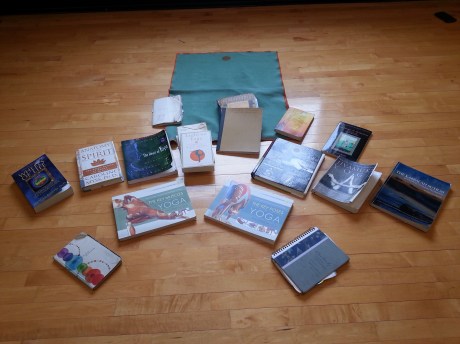
(NOTE: The picture above is missing Leslie Kaminoff’s Yoga Anatomy, Steve Ross’s Happy Yoga, Stephen Cope’s The Wisdom of Yoga, all my Yin Yoga and Taoist texts, a copy of the Ramayana, and Alanna Kaivalya’s Myths of the Asanas, at the very least.)
Part of me wants to break this down into a book on the physical practice versus a book on the philosophy; however, sitting with WHY I want to make that distinction, brings me to one very comprehensive option: T. K. V. Desikachar’s The Heart of Yoga: Developing A Personal Practice.
Desikachar was the son of Sri Krishnamacharya, who was the teacher responsible for the resurgence of yoga in 20th Century India. Krishnamacharya taught Desikachar, B. K. S. Iyengar, Sri Pattabhi Jois, and Indra Devi – who all had a hand in bringing the physical practice of yoga to the West. Each of the teachers mentioned above wrote at least one book which impacted someone’s yoga practice (including mine), and all of them have had books written about them. Desikachar’s The Heart of Yoga is simultaneously about yoga and about a teacher’s teacher. It is also a practice manual with a heavy focus on the philosophy. Unlike some other books I might refer to as practice manuals, The Heart of Yoga not only offers an overview of the 8-limb philosophy of yoga, it includes a translation of the Patanjali’s Yoga Sutras. (NOTE: Patanjali’s Yoga Sutras are 196 aphorisms. Most books on the sutras include each aphorism, plus a translation and commentary for each aphorism. I use several sources for translation/commentary comparative analysis; however, my go-to resource is a website by Swami J, of the Himalayan tradition.) The Heart of Yoga gives practitioners of any fitness or experience level the opportunity to build a physical practice, while also maintaining a connection to the overall philosophical practice.
My similar dilemma regarding a book on meditation could be resolved by recommending a book on yoga mediation… and a book from each of several different Buddhist traditions…plus a book on the Kabbalah…and a book on Catholic contemplation and…..You get the idea. But, when it gets right down to it, there’s one book I am continually giving away – and it’s the same book used when I guided meditation with Dr. Thomas Bushlack’s University of St. Thomas classes: The Miracle of Mindfulness: A Manual on Meditation by Thich Nhat Hahn.
I first came across The Miracle of Mindfulness when I was babysitting for some friends in Minneapolis. One day, when the kids were napping, this little violet paperback on the bookshelf in the living room caught my eye. I pulled it down, and found…stillness.
OK, I’m being dramatic. I had, of course, already experienced stillness in both yoga and seated meditation. However, Nhat Hahn’s The Miracle of Mindfulness made me pause, sit, and contemplate my overall practice and its connection to meditation. Over the last ten years, it has played an instrumental part in my re-commitment to the physical practice of yoga as a form of meditation.
Let me be clear: Nhat Hahn is not known as a yoga teacher and The Miracle of Mindfulness is not a book related to hatha yoga (the physical practice of yoga). Nhat Hanh is a Vietnamese Buddhist monk most commonly associated with Zen Buddhism, but whose training includes several traditions. His Miracle of Mindfulness is based on Buddhist principles and practices, but is not teaching Buddhism, per se. Some might argue that it is not even teaching meditation (but, rather, mindfulness). Still, it accessible to people regardless of their background or experience and includes personal anecdotes as well as a series of practices that are simultaneously simple and profound.
To answer E’s final question, The Miracle of Mindfulness definitely has the tools to help a beginner establish a daily practice. Tools, however, do not build a mansion – and the mansion will not be built overnight.
“Practice, practice, practice – all is coming.” ~ Sri Pattabhi Jois
If you find this information helpful, insightful, validating, and/or curious, please Kiss My Asana by making a donation, joining the team, asking a question, and/or joining me for a donation-based class to benefit Mind Body Solutions.
Sandra Razieli and I will co-host a donation-based class on Saturday, April 22nd (6:30 PM – 8:00 PM) at Flourish Pilates+Yoga+Bodywork. I will host a second class on Saturday, April 29th (3:30 PM – 5:30 PM) at Nokomis Yoga. Please RSVP via email (Myra at ajoyfulpractice.com). All donations will benefit Mind Body Solutions, where awakening the connection between mind and body transforms trauma, loss, and disability into hope and potential.
### OM SHANTI, SHANTI, SHANTIHI OM ##
2017 KISS MY ASANA QUESTION #4: IS THERE A WAY TO MODIFY…? April 10, 2017
Posted by ajoyfulpractice in 31-Day Challenge, Abhyasa, Books, Dharma, Donate, Faith, Fitness, Gratitude, Healing Stories, Health, Hope, Karma Yoga, Life, Men, Minneapolis, Minnesota, Pain, Peace, Philosophy, pro, Science, Suffering, Texas, Twin Cities, Vairagya, Volunteer, Women, Yoga.Tags: Downward Facing Dog, Iyengar, KISS MY ASANA, Matthew Sanford, Mind Body Solutions
2 comments
“I’m not very flexible and when I do yoga, every pose seems to stretch/work the backs of my legs. They are definitely my limiting factor. Is there a way to modify poses, down dog for example, to work/stretch other muscles?” – YogaNovice
YogaNovice’s question about modifying a pose, like down dog, in order to work/stretch other muscles required a little follow-up, because (a) I’m not familiar with the practitioner’s body or practice and (b) the words “stretch” and “work” convey different engagements to me. However, even before asking some follow-up questions, my answers came down to intention and alignment.
Before practicing a pose, consider the purpose of the pose in general and then the specific purpose of the pose within the sequence. Adho Mukha Svanasana (Downward Facing Dog) is a standing pose, an arm balance, a forward bend, an inversion, and includes a slight back bend. It can be used to strengthen the limbs of the body, alleviate pain and stiffness in the legs, ankles, feet, arms, wrists, and shoulders – while also helping a practitioner engage core muscles. In vinyasa, it often feels like the least strenuous pose and therefore becomes a re-set moment. As an inversion, it can be exhilarating, since the head is below the heart, but does not require pressure on the head and neck. I refer to it as “a full body stretch” – and yet, all the benefits of the pose may be lost if the pose is misaligned.
As my friend Tom Bushlack pointed out in a recent post on alignment (and misalignment), B. K. S. Iyengar and his Light On Yoga are the first resources many people in the West mention when discussing alignment. Other great alignment resources include Leslie Kaminoff and his Yoga Anatomy, as well as Dr. Ray Long’s series of books. Many of these may be a little much for a yoga novice and, therefore, I also recommend Iyengar’s Yoga: The Path to Holistic Health. Ultimately, however, the greatest alignment resource is practicing with an anatomy-focused teacher (like Matthew Sanford or the other teachers at Mind Body Solutions).
Alignment-focused yoga offers the opportunity to use props for better engagement. So, rather than muscling into a pose and experiencing strain or injury, props enable a practitioner to find the balance between effort and relaxation and to, as Patanjali states in the Yoga Sutras (2:46 – 2:48), cultivate a steady (or stable), easy (or joyful) seat (or pose). A person could use a wall, blocks, blankets, an extra mat, a strap, and/or another person in order to find more balance in pose.
Here’s a practice to help YogaNovice find more ease in Downward Facing Dog. Read through the sequence before practicing it, and remember to check with your health care practitioner before starting any new exercise. Each step below may be practiced in 1 minute increments.
- Establish what your body feels like when standing in a neutral (spine and hip) position, like Tadasana/Samasthiti (Mountain Pose/Equal Standing).
- Establish what your body feels like when the spine is in neutral Table Top (on hands and knees, with shoulders and elbows over wrists and hips over knees) versus when inhaling into Cow Pose (spinal extension), exhaling into Cat Pose (spinal flexion).
- If it is accessible to you, move into Puppy Dog variation of Balasana (Child’s Pose) with feet and knees the same distance apart and extended on the floor over your head. Release/relax.
- Sitting on a block or blanket (for extra support) and with your hips and back against a wall – or sitting on a chair with spine in a neutral position, lift your arms overhead with fingers pointed toward the wall (palms will be facing the ceiling). Play with how the arms and back feel when the legs are fully extended versus when the legs are slightly bent (at the knees). Once you’ve established a leg position that feels like balanced effort, then, play with how the arms and back feel when the arms are fully extended versus slightly bent (at the elbows). (Again, you want to experience a kind of lightness in the final pose that indicates balanced effort.)
- Stand, facing a wall, with feet 18 inches (45 centimeters)* apart and arms extended at shoulder height so that the fingers barely touch the wall. Then, maintaining the established arms’ length, flatten the palms and fold until the back is “parallel” to the ceiling. Now, notice how it feels when the knees are bent versus straight, (Again, you want to experience a kind of lightness in the final pose that indicates balanced effort.) Next, experiment with the arm position to find balanced effort. Don’t forget: Balance comes from all accessible limbs sharing your body weight!
- If it is accessible to you, move back into Puppy Dog variation of Balasana (Child’s Pose) with feet and knees the same distance apart and extended on the floor over your head. This time, curl the toes under and actively press the hands and feet down while actively extending the spine into a mini-back bend. Relax after a few breaths.
- From Table Top (on hands and knees with a neutral spine), curl the toes under and lift the hips up into an upside down “V” for victory, with spine and thighs pressing towards the space behind you. Now that you’ve moved into the shape of Downward Facing Dog, active the pose as follows:
- Make sure middle fingers are pointing forward (with fingers spread wide), pressing into the thumb and first finger (so there is less weight on the outer wrist). As much as you’re able, maintain the hand position and rotate the elbows towards the knees.
- If experiencing wrist issues, use a wrist guard or return to hands and knees to set-up Dolphin Dog.
- As you lower your head and shoulders, make sure big toes are parallel to each other. In Yoga: The Path to Holistic Health, Iyengar recommends placing feet 18 inches (45 centimeters)* apart. Note that in an actual Iyengar class, Matthew Sanford has commented on how people have their feet too close together – in part, because we’re often practicing someone else’s alignment (versus our own body’s alignment). (This kind of individual instruction is why practicing with an alignment-focused teacher is invaluable!)
- Spread the toes and let the heels reach towards the earth, but don’t focus on pressing/forcing the heels into the earth. Bend the knees, as needed, to achieve the previously experienced lightness of balanced effort. (Extreme knee flexion may mean you bring knees to the mat and practice an active Puppy Dog.)
- You’ll find in an Iyengar practice that props may be added under the head, heels, and hands to provide support. A teacher can provide hands-on assistance to encourage the hips to lift as the spine extends.
- Release/relax in Balasana (Child’s Pose) with toes pointed behind the body and arms resting by the hips. If Child’s Pose is not accessible, lie on your back.
Yoga requires patience and dedication. In the Yoga Sutras (1:12 – 1:16), Patanjali emphasizes that mastery comes from combining abhyasa (repeated and consistent practiced) and vairagya (non-attachment). Consistently practicing the above over a period of time is one way to experience abhyasa; practicing any of the steps above as an alternative to practicing Downward Facing Dog as it appears in a book or a magazine is a form of vairagya.
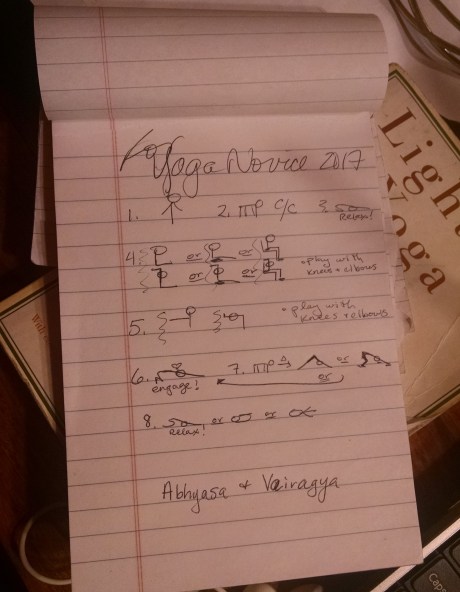
Thank you, YogaNovice, for helping me fulfill my 2017 Kiss My Asana commitment. If you haven’t already, I strongly encourage you to check out one of the classes at Mind Body Solutions, where awakening the connection between mind and body transforms trauma, loss, and disability into hope and potential.
Please consider joining the yogathon by making a donation, joining the team, and asking a question.
### JAI JAI GURU DEV (SHINE ON) ###
 A Joyful Practice