BEING WATCHFUL – 2018 Kiss My Asana Offering #5 April 5, 2018
Posted by ajoyfulpractice in 31-Day Challenge, Abhyasa, Books, Buddhism, Changing Perspectives, Dharma, Donate, Faith, Fitness, Gratitude, Healing Stories, Health, Hope, Japa, Japa-Ajapa, Karma Yoga, Life, Meditation, Men, Minneapolis, Minnesota, Movies, One Hoop, Peace, Philosophy, Poetry, Science, Tantra, Texas, Twin Cities, Vairagya, Vipassana, Volunteer, Wisdom, Writing, Yoga.Tags: awareness, farming, inspiration, KISS MY ASANA, Mind Body Solutions, walking
add a comment
“Practice, practice, practice…all is coming.” – Sri Pattabhi Jois
“It comes in its own good time
and in its own way to the one who will go where it lives,
and wait, and be ready,
and watch.
Hurry is beside the point, useless, an obstruction.
The thing is to be attentively present.
To sit and wait is as important as to move.”
– from Being Watchful by Wendell Berry
We’ve been here before, and we will be here again – that is the nature of the practice. Practicing hatha yoga (the physical practice, regardless of style or tradition) can be a little like being in an old Western where characters pass the same rock again and again. In the movies, the only thing that changes is the characters’ bodies and their awareness.
Come to think of it, the same thing is true of our practice.
Some practices (e.g., Ashtanga – one of the earliest forms of vinyasa, introduced to the West by Sri Pattabhi Jois; Bikram Choudhury’s hot yoga sequence; and Sivananda Yoga – based on the teachings of Swami Sivananda) include the same poses in the same order every time. These practices give people a standardized measure by which to gauge their practice and their evolution within the practice.
On the flip side, some practices include an ever rotating set of poses and sequences so that we keep coming at the metaphorical rock from a different direction.
Either way, as the body and the mind change, the practice also changes. The body and the teacher will repeat the same information again and again, but we won’t “hear” the information until we’re ready to process and synthesize it. That’s why, when people new to yoga ask me how they can hurry up and get up to speed, I tell them to keep practicing.
“And then I began to learn perhaps
the most important lesson that nature had to teach me:
that I could not learn about her in a hurry.
– from “Being Watchful” by Wendell Berry
We’ve been here before…but now something is different. It may be a while before we notice the difference, but it’s there…just waiting for us to be ready. In some ways, this is all like walking the land.
Walking the land is not unusual for a farmer – it’s what they do after all. They walk the land, pausing to assess something or just to soak it all in. Sometimes they just walk for the sake of walking. And, anyone who has walked just for the sake of walking will tell you, it is not unusual for the mind to open up on a walk.
Wendell Berry is a poet, a farmer, a novelist, an environmentalist, a Christian, an activist, and a Kentuckian. He is also a walker – and by that I mean, he walks. Naturally, being a farmer who is also a poet, he writes poems inspired on his walks. He calls them “Sabbath poems.” Consider today’s practice a “Sabbath poem.”
Being Watchful – by Wendell Berry
Move into Child’s Pose (Balasana) as if you are moving into a new house. Take your time to balance the effort and relaxation inherent in the pose. Watch the breath. Pause and take in the landscape that is your mind and your body in this present moment.
When you move into Table Top – hands and knees to the mat with shoulders over elbows and wrists, hips over knees – or into a seated position if that is more accessible, move as if you are taking a leisurely stroll. Take your time, and pause to get the lay of the land. Move through Cat/Cow or the “Un-Cat” sequence precisely matching the movement to the breath. So that, as the breath gets long and fine and deep, the movement gets richer – whatever that means to you in this moment.
“from this
moment this moment
is the first
– from Be Still In Haste by Wendell Berry*
Pause with the spine back in Table Top position. Sit down with your legs straight out in front of you. Sit up on a blanket or a block if you have a lot of tightness/stiffness in the back of your body. This is Staff Pose (Dandasana), which appears on the Top 10 Poses People Overlook/Underestimate.
Press your heels down into the ground, flex the ankles so the toes reach for the nose, and then spread the toes. At the same time, fire up your thighs and engage the quadriceps (the four muscles at the top of your things) in order to lift the knee caps into their full extended position. Press the sit bones and hands down (with the hands next to the hips). If this engagement is too extreme, bend knees or place the hands behind the hips (but still wide enough to just barely be outside of the hips).
As if they are seeds you are planting, push your shoulders and everything touching the floor, the mat, or a prop down into the earth. Watch how the engagement of your feet, your legs, your hips, your core, your hands, and your arms allows you to lift the heart and the ribs away from the lower body. You are actively creating space. Now, engage the space: squeeze your perineum muscles for the root lock (mula bandha); draw the belly button up and back for the core lock (uddiyana bandha); and press the chin into your throat for the chin lock (jalandhara bandha). With your eyes on your nose, watch your breath.
Keep the left leg extended and bend the right knee in order to set up the Sage Twist. Remember to keep the left heel and the right foot flat on the floor. You can place the right foot next to the inside or the outside of the left leg, as long as the knees are comfortable and the right foot is flat on the floor.
On an inhale, lift your right arm up and, as you watch it, reach the right arm back to the floor behind your hips. As you settle into the twist, adjust your left arm to provide additional support wherever you need it. You can always sit on a block and/or place a block under your hand if you’re hips and low back are really tight. If you don’t have a block, substitute a book.
Watch how you engage your base. Again, like you a planting, use every inhale to press down in order to lift up – creating more space between your ribs and your hips. Use every exhale to twist and rinse – engaging that space. Remember to start the twist in your base (not in your neck). Do not allow your body to collapse or untwist until you complete 3 – 5 complete breaths. After the third or fifth exhale, inhale to center, give the lifted knee a squeeze, and return to Staff Pose. Repeat the Sage Twist instructions for the Sage Twist (replacing right with left).
After the third or fifth exhale on the left, inhale to center and give the lifted knee a squeeze. Bend or extend both, as needed, and lower down onto your back for Corpse Pose (Savasana). Be here, and be watchful.
This opportunity to explore a poem on the mat is part of my offering for the 2018 Kiss My Asana yogathon. I encourage you to set aside at least 5 minutes a day during April, to practice with the poem as inspiration. You can practice in a class or on your own, but since the Kiss My Asana yogathon raises resources as well as awareness, I invite you to join me at one of the donation-based classes listed (April 7th and April 28th).
I also challenge you to set aside a certain amount every day that you practice with a poem in mind. It doesn’t matter if you set aside one dollar per practice or $25 – set aside that amount each time you practice and donate it by April 30th.
Founded by Matthew Sanford, Mind Body Solutions helps those who have experienced trauma, loss, and disability find new ways to live by integrating both mind and body. They provide classes, workshops, and outreach programs. They also train yoga teachers and offer highly specialized training for health care professionals. By participating in the Kiss My Asana yogathon you join a global movement, but in a personal way. In other words, you practice yoga. Or, as this year’s tag line states, “do yoga. share yoga. help others.”
*Yes, clock watchers, the extra poem in this post is just for you!
## do yoga. share yoga. help others. ##
JUST SITTING & BREATHING – 2018 Kiss My Asana Offering #3 April 3, 2018
Posted by ajoyfulpractice in 31-Day Challenge, Abhyasa, Books, Changing Perspectives, Daoism, Donate, Faith, Fitness, Healing Stories, Health, Hope, Karma Yoga, Mathmatics, Meditation, Minneapolis, Minnesota, Peace, Philosophy, Poetry, Science, Tantra, Taoism, Traditional Chinese Medicine, Twin Cities, Vairagya, Volunteer, Wisdom, Writing, Yoga.Tags: breath, healing, inspiration, KISS MY ASANA, Mind Body Solutions, recovery, spine, vinyasa
add a comment
“To breathe! Oh poem we cannot see!
Pure space exchanged continually
For one’s own being. Counterpoise,
In which I come to be, a rhythm.”
– from Sonnets to Orpheus II, 1 by Rainer Maria Rilke
“feel how your breathing makes more space around you”
– from Sonnets to Orpheus II, 29 by Rainer Maria Rilke
Regardless of what you practice or how you practice yoga, breathing is an essential part of the practice. In fact, the physical practice of yoga, Hatha Yoga (regardless of the style or tradition) is a combination of the third and fourth limbs of the philosophy of yoga: asana (“seat”) and pranayama (“awareness” or “extension” of breath). As the body is a container for the breath, the asana is a way to direct the breath, as well as a way to connect the mind and body.
Connecting through the breath is also a way to bring about change in the mind and body. Literally speaking, Hatha Yoga may be translated as “sun-moon union” or “by-force union.” The power of the practice comes from the uniting of opposites. It is by the force of the breath that we bring about change.
Sir Isaac Newton stood on the shoulders of giants, in particular Nicolaus Copernicus, Galileo Galilei and Johannes Kepler, and published his laws of motion in 1687. Three hundred and thirty-one years later, these physical laws first published in the Philosophiae Naturalis Principia Mathematica still hold up: (1) that an object at rest remains at rest and an object in motion remains in motion – unless acted upon by a force; (2) that the rate of change in momentum is directly related to the force applied, and the direction applied; and (3) that there is an equal and opposite reaction to every action.
Every time we breathe, especially if we observe the body’s natural reaction to the breath, we are seeing these laws at work. Take a deeper breath in and that action results in a deeper breath out. As, the breath enters the body the belly rises; as the breath leaves, the belly falls. Simultaneously, the diaphragm rises and falls, enters and leaves – but, in the opposite direction of the belly. Also, on a much deeper level, the spine extends as we inhale and flexes as we exhale. Our physical practice of yoga is simply a way to observe natural phenomena at work.
Our physical practice is also a way to observe natural phenomena from a philosophical standpoint. For example, Daoism views everything in existence as the manifestation of four (4) actions: entering and leaving, rising and falling. As we inhale, things and people come into our lives, things happen around us. As we exhale, things and people leave our lives, things change around us. Notice the thoughts and emotions that arise. Notice how the thoughts and emotions settle.
Sonnets to Orpheus II, 29 – by Rainer Maria Rilke
Move into Child’s Pose (Balasana) as if you are moving into a new house. Make yourself comfortable and stable enough to focus on the breath. Notice the inhale, the pause, the exhale, the pause. Notice how the body reacts to each part of the breath. Notice how the inhale creates space and the exhale allows you to engage that space.
After a few minutes in Balasana, make your way into Table Top – hands and knees to the mat with shoulders over elbows and wrists, hips over knees – or into a seated position if that is more accessible. Begin to move with the breath in an exaggeration of your body’s natural tendencies: Inhale and extend the spine into a back-bend with the belly dropping down (this is Cow Pose). Exhale and flex the spine so the belly is drawn up into the spine (this is Cat Pose). If you sit hunched over a computer all day, you might try the “un-Cat” instead.
As Rainer Maria Rilke writes, “Move back and forth into the change.” Match the movement to the breath and notice the natural balance of the breath being reflected in the movement. Notice how your mind settles into the rising and falling, the ebbing and flowing. Notice how your mind settles into the present moment – even as it changes.
After a few minutes of Cat/Cow or the “un-Cat” (from the link above), move into Corpse Pose (Savasana). Notice the rising and falling of the belly as the breath enters and leaves the body. Feel the breath in your spine. Notice the breath that leaves the body is entering the world, and vice versa.
Breath is spirit. In fact, in the old languages, people used the same words for breath that they used for spirit: Prana in Sanskrit, Qi in Chinese, Pneuma in Greek, Ruach (in the body) in Hebrew, and Spiritus in Latin. So, feel the force of your spirit in the body and in the world.
This opportunity to explore a poem on the mat is part of my offering for the 2018 Kiss My Asana yogathon. I encourage you to set aside at least 5 minutes a day during April, to practice with the poem as inspiration. You can practice in a class or on your own, but since the Kiss My Asana yogathon raises resources as well as awareness, I invite you to join me at one of my donation-based classes (April 7th and April 28th).
I also challenge you to set aside a certain amount every day that you practice with a poem in mind. It doesn’t matter if you set aside one dollar per practice or $25 – set aside that amount each time you practice and donate it by April 30th.
Founded by Matthew Sanford, Mind Body Solutions helps those who have experienced trauma, loss, and disability find new ways to live by integrating both mind and body. They provide classes, workshops, and outreach programs. They also train yoga teachers and offer highly specialized training for health care professionals. By participating in the Kiss My Asana yogathon you join a global movement, but in a personal way. In other words, you practice yoga. Or, as this year’s tag line states….
# do yoga. share yoga. help others. #
Going With The Flow, When There’s An Obstacle In The Way December 31, 2017
Posted by ajoyfulpractice in 108 Sun Salutations, Abhyasa, Books, Changing Perspectives, Faith, Fitness, Healing Stories, Japa, Japa-Ajapa, Life, Mala, Meditation, Minneapolis, Minnesota, New Year, Peace, Philosophy, Science, Surya Namaskar, Tantra, Twin Cities, Vairagya, Vipassana, Whirling Dervish, Wisdom, Yoga.Tags: 108, Alex Lickerman, inspiration, Marcus Aurelius, New Year, obstacles, Ryan Holiday, Sun Salutations, Surya Namaskar, WBYeats
7 comments
If we learned nothing else in the last year, it was that things don’t always go according to (our) plan. 2017 was a year that, for some of us, seemed to go awry even before it started. There were times when we fell down and wanted to throw our hands up. But, instead, many got up…and kept moving forward. There’s merit in that.
I didn’t think I needed a personal reminder of the merit of moving forward, no matter the obstacles. But then I started confirming my plans for the New Year’s Day 108 Sun Salutations and well…let’s just say William Butler Yeats had it right:
Turning and turning in the widening gyre
The falcon cannot hear the falconer;
Things fall apart; the centre cannot hold;
In 2013, I started leading a New Year’s Day morning japa-ajapa mala practice of 108 Sun Salutations. A year later I added an afternoon practice. At times I thought about renting a space and combining the two, but I ignored the writing on the wall. I was in the flow of my own making, totally and utterly attached to the momentum that worked for me.
So, this year I was thrown into a bit of a tailspin when I discovered I needed to relocate the morning practice. I kept moving forward, confirmed a new location, and, for the sixth year, the practice is full.
Then, on Wednesday, I learned about a scheduling issue that resulted in the cancellation of the afternoon 108 practice at the Downtown Minneapolis YMCA. Thankfully, anyone who was planning to attend that practice can scroll to the end of this blog post for options which will allow them to keep moving forward.
And there’s merit in that. Not just merit in the idea that we keep moving forward, no matter the obstacles. There’s something to be said for letting go of our attachments and going with the flow.
Don’t get me wrong. I’m not suggesting that we rollover and play dead when things don’t go our way. Nor am I suggesting that we jump on a band wagon headed for Hades just because there’s a lot of momentum pushing us in that direction. Instead, what I’m suggesting requires going a little deeper – into ourselves and into the situation – in order to leverage the momentum in a skillful manner. What I’m suggesting requires understanding the powerful dynamics of movement(s).
Vinyasa, a popular form of Hatha Yoga (the physical practice of yoga) is often referred to in English as “Flow” or “Yoga Flow.” Three (3) of the 12 poses in Surya Namaskar (Sun Salutation) are so ubiquitous in the West that some practitioners think those poses are what makes something a vinyasa practice. All of which contributes to people overlooking a key element of the style and tradition: the meaning/intention underlying the practice.
The word “vinyasa” comes from the words “nyasa, “ which means “to place, to touch, to apply” and “vi,” which means “in a special way.” In a Vinyasa yoga practice, poses are placed so that, in theory, the movement matches the human body’s natural tendencies (to extend/expand on an inhale; to flex/contract on an exhale) and practitioners can move one breath (to) one motion (i.e., flow). When we match the movement to the breath, the movement becomes seamless and very much like a dance – or a moving meditation.
Similarly, the name of the insight meditation technique and tradition “vipassana” literally means “to see or to recognize” (“passana”) “in a special way” (“vi”). In Insight Yoga, Sarah Powers wrote, “So vipassana is the art of seeing or relating to life freed from the mesmerizing power of our entrenched prejudices and preferences. This unconstricted view breeds insight into the underlying nature of things.”
Therefore, if we can see and/or recognize the underlying nature of ourselves and our surroundings (causes and conditions), if we have insight into the evolution of ideas (starting with the desires, which are the seeds of these ideas), then we may place or apply ourselves in a way that works with the flow of energy, rather than against it. The very thing that stood in our way (the obstacle) becomes our way. Or, as Marcus Aurelius wrote is his personal notebook, “Our actions may be impeded, but there can be no impeding our intentions or dispositions. Because we can accommodate and adapt. The mind adapts and converts to its own purposes the obstacle to our acting. The impediment to action advances action. What stands in the way becomes the way.”
In a 2014 Psychology Today review of Ryan Holiday’s The Obstacle is the Way (which is a great handbook on old fashioned stoicism), Dr. Alex Lickerman refers to situations that train us to deal with challenges, stating, “… when victory over external barriers is contingent upon victory over internal ones, the greatest benefit a situation has to offer us is training—by which I mean a challenge that forces us to grow in a way that makes achieving our goal possible.”
To me, the physical practice of yoga (any style or tradition) or a seated meditation practice are ways to train the body and mind for the challenges of life. Each practice comes with a different set of challenges, and a different set of obstacles. Every practice, in its own way, pairs internal barriers with external barriers, and (because so many of my practices are vinyasa practices) a different set of ways to go with the flow.
2018 promises to be a year full of challenges.
Let’s start it off with a practice, or two.
Monday, January 1st – New Year’s Day:
9:00 AM – 11:00 AM 108 Sun Salutations with Susan (Yoga Center of Minneapolis, St. Louis Park – REGISTRATION)
10:00 AM – 1:00 PM 108 Sun Salutations with Myra (reservations required – THIS PRACTICE IS FULL)
10:00 AM – 12:30 PM “Set Your Course!” with Nora Gordon (Big River Yoga – REGISTRATION)
10:30 AM – 1:00 PM New Year’s Day Practice with Nancy Boler (reservations required – THIS PRACTICE IS FULL)
12:00 PM – 2:00 PM 108 Sun Salutations & Restorative Yoga with Vie Boheme (Radiant Life Yoga – REGISTRATION)
12:00 PM – 2:30 PM 108 Sun Salutations with Aubrey Weger & live music (Yoga Sanctuary Mpls – REGISTRATION REQUIRED)
12:00 PM – 2:00 PM 108 Sun Salutations with Kate L and Rachel R (CorePower Maple Grove)
1:00 PM – 2:30 PM New Year’s Day with Ian M (Downtown Minneapolis YMCA, members & their guest)
1:30 PM – 4 PM “Sankalpa Shakti: The Power of Inspired Intention” with Ben Vincent (Vincent Yoga at One Yoga – REGISTRATION REQUIRED)
2:00 PM – 3:45 PM 108 Sun Salutations with Jennifer Davis (Blaisdell YMCA, members & their guests)
Tuesday, January 2nd – “What’s In A Name?”
Wednesday, January 3rd – “New Beginnings”
Saturday, January 6th – Epiphany / “Manifesting Your Intention”
~ SEE YOU ON THE MAT ~
###
2017 KISS MY ASANA QUESTIONS #5, 6, & 7: IF YOU COULD RECOMMEND ONE BOOK…? April 15, 2017
Posted by ajoyfulpractice in 31-Day Challenge, Books, Buddhism, California, Changing Perspectives, Daoism, Donate, Faith, Fitness, Healing Stories, Health, Karma Yoga, Life, Meditation, Men, Minneapolis, Minnesota, Peace, Philosophy, Science, Tantra, Taoism, Texas, Twin Cities, Volunteer, Wisdom, Women, Writing, Yin Yoga, Yoga.Tags: inspiration, KISS MY ASANA, meditation, Mind Body Solutions, yoga books, yoga practice
add a comment
“If you could recommend one book about yoga that really impacted your practice, what book would that be?”
“If you could recommend one book about meditation, what would it be?”
“Is there a book that would help a beginner like me establish a daily practice?”
– E
There might be more books on yoga and meditation than there are ways to practice yoga and meditation. I know for sure that there are so many books on each it is sometimes hard to narrow things down to a single recommendation. Even if I had read everything that’s ever been printed – and nothing else was ever printed (which would be a shame since one of my teachers is currently working on her first book) – and even if I only focused on books that really impacted my practice, I would still end up with a bag full of books.
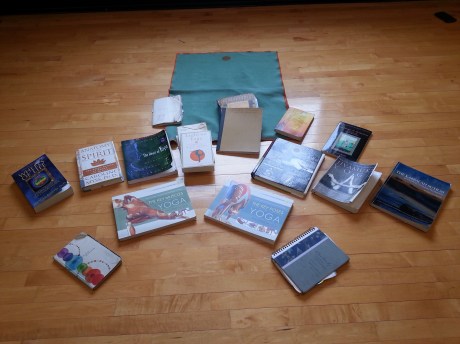
(NOTE: The picture above is missing Leslie Kaminoff’s Yoga Anatomy, Steve Ross’s Happy Yoga, Stephen Cope’s The Wisdom of Yoga, all my Yin Yoga and Taoist texts, a copy of the Ramayana, and Alanna Kaivalya’s Myths of the Asanas, at the very least.)
Part of me wants to break this down into a book on the physical practice versus a book on the philosophy; however, sitting with WHY I want to make that distinction, brings me to one very comprehensive option: T. K. V. Desikachar’s The Heart of Yoga: Developing A Personal Practice.
Desikachar was the son of Sri Krishnamacharya, who was the teacher responsible for the resurgence of yoga in 20th Century India. Krishnamacharya taught Desikachar, B. K. S. Iyengar, Sri Pattabhi Jois, and Indra Devi – who all had a hand in bringing the physical practice of yoga to the West. Each of the teachers mentioned above wrote at least one book which impacted someone’s yoga practice (including mine), and all of them have had books written about them. Desikachar’s The Heart of Yoga is simultaneously about yoga and about a teacher’s teacher. It is also a practice manual with a heavy focus on the philosophy. Unlike some other books I might refer to as practice manuals, The Heart of Yoga not only offers an overview of the 8-limb philosophy of yoga, it includes a translation of the Patanjali’s Yoga Sutras. (NOTE: Patanjali’s Yoga Sutras are 196 aphorisms. Most books on the sutras include each aphorism, plus a translation and commentary for each aphorism. I use several sources for translation/commentary comparative analysis; however, my go-to resource is a website by Swami J, of the Himalayan tradition.) The Heart of Yoga gives practitioners of any fitness or experience level the opportunity to build a physical practice, while also maintaining a connection to the overall philosophical practice.
My similar dilemma regarding a book on meditation could be resolved by recommending a book on yoga mediation… and a book from each of several different Buddhist traditions…plus a book on the Kabbalah…and a book on Catholic contemplation and…..You get the idea. But, when it gets right down to it, there’s one book I am continually giving away – and it’s the same book used when I guided meditation with Dr. Thomas Bushlack’s University of St. Thomas classes: The Miracle of Mindfulness: A Manual on Meditation by Thich Nhat Hahn.
I first came across The Miracle of Mindfulness when I was babysitting for some friends in Minneapolis. One day, when the kids were napping, this little violet paperback on the bookshelf in the living room caught my eye. I pulled it down, and found…stillness.
OK, I’m being dramatic. I had, of course, already experienced stillness in both yoga and seated meditation. However, Nhat Hahn’s The Miracle of Mindfulness made me pause, sit, and contemplate my overall practice and its connection to meditation. Over the last ten years, it has played an instrumental part in my re-commitment to the physical practice of yoga as a form of meditation.
Let me be clear: Nhat Hahn is not known as a yoga teacher and The Miracle of Mindfulness is not a book related to hatha yoga (the physical practice of yoga). Nhat Hanh is a Vietnamese Buddhist monk most commonly associated with Zen Buddhism, but whose training includes several traditions. His Miracle of Mindfulness is based on Buddhist principles and practices, but is not teaching Buddhism, per se. Some might argue that it is not even teaching meditation (but, rather, mindfulness). Still, it accessible to people regardless of their background or experience and includes personal anecdotes as well as a series of practices that are simultaneously simple and profound.
To answer E’s final question, The Miracle of Mindfulness definitely has the tools to help a beginner establish a daily practice. Tools, however, do not build a mansion – and the mansion will not be built overnight.
“Practice, practice, practice – all is coming.” ~ Sri Pattabhi Jois
If you find this information helpful, insightful, validating, and/or curious, please Kiss My Asana by making a donation, joining the team, asking a question, and/or joining me for a donation-based class to benefit Mind Body Solutions.
Sandra Razieli and I will co-host a donation-based class on Saturday, April 22nd (6:30 PM – 8:00 PM) at Flourish Pilates+Yoga+Bodywork. I will host a second class on Saturday, April 29th (3:30 PM – 5:30 PM) at Nokomis Yoga. Please RSVP via email (Myra at ajoyfulpractice.com). All donations will benefit Mind Body Solutions, where awakening the connection between mind and body transforms trauma, loss, and disability into hope and potential.
### OM SHANTI, SHANTI, SHANTIHI OM ##
2017 Kiss My Asana Question #2: Why 108? April 3, 2017
Posted by ajoyfulpractice in 108 Sun Salutations, 31-Day Challenge, Baseball, Bhakti, Books, Buddhism, Chicago Cubs, Depression, Dharma, Donate, Faith, Fitness, Gratitude, Healing Stories, Health, Hope, Japa, Japa-Ajapa, Karma, Karma Yoga, Kirtan, Life, Loss, Love, Mala, Mantra, Mathematics, Meditation, Men, Minneapolis, Minnesota, Music, Mysticism, Pain, Peace, Philosophy, Qigong, Religion, Science, Suffering, Surya Namaskar, Tai Chi, Tantra, Texas, Tragedy, TV, Twin Cities, Volunteer, Wisdom, Women, Writing, Yoga.Tags: anger, awareness, Beyond Disability, community, compassion, fear, grief, inspiration, kindness, Kiss M, Mind Body Solutions
add a comment
“The number of words you use to answer these questions is going to be divisible by 108? Why 108?” – the obvious questions
The significance of 108 is something pondered pretty much whenever people get ready to practice 108 Sun Salutations (for New Year’s Day, Spring/Fall Equinox, and Summer/Winter Solstice). It is considered an auspicious number in a variety of disciplines and traditions. So much so that if I listed 108 reasons, I might still be missing some. Swami J has a pretty comprehensive list; however, here are some of my favorites:
- 108 is a harshad (or, “great joy” bringer) number in mathematics, meaning that it is divisible by the sum of its parts (1+0+8=9; 108/9 = 12)
- Note also 1+2 = 3; 12/3 = 4 and 108/3 = 36; 3+6 = 9; 36/9 = 6
- 108 is a prime example of numbers being exponentially powerful {(1, raised to the 1st power) multiplied times (2, raised to the 2nd power) multiplied times (3, raised to the 3rd power), i.e., 1*4*27}
- 108 suitors pursue Penelope in Homer’s Odyssey.
- In Buddhism, the 108 feelings or sensations humans experience result from external/physical and internal/mental stimuli (2) being received through our senses and consciousness (5+1) multiplied times our perception of sensation as positive/pleasant, negative/painful, or neutral (3) multiplied times our ability to experience feelings or sensations in the past, present, and future (3). {2*(5+1)*3*3}
- In Eastern religions and philosophies, a mala used to count repetitions during meditation contains 108 beads – or a fraction of 108, and this coincides with an old school Catholic rosary which allows you to count out 10 decades, and provides 8 additional beads (for mistakes). The cross would be considered the guru bead.
- In some religions there is only one God; however there are 101-108 names for God.
- In an Indian creation story, God as Dance (Nataraja) creates the universe through a dance containing 108 steps or poses; and, there are 108 forms of dance in Indian traditions.
- Some martial arts forms contain 108 steps or poses.
- According to some yoga texts, there are 108 nadis (energy rivers carrying the bodies vitality) intersecting at the heart chakra.
Since I’m writing this on opening day 2017:
- The 108 double stitches on a Major League baseball are hand stitched; AND
- It took 108 years for a much loved baseball team to break a curse (that may or may not be real) – and they did it in the 10th inning with 8 runs!
Finally, it would be seriously auspicious if a couple of people (2) Kiss(ed) My Asana by clicking here and donating $54 each. Or, you know what would be a real joy bringer? If a certain number of individuals (108) clicked above and donated $108 each.
For those of you doing the math: $25 shares a “Beyond Disability” DVD with a home-bound person living with a disability; $250 provides four yoga classes at a battered women’s shelter or veterans center; $500 provides full tuition for an Opening Yoga Teacher Training Workshop; and $1000 transforms the life of someone living with a disability by providing them an entire year of adaptive yoga. While these numbers focus on the people directly receiving the service, consider how yoga affects not only the individual on the mat, but everyone that individual encounters off the mat.
~ LOKAH SAMASTAH SUKHINO BHAVANTU ~
Are You Ready? Are You Ready…to Kiss My Asana? April 1, 2017
Posted by ajoyfulpractice in 31-Day Challenge, Art, Books, Changing Perspectives, Confessions, Depression, Dharma, Donate, Faith, Fitness, Gratitude, Healing Stories, Health, Hope, Karma, Karma Yoga, Life, Loss, Love, Mathematics, Meditation, Men, Minneapolis, Minnesota, Movies, Music, Mysticism, Pain, Peace, Philosophy, Science, Suffering, Super Heroes, Tantra, Texas, TV, Twin Cities, Vipassana, Volunteer, Wisdom, Women, Writing, Yoga.Tags: community, grief, inspiration, kindness, KISS MY ASANA, laughter, Mind Body Solutions, recovery, union
4 comments
“Are you ready? Are you ready? / For what’s to come…Oh, I said Are you ready? / Are you ready? For what’s to come / Ten, nine, eight, seven, six, five, four, three, two, one / Count down to…”
– Are You Ready by Creed
It’s that time again! Spring? Yes, but also it’s time for Kiss My Asana. For the fourth year in a row, I am joining joyful yogis everywhere to raise awareness and resources for Mind Body Solutions and their adaptive yoga programs.
Matthew Sanford and the other teachers at Mind Body Solutions are committed to a yoga practice which “transcends ability and disability, opens people’s lives to new possibilities, and transforms the delivery of health care.” The annual yogathon is a virtual four-week challenge open to anyone, anywhere, and it’s pretty much open to any way you want to do more yoga, learn more about yoga, and share more yoga.
“Are you ready? For what’s to come?”
Then let’s get started. There are a lot of ways to help raise awareness and resources during the month of April. Here are just a few suggestions.
- Since my previous Kiss My Asana offerings are still available, you can participate in this April’s yogathon by practicing “30 Poses in 30 Days” (posted in 2014); use the 2015 “30 Songs in 30 Days” as your practice playlist; add one of these 5-minute yoga or meditation practices to your weekly/daily routine (posted in 2015); and/or revisit last year’s yogi videos and profiles (featuring 5 practice focused questions).
- If you join the “A Joyful Practice” donation team, you will receive a studio passport which will enable you to practice at participating passport studios for free. You may also use the joyful link above to donate to Mind Body Solutions and the 2017 Kiss My Asana Yogathon (without committing to raising additional resources).
- You can attend one or more than one of the donation-based yoga classes being offered during Kiss My Asana.
- Erika Peterson will host a KMA donation-based class at Nokomis Yoga on Sunday, April 9th.
- I will host donation-based classes at Flourish on Saturday, April 22nd (6:30 PM – 8:00 PM) and at Nokomis Yoga on Saturday, April 29th (3:30 PM – 5:30 PM).
- For more opportunities, check out KMA registered classes for 2017.
Erika teaches a Vin-Yin class at Nokomis, and her KMA class will be a Slow Flow Vinyasa. The classes I host (or co-host) will be inspired by the practice principles featured in the adaptive yoga DVD “Beyond Disability” as led by Matthew Sanford. (Please RSVP using the links above if you would like to join one of these donation-based classes.)
- You can challenge yourself by practicing one thing (an asana, pranayama, or a meditation) every day for 30 days.
- You can use yoga to embody your favorite story, song, emotion, poem, prayer, visual art, person, or moment in time.
- You can blog, tweet, instagram, or Facebook link about how your yoga practice on the mat transforms your experiences off the mat.
This is all good, but “What,” you might ask, “are you (Myra) doing as the virtual part of this year’s Kiss My Asana?”
Good question. As you may have noticed (especially after last year), I love questions. I’ve fallen for “Questions” by R. S. Thomas and, like the Creed song quoted above, my personal playlist currently features question-centered songs by Fink, X Ambassadors, Ed Sheeran, Cole Swindell, and Garth Brooks (naturally)!
In my favorite “Letters To A Young Poet” passage, Rainer Maria Rilke urges Franz Kappus: “… try to love the questions themselves…. the point is, to live everything. Live the questions now.”
Oh, and did I mention that questions led me to yoga teacher training?
When I started practicing in Texas, I often encountered people whose only intersection with yoga was me. These people had questions – lots and lots of questions. I, unfortunately, had no answers…other than telling people they could come with me to practice. When some of my teachers suggested teacher training, I thought, “Sure, someday. Then I’ll know some answers – or, at least, know a resource where someone could live (or practice) their way into their own answers.” Flash forward to “someday” and I’m in Minneapolis attending a teacher training focused on teaching people how to teach – and everybody had to teach.
So, last year I asked people questions. This year, you get to ask me questions. Answer word count will be divisible by 108.
Want to ask me a question? You can make a comment below, ask me before or after a class, or send an email to myra at ajoyfulpractice.com. Subscribers to ajoyfulpractice.com will receive my answers as they are posted – or, you can check back here throughout April.
### Peace In, Peace Out ###
2016 Kiss My Asana #26: Mastering the Art of SODOTO February 28, 2016
Posted by ajoyfulpractice in Books, Changing Perspectives, Confessions, Dharma, Donate, Faith, Fitness, Gratitude, Healing Stories, Health, Hope, Japa-Ajapa, Karma, Karma Yoga, Life, Love, Mathematics, Meditation, Men, Minneapolis, Minnesota, Movies, Music, Mysticism, One Hoop, Peace, Philosophy, Science, Suffering, Tantra, Taoism, Texas, TV, Twin Cities, Volunteer, Wisdom, Women, Writing, Yoga.Tags: community, donation-based events, faith, finding hope, Karma Yoga, KISS MY ASANA, Mind Body Solutions, music, union
add a comment
“Even in the animal kingdom, the ability to search and reapply know-how is a key attribute that moves a species from survival to prosperity.
Just as the guru tutors the novitiate so does the goldsmith his apprentice. The same is true for officers and engineers and in all fields where the mastery of craft is a matter of certification. The greater enlightens the lesser. The maxim is “See One, Do One, Teach One” or as the sensei might say ‘SODOTO.’”
– Excerpt from The Enlivened Self: The Art of Growing, Part II – Creativize by Jeff DeGraff
During my first year teaching, a student approached with questions about yoga teacher training. He had been practicing long before I arrived, but now he was ready to consider the possibilities. We talked about his goals, and the will/determination driving those goals. I gave him a summary of the big teacher training programs in the Twin Cities. A few months later, someone else approached me. I had the list (and the highlighted bullet points) ready. Those first two students, and many of the ones who came later, ended up completing yoga teacher training and started teaching. Sometimes I would even take classes from them. Often I would refer others to them. At least one of those early students who became the teacher began teaching other students how to teach! Eventually, I discovered trainings were changing and growing in the Twin Cities; so I started updating the list.
And the people kept asking, again, and again…and again. But they weren’t always people who regularly practiced with me. Once the person who asked was someone I just knew from a neighborhood coffee shop. Once, someone visiting from California before entering Kripalu teacher training, emailed me for additional tips as she approached her finals. Once a woman approached me after I subbed her regular class – she was already in a training program, but seriously considering dropping out over a major theological issue. By the time Yogi #26 (Annamaria) approached me it had occurred to me that maybe my presence as a teacher reminded people that they had something to offer the world. It was as if, after years of ruminating and precontemplation, something in them woke up and shouted, “If she can do that, I can so do that!”
“Wax on, right hand. Wax off, left hand. Wax on. Wax Off. Breathe – in through nose, out the mouth. {Sound of inhale, sound of ‘ha’ out} Wax on. Wax off. Don’t forget to breathe – very important. Wax on. Wax Off. Wax on…”
– Noriyuki “Pat” Morita as Mr. (Kesuke) Miyagi in The Karate Kid
Daniel: So, you’re suppose to teach and I’m suppose to learn….
Mr. Miyagi: You learned plenty.
Daniel: I learned plenty. I learned how to sand your decks, maybe. I waxed your car. Paint your house. Paint your fence. I learned plenty – right!
Mr. Miyagi: Ahh. Not everything is as seems.
– Ralph Macchio as Daniel LaRusso and Noriyuki “Pat” Morita as Mr. (Kesuke) Miyagi in The Karate Kid
Yoga teacher training requires adjusting one’s life off the mat, in order to spend more time on the mat – even when the mat is all in one’s head. That adjustment can be extra hard for a modern day householder – who already has to balance life-at-work with life-at-home, life-at-play, life-with-family, life-with-friends, life-with-oneself, and life-with-one’s-spirit. Adding to all that, teacher training requires doing things over and over again, even when your arms no longer want to move, until whatever you’re doing becomes hardwired – hopefully without all the bad habits you’ll discover along the way. And, the more yoga you do, the more your personal yoga practice changes. Your body is different; your awareness of your body is different. Whereas before part of your mental challenge was letting go of all your regular daily life chatter, once you go through teacher training you’ll find yourself judging the poses (or the teachers) and thinking about how you’d cue the sequence you’re practicing if you were teaching your students – especially if your students are very different from the people surrounding you at a major yoga studio.
As a modern day householder, Annamaria decided pursuing teacher training was totally worth the personal investment. She wasn’t looking at teaching yoga as a stepping stone into a new career. She wanted to start with a basic 200-Hour training, which typically involves more than 200 hours worth of curriculum, and gradually add blocks which would enable her to serve in some underserved communities. Like me at the beginning of my yoga journey, she was inspired by the people around her who might find yoga beneficial – but didn’t (or couldn’t) want the benefits to come at the price of a new outfit and an $18 – $20 drop-in fee. Right now, we’re converging – still discussing what comes next as she evolves and grows as a teacher – but evidence of divergence is hard to ignore. Soon, Annamaria will do things as a yoga teacher that I will only ever dream of doing. She’s going to be one of our greats.
“What I think is very special about this is that he’s one of our great teachers, and great spiritual luminaries, and that there was anything that I did that inspired him…that inspires me. And it touches me. And it makes me feel like I’m on the path that I prayed to be on. So, I feel blessed to have had that reflected back to me – through the eyes, and through the words of the, one and only, Wayne Dyer.”
– India.Arie talking about Wayne Dyer talking about her song inspiring his teachings
“If I have seen further than others, it is by standing on the shoulders of Giants.”
– my father paraphrasing Sir Isaac Newton
I grew up surrounded by teachers: my dad’s a professor; his mother was a school teacher; Sunday school teachers reign on both sides (starting for me with my mother’s grandmother); and one of my cousins taught people how to drive buses and trucks. All that before even mentioning all the behind-the-scenes mentoring, guiding, and teaching we take for granted because, ‘Hey, that’s what moms do, right?’ Loving school as I did, certain teachers always had a special place in my heart. Annamaria’s dedication to going deeper on behalf of her yoga students reminds me of my favorite teachers.
A few years after I started practicing yoga, I noticed myself referring to some people as “my yoga teacher” and others as “my yoga instructor” – for a moment I wondered why my subconscious mind would so consciously make that distinction. Then I wondered if it was true; was there a difference, and (if there was a difference) was it my perceptions of the teachers’ perceptions?
During my yoga teacher training, there was a lot of discussion about people who teach yoga and people who teach asana. Looking back, I realized that even though all my early classes included basic elements of the yoga philosophy, some teachers were focused on instructing us how to exercise the bodies, while others were focused on teaching us how to engage the mind-body connection on (and off) the mat. In the end, we teachers are like everybody else: We teach what we know.
“Teach what is appropriate for an individual.”
– The teaching philosophy of T. Krishnamacharya, described in Krishnamacharya: His Life and Teachings by A. G. Mohan
If you follow a certain yoga SODOTO trail, like you might follow a tiny creek or a small drop of water into the earth, you will find the following: T. Krishnamacharya, a great scholar of all the Indian philosophies, taught his brother-in-law B. K. S. Iyengar, a very sickly teenage boy, who grew up to teach Jo Zukovich, whose “realization that yoga is a wide-ranging subject” enabled her to teach Matthew Sanford how to “cultivate a presence within his body through awareness, breath and attention.” If you’re following the tiny creek, you may realize that Matthew Sanford is the beginning of a waterfall. If you’re an MIT scientist following the small drop of water into the earth, you may realize that Mind Solutions is giving us an opportunity to take the ancient practices of yoga airborne. Be a tiny bubble of air – KISS MY ASANA once more with feeling!
A big giant thank you to the 15 yogis who held the space and shared the practice during my donation-based KISS MY ASANA class on Saturday, February 27th(details coming soon). If you’re interested, there are still spaces available for March 5th (6:30 – 8:00 PM at Flourish). Contact Myra at a joyfulpractice.com to reserve a spot (or two). Space is limited. Bay Area yogis, don’t forget: Sandra Razieli’s KISS MY ASANA class is in Oakland on Sunday, February 28th.
~ JAI GURU DEV, JAI JAI ~
2016 Kiss My Asana #24: Guiding and Pulling (In) the Light February 26, 2016
Posted by ajoyfulpractice in Bhakti, Books, California, Changing Perspectives, Confessions, Daoism, Depression, Dharma, Donate, Faith, Fitness, Food, Gratitude, Healing Stories, Health, Hope, Karma, Karma Yoga, Kirtan, Kundalini, Life, Loss, Mantra, Minneapolis, Minnesota, Mirabai Starr, Music, Mysticism, Oliver Sacks, One Hoop, Peace, Philosophy, Qigong, Religion, Science, Suffering, Tai Chi, Tantra, Taoism, TV, Twin Cities, Volunteer, Wisdom, Women, Writing, Yoga.Tags: answers to tragedy, community, donation-based events, faith, Karma Yoga, KISS MY ASANA, laughter, Mind Body Solutions, music, peace, personal crisis
add a comment
“Music can lift us out of depression or move us to tears – it is a remedy, a tonic, orange juice for the ear.”
– Excerpt from Musicophilia by Oliver Sacks
“When you squeeze an orange, orange juice comes out – because that’s what’s inside. When you are squeezed, what comes out is what’s inside.”
– Wayne Dyer
Yogi #24 (Marilyn) gave me some amazingly delicious oranges once. She told me a little of their back story – they had been given to her by a friend who, if I remember correctly, has a grove in California. Eating the oranges gave me great joy (as she intended) and thinking of their back story filled me with awe and gratitude – but it also made me realize that, in reality, I knew very little of their back story.
How many people were responsible for the planting, the nurturing, the harvesting, and the transporting? How were their lives affected by the oranges? Who even had the idea to start all these endeavors? There was just no way to know. In the end, I could only be grateful.
“Gratitude is our ability to see the grace of God, morning by morning, no matter what else greets us in the course of the day. That has the effect of making us gracious as well.”
– Excerpt from Hustling God: Why We Work So Hard for What God Wants to Give Us by M. Craig Barnes
Marilyn herself is a lot like those oranges: Bright sunshine on a cold January day and present after long journeys, she is delightful, joyful, and fills me with awe and gratitude – yet I only know bits and pieces of her back story. I know she teaches; I know she heals; I know she loves animals, travel, and bicycling. Bottom line: I know just enough about Marilyn to know she has seen amazing places, people, and things in the world and encountered the very best and, possibly, the very worst that the world has to offer. Yet, she is always kind and graciously grateful, for the smallest things, even when someone has wronged her. And her smile lights up a room, even when she is frustrated.
“No other light, no other guide,
Than the one burning in my heart.
This light led the way
More clearly than the risen sun
To where he was waiting for me
– The one I knew so intimately –
In a place no one could find us.”
– Excerpt from Dark Night of the Soul by Saint John of the Cross (translated by Mirabai Starr)
“Every human life is made up of the light and the dark, the happy and the sad, the vital and the deadening. How you think about this rhythm of moods makes all the difference. Are you going to hide out in self-delusion and distracting entertainments? Are you going to become cynical and depressed? Or are you going to open your heart to a mystery that is as natural as the sun and the moon, day and night, summer and winter?”
– Excerpt from the introduction to Dark Nights of the Soul: A Guide to Finding Your Way Through Life’s Ordeals by Thomas Moore
Marilyn practices qigong as well as yoga, which means she’s one of the people who get’s my little energetic puns when I describe one set of arm movements as “Gathering Prana” and the complimentary set of movements as “Gathering Qi.” Both qi and prana are words used to describe the life-force energy that is within us and all around us. Like ruach, pneuma, and spiritus, these are also words which were once used to simultaneously define breath and spirit.
Our ancestors, from all their different cultures, didn’t distinguish between spirit and breath – they were both divinely given and received. Our ancestors, from all their different cultures, believed spirit/breath was the light of the world – it was in them and all around them. Now, the modern mind turns to quantum physics to confirm the Truth our ancestors already knew: We can gather it, guide and pull it; dance with it and in it. Like Marilyn. Or not.
“Of the deities presiding over light, I am the one for January, loved by all for turning the world’s course toward warmth. Of the wind gods who bring immense good in the world, I am the whirlwind. Of the daytime luminaries I am the radiant sun, and of the lights of the night I am the moon.”
– Bhagavad Gita 10:21
“Of David: YHVH is my light and my salvation; whom shall I fear? YHVH is the strength of my life; of whom shall I be afraid?”
– Tehillim (Psalms) 27:1
Jesus said, ‘I am the light that is over all things. I am all: from me all came forth, and to me all attained. / Split a piece of wood; I am there. / Lift up the stone, and you will find me there.’”
– The Gospel of Thomas 77
“I sit in my own splendor. / Wealth or pleasure, / Duty or discrimination, / Duality or nonduality, / What are they to me? / What is yesterday, / Tomorrow, / Or today? / What is space, / Or eternity? / I sit in my own radiance.”
– Excerpt from Heart of Awareness: Translation of the Gita by Thomas Byrom 19:2 – 3
One of my favorite sacred texts is the Ashtavakra Gita (The Song of the Man with 8-Bends in His Limbs). It presents the wisdom of a person whose outside is considered less than ideal, by the people around him. According to one of Ashtavakra’s back stories, he was 12-years old when he walked into the court of the King (who would eventually become his pupil) – and everyone laughed at him. Ashtavakra also laughed, and then he started to cry.
When the King asked why he first laughed, as everyone laughed at him, and then cried, Ashtavakra said, “I started laughing because you saw only my outside. I started crying because I crawled all this way to discuss the Truth with great scholars and all I find here are shoemakers and leather workers.” When the King took great offense and proclaimed his court a court of great scholars, Ashtavakra shook his head and said, “It is only shoemakers and leather workers who are so concerned with the quality of the outside that they can’t see the Truth within.”
I’d like to believe that, in these modern times, we’re not so one dimensional that a shoemaker and a leather worker can’t also be great scholars. Yet, too often, people in a position to teach the Truth get caught up with the quality of the outside. Too often, people in a position to receive the Truth get turned away because their outsides are considered less than ideal. Too often we all forget that we are in bodies together – and these bodies are the ideal vehicle for our spirits. The work being done by Matthew Sanford and Mind Body Solutions allows more people to experience the Truth of who we all are and how we are all connected. KISS MY ASANA if you see the Truth – or the light.
My donation-based KISS MY ASANA class on Saturday, February 27th is full; however, I still have spaces available for March 5th (6:30 – 8:00 PM at Flourish). Contact Myra at a joyfulpractice.com to reserve a spot (or two.)Space is limited. Bay Area yogis, don’t forget: Sandra Razieli’s KISS MY ASANA class is in Oakland on Sunday, February 28th.
~ “If the family were a fruit, it would be an orange, a circle of sections, held together but separable – each segment distinct. – Excerpt from Family Politics: Love and Power on an Intimate Frontier Letty Cottin Pegrebin ~
2016 Kiss My Asana #18:This Is Why a Tree Bends Toward the Light February 19, 2016
Posted by ajoyfulpractice in Bhakti, Books, Changing Perspectives, Confessions, Dharma, Donate, Faith, Fitness, Gratitude, Healing Stories, Health, Karma Yoga, Life, Love, Minneapolis, Minnesota, Music, One Hoop, Peace, Philosophy, Science, Tantra, Twin Cities, Uncategorized, Volunteer, Wisdom, Women, Yoga.Tags: awareness, community, donation-based events, KISS MY ASANA, Mind Body Solutions, music, peace
2 comments
“There’s a tree that grows in Brooklyn. Some people call it the Tree of Heaven. No matter where its seed falls, it makes a tree which struggles to reach the sky. It grows in boarded-up lots and out of neglected rubbish heaps. It grows up out of cellar gratings. It is the only tree that grows out of cement. It grows lushly . . . survives without sun, water, and seemingly without earth. It would be considered beautiful except that there are too many of it.”
– preface to A Tree Grows In Brooklyn by Betty Smith
Since a lot of people come to my classes, I could reiterate the passage above and claim they are too many to be considered beautiful. But it wouldn’t be true. Some people stand out. Some people are beautiful inside and out. It’s not a showy thing, and I don’t think it’s something they do on purpose. However, some people are just so naturally themselves that, no matter where they go or what they do, their energy shines through. Maybe it’s because people like Yogi #18 (Tracy) aren’t wasting a lot of energy trying to be someone other than themselves.
“Your very nature dictates that you perform the duties attuned to your disposition. Those duties are your dharma, your natural calling. It is far better to do your own dharma, even if you do it imperfectly, than to try to master the work of another. Those who perform the duties called for by their obligations, even if those duties seem of little merit, are able to do them with less effort – and this releases consciousness that can be directed Godward.”
– The Bhagavad Gita (18:47)
Tracy is a natural scientist, who spends a lot of time outdoors. I don’t imagine it was easy, getting where she is in her life and in her career, but she makes things look easy. From what I can tell, that ease comes from loving what she does, on and off the mat. Her appreciation for what’s she’s doing, in the moment, is one of the reason it’s a pleasure to work with her. She’s also got one of the best smiles. And, no matter how hard I work her, she always shares that smile and expresses gratitude for the work we’ve done together. Those are just a few of the reasons Tracy is one of my favorite co-workers.
At this point, someone who knows me and/or Tracy is thinking, “Wait, Tracy works with you?!?!?” Yep. She’s one of the people I see when I go to work each week, and we collaborate on special projects (i.e., ourselves).
Now, I realize that my perspective is a little different from everybody else in the studios – after all, most people see me when they’re on a break from their work. Still, I’m lucky to work with a really great group of people – and Tracy is one of the people I look forward to seeing when I go to work. Like that person you see once or twice a week for a status report, Tracy and I occasionally share little tidbits about our lives and celebrate random successes. She shared her “favorite musical yoga moment” with me when it happened a few years back; she got her (now) husband to practice a little yoga during the first Kiss My Asana yogathon; and over the years she’s mentioned times when she’s brought the practice off the mat. But what strikes me most when we’re in the middle of the practice is how Tracy works it, gloriously – like she’s so glad to be there.
“Look at everything always as though you were seeing it either for the first or last time: Thus is your time on earth filled with glory.”
– A Tree Grows In Brooklyn by Betty Smith
A seed settles into the soil and waits. Once it germinates, it moves stone and earth to tunnel the shoot that will become its roots. The seed projects a second shoot skyward, which will allow it to convert sunlight into the energy it will use to sustain itself for the rest of its life. Drawing upon every resource available, a seed is compelled to become the thing it was meant to be: a tree, grass, vine, bush, shrub, or flower. If unsuccessful, it will have died trying, but not before exhausting every last fiber of its being to fulfill its potential.
A honeybee, drawing nectar from a blossom, bats its wings 11,400 times per minute. Salmon swim as much as a thousand miles upstream, or more, in order to spawn. An ant will carry twenty times its weight to serve a colony. This same drive, all but invisible, pervades everything in the natural world. The world we live in is little more than an endless and vibrant expression of energy.”
– Excerpted from The Four Desires by Rod Stryker
Tracy strikes me as the kind scientist who appreciates the energy of nature with every inhale and every exhale. But it’s easy to overlook the simple and profound things happening around us and within us. It’s easy to take nature for granted – and, in the process, to take ourselves for granted. A physical yoga practice is an opportunity to tap into our natural resources, on and off the mat. It’s an opportunity to reconnect to the reason we have bodies and minds.
Sometimes, however, there’s a whole lot of mental and physical busyness (or business) keeping a person off the mat. Sometimes that mental busyness is the idea that the body already has to be a certain way in order to practice yoga. Unfortunately, a lot of us teaching yoga here in the West are so focused on the outside we can’t feel the forest or the trees. If you take a class from Matthew Sanford, you will feel the energy of your mind-body. That’s what he does: practices from the inside out (instead of the outside in). JOIN my KISS MY ASANA when you donate and you not only support more teachers learning how to teach the essence of the practice, you’ll also have the opportunity to take some free yoga classes at area studios (through the end of February).
Want to KISS MY ASANA while you practice? Contact Myra at a joyfulpractice.com to reserve a spot (or two) at a donation-based class on Saturday, February 27th (3:30 - 5:30 PM) or Saturday, March 5th (6:30 - 8:00 PM). Space is limited.
~ OM, NAMAH SHIVAYA ~
2016 Kiss My Asana #17:Practicing in Scordatura, As Intended February 18, 2016
Posted by ajoyfulpractice in Bhakti, Books, Buddhism, Changing Perspectives, Confessions, Dharma, Donate, Faith, Fitness, Gratitude, Healing Stories, Health, Hope, Karma Yoga, Life, Loss, Love, Mantra, Meditation, Men, Minneapolis, Minnesota, Movies, Music, Mysticism, One Hoop, Pain, Peace, Philosophy, Science, Suffering, Tantra, Tragedy, Twin Cities, Volunteer, Whirling Dervish, Wisdom, Women, Writing, Yoga.Tags: answers to tragedy, awareness, community, finding hope, KISS MY ASANA, Mind Body Solutions, music
add a comment
“And be not conformed to this world: but be transformed by the renewing of your mind, that you may prove what is that good, and acceptable, and perfect, will of God.”
– Romans 12:2
“It is the aim of my pilgrimage on earth to show my brethren by living demonstration how one may serve God with merriment and rejoicing. For he who is full of joy is full of love for me and for all fellow creatures.”
– Baal Shem Tov*
“‘Where are you going?’
She said, ‘To that world.’
‘And where have you come from?’
She answered, ‘From that world.’
‘And what are you doing in this world?’
And she said, ‘I am sorrowing.’
‘In what way?’ they asked her.
And Rabia replied,
‘I am eating the bread of this world,
And doing the work of that world.’”
– “Rabia Song” by Zuleikha*
Follow me for a moment, while I tell you a story: Once upon a time, a great composer created a piece of music that would inspire the world. The only problem was that none of the existing instruments in the world sounded quite right as the featured soloist. She tried everything. Finally, she decided to make a special instrument – that had to be played a special way. In her studio, the instrument sounded, mostly, divine. Honestly, it sounded OK if treated like any other instrument. And, it had the unfortunate knack of being really off-key if it wasn’t held properly or used appropriately. However, when proper care and attention were taken, there was nothing like it on Earth. It would sound heavenly and enhance the sound of all the other instruments in the orchestra. Knowing she wouldn’t be around to pass the instrument along in person, the great composer left the instrument, music, and instructions for a very competent musician.
Like all music, the figured bass should have no other end and aim than the glory of God and the recreation of the soul; where this is not kept in mind there is no true music, but only an infernal clamour and ranting.” – Johann Sebastian Bach
I have it on good authority that Yogi #17 (Greg) is a very competent musician. Like Yogi #16 (my good authority), he is also a healer whose presence is as soothing as his favorite music. If the world really were an orchestra – full of divine instruments and competent musicians (like Greg), who knew how to play their holy instruments – all would be right with the world.
Unfortunately, the musical story above doesn’t always end well.
In some versions of the story most of the composer’s instructions were lost; the music was rearranged; the special instrument may (or may not) have gotten a little dented; and the conductor didn’t know who was supposed to lead.
So, there you have it: the state of the world as we know it. We have these bodies that can touch and be touched – yet, we often feel disconnected from our bodies, and all the bodies around us. We have these minds that can draw in, process, and evaluate information in the present moment – yet, we spend quite a bit of time making up stuff about past and future moments. We have something driving us to live, to love, to play and be known – let’s call it a spirit – yet, we continuously ignore that our bodies, minds, and spirits are connected. It’s enough disharmonious ranting to make Bach pull off his powdered wig!
“Two things are guaranteed to hook you up with the God of Love: sorrowing and rejoicing. You do not need to go searching for either; they are written into the architecture of human existence.”
– (*All with asterisks) Excerpted from God of Love by Mirabai Starr
Somehow there is harmony and beauty in the world. Maybe, as Mirabai Starr indicates, that harmony and beauty (like sorrowing and rejoicing) is part of our basic make-up. Maybe we just need a practice, the right music, a healer like Greg, or a teacher like Matthew Sanford to help us connect to the very fibers of our being.
All I know for sure, is that on any given Sunday (or Monday through Saturday), someone realizes that they are more than their body, more than their mind. On any given Sunday (or Monday through Saturday), someone awakens to the fact that they are connected to something Divine/Universal. And, maybe they see the Divine/Universal something as an anthropomorphic being, or maybe they feel it as a sensation of connectedness to the people around them. Either way, this awakening comes with a responsibility and a purpose to play the notes they’ve been given.
“To be tender, loving, and caring, human beings must be tenderly loved and cared for in their earliest years, from the moment they are born.”
– Ashley Montagu
“The simple act of touching is of extreme importance to the healthy functioning of the human organism. The skin can be considered the outer layer of the nervous system. The skin is the boundary of our bodies. Through touch, that boundary is gently broken down, permeated by another, and our whole internal system enhanced and stimulated.”
– Excerpt from Wheels of Life: A User’s Guide to the Chakra System by Anodea Judith, Ph.D.
Greg, like Matthew Sanford, believes in the power of touch. It is important not only for the person who needs care, but also to the caregiver. It is critical to the person dying, as well as to those who go on living. During the KISS MY ASANA yogathon, it’s easy to reference the people who have obvious external signs that they’ve experienced trauma, loss, and disability. However, let’s not forget the caregivers and the space holders. While “best known for adapting yoga for persons living with disabilities,” Mind Body Solutions also offers workshops and trainings for caregivers, healthcare providers, and whole organizations. Remember: Everyone benefits when we integrate our mind-body, on and off the mat. So, if you want to honor a healer (or a musician), go to Sharon’s page (she’s matching donations) and KISS MY ASANA!
 A Joyful Practice