Getting More Light [On Gratitude & Happiness] (the “missing” Tuesday post w/an excerpt) October 22, 2024
Posted by ajoyfulpractice in 7-Day Challenge, Bhakti, Books, Changing Perspectives, Dharma, Faith, Gratitude, Healing Stories, Hope, Life, Music, One Hoop, Pain, Philosophy, Religion, Suffering, Sukkot, Tragedy, Wisdom, Writing, Yoga.Tags: 988, A. H. Wilson, Alan Walker, Alfred Nobel, Anne Frank, Bhagavad Gita, Ecclesiastes, epiphany., Franz Liszt, gratitude, Jack Hawley, King Solomon, Kohelet, light, Sukkot, svadyaya, svādhyāya, Theodore Dreiser, Thomas Edison, tov
add a comment
“Chag sameach!” to those celebrating Sukkot! Many blessings to everyone and especially to anyone grateful for friendship, peace, freedom, understanding, and wisdom.
May everyone be healthy and strong; may everyone be peaceful and happy. May everyone follow through on a good idea!!
This is the “missing” post for Tuesday, October 22nd (with some references to October 21st). It includes some previously posted content and an excerpt. You can request an audio recording of this practice via a comment below or (for a slightly faster reply) you can email myra (at) ajoyfulpractice.com.
In the spirit of generosity (“dana”), the Zoom classes, recordings, and blog posts are freely given and freely received. If you are able to support these teachings, please do so as your heart moves you. (NOTE: You can donate even if you are “attending” a practice that is not designated as a “Common Ground Meditation Center” practice, or you can purchase class(es).
Donations are tax deductible; class purchases are not necessarily deductible.
Check out the “Class Schedules” calendar for upcoming classes.
“Breath of breath, said the Teacher; [like the shadow of mist that passes], all is breath.*
What profit has man in all his toil that he toils under the sun?
A generation goes and a generation comes, but the earth endures forever.
The sun rises and the sun sets, and to its place it yearns and rises there.
It goes to the south and goes to the north; the will goes around and around, and the will returns to its circuits.”
— Kohelet — Ecclesiastes (1:2 – 6)
(*NOTE: The Hebrew word “hevel” (variations of which occur in K-E 1.2, 3 times in the singular and twice in the plural, for a total of 7 times) is often translated into English as “vanity,” “futility” or “meaningless,” but is literally translated as “breath.)
Once again, we are faced with that time-honored — and time-honoring — question: “How could I spend my time?”
Since last Wednesday at sunset marked the beginning of Sukkot, some people have spent time in a a sukkah, a temporary shelter consisting of three walls of any material and a roof made of natural fiber. (Natural being something grown from the earth.) As I have mentioned before (see link above), people within the Jewish community and people who observe holidays commanded in Devarim / Deuteronomy, celebrate the “Festival (or Feast) of the Tabernacles (or Booths)” for seven days, 8 in the diaspora.
People will eat, sleep, socialize, and sometimes work in their temporary shelter — but, not necessarily every day. The first two days of Sukkot are both yom tov (“good day”), meaning they are the commanded days with obligations and restrictions similar to those observed on Shabbat (the Sabbath). For some, this means that normal every day work is forbidden. Depending on ethnicity and tradition, certain prayers, rituals, and traditions are only observed on the first two days, on the first and last two days, or throughout the week. For example, in some traditions, the time in the sukkah is the time to read Kohelet / Ecclesiastes.
“Everything has an appointed season, and there is a time for every matter under the heaven.”
— Kohelet — Ecclesiastes (3:1)
While many people — even non-religious people in various religious traditions — are familiar with the third chapter of Kohelet / Ecclesiastes, they may not realize that what comes before could be translated in a less than hopeful way. For example, if “hevel” is translated as “vanity,” “futility” or “meaningless,” the beginning not only reinforces the temporal nature of life, it makes it seem as if there is no point in doing anything. When everything we do — all the work we do — is seen as pointless, then our earlier question becomes, “Why bother doing anything?” or “What’s the point of doing anything?”
Of course, the point that the Teacher (King Solomon) reaches is the same point that Krishna explains to Arjuna in the Bhagavad Gita: there is good, there is evil, there is wisdom, there is ignorance/foolishness and — perhaps most importantly — that we are “supposed to live a truth-based life, a life of dharma [duty].” (BG 2.2)
Oh, and also, “Be happy. This is your opportune moment!” (BG 2.32)
“‘The ideal, Arjuna, is to be intensely active and at the same time have no selfish motives, no thoughts of personal gain or loss. duty uncontaminated by desire leads to inner peacefulness and increased effectiveness. This is the secret art of living a life of real achievement!’” (2.47 excerpt)
“‘To work without desire may seem impossible, but the way to do it is to substitute thoughts of Divinity for thoughts of desire. Do your work in this world with your heart fixed on the Divine instead of on outcomes. Do not worry about results. Be even tempered in success or failure. This mental evenness is what is mean by yoga…. Indeed, equanimity is yoga!’” (2.48)
— Krishna speaking to Arjuna in The Bhagavad Gita: A Walkthrough for Westerners by Jack Hawley
Being “even tempered in success or failure” is easier said than done. While there are some people who seem to be born with an even-tempered disposition, many (maybe most) others have to work at it; practice, in order to cultivate the habit. We can learn a lot from either personality type, especially if we do a little svādhyāya (“self-study”) and put ourselves in their shoes.
For instance, how would you react if, like Alfred Nobel (born October 21, 1833), you spent much of your adult life working to make the world a better place — only to find out in a moment of grief that the world hated you (and your life’s work)?
Or, how would you spend your time if, after several months of working long hours (and after what others considered failures), you finally successfully tested the first (commercially viable) electric light bulb — as 32-year old Thomas Edison did in the late on the evening of October 21st, or sometime in the wee early morning hours of October 22nd, 1879?
Finally, how would you react if, after 35 years of success, all your hard work went up in smoke? Would you spend your time the way Thomas Edison and his team did in 1914? Would you give up or would you be gleeful, joyful, and grateful for what was to come?
“There’s only one thing to do, and that is to jump right in and rebuild.”
— A. H. Wilson, vice president and general manager of Thomas Edison’s Menlo Park
The following excerpt is from 2020/2023 post:
“Some would say that the ‘ah-ha’ moment came to Thomas Edison one night when he was ‘absent mindedly’ rolling a piece of lampblack (or black carbon) between his fingers. But such a depiction ignores all the previous experiments, his scientific knowledge, and the fact he had used lampblack in his telephone transmitter. Such a premise also discounts the additional changes that would be made before the bulb was commercially viable.”
CLICK HERE FOR MORE!
“These are some sombre thoughts which amount to morbidity in one so young. Yet they ran like leitmotifs through the heart and brain of the youthful Liszt. The fifteen-year old boy kept a diary…. Containing quotations from St. Paul and St. Augustine, this journal also preserves Liszt’s own thoughts.
Wasting time is one of the worst faults of the world. Life is so short, every moment is so precious and yet, we live as if life will never end. [page 21]”
— quoted from “Book One: The Young Prodigy, 1811-1829 — Paris and the First World Tours ~ [Part] IX” of Franz Liszt: The Virtuoso Years, 1811-1847 (Revised Edition) by Alan Walker
Franz Liszt is on the 2024 remixed playlist (and the earlier playlists for this date), because he was born October 22, 1811, in Doborján, Kingdom of Hungary, Austrian Empire. During the Tuesday evening practice, I mentioned that he was on the playlist because it was the anniversary of his birth and that I knew some people found hope in his music (and his life story) during the Holocaust. I did not know, however, how he dealt with setbacks and/or “failures”.
Turns out, Franz Liszt lived a somewhat charmed life up until his father died unexpectedly, when Franz was 16. That is not to say that he didn’t have any bad days before that. In fact, he definitely struggled a bit over touring versus the possibility of religious life. However, after his father’s death, those struggles become all-consuming. His health suffered; he developed some bad habits (which made his health worse); he suffered his first romantic heartbreak; and even stopped playing and composing music. Eventually, however, he rallied, bounced back, and even played concerts that benefited people who had suffered great tragedies. Some credit his resilience to him cultivating a deeper spiritual/religious connection.
“‘Those who see Me in everything and everything in Me, know the staggering truth that the Self in the individual is the Self in all. As they live in constant spiritual awareness, I am never out of their sight or lost to them – nor are they every out of My sight or lost to Me.’” (6.30)
— Krishna speaking to Arjuna in The Bhagavad Gita: A Walkthrough for Westerners by Jack Hawley
Tuesday’s playlist is available on YouTube and Spotify. [Look for “Sukkot 6 for 10222024”]
“‘I never did anything worth doing by accident, nor did any of my inventions come indirectly through accident, except the phonograph. No, when I have, fully decided that a result is worth getting, I go about it, and make trial after trial, until it comes.’”
— Thomas Edison, as quoted in “A Photographic Talk with Edison” by Theodore Dreiser (printed in Success Magazine, Feb. 1898)
If you are thinking about suicide, worried about a friend or loved one, or would like emotional support, you can dial 988 (in the US) or call 1-800-273-TALK (8255) for the Suicide and Crisis Lifeline. You can also call this TALK line if you are struggling with addiction or involved in an abusive relationship. The Lifeline network is free, confidential, and available to all 24/7. YOU CAN TALK ABOUT ANYTHING.
White Flag is a new app, which I have not yet researched, but which may be helpful if you need peer-to-peer (non-professional) support.
If you are a young person in crisis, feeling suicidal, or in need of a safe and judgement-free place to talk, you can also click here to contact the TrevorLifeline (which is staffed 24/7 with trained counselors).
### Sunlight/Daylight, Sustainable Electric Lights, Heart Light ###
Getting More Light [On Gratitude & Happiness] (just the music and blessings) **UPDATED w/link*** October 22, 2024
Posted by ajoyfulpractice in Faith, Music, One Hoop, Religion, Sukkot, Wisdom, Yoga.Tags: 988, gratitude, Sukkot
add a comment
“Chag sameach!” to those celebrating Sukkot! Many blessings to everyone and especially to anyone grateful for friendship, peace, freedom, understanding, and wisdom.
May everyone be healthy and strong; may everyone be peaceful and happy. May everyone follow through on a good idea!!
CLICK HERE FOR THE RELATED POST.
Please join me today (Tuesday, October 22nd) at 12:00 PM or 7:15 PM for a yoga practice on Zoom. You can use the link from the “Class Schedules” calendar if you run into any problems checking into the class. You can request an audio recording of this practice via a comment below or by emailing myra (at) ajoyfulpractice.com.
Tuesday’s playlist is available on YouTube and Spotify. [Look for “Sukkot 6 for 10222024”]
If you are thinking about suicide, worried about a friend or loved one, or would like emotional support, you can dial 988 (in the US) or call 1-800-273-TALK (8255) for the Suicide and Crisis Lifeline. You can also call this TALK line if you are struggling with addiction or involved in an abusive relationship. The Lifeline network is free, confidential, and available to all 24/7. YOU CAN TALK ABOUT ANYTHING.
White Flag is a new app, which I have not yet researched, but which may be helpful if you need peer-to-peer (non-professional) support.
If you are a young person in crisis, feeling suicidal, or in need of a safe and judgement-free place to talk, you can also click here to contact the TrevorLifeline (which is staffed 24/7 with trained counselors).
In the spirit of generosity (“dana”), the Zoom classes, recordings, and blog posts are freely given and freely received. If you are able to support these teachings, please do so as your heart moves you. (NOTE: You can donate even if you are “attending” a practice that is not designated as a “Common Ground Meditation Center” practice, or you can purchase class(es).
Donations are tax deductible; class purchases are not necessarily deductible.
Check out the “Class Schedules” calendar for upcoming classes.
###
###
Fatten the Bone (the “missing” and remixed Sunday post) October 21, 2024
Posted by ajoyfulpractice in 7-Day Challenge, Books, Changing Perspectives, Fitness, Food, Gratitude, Healing Stories, Health, Hope, Life, Love, Maya Angelou, Music, One Hoop, Pain, Religion, Science, Sukkot, Twin Cities, Wisdom, Yoga.Tags: 988, Abhyasa, Bones, Bruce H. Kramer, Carry app, Cathy Wurzer, George Thorogood & The Destroyers, gratitude, Gregory Porter, KPM, Maren Morris, Matthew Sanford, Maya Angelou, Mishlei, Northern Sparks, Proverbs, Sukkot, Tal Ben-Shahar, Tom Petty, World Osteoporosis Day, yoga
add a comment
“Chag sameach!” to those celebrating Sukkot! Many blessings to everyone and especially to anyone grateful for friendship, peace, freedom, understanding, and wisdom.
May everyone be healthy and strong; may everyone be peaceful and happy.
This is the “missing” post for Sunday, October 20th. It includes some previously posted content. You can request an audio recording of this practice via a comment below or (for a slightly faster reply) you can email myra (at) ajoyfulpractice.com.
In the spirit of generosity (“dana”), the Zoom classes, recordings, and blog posts are freely given and freely received. If you are able to support these teachings, please do so as your heart moves you. (NOTE: You can donate even if you are “attending” a practice that is not designated as a “Common Ground Meditation Center” practice, or you can purchase class(es).
Donations are tax deductible; class purchases are not necessarily deductible.
Check out the “Class Schedules” calendar for upcoming classes.
“I’ve learned that people will forget what you said, people will forget what you did, but people will never forget how you made them feel.”
— quoted from “Love & Relationships” in Rainbow in the Cloud: The Wisdom and Spirit of Maya Angelou by Maya Angelou
How do you feel when someone you enjoy being around enters the room? Imagine someone you love, trust, and respect; someone whose light shines bright in every room they enter. Express gratitude for that person’s presence in your life and notice how that feels.
Now, how would you feel if they came bearing good news about their good fortune? Or, how would you feel if that good news was about something fortuitous that was happening for you? How do you feel when you add more gratitude to the mix?
More importantly, can you feel what you are feeling all the way down to your bones?
“The light of the eyes makes the heart happy; good news fattens the bone.”
— Mishlei — Proverbs (15:30)
While some modern (Christian) translations of Mishlei/Proverbs 15:30 use the word “fat” in some way, many use words like “gives [good] health”, “refreshes”, “nourishes”, “invigorates”, “makes the bones healthy”, or “strengthens”. Others focus on the ultimate meaning: that this is about the health, prosperity, and the overall wellbeing of the person. Whichever way you view it, we all want and need strong, healthy bones: “fat” bones, if you will. The need and desire to have them and cultivate them — even “fertilize” them — becomes more important the older we get, because age can cause bone health to diminish.
In fact, years and years ago, one of my yoga-buddies, Sister Karen, forwarded me an article about studies showing that some asanas and some styles of yoga are good for bone health. Since she and some of the other people in her community are of an age where they are thinking about their bone-density, she wanted to know what I would recommend. As it turned out, the article mentioned poses that we do in almost every vinyasa practice. In fact, a typical vinyasa practice is a weight-bearing practice — which is recommended for good bone health.
Since we are taking every opportunity to express gratitude during Sukkot, give thanks if you are already doing something good for your bones!
Now, give thanks for the possibility of learning more about your bones (since the 2024 observation of World Osteoporosis Day falls during Sukkot)!
FTWMI: The following is a slightly remixed version of a 2021 post entitled “To the Bone”.
“When the bones are good, the rest don’t matter
Yeah, the paint could peel, the glass could shatter
Let it break ’cause you and I remain the same
When there ain’t a crack in the foundation
Baby, I know any storm we’re facing
Will blow right over while we stay put
The house don’t fall when the bones are good”
— quoted from the song “The Bones” by Maren Morris
Unless something goes wrong, our bones are something we very rarely talk about. Sure, when I taught Yin Yoga on a regular basis, my quick-and-dirty explanation for the different engagement was that in vinyasa and other weight-bearing exercises, we are typically squeezing our muscle and skin into the bones, while with Yin Yoga (and Restorative) we want the muscle and skin to melt away from the bones. However, that’s not even completely accurate. While we do squeeze the muscle (and the skin) into the bones in order to move the bones, once we are holding a pose, proper alignment can give us an opportunity to relax some of the muscle and skin.
Also, I’ve done some special events where I talk about “Dem Bones” — referencing the way our bones are connected and the song (which, by the way, is virtually impossible to add to a playlist) — but, even then, I wasn’t talking about bone health. All that changed (in 2021) when I learned that October 20th is World Osteoporosis Day.
Originally conceived in 1996, by the United Kingdom’s Osteoporosis Society (and supported by the European Commission), World Osteoporosis Day has been organized by the International Osteoporosis Foundation (IOF) since 1997, and recognized by the World Health Organization since 1998. It is a day dedicated to “raising global awareness of the prevention, diagnosis and treatment of osteoporosis and metabolic bone disease.” The 2024 theme is “Say No To Fragile Bones” and includes a year-long campaign centered around building stronger bones through movement. Of course, the campaign centers around education and awareness about the importance of bone health and what we can do — at any age or ability — to promote it.
“Those who practice yoga say it is life changing. Those of us who are as flexible as a piece of lumbar are not so sure. I admire yoga’s rich history, more than five thousand years old, but I run into a few mental roadblocks in understanding concepts like grounding and spinal energy. In fact, I was sitting in my slumped-over and crooked version of the lotus position during a special yoga class taught by Bruce’s mentor Matthew Sanford, when Matthew said to a student, ‘Breathe into your spine for God’s sake!’ I had no idea what that meant. The student understood though, and he made proper adjustments. What was remarkable was that both teacher and student were in wheelchairs.”
— quoted from “24. Dis Ease Yoga” in When Know How This Ends: Living while Dying by Bruce H. Kramer with Cathy Wurzer
The word “osteoporosis” comes from Greek words meaning “bone” and “passage” or “pore.” The condition causes bones to weaken form the inside out and become so fragile that the simplest things can can cause the bones to break or fracture. By “the simplest things,” I mean that someone with osteoporosis can suffer a break or a fracture when they sneeze, make a sudden movement, bump up against something, and/or experience a a minor fall or stumble. Sure, we may think about the possibility of breaking a bone when someone has a major fall; but, if your bones are brittle, even stubbing your toe on something and then catching yourself before you tumble to the ground can result in a severe injure. Keep in mind, also, that a minor fracture when you have healthy bones may or may not be a big deal. However, osteoporosis-related fractures can be life-threatening and are a major cause of pain and long-term disability.
According to the World Osteoporosis Day website, 1 in 3 women and 1 in 5 men, age 50 years or older, will suffer an osteoporotic fracture. That works out to millions and millions of people — many of whom will not seek treatment. Additionally, statistics indicate that only about 20% of people with osteoporotic fractures are actually treated for osteoporosis. That translates into millions of people who may have a fracture or a break treated, but remain at high risk for more fractures and more breaks — and that can translate into a major drain on the healthcare system.
The older we get, the more likely we are to fall and there is sometimes a tendency to handle our bones with care. But, sometimes we go too far in our efforts to protect ourselves and actually create more risk.
The human body is designed to move and to stay mobile. Consider the fact that even when we are not moving on the outside, there are lots of things inside of us that are in constant motion. For example, the spine reacts to breathing unless something gets in the way. There’s a micro-extension when we inhale and a little bit of flexion when we exhale. This little bit of movement is one of the ways the spine stays healthy and balanced and one of the ways it supports us and our nervous system. Take away that little bit of movement and we’ve got some problems.
“Jo and I discovered that alignment and precision increase mind-body integration regardless of paralysis. The mind is not strictly confined to a neurophysiological connection with the body. If I listen inwardly to my whole experience (both my mind’s and my body’s), my mind can feel my legs.
This is one of those truths that is easy to pass by, like the existence of dinosaurs. But in fact, it should dumbfound us – that, on some level, something as simple as the more precise distribution of gravity can transcend the limits set by a dysfunctional spinal cord. When I move from a slumped position to a more aligned one, my mind becomes more present in my thighs and feet. This happens despite my paralysis. It is simply a matter of learning to listen to a different level of presence, to realizing that the silence within my paralysis is not loss. In fact, it is both awake and alive.”
— quoted from “14. Maha Mudra” in Waking: A Memoir of Trauma and Transcendence by Matthew Sanford
If you are currently a fairly ambulatory person, you may take your mobility for granted; you may even underestimate the fact that walking — like yoga — is a great weight-bearing exercise for the bones. Here is even more good news (that I hope you feel in your bones): Both yoga and walking include a little balance — even when you don’t realize you’re balancing.
Remember, whenever you take a step, there is a moment when you are balancing on one foot. We may not think very much of it when we are in the prime of our lives; however, being able to stand on one foot (and then hop on one foot) is an important marker in child development. A toddler has to be able to stand on one foot in order to…well, toddle. By age 5 or 6, a neurotypical child should be able to balance on one foot for about 10 seconds; jump up and land with both feet; jump over an object that is 10 inches high; hop on one foot for about 20 feet (or more); and skip. Keep in mind that “normal” falls on a spectrum when it comes to child development. There’s no hard-and-fast timeline in terms of when a child goes from balancing on one foot for 4 seconds to balancing on one foot for 20 seconds (which is a marker for someone who is 7 years old). Similarly, some kids will walk on their tiptoes long enough for it to be recognized as a balancing marker, while others will not be super invested in that experience.
The body’s ability to balance is based on continuous communication and coordination between the brain, the inner ear, eyes, muscles, and joints. These parts of our overall system, and the communication between them, make up our proprioception and vestibular systems. Proprioception is how the brain uses the muscle and joints to find the body in space. The vestibular system — sometimes called the balance center — combines that awareness of the body’s position (in reference to the elements around it) with information about speed of motion (acceleration and deceleration) that is transmitted through the inner ear and eyes. This speed of motion information is largely based on the position of the head. Change one element and we wobble, maybe even fall.
“And I’m free, free fallin’
Yeah I’m free, free fallin’”
— quoted from the song “Free Fallin’” by Tom Petty (b. 10/20/1950)
Dr. Tal Ben-Shahar, an expert in Positive Psychology and the author of Happier: Learn the Secrets to Daily Joy and Lasting Fulfillment and A Clash of Values: The Struggle for Universal Freedom, used to teach a class at Harvard University called “Happiness 101”. In his class and through his research, he offered 6 very practical tips for cultivating happiness. Those tips are featured in the practices during Sukkot (and highlighted here). They also dovetail nicely with the following five tips or steps to healthy bones and a fracture-free future, recommended by the IOF:
- EXERCISE: Exercise regularly to keep your bones and muscles moving. For bone health, focus on weight-bearing, muscle-strengthening, and balance-training exercises.
- NUTRITION: Ensure your diet is rich in bone-healthy nutrients like calcium, vitamin D, and protein. You can combine these first two elements by talking a walk (or run) outside in order to absorb a little vitamin D through safe exposure to the sun.
- LIFESTYLE: Avoid negative lifestyle habits by maintaining a healthy weight and avoiding smoking and excessive amounts of alcohol.
- RISK FACTORS: Some bone issues are genetic; so, make sure you know your family history and talk to your health care practitioner about any old fractures or bone pain. Also, talk to your health care provider about any medication that might affect your bone health.
- TESTING & TREATMENT: One of the big activities around World Osteoporosis Day is bone-strength testing for people 40 years or older and people in other high risk groups. Lifestyle changes and/or medication can help protect your bones. Furthermore, the earlier osteoporosis is detected, the effectively it can be treated.
Remember, in American English, “bad” has two meanings. Take a moment to consider what you can do so that you are “bad to the bone” in a way that is “even better than good,” rather than in a way that means your bones are “horrible” or “of quality”.
“I’m here to tell ya honey
That I’m bad to the bone
Bad to the bone
B-B-B-B-Bad
B-B-B-Bad
B-B-B-Bad
(Hoo) bad to the bone”
— quoted from the song “Bad to the Bone” by George Thorogood & The Destroyers
Sunday’s playlist is available on YouTube and Spotify. [Look for “10202024 Fatten the Bone (& Sukkot 4.5)”]
Click here for the original post with the original playlist.

“‘Cause these dry-dry bones gonna rise up, gonna rise up
Gonna rise up, gonna rise up
Gonna rise up
Take my hand let it set you free
Keep working on your destiny
There’s healing in the air, get touched
Can you feel it ’cause the message is love”
– quoted from the song “Dry Bones” by Gregory Porter
If you are thinking about suicide, worried about a friend or loved one, or would like emotional support, you can dial 988 (in the US) or call 1-800-273-TALK (8255) for the Suicide and Crisis Lifeline. You can also call this TALK line if you are struggling with addiction or involved in an abusive relationship. The Lifeline network is free, confidential, and available to all 24/7. YOU CAN TALK ABOUT ANYTHING.
White Flag is a new app, which I have not yet researched, but which may be helpful if you need peer-to-peer (non-professional) support.
If you are a young person in crisis, feeling suicidal, or in need of a safe and judgement-free place to talk, you can also click here to contact the TrevorLifeline (which is staffed 24/7 with trained counselors).
### My bones, my joints, my muscles/tendons/ligaments/fascia…. ###
A Quick Note & Excerpts About Time, Gratitude, Love, & Holidays October 14, 2024
Posted by ajoyfulpractice in Books, Changing Perspectives, Faith, First Nations, Gratitude, Healing Stories, Hope, Life, Love, Mysticism, One Hoop, Pain, Peace, Philosophy, Poetry, Religion, Suffering, Tragedy, Wisdom, Writing, Yoga.Tags: 988, Canadian Thanksgiving, Christopher Columbus, e e cummings, First Nations, grace, gratitude, Gregorian calendar, Indigenous Peoples, Native, Pandit Rajmani Tigunait, Vatican II, Yoga Sutra 1.25
add a comment
Many blessings to everyone and especially to anyone grateful for friendship, peace, freedom, understanding, and wisdom.
Stay safe! Live well! Hydrate and nourish your heart, body, and mind.
This quick note with excerpts is the post-practice post related to the practice on Monday, October 14th. The 2024 prompt question was, “For what or for whom are you grateful?” You can request an audio recording of this practice via a comment below or (for a slightly faster reply) you can email myra (at) ajoyfulpractice.com.
In the spirit of generosity (“dana”), the Zoom classes, recordings, and blog posts are freely given and freely received. If you are able to support these teachings, please do so as your heart moves you. (NOTE: You can donate even if you are “attending” a practice that is not designated as a “Common Ground Meditation Center” practice, or you can purchase class(es).
Donations are tax deductible; class purchases are not necessarily deductible.
Check out the “Class Schedules” calendar for upcoming classes.
“i thank You God for most this amazing
day:for the leaping greenly spirits of trees
and a blue true dream of sky; and for everything
which is natural which is infinite which is yes”
— quoted from “i thank You God for most this amazing” by e e cummings (b. 1894)
This practice begins and ends with gratitude; something that will come up even more than usual over the next week or so and something that I do at the beginning and end of every day. This particular gratitude practice is inspired by the fact that the second Monday in October is Thanksgiving in Canada — which some people say has a less problematic history than Thanksgiving in the United States — and, also, overlapping holidays in the United States (which come with their own history).
This year, all of these observations fall on what I call an “extra day” (because of the 1582 calendar reform in Papal-governed countries); the anniversary of the beginning of Vatican II; and the anniversary of the birth of one of my favorite poets, E. E. Cummings (born October 14, 1894).
CLICK ON THE EXCERPT TITLES BELOW FOR MORE.
“At this point, and only at this point, surrender becomes a matter of personal experience—a state of gratitude powerful enough to fill your mind and consume all the afflictions that once used to agitate it.”
— quoted from the Yoga International commentary on Yoga Sūtra 1.25 by Pandit Rajmani Tigunait, PhD
There is no playlist for the Common Ground Meditation Center practices.
If you are struggling, thinking about suicide, worried about a friend or loved one, or would like emotional support, you can dial 988 (in the US) or call 1-800-273-TALK (8255) for the Suicide and Crisis Lifeline. You can also call this TALK line if you are struggling with addiction or involved in an abusive relationship. The Lifeline network is free, confidential, and available to all 24/7. YOU CAN TALK ABOUT ANYTHING.
White Flag is a new app, which I have not yet researched, but which may be helpful if you need peer-to-peer (non-professional) support.
If you are a young person in crisis, feeling suicidal, or in need of a safe and judgement-free place to talk, you can also click here to contact the TrevorLifeline (which is staffed 24/7 with trained counselors).
### I am grateful for ——— ! ###
First Friday Night Special #40: An Invitation to Shine (a brief post practice post with links) February 3, 2024
Posted by ajoyfulpractice in "Impossible" People, Art, Buddhism, Changing Perspectives, Faith, Gratitude, Healing Stories, Hope, Karma, Life, Movies, Music, One Hoop, Pain, Philosophy, Religion, Suffering, Wisdom, Yoga.Tags: ballet, Bill Murray, Candlemas, gratitude, Groundhog Day, Margaret Fuhrer, Phil Connors, Raven Wilkinson, Restorative Yoga, Richard Henzel, Season for Nonviolence, Season of Non-violence, Sergei Denham, Somatic Yoga
add a comment
Many blessings,” to those who are observing Candlemas! Peace, ease, and gratitude to all during this “Season of Non-violence” and all other seasons!
My apologies for not posting this before tonight’s “First Friday Night Special.” You can request an audio recording of tonight’s Somatic & Restorative Yoga practice via a comment below or (for a slightly faster reply) you can email me at myra (at) ajoyfulpractice.com.
In the spirit of generosity (“dana”), the Zoom classes, recordings, and blog posts are freely given and freely received. If you are able to support these teachings, please do so as your heart moves you. (NOTE: You can donate even if you are “attending” a practice that is not designated as a “Common Ground Meditation Center” practice, or you can purchase class(es). Donations are tax deductible.
“It’s always Feb 2nd — there’s nothing I can do about it.”
— Bill Murray as “Phil Connors” in the movie Groundhog Day
Have you ever had one of those moments, like Phil Connors had in the movie Groundhog Day, where you woke up and every day seemed (or actually was) the same? Or, maybe, like Raven Wilkinson (who was born today in 1935), you see things in the world that you want to be different… even though it seems like those things have been the same for so long that they are unchangeable.
I think it is very easy to look at the world and see things we would like changed. I also think we have all had days where nothing we do seems to make a difference. Yet, the reality is that everything we do changes something.
Being alive is like a dance between our body, our mind, our spirit, and the world. Everything is shifting, changing. Everything is balance and counterbalance, inhale and exhale, enter and leaving, rising and falling. Sometimes we lead. Sometimes we follow. Sometimes we are watching from the side, resting, or waiting for our turn to lead or follow. Start to notice that dance and your start to notice change and how you engage it. You also start to notice when you are stuck… and the choices you make when you are stuck.
Do you get frustrated and stay stuck?
Do you “accept the things [you] cannot change”… and stay stuck?
Or, do you “change the things [you] can”… with gratitude?
Click here for more about changing perspectives and Groundhog Day.
Click here to learn how Raven Wilkinson was one of the people who changed the world of dance.
Whether we realize it or not, everything we do changes something about us. It changes our perspective. Maybe the change is a reinforcement of what we already believe. Sometimes, however, we see ourselves and the world in a new way, a special way. That new insight can lead us to interact with people in a different way — and that can change their perspectives. The first part happened to Phil Connors in the movie. Both parts happened to Raven Wilkinson and, therefore, to ballet dancers and ballet fans.
That’s the way life goes. We just have to rise and shine.
“Okay, campers, rise and shine, and don’t forget your booties cause it’s cooooold out there today.”
— Richard Henzel as “DJ #1” in the movie Groundhog Day
The February First Friday Night Special features a Somatic Yoga Experience (SYE) with some movement and some stillness (Restorative Yoga) plus pranayama. It is accessible and open to all. (The chair options are highly recommended if you are having a lot of hip issues.)
Friday’s (2024) playlist is available on YouTube and Spotify.
Prop wise, this is a kitchen sink practice. You can practice without props or you can use “studio” and/or “householder” props. Example of “Studio” props: 1 – 2 blankets, 2 – 3 blocks, a bolster, a strap, and an eye pillow. Example of “Householder” props: 1 – 2 blankets or bath towels, 2 – 3 books (similar in size), 2 standard pillows (or 1 body pillow), a belt/tie/sash, and a face towel.
You may want extra layers (as your body may cool down during this practice).
“During that same meeting, I also told Mr. Denham that I didn’t want to put the company in danger, but I also never wanted to deny what I was. If someone questioned me directly, I couldn’t say, ‘No, I’m not black.’ Some of the other dancers suggested that I say I was Spanish. But that’s like telling the world there’s something wrong with what you are.”
— Raven Wilkinson quoted from the Pointe Magazine interview ” Raven Wilkinson’s Extraordinary Life: An Exclusive Interview” by Margaret Fuhrer (dated June 1, 2014)
### THANK YOU! ###
One Mo *Extra* Seat (mostly an index with music & links) November 21, 2023
Posted by ajoyfulpractice in Changing Perspectives, Gratitude, Healing Stories, Health, Karma Yoga, Life, Men, Music, One Hoop, Yoga.Tags: 988, gratitude, Indu Arora, lagniappe, Men's Health, mental health, Movember, Seane Corn, vinyasa, Yoga Sutra 2.46, Yoga Sutra 3.44, Yoga Sutra 3.46
add a comment
May we all be safe and protected / May we all be peaceful and happy / May we all be healthy and strong.
“I had come to understand that yoga has never been about the stretch; it’s always been about the reach. And if I could use my reach to bring yoga’s healing powers to people everywhere and my influence to raise awareness and funds for social causes that alleviate suffering and separation, then I was all in.”
— quoted from Revolution of the Soul: Awaken to Love Through Raw Truth, Radical Healing, and Conscious Action by Seane Corn
Click here to learn why sometimes (like today) I’m just a little extra.
Click here to learn a little mou’ about Movember.
Click here to to learn about this type of practice (in general).
(One more link is coming….)
Please join me today (Tuesday, Movember 21st) at 12:00 PM or 7:15 PM for a yoga practice on Zoom. You can use the link from the “Class Schedules” calendar if you run into any problems checking into the class. You can request an audio recording of this practice via a comment below or (for a slightly faster reply) you can email myra (at) ajoyfulpractice.com.
Tuesday’s playlist is available on YouTube and Spotify. [Look for “Movember 20th 2021”]
NOTE: The Spotify playlist has been updated to better match the YouTube playlist in list in length/duration.
If you are thinking about suicide, worried about a friend or loved one, or would like emotional support, you can dial 988 (in the US) or call 1-800-273-TALK (8255) for the Suicide and Crisis Lifeline. You can also call this TALK line if you are struggling with addiction or involved in an abusive relationship. The Lifeline network is free, confidential, and available to all 24/7. YOU CAN TALK ABOUT ANYTHING.
White Flag is a new app, which I have not yet researched, but which may be helpful if you need peer-to-peer (non-professional) support.
If you are a young person in crisis, feeling suicidal, or in need of a safe and judgement-free place to talk, you can also click here to contact the TrevorLifeline (which is staffed 24/7 with trained counselors).
In the spirit of generosity (“dana”), the Zoom classes, recordings, and blog posts are freely given and freely received. If you are able to support these teachings, please do so as your heart moves you. (NOTE: You can donate even if you are “attending” a practice that is not designated as a “Common Ground Meditation Center” practice, or you can purchase class(es). Donations are tax deductible; class purchases are not necessarily deductible.)
### Inhale / Exhale ###
Practicing Gratitude November 26, 2019
Posted by ajoyfulpractice in Changing Perspectives, Gratitude, Healing Stories, Health, Hope, Life, Minneapolis, Minnesota, Music, Texas, Twin Cities, Yoga.Tags: Garth, giving thanks, gratitude, Thanksgiving, yoga
6 comments
“Just for today I’m going to see the opportunity instead of the obstacle. Just for today I am going to recognize the kindness instead of the apathy, the light instead of the dark, the love instead of the hate, the beauty instead of the chaos, the blessing instead of the lack.
Just for today, I want to say thank You. For the rising sun and the autumn leaves. For the shelter, the water and the food. For my arms, my legs, my eyes, my heart and for every breath You grant me. For the gift of my children. For the Torah and all the myriad blessings it brings into my life. For all this and for so much more.”
– Sara Debbie Gutfreund, on cultivating gratitude
Some governments, like the United States and Canada, dedicate one day a year to giving thanks. Some religions also include giving thanks during certain holidays and then prescribe practicing gratitude before and/or after every meal. Some even command giving thanks at least once a week on top of that. Then social convention dictates expressing gratitude when you receive a gift, a boon, or a kindness from another person. Science, however, indicates that we should give thanks every day – and multiple times a day at that.
I’m not going to go into the science (you can read about some of the research here and here); however, I am going to take a moment to practice a little gratitude.
One of my favorite songs, by one of my favorite musicians is “Unanswered Prayers” by Garth Brooks. This, I know, is a big surprise to absolutely no one who knows me. The song, like all great songs, is also a great story and so, in that spirit, I’m going to tell you a little story.
About 13 years ago, I was at loose ends. I wanted my life to go in a certain direction and it just didn’t seem to be going that way – not professionally and definitely not personally. Don’t get me wrong, my life was mostly good, but I was definitely floundering. I prayed, I mediated, I wrote, I cried for a change – but I also put limits on that change: I wanted things to be the way I wanted things to be.
Around this same time, I was recruited for a job in the Twin Cities. It was the kind of theater job I didn’t expect to do again, in a city I had only ever been to on tour. Ironically, it was one of three cities I had been to while on various tours that had me thinking, “I could live here.” I didn’t consider that whispered thought as a prayer, but it kind of was – and there was definitely some intense emotion behind the thought. Fast forward and, after visiting the Cities (again during REALLY warm weather), I took the job.
Things did not go as planned.
I had a hard time finding an apartment to rent and a hard time acclimating to the Mid-West culture, not to mention the cold climate. Despite a lot of great experiences and the kindness of a lot of great people, I was ready to head South within a matter of months.
At loose ends again, I prayed, mediated, visualized, wrote, sighed, cried, sang, danced around various ideas about what would come next. I decided I would take a yoga teacher training class – because I had the time and the money at the same time that a course was coming up. I wanted to deepen my practice and, while I didn’t plan on teaching, I wanted the ability to answer people’s questions or point them in a help direction. (SIDE NOTE: I had been practicing yoga for almost 10 years and knew a lot of people whose only intersection with yoga was knowing that I practiced.) Also, I had no other plans or, as I might have said at the time, “nothing better to do.” Smile.
The yoga teacher training focused on teaching us how to teach yoga. Within a few months, that’s exactly what I was doing: teaching yoga. I started teaching two to three classes a week in the homes of some friends to whom I will always be grateful (Thank you, Erin! Thank you, Kirsten! Thank you, Inger!).
I said I would keep teaching classes until I went back to Texas. Then I thought, I wonder what life would be like if I did this teaching thing on purpose. I applied to the YMCA (Thank you, Daniella!); set up an interview/audition (Thank you, Courtney!); and also met with a teacher who was starting a new studio (Thank you, Solveig!) I went from three classes in three spaces, to 15 in 5, and now am back to 13 in 5 – give or take in any given week. Along the way, I have met some of the most incredible people – some students and some the friends and family of students – and some of these incredible people I have the extra pleasure of calling my friends. (Thank you, everybody!)
And, if even one of the aforementioned prayers had been answered the way I wanted them to be answered, I wouldn’t be here, doing what I’m doing, surrounded by the amazing people I’ve met on and off the mat.
“Sometimes I thank God for unanswered prayers. Remember when you’re talking to the man upstairs, that just because he may not answer, doesn’t mean he don’t care. Some of God’s greatest gifts are unanswered…some of God’s greatest gifts are all too often unanswered…some of God’s greatest gifts are unanswered prayers.”
– Garth Brooks
Just in case, I missed the point, this morning the Universe peeled back the curtain and winked. On my way to a class (I wouldn’t have been teaching if my holiday plans had gone as planned), I sat on the train next to a woman a lot like the women from my grandmother’s neighborhood – women who used to ask me the questions about yoga that I didn’t know how to answer. We spent about 15 minutes talking about her low back pain, her knee replacements, and her balancing challenges – especially during winter – and yoga might help her.
Not for the first time, I turn to the Universe…and wink back. Thank you.
(Click here if you don’t see the video.)
I’m teaching my regular classes tonight at 7:15 PM and Wednesday at 12:45 PM.
No classes for me on Thursday and Friday, but I’ll be back to my regular schedule on Saturday.
Peace and A Million Thanks to All of You!
###
Quick Thank You and Announcements May 4, 2018
Posted by ajoyfulpractice in 31-Day Challenge, Books, Changing Perspectives, Depression, Donate, Faith, Gratitude, Healing Stories, Health, Hope, Karma Yoga, Life, Loss, Meditation, Men, Minneapolis, Minnesota, One Hoop, Peace, Philosophy, Poetry, Sukkot, Texas, Twin Cities, Volunteer, Wisdom, Women, Writing, Yoga.Tags: Bill and Penny George, George Foundation, George Wellbeing Center, gratitude, KISS MY ASANA, meditation, Mind Body Solutions, Poetry, poetry month, Sukkot, Walt Whitman
add a comment
“I have heard what the talkers were talking, the talk of the beginning and the end,
But I do not talk of the beginning or the end.”
– from Song of Myself (2) (1892 version) by Walt Whitman
First, the thank you:
Officially speaking, Monday (4/30) was the last day of the 5th Kiss My Asana yogathon. I am happy to say, we helped Mind Body Solutions meet their goal of $60K while also raising awareness about their work and mission! Thanks to your support Mind Body Solutions will be able to:
- Create digital content and resources for students and teachers around
- Partner with organizations supporting cancer patients, victim-survivors of sexual assault, and more
- Provide workshop scholarships to aspiring adaptive yoga teachers
- Offer free yoga classes to military veterans and their loved ones
- Launch new programs like Living ‘til the End
- …and so much more!
I am eternally grateful to everyone who donated online or via the donation-based classes. (If you wanted to donate, but missed the end of the month, this link still works!!!)
I am also super grateful to everyone who read (and sometimes commented or liked) the 22 posts featuring poetry-based practices. However, we’re not finished. I still have 8 more posts featuring 8 more poetry-based practices and, hopefully, you will join me as we finish out this journey.
Feel free to keep commenting (online and in person). Also, please keep yoga and Mind Body Solutions in mind if you or someone you know is dealing with trauma, loss, and disability. (Don’t forget: Mind Body Solutions works with everybody – included health care providers and other caregivers!)
And now, the announcements:
The George Wellbeing Center is officially open! I will be teaching the very first group class in this first-of-its-kind YMCA holistic health center tomorrow (Saturday, May 5th) beginning at 11:30 AM. (Psst, some classes – including mine – are free during the month of May!)
Located on the second floor of the Dayton Y (in Downtown Minneapolis, see link above) and developed in coordination with the George Family Foundation, the Center was made possible by a grant from Bill and Penny George. It will feature services based on three (3) core tenets:
- Be Aware: Assessments, programs, lectures and coaching that empower clients to be central agents of their own health.
- Be Centered: Exercise and movement programming, mindfulness and meditation and other mind-body approaches.
- Be Restored: Personal services such as massage and acupuncture to aid in chronic stress reduction, pain relief and exercise recovery.
Services are open to the public and, as I mentioned earlier, some classes will be free during the month of May!
Please join me 11:30 AM on Saturdays for a yoga class focused on preparing the body and mind for meditation (or contemplation). This class will include asana (seat/pose) and pranayama (awareness of breath/breath extension) in a way that transfers the practice from the mat to the cushion and into your day-to-day life.
And, one more….
Mark your calendars, because the next Sukkot/Gratitude retreat will be September 28th – 30th. Details to follow, but just wanted to give you a heads up, because we are back on the road! (So, maybe give yourself an extra day before or after!)
### THANK YOU & NAMASTE ###
2017 KISS MY ASANA QUESTION #3: IS IT POSSIBLE TO GET A LIST OF LAST MONDAY’S POSES…? April 5, 2017
Posted by ajoyfulpractice in 31-Day Challenge, Books, Daoism, Depression, Donate, Faith, Fitness, Gratitude, Healing Stories, Health, Hope, Karma Yoga, Life, Loss, Meditation, Men, Minneapolis, Minnesota, Music, Mysticism, Pain, Peace, Philosophy, Science, Suffering, Taoism, Traditional Chinese Medicine, Twin Cities, Volunteer, Wisdom, Women, Yin Yoga, Yoga.Tags: gratitude, healing, KISS MY ASANA, Mind Body Solutions, neuropathy, recovery, Yin Yoga
2 comments
“Your last Monday Yin Yoga class was the best class I’ve experienced in a long time. Today’s class was almost just as good. Is it possible to get a list of poses from last Mon, or, might you have a repeat of the class sometime & I could make a list of the poses?
By the way, the Yin classes are more frequently & for longer periods lowering my neuropathy pain in my feet. Thanks for your medicinal touch.”
– G
Yin Yoga has its roots in Traditional Chinese Medicine, which maps out the vitality of the body’s organs through a system of meridians located in the deep tissue of the body. As we move into spring, my Yin Yoga classes are focusing on the gall bladder Meridian (running down the outer perimeter of the body) and liver Meridian (running up the inner thigh) – which means lots of hip opening.
The long, prop-supported holds (typically, 3 – 5 minutes) in Yin Yoga may appear similar to poses in a restorative practice; however, Yin Yoga can be significantly more “intense” than a restorative practice. By “intense,” I don’t mean active. In fact, Yin Yoga is, in some ways, the opposite of our other Hatha Yoga (physical yoga) practices. Rather than addressing the outer musculature (the muscles we can see, shape, and tone), Yin Yoga addresses the body’s fascia, deep tissue, and connective tissues. The practice may also decompress areas around the joints. One of the best online resources for Yin Yoga is Bernie Clark’s aptly named yinyoga.com, where you will find pose details, a community forum, and links to Clark’s YouTube channel.
My regular students are always welcome to take a picture of my “playbook” (see below).
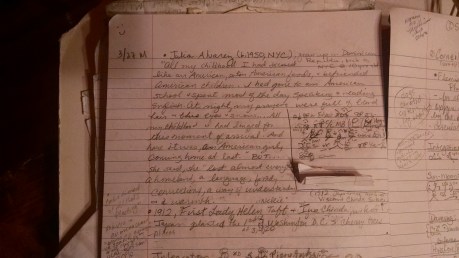
(Please note: These practice details are intended for individuals who already have a Yin Yoga practice. Before starting a new practice, be sure to check in with your health care provider. Most importantly, remember that although you may experience health benefits from your practice, this practice information is not intended as medical advice or as a means to replace medical care.)
Since my so-called hieroglyphics can be a little tiny or hard to read, here is an outline of the Monday Yin Yoga class from March 27, 2017 a.k.a. Julia Alvarez’s Big Day, a.k.a. the anniversary of the day First Lady Helen Taft and Viscountess Iwa Chinda planted cherry blossoms in D.C.:
- Legs-Up-The Wall (for centering and integration): Sit sideways on the mat, so that the side of your hip is up against the wall; then pivot the body so the legs swing up and the back reclines on the mat. The trick is to keep your bottom on the wall. (For more release in the hamstrings, back, and hips, place the feet on a chair or table so that hips, knees, and ankles are resting at 90 degree angles.) Hold for about 2 minutes with back on the floor or a blanket. For additional decompression, bend the knees in order to use the legs to lift the hips and add a block, making sure not to pinch the spine. Hold for another 3 minutes.
- “Sleeping Butterfly” – on the wall (counter-pose): Remove the block and move into Butterfly (feet together like a prayer, knees open up like the pages of a book) with legs on the wall for about one minute. Use “Sleeping Butterfly” or a Squat on the wall to set a personal intention, which will keep you on the wall for another minute.
- Dragonfly, on the wall: Stretch your legs out (on the wall) as wide as they’ll go, and support the legs by placing a block between the wall and each thigh or by placing blocks or a bolster on the outside of each thigh. Hold for 3 – 5 minutes.
- “Sleeping Butterfly” (transitional pose) and Fetal Position (transitional pose)
- Wide Legged Child’s Pose (with arms bent on floor over head): Props may be placed under the hips and/or under your chest. If you have a bolster, you can recline your whole body on it. Hold for 2 – 3 minutes.
- Counter-pose Moment: Inhale to table top and use Cat/Cow to transition into about 1 minute of gentle movement to break up the stillness.
- Half Shoelace or Half Square sequence: Sit with legs extended in front of you. If there’s compression in the low back and/or hips, sit up on top of a blanket or block. Hug right knee in and lift it over extended left leg. You can either rotate the top leg so the knee points to the left foot or slide the top leg to the side so the ankle rests on the bottom thigh, right below the knee. (If elevated, you can place a blanket or towel under the extended shin – to soften the experience at the back of the knee. If you have a hamstring issue, you could sub “Full” Shoelace or Square by bending the bottom knee into the appropriate position.) Twist upper body to the right and hold for at least 1 minute. Rotate back to center and fold until you feel a change, support the change and hold for at least 3 minutes.
- Counter-pose Moment: Inhale to lift the body, unravel the legs and give them a rub or a hug. Lean back on the forearms or recline with back on the floor, windshield wiper bent knees for about 1 minute.
- Repeat “Half Shoelace or Half Square” sequence on opposite side and Counter-pose Moment.
- (Prone) Frog or Dragonfly: Face the long side of the mat and set up props as needed. For (Prone) Frog, come into table top; spread the knees as wide as they’ll go, with ankles under the knees (when you look down the legs) and hips pressing back. Extend the chest forward and recline on forearms and/or props. Prop the thighs. For Dragonfly, sit with legs in front of you and spread wide; prop as needed for low back and lean forward until you feel a change; prop the change. Hold for 5 minutes
- Counter-pose Moment: (Prone) Frogs Inhale to table top and use Cat/Cow to transition; Dragonflies use inhale to rise up, hug the knees into the chest and then recline to windshield wiper bent knees. Gentle movement for about 1 minute.
- “Sleeping Butterfly”: Set up props so upper back is supported, behind shoulder blades, and head us raised slightly above the chest by a prop that supports the nape of the neck (where head meets the spine). If thighs do not touch the ground when legs rest in position, place a block under each thigh. Hold for 5 minutes.
- Counter-pose Moment: Mindfully, move off the props.
- Savasana (with props, as needed): Hold for at least 5 minutes.
- Counter-pose Moment: Be easy and gentle as you move out of Savasana and into a fetal position. Give yourself a moment before sitting up and closing out your practice. Namaste.
Thanks, G, for your question. I’m always so glad to see you in class and (of course) super grateful your yoga practice is helping you feel good!
If anyone else out there is grateful for the way yoga helps you feel, please share your practice and consider Kiss(ing) My Asana with a joyful donation.
### Om Shanti, Shanti, Shantihi Om ###
Seriously, Is That All You’ve Got? December 31, 2016
Posted by ajoyfulpractice in 108 Sun Salutations, Books, Changing Perspectives, Depression, Faith, Fitness, Gratitude, Health, Hope, Japa-Ajapa, Karma, Life, Loss, Mala, Meditation, Minneapolis, Minnesota, Mysticism, New Year, One Hoop, Pain, Peace, Philosophy, Science, Suffering, Surya Namaskar, Texas, Twin Cities, Whirling Dervish, Wisdom, Yoga.Tags: awareness, community, confidence, devotion, gratitude, inspiration, kindness, New Year, recovery, yoga practice
6 comments
It is New Year’s Eve eve. And, while I still have things to do in anticipation of the New Year, I am more than ready for the arrival of 2017. Funny thing is, all of us who are “D-O-N-E, stick-a-fork-in-it, done” with 2016, have to admit that it hasn’t all been bad. There have been some memorable and very personal highlights and there have been many changes for the better. Oh, then there’s the fact that this whole “new year” thing is completely arbitrary.
Yes, yes, there are reasons and explanations for why the Western world celebrates a beginning and an ending at this time of year. But, in some ways those reasons and explanations are beside the point. What’s important is that change is always happening – and most of it is beyond our control. Since being out of control can be psychologically uncomfortable, we take control by choosing a transition to celebrate. The celebration is a reminder that everything, including hard times, ends and that the end of one thing marks the beginning of another thing.
We can only hope the new thing is better than the old thing.
Even when, it’s the same thing over and over again.
Throughout history, different cultures have had different ways of marking transitions. One yoga tradition is to practice 108 Sun Salutations (Surya Namaskar) when the seasons change on the equinoxes and solstices. Here in the West, we have also taken to practice this yoga variation of a marathon when the calendar year changes. (I am again leading the Surya Namaskar malas at Nokomis Yoga (this practice is full) and at the Downtown Minneapolis YMCA (3 PM – 6 PM).)
Sun Salutations (Surya Namaskar) are a moving meditation consisting of 12 poses. The series of poses are linked with breath so that we mimic our bodies’ natural inclination to extend the spine and open the heart as we inhale, to flex the spine and engage the core as we exhale. Or, you could think of it symbolically: as reaching for the sun as you inhale, drawing its energy to the earth as you exhale. Or, you could reach to the Source of all the things as you inhale, surrender to that Source as you exhale. Or…you get the idea. Whether you come to the practice from a physical-mental, psychic-symbolic, or emotional-energetic perspective, this series of poses engages your whole being: mind, body, and spirit.
Since the practice mirrors the cycle of time – the beginning of each breath marking the end of another, the end of each pose marking the beginning of the next – we inevitably find ourselves appreciating it, enjoying it, and then wishing it were done. We can be lost in/absorbed by the effortless repetition (ajapa japa), but then find our brains want a delineated break.
We seek the break, not because we’re tired, per se, but because it’s a way for our brains to absorb the pattern. And, in that moment, we may create the break by asking the question that has been coming up a lot in my practice: Is that all you’ve got? Seriously, is that all you’ve got?
I can’t remember if it was during an interview or during a teacher training, but I very clearly remember Seane Corn describing a conversation where she said to the Universe, “Bring it; but, bring it gently.” I love that sentiment. It acknowledges that throughout our lives we are going to be faced with challenges, and it simultaneously reinforces the idea that we can be ready to meet those challenges head on. It is a statement sourced in strength, courage, and wisdom – without being braggadocios. In fact, it embodies the splendor of humility.
This secular calendar year, 2016, New Year’s Eve happens to fall on the 8th Night of Chanukah. (Therefore, New Year’s Day 2017 is the 8th Day of Chanukah 5777.) Hod (humility, splendor, surrender, or gratitude) is the eighth aspect of the Divine found on the Tree of Life (in Jewish mysticism, Kabbalah). Physically it is symbolized by the left foot and leg. Energetically it is directly connected to Gevurah (Strength, discipline), Tiferet (Balance, Compassion), Netzach (Endurance), and Yesod (Foundation or Bonding). It can also be energetically connected to the 3rd Chakra, our physical core, which is related to our personality, our sense of self, and our self esteem.
I could go on, but what I’m getting at here is that the question (Is that all you’ve got?) isn’t something I’m asking the Universe. I know the Universe has more in store for us. I know it’s going to bring it (hopefully, gently). What I’m really doing, at those moments when I want to throw in the towel, is asking myself the question: Is that all you’ve got? Seriously, is that all you’ve got?
My early teachers often said, “How you do yoga is how you do life.” Whether we are in the middle of 1 hour, 90 minutes, or 3 hours of yoga – or anything else – we all have that moment where we want to throw in the towel. But, if we pace ourselves, we inevitably get a second wind. And, while I don’t always feel this way after I other physical things I do, in yoga and in life I almost always feel like I could have handled a little bit more. Not that I want to or need to – but, that if I had to, I could dig deep and pull up a little bit more of whatever I need to face the challenge.
The first day of 2017, is just another day on the calendar; just another day in our lives. It’s a beginning and it’s an ending. So, yes, celebrate, set an intention, and move on.
But, don’t forget that this liminal or transitional moment is also a middle. And, ultimately, the most significant thing that’s changing is your awareness and your perspective. Start noticing what you’re doing when you ask a question like “Is that all you’ve got?” Start noticing what you’re doing when your answer to the question changes.