In the beginning… June 28, 2020
Posted by ajoyfulpractice in "Impossible" People, Books, Changing Perspectives, Healing Stories, Life, Love, Men, One Hoop, Pain, Suffering, Super Heroes, Wisdom, Women, Yoga.Tags: Craig Rodwell, Dave Van Ronk, Dick Leitsch, Fred Sargent, Howard Smith, Jackie Hormona, John O'Brien, John O’ Brian, Marsha P. Johnson, Martha Shelley, Marty Boyce, PRIDE, Raymond Castro, Stonewall Inn, Stormé DeLarverie, Sylvia Rivera, yoga, Yvonne “Maria” / “Butch” Ritter, Zazu Nova
add a comment
“[It was] a perfect event in my life because it let me live the kinds of dreams I had of seeing an equitable society. I was able to live my life, which I would have done anyway, but without Stonewall I would have had more opposition. So it turns out the times were on my side, which left me with a basically happy life.”
– Martin “Marty” Boyce
It started off like any other regular Friday. People got up, got dressed, went to work (on Wall Street) or to school. Some wrote poetry or songs in a café. Some gathered on a street corner hoping to score their next meal. It was a regular Friday, and people were looking forward to the weekend. They came home or went to a friend’s place. They changed clothes – that was the first spark of something special… but it was still just a regular Friday. People were going to go out, have a good time, sing, dance, gather with friends (maybe do it again on Saturday night), and then spend some time recovering so that, on Monday, they could go back to being regular.
It was a regular Friday… that became an extraordinary Saturday, because at around 1:20 AM on Saturday, June 28, 1969, four policeman dressed in dark suits, two patrol officers in uniform, a detective, and a deputy inspector from the New York Police Department walked into the Stonewall Inn and announced that they were “taking the place!” It was a raid.
“I was never afraid of the cops on the street, because I was not an obvious person. I was not flaunting my homosexuality to anyone. I wasn’t holding hands. It would never have occurred to me to try and have a confrontation with them [because] you don’t want to be arrested for any stupid reason. I never had any problems with the police. I never had problems with anyone anywhere, until that night…. I never ever gave it a thought of [Stonewall] being a turning point. All I know is enough was enough. You had to fight for your rights. And I’m happy to say whatever happened that night, I was part of it. Because [at a moment like that] you don’t think, you just act.”
– Raymond Castro
In some ways, there was still nothing special. The Stonewall Inn, located on Christopher Street in the Greenwich Village neighborhood of Lower Manhattan was a Mafia owned “private bottle bar” frequented by members of the GLBTQIA+ community. It was raided on a regular basis, usually at a standard time. Because the bar was Mafia owned, it would normal get a heads up (from someone who knew the raid was coming – wink, wink, nudge, nudge) and just before the raid was scheduled the lights would come up so people could stop holding hands or dancing (both of which were illegal for same sex partners) and any illegal alcohol could be hidden. The police would separate people based on clothing and then a female officer would take anyone wearing a dress into the bathroom in order to check their genitalia. Some people were arrested, but many would go back to the party once the police had taken their leave.
The raid that happened this morning in 1969 was different. There was no warning. No lights came up. No then-illegal activity was hidden. Unbeknownst to the patrons, four undercover officers (two men and two women) had previously been in the bar gathering visual evidence. The police started rounding people up and, also, letting some people go. They were planning to close the bar down. The only problem was…people didn’t leave. The people who were released stayed outside in the street, watching what was happening, and they were eventually joined by hundreds more.
“I changed into a black and white cocktail dress, which I borrowed from my mother’s closet. It was mostly black, empire-waisted, with a white collar. I used to dress with a bunch of older queens and one of them lent me black fishnet stockings and a pair of black velvet pumps…. The cop looked at me and said, ‘Hey, you!’ and I said, ‘Please, it’s my birthday, I’m just about to graduate from high school, I’m only 18,’ and he just let me go! [I was] scared to death that my father would see me on the television news in my mother’s dress.”
– Yvonne (also known as Maria) Ritter
At times the crowd was eerily quiet. But then, as Mafia members were brought out, they started to cheer. When employees were brought out, someone yelled, “Gay power,” and someone started to sing. An officer shoved a person in a dress and she started hitting him over the head with her purse. The crowd was becoming larger… and more restless. At some point people started throwing beer bottles and pennies (as a reference to the police being bribed by the Mafia.) This was becoming a problem, but an even bigger problem was when the police found out the second van was delayed. They were stuck.
Then, things went from bad to worse when some of the 13 people arrested (including employees and people not wearing what was considered “gender appropriate clothing”) resisted. One of the women, a lesbian of color, managed to struggle and escape multiple times. At some point there were four officers trying to contain her. When a police officer hit her over the head, she yelled at the crowd, “Why don’t you guys do something?” And they did.
Police officers barricaded themselves and several people they were arresting (some of whom were just in the neighborhood) inside of the bar for safety. The NYPD’s Tactical Patrol Force was called out to free the officers and detainees trapped inside the Stonewall Inn. One witness said that the police were humiliated…and out for blood. The police’s own escalation, in trying to contain the violence, was met with a Broadway chorus style kick-line… and more violence. The escalation continued. At times, people were chasing the police.
The ensuing protests/riots lasted through the weekend and, to a lesser degree, into the next week. The bar re-opened that next night and thousands lined up to get inside. There was more vandalism and more violence, but on Saturday night (June 28th) there were also public displays of affection: at that time, illegal same-sex public displays of affection. People were out.
“It was a rebellion, it was an uprising, it was a civil rights disobedience – it wasn’t no damn riot!”
– Stormé DeLarverie
The Stonewall Uprising, the riots and the ensuing protests and celebrations were not the first of their kind. Three years earlier, the Mattachine Society had organized “sip-ins” where people met at bars and openly declared themselves as gay. That kind of organized, peaceful civil disobedience was happening all over the country during the 60’s. It was a way to break unjust laws and it temporarily reduced the number of police raids. However, the raids started up again.
Stormé DeLarverie, Marsha P. Johnson, Zazu Nova, Jackie Hormona, Martin “Marty” Boyce, Sylvia Rivera, Raymond Castro, John O’ Brian, and Yvonne “Maria” / “Butch” Ritter were among the people involved in the Stonewall Uprising. The musician Dave Van Ronk (who famously arranged the version of “House of the Rising Sun” made famous by Bob Dylan) was not gay, but he was arrested. Alan Ginsberg, who was gay, would witness the riots and applaud the people who were taking a stand. Village Voice columnist Howard Smith was a straight man who had never been inside the Stonewall Inn until he grabbed his press credentials and made his way into the center of the uprising. Craig Rodwell (owner of the Oscar Wilde Memorial Bookshop) and Fred Sargent (the bookstores manager) started writing and distributing leaflets on behalf of the Mattachine Society. They also drummed up media interest. In addition to Rodwell and Sargent, Dick Leitsch (a member of the Mattachine Society), John O’Brien, and Martha Shelley (a member of the Daughters of Bilitis) would start organizing so that the protest that turned into a riot would come full circle as a protest that created change.
A year later, June 28, 1970, thousands of people returned to Stonewall Inn. They marched from the bar to Central Park in what was then called “Christopher Street Liberation Day.” The official chant was, “Say it loud, gay is proud.” And, I’m betting there was at least one kick line.
Please join me for a 65-minute virtual yoga practice on Zoom today (Sunday, June 28th) at 2:30 PM to celebrate Pride. You can use the link from the “Class Schedules” calendar if you run into any problems checking into the class. PLEASE NOTE: Zoom 5.0 is in effect. If you have not upgraded, you will need to give yourself extra time to log into Zoom. You can always request an audio recording of this practice (or any practice) via email or a comment below.
Today’s playlist is available on YouTube and Spotify.
*
Errata: Categories have been added and a typo has been corrected.
### SAY IT LOUD ###
It’s About More Than Begetting A Child June 21, 2020
Posted by ajoyfulpractice in Uncategorized.Tags: asana, Atheist Solidarity Day, Dad's Big Day, Father's Day, hatha yoga, International Yoga Day, Ivan Zupa, Maurice Fleuret, Sadhguru, Sonora Smart Dodd, T. K. V. Desikachar, viniyoga, World Handshake Day, World Humanist Day, World Music Day, yoga, yoga philosophy
add a comment
“Why believe in a god? Just be good for goodness’ sake.”
– bus billboard for the American Humanist Association
Today, June 21st, is vying with May 1st to be the hardest working day of the year. It’s International Yoga Day, World Music Day, World Handshake Day, Atheist Solidarity Day, World Humanist Day, and sometimes (although not this year) it’s Summer Solstice. I feel like I’m forgetting something….
Oh yes, and this year, today is Father’s Day. Although, y’all know I prefer Daddy’s Day and have been trying to get people to switch for years; because, the day is a celebration of nourishing, not procreating. There is some traction (on Twitter) for “Dad’s Big Day” and even though I’m not on social media I am going to support that. So, Dad’s Big Day it is!
A day to honor fathers and paternal figures actually predates a day to honor mothers and maternal figures. In Europe, there were religious observations as far back as the Middle Ages. The Christian Orthodox Church commemorates the second Sunday before Nativity (usually December 11th or 17th) as the Sunday of the Forefathers and honors biblical ancestors and a variety of prophets going back as far as Adam. This observation includes Mary as Theotokos and places a special emphasis on Abraham, the “father” of three major religions and their progeny. Catholics in Europe have celebrated the May 19th feast day of Saint Joseph as a day to honor fathers and father figures. The Coptic Orthodox Church of Alexandria also observes in this way, but on July 20th. (Note that Saint Joseph has three other feast days in the Eastern and Western Christian traditions – including May 1st when he is remembered as “the Worker.”) Just like the idea for Mother’s Day, the idea for a secular Father’s Day was promoted by a daughter – who was inspired by a church sermon.
“I remember everything about him. He was both father and mother to me and my brothers and sisters.”
– Sonora Smart Dodd, speaking to the Spokane Daily Chronicle about her father
Born February 18, 1882, Sonora Smart Dodd was one of six children born to Civil War veteran William Jackson Smart (who served as a sergeant in the Union army, but had previously fought for the Confederacy) and his wife Ellen Victoria Cheek Smart, but she was one of 14 children between the couple. Both William and Ellen had been widowed with children. When Ellen died in childbirth, William became a single dad and Sonora (age 16), as their only (shared) daughter, assisted him in the raising of the younger sons. When she heard a Mother’s Day sermon at Central Methodist Episcopal Church in the early 1900’s, she suggested that her own father’s birthday become a day to honor all fathers. The Spokane Ministerial Alliance appreciated the idea – but not so much the date of June 5th (as they couldn’t pull something together that fast) – and the first secular Father’s Day was observed in Spokane, Washington on June 19, 1910. Eventually, the day was noted by Presidents Woodrow Wilson (who praised it in a telegraph), Lyndon B. Johnson (who signed a proclamation affirming the third Sunday in June as Father’s Day), and Richard Nixon (who established it as a permanent national observation).
“The foremost reason my father became a scholar of Sanskrit was because of his family tradition. In the old days, people like my father’s forbears were well known as advisors, even to the kings. Nowadays we would call my father’s grandfather something like prime minister, for example, but at that time the position of prime minister was not a political one in the way that we know it now. He was rather an advisor who told the rulers what was right and what was wrong.”
– T. K. V. Desikachar answering a question about his father, Sri T. Krishnamacharya (known as the “Father of Yoga”)
Born today in 1938, in Mysore, India, T. K. V. Desikachar is one of the students of Sri T. Krishnamacharya who was charged with spreading the practice of yoga into the Western world. Just as his father and grandfather before him, Desikachar’s students included his children and world leaders. His teaching was so influential that a celebration of yoga was proposed to the United Nations General Assembly in 2014. The first International Yoga Day observation occurred today in 2015, with over 200 million people in almost 180 nations practicing yoga – some even extending the celebration into the entire week.
“We must understand that yoga is not an Indian (thing). If you want to call yoga Indian, then you must call gravity European.”
– Sadhguru Jaggi Vasudev, founder of the Isha Foundation, speaking in a 2016 United Nations panel discussion about International Yoga Day
World Music Day, not to be confused with International Music Day, was started in France in 1982 and has been adopted by over 120 nations, including India. The idea for free concerts in open areas by a variety of musicians was first proposed by American Joel Cohen as far back as 1976. In 1981, however, French Minister of Culture Jack Lang appointed musician Maurice Fleuret as the Director of Music and Dance. The duo collaborated to create an event in 1985 whereby even amateurs would be encouraged to musically express themselves in public. Fleuret said there would be “music everywhere and the concert nowhere.”
There are atheists everywhere, even though many people believe they are few and far between. Mike Smith started a Facebook group in 2010 to make Atheist Solidarity Day an official holiday. Even though he deleted the group soon after, people were engaged and today atheist celebrate June 21st as a global protest, celebration, and awareness raising event for people who don’t always have the freedom to openly express their lack of belief in “god,” whatever that means to you at this moment. While I am not an atheist, the black and red theme today is in solidarity of people having the freedom to believe what serves them.
“My son, place your hand here in the sea and you are united with the whole world.”
– Ivan Zupa, founder of World Handshake Day, remembering the advice of an old man
Yoga is a Sanskrit word that means “union.” As today is often Summer Solstice, it is viewed as the longest day of the year in the Northern Hemisphere and therefore a great day for people to come together. Even with the challenges of the pandemic, we are still coming together.
Please join me for a 65-minute virtual yoga practice on Zoom today (Sunday, June 21st) at 2:30 PM to learn more about the aforementioned holidays, and how you can safely celebrate World Handshake Day during the pandemic. You can use the link from the “Class Schedules” calendar if you run into any problems checking into the class. PLEASE NOTE: Zoom 5.0 is in effect. If you have not upgraded, you will need to give yourself extra time to log into Zoom. You can always request an audio recording of this practice (or any practice) via email or a comment below.
Today’s playlist is available on YouTube and Spotify.
### BREATHE INTO YOUR SPINE ###
Abe Lincoln’s House June 16, 2020
Posted by ajoyfulpractice in Uncategorized.Tags: "A House Divided", Abraham Lincoln, Bramaviharas, Dred Scott, Gettysburg, Matthew 12:25, Pandit Rajmani Tigunait, sankhya, siddhis, Stephen A. Douglas, Union Cooper Speech, yoga, yoga philosophy, yoga sutras
2 comments
“But Jesus knew their thoughts, and said to them: ‘Every kingdom divided against itself is brought to desolation, and every city or house divided against itself will not stand.’”
– The Gospel According to Matthew 12:25 (NKJV)
“If we could first know where we are, and whither we are tending, we could better judge what to do, and how to do it.
We are now far into the fifth year, since a policy was initiated, with the avowed object, and confident promise, of putting an end to slavery agitation. Under the operation of that policy, that agitation has not only, not ceased, but has constantly augmented. In my opinion, it will not cease, until a crisis shall have been reached, and passed –
‘A house divided against itself cannot stand.’ I believe this government cannot endure permanently half slave and half free. I do not expect the Union to be dissolved – I do not expect the house to fall – but I do expect it will cease to be divided. It will become all one thing, or all the other.”
“Have we no tendency to the latter condition?”
– from “A House Divided” speech by Abraham Lincoln, Springfield, Illinois (June 16, 1858)
Ask any historian, biographer, or movie maker (not to mention some serious Civil War re-enactors) and they can easily identify a handful of defining moments in the life of President Abraham Lincoln. These moments that highlight the evolution of Lincoln’s life as a public figure also outline the shape of the United States – then and now. I say “then and now,” because when you read or listen to the words of Abraham Lincoln you find they still resonate and hold true. It doesn’t matter if you consider his “House Divided” Speech (in Springfield, Illinois, today in 1858), which launched his unsuccessful bid to unseat the Democratic Senator Stephen A. Douglas; his Union Cooper Speech (in New York City, February 27, 1860), which solidified his nomination as the Republican Presidential candidate – and some say contributed to him winning the race; the very short, yet incredibly memorable and poignant Gettysburg Address (on the battlefield in Gettysburg, Pennsylvania, November 19, 1863); or his Second Inaugural Address (in Washington, D. C., March 4, 1865). Pick one, it doesn’t matter which one, and you will find that his words regarding the issue of slavery in the United States and its territories are still relevant. You need not even change the words. Although, one must note that he was referencing Biblical text and “current events,” the details of which did not always need elaboration in the 1860’s, but which may be unfamiliar to some modern-folks.
“At length a squabble springs up between the President and the author of the Nebraska bill, on the mere question of fact, whether the Lecompton constitution was or was not, in any just sense, made by the people of Kansas; and in that quarrel the latter [Senator Douglas] declares that all he wants is a fair vote for the people, and that he cares not whether slavery be voted down or voted up.”
– from “A House Divided” speech by Abraham Lincoln, Springfield, Illinois (June 16, 1858)
Just as I am astounded when I feel the relevance of 19th century speeches and essays written by Ralph Waldo Emerson, I am flabbergasted by the similarities in Lincoln’s America and our modern day America – specifically as it relates to what divides us. The difference, however, is that what I feel whenever I look at Emerson’s work is awe and fascination. What I feel when I look at Lincoln’s work, today, is sick to my stomach.… Because, for all intents and purposes, Lincoln is talking about me…and most of my family.
“The several points of the Dred Scott decision, in connection with Senator Douglas’ “care not” policy, constitute the piece of machinery, in its present state of advancement. The working points of that machinery are: Firstly, that no negro slave, imported as such from Africa, and no descendant of such slave can ever be a citizen of any State, in the sense of that term as used in the Constitution of the United States. This point is made in order to deprive the negro, in every possible event, of the benefit of that provision of the United States Constitution, which declares that – ‘The citizens of each State shall be entitled to all privileges and immunities of citizens in the several States.’
Secondly, that ‘subject to the Constitution of the United States,’ neither Congress nor a Territorial Legislature can exclude slavery from any United States Territory. This point is made in order that individual men may fill up the territories with slaves, without danger of losing them as property, and thus enhance the chances of permanency to the institution through all the future.
Thirdly, that whether the holding a negro in actual slavery in a free State, makes him free, as against the holder, the United States courts will not decide, but will leave to be decided by the courts of any slave State the negro may be forced into by the master.”
– from “A House Divided” speech by Abraham Lincoln, Springfield, Illinois (June 16, 1858)
As I post this, I have not decided exactly how I will approach today’s class. Part of me feels that I cannot approach it in the same abstract, philosophical and symbolic way I have approached previous classes on Lincoln’s Cooper Union Speech or the Gettysburg address. Part of me feels we all need more than a historical reminder. Part of me feels we need to activate something powerful.
That feeling of wanting to activate something powerful was part of the inspiration for yesterday’s blog and Common Ground Meditation Center class. I focused on the siddhis or “powers” described in the yoga and sāmkhya philosophies – and, in particular those six abilities or powers which are “unique to humans.” The first three (related to intuition, communication, and analysis (with comprehension) lead to the final three. The final three (related to the elimination of three-fold sorrow, the cultivation of friendship, and the power of generosity) can be considered heart practices, just as wisdom and the brahmavihārās (or divine abodes of loving-kindness, compassion, equanimity, and sympathetic joy) are heart practices in Buddhism. Notice that there is a definitive overlap between wisdom, friendship, compassion, and generosity. The other thing that strikes me is how Lincoln’s words dovetail with the commentary of Pandit Rajmani Tigunait, PhD, (specifically as it relates to generosity): “This joy is the architecture of human civilization, characterized by self-sacrifice and selflessness.”
“We shall lie down pleasantly dreaming that the people of Missouri are on the verge of making their State free; and we shall awake to the reality, instead, that the Supreme Court has made Illinois a slave State.
To meet and overthrow the power of that dynasty, is the work now before all those who would prevent that consummation. That is what we have to do. But how can we best do it?
There are those who denounce us openly to their own friends, and yet whisper us softly, that Senator Douglas is the aptest instrument there is, with which to effect that object. They do not tell us, nor has he told us, that he wishes any such object to be effected. They wish us to infer all, from the facts, that he now has a little quarrel with the present head of the dynasty; and that he has regularly voted with us, on a single point, upon which, he and we, have never differed.
They remind us that he is a great man, and that the largest of us are very small ones. Let this be granted. But ‘a living dog is better than a dead lion.’ Judge Douglas, if not a dead lion for this work, is at least a caged and toothless one. How can he oppose the advance of slavery? He don’t care anything about it. His avowed mission is impressing the “public heart” to care nothing about it.”
– from “A House Divided” speech by Abraham Lincoln, Springfield, Illinois (June 16, 1858)
However you look at it, the reality is that “our house” is divided [still…once again, you pick]. We are divided around the same issues of race, state rights versus civil rights, and federal sovereignty. And, we can’t go back. Going back just takes us to another form of divided.
We can talk all day about how we move forward, but we must move forward – and that requires moving out of the sympathetic nervous response of fight-flight-freeze/collapse. We can argue/debate the merits of starting something over from scratch and building from the ground up or just redecorating, but either way we have the same tainted building blocks and scorched earth. If we are to make something out the ruins, if we are to rise out of our own ashes, we must do so with the awareness that we are the same human beings that got it “wrong” the first time. Moving forward as a house divided, we are faced with the same problems and pitfalls as our ancestors. Those problems and pitfalls require us to figure out a way to come together and move forward together or, conversely, we repeat the mistakes of our ancestors.
Don’t get me wrong, things may look different. The new normal, however, can too easily settle into a different verse of the same song. Ask yourself if you want your children, grandchildren, or great grandchildren to be dealing with the “instant replay” of these same issues 50, 60, 100, 200, or 400 years from now. If you’re younger than me, do you want to be dealing with these same issues 50 or 60 years from now? ‘Cause, I’m going to be frank, we’ve been here before. This may feel new and different to some, but to others of us….
“Senator Douglas holds, we know, that a man may rightfully be wiser today than he was yesterday – that he may rightfully change when he finds himself wrong. But, can we for that reason, run ahead, and infer that he will make any particular change, of which he, himself, has given no intimation? Can we safely base our action upon any such vague inference?
Now, as ever, I wish to not misrepresent Judge Doulgas’ position, question his motives, or do aught that can be personally offensive to him. Whenever, if ever, he and we can come together on principle so that our great cause may have assistance from his great ability, I hope to have interposed no adventitious obstacle. But clearly, he is not now with us – he does not pretend to be – he does not promise to ever be.
Our cause, then, must be intrusted to, and conducted by its own undoubted friends – those whose hands are free, whose hearts are in the work – who do care for the result.”
– from “A House Divided” speech by Abraham Lincoln, Springfield, Illinois (June 16, 1858)
Please join me today (Tuesday, June 16th) at 12 Noon or 7:15 PM for a virtual yoga practice on Zoom. Use the link from the “Class Schedules” calendar if you run into any problems checking into the class. Give yourself extra time to log in if you have not upgraded to Zoom 5.0. You can request an audio recording of this practice via a comment below.
Tuesday’s playlist is available on YouTube and Spotify. (Links will be available on Zoom and I have updated this page.)
A House Divided” (audio with text) by Abraham Lincoln
### “We shall not fail – if we stand firm, we shall not fail. Wise counsels may accelerate or mistakes delay it, but sooner or later the victory is sure to come.” AL ###
Building From the Ground Up (II) June 8, 2020
Posted by ajoyfulpractice in Art, Changing Perspectives, Minneapolis, Philosophy, Yoga.Tags: architecture, Esperanto, Frank Lloyd Wright, hatha yoga, inspiration, L. L. Zamenhof, Prarie School, truth, Usonia, yoga, yoga philosophy, yoga practice
add a comment
“Form follows function – that has been misunderstood. Form and function should be one, joined in spiritual union.”
– Frank Lloyd Wright
Yoga is the Sanskrit word for union – and we could spend all day talking about what that means in a literal sense, let alone in a spiritual or metaphorical sense. But, let’s just focus on the spiritual for a moment. The 8-limb philosophy of yoga contains several references to a spiritual (or metaphysical) element. That is to say, there is an acknowledgement that people are more than bodies and more than minds. Furthermore, within that acknowledgement is the awareness that inherent in the mind-body connection is the “more,” whatever that means, and that the end goal of the philosophical practice is to be fully aware of not only the “more” but also of our connection to it. Simply put, the end goal can be defined as “spiritual union.”
Born today in 1867, Frank Lloyd Wright was an architect, interior designer, writer, and teacher who designed over 1,000 structures. Over 500 of his designs were actually built, 50 of which were private houses and ~10 of those houses (plus a gas station) are in Minnesota. Almost 60 of his designs were built in his birth state of Wisconsin. Wright believed in organic architecture, the idea that a building should be in harmony with nature/environment and humanity. He pioneered the Prairie School architecture movement in the late 19th / early 20th century and would not only design a structure, but also the furniture contained within the structure.
Wright’s work and work-philosophy is a great reminder to build from the ground up and also to consider how everything works together. We need the reminder, because, sometimes we forget our purpose. Sometimes we get so far into an idea or the development of a thing that we forget its original function. Sometimes we get so distracted by the form that we forget the original intention. And, this way of thinking can become such a habit that we may forget there was/is another way to work.
“Get in the habit of analysis – analysis will in time enable synthesis to become your habit of mind.”
– Frank Lloyd Wright
On a philosophical (and political) note, people all over the US – and especially here in the Twin Cities – are talking about scrapping something and starting over from scratch, versus fixing what exists. I’m not intending to weigh in here on my personal opinion regarding defunding versus reforming an existing part of our government and infrastructure. What I will say is that, both require considering the original blueprint. Also, as a whole, I think we are a society that is in the habit of building and engaging without analysis (with analysis being a type of mindfulness). To me, the question of defunding or reforming is moot if there’s no analysis or consideration of the underlying foundation – which is shaky at best. How do we, as a society, build from the ground up and build in harmony with humanity and our environment if we haven’t really considered the elements which make up our environment?
Frank Lloyd Wright conceived of a utopian America, which would be a reflection of (and reflected by) the architecture. Form and function would be one; people would live, work, play, and pray in harmony with one another and with their environment. The open format of the structures would allow for interaction between family members, even as they engaged in their own pursuits. He called this concept of America “Usonia,” which is very close to the Esperanto name for the United States. (Esperanto being the language L. L. Zamenhof created in order for the world to have a shared language, which he believed would lead to a more unified society.) While Wright’s Usonian designs still influence home and workspace designs to this day, he couldn’t seem to maintain an idyllic home life for himself and his family, let alone idyllic professional relationships.
“Space is the breath of art.”
– Frank Lloyd Wright
Let’s breathe together and build (each pose and every sequence) from the ground up. If it’s possible, please join me on the virtual mat today (Monday, June 8th) at 5:30 PM for a 75-minute yoga practice on Zoom.
This is a 75-minute Common Ground Meditation Center practice that, in the spirit of generosity (dana), is freely given and freely received. You can use the link from the “Class Schedules” calendar if you run into any problems checking into the class. You can request an audio recording of this practice via a comment below.
If you are able to support the center and its teachings, please do so as your heart moves you. (NOTE: You can donate even if you are “attending” my other practices, or you can purchase class(es). Donations are tax deductible, class purchases are not necessarily.)
There is no playlist for the Common Ground practices.
[Here’s a previous post on building a practice from the ground up. Please note that we have continued this tradition on Saturdays, but are in a different phase. You are free to join us.]
#### MAKE ANALYSIS A HABIT ####
Today is the Birthday of Poets June 7, 2020
Posted by ajoyfulpractice in Uncategorized.Tags: asana, Gwendolyn Brooks, insight, inspiration, Life, Loss, Louise Erdrich, Love, Nikki Giovanni, Poetry, Prince Rogers Nelson, protests, trauma, truth, yoga
4 comments
Today I bring you poetry. True
It is no longer poetry month / but
It is the birthday of poets – and so,
I bring you their words, their lyrics, their music.
I bring you their movement, and
their Movements.
I bring you POC [Poets of Color],
NOT because of what’s happening…
BUT because…
That is what I’ve always done, while you pose… {Did you not notice?}
AND
Today is the birthday of poets.
Nikki dared you to listen to “The Song of the Feet” (and apply
Hear The Painted Drum (Louise, please…more:)
Gwendolyn wrote “about what I saw and heard in the street,”
and asked us what we would do “with all this life.” Then she warned us…
“that we are each other’s
harvest:
we are each other’s
business:
we are each other’s
magnitude and bond.”
Looks like we failed to listen, even
To the royal “Condition of the Heart”
Now, birds cry in the snow and the rain,
“I think I know a better way y’all.”
And I ask,
are you “Willing and Able”
“America”? “Around the World…”?
Anybody?
– whisper, shout, scream, or –
will we continue to be “like a child lost in the wilderness [?]”
If we live, we [still only] have two choices:
“[we’ll] either learn or we won’t;”
“growing up or decaying.”
(One requires love & listening “to [y]our own Black heart[s].”)
Of course…
those were our choices all along.
©MKR 2020
Please join me for a 65-minute virtual yoga practice on Zoom today (Sunday, June 7th) at 2:30 PM. You can use the link from the “Class Schedules” calendar if you run into any problems checking into the class. PLEASE NOTE: Zoom 5.0 has gone into effect yesterday. If you have not upgraded, you will need to give yourself extra time to log into Zoom. You can always request an audio recording of this practice (or any practice) via email or a comment below.
Today’s playlist is available on YouTube and Spotify. (Interlude music is different between the playlists. YouTube is the original.)
### DON’T WASTE ANY SWEETNESS ###
To Play or Not To Play June 6, 2020
Posted by ajoyfulpractice in Uncategorized.Tags: acupuncture, D-Day, divine play, George Williams, Johan Huizinga, leela, lila, Plato, Saint Thomas Aquinas, Sosthenes, YMCA, yoga, yoga philosophy, Yoga Sutra, yoga sutra 2.23
add a comment
“Let us look at the matter thus: May we not conceive each of us living beings to be a puppet of the Gods, either their plaything only, or created with a purpose-which of the two we cannot certainly know? But we do know, that these affections in us are like cords and strings, which pull us different and opposite ways, and to opposite actions; and herein lies the difference between virtue and vice. According to the argument there is one among these cords which every man ought to grasp and never let go, but to pull with it against all the rest; and this is the sacred and golden cord of reason, called by us the common law of the State; there are others which are hard and of iron, but this one is soft because golden; and there are several other kinds. Now we ought always to cooperate with the lead of the best, which is law.” (Book 1)
– from The Laws by Plato
Yoga Sutra 2.23: svasvāmiśaktyoh svarūpopalabdhihetuh samyoga
– “The union (yoga), alliance, or relationship between our power to see (and what we see) is the way to experiencing our own true nature.”
I’m going to acknowledge, right off the bat, that there are other ways to work – or explore or play – with the sutra of the day. I’ll even go so far as to say that if we were encountering this sutra at almost any other time, even on this day in any other year, I would definitely be all about the play. Play is, after all, essential to our growth and is also an element of the Divine. In Hinduism, divine play is lila (or leela) and the concept occurs in non-dualism Indian philosophy (as a way to describe everything in the universe as the outcome of creative play) and in dualism Indian philosophy (as the interaction between God and God’s disciples, in order to understand the nature of the universe). If you are having a hard time telling the difference, do not despair… play around with it a little.
“According to my view, any one who would be good at anything must practise that thing from his youth upwards, both in sport and earnest, in its several branches: for example, he who is to be a good builder, should play at building children’s houses; he who is to be a good husbandman, at tilling the ground; and those who have the care of their education should provide them when young with mimic tools. They should learn beforehand the knowledge which they will afterwards require for their art.” (Book 1)
And what is the right way of living? Are we to live in sports always? If so, in what kind of sports? We ought to live sacrificing, and singing, and dancing, and then a man will be able to propitiate the Gods, and to defend himself against his enemies and conquer them in battle. The type of song or dance by which he will propitiate them has been described, and the paths along which he is to proceed have been cut for him.” (Book 7)
– from The Laws by Plato
“Life must be lived as play, playing certain games, making sacrifices, singing and dancing, and then a man will be able to propitiate the gods, and defend himself against his enemies, and win in the contest.”
– Dutch philosopher Johan Huizinga summarizing Plato (in Homo Ludens)
Outside of Indian religion and philosophy, you find a similar concept in the ancient Greek philosophers and in forms of ecstatic dance (which exists in various Christian traditions, as well as in Judaism, the Sufism, various Shamanism, and Santeria). You also find it in sacred text. For example, in First Corinthians 3:18 -19, Saint Paul (and Sosthenes), the people who make up the Christian Church in Corinth (Greece) are instructed, “Let no one deceive himself: If anyone among you thinks himself to be wise in this age, let him become foolish, so that he may become wise. For the wisdom of this world is foolishness with God.” (Berean Literal Bible) Some translations state that the “wise” should “become fools.” A little later in the letter, the authors will speak of “put[ting] away childish things” (1st Corinthians 13:11 -12); which many people see as a reference to physical age/maturity – when, in fact, the authors are speaking of spiritual maturity. There is, then, an implication in the text that all wisdom here on Earth is, actually, foolishness and that as long as we only “see” the material world (and ourselves in the material world) there is a need to keep playing. (This dove-tails back to the sutra and to Plato, in that there is a definite purpose to playing.)
“On the contrary, Augustine says (Music. ii, 15): ‘I pray thee, spare thyself at times: for it becomes a wise man sometimes to relax the high pressure of his attention to work.’ Now this relaxation of the mind from work consists in playful words or deeds. Therefore it becomes a wise and virtuous man to have recourse to such things at times.”
– from Summa Theologica (2a 2ae, 168 3) by Saint Thomas Aquinas
Saint Thomas Aquinas not only points to the need to play, as a way to rest the soul, he also provides very specific guidelines for spiritual. Additionally, in the Second Part of the Second Part of the Summa, when addressing question 168, he cautions against excessive play, as well as “the sin” of too little play. With regard to the guidelines, first and foremost, he says that “[play] should not be sought in indecent or injurious deeds or words” and, ultimately, that “we must be careful, as in all other human actions, to conform ourselves to persons, time, and place, and take due account of other circumstances, so that our fun ‘befit the hour and the man,’ as Tully says (De Offic. i, 29).”
All of this to say that the theme(s) for today beg(s) for a little divine play, as the sutra indicates such interaction helps us to better understand the universe and our place in the universe. Also, in the past, I have played today (mostly at the Y) to celebrate the day the YMCA was founded by George Williams in 1844. I have always endeavored to balance the play with an element of seriousness as today is also the anniversary of D-Day (1944). Add to that everything else that is happening in the world, in my little piece of the world, and in my personal world, and sometimes even I find it hard to play. However, even though I am super late in posting, we are still having class at Noon today.
It is up to you if you play, explore, or work during the 90-minute virtual yoga practice on Zoom today (Saturday, June 6th) at 12:00 PM. You can use the link from the “Class Schedules” calendar if you run into any problems checking into the class.
Today’s playlist will be available on YouTube and Spotify. (Links will be available on Zoom and I will update this page, with links, after the class. If you are not feeling particularly playful, you can use the playlists titled “06032020 How Can We See, Dr. Wiesel.”)
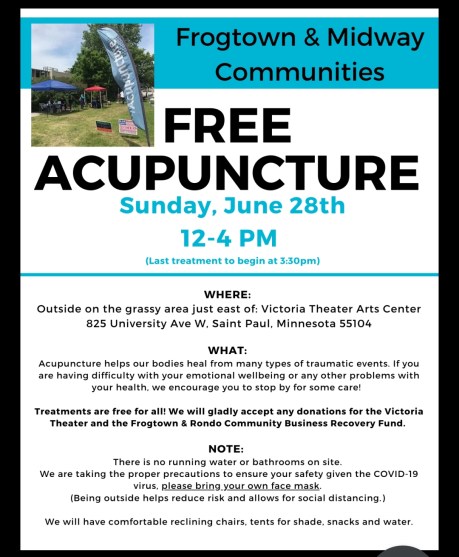
Another way, to refresh and restore your body today is with free (outdoor) acupuncture available in Saint Paul today(11 AM – 5 PM, see details here).
### NAMASTE ###
How Can We See, Dr. Wiesel? June 3, 2020
Posted by ajoyfulpractice in Uncategorized.Tags: Alexandra Stéliski, Bear McCreary, Dr. David Hubel, Dr. Gerald Edelman, Dr. Oliver Sacks, Dr. Torsten Wiesel, eyes, ocular plasticity, Pandit Rajmani Tigunait, truth, visual cortex, yoga, yoga philosophy, Yoga Sutra 2.20
4 comments
“I stopped explaining myself when I realized other people only understand from their level of perception.”
– Anonymous
“‘Every act of perception,’ Edelman writes, ‘is to some degree an act of creation, and every act of memory is to some degree an act of imagination.’”
– Dr. Oliver Sacks, quoting Dr. Gerald Edelman (co-winner of the 1927 Nobel Prize in Physiology or Medicine)
Yoga Sutra 2.20: draşțā dŗśimātrah śuddho’pi pratyayānupaśyah
– “The Seer is the pure power of seeing, yet its understanding is through the mind/intellect.” [Translation by Pandit Rajmani Tigunait (for comparative analysis), “The sheer power of seeing is the seer. It is pure, and yet it sees only what the mind shows it.”]
The beginning of today’s blog post looks like a Saturday blog post. During the Saturday practices, we’ve spent the last year and a half digging deep into the Yoga Sutras, where Patanjali outlines the 8-limb philosophy of Yoga and spends quite a bit of time talking about the mind and how the mind works. The last few weeks (and really most of the quarantine), there has been an emphasis on the “seen” and the “unseen” and how we perceive the world around us (and how the world around us based of those same perceptions). Much of what we’ve been exploring on Saturdays fits in with this week’s theme of how perception connects to ideals.
Remember, what we “see” translates into what we understand (because we can only understand what the mind shows us) and what we understand leads to what we believe, which in turn forms our ideals – and how we live is determined by what we believe. Check to make sure you got that: We live not by what we say we believe (or what we claim are our ideals and values), but by what we actually believe in our hearts. Before, however, we get into the emotional and energetic side of this – before we go deeper into the metaphor of “seeing” – let’s take a step back, and consider how we (literally) visually see.
“The eye and the brain are not like a fax machine, nor are there little people looking at the images coming in.”
– Dr. Torsten Wiesel (b. 06/03/1924), co-winner of the 1981 Nobel Prize in Physiology or Medicine
“We’re interested in how the brain works, and we work on the part of the brain that has to do with vision. And we…we record from single cells in the brain, and ask how it is you can influence those cells by shining lights and patterns.”
– Dr. David Hubel, summarizing research with Dr. Torsten Wiesel that won the 1981 Nobel Prize in Physiology or Medicine
When Dr. Torsten Wiesel, born today in 1924, started working with Dr. David Hubel in the 1950’s, they were under the impression that animals (people included) saw whole images. By connecting the brain of an anesthetized cat to electrodes which produced a sound when the receptor cells within the visual cortex were activated, they thought they could map the cat’s neural pathways. Eventually they would not only map the cells associated with the visual cortex (and determine the mechanism by which they work), they would also win the 1981 Nobel Prize in Physiology or Medicine for their research on ocular dominance columns. I say “eventually,” however, because they weren’t very successful when they started. Their basic premise was flawed, and it was by virtue of a “lucky” accident that they started making headway (pun intended). This, then, is one of those “aha” or epiphany moments I talk about all the time, where a realization occurs because someone is primed to recognize/understand what they are seeing.
“Science is not an intelligence test. Intuition is important, knowing what questions to ask. The other thing is a passion for getting to the core of the problem.”
– Dr. Torsten Wiesel, co-winner of the 1981 Nobel Prize in Physiology or Medicine
Wiesel and Hubel started off by shining bright lights at the cat, which resulted in no reaction from the electrodes, meaning no reaction from the receptor cells. They then moved on to slides of black dots. The black dots seemed to work – in that the cells fired and the electrodes engaged to produce a sound. However, the cells didn’t seem to fire consistently. When the researchers paid attention to the exact moment the cells fired, they realized the cat’s brain wasn’t reacting to the very pronounced black dot. Instead, the cells deep inside the visual cortex were reacting to the very faint line produced by the edge of the slide as it was moved in and out of the projector.
By experimenting with the placement and angle of lines (of various densities and from various sources), the scientist were able to identify and map “simple cells” and “complex cells.” Simple was the term applied to cells which reacted to lines presented at a specific angle (some cells reacting at one angle, others at another). Complex was the term applied to cells which responded to lines presented at a specific angle and moving in a specific direction. They were also able to determine which cells responded to light versus dark lines, which cells responded to bright versus dim lines, and which responded to lines of different colors and densities. All told, they expand were able to determine that the 125 million rods and cones in each retina sent information to 1 million fibers of optic nerve, which each transmitted signals to a variety of different regions in the brain. Those regions in the brain consisted of over 1 million cables of fibers which transmitted electric signals to additional regions before the signals finally reach the simple and complex cells in the visual cortex (about seven stages beyond the retina). All of this signaling and transmitting happens in the blink of an eye. (Sorry, couldn’t resist.)
As they went deeper, Weisel and Hubel discovered that if they covered one eye in kittens, preventing stimulation, the now dominate eye took over the areas of the brain (and the corresponding cells) which would normally be activated by the opposite eye. However, the cells of these kittens did not develop in the same way as kittens using both eyes. They did not develop binocular vision, which meant they did not see objects 3-dimensionally within their environment – and this lack of development was irreversible, which lead to a deeper understanding of ocular (and brain) plasticity.
“Innate mechanisms endow the visual system with highly specific connections, but visual experience early in life is necessary for their maintenance and full development. Deprivation experiments demonstrate that neural connections can be modulated by environmental influences during a critical period of postnatal development.”
– Dr. Torsten Wiesel
“We are born with this ability. So, as a newborn, open your eyes, visual system is ready to respond to the outside world.”
– Dr. Torsten Wiesel, explaining significance of research that won the 1981 Nobel Prize in Physiology or Medicine
Consider, for a moment, what you (literally and visually) saw as a child. Did you see people from different ethnicities, cultures, religions, and races? Did you see different genders and sexualities? Did you see people of different ages and socioeconomic backgrounds? Did you see people of different heights and weights? Did you see people of different abilities? How did you see these people? And, how did you come to understand these people and how they fit into your world?
These are important questions to ask ourselves, in part, because while science has shown that brains can experience quite a bit of plasticity over a lifetime, change and new neural pathways are only created when we understand what we are seeing/perceiving – and understand that what we are seeing/perceiving is different from what we have seen/perceived/understood before. Additionally, the neural pathways are only hardwired when repeated experiences reinforce the new experience. Ultimately, however, if we don’t have reinforced experiences (or we don’t understand what we are seeing/perceiving) then what is reinforced is our tunnel vision and lack of depth. Confirmation bias, the tendency to interpret new information as confirmation or proof of existing beliefs is tunnel vision and a lack of depth. It can also be a bit of hallucination.
“We see with the eyes, but we see with the brain as well. And seeing with the brain is often called imagination. And we are familiar with the landscapes of our own imagination, our inscapes. We’ve lived with them all our lives. But there are also hallucinations as well, and hallucinations are completely different. They don’t seem to be of our creation. They don’t seem to be under our control. They seem to come from the outside, and to mimic perception.”
– Dr. Oliver Sacks in a TED Talk, discussing Charles Bonnet syndrome (a condition where visually impaired people hallucinate)
“I saw people that had been incarcerated and, you know, the whole issue about the rights of people determining their own fate has always been close to my heart.”
– Dr. Torsten Wiesel, discussing his humanitarian efforts as an academic and scientist
Dr. Torsten Wiesel turns 96 today. His career as a scientist, a researcher, and an academic allowed him to be exposed to people from all over the world. And, it seems, he always kept his eyes open. He served as chair of the Committee of Human Rights of the National Academies of Science in the US, as well as the International Human Rights Network of Academies and Scholarly Societies for 10 years. He is a founding member of the Israeli-Palestinian Science Organization, a nongovernmental nonprofit established in 2004 to support collaborative research between scientists in Israel and Palestine. In addition to his many scientific awards and accolades, he was awarded the 2005 David Rall Medal from the Institute of Medicine and the 2009 Grand Cordon Order of the Rising Sun Medal (in Japan).
Please join me today (Wednesday, June 3rd) at 4:30 PM or 7:15 PM for a practice that’s as much about the brain as it is about the body and the heart. Use the link from the “Class Schedules” calendar if you run into any problems checking into the class. You will need to register for the 7:15 PM class if you have not already done so. Give yourself extra time to log in if you have not upgraded to Zoom 5.0. You can request an audio recording of this practice via a comment below.
Wednesday’s playlist is available on YouTube and Spotify.
“For me ‘plus tôt’ is a piece that talks about the sort of space and time that you’re in before things happen to you. The sort of calm you can feel when you don’t know that some events are about to change you. It’s the beginning of the trip. It’s the beginning of the inscape.”
– Alexandra Stéliski explaining the inspiration for the first piece on her album Inscape (the song title translates to “earlier”)
(NOTE: Some blog quotes by Drs. Wiesel and Hubel are from a short biography produced by National Science & Technology Medals Foundation when Dr. Wiesel was awarded the 2005 National Medal of Science.)
### I CAN SEE YOU. CAN YOU SEE ME? ###
Noticing Things (on June 2nd) June 2, 2020
Posted by ajoyfulpractice in Uncategorized.Tags: Afterwards, destiny, future, inspiration, Jeremy Irons, Jon Lord, Jude the Obscure, meditation, Thomas Hardy, will and determination, yoga
2 comments
“And will any say when my bell of quittance is heard in the gloom,
And a crossing breeze cuts a pause in its outrollings,
Till they rise again, as they were a new bell’s boom,
“He hears it not now, but used to notice such things?”
– from the poem “Afterwards” by Thomas Hardy, set to music by Lon Lord
Born today (June 2nd) in 1840, Thomas Hardy was an architect who is remembered as a novelist and a poet who noticed things. I know, I know, writers notice things – that’s part of their job description. But Hardy also noticed what he (and others) noticed. He noticed the art or practice of noticing. Take a moment to notice what you notice. Bring awareness to your awareness.
You can jump over to the April 19th “Noticing Things” post or do that “90-second thing” right here. Either way, pause, just for a moment and notice without the story or the extra dialogue that springs to mind. Or, notice the extra dialogue that inevitably springs to mind.
As I mentioned yesterday, this week is about perception and ideals. Start to notice what you notice, but also notice what you make important. When you notice what sticks in your heart and in your mind, you will start to notice the origins of your words and deeds. You will start to notice the kind of person you are telling the world you are and aim to be.
“‘It is a difficult question, my friends, for any young man– that question I had to grapple with, and which thousands are weighing at the present moment in these uprising times– whether to follow uncritically the track he finds himself in, without considering his aptness for it, or to consider what his aptness or bent may be, and re-shape his course accordingly. I tried to do the latter, and I failed. But I don’t admit that my failure proved my view to be a wrong one, or that my success would have made it a right one; though that’s how we appraise such attempts nowadays–I mean, not by their essential soundness, but by their accidental outcomes.’”
– from Jude the Obscure by Thomas Hardy
“‘Remember that the best and greatest among mankind are those who do themselves no worldly good. Every successful man is more or less a selfish man. The devoted fail…’”
– from Jude the Obscure by Thomas Hardy
Hardy wrote about sex, religion, marriage, class, education, morality, and where all six themes intersected with each other as well as with a person’s individual will as it intersected with universal will (or a single other person’s will), what he called “Immanent Will.” He wrote about being alive, being dead, and about ghosts and spirits. He also wrote, in letters, about race and the impact different cultures could have on society. He noticed things… and made some of those things important.
Please join me today (Tuesday, June 2nd) at 12 Noon or 7:15 PM for a practice of noticing things, virtually. Use the link from the “Class Schedules” calendar if you run into any problems checking into the class. Give yourself extra time to log in if you have not upgraded to Zoom 5.0. You can request an audio recording of this practice via a comment below.
Tuesday’s playlist is available on YouTube and Spotify. (NOTE: This is the playlist titled “04192020 Noticing Things.” We are using the first half of the playlist.)
“‘I had a neat stock of fixed opinions, but they dropped away one by one; and the further I get the less sure I am. I doubt if I have anything more for my present rule of life than following inclinations which do me and nobody else any harm, and actually give pleasure to those I love best. There, gentlemen, since you wanted to know how I was getting on, I have told you. Much good may it do you! I cannot explain further here. I perceive there is something wrong somewhere in our social formulas: what it is can only be discovered by men or women with greater insight than mine–if, indeed, they ever discover it– at least in our time. ‘For who knoweth what is good for man in this life?–and who can tell a man what shall be after him under the sun?’”
– from Jude the Obscure by Thomas Hardy

